Battery Burns, Button-Cell Injury, Foreign Bodies, Heavy Metals, and Thermal Hazards
Are Batteries Poisonous to Dogs, Cats, and Other Animals?
Yes. A chewed, punctured, swallowed, leaking, hot, smoking, or missing battery is an urgent veterinary concern. The danger is not one universal substance called "battery acid." Different batteries can cause rapid electrochemical burns, alkaline or acidic chemical burns, pressure injury, esophageal or intestinal obstruction, perforation, thermal burns, smoke exposure, and in selected products, toxic-metal exposure.
Button and coin cells deserve exceptional urgency because a battery trapped against moist tissue can generate hydroxide at its negative pole and create a severe local alkaline burn even when the case has not visibly leaked. Experimental work has documented deep esophageal injury after very short contact, and a canine case report described fatal intestinal perforation after disk batteries remained in the gastrointestinal tract.
Cylindrical alkaline batteries, rectangular 9-volt batteries, rechargeable cells, and lead-acid batteries create different combinations of caustic material and foreign-body risk. A pet can have serious mouth or esophageal injury while still acting relatively normal, so the absence of immediate vomiting or collapse does not make an uncertain battery exposure safe to watch at home.
About this guide: This page provides general pet-poisoning information and cannot diagnose or treat an individual animal. For any suspected exposure, contact a veterinarian or animal poison-control service immediately. Do not induce vomiting, give medication, or attempt home decontamination unless directed by a veterinary professional.
Agent and Exposure Profile
Quick Reference
Battery Types, Components, and Hazards
Batteries are manufactured systems rather than a single poison. The clinically important hazard depends on the battery's shape, voltage, chemistry, state of charge, degree of damage, location in the body, and length of tissue contact. An intact battery in the stomach is not equivalent to a coin cell lodged in the esophagus, and a chewed lead-acid battery is not equivalent to a punctured alkaline AA cell.
Button and coin cells
Small disk-shaped batteries include silver-oxide, alkaline manganese, zinc-air, and lithium coin cells. Common label codes include CR, BR, LR, SR, PR, and product-specific equivalents. Their most dangerous local effect can occur without leakage: contact with moist tissue completes an electrical circuit, water is split, and hydroxide accumulates next to the negative pole. The resulting alkaline environment can rapidly destroy mucosa and deeper tissue.
Three-volt lithium coin cells are often wider and produce a stronger electrical injury than many smaller 1.5-volt button cells. Their flat profile allows them to sit against the same tissue surface, while their diameter may permit impaction in the esophagus or at a narrowed intestinal segment. A discharged battery may retain enough voltage to injure tissue and remains a foreign body even when it no longer powers a device.
Alkaline and zinc-carbon household batteries
AA, AAA, C, D, and 9-volt batteries commonly contain alkaline electrolyte such as potassium hydroxide or sodium hydroxide, or an electrolyte system used in zinc-carbon construction. Chewing can expose caustic material that burns the lips, tongue, gingiva, esophagus, stomach, skin, or eyes. The metal casing, separator, carbon components, and internal paste can also become sharp or obstructive foreign material.
Zinc and manganese compounds are present in many dry cells, but the immediate veterinary problem after chewing is usually the combination of caustic injury and swallowed debris rather than a predictable systemic metal syndrome. The exact product still matters because rechargeable and specialty cells may contain different metals and electrolytes.
Lead-acid batteries
Vehicle, motorcycle, lawn-equipment, marine, alarm, emergency-lighting, and uninterruptible-power-supply batteries may contain sulfuric acid and lead-containing plates or paste. Chewing or breaking one creates severe local corrosive exposure, while ingestion of lead-bearing material introduces a separate risk of delayed gastrointestinal, neurologic, hematologic, and renal toxicity. An apparently small amount of dark internal plate material should not be dismissed as ordinary plastic debris.
Rechargeable lithium-ion, nickel-metal hydride, and nickel-cadmium products
Phone, laptop, camera, power-tool, vacuum, bicycle, scooter, power-bank, and hobby batteries may be single cells or multi-cell packs with protective circuits. Crushing, puncturing, short-circuiting, overheating, or charging damage can cause leakage, fire, thermal runaway, hot gas, and smoke in addition to chemical burns and foreign-body injury. Nickel-cadmium cells add a potential cadmium concern, but product-specific composition and the amount actually released determine systemic risk.
Systemic lithium poisoning from swallowing a battery is not automatically the same as poisoning from a soluble prescription lithium salt. For coin cells, the dominant early danger is usually focal electrochemical injury and impaction. For damaged lithium-ion packs, thermal, chemical, inhalational, and foreign-body hazards may dominate.
Where Batteries May Be Found
Batteries are present in far more products than remote controls and flashlights. A missing battery may come from a device that an owner did not realize contained a replaceable cell, and small housings can be destroyed before anyone notices the source.
- Remote controls, key fobs, garage-door openers, trackers, scales, calculators, thermometers, watches, clocks, cameras, hearing devices, and electronic collars
- Toys, talking books, musical cards, light-up decorations, holiday ornaments, flameless candles, laser pointers, small LED lights, and novelty items
- Bathroom scales, glucose meters, pulse devices, medical alert equipment, and other home health electronics
- Phones, tablets, laptops, headphones, power banks, chargers, cordless tools, robotic vacuums, and removable rechargeable packs
- Vehicles, motorcycles, lawn equipment, boats, backup power units, alarms, emergency lighting, solar systems, and farm equipment
- Loose batteries stored in drawers, purses, toolboxes, luggage, junk containers, recycling bins, trash, workshops, garages, barns, and maintenance rooms
Search for markings on the battery or device, including voltage, chemistry abbreviations, model numbers, and size codes. For coin cells, a code such as CR2032 describes chemistry and dimensions; for household cells, identify alkaline, lithium, zinc-carbon, nickel-metal hydride, or nickel-cadmium labeling when possible. Do not scrub or discard damaged fragments before the veterinarian has enough information to identify them.
If the battery cannot be found, preserve the empty compartment and compare it with an identical device, manual, manufacturer label, or retail package. A photograph of the compartment and the type of battery used can be as important as estimating how much material was swallowed.
Exposure Scenarios and Risk Factors
Chewed remotes, toys, and household devices
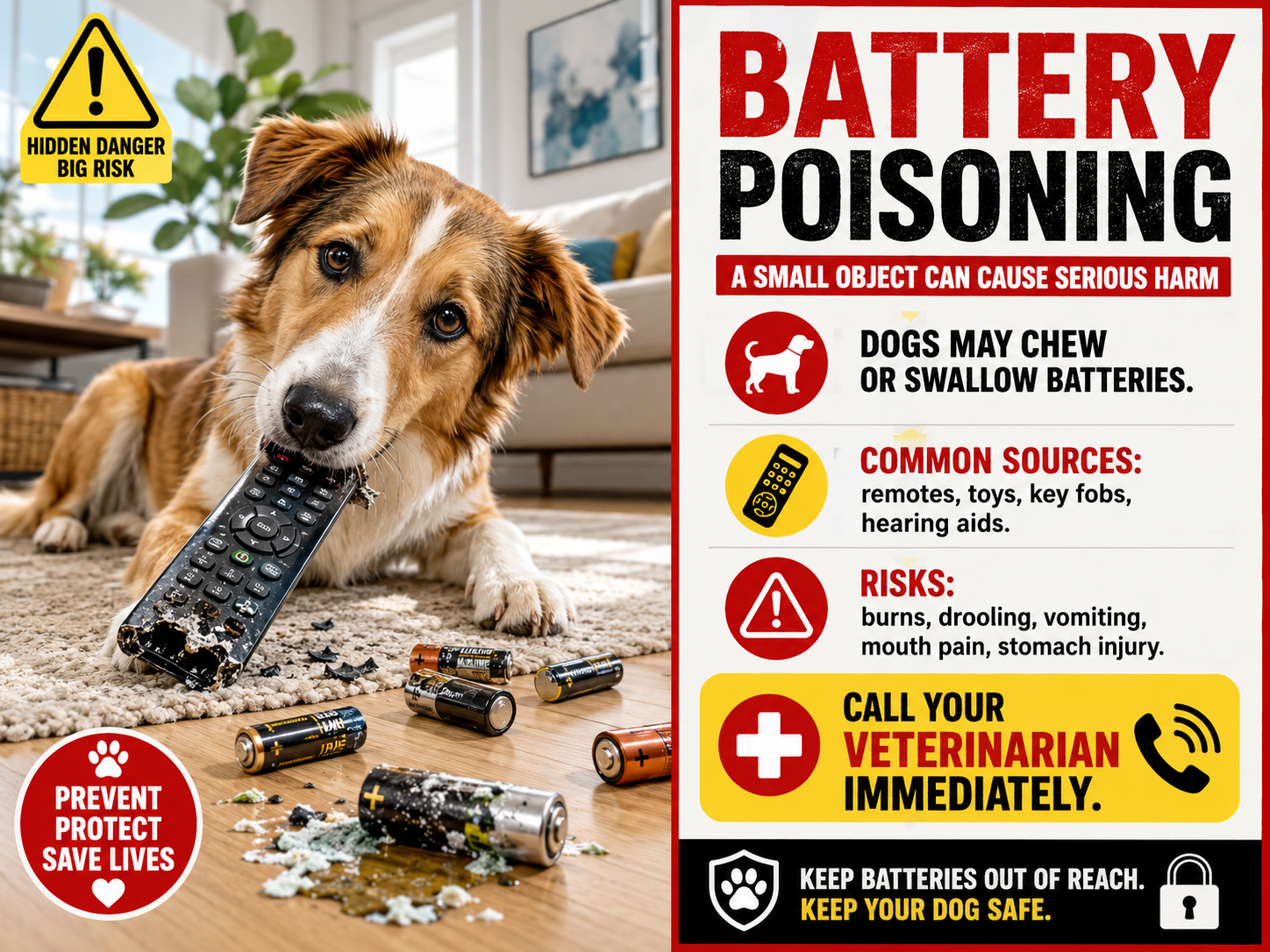
Dogs commonly reach batteries by crushing a remote control, children's toy, electronic collar component, flashlight, key fob, or decorative device. The battery may be punctured in the mouth, swallowed whole, broken into several pieces, or carried away. Saliva can spread alkaline material across the lips, gums, tongue, palate, and fur before obvious ulceration develops.
A household may find the broken device but not the battery. That uncertainty is itself important because a coin cell can be hidden under furniture, swallowed by another pet, or lodged without immediate signs. Counting the remaining batteries and separating every animal with access can help reconstruct the event, but it should not delay radiographs when ingestion is possible.
Button cells swallowed without chewing
Coin and button cells may be swallowed intact after falling from a scale, key fob, hearing device, thermometer, toy, light, or greeting card. The smooth casing may show little external damage while the battery is actively injuring tissue. The risk is highest when the cell remains pressed against the esophagus or another mucosal surface, but gastric and intestinal injury can also occur.
Garage, workshop, farm, and kennel exposures
Discarded lead-acid batteries, damaged equipment batteries, loose cells, recycling containers, and charging areas create risk for dogs, barn cats, horses, goats, cattle, pigs, and other animals. Large animals may mouth or step on broken battery material, while dogs may carry fragments away from a work area. Acid or alkaline liquid can contaminate paws, coats, muzzles, feed areas, or water containers.
Small mammals, birds, and reptiles
Rabbits, ferrets, rodents, birds, and reptiles may chew small electronics, exposed wires, battery wrappers, or device housings. Their smaller gastrointestinal diameter makes even a small cell or fragment more likely to obstruct, and rabbits cannot vomit. Birds may sustain beak, tongue, crop, or gastrointestinal injury, while reptiles may show little outward illness until disease is advanced.
The veterinary literature is much deeper for people and dogs than for many exotic species. That evidence gap should not be mistaken for safety. When a small animal has credible access to a battery, the chemistry, size, radiographic location, and clinical examination matter more than the absence of a species-specific toxic-dose chart.
Hot, smoking, ruptured, or burning rechargeable packs
A damaged lithium-ion cell can overheat or ignite after puncture, crushing, charging failure, or an internal short circuit. The animal may have oral or skin burns, eye contamination, smoke exposure, and inhalation injury in addition to swallowed fragments. Human safety comes first when a battery is actively burning or producing dense smoke; move the animal only when it can be done without entering an unsafe fire or electrical environment.
Battery Exposure Symptoms and Clinical Progression
Early mouth and throat injury
Initial signs may include sudden drooling, lip licking, pawing at the mouth, reluctance to eat, crying when chewing, foul odor, visible battery paste, red or gray oral tissue, blisters, ulcers, tongue swelling, or blood-tinged saliva. Burns can continue to evolve after the battery or residue has been removed, so a normal-looking mouth immediately after exposure does not exclude deeper injury.
Esophageal involvement may cause repeated swallowing, gagging, retching, regurgitation, dysphagia, neck extension, neck pain, coughing, or refusal of water. A battery lodged in the esophagus may produce surprisingly few signs at first. Experimental canine work with lithium coin cells showed deep necrosis after brief contact, including extension toward adjacent structures as exposure continued.
Stomach and intestinal injury
Vomiting, loss of appetite, abdominal pain, lethargy, hematemesis, dark stool, fresh blood in stool, diarrhea, straining, or failure to pass stool may reflect chemical injury, ulceration, obstruction, or perforation. A battery that has moved beyond the stomach is not automatically harmless. Disk batteries have caused full-thickness intestinal necrosis and perforation in a dog.
Perforation can lead to fever, worsening abdominal pain, a tense abdomen, profound weakness, pale gums, rapid heart rate, shock, septic peritonitis, and collapse. Esophageal perforation may produce fever, severe chest or neck pain, breathing difficulty, fluid or air around the lungs, or air under the skin. These complications may appear after an earlier period of mild or improving signs.
Eye, skin, respiratory, and thermal injury
Leaking electrolyte on the skin can cause redness, pain, hair loss, ulceration, or progressive tissue damage. Ocular contamination may cause squinting, tearing, corneal injury, cloudiness, and vision-threatening burns. Hot cells and burning packs can create thermal burns that are deeper than the surface initially suggests.
Smoke or hot-gas exposure may cause coughing, noisy breathing, rapid breathing, increased respiratory effort, weakness, soot around the face, or delayed pulmonary injury. Any respiratory sign after a battery fire or rupture requires urgent assessment even when the animal was removed quickly.
Delayed systemic toxicity
Lead-bearing battery material can produce delayed vomiting, abdominal discomfort, constipation or diarrhea, appetite loss, behavior change, tremors, seizures, blindness, weakness, anemia, and kidney abnormalities. The timing and pattern depend on the amount and form of lead ingested, whether fragments remain in the gastrointestinal tract, and the animal's size and health.
Other battery metals may be relevant in damaged specialty cells, but there is no single syndrome that applies to every product. Veterinarians should use the actual battery chemistry, exposure history, imaging, laboratory trends, and clinical progression rather than assume that all batteries create identical systemic poisoning.
First Aid for Suspected Battery Exposure
- Remove access to the device, loose batteries, fragments, contaminated bedding, and other animals without placing your hand into a painful or biting mouth.
- Call a veterinarian or veterinary emergency service immediately when a battery was swallowed, is missing, was punctured, leaked, became hot, smoked, or may be lodged.
- Preserve the device, battery package, model numbers, loose fragments, photographs, matching batteries, and the earliest and latest possible exposure times.
- Do not induce vomiting. A battery or sharp fragment can burn or injure the esophagus again on the way up, and a caustic-exposed animal may aspirate.
- Do not give activated charcoal. Charcoal does not neutralize a battery's electrical, caustic, or foreign-body hazards and can complicate endoscopy or aspiration risk.
- Do not attempt chemical neutralization with vinegar, baking soda, antacids, or other household products. Product chemistry and tissue location are uncertain, and neutralization can add heat or delay definitive removal.
- For visible skin or eye contamination, begin gentle continuous flushing with clean lukewarm water while another person contacts the veterinarian, provided the battery is no longer electrically or thermally hazardous.
- Do not handle a hot, smoking, ruptured, or burning rechargeable cell with bare hands. Avoid smoke, prevent human exposure, and use emergency fire services when the scene is unsafe.
Oral contamination
If the animal is alert, breathing normally, and can swallow without gagging, visible residue at the front of the mouth may be gently rinsed away with water. Do not force water into the mouth, probe deep tissue, scrape adherent material, or delay transport for prolonged home cleaning. A painful animal may bite, and deeper esophageal injury cannot be treated by rinsing the lips or tongue.
Do not offer food, bulky material, or large volumes of liquid when the animal is drooling, gagging, regurgitating, struggling to swallow, depressed, or likely to need sedation and endoscopy. The veterinary team may give product-specific instructions based on the battery location and the animal's airway status.
Transport and evidence preservation
Transport the animal in a secure carrier or vehicle area where regurgitated material can be observed. Keep the head and neck in a comfortable neutral position and avoid pressure on a painful abdomen. Bring the damaged device and battery information in a sealed secondary container, but do not place a leaking or hot cell in a pocket or enclosed container that could worsen heating.
If more than one pet had access, separate them and identify each animal's weight, signs, and possible exposure. A normal-appearing pet may still need imaging when a battery is missing. Do not assign all missing fragments to the animal that looks sickest.
Battery Toxicology and Injury Mechanisms
Electrochemical hydroxide generation
Button-battery injury is often misunderstood as simple leakage. When a battery bridges moist tissue, current flows through the tissue fluid. At the negative pole, electrolysis generates hydroxide and drives the local pH sharply upward, creating an alkaline burn. The battery may remain externally intact while tissue under one surface is undergoing progressive necrosis.
The severity depends on voltage, battery diameter, orientation, remaining charge, tissue contact, and duration. Larger 3-volt lithium coin cells are especially concerning because they can lodge and maintain broad contact. Experimental canine and porcine models have shown injury beginning rapidly and extending through deeper layers with time.
Direct caustic exposure from damaged cells
Chewed alkaline batteries can release potassium- or sodium-hydroxide-containing material. Strong alkali causes liquefactive necrosis, saponifies tissue fats, disrupts proteins, and can penetrate beyond the visibly damaged surface. Tissue may initially look pale, gray, or dark and then ulcerate or slough.
Lead-acid batteries can release sulfuric acid, producing a different corrosive pattern. The distinction does not create a safe home-treatment rule. Both acid and alkali exposures can severely damage the mouth, esophagus, stomach, skin, and eyes, and mixed battery debris makes the actual chemistry difficult to judge outside a controlled evaluation.
Pressure, obstruction, and perforation
A battery is also a physical foreign body. A disk cell can remain pressed against one point, while cylindrical cells and pack fragments can obstruct or abrade the gastrointestinal tract. Sharp casing edges may lacerate tissue. Local pressure, electrical injury, caustic exposure, and impaired blood flow can act together, causing full-thickness necrosis and delayed perforation.
Thermal and inhalational injury
Rechargeable lithium-ion cells store substantial energy. Internal short circuits, crushing, puncture, overcharging, or heat can trigger rapid temperature rise, venting, fire, and thermal runaway. The animal may be injured by hot casing, flame, hot electrolyte, gases, or smoke. These are not adequately described by the word "poisoning" alone.
Systemic metals and evidence boundaries
Lead from lead-acid battery plates or paste can be absorbed after ingestion, especially when material remains in the gastrointestinal tract. Lead disrupts multiple enzyme systems and can affect the nervous system, gastrointestinal tract, blood formation, and kidneys. Removal of retained lead-bearing fragments may be important in addition to medical management.
Zinc, manganese, nickel, cadmium, cobalt, lithium compounds, and other materials may be present in specialty cells, but casing composition and bioavailability vary. Systemic toxicity should be assessed product by product. The strongest veterinary evidence for ordinary household-battery emergencies concerns local caustic injury, button-cell electrochemical burns, and foreign-body complications rather than a universal blood-metal pattern.
Clinical Management
Veterinary Care and Prognosis
Veterinary Diagnosis and Treatment
Emergency triage and airway protection
The veterinary team first evaluates breathing, circulation, pain, mental status, swallowing, and evidence of oral, esophageal, abdominal, ocular, dermal, or thermal injury. Severe tongue or throat swelling, regurgitation, respiratory distress, or depressed consciousness may require oxygen, suction, airway protection, and careful preparation for anesthesia. Pain control is important, but medications must be selected around hydration, kidney status, gastrointestinal injury, and planned procedures.
Imaging and battery localization
Radiographs of the neck, chest, and abdomen may be needed because a radiopaque battery can lodge anywhere from the pharynx to the colon. More than one view helps distinguish location and orientation. Button cells may show a double-rim or step-off appearance, but radiographic interpretation should not delay removal of an obvious esophageal battery.
Imaging also looks for multiple batteries, casing fragments, obstruction, free gas, aspiration, pleural abnormalities, or perforation. Serial radiographs may be appropriate when a battery has moved beyond immediate endoscopic reach, but observation is a veterinary decision based on size, chemistry, location, movement, symptoms, and evidence of tissue damage.
Endoscopic or surgical removal
A battery lodged in the esophagus is an emergency because tissue injury can progress rapidly. Endoscopy permits removal and direct assessment of mucosal damage when the patient is stable enough for anesthesia. Gastric batteries may also require prompt retrieval when they are large, damaged, symptomatic, retained, accompanied by other foreign material, or judged likely to injure tissue.
Surgery may be required for perforation, obstruction, batteries beyond endoscopic reach that are not progressing safely, or full-thickness intestinal injury. The canine disk-battery perforation literature shows why passage into the lower gastrointestinal tract cannot be treated as proof that danger has ended.
Decontamination and local injury care
Professionally induced vomiting is generally avoided when caustic exposure, sharp battery fragments, esophageal injury, impaired swallowing, or aspiration risk is possible. Activated charcoal does not bind the principal electrical and corrosive hazards. Veterinary lavage or irrigation decisions depend on anatomic location and airway protection rather than a universal battery protocol.
Skin and eye contamination require copious irrigation and repeated assessment. Oral and esophageal burns may require analgesia, antiemetic therapy, acid suppression when indicated, mucosal protection, nutritional planning, and monitoring for aspiration or perforation. Severe oral injury may make feeding painful or unsafe, and temporary assisted nutrition may be needed.
Laboratory evaluation and systemic toxicants
Baseline and follow-up testing may include a complete blood count, chemistry panel, electrolytes, urinalysis, acid-base assessment, and tests directed by the battery chemistry. Credible lead-acid battery exposure may justify blood lead testing and evaluation for retained radiopaque material. Other metal testing should be selected from the product history rather than ordered as a generic battery panel.
Animals with vomiting, shock, burns, or perforation may need intravenous crystalloids, electrolyte correction, blood-pressure support, antiemetics, antibiotics when infection or perforation warrants them, and intensive monitoring. Persistent hypotension despite appropriate fluid resuscitation may require vasopressor support. Respiratory injury may require oxygen, airway management, and imaging or blood-gas monitoring.
Monitoring after removal
Removing the battery ends ongoing contact but does not instantly reverse established necrosis. Serial examinations, imaging, endoscopy, laboratory testing, and nutritional monitoring may be needed. Esophageal strictures, perforation, fistula formation, aspiration pneumonia, peritonitis, delayed bleeding, and wound slough can develop after the initial emergency has passed.
Prognosis, Recovery, and Follow-Up
Prognosis is generally favorable when a battery is identified quickly, removed before prolonged tissue contact, and no substantial burn, obstruction, perforation, thermal injury, or systemic metal exposure has occurred. A pet that merely mouthed an intact battery may recover without complication after examination confirms that the casing is undamaged and no battery is missing.
Prognosis becomes more guarded when a button cell is lodged, the battery was punctured, oral or esophageal burns are present, the exposure time is unknown, multiple batteries are involved, or the patient has regurgitation, respiratory signs, gastrointestinal bleeding, obstruction, or shock. Full-thickness necrosis and perforation are life-threatening even after the battery has moved or been removed.
Esophageal injury can lead to delayed narrowing that interferes with swallowing days to weeks later. Owners should report renewed regurgitation, slow eating, difficulty swallowing, weight loss, coughing after drinking, fever, abdominal pain, vomiting, dark stool, or reduced appetite during recovery. A temporary improvement does not cancel scheduled rechecks.
Lead-bearing material can require longer follow-up because systemic effects may be delayed and retained fragments can prolong exposure. Serial blood tests, imaging, neurologic assessment, and treatment response may influence prognosis. Exotic species and very small patients may have a more guarded outlook because obstruction, blood loss, dehydration, and nutritional interruption become serious quickly.
Preventing Battery Injuries and Poisoning
Secure every battery compartment
Use devices with screw-secured or tool-required battery compartments whenever possible, especially for coin cells. Replace cracked covers, missing screws, loose clips, swollen packs, and damaged housings rather than relying on tape alone. Check toys, remotes, scales, key fobs, lights, decorations, and hearing devices after drops or chewing.
Store loose and used batteries as hazardous small objects
Keep new, used, and supposedly dead batteries in rigid closed containers inside latched cabinets. Do not leave them in purses, bowls, junk drawers, tool trays, countertops, bedside tables, or open recycling bins. Store coin cells separately from food, medication, and pet supplies.
Cover battery terminals according to local recycling guidance and take damaged, swollen, leaking, or recalled rechargeable batteries to an appropriate collection program. Do not place a hot or unstable lithium-ion battery into ordinary household trash or a closed indoor container.
Create protected charging and work areas
Charge phones, tools, power banks, bicycles, vacuums, and battery packs in an area pets cannot enter. Retire chewed cords, cracked packs, swollen cells, and devices that become unusually hot. Garages, barns, maintenance rooms, and kennel utility areas should keep vehicle and equipment batteries behind physical barriers.
Account for batteries immediately
When a device breaks, find every battery and fragment before allowing animals back into the area. In homes with multiple pets, separate animals until the battery count is confirmed. Do not assume the pet holding the plastic shell is the only animal that had access.
Plan for visitors, children, and seasonal items
Musical cards, holiday lights, ornaments, novelty toys, flameless candles, luggage scales, and guest electronics can introduce unfamiliar batteries into a pet area. Include battery checks in holiday cleanup, boarding intake, daycare room inspection, travel packing, and childproofing routines. A brief inventory is easier than reconstructing a missing coin cell after exposure.
Battery Poisoning FAQ
My dog only licked a chewed battery. Is that still an emergency?
Yes, it warrants prompt veterinary direction because a brief lick can transfer caustic material to the tongue and gums, and the battery may have been punctured before you saw it. Rinse only as safely directed, preserve the battery, and have the mouth evaluated. The visible surface can underestimate deeper or developing injury.
The battery is missing, but my pet looks normal. Can I wait?
No. A swallowed battery can lodge or injure tissue before obvious symptoms appear. The practical next step is to identify the likely battery type and obtain veterinary assessment, often including radiographs. Waiting for vomiting, pain, or blood can allow preventable injury to progress.
Is a dead battery safe because it has no charge left?
No. A used battery may retain enough voltage for electrochemical injury, may leak caustic material, and remains a foreign body. Owners cannot reliably determine remaining voltage or casing integrity by whether the device stopped working.
Are button batteries and coin batteries the same thing?
The terms overlap in everyday use, but coin cells are often wider lithium cells while button cells may be smaller alkaline, silver-oxide, or zinc-air products. Both can be hazardous. Size, voltage, chemistry, and location matter more than the casual name.
Do all batteries contain acid?
No. Many common household batteries contain alkaline electrolyte, while lead-acid vehicle batteries contain sulfuric acid. Button-cell injury may be driven mainly by electrical generation of hydroxide against tissue rather than visible leakage. Treating every battery as identical "battery acid" can lead to unsafe assumptions.
My pet vomited the battery back up. Is the danger over?
No. The battery may have burned the mouth or esophagus, fragments may remain, and vomiting can itself expose tissue again. Preserve the battery and vomited fragments and seek veterinary assessment. Do not reinsert pieces into a damaged device or discard them before identification.
I saw a battery in the stool. Does that prove there is no injury?
No. Passage confirms that one object exited, but it does not show whether tissue was burned, whether the casing leaked, or whether another battery or fragment remains. Report the battery's condition and any vomiting, appetite change, blood, pain, or swallowing difficulty to the veterinarian.
Should I give milk, bread, water, or food to dilute the battery material?
Do not improvise oral treatment. A pet with swallowing injury may aspirate, and food can complicate anesthesia or endoscopy. A veterinarian may recommend limited rinsing or another product-specific step, but the decision depends on airway status, battery type, and location.
Why should I not induce vomiting?
Vomiting can drag a battery or sharp casing back through the esophagus, repeat caustic exposure, and increase aspiration risk. Button cells and large batteries may also lodge during return. Removal decisions should be made with imaging and airway protection.
Human websites sometimes mention honey after button-battery ingestion. Should I give it to my pet?
No, not unless a veterinarian who is managing the case gives that instruction. Human pediatric protocols are built around specific ages, swallowing ability, timing, and rapid hospital removal. They cannot be transferred mechanically to dogs, cats, birds, rabbits, reptiles, or other animals, and honey is not a substitute for localization and removal.
Can an X-ray identify the type of battery?
Radiographs can usually locate a radiopaque battery and may suggest a button-cell shape, casing fragments, or more than one object. They do not always identify exact chemistry or show the full depth of tissue injury. The device, package, and matching battery remain important.
When is endoscopy used instead of surgery?
Endoscopy is often used for batteries in the esophagus or stomach when they can be reached safely and the patient can undergo anesthesia. Surgery may be needed for perforation, obstruction, inaccessible batteries, retained objects that are not progressing, or full-thickness intestinal injury. The location alone does not decide the procedure.
Why can blood tests be normal even when the battery is dangerous?
Early electrochemical and caustic burns are local tissue injuries and may not immediately change routine bloodwork. Imaging and endoscopy can reveal hazards that a chemistry panel cannot. Repeat testing becomes important when bleeding, infection, dehydration, kidney injury, or systemic metal exposure develops.
Is chewing a car battery mainly an acid-burn problem?
It can cause severe acid burns, but lead-containing internal material creates a separate systemic toxicology concern. The veterinarian may need to evaluate retained fragments and blood lead exposure in addition to treating corrosive injury. Bring information about the battery type and age.
What is different about a punctured lithium-ion battery pack?
A damaged rechargeable pack may leak, become extremely hot, vent gas, ignite, or expose multiple cell components. The emergency can include chemical, thermal, inhalational, electrical, and foreign-body injury. Scene safety and fire risk may be as urgent as ingestion.
What should I do when several pets could have swallowed the battery?
Separate them, count all batteries and fragments, document each animal's weight and signs, and tell the veterinarian that exposure cannot be assigned to one pet. More than one animal may need imaging. Do not rely on which pet was nearest the broken device.
Are rabbits, birds, ferrets, and reptiles less vulnerable than dogs?
No safe generalization is justified. Their exposure patterns and anatomy differ, and the published veterinary evidence is limited. Small body size, narrow gastrointestinal diameter, inability to vomit in rabbits, and delayed recognition of illness can increase practical risk.
What delayed problems can appear after the battery is removed?
Established tissue necrosis can continue to declare itself after removal. Possible complications include oral sloughing, esophageal stricture, perforation, fistula, aspiration pneumonia, gastrointestinal bleeding, peritonitis, infection, poor intake, and delayed effects from lead-bearing material. Keep every recommended recheck even when the animal initially improves.