Borate, Borax, and Boric Acid Poisoning in Animals
Are Borates and Boric Acid Poisonous to Dogs, Cats, Horses, and Livestock?
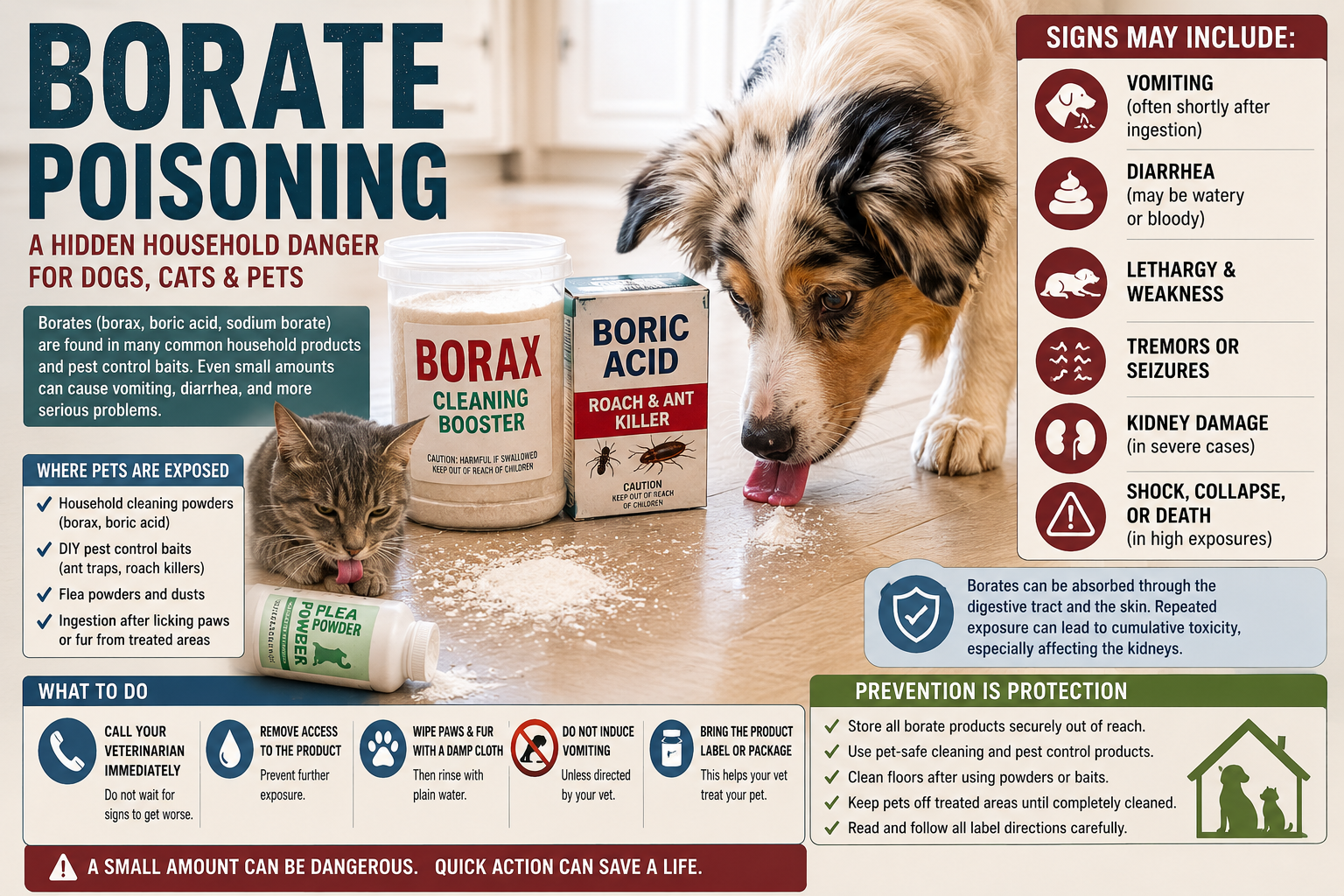
Yes. Boric acid, borax, sodium borates, and concentrated boron-containing products can poison animals when enough is swallowed, inhaled, or absorbed through damaged skin. Most limited companion-animal ingestions produce vomiting, drooling, abdominal discomfort, diarrhea, depression, or reduced appetite, but large or concentrated exposures can cause profound weakness, fasciculations, tremors, seizures, dehydration, kidney injury, collapse, and death.
Borate exposure is often underestimated because these compounds are described as natural minerals or lower-toxicity pesticides. Correctly placed enclosed ant or roach bait is different from an animal consuming an open pile of boric acid powder, a box of borax laundry booster, concentrated slime activator, pool or spa chemical, boron fertilizer, wood-treatment product, or contaminated livestock feed. The amount, concentration, formulation, route, patient size, kidney function, and co-ingredients determine the risk.
Boric acid and borate salts are not the same as elemental boron, boron carbide, or every compound whose name contains “boron.” Borax usually refers to sodium tetraborate decahydrate, while other labels may list sodium borate, disodium tetraborate, sodium tetraborate pentahydrate, boric acid, orthoboric acid, boron fertilizer, or borate buffer. Exact product identification is essential because detergents, oxidizers, insecticides, solvents, sweeteners, and other ingredients may create additional hazards.
About this guide: This page provides general pet-poisoning information and cannot diagnose or treat an individual animal. For any suspected exposure, contact a veterinarian or animal poison-control service immediately. Do not induce vomiting, give medication, or attempt home decontamination unless directed by a veterinary professional.
Agent and Exposure Profile
Quick Reference
Borate Identity, Chemical Forms, and Product Recognition
Boric Acid
Boric acid, also called orthoboric acid, has the formula H3BO3. It is a weak Lewis acid rather than a strongly dissociating mineral acid. In water and physiologic fluids, boric acid and borate species exist in an equilibrium influenced by pH and concentration. The label may list boric acid as an insecticide, preservative, buffer, antiseptic ingredient, industrial chemical, or laboratory reagent.
Borax and Sodium Borates
Borax commonly refers to sodium tetraborate decahydrate. Related names include sodium borate, disodium tetraborate, sodium tetraborate pentahydrate, sodium metaborate, and anhydrous borax. These salts can convert to boric acid or borate ions in solution and should not be assumed harmless because they are sold as laundry, craft, cleaning, or pest-control products.
Boron Fertilizers
Plants require small amounts of boron, but concentrated fertilizer can poison animals. Fertilizer products may contain borax, boric acid, sodium borate, sodium octaborate tetrahydrate, or other boron sources. Accidental contamination of feed or unrestricted livestock access can produce rapid herd-level illness and death.
Sodium Perborate and Oxidizing Bleaches
Sodium perborate is an oxidizing boron compound historically used in laundry bleaches, cleaners, and some dental products. In water it can release hydrogen peroxide. Its hazard therefore includes both borate exposure and oxidizing or caustic effects, and it should not be evaluated as though it were plain borax.
Borate Buffers and Contact-Lens Products
Boric acid and sodium borates may be used as buffering agents in eye-care, contact-lens, cosmetic, laboratory, or pharmaceutical products. Concentrations are usually much lower than bulk powder, but the finished product may contain preservatives, surfactants, disinfectants, alcohols, or other ingredients that alter the clinical problem.
Elemental Boron and Other Boron Compounds
Elemental boron, boron carbide, boron nitride, organoboron compounds, and boranes have different physical and toxicologic properties. A page about borax or boric acid cannot safely classify every boron-containing industrial material. Product labels, safety data sheets, and specialist consultation are required when the chemical is unfamiliar.
Where Borates and Boric Acid May Be Found
Ant, Roach, Silverfish, and Termite Products
Boric acid and sodium borates are registered in pesticide products used against ants, cockroaches, silverfish, termites, and other insects. Formulations include dusts, powders, tablets, granules, pastes, gels, liquid baits, crack-and-crevice products, and treated materials. Enclosed bait stations generally limit access better than open powder, but a dog may chew the station and consume the bait and plastic together.
Laundry and Household Cleaning Products
Borax is sold as a laundry booster, deodorizer, cleaner, water softener, and stain-removal ingredient. Borates may also appear in powdered detergents, hand cleaners, polishes, soaps, and specialty cleaning products. The full formula matters because surfactants, fragrances, enzymes, oxidizers, and alkaline builders may cause additional gastrointestinal, eye, skin, or respiratory injury.
Slime, Crafts, and School Projects
Homemade slime recipes may use borax solution, boric acid, sodium borate-containing contact-lens solution, liquid starch, glue, shaving foam, detergents, pigments, fragrances, or glitter. Finished slime is not chemically identical to the concentrated activator. Risk increases when an animal drinks the activator, consumes a large batch, swallows containers or craft objects, or is exposed to a recipe containing detergent, salt, essential oils, or other ingredients.
Pool, Spa, Algaecide, and Water-Treatment Products
Borates may be used to buffer water, suppress algae, stabilize pH, or support industrial water treatment. Concentrated pool and spa products can contain high percentages of boric acid or sodium borate and may be strongly acidic or alkaline depending on formulation. Pets should not drink mixing solutions, spilled concentrate, or freshly treated water before label requirements are met.
Wood Preservatives and Construction Materials
Disodium octaborate tetrahydrate and related borates are used in wood preservatives, structural treatments, insulation, cellulose products, and termite-control systems. Dogs may encounter spilled powder, treated sawdust, demolition debris, or concentrated application solutions. Inhalation and grooming exposure can accompany ingestion.
Fertilizers, Feed, and Agricultural Products
Boron fertilizers may be sold as granular, powdered, or liquid micronutrient products. Livestock poisonings have followed accidental exposure to fertilizer and incorporation of borax into feed. Mineral supplements and feed ingredients require accurate formulation because the difference between a trace nutrient and a toxic concentration can be substantial.
Cosmetics, Medical Products, and Laboratory Materials
Boric acid or borate buffers may occur in cosmetics, powders, eyewashes, contact-lens solutions, laboratory buffers, specimen containers, industrial fluxes, ceramics, glassmaking materials, and metalworking products. Co-ingredients and concentration must be identified rather than inferring safety from the word “buffer.”
Exposure Scenarios and Risk Factors
Common Companion-Animal Exposures
- A dog tears open a box of borax laundry booster or a bulk boric acid pesticide container.
- A pet licks open roach-killing powder from a floor edge, cabinet, appliance space, kennel, or garage.
- A dog chews an ant-bait station and swallows bait, plastic, and other pesticide ingredients.
- A cat walks through powder and ingests it while grooming.
- A pet drinks concentrated slime activator, pool chemical, contact-lens solution, or a craft mixture.
- An animal accesses treated sawdust, insulation, wood-preservative powder, fertilizer, or contaminated feed.
- Several pets share access to a spill, bait placement, feed bin, water source, or craft area.
Open Powder Versus Enclosed Bait
The same active ingredient can create different exposure potential depending on how it is presented. A small amount contained inside an intact bait station is not equivalent to loose powder scattered across a floor or mixed into food. A chewed station also introduces plastic fragments and any attractants or co-insecticides.
Concentrated Activator Versus Finished Slime
Polymer formation can reduce the immediate availability of some ingredients in finished slime, but concentration and recipe vary widely. A mouthful of finished craft material may mainly cause gastrointestinal upset or foreign-body risk, while drinking the borax solution or concentrated activator can deliver a much larger soluble borate exposure.
Damaged Skin and Repeated Dermal Exposure
Intact skin limits absorption better than abraded, burned, inflamed, or chronically wet skin. Repeated application of boric acid-containing powder or solution to wounds, dermatitis, burns, paws, skin folds, or large body surfaces can increase systemic absorption. Grooming converts dermal contamination into an oral exposure.
Inhalation and Dust Contamination
Dust can irritate the nose, eyes, throat, and lungs and then be swallowed after mucociliary clearance or grooming. Risk increases during sweeping, sanding treated wood, handling insulation, pouring bulk powder, or applying pesticide dust in a confined space.
Livestock Feed and Fertilizer Incidents
A small measuring or mixing error can expose an entire herd. In a documented cattle incident involving boron fertilizer, 26 cows died after developing diarrhea, weakness, ataxia, depression, and rapid clinical decline. Every animal sharing feed, mineral, water, pasture, or fertilizer access must be evaluated.
Patient Factors
Small dogs, cats, puppies, kittens, rabbits, birds, geriatric animals, dehydrated patients, and animals with kidney disease have less margin for concentrated exposure or fluid loss. Repeated vomiting and diarrhea can worsen renal elimination by reducing perfusion and urine production.
Borate and Boric Acid Poisoning Symptoms
Early Gastrointestinal Signs
Vomiting is one of the most common signs in dogs and cats after a clinically important ingestion. Drooling, nausea, lip licking, reduced appetite, abdominal discomfort, diarrhea, and depression may follow. Stool or vomit can contain visible white powder, bait material, slime, detergent foam, or plastic fragments, but appearance does not identify the active ingredient reliably.
Severe Gastroenteritis and Fluid Loss
Larger exposures can cause repeated vomiting, profuse diarrhea, blood in vomit or stool, dehydration, electrolyte abnormalities, acid-base disturbance, weakness, and circulatory compromise. Rabbits and horses cannot vomit, so abdominal pain, diarrhea, reduced fecal output, salivation, depression, or colic may be more prominent.
Weakness, Fasciculations, Tremors, and Seizures
Severe acute borate poisoning has been associated with muscle fasciculations, rapid prostration, inability to stand, tremors, seizure-like activity, and seizures. These findings may result from direct cellular toxicity, electrolyte or acid-base disturbance, dehydration, poor perfusion, or a co-ingredient.
Kidney Injury
Boron compounds are eliminated mainly through the kidneys. Severe dehydration, reduced renal perfusion, direct tubular injury, or preexisting kidney disease can reduce clearance and worsen toxicity. Owners may notice increased or decreased thirst, changes in urine volume, weakness, persistent vomiting, or complete failure to urinate.
Skin and Eye Effects
Powder and concentrated solutions can cause dryness, redness, irritation, pain, or dermatitis. Exposure of damaged skin can increase absorption. Eye contact may produce tearing, blinking, redness, discharge, or corneal discomfort, especially when the formulation also contains detergents, oxidizers, or preservatives.
Respiratory Irritation
Airborne dust may cause sneezing, coughing, nasal discharge, gagging, or breathing discomfort. Severe respiratory signs are not expected from a minor oral borax exposure and should prompt investigation for aspiration, concentrated aerosol, another chemical, or an underlying cardiopulmonary problem.
Subacute and Chronic Exposure
Repeated high exposure in laboratory animals has identified the testes and developing fetus as sensitive targets. Findings have included testicular atrophy, reduced spermatogenesis, reduced fertility, and developmental effects. These data establish biologic hazards but do not mean that one small household exposure will cause infertility in a pet.
Signs Suggesting Another Ingredient
Marked oral burns, severe respiratory depression, cholinergic signs, hyperthermia, profound agitation, methemoglobinemia, or unusual bleeding may indicate a detergent, oxidizer, pesticide, solvent, sweetener, or other co-ingredient. Product identification remains central to diagnosis.
First Aid for Suspected Borate or Boric Acid Exposure
Immediate Owner Actions
- Remove the animal from the product and prevent access by every other pet or livestock animal.
- Preserve the package, ingredient panel, pesticide label, safety data sheet, remaining product, slime recipe, bait station, fertilizer bag, and photographs.
- Record the maximum amount accessible, product concentration, exposure route, earliest and latest possible time, and all clinical signs.
- Obtain a current weight and prepare the animal's medical, medication, and kidney-history information.
- Contact a veterinarian promptly for concentrated products, unknown quantities, repeated exposure, significant symptoms, small animals, or multiple animals sharing a source.
Do Not Induce Vomiting Without Veterinary Direction
Do not give hydrogen peroxide, salt, mustard, syrup of ipecac, or attempt manual gagging. Vomiting may be unsafe when the product contains detergent, oxidizer, caustic ingredients, petroleum, solvents, or sharp bait-station fragments, or when the animal is weak, tremoring, seizuring, or unable to protect the airway.
Activated Charcoal Is Usually a Poor Match for Borates
Activated charcoal binds many organic chemicals but is not considered a dependable binder for simple inorganic borate salts. It can also be aspirated by a vomiting or neurologically abnormal patient and may worsen dehydration. Whether it has a role for another co-ingredient is a veterinary decision.
Dry Powder on Fur or Paws
Prevent grooming and move the animal to a ventilated area away from the spill. Wear gloves. Avoid brushing, blowing, or vacuuming powder from the coat where it can become airborne. A veterinarian or product safety professional may recommend controlled washing with lukewarm water and a mild species-appropriate cleanser after loose material is contained.
Eye Exposure
Gently rinse the eye with sterile saline or clean lukewarm water when this can be done safely. Do not use vinegar, baking soda, peroxide, contact-lens disinfectant, redness-relief drops, or leftover eye medication. Persistent squinting, pain, redness, cloudiness, or discharge requires veterinary examination.
Slime and Craft Exposures
Preserve the recipe and every ingredient container. Do not assume the exposure is only borax; glue, detergent, contact-lens disinfectant, shaving foam, fragrance, pigment, glitter, beads, and small toys can add toxicologic or obstruction concerns.
Safe Transport
Transport the animal in a secure carrier or restrained area with absorbent material for vomit or diarrhea. Bring the product in a sealed secondary container. Call ahead for a large spill, dusty container, fertilizer exposure, seizure, collapse, or multiple-animal incident so the clinic can plan safe handling.
Borate Toxicology and Mechanism
Conversion to Boric Acid and Borate Species
Borax and many sodium borates dissolve and form boric acid and borate species in body fluids. Toxicity is therefore often expressed in terms of elemental boron dose even when the original product was boric acid, borax, or another salt. Products with different hydration states contain different proportions of boron by weight.
Absorption and Distribution
Boric acid and soluble borates are absorbed from the gastrointestinal tract and can also enter through damaged skin. Distribution occurs mainly through body water rather than extensive storage in fatty tissue. Repeated exposure can still maintain systemic concentrations when intake continues or renal elimination is impaired.
Renal Elimination
Boron is eliminated primarily in urine, much of it without extensive metabolism. Hydration, renal perfusion, and kidney function therefore influence clearance. Severe gastrointestinal fluid loss can reduce elimination at the same time that the absorbed dose is producing systemic effects.
Cellular and Gastrointestinal Toxicity
The complete acute mechanism is not reducible to one receptor or enzyme. Boric acid is cytotoxic at sufficiently high concentration, and the gastrointestinal tract is a prominent target after ingestion. Cellular membrane effects, enzyme disruption, altered energy metabolism, and tissue irritation contribute to vomiting, diarrhea, depression, and organ injury.
Neurologic Effects
Fasciculations, tremors, prostration, and seizures have been described in severe animal poisoning. Neurologic deterioration may reflect direct toxicity combined with dehydration, electrolyte imbalance, acid-base disturbance, poor perfusion, and renal dysfunction.
Reproductive and Developmental Targets
Repeated-dose animal studies consistently identify the male reproductive system and developing fetus among the most sensitive targets. Testicular atrophy and impaired spermatogenesis have been observed in dogs, rats, and mice at sufficiently high sustained exposure, while developmental studies have found reduced fetal weight and skeletal effects in laboratory species.
Acute Poisoning Is Different from Chronic Risk Assessment
A dog consuming a box of borax powder presents an acute gastrointestinal and systemic emergency. Reproductive and developmental studies usually involve controlled repeated exposure over weeks or months and are used to identify sensitive target organs. Those data should inform prevention without being misapplied to predict infertility after one small accidental lick.
Why a Universal Public Toxic Threshold Is Misleading
Boric acid, borax decahydrate, borax pentahydrate, sodium octaborate, fertilizer, bait, and finished household products contain different amounts of elemental boron and different co-ingredients. Species, weight, hydration, kidney function, acute versus repeated exposure, and uncertainty in the amount all change risk. Product-specific veterinary assessment is safer than a single public cutoff.
Evidence Boundaries
Companion-animal clinical reports are limited compared with experimental toxicology and livestock incidents. The strongest evidence for acute severe illness includes veterinary toxicology reviews and herd exposures, while chronic reproductive and developmental conclusions rely heavily on controlled studies in dogs, rats, and mice. Treatment remains supportive because no proven specific antidote is available.
Clinical Management
Veterinary Care and Prognosis
Veterinary Diagnosis and Treatment
Exposure Reconstruction
The veterinary team will identify the exact compound, formulation, concentration, maximum amount, exposure route, time window, and every co-ingredient. A pesticide registration number, safety data sheet, fertilizer analysis, slime recipe, bait-station remains, and product photographs may be needed because the front label rarely provides enough detail.
Initial Examination
Assessment focuses on hydration, circulation, blood pressure, temperature, abdominal pain, vomiting and diarrhea frequency, neurologic status, tremors, seizure activity, kidney function, urine production, eye or skin injury, and respiratory irritation. Multiple exposed animals are evaluated separately rather than assumed to have consumed equal amounts.
Laboratory Testing
Testing may include a complete blood count, serum chemistry profile, electrolytes, glucose, kidney and liver values, urinalysis, blood-gas analysis, lactate, and serial monitoring of hydration and urine output. Severe diarrhea, shock, seizures, or suspected oxidizer exposure may justify additional coagulation, muscle-enzyme, or respiratory evaluation.
Boron Measurement
Blood, serum, plasma, urine, gastrointestinal contents, feed, water, fertilizer, bait, or product may be submitted for boron analysis through a veterinary diagnostic or toxicology laboratory. Interpretation depends on specimen timing, hydration, renal function, background dietary boron, and the chemical form. A single total-boron result should not be interpreted without exposure context.
Professional Decontamination
Emesis may be considered for a recent ingestion in an alert, clinically normal patient when the formulation and airway make it safe. It may be inappropriate with detergent, oxidizer, caustic ingredients, aspiration risk, neurologic signs, or sharp container fragments. Gastric lavage or other procedures are reserved for selected severe exposures.
Activated charcoal is generally not relied upon for simple inorganic borates. A veterinarian may consider it only when another charcoal-bindable toxicant is present. Whole-bowel irrigation is not routine and would depend on a specific product, quantity, and clinical situation.
Fluids and Renal Support
Intravenous crystalloid therapy may correct dehydration, restore perfusion, support urine production, and replace ongoing gastrointestinal losses. Fluid choice and rate depend on cardiovascular status, electrolytes, acid-base balance, kidney function, urine output, and the risk of overload. Persistent hypotension after appropriate fluid resuscitation may require vasopressor support.
Gastrointestinal and Neurologic Support
Veterinarian-selected antiemetics, analgesia, mucosal protection, electrolyte correction, and nutritional support may be required. Tremors and seizures are treated promptly with appropriate anticonvulsants while temperature, glucose, oxygenation, perfusion, and acid-base abnormalities are corrected.
Skin, Eye, and Respiratory Care
Professional decontamination removes residual powder without aerosolizing it. Eye exposure may require prolonged irrigation, fluorescein staining, and treatment of corneal injury. Significant inhalation exposure may require oxygen, airway support, thoracic imaging, or monitoring for aspiration and chemical pneumonitis caused by co-ingredients.
Extracorporeal Elimination
Boron is small, water soluble, and primarily renally eliminated, so hemodialysis has been used in severe human poisoning. Veterinary experience is sparse. Referral-level extracorporeal treatment may be discussed for exceptional cases involving renal failure, severe persistent systemic illness, or inability to manage fluid balance, but no universal veterinary threshold exists.
No Specific Antidote
No proven antidote reverses borate poisoning. Treatment centers on stopping exposure, appropriate decontamination, aggressive correction of fluid and electrolyte losses, seizure control, renal monitoring, and management of co-ingredients. Public treatment doses are intentionally omitted.
Prognosis, Recovery, and Follow-Up
Limited Exposure
Prognosis is generally favorable when a small exposure is identified quickly, the product contains a low borate concentration, vomiting and diarrhea remain mild, hydration and kidney function stay normal, and no dangerous co-ingredient or foreign body is present.
Guarded Situations
The outlook becomes more guarded with bulk powder or fertilizer ingestion, repeated vomiting or diarrhea, severe dehydration, inability to stand, fasciculations, tremors, seizures, acute kidney injury, shock, delayed treatment, damaged-skin absorption, or herd-level feed contamination. Rapid livestock deaths have occurred after concentrated fertilizer exposure.
Delayed Abnormalities
An animal may look brighter after vomiting stops while dehydration, electrolyte abnormalities, or kidney injury continue to evolve. Serial chemistry testing, urinalysis, body weight, hydration assessment, and urine-output monitoring may be needed after a significant exposure.
After Discharge
Follow the prescribed feeding, medication, activity, and recheck plan. Return promptly for renewed vomiting or diarrhea, blood in stool, appetite loss, weakness, twitching, tremors, seizures, reduced urination, collapse, or any decline after initial improvement.
Preventing Borate and Boric Acid Poisoning
Use Pest Products Exactly as Labeled
Place enclosed baits where animals cannot reach or chew them. Do not scatter loose boric acid powder across open floors, kennels, feeding areas, barns, poultry houses, or pet-accessible appliance spaces. Follow label restrictions for cracks, crevices, food-contact surfaces, and cleanup.
Secure Bulk Household Products
Store borax, boric acid, laundry products, pool chemicals, fertilizer, wood preservatives, and laboratory chemicals in their original closed containers inside a locked or inaccessible cabinet. Never transfer them to food jars, cups, beverage bottles, or unlabeled bags.
Supervise Crafts and Slime
Keep concentrated activator, contact-lens solution, glue, detergent, pigments, fragrances, beads, glitter, and finished slime away from pets. Clean spills immediately using a method that does not aerosolize powder. Store the recipe and ingredient labels together.
Protect Feed, Water, and Mineral Mixing
Keep boron fertilizer away from feed rooms, hay, grain, mineral supplements, water troughs, and equipment used to mix rations. Use calibrated equipment and independent verification for micronutrient additions. Investigate shared feed or water immediately when several animals develop diarrhea or weakness.
Control Dust and Treated-Wood Debris
Exclude animals during application of borate wood preservatives, insulation work, sanding, demolition, or cleanup. Contain sawdust and powder, use appropriate personal protection, and prevent contaminated clothing or tools from entering animal areas.
Do Not Apply Boric Acid to Pet Skin Without Veterinary Direction
Do not use bulk boric acid powder on wounds, burns, hot spots, paws, ears, skin folds, bedding, or large body areas. Damaged skin can increase absorption, and grooming adds oral exposure. Use only veterinary products prescribed or approved for the individual animal.
Borate, Borax, and Boric Acid Poisoning FAQ
Are borax, boric acid, and sodium borate the same thing?
No. They are related boron compounds that form boric acid and borate species in solution, but their molecular weights, hydration states, pH, and elemental boron content differ. Product concentration and formulation must be identified separately.
Is borax safe because it is a natural mineral?
No. Natural origin does not prevent toxicity. Properly used products may create low exposure, but ingestion of bulk powder, concentrated solution, fertilizer, or open pesticide dust can cause serious illness.
Is a boric acid ant bait less dangerous than loose powder?
Usually the accessible amount is smaller in an intact enclosed station, but the active concentration, bait size, co-ingredients, animal size, and number of stations matter. A chewed station can also create plastic foreign-body risk.
My dog licked a tiny amount of finished slime. Is that the same as drinking borax solution?
No. Finished slime and concentrated activator are different exposures, but recipes vary widely. Preserve the recipe and labels because detergent, contact-lens solution, fragrance, glitter, beads, and other ingredients may be more important than the borate alone.
Can contact-lens solution poison a pet?
Some solutions use boric acid or borate buffers at relatively low concentrations, but preservatives, disinfectants, surfactants, and the amount consumed still matter. Concentrated hydrogen-peroxide lens systems create a different and potentially more irritating exposure.
Can boric acid powder be used on a dog's skin, bedding, or ears?
Not without veterinary direction. Powder can be inhaled, licked, tracked through the home, or absorbed more readily through damaged skin. Ear and skin disease also require diagnosis because ruptured eardrums, ulcers, infection, and inflammation change product safety.
Will activated charcoal absorb borax or boric acid?
Not reliably. Simple inorganic borates are poor candidates for charcoal binding. A veterinarian may still consider charcoal for another co-ingested chemical, but it should not be used at home.
Why can several cows become sick at once?
Fertilizer or mixing errors can contaminate a shared feed, mineral, water, or pasture source. A documented boron-fertilizer incident killed 26 cows after rapid diarrhea, weakness, ataxia, and depression. One affected animal should trigger immediate source investigation.
Can borates damage the kidneys?
Yes. Severe dehydration and poor perfusion can cause secondary kidney injury, and renal tubular damage has been described with high toxic exposure. Because boron is eliminated mainly in urine, impaired kidney function can also prolong systemic exposure.
Can boric acid cause seizures?
Seizures are uncommon after small household exposures but have been reported in severe poisoning. Tremors, fasciculations, inability to stand, or seizures require emergency treatment and evaluation for electrolyte disturbance, renal dysfunction, or another co-ingredient.
Can a pet inhale enough borate dust to become sick?
Dust can irritate the eyes and respiratory tract and may be swallowed after settling in the airway or on fur. Systemic poisoning is more often associated with ingestion or damaged-skin exposure, but a large confined-space dust event requires veterinary assessment.
Does sodium perborate create the same emergency as plain borax?
No. Sodium perborate can release hydrogen peroxide in water and may cause oxidizing or caustic effects in addition to borate toxicity. The exact cleaner or bleach formula is essential.
Can one exposure make a dog infertile?
Reproductive injury is best documented after sustained high experimental exposure, not one small accidental lick. A major acute exposure can still injure the animal systemically and should be treated promptly, but chronic-study findings should not be used to predict inevitable infertility from a minor event.
Why might the veterinarian repeat kidney testing?
Early results may be normal before dehydration, reduced perfusion, or tubular injury becomes apparent. Serial chemistry values, urinalysis, body weight, hydration, and urine output show whether the patient is continuing to improve.
Is there an antidote for borate poisoning?
No proven specific antidote is available. Treatment relies on stopping exposure, case-specific decontamination, fluid and electrolyte replacement, antiemetics, seizure control, renal monitoring, and management of other ingredients.
Could dialysis be used?
Boron is water soluble and primarily excreted by the kidneys, and dialysis has been used in severe human poisoning. Veterinary evidence is limited. Referral-level treatment may be discussed for exceptional severe cases, especially with renal failure or difficult fluid management.
What if several pets had access to the same spill?
Do not divide the missing amount evenly. Separate the animals, identify each weight and symptoms, preserve the product, and report the maximum possible exposure for each pet. One animal may have consumed most of the material.
When can a pet return to an area treated with boric acid or borate pesticide?
Follow the exact product label. Animals should remain excluded until the application is complete, dust has settled or been contained as directed, bait is inaccessible, treated surfaces are dry when required, and no loose product remains available for licking or grooming.