Klonopin, Clonazepam, Benzodiazepine Sedation, and Mixed-Drug Exposure
Is Klonopin (Clonazepam) Poisonous to Dogs, Cats, and Other Animals?
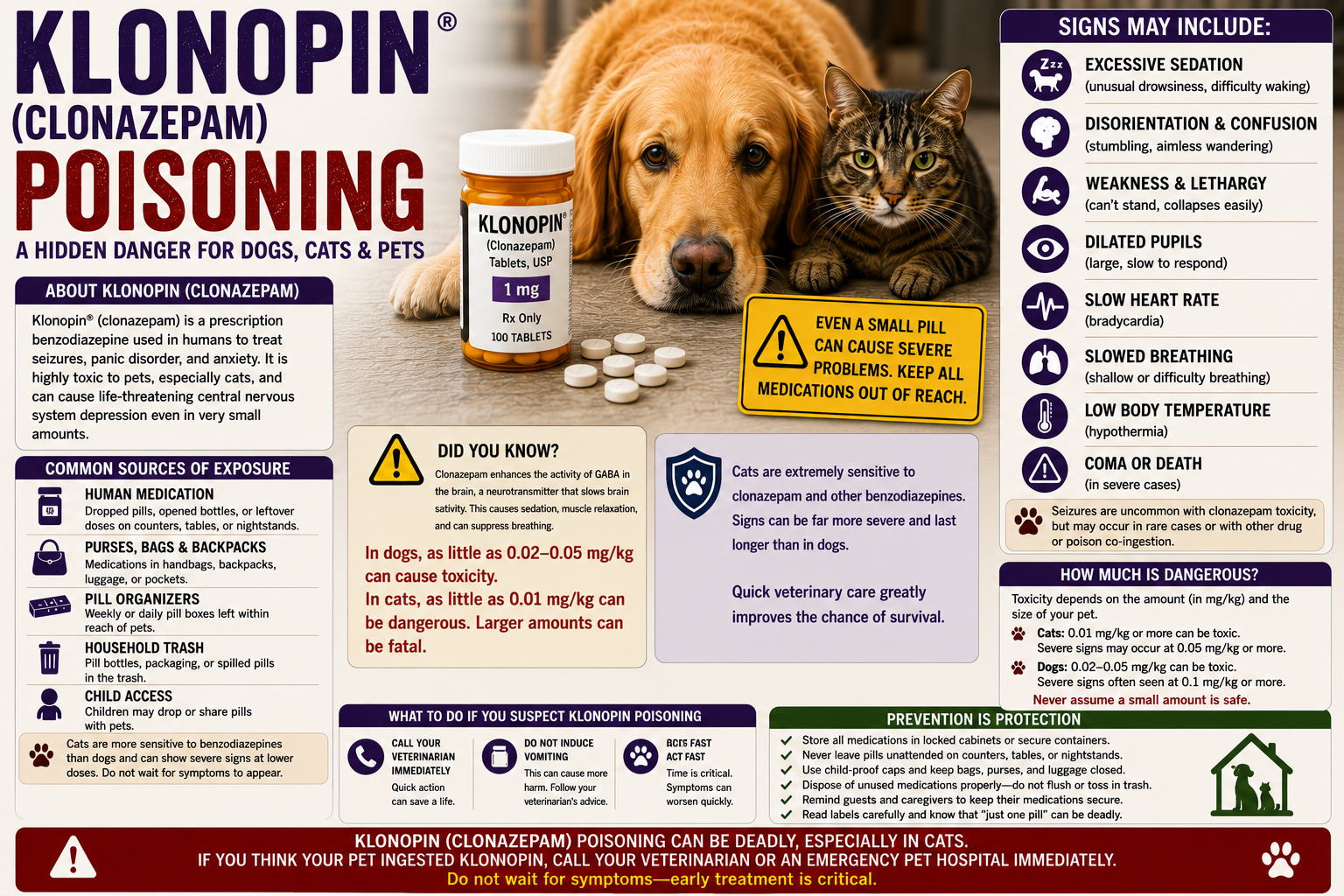
Yes. Klonopin is a brand name for clonazepam, a long-acting benzodiazepine that can cause clinically important poisoning after accidental ingestion, excessive dosing, or a dangerous combination exposure. Common effects include sleepiness, weakness, wobbliness, disorientation, reduced coordination, abnormal behavior, and loss of normal protective reflexes. Some animals become unusually excited, restless, vocal, aggressive, or hyperactive instead of sedated.
Severe poisoning is more likely when clonazepam is combined with opioids, alcohol, sleep medicines, gabapentinoids, muscle relaxants, antihistamines, antidepressants, anticonvulsants, or other central nervous system depressants. Profound sedation can lead to aspiration, low body temperature, low blood pressure, poor ventilation, coma, or injury from falls. A tablet that seems small to a person may represent a substantial exposure for a small dog, cat, bird, rabbit, or other companion animal.
Veterinarians may prescribe benzodiazepines for selected neurologic, behavioral, or emergency indications, but a legitimate prescription does not make unsupervised access safe. A pet already receiving clonazepam or another seizure medicine also should not have treatment stopped abruptly without veterinary direction because sudden withdrawal can destabilize seizure control.
About this guide: This page provides general pet-poisoning information and cannot diagnose or treat an individual animal. For any suspected exposure, contact a veterinarian or animal poison-control service immediately. Do not induce vomiting, give medication, or attempt home decontamination unless directed by a veterinary professional.
Agent and Exposure Profile
Quick Reference
Klonopin and Clonazepam Identity, Formulations, and Product Recognition
Klonopin is clonazepam
Klonopin is a brand name for clonazepam. Clonazepam belongs to the benzodiazepine class and has anticonvulsant, anxiolytic, sedative, hypnotic, and muscle-relaxing effects. Generic prescription labels usually emphasize the name clonazepam rather than Klonopin, so both names must be included when reconstructing an exposure.
Clonazepam is not the same drug as clonidine, clozapine, clorazepate, or clonazolam. Those names are easily confused but represent different substances with different toxicologic concerns. A photograph of the imprint, package, or pharmacy label is safer than relying on a remembered name.
Tablets and orally disintegrating products
Clonazepam is commonly dispensed as conventional tablets and orally disintegrating tablets. Generic color, shape, scoring, and imprint vary by manufacturer. Orally disintegrating products can dissolve quickly in saliva or on a wet floor, which may make the amount recovered from the mouth or packaging unreliable.
Compounded liquids and veterinary prescriptions
Compounding pharmacies may prepare flavored liquids, capsules, or other dosage forms for human or veterinary patients. Concentration can differ substantially from one preparation to another. The prescription label, beyond-use date, storage instructions, and measuring device should accompany the animal to the clinic.
Related benzodiazepines are a drug class, not synonyms
Alprazolam, diazepam, lorazepam, midazolam, oxazepam, temazepam, triazolam, and clorazepate share benzodiazepine receptor activity but are not clonazepam. They differ in potency, onset, duration, metabolism, formulation, and veterinary use. This guide's emergency principles overlap with that class, but the exact drug remains important.
Combination exposure changes the emergency
Klonopin and generic clonazepam are ordinarily single-ingredient products, but animals often reach mixed pill organizers, purses, bedside containers, or several dropped medications at once. Opioids, antidepressants, stimulants, sleep aids, antihistamines, muscle relaxants, anticonvulsants, and alcohol can add respiratory, cardiovascular, neurologic, serotonergic, or seizure hazards that clonazepam alone does not explain.
Where Klonopin and Clonazepam May Be Found
Prescription bottles and blister packs
Clonazepam may be stored in medicine cabinets, bathroom drawers, bedside tables, kitchen counters, purses, backpacks, work bags, luggage, locked medication boxes, and weekly pill organizers. Dogs can crush plastic bottles or blister cards, while cats and small animals may ingest a dropped tablet or encounter residue from an orally disintegrating product.
Pill organizers and mixed medication containers
A compartment containing clonazepam may also hold antidepressants, blood-pressure medicines, opioids, anticonvulsants, sleep aids, vitamins, or supplements. When a pet breaks an organizer, every missing item must be considered. Identifying only the most recognizable tablet can miss the ingredient responsible for agitation, arrhythmia, seizures, or respiratory compromise.
Guest rooms, vehicles, and travel bags
Visitor medications are a frequent source of unexpected access. Tablets may be left on nightstands, in open suitcases, in hotel rooms, beside reclining chairs, or inside purses placed on the floor. A household that normally stores medicines securely can still have an exposure when a guest or caregiver follows a different routine.
Human and veterinary treatment areas
Clonazepam may be prescribed for panic disorder, seizure disorders, movement disorders, or other human indications, and it may occasionally be used by veterinarians for selected patients. Clinics, rescues, boarding facilities, barns, and multi-pet homes should treat labeled client medication as controlled inventory and document each administration.
Counterfeit, imported, or unlabeled tablets
A tablet represented as Klonopin may contain a different amount, another benzodiazepine, an opioid, or an unidentified substance when it did not come from a licensed pharmacy container. Unlabeled pills should be treated as unknown mixed-drug exposures. Do not rely on color or an internet image alone to identify them.
Klonopin and Clonazepam Exposure Scenarios and Risk Factors
Accidental ingestion of a dropped tablet
A single dropped tablet may be consumed before anyone notices, especially by a small dog or a pet that searches under furniture. The absolute number of tablets does not describe risk without the tablet strength, animal's weight, health status, and concurrent drugs. Orally disintegrating tablets may leave little visible evidence.
Chewed prescription bottles and pill organizers
Dogs may ingest several tablets, plastic fragments, foil, desiccants, or unrelated medications during the same event. The container may be found hours later with an uncertain pill count. Use pharmacy refill records, recent dosing history, and photographs of all recovered tablets to estimate the maximum possible exposure.
Medication errors and duplicate dosing
Poisoning can occur when two caregivers give the same dose, a decimal or concentration is misread, a human tablet is substituted for a compounded product, or a medication intended for one animal is given to another. Repeated dosing matters because clonazepam can have prolonged effects and sedation may deepen as additional drug is absorbed.
Mixed sedative or opioid exposure
Concurrent opioids, alcohol, sleep drugs, gabapentin or pregabalin, muscle relaxants, sedating antihistamines, barbiturates, anesthetics, or other benzodiazepines can produce more profound central nervous system and respiratory depression. The combination may be dangerous even when the clonazepam amount alone would be expected to cause only ataxia or sleepiness.
Paradoxical excitation
Some animals respond to benzodiazepines with agitation, pacing, disinhibition, vocalization, hyperactivity, or aggression. A sedative exposure should not be ruled out because the pet appears stimulated. Excited animals may overheat, fall, bite, escape, or injure themselves while still having impaired judgment and coordination.
Patients with reduced physiologic reserve
Very small, pediatric, geriatric, brachycephalic, debilitated, or neurologically impaired animals may tolerate sedation poorly. Liver dysfunction, respiratory disease, aspiration risk, low blood pressure, hypothermia, and concurrent central nervous system medication can complicate the course. Birds, rabbits, reptiles, and other small species can deteriorate rapidly from reduced ventilation, inability to eat, or trauma even when species-specific clonazepam data are limited.
Chronic therapy and abrupt withdrawal
An animal receiving clonazepam or another benzodiazepine repeatedly may develop physiologic adaptation. Abrupt discontinuation after chronic administration can cause rebound anxiety, agitation, tremors, or seizures. An overdose and a missed-dose problem therefore require different plans; owners should not stop or restart chronic therapy without veterinary guidance.
Klonopin and Clonazepam Poisoning Symptoms and Clinical Progression
Sedation, ataxia, and disorientation
Common signs include drowsiness, weakness, a wide-based stance, swaying, stumbling, falling, delayed responses, reduced awareness, and difficulty navigating stairs or furniture. Pupillary changes and abnormal behavior may occur. Affected animals can appear intoxicated while remaining intermittently responsive.
Paradoxical agitation and disinhibition
Instead of becoming quiet, some animals become restless, vocal, impulsive, hyperactive, irritable, or aggressive. They may pace, pant, startle easily, or react unpredictably to handling. This pattern is clinically important because restraint and transport can provoke injury even though the underlying drug is classified as a sedative.
Vomiting, aspiration, and loss of protective reflexes
Vomiting may occur, particularly in mixed exposures or after chewing packaging. A heavily sedated animal may not swallow or protect the airway normally, allowing saliva, food, water, charcoal, or vomit to enter the lungs. Coughing, rapid breathing, fever, abnormal lung sounds, or worsening oxygenation can signal aspiration pneumonia.
Temperature, blood pressure, and respiratory changes
Hypothermia can develop when an animal is inactive, exposed to a cool environment, or unable to regulate posture. Blood pressure may fall, especially with dehydration or another depressant. Severe intoxication can reduce respiratory rate, depth, or airway tone, although profound respiratory depression is more typical of combination exposures than isolated benzodiazepine ingestion.
Severe neurologic depression
Large or mixed exposures may progress to stupor, coma, poor airway control, and inability to stand. Trauma can occur before the pet becomes fully recumbent. Seizures are not the expected effect of uncomplicated acute clonazepam ingestion, but they may reflect a co-ingestant, abrupt withdrawal in a dependent patient, hypoxia, metabolic disease, or use of an antagonist in an inappropriate mixed overdose.
Duration can be prolonged
Clonazepam is considered a longer-acting benzodiazepine. Clinical effects may outlast the period an owner expects from a sleep medicine, particularly after repeated dosing, large ingestion, hepatic impairment, or mixed-drug exposure. Temporary improvement after stimulation does not prove the animal is ready for unsupervised recovery.
First Aid for Suspected Klonopin or Clonazepam Exposure
Immediate owner actions
- Remove access to the medication and separate every animal that may have reached the pills or packaging.
- Preserve the bottle, pharmacy label, blister pack, pill organizer, remaining tablets, fragments, and photographs of imprints.
- Record the strength, formulation, maximum amount missing, earliest and latest exposure time, and every medication or supplement the animal receives.
- Obtain a current weight and contact a veterinarian or veterinary emergency service immediately.
- Keep an unsteady animal on the floor in a quiet, dim area away from stairs, pools, furniture edges, and other pets while transport is arranged.
Do not induce vomiting without veterinary direction
Hydrogen peroxide, salt, mustard, manual gagging, or other home methods can cause aspiration, esophageal injury, or delayed treatment. Vomiting is especially unsafe once sedation, wobbliness, abnormal behavior, or impaired swallowing has begun. The benefit of professional decontamination depends on timing, formulation, co-ingestants, and airway protection.
Do not give activated charcoal at home
Activated charcoal may be considered by a veterinary team in selected recent exposures, but a sedated animal can inhale it. Charcoal also does not correct low blood pressure, hypothermia, respiratory depression, or trauma. It should not be forced into a patient with reduced consciousness or poor swallowing.
Do not counteract sedation with stimulants
Coffee, caffeine tablets, energy drinks, nicotine, cold medicines, or exercise can create additional toxicity and do not safely reverse benzodiazepine receptor effects. Do not give a human flumazenil product or another prescription drug. Antagonist use requires careful assessment of seizure history, chronic benzodiazepine exposure, and possible co-ingestants.
Safe transport
Use a carrier, padded box, or secure flat vehicle area so the animal cannot fall. Keep the neck in a neutral position and monitor breathing. Do not force food or water. Call ahead for profound sedation, paradoxical aggression, vomiting, slow breathing, collapse, seizure activity, or possible opioid exposure so the hospital can prepare airway and monitoring support.
Klonopin and Clonazepam Toxicology and Mechanism
Positive modulation of GABA-A receptors
Clonazepam binds to the benzodiazepine site on gamma-aminobutyric acid type A receptors. It does not simply turn the receptor on by itself; it enhances the inhibitory effect of GABA when GABA is present. Increased chloride-channel activity makes neurons less likely to fire, producing anticonvulsant, anxiolytic, sedative, and muscle-relaxing effects.
Why coordination and behavior change
Enhancement of inhibitory signaling affects cerebral, cerebellar, vestibular, and brainstem networks. The result can be somnolence, impaired coordination, delayed responses, muscle weakness, and altered judgment. Disinhibition can produce the opposite-looking syndrome of excitement or aggression when normal behavioral restraint is reduced.
Respiratory depression is context dependent
Benzodiazepines alone often have a wider safety margin than barbiturates or many opioids because their action depends on endogenous GABA. That does not make overdose harmless. High exposure, airway obstruction, serious underlying disease, and coadministration with opioids, anesthetics, alcohol, or other depressants can produce clinically important hypoventilation and loss of airway protection.
Pharmacokinetic uncertainty in animals
Species, formulation, hepatic metabolism, repeated exposure, and individual health influence onset and duration. Veterinary clonazepam poisoning data are far less extensive than data for some other benzodiazepines, so a single public toxic threshold would create false precision. Clinical monitoring and the exact exposure history are more useful than assuming that all benzodiazepines behave identically.
Flumazenil antagonism
Flumazenil competitively blocks the benzodiazepine binding site and can reverse sedation in selected cases. Reversal may be incomplete or shorter than the clonazepam effect, requiring continued observation. It can also precipitate seizures or withdrawal in benzodiazepine-dependent patients or remove a protective anticonvulsant effect during certain mixed overdoses.
Evidence boundaries
Published veterinary evidence includes a confirmed canine clonazepam intoxication case, large canine benzodiazepine exposure series involving related drugs, pharmacokinetic work, and reports of flumazenil use. Those sources support class-level emergency principles but do not justify treating alprazolam, diazepam, clonazepam, and every other benzodiazepine as dose-for-dose equivalents.
Clinical Management
Veterinary Care and Prognosis
Veterinary Diagnosis and Treatment
Exposure reconstruction and emergency assessment
The veterinary team identifies the exact drug, strength, formulation, maximum missing amount, exposure window, repeated doses, chronic benzodiazepine use, seizure history, and every possible co-ingestant. Triage focuses on airway, breathing, circulation, temperature, blood pressure, mental status, gait, pupil response, swallowing, trauma, and signs of aspiration.
Laboratory testing and differential diagnosis
Testing may include blood glucose, packed cell volume, serum chemistry, electrolytes, blood gas analysis, lactate, urinalysis, and tests directed by co-ingestants or underlying disease. Routine human urine benzodiazepine screens may not detect every veterinary exposure reliably and can cross-react unpredictably. A negative screening result does not overrule a compatible history and clinical examination.
Professional decontamination
Veterinary emesis may be considered only in a recent exposure when the patient is fully alert, can protect the airway, and has no contraindicating co-ingestant or neurologic abnormality. Once sedation or ataxia is present, airway risk often outweighs benefit. Activated charcoal may be used selectively with appropriate airway protection and hydration assessment.
Supportive care
Treatment commonly includes a quiet padded environment, temperature support, intravenous access, fluid therapy when indicated, blood-pressure monitoring, oxygen, antiemetic therapy, and repeated neurologic examinations. Intravenous crystalloids are used first when hypotension is related to dehydration or poor perfusion; persistent hypotension after appropriate fluid resuscitation may require vasopressor support.
Airway and respiratory support
Profoundly depressed animals may need suction, supplemental oxygen, endotracheal intubation, or assisted ventilation. Aspiration risk is managed proactively rather than waiting for severe pneumonia. Respiratory monitoring is especially important after opioid, alcohol, muscle-relaxant, gabapentinoid, or anesthetic co-exposure.
Flumazenil in selected patients
Flumazenil may rapidly improve benzodiazepine-associated neurologic depression, but it is not appropriate for every overdose. The clinician weighs chronic benzodiazepine exposure, seizure disorders, tricyclic antidepressants, stimulants, unknown tablets, and other proconvulsant co-ingestants. Because reversal may wear off before clonazepam, recurrence of sedation remains possible.
Managing paradoxical excitation and complications
Agitated patients require low-stimulation handling, temperature monitoring, and protection from falls and self-injury. Medication choices must account for the possibility of mixed poisoning. Trauma, hypoglycemia, aspiration, hypothermia, and pressure injury are treated as separate problems rather than attributed entirely to sedation.
Monitoring duration
Observation continues until gait, alertness, temperature, blood pressure, ventilation, swallowing, and behavior remain stable without temporary reversal or stimulation. Large, repeated, or uncertain exposures and patients with liver disease or co-ingestants may require extended hospitalization. Chronic clonazepam schedules are restarted or tapered only under veterinary direction.
Prognosis, Recovery, and Follow-Up
Isolated exposure often has a favorable outcome with care
Prognosis is generally favorable when clonazepam is the only drug involved, the exposure is recognized promptly, airway protection remains intact, and the patient can be kept safe while the medication is eliminated. Many animals recover with monitoring and supportive care, but prolonged wobbliness or sleepiness can still require hospitalization.
Factors that make prognosis more guarded
The outlook becomes more guarded with opioid or multi-drug exposure, severe hypoventilation, aspiration pneumonia, coma, persistent hypotension, major trauma, uncontrolled hyperthermia from paradoxical agitation, preexisting respiratory disease, or seizures caused by withdrawal or a co-ingestant. Unknown or counterfeit tablets add substantial uncertainty.
Temporary reversal is not the same as complete recovery
An animal that wakes after flumazenil may become sedated again when the antagonist wears off. Normal response to stimulation also does not guarantee normal airway reflexes or coordination. Discharge decisions are based on sustained stability rather than a brief period of alertness.
After discharge
Owners should restrict stairs, jumping, swimming, and unsupervised outdoor access until coordination is normal. Return promptly for recurrent sleepiness, coughing, difficult breathing, vomiting, inability to stand, agitation, tremors, collapse, or seizures. Any changes to a chronic seizure or behavior medication plan should come from the prescribing veterinarian.
Preventing Klonopin and Clonazepam Poisoning
Store clonazepam as a high-risk controlled medication
Keep bottles, blister packs, compounded liquids, and pill organizers inside a closed, latched cabinet. Child-resistant packaging is not dog-resistant. Do not leave medication in purses, backpacks, bedside dishes, bathroom counters, vehicle consoles, or luggage accessible to pets.
Control dosing and documentation
Use a written or electronic medication record showing the patient, product, strength, amount, time, and caregiver. One person should verify each dose in multi-caregiver homes and facilities. Never estimate a compounded liquid concentration from a previous bottle.
Separate human and veterinary medication
Store each animal's medication in a labeled area separate from human prescriptions. Avoid transferring pills into unlabeled bags or mixing unrelated drugs in one container. Read the full label before every administration, especially when clonazepam, clonidine, clorazepate, and similarly named drugs are present.
Plan for guests, travel, and facilities
Ask visitors to keep medication behind a closed door or in a locked container. Boarding facilities, rescues, daycares, and veterinary hospitals should require original labeled packaging, document every dose, secure client belongings, and report dropped tablets immediately.
Do not stop chronic benzodiazepines abruptly
When clonazepam has been used repeatedly, refills and tapering plans should be coordinated before the supply runs out. Abrupt withdrawal can destabilize behavior or seizure control. If an overdose occurs in a chronically treated patient, the emergency clinician should direct both immediate care and the later medication schedule.
Dispose of unused medication securely
Use an authorized medication take-back option when available. Until disposal, keep unwanted tablets in their labeled child-resistant container inside a locked location. Do not place loose clonazepam tablets in open trash, compost, or a container that a pet can chew.
Klonopin and Clonazepam Poisoning FAQ
Are Klonopin and clonazepam the same medication?
Yes. Klonopin is a brand name and clonazepam is the active drug. Generic bottles commonly say clonazepam without the brand name.
Is clonazepam the same as clonidine?
No. Clonidine is a different medication with important cardiovascular and central nervous system effects. Similar spelling is not evidence that the drugs share the same treatment plan.
Is one clonazepam tablet dangerous to a pet?
It can be, especially for a small animal, a high-strength tablet, a patient with respiratory or liver disease, or a mixed exposure. The exact strength, weight, timing, and co-ingestants must be assessed rather than relying on tablet count alone.
Why is my dog hyperactive after swallowing a sedative?
Benzodiazepines can cause paradoxical excitation or behavioral disinhibition. Pacing, vocalization, impulsivity, and aggression can occur even though sedation and poor coordination may also be present.
Can clonazepam slow breathing?
Severe respiratory depression is less common with an isolated benzodiazepine than with many opioids or barbiturates, but it can occur with large exposure, airway compromise, serious disease, or another depressant. Slow or difficult breathing is an emergency.
What if the clonazepam was taken with an opioid?
That combination substantially increases concern for profound sedation, poor ventilation, aspiration, and coma. Bring every medication package and seek emergency care immediately.
Should I make my pet vomit?
No, unless a veterinarian specifically directs professional decontamination after assessing the patient. Sedation, wobbliness, or poor swallowing makes aspiration especially dangerous.
Does activated charcoal reverse clonazepam?
No. Charcoal may reduce absorption in selected early cases but does not reverse drug already absorbed and can be aspirated by a sedated animal. It should not be given at home.
Can coffee or caffeine wake the animal up safely?
No. Caffeine can cause a second poisoning with agitation, arrhythmias, tremors, and seizures. It does not safely antagonize clonazepam.
What is flumazenil?
Flumazenil is a benzodiazepine-receptor antagonist that veterinarians may use in selected cases. It requires intravenous access, monitoring, and assessment of seizure risk and co-ingestants.
Why would flumazenil be avoided?
It can precipitate withdrawal or seizures in benzodiazepine-dependent patients and may remove protective anticonvulsant activity in certain mixed overdoses. Unknown tablets, tricyclic antidepressants, stimulants, and seizure disorders change the risk-benefit decision.
Can sedation return after flumazenil works?
Yes. The antagonist may wear off before clonazepam is eliminated. Continued observation is needed even when the animal wakes rapidly.
Can a urine drug test prove clonazepam poisoning?
Not reliably. Screening assays differ in which benzodiazepines and metabolites they detect, and false-negative or misleading results can occur. History, examination, imaging of packaging when relevant, and clinical response remain important.
What if my pet vomited the tablet?
Visible material does not prove that the full dose was recovered. Some drug may have dissolved or been absorbed, and a sedated animal may aspirate during vomiting. Preserve the material and obtain veterinary advice.
Can my pet sleep it off at home?
Not safely without veterinary assessment. An animal that appears asleep may have poor airway protection, low temperature, low blood pressure, a mixed exposure, or injuries from falling.
What if several pets had access?
Separate them and do not divide the missing tablets evenly. Record each animal's weight and signs and report the maximum plausible exposure for each patient.
Should chronic clonazepam be stopped after an accidental extra dose?
Do not make that decision without the treating veterinarian. The immediate overdose must be managed, but abrupt discontinuation after repeated use can provoke withdrawal or destabilize seizure control.
Are cats, birds, rabbits, and reptiles safe because most reports involve dogs?
No. Limited published poisoning data do not establish safety. Small body size, respiratory vulnerability, inability to tolerate prolonged anorexia, and species-specific metabolism can make credible exposure important even when canine evidence is stronger.