Dog Daycare Construction Materials
Dog Boarding Suite and Kennel Materials: Build for the Dog That Studies Weak Spots Overnight
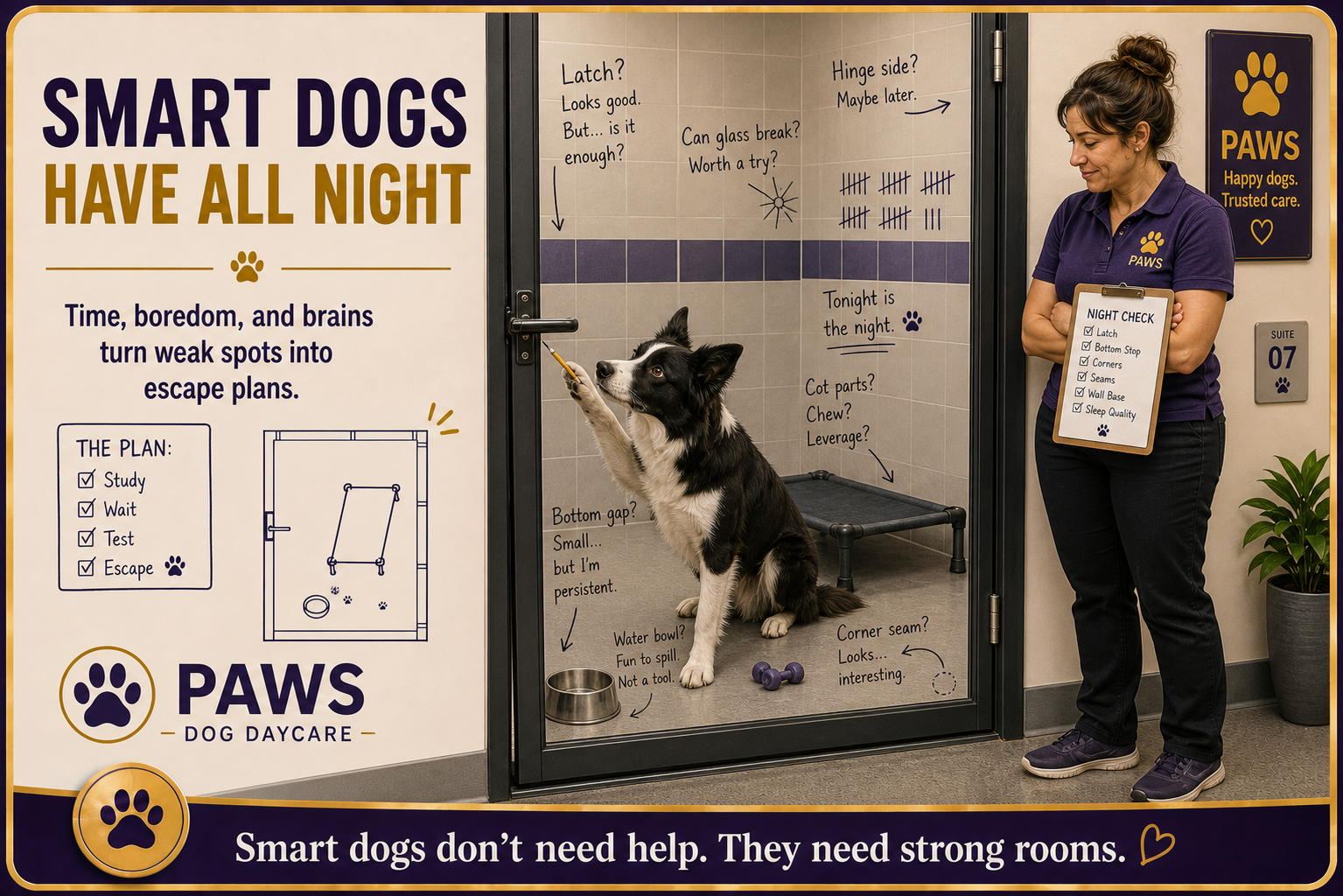
Boarding materials must survive stress, separation, chewing, pawing, climbing, and overnight pressure.
Boarding is not just daycare with bedtime. Boarding dogs may be anxious, tired, overexcited, confused, homesick, medicated, old, young, bored, or determined to leave. That changes the material conversation.
A dog in a boarding suite may paw the door, chew a corner, push a latch, climb a barrier, scratch a wall, destroy bedding, bend weak wire, or work on the same spot for hours. Daycare damage often happens in motion. Boarding damage can happen through repeated pressure in one place.
The materials are not magical or mysterious. They are the same dog-resistant ideas from walls, gates, floors, drains, edges, HVAC, odor control, and noise planning. Boarding just removes the margin for weak details because the dog has time.
A boarding suite is not a hotel room for dogs. It is a small containment room that has to survive fear, boredom, urine, claws, teeth, cleaning chemicals, emotional support luggage from home, and a dog with nothing better to do than test your construction like it has a clipboard.
🗺️
Use This Page Like a Boarding Room Material Map
Do not plan boarding materials by asking what looks nice on opening day. Ask what survives when the building is quiet, the owner is gone, and one dog decides the lower corner of the door is now a personal project.
🧱
Suite Walls
Lower walls, seams, corners, urine splash, and chew points decide how clean the room stays.
🚪
Doors and Latches
The kennel front is where bored, anxious, or excited dogs concentrate pressure.
🔩
Edges and Corners
If a dog can get a tooth, paw, claw, or nose under an edge, that edge is now a project.
💧
Floors and Drains
Overnight messes punish bad slope, bad seams, absorbent materials, and poor cleaning flow.
👀
Solid vs. Visible Dividers
Dogs do not always need to stare at each other all night.
🛏️
Bedding and Bowls
Comfort items become material risks when they are soaked, shredded, chewed, or swallowed.
🧳
Owner Item Policy
Stuffies, shirts, blankets, beds, collars, and chews need rules before they become safety problems.
🔊
Noise and Air
Boarding rooms need rest, odor control, humidity control, and less barking feedback.
🧴
Cleaning and Sanitation
The suite has to clean fast without holding urine, odor, moisture, or chemical residue.
📋
Material Options
Tile, coated block, HDPE, PVC, FRP, metal guards, and kennel fronts all have tradeoffs.
✅
Nightly Inspection
Check the weak spots before the anxious dog checks them after you leave.
🛠️
Contractor Questions
Ask about anchoring, latch engagement, edges, seams, cleaning, replacement parts, and repair access.
🧪
Suite Diagnostic
Walk the suite like a dog, a cleaner, a staff member, and a tired owner.
❓
FAQ
Straight answers for boarding suite material, door, wall, floor, divider, and inspection questions.
📌
Final Word
Boarding suites fail when owners build for the tour instead of the overnight dog.
📌
Boarding material rule:
Build boarding spaces for the dog that is calm on the tour but panics at 11:30 p.m. when the building is quiet and the owner is gone.
🌙
Boarding Damage Is Repetition Damage
Daycare damage usually happens while dogs are moving. Boarding damage can happen because a dog has time.
A daycare dog may slam into a wall, bounce off a gate, scratch a door during pickup, or crash into a divider during play. That damage matters, but it usually happens in bursts. Boarding changes the rhythm. A boarding dog may stand in one suite and paw the same door, chew the same corner, push the same lower panel, or test the same latch over and over.
That is why boarding materials need less forgiveness. The space is smaller. The dog is contained longer. Staff may not be standing there every second. The building may be quiet. The dog may be tired, medicated, confused, stressed, bored, or over-alert. That combination turns small weak points into big repair bills.
The mistake is thinking boarding suites should be softer, prettier, or more residential because customers like the word “suite.” Comfort matters, but the structure still has to survive dog behavior. If the material cannot handle claws, teeth, urine, water, cleaning, and repeated pressure, it does not belong in the dog-contact zone.
| Pressure Type | What Happens | Material Lesson |
|---|---|---|
| Door pawing | The dog works the same lower door area repeatedly. | Use durable door surfaces, protected lower panels, strong latch engagement, and bottom control where needed. |
| Corner chewing | A small exposed edge becomes a long overnight project. | Protect corners, caps, panel edges, trims, thresholds, and any exposed seam dogs can catch. |
| Latch testing | The dog pushes, paws, bumps, or mouths the hardware. | Use dog-resistant kennel hardware, positive latching, good alignment, and daily inspection. |
| Barrier frustration | Dogs react to other dogs through open fronts or dividers. | Use solid lower panels, controlled visibility, and layout that reduces nose-to-nose conflict. |
| Overnight messes | Urine, stool, vomit, spilled water, and shredded bedding sit until staff finds them. | Use cleanable surfaces, sealed seams, good drainage logic, and materials that do not absorb odor. |
| Noise loops | One barking dog wakes or agitates others. | Use room layout, acoustic thinking, solid barriers, airflow planning, and staffing routines that reduce stress. |
🧱
Boarding Suite Walls Need the Same Protection With Less Mercy
The wall system does not need to be mysterious. It needs to match what happens in a small dog room overnight.
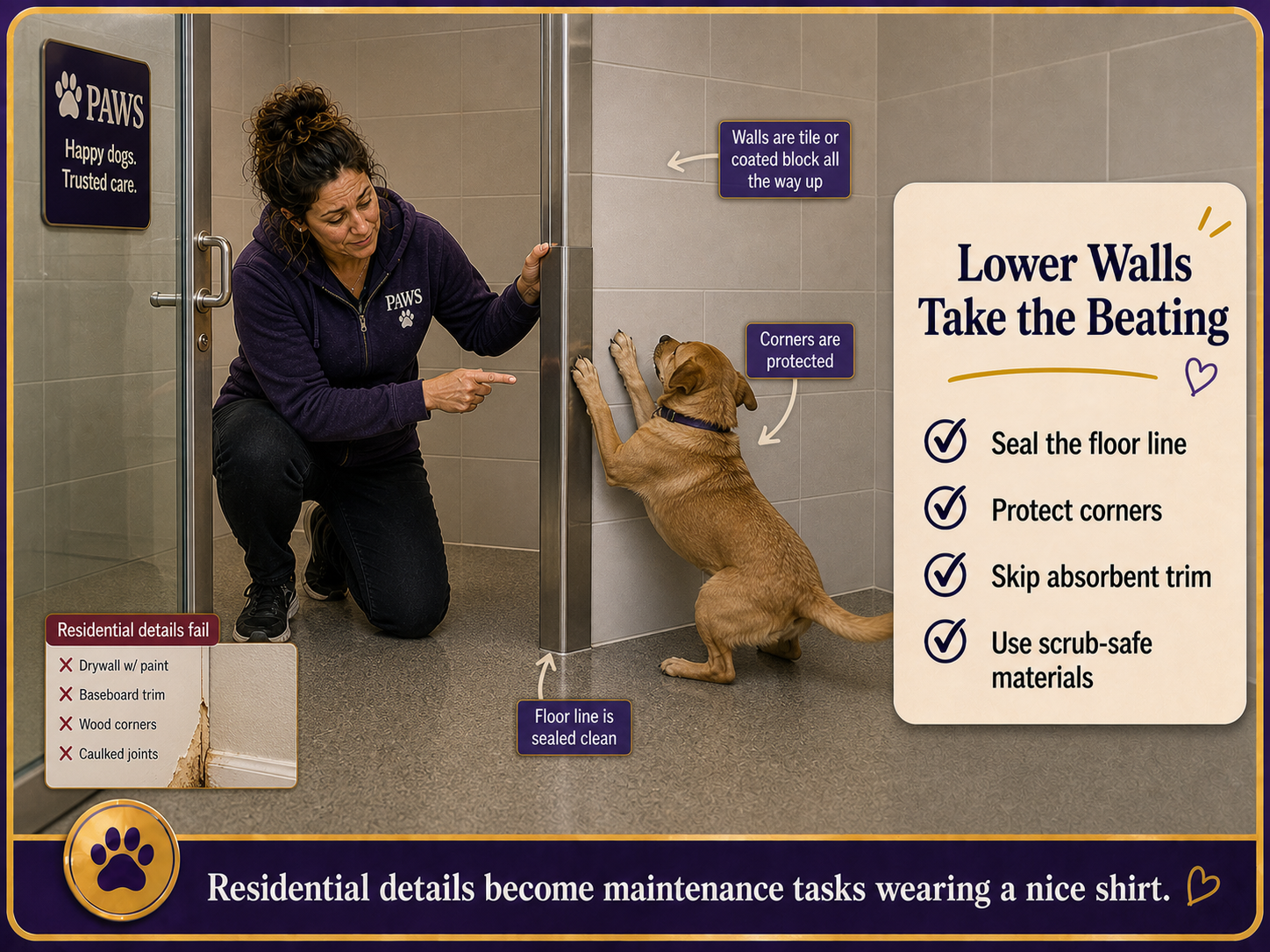
The wall rules from dog daycare playrooms still apply here: protect the lower wall zone, avoid absorbent trim, seal the wall-to-floor transition, protect corners, and use materials that can survive urine splash, cleaning chemicals, claws, rubbing, pawing, and daily wipe-downs.
Boarding adds one extra problem: the dog may not be moving through the space. The dog may be standing right at the same wall, same divider, same door, or same corner for a long time. That makes weak lower-wall details much more important.
Smooth tile, coated block, structural glazed tile, HDPE dividers, PVC panels, properly installed FRP, resinous wall systems, commercial coatings, metal guards, and other cleanable non-porous systems all belong in the research pile. The right answer depends on the building, budget, dog size, cleaning method, water exposure, and whether the material is in the dog-contact zone.
What does not belong in the abuse zone is ordinary residential thinking. Painted drywall, exposed base trim, soft wood edges, open seams, cheap caulk, heavy texture, and decorative materials that cannot be scrubbed are not boarding-suite material solutions. They are future maintenance tasks wearing a nice shirt.
Wall rule: if the dog can scratch it, chew it, pee near it, rub against it, soak it, or force staff to clean it every day, it needs to be treated like a dog-contact surface, not a normal wall.
Operator note: boarding walls do not always fail because a dog destroys the whole wall. They fail because one lower corner, one strip of trim, one seam, or one chewed edge becomes the dog’s evening hobby. Build like the dog has time, because in boarding, it does.
🚪
Kennel Fronts, Doors, and Latches Are the First Serious Pressure Point
A boarding suite door is not just an entrance. It is the place the dog studies when it wants out.
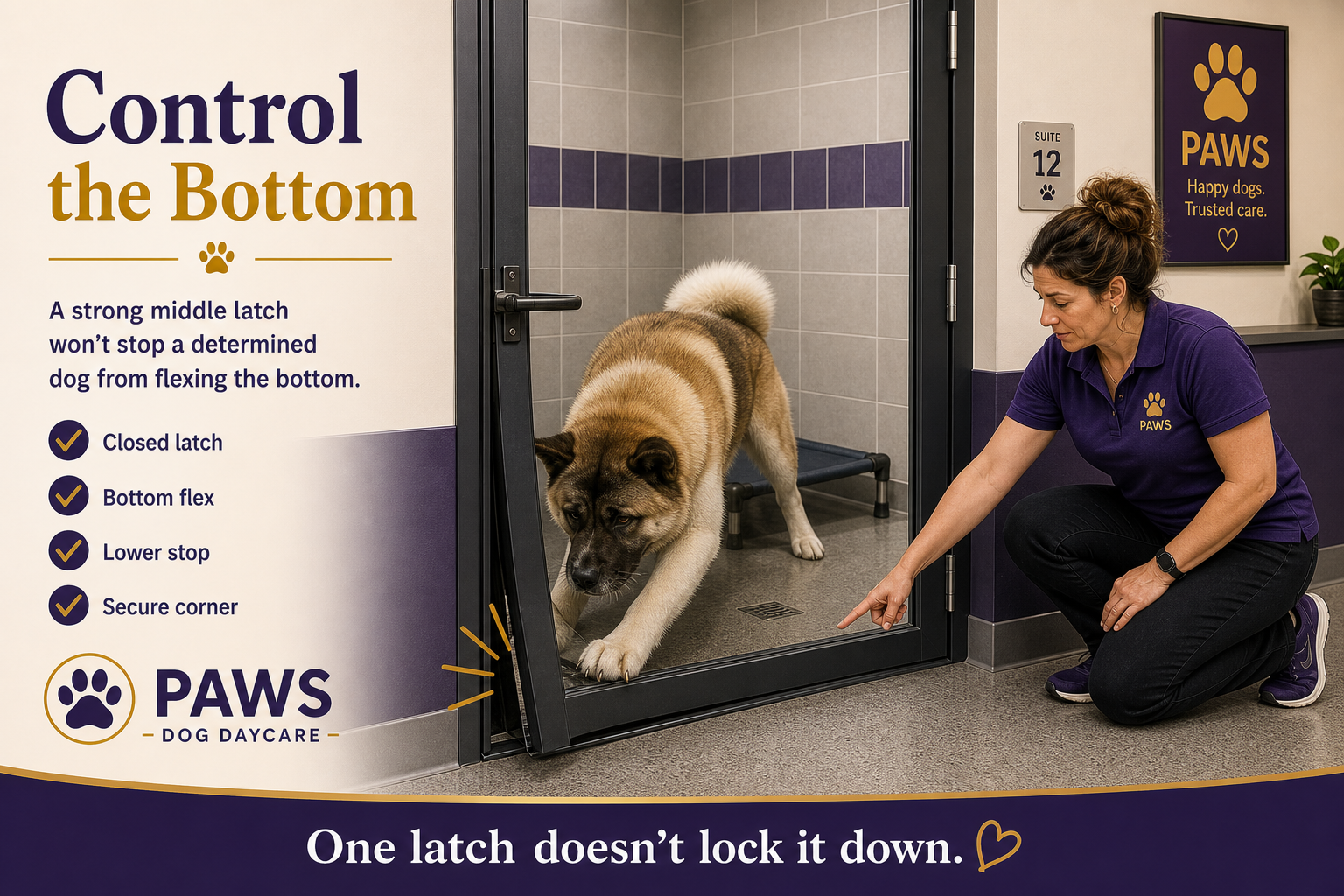
Purpose-built commercial kennel fronts are usually the cleanest answer when the budget allows. They are designed around containment, cleaning, visibility, hardware, and repeat use. But even commercial-looking kennel fronts can fail if they are installed badly, anchored poorly, latched weakly, or allowed to flex at the bottom.
A middle latch does not mean the bottom of the kennel door is controlled. If a dog can push the lower corner out, the latch being closed is not the same thing as the door being secure. This matters with weak framed doors, acrylic panels, glass-like panels, wire fronts, and any door where the lower section can bow under pressure.
Residential door handles do not belong in serious dog-contact areas. Dogs can paw them, chew them, bump them, and damage them. Staff also need hardware that works under pressure with one hand, with a leash, bowl, mop, medication, or excited dog in the other hand.
| Door Detail | Failure Risk | Better Direction |
|---|---|---|
| Weak middle latch only | Dog pushes lower corner until the door flexes or hardware shifts. | Use proper kennel hardware, stronger framing, and bottom control where needed. |
| Residential handle | Chewing, pawing, weak latch contact, and poor impact resistance. | Use commercial dog-resistant latch hardware matched to the door. |
| Open wire front | Paws, noses, mouths, chewing, barking, fence fighting, and body-part risks. | Use appropriate openings, solid lower panels, or commercial kennel-front systems. |
| Door mounted into weak framing | Sagging, latch misalignment, loosened hinges, and progressive failure. | Anchor into real structure, not decorative trim or wishful blocking. |
| Large bottom gap | Paws, noses, toys, bedding, water, squeeze attempts, and dogs working the opening. | Keep gaps small while still allowing safe swing, cleaning, and drainage logic. |
Operator rule: boarding suite doors get studied. Daycare gates get hit during busy moments. Boarding doors get pawed, pushed, chewed, stared at, and tested when no one is standing there cheering for the hardware.
🔩
Edges, Corners, Caps, and Thresholds Are Where Dogs Start
Dogs do not need to destroy the whole suite. They only need one exposed weak point.
Door frames, wall corners, panel edges, threshold strips, gate edges, divider caps, trim seams, bedding frames, crate edges, and transition strips are often the first places a boarding dog tests. The flat middle of a wall may be fine. The exposed edge is where the problem starts.
Boarding makes this worse because the dog has time. One small lifted corner, loose trim piece, proud fastener, cracked panel edge, or chewy threshold can become a nightly hobby. Once the dog finds it, the damage may not stay cosmetic. It can become a sanitation problem, a sharp-edge problem, a urine trap, an escape risk, or the beginning of a bigger wall or door failure.
Protect exposed edges before opening. Use metal guards, proper caps, protected panel edges, sealed transitions, durable thresholds, and details that do not give the dog a starting point. If the dog cannot get under it, catch it, peel it, bite it, or pry it, you are already ahead.
💧
Boarding Floors and Drains Have to Handle the Mess Nobody Saw Happen
Overnight messes punish bad materials because they sit longer.
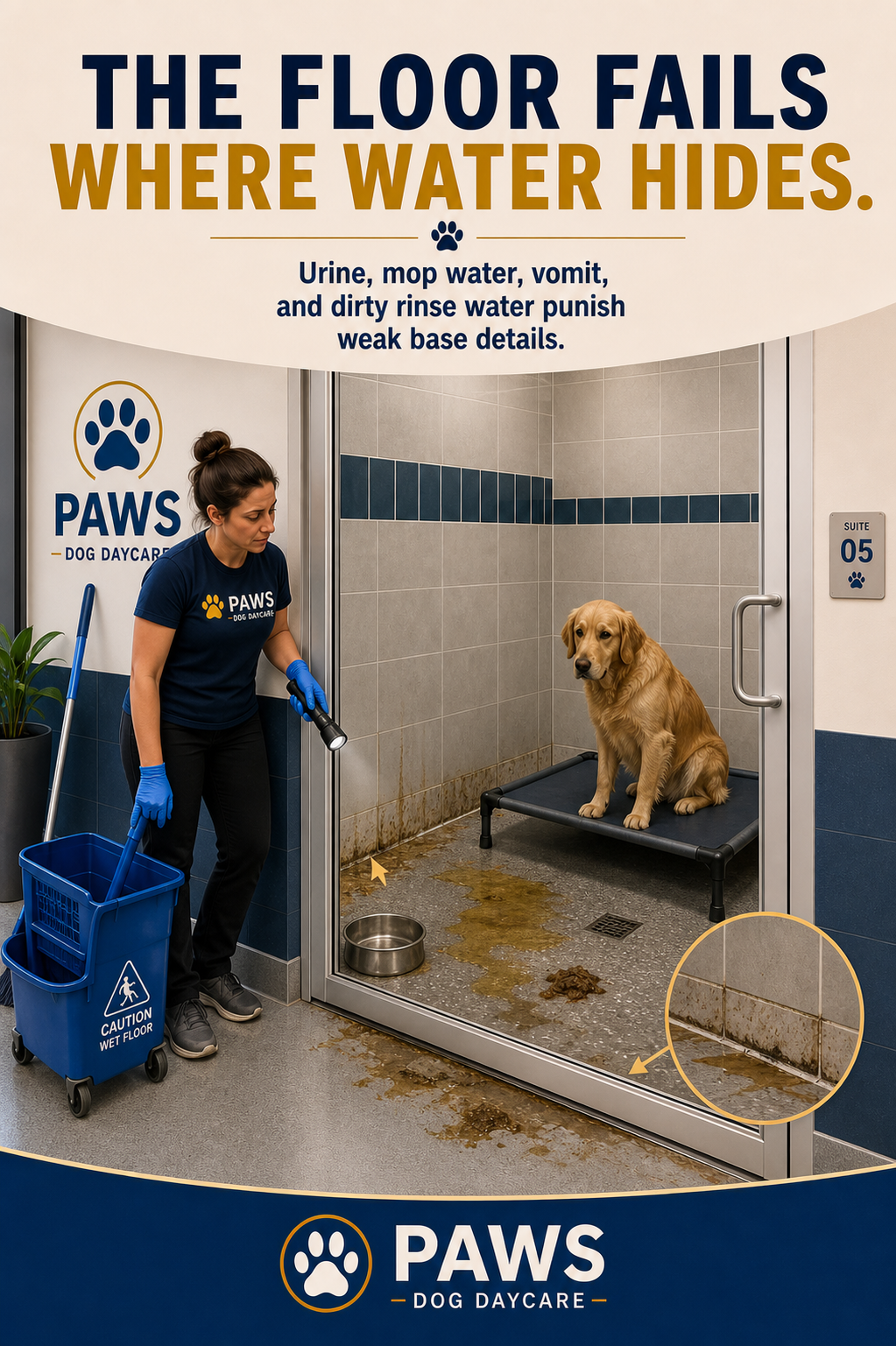
Boarding floors need to handle urine, stool, vomit, spilled water, wet paws, cleaning chemicals, mop water, disinfectant contact time, bedding laundry, and dog traffic. The floor has to clean without soaking, swelling, trapping odor, or sending water into wall seams.
The floor-to-wall transition matters as much as the floor. Urine and water love gaps, failed caulk, open base trim, dirty grout, panel seams, and absorbent edges. If the floor is decent but the base detail is weak, the suite can still smell wrong and clean badly.
Not every boarding suite needs a drain in the exact same way, and some buildings make drainage expensive or impossible. But the cleaning flow still has to be planned. Where does water go? Where does staff rinse? Where does the dirty mop water travel? How fast does the suite dry? What happens when one dog has diarrhea at 2:00 a.m. and the first employee finds it at opening?
| Floor / Drain Issue | What Goes Wrong | Planning Direction |
|---|---|---|
| Absorbent flooring | Urine, odor, and moisture become part of the building. | Use non-porous, cleanable, dog-safe floor systems suited for animal use. |
| Weak wall base | Water and urine get behind trim, panels, or drywall. | Use sealed transitions, cove logic, tile base, resinous cove, or another durable base detail. |
| No cleaning flow | Staff push water around without a real destination. | Plan drains, mop sinks, rinse points, drying time, and dirty-water movement. |
| Standing water | Slip risk, odor, humidity, and longer room downtime. | Plan slope, squeegee routes, ventilation, and drying procedures. |
| Bad drain smell | The suite smells dirty even after cleaning. | Review drain design, traps, cleaning schedule, ventilation, and floor drying. |
Cleanup Reality
Boarding messes are not always discovered fresh. A dog can pee, vomit, spill water, shred bedding, or have diarrhea while the building is quiet. The floor, wall base, drain plan, and drying plan need to survive the mess that had several hours to get comfortable.
👀
Solid vs. Visible Dividers: Dogs Do Not Always Need to Stare at Each Other All Night
Visibility can help staff. It can also create barking, marking, fence fighting, and stress.
Owners often like open-looking boarding rooms because they feel less harsh. Staff also need visibility for supervision. But dogs do not always benefit from staring at the dog next door. Some dogs settle better with visual breaks, solid lower panels, or partial privacy.
Open dividers can create nose-to-nose conflict, barking loops, pawing, chewing, fence fighting, and pee-through problems. A dog may spend the night reacting to movement across the aisle instead of resting. That is not luxury. That is a stress machine with nicer lighting.
The better answer is balance. Use staff visibility where it matters, but control dog-level visual pressure where it creates problems. Solid lower panels, privacy dividers, careful suite orientation, controlled sightlines, and smart aisle layout can reduce stress while still allowing staff to monitor dogs.
🛏️
Bedding, Bowls, Collars, Stuffies, and Owner Luggage
Some owners pack for boarding like the dog is leaving for a four-week international vacation with emotional support luggage.
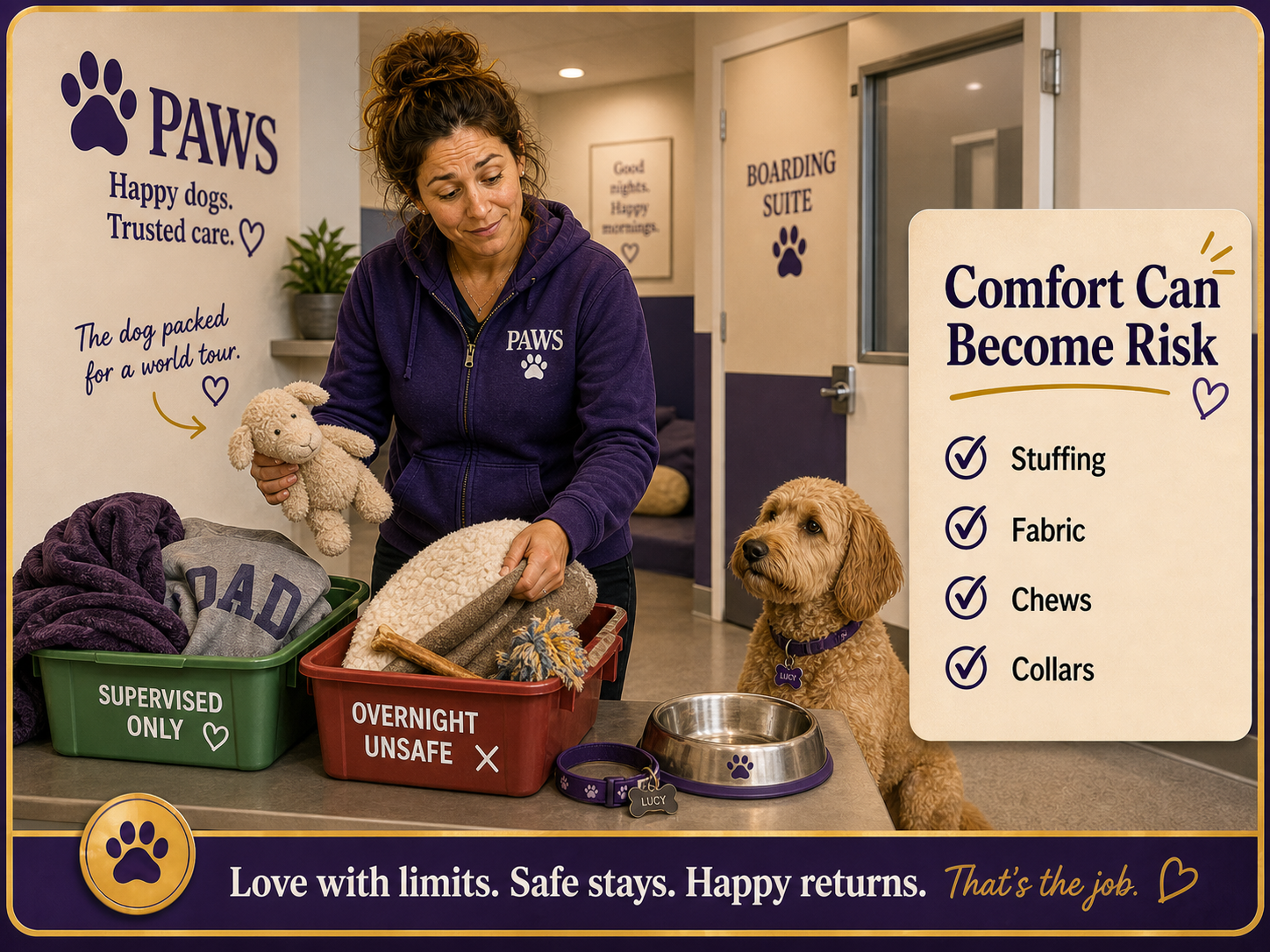
Owners will bring stuffed toys, chewy toys, blankets, shirts that smell like home, pillows, beds, bones, snacks, special bowls, and sometimes enough personal property to make the dog look like it has a better travel agent than you do. The intention is usually good. They want the dog to feel comfortable. The problem is that comfort items can become safety problems when the dog is alone, anxious, bored, tired, or upset.
A nervous boarding dog can tear apart a stuffed toy, chew a blanket, shred a bed, swallow fabric, choke on stuffing, ingest pieces, soak everything in urine, or drag bedding into the door. Then you are not just dealing with a dog problem. You are dealing with a safety risk, a cleaning problem, a possible vet problem, and a customer-service mess because the owner thinks you let their property get destroyed while nobody was paying attention.
My rule was simple: the facility had the right to remove any owner-provided item for safety, cleaning, or damage reasons. The dog could have supervised time with certain items when appropriate, but that did not mean the item stayed in the suite overnight. When the building closed down and the dog was alone, the room got stripped down to the safe basics.
In a boarding suite, the safest overnight setup is usually boring on purpose: an approved raised bed, such as a Kuranda-style bed or other facility-approved raised cot, and a water bowl. Food bowls are used when feeding is needed, then removed or managed according to your routine. No stuffed toys. No loose blankets for dogs that shred. No chew items that can splinter, swell, break, or be swallowed. No owner shirt left in the room just because it smells like home. Sentimental fabric does not help anyone if the dog eats half of it at midnight.
Collars are another issue. Dogs should not be left unattended in boarding suites wearing collars that can catch, twist, snag, or tighten. Choke chains should not be allowed in the facility at all. A dog wrestling, pawing, rolling, rubbing against a gate, or reacting through a divider can get a foot, jaw, tooth, or another dog caught in the wrong collar hardware. Boarding dogs should go into their suites stripped down for safety, not dressed for a photo.
| Owner Item | What Can Go Wrong | Better Boarding Rule |
|---|---|---|
| Stuffed toys | Shredding, stuffing ingestion, choking, squeaker swallowing, and mess. | Supervised use only when appropriate. Remove before overnight or unsupervised boarding. |
| Owner shirts or blankets | Chewing, fabric ingestion, urine soaking, odor, and destroyed personal property. | Explain that scent items may be limited or removed for safety and sanitation. |
| Soft beds from home | Shredding, urine absorption, hidden mess, stuffing ingestion, and laundry problems. | Use facility-approved raised beds or washable bedding only when safe for that dog. |
| Chews and bones | Choking, splintering, guarding, swallowing pieces, diarrhea, and emergency vet risk. | Do not leave risky chew items with unattended boarding dogs. |
| Collars | Catching, tightening, snagging, twisting, or getting caught during panic or rubbing. | Remove collars for boarding-suite time unless a specific supervised need exists. |
| Choke chains | High snag, tightening, foot-catching, jaw-catching, and injury risk. | Do not allow choke chains in the facility. |
Operator rule: comfort does not outrank safety. When the dog is alone in the suite, the room should not contain anything the dog can eat, inhale, shred, choke on, soak with urine, weaponize, or turn into tomorrow morning’s customer argument.
🧳
Owner Item Policy: The Dog Does Not Need a Vacation Suitcase Overnight
Customer comfort items can be kind, sentimental, and completely inappropriate once the dog is alone.
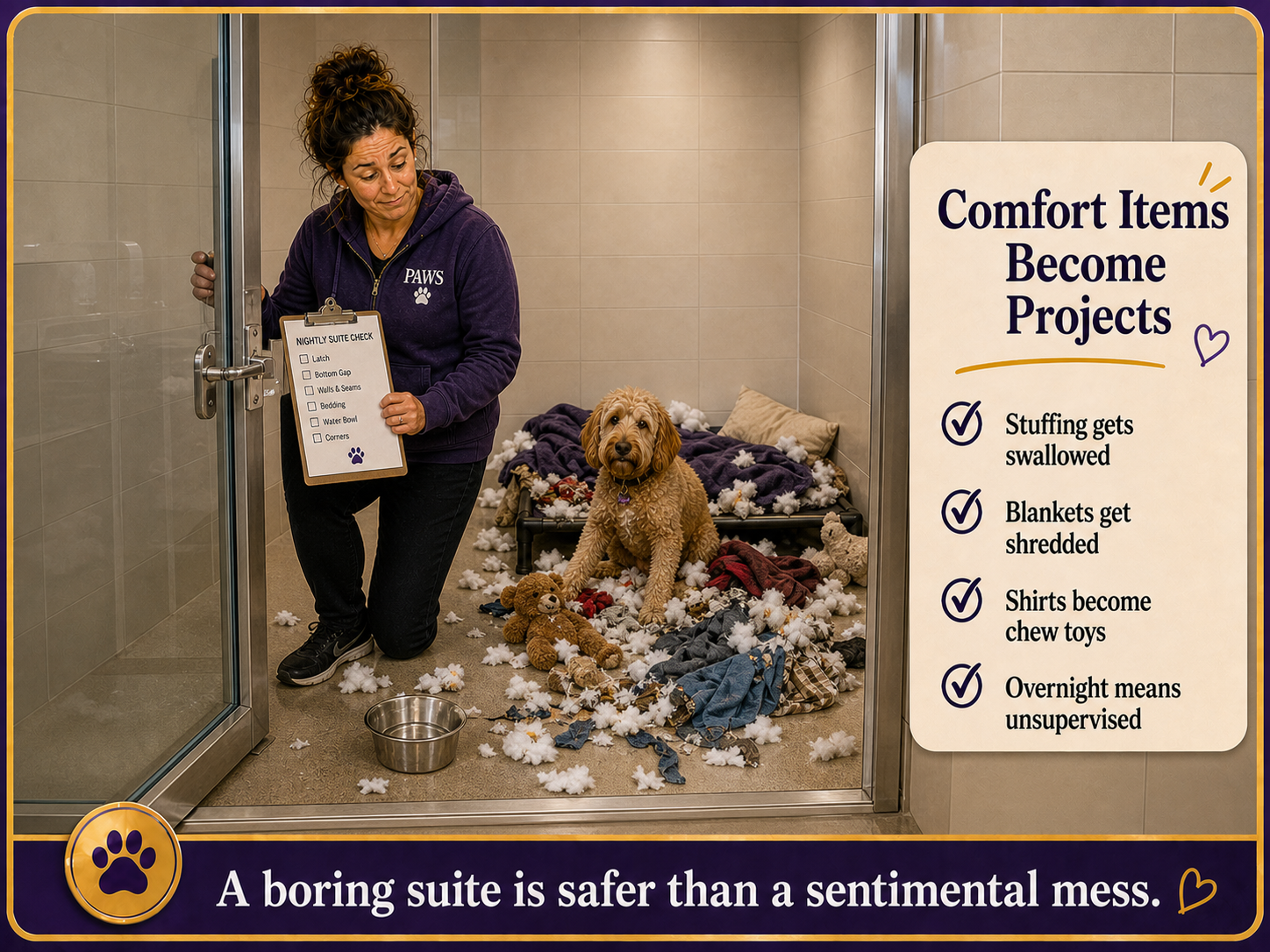
This needs to be handled before the owner leaves, not after the dog eats half a stuffed duck and everyone is trying to decide whether the squeaker passed through, stayed in the stomach, or is now part of tomorrow’s vet bill.
Owners should know up front that the facility may allow certain personal items during supervised time, but reserves the right to remove anything from the suite for safety, sanitation, choking, ingestion, damage, or cleaning reasons. That includes stuffed toys, blankets, owner shirts, soft beds, bones, chews, collars, harnesses, and anything else the dog can shred, swallow, soak, snag, or turn into a problem.
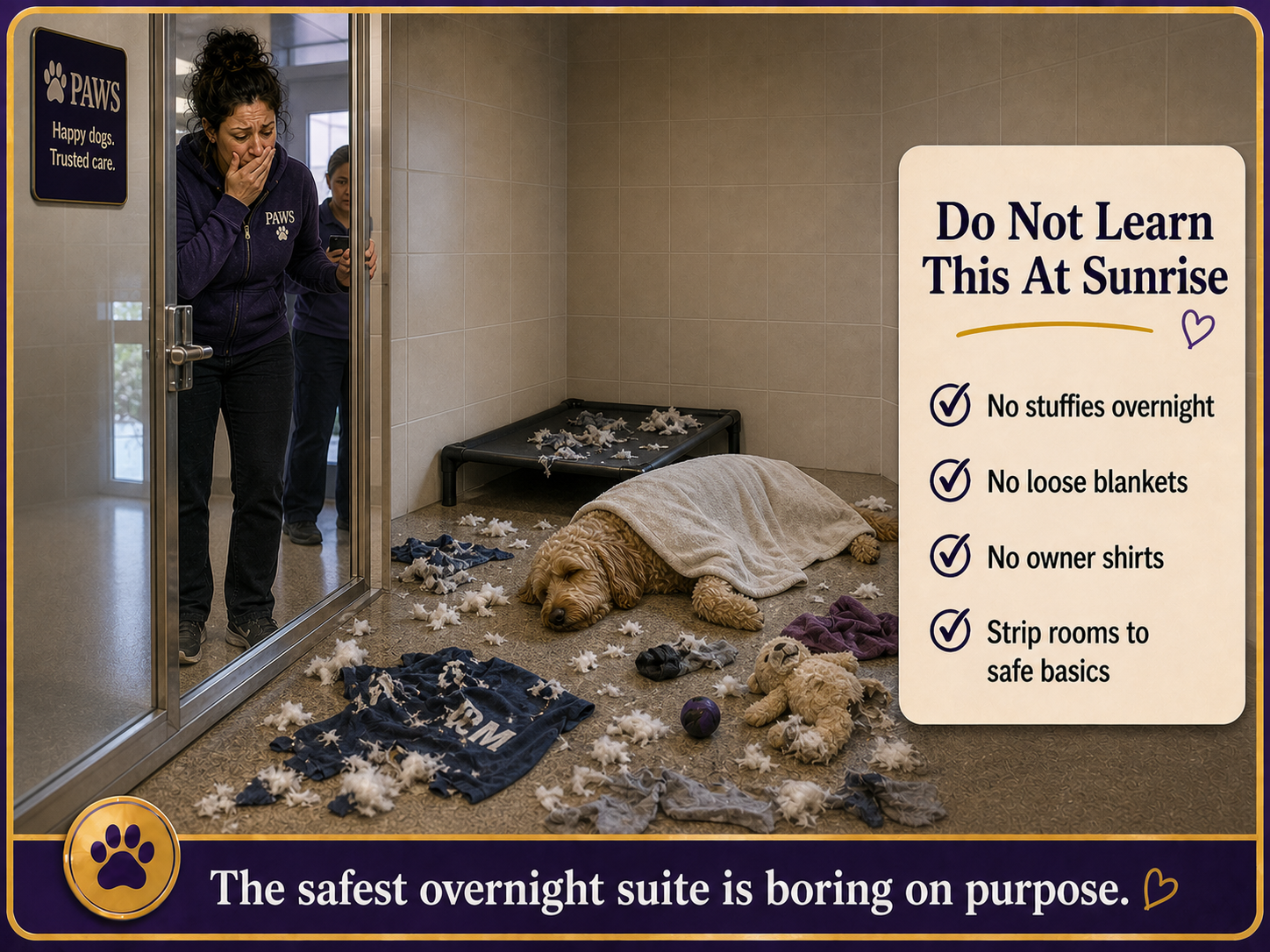
This is not being mean to the dog. It is being honest about what happens when dogs are nervous, bored, tired, or alone. The dog does not understand that the shirt is sentimental. The dog understands that it smells like home, feels chewable, and is sitting right there at midnight.
Staff Script
“You are welcome to bring comfort items, and we may use them when staff can supervise. For overnight safety, we reserve the right to remove any item that could be chewed, swallowed, tangled, soaked, or damaged. At night, most dogs are safest with their facility-approved bed and water only.”
Policy rule: put this in writing. If the owner brings half the dog’s bedroom and you quietly remove it later, they may think you are careless. If you explain the safety policy at intake, you are protecting the dog, the staff, and tomorrow morning’s conversation.
🔊
Noise, Air, Odor, and Sleep Are Material Problems Too
A boarding room that is cleanable but loud, stale, wet, or stressful is still working against you.
Boarding dogs need rest. That sounds obvious until the room is all hard surfaces, open fronts, echo, barking, slamming doors, nervous dogs, grooming dryers nearby, and stale overnight air. Then the materials are not just durable. They are amplifying stress.
Hard cleanable surfaces are often necessary, but they can reflect sound. Solid dividers can reduce visual stress, but they may change airflow and staff visibility. Ventilation matters because dogs are in the room for long periods, not just passing through for daycare. Humidity, odor, urine events, cleaning fumes, and closed-building air all become more noticeable overnight.
This is why the boarding suite conversation cannot stop at the kennel front. Walls, doors, floors, drains, ceiling treatment, air movement, exhaust, humidity, room layout, and cleaning schedule all connect. A beautiful suite that barks like a metal hallway and smells stale by morning is not finished.
🧴
Cleanable Means More Than “Can Be Wiped”
Boarding materials need to survive daily cleaning without becoming odor storage.
A boarding suite may look clean and still be built wrong. Odor hides in open seams, absorbent wall bases, dirty grout, cracked caulk, panel joints, unsealed block, bedding platforms, threshold gaps, and moisture trapped behind materials.
Cleaning also has to match the material. Some coatings cannot handle certain chemicals. Some panels scratch. Some grout lines need maintenance. Some sealants fail when hit repeatedly with water and disinfectant. Some surfaces look washable until the dog scratches them and opens the surface.
Ask how the room will be cleaned every day, what products will be used, how long contact time needs to be, how the room will dry, and what happens when the same suite has three messy boarders in one weekend. The construction has to match the cleaning reality, not the opening-day photo.
Operator rule: if a suite still smells after it was cleaned, stop blaming the mop first. Check seams, bases, drains, bedding platforms, panel joints, failed caulk, urine splash zones, and anything soft enough to hold yesterday’s mistake.
📋
Boarding Material Options by Suite Component
There is no one perfect material. There is the material system that fits the room, dog pressure, cleaning method, budget, and repair plan.
| Component | Materials to Research | Watch the Details |
|---|---|---|
| Lower walls | Smooth tile, coated block, PVC panels, FRP, HDPE shields, resinous wall systems, commercial coatings. | Seams, backing, grout, edges, fasteners, chemical compatibility, chew points, and wall-to-floor transition. |
| Suite dividers | HDPE panels, PVC systems, coated block, solid lower panels, commercial kennel divider systems. | Visual pressure, urine splash, top flex, chewable edges, staff visibility, and cleaning access. |
| Kennel fronts | Commercial kennel fronts, welded framed systems, solid lower fronts, properly designed door panels. | Latch engagement, bottom flex, paw gaps, nose gaps, door swing, hinge anchoring, and replacement parts. |
| Doors and latches | Commercial kennel latches, positive latch hardware, bottom control hardware, floor bolts, drop pins where appropriate. | One-handed staff use, dog resistance, alignment after wear, emergency access, and daily inspection. |
| Floors | Sealed concrete systems, epoxy/resinous floors, commercial animal-care flooring, other non-porous cleanable systems. | Slip resistance, urine resistance, slope, drain access, cleaning chemicals, repairability, and dog comfort. |
| Edges and corners | Metal guards, corner guards, caps, protected thresholds, sealed transitions, durable trims. | Exposed lips, sharp edges, chew starts, moisture pockets, fasteners, and repair access. |
| Bedding / raised beds | Washable bedding, removable mats, raised beds, commercial cot-style systems. | Chewing, soaking, laundering, ingestion risk, frame corners, loose fabric, and room-specific dog risk. |
✅
Before Lights Out, Check What the Dog Will Check Later
Nightly inspection is not busywork. It is how you catch weak spots before a dog turns them into an overnight project.
Doors and Latches
- Latch fully catches and does not half-seat.
- Door bottom does not flex open under pressure.
- Hinges, bolts, and plates are tight.
- No sharp metal, cracked panel, or bent wire is exposed.
- No bedding, leash, bowl, or toy blocks the door closing path.
Check What Dogs Check Later
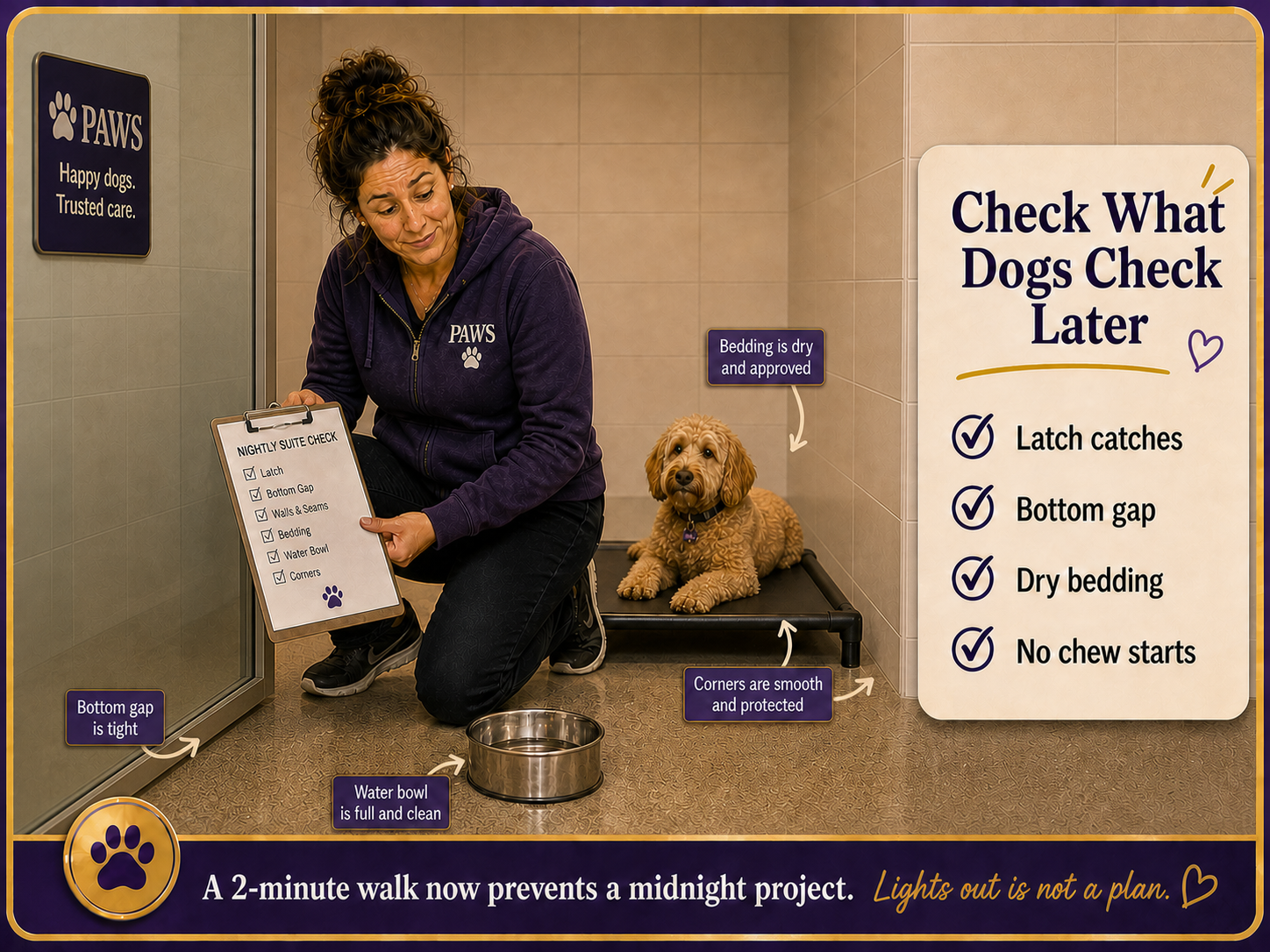
The nightly check should look at the same things the dog will investigate after lights out.
Floor and Cleaning
- Floor is dry enough for the dog to rest safely.
- Water bowl is stable and not creating a wet zone.
- No drain smell, standing water, or hidden mess remains.
- Bedding is dry, safe, and not shredded.
- Cleaning products are not leaving harsh fumes in the suite.
Dog Behavior Notes
- Dog is not obsessing over the door, latch, neighbor, or corner.
- Dog is not chewing bedding, bowls, panels, or raised bed edges.
- Dog is not fence fighting or barking through the divider.
- Dog has appropriate comfort items for its risk level.
- Staff notes identify suites that need extra morning inspection.
🛠️
Questions to Ask the Contractor or Kennel Supplier
“It should hold up” is not enough. Ask how it holds up, how it cleans, and how it gets repaired.
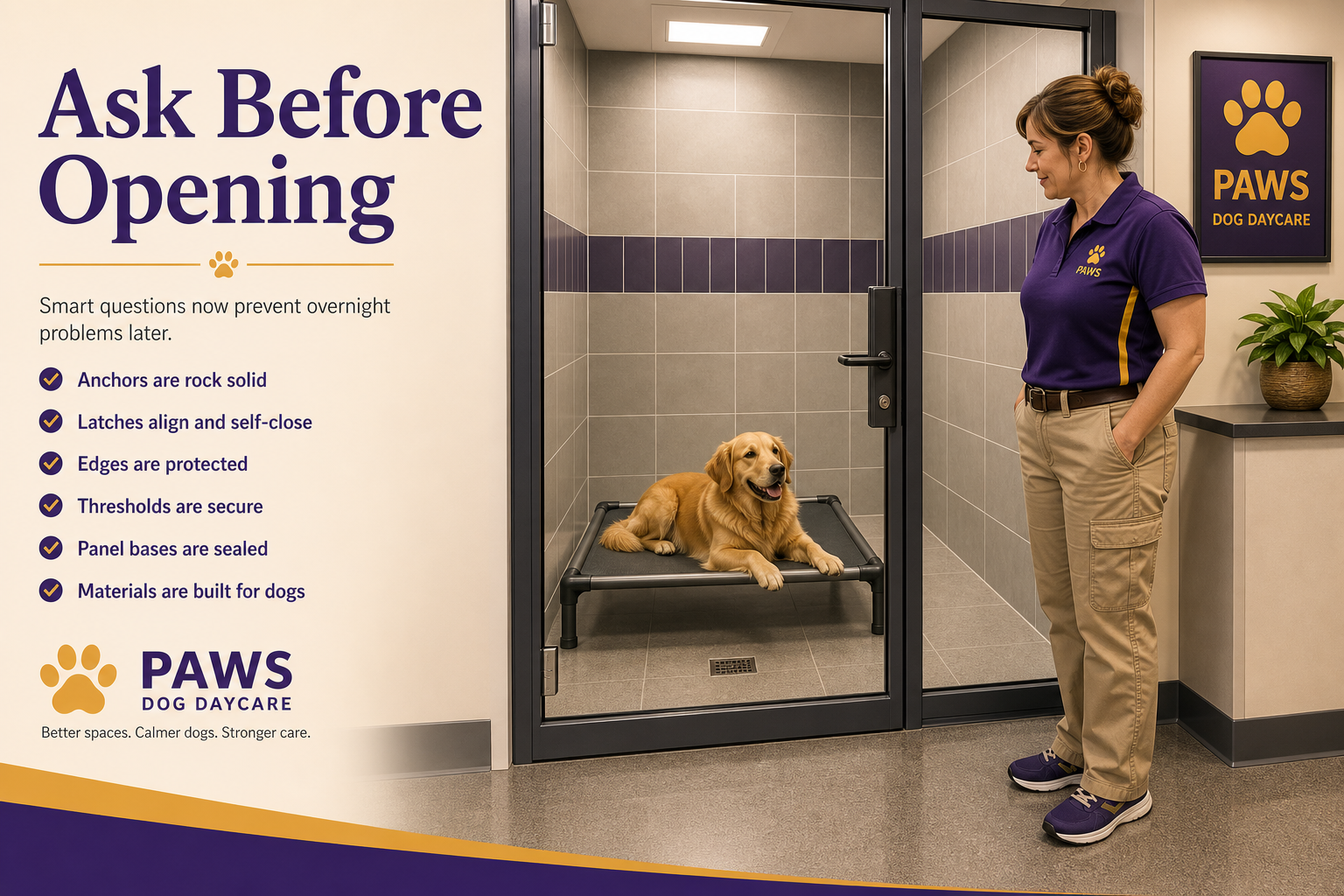
Ask Before Opening
Ask the materials questions before the suite has a dog, water bowl, loose blanket, and eight quiet hours to test your optimism.
| Question | Why It Matters |
|---|---|
| What is each kennel front anchored into? | Boarding doors need real structure behind the pretty surface. |
| Can the bottom of the door flex if a large dog pushes it? | A middle latch may not control the lower corner. |
| How are latch alignment and replacement handled after wear? | Hardware shifts over time, especially with repeated dog pressure. |
| How are panel edges, caps, and corners protected? | Dogs start damage where they can catch an edge. |
| Can dogs get paws, jaws, noses, collars, or body parts into openings? | Openings are containment, injury, chewing, and panic risks. |
| How does the wall-to-floor seam handle urine and water? | That seam decides whether the suite starts smelling later. |
| What cleaning products are compatible with the materials? | Some coatings, sealants, panels, grout, and metals do not tolerate every chemical. |
| Can individual panels, latches, hinges, or guards be replaced after opening? | Repairability matters when one suite gets damaged and the business is still operating. |
| How does the design reduce barking, visual stress, and pee-through problems? | Containment is not just physical. The room also has to help dogs settle. |
| What does the warranty actually cover in a dog boarding environment? | Animal use, chewing, cleaning chemicals, and installation details may affect coverage. |
🧾
Commercial Kennel Front Buying Questions
Before you buy the pretty kennel fronts, make sure they can survive the dog that treats the lower door corner like a puzzle.
Commercial kennel fronts can be a good investment, but do not buy them only because they look clean in a brochure. Ask how they anchor, how the latch actually engages, how the bottom of the door is controlled, how panels are replaced, how edges are protected, and what happens when a large dog spends half the night pushing the same spot.
The supplier may be selling a good product. That still does not mean the exact product, exact install, exact panel style, exact latch, and exact divider setup are right for your dog count, dog size, cleaning method, staffing pattern, and boarding layout.
| Buying Question | What You Are Trying to Learn | Why It Matters After Opening |
|---|---|---|
| What is the kennel front anchored into? | Whether the system is tied into real structure or just attached to weak framing. | A good-looking front can still loosen, shift, sag, or fail if the backing is weak. |
| Can the bottom corner flex when a large dog pushes it? | Whether the door is controlled at the bottom or only latched in the middle. | Dogs test the lower door area. A middle latch does not automatically control bottom flex. |
| What latch is used, and how does it stay aligned? | Whether the latch is dog-resistant, staff-friendly, and serviceable after wear. | Latches shift with daily use. A latch that barely catches on day one becomes a problem later. |
| Are there paw, nose, jaw, collar, or tooth gaps? | Whether openings create containment, injury, chewing, or panic risks. | Openings that look harmless in a showroom can become the dog’s favorite bad idea overnight. |
| Can damaged panels, hinges, latches, and guards be replaced individually? | Whether the system can be repaired without shutting down a whole room or replacing an entire front. | Repairability matters when one suite gets damaged and the business still has dogs checking in. |
| How do the fronts handle cleaning chemicals and daily wash-down? | Whether coatings, metals, fasteners, seams, and panels tolerate your cleaning process. | A kennel front that looks great dry can corrode, stain, smell, or fail under real cleaning. |
| Do the dividers reduce stress or create a barking hallway? | Whether the layout gives dogs too much visual access to each other. | Full visibility can look open and friendly to humans while keeping dogs awake and reactive. |
| What does the warranty exclude? | Whether animal use, chewing, urine, cleaning chemicals, improper installation, or wear are excluded. | Warranty language matters after the dog, cleaner, and mop water have all had their vote. |
Buying Rule
Do not ask, “Is this strong?” Ask, “What happens when a bored, anxious, ninety-pound dog pushes the same lower corner for three hours, and how do I repair it without turning one damaged suite into a construction project?”
🚧
Common Boarding Suite Material Mistakes
These are the shortcuts that look fine during tours and then get explained by dogs after closing.
Building Pretty Instead of Durable
Residential-looking suites can fail fast if the lower walls, seams, doors, edges, and floors are not dog-contact ready.
Trusting a Middle Latch
If the door bottom flexes, the latch being closed does not mean the door is secure.
Leaving Chew Starts
Exposed trim, caps, thresholds, panel edges, and cracked corners invite dogs to start working.
Using Absorbent Bases
Urine and water will find gaps, swollen trim, bad caulk, porous seams, and weak wall bases.
Making Everything See-Through
Dogs do not always settle when they can stare at every neighbor, every movement, and every aisle.
Ignoring Night Inspection
Gate sag, loose latches, chewed edges, cracked panels, and bedding destruction do not fix themselves.
Forgetting Cleaning Flow
If water has nowhere smart to go, staff will push mess around and the building will start holding odor.
Choosing Materials Without Repairs in Mind
A damaged suite should not require shutting down half the building because nobody planned replacement parts.
Treating Noise Like Background
Boarding dogs need rest. Echo, barking loops, hard surfaces, and bad layout can turn the room into a stress amplifier.
🧪
Boarding Suite Material Diagnostic
Walk the suite like a dog, a cleaner, a staff member, and a tired owner who has to pay for repairs.
Dog Test
- Can a dog chew or pry any exposed edge?
- Can a dog paw the latch, bottom gap, or door corner?
- Can a dog climb, squeeze, or push under anything?
- Can a dog see another dog in a way that creates barking or barrier frustration?
- Can a dog destroy bedding, bowls, or raised bed parts inside the suite?
Cleaning Test
- Can urine be cleaned without entering wall seams?
- Does water have a clear cleaning path?
- Can the suite dry quickly enough?
- Are the materials compatible with your cleaning products?
- Can staff clean corners, thresholds, and door bottoms without fighting the room?
Staff Test
- Can staff open the door safely with an excited dog inside?
- Can staff operate the latch one-handed?
- Can staff see enough to monitor dogs without creating unnecessary dog-to-dog stress?
- Can damaged parts be replaced quickly?
- Can staff inspect all weak points every night?
Owner Test
- Will the suite still look professional after one year of real boarding use?
- Are replacement parts, spare panels, and product records documented?
- Does the design reduce repair calls instead of creating them?
- Does the suite support odor control, noise control, and cleaning flow?
- Would you trust the room with the dog that gets anxious after the owner leaves?
❓
Dog Boarding Suite and Kennel Material FAQ
Straight answers for the materials, doors, walls, floors, dividers, and inspection questions that show up when dogs stay overnight.
What materials are best for dog boarding suites?
The best materials depend on the room, budget, dog size, cleaning system, and risk level. Research smooth tile, coated block, HDPE, PVC panels, FRP, resinous wall and floor systems, commercial kennel fronts, metal guards, and other non-porous cleanable systems. The installation details matter as much as the material.
Is regular drywall acceptable in boarding rooms?
Regular painted drywall is a bad bet in dog-contact areas. It can scratch, swell, stain, absorb odor, and fail around seams and lower wall zones. It may be fine in offices or low-risk areas, but boarding suites need stronger protection where dogs touch, scratch, pee, or chew.
Are commercial kennel fronts worth it?
Usually, yes, when the budget allows. Purpose-built kennel fronts are designed for containment, cleaning, latching, and repeat use. They still need proper anchoring, latch alignment, bottom control, and daily inspection.
Do kennel doors need bottom latches or bottom control?
If the bottom of the door can flex under dog pressure, it needs some kind of bottom control or stronger design. A middle latch alone may not stop a determined dog from pushing the lower corner until something shifts, bends, or fails.
Should boarding suite dividers be solid or see-through?
Usually, the answer is a balance. Staff need visibility, but dogs do not always need full dog-to-dog visibility. Solid lower panels and controlled sightlines can reduce barking, marking, fence fighting, and stress.
What flooring should boarding suites use?
Use a non-porous, cleanable, dog-safe floor system that can handle urine, water, disinfectants, traction needs, and daily cleaning. The wall-to-floor transition is critical because urine and water love weak base details.
Do boarding suites need drains?
Not every building can add drains easily, and the best layout depends on the facility. But every boarding area needs a cleaning-flow plan. Staff need to know where water goes, how messes are removed, and how rooms dry.
What is the biggest boarding material mistake?
Building pretty suites without designing for the dog that paws, chews, pushes, marks, spills water, destroys bedding, and tests the same weak spot for hours.
How often should boarding suite materials be inspected?
Daily, with a stronger check before lights out. Latches, hinges, bottom gaps, edges, bedding, bowls, wall seams, floor condition, and dog behavior notes should all be part of the routine.
Can boarding suites look nice and still be durable?
Yes. Durable does not have to mean ugly. But the dog-contact zone has to come first. Use professional finishes that are cleanable, repairable, and resistant to real dog behavior instead of residential materials that only look good before the dogs move in.
📌
Final Word: Same Materials, Smaller Room, Longer Pressure
Boarding suites fail when owners build for the tour instead of the overnight dog.
Boarding does not require a completely different set of materials from the rest of the dog daycare facility. It requires the same wall, gate, floor, drain, edge, cleaning, noise, and airflow thinking applied with less forgiveness.
The dog is contained longer. The weak spot gets more attention. The mess may sit longer. The barking may build longer. The door may get tested longer. The corner may get chewed longer. That is the boarding difference.
Build the suite for the dog that studies weak spots overnight. Protect the lower walls. Control the door bottom. Use real latch hardware. Seal the wall-to-floor transition. Harden the corners. Plan the cleaning flow. Reduce stress where the building can help. Inspect the room before the dog gets bored enough to inspect it for you.
Boarding suites are not just rooms. They are containment, sanitation, rest, stress control, staff workflow, repair planning, and customer trust in one small space.