Dog Daycare Drains, Plumbing, Wash Areas, Floor Drains, Trench Drains, Slope, Hose Bibs, Mop Sinks, Dog Wash Plumbing, Hair Traps, Cleanouts, Sewer Gas, Odor Control, Cleaning Routes, and Facility Sanitation Flow
Dog Daycare Drains, Plumbing, and Cleaning Flow: If Water Cannot Move, the Building Punishes You
Cleaning is not just a staff task. It is a building design issue.
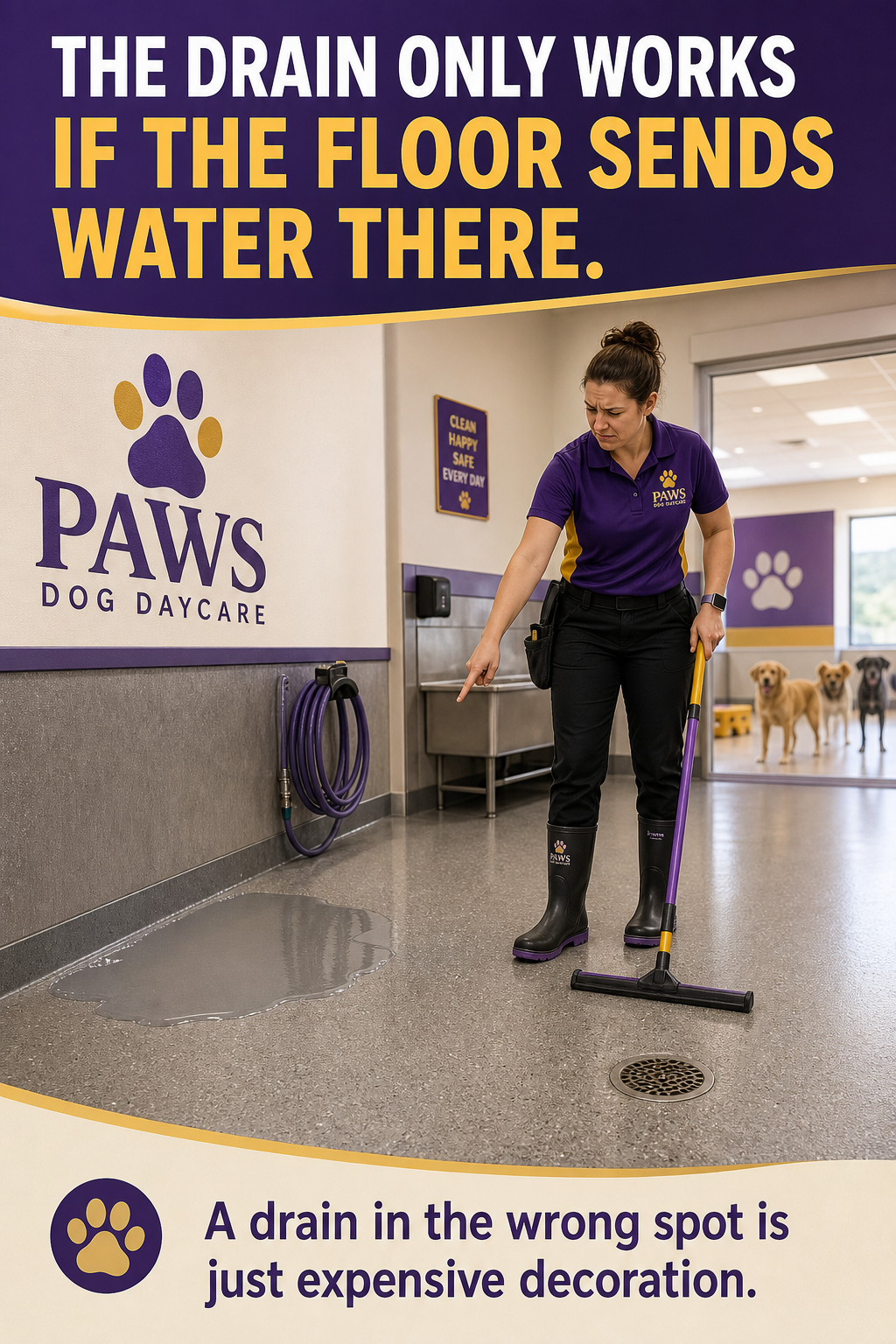
If water cannot move where it belongs, the building punishes you every day.
Cleaning is not just a staff task. It is a building design issue. The easier the building is to rinse, mop, drain, dry, and reset, the less labor gets burned fighting the same mess every day.
Drains, plumbing, hose access, mop sinks, wash areas, slope, hair control, sewer gas prevention, and where dirty water goes all matter. If the building forces staff to drag water across clean areas, push sludge uphill, or work around standing puddles, the business pays for that mistake every day.
The deep dive below covers the mechanics of an efficient facility: floor and trench drains, proper slope, wash-down areas, dog wash stations, mop sinks, hose bibs, plumbing limits, hair management, odor traps, cleaning routes, cleanouts, and the real impact of water movement on sanitation and labor costs.
⚠️
Operator warning: a drain is not a cleaning plan.
A floor drain in the room does not mean the room is easy to clean. The floor has to slope correctly. Water has to reach the drain. Hair has to be caught. Staff need hose access. Dirty water should not cross clean areas. The drain needs to be maintainable. The trap needs to behave. The cleanout needs to be reachable.
A drain sitting on the high side of the room is just a decorative hole with plumbing attached.
🗺️
Use This Page Like a Water Movement Map
Do not start with “does the building have drains?” Start with “where does dirty water go?”
💧
Cleaning Flow
Where the mess starts, where water comes from, where dirty water moves, where tools reset, and where the room dries.
🕳️
Floor Drains
Useful in bathrooms, small wet zones, utility rooms, and spaces where the floor actually slopes to the drain.
🚿
Trench Drains
Convenient for wash-down areas when they are sloped, cleanable, accessible, and protected with removable grates.
🧼
Mop Sinks and Tool Reset
Staff need a place to fill buckets, dump dirty water, rinse tools, and reset cleaning gear without using the customer restroom like a crime scene.
✂️
Grooming Plumbing
Dog wash areas create hair, shampoo, wet towels, shaking dogs, humidity, and drain problems fast.
🎾
Cleanouts and Clogs
Dogs drop things. Staff miss things. Plumbing finds out later. Cleanouts are not optional in dog-use drain lines.
👃
Sewer Gas and Mystery Odor
Sometimes the building does not smell like dogs. Sometimes it smells like plumbing nobody has checked.
🧽
The Cleaning Flow Problem
Cleaning has a route. Bad buildings make that route stupid.
Every cleaning job has a path. The mess starts somewhere. Water comes from somewhere. Dirty water moves somewhere. Solids and hair get caught somewhere. Tools get washed somewhere. The room dries somewhere. Then dogs, staff, customers, or clean supplies move back through the space.
If the building makes staff drag dirty water through clean space, the cleaning plan is already losing. If staff have to push water uphill, squeegee around puddles, carry mop buckets across the lobby, stretch hoses across walking paths, or rinse dog hair into a drain that cannot handle it, the facility is fighting the payroll.
This is why drains and plumbing are not just contractor details. They control staff labor, sanitation consistency, odor, slip risk, customer perception, and how exhausted the crew feels at the end of the day.
🐾
Cleaning flow rule
The building either helps staff clean, or it makes every cleaning cycle a small argument with gravity.
🧮
PAWS Cleaning Flow Failure Finder
Find the room design mistake that turns water, hair, slope, drains, cleanouts, odor, and staff labor into a nightly fight.
This is not a plumbing design. It is a planning filter. Use it before you sign a lease, approve a build-out, accept a contractor’s “it should be fine,” or discover that the only way to clean the big dog room is to push dirty water toward the lobby like an idiot with a squeegee.
Work one room at a time. Add the room to the packet so the plumber, contractor, landlord, floor installer, and owner are all looking at the actual cleaning route instead of pretending a drain somewhere in the building is a plan.
Cleaning Flow Command Board
Build the room like closing staff have to clean it.
Walk the water path: mess starts, water enters, dirty water moves, hair gets caught, drains stay serviceable, and the room dries. If one step is broken, the building steals payroll every night.
🏢
1. Room and Drain Setup
Start with how the room is actually used. A playroom, grooming room, lobby, and boarding run do not fail the same way.
🧽
2. Cleaning Reality
This is the stuff staff fight every day when the room was designed by somebody who never closed a dog daycare.
➡️
3. Dirty Water Route
Dirty water should not cross clean space, customer paths, or rooms that just got reset.
Fix First
Watch-Outs
Contractor / Plumber Questions
Maintenance Reality
Printable Packet Rooms
Add rooms one at a time. Print the packet before the pretty finishes hide the plumbing problem.
No rooms added yet.
PAWS cleaning-flow planning tool. Not a plumbing design, not code advice, and not permission to trust a drain that water cannot reach.
🕳️
Floor Drains vs. Trench Drains
The best drain is the one the floor, room, staff, and cleaning routine can actually use.
Floor drains are not bad. In bathrooms, small wet rooms, utility areas, and places where the floor slopes cleanly to the drain, a regular point drain can work fine. The problem is when somebody points at a lonely round drain in the corner and acts like it will magically pull water from the whole room.
Trench drains are often more convenient in dog areas because they create a long target for wash water. If the trench runs along the outside edge of a play area, behind kennel runs, or along the cleaning side of a wash-down space, staff can push water toward it instead of chasing puddles around the room.
But trench drains have their own rules. The floor has to slope toward the trench. The trench itself needs adequate slope inside the channel so water and debris do not sit there. The grates need to be removable. The drain needs baskets, strainers, cleanout access, or some other way to get hair and gunk out before the plumbing becomes a plumber’s boat payment.
Swipe left/right to see the full table.
| Drain Type | Best Use | Operator Warning |
|---|---|---|
| Point / floor drain | Bathrooms, mop rooms, small wet zones, utility spaces, and rooms with proper slope to one point. | Does little if the floor is flat or sloped wrong. A drain on the high side of the room is decoration with plumbing. |
| Trench drain | Playrooms, kennel rows, wash-down areas, and places where staff need a long water target. | Needs internal slope, sealed joints, removable grates, cleaning access, hair control, and cleanouts. |
| Slot drain | Modern linear drainage where a narrow opening and concealed channel make sense. | Can be cleaner looking, but access, cleaning method, hair load, and serviceability still matter. |
| Dog wash / tub drain | Grooming tubs, bathing stations, wet tables, and dog wash rooms. | Needs hair interception and access from the top or staff will ignore it until the line clogs. |
| Exterior yard drain | Outdoor rinse zones, turf edges, yard wash-down routes, and rainwater areas. | Leaves, gravel, hair, mud, fecal material, and toys can clog it. Outdoor drains need debris planning too. |
| Mop sink / utility drain | Dumping dirty water, rinsing tools, filling buckets, and resetting cleaning gear. | If staff do not have a dirty-work sink, they will invent one. You will not like where they invent it. |
🐾
Drain comparison rule
Do not fall in love with a drain style. Fall in love with clean water movement, reachable grates, serviceable lines, and staff who can actually clean the room without fighting the building.
📐
Slope: The Invisible Part That Decides Everything
Water does not care where the contractor said the drain was supposed to work.
Floor slope is boring until you open the business and find the puddle that never leaves. A flat floor holds water. A wrong-slope floor sends water away from the drain. A low spot becomes a little swamp that smells worse every time staff “clean around it.”
Slope matters with epoxy floors, sealed concrete, tile, resinous flooring, rubberized systems, wash areas, playrooms, and grooming rooms. A drain without slope is not a cleaning solution. It is a hope hole.
Retrofitting slope after the fact can be expensive and disruptive. By the time the floor coating is down, the walls are finished, the gates are installed, and dogs are using the room, correcting bad water movement can become a rebuild problem instead of a simple construction decision.
Water follows gravity and embarrasses paperwork.
🎾
Trench Drains Need Removable Grates, Hair Control, and Cleanouts
Dogs will find the one thing the contractor did not think about.
Trench drains can be excellent in dog daycare areas, especially when they run along the outside of play spaces or along the cleaning side of kennel rows. I had trench drains along the outside of my play areas where I used epoxy river stone, and that worked well when I was hosing the areas off. Water had somewhere obvious to go.
But trench drains need to be built like something staff will actually maintain. The grates should be removable. The channel should be reachable. Hair, sludge, mud, and toy pieces need somewhere to get caught before they head deeper into the plumbing. The trench itself needs enough slope inside the drain body so the mess moves down the line instead of sitting there like a long wet trash tray.
Cleanouts matter. In a dog facility, I would want cleanout access for every drain that is going to be used in or around dogs. Dogs drop things. Staff miss things. Water hides the evidence.
One time a dog pulled the grate off a drain with his teeth and dropped a tennis ball down it. I did not know for about a week. I just knew the building kept backing up. A plumber finally came out, roto-rooted the line, and pulled an entire tennis ball out of the drain system.
That is not a theoretical plumbing concern. That is a Tuesday.
⚠️
Cleanout rule
If dogs can reach the drain, assume hair, mud, toy pieces, tennis balls, bedding bits, food, fecal residue, and staff mistakes may eventually try to enter the line. Give the plumber somewhere sane to access the problem.
🚿
Wash-Down Areas and Wet Rooms
Not every room should be treated like a wash-down room.
A room designed for hosing needs drains, slope, wall protection, sealed seams, protected electrical, ventilation, drying time, and cleaning access. Otherwise you are just spraying water into future problems.
Playrooms may need rinse capability, but that does not mean every wall, outlet, base seam, and doorway is ready for water. Bathing rooms and grooming tub areas are wet rooms by nature. Isolation and sanitation rooms need cleanable surfaces and controlled dirty-water movement. Laundry and utility rooms need drains and sinks that match the actual mess.
If the building was not designed for wash-down, blasting water around can drive moisture under walls, behind panels, into bad seams, around door frames, and into places that never fully dry. Then the room smells bad even after staff swear they cleaned it.
🧯
Hose Bibs, Hose Reels, and Water Access
A hose bib in the wrong place is not convenience. It is a daily obstacle with water pressure.
Staff should not have to drag hoses across clean areas, customer paths, lobby doors, or dog movement routes just to rinse the room. Hose access should match the cleaning route. Where does staff start? Where does the water need to go? Where does the hose live when not in use? Can it be reeled up quickly? Does it create a trip hazard?
Hot and cold water may matter in grooming, bathing, and certain cleaning areas. Shutoffs matter. Hose reels matter. Exterior hose access matters. Backflow prevention, code requirements, winterization, and plumbing details should be handled with the plumber and local code people, not guessed by the owner with a shopping cart and a dream.
📌
Hose access rule
Put water where the cleaning actually happens. Every extra hose drag becomes staff time, trip risk, wet floors, and another reason people skip the full cleaning route when they get tired.
🪣
Mop Sinks, Utility Sinks, and Dirty Tool Reset
Cleaning tools need somewhere to go when the room is done.
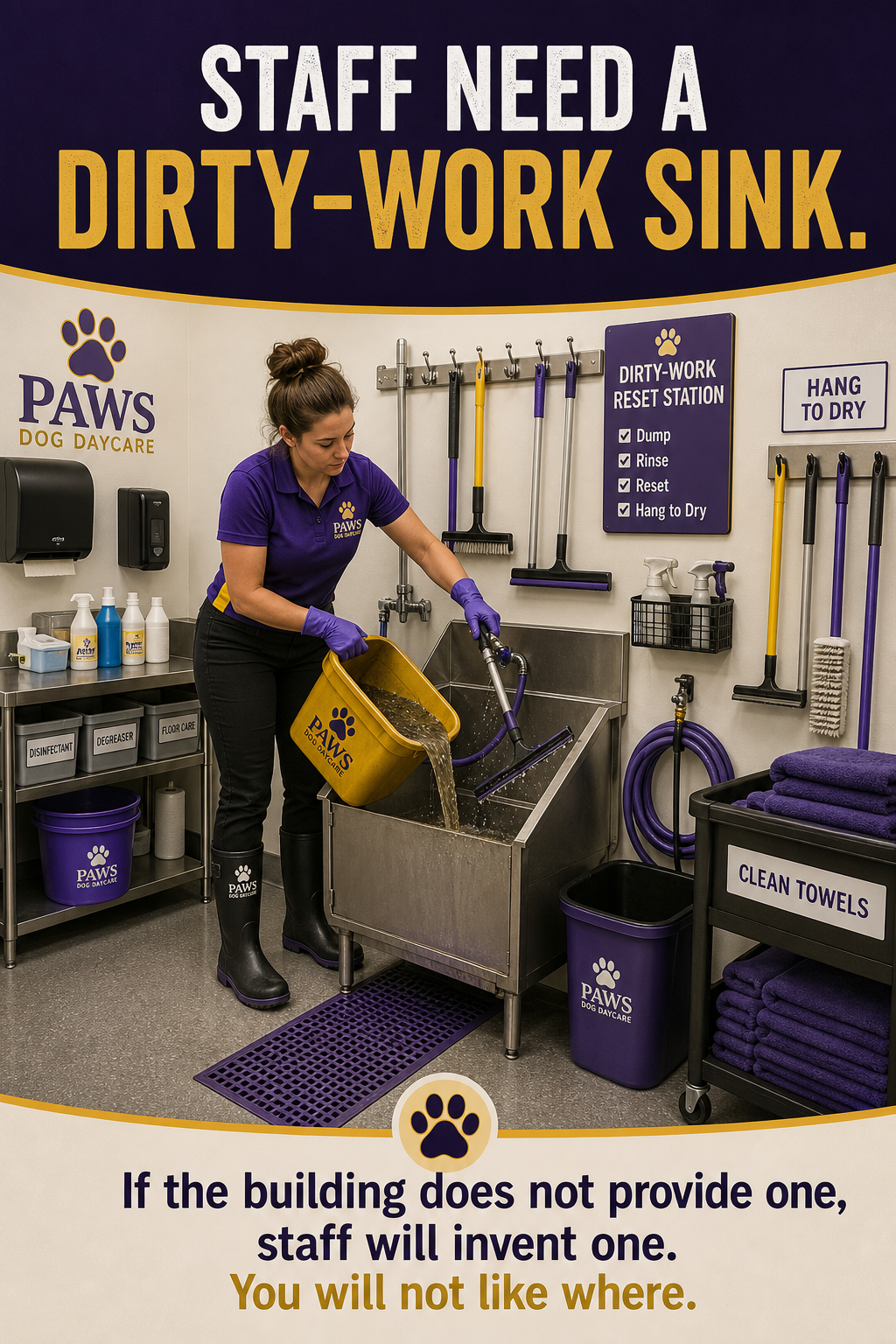
Mop sinks and utility sinks are not glamorous, but they save a facility from disgusting staff improvisation. Staff need a place to fill buckets, dump dirty water, rinse squeegees, wash scrub brushes, clean mop heads, rinse dustpans, and deal with wet tools without contaminating customer or staff hygiene areas.
If staff do not have a dirty-work sink, they will invent one. You will not like where they invent it. Customer restroom sinks, grooming tubs, laundry machines, outdoor hose areas, and random floor drains become the backup plan when the building does not provide a real cleaning reset point.
A good cleaning area should also think about towel flow, chemical storage, ventilation, drying racks, trash, gloves, paper towels, and where wet equipment goes before it becomes a smell source.
🛁
Grooming and Dog Wash Plumbing
A dog wash is not just a tub.
A dog wash is hair, water, mud, shampoo, towels, shaking dogs, wet floors, and plumbing that gets tested every day. The tub drain is only one part of the system. The room also needs floor protection, wall protection, drying logic, humidity control, storage, towel flow, and a way to keep hair from turning the drain line into a felt sculpture.
Hair traps and interceptors matter in grooming areas. The easier they are to reach and clean, the more likely staff will actually maintain them. Top-access hair traps are often more realistic for daily operation than anything that requires crawling around under a tub when everyone is busy.
Hot water capacity matters too. A grooming area can burn through hot water quickly if the building was never planned for dog baths. Do not let the lease tour version of “there is plumbing” trick you into thinking the plumbing is useful for grooming volume.
⚠️
Grooming drain warning
Dog hair is plumbing confetti from hell. If the system does not catch it before it goes deep into the line, the plumber will eventually meet your shampoo schedule.
🧻
Hair, Mud, Solids, and Drain Clogs
The drain is not a garbage disposal for daycare sludge.
Dog daycare drains see a ugly mix of water, urine, hair, dirt, mud, disinfectant, fecal residue, food, treats, toy pieces, bedding bits, paper towels, wipes, leaves, and whatever the dogs managed to drag into the room. That does not mean all of it belongs in the plumbing.
Staff need a solids-first rule. Pick up feces. Remove toy pieces. Sweep or collect loose hair where practical. Empty baskets. Clean strainers. Do not use the drain as a trash can just because the hose can push the evidence out of sight.
Out of sight is not gone. Sometimes it is just waiting in the line.
🐾
Solids rule
If it would gross you out to pull it back out of the drain basket, do not casually hose it into the drain line and act surprised when the system complains later.
👃
Sewer Gas, Dry Traps, and Mystery Odor
Sometimes the building does not smell like dogs. Sometimes it smells like plumbing nobody has checked.
Drains have traps for a reason. When traps dry out, fail, get installed wrong, or are connected into a poor plumbing situation, sewer gas and drain odor can start showing up in the building. Staff may keep cleaning harder while the real issue is below the floor.
Unused drains can become odor sources. Dirty trench channels can smell. Open seams can hold urine. Concrete around failed drain joints can absorb odor. Hair and sludge sitting in a line can smell like the dogs committed a felony even after the room was cleaned.
Do not let every odor complaint become “the staff did not clean.” Sometimes the cleaning is fine and the plumbing needs attention.
➡️
Dirty Water Should Not Cross Clean Areas
Clean flow and dirty flow should not be playing chicken in the hallway.
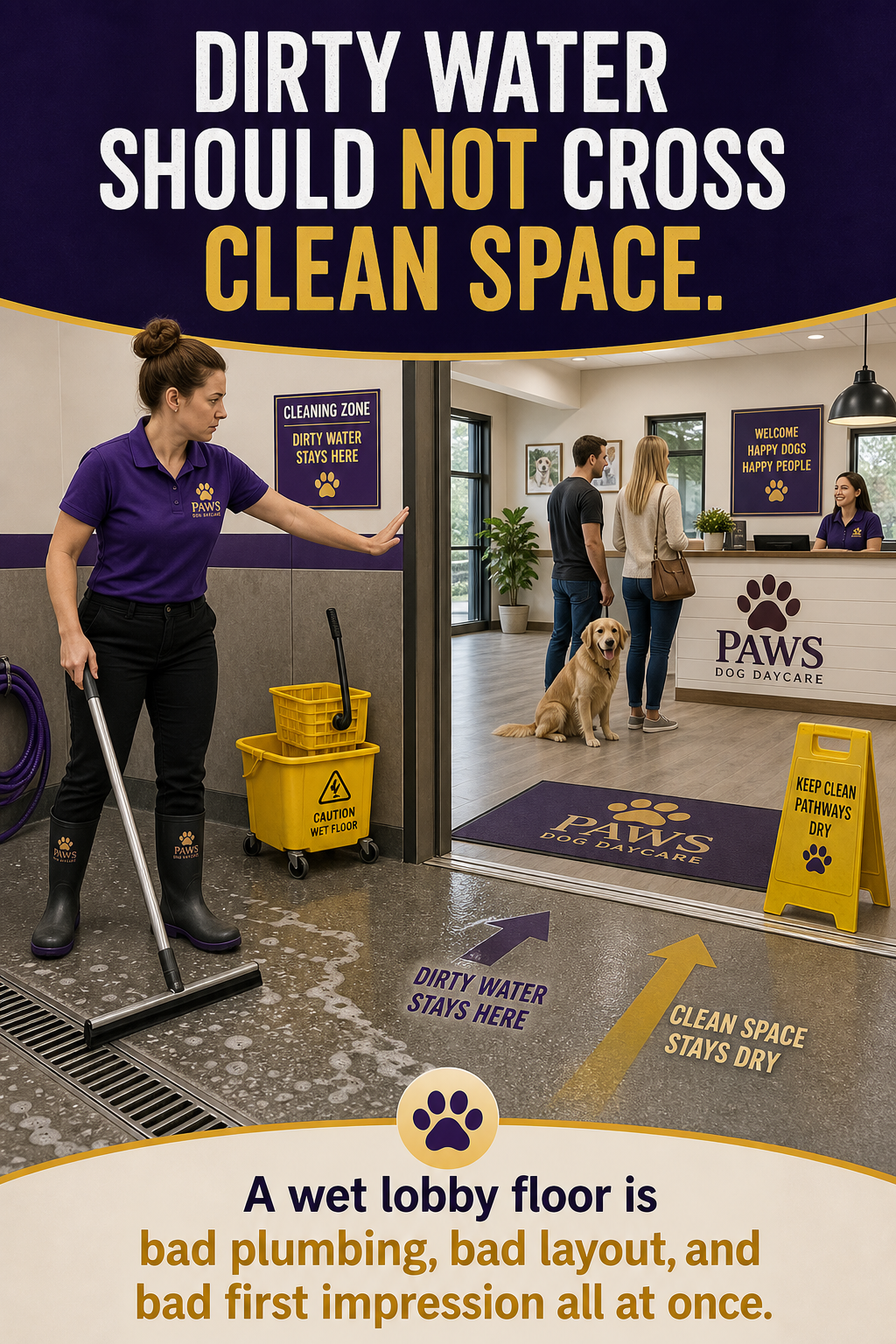
Think about where dirty water travels. Does playroom wash water move toward the lobby side? Do mop buckets get carried through reception? Does grooming mess move through a boarding hallway? Do hoses cross customer paths? Does outdoor mud enter through the same route customers use for tours?
Every dirty-water crossover creates more cleaning, more odor risk, more slip risk, and more customer perception risk. A customer may not understand plumbing, slope, or trench drains, but they understand a wet lobby floor, a mop bucket in the wrong place, and a hallway that smells like somebody lost a fight with a wet dog.
⚠️
Route warning
If the only way to clean the dog area is to drag dirty water through clean space, the building layout is charging you rent and payroll at the same time.
💸
Bad Drainage Steals Payroll
A bad cleaning route does not just annoy staff. It costs money every day.
A small drainage mistake becomes a daily labor leak. Extra squeegee time, extra mop runs, extra hose dragging, extra puddle checks, extra odor complaints, extra plumber visits, and extra staff frustration all come from building details that looked boring during construction.
Swipe left/right to see the full table.
| Bad Building Detail | Daily Result | Business Cost |
|---|---|---|
| No slope to drain | Puddles, repeated squeegee work, slow drying. | Labor waste, odor risk, slip risk, bad tours. |
| Trench drain without cleaning access | Hair and gunk sit inside the channel. | Odor, clogs, staff avoidance, plumber calls. |
| No nearby hose access | Staff drag hoses through other areas or use buckets. | Longer cleaning cycles and higher frustration. |
| No mop sink or dirty-work sink | Staff dump or rinse tools wherever they can. | Sanitation shortcuts, dirty restrooms, bad habits. |
| No hair trap in grooming | Hair reaches traps, lines, and sewer/septic path. | Clogs, slow drains, downtime, emergency plumbing. |
| Dirty water crosses clean areas | Wet paths through hallways, lobby, or staff zones. | More cleaning, more risk, worse customer impression. |
| Poor drying and ventilation | Rooms stay damp after cleaning. | Stale odor, surface wear, customer complaints. |
📄
Lease, Code, Sewer, Septic, and Contractor Limits
Plumbing is where wishful thinking meets permits.
Dog daycare plumbing decisions can be limited by the lease, landlord approval, concrete slab, sewer connection, septic system, grease/waste requirements, local plumbing code, floor elevation, existing drain lines, venting, permits, and whether the building was ever designed for wet animal-care use.
Do not assume “the building has plumbing” means “the building can support dog daycare cleaning.” A customer restroom, a tiny janitor sink, and one old floor drain in the wrong place do not equal a cleaning system.
Bring the plumber, contractor, landlord, and code people into the conversation before you build walls, coat floors, install kennels, or sign off on a layout. Drainage and kennel layouts should be coordinated so walls, gates, partitions, floor coating, and slope do not block water from reaching the drain.
⚠️
Approval warning
This page helps you ask better questions. It does not replace your plumber, contractor, landlord, architect, sewer authority, code official, fire marshal, health department, or local inspector.
🧠
The Drain Is Not the Plan
A drain is only the last stop. The real question is whether the whole room helps water, hair, waste, staff, and cleaning tools move the right direction.
A lot of new dog daycare owners look at a building and think, “Good, it has a floor drain.” That is a start, but it is not a cleaning system. A floor drain by itself does not mean water will reach it. It does not mean hair will be caught before it enters the line. It does not mean staff can remove the grate, clean the channel, flush the trap, reach a cleanout, or dry the room before dogs come back in.
The drain is only one part of the system. The system includes floor slope, drain placement, grate design, hose access, mop sink access, hair and solids control, cleanout access, trap maintenance, ventilation, drying time, staff route, dirty-water route, door thresholds, wall-to-floor seams, and whether the plumber can service the line without tearing up half the business.
Installing a drain and calling it a cleaning plan is like buying a leash and calling yourself a dog trainer. It might be involved, but it is not the whole job.
The better way to think about it is simple: where does the mess start, where does the water go, what gets caught before it reaches the pipe, who cleans the drain, and how does the room dry afterward?
⚠️
Operator warning
If the building only has “a drain somewhere,” staff may still spend years pushing water uphill, chasing puddles, fighting odor, and apologizing for wet floors during tours.
🪠
The Stuff That Clogs Before the Plumbing Even Gets a Vote
Dog daycare drains do not just handle water. They get tested by everything the dogs, staff, weather, grooming room, and cleaning routine throw at them.
Dog hair is obvious, but it is not the only problem. Dog daycare drains can see mud, fecal residue, food, gravel, toy pieces, tennis ball fuzz, mop strings, paper towels, wipes, bedding fibers, grooming sludge, shampoo residue, outdoor yard debris, and whatever mystery object a dog proudly carried into the room like it had a job title.
This is why “just hose it down” is not a cleaning policy. Staff should remove solids first, then rinse what the drain system is actually designed to handle. If every cleaning cycle starts by blasting all debris toward the drain, the drain is being used as a trash can with plumbing attached.
That shortcut may feel faster during closing. It may even look fine for a little while. Then one day the line slows down, the room starts holding water, the trench smells like a wet basement with opinions, and the owner gets to learn what emergency plumbing costs after hours.
The goal is not to baby the drain. The goal is to design the room so normal staff behavior does not destroy the plumbing. Good drain planning assumes tired staff, busy mornings, shedding dogs, wet weather, sick dogs, rushed closings, and the occasional “how did that even get in there?” moment.
Swipe left/right to see the full table.
| Drain Enemy | Where It Comes From | What To Plan |
|---|---|---|
| Dog hair | Grooming, bathing, shedding daycare dogs, boarding cleanup. | Hair baskets, strainers, interceptors, removable grates, staff cleaning schedule. |
| Fecal residue and solids | Accidents, kennel cleaning, sick dogs, outdoor tracking. | Solids picked up before rinsing, staff procedure, drain protection, cleanouts. |
| Mud and grit | Outdoor yards, rainy days, gravel lots, grass-to-building transitions. | Entry rinse strategy, mud control, floor mats where appropriate, serviceable drain access. |
| Toy pieces and tennis ball fuzz | Playrooms, boarding runs, enrichment items, chewers. | Pickup before washdown, staff room checks, baskets or strainers before deeper plumbing. |
| Paper towels and wipes | Staff shortcuts, cleanup carts, customer areas, grooming. | Trash placement, training, clear “do not rinse this” rules. |
| Shampoo and grooming sludge | Bathing tubs, self-wash, grooming rinse areas. | Hair interception, proper tub plumbing, cleaning access, plumber-approved drain design. |
👃
Cleanouts, Trap Seals, and Sewer Gas: The Boring Stuff That Becomes the Smell
When a room smells dirty right after it was cleaned, quit arguing with the mop bucket and start asking plumbing questions.
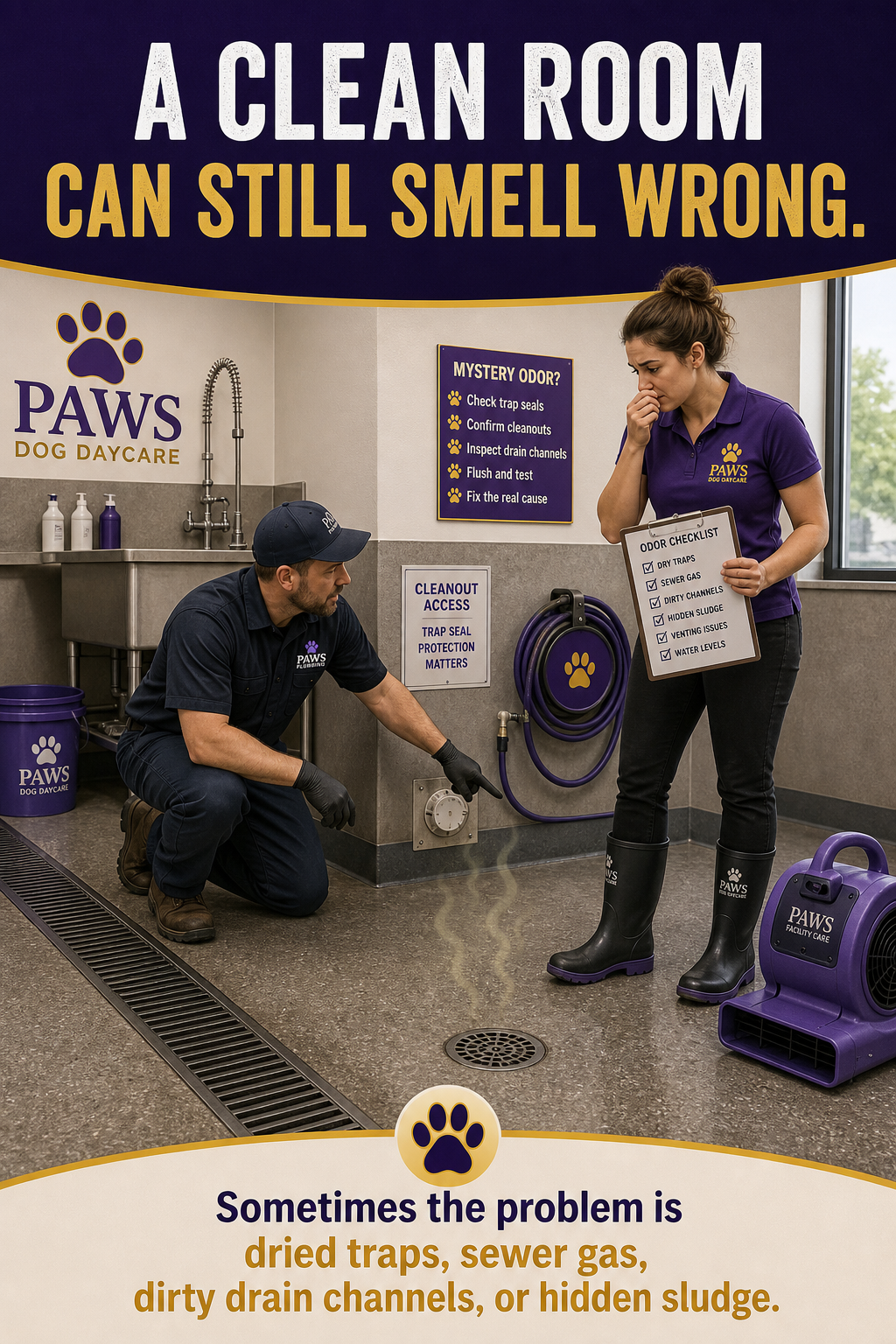
Some odor problems are cleaning problems. Some are porous-floor problems. Some are wall-seam problems. But some are plumbing problems, and those can fool a new owner because the surface may look clean while the drain system is quietly causing the stink.
Floor drains and trench drains usually need traps. Those traps are supposed to help block sewer gas from coming back into the building. If a trap dries out, loses its seal, is poorly maintained, or is connected into a bad system, the room can smell wrong even when staff just cleaned it.
Low-use drains can be especially sneaky. A drain in an isolation room, utility room, corner wash area, or old converted space may not get regular water flow. If nobody knows whether the trap is protected, maintained, or flushed properly, the drain can become an odor source that gets blamed on dogs, staff, disinfectant, or “that one room.”
Cleanouts matter for the same reason. Dog daycare plumbing is not delicate office plumbing. Hair, sludge, mud, toy pieces, and solids can create slow drains and backups. If the plumber cannot access the line in a sane way, the business may end up paying for guesswork, wall cuts, slab cuts, or repeated service calls.
This is where the owner does not need to become a plumber. The owner needs to ask plumber-level questions before committing to the layout.
- Where are the traps for each floor drain, trench drain, tub, mop sink, and floor sink?
- Are any traps at risk of drying out during low-use periods?
- Does the plumber recommend trap primers, trap seal protection, or a maintenance routine?
- Where are the cleanouts for dog-use drain lines?
- Can a plumber reach the line without destroying finished floors, walls, kennels, or coated surfaces?
- If the room smells after cleaning, what plumbing issues should be checked before blaming staff?
⚠️
Smell warning
A clean-looking room with a bad drain smell is not “just dog odor.” It may be dried traps, dirty drain channels, hidden sludge, sewer gas, failed seals, or poor drying.
🏢
Room-by-Room Drain Risk
The right drain question changes by room. A playroom, grooming room, lobby, and boarding run do not fail the same way.
A good dog daycare building does not treat every room like the same wet box. Some rooms need fast washdown. Some need hair control. Some need dry customer movement. Some need odor control. Some need staff to reset equipment without dragging dirty water through the building.
This is where a lot of remodels go sideways. The owner asks, “Does it have a drain?” instead of asking, “Does this room have the right cleaning route for how this room will actually be used?”
Swipe left/right to see the full table.
| Room / Area | Best Drainage Question | Common Mistake | What Staff Pays For Later |
|---|---|---|---|
| Daycare playroom | Can staff rinse, squeegee, and dry the room without pushing water into customer or clean dog areas? | One drain in the wrong corner with flat flooring. | Daily puddles, odor, longer closing, wet dog returns. |
| Boarding runs | Does waste water move away from dogs, bedding, doors, and staff walking paths? | Drain placement that makes staff spray through or across the run. | More laundry, more smell, more kennel reset time. |
| Grooming | Where does hair get caught before it reaches deeper plumbing? | Trusting a small tub strainer to handle commercial grooming volume. | Slow drains, clogged traps, messy shutdowns, plumber calls. |
| Bathing / self-wash | Can the wet floor around the tub drain and dry safely? | Thinking tub drainage solves the whole wet-room floor. | Slippery floors, damp walls, wet customer paths. |
| Isolation / sick dog space | Can this room be cleaned without spreading dirty water into the rest of the facility? | Using a leftover room with no clean dirty-water route. | Cross-contamination risk, staff shortcuts, odor complaints. |
| Lobby / customer path | How do dogs, shoes, leashes, rain, and mud enter without turning the lobby into a wet floor sign display? | No transition plan between outside, dog areas, and reception. | Bad first impression, slip risk, constant mop work. |
| Outdoor yard entry | Where does mud stop before it reaches the building? | Letting the outside yard drain problem become an indoor cleaning problem. | Tracked mud, drain grit, dirty hallways, faster floor wear. |
| Laundry / utility room | Can staff dump, rinse, and reset dirty tools without using customer or hygiene sinks? | No mop sink or dirty-work sink in a practical location. | Dirty restrooms, bad habits, slower cleaning resets. |
💧
The Before-You-Sign-the-Lease Water Test
A lease tour with dry floors is a magic show. Bring water into the conversation before the dogs do.
Before signing a lease or approving a build-out, walk the building with the landlord, contractor, plumber, and your actual cleaning routine in mind. Do not just look at the floor. Think like closing staff at 7:30 p.m. after a rainstorm, three accidents, a grooming hair explosion, and one dog that thought the mop bucket was a personal challenge.
Ask whether you can test or verify slope. In some buildings, a small amount of water or a level check can reveal the truth quickly. Water should move where the plan says it will move. If it sits under gates, runs toward the lobby, collects near wall seams, or stops in the middle of the room, the building is already arguing with your cleaning plan.
This does not mean flooding the property during a showing. It means getting permission, involving the right people, and refusing to rely on hope. A dry empty room can hide bad slope, low spots, clogged lines, inaccessible drains, unprotected traps, and cleaning routes that only make sense on paper.
- Ask where wash water will start, travel, and end in each dog-use room.
- Check whether the floor slopes toward the drain or simply looks flat and hopeful.
- Look for low spots near gates, thresholds, corners, walls, and kennel fronts.
- Ask whether trench drain channels have internal slope, not just a long opening in the floor.
- Ask whether drain grates are removable, secure, paw-safe, and realistic for staff to clean.
- Find the cleanouts before the first clog teaches everyone where they should have been.
- Ask whether traps are protected from drying out or causing sewer-gas odor.
- Confirm whether grooming, bathing, and dog wash areas need hair interception.
- Confirm hot water capacity for real bathing volume, not one polite dog every now and then.
- Get landlord approval in writing for slab cuts, new drains, hose bibs, mop sinks, floor coating, and plumbing changes.
⚠️
Lease warning
If the landlord says “that should be fine,” politely convert that sentence into written approval, contractor review, plumber review, permit review, and lease language before spending build-out money.
✂️
Grooming and Bathing Plumbing Need Their Own Plan
Grooming hair does not disappear. It either gets caught where staff can clean it, or it gets caught where a plumber can bill you for finding it.
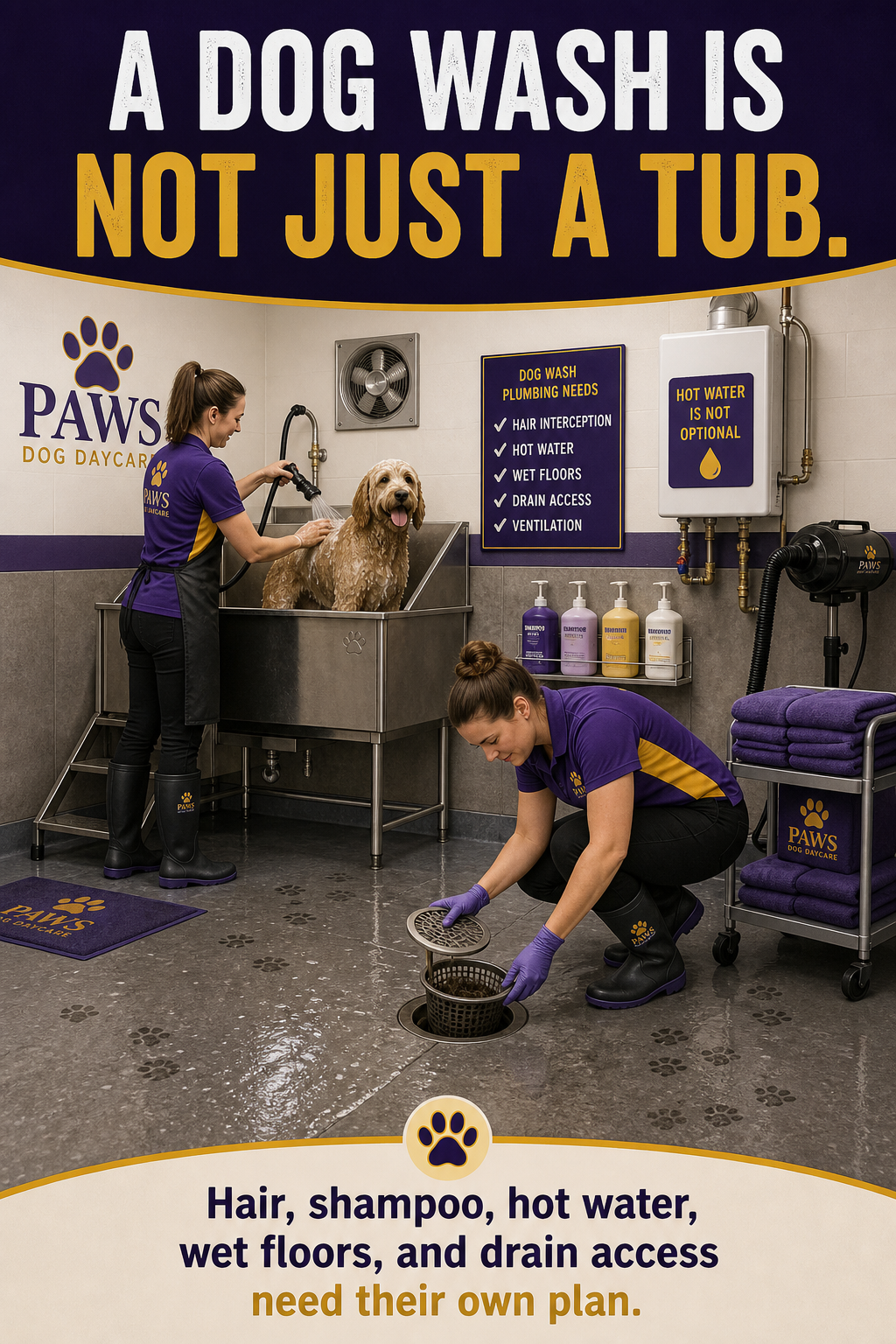
Grooming and bathing areas are not just “wet rooms.” They create a different kind of plumbing load than a normal playroom. You are dealing with hair, shampoo, conditioner, loose undercoat, nail dust, towel lint, dirty paws, sometimes mud, sometimes flea/tick mess, and sometimes a dog that shakes half the tub onto the floor before staff can blink.
A basic tub screen may help, but commercial grooming volume can overwhelm weak planning fast. If grooming is part of the business model, ask the plumber about hair interception, drain sizing, cleanable baskets, accessible traps, cleanouts, hot water recovery, tub placement, floor drainage around the tub, wall protection, electrical protection, and how staff will clean the area between appointments.
The floor around the tub matters too. A tub drain does not magically dry the wet floor around the tub. Staff still need a place for water to go when dogs shake, step out, drip, back up, or turn bath time into a small indoor weather event.
If self-wash is involved, be even more careful. Customers do not clean like trained staff. They miss hair. They drop towels. They overuse product. They leave strainers full. They let water go where water should not go. A self-wash area needs to be designed for real customer behavior, not the imaginary customer who reads every sign and respects plumbing like a sacred object.
- Does grooming have a hair trap, interceptor, basket, strainer, or plumber-approved hair control method?
- Can staff clean the hair-control device quickly without crawling, disassembling half the room, or skipping it because it is miserable?
- Is there a floor drain or wet-floor plan around the tub?
- Is hot water capacity realistic for the number of baths, groom dogs, daycare baths, and boarding exit baths?
- Are outlets, cords, dryers, tables, and equipment protected from wet-floor workflow?
- Does the room have ventilation and drying support so damp grooming odor does not spread?
📆
A Simple Drain Maintenance Schedule Keeps Problems From Becoming Traditions
Bad drain habits do not usually explode on day one. They quietly become “how we do things here” until the building smells like regret.
Dog daycare drain maintenance does not need to be fancy, but it does need to exist. If drain care is not assigned, scheduled, and inspectable, it becomes one of those invisible jobs everyone assumes someone else did.
The owner should work with the plumber, contractor, chemical supplier, and local rules to build the actual maintenance plan. But from an operator standpoint, every wet dog-use area needs a routine for solids removal, hair removal, grate checks, drain-channel cleaning, drying, odor checks, and slow-drain reporting.
The most dangerous phrase in this area is “we’ll just keep an eye on it.” Nobody keeps an eye on a drain during pickup chaos, lunch rotations, barking, tours, phone calls, bathing appointments, staff breaks, and closing. Put the work on a checklist or it will vanish.
Swipe left/right to see the full table.
| Frequency | What To Check | Why It Matters |
|---|---|---|
| Every cleaning cycle | Pick up solids before rinsing. Check that water reaches the drain. Remove obvious hair, toy pieces, paper, and debris. | Prevents staff from using the drain as a garbage disposal. |
| Daily | Squeegee standing water, check wet walking paths, inspect grates, confirm rooms dry before reuse where practical. | Reduces odor, slip risk, damp dog smell, and surface wear. |
| Weekly | Clean accessible grates, baskets, strainers, hair traps, trench channels, and mop sink area. | Catches the gross stuff before it becomes a clog or smell complaint. |
| Monthly | Inspect wall-to-floor seams, low spots, slow drains, recurring puddles, and odor near drains. | Finds layout and maintenance failures before they become normal. |
| As needed | Call the plumber for repeated slow drains, sewer-gas smell, backups, mystery odor, or drains that suddenly behave differently. | Repeated drain problems are not “just part of owning dogs.” They are warning signs. |
| Before build-out changes | Review drain location, cleanouts, trap protection, sewer/septic capacity, slope, and access before walls, gates, kennels, or coatings lock the plan in place. | It is cheaper to ask boring questions before concrete, coating, and kennels make them expensive. |
🧾
Questions to Ask the Plumber and Contractor Before the Room Is Finished
You do not need to sound like a plumber. You need to ask the questions that stop expensive surprises.
A good contractor or plumber should not be offended by practical questions. Dog daycare is not a normal office build-out. It is wet animal care, staff washdown, odor control, customer perception, hair control, and daily cleaning labor all stacked on top of each other.
The goal is to get the ugly details discussed before the pretty finishes go in. Once the floors are coated, walls are built, kennels are anchored, and customers are touring the space, every missed plumbing question gets more expensive.
- What drain type do you recommend for each dog-use room, and why?
- What slope is needed so water actually reaches the drain?
- Will the drain channel itself slope properly, or only the floor around it?
- Are the grates removable, secure, paw-safe, and flush enough to avoid trip and dog-foot problems?
- Where will hair, mud, solids, and debris be caught before they enter deeper plumbing?
- Where are the cleanouts, and can they be accessed after kennels, gates, walls, and equipment are installed?
- Are traps protected from drying out, sewer-gas odor, or low-use problems?
- Does grooming or bathing need a hair interceptor or other hair-control device?
- Can the sewer or septic system handle the expected dog daycare, boarding, grooming, laundry, and cleaning use?
- Is hot water capacity enough for grooming, bathing, laundry, cleaning, and daily operations?
- Where should hose bibs, hose reels, mop sinks, and utility sinks go so staff do not drag dirty water across clean areas?
- What permits, inspections, landlord approvals, or code limitations apply before work starts?
⚠️
Finish-work warning
Do not let beautiful floors, fresh walls, and new gates hide a plumbing layout that staff will hate every single night.
✅
Dog Daycare Drains and Cleaning Flow Checklist
Walk the building with this list before you trust the plumbing.
- Does every dog-use room have a clear dirty-water route?
- Does the floor actually slope toward the drain?
- Does the trench drain have slope inside the channel?
- Are trench drain grates removable for cleaning?
- Are grates secure enough that dogs cannot easily lift or pull them loose?
- Are grate openings paw-safe for the dogs using the space?
- Is there a basket, strainer, hair trap, catch basin, or other way to stop hair and solids?
- Are there cleanouts near dog-use drain lines?
- Can a plumber reach the line if a toy, tennis ball, or sludge clog gets into the system?
- Is hose access placed where cleaning actually happens?
- Are hose reels or storage planned so hoses do not cross walkways?
- Is there a mop sink or utility sink for dirty water and tool reset?
- Does grooming have hair interception before hair reaches deeper plumbing?
- Does the dog wash area have enough hot water capacity for real use?
- Are traps, sewer gas, unused drains, and odor risks part of the maintenance plan?
- Does dirty water stay away from the lobby, customer path, clean storage, and clean dog movement routes?
- Are wall-to-floor seams protected where wash water will hit?
- Are electrical outlets, covers, and equipment protected in wet/wash-down areas?
- Has the landlord approved drain, plumbing, floor, and wall changes in writing?
- Has a plumber confirmed code, venting, sewer/septic capacity, cleanouts, and permit issues?
❓
Dog Daycare Drains, Plumbing, and Cleaning Flow FAQ
Quick answers for owners trying to avoid building a daily cleaning problem.
Are trench drains better than floor drains for dog daycare?
Often, yes, in playrooms, kennel areas, and wash-down routes because they give staff a long target for water. But a trench drain still needs floor slope, internal channel slope, removable grates, cleaning access, hair control, sealed joints, and cleanouts. A bad trench drain is just a long dirty problem.
Are regular floor drains useless?
No. Floor drains can work well in bathrooms, small wet rooms, mop rooms, utility rooms, and areas where the floor truly slopes to the drain. They fail when people expect one small point drain to solve a whole room with bad slope.
What is the biggest dog daycare drain mistake?
Treating the drain like magic. The building needs slope, water access, a dirty-water route, removable cleaning access, hair and solids control, cleanouts, and staff procedures.
Do trench drains need removable grates?
Yes, in practical dog-use areas. Staff need to access hair, gunk, strainers, baskets, and the channel. If the grate cannot be removed or cleaned realistically, the drain becomes an odor and clog risk.
Can dogs pull up drain grates?
Some dogs will absolutely test anything they can grab with teeth or paws. Grates need to be secure, appropriate for dog traffic, and designed so dogs cannot easily lift, pry, chew, or move them.
Why do cleanouts matter so much?
Dog areas create unpredictable drain problems. Hair, mud, sludge, fecal residue, toy pieces, and even tennis balls can end up where they do not belong. Cleanouts give plumbers access without destroying half the building to find the clog.
Should every dog-use drain have a cleanout nearby?
That is the practical operator direction I would push for. Let the plumber confirm the exact design, but dog-use drains should not be mystery lines with no sane access when they clog.
What about hair traps in grooming?
Grooming drains need hair interception. Dog hair will clog traps and lines if the system is not designed to catch it. The trap also needs to be easy enough to clean that staff actually clean it.
Can I hose everything into the drain?
No. Drains are not garbage cans. Pick up solids first. Remove toy pieces, feces, heavy hair, mud clumps, wipes, paper towels, and debris before rinsing. Only rinse what the drain system is designed to handle.
Why does a clean room still smell bad?
The problem may be plumbing, not cleaning. Dry traps, dirty trench channels, hair and sludge, sewer gas, failed drain joints, urine in porous concrete, and wet seams can create odor even when the surface looks clean.
Does a dog daycare need a mop sink?
It should have a dirty-work sink or utility sink somewhere practical. Staff need a place to dump dirty water, fill buckets, rinse tools, and reset cleaning equipment without using customer or staff hygiene sinks.
What should I check before signing a lease?
Check drain locations, slope, sewer/septic capacity, cleanouts, hose access, mop sink access, grooming plumbing, landlord approval, code limits, concrete slab limits, and whether dirty water can move without crossing clean customer areas.
🐾
The Bottom Line: The Building Either Helps Staff Clean or Fights Them Every Day
Drains are not just holes in the floor. They are part of the labor system.
The best drain setup depends on the room, dogs, floor slope, cleaning method, hair load, grooming volume, hose access, sewer/septic limits, landlord approval, and how staff actually clean the building.
Floor drains can work. Trench drains can work. Slot drains can work. Dog wash drains can work. But none of them work well if water cannot reach them, staff cannot clean them, hair goes straight into the line, grates cannot be removed, cleanouts are missing, or dirty water has to cross clean space.
Build the cleaning route before the dogs arrive. Water will find the truth.
Complete Digital Manual
Build the Dog Daycare Before the Dogs Find the Cheap Parts
Floors, walls, gates, drains, HVAC, doors, trim, outdoor yards, boarding suites, cleaning flow, odor control, staffing, insurance, forms, pricing, and customer expectations all connect. The complete PAWS Dog Daycare Start-Up Manual helps organize the business before the build-out budget turns into a repair budget.
- Instant digital download after checkout.
- No physical product is shipped.
- Built around real-world dog daycare operating experience.
- Useful for startup planning, facility design, materials, pricing, operations, safety, marketing, staffing, insurance planning, and risk control.