Puppy Socialization • Daycare Readiness • Confidence Building • Safe Exposure • Puppy Classes • Behavior Prevention • Adult Dog Stability
How to Socialize a Puppy for Daycare, Public Life, and Adult Stability
Socialization is not dragging a puppy through the world like a tiny emotional crash-test dummy.
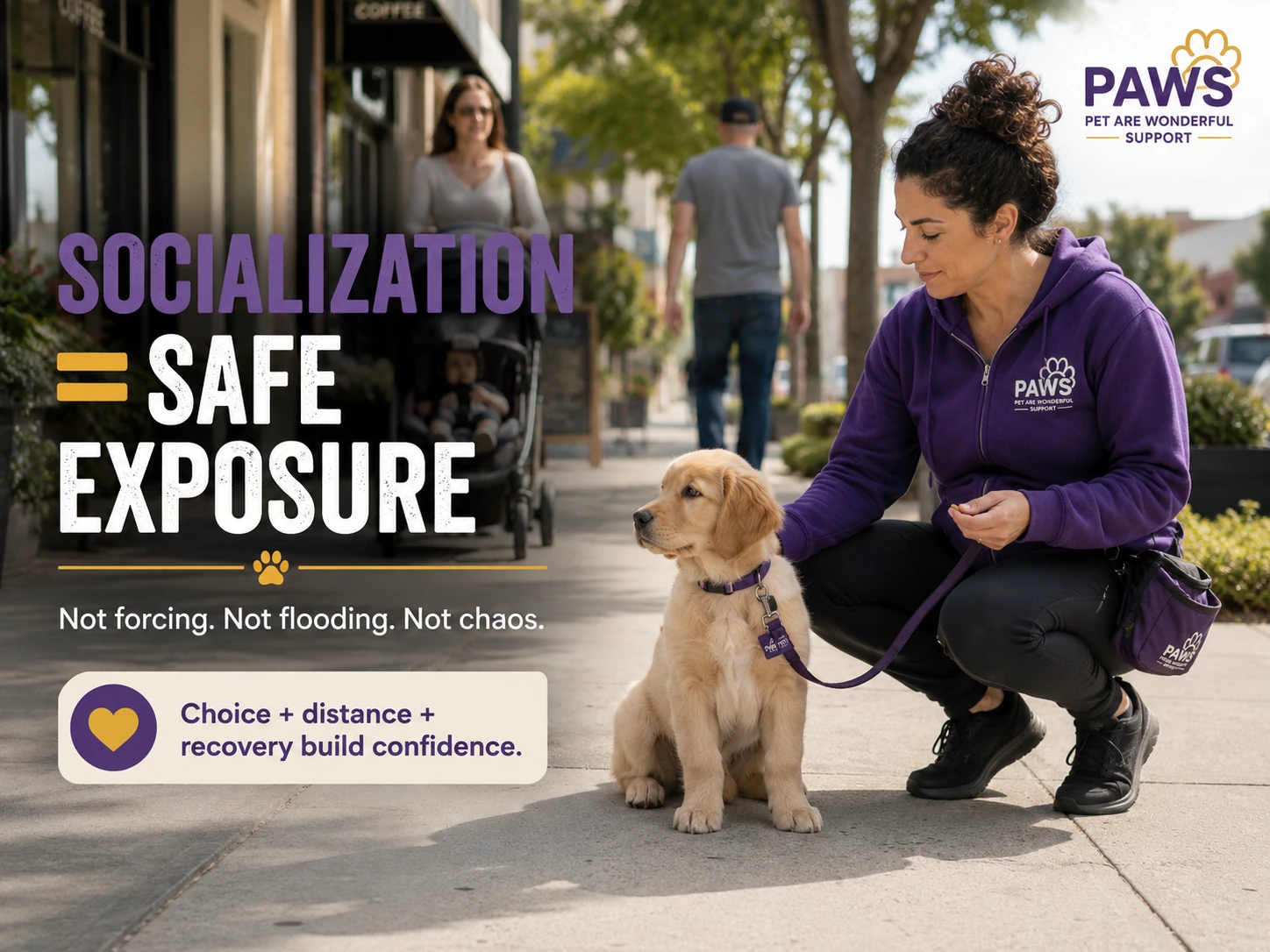
The goal of puppy socialization is not to create a dog that loves every person, every dog, every noise, every surface, every car ride, every grooming table, every lobby, and every strange object like the world is one giant birthday party. That is not realistic, and it is not even necessary.
The goal is to create an adult dog that can notice new things without falling apart. A well-socialized dog can see a stroller, hear traffic, walk past another dog, ride in the car, visit the vet, meet a guest, stand on a different surface, tolerate normal handling, and recover from surprise without melting into fear, panic, defensive barking, frantic jumping, or teeth.
Puppy socialization is controlled, positive, age-appropriate exposure. It is not flooding. It is not forcing. It is not taking a half-vaccinated puppy to the dog park and hoping the universe is feeling generous. It is not letting every stranger grab the puppy’s face. It is not throwing a puppy into an adult daycare group and calling it “learning.”
Done well, socialization helps produce a calmer, safer, more confident adult dog. Done badly, it can create the exact dog everyone later complains about: fearful, reactive, overexcited, defensive, rude, mouthy, anxious, noisy, unable to recover, or impossible to handle in public.
📌
Core rule
Socialization is not exposure volume. It is the puppy having repeated safe experiences with the world at a level the puppy can handle, paired with food, play, calm handling, distance, choice, and recovery.
🗺️
Use This Page Like a Puppy Socialization Road Map
The goal is not “more exposure.” The goal is better exposure, better timing, better recovery, and fewer dumb mistakes.
🍼
Before 8 Weeks
Socialization starts with the breeder, foster, shelter, or rescue before the new owner ever gets the puppy.
🧬
What Socialization Cannot Fix
Genetics, health, trauma, pain, and temperament still matter. Puppies are not blank slates.
🌎
What to Expose To
People, sounds, surfaces, handling, grooming, cars, crates, and calm observation.
🔁
Keep It Going
Socialization does not end at 16 weeks. Adolescence can test everything.
🧠
What Puppy Socialization Really Means
Socialization is the puppy learning that normal life is safe, manageable, and not worth panicking over.
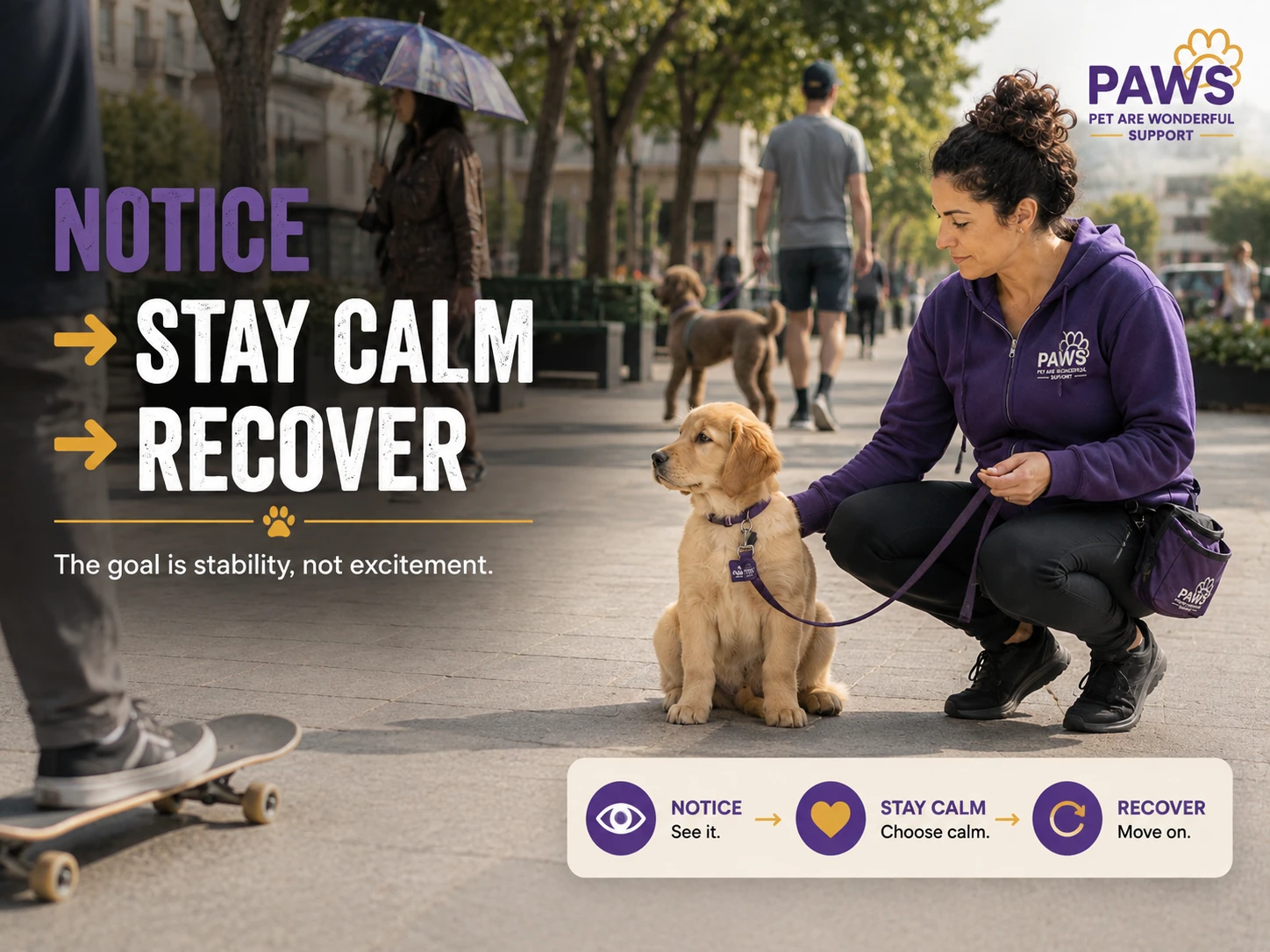
A lot of people use the word socialization like it means “meet more dogs.” That is too narrow. A puppy can meet a hundred dogs and still become a disaster if every meeting is chaotic, scary, rude, overwhelming, or uncontrolled.
Puppy socialization means carefully introducing the puppy to the kinds of people, animals, places, surfaces, sounds, handling, movement, confinement, grooming, and everyday weirdness the dog will experience as an adult. The puppy should learn that new things are normal, not threatening, and not automatically exciting enough to lose his tiny mind.
The emotional outcome matters more than the exposure count. A puppy who watches a jogger from a comfortable distance while eating treats may be learning more than a puppy who is dragged into a crowd, grabbed by strangers, barked at by another dog, and then called “socialized” because technically he was there.
Good socialization creates confidence and recovery. Bad socialization creates fear, suspicion, hyperarousal, defensive behavior, avoidance, or learned rudeness. The puppy is not just seeing the world. The puppy is deciding what the world means.
The useful sequence is notice, stay regulated, and recover. The puppy may look at the new thing, take information, return attention to the handler, sniff, eat, move away, or settle. The puppy does not have to approach or perform enthusiasm for the experience to count.
Owners should judge progress by changes across repeated sessions: shorter startle, faster recovery, softer posture, greater curiosity, and less need for distance. Counting how many strangers touched the puppy or how many dogs the puppy met measures activity, not emotional learning.
📌
Operator translation
Socialization is not “the puppy survived the experience.” Socialization is “the puppy left the experience feeling safe enough to handle it better next time.”
🧬
What Socialization Cannot Fix by Itself
Socialization matters, but puppies are not empty hard drives waiting for humans to install personality.
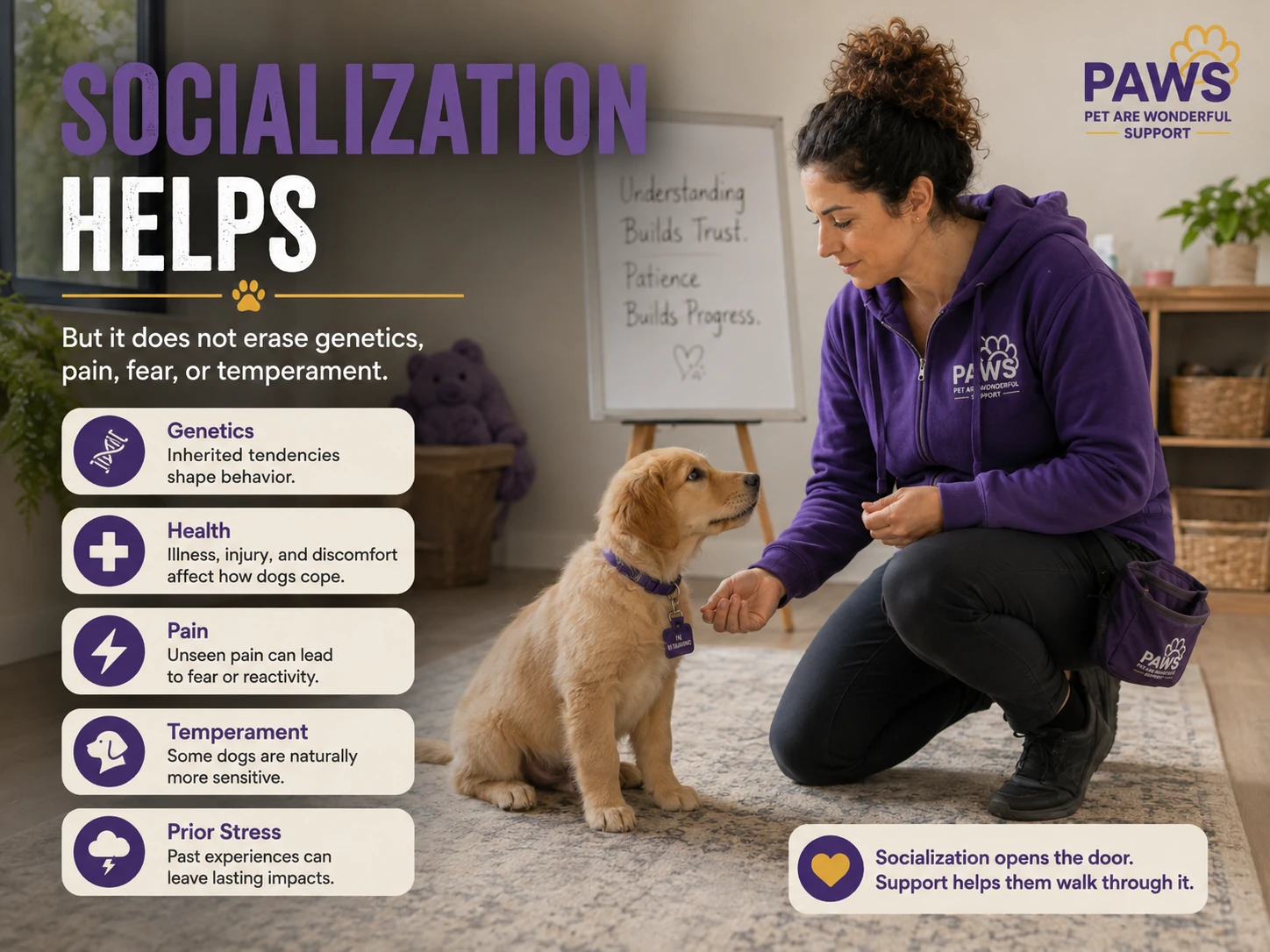
Good socialization is powerful, but it is not magic. Genetics matter. Breed tendencies matter. The mother’s behavior and health matter. Early nutrition matters. Early environment matters. Pain, illness, parasites, poor sleep, trauma, isolation, and repeated frightening experiences can all affect how a puppy learns and responds.
This matters because owners sometimes blame themselves for every fear response, and other owners pretend socialization will fix anything if they just expose the puppy hard enough. Both are wrong. A shy puppy may become more confident, but may never become the dog who wants strangers grabbing him at a festival. A high-arousal puppy may improve, but may still need careful structure. A fearful puppy may need professional support instead of more random exposure.
Good socialization gives the puppy the best chance to become stable. It does not erase temperament, genetics, pain, medical issues, or bad early history. The goal is not to force every puppy into the same personality. The goal is to help each puppy become the safest, most confident, most functional version of that dog.
Socialization should support the puppy that exists rather than pressure the puppy into a predetermined lifestyle. A cautious dog may learn to move through public life calmly without wanting direct contact, while an intense puppy may need lifelong structure even after excellent early work.
When progress stalls, the answer is not automatically more exposure. Reassess sleep, pain, health, handling, environment, reinforcement, distance, and whether the puppy is repeatedly being placed above the level where learning can occur.
Swipe left/right to see the full table.
| Factor | Why It Matters | Practical Response |
|---|---|---|
| Genetics and temperament | Some puppies are naturally bolder, softer, more sensitive, more intense, or more cautious. | Match the plan to the puppy. Do not compare every puppy to the boldest dog in class. |
| Breed tendencies | Breeds and breed mixes may differ in arousal, guarding, herding, sensitivity, sociability, prey drive, and recovery. | Socialize for the dog you actually have, not the fantasy version on a breed poster. |
| Health and pain | A puppy in pain or physically uncomfortable may look fearful, reactive, cranky, or shut down. | Rule out medical issues when behavior changes suddenly or handling becomes difficult. |
| Early trauma or isolation | Puppies with poor early experiences may need slower, safer, more deliberate exposure. | Use distance, short sessions, professional support, and avoid flooding. |
| Unrealistic owner expectations | Owners may expect every puppy to become a café dog, daycare dog, dog-park dog, and child-proof dog. | Build the puppy’s real-world skills. Do not force a lifestyle the dog cannot safely handle. |
⚠️
Expectation warning
Socialization is not a personality transplant. It is risk reduction, confidence building, and skill development. If the puppy is showing serious fear, panic, aggression, shutdown, or repeated inability to recover, get qualified help instead of turning up the exposure dial.
⏳
The Puppy Socialization Window
The easiest learning period does not wait until the owner finally feels organized.
Puppies have a sensitive developmental period where they are especially open to learning that people, dogs, sounds, objects, environments, and handling are normal parts of life. The exact dates are not a magic light switch, but the practical point is simple: the early weeks matter.
Many puppies go to their new homes around eight weeks of age. That means the owner is not starting with unlimited time. The puppy is already inside the most important window. Waiting until the puppy is older, bigger, fully vaccinated, bored, strong, and already rehearsing fear or overexcitement can make the job harder.
This does not mean reckless exposure. It means planned exposure. The owner and veterinarian should balance early socialization with infectious disease prevention. The puppy should not be treated like a bubble-wrapped museum artifact, but the puppy also should not be marched into contaminated dog traffic like common sense died in the parking lot.
After the early window, socialization does not become impossible. Older puppies and adult dogs can still improve. But the work often becomes slower, more deliberate, and more about behavior modification than simple early confidence-building.
⚠️
Timing warning
“I will start socialization after everything is perfect” is how many owners accidentally wait until the easiest part is already gone. Safe early exposure is the goal, not reckless exposure and not total isolation.
🍼
Before 8 Weeks: Breeder, Foster, Shelter, and Early Handling Matter
Puppy socialization does not magically begin when the new owner picks up the leash.
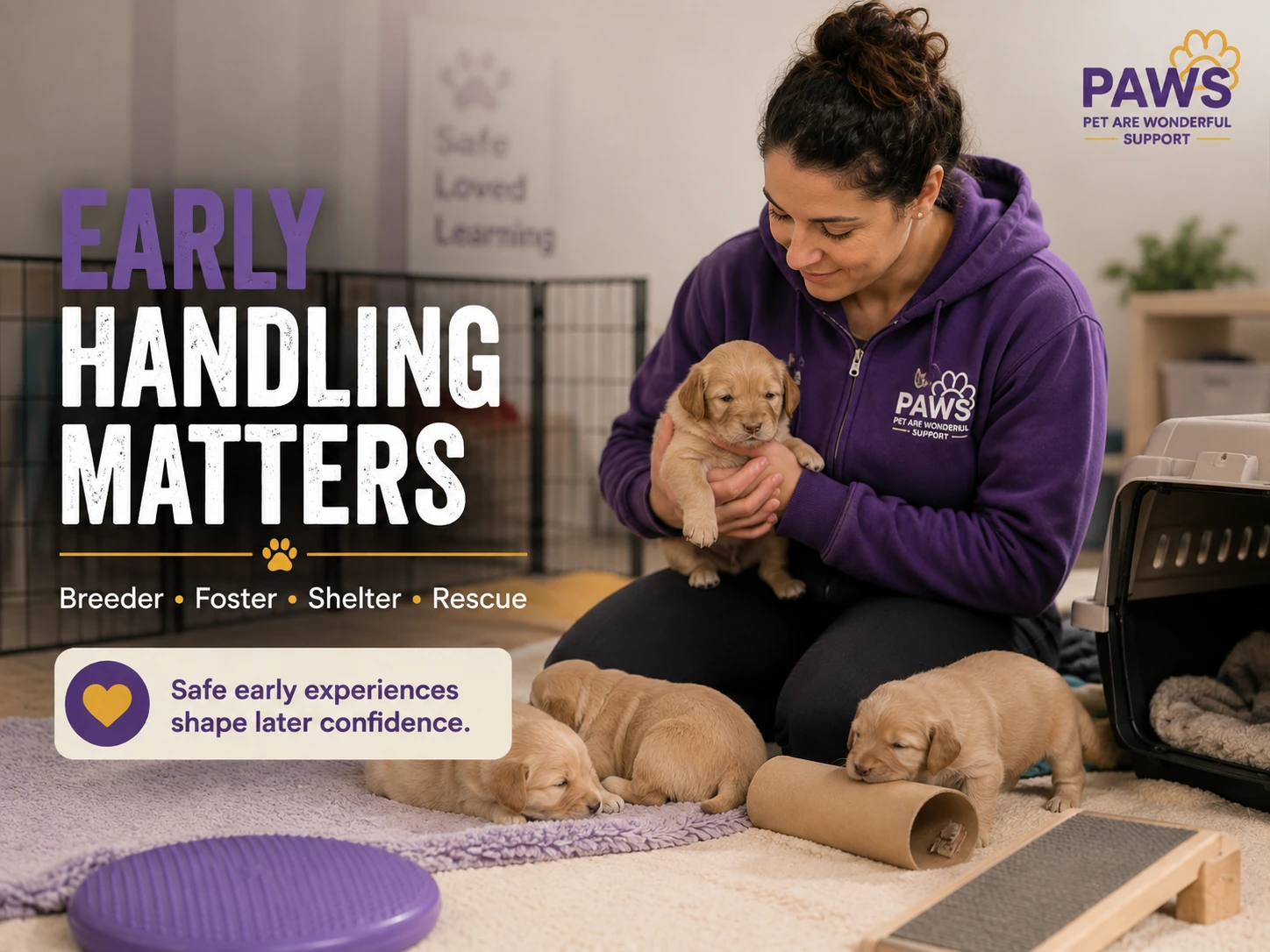
A lot of puppy advice accidentally starts too late. Many owners bring a puppy home around eight weeks and think, “Now we begin socialization.” In reality, the puppy has already been learning for weeks. The breeder, foster home, rescue, shelter, or early caretaker has already influenced how that puppy sees people, handling, noise, confinement, surfaces, littermates, mother, and the world.
A puppy raised in a clean, enriched, human-aware environment usually has a better starting point than a puppy raised in isolation, a barren kennel, a chaotic neglect situation, or a place where the puppy had little safe contact with people and normal household life.
That does not mean a rough-start puppy is hopeless. It means the owner and daycare should be honest about the starting line. A puppy who missed early handling may need slower exposure, more distance, more recovery, and more professional support than a puppy who came from a thoughtful early environment.
Good early caretakers help puppies experience gentle body handling, mild household sounds, safe surfaces, clean living areas, appropriate human interaction, littermate play, mother-dog learning, short car exposure when appropriate, toys, problem-solving, and calm confinement. That early foundation matters before the puppy ever walks into a puppy class or daycare facility.
Prospective owners should ask specific questions instead of accepting general assurances. Ask how often puppies were handled, which surfaces and sounds they experienced, whether they had calm confinement, how they responded to novelty, and whether any puppy consistently hid, froze, or failed to recover.
Once the puppy comes home, use that history as the starting point. Missing experiences can be introduced gradually, but the new owner should not try to repair an early gap by compressing weeks of exposure into one overwhelming weekend.
Swipe left/right to see the full table.
| Early-Life Factor | Helpful Start | Risky Start |
|---|---|---|
| Human handling | Gentle touching, lifting, paw handling, ear handling, mouth checks, calm people. | Little human contact, rough handling, scary restraint, or only stressful contact. |
| Environment | Clean area with safe toys, mild household sounds, different textures, and supervised exploration. | Barren kennel, filth, isolation, constant noise, or no normal household exposure. |
| Mother and littermates | Appropriate time with mother and littermates for early dog communication and play learning. | Removed too early, no littermate learning, or stressful mother/litter environment. |
| People variety | Calm exposure to different safe people: adults, gentle children, voices, movement, normal home activity. | No people variety or only overwhelming, loud, grabbing, frightening interaction. |
| Surfaces and sounds | Short positive exposure to tile, mats, grass, crates, gates, appliance sounds, and normal movement. | First exposure happens later when the puppy is already suspicious, bigger, and harder to guide. |
📌
Buyer and adoption rule
Ask what the puppy experienced before you got him. “Raised with love” is nice, but it is not a socialization plan. Ask about handling, sounds, surfaces, people, littermates, mother, crate exposure, car exposure, and early vet care.
🩺
Vaccines, Disease Risk, and Safe Puppy Exposure
The answer is not “hide the puppy” and it is not “let the puppy lick the dog park.”
Puppies need socialization before they are fully mature, but puppies also need protection from infectious disease. This is where owners need their veterinarian involved. Local disease risk, vaccine history, the puppy’s health, class requirements, and the environment all matter.
Safe early exposure can include carrying the puppy in public, sitting in a parked car with the windows down, watching traffic from a distance, visiting clean homes with healthy vaccinated dogs, attending properly managed puppy classes, exploring clean surfaces, hearing normal household sounds, meeting calm visitors at home, and seeing the world without being put down in high-risk dog areas.
Unsafe or higher-risk exposure includes dog parks, unknown dog traffic, heavily contaminated public grass, pet-store floors with unknown dogs, random sidewalk dog greetings, crowded events where the puppy gets overwhelmed, and any environment where sick or unvaccinated dogs may have been.
A good socialization plan does not ignore vaccines. It works around the risk intelligently. The puppy can still see people, hear noises, ride in the car, practice handling, meet safe known dogs, and learn about the world without being tossed into every disease puddle in town.
Risk management works in layers. Choose cleaner locations, avoid unknown dog traffic, use known healthy dogs, carry the puppy when appropriate, bring a clean mat, keep sessions brief, and leave before fatigue or stress changes the experience.
The veterinarian’s guidance should shape the plan, but the plan still needs behavioral judgment. An exposure can be medically lower-risk and emotionally overwhelming, or emotionally easy and medically inappropriate. Both sides of the decision matter.
Swipe left/right to see the full table.
| Exposure Option | Safer Use | Avoid or Use Caution |
|---|---|---|
| Puppy class | Clean facility, vaccine/deworming rules, small groups, supervised play, reward-based instruction. | Free-for-all puppy wrestling, unknown health status, dirty floor, no trainer control. |
| Known adult dog | Healthy, vaccinated, calm, tolerant adult dog with good social skills. | Rude, pushy, fearful, aggressive, sick, unvaccinated, or unknown dogs. |
| Public places | Carry the puppy, use a stroller, sit on a clean blanket, observe from distance. | Public dog grass, pet-store floors, dog parks, unknown feces, random dog contact. |
| Visitors at home | Calm people, treats, sit-to-greet practice, no grabbing or crowding. | People rushing, squealing, picking up, looming over, or forcing contact. |
| Sounds and movement | Low-volume, distance, treats, play, short sessions, puppy can leave. | Blasting noise, trapping the puppy, forcing the puppy to “get over it.” |
| Grooming and handling | Short handling sessions with food: paws, ears, mouth, collar, brush, towel, nail tool. | Restraint battles, flooding, painful handling, waiting until grooming is urgent. |
📌
Veterinary rule
Ask the puppy’s veterinarian what is reasonable in your area. A rural yard, a parvo-heavy city neighborhood, a clean puppy class, and a dog park full of mystery dogs are not the same risk.
✅
The Four-Part Rule: Positive, Short, Controlled, Repeatable
This is the difference between socialization and just dumping the puppy into noise.
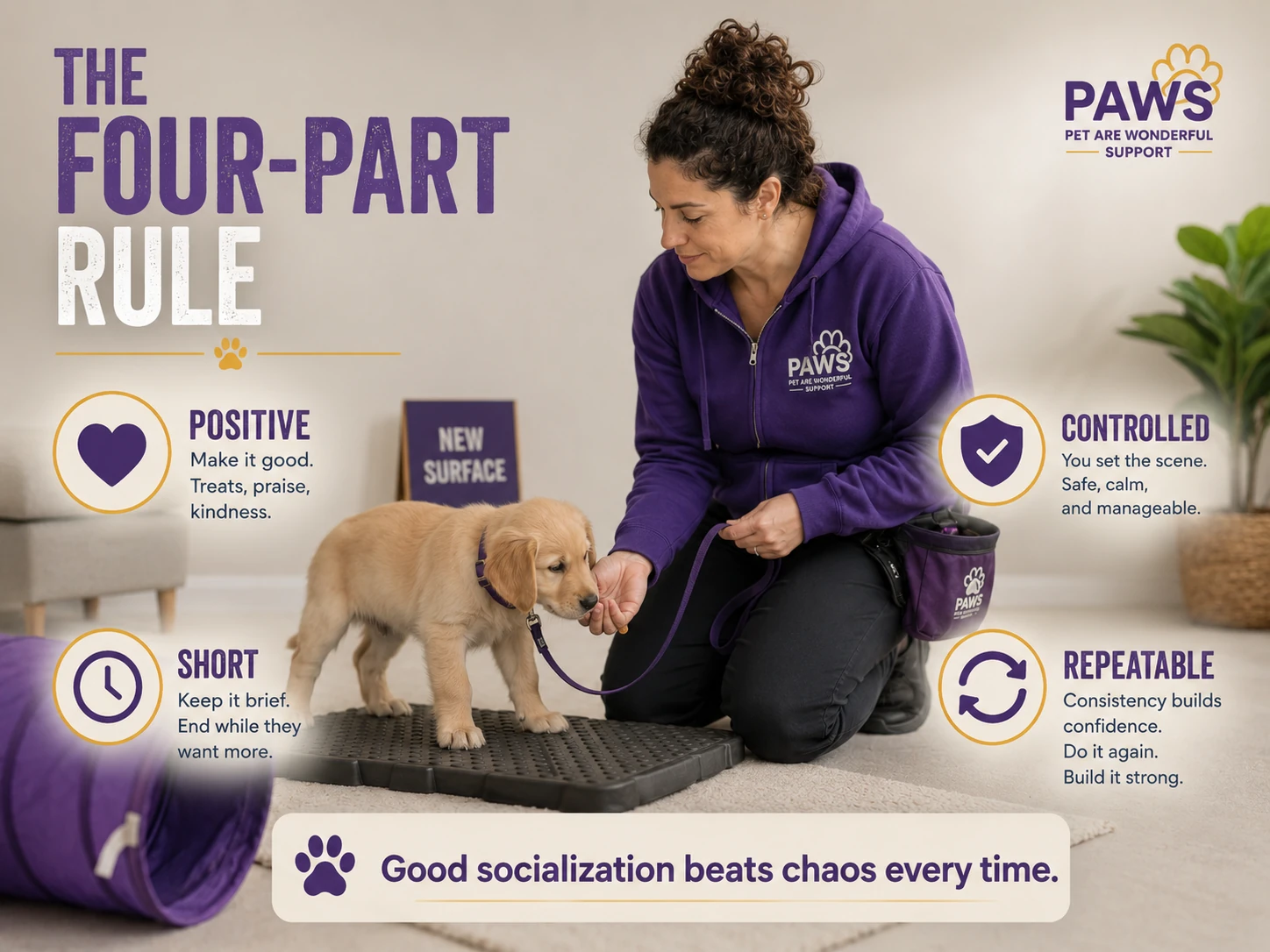
Good puppy socialization should be positive. The puppy should get food, play, praise, distance, sniffing time, a chance to observe, and a way to leave if the puppy becomes uncomfortable. The experience should predict good things, not pressure.
Good socialization should be short. Puppies get tired. Their brains get full. Their self-control is tiny. A five-minute successful exposure is better than a forty-minute meltdown with a photo at the end.
Good socialization should be controlled. The owner should choose the distance, the dog, the person, the environment, the surface, the volume, and the exit plan. Random chaos is not a curriculum.
Good socialization should be repeatable. One good car ride does not create a car-ready dog. One polite child does not create a child-safe dog. One easy grooming session does not create grooming tolerance. The puppy needs repetition in small, successful pieces.
Progress only when the puppy can remain functional at the current level. Useful signs include taking food, exploring, responding to the handler, moving normally, and recovering after surprise. If those abilities disappear, reduce difficulty rather than insisting the puppy finish the exercise.
Repeatable does not mean identical. Generalize slowly by changing one variable at a time: a different person, another surface, a slightly busier location, a new sound, or a little less distance. Changing everything at once makes it difficult to know what the puppy actually learned.
- Start at a distance where the puppy can look, think, eat, and recover.
- Pair new things with food, play, praise, exploration, and calm support.
- End the session while the puppy is still doing well.
- Repeat the experience in small variations instead of trying to cram the whole world into one outing.
- Increase difficulty only when the puppy is relaxed and recovering easily.
- Back up, reduce intensity, or leave if the puppy starts showing fear, shutdown, or frantic arousal.
🌎
What to Expose a Puppy To
A stable adult dog needs more than dog play. The world is bigger than the playroom.
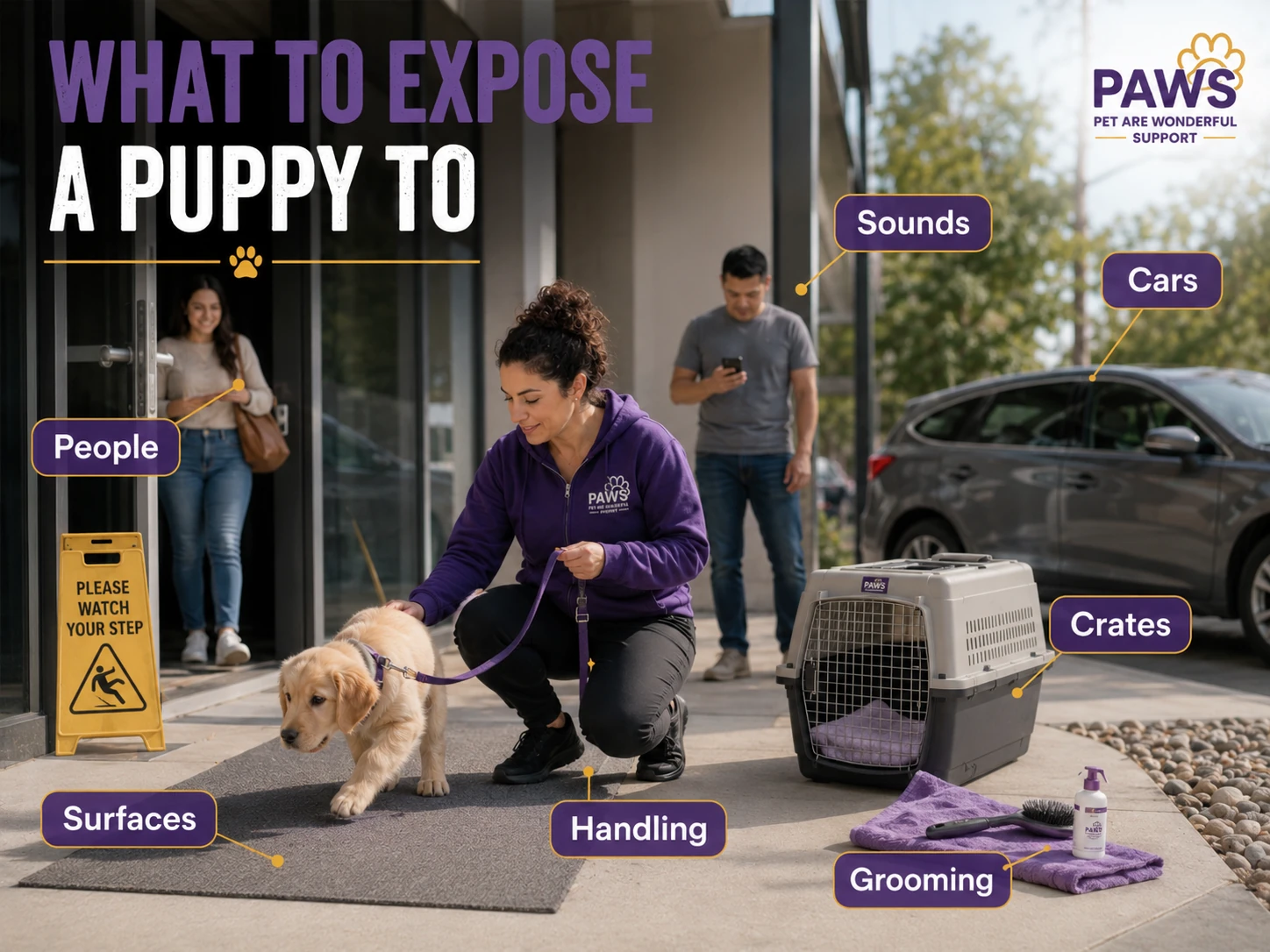
Puppy socialization should cover the normal categories of adult life: people, animals, sounds, movement, surfaces, handling, grooming, vet care, vehicles, crates, gates, alone time, household life, public observation, and calm recovery.
The point is not to complete the list like a scavenger hunt. The point is to introduce each category in a way that teaches the puppy, “I can handle this.”
Build categories instead of chasing a giant checklist. The puppy does not need to meet every possible example; the puppy needs enough varied, successful experiences to learn that unfamiliar people, movement, surfaces, sounds, and handling can be processed safely.
Include recovery and neutrality in the curriculum. A puppy who can ignore a person, rest behind a gate, wait in a car crate, settle after play, or watch another dog without greeting is learning life skills that matter as much as direct interaction.
Swipe left/right to see the full table.
| Category | Examples | Best Approach |
|---|---|---|
| People | Men, women, children, seniors, hats, sunglasses, uniforms, beards, canes, wheelchairs, strollers. | Let the puppy observe first. Reward calm interest. Do not allow strangers to crowd or grab. |
| Children | Running, laughing, toys, bikes, scooters, fast movement, loud voices. | Use distance, calm supervision, and controlled greetings. Children should not swarm the puppy. |
| Sounds | Vacuum, doorbell, traffic, trucks, thunder recordings, grooming dryer, clippers, carts, gates, barking. | Low intensity first. Pair with treats or play. Increase gradually. |
| Surfaces | Tile, rubber mat, grass, gravel, metal grate, wood, concrete, tarp, grooming table, vet scale. | Let the puppy choose to investigate. Reward stepping on, sniffing, and recovering. |
| Handling | Collar grab, harness, leash, paws, ears, mouth, tail, gentle restraint, towel, lift practice. | Pair touch with food. Keep it short. Stop before the puppy starts fighting. |
| Grooming | Brush, comb, nail clippers, grinder noise, bath, dryer, towel, table, ear cleaning. | Introduce tools before they are needed. The first nail trim should not be a wrestling match. |
| Veterinary care | Exam table, scale, mouth check, ear check, foot handling, waiting room sounds. | Happy visits, treats, low-pressure handling, and calm observation when appropriate. |
| Vehicles | Car rides, engine sounds, parking lots, car crate, seat belt harness, loading and unloading. | Start with short easy trips. Pair the car with good outcomes, not only vet shots. |
| Confinement and barriers | Crate, baby gate, kennel run, x-pen, daycare gate, brief separation. | Teach calm rest and independence. Socialization also means the puppy can settle. |
| Public observation | Store parking lot, school pickup from distance, outdoor café edge, park bench, traffic corner. | Watch from a safe distance. Reward calm looking. Leave before the puppy gets overloaded. |
🐕
Socializing a Puppy With Dogs
Dog exposure should be selected. Random dogs are not a lesson plan.
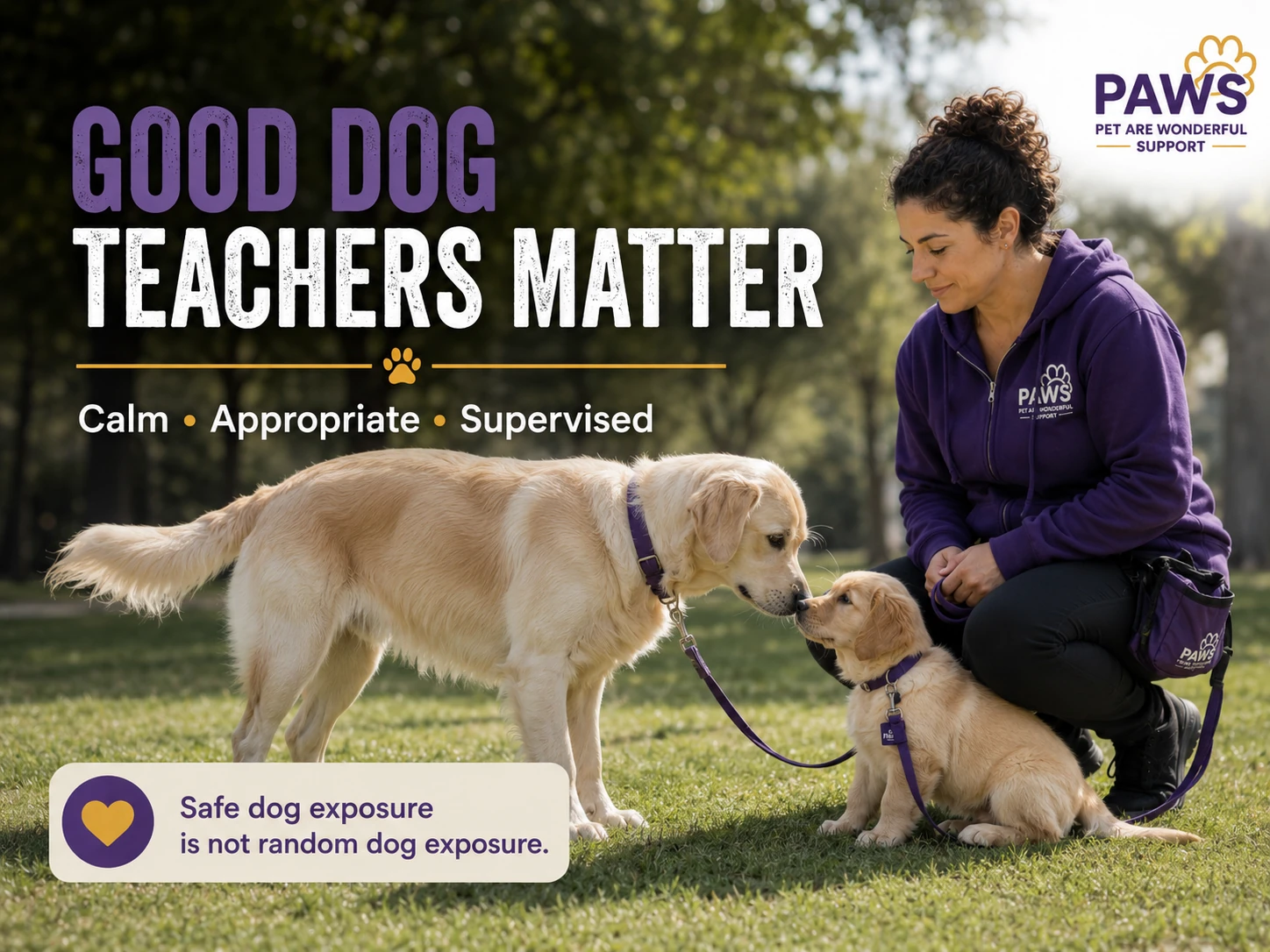
Puppies need to learn about dogs, but “dogs” is not one safe category. Some dogs are calm and socially skilled. Some are rude. Some are pushy. Some are fearful. Some are predatory toward small puppies. Some are not healthy. Some are not vaccinated. Some are the exact wrong teacher.
A puppy should meet safe, healthy, vaccinated, well-mannered dogs who can help the puppy learn normal dog communication without bullying, pinning, chasing, body slamming, resource guarding, or terrifying the puppy into shutdown.
Do not rely on the lazy sentence, “The older dog will teach him manners.” Sometimes that is true. Sometimes the older dog teaches the puppy that dogs are dangerous, greetings are scary, or the only way to survive is to bite first and ask questions later.
Good dog socialization includes observation, parallel movement, sniffing, breaks, matched play, calm adults, appropriate puppies, and staff or owner interruption before play becomes pressure.
The selected dog should be able to disengage, soften corrections, adjust intensity, and allow the puppy to leave. Size alone does not determine safety. A larger calm adult may be a better teacher than a same-size puppy that relentlessly chases, pins, or ignores every signal.
Use pauses to evaluate the interaction. Separate briefly and watch whether the puppy returns voluntarily with a loose body or uses the break to hide, cling, or leave. The puppy’s choice after the pause gives staff better information than the amount of motion in the game.
Swipe left/right to see the full table.
| Dog Exposure | Good Candidate | Bad Candidate |
|---|---|---|
| Adult dog | Healthy, vaccinated, calm, tolerant, socially skilled, able to disengage. | Pushy, predatory, rough, fearful, aggressive, possessive, sick, unknown. |
| Puppy playmate | Similar size, compatible play style, healthy, supervised, breaks enforced. | Size mismatch, relentless chasing, pinning, bullying, no adult control. |
| Leash greeting | Brief, loose leash, calm dogs, easy exit. | Tight leashes, face-to-face pressure, barking dogs, owner denial. |
| Dog park | Not recommended for young puppy socialization. | Unknown dogs, unknown vaccine status, disease exposure, bullying, bad play, no control. |
| Daycare | Structured puppy program, screening, small groups, rest, staff watching body language. | Dumping puppies into adult groups and calling chaos “socialization.” |
⚠️
Dog rule
A puppy does not need to meet every dog. A puppy needs good dog experiences. There is a difference, and it is not a small one.
🏫
Puppy Socialization Classes
A good puppy class is structured exposure. A bad puppy class is a mosh pit with registration forms.
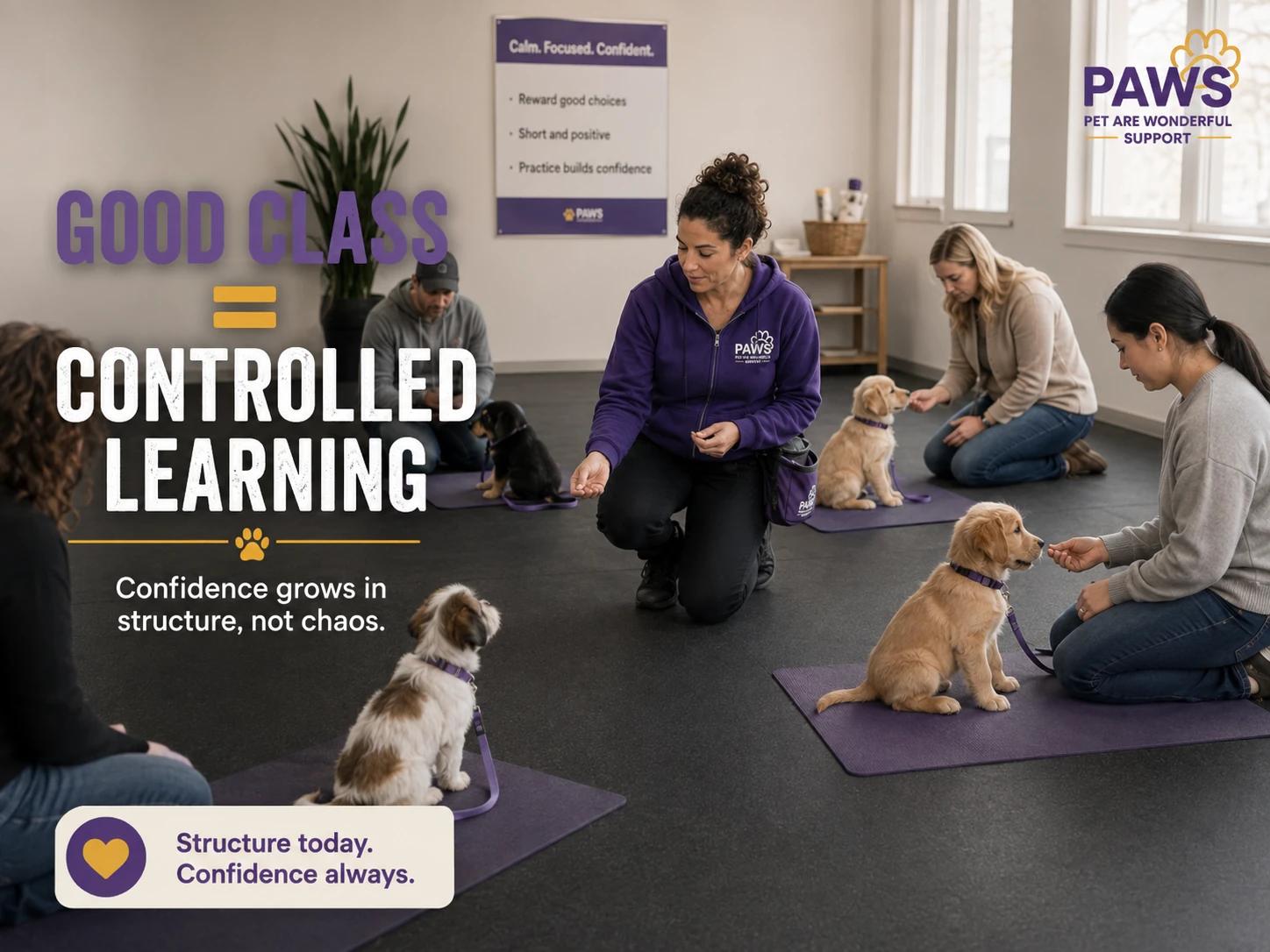
A well-run puppy class can be one of the best tools for early socialization because it can combine people, puppies, sounds, surfaces, handling, training, restraint practice, confidence work, owner education, and controlled play in one environment.
The phrase “puppy class” does not automatically mean good class. The details matter. The facility should have health requirements, cleaning procedures, age guidelines, supervision, trainer control, reward-based handling, and the ability to interrupt bad play before a timid puppy gets crushed or a rude puppy learns to become a tiny tyrant.
The class should teach owners what to watch for, not just hand them a leash and let puppies orbit the room. Owners need to learn when a puppy is enjoying play, when a puppy needs a break, when a puppy is bullying, when a puppy is scared, and when the session needs to get easier.
A useful class also teaches observation and recovery. Puppies should practice settling on mats, watching activity without joining it, tolerating brief handling, moving across surfaces, and taking breaks from play rather than spending the full session in constant contact.
Owners should leave with skills they can repeat at home. The instructor should explain body language, how to reduce difficulty, when to stop a greeting, how to protect a timid puppy, and how to keep a bold puppy from rehearsing pressure.
Swipe left/right to see the full table.
| Class Feature | Good Class | Warning Sign |
|---|---|---|
| Health rules | Requires appropriate vaccines/deworming for age and follows veterinary guidance. | No health screening, no vaccine rules, no cleaning protocol. |
| Play | Matched play, short sessions, breaks, staff interruption, timid puppies protected. | Free-for-all wrestling where the loudest puppy wins. |
| Training style | Food, play, praise, confidence, gentle handling, owner coaching. | Harsh leash corrections, intimidation, flooding, or punishment for fear. |
| Environment | Clean, controlled, age-appropriate, enough space, enough supervision. | Crowded, dirty, chaotic, loud, no exits, no control. |
| Owner education | Teaches body language, handling, calm greetings, confidence exercises, and recovery. | Only teaches sit while ignoring fear, overarousal, and bad play. |
🐾
Puppy Daycare Is Not a Free-for-All
Daycare can help a puppy or damage a puppy. The difference is structure.
Puppy daycare can be useful when the facility understands puppy development, vaccination rules, behavior screening, safe grouping, rest periods, and staff supervision. It can give puppies controlled exposure to people, surfaces, gates, routines, handling, calm separation, and appropriate dog play.
Puppy daycare can also be a disaster when the puppy is dumped into an adult group with bigger dogs, rough dogs, pushy dogs, chase addicts, resource guarders, or dogs that do not respect puppy signals. That is not socialization. That is asking the puppy to survive a room the staff failed to manage.
A young puppy does not need an eight-hour wrestling festival. Puppies need short play, breaks, sleep, potty routines, calm handling, confidence work, and protection from bad experiences. A puppy that gets bullied in daycare may not “get over it.” The puppy may remember that other dogs are dangerous.
Daycare staff should watch whether the puppy can recover. Does the puppy take breaks? Does the puppy return to play voluntarily? Does the puppy hide? Does the puppy become frantic? Is the puppy being chased more than choosing to play? Is the puppy bullying others? Is the puppy so overstimulated that he cannot think?
Readiness should be evaluated over more than one visit. Staff need to see how the puppy handles arrival, separation, gates, rest, potty routines, handling, transitions, different play partners, and the period after excitement begins to fade.
The facility should be willing to shorten visits, restrict groups, add rest, move the puppy to quieter activities, or delay daycare entirely. Enrollment is not a promise that open-group play is appropriate every day.
Swipe left/right to see the full table.
| Daycare Practice | Helps the Puppy | Hurts the Puppy |
|---|---|---|
| Grouping | Puppies grouped by size, play style, confidence, health status, and maturity. | Puppies placed with inappropriate adult dogs because staff want convenience. |
| Play duration | Short play, frequent breaks, enforced rest, nap time. | Endless arousal until the puppy becomes mouthy, frantic, or exhausted. |
| Staff response | Interrupts bullying, mounting, pinning, chasing, cornering, and panic. | “They are just playing” while one puppy is getting steamrolled. |
| Confidence building | New surfaces, calm handling, gates, crates, friendly staff, predictable routines. | Noise, pressure, chaos, and no one noticing the puppy is overwhelmed. |
| Owner feedback | Honest reports about confidence, play style, rest, fears, and progress. | “He did great” used for every puppy because nobody took real notes. |
📌
Daycare rule
Puppy daycare is not automatically socialization. It is only socialization when the puppy is protected, guided, observed, and allowed to recover.
🚩
Signs a Puppy Is Overwhelmed
Fear is not always dramatic. Sometimes it looks like freezing. Sometimes it looks like chaos.
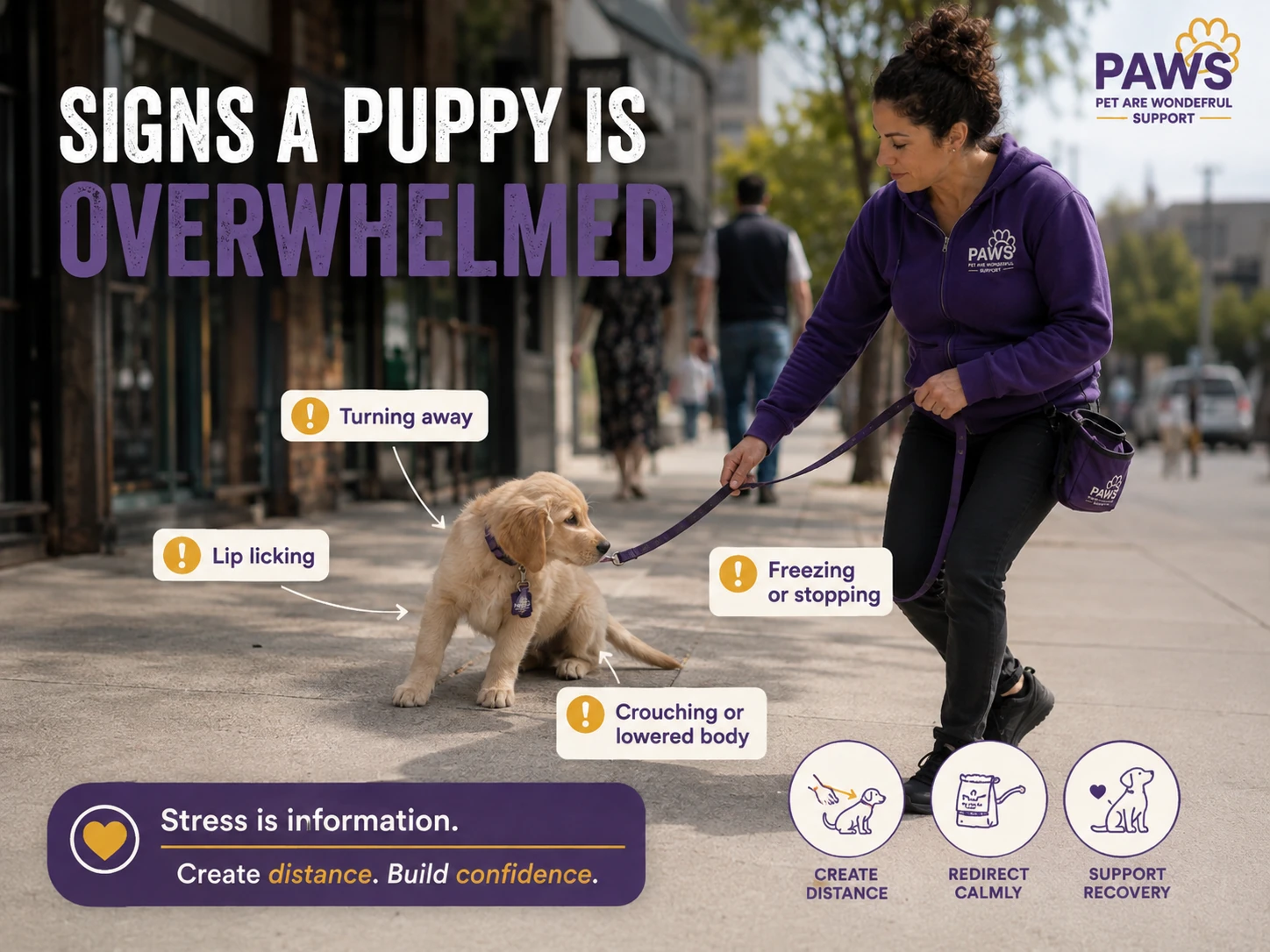
Owners often miss fear because they are looking for obvious terror. A puppy does not have to scream, urinate, or hide under a chair to be overwhelmed. Some puppies freeze. Some avoid. Some stop taking food. Some become clingy. Some get frantic. Some bark. Some bite the leash. Some look wild, not confident.
A puppy who cannot eat, cannot disengage, cannot recover, cannot respond, or cannot settle is not in the right learning zone. The session needs to get easier. Add distance, reduce noise, reduce movement, shorten the exposure, or leave.
Recovery is the key decision point. After distance or a break, the puppy should begin moving normally, taking food, exploring, orienting to the handler, or resting. A puppy that remains frozen, frantic, avoidant, or unable to settle needs a lower-demand plan.
Record the trigger, distance, duration, body language, recovery time, and what helped. Repeated notes reveal whether the puppy is improving, remaining stuck, or becoming more sensitive despite continued exposure.
Swipe left/right to see the full table.
| Sign | What It May Mean | Better Move |
|---|---|---|
| Freezing or refusing to move | Puppy may be overwhelmed, unsure, or afraid. | Add distance, soften the environment, use treats, do not drag. |
| Tucked tail, low body, hiding | Puppy is not comfortable. | Let the puppy retreat. Make the next exposure easier. |
| Refusing food | Stress may be too high for learning. | Increase distance, reduce intensity, or end the session. |
| Frantic jumping, biting, barking | May be overarousal, stress, frustration, or too much stimulation. | Create space, lower excitement, give a break, avoid rehearsing chaos. |
| Whale eye, lip licking, yawning, panting | Stress signals, especially when not tied to heat or normal tiredness. | Stop pushing. Let the puppy recover. |
| Trying to escape | Puppy is past the useful learning point. | Leave. Do not force the puppy to “face it.” |
| Snapping or growling | Puppy is communicating that pressure is too high. | Back off, protect the puppy, reassess, and get professional help if repeated. |
⚠️
Do not punish fear.
If a puppy is scared, punishment does not create confidence. It teaches the puppy that scary things are followed by more scary things from the owner. That is not leadership. That is bad math.
👀
Calm Observation Is Socialization
The puppy does not have to touch everything to learn from it.
One of the most underused socialization tools is letting the puppy watch the world from a safe distance. The puppy can sit in the owner’s lap, stand on a clean blanket, ride in a stroller, sit in the car, or stand far enough away to look without panicking.
Watching buses, children, shopping carts, bikes, joggers, people in hats, construction noise, flags, doors, carts, strollers, and other dogs from a distance can be extremely useful. The puppy learns that things can move, sound strange, and exist nearby without requiring panic or explosion.
This is especially useful for puppies that are cautious, easily startled, small, medically restricted, not fully vaccinated, or overwhelmed by direct interaction. Observation is not doing nothing. Observation is controlled information.
Observation sessions should have a clear starting distance, a short duration, and an exit plan. The owner can reward looking, checking in, sniffing, and choosing to disengage without requiring the puppy to approach the activity.
End while the puppy still has mental room. A calm five-minute session repeated across several locations teaches more than staying until the puppy becomes tired, vocal, mouthy, or unable to respond.
- Sit far enough away that the puppy can notice the thing and still take treats.
- Reward calm looking, checking in, sniffing, relaxing, and disengaging.
- Do not force the puppy to approach just because the puppy noticed something.
- Leave before the puppy becomes tired, frantic, or overwhelmed.
- Repeat from different distances and locations until normal life becomes boring.
❌
Common Puppy Socialization Mistakes
Most bad socialization is not evil. It is sloppy, rushed, or based on advice that sounds simple and works badly.
Most mistakes come from confusing exposure with learning. The puppy may physically remain in the location while becoming more frightened, more frantic, less responsive, or more suspicious. Completion of the outing does not prove the experience helped.
Correct the mistake by reducing one or more variables: distance, duration, noise, movement, number of people, dog intensity, handling pressure, or environmental complexity. The next session should be easier enough that the puppy can think and recover.
Repeated mistakes deserve a plan change. If the puppy keeps freezing, escaping, barking, biting the leash, refusing food, or failing to settle, stop repeating the same exposure and seek qualified guidance.
Swipe left/right to see the full table.
| Mistake | Why It Backfires | Better Choice |
|---|---|---|
| Waiting until fully vaccinated to start everything | The owner may miss the easiest early learning period. | Ask the vet for a safe exposure plan and start controlled socialization early. |
| Taking the puppy to dog parks | Unknown dogs, unknown health, rough play, disease risk, no control. | Use known healthy dogs, puppy classes, and controlled play. |
| Letting every stranger touch the puppy | The puppy may learn that people are overwhelming or that jumping gets rewarded. | Use calm greetings, observation, and consent-based interaction. |
| Forcing the puppy toward scary things | The puppy may become more afraid and lose trust. | Add distance, reward investigation, let the puppy choose. |
| Confusing overarousal with confidence | Frantic puppies are often stressed, overstimulated, or out of control. | Teach calm looking, breaks, recovery, and impulse control. |
| Letting rude dogs “teach manners” | The puppy may learn fear, defensiveness, or bad play habits. | Choose safe adult dogs and interrupt pressure early. |
| Only focusing on dog play | The puppy may still fear grooming, cars, people, sounds, surfaces, and handling. | Socialize the whole dog, not just the play style. |
| Too much, too long, too loud | The puppy gets overloaded and stops learning well. | Short sessions, recovery, distance, and repeatable success. |
| Ignoring rest and confinement | The puppy may become unable to settle or tolerate separation. | Practice crates, gates, naps, calm alone time, and recovery. |
🔁
Socialization Does Not End at 16 Weeks
The early window is important. It is not the finish line.
The early socialization window is the easiest and most important time to build confidence, but owners should not stop once the puppy hits four months. Dogs continue developing through juvenile and adolescent periods. Skills can improve, weaken, or get weird for a while.
A puppy who handled a stroller at ten weeks may bark at one at eight months. A puppy who loved every person may suddenly become suspicious of men in hats. A puppy who played well may become pushier, more selective, more easily frustrated, or less tolerant as maturity starts to show up.
That does not mean the early socialization failed. It means the dog is still developing. The owner should keep calm exposure, good experiences, handling practice, rest, structure, and safe dog contact going through the first year and beyond.
Daycare operators should pay attention to this too. A puppy who was easy at four months may not be the same dog at ten months. Adolescence can change arousal, confidence, play style, conflict behavior, sex-related behavior, resource issues, and tolerance. Good facilities keep evaluating instead of assuming the puppy’s first month tells the whole future.
Adolescent changes should trigger reassessment rather than punishment or automatic removal of every opportunity. Reduce intensity, rebuild easy wins, increase rest, review medical concerns, and change dog pairings when the developing dog becomes more selective or easily aroused.
Facilities should compare current behavior with the puppy’s earlier baseline. New guarding, handling sensitivity, fear, roughness, poor recovery, or social pressure deserves documentation and a revised service plan rather than the assumption that the dog will simply grow out of it.
Swipe left/right to see the full table.
| Development Stage | What Can Happen | Best Response |
|---|---|---|
| 8 to 16 weeks | Primary early socialization work: people, sounds, handling, surfaces, safe dogs, cars, confinement. | Controlled positive exposure, short sessions, safe environments, veterinary guidance. |
| 4 to 6 months | Puppy may become more confident, stronger, mouthier, faster, and more easily overstimulated. | Keep exposure going, add impulse control, maintain rest, prevent rude habits. |
| 6 to 12 months | Adolescence may bring testing, selective fear, higher arousal, less tolerance, or new social pressure. | Reassess playgroups, keep sessions controlled, reward recovery, avoid forcing scary exposure. |
| 12 months and beyond | Adult personality, breed traits, confidence, selectivity, and social preferences become clearer. | Respect the dog’s mature needs. Not every adult dog remains a daycare dog. |
📌
Maintenance rule
Keep giving the dog calm, positive, manageable experiences after the early window. Socialization is not a one-time puppy project. It is a foundation that still needs maintenance.
📋
Puppy Socialization and Daycare Readiness Checklist
A puppy is not ready because the owner wants daycare. The puppy is ready when the puppy can handle the environment.
Use this checklist across several days and environments rather than treating it as a one-time admission test. A puppy may appear confident in a quiet lobby and become overwhelmed during separation, gates, dog movement, rest, or handling.
A missing skill does not automatically mean the puppy has failed. It identifies what should be taught in a lower-pressure setting before the facility asks the puppy to perform that skill in a busy daycare environment.
The checklist should produce a service decision: ready for a structured puppy group, ready only for short or private exposure, temporarily restricted while skills improve, or not currently appropriate for daycare.
- The puppy has a veterinarian-approved vaccination and exposure plan.
- The puppy can meet calm people without hiding, panicking, or exploding into uncontrollable jumping.
- The puppy can observe new people, dogs, movement, and sounds from a distance and recover.
- The puppy has had positive exposure to safe, healthy, vaccinated dogs or a structured puppy class.
- The puppy can take food or engage with the owner during mild novelty.
- The puppy can tolerate gentle collar, harness, paw, ear, mouth, and body handling.
- The puppy has started grooming desensitization before grooming becomes a fight.
- The puppy can ride in a car without every trip becoming panic, vomiting, or chaos.
- The puppy can spend short periods behind a gate, in a crate, or separated from the owner without a full meltdown.
- The puppy can take breaks during play instead of escalating until everyone regrets the decision.
- The puppy is not being repeatedly bullied, pinned, chased, cornered, or overwhelmed by other dogs.
- The puppy is not repeatedly bullying, body slamming, mounting, harassing, or ignoring other dogs’ signals.
- The facility has a puppy plan: screening, grouping, rest, cleaning, supervision, and honest feedback.
- The owner understands that daycare is not a replacement for home training, public exposure, handling work, and calm-life skills.
❓
Puppy Socialization FAQ
Detailed answers about timing, vaccines, fear, excitement, safe dog exposure, puppy classes, daycare, handling, adolescence, recovery, and professional support.
Should I wait until my puppy is fully vaccinated before starting socialization?
Do not treat socialization as something that must remain completely paused until the entire vaccine series is finished. Work with the puppy’s veterinarian to balance local disease risk with the early developmental window. Safer options may include carrying the puppy, using a clean mat or stroller, observing public activity from a distance, visiting clean homes with healthy vaccinated dogs, practicing handling and grooming at home, and attending a properly managed puppy class that follows health requirements.
What does puppy socialization actually mean?
Socialization is emotional learning about normal life. The puppy learns that people, dogs, sounds, surfaces, movement, vehicles, confinement, grooming, handling, and unfamiliar environments can be noticed and processed without panic or uncontrolled excitement. The goal is not constant interaction; it is confidence, neutrality, choice, and recovery.
When should puppy socialization begin?
Learning begins before the puppy enters the new home. Breeders, fosters, shelters, rescues, the mother, littermates, early handling, and the first environment all shape the starting point. After adoption, the owner should begin safe, age-appropriate exposure promptly rather than waiting for a perfect future date.
What if my puppy missed early socialization?
The puppy can still improve, but the work may need to be slower and more deliberate. Begin at a distance and intensity where the puppy can eat, explore, respond, and recover. Avoid trying to repair the missed period by forcing many exposures quickly, and involve a qualified trainer, behavior consultant, or veterinarian when fear or defensiveness is already established.
Can an older puppy or adult dog still be socialized?
Yes, although the process may look more like confidence building and behavior modification than simple early exposure. The dog may need carefully controlled setups, greater distance, shorter sessions, and management that prevents rehearsal of fear or reactivity. Progress should be measured by improved function and recovery, not by forcing the dog to enjoy every situation.
How long should a puppy socialization session last?
Keep it short enough that the puppy remains functional and leaves with mental room. Some useful sessions may last only a few minutes. End while the puppy can still eat, explore, respond, and recover rather than waiting for fatigue, frantic behavior, freezing, or shutdown.
How do I know whether an exposure was successful?
Look for recovery and improved coping. The puppy may take food, sniff, explore, check in, soften posture, move normally, settle, or handle the same stimulus more easily during later sessions. Success does not require direct contact or obvious excitement.
What should I do when my puppy is scared?
Reduce the difficulty immediately. Add distance, lower noise or movement, stop forced contact, allow retreat, and pair the easier version with food, play, sniffing, and calm support. Do not punish fear or hold the puppy in place to make the puppy face it. Repeated or worsening fear deserves qualified professional guidance.
What if my puppy becomes wildly excited around people or dogs?
Overexcitement is not automatically confidence. A puppy that cannot disengage, take breaks, respond, or settle may be overaroused. Increase distance, shorten exposure, reward calm observation, use planned pauses, and stop allowing frantic greetings or nonstop play to become the puppy’s normal pattern.
What are the clearest signs that a puppy is overwhelmed?
Watch for freezing, refusal to move, tucked posture, hiding, turning away, lip licking, yawning, whale eye, food refusal, frantic barking, leash biting, escape attempts, growling, snapping, or inability to settle. The important question is whether the puppy can recover after pressure is reduced.
Does calm observation count as socialization?
Yes. A puppy can learn by watching people, traffic, dogs, carts, children, bikes, and other activity from a safe distance without greeting. Reward calm looking, checking in, sniffing, and disengaging. Observation is especially valuable for cautious, medically restricted, or easily overwhelmed puppies.
Does every stranger need to touch my puppy?
No. The puppy should learn that people are normal, not that every person is entitled to physical contact. Calm observation and passing people without interaction are valuable skills. When greetings occur, preserve choice and prevent looming, face grabbing, forced holding, or repeated pursuit when the puppy moves away.
Does my puppy need to meet every dog?
No. Safe dog exposure is selected, not random. Choose healthy, vaccinated, socially skilled dogs that can disengage, adjust intensity, and respect puppy signals. A few excellent dog experiences are more useful than many encounters with rude, frightening, unhealthy, or uncontrolled dogs.
Is the dog park a good place to socialize a young puppy?
Usually not. Dog parks combine unknown health status, unknown behavior, size mismatches, rough play, disease exposure, and limited control. Structured puppy classes, known healthy adult dogs, compatible puppy playmates, and calm observation provide more useful and manageable learning.
Are puppy socialization classes safe and useful?
A well-run class can be extremely useful when it has health requirements, cleaning procedures, small or manageable groups, reward-based instruction, controlled play, rest, and an instructor who protects timid puppies and interrupts rude behavior. A crowded free-for-all with no screening or recovery time can create problems instead of preventing them.
Is daycare good for puppy socialization?
It can be, but only when the program is designed for puppies. The facility should screen behavior and health, match groups, provide short play and enforced rest, interrupt bullying and overarousal, teach calm handling and separation, and give owners honest feedback. Open-group chaos is not automatically socialization.
How can I prepare my puppy for grooming and veterinary handling?
Introduce paws, ears, mouth checks, collar handling, towels, brushes, nail tools, tables, scales, and gentle restraint in very short sessions paired with food. Stop before the puppy begins fighting. Waiting until grooming or medical handling becomes urgent often creates a much harder first experience.
Can good socialization erase genetics, fear, pain, or temperament?
No. Socialization can improve coping skills and reduce preventable fear, but it is not a personality transplant. Genetics, breed tendencies, health, pain, trauma, sleep, early history, and individual temperament still matter. The plan should help the puppy become the safest and most functional version of that dog.
Why can behavior change during adolescence after good early socialization?
Dogs continue developing after the early window. Adolescence may bring new caution, higher arousal, greater strength, selective social preferences, frustration, guarding, or less tolerance. Return to easier exposures, maintain rest and structure, reassess dog pairings, and keep documenting rather than assuming the early puppy pattern will remain unchanged.
When should I seek professional help?
Get help when the puppy shows intense or repeated fear, panic, shutdown, growling, snapping, defensive behavior, handling intolerance, inability to recover, or worsening reactions despite easier exposure. Veterinary evaluation may be needed when pain or health could contribute, and a qualified reward-based trainer or behavior professional can build a safer individualized plan.
🐶
The Bottom Line: Build a Dog Who Can Handle Life
The goal is not a puppy who meets everything. The goal is an adult dog who can live in the world.
Properly socializing a puppy benefits the dog and the owner for the rest of the dog’s life. It helps the dog handle public places, car rides, vet visits, grooming, visitors, other dogs, noises, surfaces, and normal daily weirdness with less fear and less chaos.
The process is not complicated, but it does require thought. Start early. Keep it safe. Keep it positive. Keep it short. Choose good dogs. Protect the puppy from bad experiences. Teach calm. Teach recovery. Stop before the puppy is overwhelmed. Repeat until the world becomes normal.
A well-socialized puppy is not created by luck. A well-socialized puppy is created by owners and facilities that understand the assignment.
The final measure is function: the dog can move through normal life, communicate discomfort without being forced, recover from surprise, accept necessary handling, settle after activity, and remain safe even when the dog does not want direct interaction.
Good socialization is built from hundreds of small decisions. Owners and facilities choose the distance, protect the puppy from bad teachers, end sessions before collapse, repeat successful experiences, and adjust when the puppy shows that the plan is too difficult.
👥
Socializing a Puppy With People
The puppy does not need to be handled by everyone with a pulse.
Many owners accidentally teach puppies that people are either overwhelming or wildly exciting. They let strangers rush in, squeal, bend over the puppy, grab the face, pick the puppy up, or encourage jumping because “he is just a baby.”
Then six months later, the same owner is shocked that the dog jumps on guests, barks at strangers, mouths hands, or panics when someone reaches over his head. That is not a mystery. That is training with a cute costume on.
A better approach is calm observation first, then controlled greeting if the puppy wants to engage. The puppy can be rewarded for looking at people, walking past people, sitting near people, taking treats, and staying soft. Not every person needs to touch the puppy.
Teach the puppy that people are normal, not a threat and not a trampoline. A calm dog who can ignore people is often more useful than a dog who “loves everyone” by launching himself into their stomach.
Choice does not mean allowing the puppy to drag toward every person. The handler controls access while preserving the puppy’s ability to decline contact. Calm neutrality is a valid goal, especially for puppies that become frantic or worried during greetings.
Watch the person as carefully as the puppy. A well-meaning stranger who looms, reaches over the head, grabs the face, or keeps following avoidance can turn a planned exposure into a lesson that people ignore boundaries.