Pet Sitting, Dog Daycare, Pet Care Business Models, Mobile Pet Care, Facility-Based Dog Care, Startup Planning, Income Ceiling, Scaling, Dog Behavior, Boarding, Grooming, Training, and Dog Daycare Operations
Pet Sitting vs. Dog Daycare: Which Pet Care Business Model Actually Scales?
Pet sitting and dog daycare both sound like “working with dogs.” They are not the same business.
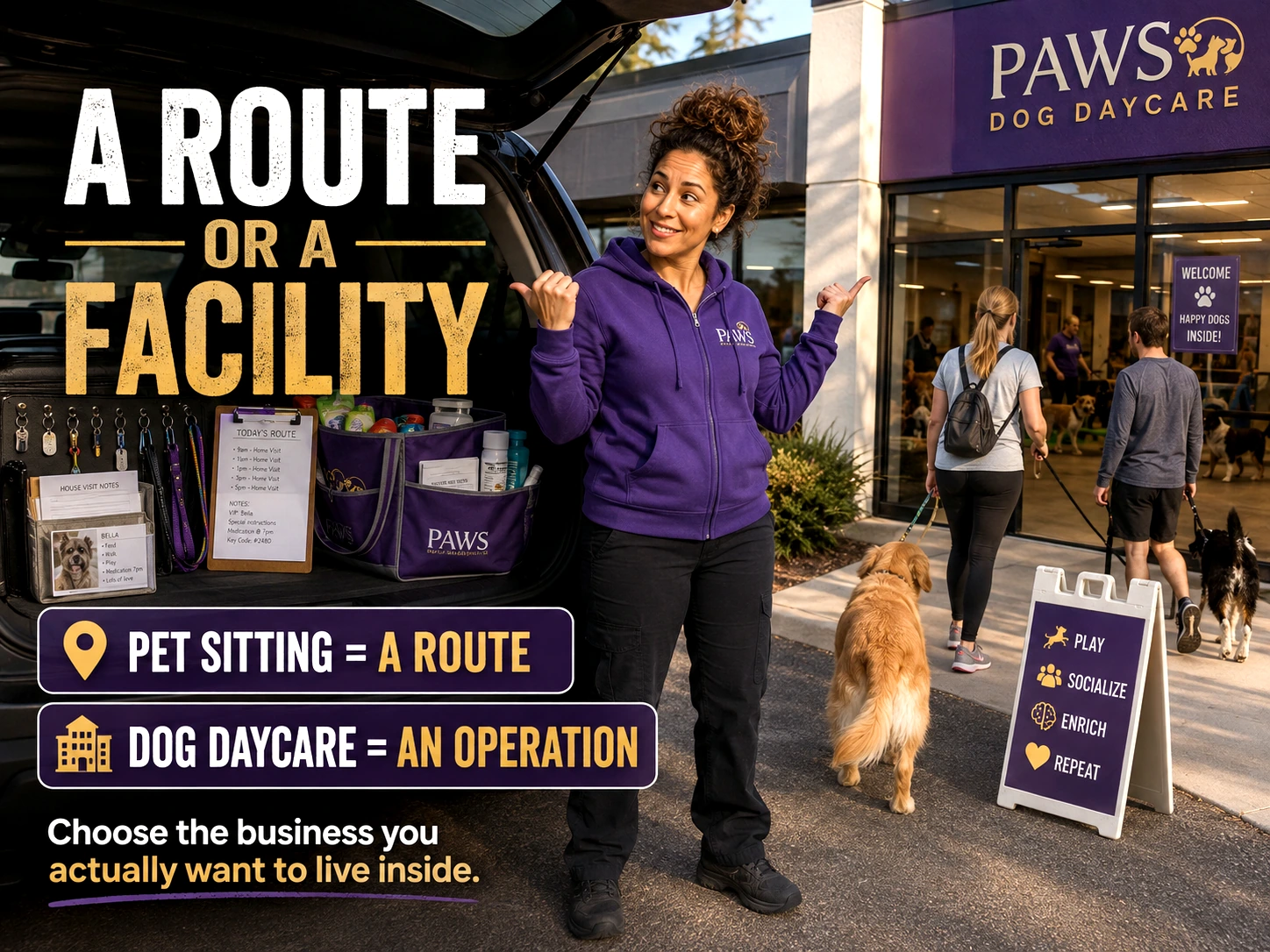
Pet sitting is usually a mobile labor business. You drive to the customer’s home, care for the pet, lock up, deal with keys, alarms, traffic, weather, route timing, and then drive to the next house. It can be a good service. It can also become a car-based job where the owner spends half the day driving and the other half trying to make the schedule behave.
Dog daycare is a facility-based operating business. The customers bring the dogs to you. That sounds better until you remember that the facility now has rent, buildout, licensing, insurance, staffing, cleaning, HVAC, flooring, gates, dog fights, bites, disease control, customer drop-off, pickup, noise, odor, and a monthly nut that does not care how much you love puppies.
One model is easier to start and harder to scale. The other model is harder to open and easier to scale if the operator builds it correctly. That is the real comparison.
This page is not here to pretend pet sitting is bad or dog daycare is automatically better. Pet sitting is absolutely the correct service for cats, elderly pets, medical pets, reactive dogs, dogs that should not be in group play, and owners who need in-home care. Dog daycare is the better fit for social dogs, high-energy dogs, dogs that need routine, and business owners who want a larger facility-based operation with room for boarding, grooming, training, packages, and other income streams.
The question is not which one sounds cuter. The question is which business model you actually want to live inside.
⚠️
Operator warning
Do not choose a dog business because the brochure version sounds sweet. Choose it because the daily reality, risk, income ceiling, startup cost, and owner lifestyle match what you can actually operate.
🗺️
Use This Page Like a Business Model Map
Do not start with “I love animals.” Start with startup cash, daily labor, scaling limits, dog behavior risk, customer trust, and whether you want a route or a facility.
⚖️
Quick Answer
Pet sitting is easier to start. Dog daycare is harder to open. Dog daycare usually scales better when built correctly.
🚗
Pet Sitting Model
Mobile visits, in-home trust, route timing, keys, alarms, traffic, weather, and one-house-at-a-time labor.
🏢
Dog Daycare Model
Facility care, staff, group play, temperament screening, cleaning, insurance, customer flow, and scalable service add-ons.
📊
Business Comparison
Startup cost, labor, travel time, income ceiling, insurance, risk, trust, and scaling side by side.
⛽
Pet Sitting Ceiling
Travel time, visit windows, geography, staffing, and missed visits can cap the business hard.
🧱
Dog Daycare Wall
Lease, zoning, buildout, insurance, staffing, behavior, cleaning, and fixed overhead are the entry wall.
🐈
Pets That Fit Sitting
Cats, medical pets, elderly pets, reactive dogs, shy dogs, and animals that should not be in group play.
🐕
Dogs That Fit Daycare
Social, stable, energetic dogs that pass intake and benefit from supervised activity.
🔀
Hybrid Reality
Boarding, grooming, training, enrichment, transport, and referral relationships can expand the model.
🔗
Next Step Path
A short, relevant path into the startup pages that matter after this comparison.
✅
Decision Checklist
A practical check before choosing a mobile route business or facility-based dog daycare.
❓
FAQ
Straight answers about startup cost, profit, risk, scaling, pet sitting, daycare, and hybrid services.
⚖️
Quick Answer: Easier to Start Is Not the Same as Easier to Scale
Pet sitting and dog daycare solve different problems for customers and create different lives for the owner.
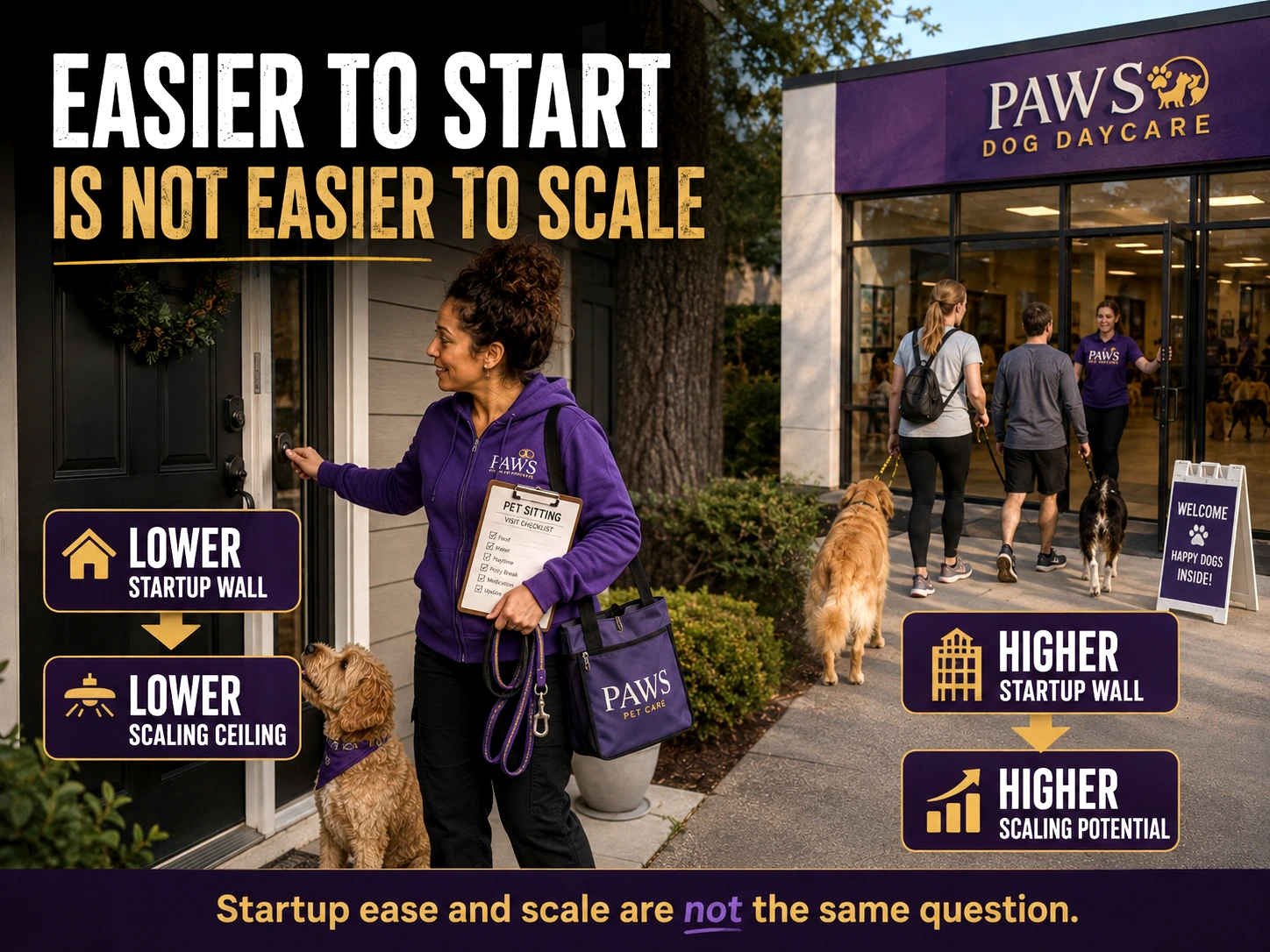
Pet sitting is usually easier to start. You may not need a commercial lease, facility buildout, play yards, drains, epoxy floors, kennel panels, daycare software, temperament testing rooms, or a staff schedule on day one. You need trust, insurance, reliable transportation, clear service agreements, key control, scheduling discipline, and enough local demand.
Dog daycare is usually harder to start. You need location approval, licensing research, insurance, buildout money, safe materials, dog handling systems, cleaning procedures, staff, customer agreements, and enough cash to survive while the business fills. The rent clock starts whether the dogs show up or not.
But once the daycare is built correctly, customers bring multiple dogs to one location. That is the scaling advantage. Pet sitting usually makes the owner drive to each dog. Dog daycare makes the dogs drive to the owner.
The entry barrier and the scaling ceiling should be evaluated separately. A low-cost startup can still create a business that remains tightly tied to the owner’s personal labor, while a high-cost facility may support more revenue only after occupancy, staffing, pricing, and operations become stable.
The decision should include the owner’s available cash, tolerance for fixed overhead, management skill, willingness to hire, desired service mix, and preferred daily schedule. Startup cost alone does not identify the better business.
📌
Plain business truth
Pet sitting is a route. Dog daycare is an operation. A route can be easier to start. An operation can be bigger. Pick the one you are actually built to run.
🚗
What Pet Sitting Really Is
Pet sitting is not just “playing with dogs at people’s houses.” It is trust, timing, access, routes, and responsibility.

A pet sitter normally goes into the customer’s home while the owner is away. The sitter may feed pets, refill water, give medications, let dogs outside, walk dogs, scoop litter boxes, clean small accidents, bring in mail, turn lights on or off, water plants, check doors, and make the house look occupied.
That can be a valuable service. It is especially useful for cats, elderly pets, medical pets, shy animals, dogs that do poorly in groups, and households where staying home is less stressful than being transported somewhere else.
The trust burden is big. You are entering someone’s house, handling keys, alarms, cameras, access codes, medications, pets, and sometimes very expensive personal property. If something is missing, broken, unlocked, wet, chewed, escaped, sick, or dead, the pet sitter may be the first person questioned.
The business is also limited by geography. You can only drive so far, visit so many homes, and keep so many exact-time promises before the route becomes the boss.
The operator question is not “will customers like me?” It is “how does this business prove the visit happened, control keys and codes, handle alarms, document medication, manage lockouts, cover sickness, and communicate when the route goes sideways?” A pet sitting route without proof, backup, and key control is not a business system. It is a person driving around with everyone’s house keys and a calendar full of promises.
Route density determines whether the schedule behaves like a business or a collection of expensive promises. Two hours of paid visits can consume much more than two hours once drive time, parking, keys, alarms, notes, supply restocking, and customer communication are included.
The scalable version of pet sitting requires verification and backup: standardized visit windows, GPS or time records, medication controls, key and code logs, route coverage, incident procedures, and a customer communication system that does not depend on the owner personally remembering every detail.
- Good for in-home pet care, cats, elderly pets, medical routines, shy pets, and dogs that should not be in group play.
- Lower startup wall than a dog daycare facility.
- Heavy trust burden because the business enters private homes.
- Limited by drive time, visit windows, weather, traffic, staffing, and route density.
- Needs proof-of-visit, key/code control, backup coverage, medication notes, lockout procedures, and customer communication standards.
📑
Pet sitting has its own paperwork problem
In-home care is not daycare with a car. Pet sitting has keys, alarms, home access, medication notes, visit timing, property concerns, and customer trust issues that need their own agreement.
Review the differences between Pet Sitting and Dog Daycare →
🏢
What Dog Daycare Really Is
Dog daycare is not a friendship factory. It is a supervised animal-care business with moving teeth and fixed overhead.
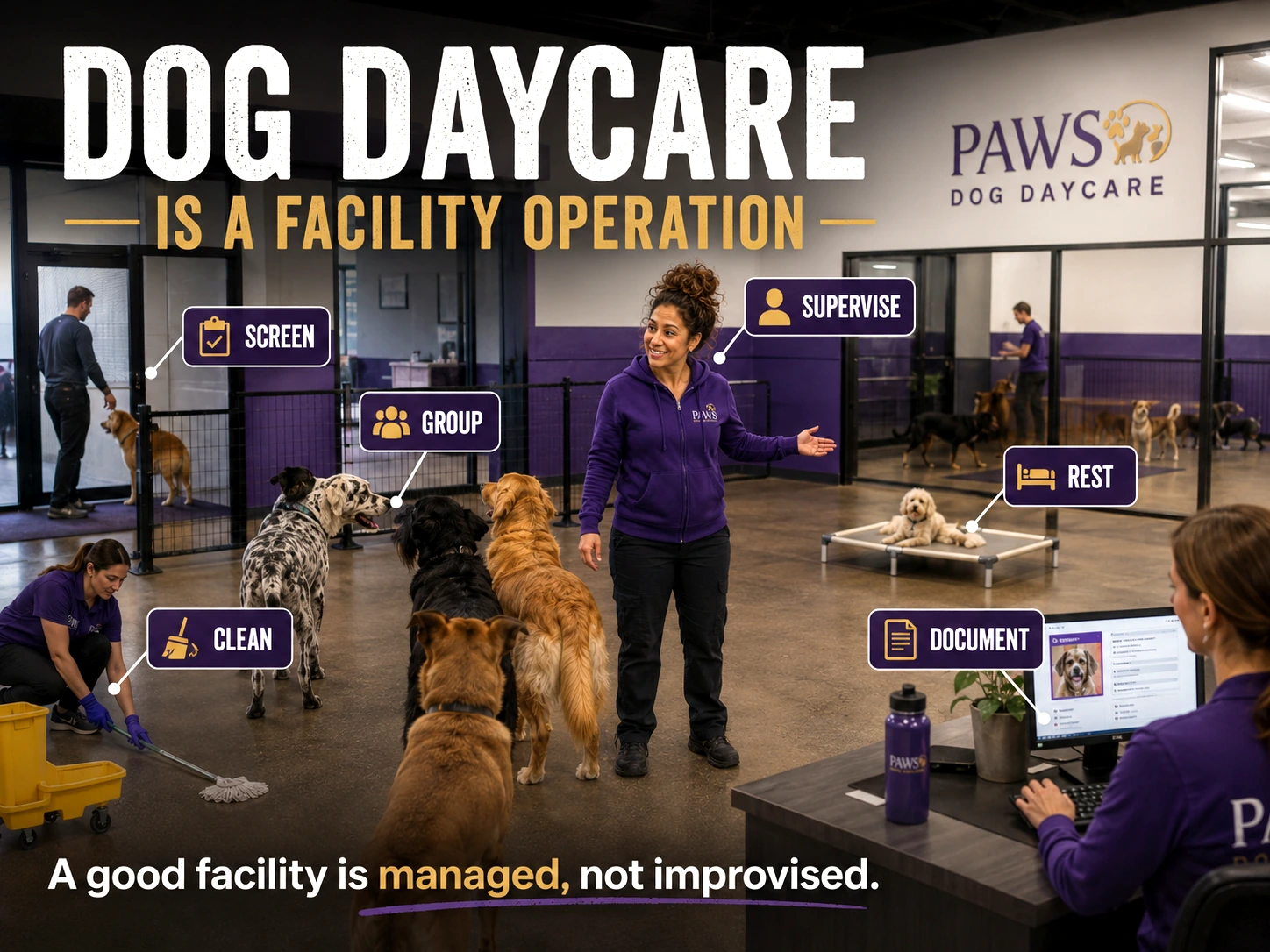
Dog daycare brings dogs into a central facility where staff supervise activity, social time, rest, feeding routines, cleaning, owner communication, and safe transitions. In a good facility, dogs are screened, grouped, observed, interrupted, rested, and documented. In a bad facility, dogs are dumped into a room and the invoice calls it socialization.
The business model is different because the dogs come to you. A single building can serve many customers in one place. That is why daycare can scale beyond the owner’s personal driving route. It can also connect naturally to boarding, grooming, training, enrichment, photo updates, packages, memberships, and other income streams.
But the tradeoff is real. You now have commercial rent, zoning, licensing, staffing, insurance, cleaning, HVAC, drainage, flooring, odor control, noise, dog fights, bites, communicable disease, customer complaints, and facility maintenance. Daycare gives you more scaling potential, but it also gives you more ways to get punched in the wallet if you build it wrong.
Daycare also has a health-control problem that pet sitting usually does not carry at the same density. Dogs are sharing air, staff, floors, gates, water areas, toys, play pressure, excitement, and germs. That means the operator needs vaccination policy, illness exclusion, cleaning procedure, ventilation awareness, rest cycles, owner communication, and outbreak response. A daycare that treats every coughing dog, tired dog, overstimulated dog, and “he just seems off” dog like normal traffic is not relaxed. It is gambling with the customer base.
Facility capacity is not simply the number of dogs that fit inside the building. Safe capacity depends on room layout, staffing, dog mix, rest areas, handling ability, ventilation, cleaning load, lobby flow, and whether the operation can maintain standards during peak arrival and pickup.
The daycare becomes scalable only when the owner can transfer repeatable work to trained staff without losing screening quality, supervision, documentation, customer communication, or control of the room. A full building with weak systems is not successful scale.
⚠️
Daycare reality
Do not open a dog daycare because you want to hug dogs all day. Open one because you are ready to operate a facility, manage staff, control groups, track numbers, talk to customers, clean constantly, and handle the days when dogs act like dogs.
📊
Pet Sitting vs. Dog Daycare Business Model Comparison
This is the comparison most people skip before they start buying logos, leashes, and dreams.
Use the comparison as an operating model, not a winner-and-loser scorecard. A factor that favors one owner may disqualify the model for another because available cash, local geography, staffing access, customer demand, and risk tolerance differ.
The important numbers are capacity, utilization, labor, dead time, fixed cost, and margin after the business performs every promise. Gross revenue without the cost of travel, payroll, rent, cleaning, software, insurance, and backup coverage can make either model look healthier than it is.
Swipe left/right to see the full table.
| Business Factor | Pet Sitting | Dog Daycare | Operator Takeaway |
|---|---|---|---|
| Startup cost | Usually lower. Transportation, insurance, forms, software, marketing, and supplies. | Usually much higher. Lease, buildout, flooring, gates, drains, HVAC, insurance, staffing, and opening cash. | Pet sitting is easier to enter. Daycare requires real startup capital. |
| Revenue ceiling | Route and labor limited. | Facility capacity and staffing limited. | Daycare can scale better, but only after the facility and systems work. |
| Daily owner labor | Driving, visits, keys, locks, notes, alarms, traffic, and customer updates. | Staff management, intake, cleaning, customer flow, dog handling, scheduling, and facility control. | Pet sitting owns your route. Daycare owns your building. |
| Customer trust issue | You enter private homes and handle access. | Customers leave pets inside your facility. | Both require trust. The trust problem just changes shape. |
| Dog behavior risk | Usually one household at a time, but still includes bites, escapes, medication issues, and leash problems. | Group play, fights, bites, over-arousal, temperament mistakes, and staff handling risk. | Daycare requires stronger behavior systems. |
| Facility risk | Lower facility burden because the customer owns the building. | High facility burden because the daycare owns or leases the operating space. | Daycare mistakes can be built into the walls, floors, gates, and drains. |
| Missed service risk | A missed visit can mean no food, no medication, no potty break, or a pet emergency. | A staffing failure can affect an entire room or facility. | Both need procedures. Pet sitting needs route reliability. Daycare needs staffing depth. |
| Proof of service | Visit notes, photos, GPS/time stamps, medication logs, and locked-door confirmation may be needed to prove the route actually happened. | Facility software, check-in/out records, cameras, staff notes, incident reports, and customer updates help prove what happened inside the building. | Both models need proof. Pet sitting proves visits. Daycare proves supervision. |
| Backup coverage | A sick sitter, broken car, lockout, storm, or route mistake can leave pets waiting at home. | A sick employee, no-call/no-show, or understaffed room can affect many dogs at once. | Solo pet sitting needs backup routes. Daycare needs staffing depth. |
| Illness exposure | Usually lower dog-to-dog density because pets remain in their own home. | Higher exposure density because dogs share space, air, surfaces, staff handling, and excitement. | Daycare needs stronger vaccination, exclusion, cleaning, ventilation, and outbreak procedures. |
| Add-on income | Dog walking, overnight sitting, medication visits, house checks, plant care, small errands. | Boarding, grooming, training, enrichment, memberships, packages, photos, retail, and transportation. | Daycare has more built-in expansion paths. |
| Owner lifestyle | Mobile, route-based, often solo or small team. | Facility-based, staff-based, operations-heavy. | Choose the daily life, not just the logo. |
⛽
The Pet Sitting Ceiling
Pet sitting can be profitable, but the business has a hard ceiling when one person can only be in one driveway at a time.
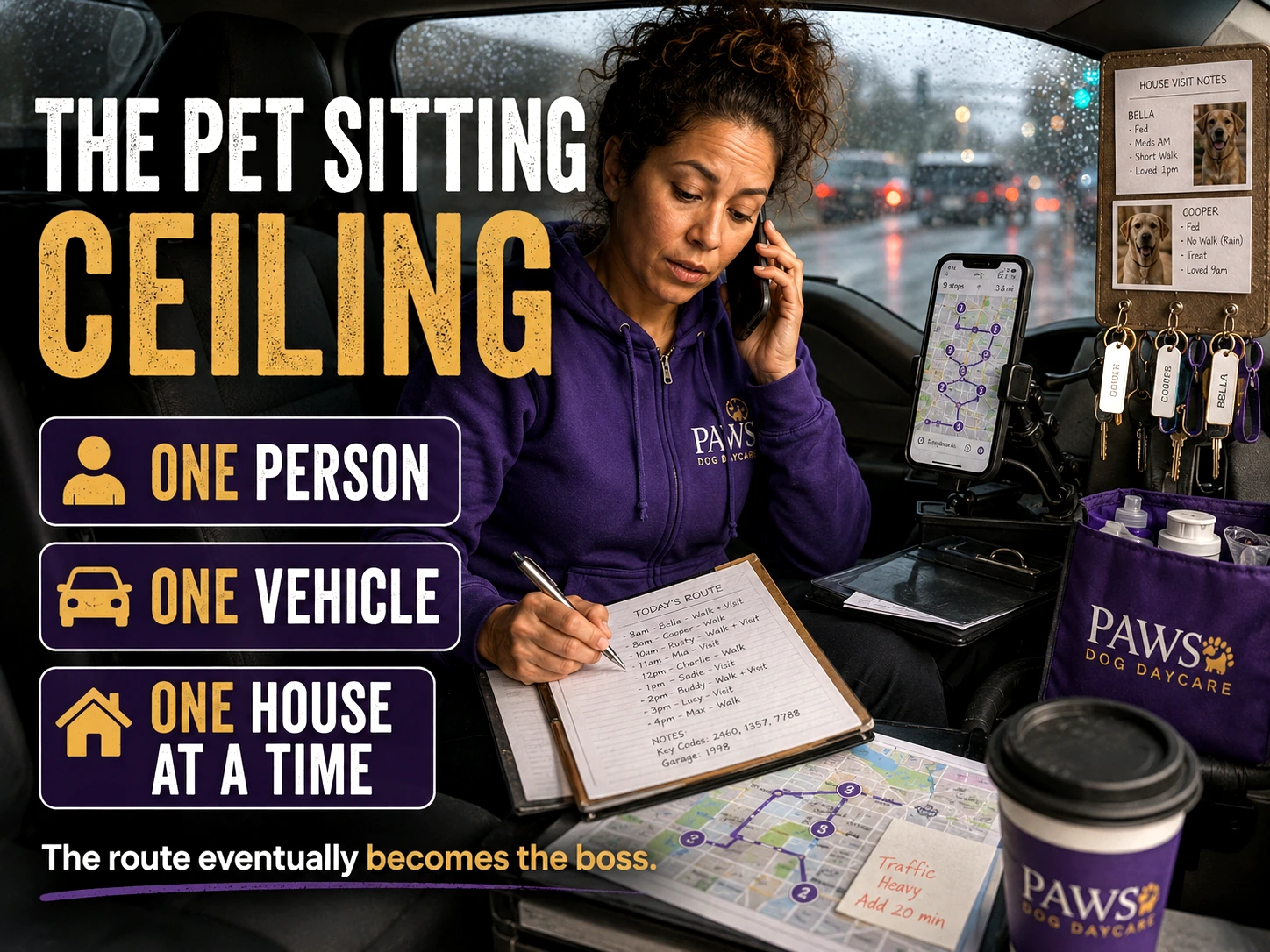
The biggest limit in pet sitting is not usually love, demand, or work ethic. It is time and geography. You can only drive to so many homes. You can only complete so many visits. You can only absorb so much traffic, weather, road construction, late customers, alarm problems, locked doors, missing keys, loose dogs, and “while you are there can you also...” requests before the route starts eating the business.
A full pet sitting calendar can look great on paper and feel terrible in real life. Twenty visits sounds profitable until the visits are spread across a wide area, half the pets need exact timing, three clients want midday, one alarm will not disarm, it is raining sideways, and your vehicle has become the office, break room, supply closet, and emotional support cage.
Hiring staff can expand pet sitting, but then the business changes. Now you need employee screening, key control, training, route standards, insurance, quality control, visit verification, customer communication, and a way to prove the visit actually happened. The moment you send employees into customer homes, trust becomes an operating system, not a nice personality trait.
The route ceiling can be moved through tighter service areas, minimum visit charges, grouped time windows, route software, recurring clients, and trained employees. It cannot be removed completely because each visit still consumes travel and on-site time.
Operators should calculate revenue per route hour rather than revenue per visit alone. A high-priced visit with excessive drive time, parking, access problems, or exact-time requirements may contribute less than a lower-priced visit inside a dense route.
📌
Pet sitting ceiling
Pet sitting can be a good business. But at some point the owner is not selling pet care anymore. The owner is selling calendar slots and windshield time.
🧱
The Dog Daycare Wall
Dog daycare can scale, but the wall you climb to open one is much higher.
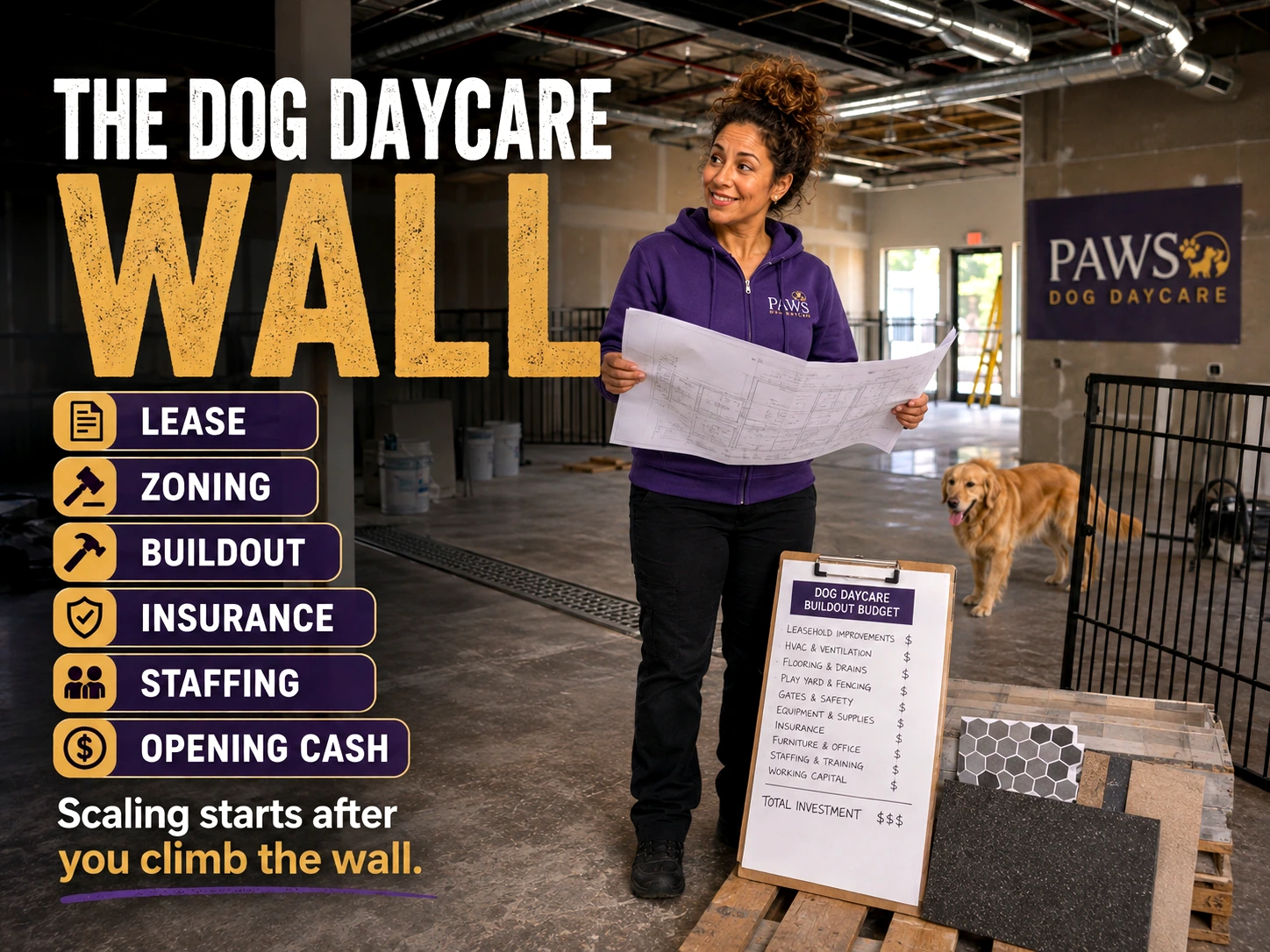
Dog daycare is not a low-friction side hustle. You need a location that can legally operate as dog daycare. You need a lease that does not quietly kill the business. You need zoning, licensing, insurance, buildout planning, flooring, cleaning systems, gates, drains, HVAC, odor control, noise control, staff procedures, emergency plans, intake forms, customer agreements, and cash reserves.
Then you need dogs. Not just any dogs. The right dogs. Social enough, stable enough, healthy enough, vaccinated according to your policy, manageable enough, and appropriate for the service you are selling. A building full of the wrong dogs is not a daycare. It is an incident report waiting for stationery.
The dog daycare wall is why the profit ceiling can be higher. Once the systems work, dogs come to one location and the business can stack services around the same customer relationship. But that only matters if the business survives the opening wall.
The wall is not only money. It is also discipline. Daycare owners have to say no to some dogs, no to some owners, no to bad lease terms, no to underpriced services, no to lazy cleaning, and no to the fantasy that every dog belongs in open group. The building does not become safer because the owner is nice.
Opening capital should cover more than construction. The business needs enough cash for deposits, permits, equipment, software, insurance, payroll, utilities, marketing, repairs, and the months required to fill capacity without underpricing the service.
The facility wall also creates long-term commitments. A poor lease, undersized HVAC system, weak drainage, bad parking pattern, noise conflict, or layout that forces dogs through the same choke point can remain expensive long after opening day.
⚠️
Rent-clock warning
A commercial lease does not care that the daycare is “almost full.” Rent, utilities, payroll, insurance, cleaning, software, loan payments, and repairs show up whether the dogs do or not.
🐈
Pets That Often Fit Pet Sitting Better
Sometimes the best dog-care decision is not daycare.
Pet sitting is often the logical choice when the animal is safer, calmer, or easier to manage at home. That does not make daycare bad. It means the pet’s needs do not match a group-care facility.
Service fit should include the individual pet’s medical, behavioral, environmental, and household needs. A pet that remains comfortable at home may receive better care from reliable visits than from transportation and group exposure.
The sitter still needs a complete plan for access, medication, emergency transport, weather, backup care, escape prevention, and what happens when the pet is not found or does not appear normal. Lower social pressure does not remove professional responsibility.
🐱
Cats
Most cats are not looking for a social calendar and a lobby full of barking opinions. In-home care often makes far more sense.
🩺
Medical Pets
Pets with strict medication schedules, recovery needs, mobility limits, or fragile health may need calm in-home care.
🦴
Elderly Pets
Older animals may need routine, low stress, soft bedding, slow movement, and fewer surprises.
🚫
Reactive Dogs
Dogs that cannot safely handle groups, strangers, handling, or other dogs may be better managed at home.
🫥
Shy or Shut-Down Dogs
Some dogs do not need “more socialization.” They need less pressure and a plan that does not flood them.
🏠
Home-Bound Routines
Some pets simply do better when the care comes to them instead of transporting them into noise, dogs, and new smells.
🐕
Dogs That Often Fit Dog Daycare Better
Daycare works best when the dog actually fits the environment.
Dog daycare is usually a better fit for dogs that benefit from supervised activity, routine, social exposure, and structured time away from home. But “likes dogs” is not enough. The dog still needs intake, temperament screening, health requirements, staff observation, and a safe group placement.
A dog may fit daycare behaviorally but still need restrictions based on age, health, stamina, play style, recovery, or handling. The service plan can include shorter visits, quieter groups, structured rest, or enrichment without assuming every accepted dog needs all-day open play.
The facility should keep reassessing fit. Maturity, pain, medical changes, repeated over-arousal, new guarding, social selectivity, or poor recovery can change a dog that previously used daycare successfully.
- Social dogs that enjoy other dogs without bullying, freezing, guarding, or escalating.
- High-energy dogs that need exercise, routine, and stimulation while the owner works.
- Dogs that become destructive at home from boredom, isolation, or unspent energy.
- Dogs that can recover from excitement and settle after play.
- Dogs that pass temperament screening and can be safely handled by trained staff.
- Dogs whose owners want recurring care, boarding connection, grooming add-ons, training support, or routine structure.
🧍
Owner Lifestyle: Route Owner vs. Facility Operator
The business you choose becomes the day you live.
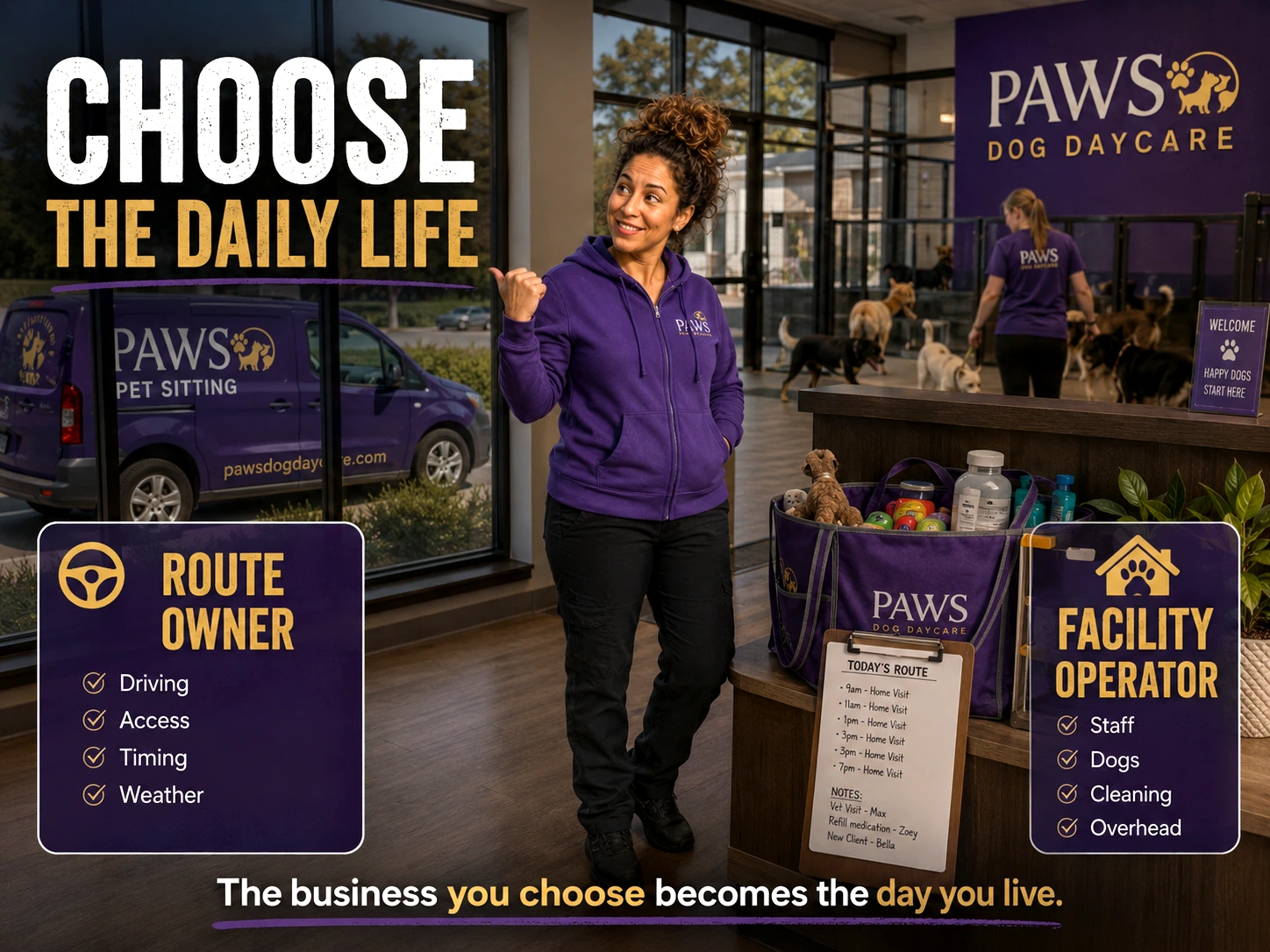
The owner should picture the ordinary Tuesday, not the launch announcement. Pet sitting means route changes, home access, driving, exact-time visits, and customer messages across many locations. Daycare means opening a building, managing staff and dogs, cleaning, customer flow, and remaining responsible for the whole operation until close.
Freedom looks different in each model. A route may have lower fixed overhead but can tie the owner personally to visits and travel. A facility can create management leverage through staff, but the lease, payroll, and operating systems keep demanding attention even when the owner is not on the playroom floor.
Choose the daily life whose recurring problems you are willing and able to solve.
Pet Sitter Owner
- Drives from home to home.
- Manages keys, alarms, access codes, cameras, and customer trust.
- Works around customer travel schedules, lunch visits, medication times, traffic, and weather.
- Can start smaller, but may become personally tied to every route and visit.
Dog Daycare Owner
- Operates a building with fixed monthly overhead.
- Manages staff, dog groups, customer flow, cleaning, maintenance, software, and procedures.
- Deals with noise, odor, urine, poop, bites, fights, disease control, and customer expectations.
- Can build a larger business, but only with real systems.
🔀
The Hybrid Reality: Daycare Can Connect to More Than Daycare
Pet sitting usually expands by adding routes. Dog daycare can expand by stacking services around one facility.
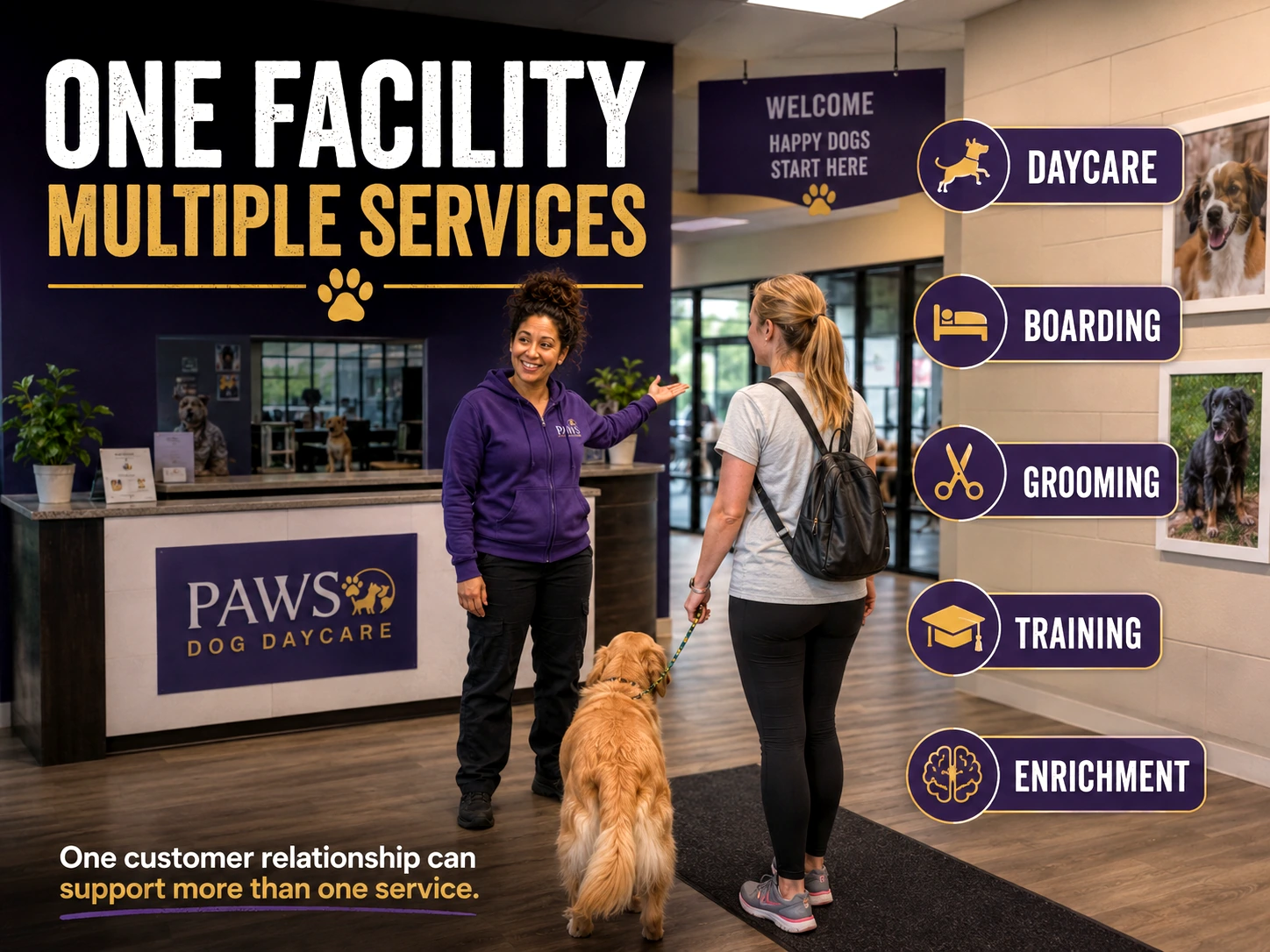
A dog daycare does not have to stay only daycare. Once customers trust the facility, other services can connect naturally: boarding, grooming, training, enrichment, photos, packages, memberships, retail, special events, and transportation. Not every add-on is worth doing, but the facility relationship gives the owner more options.
That does not mean a daycare should automatically offer pet sitting. In-home pet sitting creates different risks: keys, alarms, private homes, employee trust, visit verification, travel time, and customer property. Some daycare owners are better off referring pet sitting to a trusted partner instead of turning their facility business into a route business on the side.
The smart move is not “offer everything.” The smart move is to understand what each service does to staffing, insurance, schedule, customer trust, and profit.
Stacked services work best when the same staff, customer relationship, records, space, and operating systems can support them without creating a second uncontrolled business. Boarding may share more infrastructure with daycare than mobile pet sitting does.
Each add-on should be evaluated through incremental labor, equipment, insurance, scheduling, training, space, and margin. Revenue that creates more operational conflict than profit is not automatically valuable because it appears on the service menu.
🔗
Where This Fits in the Dog Daycare Business Plan
This page is the bridge between “I want to work with pets” and “I am ready to build a facility-based dog daycare business.”
Pet sitting may be the first pet-care business many people think about because it is easier to enter. Dog daycare is a larger operating model. Once you start thinking about daycare seriously, the question changes from “Do I like dogs?” to cash flow, pricing, location, licensing, dog behavior, insurance, and service expansion.
Use the next pages as a clean decision path. Do not read every page randomly like a raccoon got into the sitemap. Start with the business model, then the money, then the location, then the dog-handling risk, then the income expansion.
The comparison should end with numbers and operating assumptions. Estimate realistic customer volume, price, labor, travel or occupancy limits, fixed overhead, startup cash, owner compensation, and the time required before the model can support itself.
Then test the decision against the owner’s actual resources. A facility plan without enough cash, or a route plan without reliable transportation and backup coverage, is not ready simply because demand may exist.
📘
Start With the Manual Intro
Before leases, logos, vans, or facility dreams, understand what the daycare business actually includes.
💵
Run the Opening Cash Flow
Dog daycare fails when the rent clock outruns the fill-up curve. Know the opening cash problem before signing.
🧮
Check Pricing and Survival Floor
Prices need to support the building, staff, cleaning, insurance, and slow months. Friendly pricing does not pay rent.
📍
Solve Location and Licensing
A bad location, bad lease, zoning issue, or licensing surprise can wreck the daycare before dogs ever arrive.
🐾
Understand Dog Handling Risk
Daycare is not pet sitting with more dogs. Group care needs intake, personality awareness, playgroup control, and fight prevention.
📈
Plan the Add-On Income
Boarding, grooming, training, enrichment, and smaller add-ons can help, but only when they fit the operation.
⚠️
Risk Comparison: Different Business, Different Ways to Bleed
Neither model is risk-free. The risk just moves.
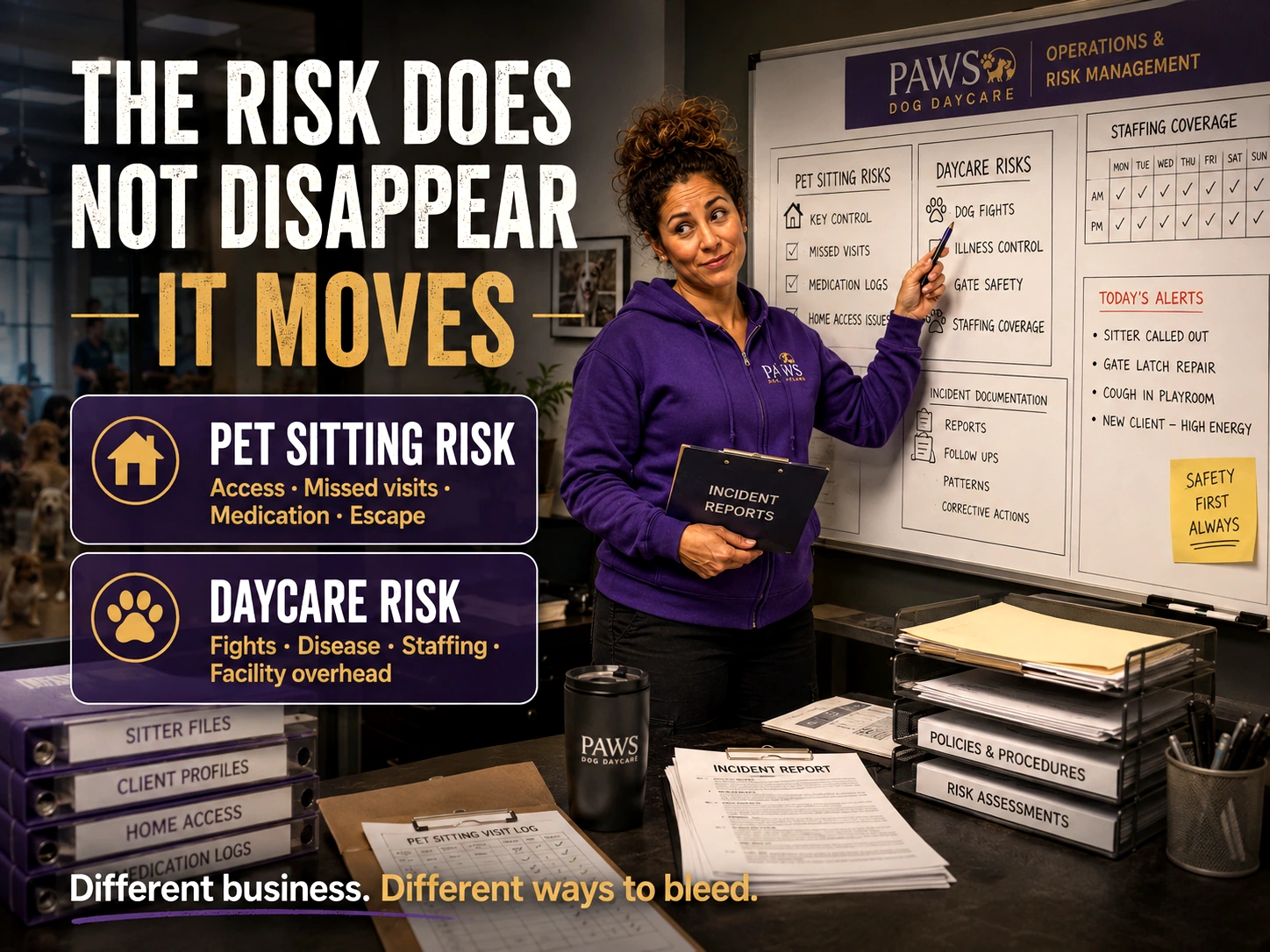
Risk does not disappear when the business changes form. Pet sitting concentrates exposure around private-home access, missed visits, medication, keys, driving, and a single employee working alone. Daycare concentrates exposure around groups, staff decisions, facility defects, illness, escapes, and fixed overhead.
The correct comparison is not which model has less risk in the abstract. It is whether the operator can build insurance, forms, training, verification, backup, documentation, and emergency procedures around the risks that model creates.
A business becomes safer when its recurring failure points are visible and controlled, not when the owner assumes another model would have been easier.
Pet Sitting Risk
- Missed visits, missed medication, or wrong feeding instructions.
- Lost keys, alarm problems, home access issues, cameras, and customer property claims.
- Pet escape at the home, leash accidents, bites, illness, injury, or death while owner is away.
- Staff trust problem when employees enter private homes.
Dog Daycare Risk
- Dog fights, dog bites, staff injuries, customer complaints, and incident documentation.
- Communicable disease, cleaning failures, ventilation problems, odor, and facility defects.
- Escape risk, gate failures, wrong dog release, lobby chaos, and parking/drop-off issues.
- Fixed overhead, payroll, insurance, licensing, lease problems, and startup cash pressure.
✅
Which Pet Care Business Should You Start?
The right answer depends on money, temperament, risk tolerance, and whether you want a job route or a facility operation.
Choose based on the constraints you are prepared to own. A route operator must accept driving, exact-time promises, home access, and personal labor limits. A facility operator must accept fixed overhead, staffing, behavior risk, cleaning, and a longer path to stable occupancy.
Write down the first three years rather than only the first three months. Consider how the business will cover owner illness, employee turnover, vehicle failure, slow seasons, lease increases, repairs, emergency care, and the owner’s eventual need to step away from daily service.
The wrong choice is the model that depends on the owner ignoring its central limitation. Pet sitting does not become scalable by pretending travel is free, and daycare does not become profitable by pretending the building will fill immediately.
Choose Pet Sitting If...
- You want a lower-cost entry into pet care.
- You are comfortable driving, scheduling, entering homes, and managing route details.
- You want to serve cats, elderly pets, medical pets, and dogs that may not belong in group play.
- You are not ready for a lease, facility buildout, staff-heavy operation, or large fixed overhead.
Choose Dog Daycare If...
- You want a facility-based business with higher scaling potential.
- You can handle rent, buildout, licensing, insurance, staff, cleaning, dog behavior, and customer systems.
- You want customers to bring many dogs to one location instead of driving to each house.
- You are willing to run a real operation, not just “hang out with dogs.”
📌
Decision rule
Choose pet sitting when you want a lower-overhead route business. Choose dog daycare when you are ready to operate a facility. Do not choose daycare just because it sounds more impressive. The building will humble you fast.
❓
Pet Sitting vs. Dog Daycare FAQ
Detailed answers about startup cost, scale, route density, facility overhead, staffing, service fit, risk, trust, add-on income, and choosing the right operating model.
Is pet sitting easier to start than dog daycare?
Usually, because pet sitting can begin without a commercial lease, major buildout, play yards, drainage, HVAC upgrades, or a large opening staff. The operator still needs insurance, reliable transportation, service agreements, route software, key and code control, visit verification, emergency procedures, and backup coverage. Lower capital does not excuse weak systems.
Does easier startup mean pet sitting is the better business?
No. Startup difficulty and long-term fit are separate questions. Pet sitting may match an owner who wants a lower-overhead route and can manage travel and private-home trust. Dog daycare may match an owner who has capital, facility-management ability, staffing skill, and a goal of serving many dogs at one location.
Is dog daycare automatically more profitable?
No. Daycare has a higher potential ceiling because one facility can serve many customers and support boarding, grooming, training, enrichment, and packages. It also carries rent, payroll, insurance, cleaning, utilities, maintenance, staffing, and a slow fill-up curve. Profit depends on pricing, utilization, labor control, capacity, and whether the facility was built and operated correctly.
Which model scales better?
Dog daycare usually has the stronger facility-based scaling path because customers bring dogs to one location. Pet sitting can scale through dense routes and employees, but every visit still consumes travel and on-site time. Daycare scale is limited by safe capacity, staffing, space, and systems rather than route geography.
What is the main scaling limit in pet sitting?
The hard limit is route time. Driving, parking, access, alarms, notes, customer messages, weather, exact-time medications, and unexpected problems surround every paid visit. Operators should measure revenue per route hour and route density, not only the price charged for the time inside the home.
What is the main startup obstacle for dog daycare?
The obstacle is the combined lease, zoning, buildout, insurance, staffing, equipment, licensing, and opening-cash requirement. The facility must survive before customer volume reaches stable capacity. A bad lease or physical design mistake can remain expensive for years, so due diligence matters before signing.
Which business is better for a solo owner?
Pet sitting is usually easier for one person to launch because the owner can add clients gradually without opening a full facility. The route can still overwhelm one person, especially during holidays, illness, or vehicle problems. A solo daycare is difficult because supervision, cleaning, customer service, emergencies, and dog handling must continue at the same time.
How should a pet sitter prove that visits occurred?
Use time-stamped visit records, GPS when appropriate, photos, written care notes, medication logs, lock confirmation, and a consistent check-in and check-out procedure. Proof protects the pet, customer, employee, and business when timing, feeding, medication, property access, or a pet’s condition becomes disputed.
What systems does a pet-sitting business need before hiring?
It needs employee screening, route standards, key and code controls, alarm procedures, medication documentation, visit verification, customer communication, backup coverage, incident reporting, and a process for lockouts or vehicle failure. Sending employees into private homes requires a repeatable trust system, not only confidence that the employee likes animals.
What systems make a daycare scalable?
The facility needs screening, group placement, staff training, supervision standards, rest schedules, cleaning, illness exclusion, intake records, customer communication, incident documentation, capacity controls, and leadership coverage. The owner must be able to transfer work to trained staff without losing safety or service quality.
Which pets usually fit pet sitting better?
Cats, elderly animals, medical pets, shy or shut-down pets, reactive dogs, recovering animals, and pets that remain calmer at home often fit in-home care better. The sitter still needs detailed instructions, emergency authorization, medication controls, access procedures, and a backup plan.
Which dogs usually fit daycare better?
Daycare tends to fit social, healthy, manageable dogs that benefit from structured activity and can recover after excitement. The dog must still pass intake and remain appropriate over time. Age, pain, maturity, new guarding, over-arousal, or social selectivity can change a dog that previously used daycare successfully.
Can a daycare offer pet sitting too?
It can, but mobile care creates a separate risk and staffing model involving travel, keys, alarms, private property, visit verification, and route coverage. The owner should calculate whether the new service improves profit or distracts from the facility. A referral relationship may be cleaner when the daycare lacks route systems.
Should a daycare add boarding before pet sitting?
Boarding often connects more naturally to a daycare because the facility, records, customer relationship, cleaning, and dog-handling systems already exist. It still adds overnight responsibility, medication risk, emergency coverage, noise, staffing, and occupancy management. The add-on should be priced and staffed as a real service.
Can one facility support several revenue streams?
Yes. Daycare may connect to boarding, grooming, training, enrichment, memberships, packages, retail, transportation, and special services. Each addition should be evaluated for incremental labor, equipment, space, insurance, scheduling, training, and margin. More revenue lines are not useful when they weaken the core operation.
How should operators compare the price of pet sitting and daycare?
Compare contribution after the full cost of delivery. Pet sitting must account for travel, dead time, fuel, payroll, vehicle wear, access problems, and route gaps. Daycare must account for rent, payroll, cleaning, utilities, insurance, software, repairs, and unused capacity. Customer price alone does not identify the better margin.
Which model carries more behavior risk?
Daycare usually carries greater dog-to-dog and group-handling exposure because staff manage multiple animals, arousal, fights, bites, escapes, and shared space. Pet sitting generally involves fewer animals at once but still includes bites, leash failures, escape, medication, and entering a pet’s territory. Each model requires training built around its actual exposure.
Which model carries more trust risk?
Pet sitting creates direct private-home trust involving keys, codes, cameras, medications, property, and proof that the visit occurred. Daycare creates facility trust because owners leave pets under the business’s supervision. Both need clear agreements, documentation, insurance, privacy standards, and incident procedures.
Can pet sitting be a path toward opening daycare later?
Yes. A sitter may build local relationships, customer trust, service experience, and cash before moving toward a facility. Daycare must still be treated as a different business requiring site research, zoning, licensing, cash-flow planning, buildout, staff, insurance, pricing, and dog-handling systems. A route does not automatically prepare a building to operate.
How should an owner make the final decision?
Write realistic three-year operating assumptions for each model: startup cash, prices, customer volume, capacity, labor, owner hours, route or occupancy limits, overhead, backup coverage, and owner compensation. Then choose the model whose ordinary problems, capital needs, and daily life match the owner’s actual resources and skills—not the model with the more attractive fantasy.
🐾
Bottom Line: Pick the Business Model, Not the Fantasy
Pet sitting and dog daycare are both real pet-care businesses. They are not the same machine.
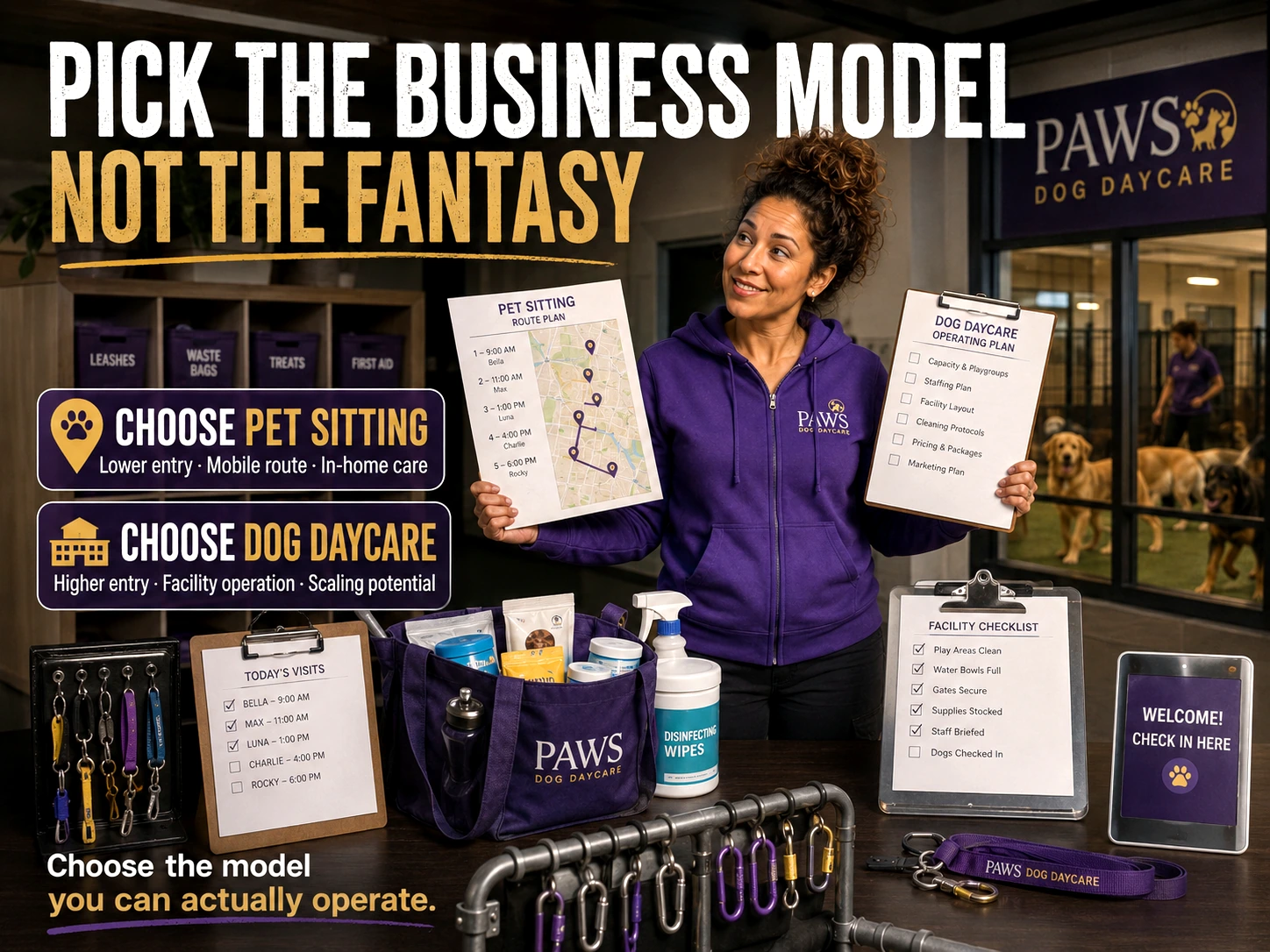
Pet sitting is a mobile trust business. It can be lower cost to start, valuable for many pets, and a good fit for owners who want a route-based service. But it is limited by travel time, visit windows, geography, and the fact that one person can only be in one house at a time.
Dog daycare is a facility operation. It has higher startup risk, higher overhead, more staff pressure, more dog behavior complexity, and a much bigger opening wall. But when built correctly, it can scale better because customers bring the dogs to one place and the business can add related services.
Neither model is automatically better. Pet sitting may be the right first business. Dog daycare may be the better long-term operation. The wrong answer is pretending they are the same because both involve dogs.
Decide whether you want a route or a facility. Then build the business like you understand what that choice actually means.
The best model is the one whose constraints the owner can manage consistently. Pet sitting requires route discipline and private-home trust. Daycare requires capital, staff leadership, facility control, behavior systems, and tolerance for fixed overhead.
Choose after comparing the ordinary week, not the exciting opening story. The owner will spend far more time managing schedules, staff, keys, cleaning, customers, records, and risk than performing the brochure version of animal care.