Dog Bite Prevention, Owner Responsibility, Dog Daycare Behavior, Warning Signs, Socialization, Training, Management, Supervision, Bite Risk, and Playgroup Safety
Preventing Dog Bites: Owner Responsibility, Warning Signs, and Daycare Reality
You cannot guarantee a dog will never bite. You can lower the odds with better training, management, supervision, and judgment.
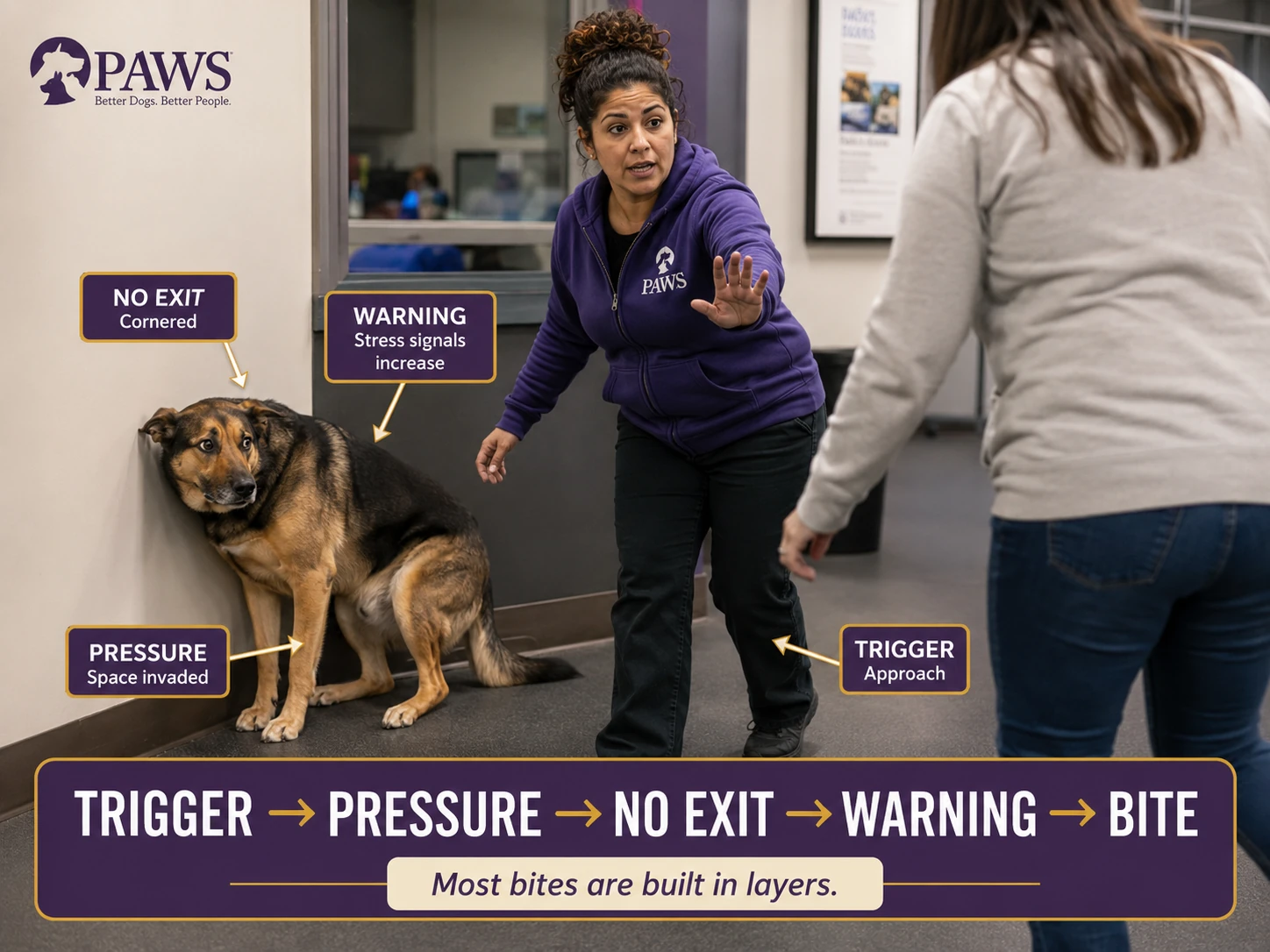
There is no way to guarantee that a dog will never bite. Anyone who tells you otherwise is selling comfort, not reality. Dogs have teeth. Dogs feel fear, pain, pressure, confusion, frustration, possession, stress, and over-arousal. A good dog can still bite in the wrong situation.
Bite prevention is not one magic trick. It is layers. Socialization. Training. Supervision. Management. Reading body language. Respecting warning signs. Keeping dogs out of bad setups. Getting professional help before the problem becomes somebody’s hand, face, child, neighbor, customer, or dog on the other end of the incident report.
A lot of bites do not happen because the dog woke up and decided to become a villain. They happen because people missed the warning signs, ignored the dog’s discomfort, let arousal climb too high, punished the growl, forced the greeting, left a child unsupervised, allowed resource guarding, trusted a weak gate, or put the dog in a situation where teeth became the dog’s final answer.
Dog daycare can help the right dog in the right program with the right supervision. It can also make the wrong dog worse if the dog is frightened, over-aroused, bullied, defensive, guarding, poorly matched, or constantly rehearsing bad behavior in a room full of moving targets.
The goal is not to pretend bites are impossible. The goal is to reduce the number of situations where biting becomes likely.
⚠️
Operator warning
Most bite prevention is not about proving a dog is “bad.” It is about not creating the situation where the dog has to be perfect under bad conditions. Good owners do not ask dogs to carry all the responsibility.
🗺️
Use This Page Like a Bite Prevention Map
Do not start with “my dog would never.” Start with the dog, the situation, the pressure, the warning signs, the human handling, and whether the dog has a safe way out.
🦷
Why Dogs Bite
Fear, pain, pressure, guarding, frustration, over-arousal, and poor handling all matter.
🧱
Prevention Layers
Training, management, socialization, supervision, and judgment work together.
🐾
Socialization Done Right
Exposure should build confidence, not flood the dog into survival mode.
🎓
Training and Control
Rules, boundaries, recall, leash manners, handling, and owner skill matter.
👀
Warning Signs
Freeze, hard stare, growl, lip lift, avoidance, stiffness, and stress are information.
✋
Operator Bite Reality
Bites are not just punctures. Speed, pressure, bite zone, and warning snaps change the risk.
🛡️
Active Attack Self-Defense
When a dog is already attacking, the situation changes from training to emergency control and self-defense.
🐕
Grooming Room Case Study
A real operator account of how a warning snap turned into an active attack in a confined grooming room.
🔇
Do Not Punish the Warning
Punishing a growl may teach the dog to skip the memo and go straight to teeth.
🏠
Kids, Guests, and Doorways
Many bites happen around normal household moments people handle badly.
🧨
Bite Setup Stack
Most bites are not one magic moment. They are pressure, trigger, no exit, ignored warning, and contact.
🦴
Mouth Pressure
“He is just mouthy” is not a plan. Mouth pressure and rough play need rules before adult teeth add consequences.
🏷️
Breed Is Not a Safety Plan
Breed, size, and history matter, but the breed label cannot supervise the dog.
📋
Daycare Intake Questions
Ask the bite-risk questions before the dog is already in a room full of moving targets.
🩹
After a Bite or Near Miss
Separate, document, check injuries, notify, report when required, and do not put the dog back into the same setup.
🚫
There Is No Such Thing as a Guaranteed Non-Biting Dog
Bite prevention is risk reduction, not a fairy tale.
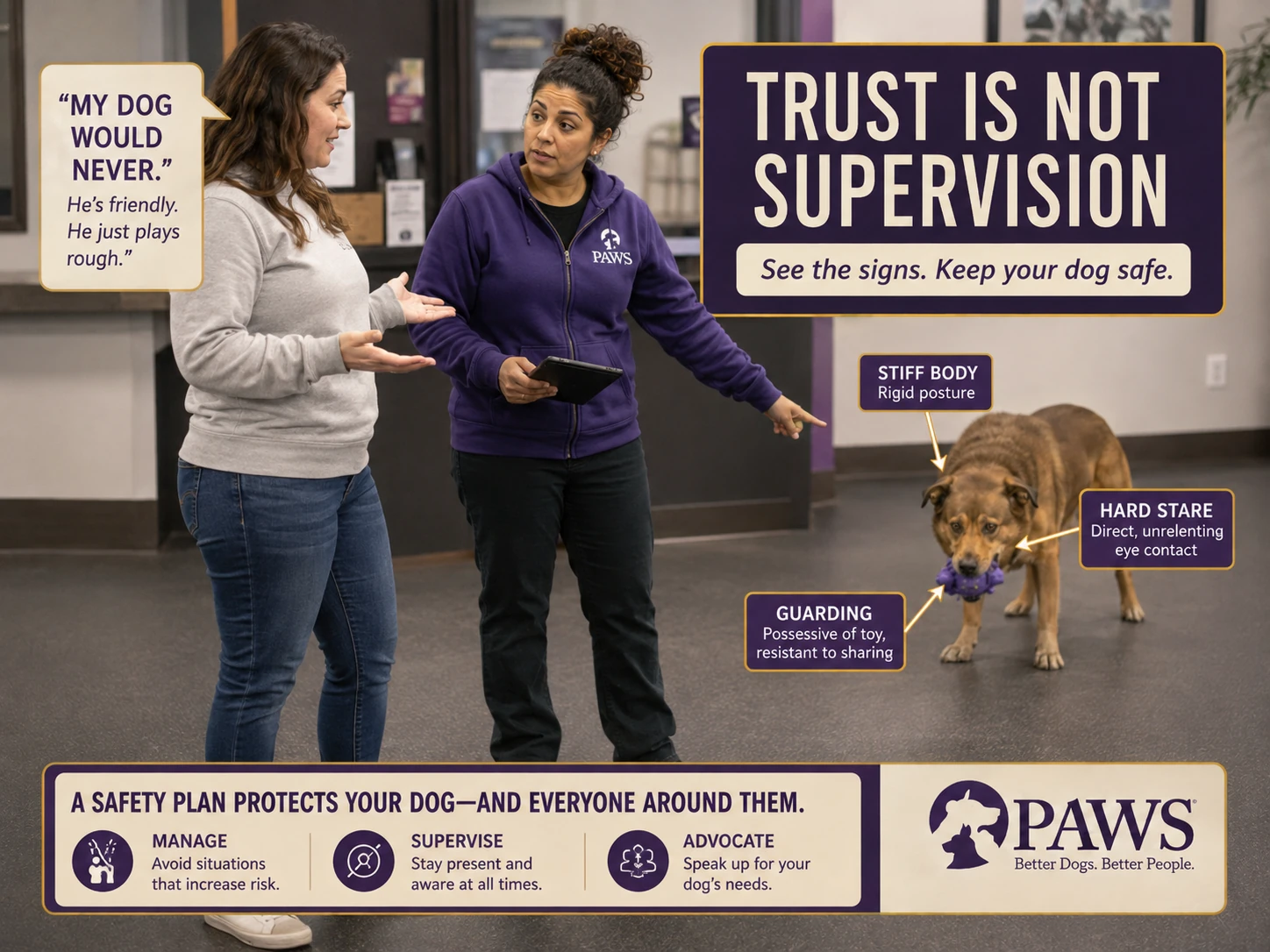
The honest answer is simple: no, you cannot guarantee your dog will never bite. A dog is a living animal with instincts, stress limits, pain responses, fear responses, teeth, and a nervous system. That does not make the dog bad. It makes the dog a dog.
What you can do is lower the odds. You can train the dog. You can socialize the dog correctly. You can avoid stupid setups. You can supervise children. You can stop forced greetings. You can secure doors and gates. You can manage food, toys, bones, beds, resting spaces, and visitors. You can get help when the dog starts showing warning signs.
Bite prevention is not about trusting the dog harder. Trust is not a leash, a fence, a training plan, or a warning-sign reader. The owner has to do the work.
Risk changes with context. A dog that has never bitten may still react differently when injured, startled, trapped, guarding, exhausted, aging, medicated, or placed under pressure the owner has never seen before.
A useful safety plan assumes that management can fail and adds backup: a closed door behind the gate, an adult actively supervising the child, a leash before the visitor enters, and a written handling plan before staff touch the sensitive dog.
📌
Plain truth
“My dog would never” is not a safety system. It is a sentence people say before finding out the dog had a limit.
🦷
Why Dogs Bite
Teeth are not always a personality defect. Sometimes teeth are what happens when pressure has nowhere else to go.
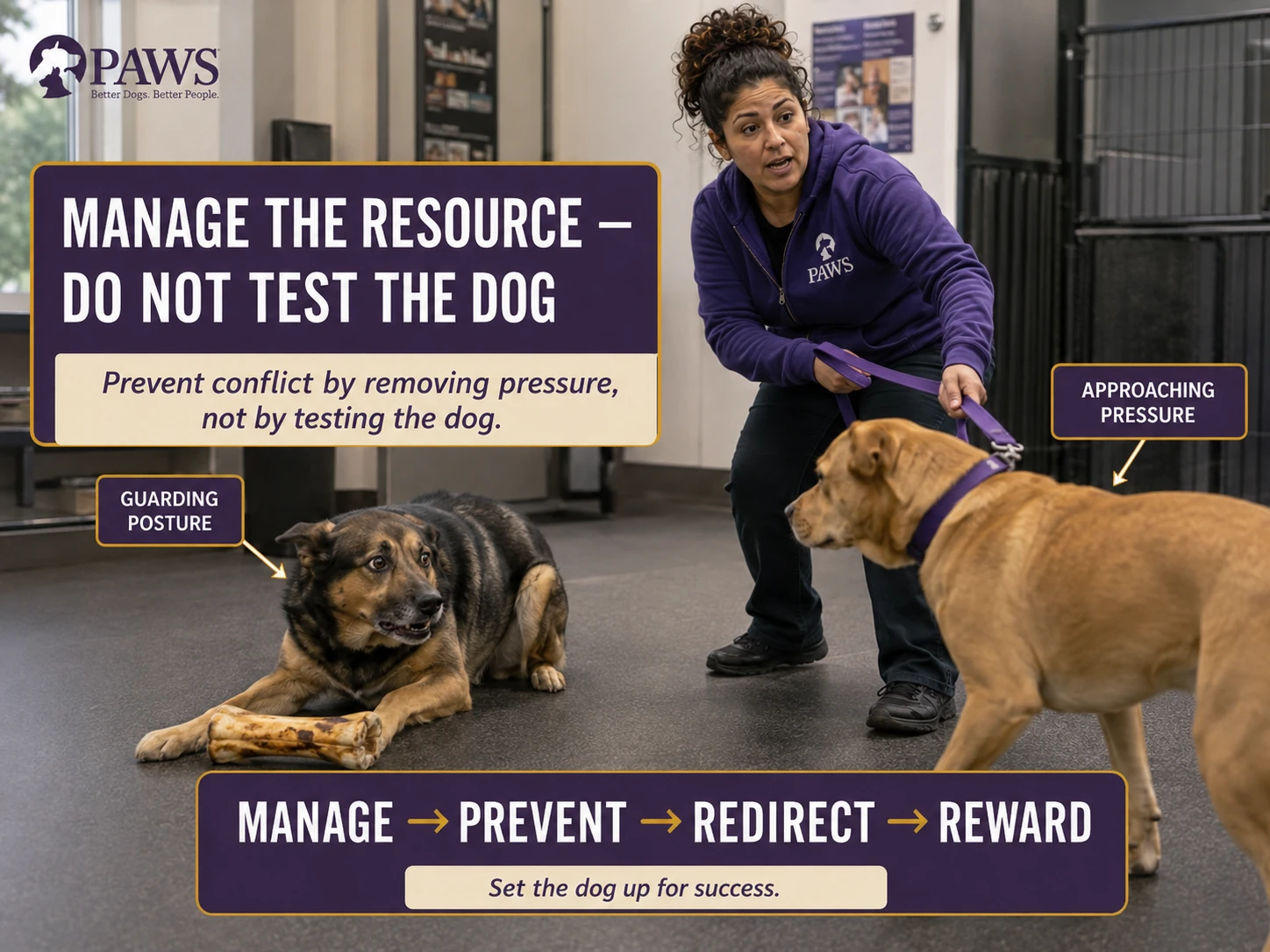
Dogs bite for different reasons. Fear bites do not look the same as resource guarding bites. Pain bites do not come from the same place as over-arousal bites. A dog defending a bone, a dog panicking when cornered, a dog being hugged by a child, and a dog body-slammed into a fight are not the same situation.
That is why lazy explanations get people hurt. “He is dominant.” “He is protective.” “He is jealous.” “He was fine yesterday.” None of that is enough. You need the setup, the trigger, the warning signs, the dog’s history, the human handling, and what happened right before the bite.
The same outward behavior can have different functions. A dog that growls over a chew may be guarding; a dog that growls when lifted may be in pain; a dog that growls when blocked may be asking for distance. Prevention depends on identifying what the dog is trying to protect, avoid, stop, or obtain.
Sudden behavior change deserves medical attention. Dental pain, orthopedic pain, ear disease, skin pain, neurologic disease, sensory decline, and other health problems can reduce tolerance before anyone recognizes the dog as sick.
Swipe left/right to see the full table.
| Reason | What It Can Look Like | Prevention Translation |
|---|---|---|
| Fear | Backing away, tucked posture, whale eye, freezing, hiding, growling, snapping when approached. | Do not corner the dog, force greetings, or punish the dog for being scared. |
| Pain or illness | Sudden irritability, guarding a body part, biting during touch, grooming, lifting, or restraint. | Assume medical causes are possible. Get veterinary input. |
| Resource guarding | Stiffening over food, bones, toys, beds, people, crates, water, or resting spots. | Manage access, stop testing the dog, and get professional help if guarding escalates. |
| Startle | Dog bites when woken, stepped over, grabbed, surprised, or touched from behind. | Do not let children climb on, hug, wake, or surprise dogs. |
| Frustration | Barrier barking, redirected biting, leash frustration, door/gate explosions. | Control transitions before frustration becomes teeth looking for an outlet. |
| Over-arousal | Rough play turns harder, mouth gets stronger, dog ignores corrections, dog cannot recover. | Stop the dog before play becomes impact, conflict, or a bite. |
| Territorial behavior | Dog reacts around doors, fences, yards, cars, delivery people, or visitors entering space. | Secure the dog before the person enters the dog’s problem zone. |
| Social pressure | Dog is mounted, crowded, stared at, blocked, chased, or repeatedly bothered. | Do not let one dog or person keep pushing until the target dog finally answers with teeth. |
| Poor handling | Grabbing collars, pinning, alpha nonsense, rough restraint, teasing, or ignoring warnings. | Stop turning handling into a fight the dog has to win. |
🧨
The Bite Setup Stack
A bite is rarely one thing. It is usually a stack of bad setup, rising pressure, ignored signals, and no safe exit.
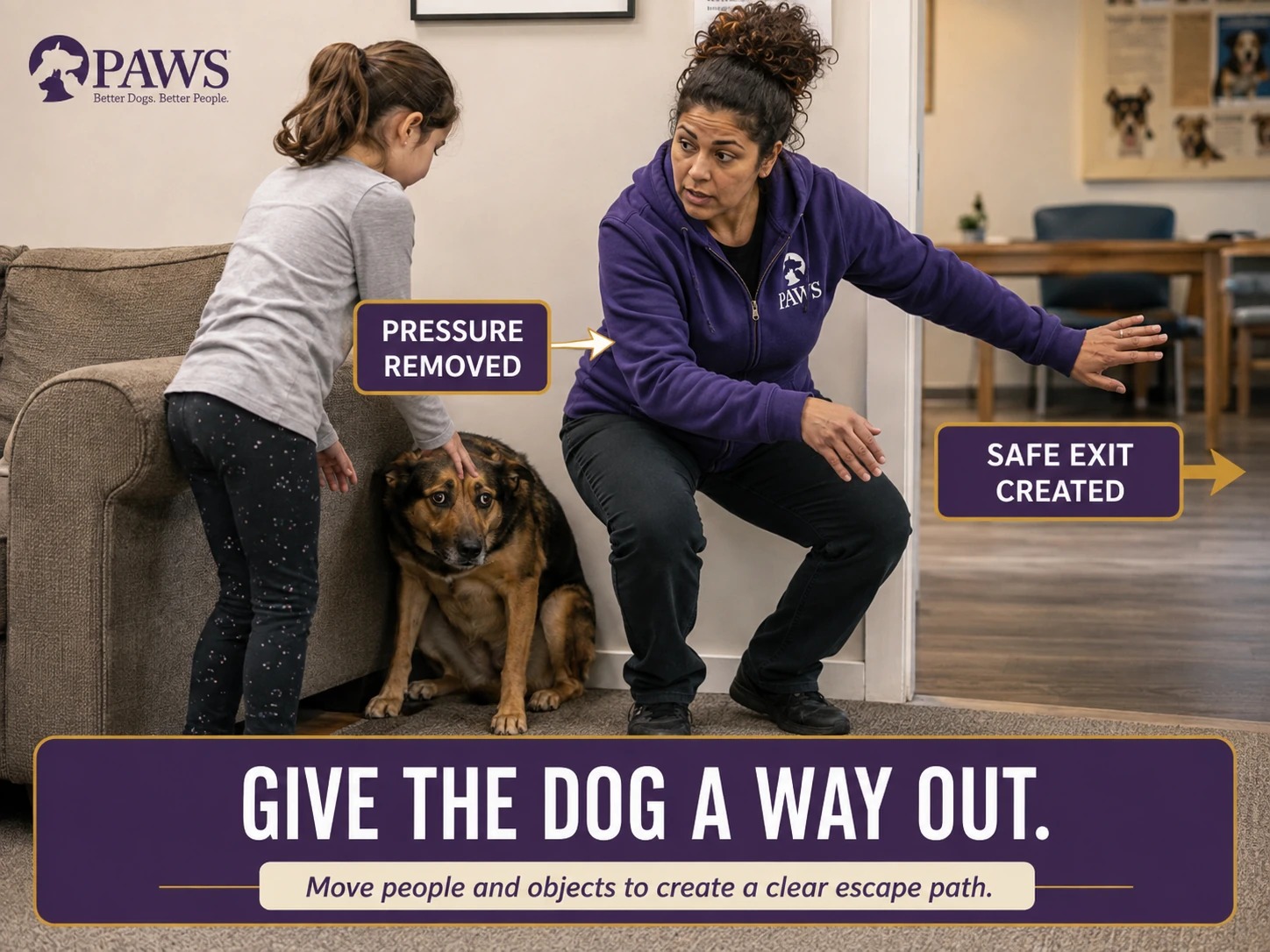
A lot of people treat a bite like it was one sudden event. Sometimes it is. More often, the bite was being assembled piece by piece while the humans were busy explaining why everything was fine.
The dog had a trigger. The dog had pressure. The dog had limited choices. The dog gave warning signs. The warning signs did not work. Then the dog used teeth.
This is why good bite prevention is not just “train the dog.” Training matters, but the setup matters too. A trained dog can still bite if the dog is in pain, trapped, guarding, scared, over-aroused, or repeatedly ignored.
The stack is dynamic. Removing one layer early may prevent the rest from forming: move the child, remove the chew, open the doorway, stop the mounting dog, end the grooming attempt, or give the frightened dog distance before the warning has to become contact.
After an incident, reconstruct the full sequence rather than naming only the final trigger. The useful review includes what happened earlier that day, the dog’s physical condition, prior warnings, room layout, available exits, people present, and which intervention opportunity was missed.
Swipe left/right to see the full table.
| Stack Layer | What It Looks Like | Human Job |
|---|---|---|
| Trigger | Food, toy, child, guest, doorbell, another dog, pain, grooming tool, crate, leash, collar grab, or surprise touch. | Identify what started the dog’s pressure before blaming personality. |
| Pressure | The dog is crowded, cornered, stared at, restrained, chased, hugged, mounted, teased, or repeatedly approached. | Lower pressure. Create distance. Stop the thing that is loading the dog. |
| No exit | The dog cannot leave because of a wall, leash, crate, child, gate, furniture, person, or pushy dog. | Give the dog a safe way out before the dog creates one with teeth. |
| Warning ignored | Freeze, hard stare, growl, lip lift, tucked body, avoidance, air snap, stiff posture, or guarding. | Treat warning signs as useful information, not disobedience. |
| Contact | Snap, nip, puncture, grab, shake, repeated bites, redirected bite, or dog-dog fight with human hands in the wrong place. | Stop the setup, separate safely, check injuries, document, notify, and reassess the dog’s plan. |
📌
Operator translation
Do not ask “why did he bite?” like the answer is hiding in one second of video. Ask what stacked before the bite: trigger, pressure, exit, warning, human handling, room energy, and whether anyone interrupted early enough.
🧱
Bite Prevention Is Built in Layers
No single layer is enough by itself.
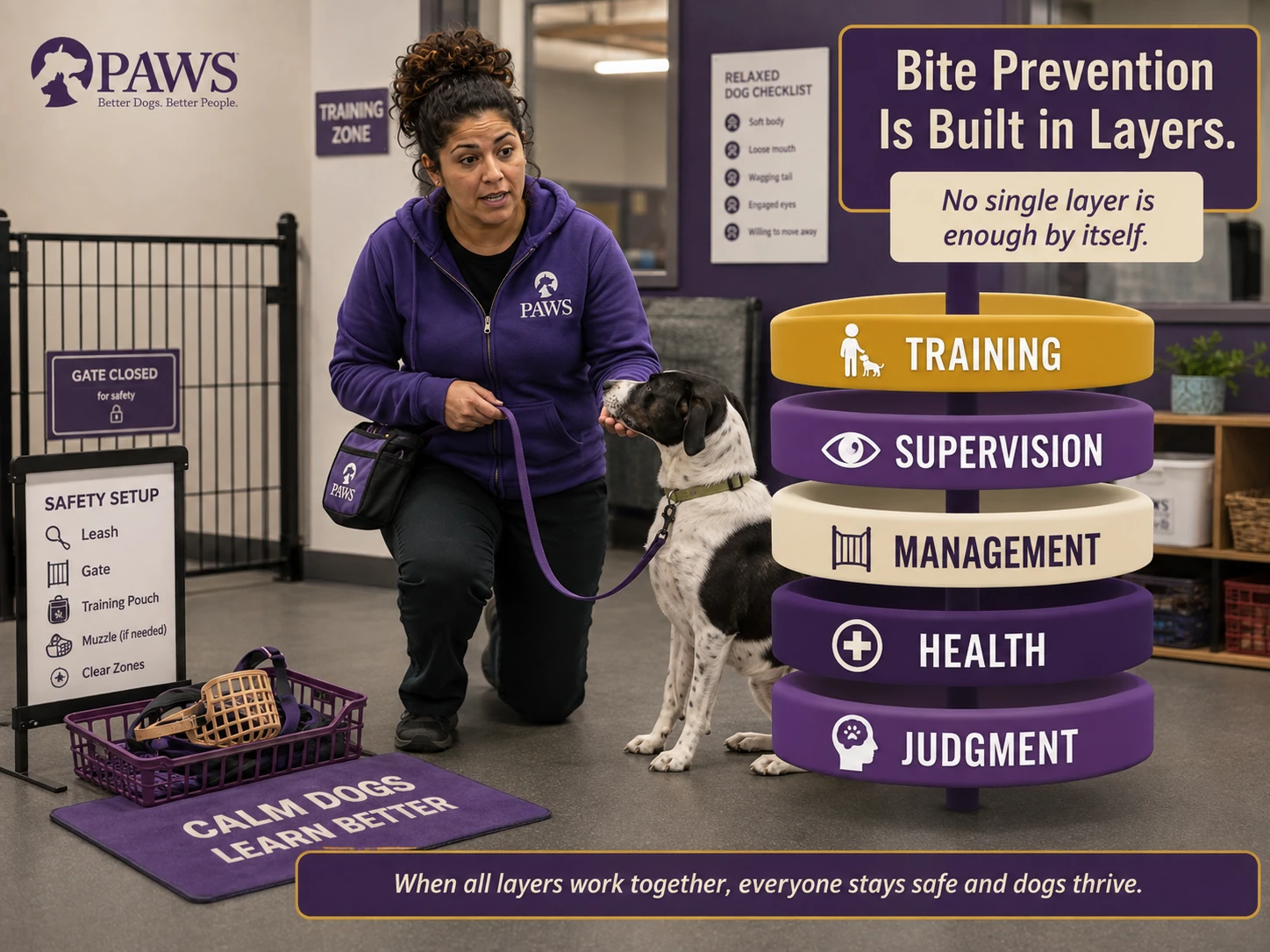
Spay or neuter can help with some roaming, mating-related conflict, and management issues. Socialization can help a dog feel safer in the world. Training gives the dog rules and gives the owner handling skill. Supervision catches bad setups before they become bites. Management keeps the dog away from situations the dog cannot handle.
But none of those layers work if the owner ignores the dog in front of them. A trained dog can still bite. A social dog can still bite. A neutered dog can still bite. A daycare dog can still bite. Bite prevention depends on the whole system.
Layers should overlap because every layer can fail. A recall may fail under arousal, a gate may be left open, a child may ignore a rule, or pain may change a familiar dog. Supervision and management provide backup when training is temporarily unavailable.
Review the layers whenever the dog’s health, household, routine, service setting, or behavior changes. A plan that worked for a young healthy dog may not be enough for the same dog after injury, sensory loss, relocation, or a new child in the home.
🎓
Training
Teach useful behaviors before the emergency: recall, leave it, drop it, place, leash control, wait, release, and calm handling.
👀
Supervision
Watch children, guests, dog-dog play, food, toys, gates, transitions, and body language before pressure turns into a bite.
🔒
Management
Use gates, crates, leashes, muzzles, closed doors, separate feeding, and structured introductions when the situation calls for it.
🐾
Socialization
Build confidence through controlled exposure. Do not flood the dog and call it experience.
🩺
Health
Pain and illness can change behavior. A sudden bite or sudden irritability deserves a veterinary look.
🧠
Judgment
The best safety tool is an owner who stops saying “he is fine” when the dog is clearly not fine.
⚕️
Spay or Neuter Your Dog, but Do Not Treat It Like a Magic Switch
It can help with some risks. It does not erase fear, pain, guarding, bad handling, or bad management.
Spaying or neutering may lower roaming, mating-driven conflict, and some hormonally influenced behavior. That can reduce certain risk situations, especially when intact dogs are loose, unsupervised, poorly contained, or constantly looking for trouble outside the property line.
But sterilization does not automatically create a safe dog. A neutered dog can still guard a bone. A spayed dog can still bite from pain. A fixed dog can still be fearful, over-aroused, defensive, territorial, or poorly socialized. Do not use surgery as a substitute for training, supervision, and common sense.
Talk with your veterinarian about timing, health, and individual risk. Then keep doing the rest of the work.
🏷️
Breed, Size, and History Are Not a Safety Plan
A breed label can be part of the information. It cannot do the supervising.
Breed matters in the same way size, strength, jaw size, energy level, working drive, owner skill, health, training, history, and environment matter. A large powerful dog can do more damage than a small dog. A high-drive dog may need more structure. A dog bred for certain work may bring certain tendencies into the room.
But breed is not a bite-prevention plan. The breed label does not tell you whether the dog guards food. It does not tell you whether the dog freezes before biting. It does not tell you whether the owner lets children climb on the dog. It does not tell you whether the dog is in pain, poorly socialized, over-aroused, frightened, or repeatedly put into bad setups.
Small dogs also bite. Friendly-looking dogs bite. Popular family breeds bite. Mixed breeds bite. Expensive dogs bite. Rescue dogs bite. Purebred dogs bite. The answer is not to pretend all dogs are the same. The answer is to evaluate the actual dog in the actual situation.
⚠️
Do not outsource judgment to a label
“He is a nice breed” is not supervision. “He is a scary breed” is not a full assessment. Watch behavior, history, owner control, warning signs, strength, environment, and whether the dog can be safely managed.
🎓
Train the Dog and Train the Owner
Training is not tricks. Training is how the dog learns to live safely with humans.
Training gives the dog rules and gives the owner control. A dog that can come when called, release an object, leave something alone, wait at a door, walk on leash, settle on cue, tolerate normal handling, and move away from conflict has more ways to avoid trouble.
But owner skill matters just as much. A dog can know a cue and still fail if the owner constantly puts the dog in bad setups. Training is not a certificate you hang on the refrigerator and then stop thinking.
Teach the dog appropriate behavior early. Do not encourage chasing, attacking, rough hand play, hard mouthing, guarding games, fence fighting, or “protective” behavior because it looks cute in a puppy. The dog you have in adulthood is often the dog you trained, allowed, ignored, or accidentally rewarded as a puppy.
Cue reliability should be tested gradually around realistic distractions before the cue is treated as a safety system. A recall that works in the kitchen may disappear at a gate, around a child, near a guarded item, or during high-arousal play.
Management remains necessary while training develops. Use the leash, barrier, separate room, muzzle conditioning, resource plan, or restricted service instead of repeatedly placing the dog in the same dangerous rehearsal and hoping the cue works this time.
- Teach recall before the dog is loose in high-risk situations.
- Teach leave it and drop it before the dog has something dangerous or valuable.
- Teach door and gate manners before the dog is exploding at visitors.
- Teach calm handling before grooming, vet care, restraint, and emergencies.
- Teach the dog how to disengage instead of letting the dog rehearse pressure until teeth show up.
🦴
Bite Inhibition, Mouth Pressure, and Rough Play
“He is just mouthy” is not a complete answer once the dog has adult teeth and no brakes.
Puppies explore with their mouths. Young dogs play with their mouths. Some dogs use their mouths when excited, frustrated, tired, overstimulated, or poorly taught. That does not mean every mouthy dog is aggressive, but it also does not mean mouth pressure should be ignored.
Bite inhibition means the dog has learned to control how hard the mouth closes. That matters. A dog with good mouth control may make contact during play and not injure anyone. A dog with poor mouth control may turn excitement into bruises, torn skin, punctures, or a daycare report that starts with “he has never done that before.”
Owners should not encourage rough hand play, hard mouthing, chasing hands, sleeve biting, face biting, or “attack him” games unless they are deliberately building a problem. Puppy behavior that looks cute at fifteen pounds may be a completely different conversation at seventy.
In daycare, repeated hard mouthing is a supervision issue. Staff should interrupt it, document it, and change the play plan. Do not wait until the mouthy dog finds a dog that answers harder.
Swipe left/right to see the full table.
| Mouth Behavior | What It May Mean | Staff / Owner Response |
|---|---|---|
| Soft puppy mouthing | Normal learning stage, but still needs rules. | Redirect to toys, reward calm behavior, stop rough hand games. |
| Hard play mouthing | Excitement is rising and mouth control is slipping. | Pause play, lower arousal, separate if needed. |
| Repeated grabbing | The dog may be rehearsing pressure, frustration, or poor play skills. | Document, restrict rough play, use smaller groups or structured breaks. |
| Sleeve, ankle, or hand targeting | Could be play, frustration, herding, overstimulation, or conflict. | Stop the pattern. Do not laugh it into a habit. |
| Mouth contact with stiff body | Possible warning, guarding, pressure, fear, or escalation. | Treat as a risk signal, not play. Separate and reassess. |
👀
Warning Signs Before a Dog Bite
Many dogs warn before they bite. Humans are often the ones who refuse to read.
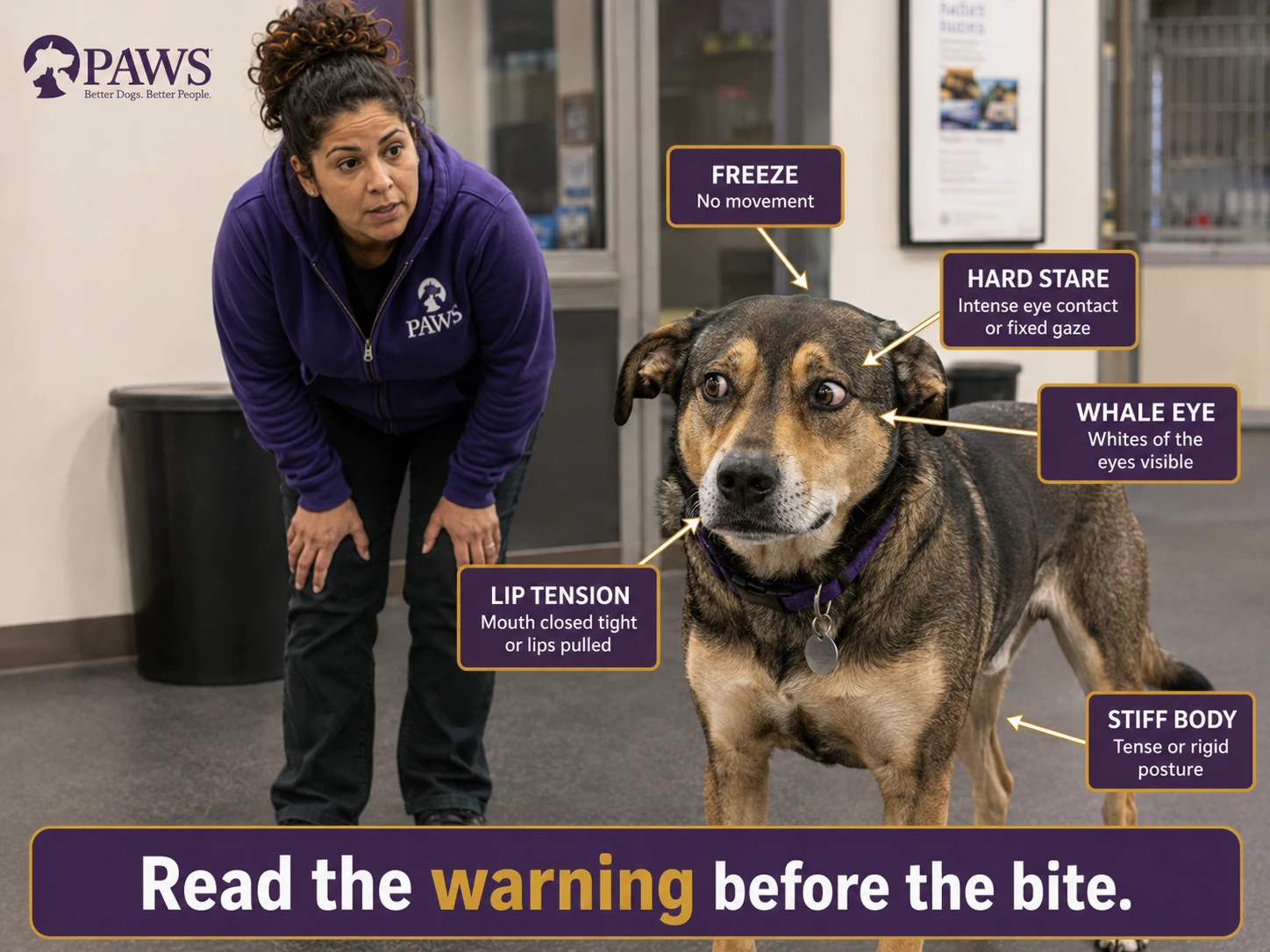
A bite does not always come “out of nowhere.” Sometimes the warning signs were standing in the room wearing a parade hat and people still missed them. Dogs may freeze, stare, turn away, lick lips, yawn, tuck, stiffen, growl, show teeth, air snap, guard, avoid, hide, or try to leave before biting.
The job is to notice the early stuff. If staff or owners only react after skin is broken, they are late.
Read patterns rather than waiting for one dramatic signal. A closed mouth, weight shift, still tail, fixed eyes, avoidance, and reduced movement may appear together before a growl. The dog’s normal baseline matters because subtle change can be the warning.
The immediate response is to stop adding pressure. Pause the hand, move the child, call off the approaching dog, open the exit, remove the resource conflict, or end the handling attempt. Do not crowd the dog while discussing what the signals mean.
Swipe left/right to see the full table.
| Warning Sign | What It May Mean | Human Translation |
|---|---|---|
| Freeze | The dog stops moving and goes still. | Stop what you are doing. Stillness can be the pause before impact. |
| Hard stare | Fixation, challenge, guarding, fear, or pressure. | Break the setup before the stare turns into a lunge. |
| Whale eye | The dog shows the whites of the eyes while avoiding direct comfort. | The dog may feel trapped or uncomfortable. |
| Lip lift or teeth | The dog is warning that escalation is possible. | Do not test whether the dog is serious. |
| Growl | The dog is communicating discomfort, fear, guarding, or threat. | Thank the dog for the warning and change the situation. |
| Air snap | The dog is warning without full contact. | The next answer may not miss. |
| Avoidance | The dog turns away, walks away, hides, or tries to escape. | Let the dog leave. Do not follow and force contact. |
| Tucked body | Fear, insecurity, pain, or pressure. | Lower pressure. Do not crowd the dog. |
| Stiff body | Rising tension or conflict. | Loose dogs bend. Stiff dogs need attention. |
| Guarding posture | Dog stiffens over food, toys, bones, people, beds, doors, or space. | Manage the resource. Do not reach in and make a point. |
🔇
Do Not Punish the Warning
A growl is information. Do not train the dog to stop giving information.
People get this wrong all the time. The dog growls, and the human punishes the growl. The human thinks the problem is solved because the growling stops. Sometimes what actually happened is worse: the dog learned that warning does not work.
A growl, lip lift, freeze, avoidance, or air snap is not something to admire, but it is useful information. It tells you the dog is uncomfortable, pressured, guarding, frightened, in pain, or over threshold. That is your chance to change the setup before the dog uses teeth.
If you punish the warning without fixing the cause, you may create a dog that looks quiet right up until the bite. That is not better training. That is removing the smoke alarm and acting surprised by fire.
📌
Room rule
Do not make the dog choose between being ignored and biting harder. Listen early.
✋
Operator Bite Reality: Pressure, Speed, and the Bite Zone
A dog bite is not just “holes in the skin.” Sometimes the puncture is not even the worst part.
Anyone who has worked around enough dogs learns to respect teeth differently than someone who has only imagined a bite. A quick snap-and-release can leave punctures, bleeding, bruising, and a bad day. But a bite-and-hold from a strong dog is a different animal. The pressure is what gets your attention.
The top of the hand is one of the worst places to get bitten. There is not much padding there. A dog that clamps down across the top of the hand can make you feel the crushing pressure through the bones, tendons, and joints fast. Fingers are the same problem. A dog that can casually crack animal bones while eating has more than enough strength to damage a human hand.
This is why “he only nipped” is not always the comfort people think it is. Bite location, pressure, duration, and intent matter. A snap that misses, a mouthy grab, a warning bite, a crush bite, a puncture bite, and a bite-and-hold are not the same risk.
Speed is another reality people underestimate. If you are already inside the dog’s bite range and the dog truly decides to bite, you are probably not fast enough to beat the mouth. Dogs can turn, snap, and make contact faster than most humans can react. If a dog air snaps near you and does not touch you, do not assume you heroically dodged it. A lot of the time, the dog was warning you that it could have bitten and chose not to.
That warning deserves respect. A dog that is giving you air snaps, hard stares, freezes, growls, lip lifts, or stiff body language is not asking for a debate. The dog is telling you the situation is loaded. Back up, lower pressure, create distance, use trained handling procedures, and stop trying to win an argument with an animal that has faster equipment than you do.
Swipe left/right to see the full table.
| Bite Reality | What People Underestimate | Safer Interpretation |
|---|---|---|
| Snap and release | People focus only on whether the wound is small. | The dog made contact. Find the trigger, document it, and do not repeat the setup. |
| Bite and hold | The punctures may not be the worst part. | Crushing pressure can damage hands, fingers, arms, tissue, joints, and confidence fast. |
| Top-of-hand bite | There is very little padding over the bones and tendons. | Treat hand bites seriously. Small-looking wounds can still involve deeper injury. |
| Air snap | People think the dog “missed.” | Many air snaps are warnings. If the dog wanted contact and was in range, contact was probably available. |
| Bite range | People think only the space directly in front of the mouth is dangerous. | Dogs can turn fast. Hands near the face, collar, neck, shoulders, front legs, or side of the head may still be in the bite zone. |
| Escalation | People imagine one bite to the hand and then it is over. | A dog in full defensive or offensive escalation may redirect, bite repeatedly, or move from hands to arms, legs, or face. |
⚠️
Handler warning
Do not get casual because the dog is cute, familiar, small, tired, old, or “usually fine.” If the dog is inside bite range and decides to bite, your reaction speed is probably not the safety plan you think it is.
📌
Operator translation
Dogs are not furry little children with decorative teeth. They are emotional, social, instinctive animals with speed, strength, mood, memory, pressure limits, and bite equipment. Respect the warning signs before the dog gives you the version that needs medical supplies.
🛡️
When It Becomes Self-Defense, Not Training
There is a difference between a dog warning you and a dog that has decided the fight is on.
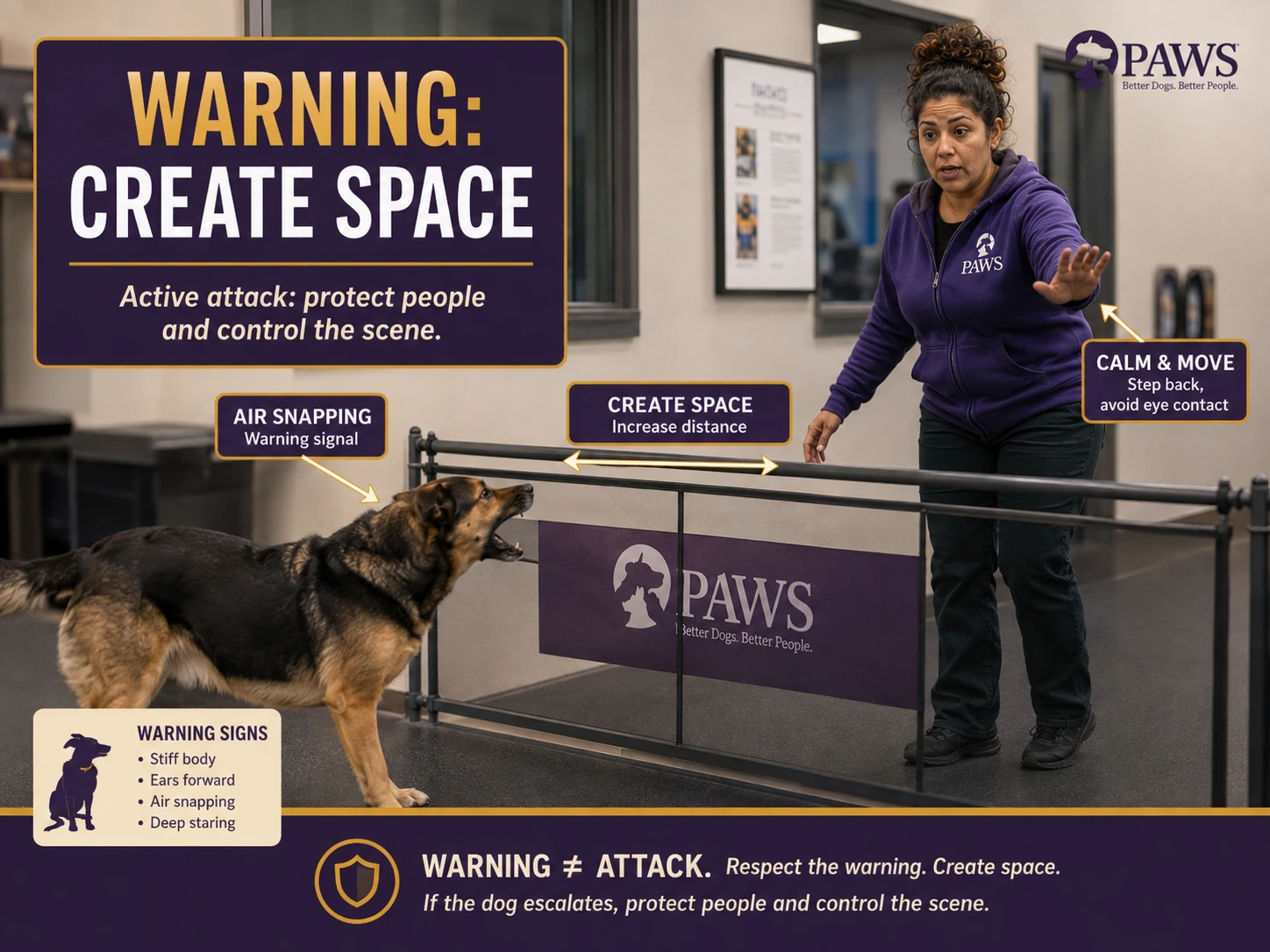
Most bite prevention should happen before contact. Read the warning signs. Lower pressure. Give the dog an exit. Stop the setup. That is the clean version.
But sometimes the clean version is gone. The dog is not giving you a polite memo anymore. The dog is coming forward, grabbing, holding, redirecting, or trying to fight. At that point, this is not obedience training. It is not socialization. It is not a teachable moment. It is emergency self-defense.
If you are already inside bite range and a dog truly wants to bite, you are probably not going to out-react him. Dogs can move faster than most people think. Freezing because you are afraid of being bitten can make the situation worse, because in an active attack you may get bitten anyway. The goal is not to float through untouched. The goal is to avoid the catastrophic injury.
That is an ugly truth, but it matters. A superficial bite to the forearm is bad. A crushing bite to the top of the hand, fingers, face, throat, groin, or a child is a different conversation. If the dog already has one part of you, you may have to make a hard decision about protecting everything else. In the middle of a real attack, you are not choosing between perfect and bad. You are choosing between bad, worse, and life-changing.
I have been bitten enough times to respect that difference. A quick snap-and-release can leave holes and bruising. A bite-and-hold is different. The pressure is the part people do not understand until they feel it. A strong dog clamped onto a hand or arm can make you feel the crushing force through bone and tissue. It is not just “he punctured me.” It is “this animal has enough mouth strength to seriously damage the part of me he has.”
That is why staff cannot treat every bite the same. A warning snap is not the same as a bite-and-hold. A dog that makes one defensive contact and retreats is not the same as a dog that keeps coming. A dog cornered under a tub is not the same as a dog loose in an open yard. Context matters.
It is also why you do not punish the dog after the emergency is over. Once the dog is secured and the room has cooled down, the professional response is not revenge. You do not yell, hit, threaten, or try to “teach him a lesson” after the dog has come down. In the dog’s world, that moment may already be gone. If the human starts another conflict, the human may restart the problem.
The professional response is control. Secure the dog. Stop the service if needed. Treat injuries. Preserve video if it exists. Write the report. Call the owner. Decide whether the dog needs restrictions, muzzle conditioning, medical review, private handling, professional behavior help, or refusal from that service.
Swipe left/right to see the full table.
| Situation | What It Really Means | Operator Priority |
|---|---|---|
| Warning snap | The dog is telling you it can bite and wants the pressure to stop. | Back off, lower pressure, create space, and do not test whether the next one lands. |
| Bite and release | The dog made contact and let go. | Separate, check injury, document, and stop repeating the setup. |
| Bite and hold | The dog is applying sustained pressure, and the crushing force may be worse than the punctures. | Protect vulnerable body parts, get help, control the scene, and prevent the dog from getting a worse target. |
| Confined room attack | The dog, handler, equipment, corners, and walls all become part of the fight. | Reduce chaos, avoid feeding hands into the bite zone, get help, and secure the dog when possible. |
| Empty mouth problem | If the dog releases one target while still committed to the fight, the next target may be worse. | Think in terms of protecting the most vulnerable areas: face, throat, hands, groin, and anyone smaller nearby. |
| Dog comes down after control | The dog may emotionally reset once the pressure drops and the emergency ends. | Secure, document, treat injuries, notify the owner, and do not restart the fight with punishment. |
⚠️
Hard truth
In an active attack, you may get bitten even if you handle it correctly. The goal is to prevent the worse bite, the worse target, the worse injury, and the worse chain reaction. Do not freeze because you are afraid of getting holes in you. If the dog is already committed, the problem is already happening.
📌
Operator translation
A dog that is warning you deserves space. A dog that is actively attacking creates a self-defense problem. Both situations require respect, but they are not the same thing. Do not confuse bite prevention with standing there politely while a dog tries to chew you up.
🐕
Operator Case Study: The Lab in the Grooming Room
This is not a cute training story. This is what an active dog attack can feel like in a confined room when the warning phase is already over.
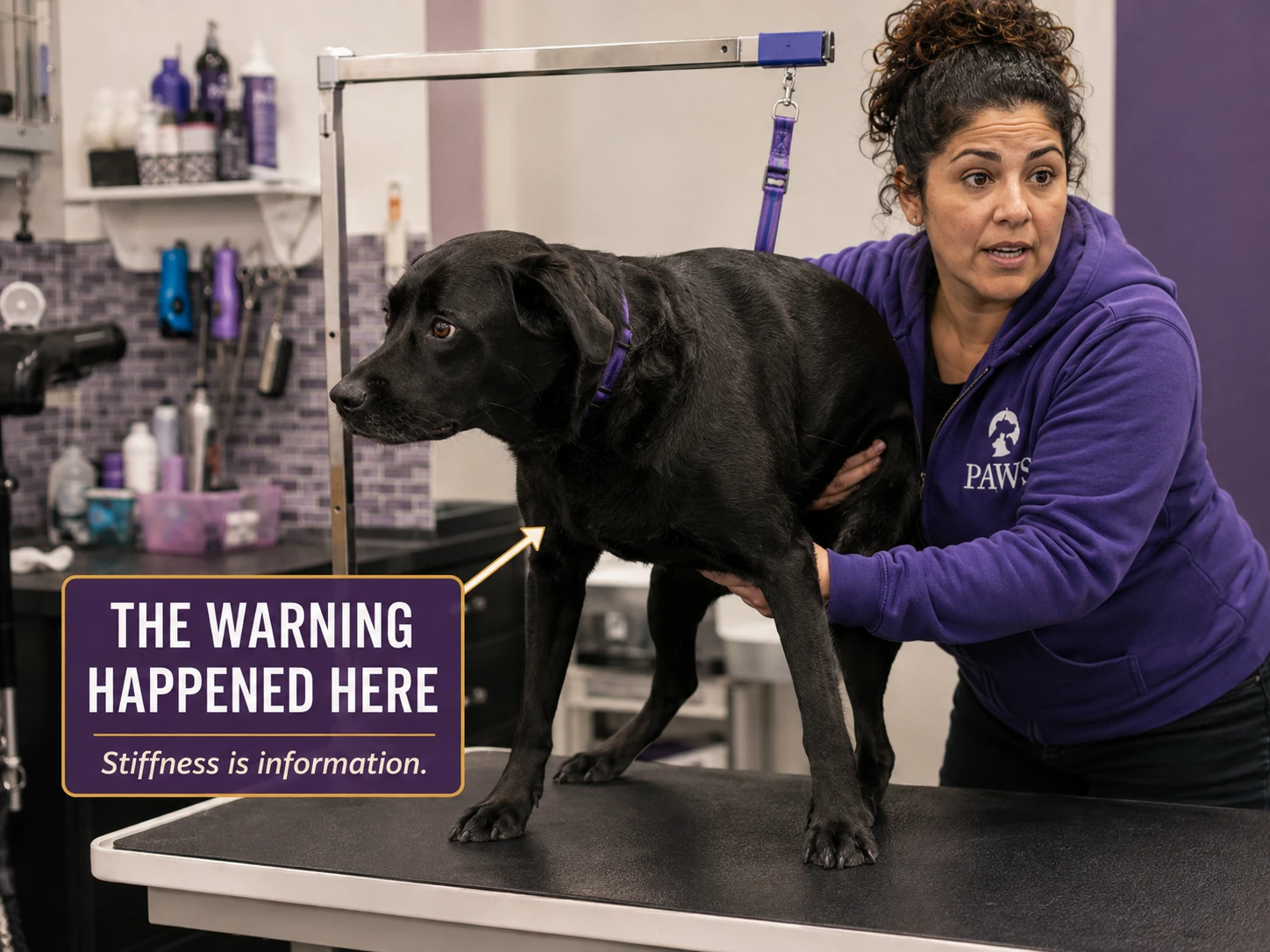
I had a large black Lab on the grooming table. I was trimming his nails, and then I went to lift him toward the tub. That was my mistake. I did not read him well enough. When I put my hands on him to pick him up, he stiffened. That was the warning. I missed it, or I did not respect it fast enough.
As soon as I started to lift, he came apart. He snapped toward my face while I was trying to cradle him up and move him toward the grooming tub. It was a warning bite, but it was close enough to get my attention. When he snapped, I opened my hands. He dropped, hit the floor, and landed badly enough that when he came back up, the mood had changed completely.
At that point, he was not just giving me a warning anymore. He was ready. He came up angry, snapping, snarling, and trying to come forward. He tried to get at me from around the front of the grooming table. Then he tried to come under it. The tile floor kept him from getting good traction, which probably helped more than anything I did in those first few seconds.
A grooming room is a bad place for this kind of problem. It is tight. There are tables, tubs, corners, gates, tile floors, equipment, walls, and nowhere clean to move. Every time you try to get control, you may also be cornering the dog, and cornering the dog can make the whole thing worse. He went under the grooming tub into that small cornered area, and that is the kind of place you cannot just reach into like you are grabbing a towel off a shelf. That is how you donate a hand.
He kept coming, and eventually he got my forearm.
Once he had my forearm, that forearm was already bought and paid for. I was not going to politely pull it out and give him an empty mouth to fill with something more expensive, like my face, my hand, my groin, or my thigh. That sounds rough because it is rough. But in that moment, the bite had already happened. The question was not whether I was going to get bitten. I was already bitten. The question was whether I could keep the situation from getting worse.
So I grabbed the back of his head and drove my forearm deeper into his mouth so he could not let go and immediately grab something else. I was not doing that because it was pretty. I was doing it because his mouth was occupied, and an occupied mouth was better than an empty mouth looking for a better target. The fight was already on. I accepted the loss I had and tried to prevent the bigger one.
We went to the ground. I ended up on top of him. My forearm was still pressed into his mouth, and I had to keep control without turning the whole thing into a beating. I was not punching him. I was not kicking him. I was not trying to hurt him for revenge. I was trying to stop the emergency.
Once I had enough control, I worked my way into a position where I could get my forearm out without giving him a free shot at something worse. I controlled his head and throat area long enough to keep him down and keep the mouth from becoming the next problem. I was not choking him out. I was not trying to throttle him. I was holding him. That was the job. Hold him. Keep him from re-engaging. Let the temperature of the room come down.
He was panting hard. His tongue was purple. His eyes had that great-white-shark look where the dog is still in that high-arousal tunnel and not really back with you yet. That is the part people do not understand if they have only seen dog behavior from the safe side of a leash. In that moment, you are not negotiating. You are not explaining. You are not doing obedience. You are waiting for the animal to come down enough that the next move does not restart the whole thing.
While I held him there, another staff member came in and got a slip lead over his head. Once that happened, I could transition him out of the fight. I took the lead, lifted up, and just like that, the dog started coming back to himself. The same dog that had just been in full attack mode was suddenly acting like it was another Tuesday.
That is one of the strangest realities of working with dogs. They can switch emotional gears fast. A dog can go from snarling, grabbing, and trying to fight to looking like, “Okay, are we done now?” That does not mean the bite did not happen. It does not mean the incident was fake. It does not mean the dog was safe in that setup. It means the triggering moment, the pressure, and the chaos had dropped, and the dog’s brain came back down with it.
Once it was over, it was over. You cannot be angry at the dog in that moment and start punishing him after he has come down. In his world, the fight is gone. If you start yelling, hitting, threatening, or trying to “teach him a lesson” after the emergency is controlled, you may just restart the exact thing you finally got stopped.
The dog lived a normal life and died of old age. I kept all ten fingers. I had holes in me, the situation was handled, and nobody needed to turn it into revenge. That is the reality of this work sometimes. You respect the dog, you respect the damage the dog can do, you handle the emergency in front of you, and then you go clean yourself up and write the facts down.
⚠️
Do not read this as a handling tutorial
This is one operator’s real incident, not a step-by-step instruction sheet. The lesson is not “copy this move.” The lesson is that active attacks are fast, ugly, confined spaces make them worse, and once the dog is already committed, the handler may be choosing between bad injury and worse injury.
Swipe left/right to see the full table.
| Part of the Incident | What Actually Mattered | Lesson for Dog Daycare and Grooming |
|---|---|---|
| The stiffening before the lift | The dog gave an early warning before the bite. | Stiffness is information. Stop and reassess before moving deeper into handling. |
| The snap toward the face | The dog showed he had the speed and intent to make contact if pushed further. | A warning snap is not a joke. It is the dog telling you the next version may not miss. |
| The confined grooming room | Tables, tubs, corners, tile, and equipment made every movement harder. | Room layout matters. Tight spaces can turn handling problems into cornered-dog emergencies. |
| The forearm bite | The injury had already happened. The priority became preventing a worse target. | In an active attack, the goal may be reducing damage, not avoiding all damage. |
| The dog coming down | Once secured and pressure dropped, the dog emotionally reset. | Do not punish after the emergency. Secure, document, treat injuries, and change the plan. |
📌
Operator translation
There is a big difference between a dog that warns you and a dog that has crossed into an active fight. When the fight is already on, you may get bitten no matter what. The goal is to keep the injury from becoming worse, protect the most vulnerable targets, get help, secure the dog, and then stop. No revenge. No lecture. No round two.
🏠
Children, Strangers, Guests, and Doorways
Many bite setups are normal household moments handled badly.
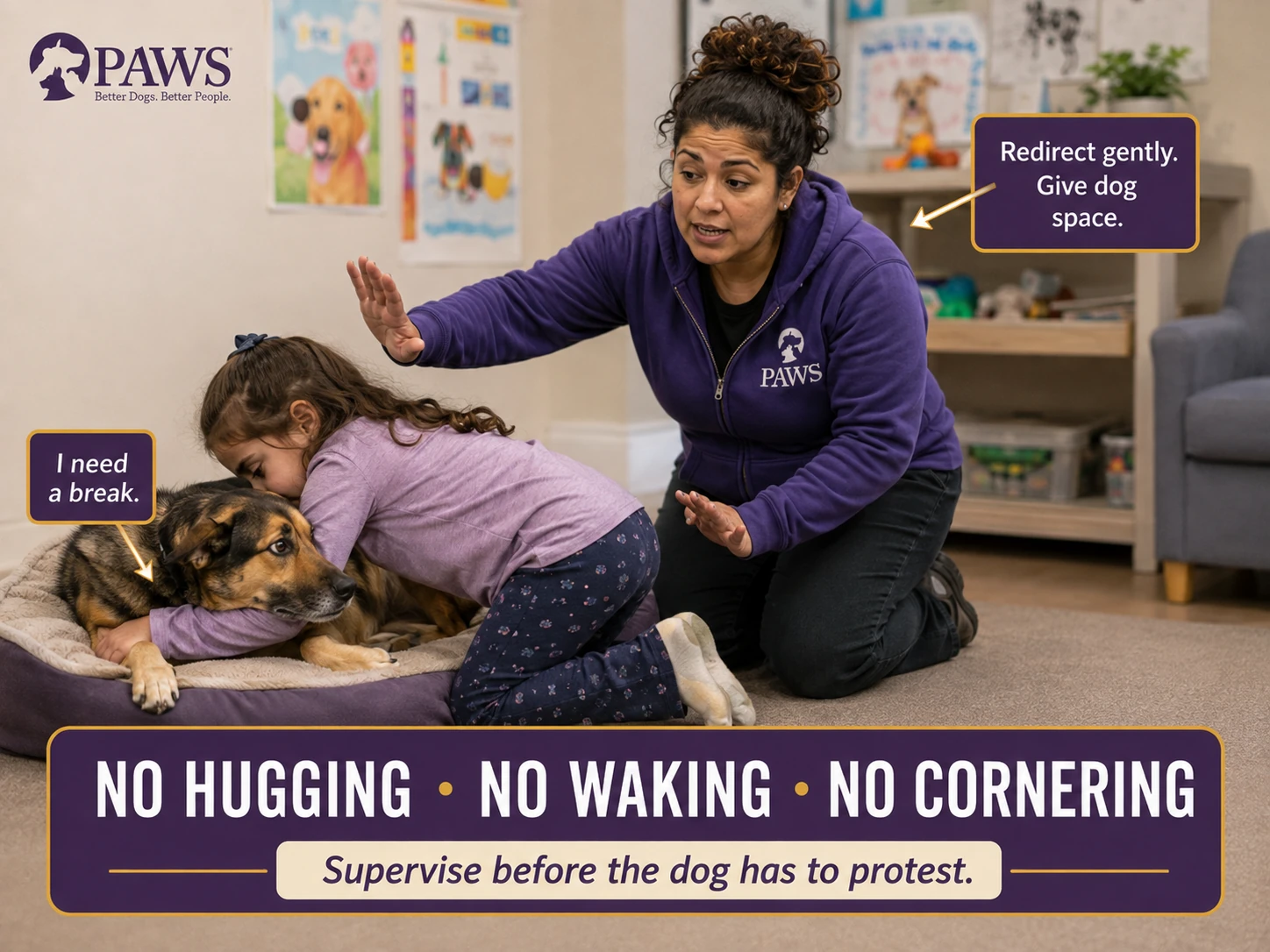
Dogs do not need to be aggressive monsters to bite in a household setting. A child hugs the dog. A guest reaches over the dog’s head. A delivery person comes to the door. A dog is eating. A dog is sleeping. A dog is guarding a toy. Somebody grabs the collar. Somebody leans into the dog’s face. Somebody ignores the growl because “he knows me.”
Children should not be allowed to climb on dogs, hug dogs, wake sleeping dogs, take food or toys, chase dogs, corner dogs, or treat dogs like stuffed animals with pulse and fur. The dog may be patient until the dog is not.
Doorways are another common problem area. Dogs can become protective, territorial, frustrated, excited, or startled when strangers come to the door. Secure the dog before opening the door. Do not make the dog decide what the mail carrier, guest, delivery driver, contractor, or neighbor means.
Active supervision means an adult is close enough to interrupt immediately and is watching the interaction rather than a phone, television, or conversation. A child and dog sharing a room is not automatically supervised.
Give the dog a protected resting area that children and guests cannot enter. The dog should not have to defend a bed, crate, doorway, food bowl, or escape route from people who were never taught to leave it alone.
- Separate dogs from children during eating, sleeping, chewing, or high excitement.
- Do not let children hug, climb on, ride, corner, or startle dogs.
- Secure dogs before opening doors for guests, deliveries, contractors, or strangers.
- Do not allow people to reach into crates, beds, cars, fences, or resting spaces.
- Manage food, toys, bones, beds, and favorite people when guarding is possible.
🐕
Dog Daycare Can Help the Right Dog and Hurt the Wrong Setup
Daycare is not a magic socialization machine. It is a managed group environment.
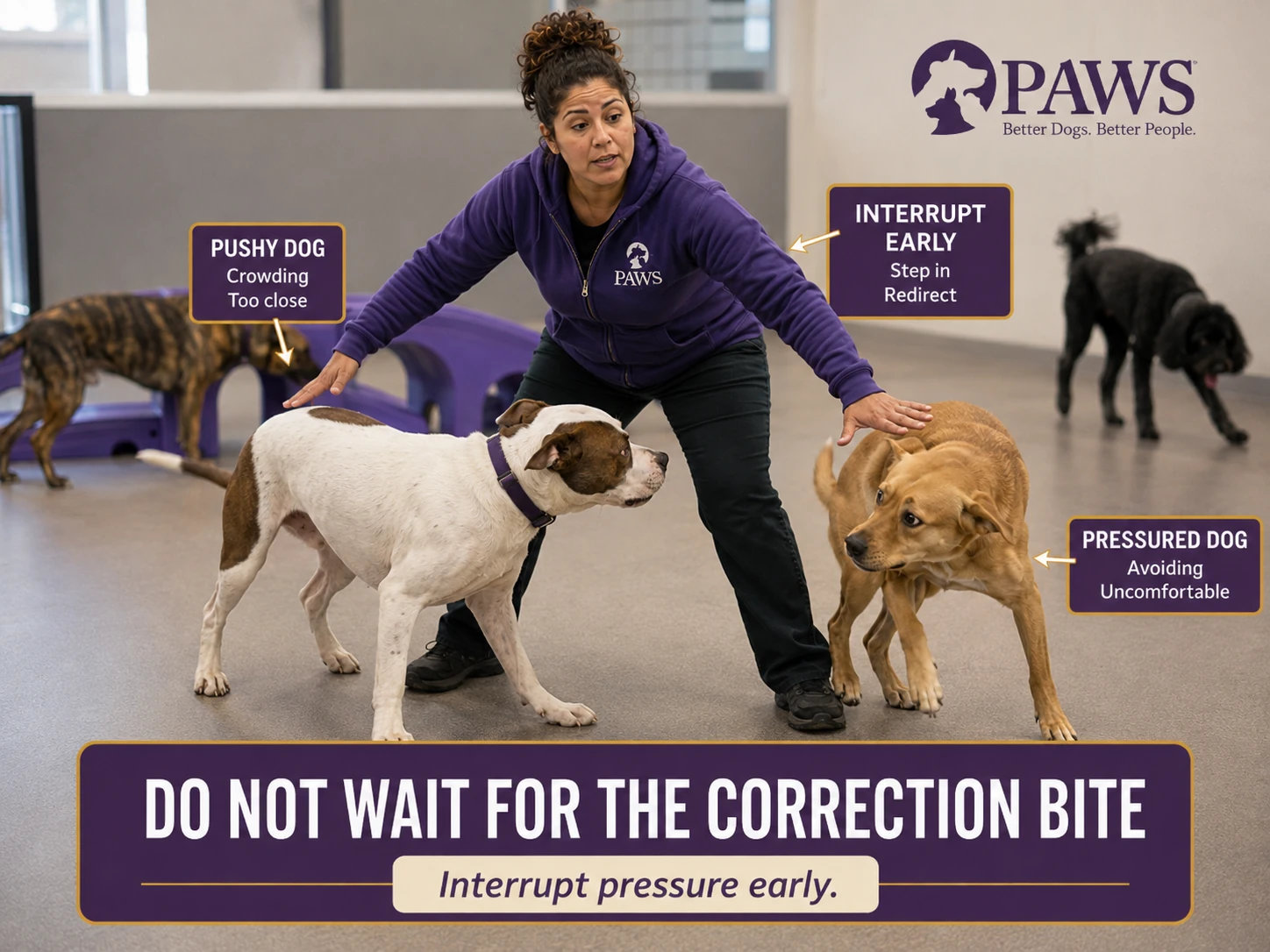
A good dog daycare can help some dogs become more comfortable, better exercised, more socially experienced, and more stable around other dogs and people. But that only happens when the dog is appropriate for the environment and the facility actually screens, sorts, supervises, interrupts, rests, and documents.
Daycare can also increase bite risk when the dog is frightened, overwhelmed, over-aroused, bullied, defensive, guarding resources, or placed with dogs that keep creating pressure. A dog that spends all day practicing panic, hard chase, mounting, body-slamming, or defensive corrections is not being improved by daycare. The dog is rehearsing the problem.
Daycare is helping when the dog remains loose, recoverable, appropriately social, responsive to staff, and able to rest. It is hurting when the dog repeatedly freezes, flees, targets, guards, mounts, hard-chases, escalates, or requires constant interruption to avoid conflict.
The service decision should match the evidence. That may mean shorter visits, smaller groups, selected partners, private enrichment, handling restrictions, enforced rest, temporary suspension, professional evaluation, or refusal of open play.
🐾
Use the dog handling hub with this page
Bite prevention connects directly to personality types, group compatibility, playgroup control, warning signs, fight prevention, emergency response, and staff documentation. This page explains why bites happen. The dog handling hub explains how to read and manage the room before the bite setup gets that far.
Open the Dog Daycare Dog Handling and Playgroup Behavior Hub →
👑
Dominant or Confident Pressure
A confident dog with no brakes can pressure another dog into defending itself.
⚠️
Daycare rule
Good daycare does not mean every dog plays with every dog all day. Good daycare means the facility knows when to say yes, when to slow down, when to separate, and when to refuse open group.
📋
Dog Daycare Intake Questions for Bite Risk
The best time to ask bite-risk questions is before the dog is already in open group.
Dog daycare intake should not be a cute form with vaccine dates and a “does your dog like other dogs?” checkbox. Owners may not know what matters. Some owners minimize. Some forget. Some are embarrassed. Some honestly do not understand that growling over a bone, snapping at kids, or attacking the vacuum can matter in a group-care environment.
The goal is not to shame the owner. The goal is to find the bite setup before the dog finds it for you.
Follow broad answers with specific examples. “He is protective” should lead to questions about doors, guests, handling, distance, contact, injuries, and what ended the event. “He only warned” should lead to what the warning looked like and how close it came to contact.
Intake is not complete until staff compare the owner history with observed behavior during arrival, leash transfer, body handling, gate movement, resource exposure, separation, and recovery. A checkbox cannot replace a controlled assessment.
Swipe left/right to see the full table.
| Intake Question | Why It Matters | Operator Translation |
|---|---|---|
| Has your dog ever bitten, snapped, air snapped, or made contact with a person or animal? | Bite history changes risk, even if the owner says it was “nothing.” | Ask for context, severity, trigger, date, injury, and what changed afterward. |
| Does your dog guard food, toys, bones, beds, water bowls, crates, people, doors, or space? | Resource guarding is one of the easiest bite setups to accidentally create. | Remove shared resources, restrict group placement, or refuse open play. |
| How does your dog handle children, strangers, delivery people, guests, and people entering the home? | Household bite patterns can show up in lobby, pickup, drop-off, and staff handling. | Doorway and stranger reactivity need written handling rules. |
| How does your dog respond to collar grabs, leash pressure, grooming, lifting, restraint, or vet handling? | Handling sensitivity becomes a staff bite risk. | Do not discover the problem while trying to pull the dog out of a playroom. |
| Does your dog get more intense the longer he plays? | Some dogs lose control as arousal rises. | Use shorter play cycles, rest breaks, small groups, or no open group. |
| Has your dog ever been removed from daycare, boarding, grooming, training, a dog park, or a playdate? | Prior service refusal is useful information. | Ask what happened, not just whether the owner agrees with it. |
⚠️
Intake rule
The owner’s embarrassment is not more important than staff safety, dog safety, and the other customers’ pets. Ask the uncomfortable questions before the room answers them.
🧍
Responsible Dog Ownership Is Bite Prevention
The dog depends on the owner for more than food and affection.
Dogs need exercise, structure, social contact, rest, training, veterinary care, enrichment, containment, and guidance. Leaving a dog chained, isolated, ignored, under-stimulated, or crated for endless hours without healthy outlets can build frustration, territorial behavior, fear, and anti-social patterns.
That does not mean every dog needs daycare five days a week. Some dogs do great with daycare. Some need structured walks, training, enrichment, private play, decompression, or a calmer life. The point is not to throw the dog into stimulation. The point is to give the dog an appropriate life.
The owner’s job is to understand the dog they actually have, not the dog they wish they had.
🧠
When to Get Professional Help
Do not wait until the dog has a bite history worth naming.
Get help when the dog is repeatedly growling, snapping, guarding, freezing, biting, lunging, cornering people, reacting badly to children, refusing handling, escalating at doors, or showing sudden behavior changes. Get help when the owner is afraid of the dog. Get help when staff are working around the dog instead of managing the dog safely.
Professional help may mean a veterinarian, trainer, behavior consultant, veterinary behaviorist, or a combination. Pain and medical problems can drive behavior. Training and behavior modification can change patterns. Management can prevent the dog from rehearsing the bite setup while the work is being done.
Start with veterinary assessment when behavior changes suddenly, handling becomes painful, the dog is aging, or the trigger involves touch or movement. Behavior work cannot succeed if untreated pain keeps lowering the dog’s threshold.
Qualified help should produce a management plan for the time between sessions. The owner and facility need written rules about children, visitors, resources, muzzles, handling, daycare eligibility, and what behavior requires the interaction to stop.
📌
Do not wait for the worse version
A near miss is not “nothing happened.” A near miss is the dog giving you a preview without the medical bill.
🩹
What to Do After a Bite or Near Miss
A snap, puncture, grabbed sleeve, or “almost bite” is not something to laugh off and repeat.
Prevention is the goal, but bites and near misses still happen. What happens next matters. The wrong response is to make excuses, put the dog back into the same setup, blame the victim without facts, or write “dog was fine” because nobody wants an uncomfortable conversation.
A near miss is useful information. A growl that worked is information. An air snap that missed is information. A sleeve grab is information. A puncture is information. The business, owner, trainer, or veterinarian should not need blood on the floor before taking the pattern seriously.
Classify the event by more than whether skin broke. Record warning distance, number of contacts, pressure, duration, target, pursuit, whether the dog released, and whether the dog attempted to re-engage. Those details affect the future risk decision.
The after-action review should identify the failed layer and assign a correction. Change the group, handling method, staffing, gate procedure, child rule, resource plan, service restriction, medical follow-up, or professional referral before the setup can happen again.
- Separate the dog from the trigger, person, animal, group, or environment immediately.
- Check the person or animal for injury. Do not assume no blood means no problem.
- For human bites, wash the wound and seek medical care when the bite is deep, serious, bleeding heavily, infected-looking, or vaccination/rabies status is uncertain.
- Report bites to local animal control or police when required by local rule, facility policy, or the seriousness of the event.
- Record the trigger, setup, warning signs, dog body language, people present, animals present, injury, response, owner contact, and next restriction.
- Preserve video if the event happened in a facility.
- Do not return the dog to the same daycare group, child interaction, grooming table, doorway, or resource setup just because everyone calmed down.
- Require veterinary, trainer, or behavior professional review when the incident involved puncture, repeated behavior, child risk, guarding, handling sensitivity, or unclear cause.
📌
Operator line
The bite is not over when the dog stops biting. The bite is over when the dog is secured, the injury is handled, the facts are written, the owner is notified, the video is saved, and the next-service decision is changed.
✅
Dog Bite Prevention Checklist
Use this before the dog has to explain the problem with teeth.
Use this checklist as a recurring risk audit, not a one-time promise that the dog is safe. Revisit it after a move, injury, new child, new pet, service change, bite, near miss, or meaningful change in behavior.
A “yes” answer to a warning-history question should create an operating rule. Identify the trigger, required distance, management tool, responsible adult, prohibited setup, and condition that ends the interaction.
For daycare use, the checklist should produce a service decision: open group, selected group, private care, handling restrictions, professional clearance, temporary suspension, or refusal. Paperwork without a changed plan does not reduce risk.
- Is the dog socialized through controlled, positive exposure instead of chaos?
- Does the dog have basic training: recall, leave it, drop it, wait, settle, leash control, and handling tolerance?
- Does the owner understand the dog’s warning signs?
- Has the dog ever growled, snapped, air snapped, bitten, guarded, frozen, or hard-stared in a concerning way?
- Are children supervised and prevented from hugging, climbing, waking, chasing, or cornering the dog?
- Are food, toys, bones, beds, crates, gates, and resting spaces managed?
- Is the dog secured before doors open for visitors, deliveries, contractors, or strangers?
- Is the dog getting appropriate exercise, enrichment, rest, and social contact?
- Is daycare helping the dog, or is the dog practicing fear, pressure, arousal, or conflict?
- Has the owner sought professional help for repeated growling, snapping, guarding, reactivity, handling sensitivity, or bite history?
- Is the owner using management tools when needed: gates, leashes, crates, separate feeding, visual barriers, muzzles, or no-contact rules?
- Is the owner making decisions based on the dog in front of them, not the fantasy version of the dog?
- Are staff and owners respecting bite range, air snaps, mouth pressure, hand risk, and the fact that a dog can bite faster than most people can react?
❓
Dog Bite Prevention FAQ
Detailed answers about warning signs, air snaps, growling, resource guarding, children, daycare suitability, muzzles, bite history, emergency response, documentation, and professional help.
Can I guarantee my dog will never bite?
No. You can reduce risk through health care, training, appropriate socialization, supervision, management, and good judgment, but no honest professional can guarantee that a living animal will never bite under every condition. Pain, fear, startle, guarding, confinement, aging, illness, and unusual pressure can expose a limit the owner has never seen. The responsible goal is not certainty; it is enough overlapping protection that one bad moment does not become contact.
If a dog air snaps and misses, did the dog just fail to bite?
Usually that is the wrong interpretation. An air snap may be a deliberate warning that communicates distance without full contact, especially when the dog is close enough to bite. Treat it as a serious near miss: stop the pressure, document the trigger and body language, and do not repeat the setup to see whether the next snap lands. The dog has already shown that teeth are part of the available response.
Why are hand bites so serious?
Hands contain small bones, tendons, joints, nerves, and blood vessels with limited soft-tissue protection. A wound that looks small on the surface can still involve crushing injury, tendon damage, infection risk, or reduced movement. Wash the wound promptly and obtain medical evaluation when the bite is deep, painful, swollen, function-limiting, contaminated, or otherwise concerning. Do not minimize the event because the punctures are small.
Does spaying or neutering prevent biting?
It may reduce roaming, mating-related conflict, and some hormone-influenced management problems, which can remove certain bite setups. It does not erase fear, pain, resource guarding, handling sensitivity, territorial behavior, over-arousal, poor socialization, or unsafe human decisions. Discuss timing and health with the veterinarian, then continue using training, supervision, containment, and behavior-specific management.
Does daycare prevent dog bites?
Daycare can help a suitable dog in a facility that screens, groups carefully, interrupts pressure, enforces rest, and documents behavior. It can increase risk when a frightened, guarding, over-aroused, defensive, or poorly matched dog repeatedly rehearses panic, hard chase, mounting, or correction behavior. The facility should judge whether the dog is recovering and making safe choices, not whether the dog simply remained in the room all day.
Is growling bad?
The situation producing the growl may be unsafe, but the growl itself is useful information. It tells people that the dog is uncomfortable, fearful, guarding, painful, or under pressure before contact occurs. Stop the setup, create distance, and determine the cause. Punishing the sound without changing the cause can leave the dog just as uncomfortable while removing an early warning that could have prevented a bite.
What warning signs should people act on before a growl?
Act on freezing, closed mouth, hard stare, whale eye, lip tension, tucked posture, backward weight, avoidance, guarding position, and sudden whole-body stiffness. Several quiet signals may appear together before the dog vocalizes. Compare the dog with its normal baseline and respond to the change by stopping touch, opening space, removing social pressure, or ending the interaction. Waiting for teeth or a loud growl means waiting until later in the sequence.
Should I use a muzzle?
A properly fitted basket muzzle can be a valuable management layer when introduced gradually and positively. It may reduce bite injury during necessary handling, transport, training, or controlled exposure, but it does not make an unsafe setup appropriate or replace supervision. The dog still needs room to breathe and pant, and staff need a written plan for when the muzzle is used, who applies it, and what happens if the dog becomes more distressed.
What if my dog has already bitten someone?
Take the bite seriously and reconstruct the full setup: trigger, pressure, warnings, exit options, contact type, injury, and what ended the event. Stop repeating the situation, use management immediately, preserve records or video, and obtain veterinary review when pain or illness may be involved. Qualified behavior help should produce a practical plan for children, visitors, resources, handling, muzzles, and service eligibility rather than a vague promise to watch the dog more closely.
What if the dog is not just warning and is actively attacking?
The priority changes from training to emergency protection. Create distance or barriers when possible, move vulnerable people away, call for help, and use the facility’s trained emergency procedures to control the scene. Once the dog is secured, stop the confrontation, treat injuries, preserve evidence, notify the owner, and change the future handling plan. Do not turn the aftermath into punishment or another fight.
Should I punish the dog after an attack once the dog calms down?
No. Delayed punishment does not safely reconstruct the event and may restart conflict after the dog has emotionally reset. The professional response is secure containment, first aid, medical care, factual documentation, owner communication, video preservation, veterinary or behavior review, and a clear restriction decision. Accountability belongs in the management plan, not revenge against the dog.
If a dog calms down quickly after biting, does that mean the bite was not serious?
No. Dogs can shift emotional states rapidly after pressure, confinement, or conflict ends. A calm appearance afterward does not erase the contact, injury, warning sequence, or risk exposed by the setup. Evaluate what happened while the dog was escalated, not only how friendly the dog looked five minutes later, and do not return the dog to the same situation merely because the room became quiet.
Are small dogs less dangerous?
Size can change the likely severity of injury, but it does not make warning signs, child risk, hand injury, or repeated biting irrelevant. Small dogs may be picked up, cornered, teased, or handled roughly more often because people underestimate them. Apply the same prevention principles: respect warnings, manage resources, supervise children, avoid forced contact, and obtain help for repeated growling, snapping, or biting.
Is more socialization always the answer?
No. Controlled exposure can build confidence when the dog remains able to eat, move, recover, and choose distance. Flooding a frightened dog with dogs, strangers, noise, or handling can strengthen panic and defensive behavior. Measure progress by voluntary engagement and recovery, not by how long the dog endured the situation. Some dogs need smaller exposures, private work, or no open group while a professional plan is developed.
How should resource guarding be handled?
Do not reach into the conflict, challenge the dog, or repeatedly test whether the dog is serious. Remove approaching pressure, separate animals or people, and manage access to food, chews, toys, beds, crates, water, or favored spaces. Teach safe exchange skills with qualified guidance and create written household or daycare rules. Guarding that escalates, generalizes, or involves children deserves prompt professional review.
What does active supervision around children actually mean?
An attentive adult must be close enough to interrupt immediately and focused on the dog-child interaction. The adult should prevent hugging, climbing, waking, cornering, taking resources, and following the dog into a resting space. Gates and separate rooms are appropriate when the adult cannot actively watch. A dog and child merely occupying the same room is not a complete supervision plan.
When should a sudden bite or irritability trigger a veterinary examination?
Seek veterinary assessment when behavior changes suddenly, the dog reacts to touch or lifting, mobility changes, the dog is aging, or there are signs of dental, ear, skin, orthopedic, neurologic, or other pain. Medical problems can reduce tolerance before obvious illness appears. Behavior training should not be used to push through a handling response that may be caused by untreated pain.
What should a daycare document after a bite or near miss?
Record the full timeline, trigger, room setup, dog body language, warnings, available exits, staff positions, contact type, target, pressure, duration, release, injuries, first aid, owner communication, witnesses, and next restriction. Preserve relevant video immediately. The report should separate direct observations from opinions and should produce a changed service plan rather than becoming a file that nobody uses.
When should a dog be restricted or refused from open daycare play?
Restriction is appropriate when the dog repeatedly guards, targets, hard-chases, mounts, ignores corrections, freezes under pressure, bites, cannot be safely handled, or requires constant intervention to prevent conflict. Options may include selected partners, shorter visits, private enrichment, handling restrictions, temporary suspension, or refusal. The decision should reflect actual risk and staff capacity, not customer pressure to keep the dog in group play.
What should happen after a near miss when nobody was injured?
Treat the near miss as prevention data, not proof that everything was fine. Secure the dog, stop the setup, write down the warning sequence, preserve video, identify the failed layer, and decide what changes before the next exposure. A growl, air snap, sleeve grab, or interrupted lunge may be the clearest opportunity the dog gives you to prevent the version that includes medical care.
🐾
The Bottom Line: Lower the Odds Before Teeth Become the Answer
Bite prevention is not about pretending dogs are harmless. It is about managing dogs like they are real.
You cannot guarantee that a dog will never bite. You can make biting less likely by raising the dog responsibly, socializing correctly, training useful behaviors, managing resources, supervising children, respecting warning signs, providing exercise and enrichment, and getting professional help before the problem escalates.
Dogs need guidance. They need boundaries. They need safe exposure. They need rest. They need owners who do not confuse love with denial.
The dog you have in adulthood is often the dog you trained, allowed, ignored, rewarded, isolated, flooded, or failed to manage as a puppy and young dog. That does not mean every problem is the owner’s fault, but it does mean the owner has work to do.
Good bite prevention is simple in concept and hard in practice: read the dog, manage the setup, respect the warning, and do not wait for teeth to teach the lesson.
🐾
Socialize Your Dog, but Do It Correctly
Socialization should make the dog safer and more confident, not more overwhelmed.
Socialization matters. Dogs should learn that people, dogs, surfaces, sounds, movement, handling, vehicles, grooming, vet visits, guests, and normal life are not automatic threats. A well-socialized dog is usually easier to handle and less likely to panic over every new thing in the world.
But bad socialization is not socialization. Throwing a frightened puppy into chaos, letting strange dogs rush him, dragging him through scary situations, or forcing greetings he is clearly trying to avoid can build fear instead of confidence.
Dog daycare can be useful for the right dog. A stable, social dog in a well-supervised facility may learn better dog skills, better confidence, and better comfort around people and dogs. But daycare is not a universal cure. A terrified dog, aggressive dog, overwhelmed dog, or over-aroused no-recovery dog may get worse if staff keep putting him in the wrong room and calling it socialization.
Good exposure happens below the point where the dog loses the ability to recover. The dog should still be able to eat, move, investigate, respond, and choose distance. Repeated freezing, frantic escape, shutdown, or defensive behavior means the session is no longer building confidence.
Progress should be measured by faster recovery and more voluntary choice, not by how long the dog endured the situation. Smaller successful exposures usually teach more than one overwhelming exposure that the dog merely survived.
⚠️
Socialization warning
Exposure only helps when the dog can process it. If the dog is panicking, hiding, freezing, snapping, or shutting down, the dog is not learning “the world is safe.” The dog is learning “the human ignores me when I am in trouble.”