Dog Daycare Personality Types, Confident Dogs, Group Play Control, Dog Compatibility, Staff Presence, Bullying Prevention, Playroom Balance, and Daycare Admission Decisions
Understanding the Confident Dog Personality in Dog Daycare
A confident dog can be one of the best dogs in the room, or the dog that quietly appoints himself room manager.
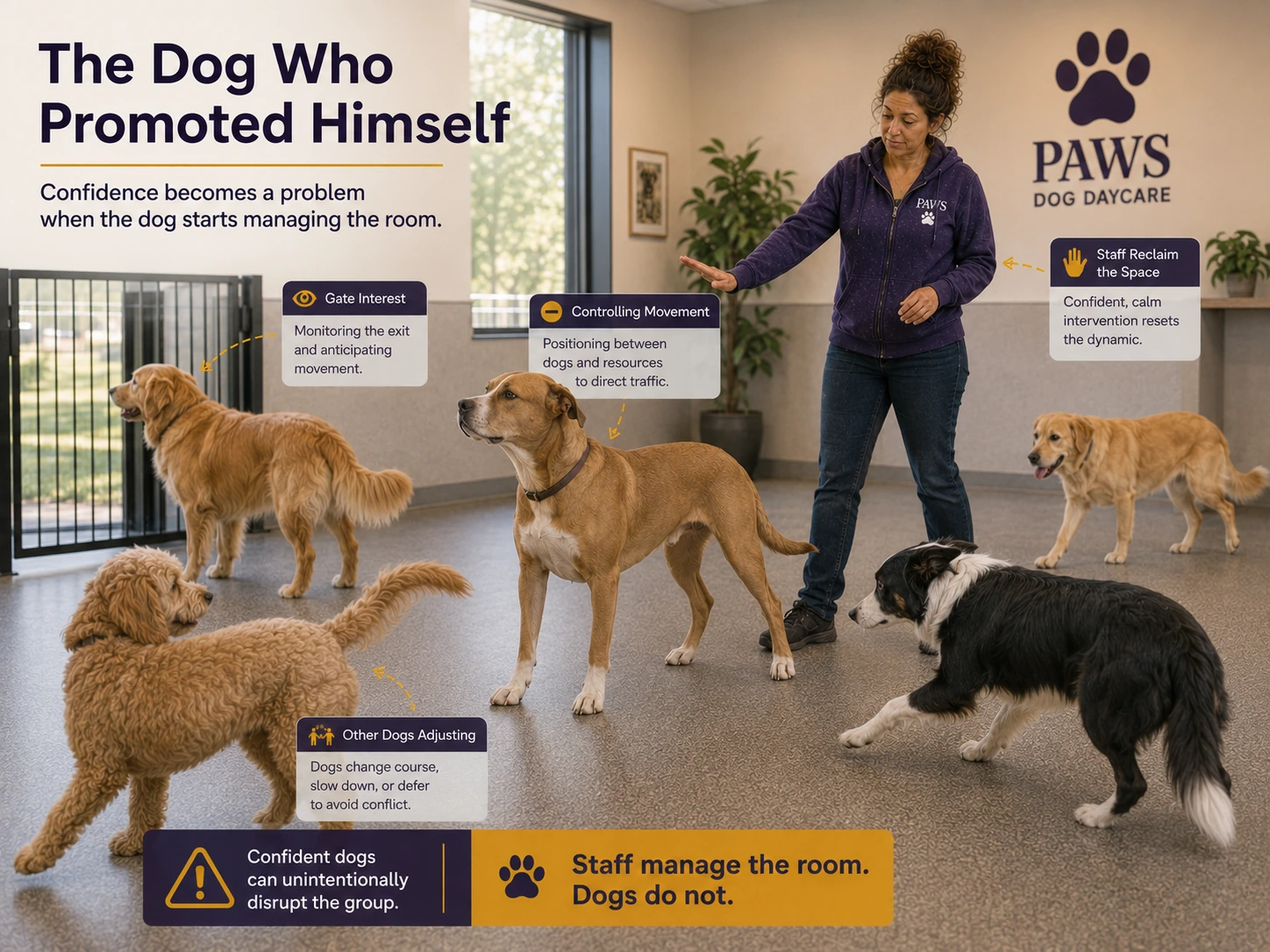
In the PAWS personality system, the confident dog is a dominant, self-assured dog that usually accepts firm, consistent human leadership but may push, posture, test, control, or bully when the room lacks structure.
This is one of the more complicated daycare personality types because the confident dog can look different depending on the staff, the room, the dogs around him, and the amount of structure in place. Around a calm, decisive handler, the confident dog may look adaptable, social, playful, responsive, and useful. Around weak staff, poor supervision, or another strong dog, that same confident dog may start acting more like the aggressive type.
That is what makes this personality valuable and dangerous at the same time. Confident dogs often have high play drive, above-average intelligence, strong social presence, and enough nerve to handle busy dog groups. They can increase play intensity and help create energy in the room. But if staff let them make decisions, they may begin controlling weaker dogs, blocking movement, guarding space, correcting too hard, or testing another confident dog until somebody has to explain to a customer why their dog has a hole in him.
A confident dog is not automatically a problem. The problem starts when the dog decides the daycare needs a manager and promotes himself without asking payroll.
⚠️
Operator warning
Do not mistake a confident dog controlling the room for a dog “being a good leader.” Sometimes that dog is not leading anything. He is just bullying quietly enough that inexperienced staff have not realized the room has a problem yet.
🐕
What PAWS Means by Confident Personality
This is the self-assured dog that walks into the room believing he can handle himself.
In the PAWS daycare personality system, the confident dog is a strong, self-assured personality. This dog is not usually timid, fragile, or looking for a place to hide. He tends to move through the room with certainty. He may enjoy play, accept instruction, and work well with a handler who has calm authority.
But confidence is not the same thing as harmlessness. A confident dog can be provoked to bite. A confident dog can stand his ground. A confident dog can decide another dog is being rude and correct harder than the situation calls for. A confident dog can bully softer personalities if staff let the pattern develop.
The key difference between the confident personality and the aggressive personality is that the confident dog usually accepts fair, consistent human leadership. The aggressive dog is more likely to use pressure, threat, force, or escalation as a primary tool. The confident dog may push, posture, and test, but many confident dogs will also settle into a good daycare routine when the room has real structure.
That is why this personality type cannot be treated like a simple yes-or-no dog. The confident dog may be one of your best regulars, or he may become the reason every insecure dog in the room starts acting weird by lunchtime.
⚖️
Confident Is Not the Same as Aggressive
The difference matters because the daycare decision is different.
A confident dog may posture, push, challenge, test, play hard, or try to influence the room. That does not automatically make him an aggressive personality. The aggressive dog tends to rely on pressure, threat, intimidation, correction, guarding, or offensive behavior as the default way to control conflict. The confident dog may use some of those behaviors under the wrong conditions, but he is often more responsive to human leadership and room structure.
That distinction matters in daycare. An aggressive dog may not belong in open group play at all. A confident dog may belong, but only if staff understand the dog and do not allow him to start running the room.
The confident dog is often a dog that can go either direction. With good supervision, enough space, correct grouping, and a handler who reads pressure early, he may be stable, playful, and useful. With weak supervision, crowded space, poor matching, or another strong personality in his face, he may shift toward control, bullying, correction, or fighting.
📌
Operator distinction
The aggressive dog often comes in trying to control the room. The confident dog may become controlling if the room lets him.
⚖️
A Quick Note About “Dominant” Dogs
Do not turn this into old alpha nonsense. That is not what this page means.
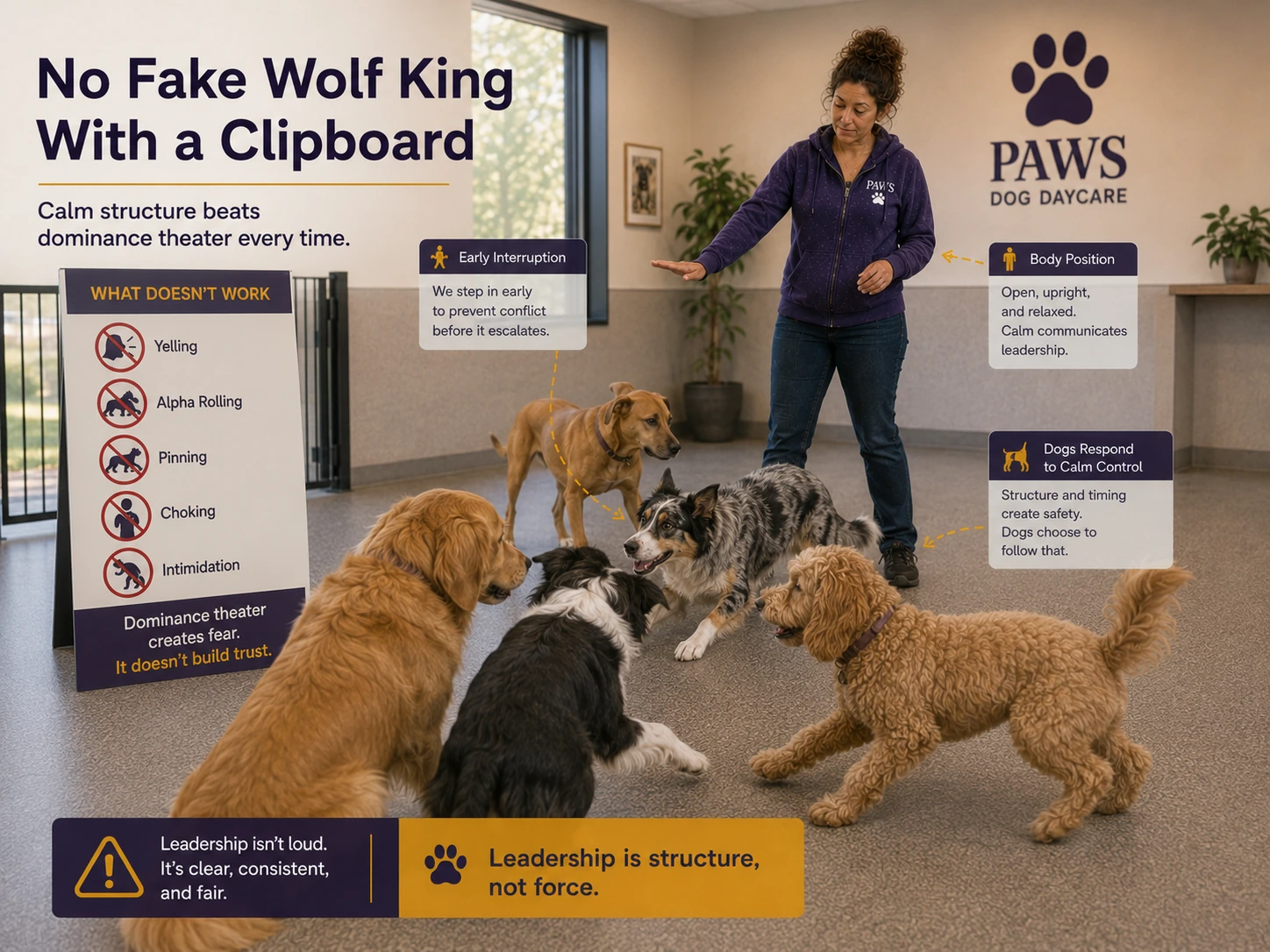
When PAWS uses words like confident, dominant, pushy, strong, or controlling, we are talking about what the dog is doing inside a daycare room. We are not saying staff should pin dogs, scare dogs, alpha-roll dogs, yell, yank, or act like some fake wolf king with a clipboard.
In real daycare operations, the useful question is not whether the dog has a permanent “alpha” label stamped on his forehead. The useful question is whether this dog is using pressure, space, posture, movement, resources, or corrections to influence the room.
A confident dog may be socially strong without being unsafe. A controlling dog may be creating risk without looking dramatic. The daycare owner has to watch the behavior, the pattern, the target dog, the staff response, and what happens after interruption.
⚠️
Room rule
Leadership in daycare means calm timing, clear structure, and smart separation decisions. It does not mean rough handling. Rough handling is how people turn one problem into three.
🔍
The Confident Dogs Staff Actually See in the Room
“Confident” is too vague. Staff need to know what version of confident just walked through the gate.
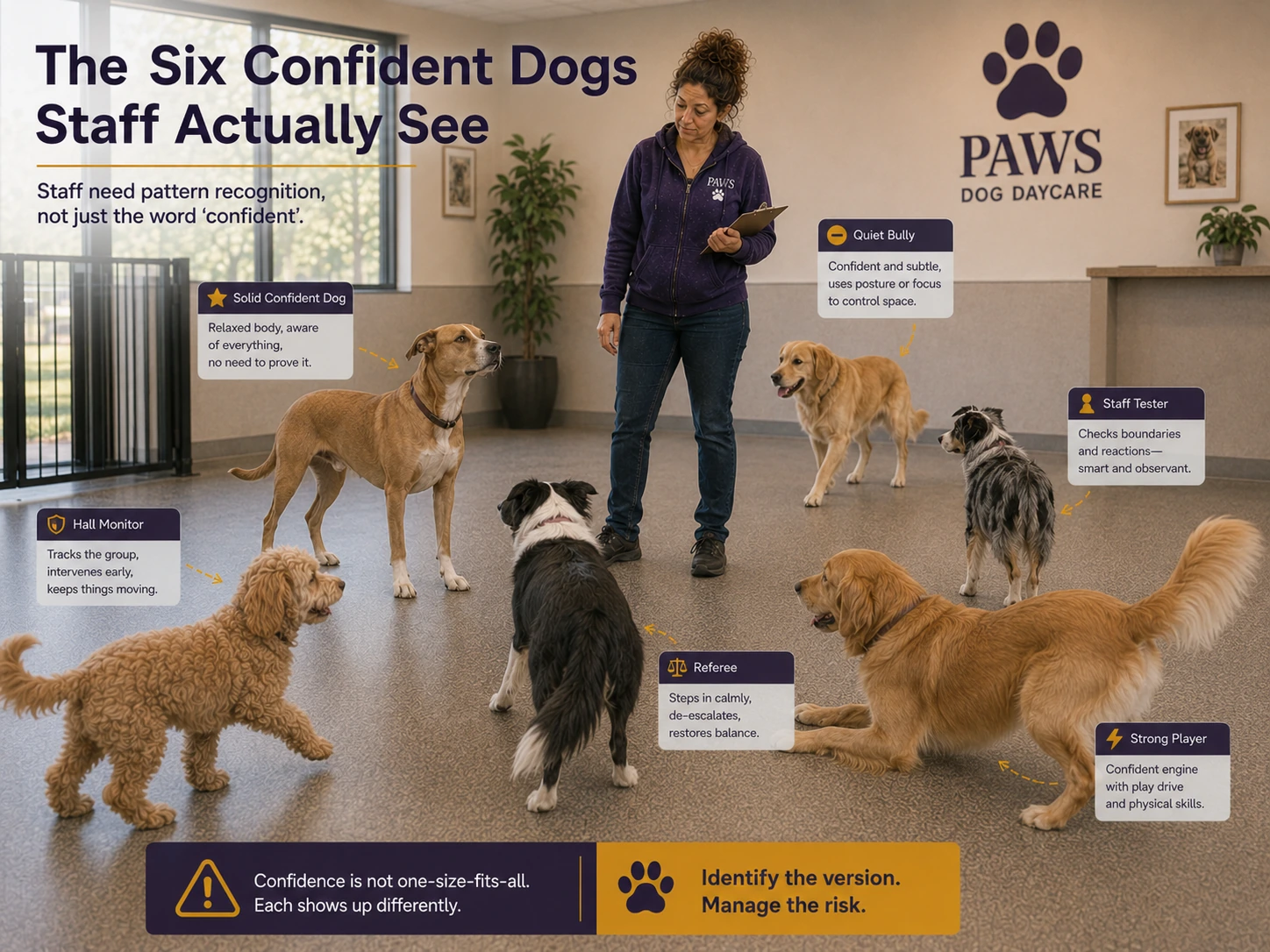
Confident dogs do not all create the same daycare situation. One dog is steady, fair, playful, and useful. Another is quietly collecting power like he is applying for middle management. Another corrects every rude dog in the room. Another ignores new staff until he finds out whether they have a spine.
The operator needs to label the pattern, not just the personality. When staff can name what they are seeing, they can manage it earlier.
Swipe left/right to see the full table.
| Confident Type | What Staff See | Daycare Meaning |
|---|---|---|
| The Solid Confident Dog | Plays hard, takes correction, gives space back, recovers quickly, and accepts staff direction. | This can be an excellent daycare dog when matched correctly. |
| The Hall Monitor | Controls gates, corners, traffic flow, staff movement, water bowls, and who gets to go where. | The dog is starting to manage the room. That is staff’s job. |
| The Quiet Bully | Does not explode, but keeps pressuring the same softer dog until that dog avoids, freezes, snaps, or hides. | Quiet bullying is still bullying. Watch the target dog, not just the confident one. |
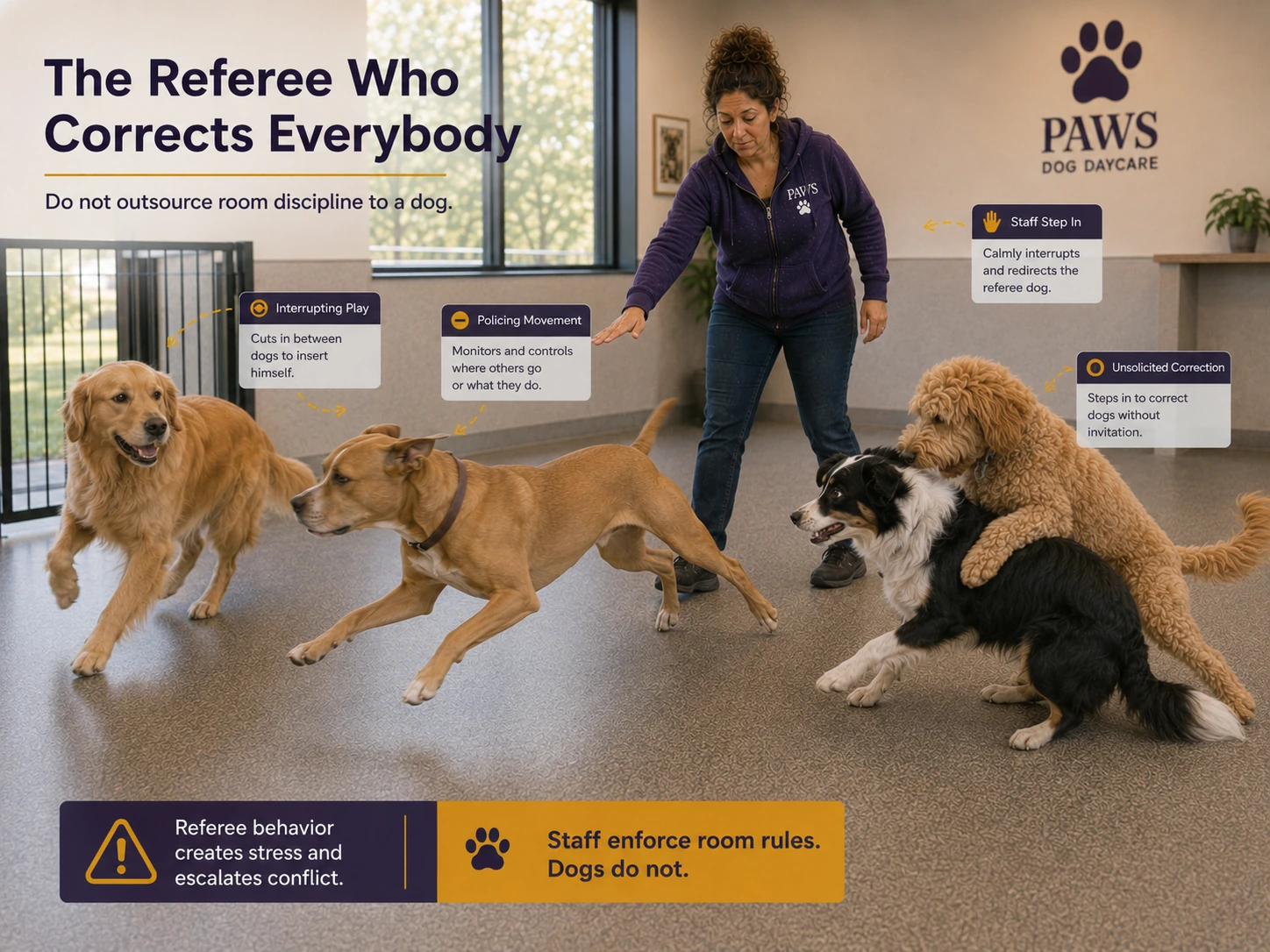
| The Referee | Corrects loud dogs, rude dogs, nervous dogs, fast dogs, awkward dogs, and anything else he did not personally approve. | The dog may be over-policing behavior that staff should handle. |
| The Staff Tester | Behaves for one employee and acts like the substitute teacher is in charge with another. | The dog is reading handler presence. Train staff before the dog trains them. |
| The Strong Player | Loves hard play, wrestling, chase, body contact, and high-energy dogs that can handle the style. | Useful with the right match. Too much for small, old, sore, insecure, or soft dogs. |
📌
Operator shortcut
Do not ask only, “Is this dog confident?” Ask, “Do the other dogs get better, worse, calmer, louder, softer, or weirder when this dog is in the room?”
🔥
Why Confident Dogs Can Be Valuable in Daycare
A good confident dog can bring energy, play, structure, and confidence into the room.
Confident dogs often do well in daycare because they are usually not overwhelmed by normal room activity. They may enjoy play, handle movement, recover from minor bumps, respond to staff direction, and give the room energy. Many of them have high play drive and enjoy the social outlet.
These dogs are often intelligent and mentally busy. You will find many of them in herding and working-type breeds, although personality is never limited to breed alone. The important part is that these dogs often need something to do. If the room gives them good play, structure, and direction, they may settle into a strong daycare role.
If the room does not give them structure, they may make their own job. Sometimes that job is chasing, controlling doorways, correcting other dogs, obsessing over movement, policing the room, or turning a soft dog into their personal project.
That is where new owners get fooled. They see a smart, active, strong dog and think, “This dog is great.” And maybe he is. But a great confident dog still needs staff who are awake at the wheel.
🧬
Breeds and Job Lines That Often Show Up as Confident Dogs
Breed is a clue. It is not a court order.
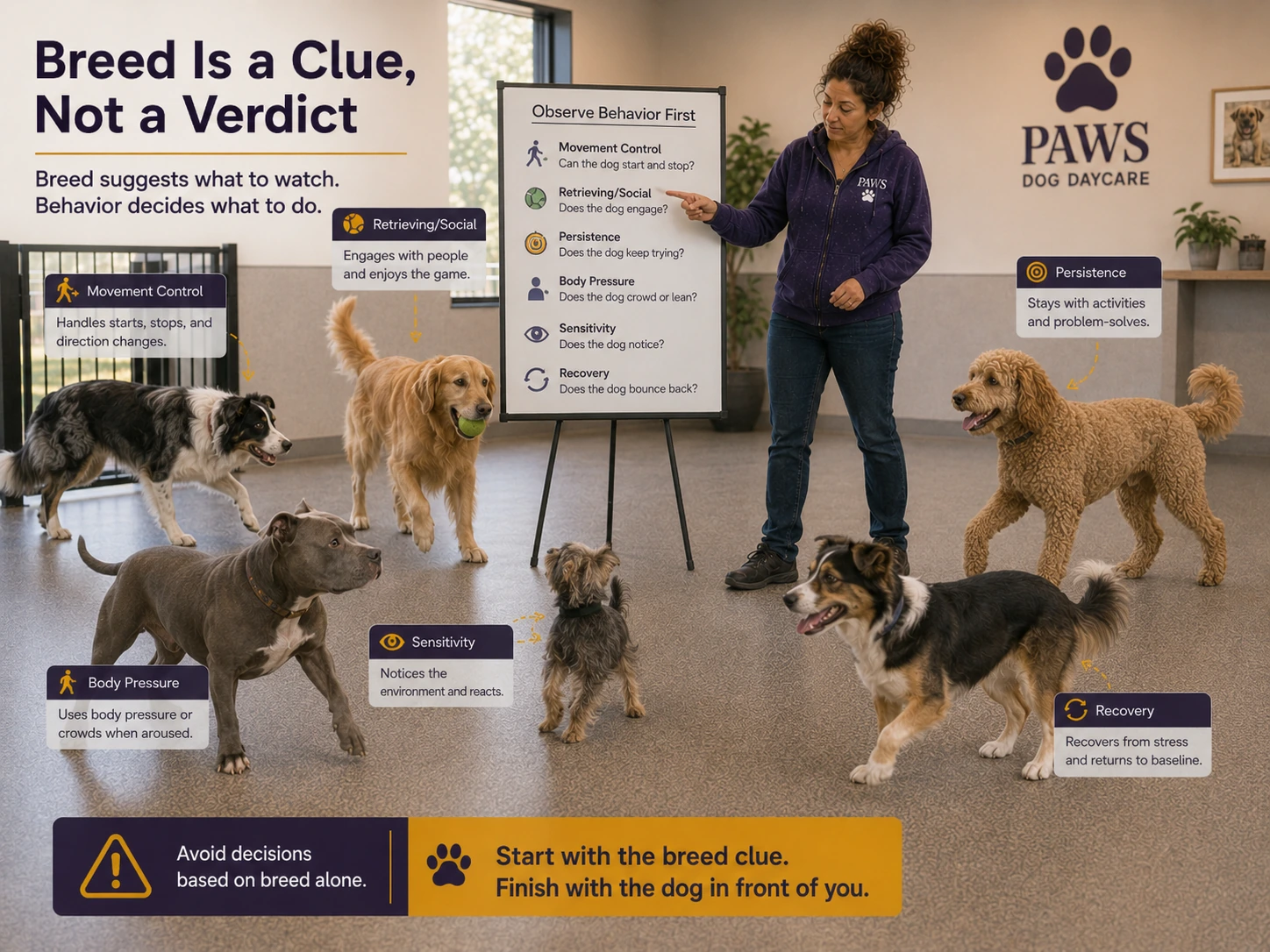
Some breed groups and job lines show up in daycare with confident traits because humans bred them for work, control, motion, guarding, problem solving, persistence, or physical confidence. That does not mean every dog in that breed is confident, pushy, safe, unsafe, social, or wrong for daycare.
The right way to use breed is simple: let it tell staff what to watch first. Then let the individual dog prove what is actually true.
Swipe left/right to see the full table.
| Common Type | Daycare Version You May See | Operator Warning |
|---|---|---|
| Herding breeds | Smart, intense, movement-sensitive, fast to read the room, often interested in controlling motion. | Watch chasing, cutting off dogs, heel nipping, policing running dogs, and frustration when the room will not behave like livestock. |
| Working and guardian-type dogs | Strong, steady, serious, protective, suspicious, or very aware of space and access. | Watch gates, corners, staff access, new arrivals, guarding behavior, and whether the dog decides the building needs security. |
| Terriers | Bold, persistent, fast to react, high opinion, often convinced size is a clerical error. | Do not let size fool staff. A small confident terrier can start a large-room problem with impressive commitment. |
| Bully-type and physical players | Powerful, body-heavy, wrestling-oriented, often comfortable with pressure and contact. | Great with the right match. Too much for dogs that dislike body pressure, face pressure, or being used as gym equipment. |
| Sporting and high-drive social dogs | Athletic, energetic, socially bold, toy-driven, mouthy, and often ready to work the room. | Watch toys, water bowls, body contact, over-arousal, and the dog that thinks every object is community property. |
| Mixed breeds with working traits | May show confidence, control, drive, guarding, chasing, or strong social pressure without fitting one clean category. | Evaluate the dog in front of you. The room does not care what the paperwork says. |
📌
Breed rule
Breed gives you a starting suspicion. Behavior gives you the answer. Never accept, reject, group, excuse, or condemn a dog on breed alone.
🚨
When Confidence Turns Into Bullying
This is the failure point with many confident dogs.
The confident dog may bully insecure and adaptable personality types if staff allow the behavior to build. Bullying does not always look like a dramatic attack. It may look like repeated blocking, shoulder checking, mounting, chasing one dog too hard, standing over a soft dog, cutting off movement, stealing space, guarding attention, or correcting every small thing another dog does.
Inexperienced staff may miss it because the confident dog looks strong and the softer dog looks like the one “acting weird.” The insecure dog starts snapping. The outgoing dog starts overreacting. The adaptable dog starts avoiding corners or hiding behind staff. Then someone says the soft dog caused the problem.
Sometimes the confident dog caused the problem by applying pressure all morning.
This is why staff have to watch the whole pattern, not just the final noise. If a confident dog keeps pushing another dog until that dog finally explodes, the explosion is not the whole story. The story started earlier when the confident dog was allowed to practice being the room supervisor.
⚠️
Bullying warning
If one confident dog keeps making other dogs look worse, do not automatically blame the other dogs. Watch who is applying the pressure before the fight gets loud.
👀
What Staff May See With a Confident Dog
The goal is to tell useful confidence from pressure that is becoming a problem.
Swipe left/right to see the full table.
| Behavior | What It May Mean | Staff Response |
|---|---|---|
| Loose, direct movement | The dog is comfortable and self-assured without necessarily pressuring others. | Allow normal play, but keep watching for shifts into control behavior. |
| Hard play with good recovery | The dog may enjoy strong play but can still self-regulate. | Match with dogs that can handle the style and interrupt before arousal gets stupid. |
| Doorway control | The dog may be claiming high-value movement points. | Move the dog off the doorway. Staff control gates, not dogs. |
| Mounting or standing over dogs | The dog may be testing control, over-aroused, or pressuring another dog. | Interrupt early. Do not let one dog rehearse dominance behavior all day. |
| Shoulder checking or body blocking | The dog may be pushing weaker dogs or controlling movement. | Redirect, separate, or change the group before the target dog reacts. |
| Correcting softer dogs | The dog may be over-policing behavior that staff should control. | Do not outsource room discipline to a dog. Interrupt and reset the group. |
| Challenging another confident dog | Two strong personalities may be negotiating control. | Separate before posturing becomes contact. Enough space matters. |
| Listens to one staff member but ignores another | The dog is reading handler presence and testing weak handling. | Train staff. Do not let the dog decide which employees count. |
🧠
The Smart Dog Problem: If You Do Not Give Them a Job, They May Invent One
Many confident dogs are intelligent enough to become useful, bored, or annoying depending on the room.
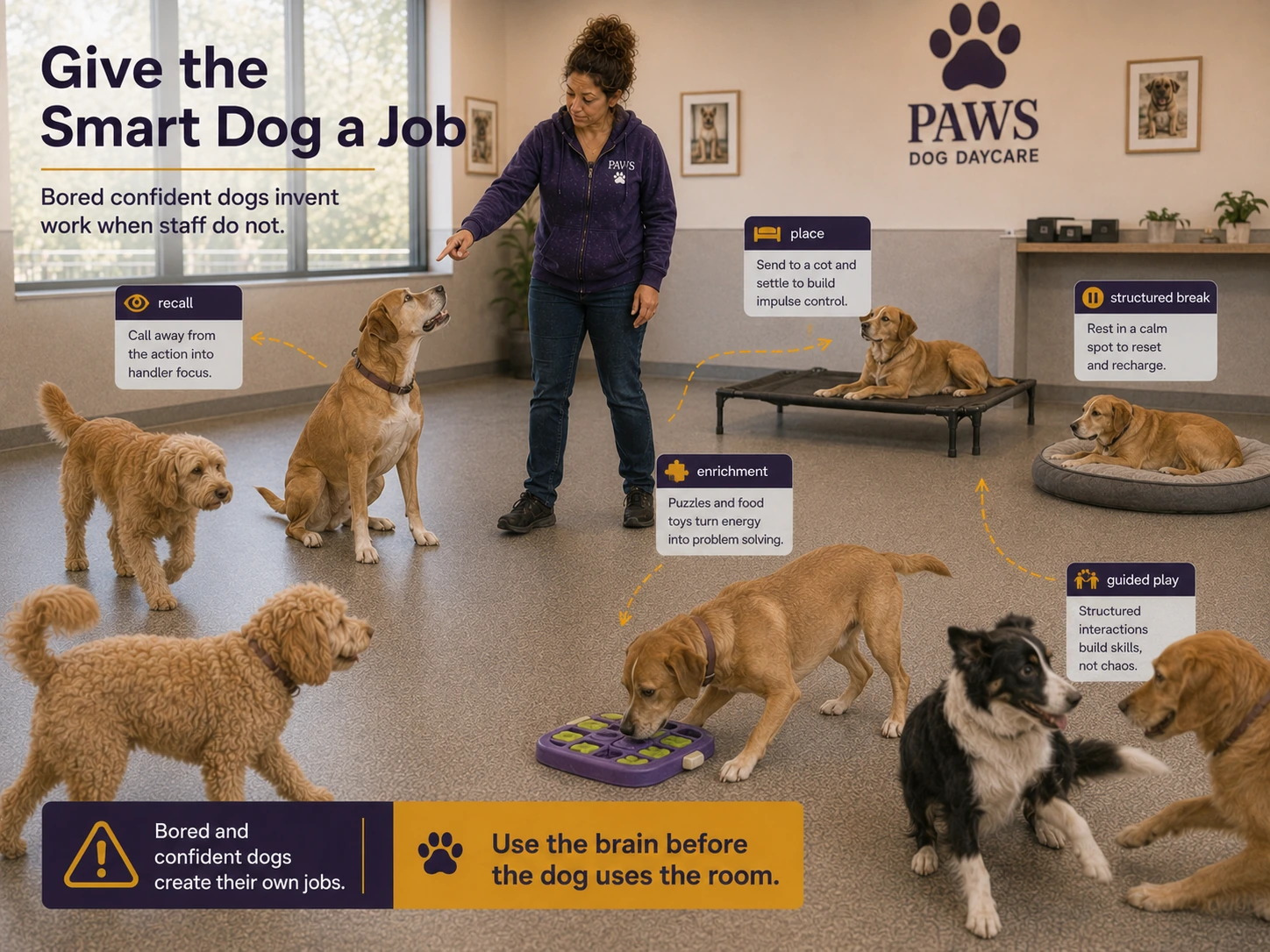
Many confident dogs are high-drive, intelligent, and mentally active. That is part of why they can be valuable. They often learn routines quickly, understand handler patterns, and respond well when the staff are consistent.
The same intelligence can also make them hard-headed when the daycare is poorly managed. A bored confident dog may start finding entertainment. He may chase movement, bark at gates, interrupt dogs, police play, push softer dogs, obsess over staff, or create little conflicts just because the room gave him nothing better to do.
This is why some owners describe these dogs as stubborn. Sometimes they are stubborn. Sometimes they are under-structured. Sometimes they are smart enough to know the human in front of them is not actually controlling anything.
The answer is not to beat the confidence out of the dog. The answer is structure, supervision, correct matching, clear interruption, rest breaks, enrichment, and staff who do not let the dog turn daycare into his personal management internship.
📈
The Confident Dog Pressure Curve
This dog often fails by pressure becoming control, not by starting as a problem.
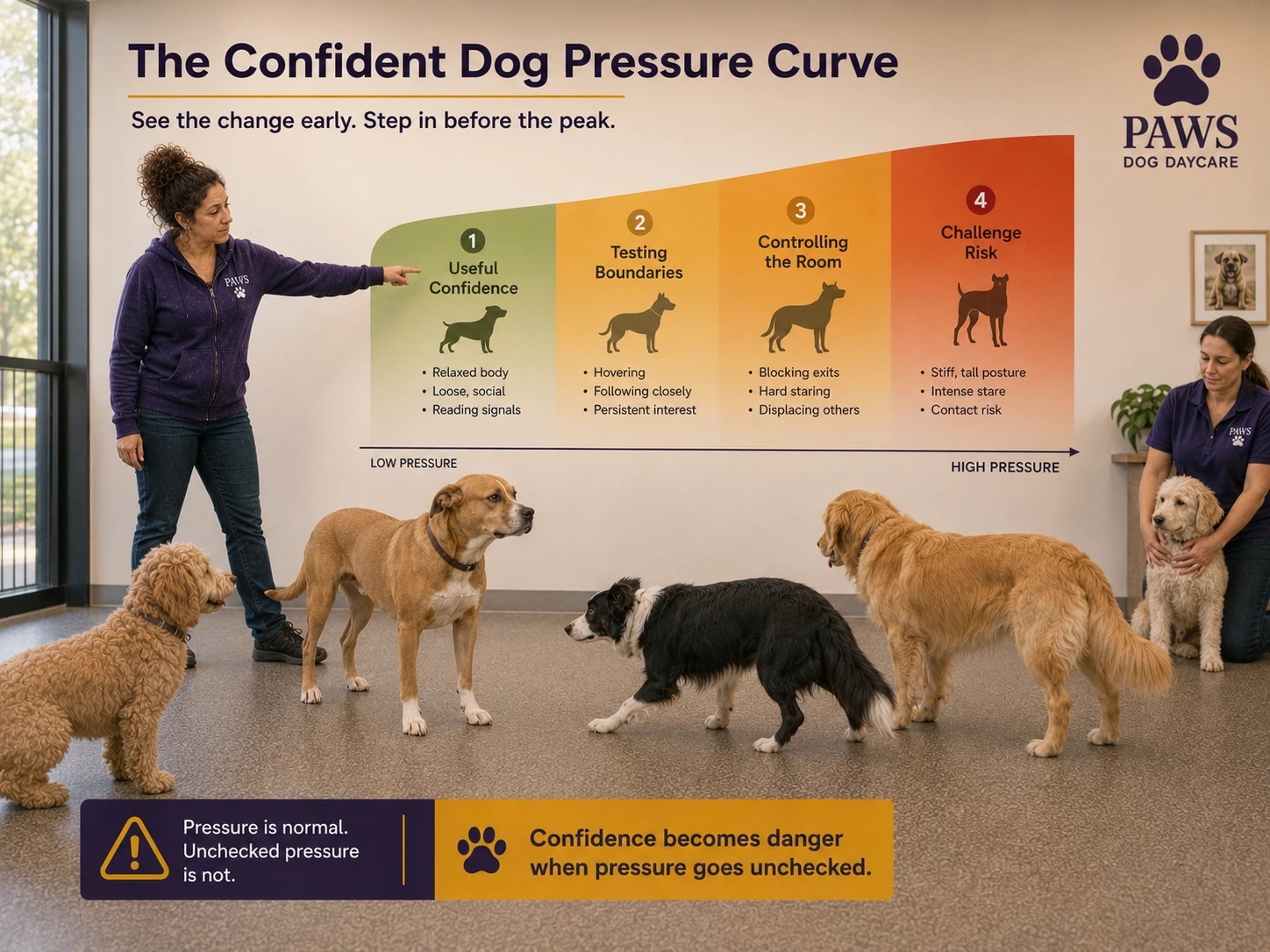
The confident dog may start the day useful. He plays, moves well, handles noise, and gives the room energy. Then a softer dog yields, a staff member misses the first doorway block, another strong dog pushes back, the room gets crowded, and the confident dog starts making decisions.
That is the pressure curve. The dog did not suddenly become a different dog. The room allowed confidence to turn into control.
Swipe left/right to see the full table.
| Stage | What It Looks Like | Staff Move |
|---|---|---|
| Useful Confidence | Loose movement, strong play, fair corrections, role changes, good recovery, responds to staff. | Let the dog work, but keep watching. Good is not permanent. |
| Testing Boundaries | Checks gates, crowds weaker dogs, ignores softer staff, repeats a behavior after interruption. | Interrupt early, reset the dog, and make the rule clear before the pattern gets paid. |
| Controlling the Room | Blocks movement, polices play, guards space, chooses targets, or makes other dogs alter their behavior. | Separate, rematch, rotate, or reduce the group. Do not let the dog keep practicing control. |
| Challenge or Fight Risk | Freezing, hard staring, posturing, refusing to yield, over-correcting, redirecting, or escalating when interrupted. | End the setup. Remove the dog from that group, document the pattern, and reassess open-play eligibility. |
🧩
Confident Personality Compatibility in Daycare
Compatibility does not mean no supervision. It means knowing where the pressure is likely to show up.
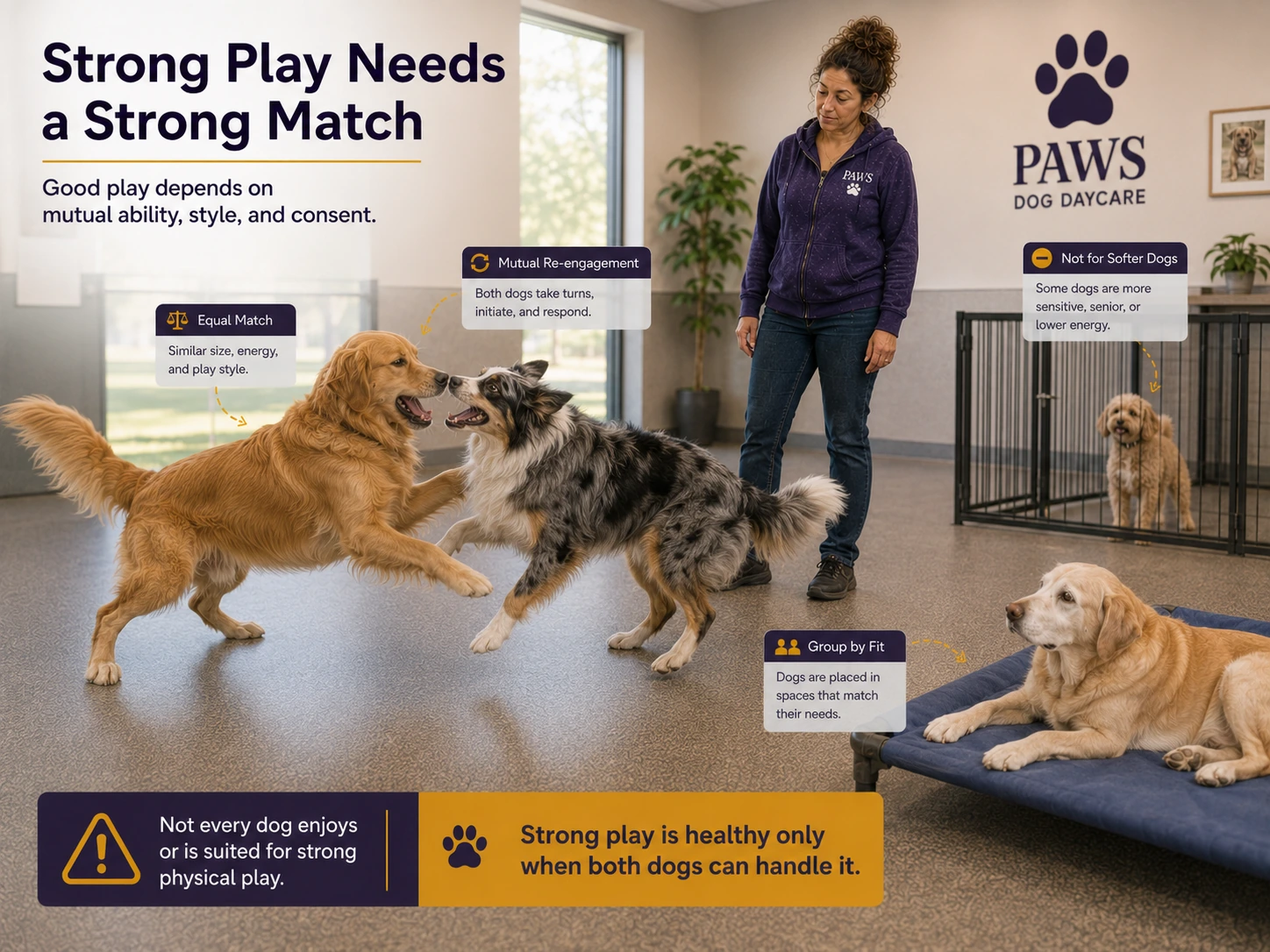
The confident personality has one of the wider compatibility windows in the PAWS system, but only when staff are actually supervising. A stable confident dog can do well with many dogs. A pushy confident dog can create problems with almost all of them.
Swipe left/right to see the full table.
| Pairing | Compatibility | Daycare Meaning |
|---|---|---|
| Confident + Aggressive | Low | A confident dog may stand his ground when challenged. That can turn pressure into a fight quickly. |
| Confident + Confident | Moderate | Two strong dogs may play well or posture for control. Space, staff timing, and personality detail matter. |
| Confident + Outgoing | High / Supervised | This can create strong play, but the outgoing dog may ignore warnings and the confident dog may correct too hard. |
| Confident + Adaptable | High | Often a workable pairing because the adaptable dog may adjust well, but staff must prevent bullying. |
| Confident + Insecure | Low / Caution | The confident dog may pressure the insecure dog, and the insecure dog may freeze, flee, snap, or panic. |
| Confident + Independent | Moderate / High | This can work if the confident dog respects space and the independent dog is not forced into constant interaction. |
⚠️
Compatibility warning
A confident dog may be compatible with many dogs on paper. That does not mean the dog gets permission to control the room. High compatibility still needs staff supervision.
⚖️
Room Balance and Staff Presence Decide Which Version of the Dog Shows Up
The same confident dog may behave differently in different rooms with different people.
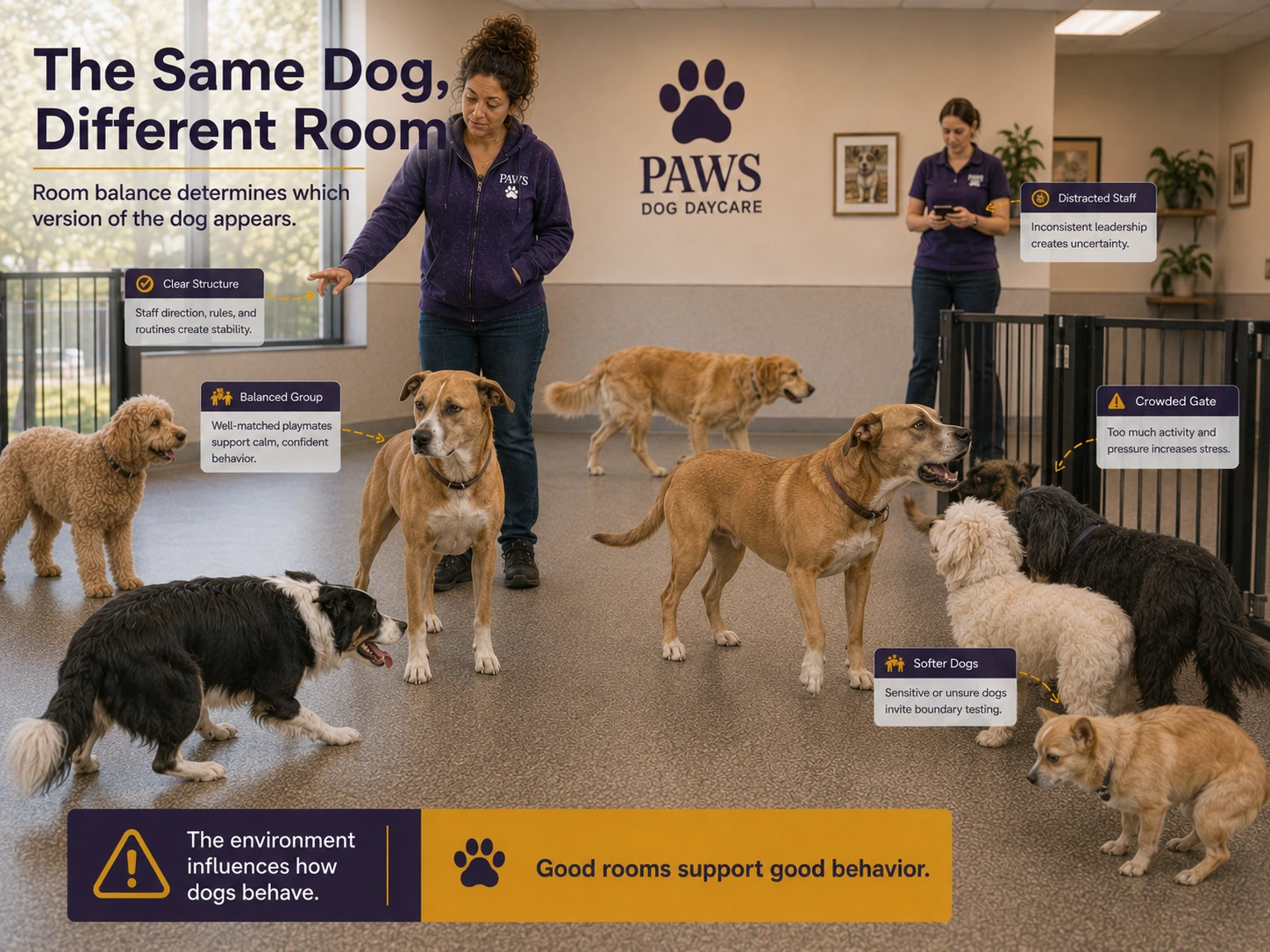
Confident dogs read the room. They read staff body language, timing, hesitation, movement, voice, and whether the person supervising actually means what they are saying. With a calm, consistent, decisive handler, the dog may settle. With weak, distracted, or nervous handling, the dog may start testing.
Room balance matters just as much. A confident dog in a well-matched group may be a great play dog. Put that same dog with an insecure dog, a rude outgoing dog, another strong confident dog, a gate-rusher, and one staff member staring at a phone, and the situation can change fast.
The staff member does not need to be rough, loud, or dramatic. That is not control. Good control is calm presence, early interruption, clear movement, consistent rules, and the ability to see pressure before the room gets loud.
If a confident dog only behaves for your strongest employee, that is useful information. It does not mean the dog is automatically safe. It means the dog has told you exactly where the weak spot is.
📌
Room rule
Confident dogs need leadership. They do not need drama. The handler should control the room before the dog decides to help.
🛑
When to Interrupt, Separate, or Remove a Confident Dog
Staff should not wait until the confident dog turns the room into a committee meeting with teeth.
- Interrupt if the dog repeatedly blocks doorways, gates, staff movement, or another dog’s escape path.
- Interrupt if mounting, shoulder checking, standing over, or body blocking becomes a pattern.
- Separate if the dog is making an insecure, adaptable, or softer dog avoid space, hide, snap, or shut down.
- Separate if two confident dogs begin posturing, freezing, staring, or refusing to yield.
- Remove from group play if the dog redirects onto staff during interruption.
- Remove from group play if the dog escalates after being corrected by staff instead of settling.
- Reassess admission if the dog requires one skilled employee watching him constantly to keep the room safe.
- Document patterns so the facility does not keep rediscovering the same problem every visit.
⚠️
Decision rule
If the confident dog is useful only when everything is perfect, the dog is not as easy as he looks. Daycare has busy days, tired dogs, new staff, bad weather, crowded gates, and customers who arrive at the worst possible time.
🗣️
How to Explain a Pushy Confident Dog to Owners
Owners may hear “confident” as praise and miss the warning.
Confident dogs are often loved because they seem strong, smart, brave, and socially capable. Owners may be proud of that. They may not understand why the same confidence can become a daycare problem when the dog is around softer dogs, crowded gates, toys, staff attention, or another strong personality.
Keep the conversation focused on the daycare environment. You are not telling the owner the dog is bad. You are explaining that the dog is applying too much pressure in group play, and the facility has to prevent that pressure from turning into fear, retaliation, or injury.
You can say, “Your dog is confident and socially strong, but we are seeing him pressure softer dogs and control space in the room. We need to adjust his group, add breaks, or move him out of open play if the pattern continues.”
That is clearer than calling the dog stubborn, dominant, mean, or fine. “Fine” is how small problems get promoted.
📌
Owner script
“Your dog is not a bad dog. He is a strong dog. In daycare, strong dogs need structure so they do not start making decisions for the whole room.”
🧭
The Practical Decision: Group Play, Smaller Group, Private Care, or No Open Play
The confident dog is not automatically a problem. The problem is pretending confidence manages itself.
A confident dog needs an operator decision, not a compliment. “He is confident” does not tell you enough. Is he confident and fair? Confident and pushy? Confident and bored? Confident and testing staff? Confident and bullying weaker dogs? Confident and useful only when your best employee is in the room?
That is the difference between a strong daycare dog and a dog quietly draining the safety out of the room. Some confident dogs belong in normal group play. Some need a smaller or better-matched group. Some need more breaks, more structure, or skilled staff only. Some should be moved into private care, boarding-only, enrichment-only, or no open play at all.
The mistake is letting the dog’s good qualities blind you to the management cost. A smart, athletic, self-assured dog can look like an asset until every softer dog starts avoiding corners, staff spend all morning redirecting him, and the whole room begins orbiting one animal with a resume.
Swipe left/right to see the full table.
| What You See | What It Usually Means | Best Operator Decision |
|---|---|---|
| Plays hard but recovers quickly when interrupted | The dog may be strong, social, and workable with normal supervision. | Allow group play with good matching, normal notes, and staff watching arousal level. |
| Pushes softer dogs, blocks movement, or keeps returning to the same target | Confidence is turning into pressure, and the softer dog may eventually snap or shut down. | Interrupt early, change the group, add breaks, and document the pattern before it becomes an incident. |
| Controls gates, doorways, water bowls, toys, beds, corners, or staff attention | The dog is starting to manage resources inside the room. | Remove access to the trigger, reset the dog, and stop letting the dog practice being in charge. |
| Works well with strong staff but tests weaker or newer employees | The dog is reading handler presence and changing behavior based on who is supervising. | Train staff, limit handling to competent employees during review, and do not build the plan around one magic handler. |
| Postures with other confident dogs and refuses to yield | Two strong personalities may be negotiating control instead of playing. | Separate, rematch, or avoid that pairing. Do not wait for the argument to become expensive. |
| Requires constant staff focus to keep other dogs safe | The dog may be consuming too much of the room’s safety margin. | Move to smaller group, private enrichment, boarding-only, or no open play depending on severity. |
⚠️
Business rule
A confident dog is worth keeping only if the room can safely afford him. If the whole playgroup has to bend around one dog every visit, that dog is no longer just confident. He has become an operating expense with legs.
✅
Confident Dog Daycare Checklist
Use this before assuming the confident dog is helping the room.
- Does the dog accept calm, consistent staff leadership?
- Does the dog recover quickly after interruption?
- Does the dog play hard without overwhelming weaker dogs?
- Does the dog bully insecure, adaptable, smaller, older, or softer dogs?
- Does the dog control doorways, gates, water bowls, toys, staff attention, beds, corners, or movement?
- Does the dog correct other dogs harder than the situation calls for?
- Does the dog behave differently with different staff members?
- Does the dog challenge aggressive or equally confident dogs?
- Can the dog be matched safely, or does the whole room have to bend around him?
- Is the dog’s behavior documented clearly enough that staff can make the same decision tomorrow?
❓
Confident Dog Personality FAQ
Detailed answers about confident-dog play, room control, staff leadership, bullying prevention, compatibility, enrichment, grouping, documentation, and open-play decisions.
Are confident dogs good candidates for dog daycare?
They can be excellent daycare dogs when they accept staff direction, recover after interruption, and play fairly with appropriate partners. Confidence helps many dogs handle movement, noise, changing groups, and normal social pressure without becoming overwhelmed. The risk begins when confidence shifts into bullying, gate control, unsolicited corrections, resource pressure, or constant testing of staff.
Is a confident dog the same thing as an aggressive dog?
No. In the PAWS system, a confident dog is self-assured and may push or test, but usually remains responsive to fair, consistent human leadership. An aggressive dog is more likely to rely on threat, force, guarding, intimidation, or escalation as a primary tool. The distinction matters because a confident dog may succeed in open play with structure, while an aggressive dog may require private care or refusal.
Why do confident dogs sometimes bully softer dogs?
Softer dogs may yield space, freeze, avoid conflict, or fail to object clearly, and a pushy confident dog can learn that pressure works. The pattern may include blocking, repeated chasing, mounting, standing over, shoulder checking, stealing space, or repeatedly selecting the same target. Staff should interrupt before the softer dog shuts down or finally retaliates and gets blamed for the loudest moment.
Can two confident dogs play together safely?
Sometimes. Two confident dogs can be excellent play partners when both dogs share roles, respect pauses, yield space, recover quickly, and accept staff interruption. The pairing becomes risky when either dog freezes, hard-stares, postures, refuses to yield, guards access, or repeatedly tries to control the other.
What is the biggest management mistake with confident dogs?
The biggest mistake is allowing the dog to become the room manager. Staff—not a dog—must control gates, space, resources, corrections, group movement, and access to softer dogs. Once the dog is repeatedly rewarded for running traffic or policing play, the behavior becomes harder to interrupt and more expensive to ignore.
How can staff tell strong play from bullying?
Strong healthy play still contains choice, role changes, pauses, loose movement, re-engagement, and the ability for either dog to leave. Bullying is more one-sided and often causes the target dog to hide, freeze, avoid space, seek staff, snap defensively, or stop participating. Staff should judge the effect on both dogs, not just whether the confident dog appears happy.
Should staff use alpha rolls or physical dominance with confident dogs?
No. Pinning, choking, yelling, intimidation, and theatrical dominance methods can increase fear, resistance, redirection, and bite risk. Professional control comes from calm body position, predictable rules, early interruption, clear movement, appropriate barriers, good grouping, and timely separation.
Why does the same confident dog behave differently with different employees?
Confident dogs notice posture, timing, hesitation, consistency, movement, and whether a staff member follows through. A dog may settle with a calm, observant employee and test a distracted, nervous, or inconsistent one. That difference is not proof that the dog is safe; it identifies a staff-training and handling restriction that must be documented.
How should staff manage doorway and gate control?
Move the dog away before opening the gate, create space around the choke point, and use staff positioning to control traffic. Do not allow the dog to block exits, rush arrivals, decide who passes, or camp beside a high-value doorway. Repeated gate control is a management pattern, not a harmless personality quirk.
Can breed tell me whether a dog will be confident or controlling?
Breed and job history can suggest tendencies worth watching, such as movement control, guarding, persistence, body pressure, retrieving, or sensitivity. Breed cannot decide the daycare outcome. Actual behavior, recovery, play fairness, response to staff, health, history, and the current room should control the decision.
What kind of enrichment helps confident working-type dogs?
Useful options include recalls, place work, simple obedience patterns, food or scent puzzles used outside conflict-prone group settings, guided play, decompression walks, and structured rest. The goal is not to exhaust the dog until it collapses. The goal is to give the dog safe, handler-directed work before it invents a job such as policing movement or controlling other dogs.
How often should a confident dog receive rest breaks?
Use the dog’s arousal, behavior, group pressure, and recovery rather than one rigid clock. A dog that begins hovering, mounting, correcting, blocking, obsessing over movement, or ignoring staff may need a break before the room gets louder. Rest should be a planned regulation tool, not a punishment delivered only after trouble.
When should a confident dog be moved to a smaller group?
A smaller group is appropriate when the dog plays well with selected partners but becomes pushy, over-aroused, or controlling in a larger or more chaotic room. It may also help when the dog needs more space, fewer gate transitions, or protection from incompatible strong personalities. The smaller group still requires supervision and documentation.
When is private care a better choice than group play?
Private care may be safer when the dog repeatedly targets soft dogs, controls resources, requires constant intervention, redirects during handling, or behaves acceptably only under unusually perfect conditions. Private enrichment, structured boarding, or non-group services can meet the dog’s needs without making the entire room absorb the risk.
What warning signs show confidence is becoming control?
Watch for repeated hovering, following, doorway blocking, body checks, mounting, standing over dogs, hard staring, guarding staff attention, unsolicited corrections, refusal to yield, and making other dogs change their routes. One isolated behavior may not define the dog, but a repeated pattern shows the room is beginning to organize around that dog.
How should staff respond when a confident dog keeps correcting other dogs?
Interrupt the referee behavior early and redirect or separate the dog before the correction becomes a routine. Staff should address rude play, crowding, and arousal themselves rather than allowing one dog to enforce room rules. A dog that repeatedly inserts itself into unrelated interactions is adding pressure, not helping.
What should be documented about a confident dog?
Document the trigger, target dog, location, staff present, exact behavior, interruption used, recovery time, repeated patterns, successful matches, failed matches, and any service restrictions. Notes should be specific enough that the next shift can make the same safe decision without rediscovering the behavior from scratch.
How should staff explain pushy confidence to an owner?
Describe what the dog is doing and how it affects the room without insulting the dog or owner. Explain that the dog is socially strong but is pressuring other dogs, controlling space, or requiring changes in grouping and rest. Clear behavior-based language is more useful than calling the dog dominant, stubborn, mean, or fine.
Can a confident dog return to open play after being removed?
Possibly, depending on severity, recovery, history, staff safety, and whether the facility can change the setup. A return should involve a documented plan, appropriate partners, skilled staff, controlled transitions, and a clear stop rule. Repeating the same room setup and hoping for a different outcome is not a retest.
What makes a confident dog an excellent long-term daycare dog?
The best confident daycare dogs play fairly, accept interruption, recover quickly, respect space, handle changing conditions, and remain stable with more than one competent staff member. They still need correct matches, clear rules, rest, and supervision. Excellent does not mean automatic; it means the dog succeeds inside a well-run system.
🐾
The Bottom Line: Confident Dogs Can Be Excellent Daycare Dogs, But They Are Not Autopilot Dogs
Confidence is useful when staff control the room. It becomes a problem when the dog does.
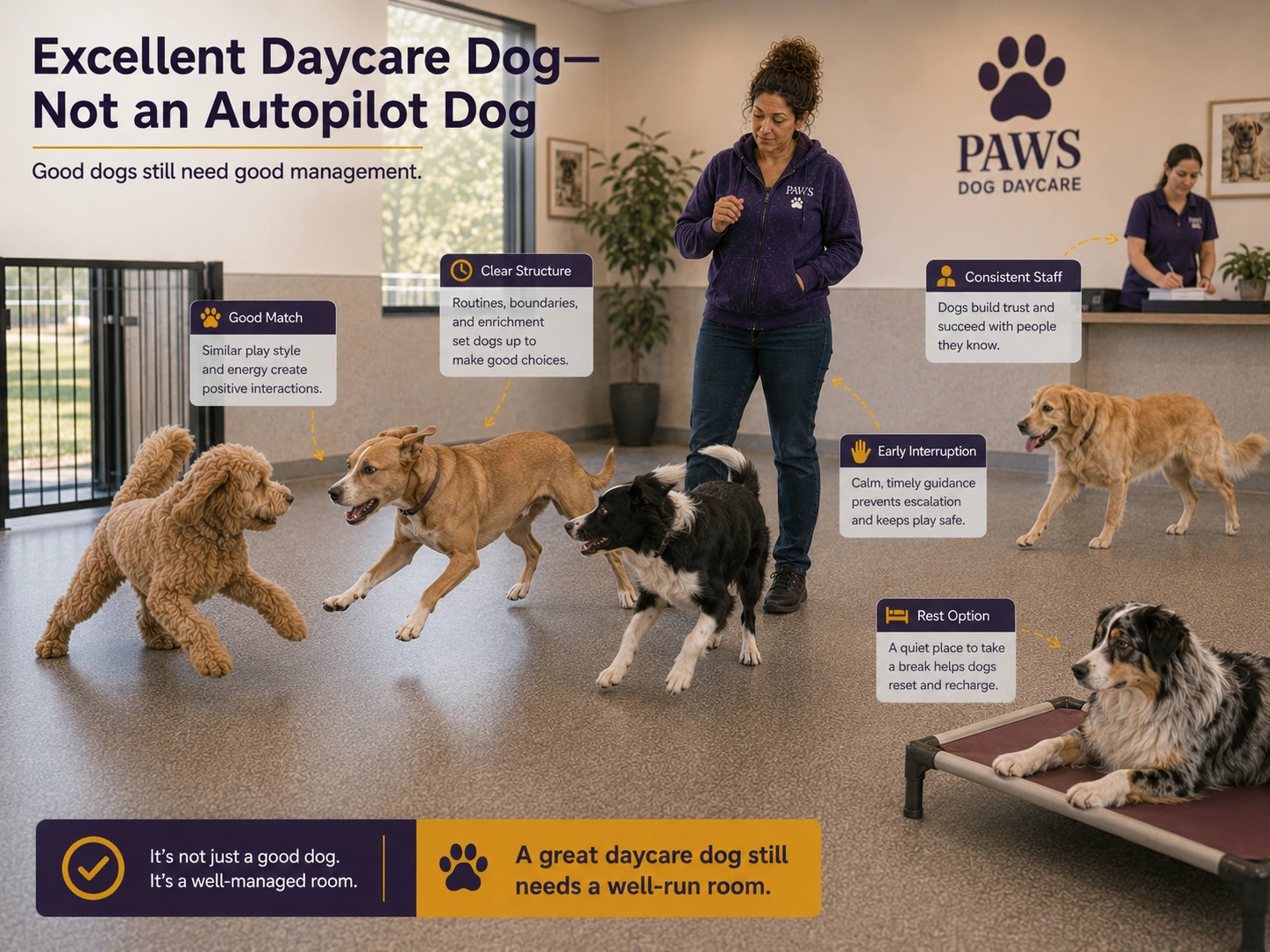
The confident personality is one of the most valuable and most mismanaged daycare types. These dogs can bring energy, play, nerve, and stability to a group. They can also bully softer dogs, challenge stronger dogs, and quietly take over the room if staff do not understand what they are seeing.
A confident dog needs structure, fair leadership, good matching, early interruption, and staff who can tell the difference between strong play and control behavior. When that is in place, the confident dog may become one of the best dogs in the building.
When that is missing, the confident dog may become the reason the rest of the room starts acting like the problem.