Dog Daycare Personality Types, Outgoing Dogs, Playgroup Fit, Social Pressure, Staff Supervision, Group Compatibility, and Daycare Admission Decisions
Understanding the Outgoing Dog Personality in Dog Daycare
Friendly does not automatically mean easy, safe, or ready for open group play.
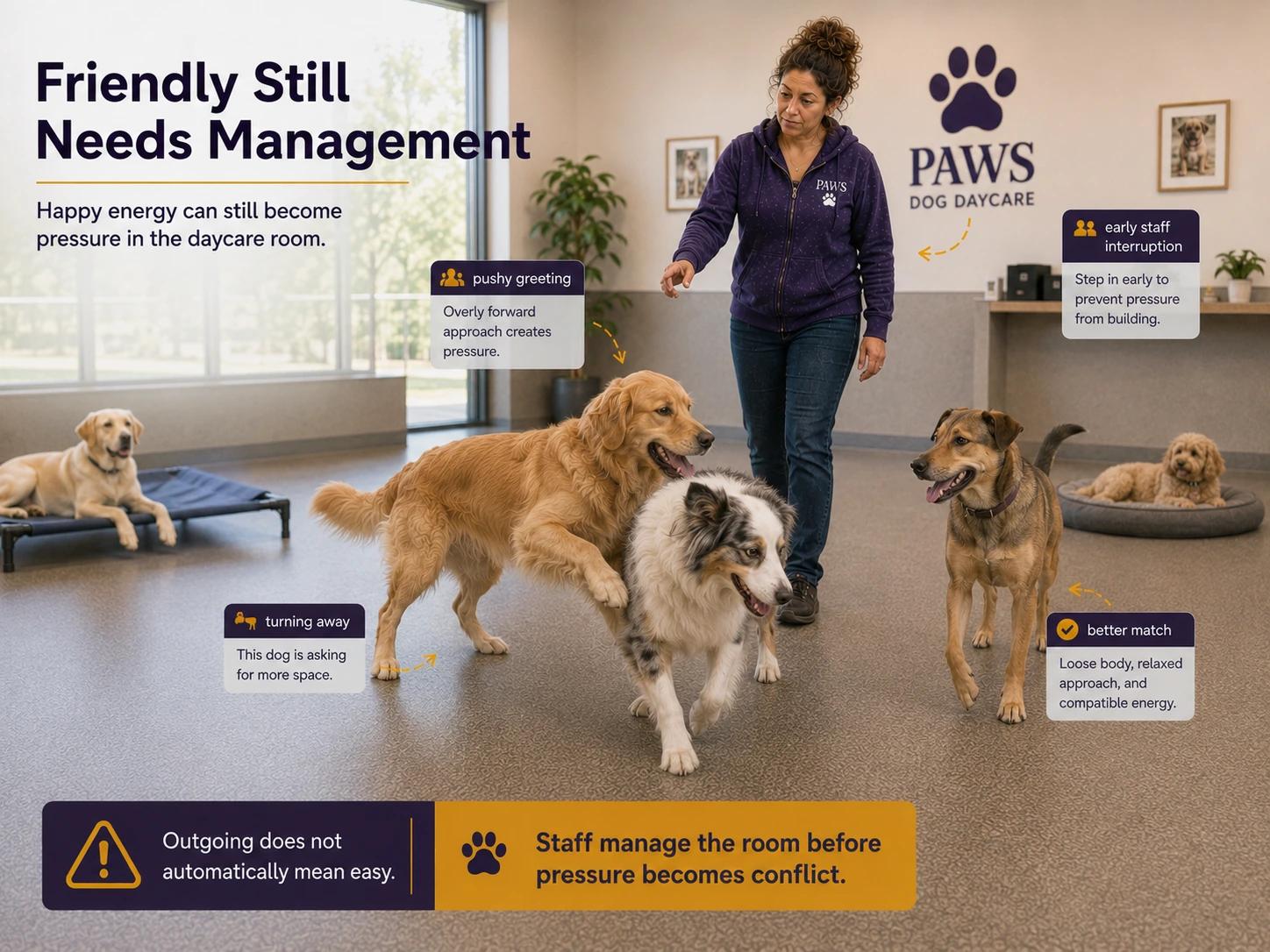
The outgoing dog is usually friendly, social, active, curious, and hungry for interaction. This is the dog many owners picture when they think of daycare: happy, excited, playful, people-oriented, and eager to be part of whatever is happening.
That is why outgoing dogs often end up in dog daycare. They may need more exercise, more attention, more movement, more structure, and more social contact than the average household schedule can provide. Left alone too long, some of these dogs bark, chew, dig, pace, climb, scratch doors, destroy crates, or turn the living room into evidence.
But the outgoing dog is not automatically an easy daycare dog. A dog can love other dogs and still be too much for the room. A dog can be friendly and still crowd gates, rush faces, body-slam smaller dogs, mount, guard toys, ignore corrections, overwhelm insecure dogs, or keep pushing after another dog has clearly said no.
Dog daycare is not a friendship factory. It is a managed environment full of strange dogs, movement, pressure, arousal, staff timing, owner expectations, and liability. The outgoing dog may be a strong daycare candidate, but only if the facility manages the dog in front of them instead of trusting the word “friendly” like it is a safety plan.
⚠️
Operator warning
The outgoing dog often gets blamed last because everybody likes him. That is how problems get missed. Happy body language does not cancel out rude behavior, pressure, poor recovery, or repeated conflict.
🎾
What PAWS Means by Outgoing Personality
This is the dog that wants contact, activity, attention, movement, and social engagement.
In the PAWS personality system, the outgoing dog is the social dog. This dog usually likes people, dogs, activity, handling, play, and attention. Many outgoing dogs are flexible, active, intelligent, and quick to join the room. They may enjoy training, exercise, games, and staff interaction.
This personality often overlaps with dogs that owners describe as happy, playful, energetic, needy, clingy, silly, social, or “he just loves everybody.” Sometimes that is true. Sometimes it is only half true. The other half is whether the dog can control that social drive when the other dog does not want it.
A good outgoing daycare dog can greet, play, disengage, take correction, accept staff direction, rest, and return to the group without turning the whole room into a circus. A problem outgoing dog wants the room, the people, the dogs, the toys, the gate, and the energy to revolve around him.
The difference matters. One version is a good client. The other version is a friendly liability with a wagging tail.
The operational question is not whether the dog seeks contact. It is whether the dog has enough social skill to make that contact safe. Staff should watch whether the dog approaches in curves instead of charging straight in, pauses when another dog stiffens, allows another dog to leave, and can shift attention back to a handler without immediately returning to the same target.
Outgoing behavior also has to be evaluated across the full daycare day. A dog may look excellent during the first fifteen minutes and become rude after repeated arrivals, rising noise, fatigue, or several rounds of hard play. Admission decisions should account for recovery and endurance, not just the cheerful first impression.
🔍
The Outgoing Dogs Staff Actually See in the Room
“Friendly” is too vague. Staff need to know what version of friendly just walked through the gate.
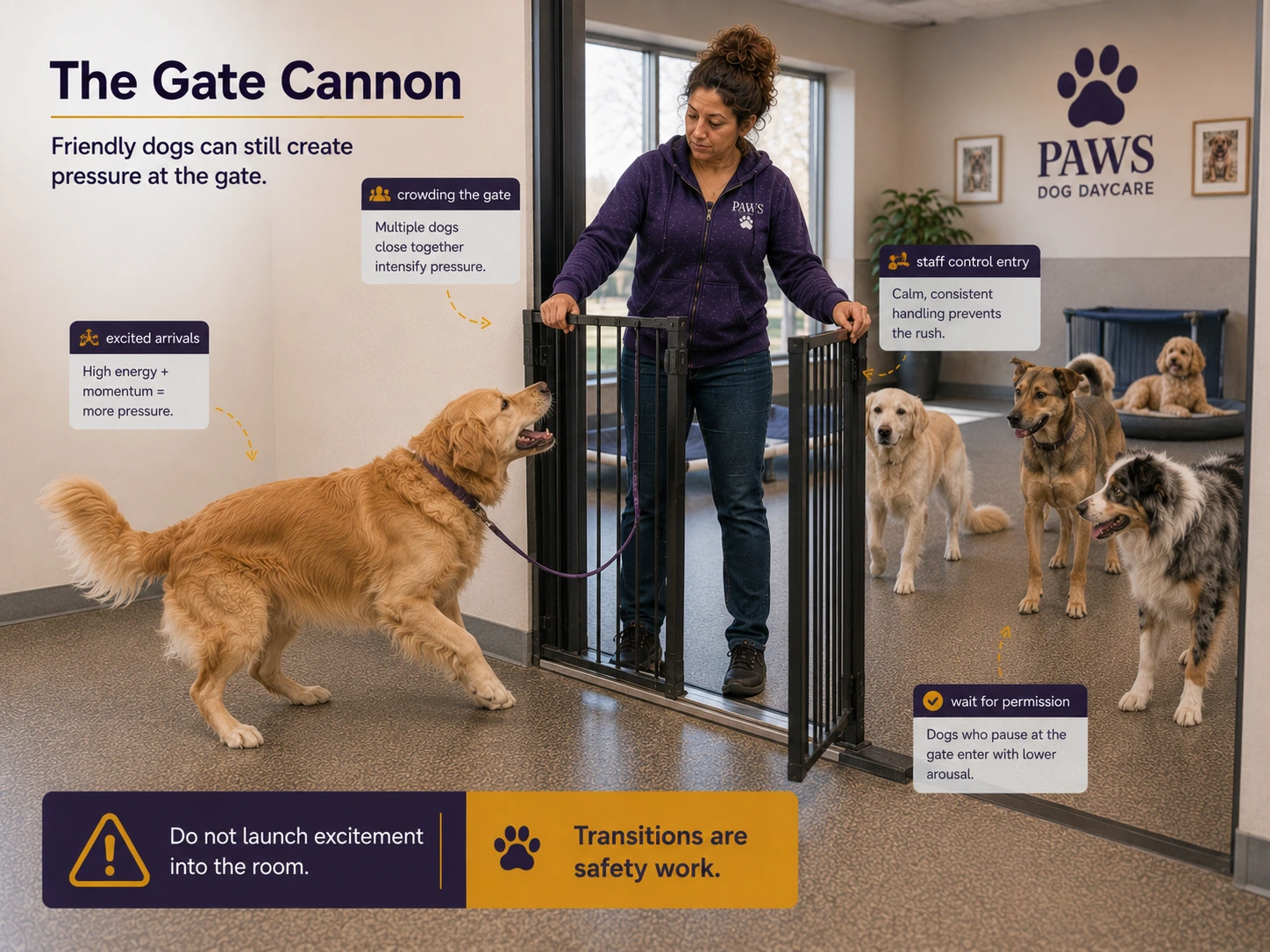
Outgoing dogs do not all create the same daycare problem. One dog is a cheerful social butterfly. Another is a gate cannon. Another is a toy thief with a smile. Another is the dog that plays beautifully for forty minutes and then turns into a sweaty little tax audit with teeth.
The operator needs to label the pattern, not just the personality. When staff can name what they are seeing, they can manage it earlier.
The same dog may move between these patterns as the room changes. A social butterfly may become a gate cannon during arrivals, a bulldozer during peak arousal, and an attention collector when staff sit down or another dog receives affection. Staff notes should describe the version that appeared, the trigger, how long it lasted, and what brought the dog back under control.
Naming the pattern creates a shared operating language. “Friendly” tells the next shift almost nothing. “Rushes entry, targets wrestling dogs, accepts one recall, then needs a five-minute break” gives staff an actual plan.
Swipe left/right to see the full table.
| Outgoing Type | What Staff See | Daycare Meaning |
|---|---|---|
| The Gate Cannon | Launches through doors, rushes arrivals, crowds exits, and turns transitions into a stampede. | This dog needs controlled entry, leash movement, gate manners, and no free explosion into the room. |
| The Social Bulldozer | Happy, physical, full-contact, body-slamming, shoulder-checking, and convinced everyone signed up for it. | Match with dogs that enjoy rough play, interrupt early, and protect smaller or softer dogs from being flattened by joy. |
| The Face Rusher | Runs straight into faces, mouths, licks, paws, or crowds dogs before reading the room. | This creates immediate pressure. Slow greetings down before another dog has to explain boundaries with teeth. |
| The No-Off-Switch Dog | Plays hard, keeps going, ignores fatigue, and gets worse as the day goes on. | This dog needs scheduled rest before the brain falls out and the body keeps partying. |
| The Attention Collector | Crowds staff, blocks other dogs from people, jumps, barks, or wedges into every human interaction. | Watch for staff guarding and jealousy around human attention. Friendly does not mean generous. |
| The Toy Room Problem | Loves toys until another dog wants one. Then the smile gets tight and the room gets stupid. | No toys in group unless the facility has a very clear reason, clean supervision, and zero guarding pattern. |
| The Adolescent Pest | Pushes limits, humps, mouths, repeats rude play, ignores corrections, then looks shocked when corrected hard. | This dog may mature into a good daycare dog, but the current version needs structure, breaks, and consequences. |
🏠
Why Daycare Gets So Many Outgoing Dogs
These dogs often need more interaction than a normal workday gives them.
Outgoing dogs make up a large part of daycare clientele because they usually need contact and activity. They may not be built for ten quiet hours alone while the owner works. Some handle isolation poorly. Some become destructive. Some bark all day. Some create neighbor complaints. Some are simply bored out of their minds.
Their sociability works for them and against them. It makes them bond closely with people and often fit well into family life. It also means the dog may struggle when the people leave, the house goes quiet, and nothing happens for hours.
Daycare can be a useful outlet for this kind of dog. It can provide movement, structure, social contact, routine, and mental stimulation. But daycare only works when the dog has the temperament to handle group pressure and staff have enough sense to manage the energy.
Owners often bring these dogs to daycare because they are looking for a productive outlet, not because the dog is already socially polished. The facility should expect enthusiasm, but it should not promise that a busy room will automatically teach manners or cure separation problems. Daycare can support a good plan; it cannot replace household training, sleep, exercise outside the facility, or owner follow-through.
A well-run program helps by giving the dog predictable movement, appropriate partners, staff-guided interruptions, and real rest. A poorly run program simply adds more stimulation to a dog that already has plenty of engine and not enough brakes.
🧬
Breeds and Job Lines That Often Show Up as Outgoing Dogs
Breed is a clue. It is not a court order.
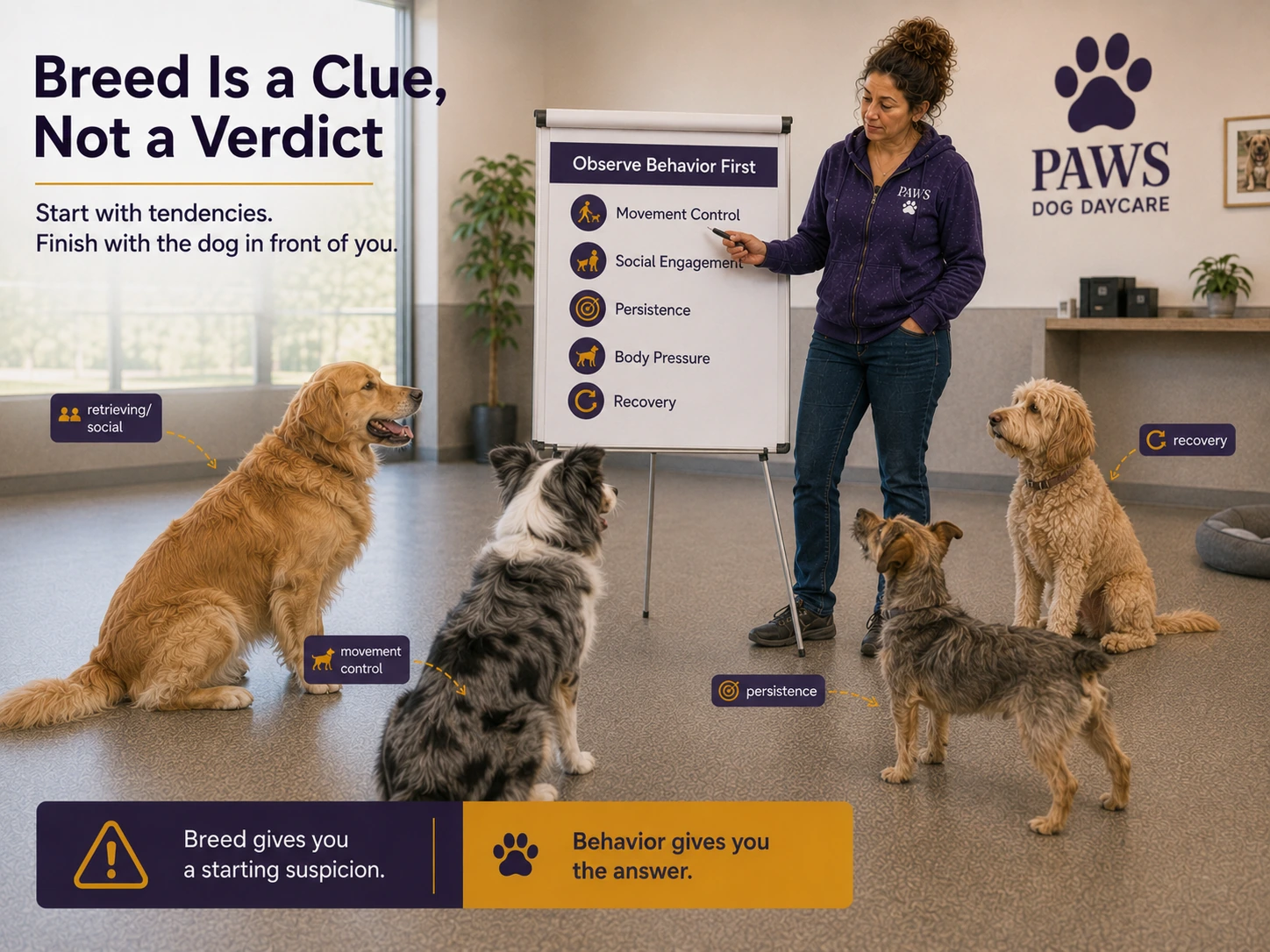
Some breed groups and job lines show up in daycare with outgoing traits because humans bred them for work, contact, motion, retrieving, chasing, herding, problem solving, or staying engaged with people. That does not mean every dog in that breed is outgoing, safe, easy, or appropriate for daycare.
The right way to use breed is simple: let it tell staff what to watch first. Then let the individual dog prove what is actually true.
Job history matters because it can explain why a dog notices movement, carries objects, stays close to people, persists after interruption, or uses body pressure during play. Those tendencies are not excuses. They are advance notice about which conditions may bring out the best or worst version of the dog.
Staff should still record the individual dog’s response. Two dogs from the same breed can differ sharply in social skill, frustration tolerance, recovery, handling sensitivity, and willingness to disengage. The name on the breed line should never become a substitute for watching the animal.
Swipe left/right to see the full table.
| Common Type | Daycare Version You May See | Operator Warning |
|---|---|---|
| Retrievers and sporting dogs | Social, mouthy, toy-driven, water-loving, fetch-obsessed, happy to work the room. | Watch toys, mouth pressure, body contact, water bowls, and the dog that thinks every object is community property. |
| Herding breeds | Smart, fast, movement-sensitive, intense, easily bored, often trying to control motion. | Watch chasing, cutting off dogs, nipping heels, policing running dogs, and frustration when the room will not behave like livestock. |
| Terriers | Bold, busy, game, fast to react, high opinion in a compact body. | Do not let size fool staff. A small outgoing terrier can start a large-room problem with the confidence of a bar fight in a lunchbox. |
| Boxers and bully-type social players | Physical, bouncy, front-foot heavy, chesty, slap-boxing, wrestling play. | Great with the right match. Too much for dogs that hate body contact, face pressure, or being used as playground equipment. |
| Doodles and mixed companion dogs | Often people-social, excitable, attention-seeking, playful, and sometimes undertrained for their size and energy. | Do not let “family dog” branding replace evaluation. Big, goofy, and untrained is still big, goofy, and untrained. |
| Puppies and adolescent dogs | Social, rude, impulsive, easily over-aroused, still learning what other dogs will tolerate. | Puppy charm expires. Adult dogs may stop tolerating behavior they forgave when the dog was smaller and cuter. |
📌
Breed rule
Breed gives you a starting suspicion. Behavior gives you the answer. Never accept, reject, group, or excuse a dog on breed alone.
✅
Where Outgoing Dogs Do Well
The best outgoing dogs are social, but they are also adjustable.
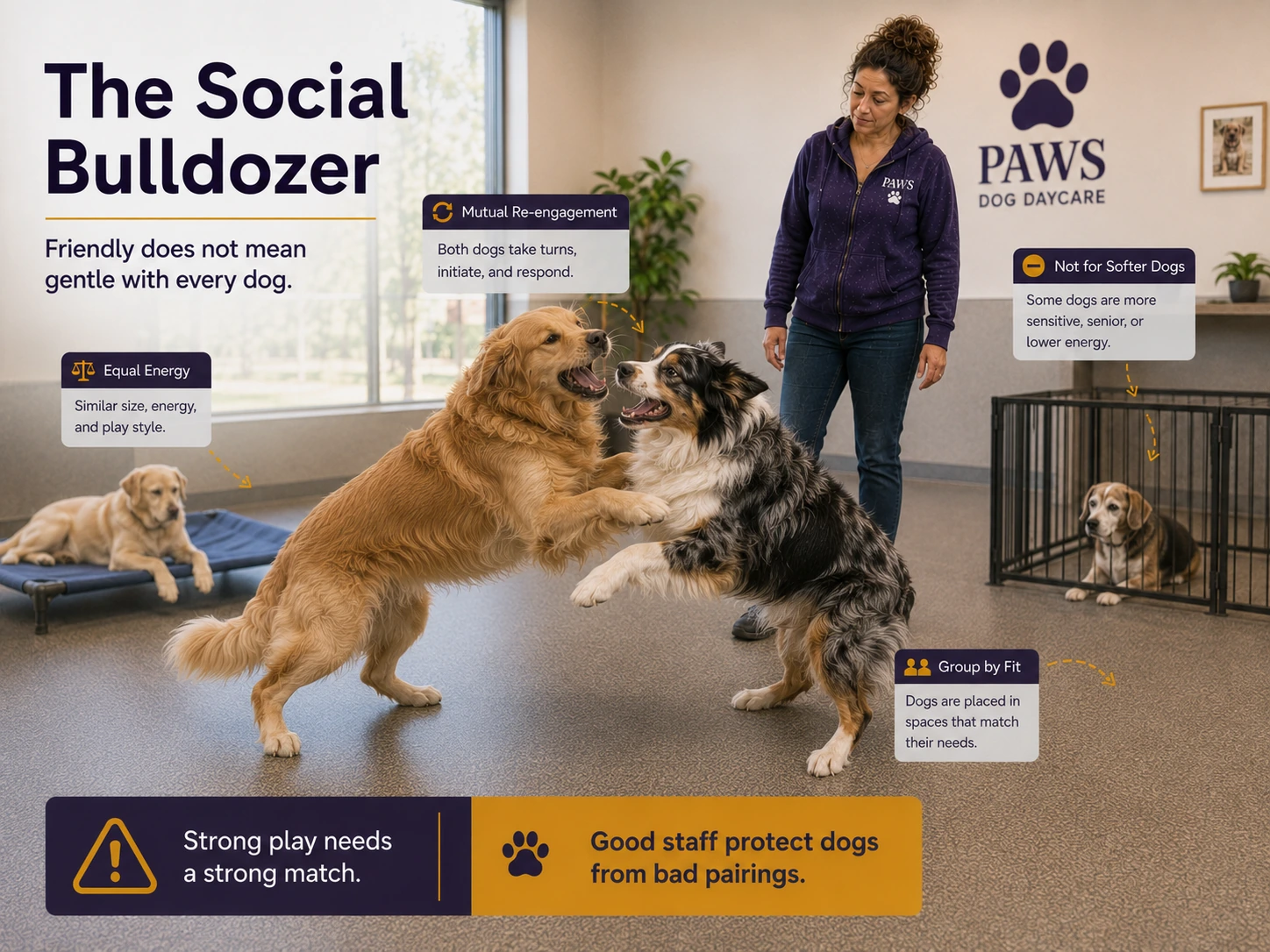
Outgoing dogs do best when their social appetite is paired with brakes. The dog should be able to join play, respond to staff, respect another dog’s exit, and settle when the room changes. Constant activity is not the goal; safe adjustment is.
Good matching considers size, energy, age, physical ability, play style, and whether both dogs repeatedly choose the interaction. Two strong social dogs may enjoy wrestling that would overwhelm an older, smaller, sore, or sensitive dog. Staff should build the room around compatibility rather than asking every dog to tolerate the loudest player.
Success should remain visible after the exciting part. A good fit can move through arrivals, active play, pauses, rest, and re-entry without the dog becoming increasingly rude or difficult to reach.
- They do well when greetings are controlled instead of letting excitement explode through the gate.
- They do well with dogs that enjoy similar energy without being bullied by it.
- They do well when staff interrupt rough play before it becomes pressure.
- They do well with rest breaks, rotation, and clear routines.
- They do well when they can disengage, calm down, and return to play without losing their mind.
📌
Room rule
Social is useful. Adjustable is safer. The outgoing dog needs both.
🚦
Where Outgoing Dogs Get Into Trouble
Pushy social behavior is still pressure.
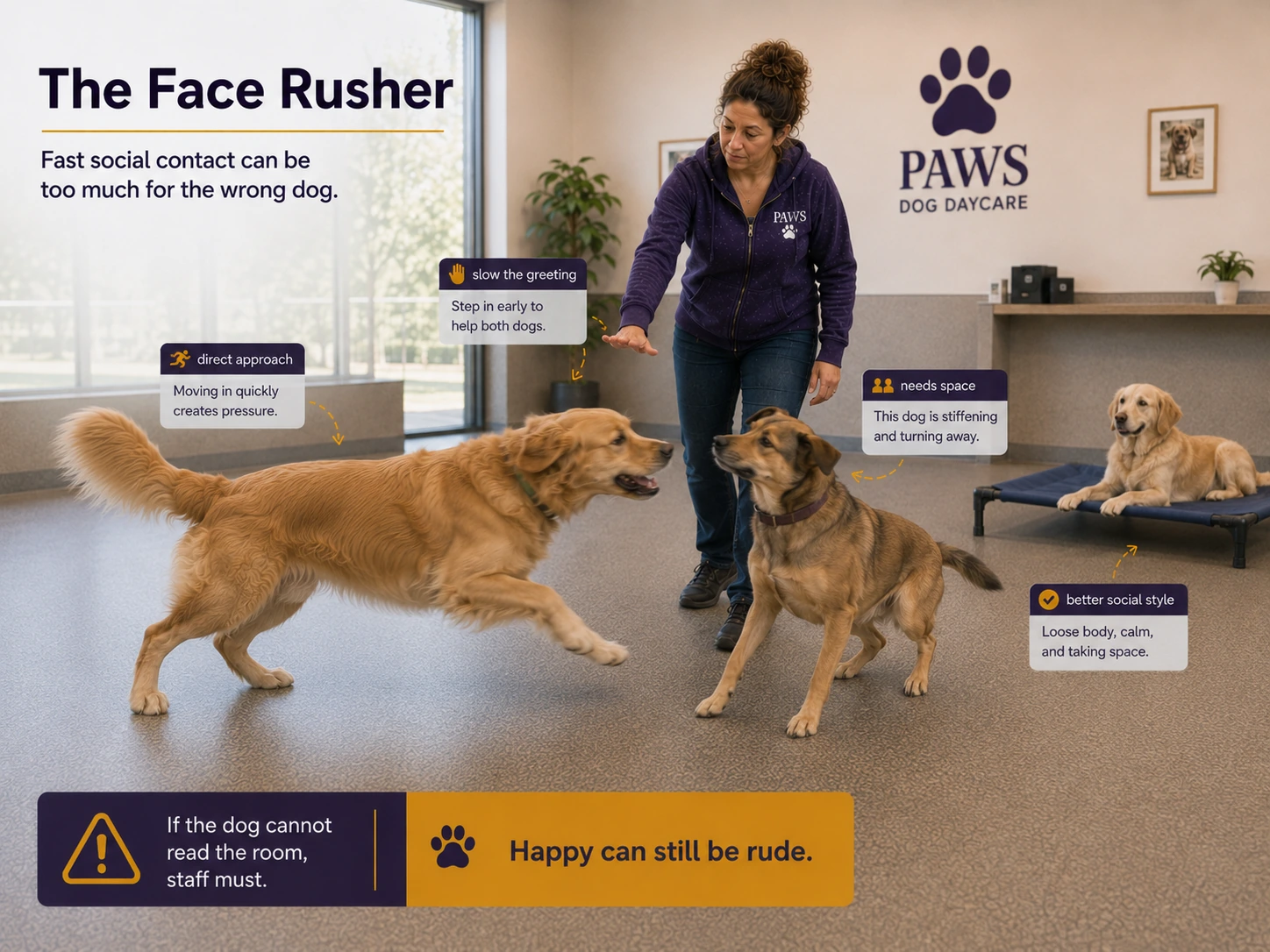
The outgoing dog gets into trouble when friendliness turns into pressure. The dog may rush into greetings, crowd faces, chase too long, body-slam, mount, steal toys, guard attention, bark in another dog’s face, or keep trying to play with a dog that is clearly finished.
This is where staff get fooled. The outgoing dog looks happy. The other dog looks stiff, trapped, tired, avoidant, defensive, or annoyed. The outgoing dog keeps pushing. Then everyone acts shocked when the other dog snaps.
If the dog cannot take no from another dog, staff have to say no first.
Most outgoing-dog conflict is built through repetition. One face rush may be tolerated. The fifth rush, third body slam, second mount, and continued chase after the other dog turns away create a cumulative pressure problem. Staff who wait for a growl or snap are waiting until the target dog has already carried too much of the management burden.
The correct response protects both sides of the interaction. Move the outgoing dog, give the other dog space, reduce stimulation, and decide whether the pairing should continue. Do not punish the dog that finally objected while leaving the dog that created the pressure free to repeat it.
Swipe left/right to see the full table.
| Behavior | What It May Mean | Staff Response |
|---|---|---|
| Hard charging greetings | The dog is dumping excitement directly onto another dog. | Control entry, slow the greeting, redirect before contact, or use a smaller introduction. |
| Repeated mounting | The dog is over-aroused, pushy, rude, or testing boundaries. | Interrupt early. Do not let mounting become the room’s normal play style. |
| Ignoring corrections | The dog is not respecting another dog’s no. | Remove pressure before the other dog has to get louder. |
| Obsessing over one dog | The dog may be targeting, fixating, bullying, or failing to disengage. | Split the dogs, redirect, rotate, or end group play if the pattern repeats. |
| Toy or attention guarding | A social dog can still control resources. | Remove the trigger or remove the dog from that setup. |
| Door or gate crowding | The dog is adding pressure at a high-arousal choke point. | Move the dog back. Gate manners are safety work, not decoration. |
📈
The Outgoing Dog Arousal Curve
This dog often fails by climbing too high, not by starting mean.
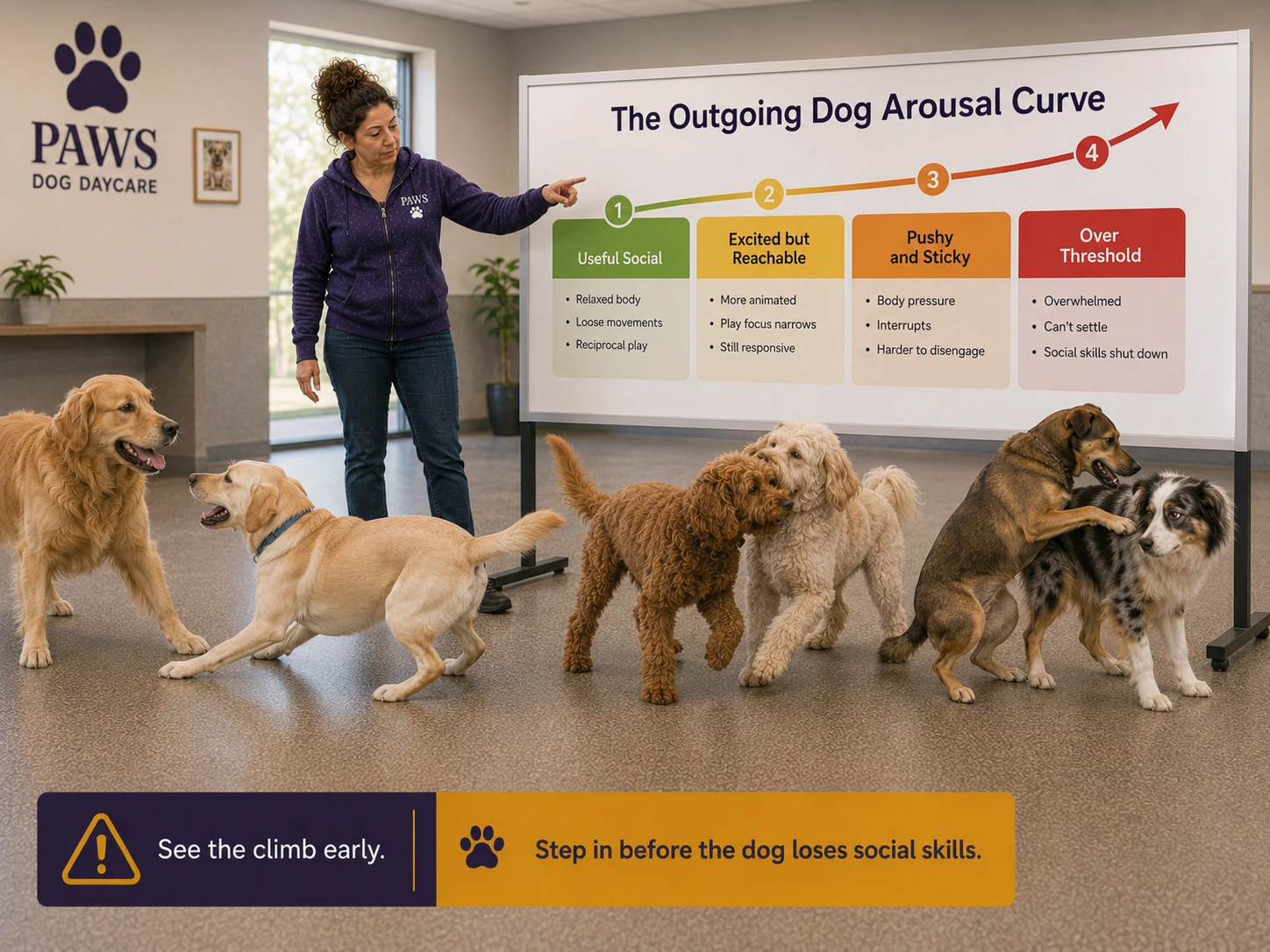
The outgoing dog may start the day loose, happy, and useful. Then the doorbell rings, three dogs arrive, one dog starts barking, somebody brings out a toy, staff change shifts, a customer walks past the window, and now the same dog is vibrating like a bad appliance.
That is the arousal curve. The dog did not become a different dog. The room pushed the dog past the point where good social skills still worked.
Early movement up the curve is usually visible. The dog begins moving faster, taking straighter approaches, repeating the same game, checking in less, pushing past pauses, or returning to a dog that has already disengaged. Those changes matter even when the tail is wagging and nobody has made contact.
The cheapest intervention happens while the dog is still excited but reachable. A recall, guided movement, short reset, quieter partner, or structured break may restore good social behavior. Once the dog is over threshold, the goal is no longer to keep the party going; the goal is to end the unsafe setup and learn from it.
Swipe left/right to see the full table.
| Stage | What It Looks Like | Staff Move |
|---|---|---|
| Useful Social | Loose body, role changes, checks in, responds to name, takes breaks. | Let the dog play, but keep watching. Good is not permanent. |
| Excited but Reachable | Faster movement, louder play, more chasing, but still responds to staff. | Call out, redirect, move the dog, slow the game, reward the reset. |
| Pushy and Sticky | Fixates on one dog, repeats mounting, ignores avoidance, crowds gates or staff. | Rotate or separate. Do not wait for the other dog to file a complaint with teeth. |
| Over Threshold | Cannot hear staff, grabs, body-slams, escalates corrections, redirects, or keeps driving back into conflict. | End group play for now. Rest, document, reassess, and change the next setup. |
🧩
Outgoing Personality Compatibility in Daycare
Friendly dogs still need the right dogs around them.
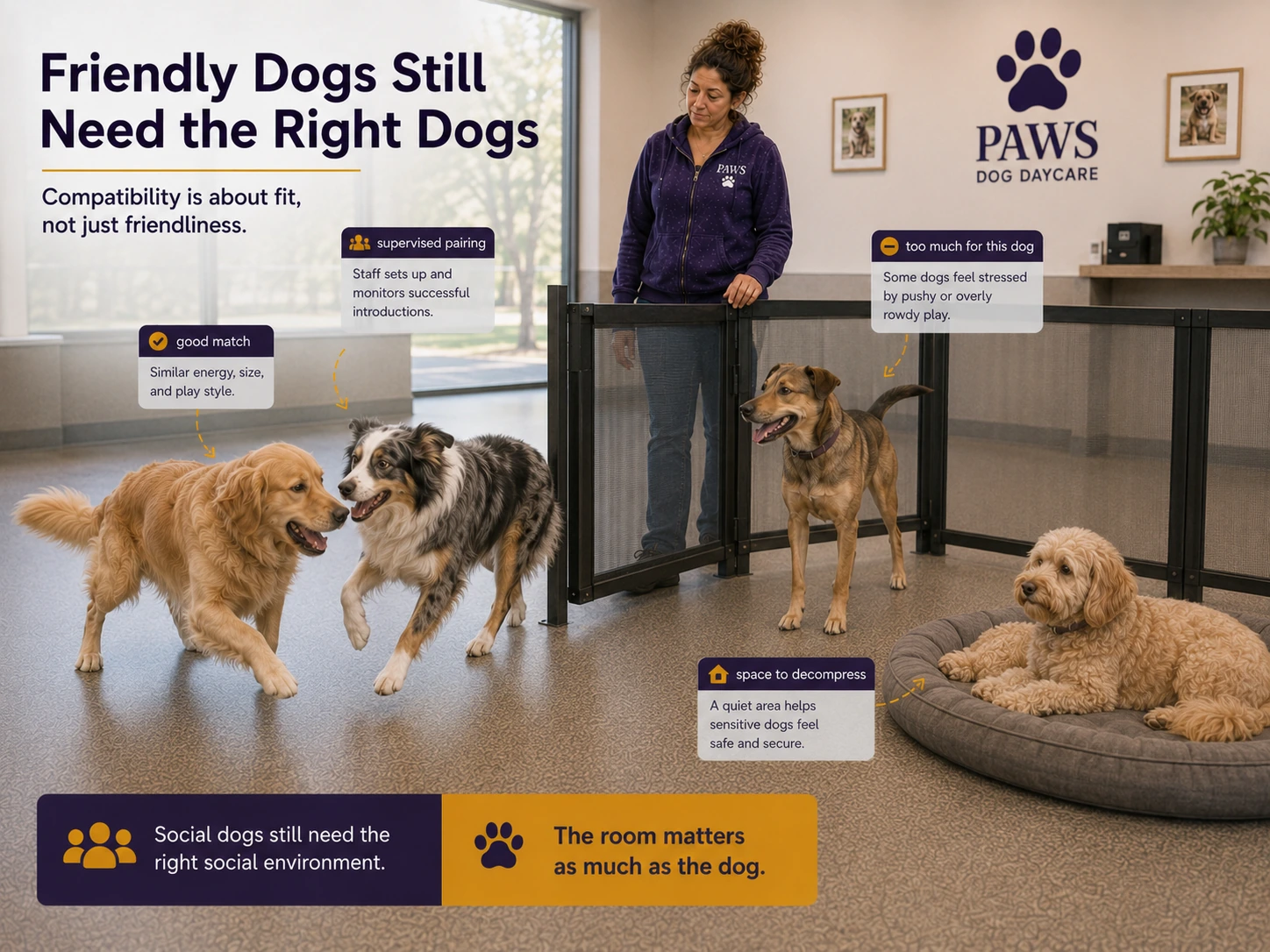
Compatibility is not a permanent label attached to two personality types. It changes with age, pain, fatigue, room size, group density, staff skill, resources, and the amount of arousal already present. A pairing that works early may become poor later in the day.
Staff should compare more than friendliness. Look at physical size, speed, play intensity, recovery, correction style, willingness to yield, and whether each dog can leave without being followed. The safer pairing is the one where both dogs retain choices.
Every compatibility decision remains conditional. If one dog begins hiding, stiffening, guarding space, avoiding the gate, or repeatedly seeking staff protection, the match needs to change even if the table predicted that it should work.
Swipe left/right to see the full table.
| Pairing | Compatibility | Daycare Meaning |
|---|---|---|
| Outgoing + Aggressive | Low | Not a casual pairing. The outgoing dog may rush, bump, invite play, or ignore warnings, and the aggressive dog may answer with force. |
| Outgoing + Confident | Moderate / High Supervision | A confident dog may tolerate energy, but may also read pushy play as a challenge. Watch posture, pressure, and corrections. |
| Outgoing + Insecure | Low / High Caution | The outgoing dog can overwhelm the insecure dog and create defensive snapping, hiding, panic, or escalation. |
| Outgoing + Adaptable | High | Often a good fit when the outgoing dog is not rude and the adaptable dog is not being used as a punching bag for bad manners. |
| Outgoing + Independent | Moderate / High | Often workable if the outgoing dog respects space. Avoidance means back off, not try harder. |
| Outgoing + Outgoing | High / Can Become Chaotic | Energy matching can be great, but two happy fools can still turn a room into a liability event if nobody slows them down. |
⚠️
Compatibility warning
High compatibility does not mean no supervision. Low compatibility does not mean every dog explodes. It means staff need to respect the risk before the dogs explain it louder.
📝
Intake: Do Not Let “Friendly” Be the Whole Evaluation
Owner description starts the conversation. Staff observation makes the decision.
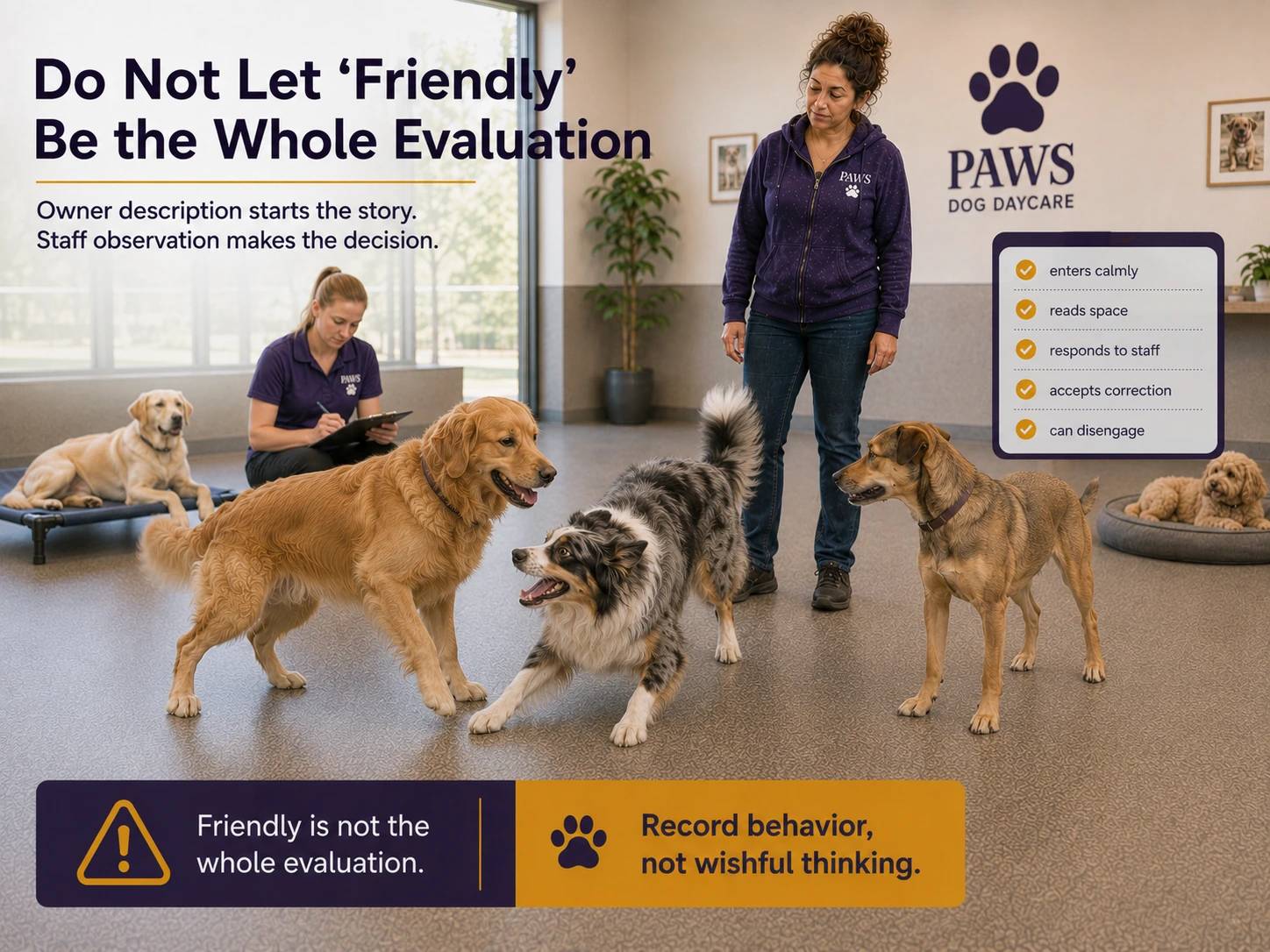
Most owners are not lying when they say their outgoing dog is friendly. They are describing the dog they know. The problem is that home, walks, family dogs, and occasional playdates are not the same as a daycare room.
Daycare adds strange dogs, tight gates, excited arrivals, resting dogs, toys, water bowls, staff handling, customer noise, tired dogs, and changing groups. The outgoing dog has to function in that environment, not just in the owner’s story.
A single greeting is not a complete evaluation. Staff should watch the dog during entry, movement through a gate, staff handling, interruption, resource exposure, rest, re-entry, and the first signs of fatigue. The dog’s ability to recover after excitement often predicts daycare success better than the amount of enthusiasm shown at the start.
History still matters. Prior fights, repeated mounting, toy guarding, escape behavior, pain, medication, and large changes in home behavior should be documented before the dog joins a group. The owner supplies context, but the facility must base the operating decision on what trained staff can observe and safely manage.
- How does the dog enter the room?
- Does the dog rush faces, shoulders, rear ends, gates, or resting dogs?
- Does the dog listen when staff redirects?
- Does the dog accept correction from another dog?
- Does the dog escalate when corrected?
- Does the dog guard toys, water, staff attention, resting spots, or doorways?
- Can the dog calm down after excitement?
- Is the behavior improving with staff management, or repeating every visit?
👀
How Staff Should Handle the Outgoing Dog
Do not punish social energy. Shape it before it runs the room.
The staff job is not to stand there smiling because the dog is happy. The staff job is to keep happy from becoming rude, rude from becoming pressure, and pressure from becoming a fight.
Outgoing dogs need early interruption. Not panic. Not yelling. Not rough handling. Early, calm, consistent direction. The dog should learn that staff control the gate, staff control play intensity, staff control breaks, and staff decide when a dog needs to stop pushing.
Good handling is physical without being forceful. Staff use position, gates, movement, leashes when appropriate, barriers, and timely recalls to change the picture before the dog reaches full speed. Standing still and repeating the dog’s name while the room keeps escalating is not an intervention.
Consistency matters because outgoing dogs quickly learn which employee opens the gate too soon, allows mounting, laughs at body slams, or gives up after one failed recall. The facility needs shared rules for greetings, rough play, staff attention, toys, rest, and re-entry so the dog does not receive a different daycare every shift.
The response to interruption should be documented. A dog that resets after one calm cue is different from a dog that immediately returns to the same target, redirects onto the handler, or becomes more frantic after separation.
- Control the first minute of entry. Do not dump excitement through the gate.
- Interrupt mounting, crowding, body-slamming, and repeated face pressure early.
- Use rotation before the dog is exhausted and stupid.
- Remove toys, food, or high-value triggers if the dog gets possessive.
- Protect insecure, tired, small, sore, or avoidant dogs from being pestered.
- Write actual behavior notes, not “had a great day” when staff spent all day peeling the dog off everybody.
⏱️
Rest, Rotation, and Transition Rules for Outgoing Dogs
The dog that cannot stop itself needs the business to stop it before the room pays for it.
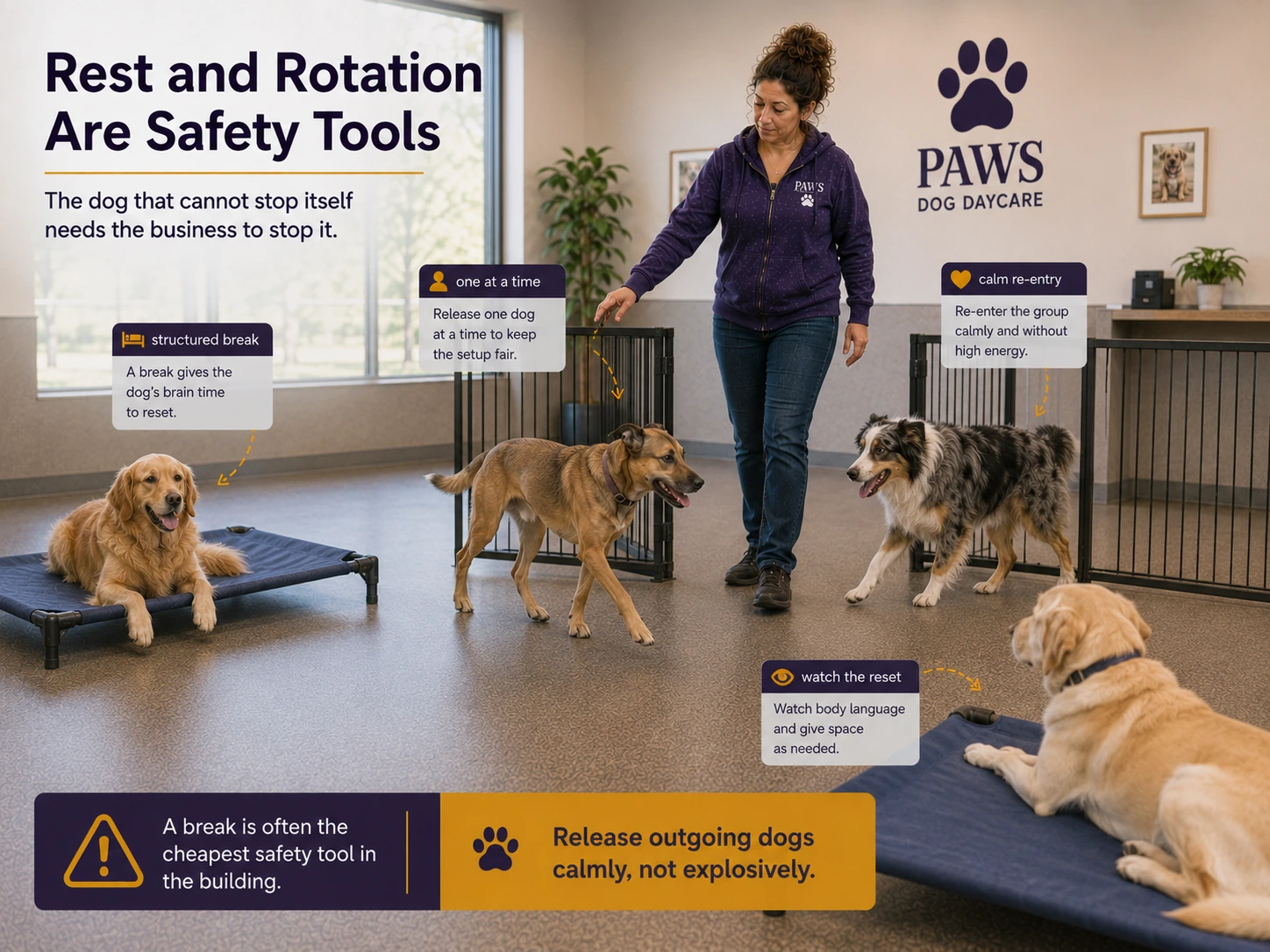
Some outgoing dogs will not take breaks on their own. They will play through fatigue, ignore dogs trying to rest, and keep stirring the room because their body is tired but their brain still thinks it is hosting a parade.
Rest is not punishment. Rotation is not failure. A break is often the cheapest safety tool in the building.
Breaks should be scheduled before the dog is completely exhausted. Waiting until behavior collapses turns rest into emergency containment instead of routine regulation. Some dogs benefit from predictable cycles that prevent the room from reaching the same daily pressure point.
Re-entry is part of the test. A dog that returns loose, responsive, and able to choose a different activity may be ready for more group time. A dog that explodes back into the same target or immediately resumes gate rushing is telling staff that the break did not restore safe behavior.
- Release outgoing dogs from rest calmly, one at a time, instead of opening the door and launching a furry grenade into the group.
- Build the group back slowly after rest periods, especially if multiple high-energy dogs are returning at once.
- Watch staff changes, customer movement, windows, fences, and lobby noise because outgoing dogs often feed off visible excitement.
- Do not use food, treats, or high-value toys in open group unless the facility has a controlled reason and a staff member watching the exact risk.
- Separate by size, energy, age, and play style. A good dog in the wrong room is still the wrong setup.
- Document whether the dog improved after rest. If rest does not reset the dog, the next answer may be smaller group, shorter day, or no open play.
🗣️
What Owners Need to Hear
Friendly dogs can still need limits.
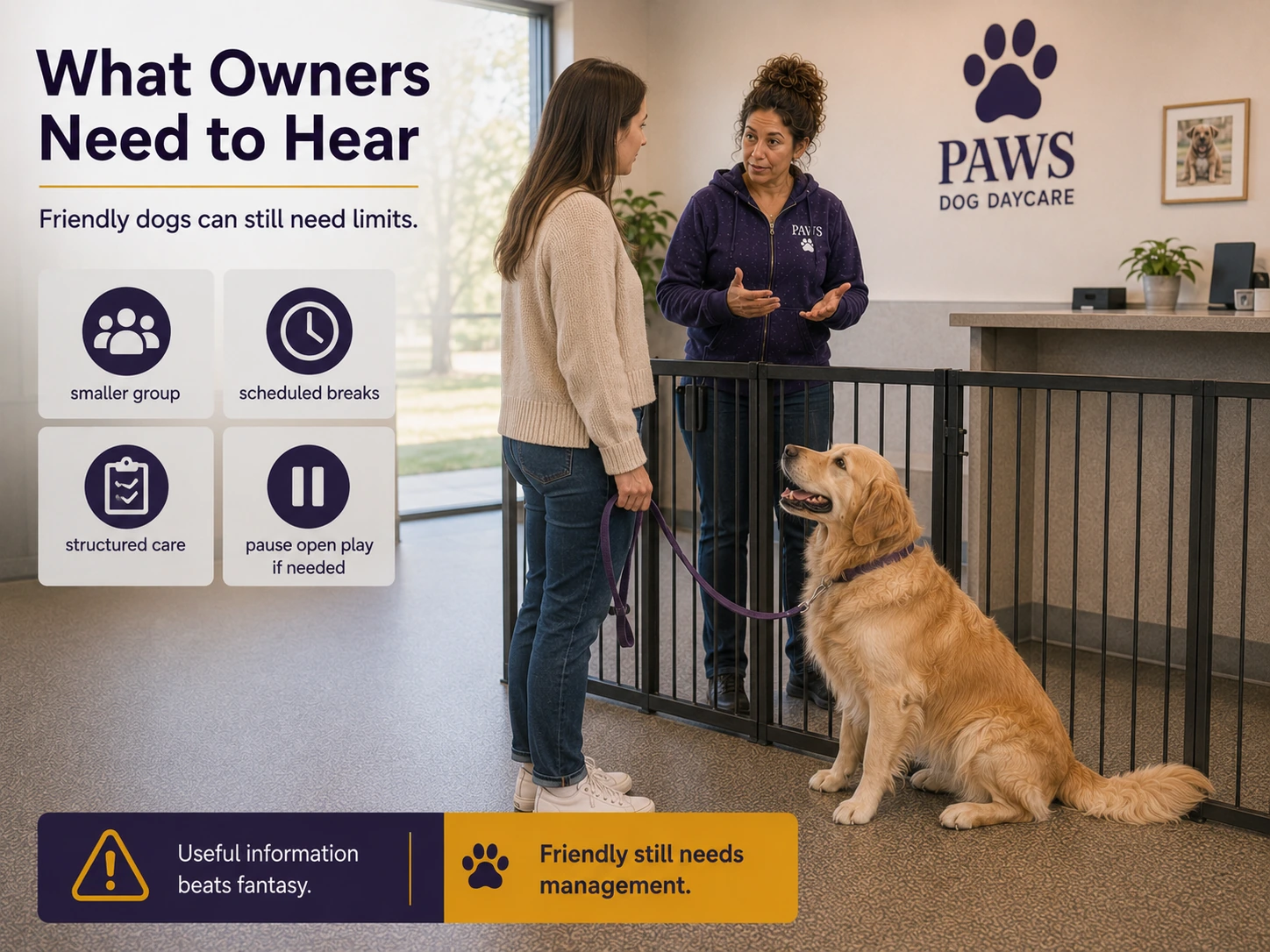
Owners may hear “too much” as an insult. Keep the conversation specific. Do not call the dog bad. Explain what the dog did, what staff did, what improved, what repeated, and what changes are needed.
The owner does not need fantasy. The owner needs useful information. If the dog is friendly but rude, say that. If the dog needs smaller groups, say that. If the dog needs breaks, say that. If the dog cannot safely stay in open play, say that too.
Behavior-specific language keeps the conversation useful. “He repeatedly rushed the same dog after that dog turned away” is clearer than “he was a little much.” Explain the setup, the staff response, whether the dog recovered, and what changes will be used on the next visit.
Owners should also understand that smaller groups, shorter days, breaks, or private care are not punishments. They are service decisions designed around the dog’s current ability and the facility’s duty to protect every dog in the room.
📌
Owner script
“Your dog is very social, but he is creating too much pressure for some dogs in open group. We are going to manage him with slower introductions, breaks, and more careful playmates. If the behavior keeps repeating, we may need to move him to a smaller group or pause daycare.”
🛑
When to Pause, Rotate, Separate, or Refuse the Outgoing Dog
Some dogs need structure. Some need smaller groups. Some need to go home.
These decisions belong on a continuum. A short pause may be enough when arousal first rises. Rotation or a smaller group may be appropriate when the dog succeeds under reduced pressure. Separation, early pickup, or refusal becomes necessary when the dog cannot remain safe inside the service the facility is offering.
The decision should consider severity, repetition, staff capacity, available space, response to intervention, and the effect on the other dogs. A dog does not have to be malicious to be beyond what the room can safely absorb.
Refusal is not a failure to love dogs. It is an operating decision that protects the dog, the group, the staff, the owner relationship, and the business.
- Pause the dog when arousal is climbing and the dog is losing manners.
- Rotate the dog when the dog plays well early but gets rude as fatigue builds.
- Separate the dog when the dog fixates on one playmate, guards a resource, or repeatedly ignores corrections.
- Use a smaller group when the dog does better with fewer dogs and less movement.
- Send the dog home when staff cannot keep the dog from pressuring the room that day.
- Refuse open group play when the dog repeatedly creates unsafe situations despite reasonable staff management.
⚠️
No fantasy rule
If the dog needs one employee watching him every second to keep the room from boiling over, that dog is not an open-group daycare fit in that facility.
✅
Outgoing Personality Daycare Checklist
Use this list before admitting, retaining, or moving an outgoing dog into open group play.
The checklist should be used with actual notes from multiple visits, not as a one-time form that disappears into a file. Outgoing dogs may look different during quiet mornings, busy arrivals, staff changes, weather disruptions, or long days.
A single concern may be manageable. A repeated cluster of poor recovery, pressure, guarding, ignored corrections, and staff inconsistency should change the dog’s group plan before the room produces a more serious answer.
- Does the dog greet without smashing into dogs or crowding faces?
- Can the dog disengage when staff interrupts?
- Does the dog accept correction from other dogs without retaliating?
- Does the dog adjust play style to smaller, older, tired, or less confident dogs?
- Does the dog guard toys, water, staff attention, gates, or resting spots?
- Does the dog become worse as the room gets louder or more crowded?
- Does the dog improve with rest breaks, or come back just as wild?
- Is the owner willing to accept smaller groups, breaks, restrictions, or refusal if needed?
- Are staff notes specific enough to guide the next visit?
❓
Outgoing Dog Personality FAQ
Detailed answers about friendly-dog screening, social pressure, play matching, arousal, rest, transitions, owner communication, documentation, restrictions, and open-group daycare decisions.
Are outgoing dogs good daycare dogs?
Many outgoing dogs can be excellent daycare dogs because they enjoy movement, people, play, and social contact. They still need screening, appropriate partners, staff direction, rest, and evidence that they can disengage when another dog is finished. Friendly energy becomes unsafe when the dog repeatedly crowds, mounts, chases, guards, or ignores corrections.
Can a friendly dog still start a fight?
Yes. The dog may have friendly intent and still create enough pressure to trigger a defensive response. Face rushing, body slamming, repeated mounting, blocking exits, and continuing after another dog turns away can make the other dog feel trapped. Staff should interrupt the pressure before the target dog has to escalate.
Why is “friendly” not enough for a daycare evaluation?
Friendly describes social interest, not social skill. Staff also need to see how the dog enters, reads space, handles interruption, responds to correction, behaves around resources, recovers after excitement, and functions when tired. The whole pattern determines whether open group play is safe.
What is a gate cannon?
A gate cannon is an outgoing dog that explodes through doors, rushes arrivals, crowds exits, or turns transitions into a high-arousal event. The fix is controlled entry, space around the gate, calm release, staff positioning, and no free launch into the group. Gate behavior should be documented because it often predicts pressure elsewhere in the room.
What is a social bulldozer?
A social bulldozer is a cheerful, physical dog that uses body slams, shoulder checks, wrestling, and full-contact play without always noticing whether the other dog enjoys it. This dog may do well with evenly matched partners that repeatedly choose the interaction. Softer, smaller, older, or sore dogs should not be expected to absorb that play style.
Why are face-rushing greetings risky?
Direct fast approaches remove space and decision time from the receiving dog. Even a wagging dog can trigger stiffness, avoidance, defensive snapping, or a fight when it runs straight into another dog’s face. Slower curved greetings and staff-controlled introductions reduce that pressure.
How can staff tell healthy rough play from bullying?
Healthy rough play includes role changes, pauses, loose movement, re-engagement, and the ability for either dog to leave. Bullying is more one-sided and often causes hiding, freezing, avoidance, staff-seeking, or repeated attempts to escape. Staff should judge what the interaction does to both dogs, not just whether the outgoing dog looks happy.
Why do outgoing dogs overwhelm insecure dogs?
Insecure dogs often need more space, slower movement, predictable approaches, and time to process. An outgoing dog that keeps licking, pawing, chasing, crowding, or following can turn ordinary social interest into sustained pressure. The insecure dog may eventually freeze, hide, panic, or defend itself.
Can two outgoing dogs play together safely?
Often, but high compatibility can still become chaos. The dogs need similar size, energy, physical ability, play style, and willingness to pause. Staff must slow the interaction when speed, body contact, fixation, or fatigue begins pushing either dog past safe social behavior.
Should outgoing dogs play with aggressive dogs?
Not as a casual default pairing. The outgoing dog may ignore warnings, push into space, or keep inviting contact after the aggressive dog has disengaged. The aggressive dog may respond with force, creating a predictable and unnecessary risk.
What warning signs show an outgoing dog is becoming over-aroused?
Watch for faster movement, straighter approaches, repeated chasing, mounting, hard body contact, reduced check-ins, poor response to name, gate crowding, fixation on one dog, and immediate return after interruption. The dog may still look cheerful while social judgment is deteriorating.
When should staff give an outgoing dog a rest break?
Give the break while the dog is still reachable, not only after behavior collapses. Rising intensity, repeated corrections, inability to disengage, fatigue, crowding, and worsening manners are useful signals. A planned break is a regulation tool, not a punishment.
How should an outgoing dog return from a break?
Re-entry should be calm, controlled, and usually one dog at a time. Staff should watch whether the dog returns loose and responsive or immediately resumes the same target, gate rush, or frantic play. If the break did not restore safe behavior, the next step may be a smaller group, shorter day, or no more open play that visit.
Should toys or treats be used in an outgoing-dog playgroup?
Only when the facility has a controlled reason, enough staff, and no guarding concern. Outgoing dogs can still guard toys, food, water, staff attention, or access to a preferred object. Removing a predictable trigger is usually cheaper than proving the dog can fail around it.
How should staff manage an outgoing dog that ignores corrections?
Remove the dog before the other dog has to become louder. Repeatedly returning to the same target after growls, avoidance, or staff interruption shows poor disengagement. The outgoing dog may need a break, a different partner, a smaller group, or removal from open play.
What should staff document about an outgoing dog?
Document the entry style, greeting behavior, preferred play, target dogs, arousal changes, resources involved, staff interventions, response to interruption, recovery time, rest results, and successful or failed pairings. “Had a great day” is not useful when the next shift needs to manage the same risk.
How should staff explain pushy friendliness to an owner?
Use specific behavior instead of labels. Explain what the dog did, how the other dog responded, what staff tried, whether the dog recovered, and what changes are needed. Owners are more likely to understand smaller groups, breaks, or restrictions when the facility provides a clear behavioral reason.
When should an outgoing dog move to a smaller group?
A smaller group may help when the dog succeeds with selected partners but becomes rude or unreachable in a larger, faster, or more crowded room. It can also reduce gate pressure, competition for staff attention, and repeated contact with softer dogs. The dog still needs supervision and clear stop rules.
When should an outgoing dog be refused open group daycare?
Refusal may be necessary when the dog repeatedly creates unsafe pressure, guards resources, escalates after correction, cannot be redirected, fixates on other dogs, or requires one employee’s constant attention to keep the room safe. Private care or another service may be more appropriate than forcing an unsafe group fit.
What makes an outgoing dog a strong long-term daycare client?
The best outgoing dogs combine enthusiasm with adjustment. They can greet, play, pause, listen, recover, accept another dog’s no, rest, and return without taking over the room. Their success still depends on appropriate partners, consistent staff, controlled transitions, and a facility willing to act before friendly pressure becomes conflict.
🐾
The Bottom Line: Friendly Still Needs Management
The outgoing dog can be a great daycare client when staff control the room instead of trusting charm.
The outgoing personality belongs in the PAWS system because many of these dogs are exactly the dogs daycare was built to serve. They need movement, social contact, structure, exercise, attention, and a productive place to put their energy.
But a daycare owner cannot confuse likable with safe. The outgoing dog still needs rules. The room still needs supervision. Other dogs still have limits. Staff still have to interrupt pressure before the pressure turns into teeth.
A good daycare does not punish friendly dogs for being friendly. It teaches the room how to stay safe around them.
The strongest outgoing dogs are not simply the ones that play the hardest. They are the dogs that can greet, participate, pause, listen, recover, and adjust when another dog or a staff member changes the plan.
That standard protects the outgoing dog too. Clear limits prevent the dog from rehearsing rude behavior until another dog delivers a correction strong enough to cause injury, fear, or a permanent change in social behavior.