Dog Daycare Doors, Door Frames, Trim, Thresholds, Corners, Transition Strips, Chew Points, Kick Plates, Edge Guards, Kennel Fronts, and Facility Weak Spots
Dog Daycare Doors, Trim, Thresholds, and Chew Points: Dogs Find Edges First
Dogs do not destroy the whole building evenly. They find edges, lips, corners, thresholds, door frames, seams, and anything they can get a tooth, paw, claw, or nose under.
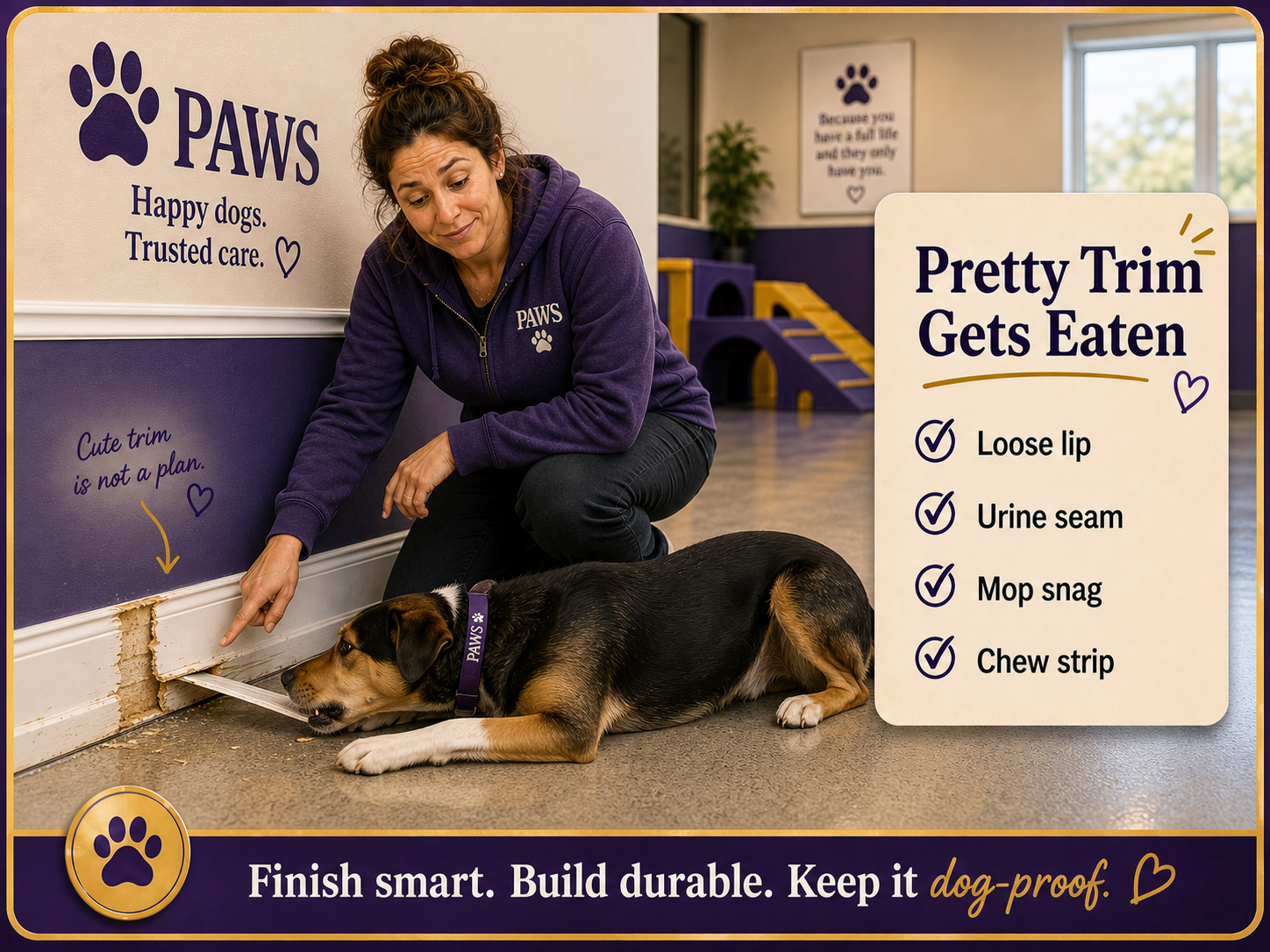
Dogs do not usually destroy a building evenly. They find the weak places first.
Door frames, trim, corners, thresholds, edges, transitions, exposed seams, gate edges, crate edges, and anything they can get a tooth, paw, claw, or nose under become the first test points in a dog daycare facility.
This is where owners get surprised. The floor may be decent. The walls may be decent. The main gates may look strong. Then one dog finds one exposed edge and turns it into a hobby.
A small chew point can become a daily repair, an ugly customer-facing mark, a sanitation problem, a urine trap, a sharp-edge safety issue, or the beginning of a larger failure. Dogs do not need a demolition plan. They just need an edge.
This guide covers the details of hardening your facility: door protection, kick plates, trim choices, metal edging, transition strips, corner guards, kennel fronts, threshold planning, and the hidden weak spots dogs notice long before you do.
🗺️
Use This Page Like an Edge-Failure Map
Do not plan dog daycare finish work by asking what looks nice on opening day. Plan it by asking where dogs can bite, paw, scratch, pry, urinate, crowd, rub, and where staff will mop, kick, bump, and clean every single day.
⚠️
Operator Warning
If a dog can get a tooth under it, that edge is already in negotiations.
🐾
Dogs Find Edges First
Flat surfaces usually last longer. Lips, corners, thresholds, trim, and seams give dogs something to work.
🗺️
Edge Failure Map
Door frames, thresholds, baseboards, transition strips, gate edges, kennel fronts, and wet-room edges all fail differently.
🧱
Trim and Chew Points
Pretty trim can become a chew strip, urine edge, mop obstruction, water trap, or odor seam.
↔️
Thresholds
Thresholds and transition strips are where flooring, water, urine, claws, and cleaning routines collide.
📐
Corners and Seams
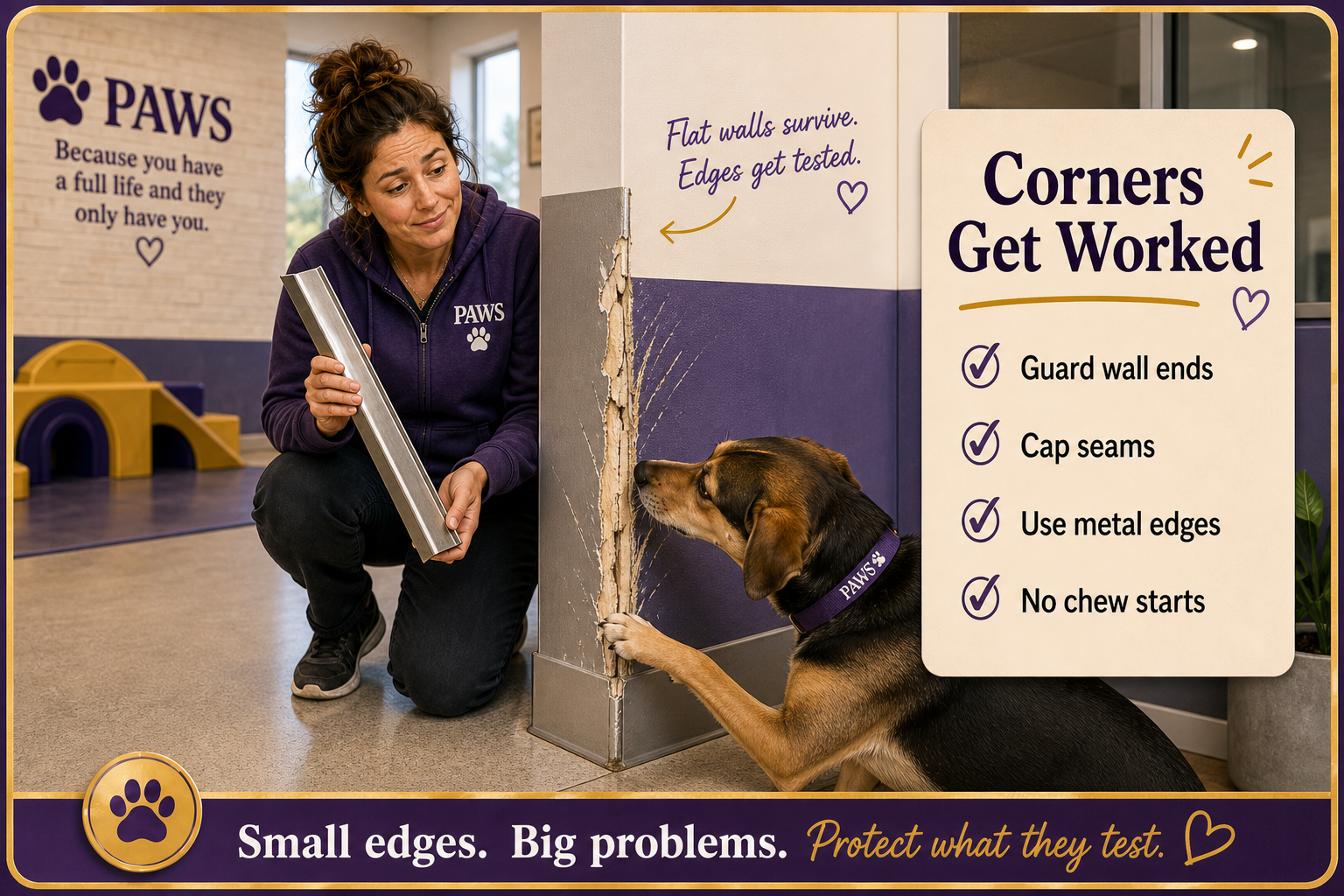
Corners, wall ends, and exposed seams take abuse from dogs, staff, gates, cleaning carts, and daily traffic.
🚧
Containment Edges
Kennel fronts, gate bottoms, latch sides, hinge sides, and crate edges collect dog pressure.
🧼
Dirty Edges
Chewed, lifted, cracked, or swollen edges become cleaning failures, odor storage, and safety problems.
👀
Customer-Facing Damage
Chewed lobby trim and rough door frames make a clean facility look neglected.
🧾
Contractor Questions
Ask about door protection, thresholds, corner guards, fasteners, seams, clearance, fire rating, ADA, and landlord approval before finish work is done.
✅
Inspection Checklist
Check door bottoms, frames, thresholds, transition strips, wall bases, corners, gates, kennel fronts, and wet-room edges before small damage spreads.
⚠️
Operator warning
If a dog can get a tooth under it, that edge is already in negotiations. Do not wait until the trim is shredded, the threshold is lifted, or the door frame looks like it lost a fight before you decide the weak point mattered.
🐾
Dogs Find Edges First
Flat surfaces are harder to start. Edges give dogs something to work.
A dog does not need to understand construction to find the weak point. Dogs test buildings with teeth, paws, claws, noses, shoulders, excitement, boredom, anxiety, water, urine, and repetition. The flat middle of a wall may last a long time. The lower corner, door casing, threshold lip, loose transition strip, exposed seam, or chewable edge may not.
Edges fail because they invite contact. A proud strip can be pawed at. A loose threshold can be lifted. A soft door frame can be chewed. A sharp transition can catch mop water, urine, hair, or nails. A corner can get bumped by dogs, gates, crates, cleaning carts, and staff every day.
That is why doors, trim, thresholds, and corners deserve their own planning page. They are small details during construction, but they become daily contact points after opening.
The wrong edge detail does not usually fail with one dramatic event. It fails in little ugly steps. A scratch becomes a groove. A groove becomes a chew point. A chew point becomes a loose piece. A loose piece becomes a sanitation problem, a repair bill, or a safety issue.
🔎
Facility rule
Walk the building at dog height. If you can see an exposed lip, loose strip, soft corner, proud fastener, or chewable edge, assume a dog will see it too.
🗺️
Dog Daycare Edge Failure Map
Different weak points fail for different reasons. Know where the dogs are going to start.
Swipe left/right to see the full table.
| Weak Point | What Dogs / Operations Do To It | What Goes Wrong | Better Planning Question |
|---|---|---|---|
| Door frames | Dogs jump, scratch, paw, chew, rub, and crowd doorways. | Chewed casing, scratched jambs, loose trim, ugly customer-facing damage. | Which door frames will dogs touch every day, and how are those edges protected? |
| Door bottoms | Dogs paw, scratch, push, urinate near doors, and crowd exit points. | Swollen edges, scratched finishes, chewed bottoms, cleaning damage. | Does the dog side of this door need a kick plate, push plate, or more durable surface? |
| Thresholds | Dogs cross, dig, trip, paw, and track water over transitions. | Lifted strips, urine intrusion, water traps, odor, trip points. | Can water, urine, hair, or claws get under the threshold? |
| Baseboards | Dogs chew lower edges, urine hits the wall base, staff mops against them. | Odor seams, swelling, peeling, cracked caulk, chew damage. | Is this trim decorative, or can it survive dog-use cleaning? |
| Wall corners | Dogs crowd, turn, jump, rub, and crash into corners during movement. | Chipped corners, exposed material, sharp edges, ugly repairs. | Which corners need guards before the first busy pickup rush? |
| Transition strips | Dogs scratch, staff mops, carts roll, water sits, flooring moves. | Loose lips, peeling strips, trapped moisture, chew starts. | Is the transition sealed, flush, durable, and cleanable? |
| Gate edges | Dogs paw, bite, push, jump, and crowd pressure points. | Sharp edges, loose panels, latch-side damage, containment risk. | Can a dog work the bottom, side, hinge, or latch edge? |
| Kennel fronts | Dogs chew, nose, paw, and push where confinement pressure builds. | Worn edges, bent panels, loose seams, noise, injury risk. | Are kennel contact points protected and serviceable? |
| Outdoor entry doors | Wet dogs, mud, excitement, leash pressure, weather, and staff traffic hit the same spot. | Swelling, rot, scratched finishes, failed seals, dirty transitions. | How does this doorway handle mud, rain, urine, and repeated cleaning? |
| Grooming and bathing edges | Wet dogs shake, staff moves tubs and tools, hair and water collect. | Water intrusion, peeling trim, damp odor, dirty seams. | Are wet-room edges sealed, protected, and easy to clean? |
⏱️
What Usually Fails First After Dogs Move In
Weak edges do not always fail on day one. They usually start small, then become part of the building’s personality.
The dangerous thing about door, trim, and threshold damage is that it often starts small enough to ignore. One scratch on a door frame. One lifted strip. One swollen corner near a mop path. One dog that keeps pawing the same threshold. Then staff get used to seeing it, customers start noticing it, and the repair becomes harder because the dog has already learned the spot.
New owners should inspect edges aggressively during the first few months. That is when the building tells you which finish-work decisions were solid and which ones were mostly decorative optimism.
Swipe left/right to see the full table.
| Timeframe | What Often Shows Up | What It Means | Operator Move |
|---|---|---|---|
| First 30 days | Scratch marks on door bottoms, pawing at gates, loose transition edges, dogs focusing on one corner. | The dogs are identifying the weak contact points faster than the owner. | Fix small edge problems immediately before they become group hobbies. |
| First 90 days | Threshold lifting, baseboard swelling, chipped corners, scratched jambs, chewed casing, cracked caulk. | Cleaning, urine, dog traffic, and staff movement are exposing weak finish work. | Document patterns and harden repeated failure points, not just patch them. |
| First 6 months | Odor near wall bases, ugly repair patches, damaged door frames, peeling strips, worn gate edges. | The building is turning small design problems into daily maintenance. | Review material choice, cleaning flow, and whether the repair itself is dog-resistant. |
| First year | The same corners, thresholds, doors, and trim pieces keep failing. | This is no longer wear and tear. It is a design problem repeating itself. | Stop repainting the problem and redesign the contact point. |
🐾
First-year rule
If the same edge fails twice, the dog is not the problem anymore. The detail is.
🚪
Doors in Dog Areas Are Not Normal Doors
A door in a dog daycare is not just a door. It is a pressure point.
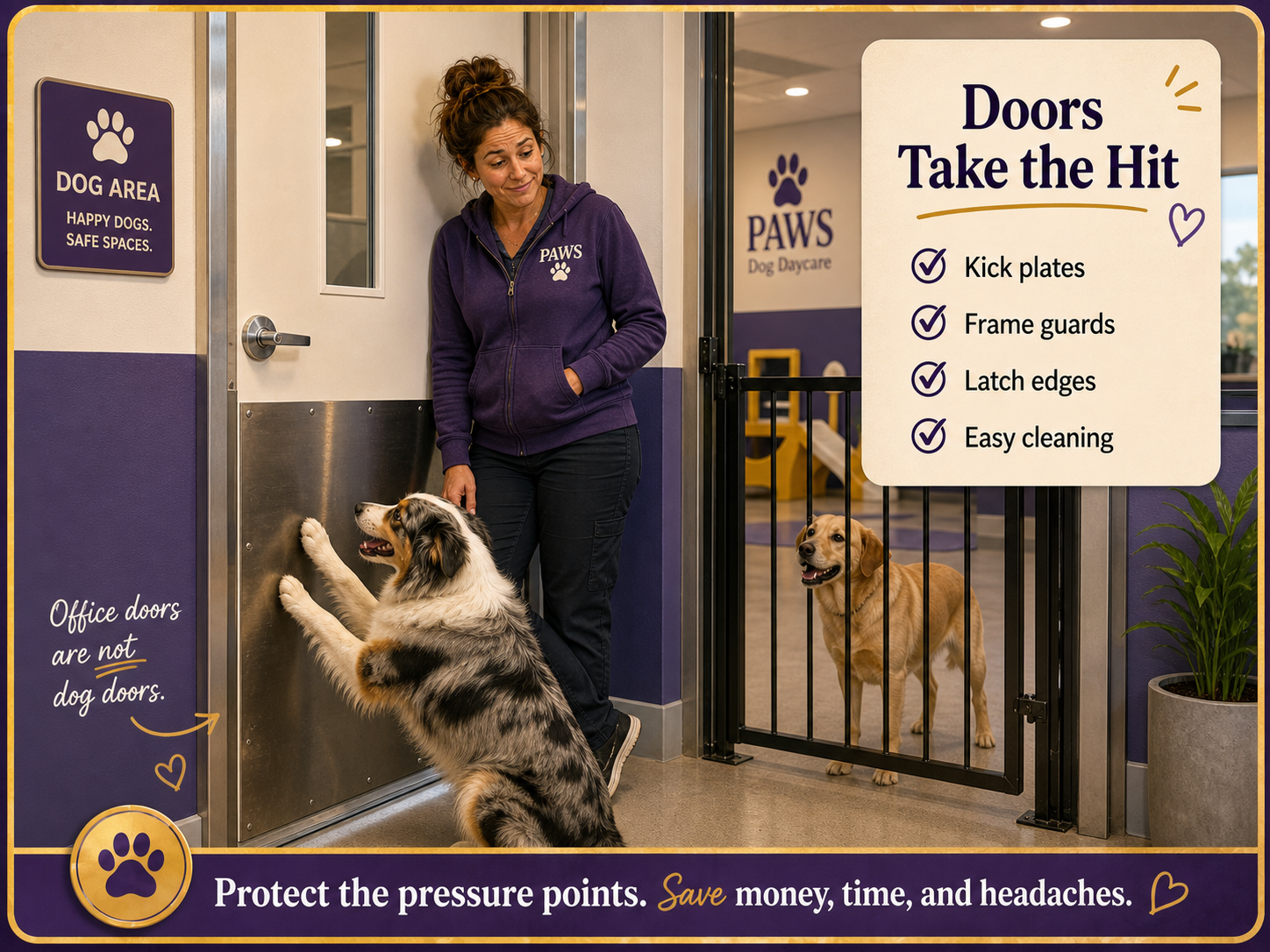
In a normal office, a door mostly has to open, close, latch, and look decent. In a dog daycare, a door may separate dogs from dogs, dogs from customers, dogs from staff-only areas, dogs from outside, dogs from food storage, dogs from grooming, dogs from isolation, or dogs from the lobby.
That means the door is part of the safety system, traffic system, cleaning system, odor-control system, and customer-confidence system. The door surface, frame, latch, hinges, stop, bottom edge, and threshold all matter.
Hollow-core doors, soft trim, exposed edges, weak kick areas, loose handles, proud screws, flimsy stops, and chewable weather stripping can all become problems. Dogs scratch at doors when excited. Dogs paw at doors when anxious. Dogs crowd doors during pickup. Staff bump doors with mop buckets, crates, leashes, cleaning tools, and full hands.
Dog-side doors may need kick plates, push plates, harder surfaces, metal edge protection, stronger jamb protection, or a different door choice entirely. But do not randomly modify doors without asking the contractor or inspector. Fire-rated doors, egress doors, ADA clearance, panic hardware, swing direction, thresholds, and door closers can all create code and inspection issues.
⚠️
Door warning
Do not treat every door the same. A closet door, lobby door, grooming door, isolation door, and dog-yard exit door all have different abuse, cleaning, safety, and code concerns.
🚪
Door Type Risk: Not Every Door Belongs Near Dogs
The wrong door can look fine during build-out and then get shredded by normal daycare behavior.
Swipe left/right to see the full table.
| Door Type | Where It Might Work | Where It Fails | Dog Daycare Warning |
|---|---|---|---|
| Hollow-core interior door | Low-contact office, storage, or staff-only areas. | Dog-use rooms, playrooms, boarding areas, grooming, exits, and high-traffic dog paths. | Cheap, light, and easy to damage. It may not survive paws, claws, moisture, or chewing. |
| Solid-core door | Higher-contact interior areas where durability matters. | Wet areas or dog-side abuse points without edge protection. | Better than hollow-core, but still needs protection at the dog side, bottom edge, and frame. |
| Metal commercial door | High-use doors, exterior exits, staff access, utility paths, and stronger separation points. | Areas where rust, dents, sharp edges, bad hardware, or poor installation create issues. | Strong is good, but damaged metal edges, loose plates, and bad fasteners become safety problems. |
| Exterior-grade door | Outdoor transitions, yard access, wet traffic, and weather-facing entries. | Dog-side scratching, bottom-edge moisture, damaged seals, and threshold abuse. | Weather resistance helps, but dogs and cleaning water still punish the lower edge. |
| Fire-rated door | Where required by code, occupancy, separation, or inspection. | When owners add plates, cut holes, change hardware, or modify it incorrectly. | Do not casually alter fire-rated doors. Ask the contractor or inspector first. |
| Dutch door / half door | Some staff-view, office, or controlled handoff areas. | Dog pressure zones, jumpers, climbers, anxiety areas, and loose-dog risk paths. | Useful in the right place, dangerous in the wrong place. Height, latch, and dog behavior matter. |
🛡️
Kick Plates, Push Plates, and Edge Guards
Protection only works when it is placed where dogs and staff actually hit the door.
Kick plates and edge guards can be useful, but they are not magic stickers. They need to cover the real abuse zone. In a dog daycare, that usually means the lower dog-side door surface, the latch-side edge, the push area staff use with full hands, and any bottom edge where dogs scratch, paw, or crowd.
A plate that is too small, too thin, poorly fastened, sharp at the edge, or mounted with proud screws can create a new problem while pretending to solve the old one. Hardware should be smooth, secure, cleanable, and appropriate for moisture, cleaning chemicals, and dog contact.
Also remember the inspection side. Added plates, guards, sweeps, seals, and thresholds can affect door clearance, swing, latch engagement, fire rating, egress, ADA access, and cleaning clearance. This is where the contractor, landlord, and inspector need to be part of the conversation before the door becomes a science experiment.
- Does the dog side of the door need lower protection from claws, paws, urine, and cleaning water?
- Does the latch-side edge need protection from chewing, crowding, or staff impact?
- Are screws, edges, and corners smooth enough for dog-contact areas?
- Will the protection trap water, urine, hair, or cleaning residue behind it?
- Will added hardware affect door swing, clearance, latch, fire rating, egress, ADA, or inspection requirements?
🧱
Trim Is Decorative Until Dogs Make It Structural
Pretty trim near dogs is only pretty until the first dog decides it has texture.
Trim is often chosen because it looks finished. Baseboards, casing, quarter round, chair rail, and transition trim can make a normal commercial space look cleaner and more complete. In a dog daycare, that same trim can become a chew strip, urine edge, mop obstruction, water trap, odor seam, or splinter point.
The lower the trim is, the more suspicious it should make you. Low trim sits where urine hits, where mop water collects, where dogs paw, where teeth can reach, where bedding and hair collect, and where cleaning chemicals get pushed during daily reset.
Wood trim may look nice on opening day, but if it is soft, poorly sealed, loosely installed, or exposed in a dog-use area, it can turn ugly fast. Once urine or water gets behind trim, the problem may no longer be visible. The room may look decent from a distance while odor is being stored at the wall base.
This does not mean every inch of trim is forbidden. It means trim should be chosen by location and use. Customer-only areas, staff offices, dog-use rooms, grooming rooms, boarding areas, and wet cleaning areas do not need the same finish choices.
🦷
Chew-point rule
If trim creates a lip, gap, soft edge, or loose corner in a dog-use area, the dog does not see trim. The dog sees a project.
🧰
Material Choice: Better, Risky, and Usually Asking for Trouble
The question is not whether a material looks finished. The question is whether it survives dogs, cleaning, urine, water, and staff traffic.
Swipe left/right to see the full table.
| Material / Detail | Better Use | Risk | Operator Note |
|---|---|---|---|
| Wood baseboard / casing | Customer-only areas, offices, low-dog-contact zones. | Chewing, swelling, urine intrusion, cracked caulk, odor seams. | Looks nice until it lives at dog-nose height. |
| MDF trim | Dry, low-contact decorative areas only. | Moisture swelling, soft edges, poor abuse resistance. | MDF near wet dog areas should make you nervous. |
| PVC / composite trim | Some moisture-prone areas when properly installed and sealed. | Still chewable, still needs secure installation, can look bad if damaged. | Better around moisture, not automatically dog-proof. |
| Rubber or vinyl cove base | Some commercial wall bases and cleanable edges. | Can peel, trap moisture, get chewed, or fail if adhesive and substrate are wrong. | Good installation matters more than the product brochure. |
| Stainless / aluminum guards | Door bottoms, corners, edges, high-contact dog-side zones. | Sharp edges, loose fasteners, corrosion, ugly dents, cleaning traps. | Useful when smooth, secure, cleanable, and correctly placed. |
| FRP or wall protection panels | Wet rooms, lower walls, utility spaces, grooming, cleaning-heavy areas. | Bad seams, exposed edges, poor trim details, water behind panels. | The panel is only as good as the edge and seam plan. |
| Exposed caulk seam | Only where appropriate and maintained. | Cracking, peeling, urine intrusion, hair collection, false sense of sealing. | Caulk is not a structural edge guard. |
| Peel-and-stick transition strip | Very limited low-abuse areas. | Lifts, peels, catches claws, traps water, becomes chew bait. | Dogs love “almost loose.” |
| Cheap rubber threshold | Temporary or low-risk use only, if appropriate. | Chewing, lifting, odor, cleaning obstruction, trip risk. | Cheap threshold today, weird smell next month. |
↔️
Thresholds and Transition Strips Are Trouble Spots
Every flooring transition is a possible water, urine, cleaning, odor, and chew problem.
Thresholds and transition strips look small during construction. After opening, they are where dogs cross, staff mop, water travels, urine sits, floor coatings end, rubber strips lift, and claws test loose edges.
A bad threshold can create a trip point, a cleaning obstruction, a water dam, a urine path, or a chew start. Once a transition strip starts to lift, dogs may paw it, bite it, scratch it, or catch nails on it. Staff may keep mopping over it until water gets under it. Then the edge becomes both a repair problem and an odor problem.
Door thresholds also connect to drainage and flooring decisions. If dirty water crosses a threshold into a clean area, the threshold is not just a finish detail. It is part of the cleaning route. If a floor coating stops at a doorway and leaves an exposed edge, that edge needs to be protected. If a transition changes height, traction, or cleanability, staff and dogs will deal with that every day.
The best threshold is not always the prettiest one. It is the one that can handle dog traffic, cleaning water, disinfectant, urine risk, traction, door clearance, and repeated staff use without becoming a loose lip.
- Does the threshold sit flush enough to avoid tripping, pawing, or nail-catching issues?
- Can water, urine, or cleaning solution get under the transition strip?
- Will the threshold interfere with door swing, weather sealing, ADA clearance, or code requirements?
- Does the flooring edge need metal protection, sealant, or a different transition detail?
- Can staff clean both sides without trapping gunk at the seam?
📐
Corners, Wall Ends, and Exposed Seams Take Abuse From Everyone
Dogs hit them. Staff hit them. Gates hit them. Cleaning tools hit them. Then everyone acts surprised.
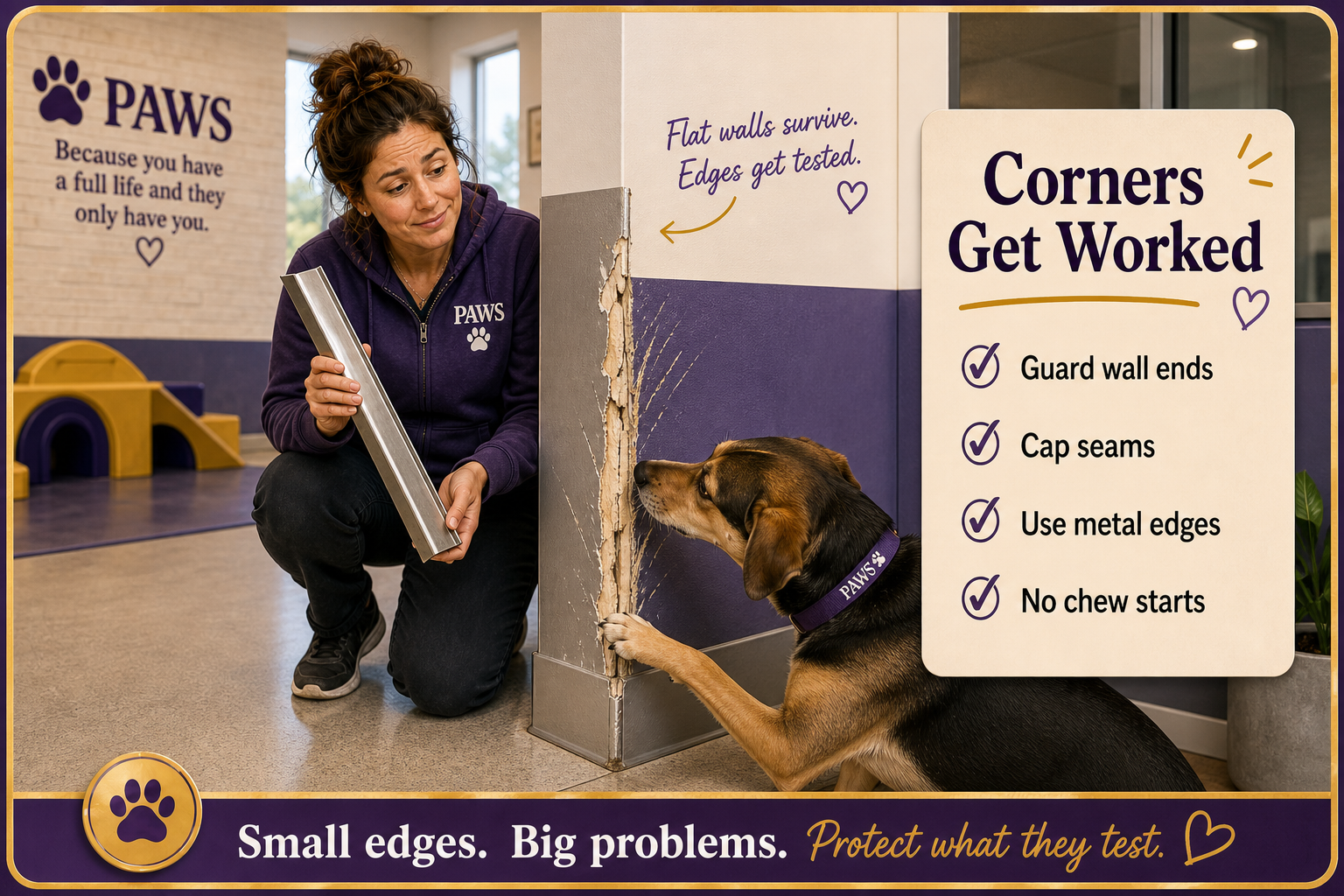
Corners and wall ends are high-contact areas. Dogs turn around them, crowd into them, jump near them, rub against them, and sometimes chew them. Staff bump them with mop handles, crates, carts, gates, leashes, trash cans, laundry bins, and cleaning equipment.
A weak corner may start as a little paint damage. Then the corner bead gets exposed. Then the drywall breaks. Then the repair patch looks ugly. Then the dog-use room starts looking rough even if the rest of the facility is clean.
Corner guards, edge guards, wall protection, sealed seams, and durable lower-wall materials can make a huge difference, especially near doorways, gates, kennel fronts, outdoor transitions, grooming rooms, and high-traffic playroom entries.
The main rule is simple: do not leave weird little edges for dogs to discover. No loose lips. No unfinished wall ends. No exposed seam that catches hair and urine. No sharp corner that becomes dangerous after the first chunk breaks off.
🚧
Kennel Fronts, Gates, and Crate Edges Are Pressure Points
Containment edges get tested because dogs focus pressure there.
Gates, kennel fronts, crate doors, and containment edges are different from decorative trim. Dogs do not just notice them. Dogs interact with them constantly. They paw them, nose them, bite them, lean into them, jump at them, bark at them, and push against them when excited or frustrated.
The latch side, hinge side, bottom edge, panel seam, and wall connection are the places to inspect. A gate can look strong from the front while the bottom edge gives a dog a perfect place to paw. A kennel panel can look clean until the joint at the wall starts collecting hair, urine, and cleaning residue.
Any containment edge that becomes loose, sharp, bent, chewable, or dirty creates more than a cosmetic problem. It can become a safety issue, escape issue, injury issue, cleaning issue, or daily staff frustration point.
This is why door, trim, threshold, and chew-point planning connects directly to the gate and kennel planning pages. The building does not care that you separated the topics into different pages. Dogs test the whole system at once.
🧼
Damaged Edges Become Dirty Edges
A chewed edge is not just a cosmetic problem. It is a cleaning problem with teeth marks.
Once an edge is damaged, it usually becomes harder to clean. A smooth sealed surface can be wiped, mopped, disinfected, and dried. A chewed, splintered, lifted, cracked, swollen, or peeling edge can hold hair, urine, dirt, moisture, and cleaning residue.
That is where odor problems start hiding. The room may look clean from the doorway, but the damaged edge near the threshold, baseboard, door casing, or kennel front may still be holding the evidence.
Damaged edges can also create sharp points, loose fragments, splinters, exposed fasteners, cracked caulk, peeling sealant, and chewable repair patches. If a dog can keep working the spot, the repair may fail faster than the original material.
Sanitation should be part of every finish-work decision. If the edge cannot survive cleaning, it does not belong in a wet dog-use area. If the repair cannot be cleaned, it is not really fixed.
⚠️
Sanitation warning
Small damaged edges can become odor storage. Do not let “minor trim damage” quietly become a urine seam, hair catch, or mystery smell.
👀
Customer-Facing Edge Damage Makes the Facility Look Neglected
A clean building can still look rough if the edges are beat up.
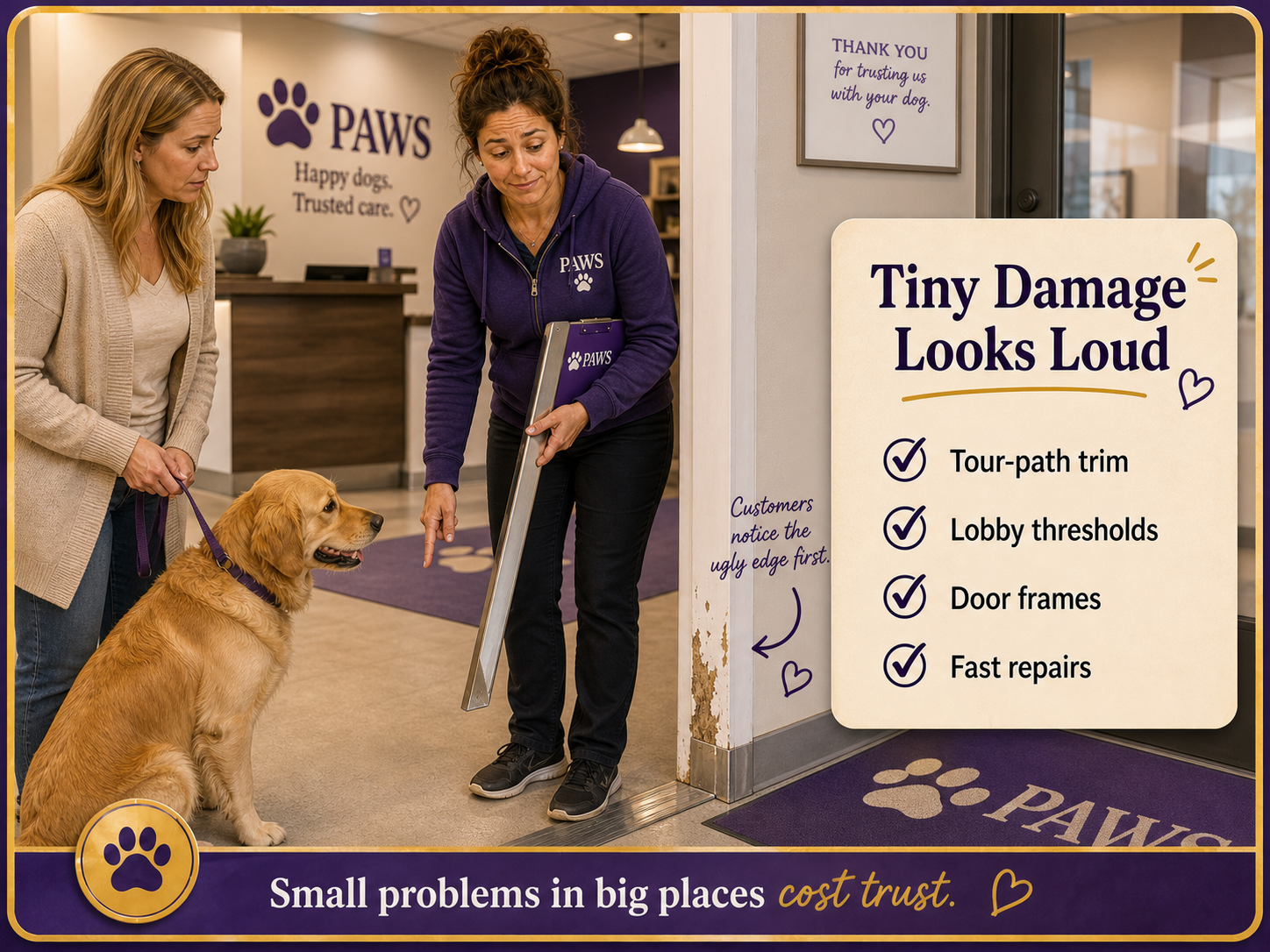
Customers may understand that dogs are dogs. They may forgive noise, hair, a wet paw print, or a little chaos during pickup. But chewed lobby trim, scratched door frames, peeling thresholds, rough repair patches, bent metal plates, and broken corner guards tell a different story.
That kind of damage makes a facility feel neglected even when staff are working hard. It can make customers wonder what else is being missed. It can make tours less impressive. It can make the business look older, dirtier, and less controlled than it really is.
This is why customer-facing edges deserve extra attention. Lobby-to-dog-area doors, tour paths, pickup areas, front desk transitions, hallway corners, and viewing areas should not look like the dogs have been slowly eating the building.
💬
Tour reality
Customers may not know what commercial trim costs, but they absolutely notice when the doorway into the dog area looks like a chew toy with hinges.
📋
Pre-Opening Edge Punch List
Walk the building before the dogs arrive, while the contractor can still fix things without working around barking, cleaning, customers, and revenue.
The best time to fix doors, trim, thresholds, and exposed edges is before opening. Once dogs are in the building, every repair has to happen around operations. That means rooms out of service, staff workarounds, ugly temporary fixes, and the constant temptation to say, “We will deal with it later.”
Do a punch-list walk at dog height. Do not just admire the finished room from the doorway. Look at the lower twelve to twenty-four inches of the building. That is where urine hits, claws scratch, teeth reach, mop water runs, and weak finish details start telling the truth.
- Walk every dog-use room at dog height and look for exposed lips, soft trim, loose edges, and chewable corners.
- Pull gently on transition strips and thresholds to see whether they are already loose.
- Check every door bottom for dog-side protection, swelling risk, scratch risk, and cleaning-water exposure.
- Check every door frame for soft casing, exposed gaps, proud screws, loose stops, and chewable edges.
- Check wall bases and corners where urine, mop water, dog traffic, and staff equipment will hit daily.
- Check grooming, bathing, utility, and outdoor-entry areas for wet-edge failure points.
- Photograph questionable edges before opening so repairs, warranty issues, landlord issues, or contractor punch-list items are documented.
- Fix the weak detail before dogs learn it exists.
⚠️
Punch-list warning
Once a dog learns one loose strip, soft corner, or chewable frame, you are not just repairing material. You are trying to erase a habit.
🧾
Questions to Ask Before Finish Work Is Approved
Ask these before the doors, trim, thresholds, gates, and floor transitions are locked into the build-out.
- Which doors will dogs directly touch, scratch, paw, crowd, or chew?
- Which door bottoms need kick plates, push plates, metal protection, or a more durable door surface?
- Which thresholds will get wet from mop water, dog feet, urine, bathing, outdoor traffic, or cleaning?
- Which transition strips can a dog get a tooth, paw, or nail under?
- Which baseboards or wall bases are exposed to urine, water, disinfectant, and repeated mopping?
- Which corners need guards before staff and dogs damage them?
- Are all fasteners flush, secure, corrosion-appropriate, and safe for dog-contact areas?
- Are wall-to-floor seams sealed where urine and wash water may reach them?
- Can damaged trim, guards, plates, or thresholds be replaced without tearing apart the room?
- Will added plates, guards, or thresholds affect door swing, clearance, fire rating, egress, ADA access, or inspection requirements?
- Has the landlord approved door, trim, threshold, wall protection, and finish-work changes in writing?
- What should staff inspect weekly so small chew points do not become permanent building damage?
✅
Doors, Trim, Thresholds, and Chew Points Inspection Checklist
A small chew point today is tomorrow's staff meeting.
- Check door bottoms for scratches, chewing, swelling, urine damage, or loose plates.
- Check door frames and casing for chew starts, claw marks, loose trim, cracked caulk, and exposed edges.
- Check thresholds for lifting, water intrusion, urine odor, sharp edges, loose screws, and trip hazards.
- Check transition strips for peeling, raised lips, gaps, loose adhesive, and chewable corners.
- Check baseboards and wall bases for swelling, odor, cracking, gaps, and cleaning damage.
- Check wall corners for chips, exposed material, broken guards, and sharp repair spots.
- Check gate edges, latch-side edges, hinges, and bottoms for bending, looseness, sharp edges, and dog pressure points.
- Check kennel fronts and crate edges for chewing, pawing wear, exposed fasteners, and dirty seams.
- Check grooming and bathing room edges for damp trim, peeling sealant, hair buildup, and water intrusion.
- Repair small chew points before other dogs learn the spot exists.
❓
Dog Daycare Doors, Trim, Thresholds, and Chew Points FAQ
Quick answers for owners trying to harden the building before dogs find the weak spots.
Should I use wood trim in dog daycare areas?
Be careful. Wood trim may be fine in customer-only or staff-only areas, but lower trim in dog-use areas can become a chew point, urine edge, water trap, odor seam, or cleaning problem. If wood is used, location, sealing, protection, and replaceability matter.
Are metal kick plates worth it?
Often, yes, on the dog side of high-contact doors. Kick plates and push plates can help protect door surfaces from claws, paws, staff traffic, and cleaning abuse. But added plates should not interfere with door clearance, fire rating, egress, ADA requirements, or inspection issues.
Are hollow-core doors okay?
They make me nervous in dog-use areas. A hollow-core door may be fine for low-contact office use, but dog areas need doors chosen around impact, scratching, moisture, cleaning, and edge damage. Ask the contractor what belongs in each location.
Why do thresholds become odor problems?
Thresholds and transition strips can let urine, mop water, and cleaning solution get underneath or around the seam. Once moisture and organic material get trapped under an edge, the smell may stay even after the visible floor is cleaned.
Should every corner have a guard?
Not every corner needs the same protection, but high-traffic corners, dog-use corners, gate corners, hallway corners, grooming corners, and kennel-area corners deserve serious attention. The corners dogs and staff hit every day should not be treated like quiet office corners.
Can I just repair chew damage later?
You can, but that usually costs more and looks worse than preventing the chew point during build-out. Once dogs learn a spot, the repair may become the new chew target unless the edge is actually hardened.
What is the biggest mistake with dog daycare doors and trim?
Using normal decorative finish choices in dog-contact areas. A dog daycare needs finish details chosen around teeth, claws, urine, water, cleaning chemicals, staff traffic, safety, sanitation, and customer perception.
What should I ask my contractor?
Ask which doors, frames, thresholds, corners, wall bases, and transitions dogs will touch or cleaning water will reach. Then ask how each edge will be protected, cleaned, repaired, and inspected without creating code or lease problems.
🐾
The Bottom Line: Protect the Edges Before the Dogs Find Them
Dogs do not need to destroy the whole building to make it look rough, smell bad, or cost money.
Doors, trim, thresholds, corners, transition strips, kennel fronts, gate edges, and exposed seams are small details during construction. After opening, they become daily contact points.
If those details are soft, loose, exposed, chewable, poorly sealed, hard to clean, or easy for dogs to work, they can become repair bills, odor traps, safety hazards, sanitation problems, and customer-confidence issues.
Build the edges like the dogs are going to inspect them. Because they will.