Dog Daycare CPR • Pet First Aid • Airway • Breathing • Pulse Check • Emergency Vet Transport • Staff Training
How to Perform Dog CPR in a Dog Daycare Emergency
If you take money to care for other people’s dogs, “I didn’t know what to do” is not good enough.
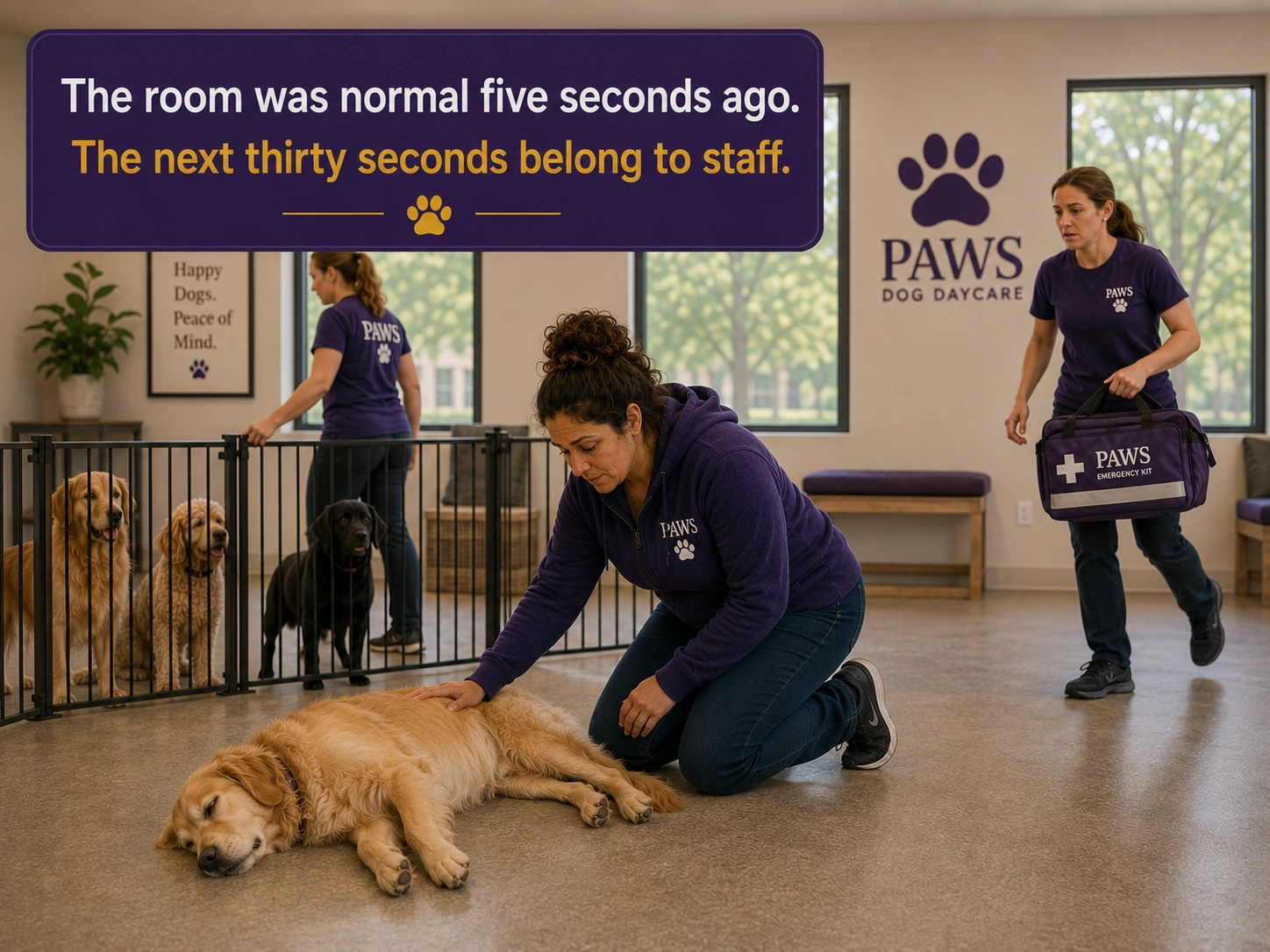
Dog CPR is one of those things every daycare operator hopes they never need and absolutely needs to understand anyway. A dog can collapse in a room that was normal five seconds earlier. A dog can stop breathing. A dog can choke. A dog can seize, go limp, lose color, or hit the floor while everyone else in the building is still trying to understand what just happened.
That is not the moment to start searching your feelings. That is the moment to check response, check breathing, check pulse, clear the airway if needed, start rescue breathing or chest compressions when appropriate, call the emergency vet, move the dog, control the rest of the room, and document what happened.
CPR is not magic. CPR does not guarantee the dog comes back. Sometimes you can do everything right, give CPR all the way to the vet, carry the dog in with a heartbeat, watch the clinic work on the dog with emergency drugs and equipment, and the dog still dies. That is ugly, but it is real.
The point of CPR is not to promise a happy ending. The point is to keep oxygen and blood moving long enough to give the dog whatever chance exists. If there is a chance to be had, staff should not waste it by freezing, arguing, crying in the corner, or waiting for someone else to become useful.
🚑
Emergency order of operations
Check response, breathing, and pulse. Clear a blocked airway if you can see or clearly reach the obstruction. Use rescue breathing when the dog has a pulse but is not breathing. Use chest compressions when the dog is not breathing and has no heartbeat or pulse. Call the emergency vet and move toward professional care while CPR continues.
⚠️
This page does not replace hands-on pet first aid and CPR training.
Dog daycare staff should be trained before the emergency happens. Reading a page during a collapse is not an emergency plan. This page gives the operator framework, the room procedure, and the practical order of operations. Staff still need real training, posted procedures, drills, and a veterinary emergency plan.
🗺️
Use This Page Like an Emergency Response Map
Dog CPR is not just chest compressions. It is airway, breathing, pulse, staff roles, vet transport, owner communication, and facility control under pressure.
🫁
Airway and Breathing
Check the mouth, clear what you can, and breathe for the dog if needed.
🎥
Angel Demonstration
Watch the demonstration with Angel, the trained Australian Shepherd.
🚨
When Dog CPR Is Needed
CPR is for a dog that is unresponsive, not breathing normally, and has no heartbeat or pulse.
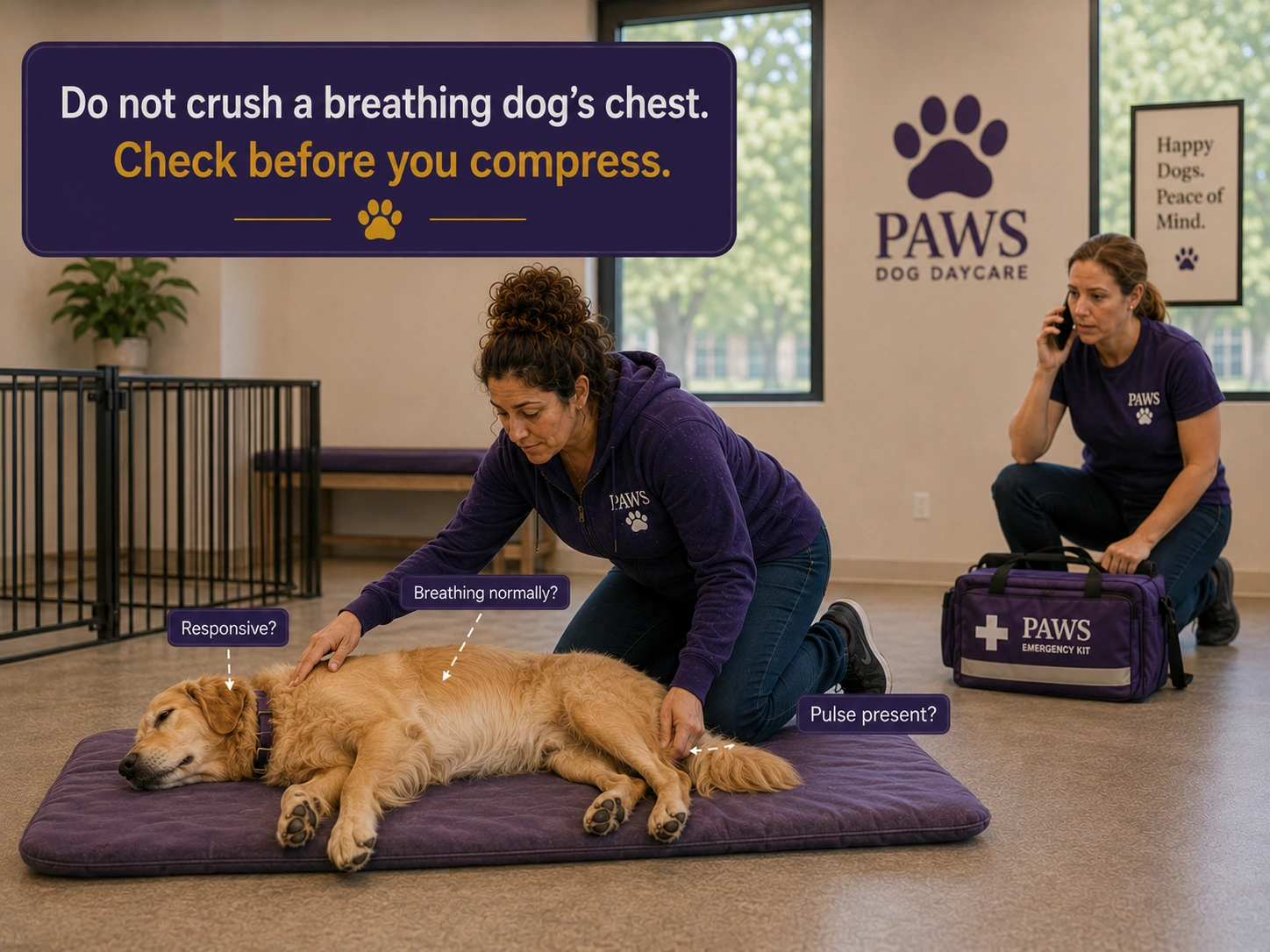
Do not perform chest compressions on a dog that is awake, responsive, breathing normally, or has a pulse. CPR is not a general “dog looks bad” button. If the dog is breathing normally, keep the dog calm, limit movement, call the vet, and transport.
The word “normally” matters. Agonal gasping, occasional reflexive gasps, weird fish-mouth breathing, or a dog opening and closing the mouth like the body is trying to remember how air works do not count as normal breathing.
CPR becomes the issue when the dog is unresponsive and you cannot confirm normal breathing or a pulse. That is when staff need to move fast. Check the dog. Open the airway. Look for obstruction. Check breathing. Check pulse. If the dog is not breathing but has a pulse, give rescue breaths and get to the vet. If the dog is not breathing and has no pulse, start CPR.
Also understand this: a scared, injured, choking, seizing, or half-conscious dog can bite. Even a sweet dog can bite when panic and oxygen loss are in the room. Protect your face and hands as much as possible, but do not become so afraid of the dog’s mouth that you stand there watching the dog die with clean fingers.
Assessment should be fast, deliberate, and tied to action. Staff are not trying to produce a perfect diagnosis on the daycare floor. They are deciding whether the dog needs monitoring and transport, rescue breathing, or full CPR while professional care is being contacted.
If two trained staff members are present, one can assess response and breathing while the other checks the femoral pulse and starts the emergency call. Dividing the work reduces delay, but the team still needs one person directing the sequence so uncertainty does not become several conflicting plans.
⏱️
The First 30 Seconds Matter
The dog does not care that staff are shocked. The dog needs action.
In a daycare setting, the emergency is bigger than one dog on the floor. You still have other dogs in the room. You still have gates. You still have staff movement. You still have customers, phones, noise, and panic trying to crawl into the procedure.
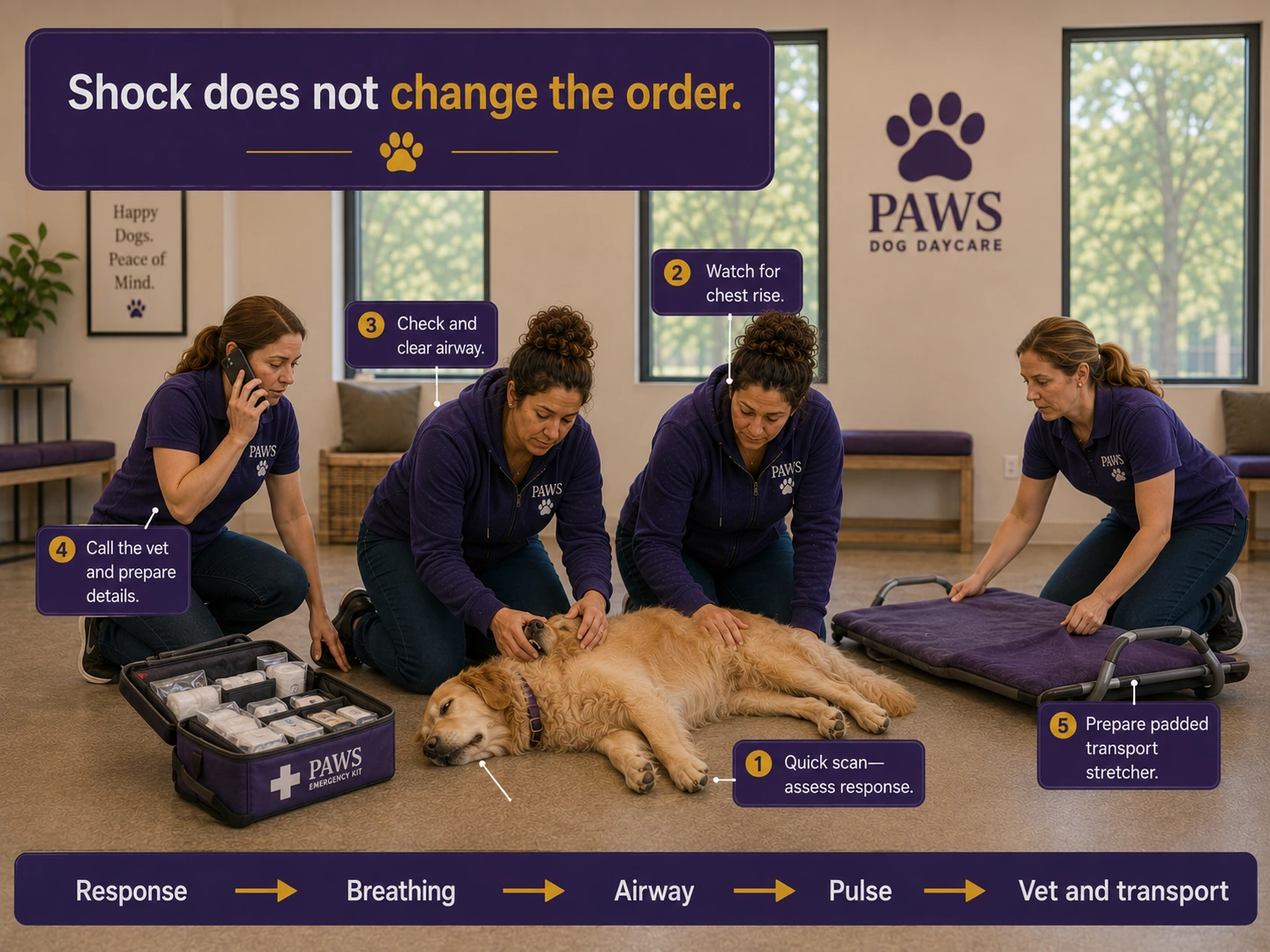
One trained staff member should take the dog. Another should secure the group. Another should call the emergency vet. Another should prepare transport. If you have only one staff member, the facility already has a staffing and emergency readiness problem, because CPR does not politely wait until coverage improves.
The first 30 seconds should answer five questions: Is the dog responsive? Is the dog breathing? Is the airway blocked? Is there a pulse? Who is calling the vet and moving the dog toward professional care?
Scene control is part of the medical response. The remaining dogs should be moved behind a secure barrier, gates should be checked, and unnecessary staff should be cleared away so the CPR team has room to work without creating an escape, redirected fight, or second injured dog.
The caller should give the clinic usable facts: the dog is unresponsive, whether normal breathing or a pulse is present, what staff have started, and that transport is being prepared. The call should support action, not stop everyone from acting while one person waits on hold.
- Tap the dog, call the dog’s name, and check for response.
- Look for chest movement.
- Listen and feel for air at the nose.
- Open the mouth and check for an obstruction.
- Check the femoral pulse high inside the rear leg where the leg meets the body.
- Call the emergency vet and tell them you are coming.
🔎
Check Airway, Breathing, and Pulse
Use the simple order: airway, breathing, circulation.
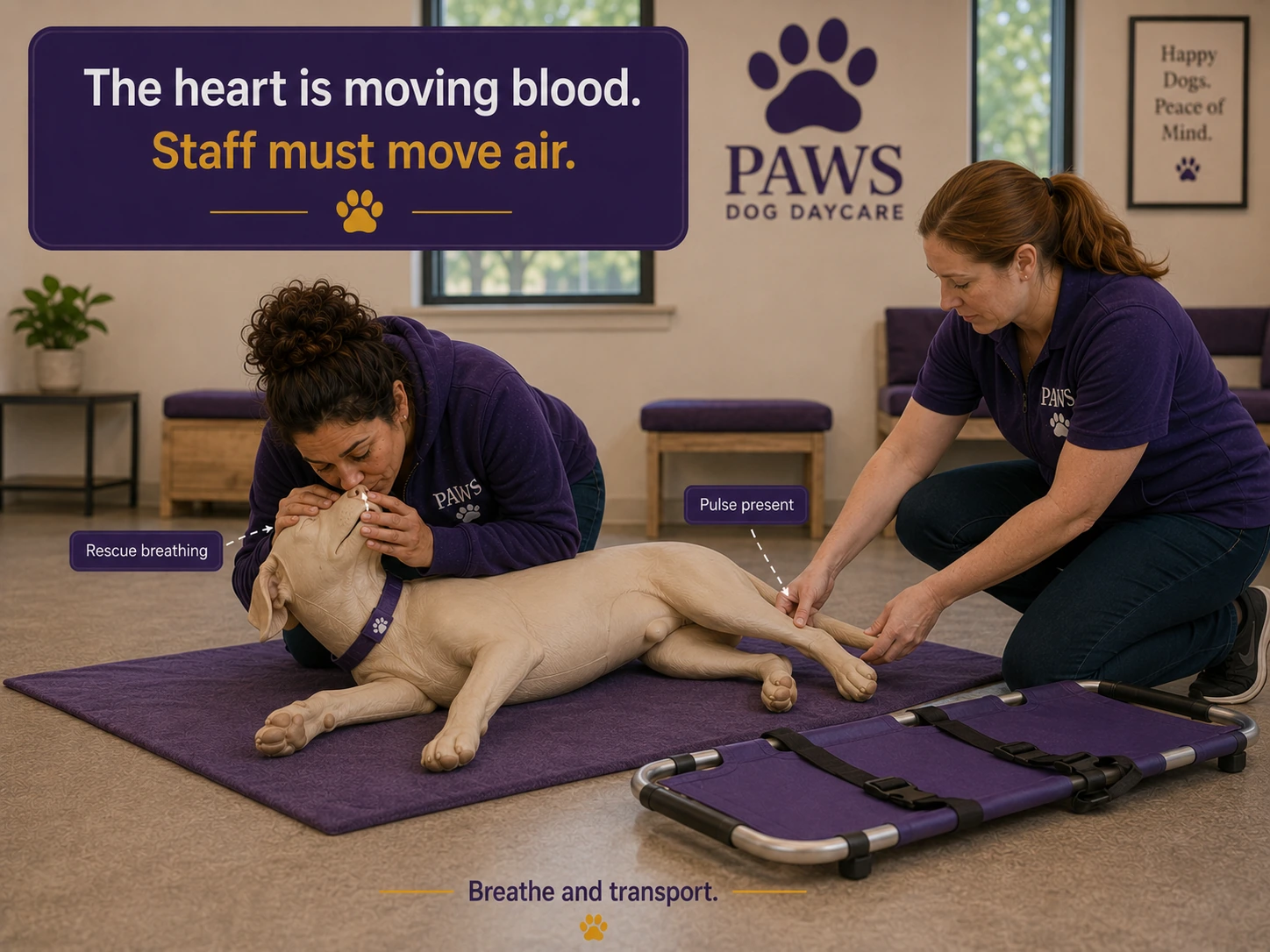
Airway means the path for air has to be open. Breathing means the dog is actually moving air. Circulation means the heart is moving blood. If one of those fails, the dog is in serious trouble.
Start by checking whether the dog responds. Tap the dog. Call the dog’s name. If the dog responds and is breathing, do not start CPR. Keep the dog calm and get veterinary help.
If the dog does not respond, check breathing. Look for chest rise and fall. Listen near the nose. Feel for air with your cheek, wrist, or the back of your hand. Do not spend forever trying to make uncertainty comfortable. If the dog is not breathing normally, move to airway and pulse immediately.
Check the femoral pulse high inside the rear leg, where the back leg meets the body. You can also look for heartbeat, but in a noisy daycare room the femoral pulse is often more practical. If there is a pulse but no breathing, give rescue breaths and transport. If there is no pulse and no breathing, begin CPR.
A pulse without breathing changes the immediate task. The heart is still moving blood, so staff should focus on opening the airway, providing rescue breaths, and moving the dog toward veterinary care. Chest compressions are added only if the pulse is lost.
Reassessment should continue because the dog can deteriorate quickly. The person giving breaths should watch for chest rise while another trained employee rechecks circulation and keeps transport moving. The team should not treat one early pulse check as a guarantee that the condition will remain stable.
🫁
Clear the Airway and Give Rescue Breaths
If air cannot move, nothing else is going to work very well.
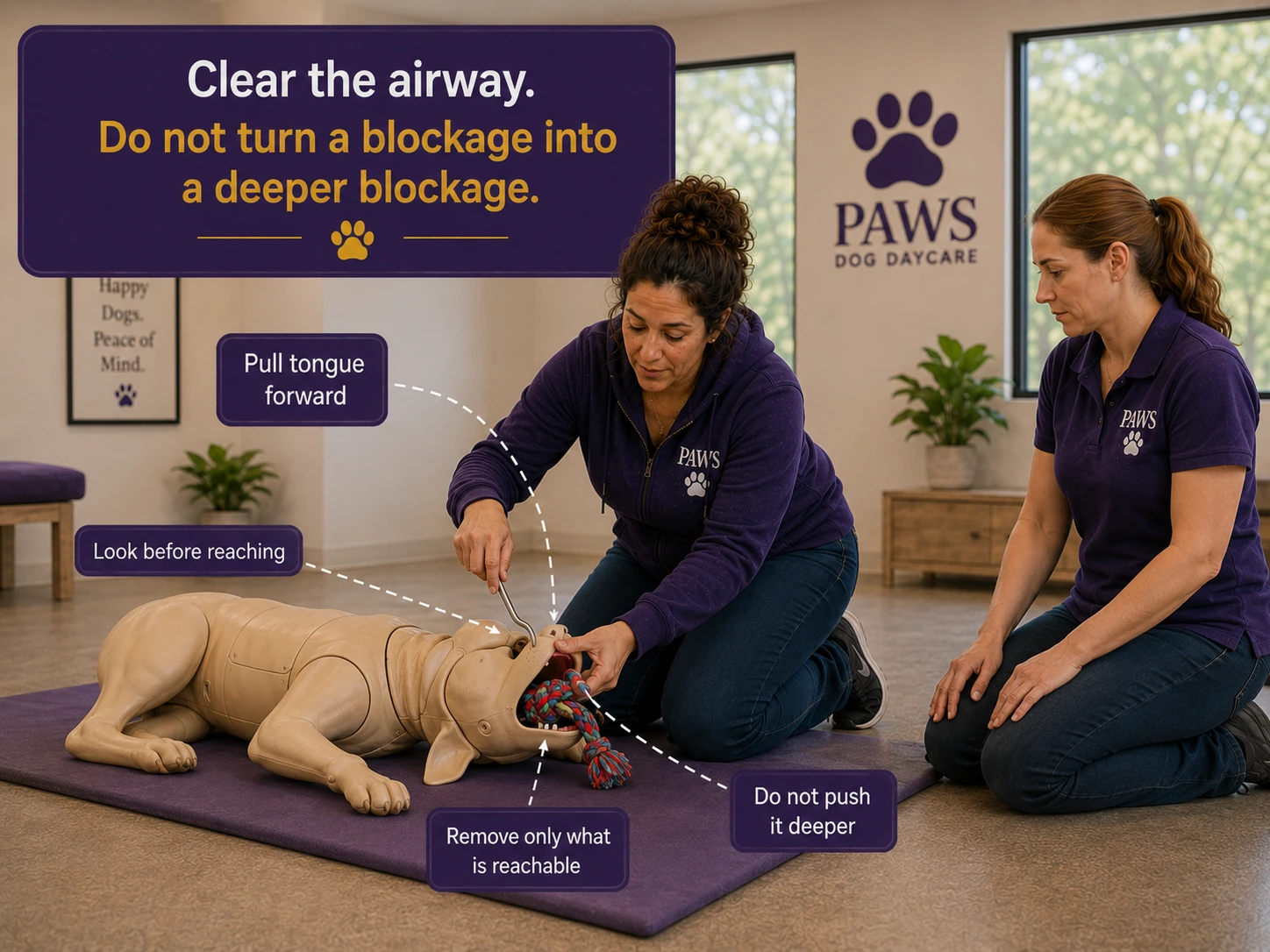
Open the dog’s mouth. Pull the tongue forward. Look deep into the mouth and throat. Dogs get things stuck back there. Balls, food, treats, toy pieces, fabric, chews, weird garbage they had no business eating in the first place. If you can see it or clearly feel it, remove it.
A deep finger sweep can be appropriate when there may be something lodged deep and reachable. Frame that correctly. Do not blindly ram your fingers around like you are trying to push the object into the next county. Open the mouth, look deep, feel carefully, hook what you can reach, and pull it out if it is actually there.
If the object does not come out and the dog cannot move air, this becomes a choking emergency. Use the choking procedure staff have been trained to use, including abdominal thrusts when appropriate, while someone is calling the emergency vet and preparing transport. Do not spend the whole emergency digging in the mouth while the dog is not getting air.
Yes, you can get bitten. That is real. But the answer is not “never touch the mouth.” The answer is use your head. If the dog is conscious enough to bite, reassess what you are doing. If the dog is unresponsive and not breathing because something is stuck, standing there protecting your manicure is not a treatment plan.
Once the airway is clear, close the dog’s mouth, extend the neck so the airway is straight, place your mouth over the dog’s nose, and breathe until you see the chest rise. Give enough air to move the chest. Do not inflate the dog like a tire. Let the chest fall before the next breath.
If the chest does not rise, stop and reposition the head and neck. Check the mouth again. Something may still be blocking the airway, or the airway position may be wrong.
❤️
Chest Compressions for Dog CPR
If the dog is not breathing and has no heartbeat or pulse, start compressions.
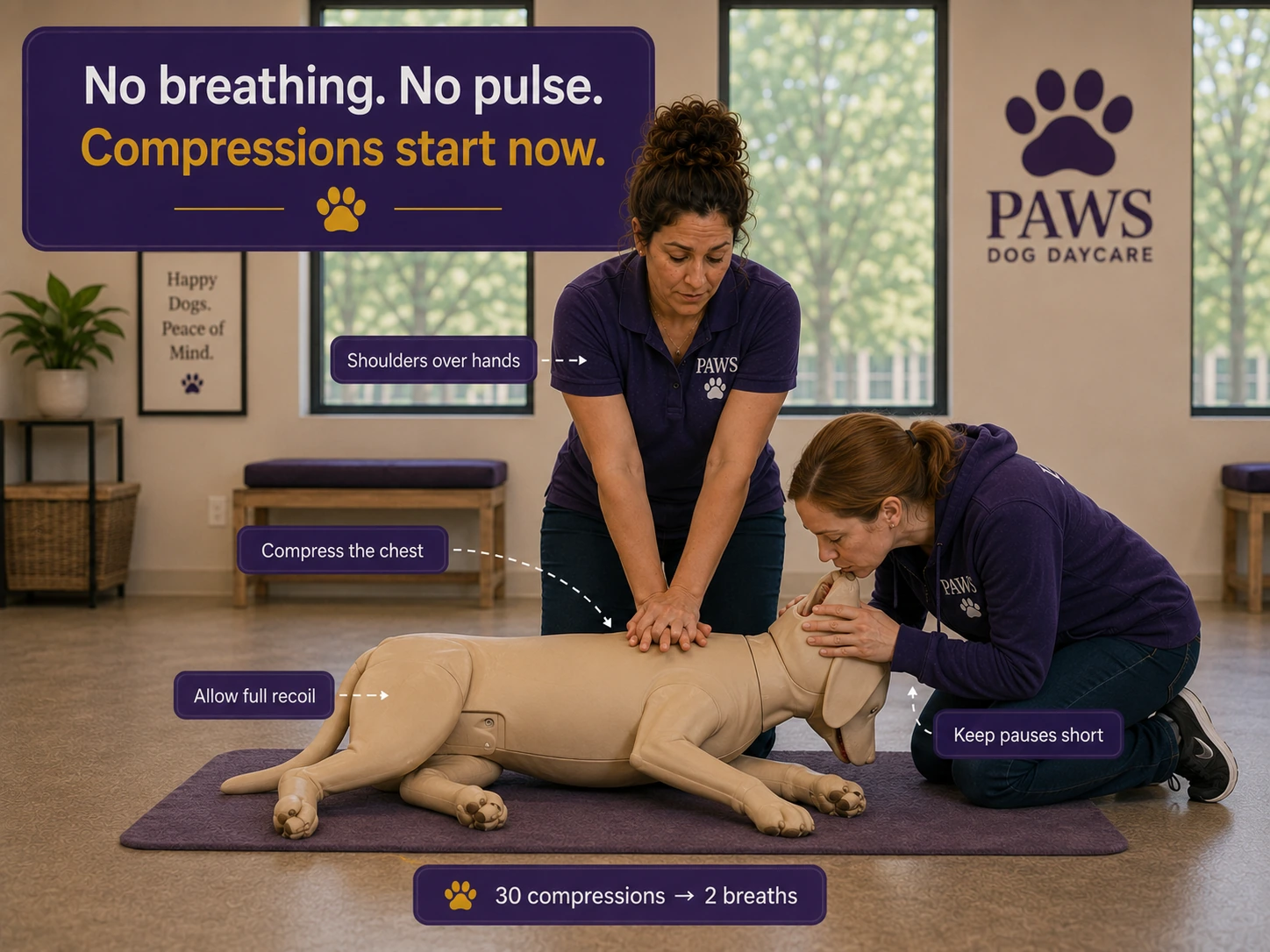
Lay the dog on its side unless the dog’s body shape or training guidance calls for another position. Put your hands where compressions will move the chest effectively. Compress hard and fast enough to move blood, then let the chest fully recoil between compressions.
The practical target is 100 to 120 compressions per minute. Compress about one-third to one-half of the chest width. Give 30 compressions, then 2 rescue breaths. Keep the pauses short. This is not the time for a committee meeting around the dog’s rib cage.
Recheck breathing and pulse about every two minutes, and switch compressors if another trained person is available. CPR is physically harder than people think. Compressions get weak when staff get tired, and weak compressions are theater, not circulation.
Continue CPR while moving toward veterinary care. If the dog starts breathing, has a pulse, or becomes responsive, stop compressions and transport immediately. A dog that comes back still needs a vet. “He looks better now” is not a medical clearance.
Good compressions require position, depth, recoil, and endurance. Staff should keep shoulders over the hands, use body weight where appropriate, and avoid leaning on the chest between compressions. Full recoil gives the chest room to refill before the next compression.
The compressor should announce fatigue before technique collapses. A planned switch is better than quietly delivering smaller and slower compressions while everyone assumes CPR is still effective. The handoff should be quick so the pause remains as short as possible.
📏
Dog Size and Chest Shape Matter
The compression goal is the same. The hand position may change.
The compression objective does not change: move enough blood to support the brain and vital organs while allowing the chest to recoil. The body shape changes how staff position the dog and where trained hands apply force.
This is one of the strongest reasons for hands-on training. Staff should practice on canine CPR manikins that represent different sizes and chest shapes instead of trying to remember a chart for the first time during a collapse.
When the dog does not fit the staff member’s memorized example, the team should use its training, maintain effective compressions, and keep moving toward veterinary care rather than freezing over perfect anatomical classification.
Swipe left/right to see the full table.
| Dog Type | Staff Position | Operator Note |
|---|---|---|
| Small dogs | Use one hand or both hands depending on size and chest depth. | Small does not mean fragile glass statue, but do not crush blindly. |
| Medium dogs | Use both hands over the appropriate compression point on the chest. | Compress deep enough to move the chest and allow full recoil. |
| Large dogs | Use locked arms and body weight, not just tired wrists. | If staff are doing tiny polite compressions, blood is not moving. |
| Deep-chested dogs | Compression placement may be closer over the heart. | Think Greyhound-type chest: narrow and deep. |
| Round-chested dogs | Compression placement is commonly over the widest part of the chest. | Think many average-bodied dogs. |
| Barrel-chested dogs | Some training guidance uses back positioning with compressions over the sternum. | Think Bulldog-type chest. Staff need hands-on training for this, not guesses. |
🎥
Dog CPR Demonstration With Angel
Angel was a trained Australian Shepherd demonstration dog. Nothing was wrong with her. She was perfectly fine.
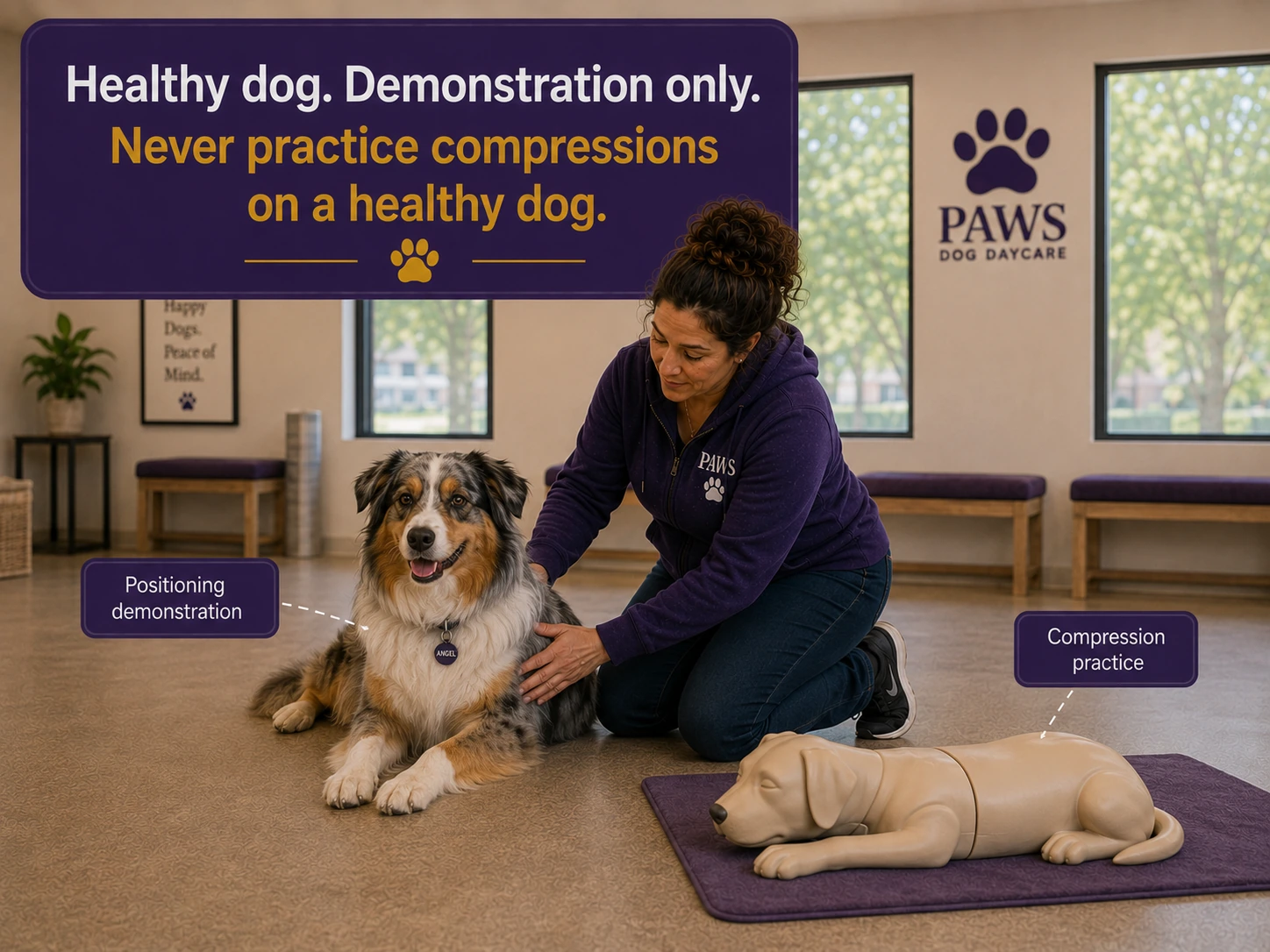
A healthy demonstration dog can help staff understand safe positioning, how to approach the body, and where the handler would stand. It should never be used for actual compression practice because pressing a normal chest can injure the dog.
The useful practice happens with a CPR manikin and a trained instructor. Staff need to feel appropriate hand placement, compression depth, recoil, rhythm, switching positions, airway alignment, and team communication without turning a live dog into equipment.
Video is a teaching aid, not competency proof. The operator should use the demonstration to reinforce formal training and drills rather than treating passive viewing as certification.
🐾
About the demonstration dog
This video shows CPR positioning and handling using Angel, my trained Australian Shepherd. She was not in distress. She was not injured. She was my happy little demonstration dog, and the video is for showing the mechanics without practicing CPR on a dog that actually needs help.
Do not practice chest compressions on a healthy dog. Use mannequins, training classes, veterinary instruction, and proper pet CPR courses for real practice.
⚠️
Training warning
Angel was trained, healthy, and safe during the video. Real CPR is for a dog that is unresponsive, not breathing normally, and has no heartbeat or pulse. Do not turn a healthy dog into a practice dummy.
👥
Staff Roles During Dog CPR
One emergency is enough. Do not let the whole facility become the second emergency.
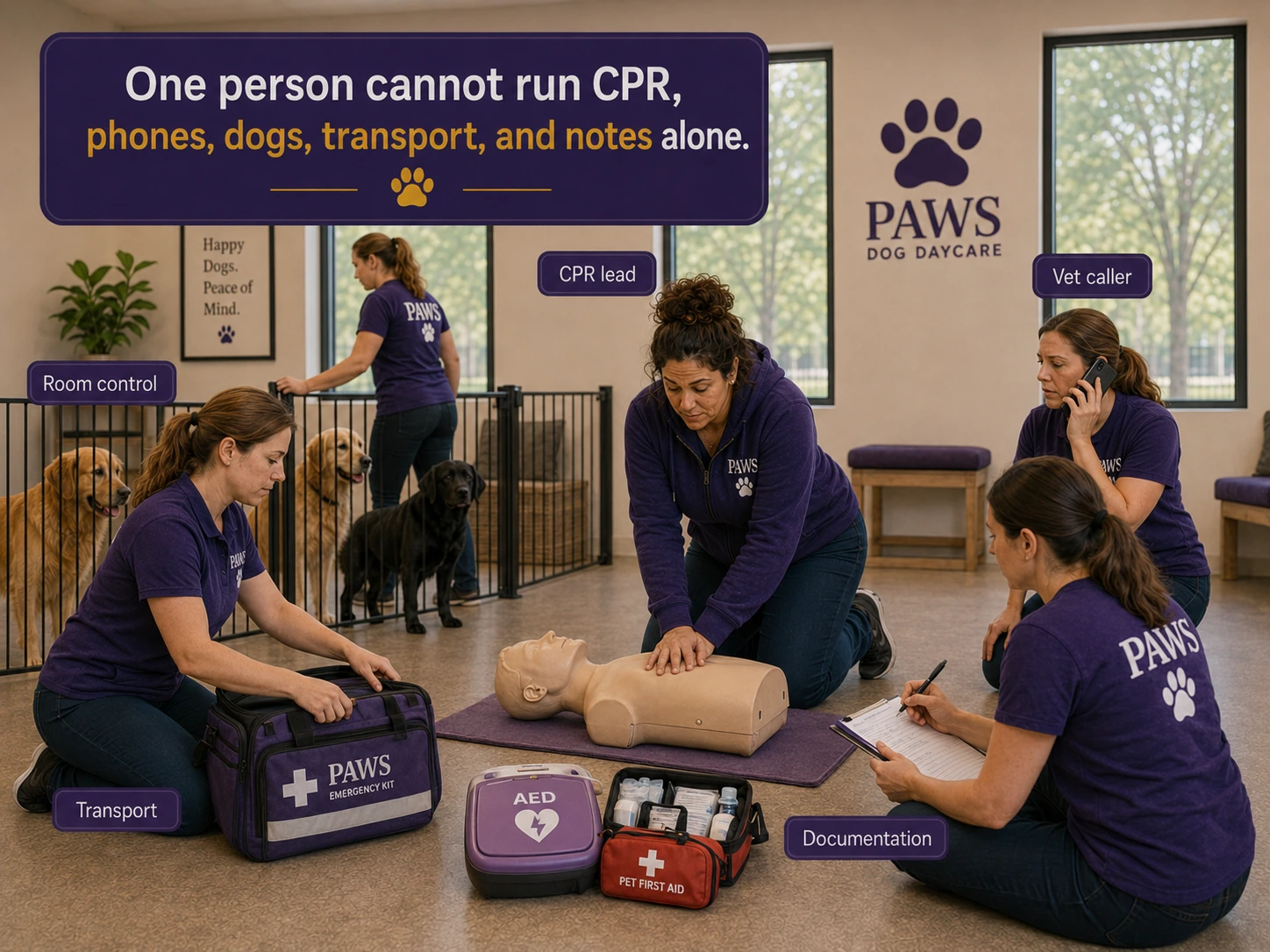
CPR becomes a facility-wide emergency even though one dog is the patient. Medical response, room control, veterinary contact, transport, owner communication, and documentation all have to move at the same time.
The lead should assign roles clearly and avoid duplicate work. Two employees making the same phone call while nobody opens the transport route is not teamwork. Each employee should know the next task and report back when it is complete.
Small teams still need role order. One person may perform more than one job, but the sequence should be predetermined: stabilize and call first, secure the remaining dogs, prepare transport, contact the owner once care is moving, and preserve the timeline.
Swipe left/right to see the full table.
| Role | Job | Why It Matters |
|---|---|---|
| CPR lead | Checks airway, breathing, pulse, and starts rescue breathing or compressions. | The dog needs one trained person making clear medical-response decisions. |
| Vet caller | Calls the emergency vet, explains the situation, and says the dog is coming. | The clinic should not first learn about the emergency when staff crash through the door. |
| Transport person | Gets vehicle ready, clears path, brings keys, towels, leash, records, and carrier if needed. | CPR is a bridge to veterinary care, not a parking-lot hobby. |
| Room control | Secures the other dogs, closes gates, controls noise, and keeps staff from clustering. | The rest of the dogs do not vanish because one dog is in crisis. |
| Owner contact | Calls the owner after immediate care and transport are underway. | The owner needs facts, but the dying dog needs action first. |
| Documentation | Records times, signs, staff actions, calls, transport, vet handoff, and witness details. | Memory turns into soup after emergencies. Write the facts while they still exist. |
🧾
CPR May Not Work
Sometimes the staff does the work, the vet does the work, and the dog still dies.
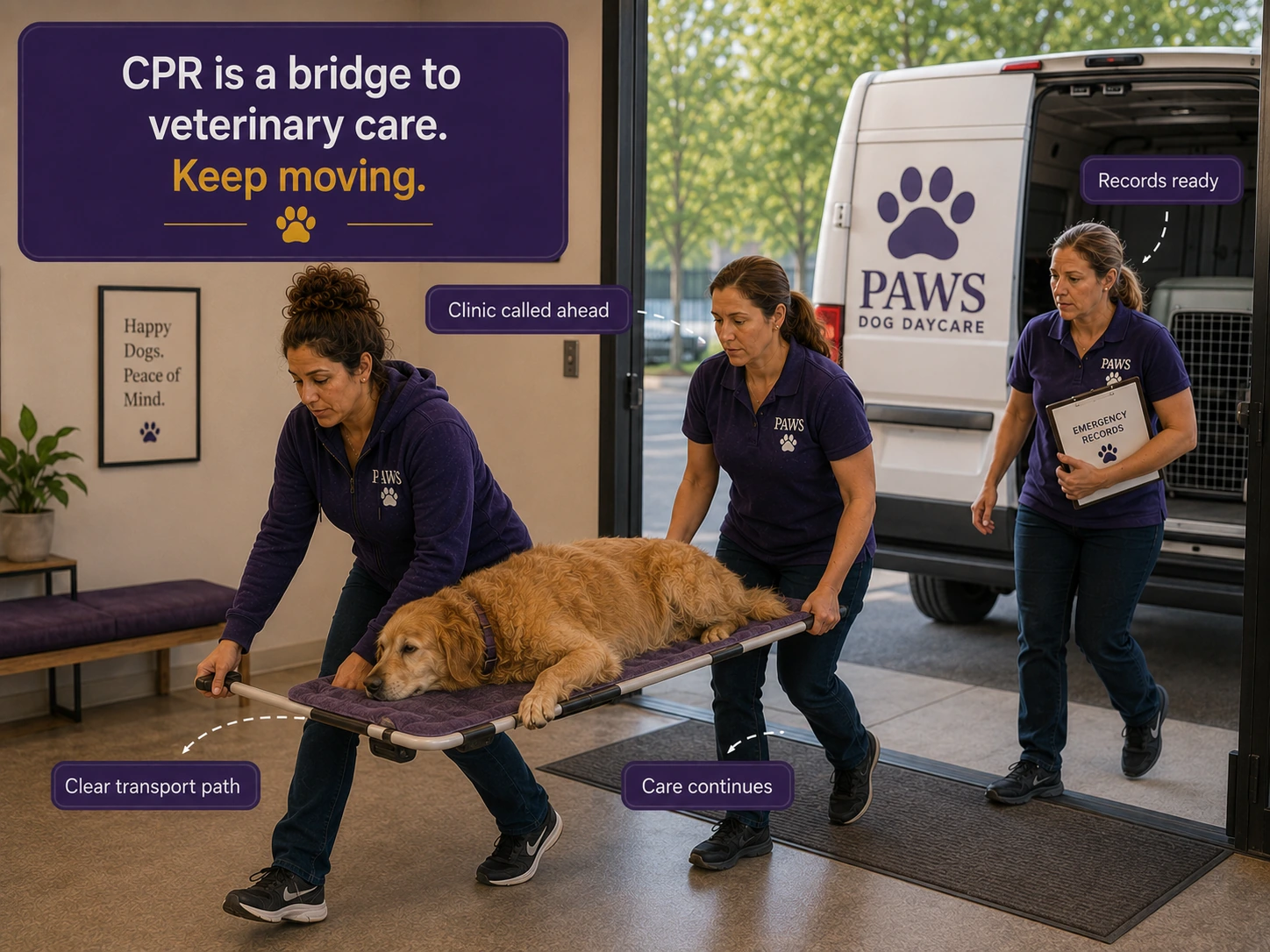
This is the part nobody wants to put in the pretty emergency binder. CPR can fail. A dog can have something catastrophic happen inside the body that daycare staff cannot see, cannot diagnose, and cannot reverse with their hands.
You can clear the airway. You can check the pulse. You can breathe for the dog. You can do compressions. You can call ahead. You can get to the vet fast. The vet can give emergency drugs, oxygen, and advanced care. The dog can still die.
That does not mean the response did not matter. It means CPR is not a resurrection spell. It is a chance. Sometimes it buys the dog enough time. Sometimes it gives the veterinarian a better starting point. Sometimes it only proves that staff did not stand there doing nothing while the dog was dying.
Operators need to understand that emotionally before it happens, because if they do not, the first real emergency can break the room, the staff, the owner conversation, and the documentation.
CPR is a bridge, not the destination. The facility should call ahead, prepare the dog for safe movement, send records and authorization information, and continue the trained response while moving toward the emergency clinic whenever staffing and transport conditions allow.
The possibility of failure makes documentation and honest owner communication more important, not less. Staff should record what they found, when each step began, what the clinic advised, and when the dog left the facility without inventing a medical cause or promising an outcome.
📌
Related operator scenario
For a real-world example of a daycare dog collapsing from a medical condition, read the Walker scenario on pre-existing medical emergencies.
🚫
What Not to Do During a Dog CPR Emergency
Bad emergency handling wastes time the dog does not have.
Most dangerous CPR mistakes come from skipping assessment, delaying action, or letting panic replace the established sequence. Staff should not improvise a new procedure because the room feels frightening or because several people are giving conflicting instructions.
The dog should not lose time while employees debate who is in charge, search for a phone number, or wait for the owner to approve the first emergency call. The facility’s written authorization and emergency plan should already explain how staff act when immediate care is required.
The rest of the daycare still matters. Crowding around the patient, leaving gates unsecured, or abandoning the playgroup can create another emergency and make transport harder. Only assigned staff should remain in the response area.
- Do not perform chest compressions on a dog that is breathing normally and has a pulse.
- Do not practice compressions on a healthy dog.
- Do not spend several minutes trying to feel emotionally certain before acting.
- Do not ignore the airway. A blocked airway makes everything else fail.
- Do not blindly shove an obstruction deeper while pretending that counts as a finger sweep.
- Do not blow so hard that the dog’s chest balloons like a pool toy.
- Do not let every employee abandon the rest of the dogs to watch the emergency.
- Do not call the owner before immediate life-saving action and emergency transport are moving.
- Do not promise the owner CPR will save the dog.
- Do not skip documentation because everyone is upset.
🏥
Facility Readiness Before a Dog Collapses
The emergency plan has to exist before the dog is on the floor.
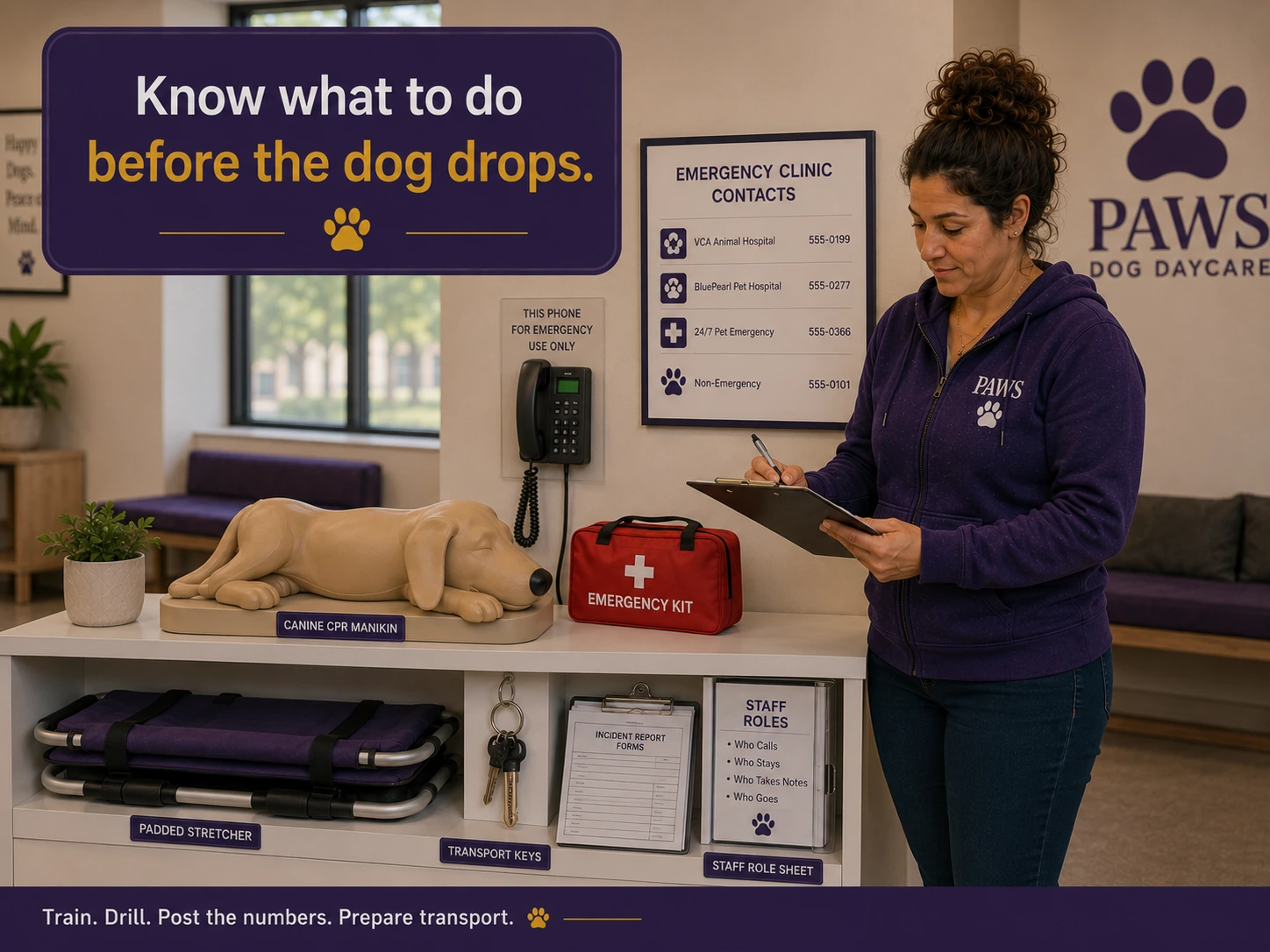
A daycare should know where the emergency vet is, who is allowed to transport, where the records are, which staff are trained, where the first aid supplies are, and how to keep the rest of the facility controlled.
Waiting until the emergency to decide who drives, who calls, where the carrier is, which vet to use, whether the owner authorized emergency care, or who is watching the other dogs is not planning. That is panic with office supplies.
Readiness also means redundancy. Emergency numbers should be posted and stored in facility phones, more than one employee should know the route and transport process, and supplies should not depend on a single manager being present.
The plan should be tested during drills. Staff should practice locating the pulse, assigning roles, moving a training manikin, securing the room, calling the clinic, gathering records, and beginning a timeline. A procedure that exists only on paper has not yet proved it can work.
- Keep emergency vet phone numbers posted and saved in facility phones.
- Know the fastest route to the emergency clinic.
- Keep client emergency contacts and veterinary authorization forms accessible.
- Train staff in pet first aid and CPR.
- Drill staff roles so the first emergency is not the first time anyone hears the plan.
- Keep towels, leashes, slip leads, gloves, first aid supplies, and transport equipment ready.
- Decide who controls the remaining dogs during a medical emergency.
- Prepare incident forms that capture times, signs, staff actions, calls, transport, and vet handoff.
📝
Documentation and Owner Communication
Tell the truth, write the timeline, and do not fill gaps with guesses.
After a CPR event, staff need a factual timeline. When was the dog last seen normal? When was the dog found down? Was the dog responsive? Was the dog breathing? Was there a pulse? Was the airway checked? Was anything removed? When did CPR start? Who called the vet? When did transport leave? When did the dog arrive?
Do not write dramatic nonsense. Do not write blame. Do not write medical conclusions the facility is not qualified to make. Write what staff saw, what staff did, who was contacted, and what happened next.
Owner communication should be direct. If the dog is being transported, say that. If CPR is being performed, say that. If the dog is critical, say that. Do not decorate the situation with fake comfort. The owner needs the truth, not a customer-service fog machine.
The timeline should separate observations from conclusions. “Dog was found on the left side with no visible chest movement” is an observation. “Dog had a heart attack” is a diagnosis the daycare is not qualified to make unless a veterinarian later provides it.
After the immediate emergency, preserve relevant camera footage, witness notes, call records, and copies of the documents sent with the dog. The purpose is not to build a defensive story. It is to preserve an accurate record before stress, grief, and repeated retelling change the details.
📞
Owner script
“Your dog had a medical emergency at daycare. Staff found him unresponsive and not breathing normally. We checked his airway, breathing, and pulse, started emergency care, called the veterinary hospital, and are transporting him now. We will keep you updated, but you need to head to the clinic immediately.”
✅
Dog CPR Emergency Checklist
Use this as the quick operator sequence.
Use this checklist as a trained response sequence, not as a substitute for training. Staff should know the order well enough to begin while another employee retrieves the posted checklist, calls the clinic, and prepares transport.
Each answer changes the next action. Normal breathing and a pulse mean no chest compressions. A pulse without breathing means rescue breathing and immediate transport. No breathing and no pulse mean compressions and breaths begin while the clinic and transport plan move.
After the first cycle, the checklist continues through reassessment, compressor changes, transport, veterinary handoff, owner communication, and documentation. The emergency is not finished merely because the dog leaves the playroom.
- Check scene safety and control the room.
- Check response: tap the dog and call the dog’s name.
- Check breathing: look, listen, and feel. Agonal gasping or weird reflexive mouth breathing does not count as normal breathing.
- Open the mouth, pull the tongue forward, and check the airway.
- Remove visible or clearly reachable obstruction without pushing it deeper.
- If the dog cannot move air and the object does not come out, follow trained choking procedure and prepare transport.
- Check femoral pulse high inside the rear leg.
- If pulse is present but breathing is absent, give rescue breaths and transport.
- If no pulse and no breathing, begin 30 compressions and 2 breaths.
- Compress at 100 to 120 compressions per minute, about one-third to one-half chest width.
- Call the emergency vet and move toward transport while CPR continues.
- Recheck breathing and pulse about every two minutes.
- Document the timeline, staff actions, calls, transport, and vet handoff.
❓
Dog CPR FAQ
Detailed answers about assessment, airway obstruction, rescue breathing, chest compressions, staffing, transport, owner communication, training, documentation, and post-resuscitation care.
Can dog CPR save every dog?
No. CPR is an attempt to keep oxygen and blood moving while the dog is taken toward advanced veterinary care; it is not a guarantee of recovery. The underlying event may be too severe or irreversible even when staff clear the airway, perform compressions and breaths correctly, call ahead, and reach the clinic quickly. The operating standard is to give the dog the best available chance without promising the owner an outcome that nobody can guarantee.
When should staff start chest compressions?
Chest compressions are for a dog that is unresponsive, is not breathing normally, and has no heartbeat or pulse that staff can confirm through their training. Staff should assess response, airway, breathing, and circulation rather than jumping directly to compressions because a dog looks weak or frighteningly still. If normal breathing and a pulse are present, keep the dog calm, limit unnecessary movement, call the veterinarian, and transport instead of compressing the chest.
What if the dog is unresponsive but still breathing?
Do not begin chest compressions solely because the dog is unconscious. Confirm that breathing is normal, keep the airway positioned and clear, monitor the dog closely, call the emergency clinic, and prepare immediate transport. Unresponsiveness is still a critical emergency, and the dog can deteriorate, so staff should continue reassessing breathing and pulse rather than assuming one check settles the situation.
Do gasps count as normal breathing?
No. Occasional agonal gasps, reflexive mouth movements, or irregular fish-mouth breathing are not the same as normal effective breathing. Staff should look for consistent chest rise, listen and feel for air, and use their CPR training to make a rapid decision. When breathing is absent or clearly ineffective, move immediately to airway and pulse assessment while the emergency call and transport plan are underway.
What if the dog has a pulse but is not breathing?
A pulse means the heart is still moving blood, so the immediate task is to move air. Open and align the airway, provide rescue breaths that create visible chest rise, and transport the dog to veterinary care without delay. Continue checking the pulse because circulation can be lost; if the pulse disappears, add chest compressions immediately instead of continuing breaths alone.
Where should staff check for a pulse?
The page directs staff to the femoral pulse high on the inside of the rear leg where the leg meets the body. In a noisy daycare, that location may be more practical than trying to hear a heartbeat. Staff should learn the location during hands-on training and practice finding it on calm dogs without creating stress, so the first attempt is not during a real collapse.
What if staff are unsure whether they feel a pulse?
Uncertainty should not become a long delay while the dog remains unresponsive and is not breathing normally. A second trained employee can check while the first manages the airway and the clinic is called. The facility’s training should teach staff how to make the rapid circulation decision and proceed consistently; the emergency is not the time for several untrained people to take turns guessing.
Should staff perform a finger sweep?
Staff should open the mouth, pull the tongue forward, look deeply, and remove an object that is visible or clearly reachable. A careful deeper sweep may be appropriate when staff can feel and hook a lodged object, but blind digging can push the obstruction farther down or injure the mouth. The goal is removal, not random probing. If the object cannot be removed and the dog cannot move air, transition to the choking procedure staff were trained to use and transport immediately.
What if an airway obstruction will not come out?
Do not spend the entire emergency repeatedly reaching into the mouth while the dog receives no air. Use the trained choking response, including the appropriate thrust procedure when indicated by training, while another employee calls the emergency clinic and prepares transport. Recheck the mouth after the maneuver because the object may move into reach. Continue toward professional care even if the object is removed, since airway injury, aspiration, or recurrence may still require veterinary evaluation.
How should rescue breaths be given?
After the airway is clear, close the dog’s mouth, extend the neck to align the airway, seal over the nose, and breathe only enough to produce visible chest rise. Allow the chest to fall before the next breath. If the chest does not rise, reposition the head and neck and check the mouth again rather than simply blowing harder, because the airway may still be blocked or poorly aligned.
How fast and how deep should chest compressions be?
The page uses a practical target of 100 to 120 compressions per minute, with the chest compressed about one-third to one-half of its width. Staff should allow full recoil between compressions and use a 30-compression to 2-breath cycle. The exact hand position changes with size and chest shape, which is why hands-on training with canine CPR manikins matters more than memorizing numbers alone.
Does dog size or chest shape change CPR?
Yes. The need to create effective circulation stays the same, but hand placement, body position, and the amount of force differ among small, medium, large, deep-chested, round-chested, and barrel-chested dogs. Staff should learn those differences in training and practice on appropriate manikins. During a real emergency, the priority is effective compressions with full recoil while moving toward veterinary care—not freezing because the dog does not perfectly match a diagram.
How often should staff recheck breathing and pulse?
The page directs staff to recheck about every two minutes. Keep the pause brief so circulation is not interrupted longer than necessary. If the dog develops a pulse or begins breathing, stop chest compressions, continue monitoring and supporting the airway as needed, and transport immediately. If there is still no pulse and no normal breathing, resume CPR promptly.
When should compressors switch?
Switch when another trained employee is available and the current compressor is tiring, ideally during a planned reassessment so the pause remains short. CPR is physically demanding, and compression depth and speed often decline before the employee admits fatigue. The lead should call the switch early and make the handoff quickly rather than allowing weak compressions to continue because nobody wants to interrupt.
Should CPR continue during transport?
CPR is a bridge to the emergency clinic, so the facility should keep care moving while transport is prepared and underway whenever staffing, vehicle setup, and safety permit. Call ahead, clear the route, bring records and authorization, and assign trained people to continue the response. The team should not remain in the daycare indefinitely performing CPR when advanced care is elsewhere.
Should staff call the veterinarian or the owner first?
For a life-threatening collapse, immediate assessment, emergency veterinary contact, and transport come first. The owner should be contacted as soon as the response is moving, but the dog should not lose critical time while staff try to create a perfect customer-service conversation. The caller should give direct facts: the dog’s condition, what staff found, what care began, and where the dog is being taken.
Can one employee manage the entire CPR emergency?
One person may have to begin alone, but a daycare should not design its emergency plan around one employee performing CPR, controlling the remaining dogs, calling the clinic, preparing transport, contacting the owner, and documenting at the same time. The facility should assign roles, maintain adequate staffing, and drill the sequence. When staffing is limited, the priority order still has to be predetermined so the employee is not inventing it during the collapse.
Can staff practice chest compressions on a healthy dog?
No. Healthy dogs may be used only for gentle positioning demonstrations when appropriate and safe; actual chest-compression practice belongs on a canine CPR manikin under trained instruction. Pressing a normal chest can injure the dog. Watching the Angel demonstration can reinforce positioning and sequence, but video viewing does not replace hands-on training, drills, and competency practice with proper equipment.
What should staff document after a CPR event?
Record when the dog was last seen normal, when the dog was found, responsiveness, breathing and pulse findings, airway observations, anything removed, the time rescue breathing or compressions began, staff roles, calls, instructions, owner contact, transport departure, and veterinary handoff. Preserve relevant camera footage and witness notes. Staff should document observations and actions without guessing at the medical cause.
What happens if the dog starts breathing or regains a pulse?
Stop chest compressions once circulation returns, but do not treat that as the end of the emergency. Continue monitoring breathing, airway, responsiveness, and pulse; provide trained support if breathing remains inadequate; and transport the dog immediately. A temporary recovery does not provide medical clearance, and the dog may deteriorate again before reaching the clinic.
🐾
The Bottom Line: Know What to Do Before the Dog Drops
Emergency procedure is not built for the average day. It is built for the one day that is not average.
Dog CPR is not glamorous. It is not clean. It is not guaranteed. It is a practical emergency response for the worst few minutes a daycare may ever have.
Staff need to know how to check airway, breathing, and pulse. They need to know how to clear an airway without making the obstruction worse. They need to know how to breathe for the dog, when to start compressions, who calls the vet, who drives, who controls the room, and who writes down what happened.
Sometimes CPR works. Sometimes it does not. But a daycare that accepts other people’s dogs should never be standing over a dying dog with no plan, no training, no phone number, no transport, and no idea what happens next.
You do not build emergency procedure because you expect every dog to collapse. You build it because one day, one dog might.