Dog Daycare Emergency Preparedness, Pet First Aid Kit, Dog CPR, Heatstroke, Dehydration, Poisoning, Emergency Vet Planning, Staff Training, Incident Documentation, and Risk Control
Being Prepared to Handle Emergencies at a Dog Daycare
The emergency is not the time to discover the first-aid kit is missing, the vet number is wrong, and nobody knows who is driving.
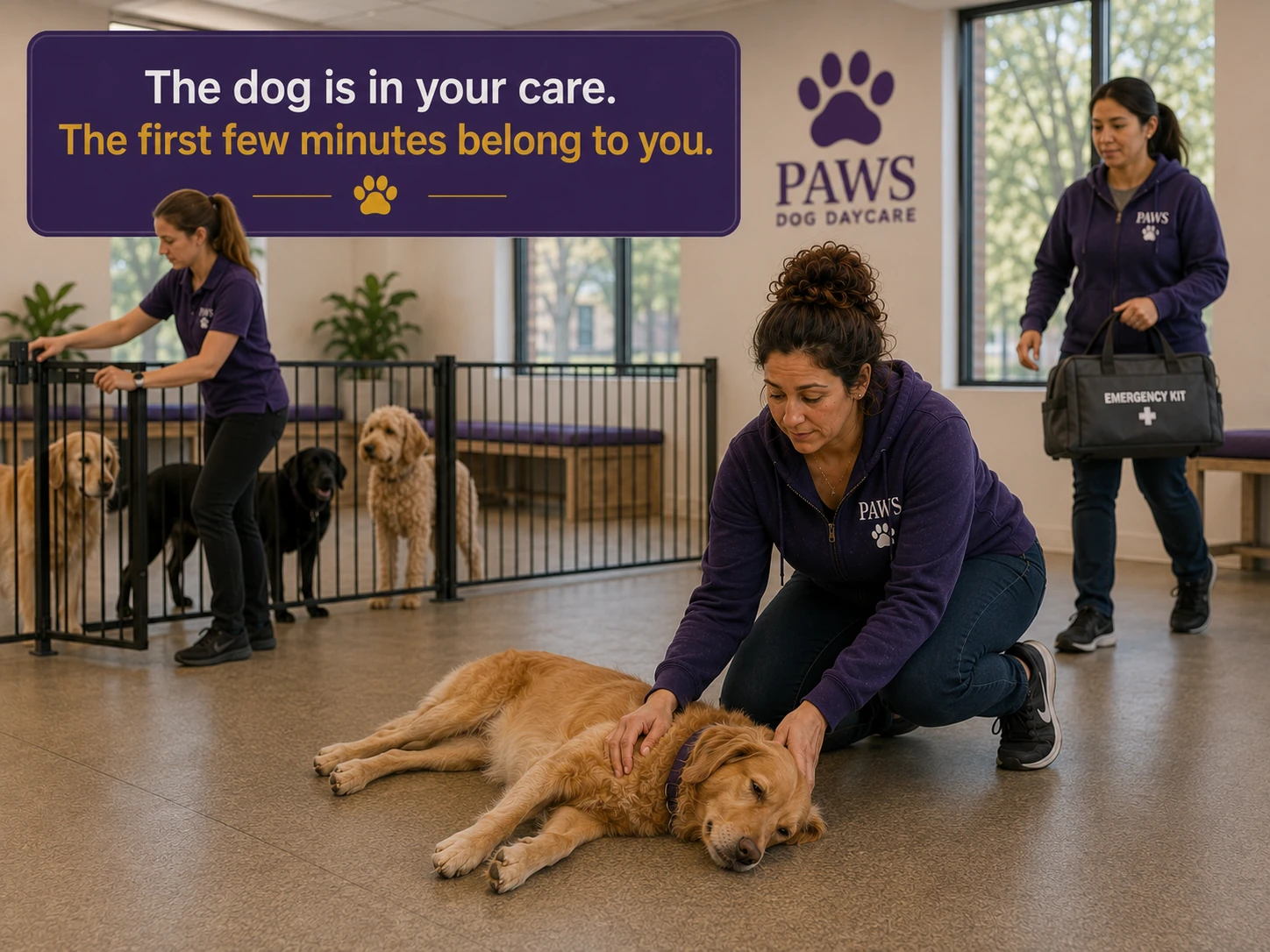
When you own a dog daycare business, emergencies are not theoretical. Dogs can fight, collapse, overheat, choke, eat something stupid, get dehydrated, have a seizure, react to medication, tear a nail, slice a pad, or suddenly look perfectly fine right up until they are not.
Whether the emergency is your fault or not, the animal is in your care. The first priority is to protect the dog, start the correct immediate response, contact the right medical help, and keep the rest of the facility from turning into a second emergency.
Being prepared does not mean staff pretend to be veterinarians. It means the business has the tools, training, phone numbers, written procedures, transportation plan, owner authorization, and mental clarity to act during the first few minutes instead of standing around in a circle making worried noises.
You may only have a few short moments to collect yourself and choose the right course of action. If you cut corners on knowledge, supplies, and staff training, you may very well end up with a dog dying that could have been saved.
🗺️
Use This Page Like an Emergency Control Map
Do not start with panic. Start with who does what, where the supplies are, who calls the vet, who controls the room, and who writes down the facts.
⏱️
First Five Minutes
The first response decides whether the business becomes useful or just noisy.
🌡️
Heatstroke
Heat emergencies do not wait for staff to finish arguing about whether the dog looks hot.
☠️
Poisoning
Toxin response needs veterinary or poison-control direction, not cowboy medicine.
☎️
Emergency Contacts
Vet, ER, poison control, owner authorization, and staff chain of command.
⚠️
Operator warning
If you cannot accept that a dog may die in your facility, you are not emotionally prepared for the responsibility yet. That does not mean you live in fear. It means you get proactive before the bad Tuesday walks through the front door.
🧠
Emergency Readiness Is More Than a First-Aid Kit
Equipment without training is decoration.
A first-aid kit matters. But a kit sitting on a shelf does not save a dog by itself. Staff have to know where it is, what is inside it, what they are allowed to use, what requires veterinary direction, who calls the vet, who controls the other dogs, who contacts the owner, and who writes the timeline.
In a real emergency, the business has several jobs happening at once. The injured or sick dog needs attention. The rest of the dogs still need supervision. The staff need direction. The owner needs facts. The veterinarian needs useful information. The incident record needs times, symptoms, actions, and instructions.
This is why preparation has to happen before the emergency. The emergency is not the time to learn that nobody knows how to take a rectal temperature, the muzzle is missing, the emergency vet moved, the owner’s phone number is wrong, and the only employee with a driver’s license went to lunch.
Role assignments need backups. If the designated caller is absent, the transport driver is already handling another dog, or the manager is off-site, the next employee in the chain should know exactly which responsibility becomes theirs.
Readiness also means separating authority from improvisation. Staff should know which immediate actions are within their training, which decisions require the manager, and which medical questions go directly to the veterinarian or poison-control professional.
📌
Business rule
Do not be helpless. Do not be stupid. Get trained, keep supplies ready, call the vet, follow instructions, document everything, and keep the dog stable long enough to get real medical care.
⏱️
The First Five Minutes of a Dog Daycare Emergency
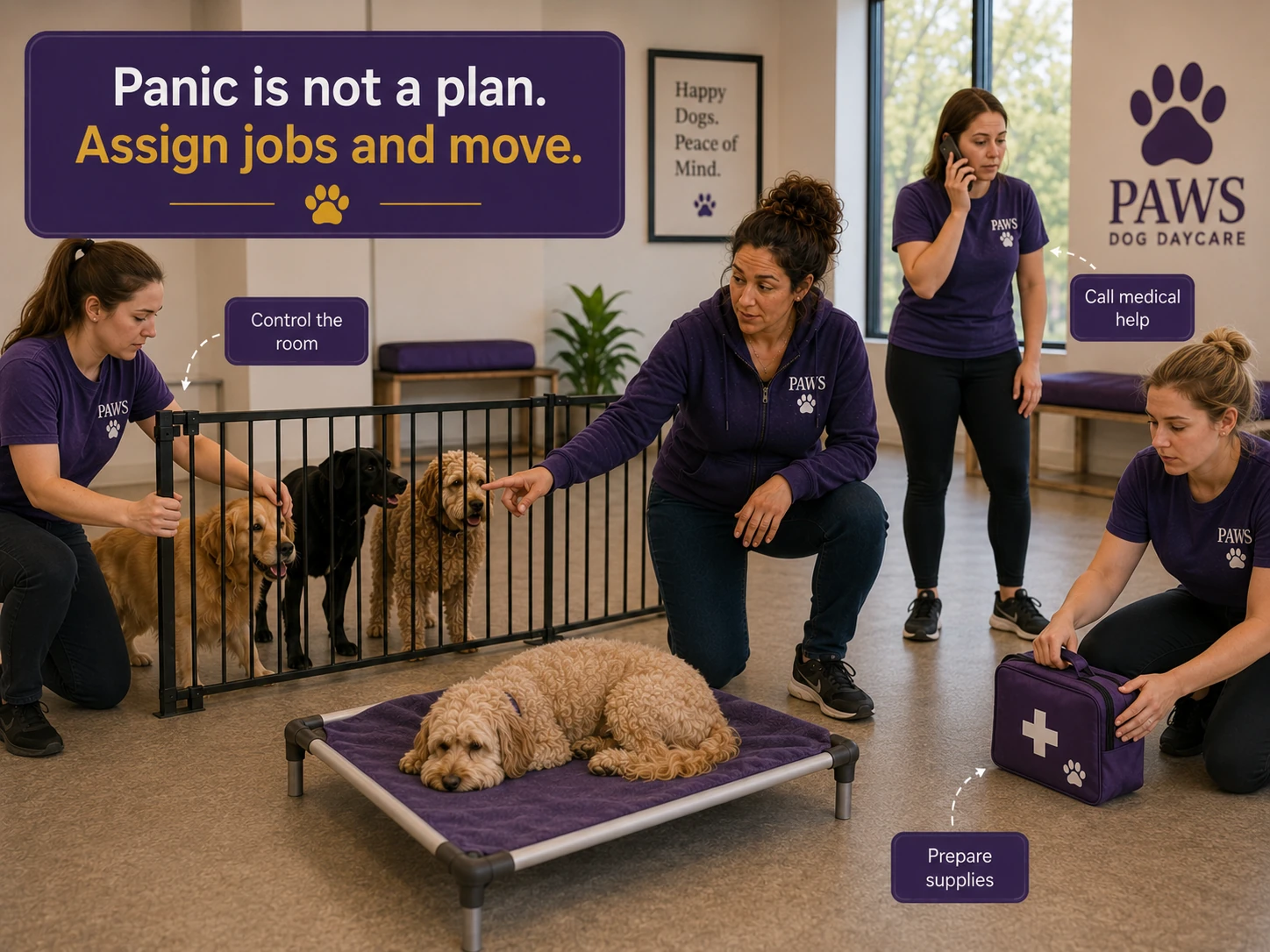
Panic is not a plan. Assign jobs and move.
The difference between rapid effective treatment and a delayed response can be the difference between life and death. Calling the vet is important. Driving to the vet may be necessary. But standing around trying to get a phone diagnosis while nobody stabilizes the dog is not emergency response.
Being prepared means having the mental toughness and clarity of thought to perform the right first steps while help is being contacted. That does not mean guessing. It means staff know their roles before the dog is bleeding, collapsing, overheating, choking, or seizing.
One person should take operational command so instructions do not compete. That person does not have to perform every task, but someone must confirm that the scene is secure, the dog is being assessed, the call is being made, transport is being prepared, and the timeline has started.
The response should stay simple enough to work under stress. Employees need short role language they have practiced before: control the room, stay with the dog, call, get the kit, prepare transport, and record times.
Staff should keep reassessing while help is being contacted. A dog that is getting worse, losing consciousness, struggling to breathe, or developing new symptoms may require the plan to move immediately from on-site first aid to transport.
Swipe left/right to see the full table.
| Job | What Happens | Why It Matters |
|---|---|---|
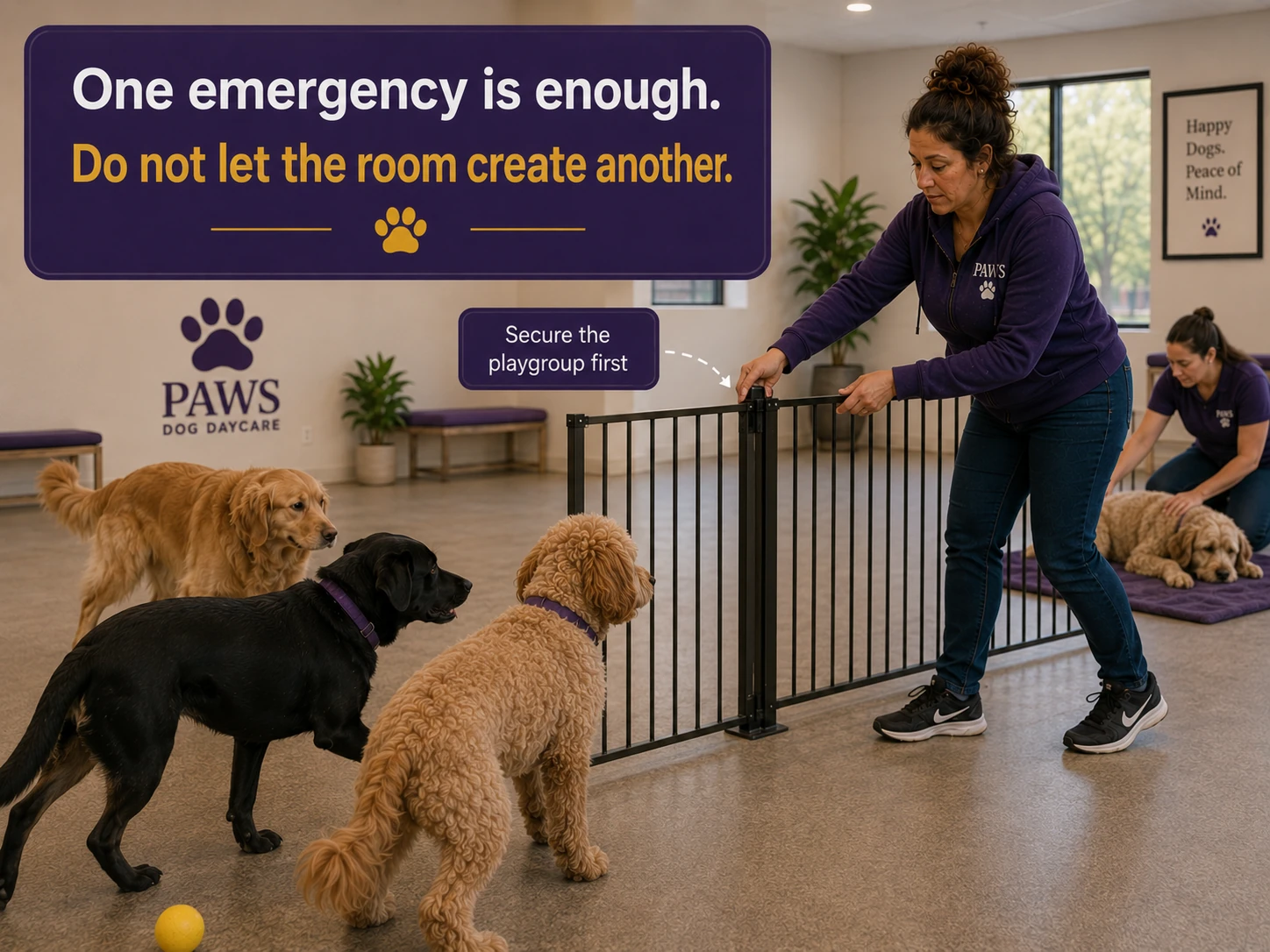
| Control the scene | Separate dogs, secure gates, move crowds away, and keep staff from clustering. | One emergency is enough. Do not create a second one because nobody is watching the room. |
| Check the dog | Look at breathing, bleeding, consciousness, temperature risk, gums, movement, and obvious injuries. | The vet needs facts, not screaming and guesses. |
| Assign the caller | One person calls the vet, emergency clinic, or poison hotline with clear information. | Three people calling and nobody acting is chaos with phone service. |
| Start approved first aid | Use trained, appropriate first-aid steps while waiting for veterinary direction or transport. | Staff should be useful without playing veterinarian. |
| Prepare transport | Identify driver, route, crate/stretcher/towels, leash, records, and owner contact. | Loading a panicked dog into a random car is not a transport plan. |
| Start the timeline | Record times, symptoms, actions, calls made, instructions received, and staff involved. | Documentation protects the dog and the business. |
🚨
No-Debate Emergencies: When Staff Stop Discussing and Move
Some situations do not need a committee meeting in the lobby.
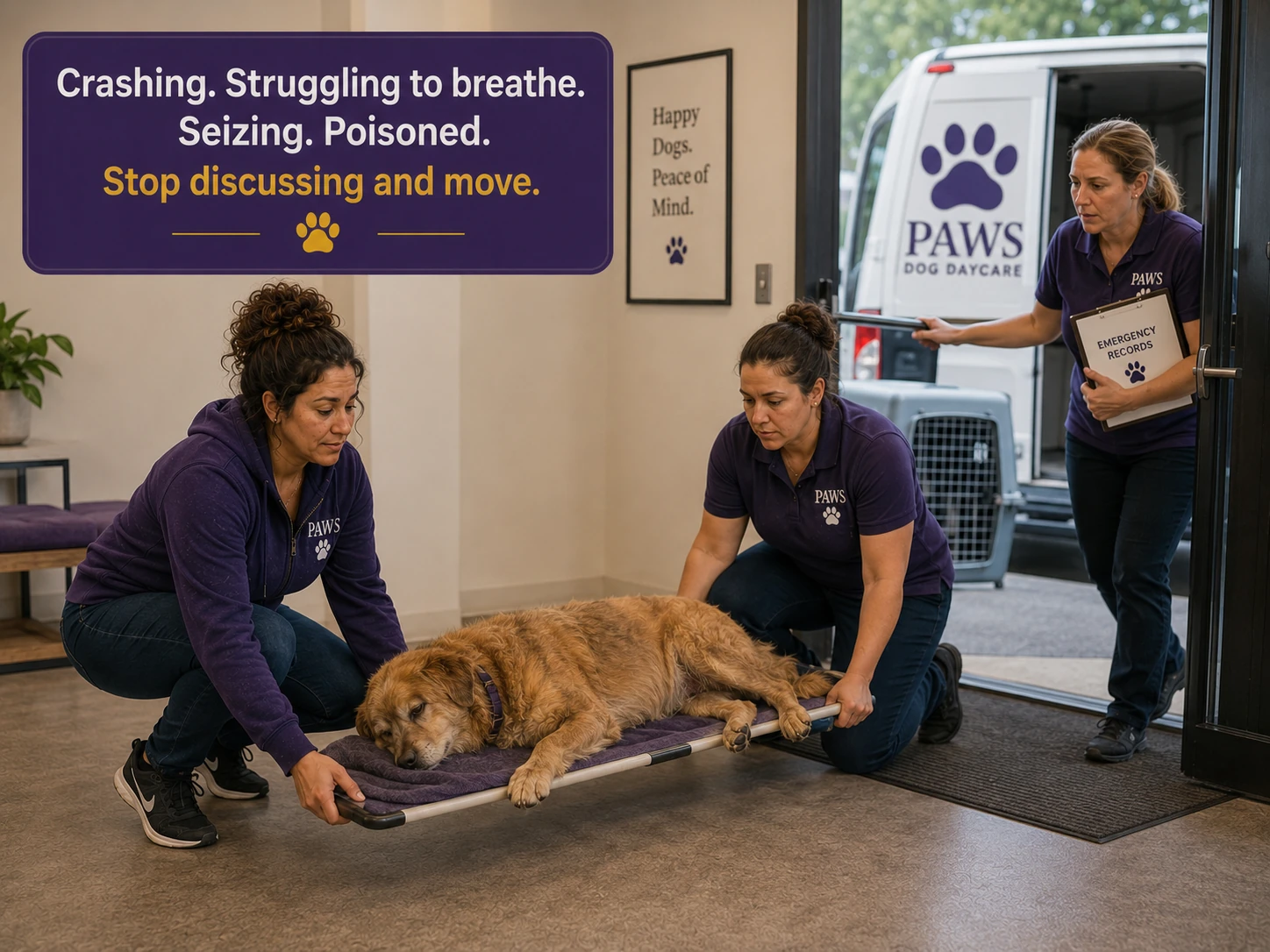
Staff need to know which emergencies are immediate veterinary problems. This does not mean panic. It means the business stops debating, controls the scene, calls the vet or emergency clinic, contacts the owner, prepares transport, and documents the facts.
The purpose of a no-debate list is not to diagnose the dog. It is to prevent staff from wasting critical time arguing about whether a visibly unstable dog is sick enough to deserve medical care.
Once the threshold is met, the facility should use the established chain: secure the room, contact the emergency clinic, begin only trained and approved first aid, contact the owner, and move the dog with the records the clinic will need.
A dog can cross the threshold while staff are watching. If symptoms intensify, recovery stops, or the dog’s condition no longer matches a minor problem, staff should escalate instead of protecting the original decision to wait.
- Trouble breathing, blue/pale gums, collapse, unconsciousness, or repeated seizures.
- Heatstroke signs, dangerously high temperature, severe weakness, vomiting, or disorientation after heat exposure.
- Heavy bleeding, deep punctures, torn skin, eye injury, suspected broken bone, or severe lameness.
- Known or suspected poisoning, toxin exposure, medication ingestion, chemical exposure, or unknown substance ingestion.
- Bloated abdomen, repeated unproductive retching, severe abdominal pain, or sudden distress.
- Any dog getting worse instead of better while staff are “watching it.”
⚠️
No-debate rule
If the dog is crashing, bleeding badly, struggling to breathe, overheating, seizing, poisoned, or getting worse in front of you, the plan is not “wait and see.” The plan is act, call, transport, and document.
🧰
Dog Daycare First-Aid Kit Categories
Keep the supplies organized by use, not buried in a mystery box.
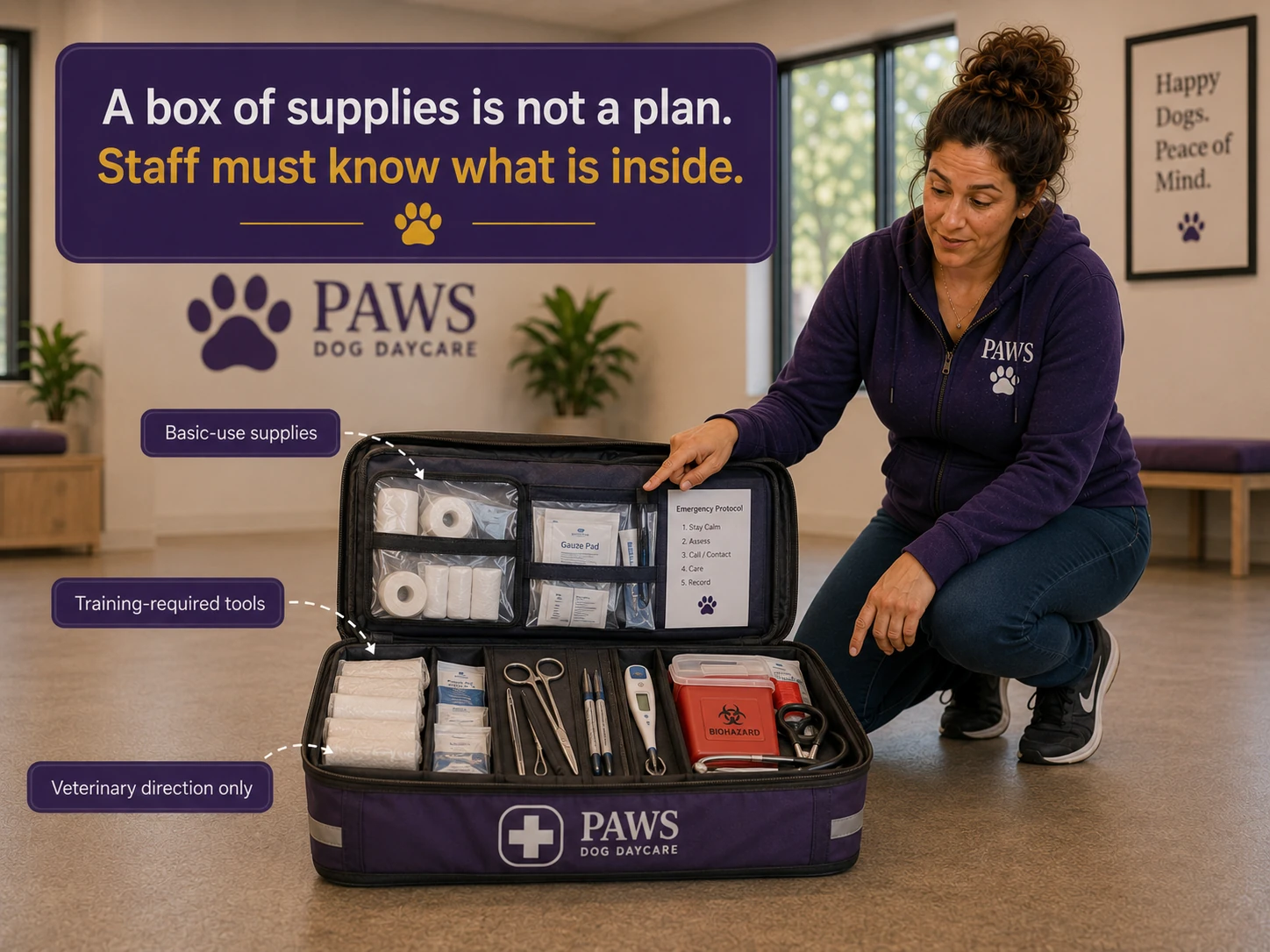
The first-aid kit should be easy to find, clearly labeled, checked on a schedule, and stocked in a way staff can understand under stress. A long supply list is only useful if the business knows what each item is for and whether staff are trained to use it.
The items below are organized by practical daycare use. Your veterinarian may recommend changes based on your services, dog volume, climate, transport distance, staff training, and local emergency access.
The kit should be arranged so an employee can find the right category in seconds. Clearly separated compartments, an inventory sheet, expiration dates, and a restocking log are more useful than one deep container filled with loose packages.
Large facilities may need more than one kit or a portable grab bag for yards, transport, and evacuation. Every kit should use the same layout so staff are not learning a new system during the emergency.
Swipe left/right to see the full table.
| Category | Supplies | Daycare Use |
|---|---|---|
| Exam and basic assessment | Rectal thermometer, pen light, pet first-aid book, emergency instruction sheet. | Helps staff gather real information before calling the vet or transporting. |
| Handling and protection | Slip leads, muzzle, towels, non-latex gloves, surgical gloves. | Injured dogs may bite. Staff safety matters, and the dog still has to be moved safely. |
| Wound cleaning and flushing | Saline solution, eye wash, iodine, iodine wipes, mild grease-cutting dishwashing liquid, cotton balls, cotton swabs. | Useful for flushing, cleaning, and temporary first response before veterinary care. |
| Bandaging and bleeding control | Sterile gauze pads, gauze bandage rolls, cohesive bandage, vet wrap, adhesive tape, styptic powder, scissors. | Helps control minor bleeding, protect wounds, and stabilize until transport. |
| Splint and limb support | SAM splint, wooden splints, cast padding, towels, cohesive wrap. | For trained staff support only. Bad splinting can make an injury worse. |
| Cooling and comfort support | Instant cold packs, towels, thermometer, water access, transport plan. | Heat and swelling emergencies need calm, correct action and veterinary guidance. |
| Eye and skin support | Eye wash, artificial tear gel, saline, dishwashing liquid, towels. | Useful after flushing irritants or contaminants when directed by the situation or vet. |
| Tools | Scissors, thumb forceps, locking hemostat, bulb syringe, large medicine syringe, pill gun. | Tools need training. A tool in an untrained hand can become the problem. |
| Veterinary-direction items | Diphenhydramine/Benadryl, 3% hydrogen peroxide, activated charcoal, rehydration mix, fluids, IV tubing, needles. | Do not administer casually. These require veterinary or poison-control direction. |
| Documentation | Incident forms, medication/first-aid log, emergency contact sheet, owner authorization, pen, clipboard. | The emergency record matters almost as much as the supplies. |
📌
Kit audit rule
Check the first-aid kit on a schedule. Supplies expire, get used, dry out, leak, disappear, or end up in someone’s desk drawer. A beautiful list does not help when the thermometer battery is dead and the gauze box is empty.
🚫
Items Staff Should Not Use Casually
Having the item does not mean staff should start playing doctor with it.
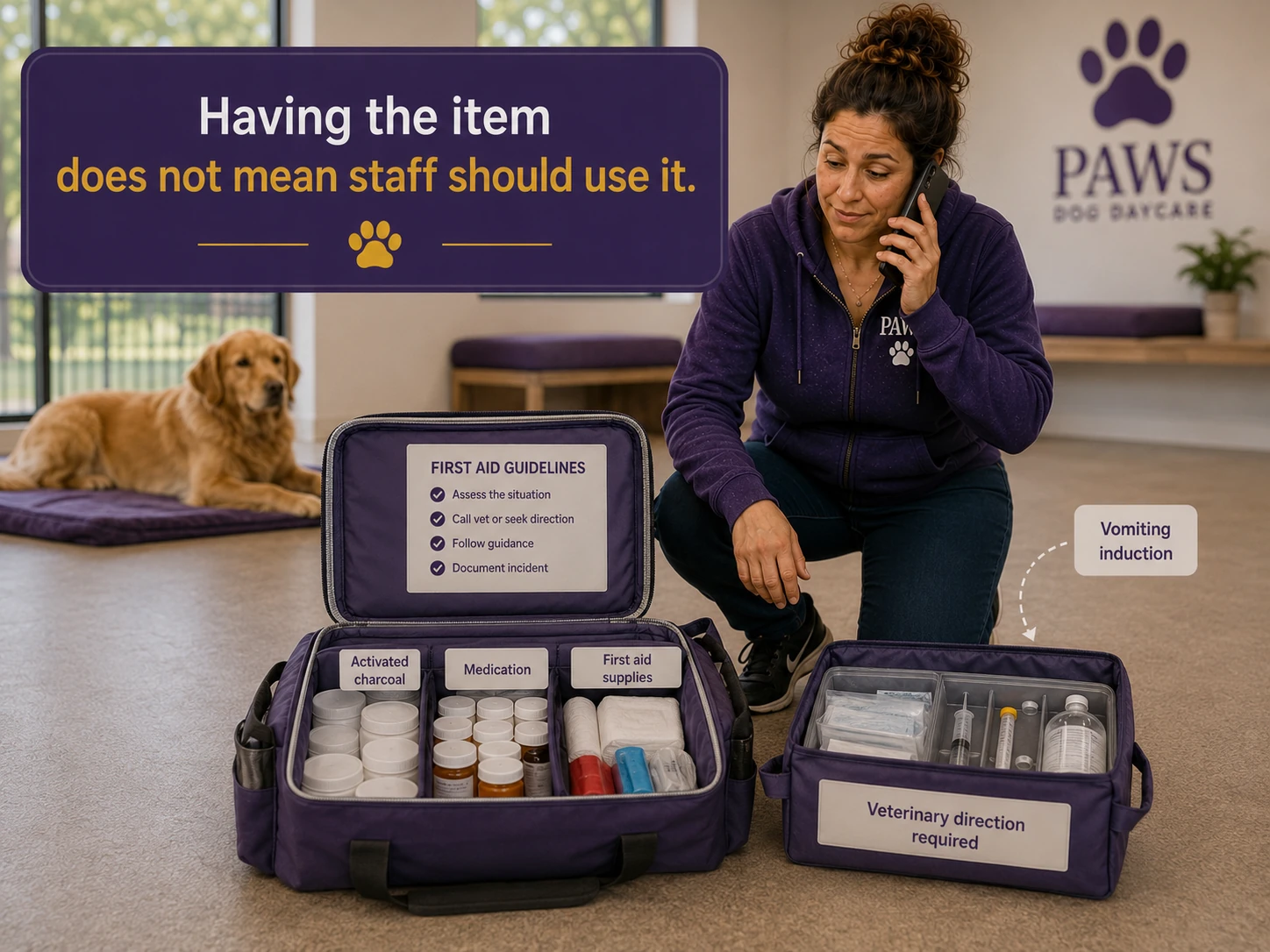
Some first-aid supplies are straightforward. Gloves, gauze, saline, towels, thermometer, slip leads, and bandage materials belong in the building. Other items require more caution because the wrong use can hurt the dog, delay proper care, or create a bigger mess.
Poisoning response is the biggest trap. Do not induce vomiting just because a dog ate something. Do not give activated charcoal just because it sounds medical. Do not give medication because someone found a dosage chart online. Call your veterinarian, emergency clinic, or animal poison-control resource and follow real instructions.
When veterinary direction is received, staff should write down who provided it, the time, the exact instruction, the product involved, and who carried it out. That protects the dog from misunderstood directions and gives the treating clinic a usable history.
The facility should also control access to higher-risk supplies. Keeping them in the building does not mean every employee should be able to reach them, select a product, and act without authorization.
Swipe left/right to see the full table.
| Item | Why It Needs Caution | Operator Rule |
|---|---|---|
| 3% hydrogen peroxide | Vomiting is not safe for every toxin, dog, or situation. | Use only under veterinary or poison-control direction. |
| Activated charcoal | It is not appropriate for every toxin and can create aspiration or dosing problems. | Do not administer unless directed by a veterinarian or poison-control professional. |
| Benadryl / diphenhydramine | Medication use depends on dog, dose, symptoms, other meds, and product ingredients. | Use only with veterinary direction. Check product ingredients. |
| Syrup of ipecac | Not a routine daycare response item and can be dangerous when used incorrectly. | Do not use unless a veterinarian specifically directs it. |
| IV fluids, needles, venoset tubing | Fluids and needles require training, dosing knowledge, and medical judgment. | Veterinary-trained or veterinary-directed use only. |
| Skin stapler | Closing wounds without proper cleaning and assessment can trap infection or hide deeper injury. | Not a casual staff item. Use only if properly trained and directed. |
| Tourniquet | Incorrect use can cause serious tissue damage. | Training-only item. Do not use as a panic strap. |
| Muzzle | Useful for staff safety, but unsafe for vomiting dogs, severe breathing distress, or heat emergencies. | Use judgment. A muzzle is not worth blocking a dog that cannot breathe or vomit safely. |
⚠️
No cowboy medicine
A daycare first-aid kit is not permission to experiment. The goal is to stabilize, protect, call the right help, follow instructions, and transport when needed.
☎️
The Emergency Contact Sheet
The number you need should not be hiding in somebody’s phone.
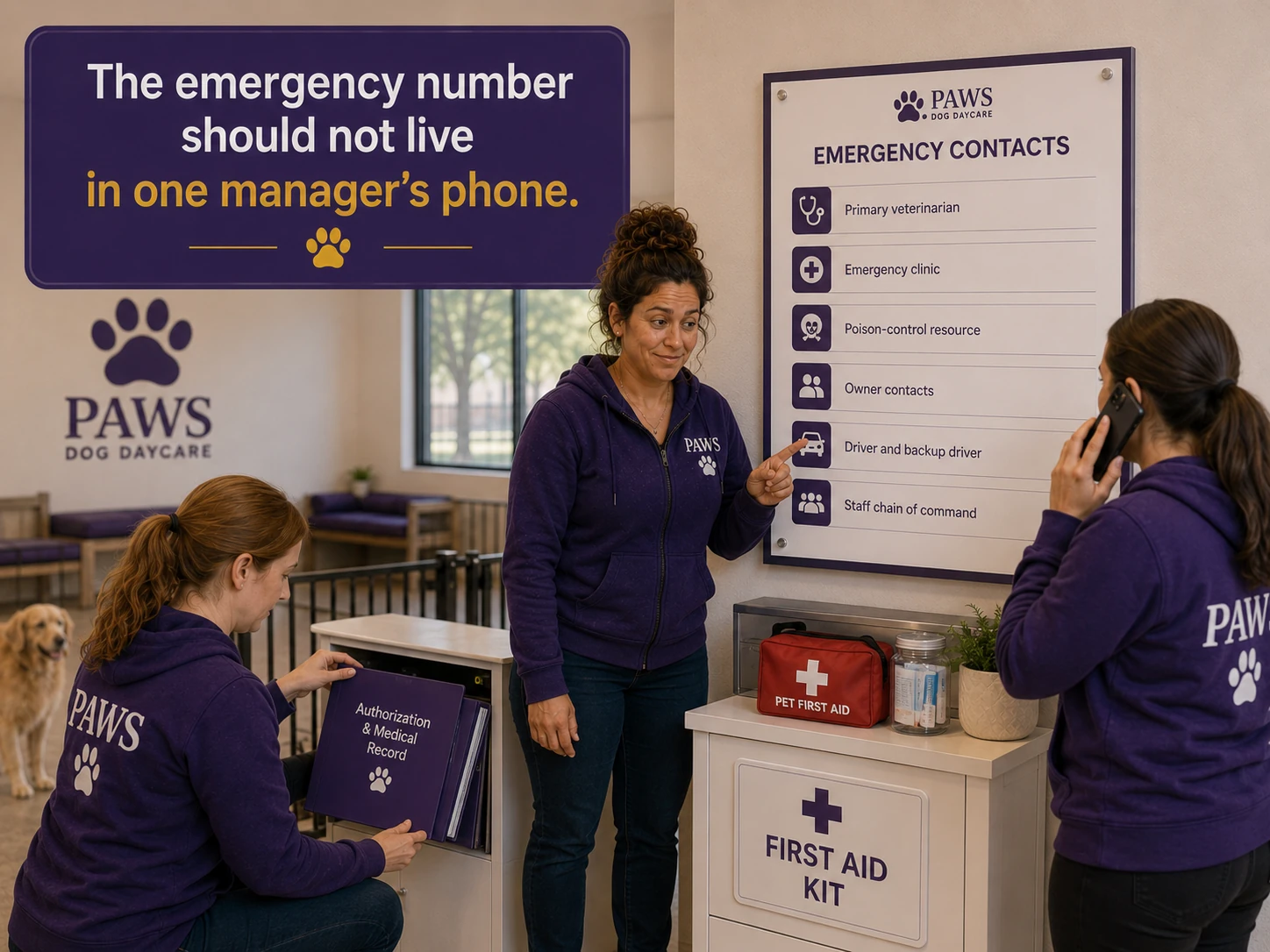
Every dog daycare should have an emergency contact sheet posted where staff can actually use it. Not buried in a file. Not saved under one manager’s contacts. Not “I think the vet number is on some clipboard somewhere.”
The contact sheet should be reviewed on a schedule. Veterinary hospitals change hours. Emergency clinics move. Staff leave. Owners change phone numbers. Poison-control resources may have fees or case numbers. None of that should be discovered while a dog is crashing.
Post the sheet in more than one practical location and keep a copy in the transport records. A power failure, locked office, damaged phone, or emergency outside the main building should not make the contact system disappear.
Owner authorization should be easy to retrieve and specific enough to guide transport and reasonable emergency care. Staff should not be searching through old enrollment paperwork while another employee is waiting for permission to move the dog.
Testing the sheet is part of maintaining it. Periodically confirm hours, routes, phone numbers, after-hours instructions, payment procedures, and which clinic is actually prepared to receive an emergency from the facility.
- Primary veterinarian name, address, phone number, and normal hours.
- Backup veterinarian or 24-hour emergency clinic with drive time.
- Animal poison-control contact information and payment/case-number procedure.
- Owner emergency contacts and authorized decision-makers.
- Current medication list, allergies, medical conditions, and special handling notes for each dog.
- Owner authorization for emergency veterinary care, transport, and reasonable first-aid response.
- Dog identification basics: photo, collar/harness notes, microchip if provided, and emergency record location.
- Staff chain of command for medical emergencies.
- Transport driver, backup driver, and vehicle plan.
- Location of first-aid kit, leashes, muzzles, towels, crate, records, and incident forms.
🎓
Training and Drills Matter More Than the Fancy Supply List
The dog does not care how impressive the kit looks if nobody knows how to use it.
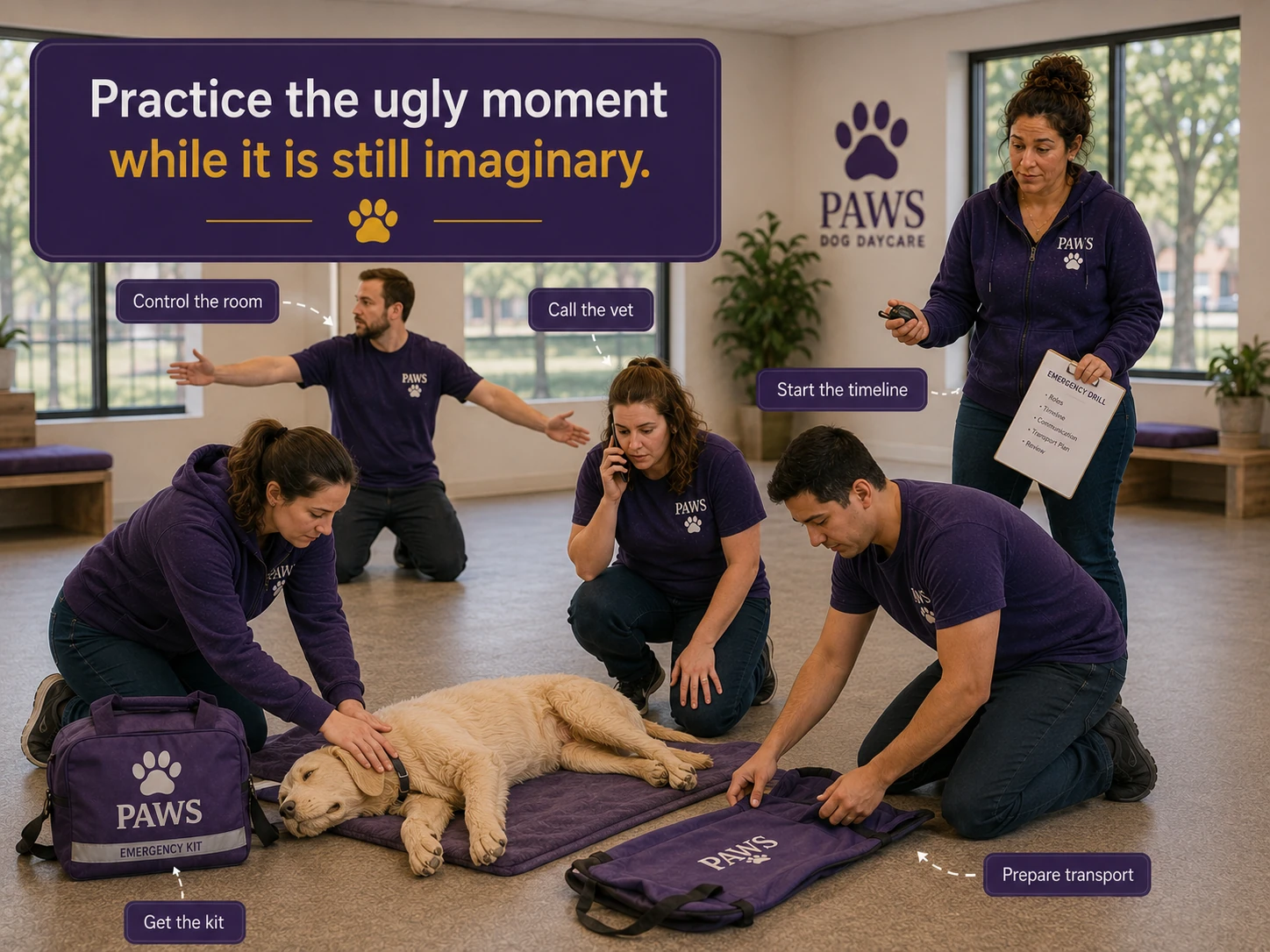
Staff training should include basic pet first aid, safe handling of injured dogs, reading signs of distress, temperature checks, bleeding control, heat emergency response, transport procedure, owner notification, and documentation.
Drills do not need to be theatrical. Walk through the scenario. Dog collapses in playroom. Dog fight with bleeding. Dog overheats outside. Dog eats unknown substance. Dog has seizure. Who controls the room? Who checks the dog? Who calls? Who gets the kit? Who prepares transport? Who writes the timeline?
If staff cannot answer those questions during a calm training day, they are not going to magically become organized when a dog is bleeding on the floor and six other dogs are barking in the background.
A drill should be evaluated, not merely completed. Record how long it took to secure the room, locate the kit, reach the contact sheet, assign transport, and begin documentation. Delays found during practice are weaknesses the business can fix without an injured dog paying for them.
Training should be repeated when staff roles change, procedures change, supplies move, or a real incident exposes confusion. A certificate earned years ago does not replace current familiarity with this building and this emergency plan.
📌
Drill rule
Practice the ugly moment while it is still imaginary. The real version is not generous.
🚑
Conditions, Treatment, and First-Aid Topics
Group dog care creates many ways for a normal day to become a medical problem.
Dog daycare owners need to identify problems before they become life-threatening. This hub connects to the major emergency topics that deserve their own focused pages.
These condition pages support the emergency plan; they do not replace veterinary assessment. Staff need enough familiarity to recognize the problem category, begin the approved first response, and communicate useful facts while arranging medical care.
The facility should identify which condition guides are most relevant to its services and climate, then include those scenarios in drills. Reading a page once is not the same as being able to act while the room remains active.
🫀
Dog CPR
Cardiopulmonary resuscitation for dogs and why staff need training before collapse happens.
💧
Dehydration
Signs, risk factors, and daycare response when a dog may be losing too much fluid.
🌡️
Heatstroke
Heat emergencies can move fast. Staff need to know signs, cooling response, and transport urgency.
☠️
Poisoning
Toxin response needs fast facts, correct contact, and no guessing with vomiting or charcoal.
📝
Emergency Documentation and Insurance Reality
The dog needs care first. The business still needs facts.
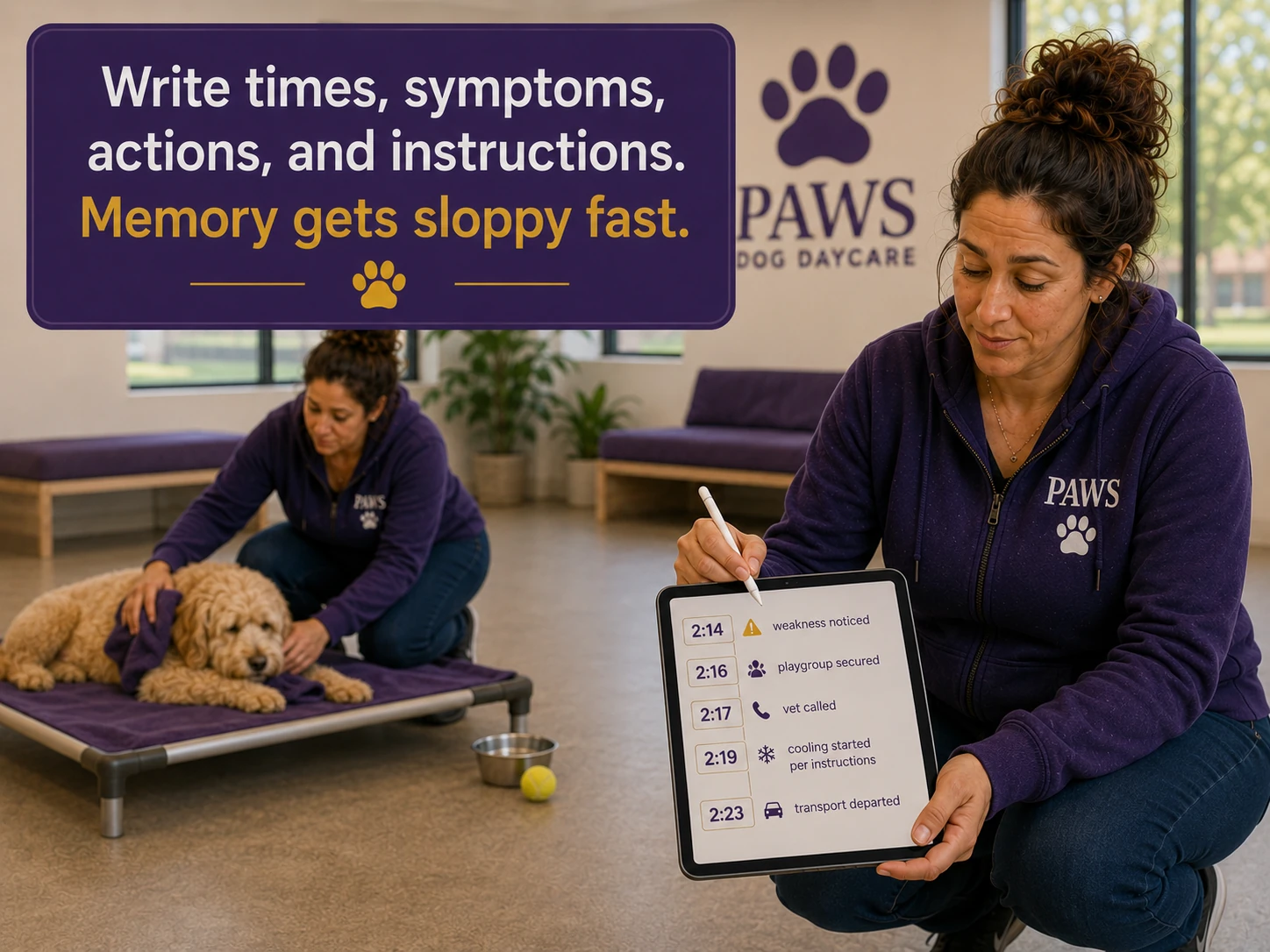
During an emergency, staff should document the timeline as soon as it is practical. That does not mean ignoring the dog to write a beautiful report. It means one staff member records the facts while the emergency response is happening or immediately afterward.
Memory gets sloppy fast. Staff will remember different times, different symptoms, different words, and different actions. The owner will be upset. The vet will need facts. Insurance may need records. The business needs a clean timeline before the whole story becomes memory soup.
The record should distinguish what staff observed from what someone assumed. Write “collapsed after vomiting twice” rather than “probably poisoned,” unless a veterinarian or known exposure supports that conclusion.
Keep original notes, call logs, written instructions, photographs when appropriate, video-review references, transport details, and follow-up communication together. A scattered record forces the business to reconstruct the event later from fragments.
The after-action review should use the timeline to identify the first preventable delay or failure. That may be an empty supply slot, an outdated number, an unclear command role, a slow gate response, or an owner authorization that staff could not locate.
- Time the issue was first noticed.
- Dog’s symptoms, behavior, temperature if taken, gum color if checked, and visible injuries.
- Staff members present and who performed each role.
- First-aid steps taken and who directed them.
- Veterinarian, emergency clinic, or poison-control calls, including time and instructions.
- Owner contact attempts, time reached, and owner instructions.
- Transport time, destination, driver, and records sent with the dog.
- Photos, video review notes, witness notes, and follow-up communication.
📌
After-action rule
Every serious emergency should produce one improvement. Restock something, retrain something, update a phone number, change a handoff rule, fix a gate issue, improve documentation, or clarify staff roles. If the same weakness survives the incident, the business learned nothing.
✅
Dog Daycare Emergency Readiness Checklist
Use this before the dog is on the floor and everyone suddenly has questions.
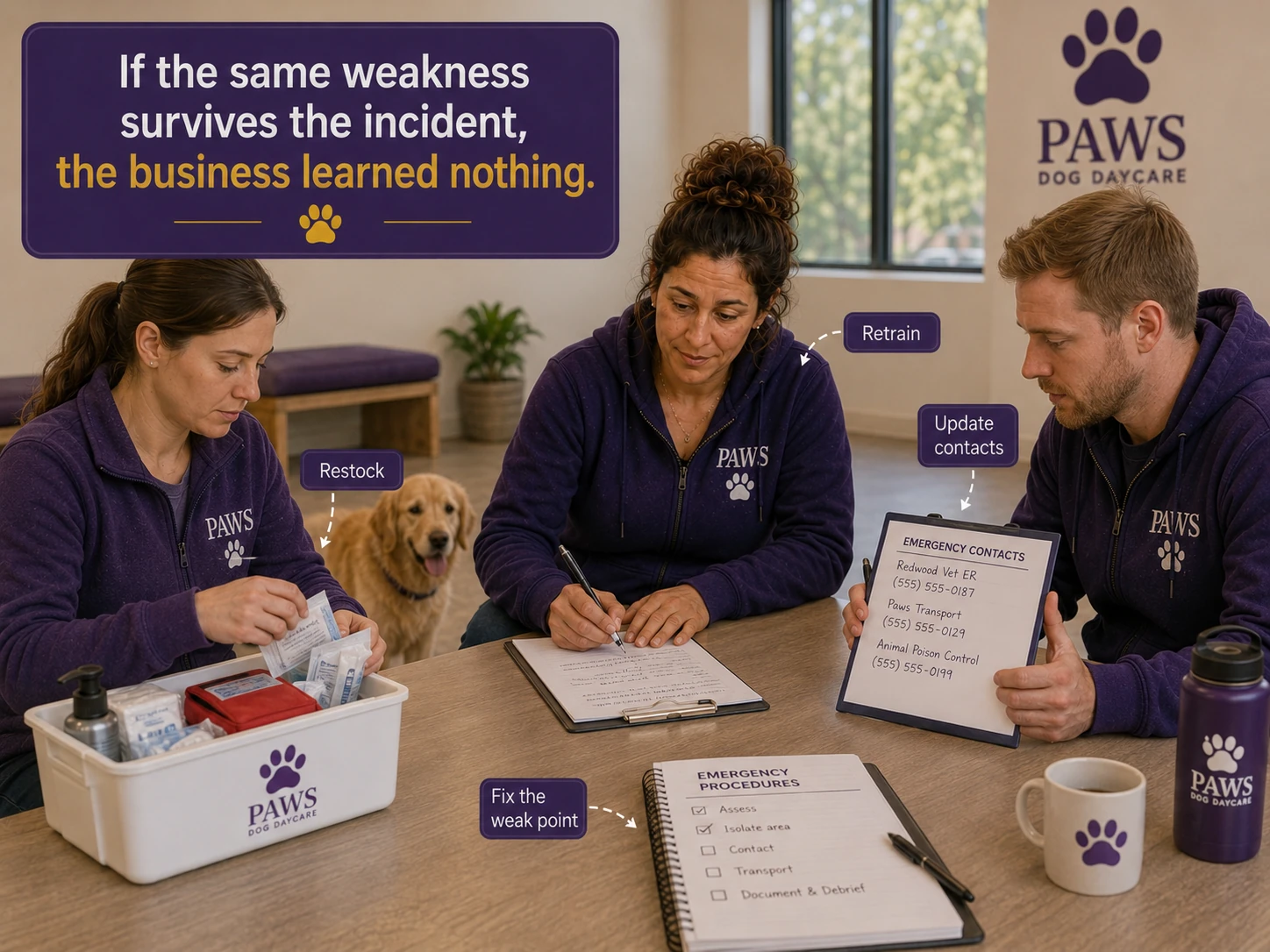
Use this checklist as a recurring operating audit, not a one-time opening requirement. The answers should be verified by looking at the kit, testing the contacts, checking the authorizations, and asking employees to explain their actual roles.
A checked box is not enough when the underlying system does not work. “Transport plan exists” means the driver, backup, vehicle, route, restraint equipment, records, and destination are current and available on the shift being evaluated.
Every serious incident and every meaningful drill should send staff back to this list. Restock the missing item, revise the unclear role, correct the outdated number, change the weak procedure, and then confirm that the repair actually works.
- Is the first-aid kit stocked, labeled, visible, and checked on a schedule?
- Do staff know which supplies are basic-use and which require veterinary direction?
- Are primary vet, backup vet, emergency clinic, and poison-control contacts posted?
- Does every dog have current owner emergency contact and treatment authorization information?
- Do staff know who controls the room, who checks the dog, who calls, who documents, and who transports?
- Is there a transport plan with driver, vehicle, crate/towel/stretcher support, and destination?
- Have staff practiced common emergency scenarios?
- Are incident forms, call logs, and emergency timelines ready to use?
- Does the facility review every serious incident afterward and fix the weak point?
❓
Dog Daycare Emergency Preparedness FAQ
Detailed answers about first-aid kits, staff roles, immediate transport, veterinary direction, owner authorization, emergency contacts, drills, documentation, video preservation, and after-action correction.
Does a dog daycare need a first-aid kit?
Yes. The kit should be stocked, organized, clearly labeled, easy to reach, and checked on a written schedule. It is only one part of readiness; staff also need training, emergency contacts, owner authorization, documentation tools, and a transport plan.
How often should the first-aid kit be audited?
The facility should use a recurring schedule and also check the kit after every use. The audit should confirm quantities, expiration dates, packaging condition, thermometer function, battery status, and whether anything has been moved. Restocking should be documented so an empty slot does not survive until the next emergency.
Who should receive emergency-response training?
Every employee responsible for dogs should understand the facility’s emergency roles and basic scene-control procedures. Designated staff should also maintain current pet first-aid and CPR training appropriate to their responsibilities. Managers must ensure new hires and backup employees can perform the plan when the usual leader is absent.
What should happen during the first five minutes?
Staff should secure the other dogs, assess the affected dog, assign one caller, begin only trained and approved first aid, prepare transport, and start a timeline. One employee should coordinate the response so tasks are confirmed rather than assumed. The dog should be reassessed while help is being contacted because a worsening condition may require immediate transport.
Why must the rest of the playgroup be secured first?
The other dogs remain the facility’s responsibility during the emergency. Crowding, escapes, redirected aggression, and staff distraction can turn one medical event into several incidents. Securing the room gives the response team space to work and protects the affected dog from additional pressure.
What conditions should trigger immediate veterinary transport?
Trouble breathing, collapse, unconsciousness, repeated seizures, severe bleeding, suspected poisoning, heatstroke signs, major trauma, bloating with unproductive retching, and rapid deterioration belong in the no-debate category described on this page. Staff should contact the receiving clinic while preparing to move. The facility should not delay transport simply because the owner has not yet answered the phone when existing authorization permits emergency action.
Should daycare staff administer medication during an emergency?
Not casually. Medication should be given only under an existing written medical order, clear owner instructions that the facility has accepted, or direct veterinary guidance for the specific dog and event. Staff should document the product, instruction, time, amount directed, and person who administered it.
Should staff induce vomiting after a possible poisoning?
No, not without veterinary or poison-control direction. Vomiting is inappropriate or dangerous in some exposures and some medical conditions. Staff should identify the substance if possible, preserve packaging, gather the dog’s information, call the proper medical resource, and follow the instruction received.
Can staff give diphenhydramine or activated charcoal from the kit?
Only with appropriate veterinary direction. The correct decision depends on the dog, symptoms, product ingredients, exposure, other medications, and the reason it is being considered. Possessing the item does not give staff authority to select or improvise treatment.
When is a muzzle appropriate during an emergency?
A muzzle may protect staff when an injured, painful, or frightened dog can still breathe normally and is not vomiting. It may be unsafe in severe breathing distress, heat emergencies, repeated vomiting, or situations where the dog cannot be monitored properly. Staff should use the least restrictive safe handling method supported by their training.
What information should staff give the veterinarian?
Provide the dog’s identity, known medical conditions and medications, the time the problem began, observed symptoms, temperature or gum color if safely checked, possible exposure, visible injuries, and first-aid actions already taken. Report changes over time rather than only the dog’s current appearance. Clear facts help the medical professional give useful instructions and prepare for arrival.
What belongs on the emergency contact sheet?
Include the primary veterinarian, backup clinic, 24-hour emergency hospital, poison-control resource, owner contacts, authorized decision-makers, staff chain of command, drivers, and locations of emergency equipment and records. The sheet should also identify clinic hours, addresses, routes, and any payment or case-number procedure staff must know. Keep printed and transport copies so the system does not depend on one phone.
Why is owner authorization important?
Current authorization lets staff transport the dog and seek reasonable emergency care without losing time searching for permission. It should be stored with the dog’s medical and contact information in a location employees can reach quickly. The business should review its authorization language and procedures with its own legal and insurance advisers.
What should an emergency transport plan include?
Identify the primary driver, backup driver, available vehicle, destination, route, restraint or stretcher equipment, towels, records, and who accompanies the dog. Staff should know how the remaining facility will be supervised after employees leave. The plan should be practiced so loading and departure are not invented beside a collapsing dog.
What emergency scenarios should staff drill?
Useful drills include collapse, dog-fight injuries, heat illness, suspected poisoning, seizure activity, breathing distress, and an emergency that occurs while staffing is limited. Each drill should test scene control, assessment, calling, supply access, transport, owner contact, and documentation. Record delays and assign corrective work rather than treating completion as success.
What should be documented during and after an emergency?
Record times, observed symptoms, staff present, actions taken, calls made, instructions received, owner-contact attempts, transport details, and changes in the dog’s condition. Separate observations from assumptions and note who directed any medication or specialized action. Keep supporting photographs, video-review references, witness notes, and follow-up communication with the incident record when appropriate.
Should staff take photographs or preserve video?
Photographs may document visible injuries, the scene, packaging, or relevant conditions when doing so does not delay care. Existing facility video should be preserved promptly so routine overwriting does not destroy it. The business should follow its privacy, evidence-retention, and insurance procedures when storing or sharing those records.
What is an after-action review?
It is a structured review of what happened, what worked, what delayed the response, and what must change. Use the timeline to identify missing supplies, outdated contacts, unclear authority, transport problems, documentation gaps, or training weaknesses. Assign each correction to a person and confirm completion before considering the incident closed.
How can staff care for the sick dog without abandoning the facility?
Emergency roles must include continued control of the other dogs. Secure groups, assign coverage, limit unnecessary staff clustering, and decide which employees remain on-site if transport occurs. The response plan fails if saving one dog creates escapes, fights, or unsupervised animals elsewhere in the building.
What is the biggest emergency-preparedness mistake?
The biggest mistake is assuming supplies equal readiness. A full kit cannot fix unclear roles, outdated numbers, missing authorization, weak transport planning, or employees who have never practiced together. Preparedness is a functioning system that reduces delay and improves after every drill or real incident.
🐾
The Bottom Line: Emergency Preparedness Is Part of Owning the Business
The dog is in your care. The first few minutes belong to you.
A dog daycare owner does not need to be a veterinarian. But the owner does need to be prepared for emergencies that can happen in a building full of dogs.
The difference between rapid effective response and delayed confusion can be the difference between a dog that survives and a dog that does not. That is not drama. That is the responsibility that comes with taking custody of someone else’s animal.
Get the supplies. Train the staff. Post the contacts. Practice the plan. Write the timeline. Know when to call the vet. Know when to transport. Do not wait until the bad moment arrives and then hope panic turns into competence.
Preparedness should be visible in daily operations: current records, stocked supplies, practiced staff roles, secure transport equipment, and employees who know where to find the plan. It should not exist only as a policy document nobody opens.
The strongest emergency program is not the one with the most equipment. It is the one that reduces delay, prevents a second incident, gets accurate information to medical professionals, and changes when a real event exposes a weak point.