Dog Daycare Supplies, Cleaning Systems, and Opening-Day Reality
Dog Daycare Supplies Checklist: What You Actually Need to Open and Operate
This is not a cute shopping list. This is the working guts of the business.
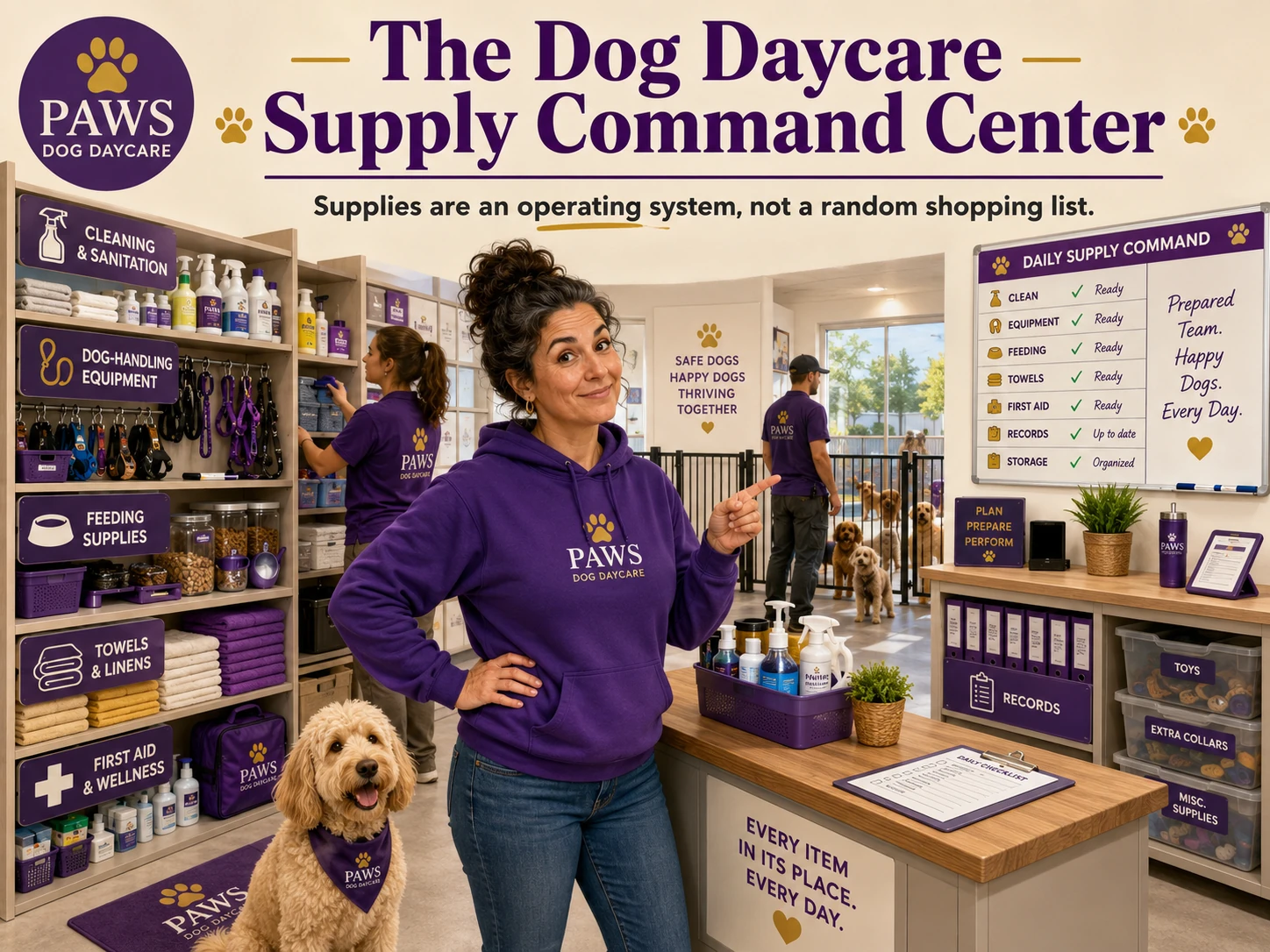
When people think about dog daycare supplies, they usually picture bowls, leashes, toys, maybe a few cute beds, and some cleaning products tossed into a closet like that counts as a plan. That is not a plan. That is a future disaster with a receipt.
A dog daycare is not a boutique with dogs sprinkled on top. It is a cleaning business, a crowd-control business, a sanitation business, a recordkeeping business, a safety business, and a customer-service business wearing a cute logo. You are going to spend a ridiculous amount of time cleaning up dog hair, dog slobber, dog urine, dog vomit, dog poop, muddy paw prints, nose prints, spilled water, wet towels, mystery puddles, and whatever creative little biohazard the morning group decides to contribute before 9:00 a.m.
That is the reality. If you are offended by that, do not open a dog daycare. This business is not all wagging tails and happy Facebook photos. It is mops, buckets, laundry, disinfectant, trash bags, drains, gloves, towels, incident reports, leashes, staff who forgot where they put the poop bags, and one Labrador who treats your freshly cleaned floor like a personal challenge.
The right supplies make the business faster, cleaner, safer, and more professional. The wrong supplies make you look cheap, slow your staff down, create odor problems, invite disease risk, frustrate customers, and turn every day into a scavenger hunt for the one tool somebody should have bought before opening.
So this page is not just “buy a mop.” This is how to think about the supply system behind a real dog daycare.
⚠️
Operator warning: most new owners underbuy the boring stuff and overbuy the cute stuff.
Do not blow the opening budget on decorative dog beds, lobby trinkets, and Instagram props while your staff is trying to clean a playroom with a kitchen mop, a sad little dustpan, and the emotional strength of a damp paper towel. The boring supplies are what keep the place alive.
🗺️
Use This Page Like an Opening Supply Workbook
Work through the supply categories in order. Dog daycare supplies are not random purchases. They are part of your operating system.
🧼
Cleaning System
Mops, buckets, disinfectants, trash flow, towels, and the daily battle against filth.
🦠
Disinfection
Clean first, disinfect correctly, respect label directions, and stop playing chemical roulette.
🐕
Dog Handling
Leashes, slip leads, muzzles, barriers, gates, and safe movement supplies.
📋
Intake and Records
Bins, labels, feeding instructions, vaccine records, medication notes, and customer paperwork.
🧺
Laundry and Bedding
Anything that absorbs urine, traps odor, or cannot be cleaned is not your friend.
💻
Front Desk
Software, payments, phones, forms, printers, records, and customer communication.
🚑
Safety and First Aid
Dog first aid, human first aid, PPE, emergency numbers, spill response, and staff readiness.
🛑
Do Not Buy Yet
The expensive distractions that can wait until the business has a pulse.
✅
Opening Checklist
Must-have, recommended, boarding-only, grooming-only, and monthly reorder supplies.
🧠
Supplies Are an Operating System, Not a Shopping List
A real dog daycare supply plan is built around workflow, cleaning, safety, storage, records, and daily survival.
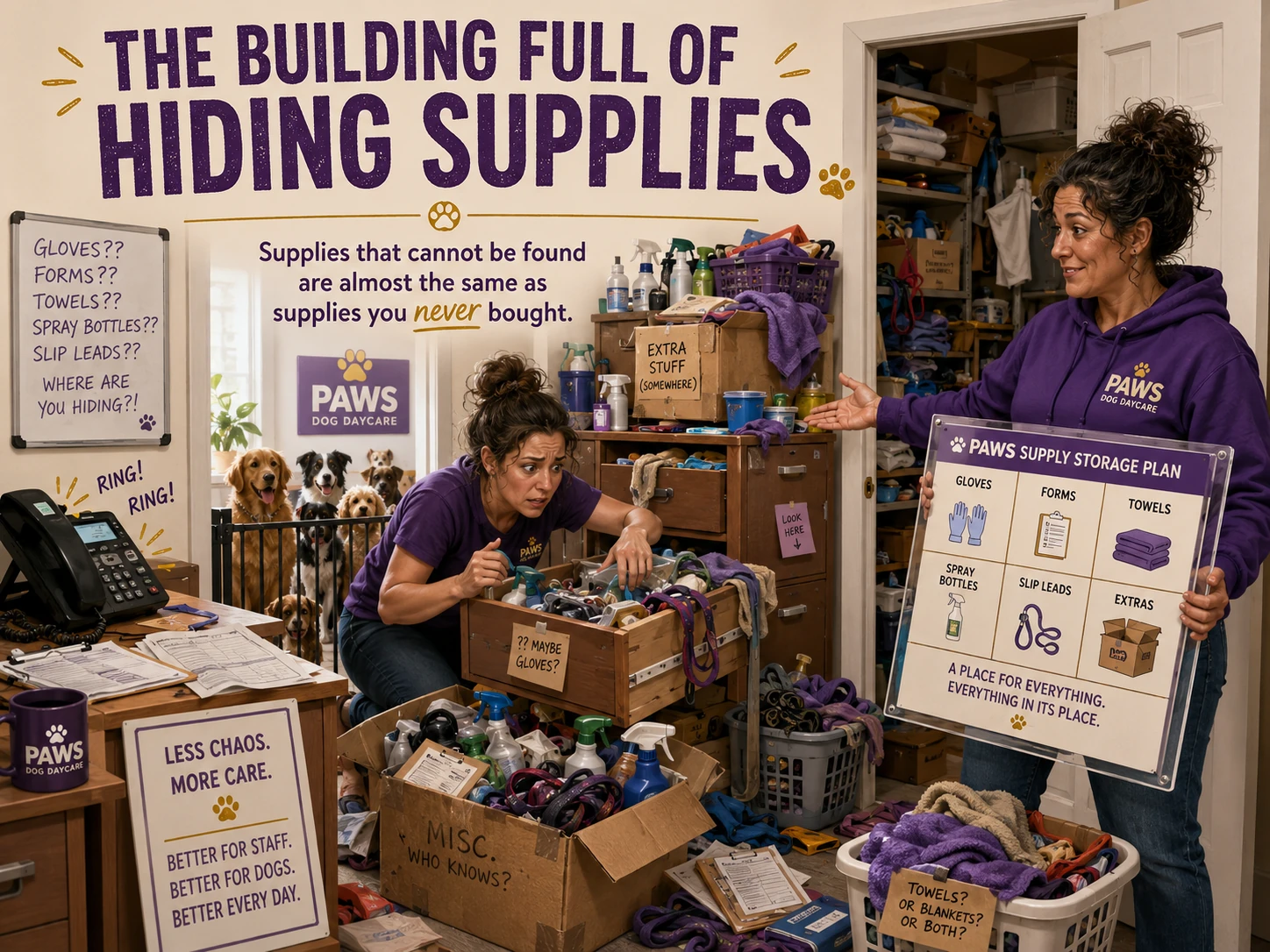
The biggest mistake new owners make is thinking supplies are just things to buy. They are not. Supplies are how the business functions when the lobby is full, the phone is ringing, two dogs are barking at the gate, a puppy just peed by the check-in counter, and somebody is asking whether you can “just squeeze in one more dog today.”
Your supplies decide whether your staff can move quickly, clean correctly, separate dogs safely, find records, identify special instructions, feed the right dog the right food, respond to incidents, and keep the building from smelling like a wet sock died under a kennel gate.
A good supply system answers practical questions before the chaos starts. Where are the slip leads? Where are the backup collars? Where do clean towels live? Where do dirty towels go? Where are the gloves? Where are the incident forms? Where are the feeding instructions? Where is the disinfectant? Who knows the contact time? Where are the SDS sheets? Where does dog luggage go? Where is the first-aid kit? Where does the poop go after someone bags it? Where does the mop go after someone uses it?
If your answer to those questions is “somewhere,” you do not have a system. You have a building full of supplies hiding from your employees.
📌
Operator rule
Buy supplies based on the work that happens every day, not based on what looks nice in a startup fantasy. Your first job is not to decorate the business. Your first job is to make the business function when dogs start doing dog things.
🧭
Supply Priority Sorter
Pick the services you plan to offer and this will sort the supply priorities. This is not a magic shopping list. It is a sanity check before you spend money like a golden retriever with a credit card.
🧱
Buy This First: The Core Dog Daycare Supply Stack
These are the boring, useful, everyday items that keep the place moving.
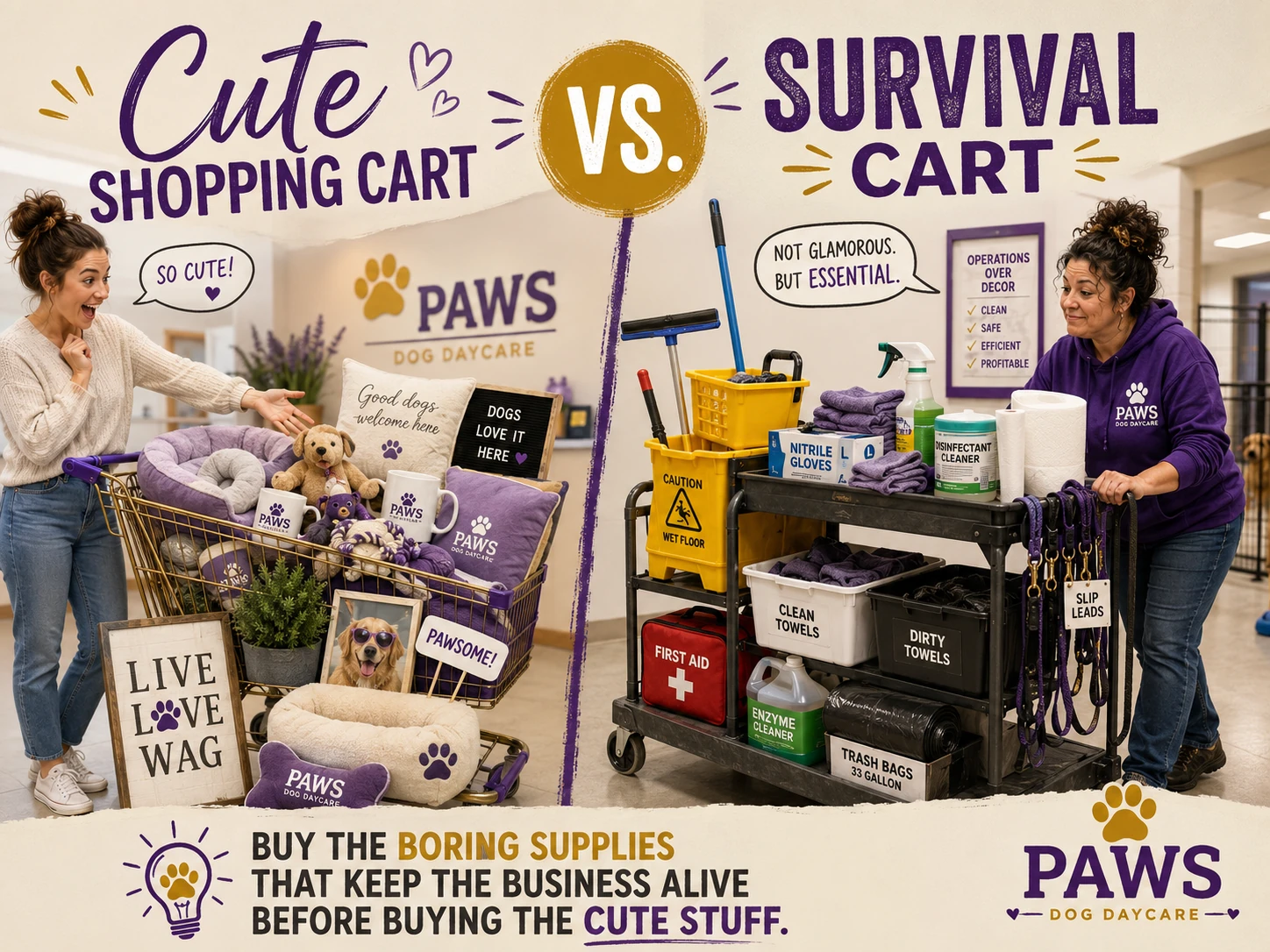
Before you start spending money on decorative furniture, retail displays, fancy photo walls, and cute little “dog mom” nonsense, make sure you have the core stack covered. These are the supplies your business will reach for every day. Some of them are not exciting. Good. Exciting supplies are usually expensive. Useful supplies are usually covered in dog hair by lunch.
If you only remember one thing from this page, remember this: the supplies that save you the most trouble are usually the ones customers never notice. A good mop system. Enough towels. Trash cans that close. Gloves that are actually stocked. Labeled bins. Backup leashes. First-aid kits. Kennel cleaner. A working printer. A system for dirty laundry. A place for dog belongings. A way to find emergency contacts without digging through a junk drawer like a raccoon with a GED.
| Core Supply Category | What You Need | Why It Matters |
|---|---|---|
| Cleaning tools | Commercial mop system, mop buckets, squeegees, push broom, standard broom, dustpan, scrub brushes, shop vac, spray bottles, gloves, paper towels. | This is the daily war machine. Cheap household tools will fold like lawn chairs. |
| Cleaning products | Kennel-safe disinfectant, general cleaner, glass cleaner, laundry detergent, odor-control products, waste cleanup supplies. | Dog daycare is a sanitation business. If the cleaning products are weak or used wrong, the building tells on you fast. |
| Waste control | Closable trash cans, poop bags, heavy-duty trash bags, outdoor waste containers, scoopers if needed, cleaning station supplies. | Dog waste has to move out of the play areas quickly. Do not make staff walk across the building carrying a biohazard trophy. |
| Dog handling | Slip leads, backup leashes, extra collars if appropriate, gates, barriers, muzzles, gloves, visual identifiers. | You need to move, separate, identify, and control dogs safely without turning every transition into a rodeo. |
| Feeding and water | Stainless bowls, water buckets or bowls, labeled feeding bins, measuring scoops, refrigerator, cleaning supplies for bowls, medication storage if applicable. | Food, water, and medication mistakes are the kind of mistakes that ruin your afternoon and possibly your reputation. |
| Laundry | Towels, laundry baskets, dirty-towel bins, detergent, disinfecting laundry plan, drying space, backup towels. | You will use more towels than your optimistic little startup brain currently believes. |
| Storage and identification | Labeled bins, cubbies, leash hooks, collar storage, luggage shelves, medical/special-instruction markers, intake tags. | If every dog’s belongings live in a pile, the business will eventually feed the wrong food, lose a leash, or create front-desk chaos. |
| First aid and safety | Dog first-aid kit, human first-aid kit, gloves, emergency contacts, incident forms, flashlight, batteries, spill response supplies. | Emergencies are not the time to discover the gauze is missing and the only pen at the front desk is dead. |
| Office and records | Computer, phone, printer/scanner, booking software, customer forms, vaccination records, payment system, basic financial software. | Modern daycare runs on records. Paper chaos becomes customer chaos. |
💵
Opening Supply Budget Estimator
This is the light public version. It helps you rough out the opening supply pile without pretending a free page can build your full purchasing plan.
🧼
Cleaning Supplies: The Stuff You Will Use Every Damn Day
If you hate cleaning, you are going to hate owning a dog daycare.
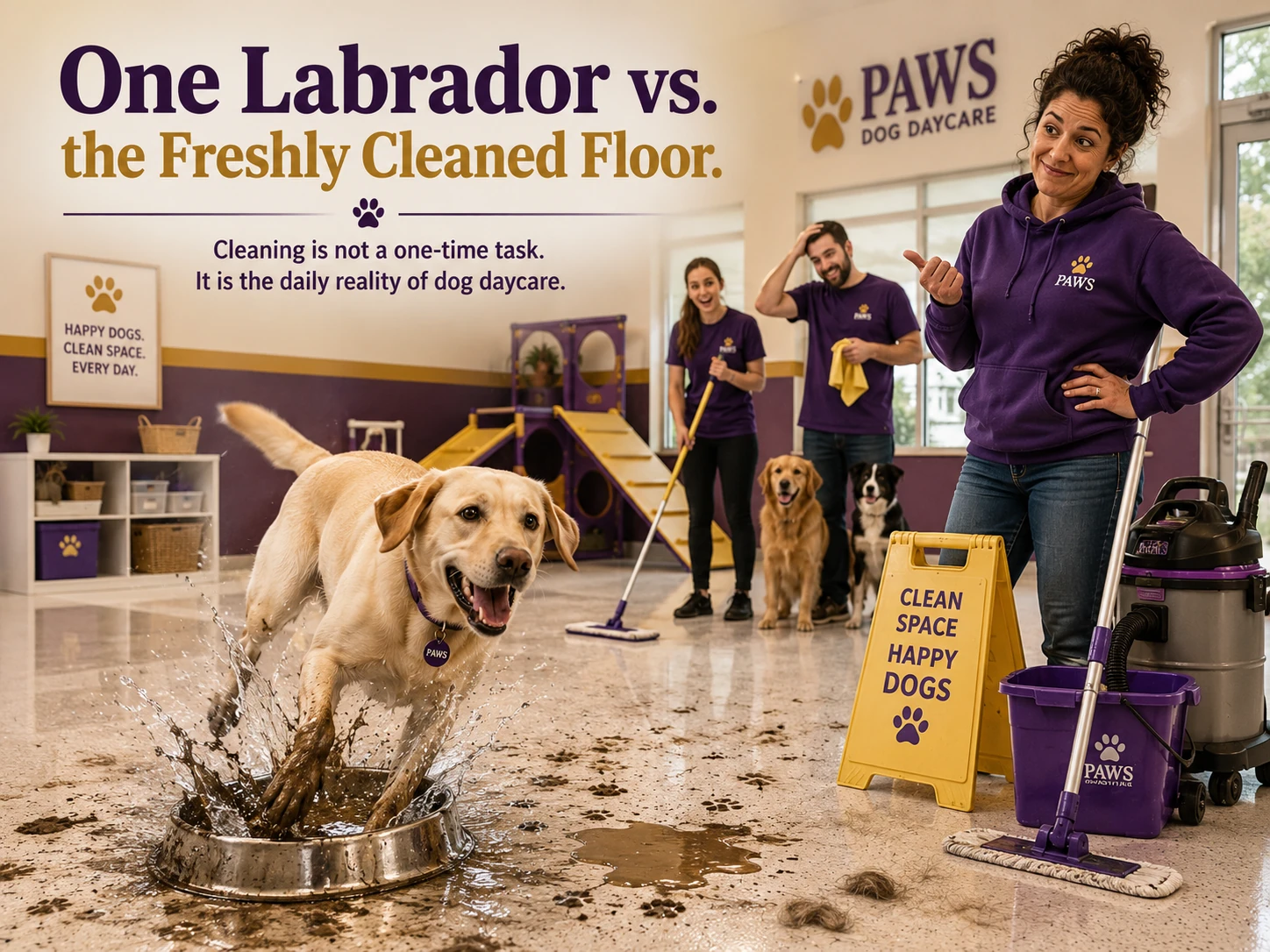
The old saying should be updated for dog daycare: behind every successful facility is a tired person with a mop wondering why they chose this life. Cleaning is not a side job in this business. Cleaning is the business breathing.
Floors get dirty. Walls get dirty. Gates get dirty. Doors get dirty. Windows get nose art. Bowls get slimy. Towels multiply. Trash fills up. Dogs shed enough hair to knit a second dog. If you do not build a serious cleaning system, the building will slowly become a stink box with a checkout counter.
Your cleaning tools need to be commercial, durable, easy to find, easy to replace, and easy to use. Do not buy the cheapest household mop because it was on sale and looked harmless. That thing was designed for a kitchen floor, not for a 50-dog playroom that just hosted a digestive uprising.
Floor tools
- Commercial mop handles and replaceable mop heads.
- Wringer mop buckets.
- Floor squeegees.
- Push broom for large areas.
- Standard broom and dustpan for small messes.
- Scrub brushes for corners, seams, and “what died there?” spots.
- Shop vac for hair, water, and wet messes where appropriate.
Daily cleaning supplies
- Kennel-safe cleaner/disinfectant.
- General-purpose cleaner.
- Glass cleaner for nose prints and paw prints.
- Paper towels or wipe system.
- Disposable gloves.
- Trash bags and poop bags.
- Laundry detergent and towel system.
Workflow supplies
- Cleaning caddies or wall stations.
- Clearly labeled spray bottles.
- Dirty mop-head storage.
- Clean towel storage.
- Dirty towel bins.
- Waste station supplies.
- Posted cleaning checklist for staff.
🧽
Your mop is not glamorous, but it may be the most honest employee in the building.
It does not care about your logo, your dream, your branding, or your opening announcement. It only cares whether the floor is filthy. In dog daycare, the mop tells the truth.
🦠
Disinfectants, Kennel Cleaners, Bleach, and Contact Time
Disinfection is not magic water. Use the right product, on the right surface, the right way.
Cleaning and disinfecting are not the same thing. Cleaning removes dirt, hair, slobber, poop residue, food, urine, mud, and the other lovely gifts dogs leave behind. Disinfecting is what happens after the surface is cleaned, when the product has a fair chance to do its job.
If you spray disinfectant over a dirty surface and call it done, you are not being efficient. You are decorating filth with chemicals. Organic material can interfere with disinfectants, and many products require the surface to stay wet for a specific contact time. That means you do not spray it, wipe it off instantly, and declare victory like you just performed science.
Read the label. Follow dilution instructions. Respect the contact time. Use the product on surfaces it is designed for. Store it safely. Train staff. Do not mix products unless the label says it is safe. Bleach plus the wrong cleaner can create dangerous fumes, and “I saw someone do it online” is not a safety protocol.
Bleach may have a place in some kennel or shelter-style cleaning protocols, but it is not automatically the answer to every daycare cleaning problem. It can be harsh on surfaces, dangerous if mixed improperly, irritating if used carelessly, and useless if the surface is not cleaned first. Kennel disinfectants, accelerated hydrogen peroxide products, quaternary products, and other commercial options all have different strengths, weaknesses, label directions, safety concerns, and surface compatibility issues.
The point is not to worship one product. The point is to build a cleaning and disinfection system that is effective, realistic, staff-proof, and safe enough to survive daily use by actual human beings who are tired, rushed, and surrounded by dogs.
| Disinfection Rule | What It Means | Operator Translation |
|---|---|---|
| Clean before disinfecting | Remove visible soil, waste, hair, food, and organic material first. | Do not spray chemicals on filth and pretend the room is clean. |
| Follow label directions | Use the proper dilution, surface, application method, PPE, and safety instructions. | The label is not decorative. It is the instruction manual. |
| Respect contact time | The surface usually has to stay wet long enough for the product to work. | Spray-and-pray cleaning is not a system. |
| Do not mix chemicals | Bleach and other disinfectants can create dangerous fumes when mixed with the wrong cleaner. | This is not where you become a garage chemist. |
| Check surface compatibility | Some products damage metals, rubber, flooring, equipment, or soft materials. | A disinfectant that destroys your facility is an expensive way to learn. |
| Train staff | Everyone should know what product to use, where to use it, how long it sits, and how to store it. | If only one person knows the system, you do not have a system. |
🛑
Do not cheap out on disinfection training.
Buying the right cleaner does not help if staff use it wrong, dilute it wrong, wipe it too soon, spray it on dirty surfaces, mix it with something stupid, or leave it in an unlabeled bottle next to the coffee maker like a lawsuit with a nozzle.
🌬️
Air Quality, Odor, HVAC, Dehumidifiers, and Why Air Purifiers Are Not Magic
Air purifiers can help. They do not fix dirty floors, wet towels, bad drainage, or poor cleaning.
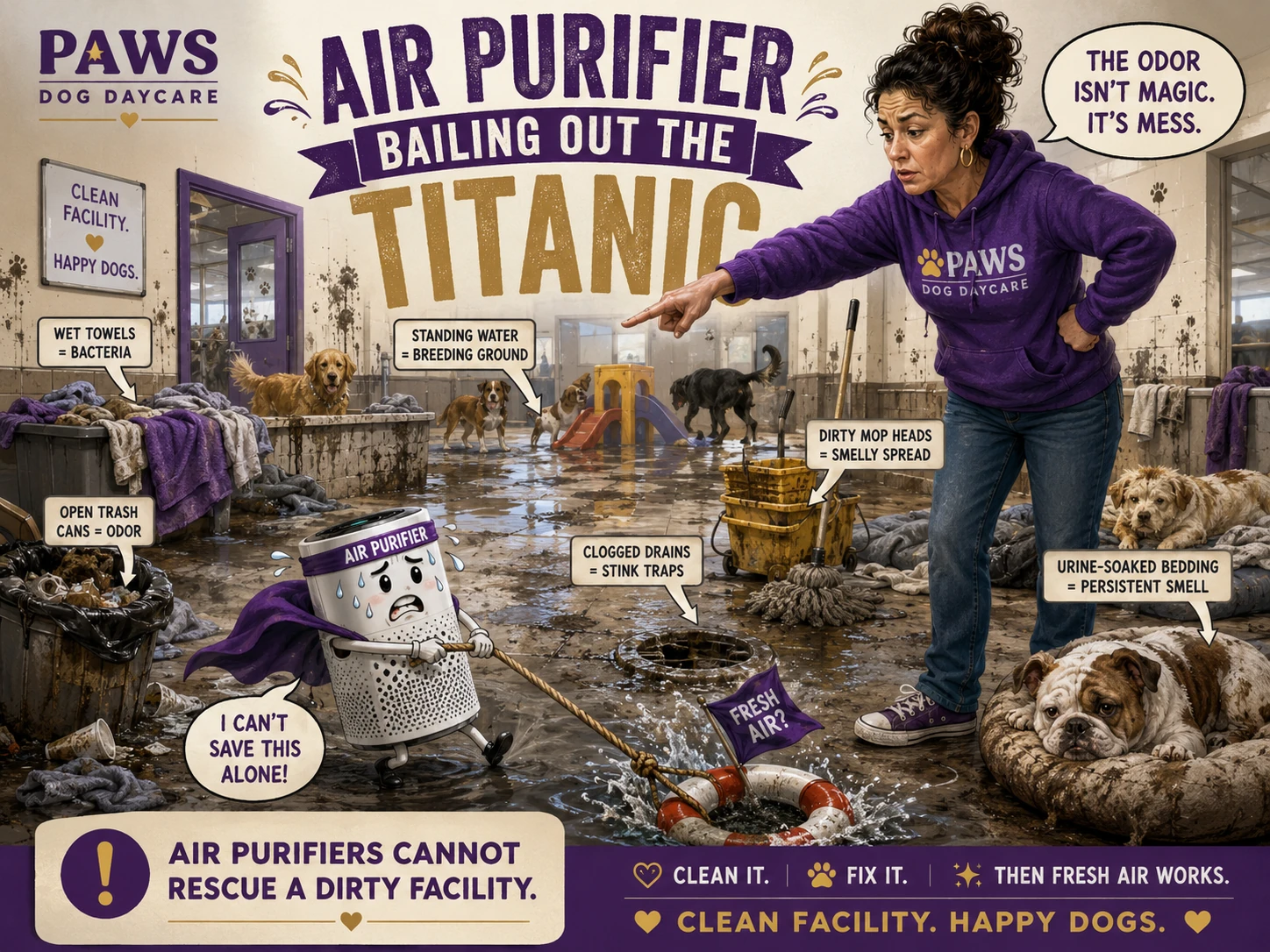
Dogs do not just make the floors dirty. They make the air dirty. Dander, hair, dust, moisture, cleaning product smell, wet-dog smell, urine odor, kennel odor, laundry odor, and general animal-business funk can build up fast. If you ignore the air, the building will tell customers before your staff says hello.
That said, do not treat an air purifier like a magical odor forgiveness machine. An air purifier is not a substitute for cleaning. It is not a substitute for drainage. It is not a substitute for ventilation. It is not a substitute for washing towels. It is not a substitute for removing trash. If the building stinks because the operation is dirty, the air purifier is just sitting there trying to bail out the Titanic with a coffee mug.
Air quality starts with facility design, ventilation, cleaning frequency, humidity control, laundry workflow, waste removal, flooring, drainage, and odor source control. Air filtration can be part of that system, but it should not be the only system.
Air problems usually start here
- Wet towels sitting too long.
- Trash cans without lids.
- Poor drainage or standing water.
- Urine trapped in soft materials.
- Dirty mop heads.
- Humidity from bathing or drying dogs.
- Weak ventilation or dead-air rooms.
Useful air-control tools
- Proper HVAC planning.
- Commercial air filtration where appropriate.
- Dehumidifier for grooming or damp areas.
- Odor-source removal.
- Regular filter changes.
- Closed waste containers.
- Good laundry turnover.
Do not expect air equipment to fix
- Bad flooring choices.
- Dirty playrooms.
- Poor staff cleaning habits.
- Improper disinfectant use.
- Wet bedding.
- Unwashed bowls.
- A facility that was designed like a basement gym for dogs.
📌
Operator rule
If customers can smell the business before they understand the business, you are already losing trust. Odor control is not perfume. It is cleaning, airflow, humidity, waste control, and not letting wet dog laundry ferment like a science project.
🐕
Dog Handling and Safety Supplies
You need tools that help staff move, separate, identify, and manage dogs safely.
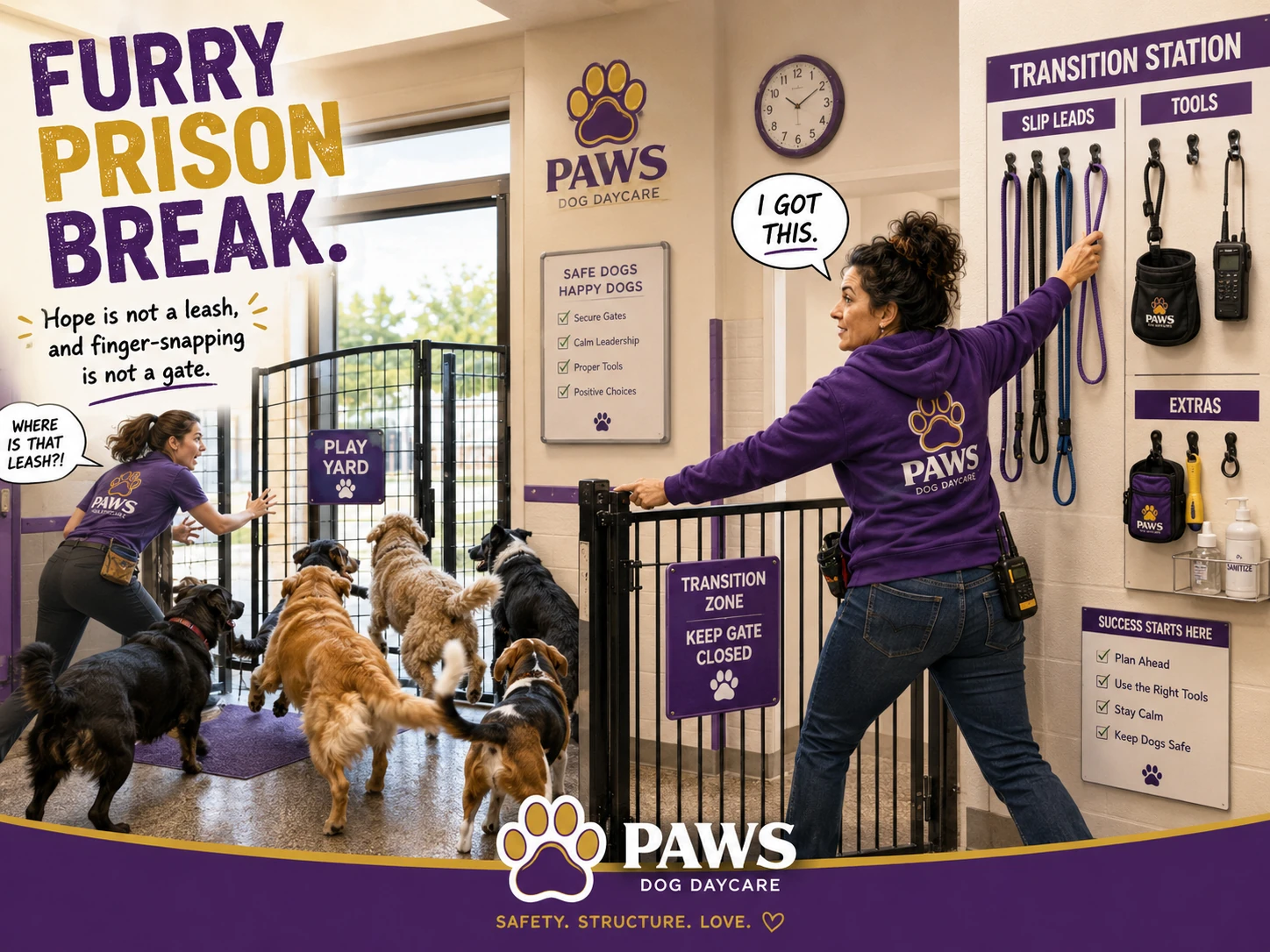
A dog daycare without proper handling supplies is just asking staff to solve live problems with hope and finger-snapping. Hope is not a leash. Finger-snapping is not a gate. You need the right tools available before the dog is already loose, overstimulated, guarding a toy, refusing to move, or trying to introduce chaos into your morning.
Dog handling supplies should be stored where staff can actually reach them. If your slip leads are in a box behind the printer, that does not help the attendant standing at the gate with six dogs pressing forward like a furry prison break.
| Handling Supply | Purpose | Operator Warning |
|---|---|---|
| Slip leads | Quickly and safely moving dogs when a customer leash is missing or inappropriate. | Keep them near entries, play areas, and transition points. |
| Backup leashes | Emergency handling, movement, and customer leash failures. | Customer leashes disappear, break, tangle, or arrive attached to the wrong dog. |
| Gates and barriers | Control movement, create separation, and manage transitions. | A good gate prevents drama. A bad gate creates it. |
| Muzzles | Emergency or controlled handling when appropriate and staff are trained. | Do not use tools staff do not understand. That is how tools become problems. |
| Gloves | Waste cleanup, minor first aid, cleaning, and handling messes. | If gloves are always “somewhere,” staff will eventually skip them. |
| Visual identifiers | Mark special needs, feeding notes, medication, intact status, or handling restrictions. | The point is not decoration. The point is preventing mistakes. |
| Group-management supplies | Tools that support separation, redirection, and safe movement. | Keep safety tools simple, accessible, and tied to staff training. |
📋
Intake, Identification, Storage, and Records
If you cannot identify the dog, the owner, the belongings, the food, the medication, and the instructions, you are not organized.
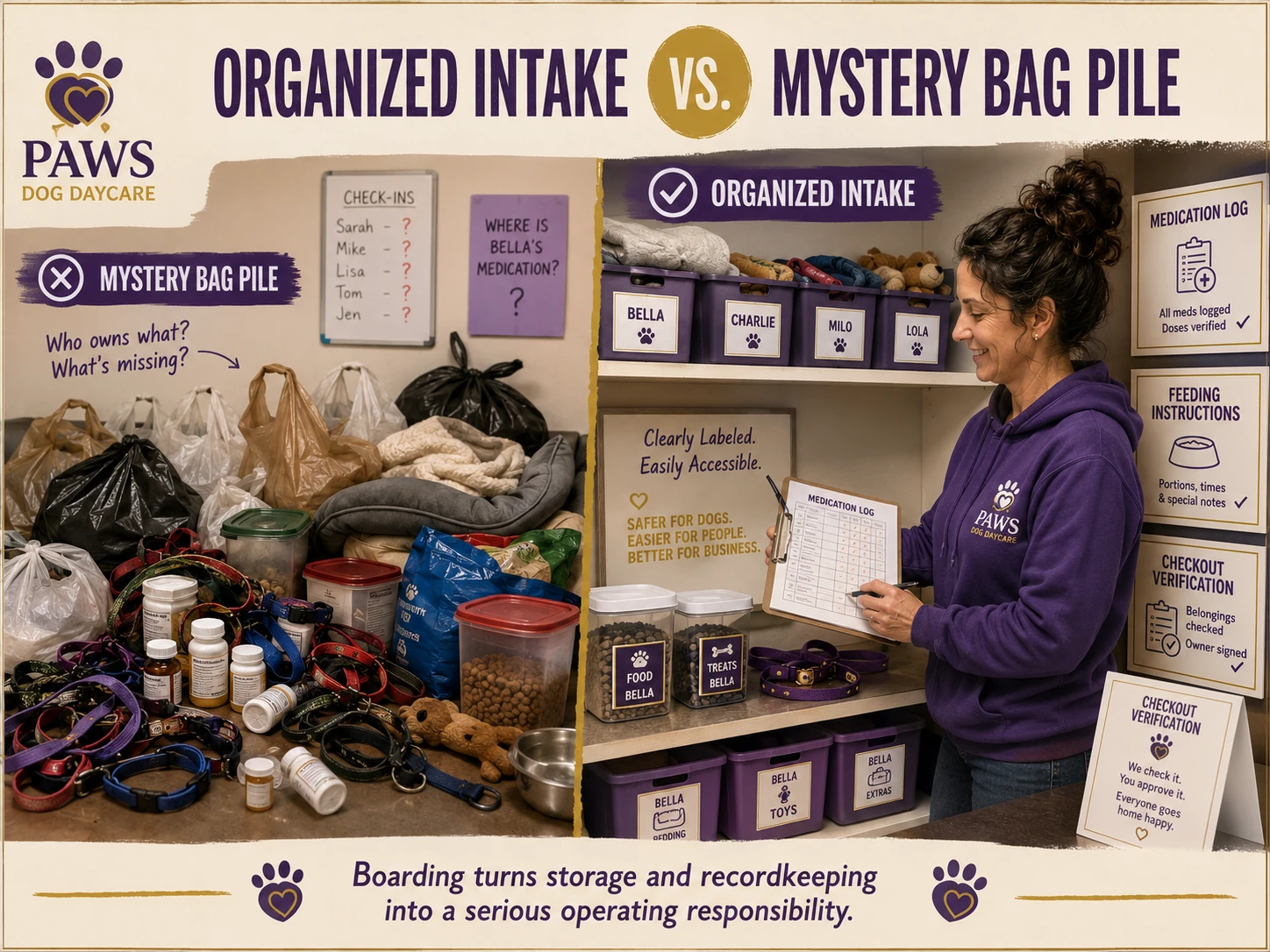
The supply system has to support records. That sounds boring until the front desk is trying to figure out which bag belongs to which dog, whether the dog gets lunch, whether the medication is due at noon, whether the owner approved group play, and whether the vaccination file is current.
You need a way to keep each dog’s belongings, instructions, leash, collar, food, medication, and special notes organized. Hooks can work for simple daycare-only operations, but once boarding, feeding, medication, or customer luggage enters the picture, bins and labeled storage become a lot more important.
A cheap storage system becomes expensive when it causes mistakes. Feeding the wrong food, losing a customer’s leash, misplacing medication, or forgetting a special instruction is not just inconvenient. It tells customers the business is sloppy.
Storage and identification supplies
- Labeled storage bins or cubbies.
- Leash and collar hooks.
- Boarding luggage shelves.
- Index-card slots or printed labels.
- Color-coded markers for special instructions.
- Red bowls or special identifiers for medical feeding needs.
- Medication lockbox or controlled medication storage where appropriate.
Recordkeeping supplies
- Customer intake forms.
- Vaccination records.
- Feeding instructions.
- Medication instructions.
- Emergency contact records.
- Incident report forms.
- Daily attendance and checkout records.
📌
Operator rule
If the system depends on one employee “just remembering,” the system is garbage. Build storage and records so the next person can understand what is happening without playing detective.
🥣
Feeding, Water, Boarding, and Medication Supplies
Food and medication are not areas where you want freestyle creativity.
Feeding supplies need to be boring, durable, cleanable, and organized. Stainless steel bowls are usually the practical choice because they are durable, easier to clean, and less likely to become chew toys than plastic. You also need a system for separating food, labeling it, storing it, measuring it, cleaning bowls, and tracking who ate what.
If you offer boarding, the supply load increases. Boarding dogs bring luggage, food, medications, bedding, instructions, and owner anxiety. That means you need better storage and better records. A daycare-only business can sometimes get by with a simpler setup. Boarding adds another layer of “please do not screw this up.”
| Supply Area | What to Stock | Why It Matters |
|---|---|---|
| Water | Stainless bowls, water buckets, cleaning brushes, drying rack, refill schedule. | Water systems get dirty fast. Slimy bowls are not a customer-confidence builder. |
| Feeding | Stainless bowls, measuring scoops, labeled food bins, feeding chart, cleaning protocol. | Food mistakes create stomach problems, owner complaints, and unnecessary drama. |
| Refrigerated items | Refrigerator, labeled containers, temperature awareness, separate storage where needed. | Some foods and medications need controlled storage. Do not wing it. |
| Medication | Medication log, original packaging policy, storage container, gloves, written owner instructions. | Medication errors are serious. This is not an “I think that was the right pill” situation. |
| Boarding belongings | Labeled bins, luggage shelves, bag tags, collar/leash storage, checkout verification. | Boarding turns storage into a real operational issue. Plan for it before bags pile up. |
🧺
Laundry, Towels, Bedding, and the Lie of Cute Dog Beds
Anything that absorbs urine, traps odor, gets chewed, or cannot be cleaned is not a supply. It is a future dumpster donation.
Towels are not optional. You will use them for wet dogs, muddy paws, spills, baths, accidents, cleanup, and whatever unplanned mess the building invents. Buy more than you think you need. Then assume half of them will be dirty, missing, wet, or being used by a staff member who swears they “just had it a second ago.”
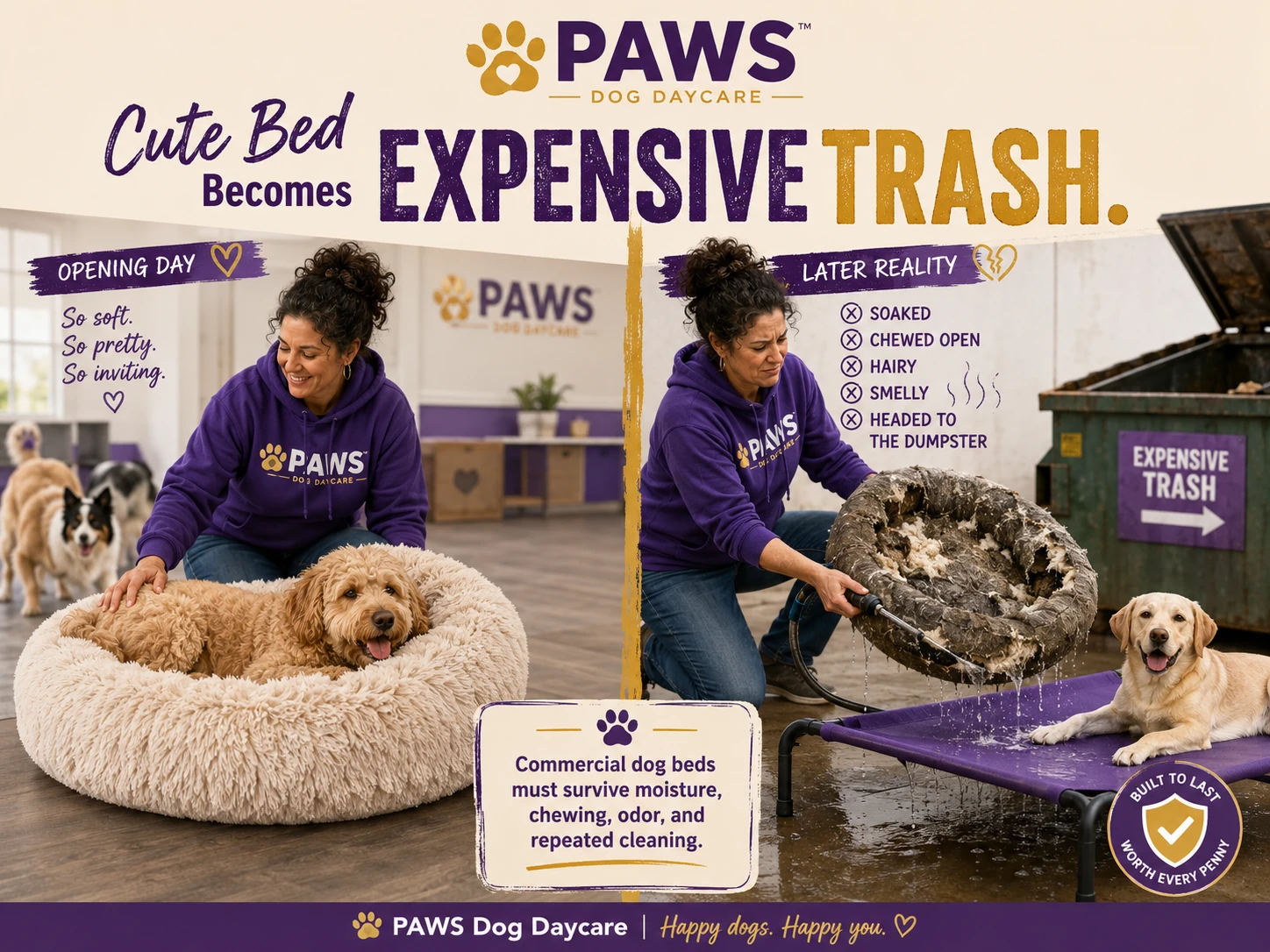
Bedding is trickier. Soft, cute, absorbent bedding may look nice in photos, but in a daycare or boarding environment it can trap urine, hair, odor, moisture, fleas, and chewing damage. If it cannot be cleaned properly and quickly, it may not belong in the facility.
This does not mean dogs should be uncomfortable. It means you need bedding and furniture choices that fit the cleaning reality. Pee-proof, chew-resistant, elevated, washable, and replaceable usually beats cute, fluffy, absorbent, and doomed.
The best commercial-style dog beds I ever used were Kuranda elevated dog beds. That is not because they were cute. It is because they were practical. They kept dogs off the floor, did not soak up urine like a sponge with a marketing budget, were easier to clean around, and held up better than the soft bedding people buy because it looks nice in the cart.
Elevated cot-style beds are usually the smarter direction for a daycare or boarding facility because they fit the reality of the business. Dogs are hard on equipment. Staff need to clean quickly. Odor has to be controlled. Bedding has to survive repeated use. If a bed cannot handle dogs, disinfecting, hair, moisture, and daily abuse, it does not belong in a commercial dog-care facility. It belongs in somebody’s living room until their own dog destroys it.
Buy plenty of
- Towels.
- Washable mats where appropriate.
- Dirty laundry bins.
- Laundry baskets.
- Detergent.
- Drying space.
- Backup laundry supplies.
Be careful with
- Soft beds.
- Fabric furniture.
- Stuffed bedding.
- Decorative pillows.
- Anything with seams dogs can chew open.
- Anything that cannot be sanitized.
- Anything that holds odor like it signed a lease.
Better choices often include
- Elevated cot-style beds.
- Kuranda-style commercial dog beds.
- Washable bedding.
- Chew-resistant surfaces.
- Water-resistant materials.
- Replaceable covers or parts.
- Items that can survive daily cleaning.
🛑
Do not furnish a daycare like a living room.
A couch may look charming until a nervous dog pees on it, another dog chews the corner, and the whole thing starts smelling like regret. Dog daycare furniture has to survive dogs, cleaning, moisture, odor, and reality.
🐾
Operator note on beds
If you are going to spend real money on dog beds for a daycare or boarding facility, spend it on beds that can take a beating. In my experience, Kuranda-style elevated beds are the category to look at first. They are not cheap throwaway fluff, and that is the point. Cheap dog beds in a commercial facility often become expensive trash.
💻
Office, Front Desk, Software, Payments, and Customer Communication
The front desk is where dog chaos meets customer expectations. Do not run it like a junk drawer.
The old front-desk setup used to be a desktop computer, phone, fax machine, cash drawer, paper forms, and a lot of crossed fingers. Modern dog daycare is different. Customers expect digital forms, vaccination tracking, online payment, booking reminders, email confirmations, photos, fast replies, and records that can be found without excavating a filing cabinet.
You do not need to buy every shiny system on the market. Some software subscriptions are useful. Some are expensive little ankle weights. But you do need a reliable way to manage customers, dogs, vaccinations, reservations, packages, payments, incident reports, staff notes, and communication.
The cash drawer also needs to match the system you are actually using. Do not buy random hardware and then discover it does not work with your software. That is not technology planning. That is buying yourself an argument.
| Front Desk Supply | What It Handles | Operator Warning |
|---|---|---|
| Computer or tablet setup | Customer records, reservations, email, payment, photos, forms, and daily workflow. | Use equipment reliable enough for the busiest part of the day. |
| Booking or kennel software | Reservations, profiles, vaccines, packages, attendance, services, and notes. | Do not choose software just because it looks cute. Test the workflow. |
| Payment system | Card payments, receipts, deposits, packages, refunds, and reporting. | Know your fees. Payment processing quietly eats margin. |
| Printer/scanner | Forms, records, vaccine documents, incident reports, and customer paperwork. | Paper is not dead. It just waits until your printer jams at the worst possible time. |
| Phone and email system | Customer questions, reminders, emergencies, cancellations, and follow-up. | Customer communication is part of the product. |
| Financial software | Revenue, expenses, taxes, reports, and planning. | If you do not track money, the money will leave unsupervised. |
| Forms and policies | Waivers, intake, incident reports, vaccination requirements, feeding notes, medication notes. | Forms are supplies. Bad paperwork creates operational and legal headaches. |
🚑
Human Safety, Dog Safety, First Aid, and Emergency Supplies
Safety supplies are not there because you expect a disaster. They are there because the day you need them, you need them now.
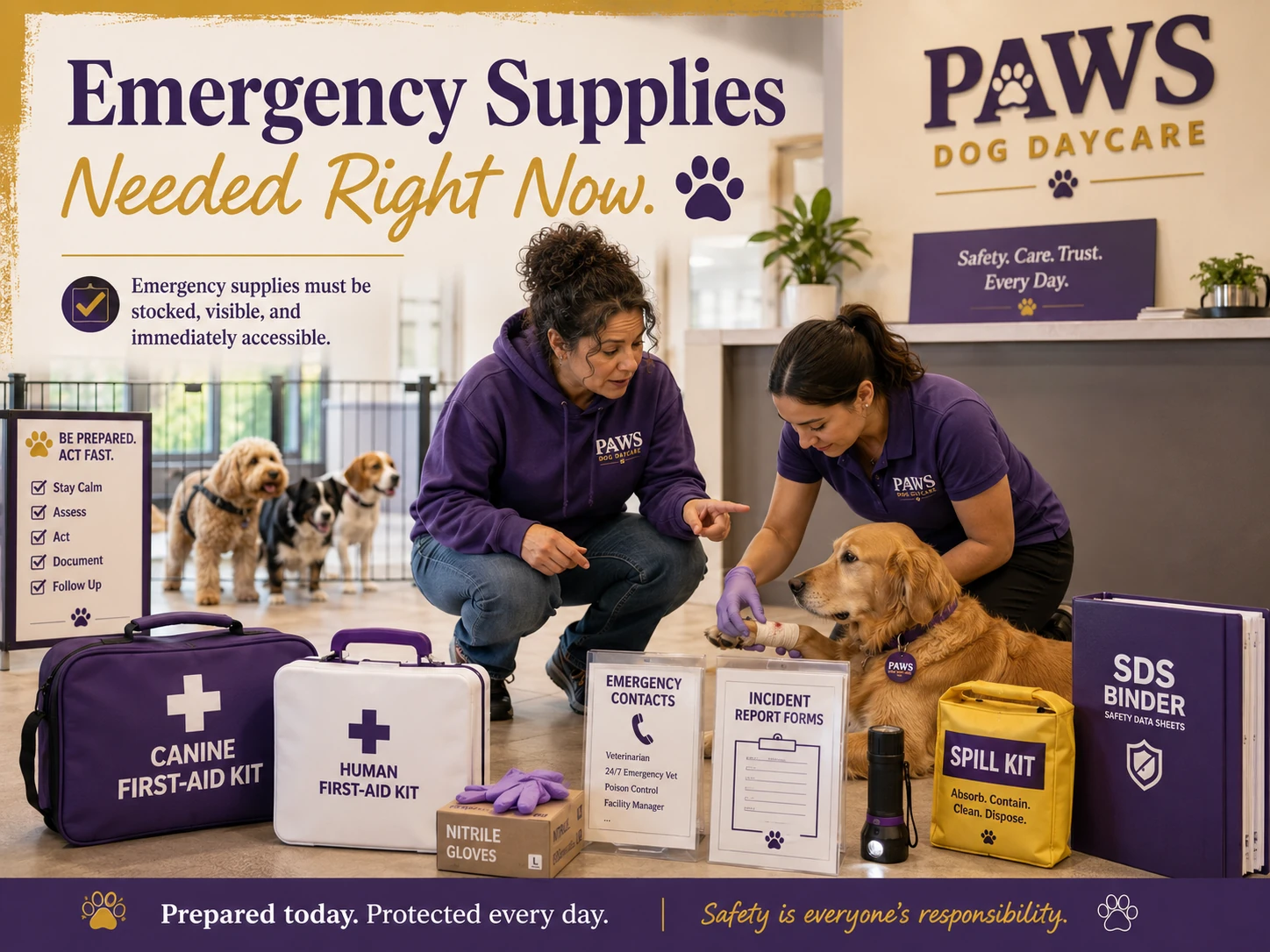
A dog daycare needs both dog first-aid supplies and human first-aid supplies. Dogs can get scrapes, torn nails, minor cuts, irritated paws, upset stomachs, or injuries from normal dog interaction. Humans can get scratched, bitten, slipped, splashed, strained, or exposed to cleaning products. This is a physical business. Pretending otherwise is how people get sloppy.
First-aid supplies should be accessible, stocked, labeled, and known by staff. Emergency numbers should be visible. Incident forms should be ready. Cleaning chemical information should be available. Gloves should be stocked. If you use chemicals that could expose eyes or skin to corrosive materials, make sure you understand what emergency flushing or eyewash setup is required for your workplace.
This does not mean turning the front desk into a hospital. It means being prepared like adults.
Dog first-aid supplies
- Bandage material.
- Gauze pads.
- Vet wrap.
- Antiseptic wipes or solution appropriate for dogs.
- Digital thermometer.
- Tweezers.
- Emergency vet contact list.
Human first-aid supplies
- Bandages.
- Gauze.
- Gloves.
- Antiseptic wipes.
- Cold packs.
- Eye wash or flushing plan where appropriate.
- Clearly marked first-aid location.
Emergency workflow supplies
- Incident report forms.
- Emergency contact sheets.
- Veterinary release forms.
- Staff emergency procedure cards.
- Flashlight and batteries.
- Spill kit or cleanup kit.
- SDS binder or digital chemical safety file.
📌
Operator rule
A first-aid kit that is empty, hidden, expired, or buried under holiday decorations is not a first-aid kit. It is a cardboard box with delusions.
🛑
What Not to Buy Yet
New owners love buying the fun stuff first. That is usually backward.
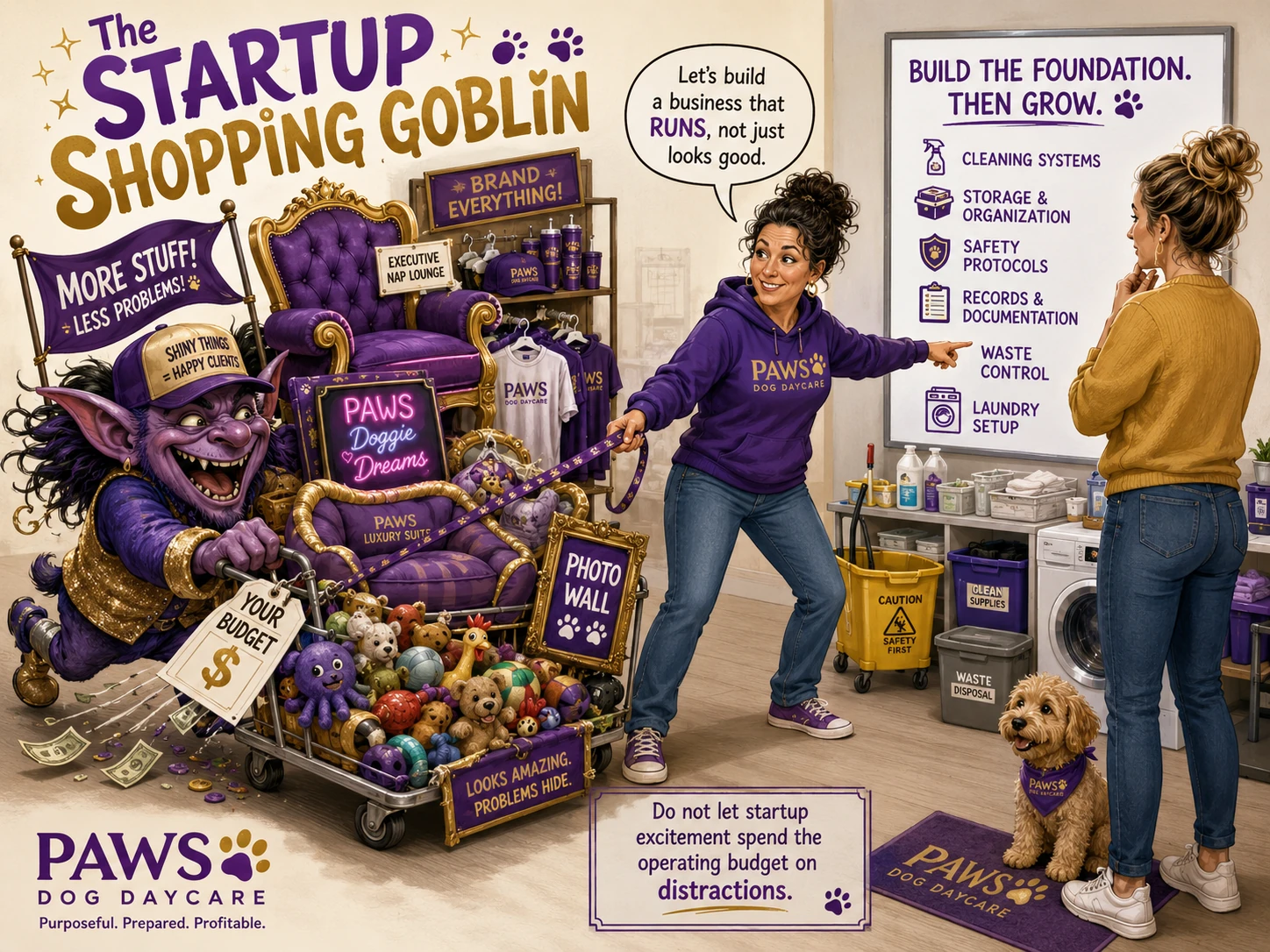
There is a dangerous little shopping goblin that lives inside every startup owner. It whispers, “Buy the cute lobby chairs. Buy the decorative dog beds. Buy the fancy retail display. Buy the expensive camera system. Buy the branded mugs. Buy the giant wall decal. Buy the stuff that makes this feel real.”
Tell that goblin to shut up until the cleaning system, safety system, storage system, record system, waste system, laundry system, and front-desk system are handled.
This does not mean appearance does not matter. It does. Customers judge the facility. But a pretty lobby attached to a dirty, disorganized, under-equipped operation is just lipstick on a kennel cough outbreak.
01
Cute Furniture Before Cleanable Furniture
Fabric, cushions, and decorative pieces can become odor traps, chew targets, and cleaning nightmares.
02
Fancy Lobby Before Functional Back-of-House
The lobby matters, but the dogs spend the day in the operating areas. Build those properly first.
03
Retail Displays Before Waste Control
If the facility smells bad, no one cares how nicely the treats are arranged.
04
Expensive Cameras Before Basic Records
Webcams are nice. Vaccination records, incident forms, and emergency contacts are not optional.
05
Too Many Toys
Toys can create guarding, conflict, choking risk, and cleanup issues. Buy with a plan, not because the aisle looked fun.
06
Cheap Cleaning Tools
The cheapest mop is rarely cheap after it slows staff down, breaks early, leaves the floor dirty, and ruins morale.
💸
Do not confuse spending money with building capacity.
Every dollar should make the business cleaner, safer, faster, more professional, easier to operate, or more profitable. If the item does none of those things, it can probably wait until the business has a pulse.
🛑
Do Not Buy This First Checker
Use this before the startup shopping goblin gets loose and starts throwing money at cute nonsense.
✅
Opening-Day Dog Daycare Supply Checklist
Use this as a starting checklist before dogs enter the building.
| Priority | Supply Category | Items to Have Ready |
|---|---|---|
| Must Have | Cleaning | Commercial mop system, buckets, squeegees, brooms, dustpans, scrub brushes, shop vac, gloves, disinfectant, cleaner, spray bottles, paper towels, trash bags. |
| Must Have | Waste control | Closable trash cans, poop bags, outdoor waste container, waste station supplies, cleaning station supplies. |
| Must Have | Dog handling | Slip leads, backup leashes, gates, barriers, muzzles where appropriate, staff-accessible handling supplies. |
| Must Have | Water and feeding | Stainless bowls, water bowls or buckets, cleaning brush, feeding chart, measuring scoops, labeled food storage. |
| Must Have | Records | Intake forms, vaccine records, emergency contacts, incident forms, feeding instructions, medication instructions, customer agreements. |
| Must Have | First aid | Dog first-aid kit, human first-aid kit, gloves, emergency vet numbers, staff emergency contacts, incident reporting supplies. |
| Must Have | Storage | Labeled bins, cubbies, leash hooks, luggage storage, medication storage where applicable, special-instruction identifiers. |
| Must Have | Office/front desk | Computer or tablet, phone, printer/scanner, software, payment system, cash drawer if used, forms, pens, labels, receipt process. |
| Strongly Recommended | Laundry | Large towel supply, dirty towel bins, laundry baskets, detergent, drying plan, backup towels. |
| Strongly Recommended | Air and odor | HVAC plan, filters, odor-source control, dehumidifier for grooming/damp areas, air filtration where appropriate. |
| Boarding Only | Overnight storage | Luggage bins, feeding storage, medication log, overnight cleaning supplies, bedding rules, checkout verification. |
| Grooming Only | Moisture and grooming cleanup | Dehumidifier, grooming towels, drying-area cleaning supplies, hair cleanup tools, drain protection where appropriate. |
| Nice to Have | Comfort and presentation | Customer-friendly lobby items, signage, retail display, branded materials, photo area, extra convenience features. |
📌
Opening-day rule
If an item affects cleaning, containment, safety, records, waste, water, feeding, first aid, or customer check-in, it belongs near the top of the list. If it mostly exists so the place feels cute, it can wait.
🔁
Monthly Reorder and Restock List
Opening supplies are only half the battle. The business has to keep restocking the boring stuff forever.
Supplies do not stay supplied. Poop bags disappear. Gloves disappear. Paper towels vanish into another dimension. Mop heads get disgusting. Spray bottles break. Towels die. Trash bags run out exactly when the morning group decides to test your faith in humanity.
Build a monthly reorder list and assign responsibility for checking it. Do not wait until staff are wiping up messes with napkins from the break room because nobody noticed the paper towel shelf was empty.
Cleaning restock
- Disinfectant or kennel cleaner.
- General cleaner.
- Glass cleaner.
- Paper towels.
- Gloves.
- Mop heads.
- Scrub brushes.
- Spray bottles.
Waste and laundry restock
- Poop bags.
- Trash bags.
- Laundry detergent.
- Towels.
- Dirty laundry liners if used.
- Odor control products.
- Waste station supplies.
- Replacement bins or lids.
Office and safety restock
- Printer paper.
- Labels.
- Forms.
- Pens.
- First-aid replacements.
- Batteries.
- Leashes or slip leads.
- Staff checklist copies.
🖨️
Printable Monthly Reorder Checklist
Supplies do not stay supplied. Print this, stick it where staff can see it, and stop discovering empty shelves after the poop has already happened.
❓
Dog Daycare Supplies FAQ
Detailed answers to the cleaning, disinfection, storage, dog-handling, laundry, bedding, intake, feeding, first-aid, software, budgeting, and restocking questions that determine whether the facility is actually ready to operate.
What supplies are absolutely essential before a dog daycare opens?
The true opening essentials are commercial cleaning tools, approved cleaners and disinfectants, waste-control supplies, slip leads and containment tools, water and feeding equipment, labeled storage, towels and laundry handling, dog and human first-aid kits, emergency contacts, customer and vaccination records, incident forms, and a reliable front-desk system. These items support sanitation, containment, safety, identification, communication, and daily workflow. Decorative furniture, retail displays, photo props, and branded merchandise can wait. A facility is not ready because it looks finished; it is ready when staff can safely handle the normal work and the predictable mess.
Why should supplies be planned as an operating system instead of a shopping list?
A shopping list tells you what was purchased. An operating system tells staff where each item belongs, when it is used, how it is cleaned or restocked, and who is responsible for it. The system should answer practical questions immediately: where are the slip leads, gloves, clean towels, incident forms, disinfectant instructions, feeding notes, medication records, and emergency contacts? Supplies that are hidden, unlabeled, empty, or stored far from the work do not create readiness. Good planning connects the item to the workflow.
Are household mops, brooms, and cleaning tools good enough?
Usually not for sustained commercial use. Household tools are designed for smaller surfaces, lighter soil, and occasional cleaning, while a daycare repeatedly handles hair, urine, water, mud, waste, disinfectant, and large floor areas. Commercial handles, replaceable mop heads, wringer buckets, floor squeegees, push brooms, scrub brushes, and an appropriate wet/dry vacuum generally withstand the workload better and reduce staff frustration. A cheap tool that slows cleaning, breaks early, or leaves the floor dirty is not actually inexpensive.
What is the difference between cleaning and disinfecting?
Cleaning removes visible soil and organic material such as hair, mud, urine, fecal residue, food, slobber, and dirt. Disinfecting uses an appropriate product on the cleaned surface according to its label so the product can address the organisms it is designed to control. Applying disinfectant over a dirty surface can reduce effectiveness because organic material interferes with the process. The normal sequence is remove debris, clean the surface, apply the correctly prepared disinfectant, maintain the required wet contact time, and complete any rinse or drying step required by the label.
Can bleach be used as the only daycare cleaning product?
No. Bleach may have a role in some protocols, but it is not automatically appropriate for every organism, surface, dilution system, or staff workflow. It can damage materials, irritate animals and people, and create dangerous fumes when mixed with incompatible products. The facility needs products selected for the actual surfaces, disease-control goals, label directions, ventilation, storage, and staff ability to use them correctly. Never mix cleaning chemicals unless the product directions expressly permit it.
Why does disinfectant contact time matter?
Many disinfectants require the surface to remain visibly wet for a stated period before the product has completed its labeled job. Spraying and immediately wiping may leave the facility looking busy without producing the intended result. Contact time affects staffing, room rotation, spray-bottle preparation, and how large areas are cleaned. Staff should know the required dilution, application method, contact time, personal protective equipment, surface compatibility, and whether a rinse is required.
Does a dog daycare need an air purifier?
It may be useful as one part of an air-quality plan, but it cannot replace source control. Odor and poor air often begin with wet towels, standing water, open trash, dirty mop heads, porous materials, weak drainage, high humidity, inadequate ventilation, or incomplete cleaning. HVAC capacity, fresh-air exchange, filter maintenance, laundry turnover, waste removal, humidity control, and sanitation come first. An air purifier can support those systems; it cannot make a dirty facility smell professionally managed.
How many towels should a daycare purchase?
More than the number needed for one normal shift. Towels are used for wet dogs, muddy paws, bathing, spills, accidents, cleaning, and unexpected messes, while part of the inventory will always be dirty, washing, drying, damaged, or temporarily missing. Estimate peak daily use, laundry turnaround, boarding or grooming demand, and the backup needed if equipment fails. The correct number is enough to continue operating without reusing dirty towels or waiting for an emergency laundry cycle.
What type of dog beds work best in a commercial daycare or boarding facility?
Beds should be selected for cleanability, moisture resistance, durability, chew resistance, repairability, and the way they fit the facility’s cleaning process. Plush household beds may look attractive but can absorb urine, hold odor and hair, conceal damage, and become expensive waste. Elevated commercial cot-style beds are often more practical because staff can clean around them and the sleeping surface is less absorbent. No bed is indestructible, so inspection, replacement parts, sanitation, and removal of damaged equipment still matter.
What dog-handling supplies should be placed near transition areas?
Transition points should have accessible slip leads, backup leashes, secure gates or barriers, and any approved visual identifiers or emergency handling tools used by trained staff. The equipment should be placed where dogs actually enter, leave, or move between groups—not hidden in an office. Gate design and staff procedure matter as much as the supplies themselves. The goal is controlled movement without crowding, escape opportunities, or employees searching for equipment while several dogs press toward an opening.
How should customer belongings and boarding luggage be organized?
Use labeled bins, cubbies, shelves, leash hooks, food storage, medication controls, and a checkout-verification process tied to the dog’s record. Food, medication, bedding, collars, leashes, and owner instructions should remain identifiable throughout the stay. Boarding adds volume and complexity that a simple daycare hook system may not handle. A loose pile of bags invites lost property, wrong food, missed medication, and a sloppy customer experience.
What supplies are needed for feeding and medication?
Feeding requires durable cleanable bowls, measuring tools, labeled food storage, written feeding instructions, a cleaning and drying process, and refrigeration when required. Medication handling requires written owner directions, original packaging rules, secure storage, a medication log, responsible staff assignment, and documentation of each administration. These systems should prevent one dog’s food or medication from being confused with another’s. Food and medication are not areas for memory-based improvisation.
What should be included in dog and human first-aid supplies?
The facility should maintain separate, clearly identified supplies appropriate for minor dog and human injuries, along with gloves, bandage materials, gauze, emergency contacts, incident forms, flashlights, spill supplies, and chemical safety information. Exact contents should reflect veterinary guidance, workplace requirements, the chemicals used, and the services offered. Staff must know where the kits are, how to report an incident, and when professional medical or veterinary care is required. A hidden or depleted kit is not preparedness.
Does a small daycare really need management software?
It needs a dependable system for reservations, customer records, dog profiles, vaccination status, attendance, packages, payments, feeding or medication notes, incidents, and communication. A small operation may not need the most expensive platform, but it still needs records that are current, searchable, backed up, and understandable by more than one employee. Before buying software, test the real workflow from intake through checkout. The wrong system can create duplicate work and subscription expense without solving the operating problem.
How should supplies be stored inside the facility?
Store supplies by work zone and risk. Frequently used handling and cleanup tools should be close to the areas where they are needed, while chemicals, medications, food, clean linens, dirty laundry, and customer records should remain appropriately separated and controlled. Use durable labels and fixed locations so new and existing staff can find items without guessing. Storage should also make inventory shortages visible before the shelf is empty.
How much should be budgeted for opening supplies?
The answer depends on facility size, services, existing equipment, inspection requirements, quality level, and whether daycare is combined with boarding, grooming, outdoor play, transport, retail, or webcams. Build the budget by category rather than one lump sum: cleaning and sanitation, handling, safety, office, laundry, feeding, storage, air quality, and specialty services. Add freight, tax, installation, replacements, and a realistic cushion. The cheapest opening stack is not always the least expensive once weak tools begin failing.
Which purchases should usually wait until after the essentials are funded?
Decorative furniture, luxury lobby upgrades, elaborate retail fixtures, excessive toys, branded merchandise, photo walls, and expensive technology that does not solve an immediate operating need can usually wait. Appearance matters, but it should not displace cleaning, containment, first aid, records, waste control, storage, laundry, or staff tools. A useful test is whether the purchase makes the business cleaner, safer, faster, easier to operate, or more profitable. If it does none of those things, it is probably not an opening priority.
How should monthly reordering be managed?
Create a standing checklist with minimum quantities, normal usage, reorder points, preferred vendors, backup vendors, and one person responsible for review. Track disinfectant, cleaners, gloves, paper towels, poop bags, trash bags, detergent, mop heads, towels, labels, first-aid replacements, batteries, forms, and handling equipment. High-use items should be checked more often than monthly when necessary. Waiting until the last bottle or bag is opened turns predictable consumption into an avoidable emergency.
How do boarding, grooming, outdoor play, and transport change the supply list?
Each service adds its own equipment, storage, cleaning, documentation, and safety burden. Boarding adds luggage, feeding, medication, bedding, and overnight cleaning systems. Grooming adds tubs, drying, hair control, towels, chemicals, moisture management, and plumbing-related supplies. Outdoor play adds waste stations, weather equipment, yard tools, gates, and drainage concerns. Transport adds vehicle restraints, cleaning, emergency supplies, records, and commercial-use considerations. The supply plan should match the services actually approved and staffed.
How can I tell whether the daycare is truly opening-day ready?
Walk through a complete operating day before dogs arrive. Simulate check-in, dog movement, a urine accident, waste removal, feeding, medication, a minor injury, dirty laundry, customer pickup, a missing leash, and an empty supply container. Staff should be able to find the required tools and records immediately and explain the process without relying on one person’s memory. Any step that produces searching, guessing, cross-contamination, or an empty shelf identifies work that must be fixed before opening.
🧠
The Bottom Line
Dog daycare supplies are not about looking prepared. They are about surviving the work.
You are going to clean constantly. You are going to handle dogs constantly. You are going to do laundry constantly. You are going to take out trash constantly. You are going to update records, answer phones, check vaccines, label belongings, wipe nose prints, refill bowls, bag poop, restock gloves, replace mop heads, and wonder how one golden retriever created that much hair in one afternoon.
That is the business. The right supplies do not remove the work, but they make the work manageable. The wrong supplies make every normal day harder than it needs to be.
Build the supply system around the real work: cleaning, containment, safety, records, feeding, laundry, air quality, storage, and front-desk workflow. Buy the boring essentials first. Add the cute stuff later, after the business can stand on its own legs without slipping in its own mop water.