Dog Daycare Startup Help Options, Franchise, Consultant, Manual, Software, Lawyer, Accountant, Contractor, Trainer, Insurance Agent, Marketing Help, Acquisition Broker, and Startup Support
Dog Daycare Startup Help Options: Match the Help to the Actual Problem
Franchise, consultant, manual, software, templates, lawyer, accountant, contractor, trainer, acquisition broker — match the help to the actual problem.

Do not buy a franchise because you need a lease reviewed. Do not hire a lawyer because you need dog-flow design. Do not buy software because you have no operating system. Match the help to the problem, or you will spend money and still be lost.
This is the closeout page for the franchise comparison series. By now, you should understand franchise costs, royalties, control, brand recognition, FDDs, operating systems, consultants, independent startups, and buying an existing dog daycare. Fine. Now comes the practical question.
What kind of help do you actually need?
Some owners need a franchise system. Some need a consultant. Some need a lawyer. Some need an accountant. Some need a contractor who can actually build what the operator needs. Some need software. Some need a manual and enough discipline to read it. Some need to stop shopping for help and admit they do not know what problem they are trying to solve.
There is no gold medal for doing everything alone. There is also no gold medal for overpaying for a giant help package when you only needed three specific answers.
The right help saves money because it stops you from paying the wrong person to answer the wrong question.
⚠️
Operator warning: help is not magic.
A startup does not fail because the owner lacked one magic helper. It fails because the owner did not know which problems needed which kind of help. A lawyer cannot make bad dog flow safe. Software cannot fix stupid pricing. A contractor can build a bad idea perfectly.
🗺️
Use This Page Like a Help-Sorting Map
Start with the problem. Then pick the helper.

Use the map to separate the kind of problem from the size of the solution before contacting anyone.
A clear diagnosis prevents the owner from buying a full package when the business needs one focused legal, financial, design, training, software, or marketing answer.
🏷️
Price / Revenue / Payroll
You need math help, pricing help, accounting help, or operator cost review. Cute branding does not make payroll affordable.
🏢
Lease / Legal / Purchase Deal
You need attorney review, not a confident guess from a consultant, broker, landlord, or Facebook group.
🧱
Layout / Build-Out / Dog Flow
You may need a dog daycare consultant, contractor, architect, code help, and somebody who understands live dog movement.
🐕
Dog Handling / Staff Training
You need operations, temperament testing, behavior, grouping, staff rules, and real dog-control knowledge.
💻
Software / Records
Software records the system. It does not create a good system out of thin air.
🧰
Full Startup Direction
If you do not know what you do not know, you may need a manual, consultant, franchise, or structured startup plan.
💸
The Wrong Help Is Expensive Even When It Is Good Help
A good professional can still be the wrong professional for the question.
A lawyer may be excellent. That does not mean the lawyer can design your playroom flow. An architect may be excellent. That does not mean the architect understands dog grouping, gate pressure, cleaning movement, or why a hallway that looks fine on paper becomes a staff traffic jam once 70 dogs are in the building.
A software company may be excellent. That does not mean the software knows your prices are dumb. A contractor may be excellent. That does not mean the contractor will stop you from building the wrong thing. A franchise may be excellent. That does not mean it is the right size solution for the problem you actually have.
Help is not automatically valuable because it is professional. Help is valuable when it solves the right problem at the right time for the right cost.
This is not launching an initial public offering of SpaceX. It is a dog daycare startup. But small business money still disappears fast when the owner pays one person to solve a problem that belongs to somebody else.
Before hiring anyone, define the decision, deadline, money at risk, and evidence needed. A general conversation may be useful early, but a lease, construction plan, acquisition, or pricing model requires a specific scope and a written answer the owner can act on.
The same professional may be appropriate at one stage and premature at another. Paying for construction drawings before dog flow is resolved, software before workflows are written, or legal drafting before the business terms are settled creates rework instead of progress.
📌
The startup-help rule
Do not start by asking, “Who should I hire?” Start by asking, “What problem am I trying to solve?”
🧩
No One Person Solves the Whole Startup
If somebody says they handle everything, ask what “everything” actually means.

A dog daycare startup is not one problem. It is a pile of problems wearing one business name.
You have market research, location, zoning, lease terms, build-out, drains, flooring, HVAC, gates, insurance, software, pricing, payroll, staffing, temperament testing, customer agreements, cleaning procedures, dog handling, marketing, website, reviews, bookkeeping, taxes, and the delightful little surprise category called “things nobody mentioned until you were already spending money.”
One person usually does not solve all of that. A franchise may provide a broad system, but it still does not replace your attorney, accountant, landlord, contractor, insurance agent, local permit office, and staff. A consultant may know dog daycare operations, but that does not make the consultant your lawyer. A contractor can build walls, but that does not mean the contractor should decide where dogs move.
The goal is not to collect advisors like trading cards. The goal is to know who answers which question.
The owner should create a responsibility map showing who advises, who decides, who designs, who verifies compliance, who performs the work, and who signs off. Without that map, important questions fall between professional lanes.
Overlap is useful when it is intentional. The consultant and architect should discuss dog movement; the accountant and operator should discuss pricing; the attorney and broker should discuss the purchase documents. Overlap becomes waste when several people repeat the same work without a clear decision owner.
📝
Before You Call Anyone, Write Down the Actual Problem
Do not call five professionals with a foggy question and expect a clean answer.
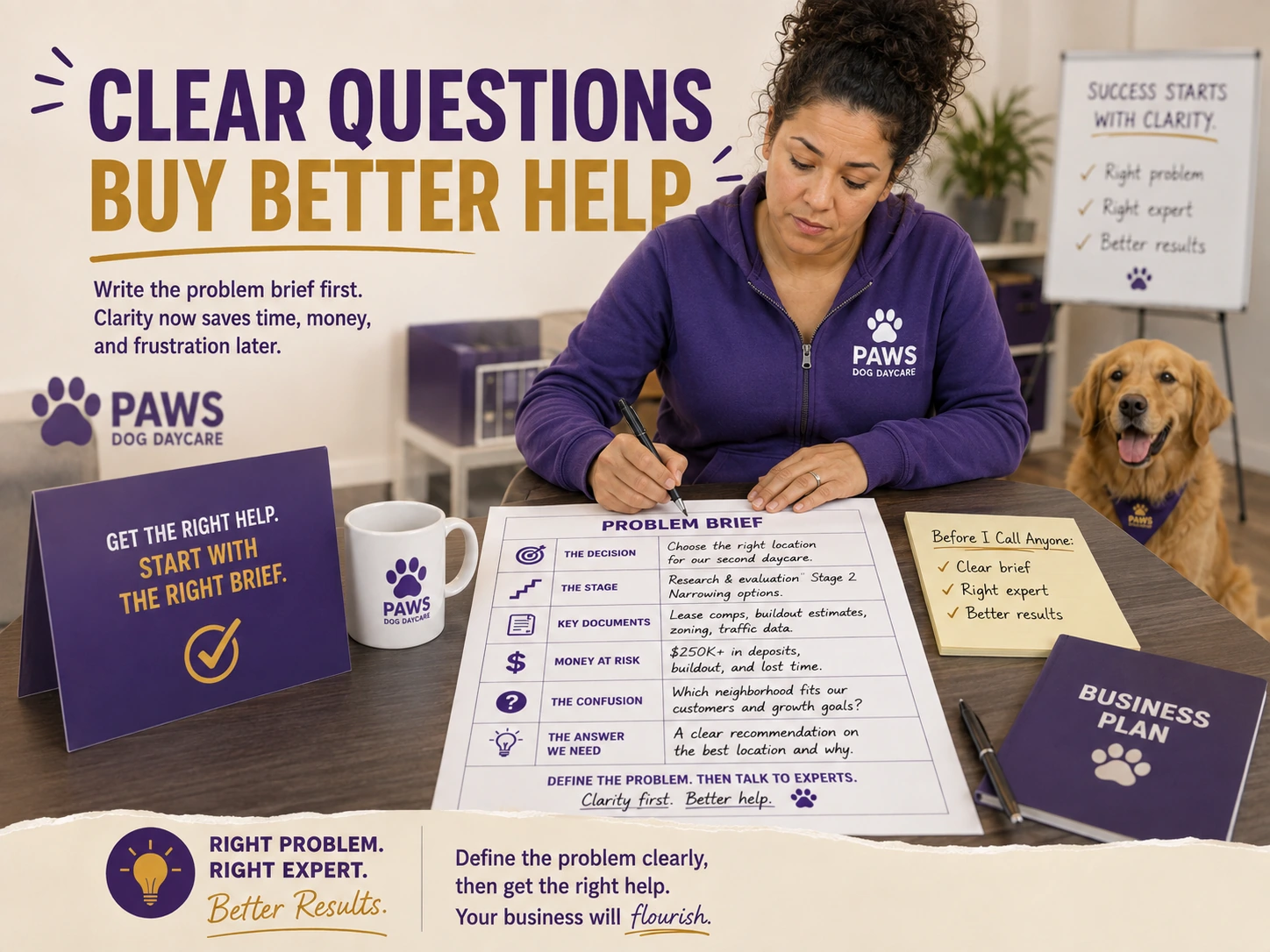
A lot of owners waste money because they call the helper before they understand the question. They call a franchise company and say, “I want to start a dog daycare.” They call a consultant and say, “What do I do?” They call a contractor and say, “Can you build this?” They call a lawyer after the lease is already in their inbox and their brain has already moved into the building.
Slow down. Before you call anyone, write a simple problem brief. It does not need to be fancy. You are not applying to Harvard. You are trying to stop your money from running into traffic.
The better you can explain the problem, the easier it is to know who should help. A vague owner gets vague help. A clear owner gets better answers faster.
Attach the documents that control the answer. A lease question needs the lease and site facts. A pricing question needs rent, payroll, capacity, service mix, and demand. A layout question needs the plan, dimensions, doors, drains, yards, and operating routines.
End the brief with the decision the owner must make. “Tell me what you think” invites a broad conversation. “Should I sign this lease before the zoning contingency is resolved?” or “Can this plan move boarding dogs without crossing daycare traffic?” produces a usable answer.
- What are you trying to do: start independent, buy existing, compare franchises, add boarding, add grooming, or build a full pet-care facility?
- What stage are you in: idea, location search, lease review, build-out, pricing, hiring, buying existing, or opening soon?
- What decision is in front of you right now?
- What money is at risk if you make the wrong decision?
- What documents do you already have: lease, floor plan, broker packet, franchise FDD, contractor bid, software proposal, financials, or insurance quote?
- What are you confused about?
- What answer do you need before you spend more money?
📌
The cleaner question
Bad question: “Can you help me start a dog daycare?” Better question: “I am looking at a 6,000-square-foot lease, want daycare, boarding, and grooming, and need to know whether the layout, lease, startup cost, and service mix make sense before I sign.”
🏪
Franchise Help
A franchise is one kind of help. It is not “all help.”
A franchise may give you branding, operating standards, training, vendor expectations, software requirements, opening support, marketing templates, design standards, and a structured system. For some buyers, that structure has value.
But a franchise is not a rich uncle, rescue squad, emotional support animal, or magic business helmet. You still need a lease. You still need permits. You still need build-out. You still need payroll. You still need staff. You still need local customers. You still need a lawyer to review the FDD and franchise agreement. You still need an accountant to review the numbers. You still need the stomach to operate the place after the grand opening balloons die.
The franchise question is not, “Does this help?” It probably helps somewhere. The better question is, “Is this the right help for the cost, control, royalties, rules, and long-term commitment?”
The buyer should separate what the franchise replaces from what still must be purchased locally. Brand standards and manuals do not replace legal review, financing, permits, construction, insurance, payroll, local management, or the owner’s responsibility for operating results.
Franchise support should be tested by stage. Ask what arrives before the lease, during design, before opening, during the first year, and after the owner is experienced. Front-loaded help does not automatically justify continuing royalties and control.
- Best fit when you want a full branded system, operating standards, training path, vendor rules, marketing templates, and ongoing structure.
- Weak fit when you only need help with a lease, layout, pricing, forms, or startup education.
- Requires careful FDD and franchise agreement review.
- Can create long-term royalty, advertising fee, control, vendor, territory, renewal, transfer, and exit issues.
🧠
Dog Daycare Consultant Help
A consultant can be the middle ground between winging it and signing a franchise agreement.
A good dog daycare consultant can help with location review, demographics, facility flow, playroom design, boarding layout, service mix, pricing, startup cost questions, operating procedures, forms, staffing, opening support, and the kind of real-world dog-care problems that do not always show up in a construction drawing.
That can be useful because dog daycare is not just “put dogs in a room.” Dog flow matters. Gate placement matters. Cleaning flow matters. Boarding movement matters. Grooming creates water, hair, noise, scheduling, and staff-flow problems. Dogs are not Amazon packages. You cannot just cram them into a layout because the square footage looks cute on paper.
But a consultant is not automatically a lawyer, accountant, architect, contractor, insurance agent, lender, or babysitter. A consultant may flag lease concerns, but your attorney reviews the lease. A consultant may help think through profitability, but your accountant reviews the books. A consultant may sketch a layout, but local code, architecture, engineering, and construction still matter.
Hire a consultant for dog daycare-specific knowledge. Do not hire a consultant and then pretend every other professional disappears.
A useful consulting scope identifies the decisions being reviewed, documents required, deliverables, meetings, response times, exclusions, and whether follow-up is included. “Startup consulting” is too vague when the owner needs a site review, layout critique, pricing model, or procedure package.
The consultant should explain the operating reason behind recommendations so the owner can apply the judgment later. Advice that cannot be understood or implemented without repeatedly buying the same explanation creates dependence rather than capability.
- Best fit when you need dog daycare-specific help without long-term royalties.
- Useful for layout, flow, operating procedures, pricing discussions, forms, staff training direction, startup planning, and opening questions.
- Not a substitute for legal, tax, accounting, architectural, code, engineering, or insurance advice.
- Should be able to push back. A consultant who agrees with every bad idea is not helping you. That is paid applause.
📘
Startup Manual / Education Help
A manual is cheap compared to bad guesses, but only if you actually use it.
A startup manual is not glamorous. It does not show up at your building with a hard hat. It does not argue with your landlord. It does not tell your contractor to stop putting the drain in the wrong place. It does not fire your bad manager.
But a good manual can save money because it gives you enough structure to ask better questions before you spend real money. It can help you think through services, pricing, startup costs, staffing, facility setup, cleaning, temperament testing, customer forms, dog handling, marketing, insurance questions, and operating procedures.
A manual is especially useful when you are early, confused, and do not yet know what to ask. It is also useful when you plan to start independent and need a system without renting one from a franchise company forever.
The catch is simple: you have to read it and use it. Buying information and ignoring it is just a more educated way to stay lost.
The owner should convert education into a working project list. Every chapter or topic should produce questions, decisions, professional calls, procedures, budgets, or documents rather than remaining passive reading.
Manuals also need local verification. Zoning, employment rules, insurance, taxes, contracts, building code, and permit requirements vary. Education helps the owner know what to ask; it does not turn general material into local professional advice.
- Best fit when you need organized startup education before making expensive decisions.
- Useful for independent startups, early planning, service design, policies, supplies, forms, pricing, and facility thinking.
- Not a substitute for a site visit, lease review, legal advice, accounting review, permits, or local code work.
- Works best when used as a question-builder before calling consultants, lawyers, contractors, accountants, and insurance agents.
💻
Software Help
Software is not an operating system. It is a record system.
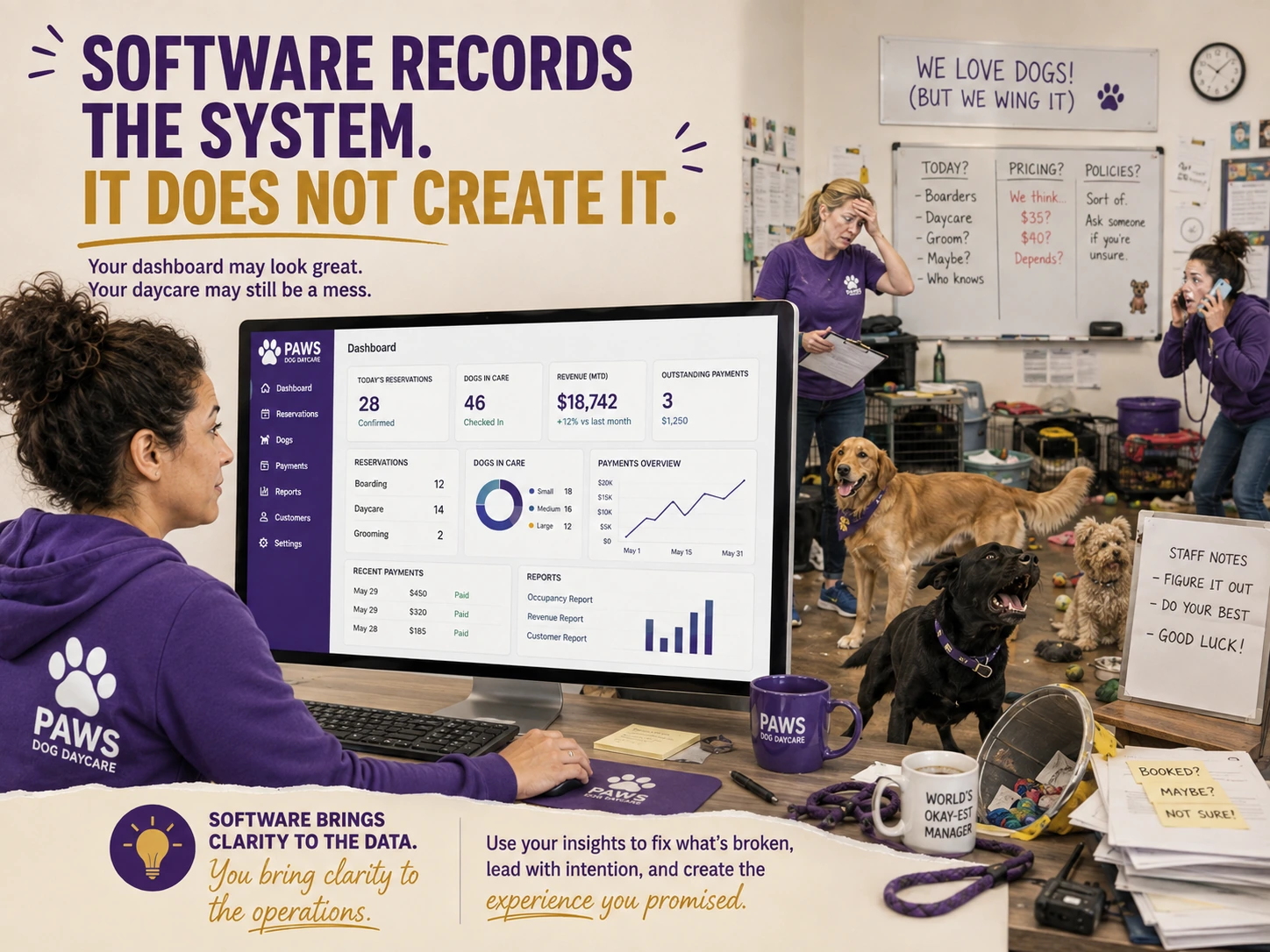
Dog daycare software can help with reservations, packages, customer records, vaccination records, boarding notes, grooming appointments, payments, reports, reminders, and staff visibility. That matters.
But software does not fix a weak business model. If your policies are bad, your pricing is dumb, your staff is loose, your dog intake process is weak, your cleaning process is sloppy, and your playroom supervision is chaos, software will organize the mess beautifully.
Buy software to support the operating system. Do not buy software instead of building the operating system.
Before choosing software, know your service mix. Daycare only? Boarding? Grooming? Training? Retail? Packages? Memberships? Multi-dog households? Vaccination tracking? Incident notes? Staff tasking? Online booking? Payment processing? Reports? The software should fit the business you are actually building, not the demo screen that looked pretty.
Run a real workflow demonstration using a sample customer and dog. Test vaccination verification, daycare packages, boarding deposits, grooming, medications, incident notes, missed payments, cancellations, reports, and staff permissions instead of watching only the vendor’s polished demo path.
Confirm data ownership, exports, backups, payment-processing costs, support response, outage procedures, hardware needs, integrations, and the cost of leaving. Software should strengthen the operating system without trapping the business inside inaccessible records.
- Best fit when you already understand your services, rules, pricing, packages, and customer workflow.
- Useful for reservations, customer records, vaccinations, packages, payments, reports, and staff notes.
- Not a substitute for policies, staff training, dog safety, pricing, or management.
- Should be tested against your real workflow before committing.
⚖️
Lawyer Help
Some problems are attorney problems. Do not cosplay as a lawyer to save a few bucks.

A lawyer should review leases, entity setup, purchase agreements, franchise documents, asset purchase deals, liability language, customer agreements, employee documents, contractor agreements, landlord issues, and anything where the words can hurt you later.
The lease alone can make or break the business. Assignment rights, permitted use, personal guarantees, renewal options, rent increases, maintenance obligations, CAM charges, signage, outdoor use, noise, waste, build-out, and default language all matter.
If you are buying an existing dog daycare, attorney review becomes even more important. You do not want to inherit old debts, claims, employee problems, vendor issues, lease problems, prepaid liabilities, or contracts you did not understand.
A lawyer is not there to tell you whether the playroom layout is smart. A lawyer is there to keep the paper from biting you.
Legal review is most effective before the business terms harden. The attorney should receive the owner’s actual operating plan, service mix, build-out expectations, outdoor use, boarding plans, financing, and exit concerns rather than only a document with no business context.
The owner should ask for a prioritized risk explanation. Not every clause carries the same consequence. Personal guarantees, permitted use, assignment, default, repair obligations, indemnity, insurance, renewal, and exit rights may deserve more attention than routine language.
- Lease review and lease negotiation.
- Franchise agreement and FDD review.
- Asset purchase, business purchase, or seller-financing documents.
- Customer agreements, waivers, employee documents, contractor agreements, and liability language.
- Entity formation, ownership structure, and local compliance questions.
🧮
Accountant / Bookkeeper Help
If the numbers are wrong, the dream is decorative.
Dog daycare owners love talking about dogs, buildings, logos, colors, and grand opening ideas. Fine. But payroll, rent, insurance, software, utilities, cleaning supplies, staff ratios, loan payments, taxes, and slow months do not care about your logo.
An accountant can help with startup budgets, break-even math, payroll cost, pricing, bookkeeping setup, tax structure, buying an existing business, SDE review, debt service, cash flow, and whether the deal you are excited about can actually breathe.
A bookkeeper helps keep the business from becoming a shoebox full of receipts and regret. That matters more than people think. Bad books make it harder to manage, borrow, sell, value, or even understand the business.
If your business plan only works because you forgot taxes, payroll, insurance, repairs, owner salary, or slow months, you do not have a business plan. You have a wish with numbers typed beside it.
The financial model should show capacity, utilization, prices, payroll, payroll burden, rent, debt service, owner compensation, repairs, marketing, taxes, and working capital by month. An annual profit estimate can hide the cash shortages that occur during ramp-up or seasonal demand.
The bookkeeping system should be designed before opening so daycare, boarding, grooming, retail, packages, discounts, deposits, refunds, payroll, and owner spending are recorded consistently. Clean books improve decisions long before they matter to a lender or buyer.
- Startup cost planning and break-even review.
- Payroll, pricing, margins, and working-capital planning.
- Buying existing business financial review.
- Bookkeeping setup, chart of accounts, tax planning, and monthly reporting.
- Debt-service reality check before buying, building, or borrowing.
🧱
Contractor / Architect / Build-Out Help
A contractor can build exactly what you asked for, even if what you asked for is stupid.
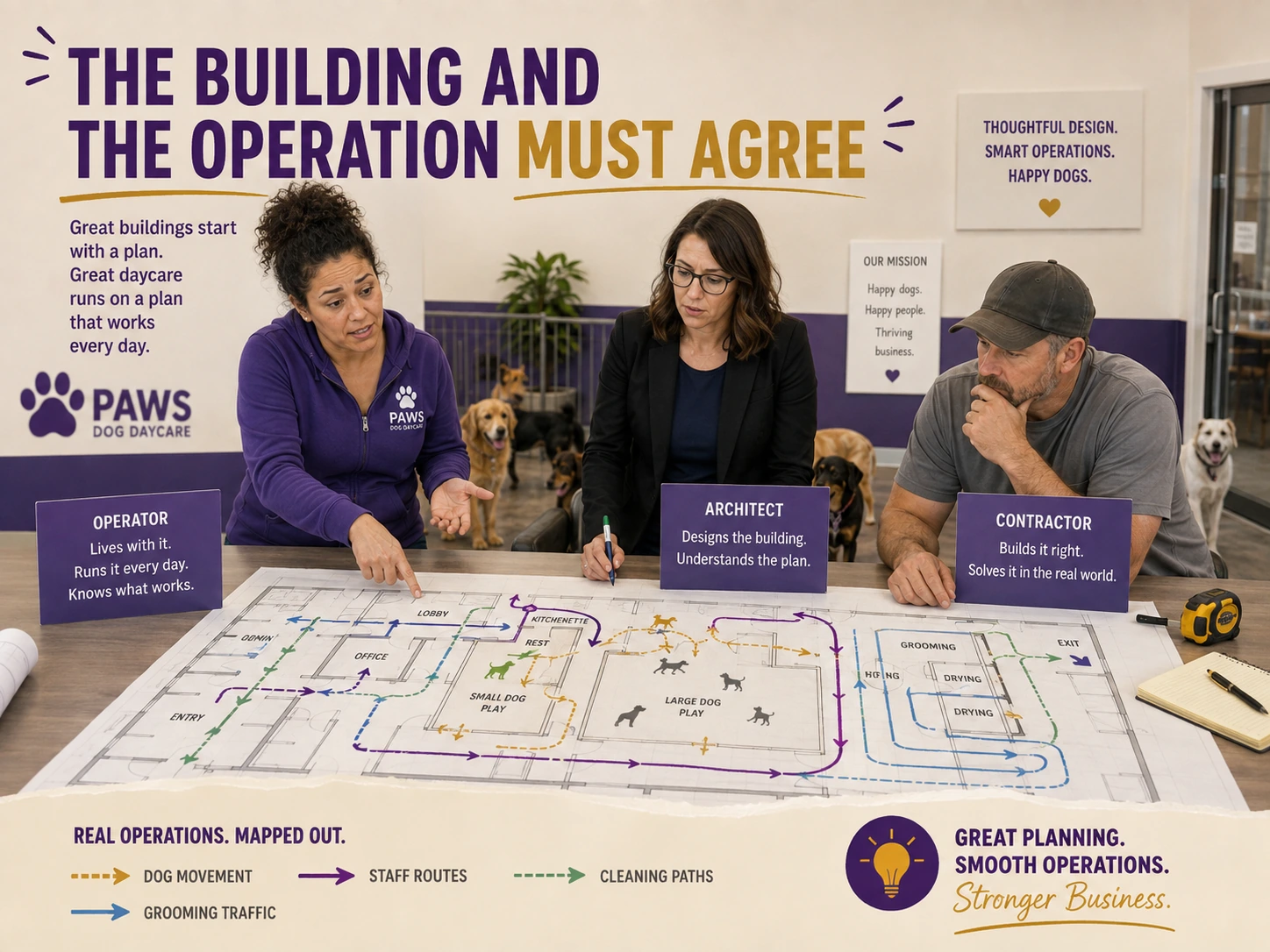
Contractors, architects, engineers, and code professionals matter. You need them. Dog daycare build-outs involve plumbing, drainage, flooring, HVAC, electrical, walls, gates, laundry, grooming, sound, odor, cleaning, outdoor areas, and local code.
But a contractor is not automatically a dog daycare operator. An architect may draw a beautiful building that creates terrible dog movement. A contractor may install what you requested even if the drain location, gate swing, room flow, or cleaning path makes daily operation miserable.
This is where dog daycare-specific design thinking and construction help need to talk to each other. The operator decides how dogs, staff, water, waste, customers, food, meds, laundry, grooming, and cleaning move through the building. The design and construction team turns that into something code-compliant and buildable.
Do not wait until after the concrete is cut to ask whether the drain is in the right place.
The design team should receive an operating narrative, not merely a room list. It should describe how dogs, staff, customers, food, medication, laundry, water, waste, grooming traffic, boarding traffic, and emergency evacuation move through the building.
Changes should be reviewed before they are built. Value engineering that removes drains, changes gates, reduces ventilation, narrows hallways, or alters surfaces may lower construction cost while increasing labor, cleaning, safety risk, or future repair expense.
- Best fit for code, drawings, permits, construction, plumbing, electrical, HVAC, flooring, and build-out.
- Needs operator input on dog flow, staff movement, cleaning flow, boarding movement, grooming flow, and safety.
- Should coordinate with landlord requirements and lease obligations.
- Should not be allowed to guess at dog daycare operations if they do not understand them.
🐾
Trainer / Behavior / Staff Training Help
Dog safety is not a slogan. It is a staff skill.
A dog daycare owner needs to understand dog grouping, temperament screening, arousal, stress, play styles, resource issues, gate pressure, body language, staff positioning, incident prevention, and when play is turning ugly.
A trainer or behavior professional can help with staff training, dog evaluations, group management, handling plans, escalation warning signs, staff language, customer education, and safety procedures.
But not every trainer understands daycare operations. Teaching one dog in a training room is not the same thing as supervising a group of dogs in a commercial playroom while phones ring, customers arrive, staff rotate, and someone is spraying poop off the floor.
Get dog-handling help that fits group-care reality. Not theory that falls apart the first time two adolescent males decide the lobby is their new courtroom.
The training provider should define observable staff competencies. Employees should demonstrate safe gate entry, dog movement, body-language recognition, interruption, separation, evaluation notes, customer communication, and escalation rather than merely attending a class.
Ongoing support matters because dog groups, employees, and management pressure change. Refresher training, incident review, coaching, and manager calibration keep standards from drifting after the opening team becomes busy.
- Temperament testing and intake process.
- Dog grouping, play supervision, staff positioning, and intervention training.
- Staff language for customer communication after incidents or failed evaluations.
- Written safety procedures and ongoing staff refreshers.
- Best when the trainer understands commercial group-care environments.
🏚️
Acquisition Broker / Business Broker Help
A broker may help find the business. That does not mean the broker proves the business.
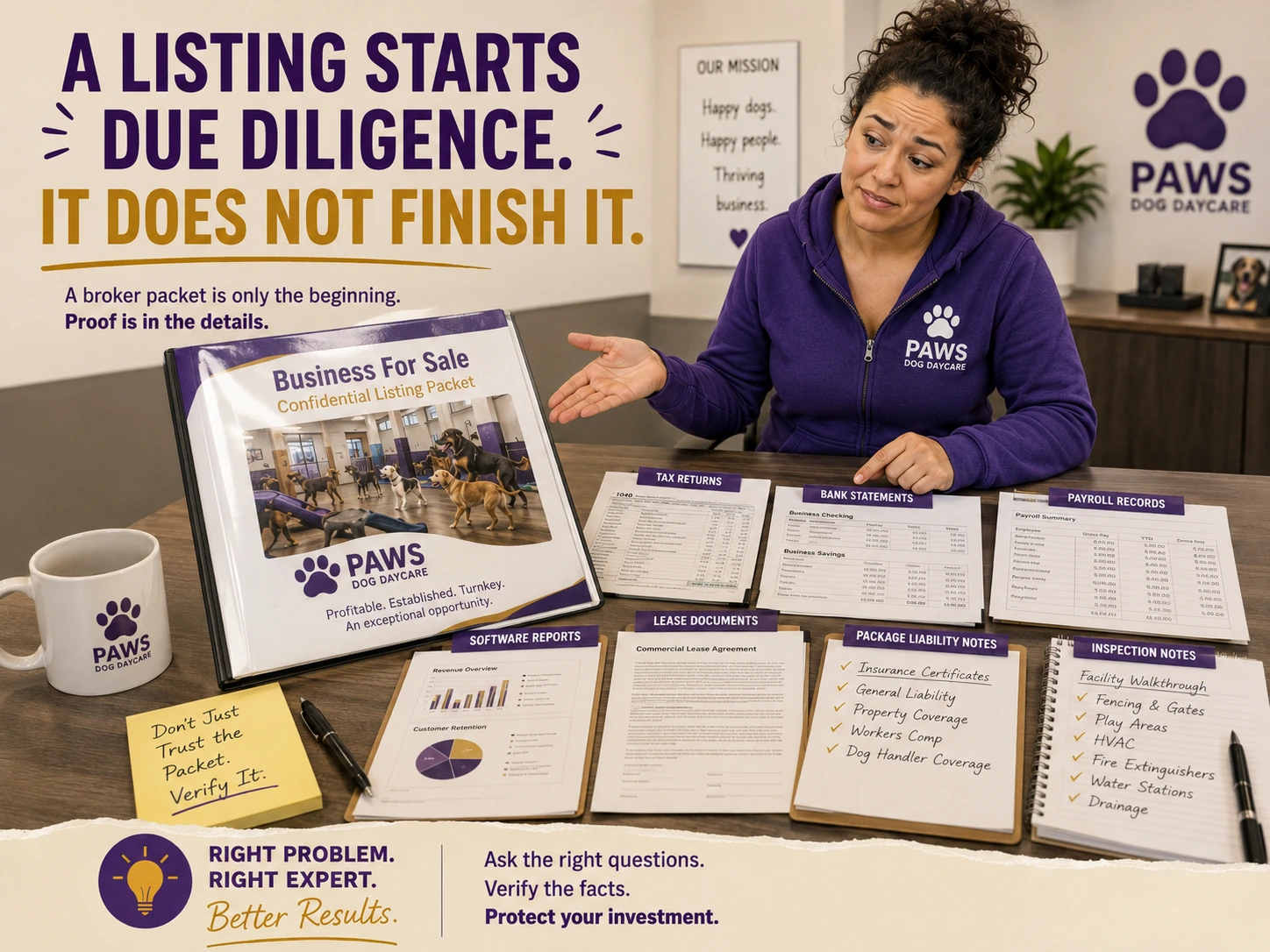
If you are buying an existing dog daycare, a business broker may help connect buyer and seller, organize basic information, manage communication, and move the deal toward closing.
That can be useful. But remember the incentive. Brokers usually get paid when the deal closes. That does not make brokers bad. It does mean the buyer still needs independent review.
A broker packet is not due diligence. A seller’s asking price is not valuation. A pretty listing is not proof. If you are buying an existing daycare, you still need tax returns, bank statements, software reports, payroll records, lease review, package balances, facility inspection, staff review, customer activity, and professional help.
Use the broker as a deal channel. Do not use the broker as your only brain.
The buyer should create a document request list before relying on valuation claims. Tax returns, bank deposits, software sales, payroll, package liabilities, gift cards, leases, equipment condition, customer activity, claims, permits, and inspection records should support the story.
Every adjustment to earnings should be tested. Owner add-backs, personal expenses, one-time repairs, underpaid family labor, deferred maintenance, and claimed growth potential do not all deserve equal treatment. The price should follow verified transferable performance.
- Useful for finding and communicating about existing businesses for sale.
- Not a substitute for buyer-side attorney, accountant, facility review, or operating due diligence.
- Broker valuation should be tested against verified earnings, liabilities, lease, staff, customers, and facility condition.
- Watch for fake urgency, vague numbers, or “potential” being priced like proven profit.
🛡️
Insurance Agent Help
Live-animal risk is not the place for generic guessing.
Dog daycare has risks that normal small-business insurance conversations may not cover well enough. You have dogs, people, staff, bites, fights, escapes, illness, grooming incidents, medication mistakes, boarding risks, property damage, customer disputes, vehicles, workers’ compensation, and business interruption questions.
A good insurance agent familiar with pet-care businesses can help review general liability, animal bailee or care/custody/control coverage, property coverage, workers’ compensation, commercial auto if needed, grooming exposure, boarding exposure, and exclusions.
Do not assume you are covered because you bought “business insurance.” Ask what happens if a dog is injured, escapes, dies, bites another dog, bites a person, gets sick during boarding, or is injured during grooming. The answer matters before the incident, not after.
Provide the agent with the actual service mix, animal volume, staffing, transportation, grooming, boarding, outdoor areas, medication practices, property values, and prior claims. Generic descriptions can produce coverage that does not match the operation.
Ask how the policy responds through specific scenarios and request the relevant wording or written explanation. The important question is not whether the agent says the business is covered, but what limits, deductibles, exclusions, conditions, and reporting duties apply when something happens.
- General liability and pet-care-specific coverage review.
- Animal bailee / care, custody, and control questions.
- Workers’ compensation and staff injury exposure.
- Grooming, boarding, transportation, property, theft, fire, and business interruption questions.
- Claims history review when buying an existing dog daycare.
📣
Website / Marketing Help
A franchise logo does not automatically create local lead flow.
Dog daycare is local. People search near their home, work, commute path, vet, apartment, and daily routine. Your website, Google Business Profile, reviews, photos, local SEO, referral relationships, signage, social proof, and customer trust matter.
A marketing person can help with website structure, local search, Google Business Profile, photography, content, service pages, ads, review strategy, social media, email, landing pages, and lead tracking.
But marketing cannot fix a bad operation forever. If the phones ring and the staff are rude, the facility smells, dogs are not safe, pricing makes no sense, or customers do not trust you, marketing just drives more people into the problem faster.
Market the business you can actually deliver. Do not advertise fantasy daycare and then hand customers chaos in a lobby.
The marketing scope should identify account ownership, deliverables, launch dates, content responsibilities, local-search work, photography, review process, lead tracking, and reporting. The business should retain administrator access to the domain, website, Google profile, phone numbers, analytics, and ad accounts.
Marketing performance should connect to calls, forms, tours, evaluations, first purchases, repeat customers, reviews, and revenue. Traffic and impressions are useful only when the location can see whether they produce customers worth the cost.
- Website structure, service pages, local SEO, Google Business Profile, and lead tracking.
- Photos, reviews, trust-building content, local outreach, and referral strategy.
- Useful before opening, during launch, and after customer feedback starts coming in.
- Not a substitute for safe operations, good customer service, clean facilities, and reliable staff.
👥
When You Need a Team Instead of One Person
Sometimes the honest answer is not “hire one helper.” It is “build a small support team.”

If you are opening a tiny, simple daycare with no boarding, no grooming, no major build-out, and a straightforward lease, you may need less outside help.
If you are signing a major lease, doing a heavy build-out, adding boarding, adding grooming, buying an existing business, using financing, hiring staff, and trying to open with real volume, you need a team. Not a giant corporate committee. A practical small-business team.
That team may include an attorney, accountant, insurance agent, contractor, architect or designer, dog daycare consultant, software provider, marketing help, and maybe a trainer or behavior professional.
The trick is sequencing. You do not need everyone at full blast all the time. You need the right person involved before the mistake becomes expensive.
The team should be small enough to coordinate and broad enough to cover the real risks. Assign one owner-side decision maker, maintain a shared issue list, and record which professional owns each answer so conflicting advice is resolved rather than ignored.
Sequence the team around irreversible commitments. Education and market work come early; legal and site review come before signature; operator and design review come before construction; software and training come before opening; marketing begins early enough to create trust before payroll starts.
| Stage | Help That Usually Matters | Why It Matters |
|---|---|---|
| Early Idea / Research | Manual, consultant, market research, basic accountant conversation. | Helps you avoid chasing a fantasy before you know the business model. |
| Location / Lease | Attorney, consultant, landlord, contractor, zoning/code review. | The wrong building or lease can bury the business before opening. |
| Build-Out Planning | Contractor, architect, engineer, consultant, code officials, insurance input. | Floors, drains, gates, HVAC, grooming, laundry, and dog flow need to work together. |
| Pricing / Finance | Accountant, bookkeeper, consultant, software planning. | Busy is not enough. The service mix has to support payroll, rent, and profit. |
| Operations / Staff | Consultant, manual, trainer, software, insurance agent. | Staff need rules before dogs arrive, not after the first incident. |
| Launch / Marketing | Website, Google Business Profile, marketing help, photos, local outreach. | Customers need to find you, trust you, and understand your services. |
| Buying Existing | Attorney, accountant, broker, consultant, insurance agent, facility inspection. | You are buying numbers, staff, lease, customers, equipment, liabilities, and transition risk. |
🧰
Match the Help to the Problem
This is the sorting table. Start here before you spend money.
| Problem | Better Help | Wrong Help | Why |
|---|---|---|---|
| Lease terms, personal guarantee, transfer, renewal, permitted use. | Lawyer. | Consultant alone. | A consultant can flag concerns, but an attorney reviews legal risk. |
| Dog flow, playroom layout, boarding movement, cleaning paths. | Dog daycare consultant plus contractor/architect. | Architect alone. | The architect draws the building. The operator has to live with the dog movement. |
| Buying an existing dog daycare. | Accountant, attorney, broker, consultant, facility inspection. | Broker packet alone. | A listing is not due diligence. You are buying proof, not brochure energy. |
| Startup costs, payroll, pricing, and break-even. | Accountant plus operator/consultant review. | Cute branding. | Branding does not make payroll affordable. |
| Dog grouping, staff handling, temperament testing. | Trainer/behavior help with daycare experience. | Contractor. | Gates hold dogs. Staff skill controls dogs. |
| Daily operations, forms, policies, service design. | Manual, consultant, templates, software after system design. | Lawyer alone. | A lawyer can draft documents. A lawyer does not run Monday morning drop-off. |
| Insurance coverage and animal-care risk. | Pet-care insurance agent. | General guessing. | Live-animal risk needs correct coverage, not “I think we’re covered.” |
| Website, local search, Google profile, lead flow. | Website/marketing help with local-service experience. | Assuming a franchise logo does it all. | Local customers still need to find and trust the business. |
| Building what was designed. | Contractor, architect, engineer, code officials. | Consultant alone. | A consultant may guide dog-care function, but construction has to meet local rules. |
| Full branded system with ongoing structure. | Franchise, if the cost/control tradeoff makes sense. | Buying random pieces and pretending they are a system. | Some owners need the whole machine. Just understand what the machine costs. |
🎤
How to Interview Startup Help Before You Pay
Do not just ask what they sell. Ask what problem they are actually solving.
Good help should get clearer when you ask questions. Bad help gets vague, offended, pushy, or suddenly starts talking about “packages” before understanding the problem.
You are allowed to interview the people you are about to pay. You are allowed to ask what they do, what they do not do, what deliverables you get, what is outside the scope, what they need from you, and what kind of owner they are not a good fit for.
This is not rude. This is buying help like an adult.
Ask for examples of deliverables rather than only testimonials. A sample issue list, review memo, layout markup, financial model, training outline, or report shows how the helper turns knowledge into something the owner can use.
Clarify communication and revision rules. The owner should know who performs the work, how questions are submitted, how quickly responses arrive, what counts as a revision, and what happens when new facts change the original question.
| Helper | Ask This Before Paying | Why It Matters |
|---|---|---|
| Franchise Company | What exactly do you provide before opening, during opening, and in year five after royalties are still being paid? | Startup help and long-term value are not the same question. |
| Consultant | What parts of the startup do you actually help with, and what must still go to my lawyer, accountant, contractor, or architect? | A consultant should know their lane and be honest about it. |
| Lawyer | Have you reviewed commercial leases, franchise agreements, asset purchases, or small-business acquisition documents before? | The lease and purchase paper can bite long after opening. |
| Accountant | Can you help with startup budget, break-even, payroll, pricing, cash flow, debt service, and buying-existing financial review? | You need business math, not just tax filing after the damage is done. |
| Contractor / Architect | Have you built animal-care, kennel, grooming, drainage, laundry, or high-moisture commercial spaces before? | A dog daycare build-out is not a boutique candle shop. |
| Software Company | How does your software handle daycare packages, boarding deposits, grooming, vaccination records, incident notes, and reports? | The demo needs to match the business you are actually building. |
| Insurance Agent | What happens if a dog is injured, escapes, dies, bites another dog, bites a person, or is injured during grooming? | “Business insurance” is not enough if live-animal risk is excluded or weak. |
| Marketing / Website Help | How will you help local customers find, trust, and contact the business before and after opening? | Pretty websites are nice. Lead flow and trust matter more. |
| Business Broker | What documents support the seller’s numbers, asking price, lease transfer, package liabilities, and staff/customer claims? | A broker packet is not proof. It is the start of proof. |
🧭
Startup Help Decision Map
Use common sense. The right answer changes by problem.
If you are early and confused, start with education. Read, study, map the business, and learn enough to ask better questions.
If you are about to sign a lease, call a lawyer. If you are about to cut concrete, get the layout and construction plan reviewed before money starts making dust. If you are buying an existing dog daycare, get an accountant and attorney involved before seller stories become your debt.
If you need full brand structure, compare franchises carefully. If you want independent ownership but need operator help, consider a consultant. If you need records and booking, choose software after you know your workflow. If you need dog safety, get dog-handling and staff-training help.
The wrong sequence costs money. Do not buy software before you know your policies. Do not hire a contractor before the flow makes sense. Do not negotiate a purchase price before the financials are proven. Do not spend $50,000 solving a problem that a $500 conversation would have identified.
Use urgency and reversibility to prioritize. A website color can be changed later; a signed guarantee, cut slab, installed drain, purchase closing, or expired permit option may be difficult or impossible to reverse.
The owner should also identify dependencies. Pricing depends on capacity and payroll. Software depends on policies and service mix. Construction depends on operations and code. Marketing depends on the service the business can actually deliver.
📌
Simple decision rule
If the problem can create legal liability, call a lawyer. If the problem can wreck the numbers, call an accountant. If the problem involves dog-care operations, call someone who has actually operated dog-care facilities. If the problem involves construction, call the people who know code and building.
🚩
Red Flags When Buying Startup Help
Bad help does not always look cheap. Sometimes it looks polished, confident, and expensive.

Some help is bad because the person does not know enough. Some help is bad because the person knows their own product but not your problem. Some help is bad because it flatters you instead of challenging you.
Paid applause is dangerous. If every idea you have is “great,” every number is “workable,” every building is “fine,” every lease is “normal,” and every concern can be solved by buying their package, slow down.
Good help should sometimes make you uncomfortable. Not because the person is rude, but because real advice has to tell you when the layout is wrong, the lease is risky, the numbers do not work, the staff plan is weak, or the thing you want to build is about to become an expensive problem.
Another warning sign is advice that cannot survive documentation. Good helpers should be willing to define assumptions, cite the documents they reviewed, identify uncertainty, and explain what additional professional input is still required.
The owner should also watch for incentives. A broker benefits from closing, a vendor benefits from selling, a franchise benefits from signing, and a contractor benefits from building. Incentives do not make the advice dishonest, but they make independent verification necessary.
- They promise success before understanding your market, lease, budget, build-out, staff plan, or service mix.
- They sell a package before asking what problem you are trying to solve.
- They say they handle “everything” but cannot clearly explain what is outside their lane.
- They avoid written scope, deliverables, timeline, fee structure, or what you actually receive.
- They create urgency instead of clarity.
- They cannot explain relevant experience with dog daycare, boarding, grooming, pet care, commercial leases, or small-business operations.
- They never push back, never warn you, and never say “that may be a bad idea.”
- They treat a dog daycare like any other retail space with dogs sprinkled on top.
- They want you dependent on them instead of helping you make better decisions.
⚠️
Operator warning: confidence is not competence.
A person can sound smooth and still be wrong. Ask for scope, proof, experience, limits, and deliverables before paying for help that might not solve the actual problem.
🛑
Common Mistakes When Buying Help
Spending money is not the same thing as solving the problem.
The most common mistake is buying help too late. Owners sign leases, commit to layouts, order equipment, hire staff, set prices, choose software, or buy existing businesses before the right person has reviewed the risk.
The second mistake is buying help too broadly. They think one helper should solve everything. Then they get mad when the lawyer does not design kennels, the contractor does not understand temperament testing, the software does not fix pricing, and the consultant does not replace an accountant.
The third mistake is buying help they do not listen to. If you hire someone with real experience and then ignore the advice because the answer is annoying, do not blame the helper when the annoying thing becomes expensive.
Owners also create waste by failing to share prior work. When the lawyer, accountant, consultant, architect, and contractor receive different facts, each may solve a different version of the startup. Maintain one current project brief and document set.
Advice should be converted into a decision log. Record the issue, recommendation, owner decision, reason, cost, deadline, and person responsible. Otherwise useful guidance is forgotten, repeated, or contradicted later.
- Hiring the right person after the mistake is already built.
- Expecting one person to solve legal, construction, dog-care, accounting, marketing, and software problems.
- Buying software before building policies and workflow.
- Letting a contractor build dog spaces without operator review.
- Signing a lease before legal and use review.
- Buying a franchise because you needed startup education.
- Refusing help because “independent” somehow became code for “guessing.”
- Paying for help and then ignoring the answer because it interfered with the fantasy.
🧍
What You Should Not Outsource
Help is support. It is not a replacement for ownership.
You can hire lawyers, accountants, consultants, contractors, software companies, trainers, marketers, brokers, and insurance agents. Good. Use them. But do not outsource your responsibility as the owner.
You still need to understand the business well enough to ask questions, read reports, challenge assumptions, notice bad advice, and make decisions. If you do not understand the basics of pricing, payroll, dog safety, customer trust, lease risk, and facility flow, you are too easy to sell to.
This is the trap: the owner does not want to feel dumb, so they hire someone and stop thinking. That is backwards. The right helper should make you smarter, not more dependent.
The owner should understand enough to detect when advice conflicts with the operating reality. That includes reading basic financial reports, recognizing unsafe dog flow, understanding staffing expectations, and knowing which customer promises the business can keep.
Final accountability also includes follow-through. Hiring the correct expert does not matter when the owner delays the call, withholds documents, ignores the answer, or fails to train staff on the resulting decision.
- Do not outsource final responsibility for the lease you sign.
- Do not outsource understanding whether payroll and pricing work.
- Do not outsource basic dog safety awareness.
- Do not outsource knowing what your staff are supposed to do.
- Do not outsource customer trust, cleanliness, or service standards.
- Do not outsource common sense just because someone has a nicer brochure.
📌
Owner rule
Hire help to sharpen your decisions. Do not hire help so you can stop making decisions.
❓
Dog Daycare Startup Help Options FAQ
Detailed answers about franchises, consultants, manuals, attorneys, accountants, contractors, trainers, insurance, software, marketing, brokers, problem briefs, professional teams, red flags, and buying the right help before expensive decisions.
Do I need a franchise to start a dog daycare?
No. A franchise is one way to obtain a brand, manuals, training, software standards, vendor rules, marketing materials, and ongoing structure, but it is not the only way to build a daycare. Independent owners can assemble education, targeted professionals, software, procedures, and experienced staff around their own brand.
The decision should turn on the owner’s actual needs. Someone who needs a complete system and continuing guardrails may value a franchise. Someone who needs a lease review, layout critique, pricing model, or operating manual may be better served by narrower help without long-term royalties and control.
When does a franchise make sense as startup help?
A franchise may fit when the owner wants a coordinated branded system rather than separate pieces. The value may include training, design standards, operating procedures, software requirements, vendor guidance, launch support, marketing templates, peer contacts, and continuing oversight.
The buyer still needs independent legal, financial, construction, insurance, and local-market review. The franchise should be judged against its full cost, royalties, advertising fees, control, required vendors, renewal terms, transfer limits, and year-five value—not only the help provided around opening.
When does a consultant make more sense than a franchise?
A consultant may fit when the owner wants dog-daycare-specific judgment without buying a permanent branded system. Useful assignments include location review, dog flow, facility layout, service mix, pricing discussion, procedures, forms, staffing, opening preparation, and identifying risks normal advisors may miss.
The scope should remain clear. A consultant may flag legal or financial concerns, but an attorney reviews legal documents and an accountant evaluates the financial model. The consultant’s value is focused operating knowledge and honest pushback, not pretending every professional role has disappeared.
Can a startup manual be enough help?
For a capable owner early in the process, a strong manual can provide structure, terminology, checklists, operating concepts, and the questions that should be asked before expensive commitments. It can be especially useful for an independent startup that needs education without a continuing franchise relationship.
A manual cannot inspect the building, negotiate the lease, confirm local permits, engineer the HVAC, review insurance, or train every employee. Its real value is helping the owner organize the startup, recognize missing decisions, and call the correct professional with a better question.
What should I prepare before contacting any startup professional?
Prepare a short problem brief stating what you are building or buying, the current stage, the decision in front of you, the deadline, the money at risk, the relevant documents, what has already been decided, and the answer needed before moving forward.
Attach the materials that control the answer. A lawyer needs the lease or agreement; an accountant needs realistic costs and revenue assumptions; a consultant or architect needs plans and operating goals. Clear facts reduce paid discovery time and make it easier to compare advice.
Do I need a lawyer before signing a lease or purchase agreement?
Yes when significant money, guarantees, property rights, or long-term obligations are involved. Commercial leases and purchase agreements can control permitted use, personal liability, assignment, renewal, repairs, construction, defaults, indemnity, insurance, seller obligations, and exit rights.
Legal help is most valuable before the owner becomes emotionally or financially committed. The attorney should understand the planned services, outdoor use, boarding, grooming, build-out, financing, and timeline so the review reflects how the business will actually operate.
What should an accountant review before I open?
An accountant should help test startup costs, working capital, payroll, payroll burden, prices, capacity, utilization, rent, debt service, taxes, owner compensation, repairs, marketing, and break-even. The model should show monthly cash flow rather than only an optimistic annual profit.
The bookkeeping structure also matters before opening. Daycare, boarding, grooming, retail, packages, memberships, discounts, deposits, refunds, and owner spending should be recorded consistently so the owner can manage the business and later prove its performance.
Can software create my operating system?
No. Software can record reservations, vaccinations, packages, payments, boarding notes, grooming appointments, incidents, communications, and reports, but it cannot decide the business’s safety rules, prices, staffing standards, cleaning procedures, or customer promises.
Choose software after the workflows are understood. Test real scenarios, confirm exports and backups, review payment and support costs, and make sure staff can use the system without maintaining unofficial spreadsheets that become the real operating record.
Who should help with facility layout and build-out?
Facility planning usually needs both dog-care operating knowledge and licensed design or construction expertise. The operator or consultant defines how dogs, staff, customers, grooming, boarding, cleaning, food, medication, laundry, waste, and emergency movement should work.
Architects, engineers, contractors, and code officials turn those needs into compliant drawings and construction. Neither side should work alone. A technically buildable plan can still operate badly, while a good operating sketch may still fail code or engineering requirements.
Who should help with dog handling and staff training?
Use a trainer, behavior professional, experienced daycare operator, or training provider who understands commercial group care. The help should cover intake, temperament evaluation, grouping, arousal, stress, gate pressure, staff positioning, interruption, separation, documentation, and customer communication.
Training should require demonstrated competence, not attendance alone. Employees should be observed performing the work, and managers need refreshers, coaching, incident review, and a consistent method for correcting unsafe drift after opening.
What kind of insurance help does a daycare need?
Use an insurance professional familiar with pet-care operations and describe the real service mix. Relevant areas may include general liability, care-custody-and-control or animal-bailee coverage, property, workers’ compensation, grooming, boarding, transportation, auto, equipment, and business interruption.
Ask scenario-based questions about bites, dog injuries, escapes, illness, death, grooming incidents, employee injuries, property damage, and closure. Request clarity about limits, deductibles, exclusions, conditions, and reporting duties rather than relying on the phrase “business insurance.”
What help is needed when buying an existing dog daycare?
A buyer usually needs an attorney, accountant, lease review, insurance review, facility inspection, and operating due diligence; a broker may help organize the transaction, and a daycare consultant may help evaluate layout, services, staffing, systems, and transition risk.
The seller’s story must be supported by tax returns, bank deposits, software reports, payroll, customer activity, package liabilities, leases, permits, claims, equipment condition, and staff information. A listing package is the beginning of diligence, not proof of value.
What should a marketing or website professional actually deliver?
The scope should identify the website, local pages, Google Business Profile, photography, service content, review process, launch plan, local SEO, advertising, tracking, account ownership, and reporting. The business should retain administrator access to its core digital assets.
Performance should connect activity to calls, forms, tours, evaluations, first purchases, repeat customers, reviews, referrals, and revenue. A polished site or high impression count is not enough when the location cannot see whether marketing produces customers.
How do I know whether I need one helper or a team?
Use the number of disciplines and the irreversibility of the decisions. A focused educational question may need one manual or consultation. A major lease, financed build-out, boarding and grooming facility, acquisition, or multi-service launch usually crosses legal, financial, construction, insurance, operating, software, and marketing lanes.
Build a small coordinated team rather than a crowd. Assign one owner-side decision maker, give everyone the same current facts, identify who owns each question, and involve each professional before the commitment in their lane becomes difficult to reverse.
What is paid applause?
Paid applause is advice shaped mainly to keep the owner excited or close a sale. Every building is described as workable, every number as achievable, every idea as strong, and every risk as something the helper’s package can solve.
Useful advice sometimes says no, asks for more evidence, narrows the plan, or recommends delay. Pushback is valuable when it is tied to facts, operating experience, documents, or numbers. Comfort without analysis can be one of the most expensive forms of help.
What are the biggest red flags when interviewing startup help?
Red flags include promising success before reviewing facts, selling a package before defining the problem, claiming to handle everything, avoiding written scope and deliverables, creating artificial urgency, refusing to explain limits, and showing no relevant experience with the issue at hand.
Also examine incentives and documentation. A broker, vendor, contractor, franchise seller, or software company may benefit when the owner buys. That does not make the advice false, but it means assumptions, exclusions, supporting documents, and independent verification should be visible.
Is free advice from friends or online groups useful?
It can provide ideas, vocabulary, referrals, and examples of problems other owners encountered. It can also be incomplete, market-specific, outdated, or based on a business with different rent, payroll, laws, service mix, staffing, and risk tolerance.
Free advice should not replace professional review where contracts, taxes, construction, insurance, licensing, financing, or major operating risk are involved. Use informal input to improve the question, not as the final answer to a costly decision.
What should I never outsource completely?
Do not outsource final responsibility for the lease, financial viability, dog safety, staff expectations, customer promises, cleanliness, or the business’s core accounts and records. Professionals advise and perform specialized work, but the owner still decides and remains responsible for implementation.
The owner must understand enough to recognize conflicting advice, read basic reports, ask follow-up questions, and verify that the answer was carried into the operation. Hiring the correct expert does not protect a business when the owner ignores the result.
What is the best sequence for buying startup help?
Start with education and problem definition. Use market and financial work before committing to a concept; legal and site review before signing; operator, architect, engineer, contractor, and code input before construction; insurance, software, procedures, and training before opening; and marketing early enough to build trust before payroll begins.
Sequence by reversibility. Website wording can change later; a personal guarantee, cut concrete, installed drain, completed acquisition, or expired approval may not. Bring the right professional in before the decision becomes an invoice.
What is the bottom-line test for any startup helper?
The helper should solve a defined problem, review the relevant facts, stay within the proper professional lane, explain assumptions and limits, provide a usable deliverable, and leave the owner better able to make and implement the decision.
Compare the fee with the money and risk protected. Good help is not the cheapest or largest package. It is the right expertise, used at the right stage, before the wrong decision becomes difficult and expensive to undo.
🐾
The Bottom Line: Buy the Help That Solves the Actual Problem
Help is useful. Random help is expensive noise.
You do not need to prove you are tough by doing everything alone. Independent does not mean guessing. It means you choose your own system, your own help, your own professionals, and your own responsibility.
You also do not need to overbuy help. A full franchise system may be more than you need if the real problem is lease review, pricing, layout, or startup education. A consultant may be the right middle ground. A manual may be enough to get your head straight. A lawyer may save you from a bad lease. An accountant may save you from fake profit. A contractor may save you from a building that does not work. Software may help you manage records once the system exists.
The mistake is not asking for help. The mistake is asking the wrong person the wrong question and then acting surprised when the answer does not fix the problem.
Match the help to the problem. Bring people in before the expensive decisions. Do not pay for applause. Do not pay for mystery. Do not pay for someone to make you feel safe while the actual risk sits untouched in the lease, numbers, building, staff, or dog flow.
Buy the help that keeps you from doing something dumb with real money.
The final support plan should list the problem, helper, scope, deliverable, cost, deadline, decision owner, and what additional professional review remains necessary. That turns a collection of advisors into a coordinated startup process.
The best help reduces uncertainty before irreversible spending, transfers useful knowledge to the owner, and leaves the business with stronger documents, systems, accounts, procedures, and decisions than it had before the engagement.