Grooming • Matted Dogs • Matted Cats • Shave-Downs • Owner Denial • Staff Safety • Humane Grooming Limits • Client Communication
The Matted Dog or Cat Issue: When “Just Brush It Out” Becomes Cruel
Severe matting is not a haircut problem. It is an animal welfare problem wearing a haircut costume.
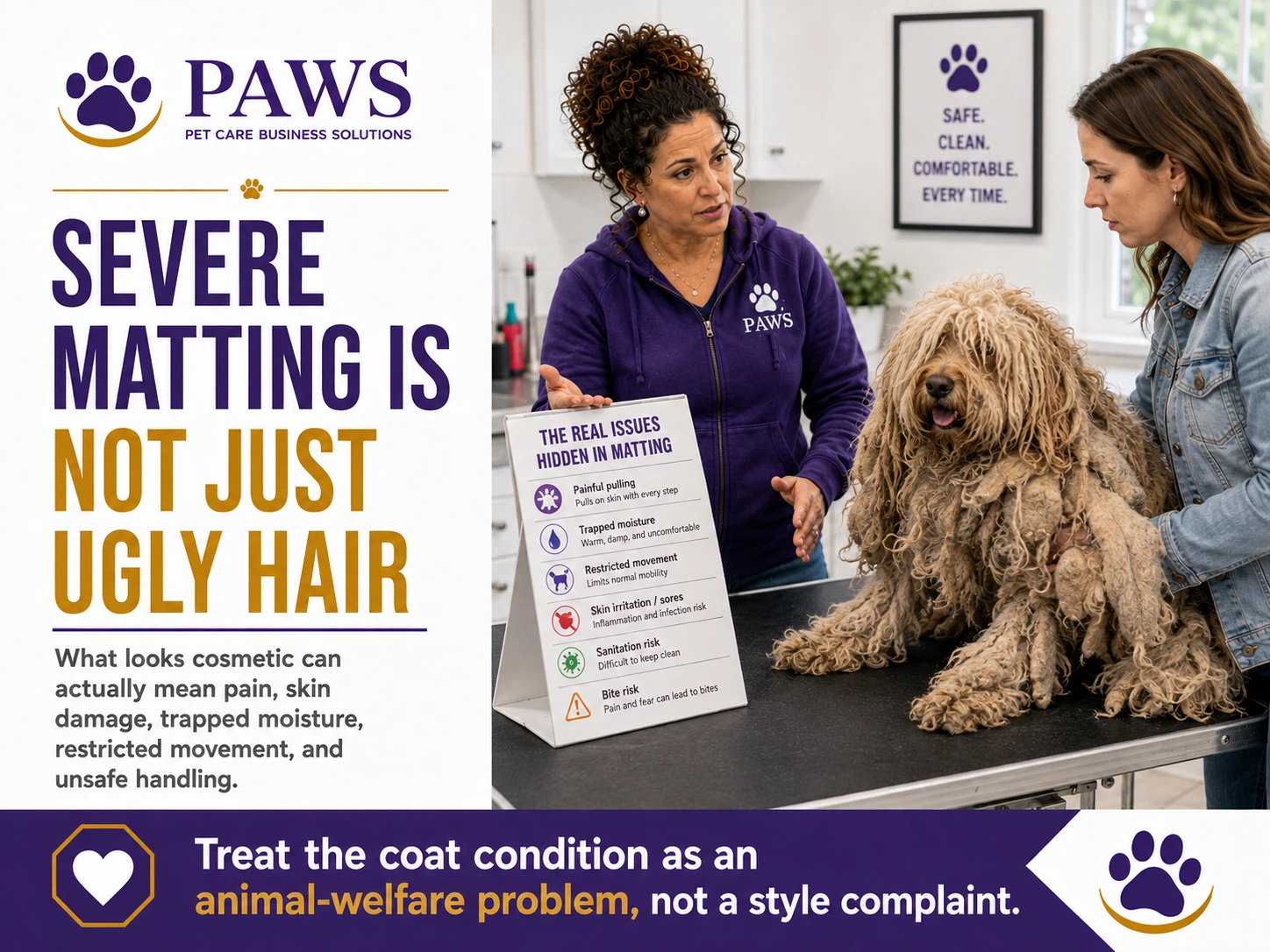
Lastly, and perhaps the most difficult grooming situation to deal with, is the matted dog or cat. In this situation, you want to be the compassionate and humane professional that you are and do what is best for the animal. That means removing the tangled and matted fur in such a way as not to cause the pet more injury, more discomfort, more distress, or unnecessary aggravation.
And just as important, you cannot put your staff members at risk trying to preserve the owner’s fantasy haircut on a dog that is already trapped in a fur prison.
I say that last part because removing matted fur from a moderately to severely matted pet can be uncomfortable, painful, dangerous, and emotionally ugly for everyone involved. The pet may be sore. The skin may be inflamed. The coat may be welded together so tightly that the only humane option is to get underneath it with clippers and remove it inch by inch.
The owner may walk in asking for fluffy. The groomer may be looking at pain, skin damage, trapped urine, feces, sores, scabs, bite risk, clipper risk, and a dog or cat that has been suffering for weeks or months under a full-body hair cast.
That is the reality of this page. The groomer did not create the matting. The groomer is the person standing there with clippers, a painful animal, an angry or embarrassed owner, and the job of making the least cruel decision available.
⚠️
Humane grooming rule
At a certain point, brushing out mats is not grooming. It is trying to unglue a wool sweater from living skin while the animal begs you to stop.
🗺️
Use This Page Like a Matted Pet Grooming Reality Map
This is where coat neglect, owner denial, animal pain, groomer skill, pricing, staff safety, and humane limits all collide.
🧶
What Matting Really Is
Not “a little knotty.” A tight interwoven hair cast pulling on living skin.
😖
Why Matting Hurts
Pulling, friction, moisture, sores, trapped waste, restricted movement, and pain bites.
🐑
The Full-Body Pelt
Sometimes the coat comes off as one thick connected shell showing legs, tail, body, and head.
✂️
Why Clippers Go Under the Mat
Clippers cannot magically cut through a felted wall of hair. They need an entry point.
⚖️
Brush-Out vs Shave-Down
The humane option depends on coat condition, pain, skin, time, and safety.
🐩
Oodles, Poos, and Coat Lies
Doodles and poodle-mix coats are often sold as cute and low-maintenance. That fantasy creates wreckage.
🙈
Owner Denial
The friend-watched-the-dog excuse, shame, guilt, blame, and the groomer becoming the bad guy.
💵
Pricing Reality
A six-hour matted shave-down is not the same service as a two-hour maintained groom.
🧾
Matted Pet Waiver
Coat condition, injury risk, hidden wounds, price range, photos, authorization, and vet referral.
🩺
Vet Referral Triggers
Open wounds, pus, maggots, severe pain, extreme age, aggression, or medical risk may exceed salon limits.
💬
Client Script
How to tell an owner the fluffy haircut is dead without turning pickup into a street fight.
❓
FAQ
Brush-outs, short shave-downs, red skin, nicks, cost, pain, prevention, and owner pushback.
🧶
What Severe Matting Really Is
Severe matting is not just ugly hair. It is a coat failure that can become a body cast.
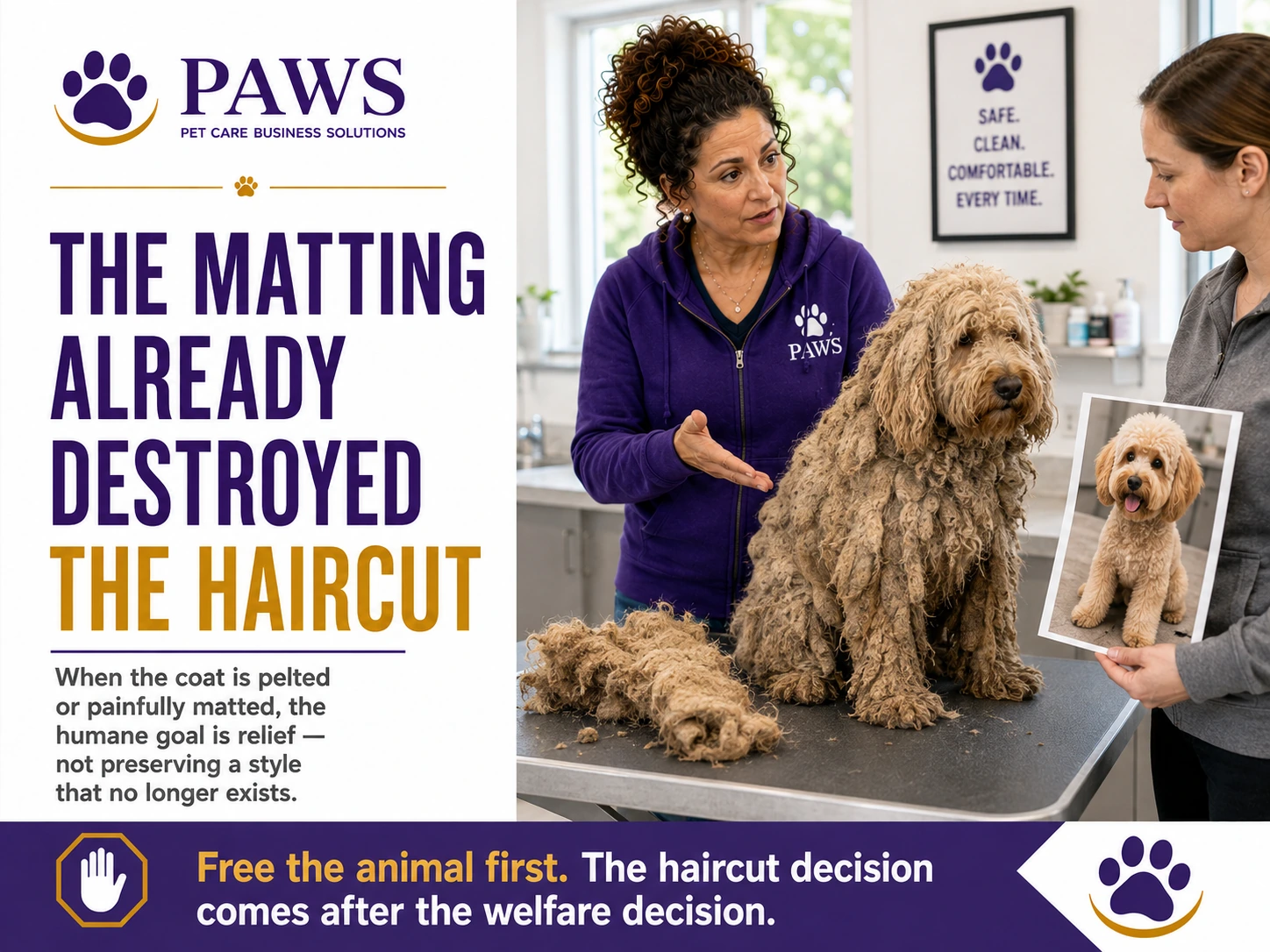
A few tangles are one thing. A small knot behind the ear is one thing. A little friction mat under the harness is one thing. Severe matting is something else entirely.
Severe matting is hair that has tangled, tightened, compacted, and hardened into an interwoven mass. It can pull on the skin every time the animal moves. It can trap moisture, urine, feces, dirt, parasites, and heat against the body. It can hide sores, scabs, wounds, bruising, skin infections, and painful irritated areas that the owner never saw because the coat became a wall.
The best descriptive example is this: imagine trying to remove a wool sweater that was super glued to the skin of the pet. That may sound extreme, but with many severely matted dogs and cats, it is not very far from the truth.
At that point, the groomer is not “giving the dog a haircut.” The groomer is trying to free an animal from a tight, dirty, painful shell without cutting the animal, burning the skin, getting bitten, or letting the owner’s denial steer the process into cruelty.
Severity should be assessed with the hands and a comb, not by looking only at the fluffy surface. Staff need to identify whether the coat separates from the skin, whether a comb can reach the base, whether the skin moves with the mat, and whether the coat is connected across multiple body areas.
The intake record should distinguish isolated tangles, spot matting, tight regional mats, and a connected pelt. Those categories affect the grooming plan, time estimate, price range, authorization, documentation, and whether the animal belongs in a salon or veterinary setting.
📌
Operator translation
Once the coat becomes a hard connected mat close to the skin, the goal changes. You are no longer saving the hairstyle. You are saving the animal from the coat.
😖
Why Matting Hurts the Animal
It is really hard to quantify in words the suffering an extremely matted pet may feel.
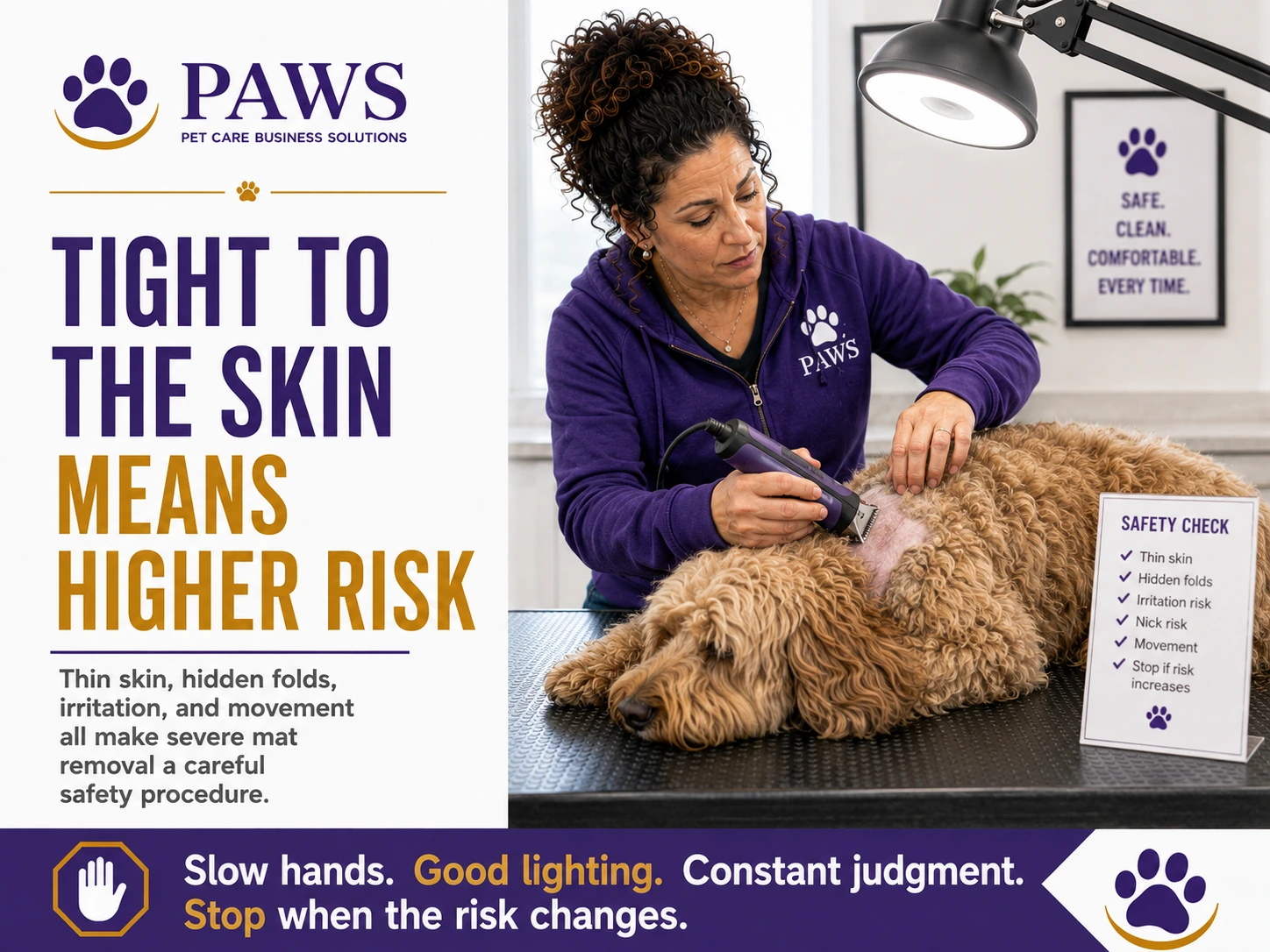
Imagine taking duct tape and covering every part of your body. Not a little strip. Your body. Your arms, legs, back, belly, neck, private areas, armpits, and thighs. Now walk around like that for days, weeks, or months.
When you move, it pulls. When you sit, it pulls. When you lie down, it pulls. When you scratch, it pulls. When you use the restroom, urine and feces can get trapped in it. Moisture sits against the skin. Waste dries into the coat. Friction rubs sensitive areas raw. Skin that should breathe is sealed under a dirty hair cast.
That is the part many owners do not understand. A severely matted dog is not just “messy.” The dog may be living inside a coat that hurts every time it moves. A cat may be so pelted that touching the coat feels like pulling on the skin underneath.
It is not uncommon to find pus-filled sores, blisters, scabs, bruising, irritated skin, hot spots, parasites, or other injuries underneath the matting, especially in high-friction areas like the inner flanks, feet, armpits, sanitary area, tail base, and behind the ears.
All of these things hurt. And when something hurts, the pet may react like it hurts. That can mean growling, biting, thrashing, screaming, trying to climb off the table, alligator-rolling, or injuring itself and staff while trying to escape the process.
That is one of the hardest parts of severe matting. You may be trying to help the animal, but the process of helping still hurts. The coat has already created the pain. You are the one who has to touch it, move it, lift it, cut under it, and get the animal through the miserable process of being freed from it.
This is why patience matters. Breaks matter. Staff safety matters. Stop points matter. The groomer cannot take the dog’s reaction personally. A dog trapped in a full-body mat is not having a spa day. He is having a bad day that should have happened weeks or months earlier before the coat turned into armor.
🐕
Do not be mad at the dog
Some matted dogs are angry, upset, aggressive or come across as resigned to the misery. Some are scared. Some are hurting so badly they squeal when you simply lay them down and try to find a place to start. You cannot be mad at the dog for that. The dog is not trying to ruin your day. The dog is telling you, in the only language he has left, that this hurts.
Pain can change throughout the groom. Removing one section may release tension while exposing a tender area somewhere else. Staff should repeatedly reassess breathing, posture, skin temperature, fatigue, bite risk, and the animal’s ability to recover during breaks.
A humane plan may require dividing the work into phases, changing position, adding handling support, or stopping entirely. Finishing the coat is never more important than preventing a painful animal from escalating into injury or medical distress.
Swipe left/right to see the full table.
| Matting Problem | What It Can Do to the Animal | What the Groomer Has to Remember |
|---|---|---|
| Tight mats pulling skin | Pain, restricted movement, tenderness, behavioral resistance. | The animal is not “being bad.” The animal may be hurting. |
| Moisture trapped under coat | Skin irritation, odor, hot spots, infection risk, raw areas. | The skin may look worse after the coat comes off because it was hidden before. |
| Urine and feces trapped in coat | Burns, sores, smell, infection risk, painful sanitary areas. | Sanitary mats can be some of the most painful and dangerous to remove. |
| Mats behind ears, legs, armpits, and flanks | Friction wounds, skin folds hidden by hair, higher nick risk. | These are danger zones. Work slowly and know when to stop. |
| Hidden wounds, scabs, warts, or thin skin | Clipper contact can uncover or aggravate existing damage. | Document and photograph. Do not let the owner pretend the groomer created every problem under the coat. |
| Pain-driven handling reaction | Biting, thrashing, panic, staff injury, pet injury. | No haircut is worth a bite, a dropped dog, or a pet pushed past its limit. |
⚠️
Humane warning
The animal’s pain matters more than the owner’s attachment to the coat length. A pretty haircut is not the goal when the coat is causing suffering.
🐑
The Full-Body Pelt Reality
Sometimes the coat does not come off like a haircut. Sometimes it comes off like evidence.
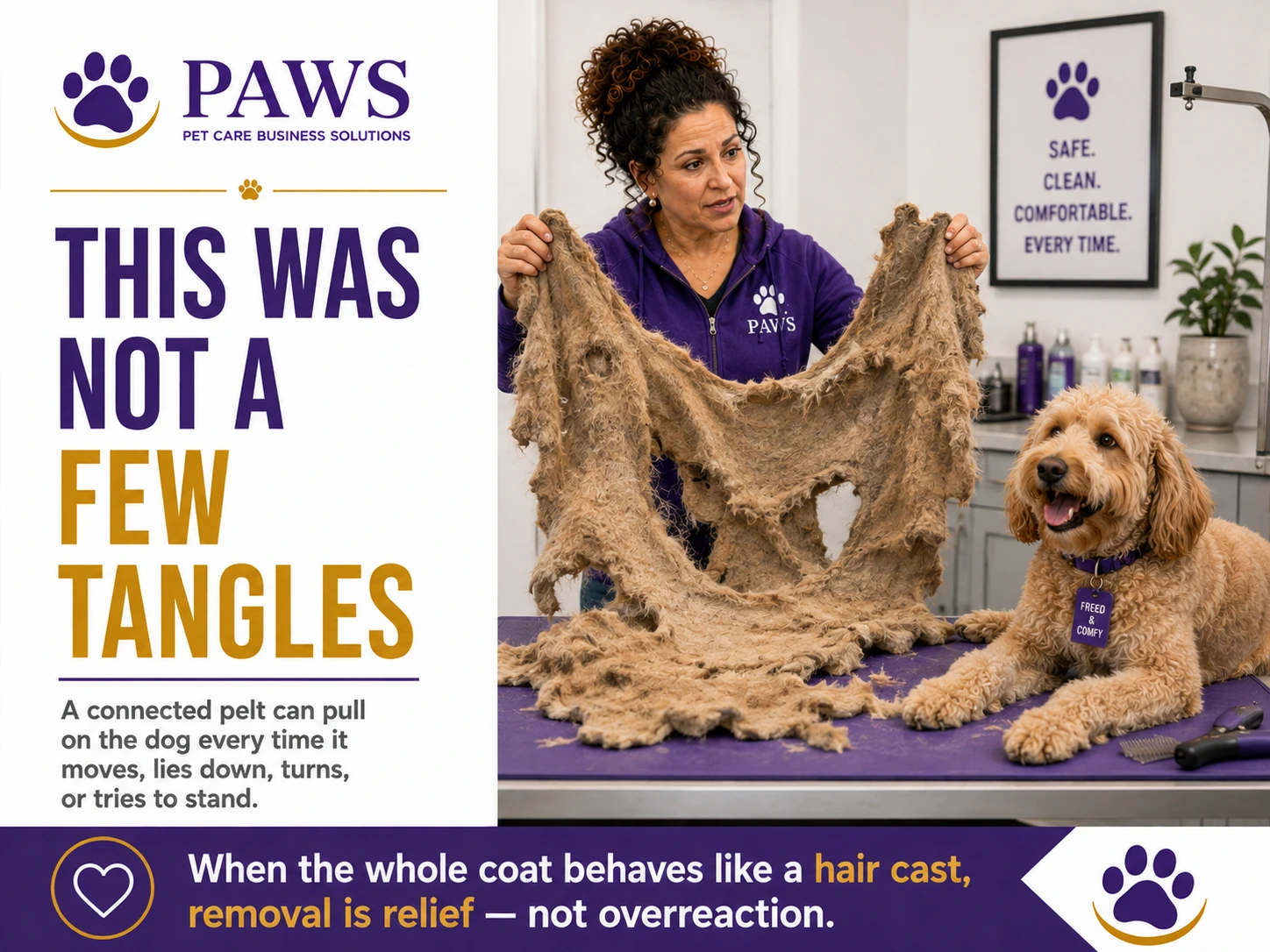
I have dematted dogs where the end result was a pelt that could be laid across the grooming room table and clearly showed the legs, tail, body, head, ears, and shape of the dog. One giant thick interconnected web of fur that had to be painstakingly and meticulously removed inch by inch over the course of hours to free the animal from its furry prison.
One of the best teaching tools I ever had was from a large Shih Tzu that came in matted from one end to the other. This dog was not just a little tangled. He was one connected hair mass. I could not get in through the back the way I normally hoped to, so I found my entry point around the chest and started working from there, up the body, around the legs, and through the rest of the coat.
When it was all said and done, I had an absolute complete pelt. All four legs. Tail. Ears. Head. Body. The whole thing. You could lay it out and it looked like a little dog-shaped bearskin rug, except it was not fake and it was not funny once you understood that a living animal had been walking around inside it.
I took that pelt, built a frame, put it in a shadow box, and hung it near the grooming room door. Customers would come in, see it, and say, “What the hell is that?”
The answer was simple: “That is what a matted dog looks like.”
A lot of people thought it was fake. It was not fake. It was exactly what came off a real dog. And once people saw it laid out like that, the lightbulb came on. They could finally understand that severe matting is not a few knots hiding in the coat. It can become one solid shell wrapped around the animal.
That is not a normal groom. That is not a “can you make him look cute?” appointment. That is a rescue mission performed with clippers, patience, staff safety, documentation, and the knowledge that the owner may still be mad at you when it is over because the dog no longer looks like the teddy bear fantasy they had in their head.
The pelt is often the proof. It shows how connected the mats were. It shows that the coat was not “a little tangled.” It shows why a comb was not going to glide through it like some magical grooming wand from a fairy tale.
When possible, take photos. Photograph the pelt. Photograph the skin underneath. Photograph tight areas before removal. Photograph the table when the coat comes off in sheets. Not to shame the owner. To document reality before denial walks back in at pickup and tries to rewrite the day.
A connected pelt also explains why the owner’s requested style is no longer available. The usable coat is trapped inside the shell, and the shell must be separated from the body before cosmetic shaping can even be considered.
Preserve evidence when the condition is severe. Wide photos, close photos, the removed pelt, hidden collars or debris, and the skin revealed underneath help the owner understand what the groomer faced and protect the business when the condition is later minimized.
📸
Documentation rule
A full-body pelt should be photographed. If you ever have a severe pelt that can be shown as an educational example, use it. Owners understand matting better when they can actually see the thing as a solid mass instead of imagining “tangled hair.”
✂️
Why Clippers Have to Go Under the Mat
Clippers cannot cut through a solid felted wall of hair just because the owner wants length left.
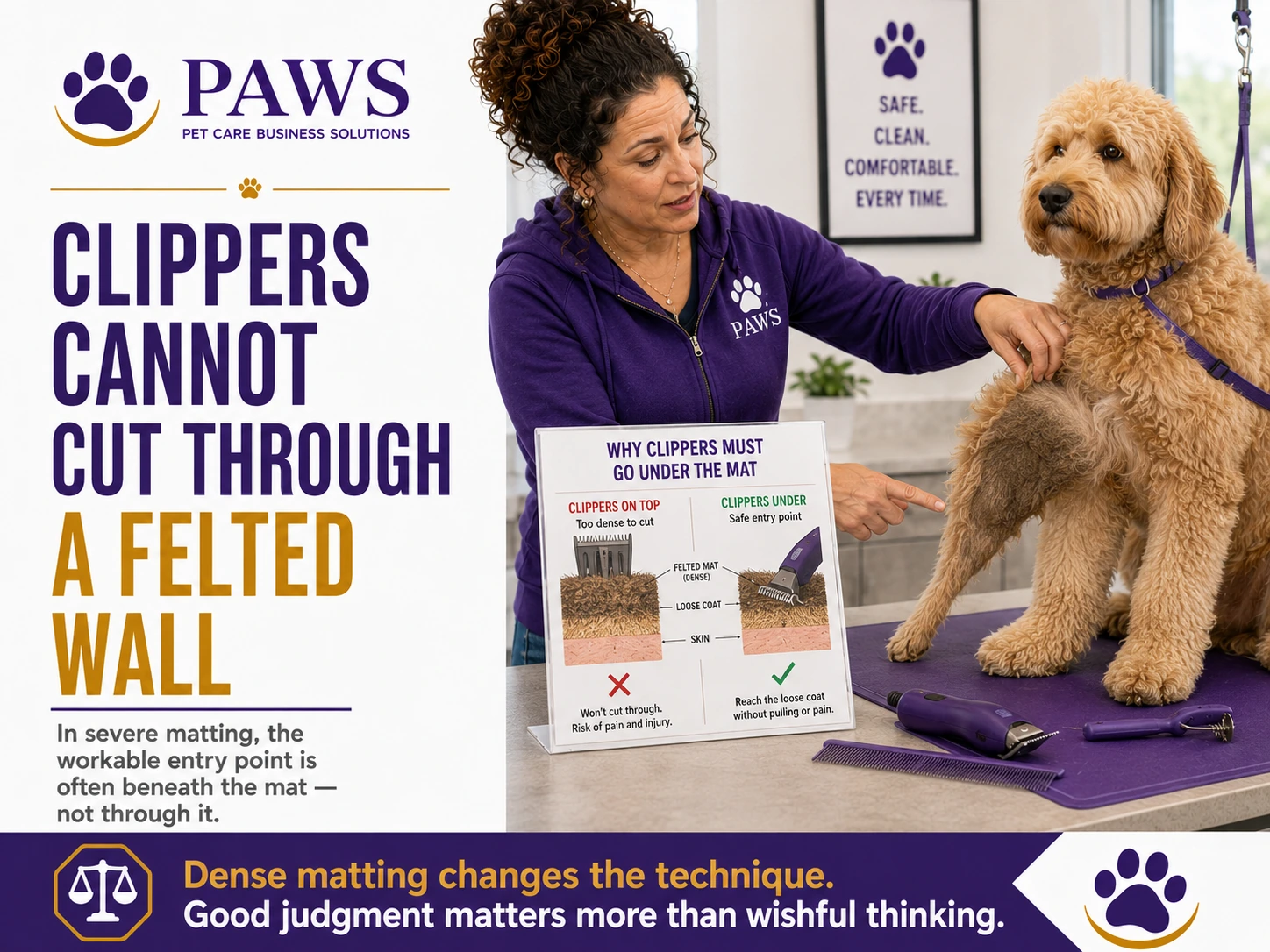
With animals that are severely matted, it can be a challenge just to find an entry point to start removing the matted coat. I typically hope to find a spot on the back between the shoulders that will allow a clipper to get through and down to the skin under the matted fur.
As the coat grows from the skin outward, the only option in many severe cases is to get underneath the existing matted fur and into the new growth closest to the skin. That is where the clipper can actually work.
Clippers cannot cut through matted fur like scissors cutting paper. For a clipper to cut, hair has to pass between the stationary outer teeth and into the path of the moving inner blade, where it can be sheared. A hard mat does not feed into the teeth. It sits there like a dirty carpet pad and laughs at your equipment.
The only place you may find hair that can enter the blade is close to the skin, underneath the mat. That is why shave-downs are often short. Not because the groomer is lazy. Not because the groomer wants the dog bald. Because the usable hair is underneath the felted mess, and underneath the felted mess is skin.
Once you find an entry point and actually get to the unmatted hair beneath, it can become an hours-long battle. You clip a small area, lift the matted hair slightly to create a sliver of separation, clip a little more, stop, breathe, reposition, check skin, and continue inch by precious inch.
Blade choice, lighting, skin tension, animal position, blade temperature, and the direction of the mat all affect risk. The operator should not reduce the process to selecting the shortest blade and pushing forward until the coat releases.
Sensitive areas may contain folds, nipples, genitals, thin skin, ear edges, old scars, warts, and tissue pulled out of normal position by the coat. Staff need permission to slow down, use another approach, leave an area for veterinary care, or stop when a safe path cannot be created.
⚠️
Clipper risk reality
The closer the mat is to the skin, the closer the blade has to work to the skin. That is why nicks, irritation, and clipper marks become more likely on severely matted pets, even when the groomer is careful.
🔍
What May Be Hiding Under the Coat
Owners often see the dog before the groom. Groomers see what the coat was hiding.
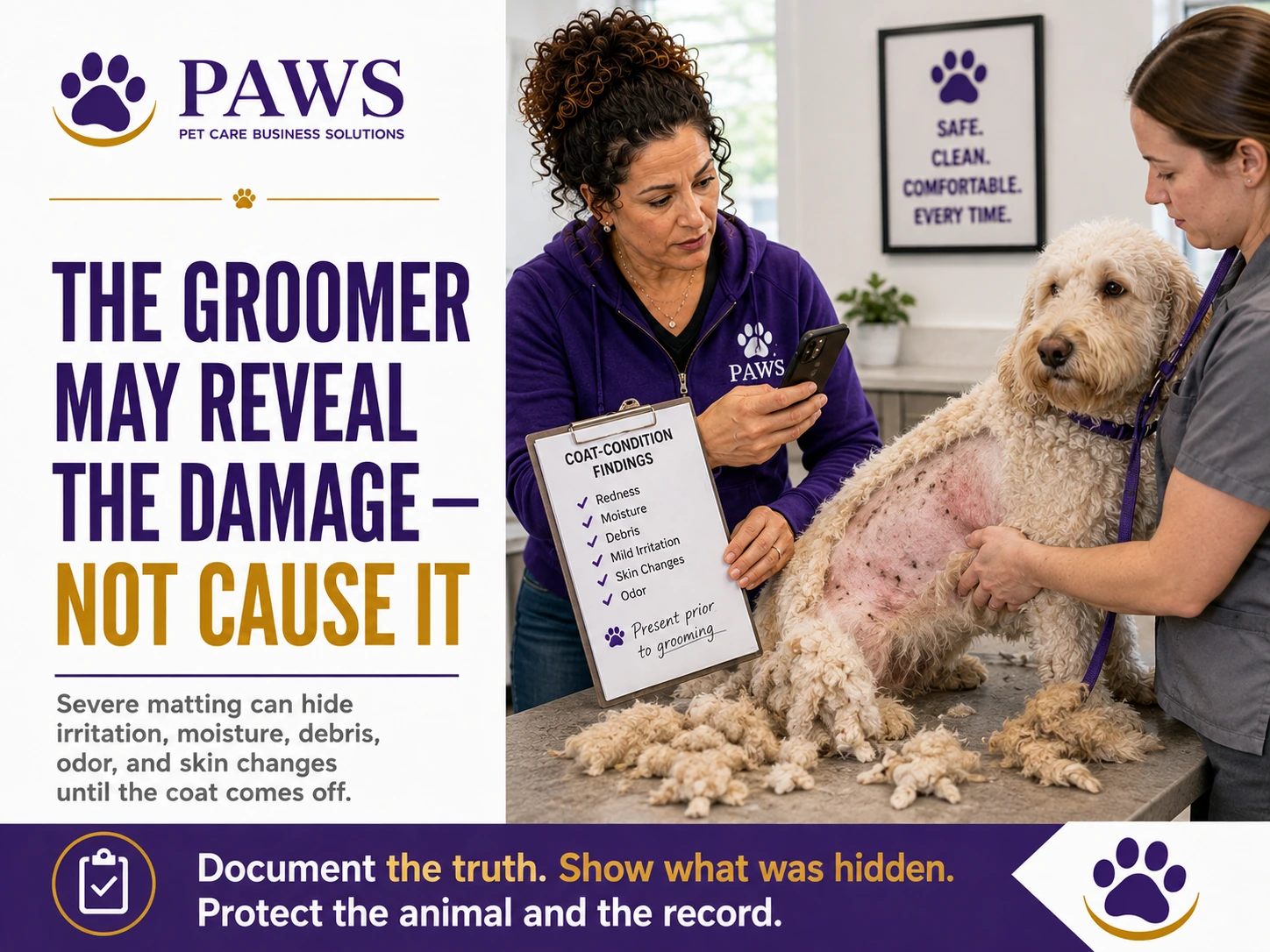
The other issue is that in many instances the skin beneath the matting is tender, inflamed, raw, or otherwise less than healthy. Until the coat comes off, nobody can fully see what is underneath.
You may find pus-filled sores, blisters, scabs, hot spots, bruising, urine burns, fecal contamination, fleas, ticks, warts, thin skin, old wounds, irritated folds, or areas where the coat has been pulling so tightly that the skin has been under constant stress.
Then the groomer removes the coat and suddenly the owner says, “What did you do to my dog?” That is why documentation matters. The groomer may have revealed the problem, not caused it.
This is one of the most unfair parts of matted pet grooming. The owner brings in a dog covered in a hair cast. The groomer removes the hair cast. The skin underneath looks awful because it has been living under a hair cast. Then the owner gets mad at the person who finally exposed the truth.
🔍
The collar hidden inside the coat
Sometimes you do not even know what is under the matting until you are already committed. I once started shaving a severely matted dog from above the tail and worked forward toward the neck. When I got near the head, I found a collar completely matted into the fur. You could not see it from the outside. It looked like the dog had no collar on at all.
The collar was buried between layers of coat, with matted hair below it and matted hair above it. We had to cut the collar itself so we could keep working. That is the kind of thing owners do not picture when they say, “Can’t you just shave it off?”
Before cleaning or applying any nonmedical product, photograph significant findings when appropriate and describe them in neutral language. Record location, color, odor, moisture, debris, bleeding, discharge, swelling, parasites, and the owner notification without attempting to diagnose the cause.
The pickup explanation should separate what was observed before or during coat removal from any grooming-related irritation. That distinction should be supported by time-stamped photos and notes rather than a defensive argument after the owner sees newly exposed skin.
- Photograph severe matting before beginning the groom.
- Photograph areas where matting is tight to the skin.
- Document sores, scabs, pus, odor, parasites, bruising, urine burns, fecal matting, and inflammation.
- Notify the owner if the skin condition changes the groom plan, price, risk level, or need for veterinary care.
- Do not diagnose medical conditions. Describe what you see and refer to a veterinarian when needed.
⚖️
Brush-Out vs Shave-Down: The Humane Decision
Some mats can be worked out. Some mats should never be tortured out.
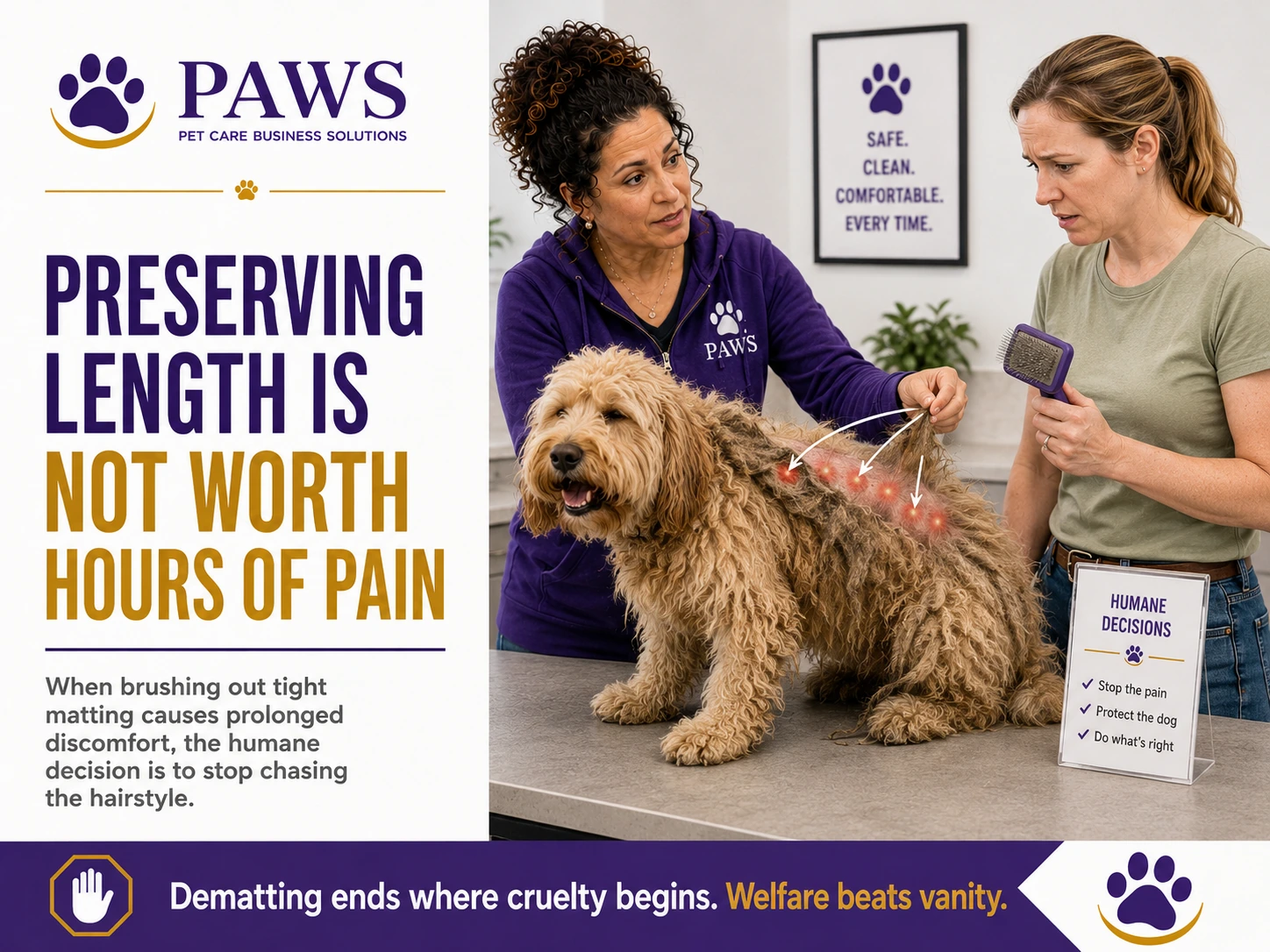
The unrealistic expectation is almost always the same: the owner believes that no matter how matted a pet is, it can simply be brushed out. They imagine enough conditioner, enough patience, enough magic spray, and enough groomer love will transform a pelted dog back into a fluffy teddy bear.
Sometimes a brush-out is reasonable. Loose tangles, mild matting away from sensitive skin, and small areas can often be handled with care. But tight matting close to the skin is different. Brushing those mats out may mean pulling on already painful skin for hours.
At a certain point, a shave-down is not the lazy option. It is the humane option.
The humane decision should consider more than coat appearance. Evaluate how tightly the mat pulls, how much body area is involved, how the animal reacts, the condition of the skin, the likely time required, and whether repeated brushing would create prolonged pain for a cosmetic result.
The business should set a written dematting limit so employees do not negotiate animal discomfort at the counter. Once that limit is reached, the options become a shorter shave-down, a modified partial groom, veterinary grooming, or refusal—not an open-ended promise to keep trying.
Swipe left/right to see the full table.
| Coat Condition | What It Looks Like | Humane Grooming Option | Client Warning |
|---|---|---|---|
| Mild tangles | Loose knots, comb can still move through most of the coat. | Brush-out may be reasonable with time and proper tools. | Maintenance needs to improve or this becomes a bigger problem. |
| Moderate matting | Mats in friction areas, behind ears, legs, belly, tail, collar, harness zones. | Spot shaving, partial shave-down, or limited dematting if safe. | There may be uneven areas, shorter patches, extra time, and extra cost. |
| Tight mats close to skin | Mat does not lift easily, skin pulls when mat moves, comb cannot pass. | Shave-down is usually the humane choice. | Nicks, irritation, hidden sores, and short coat length are real risks. |
| Full-body pelt | Coat is connected into a shell over body, legs, tail, ears, or sanitary area. | Full shave-down or veterinary referral if too painful or unsafe. | The haircut is gone. The priority is freeing the animal. |
| Painful, injured, aggressive, elderly, or medically fragile pet | Severe stress, open wounds, pus, maggots, collapse risk, bite risk, extreme discomfort. | Stop and refer to a veterinarian when salon grooming is not safe. | Some animals need medical grooming, sedation, wound care, or veterinary supervision. |
📌
Use this line
“I understand you want to save the coat. My job is to make the humane choice for the animal in front of me, and brushing this out would be painful and unfair to the dog.”
🐩
Oodles, Poos, Doodles, and the High-Maintenance Coat Problem
The teddy bear fantasy sells the puppy. The groomer gets the invoice when reality comes due.
I suppose the most common examples involve “Oodles” or “Poos” of any type or size: Poodles, Labradoodles, Goldendoodles, Yorkipoos, Maltipoos, Cockapoos, Schnoodles, Bernedoodles, Sheepadoodles, and WhoKnowsApoos.
In many instances, no matter how professional you are, how well you explain the situation, how much care you take not to injure the pet, or how knowledgeable you may be, the owners of matted pets are not going to be happy having their dog shaved down.
Accept it and do not take it personally. They may call you names, write bad reviews, curse you, throw a temper tantrum, or act like you personally hunted down the fluffy version of their dog and murdered it in the back room.
Ask any groomer. Sadly, it is not uncommon for owners to unleash their own guilt, embarrassment, and self-loathing over being unable to care for a pet’s coat onto the groomer in a furious little opera of insults and bad behavior.
Back to the coat itself. Oodles and Poos are different from many short-coated breeds. A Labrador-type coat grows, sheds, and replaces itself. Poodle-type hair keeps growing much like human hair. If left uncut and unmaintained, it gets longer and longer until it tangles into something similar to full-body dreadlocks.
The other issue is texture. If the hair of a Black Labrador is like the bristles of a wire brush, poodle-type hair is more like replacing those bristles with sewing thread. Fine, curly, soft, and ready to tangle if the owner treats it like a wash-and-ignore coat.
The end result is that these coats can transform from soft and fluffy to an interwoven hardened mass that encapsulates the pet’s body. The owner bought teddy bear. The dog grew maintenance bill.
⚠️
Doodle reality
Many owners were sold the idea of a cute, low-shedding, low-maintenance teddy bear dog. The dog may be cute. The low-maintenance part is where the fantasy goes to die.
🙈
Owner Denial and Groomer Blame
Some owners are in denial, serious need-12-steps kind of denial, when they enter your salon.
Many owners of matted pets are woefully ignorant of their pet’s coat condition, the maintenance process, the removal process, and the pain involved. Some are not ignorant. Some are in denial. Some know it is bad and are terrified of being judged. Some are broke. Some are overwhelmed. Some inherited the problem. Some had health issues, family issues, death, divorce, job loss, or a dog that became impossible to brush.
The reason matters emotionally. The coat condition matters operationally.
You can have empathy for the human situation and still refuse to torture the animal to protect the owner’s feelings.
The most famous groomer excuse is that “a friend watched the pet” and that is why it is matted. Ask any groomer. The friend must be very busy, because apparently this one mysterious friend is personally responsible for half the matted dogs in America.
Even if you make the owner sign a matted pet waiver admitting the dog is severely matted and must be stripped, do not be shocked if payment time comes and they deny the dog was ever matted to begin with. Again, accept it and do not take it personally. It is their issue, not yours.
The undeniable operating reality is that most severe matting comes from coat maintenance failure. Food, water, shelter, vaccines, veterinary care, grooming, nail care, ear care, coat maintenance — those are all part of owning the animal.
With Oodles and Poos, lack of coat maintenance can become a serious medical and welfare issue. It can cause prolonged pain and discomfort. In many instances, it is tantamount to neglect. As you gain experience and see the sad state many dogs are in when brought to your facility, you may lose sight of the need to please the customer and feel your compassion for the misery of the dog turn into hostility toward the customer for allowing the dog to suffer under the torture of a full-body hair cast.
That reaction is human. But as the professional, you still need control. You can be angry about the animal’s condition and still handle the owner with enough discipline to protect the business, the staff, and the dog.
📌
Operator translation
The owner may be mad at you because being mad at you feels easier than admitting the dog got this way before it ever walked into your salon.
💵
Pricing Reality: A Six-Hour Matted Groom Is Not a Two-Hour Maintenance Groom
The dog that was maintained should not subsidize the dog that arrived wearing a carpet.
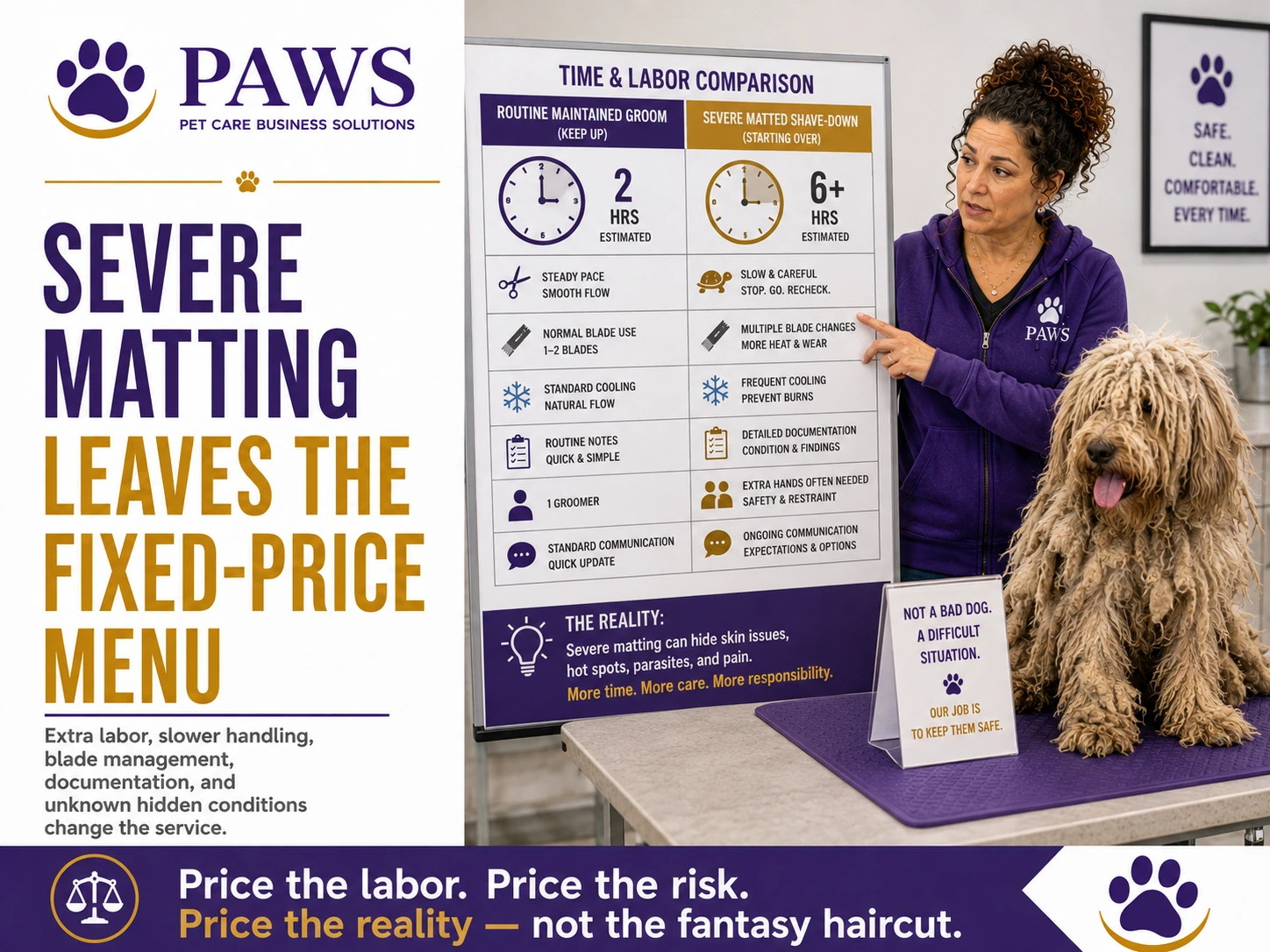
Along with unrealistic expectations about saving the coat, many owners also mistakenly believe you are in this business simply for the love of animals, profit be damned, and should provide extra time, extra labor, extra risk, and extra emotional damage for free.
They may believe every pet should be charged the same regardless of coat condition or the inordinate amount of time required to correct it. It seems to be an unfathomable concept for the average pet owner that a dog that takes six hours to demat and groom should be charged more than a similarly sized or same-breed dog that was maintained and only takes two hours to groom.
But time is time. Risk is risk. Staff are staff. Equipment wear is equipment wear. A painful, matted shave-down may require more breaks, more handling, more blades, more cooling, more documentation, more owner communication, and more emotional labor than a normal groom.
I have had matted dogs where two experienced people worked for six hours or more on one animal. That is twelve hours of human labor being poured into one dog, even if the customer only sees one dog and one final bill. Commercial tools, trained hands, patience, breaks, and inch-by-inch work are not free just because the owner wishes the dog had been brushed three months ago.
Sometimes you can only cut a tiny section at a time. Half a square inch, lift, peel, separate, check skin, cool the blade, settle the dog, give the dog a break, reposition, and do it again. That is not the same as running clippers over a maintained coat and sending the dog home with a bow.
For that reason, severely matted pets should usually leave the fixed-price menu. Once a dog is obviously pelted, you do not know what you are going to get into. You do not know how tight the coat is, what is hiding underneath, how the dog will tolerate the work, whether there are sores, whether there is a collar buried in the coat, whether the skin is fragile, or whether you will need to stop and refer to a veterinarian.
A better structure is an hourly matted-coat rate or a clearly explained time-and-labor charge. At my facility, these cases stopped being “this groom costs X.” They became, “This is hourly work because we do not know what is under there yet.” The exact rate is a business decision, but the principle matters: severe matting is not a normal groom and should not be priced like one.
I generally tried to be fair. If two of us worked on a dog for six hours, I did not necessarily bill the customer for twelve human-hours. But I also was not going to pretend six hours of dangerous, skilled, painful mat removal was the same price as a normal bath-and-haircut appointment.
The price should be explained before the groom starts. Do not surprise the owner at checkout with a number that sounds like you pulled it out of a hat during a thunderstorm. Give a range when possible. Explain that the final price depends on coat severity, time, skin condition, behavior, and whether veterinary referral becomes necessary.
The estimate should explain both the rate and the uncertainty. Severe matting may reveal additional body areas, hidden skin problems, behavior changes, required breaks, blade changes, staff assistance, or a need to stop before the groom is complete.
Track the actual labor and consumables after each severe case. That information helps the business set realistic hourly rates, deposit requirements, scheduling blocks, cancellation policies, and limits on how many difficult matting cases the grooming team can safely accept.
Swipe left/right to see the full table.
| Pricing Factor | Why It Matters | How to Explain It |
|---|---|---|
| Extra time | Matted coats may require hours of slow, careful work. | “This is not a standard groom. The coat condition requires extra time to remove safely.” |
| Multiple staff members | Severe cases may require one person to handle and another to clip, especially when the pet is painful or unstable. | “This may require additional staff support so we can work safely and avoid pushing him past his limit.” |
| Handling difficulty | Painful pets may need more breaks, more staff support, or stop points. | “We are going to work at a pace that protects the dog and staff.” |
| Skin condition | Hidden sores, inflammation, or wounds may change the groom plan. | “If we find skin problems under the matting, we may need to stop and recommend a vet.” |
| Unknown objects under the coat | Collars, debris, burrs, scabs, wounds, parasites, or skin folds may be hidden until the coat opens up. | “We cannot fully know what is under this coat until we start removing the matting.” |
| Risk | Nicks, irritation, clipper burn, and behavioral reactions are more likely. | “The closer the mats are to the skin, the higher the risk, even with careful work.” |
| Documentation | Photos, notes, owner calls, and waiver review take time. | “We document severe matting because it protects the dog, the groomer, and the owner.” |
⚠️
Pricing rule
Severe matting should not be quoted like a normal groom. Once the dog is wearing a pelt, the business is selling skilled labor, risk control, animal welfare judgment, staff time, documentation, and the slow miserable work of freeing the pet safely.
🧾
Matted Pet Waiver and Grooming Release
The waiver does not make the groom safe. It makes the reality clear before the clippers start.
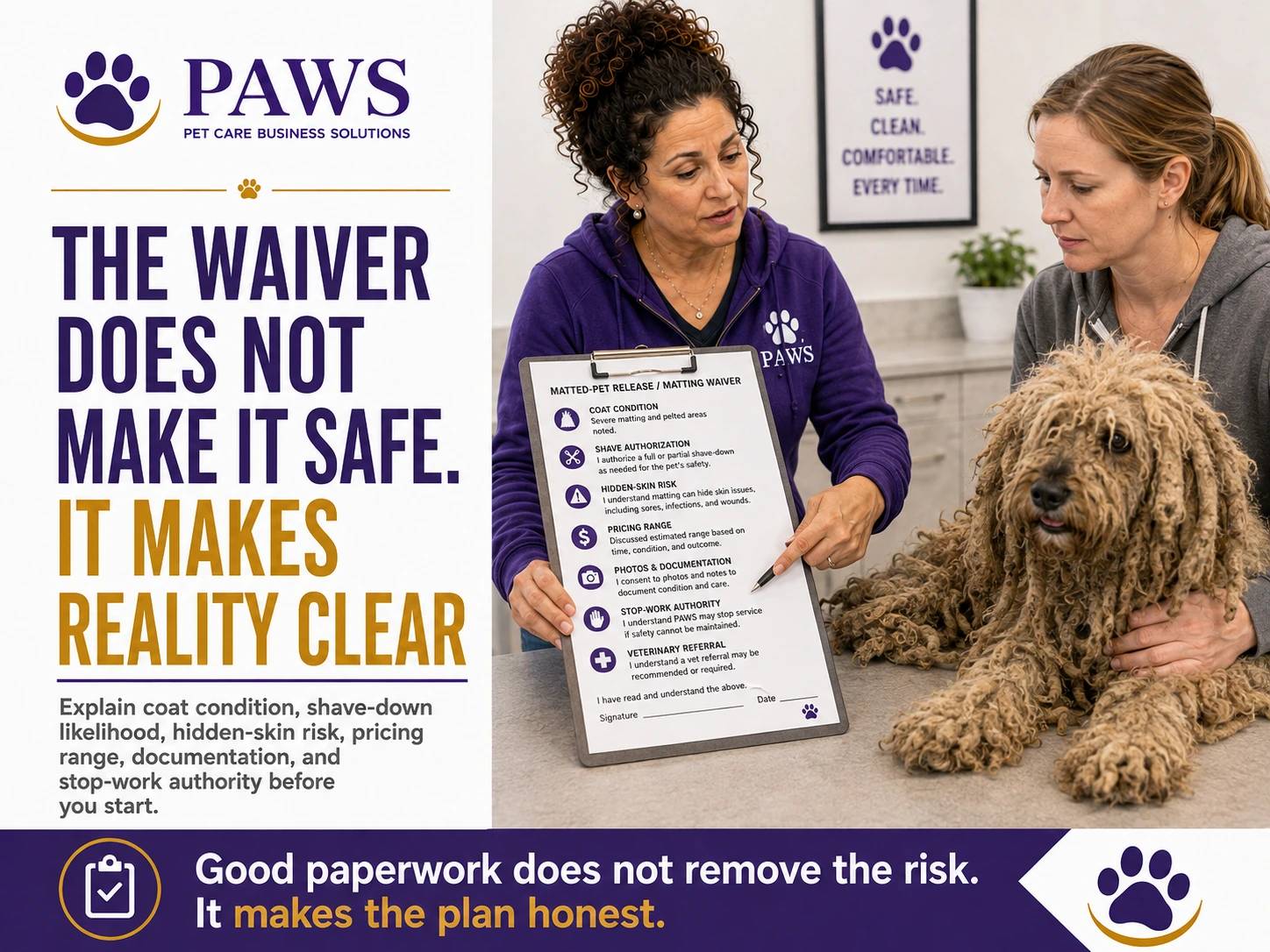
A matted pet waiver is not a magic shield. It does not excuse careless work. It does not let staff torture an animal through an impossible brush-out. It does not replace judgment.
What it does is force the conversation before the groom begins. The owner acknowledges the coat condition. The business explains the risks. The groomer gets authorization for the humane plan. The file contains proof that the owner was told what may happen.
Without that conversation, the groomer is standing at pickup trying to explain a shaved dog, red skin, hidden sores, an increased price, and an angry owner who suddenly has selective amnesia about what the dog looked like at drop-off.
Authorization should be specific enough to guide the groomer. It should identify the likely short outcome, dematting limits, permission to modify the plan, expected price method, photo documentation, owner-contact instructions, stop authority, and possible veterinary referral.
The signed form should match the verbal conversation. Staff should not bury the most important facts inside fine print and then act surprised when the owner expected a fluffy haircut. Ask the owner to confirm the plan in plain language before the pet is accepted.
Swipe left/right to see the full table.
| Waiver Item | Why It Matters |
|---|---|
| Coat condition acknowledgment | Owner confirms the pet is matted, pelted, tangled, or otherwise not in normal coat condition. |
| Humane shave-down authorization | Owner authorizes the groomer to remove the coat short when brushing out would be painful or unsafe. |
| Risk disclosure | Nicks, clipper irritation, redness, bruising, hidden wounds, sores, hot spots, and skin problems may be found or occur. |
| Price range / extra charge notice | Owner understands severe matting may require additional labor and cost. |
| Veterinary referral language | Salon may stop and refer to a veterinarian if pain, wounds, medical risk, or behavior exceeds safe grooming limits. |
| Photo and documentation permission | Business may document coat condition, matting, skin findings, and groom progress. |
| Stop-work authority | Groomer may stop the groom if continuing becomes unsafe or inhumane. |
✍️
Sample waiver language
“I understand that my pet’s coat is matted/tangled/pelted and that humane grooming may require shaving the coat shorter than requested. I understand that matting can hide sores, wounds, parasites, irritation, bruising, thin skin, and other conditions. I understand that removal of tight matting may increase the risk of nicks, clipper irritation, redness, discomfort, or the discovery of pre-existing skin problems. I authorize the groomer to proceed with the safest humane grooming option and understand that veterinary referral may be recommended if the pet’s condition exceeds safe salon grooming limits.”
📸
Photos and Documentation: Reality Before Denial
When the owner starts rewriting history, your notes and photos become the adult in the room.
Documentation is not optional with severely matted pets. If the pet arrives pelted, photograph it. If the ears are stuck to the neck with mats, photograph it. If the sanitary area is sealed in urine and feces, photograph it. If the matting comes off in a full-body shell, photograph it.
Again, this is not about humiliating the owner. It is about preserving facts. Owners under guilt and embarrassment can become very creative historians by checkout time.
Your notes should be factual: where the mats were, how tight they were, whether the comb could pass, whether the skin was visible, what risks were explained, what the owner authorized, what price range was given, what skin issues were found, whether the pet tolerated the process, and whether veterinary care was recommended.
Use a consistent photo sequence: whole pet at intake, problem areas with the coat in place, close views showing tightness or contamination, the removed coat when meaningful, the exposed skin, and the final condition. Consistency makes records easier to interpret later.
Store notes and images with the pet record, not on an employee’s personal phone. The file should show who took the photos, when the owner was contacted, what was authorized, what changed during the groom, and what follow-up or veterinary recommendation was provided.
- Take before photos of the pet standing naturally when possible.
- Photograph tight matting close to skin, especially ears, legs, tail, belly, sanitary area, and armpits.
- Photograph the coat or pelt after removal when it shows severity.
- Photograph skin findings before cleaning or treatment recommendations when appropriate.
- Document owner conversations, waiver signature, price range, and authorization.
- Document stop points, behavior concerns, muzzle use, staff assistance, and vet referral recommendations.
🩺
When to Stop and Refer to a Veterinarian
Some matted pets are beyond safe salon grooming. That is not failure. That is judgment.
There are times when the groomer should stop. Not pause. Not push through. Stop.
Some animals are too painful, too medically fragile, too injured, too aggressive from pain, too old, too stressed, or too deeply matted for a normal salon setting. Some need sedation, wound care, antibiotics, pain control, parasite treatment, or veterinary supervision.
Hero grooming is how people get bitten and animals get hurt. The groomer’s job is not to prove toughness. The groomer’s job is to make the safe and humane call.
Referral decisions should occur before the team becomes exhausted or the animal is in crisis. Severe pain, open skin, circulation concerns, medical instability, inability to position the animal safely, or escalating aggression can all make salon grooming inappropriate.
The owner should receive a factual explanation of what the salon observed and why medical support may be needed. Staff should avoid diagnosing, promising sedation, or predicting treatment; the salon’s role is to identify that the case has exceeded safe grooming limits.
- Open wounds, active bleeding, pus, severe odor, maggots, or obvious infection.
- Skin so painful the pet cannot tolerate safe handling.
- Extreme age, weakness, collapse risk, breathing difficulty, or medical fragility.
- Severe matting around genitals, anus, ears, eyes, or limbs where salon removal risks injury.
- Aggression that appears pain-driven and cannot be safely managed.
- Suspected strangulating mats, circulation problems, or constricting bands around legs, tail, or toes.
- Any situation where sedation, pain control, or wound treatment may be needed.
⚠️
Stop rule
No groom is worth forcing a painful, terrified, medically fragile animal through a six-hour ordeal because the owner wants the coat saved.
💬
Client Conversation Script: When the Owner Wants Fluffy and the Dog Needs Freeing
Say it clearly before the groom starts. Pickup is too late to introduce reality.
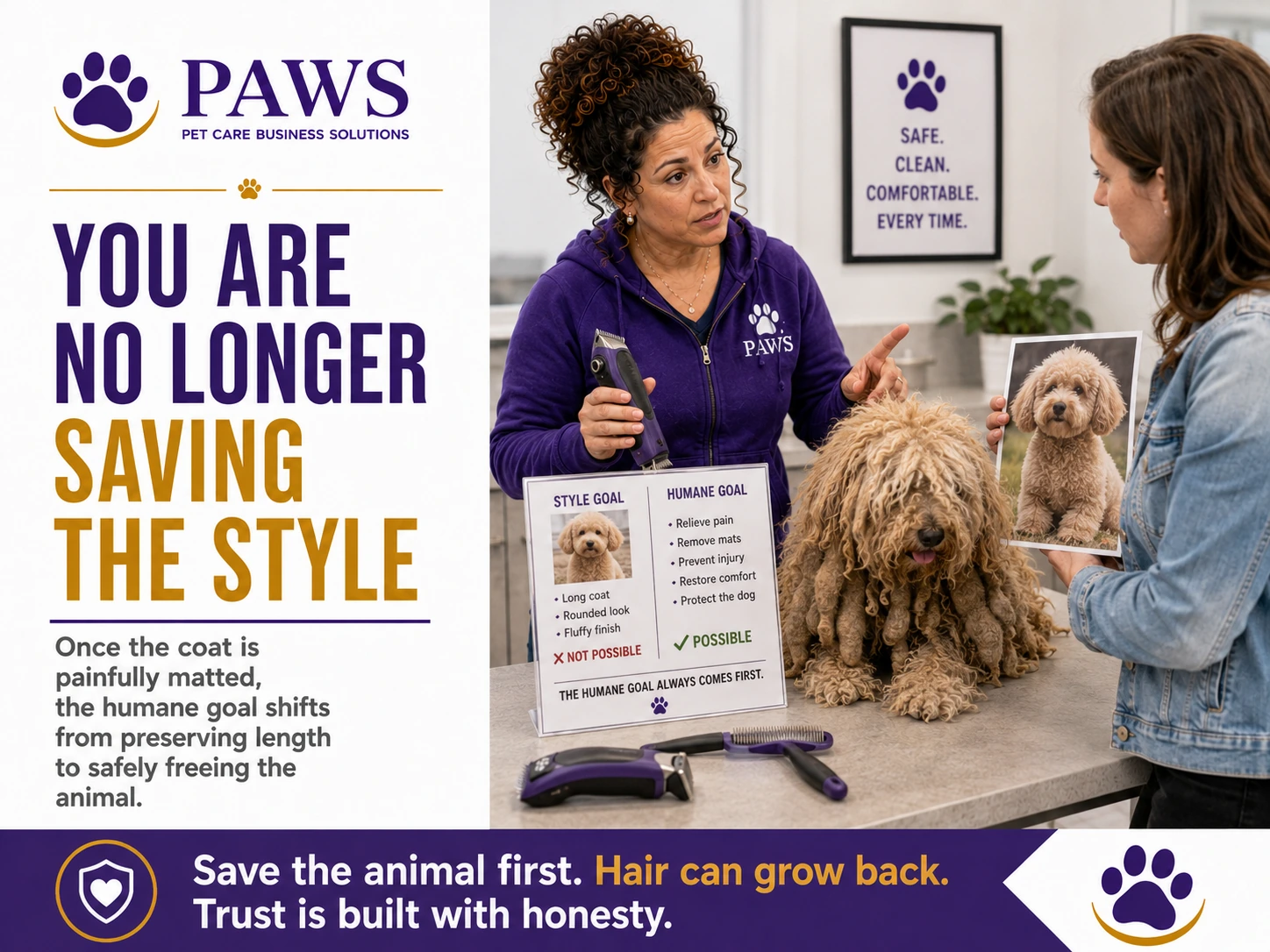
The client conversation should happen at intake, not after the dog is shaved. The owner needs to hear the coat condition, the humane limit, the risks, the likely outcome, the price range, and the possibility of veterinary referral before the clippers touch the animal.
The intake conversation should end with a documented decision, not a vague agreement to see what happens. The owner should know whether the plan is a full shave-down, limited humane dematting, a price range or hourly rate, a possible mid-groom call, and a possible veterinary referral.
Show the owner the coat condition before accepting the pet whenever practical. A comb test, photographs, and a calm explanation of where the mats touch the skin make the later result less surprising and reduce the chance that the groomer is accused of choosing a short cut for convenience.
✂️
Typical setup
Owner walks in with a pelted doodle and a photo of a fluffy teddy bear haircut. The dog is wearing a full-body hair cast. The owner says, “Can you just brush him out and leave him long?”
Pet Owner: “I want him fluffy. Please do not shave him.”
Groomer: “I understand wanting to keep him fluffy. The problem is that this coat is tightly matted close to the skin. Brushing this out would be painful and unfair to him.”
Pet Owner: “He was not like this last week.”
Groomer: “I am going to show you what I am seeing. The comb will not pass through these areas, and the matting is tight against the skin. This takes time to form and tighten. My job today is to get him comfortable safely, not preserve a coat that is already causing him pain.”
Pet Owner: “Can’t you just try?”
Groomer: “I can try within humane limits. What I cannot do is pull on painful mats for hours just to leave length. If the coat cannot be safely brushed, the humane option is a shave-down.”
Pet Owner: “But I do not want him bald.”
Groomer: “I understand. I do not want that for him either. But the usable hair is underneath the matting, close to the skin. That means the coat may have to come off short. I would rather send him home short and comfortable than long and suffering.”
Groomer: “I also need you to understand the risks. With matting this tight, we may find irritated skin, sores, scabs, or wounds underneath. There is also increased risk of nicks or clipper irritation because the blade has to work close to the skin. We will document what we find and stop if this becomes unsafe.”
Pet Owner: “So what are my options?”
Groomer: “Option one is a humane shave-down here today if he tolerates it safely. Option two is a veterinary groom if he is too painful, too stressed, or if we find skin problems that need medical care. What I will not recommend is forcing a painful brush-out.”
Swipe left/right to see the full table.
| Owner Says | Do Not Say | Better Response |
|---|---|---|
| “Just brush it out.” | “No, that is impossible.” | “I can brush what is humane to brush. These mats are tight to the skin, and brushing them out would be painful.” |
| “He was not matted before.” | “Yes, he was. You neglected him.” | “I can only speak to what is in front of me today. The comb will not pass through the coat, and the mats are tight to the skin.” |
| “My friend watched him and this happened.” | “Sure, blame the friend.” | “However it happened, our job now is to remove the matting safely and prevent him from staying uncomfortable.” |
| “I do not want to pay extra.” | “Then brush your dog.” | “This requires additional time and risk beyond a maintenance groom. I want to explain the price before we start.” |
| “You made him red.” | “That was already there.” | “The skin underneath the matting was irritated when the coat came off. Let me show you the photos and notes from the groom.” |
| “You cut my dog.” | “Well, he was matted.” | “With tight matting, the risk of nicks is higher because the blade works close to skin. Let me show you exactly where it happened and what aftercare or vet follow-up we recommend.” |
🛡️
Staff Safety: Pain Bites Are Real
A painful animal is not a moral test. It is a safety situation.
A matted pet may bite because it hurts. The dog may not be “bad.” The cat may not be “mean.” The animal may be reacting to pain, fear, restraint, heat, noise, pulling, skin tenderness, and the feeling of someone working under a coat that has been yanking on its body for weeks.
Staff need permission to stop. They need clear rules for muzzles, breaks, two-person handling, owner calls, manager decisions, and veterinary referral. No employee should feel pressured to absorb a bite because the owner wants a cute face left on a dog that is otherwise wearing a pelt.
The team should plan difficult cases before placing the animal on the table. Assign the lead handler, identify equipment, decide who may authorize a pause or referral, and keep unrelated staff from crowding the work area.
After a bite, near bite, fall, collapse, or significant distress event, stop the normal workflow and follow the facility’s incident procedure. Staff injuries, animal injuries, owner contact, medical recommendations, and future restrictions should be documented while details are fresh.
- Assess behavior before promising completion.
- Use muzzles, cones, safety loops, and handling support according to facility policy and animal welfare limits.
- Stop if the pet becomes dangerously stressed, painful, aggressive, exhausted, or medically concerning.
- Do not let one staff member struggle alone with a painful, pelted animal.
- Document bites, near bites, thrashing, panic, stop points, and owner communication.
- Refer to a veterinarian when salon grooming is no longer safe or humane.
⚠️
No hero grooming
The groomer is not obligated to get bitten, the pet is not obligated to suffer, and the business is not obligated to finish an unsafe groom just because the owner ignored the coat for too long.
🪮
Preventing This From Happening Again
The shave-down fixes today’s suffering. It does not fix the owner’s maintenance problem.
Once the dog or cat is freed, the owner needs a prevention plan. Not a lecture that makes them defensive and useless. A plan.
The plan should include realistic grooming frequency, coat length, brushing tools, comb checks, problem areas, bathing warnings, and what the owner should do before the coat gets away from them again.
Some owners should not keep a long doodle coat. That is not an insult. That is reality. If the owner cannot maintain the coat, cannot afford frequent grooming, cannot brush properly, cannot handle the dog, or will not keep a schedule, then a shorter practical haircut may be the kindest option for the animal.
Prevention advice should fit the owner’s actual ability and the animal’s tolerance. A complicated daily routine that the owner will not follow is less useful than a shorter coat, frequent professional appointments, and a simple comb-check routine.
Demonstrate what success feels like. The comb should reach the skin without catching in the high-risk areas, and the owner should understand that surface fluff can hide a tightening mat underneath. Written instructions and a booked follow-up turn the lesson into a plan.
- Recommend a grooming schedule based on coat type, lifestyle, and owner ability.
- Show the owner the high-risk areas: ears, collar, harness line, armpits, belly, sanitary area, legs, tail, and feet.
- Explain that brushing the top of the coat is not enough. The owner must be able to comb down to the skin.
- Warn that bathing a tangled coat can tighten mats and make the situation worse.
- Recommend a practical coat length if the owner cannot maintain a long coat.
- Book the next appointment before the owner leaves if possible.
❓
Matted Dog and Cat Grooming FAQ
Detailed answers about humane dematting limits, short shave-downs, hidden skin damage, clipper risk, pricing, waivers, documentation, veterinary referral, staff safety, feline cases, and preventing severe matting from returning.
Can severe mats be brushed out?
Some loose tangles and small isolated mats can be worked out when the skin is healthy, the comb can still reach the base of the coat, and the animal tolerates the process without escalating pain or stress. That is different from a tight connected mat that moves the skin when it is lifted.
The business should set a humane dematting limit based on time, body area, coat tension, skin condition, and the animal’s response. Once brushing becomes prolonged pulling on living skin, the appropriate options are a shorter shave-down, a modified groom, veterinary grooming, or stopping the service.
Why does a matted shave-down have to be so short?
The clipper needs hair that can enter the blade. A dense felted mat will not feed through from the top, so the groomer must find workable hair beneath the mat, close to the skin. The available length is determined by the space between the skin and the compacted coat.
That is why the groomer cannot simply choose a longer blade because the owner prefers a fluffy result. When there is no safe space for the longer blade, trying to preserve length increases pulling, heat, nick risk, and the chance of injuring skin hidden inside the mat.
Why can severe matting hurt even before grooming begins?
Tight mats pull on the skin every time the animal walks, sits, lies down, scratches, or turns. They can restrict movement, trap moisture and waste, create friction, and hold irritated areas against the body for days or months.
The animal may therefore react when the groomer touches or lifts the coat. Growling, biting, screaming, thrashing, or trying to escape may be pain responses rather than evidence that the pet is simply difficult. Handling plans should reflect that possibility.
Why can the skin look worse after the coat is removed?
The coat may have concealed redness, urine burns, fecal contamination, sores, scabs, parasites, bruising, hot spots, swelling, or other skin changes. Once the hair cast is removed, those conditions become visible for the first time.
Close clipping can also make already irritated skin more noticeable and may cause additional temporary irritation when the mat is tight to the skin. Before-and-during photographs help distinguish what was revealed from what may have occurred during the grooming process.
Did the groomer cause every red spot or sore found after shaving?
No. A groomer may reveal damage that was hidden under the coat. The business should document the pet’s condition before work begins, photograph tight areas and visible findings, and describe what was observed without diagnosing a medical condition.
The groomer is still responsible for careful technique and honest reporting. When a nick or grooming irritation occurs, it should be disclosed and documented separately rather than using the preexisting matting as an excuse for careless work.
Can a groomer nick a severely matted pet even when working carefully?
Yes. Tight matting can pull thin skin into abnormal positions and hide folds, warts, nipples, scars, ear edges, and irritated tissue. The blade may need to work very close to the body, where there is little room for error.
The increased risk should be explained before the groom, but it does not remove the duty to slow down, maintain lighting, monitor blade temperature, position the animal carefully, use assistance when appropriate, and stop when a safe path cannot be created.
Why is preserving coat length sometimes inhumane?
Saving length may require hours of brushing and separating mats that are pulling on painful skin. The cosmetic result belongs to the owner, but the discomfort is experienced by the animal. A long coat is not worth prolonged restraint and repeated pain.
The humane goal is to remove the source of suffering with the least additional distress. Once the coat is pelted, the matting has already destroyed the planned hairstyle. The groomer is deciding how to free the animal, not whether to ruin an intact haircut.
What is the difference between moderate matting and a full-body pelt?
Moderate matting may be limited to friction areas such as behind the ears, under the collar, in the armpits, on the legs, or around the tail. A full-body pelt is a connected shell that may include the body, limbs, ears, tail, and sanitary areas.
The distinction affects time, pricing, documentation, risk, and whether the service belongs in a salon. A connected pelt often requires an extensive shave-down and may expose medical or behavioral problems that cannot be evaluated from the outside.
Why does severe matted grooming cost more?
It may require many additional hours, multiple staff members, repeated breaks, extra blades, cooling time, careful repositioning, photography, owner calls, behavior management, and detailed notes. The groomer is performing risk-controlled coat removal, not a routine haircut.
A fixed maintenance-groom price assumes a maintained coat and predictable workflow. Severe matting introduces unknowns, so an hourly rate, time-and-labor charge, deposit, or documented price range is often more accurate and fair to both the business and maintained clients.
Should the business quote an exact price before starting?
An exact price may be impossible when the coat hides the skin, debris, wounds, behavior, and the true amount of connected matting. The business should explain the rate structure, minimum charge, likely range, and what factors may change the total.
The owner should also understand when the business will call for additional authorization and what happens if the pet must be stopped or referred. Clear uncertainty is more professional than a low fixed quote followed by a surprise bill at pickup.
What should a matted-pet waiver include?
It should acknowledge the coat condition, authorize a humane short shave when necessary, disclose hidden-skin and clipper risks, explain the pricing method, permit documentation, reserve stop-work authority, and state that veterinary referral may be required.
The form should reflect the verbal plan. Staff should point out the likely coat length, show the owner the matting, explain what cannot be promised, and confirm that the owner understands before accepting the pet.
Does a signed waiver make an unsafe groom acceptable?
No. A waiver documents informed consent and the risks already created by the coat, but it does not make poor technique, excessive force, prolonged painful brushing, or ignoring medical distress acceptable.
Staff must still reassess throughout the groom and stop when continuing becomes unsafe or inhumane. The waiver clarifies reality; it does not transfer professional judgment to the owner or authorize hero grooming.
What photographs should be taken?
Take whole-body intake photographs, close views of tight or contaminated areas, images showing whether the coat separates from the skin, the removed pelt when it demonstrates severity, and photographs of significant skin findings after exposure.
Store the images with the business record and note the date, photographer, owner conversation, authorization, and any change in plan. Personal employee phones should not become the permanent storage system for sensitive client records.
When should the groomer stop and refer to a veterinarian?
Referral is appropriate for open wounds, active bleeding, pus, maggots, severe odor with suspected infection, extreme pain, medical fragility, breathing or collapse concerns, constricting mats, unsafe aggression, or areas that cannot be removed without unacceptable injury risk.
The salon should describe what it observed and why the case exceeded grooming limits. Staff should not diagnose or promise sedation, pain medication, antibiotics, or a particular veterinary treatment.
What if the owner insists that the coat must be saved?
Acknowledge the preference and explain the coat condition in observable terms: the comb will not pass, the mat is tight to the skin, the skin moves with the coat, or the animal is showing pain. Then state the facility’s humane dematting limit.
The owner may choose a veterinary opinion or another provider, but the business should not agree to prolonged painful work to avoid conflict. The animal’s welfare and staff safety control the service offered.
How should staff respond when the owner denies the pet was matted?
Avoid arguing about blame. Show the intake photographs, comb test, notes, removed coat, and areas where the matting touched the skin. Speak to what was documented rather than making statements about the owner’s character.
The file should also show what the owner was told before work began and what was authorized. Documentation prevents the entire pickup conversation from depending on memory and emotion.
Can a painful matted pet bite even if it is normally friendly?
Yes. Pain, restraint, clipper vibration, heat, noise, skin tenderness, and the movement of the mat can push a normally social animal into defensive behavior. Staff should not interpret the reaction as a moral failure by the pet.
Assess behavior before promising completion, use trained handling methods, schedule adequate assistance, provide breaks, and stop when the risk rises. A friendly history does not guarantee safe tolerance during painful coat removal.
Should cats with severe matting be handled differently?
Cats can have thin skin, rapid escalation, twisting ability, stress sensitivity, and medical risks that make severe mat removal especially challenging. The same welfare principles apply, but the threshold for veterinary referral may be lower depending on the cat and the facility’s training.
A business should not accept severely matted cats unless staff have appropriate feline grooming experience, equipment, handling procedures, and a clear referral relationship. A dog-grooming routine should not simply be transferred to a distressed cat.
How can owners prevent severe matting from returning?
Use a realistic professional grooming schedule, maintain a coat length the owner can actually manage, brush in sections, confirm progress with a comb down to the skin, and check high-friction areas such as ears, collar lines, armpits, belly, legs, tail, feet, and sanitary areas.
Avoid bathing a tangled coat without a plan because water and drying can tighten existing mats. Book the next appointment before leaving and choose a shorter practical style when home maintenance is inconsistent or the pet resists brushing.
What is the bottom-line rule for severely matted pets?
The animal’s comfort, medical condition, and safe handling come before coat length, owner embarrassment, fixed pricing, or the desire to finish every appointment. The groomer should remove what can be removed humanely and refer what exceeds salon limits.
A strong business explains the condition before work begins, documents reality, prices the actual labor, protects staff, reports findings honestly, and sends the owner home with a prevention plan instead of allowing the same coat failure to repeat.
🐶
The Bottom Line: The Coat Is Already Gone
By the time a pet is severely matted, the groomer is not deciding whether to ruin the coat. The matting already did that.
In my personal opinion, which when combined with 99 cents may or may not still buy you a cup of coffee at McDonald’s, many owners of severely matted pets do not want to accept responsibility for the condition of the coat. They take it personally. They feel attacked. They hear “your dog is matted” as “you are stupid” or “you are an animal abuser,” and then they lash out at the groomer or the business.
I understand that things happen. Money gets tight. Other bills matter. Life falls apart. People get sick. Dogs become hard to handle. Owners buy high-maintenance coats without being taught what they actually bought. I also understand that bringing the dog in is at least an effort to correct the situation.
But the animal is still standing there in a painful coat. That is the part that cannot be negotiated away.
What you as a groomer or pet business owner need to understand is that regardless of how much empathy you show, how well you explain the situation, how carefully you remove the coat, and how much suffering you relieve, the end result in some cases will still be bad behavior from the owner.
Do not take it personally. Do not let owner denial make you cruel to the animal. Do not let the customer’s embarrassment turn into staff injury. Do not undercharge a six-hour problem because the owner wishes it were a two-hour groom.
As long as the pet is safer, cleaner, healthier, more comfortable, documented, and no longer suffering under a full-body hair cast, you did your job.
The strongest policy keeps empathy and accountability separate. Staff can recognize illness, financial strain, an inherited coat problem, or a difficult animal without allowing those circumstances to justify painful dematting or unsafe work.
The service is successful when the animal leaves relieved, the team worked within humane limits, the findings were documented, the owner received an honest explanation, and a realistic prevention or veterinary plan was established.