Pet Services Communication • Client Expectations • Dog Daycare • Boarding • Grooming • Emotional Trust • Safety Boundaries • Staff Scripts
Understanding Pet Owners: Client Communication in Dog Daycare, Boarding, and Grooming
You are not selling hamburgers. You are caring for something people love.
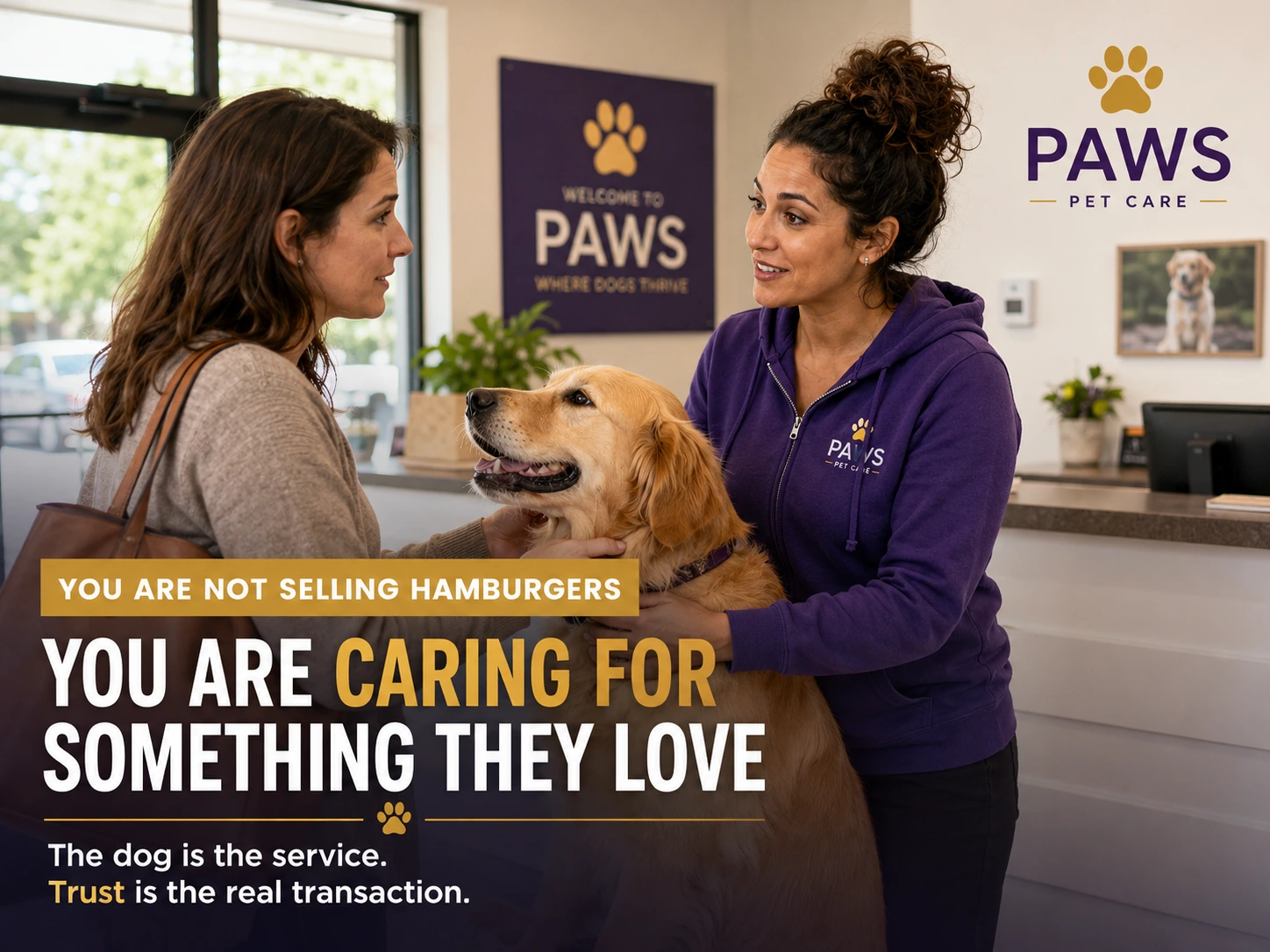
A pet services business is not a normal service business. You are not selling hamburgers, servicing a car, or working with some other inanimate replaceable thing. You are caring for a living, breathing animal with fear, habits, preferences, pain points, history, personality, and a relationship with the owner.
To the owner, that dog may not be “the dog.” That dog may be their child, best friend, routine, comfort, companion, emotional anchor, family member, identity, or the one stable thing in a life that otherwise feels like a dumpster fire with Wi-Fi.
That emotional attachment changes the customer-service equation. A normal business mistake may create irritation. A pet-care mistake can create fear, guilt, anger, panic, grief, public reviews, refund demands, accusations, and a client who feels personally betrayed because the business did not just mishandle a service — it mishandled trust.
The most important part of operating a successful pet services business is not just loving dogs, owning equipment, or having a clean facility. It is understanding the client, communicating clearly, setting safe boundaries, documenting decisions, and translating what the owner wants into what the animal actually needs and what the business can safely provide.
📌
Core rule
Pet services communication is emotional risk management. You are handling the animal, the owner’s trust, the owner’s fear, the owner’s expectations, the staff’s safety, and the business reputation at the same time.
🗺️
Use This Page Like a Client Communication Control Map
The dog may be the service, but the owner relationship decides whether the business feels trusted or dangerous.
🛒
What Clients Buy
They buy safety, reassurance, proof, convenience, and competent judgment.
🎁
The Daycare Joy Purchase
Why daycare and add-ons are often bought as a gift to the dog, not just a service.
🔺
Communication Triangle
Owner wants, animal needs, and what the business can safely provide.
📋
No Surprises
Pricing, matting, behavior, meds, bedding, emergencies, and late pickups.
👥
Staff Consistency
The front desk, groomer, handler, and manager cannot all tell different stories.
🧾
Documentation
Notes, photos, authorizations, policies, incident records, and owner instructions.
❤️
Pet Services Are Emotionally Different
You are dealing with the client’s feelings before you ever touch the leash.
A pet owner can be rational, pleasant, polite, and normal in every other area of life, then become extremely emotional when the conversation involves their dog. That does not make them crazy. It means the animal matters.
Pets give and receive affection. They live in the home. They sleep in beds. They follow routines. They become part of family history. They are present during divorce, grief, illness, loneliness, childhood, retirement, moves, breakups, and every other human mess that walks through the door wearing shoes.
When a customer brings a dog to you for daycare, grooming, boarding, nail trims, training, medication handling, or any other service, they are not just handing over property. They are entrusting you with an emotionally loaded part of their life.
That is why communication failures hit harder in pet services. A normal business might disappoint a customer. A pet care business can make the customer feel like they failed their animal by trusting the wrong person.
The emotional risk increases when the owner believes the service was supposed to create joy, comfort, or relief. An injury, frightening experience, missed medication, or careless explanation can make the owner feel responsible for choosing the business in the first place.
Staff should understand that the first conversation after a problem is part of the incident response. A factual, timely, compassionate explanation can reduce confusion. Silence, vagueness, defensiveness, or casual language can turn a manageable event into a reputation crisis.
📌
Operator translation
You are not just managing dogs. You are managing trust. Trust is built before the problem, tested during the problem, and destroyed when the business sounds careless.
🛒
What Pet Clients Are Really Buying
The invoice may say daycare, boarding, grooming, or nail trim. The client is buying something deeper.
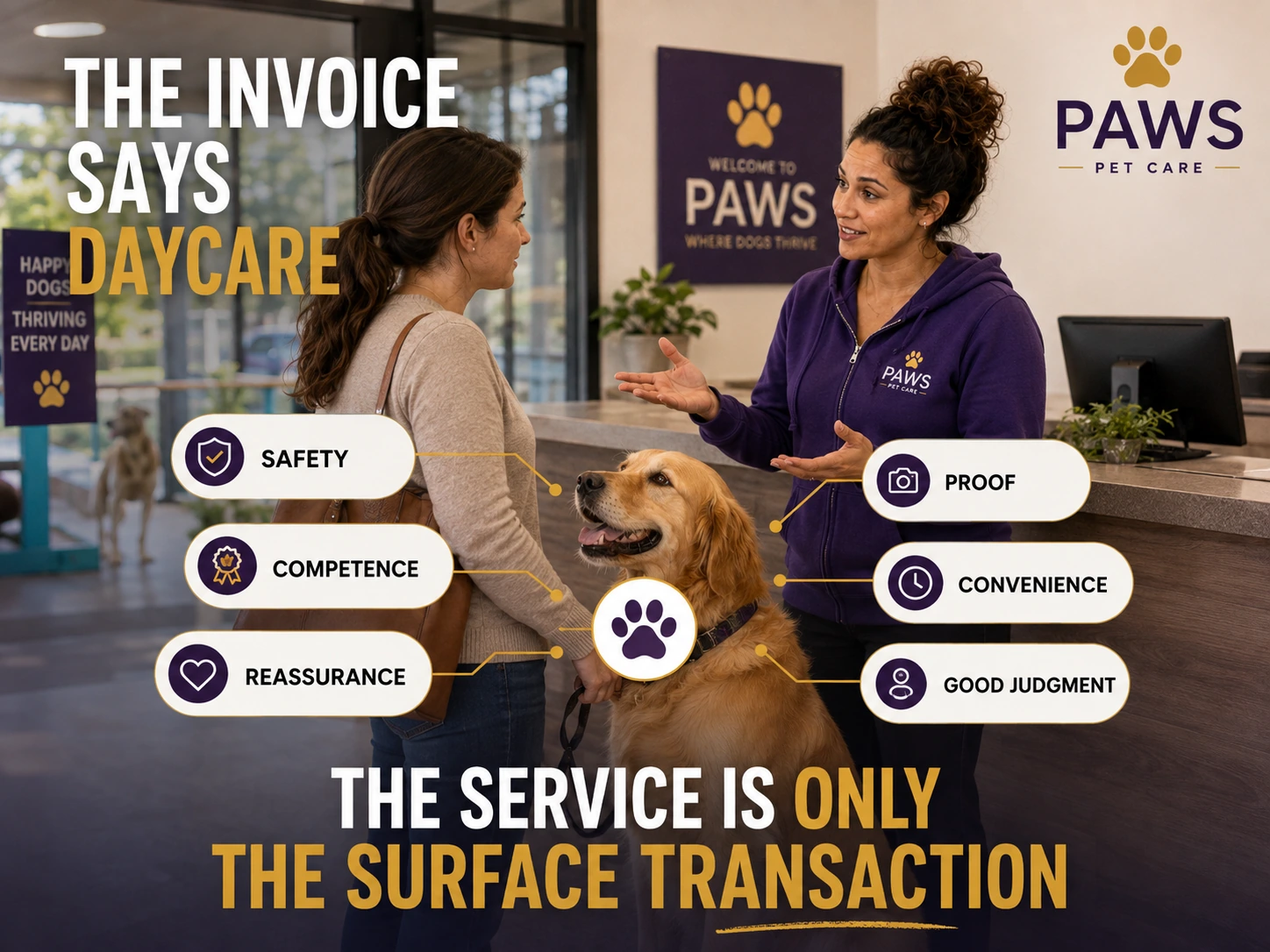
The customer may say they are buying a daycare day, a groom, a bath, a nail trim, a boarding stay, or medication administration. That is the surface transaction. Underneath that, they are buying safety, competence, reassurance, emotional relief, convenience, proof, and the belief that someone will notice if their dog is not okay.
This is why a clean building and nice equipment are not enough. A client can walk into a beautiful facility and still not trust it. Another client can walk into a modest facility and feel safe because staff communicate clearly, remember the dog, explain decisions, and do not sound like they are winging it.
The deeper purchase should shape the service design. Proof may mean a report card, photo, medication log, behavior note, grooming explanation, or clear pickup conversation. Competence must be visible enough that the owner does not have to guess whether the business noticed what mattered.
Operators should avoid promising emotional outcomes they cannot guarantee. The business can promise procedures, observation, communication, and professional judgment. It cannot honestly promise that every dog will love every day, play with every dog, or leave every service completely stress-free.
Swipe left/right to see the full table.
| Service | What the Client Says They Want | What They Are Really Buying |
|---|---|---|
| Dog daycare | “I want my dog to play and be tired.” | Supervision, safety, social judgment, exercise, enrichment, and relief from guilt while they work. |
| Boarding | “I need somewhere for my dog to stay.” | Trust, overnight safety, routine, medication accuracy, feeding accuracy, and proof the dog is okay. |
| Grooming | “I want my dog to look good.” | Cleanliness, comfort, coat health, skin observation, handling skill, and honesty about what is possible. |
| Nail trim | “Can you cut his nails?” | Relief from a task the owner may fear, avoid, or feel guilty about failing to manage. |
| Dematting | “Can you brush him out and keep him fluffy?” | A conflict between appearance, pain, skin health, cost, time, and owner guilt. |
| Medication handling | “He needs these pills.” | Accuracy, responsibility, documentation, and protection from a potentially serious mistake. |
🎁
Dog Daycare Is Often a Joy Purchase
To understand daycare clients, you have to understand what they think they are buying.

Grooming is maintenance. The dog needs it. If the coat is matted, the nails are curling, the ears are dirty, or the dog smells like he rolled in swamp soup, something has to be done. Boarding is often necessity. The owner is traveling, the dog cannot stay home alone, and somebody trustworthy has to care for him.
Dog daycare is different.
Yes, there are practical reasons. Some dogs have separation anxiety. Some dogs destroy the house. Some dogs need exercise. Some owners are paying daycare fees so they do not come home to drywall confetti, shredded blinds, and a couch that looks like it lost a bar fight.
But for a large number of daycare clients, the emotional purchase is much deeper and much simpler: they are spending money because they believe it will make their dog happy.
That is the purchase path. The owner is saying, “I am going to take this money and turn it into a good day for my dog.” They are not just buying supervision. They are buying play, joy, movement, friends, attention, stimulation, and the idea that their dog is having a better life because they chose to provide it.
That matters. A daycare customer is often receiving joy through the dog’s joy. It is the same emotional wiring that makes a parent feel good when a child opens a Christmas present and lights up. The parent did not buy the toy because plastic needed to change locations. The parent bought the moment. The smile. The feeling of, “I made someone I love happy.”
Dog daycare works the same way for many pet owners. The dog gets the play day. The owner gets the emotional return. They go to work feeling a little better because their dog is not sitting home bored. They pick the dog up and want to hear that he played, had fun, made friends, enjoyed himself, got attention, and came home tired in the right way.
That is why the pickup conversation matters. That is why report cards matter. That is why photos matter. That is why a staff member saying, “He had a great time with Bella today,” hits differently than, “He was fine.” The owner is looking for confirmation that the gift worked.
There is also a projection layer to this, and operators need to understand it without being smug about it. People do not just observe their dogs. They interpret their dogs through the relationship they have with them. They read the dog’s happiness, sadness, boredom, comfort, stress, excitement, and disappointment through human emotional language.
That language changes by owner. Some clients talk like parents. “She is my baby.” “Mommy wants her to have her treat.” “He is my little boy.” Other clients talk like friends. “He is my boy.” “That is my buddy.” “She rides with me everywhere.” “He is my road dog.” “That dog is my ride-or-die.”
Do not get stuck arguing with the words. The words are just the wrapping paper. The package underneath is attachment.
A woman may be buying the ice cream because, in her mind, she is doing something sweet for her baby. A man may be buying the one-on-one playtime because, in his mind, he is hooking up his boy while he is out of town. Another owner may not use parent language or buddy language at all. They may simply feel responsible because the dog depends on them and they do not want the dog to feel forgotten.
The emotional flavor changes. The business lesson does not. The owner is trying to say, “This animal matters to me, and I am trusting you to treat that seriously.”
Is the dog sitting in the boarding suite thinking, “Mother has upgraded me to the premium cuddle package and I now respect her financial sacrifice”? No. Obviously not.
Is the dog thinking, “My bro bought me the deluxe play session, so now he is officially my 'Bestest Friend' and ride or die forever life partner”? Also no.
But that is not really the point. The owner feels like they went the extra mile. They want to believe the dog feels cared for, chosen, loved, remembered, and not just warehoused. They want to believe the dog’s experience reflects their love, loyalty, responsibility, friendship, or whatever emotional role that dog fills in their life.
This is why boarding add-ons sell. Doggy ice cream, bedtime treats, one-on-one playtime, cuddle time, extra walks, photo updates, and individual attention are not always purchased because the dog would otherwise be neglected. The dog may be perfectly safe without the add-on. But the owner is not only buying the thing. They are buying the feeling of doing something extra.
A $5 one-on-one play session is not just thirty minutes on a clock. To the owner, it may mean, “My dog was not just stored while I was gone. Somebody spent time with him. I did that for him” Doggy ice cream is not just a frozen treat. It is a little emotional receipt and expression of love that says, “I made his stay nicer. I gave my baby, my buddy, my boy, my little shadow, or my old friend something extra.” A photo update is not just a picture. It is proof that the owner made the right choice.
Once you understand that, you understand why daycare failures feel so personal to clients.
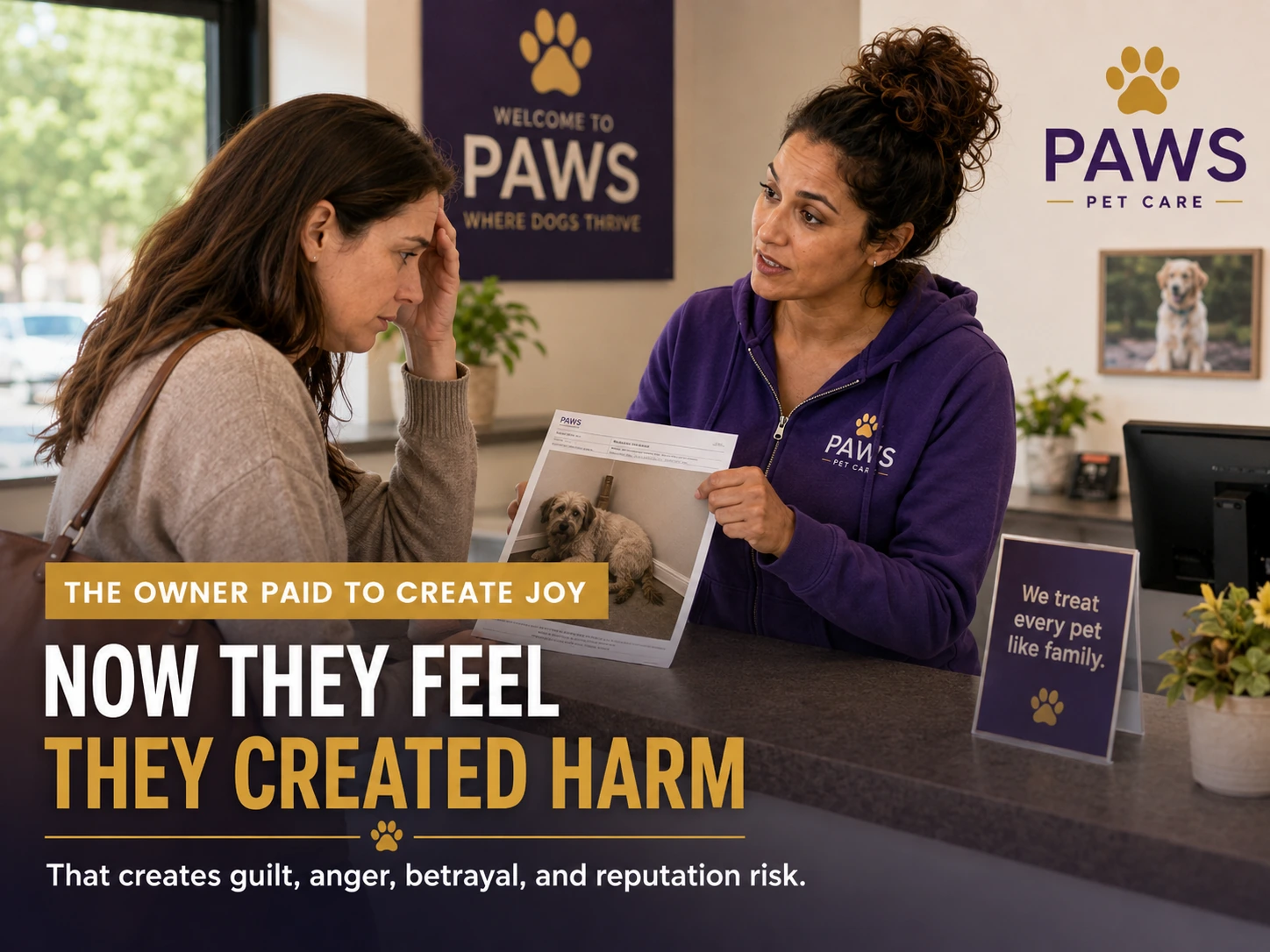
If the owner believed they were paying to make the dog happy and the dog comes home injured, terrified, filthy, ignored, exhausted in the wrong way, or emotionally worse, the business did more than fail a service. It ruined the gift. The owner paid money to create joy and now feels like they paid money to create harm. They feel as though they are personally responsible for a failure in judgement that brought displeasure or harm to a friend, and valued member of their family.
That creates guilt. It creates anger. It creates betrayal. It creates the ugly little voice in the owner’s head saying, “I took my dog there. I chose that place. I thought I was doing something good, and now my dog suffered because of my decision.”
That is a very different emotional reaction than being annoyed that a hamburger was cold.
A cold hamburger might earn a bad review, a complaint at the counter, or somebody telling a friend, “That place was disappointing.” A hurt dog can create something much more dangerous for the business: a client who feels morally obligated to warn everyone else.
From the owner’s side, this is not just “the business made a mistake.” This is, “I trusted them with something I love, I paid them because I thought I was doing something good, and my dog came home worse.” That emotional reaction is commensurate with the attachment they have to the dog.
That is when the local Facebook group becomes the town square with torches. The owner may not only want a refund. They may want witnesses. They may want other dog owners to validate that their anger is justified. They may want the crowd to feel what they feel, because in their mind the business did not simply disappoint a customer. The business hurt their dog.
This is where pet businesses underestimate the human side and get blindsided. A client who feels their dog was harmed may post photos, tell the story repeatedly, tag the business, message other customers, warn neighborhood groups, leave reviews, argue in comments, and turn one incident into a reputation event. They are not reacting like someone who got bad fries. They are reacting like someone who believes a family member, best friend, child-equivalent, or loyal companion was put in danger.
That does not mean every angry client is fair. It does not mean every accusation is accurate. It does not mean the business should accept blame for things it did not do. But it does mean the business has to understand the emotional math before responding like a robot with a policy binder.
When something goes wrong, the first response matters. If the business sounds dismissive, vague, defensive, or annoyed, it confirms the client’s worst story: “They do not care what happened to my dog.” If the business responds with facts, empathy, documentation, timing, photos when appropriate, veterinary guidance when needed, and a clear explanation of what happened next, the owner may still be upset, but the business is not pouring gasoline on the fire.
This is why pet service communication cannot be lazy. When something goes wrong, the client is not only evaluating the incident. They are evaluating whether the business understood what the service meant to them in the first place.
The emotional return should be supported with honest evidence rather than manufactured cheerfulness. A specific note about who the dog played with, when the dog rested, what enrichment was enjoyed, or why the plan changed is more trustworthy than a generic claim that every dog had an amazing day.
When the day was not ideal, staff should not fake the gift. Explain what was observed, what the business changed, how the dog responded, and what should happen next. Honest communication protects trust better than a positive report that conflicts with the dog’s condition at pickup.
Swipe left/right to see the full table.
| Purchase | What the Dog Gets | What the Owner Feels | What the Business Must Understand |
|---|---|---|---|
| Dog daycare | Play, movement, social time, stimulation, supervision, and a break from being alone. | “I gave my dog a better day than he would have had sitting at home.” | The owner wants proof the dog enjoyed the experience and was cared for as an individual. |
| Daycare for a destructive or anxious dog | Activity, supervision, routine, and less opportunity to panic or destroy the house. | “I can go to work without worrying about what I will find when I get home.” | This client is buying relief as much as play. Clear behavior feedback matters. |
| Boarding add-on | Extra attention, treat, play, walk, cuddle, or individual interaction. | “I did something extra so my dog feels loved while I am gone.” | Add-ons are not throwaway upsells. They carry emotional weight. |
| One-on-one playtime | Direct staff attention, exercise, enrichment, and a break from the normal boarding routine. | “My dog was not just put away. Somebody spent real time with him.” | Staff should treat the service like it matters because to the owner, it does. |
| Doggy ice cream or special treat | A small fun moment, assuming the dog can safely have it. | “He got something special. I made his day better.” | Small things can carry big emotional meaning, but dietary and medical rules still come first. |
| Photo update or report card | Nothing physical, but a record of the dog’s day. | “I can see that my dog is okay. I made the right choice.” | Photos and notes are emotional evidence. They should be honest, specific, and useful. |
⚠️
Daycare transaction warning
When a client pays to make the dog happy and the dog comes home worse, the owner does not experience that as a normal service problem. They experience broken trust, personal guilt, and a bad decision they made on behalf of something they love. That is the kind of emotion that can move from one upset customer to reviews, screenshots, neighborhood warnings, and a local reputation problem very quickly.
📌
Operator translation
Daycare clients are often buying joy by proxy. The dog gets the good day. The owner gets the feeling of having given the dog that good day. If the business ruins the dog’s experience, it also ruins the owner’s emotional reward.
🔺
The Pet Services Communication Triangle
Every difficult conversation has three corners: what the owner wants, what the animal needs, and what the business can safely provide.
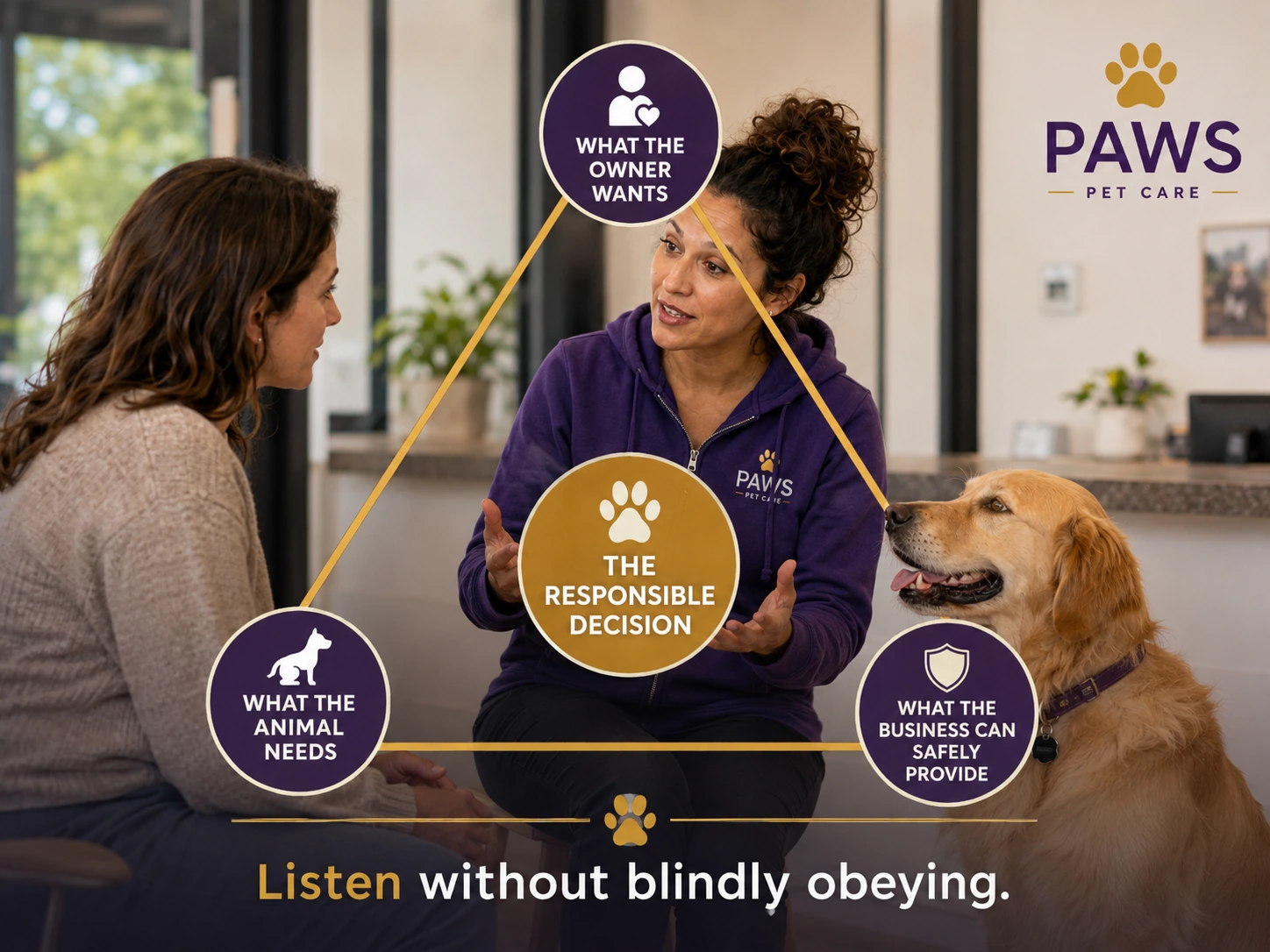
The client’s request is only one part of the decision. The animal’s welfare matters. Staff safety matters. Policy matters. Facility limitations matter. Insurance matters. Time matters. Skill matters. The condition of the dog matters. The owner’s emotional attachment does not outrank reality.
Strong pet business communication sits in the middle of that triangle. You do not blindly obey the owner, and you do not dismiss the owner. You listen, explain, set the safe boundary, and give the best available options.
The triangle should produce a decision, not only a conversation. Staff must identify the owner’s request, the animal-welfare concern, the operational limit, and the safest available options. The final plan should be clear enough that another employee could explain and carry it out consistently.
When the corners conflict, animal welfare and safety control the boundary. The owner’s wishes still deserve acknowledgment, but emotional intensity does not create staff skill, facility capacity, insurance coverage, or a humane way to perform an unsafe service.
🙋
What the Owner Wants
The owner may want a certain haircut, bedding, group play, no crate, no rest break, no muzzle, no shave-down, or a guarantee the business cannot honestly make.
🐕
What the Animal Needs
The dog may need rest, safety, medical caution, less stress, dematting relief, behavior limits, separation, a slower process, or refusal of unsafe handling.
🏢
What the Business Can Safely Provide
The business has to work within staff skill, policy, facility design, insurance, time, sanitation, safety, and honest service limits.
⚠️
Business rule
The client’s emotions deserve respect. They do not get to override animal welfare, staff safety, or reality.
🚧
When the Client Is Wrong but Emotionally Invested
Some client requests come from love, guilt, fear, denial, or habit. That does not make the request safe.
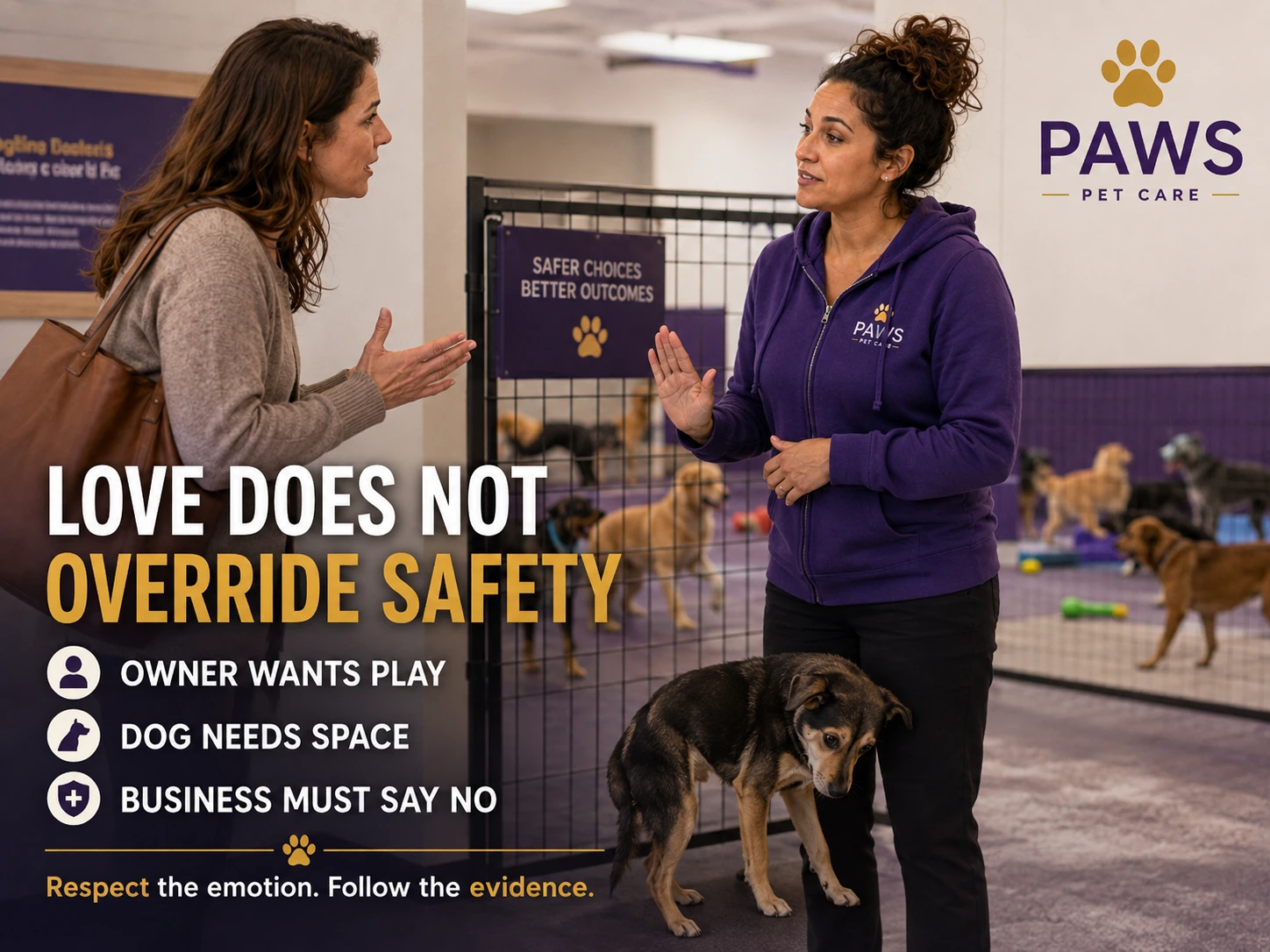
In pet services, you will often need to tactfully tell a client that a request is unsafe, unreasonable, impossible, stressful for the animal, outside policy, or not something the business can honestly provide.
This is where weak operators get into trouble. They either cave because the client is emotional, or they become blunt in a way that sounds cold and careless. The right answer is calm, clear, specific, and firm.
Use observable facts rather than attacking the owner’s motives. A request may come from love, guilt, fear, embarrassment, or misunderstanding. Staff can respect the intention while refusing the unsafe action.
The boundary should include the consequence and the alternative. Explain what the business cannot do, why it cannot do it, what safer option is available, and what happens if the client declines that option.
Swipe left/right to see the full table.
| Client Request | What May Be Driving It | Safety / Business Issue | Better Response |
|---|---|---|---|
| “Leave his bedding with him all day.” | Comfort, guilt, fear the dog will feel abandoned. | Chewing, ingestion, guarding, sanitation, urine, staff monitoring. | Acknowledge comfort concern, explain safety rules, offer approved bedding or rest-time use when safe. |
| “Do not crate him or separate him.” | Owner dislikes confinement or imagines the dog feels punished. | Rest, safety, overarousal, medical needs, feeding, behavior management. | Explain that rest/separation is a safety tool, not punishment. |
| “Brush out all the mats. Do not shave him.” | Appearance, embarrassment, guilt, attachment to coat length. | Pain, skin injury, time, coat condition, humane grooming limits. | Explain matting pain and options: humane shave-down, staged grooming if possible, future maintenance plan. |
| “Let him play even though he is nervous.” | Owner wants social progress or daycare value. | Fear, defensive behavior, dog fights, shutdown, stress. | Offer slow introduction, observation, smaller group, rest, or refusal of group play if needed. |
| “He is not aggressive, he just does not like certain dogs.” | Denial, embarrassment, fear of rejection. | Bite risk, fight risk, staff safety, liability. | Focus on observed behavior and safe service limits instead of arguing labels. |
| “Another place lets us do it.” | Pressure tactic or genuine confusion. | Different policies, risk tolerance, staffing, insurance, facility design. | Calmly state your policy and why it exists. Do not insult the other facility. |
🧘
When the Client Is Worried About Something Necessary
Sometimes the owner is not asking for something dangerous. They are afraid of something normal.
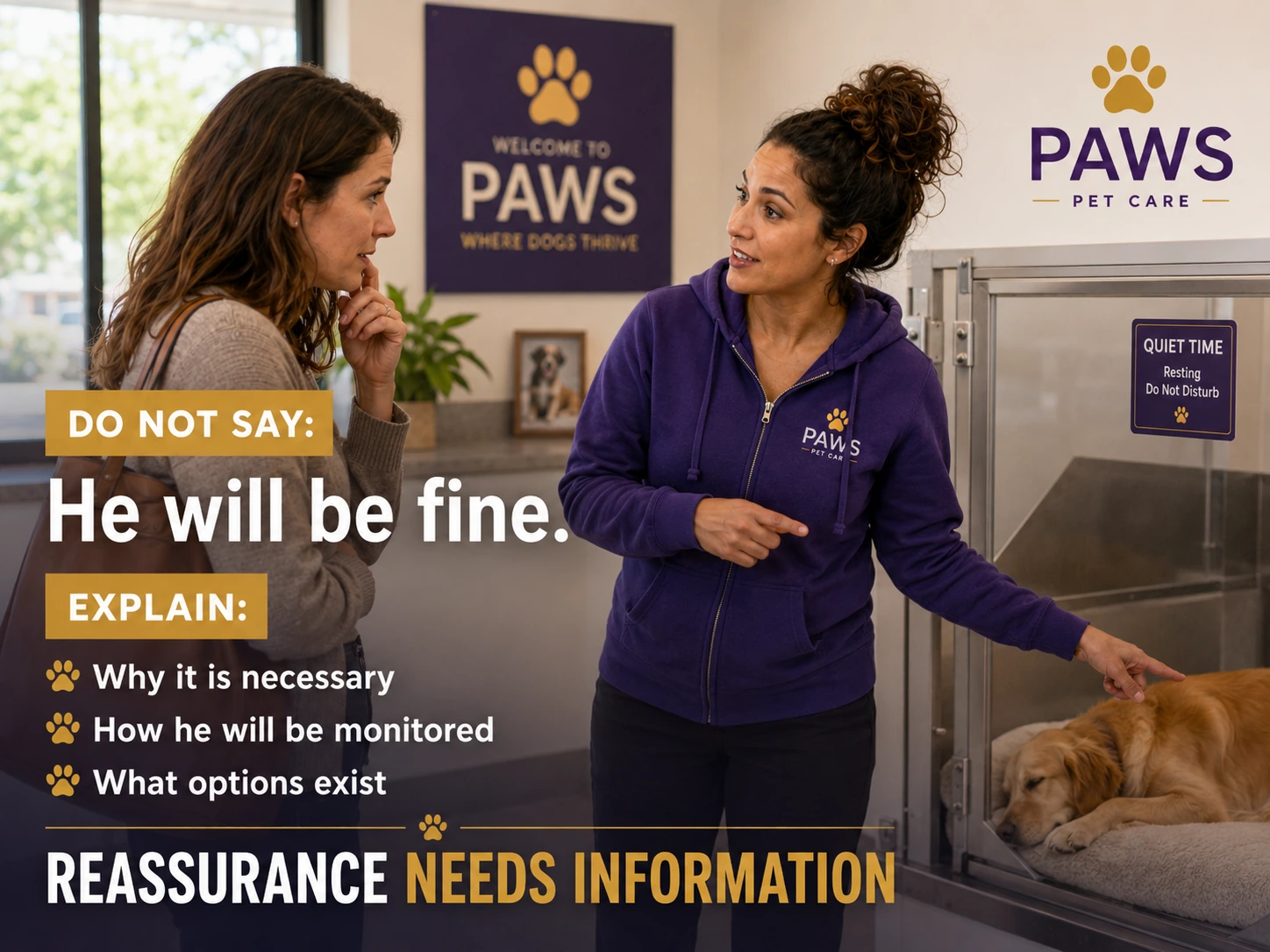
The reverse problem also happens. A client may be afraid of a process that is safe, necessary, beneficial, or routine when handled correctly. Nail trims, dematting, grooming restraint, rest breaks, group separation, bedding removal, feeding separation, medication documentation, and behavior boundaries can all trigger owner anxiety.
Do not dismiss the client with “It is fine.” That may be true, but it does not educate or reassure. The better approach is to explain what will happen, why it is being done, how the dog will be monitored, and what options exist.
Reassurance should answer four questions: what is happening, why it is necessary, how the dog will be monitored, and what choices remain. That structure gives the owner information instead of asking for blind trust.
Avoid absolute promises such as “nothing will happen” or “he will definitely be fine.” Better communication explains the controls, the expected process, the warning signs staff watch, and when the plan would change.
Swipe left/right to see the full table.
| Owner Concern | What Staff Should Explain | What Staff Should Avoid |
|---|---|---|
| “Will he be scared if you separate him?” | Separation can be used for rest, safety, feeding, medication, arousal control, or stress reduction. | “He will be fine” with no explanation. |
| “I do not want him kenneled.” | Rest areas can prevent exhaustion, fights, overstimulation, and medical problems. | Acting like the owner is stupid for caring. |
| “Will nail trimming hurt?” | The goal is controlled trimming without hitting the quick; some dogs need slow desensitization. | Promising there is zero risk or mocking the owner’s fear. |
| “Why can’t you brush the mats out?” | Severe matting can pull skin, hide sores, cause pain, and make brushing inhumane. | Making the owner feel attacked or ashamed. |
| “Why can’t he stay in group all day?” | Dogs need breaks. A tired dog may become rude, defensive, overstimulated, or unsafe. | Treating constant group play as the only measure of value. |
🗣️
The PAWS Client Communication Framework
Do not wing emotional conversations. Use a repeatable structure.
Staff need a communication structure because difficult pet conversations can get emotional quickly. The owner may be embarrassed, scared, angry, guilty, confused, or defensive. The staff member may be busy, tired, undertrained, or afraid to upset the client.
The framework is simple: acknowledge the concern, explain the reason, set the boundary, offer options, and document the decision.
The framework should be practiced before a crisis. Staff can rehearse common conversations involving group removal, matting, medication refusal, price changes, minor incidents, late pickup, bedding, and service denial until the structure becomes normal.
Managers should review whether the documented decision matches what was said to the owner. A polished front-desk explanation is useless when the internal note, staff action, or later message tells a different story.
Swipe left/right to see the full table.
| Step | What It Means | Example |
|---|---|---|
| Acknowledge | Show the client you heard the concern before correcting or refusing it. | “I understand why you want him to have his blanket. It smells like home.” |
| Explain | Give the real safety, comfort, grooming, or behavior reason. | “The issue is that he is chewing fabric today, and that can become an ingestion risk.” |
| Set boundary | Clearly state what the business can and cannot do. | “We cannot leave loose bedding with him while he is chewing it.” |
| Offer options | Give the client the safest available choices. | “We can use our washable bedding during supervised rest, or we can keep him on a clean raised cot.” |
| Document | Record the request, explanation, owner response, and final plan. | “Owner notified bedding removed due to chewing. Approved cot/rest setup.” |
📌
Communication rule
Empathy without boundaries becomes chaos. Boundaries without empathy sound cold. You need both.
💬
Client Conversation Scripts for Pet Services
Staff need usable language before the front desk becomes a live grenade.
Scripts are not meant to make staff sound fake. They are meant to keep staff from blurting out something careless, defensive, dismissive, or legally stupid when a client is emotional.
The goal is not to win an argument. The goal is to clearly explain the decision, protect the animal, protect staff, protect the business, and give the client a reasonable path forward.
Scripts should preserve facts and judgment rather than turn staff into robots. Employees need permission to adapt the wording while keeping the same structure, boundary, and approved options.
High-risk conversations should have escalation rules. Serious injury, veterinary transport, threats, refund demands, accusations, legal language, media contact, or an owner who cannot be calmed should move to a manager instead of being improvised by whichever employee answered the phone.
Swipe left/right to see the full table.
| Situation | Do Not Say | Better Script |
|---|---|---|
| Owner wants unsafe bedding | “No, we do not allow that.” | “I understand why you want him to have something from home. Today the concern is chewing and ingestion risk, so we cannot leave that item with him unsupervised. We can use our approved bedding setup and note his comfort routine.” |
| Owner wants mats brushed out | “You should have brushed your dog.” | “I know you want to keep the coat longer. The problem is that these mats are tight to the skin, and brushing them out would be painful and could injure the skin. The humane option is to remove the matting and then build a maintenance plan so this does not happen again.” |
| Dog is too stressed for group play | “He is bad in group.” | “He is showing stress in the group setting today. We are going to give him a break and reassess. Our goal is not to force play; it is to keep him safe and prevent the experience from becoming negative.” |
| Owner denies behavior risk | “Your dog is aggressive.” | “I am going to describe what we observed rather than argue labels. He stiffened, fixated, and snapped when another dog approached. For safety, we cannot place him back into open group today.” |
| Nail trim is difficult | “He will not let us do it.” | “He is very worried about paw handling today. We can stop before it becomes a fight, or we can do a slower handling plan over multiple visits. Forcing it today may make future trims harder.” |
| Owner says another facility allows it | “Then go there.” | “Different facilities have different policies. Our policy is based on how we manage safety, sanitation, staffing, and liability here. I cannot speak for another business, but I can explain what we can safely do.” |
| Minor injury or incident | “It is not a big deal.” | “I want to walk you through exactly what happened, what we observed, what we did, and what we recommend watching at home. We also documented the incident in his record.” |
| Price or extra fee surprise | “That is just the price.” | “The additional charge is because this required extra time and handling beyond the standard service. We should have made that clear before proceeding, and here is how we will handle that communication going forward.” |
📋
The No Surprises Rule
Pet owners tolerate bad news better than surprise bad news.
Many client conflicts are not caused by the decision itself. They are caused by the client feeling blindsided. The groom was more expensive than expected. The dog was separated from group. The bedding was removed. The coat was shaved shorter than expected. The dog was not allowed to play. The emergency vet was called. The medication instructions were rejected. The late pickup fee was charged.
Some surprises are unavoidable because animals are animals and life enjoys throwing chairs. But many surprises can be prevented with better intake forms, clearer policies, earlier conversations, photos, written authorizations, estimates, and staff notes.
The business should identify predictable surprise points during intake and explain them before service begins. Written policies work best when staff also summarize the parts most likely to affect that individual dog or appointment.
When the plan changes, communicate at the earliest useful moment. Early notice gives the owner time to ask questions, approve an option, or make another decision. Waiting until pickup often makes a reasonable operational change feel hidden.
- Explain grooming limits, dematting risks, coat condition, and price ranges before the groom begins.
- Explain daycare rest breaks, group removal, behavior notes, and refusal criteria before the dog needs them.
- Explain boarding bedding, feeding, medication, emergency vet authorization, and pickup rules before drop-off.
- Get written authorization for emergency care, medication instructions, grooming decisions, and policy exceptions.
- Use photos when they help explain matting, injuries, behavior damage, bedding destruction, or facility decisions.
- Tell the client early when the original plan changes. Do not save avoidable bad news for pickup time.
👥
Staff Consistency: One Business Voice
The client should not get one answer from the front desk, another from the groomer, and a third from the owner.
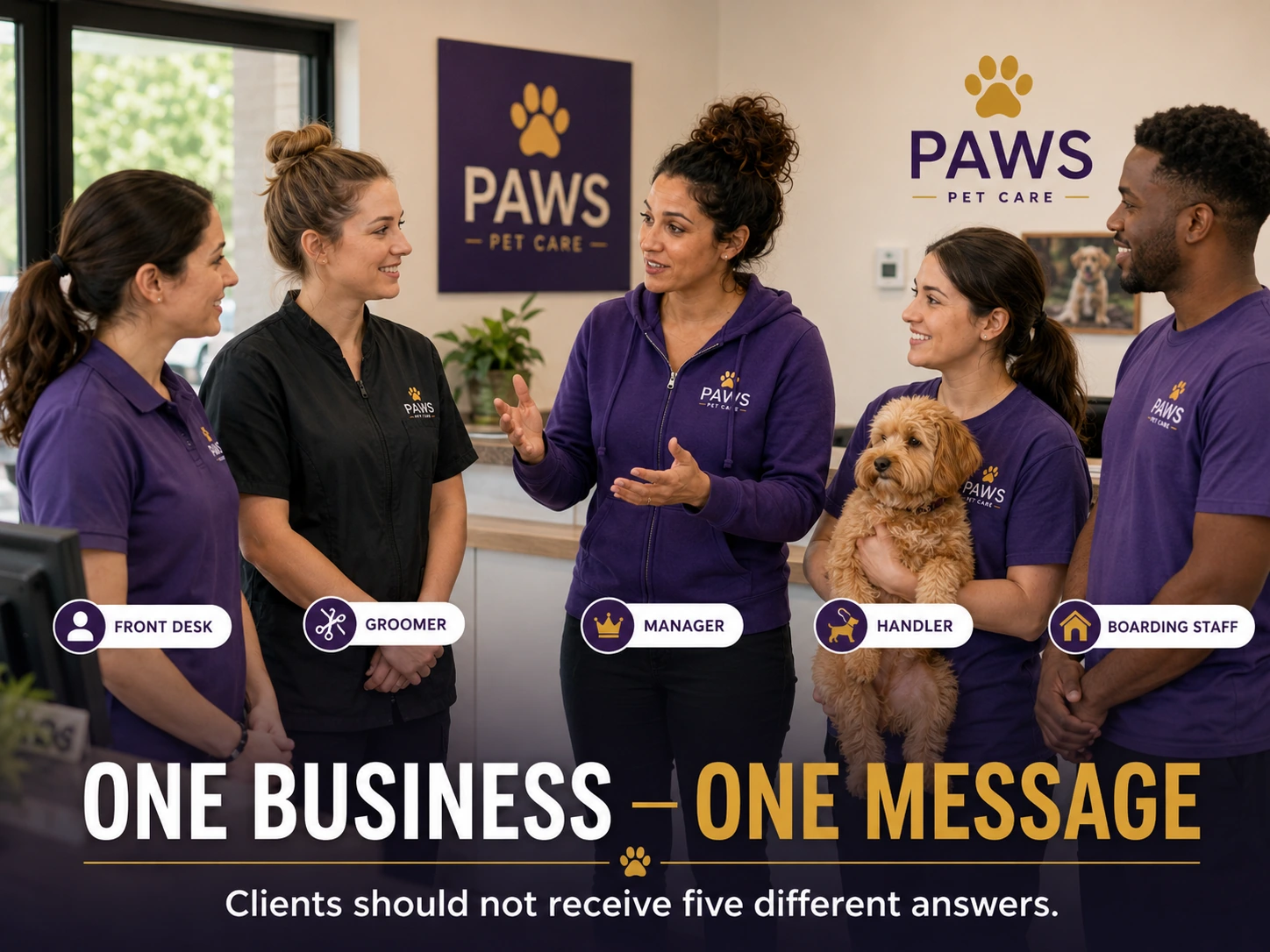
Inconsistent staff communication makes the business look disorganized even when the underlying decision was correct. If the front desk promises something the groomer cannot do, the groomer becomes the villain. If a handler gives casual behavior feedback that contradicts the manager, the client stops trusting the business. If one employee bends policy and another enforces it, the client learns to shop for the weakest staff member.
The business needs shared language for common issues: matting, nail trims, behavior removals, bedding, late pickups, medication instructions, food refusal, stress, injuries, playgroup changes, and emergency vet transport.
Consistency requires a source of truth. Shared notes, approved scripts, service definitions, escalation rules, and manager decisions should be visible to the employees who speak with the client.
Staff should never speculate to fill silence. When the employee does not know, the correct response is to verify the record or involve the person who made the decision. Confidently giving the wrong answer damages trust more than admitting that the facts need to be checked.
Swipe left/right to see the full table.
| Staff Role | Communication Job | Failure to Avoid |
|---|---|---|
| Front desk | Set expectations, collect information, explain policies, route problems to the right person. | Promising outcomes before the groomer, handler, or manager has evaluated the dog. |
| Daycare handler | Report observed behavior clearly and factually. | Casual comments like “he was bad” or “he hates other dogs.” |
| Groomer | Explain coat condition, humane limits, handling tolerance, and realistic outcomes. | Waiting until pickup to explain a major coat or price issue. |
| Boarding staff | Document feeding, meds, bedding, stress, stool, appetite, and concerns. | Telling the owner “everything was fine” when notes show problems. |
| Manager / owner | Handle escalations, policy decisions, refunds, refusals, and serious incidents. | Undermining staff in front of clients without first understanding the facts. |
🧾
Documentation Protects the Dog, the Client, and the Business
If it matters emotionally, financially, medically, behaviorally, or legally, write it down.
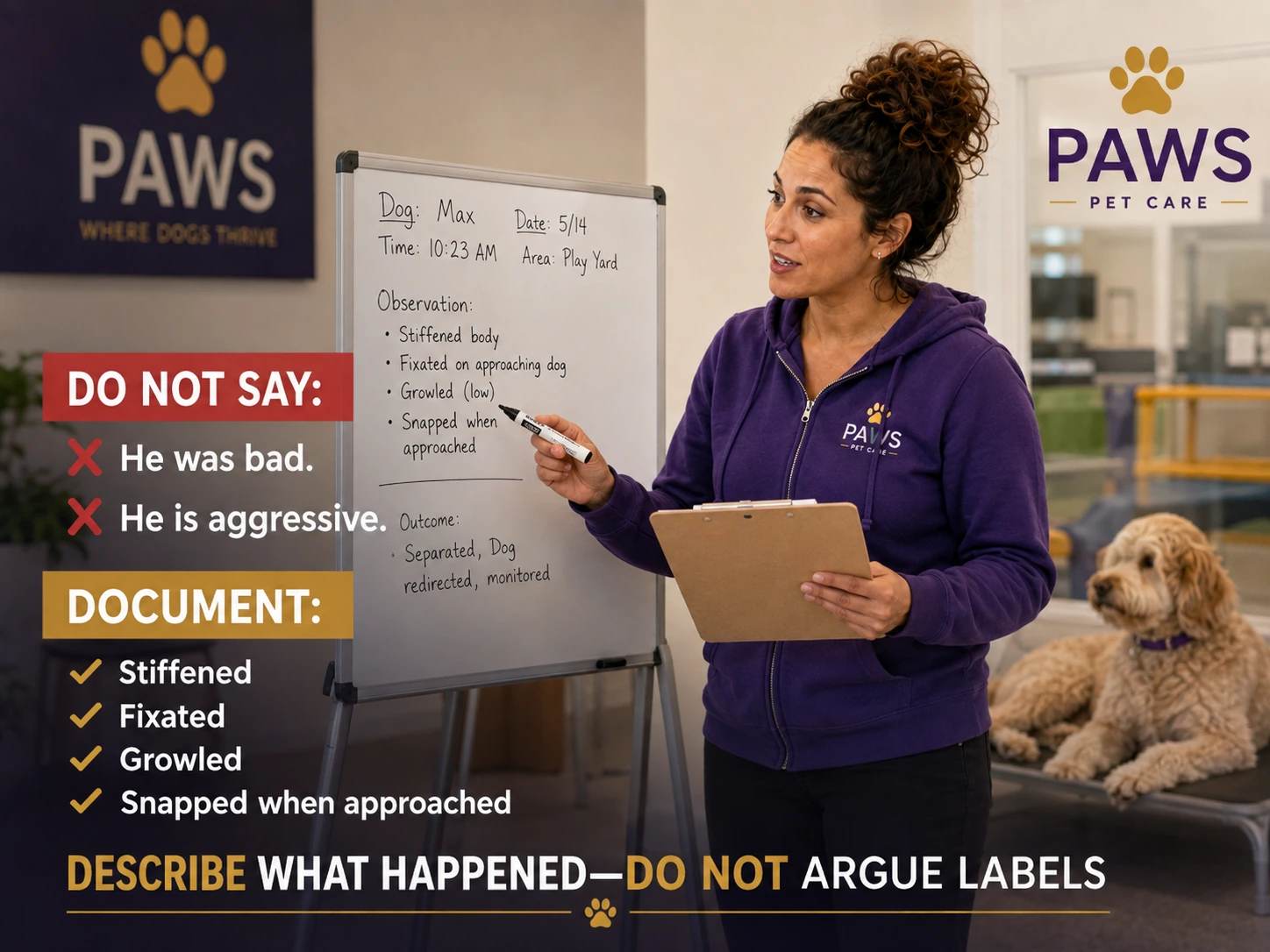
Pet service disputes often come down to what was said, what was promised, what was noticed, what was authorized, what changed, and who knew about it. Memory is not enough. Staff memory under stress is especially not enough.
Documentation does not have to be dramatic. It can be simple, factual, and consistent: owner request, staff explanation, dog condition, behavior observed, photo taken, authorization received, policy explained, call made, message sent, and decision documented.
Good notes distinguish observation from interpretation. Record that the dog stiffened, stared, growled, snapped, refused food, vomited, or tried to escape instead of writing that the dog was bad, dramatic, aggressive, or manipulative.
The record should also capture communication: who contacted the owner, when, by what method, what facts were shared, what authorization was received, and what follow-up was promised. The operational record and the client story should match.
- Intake notes for behavior, medical issues, feeding, medications, handling concerns, anxiety, and owner expectations.
- Written grooming notes for matting, coat condition, skin problems, owner instructions, price changes, and final outcome.
- Daycare behavior notes based on observed facts, not emotional labels.
- Boarding notes for appetite, stool, medication, bedding, stress, sleep, incidents, and owner communication.
- Photos when useful: matting, hot spots, injuries, damaged bedding, chewed items, coat condition, or facility concerns.
- Signed authorization for emergency veterinary care, grooming changes, medication instructions, and policy acknowledgments.
- Incident timelines with times, staff involved, dog condition, actions taken, owner contact, and follow-up instructions.
🛑
When to Say No to a Pet Services Client
Good communication does not mean the customer always gets their way.
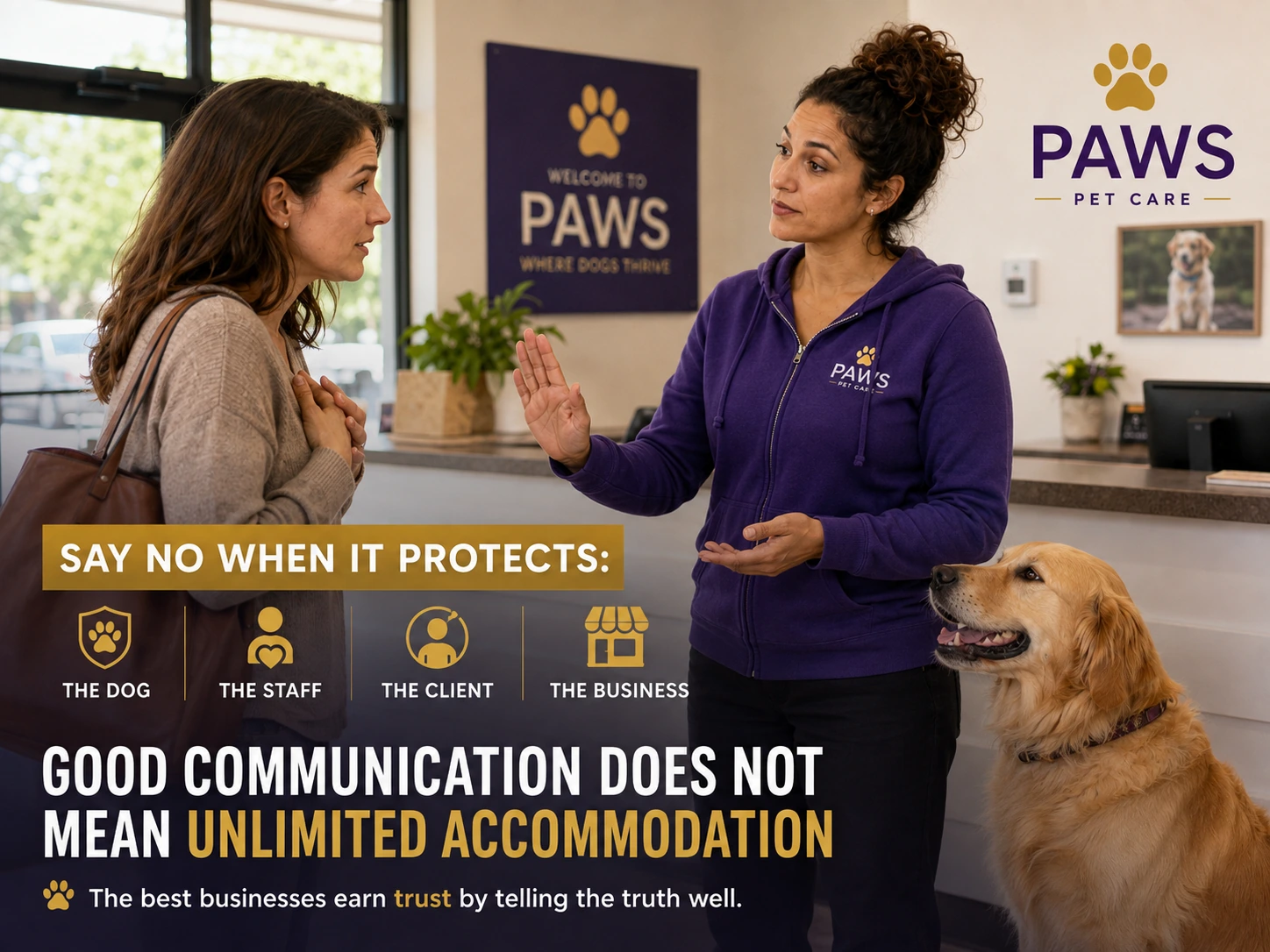
Some pet business owners confuse good customer service with unlimited accommodation. That is how facilities end up accepting unsafe dogs, unsafe instructions, unsafe grooming requests, unsafe medication handling, unrealistic promises, abusive clients, and situations they know they cannot control.
A professionally delivered “no” is not bad service. Sometimes it is the only responsible answer. The trick is to say it clearly, explain the reason, offer safe alternatives when possible, and document the decision.
A refusal should be based on a clear reason the business can defend: animal welfare, staff safety, policy, insurance, facility limits, lack of skill, unclear instructions, or repeated client conduct. Personal irritation is not a professional boundary.
Some refusals are temporary and conditional. The service may become possible after veterinary clearance, training, medication clarification, coat recovery, a different appointment structure, or a behavior plan. Others should remain permanent when the risk cannot be controlled.
- Say no when the request creates avoidable risk to the animal.
- Say no when the request creates avoidable risk to staff.
- Say no when the owner demands a grooming outcome that would be painful or inhumane.
- Say no when medication instructions are unclear, unsafe, unlabeled, or not properly authorized.
- Say no when a dog is not safe for open group play.
- Say no when the client demands a guarantee the business cannot honestly make.
- Say no when the client becomes abusive, threatening, dishonest, or repeatedly refuses policy.
- Say no when accepting the client would train the staff to ignore their own safety judgment.
⚠️
Boundary warning
The fastest way to lose control of a pet business is to let the most emotional client set the safety policy.
❓
Pet Services Client Communication FAQ
Detailed answers about emotional clients, unsafe requests, reassurance, documentation, staff consistency, behavior descriptions, service refusals, and protecting trust.
What should staff do when a client is clearly wrong?
Start by identifying the concern behind the request, then explain the animal-welfare, safety, policy, or operational issue using specific facts. State what the business cannot do, offer the safest available options, and document the final decision. The goal is not to humiliate the owner; it is to move the conversation from emotion to a workable plan.
What if the owner is too emotional to listen?
Slow the conversation down and reduce the number of people speaking. Acknowledge the concern, repeat the confirmed facts, explain the immediate plan, and avoid debating every accusation at once. When the owner remains highly distressed, move the conversation to a manager, document what was said, and arrange a follow-up after additional facts are available.
Should staff explain every policy?
Staff should explain the purpose and the part that affects the client’s situation, but they do not need to argue every policy indefinitely. A useful explanation identifies the risk the policy controls, the boundary it creates, and any available alternative. Once that is clear, the business may respectfully end a circular debate.
How should staff refuse an unsafe request?
Use a calm four-part response: acknowledge why the owner wants it, identify the specific safety concern, state the boundary, and offer safe alternatives when they exist. For example, staff can respect the owner’s wish for group play while explaining that the dog’s observed stress makes open group unsafe today.
What if a client says another facility allows the request?
Do not criticize the other business or speculate about its procedures. Explain that facilities differ in staffing, design, insurance, handling ability, and policy. State what your business can safely provide and why. The client may choose another provider, but your safety standard should not change because a competitor reportedly accepts the risk.
How do we prevent pickup-time arguments?
Communicate predictable issues before service and unexpected changes as soon as useful facts are available. Use intake questions, written estimates, policy acknowledgments, photographs, behavior notes, mid-service calls, and authorizations. Pickup should confirm the plan and outcome, not reveal a preventable surprise for the first time.
Should emotional client conversations be documented?
Yes. Record the request, the facts discussed, the policy or safety explanation, the options offered, the owner’s response, the final decision, and any promised follow-up. Keep the note factual and professional. Documentation should help the next employee understand what occurred without relying on memory or gossip.
Can good communication solve every client problem?
No. Communication can help reasonable people understand limits, but it cannot make an unsafe request safe, create missing staff skill, remove facility constraints, or require the business to tolerate threats and abuse. Some dogs, services, instructions, and clients are not appropriate for the operation.
Why are pet-care clients often more emotional than ordinary retail customers?
The service involves a living animal with a deep personal role in the owner’s life. When something goes wrong, the owner may experience fear, guilt, grief, anger, or betrayal rather than ordinary disappointment. Staff should understand the emotional stakes without surrendering facts, safety, or professional judgment.
What are pet-care clients really buying?
Beyond the listed service, clients are buying safety, competence, reassurance, convenience, proof, observation, and judgment. The business must make those qualities visible through clear communication, accurate records, consistent staff behavior, and specific feedback about the individual dog.
Why do report cards and photo updates matter?
They give the owner evidence that the dog was noticed and that the service produced the experience the owner hoped to provide. Useful updates are specific and honest. They should describe play partners, rest, enrichment, behavior, appetite, or a plan change rather than relying on the same generic sentence for every dog.
What should staff say when a dog had a difficult day?
Do not hide the problem behind a cheerful report. Describe what staff observed, when the difficulty occurred, what changes were made, how the dog responded, and what the business recommends next. Honest, specific information protects trust better than reassurance that conflicts with the dog’s condition.
How should staff describe behavior concerns?
Describe observable actions and context. State that the dog stiffened, stared, guarded a gate, growled, snapped, hid, refused food, or failed to recover after a break. Avoid vague labels such as bad, crazy, dominant, or aggressive unless a qualified professional is using a defined term for a specific purpose.
What does the communication triangle mean?
Every decision must balance what the owner wants, what the animal needs, and what the business can safely provide. Staff should listen to the request, assess welfare and risk, identify operational limits, and offer the best available plan. When those interests conflict, safety and humane care control the boundary.
How should staff reassure a worried owner?
Replace vague promises with information. Explain what will happen, why the plan is needed, how the dog will be monitored, which warning signs staff watch, what options remain, and when the owner will receive another update. Specific controls create more confidence than simply saying the dog will be fine.
How can a business keep every department on the same message?
Use shared records, approved service definitions, common scripts, escalation rules, and documented manager decisions. Front desk, handlers, groomers, boarding staff, and managers should refer to the same facts. Employees should verify uncertain information instead of guessing or making promises for another department.
When should a conversation be escalated to a manager?
Escalate serious injury, emergency transport, threats, refund demands, accusations of neglect, legal language, media contact, repeated policy conflict, or any situation the employee cannot explain accurately. Staff should know who takes over, what information to preserve, and what they may or may not promise.
When is saying no the best customer-service decision?
Say no when the request creates avoidable risk, exceeds staff skill, violates humane handling, conflicts with insurance or policy, relies on unclear medication instructions, or requires a promise the business cannot keep. A professionally explained refusal protects the dog, staff, owner, and long-term credibility of the business.
Can a refused service become possible later?
Sometimes. The business may reconsider after veterinary clearance, improved behavior, corrected medication instructions, coat recovery, a different appointment structure, additional staffing, or a documented training plan. Other refusals should remain permanent when the underlying risk cannot be controlled.
What is the main client-communication rule for pet-care businesses?
Tell the truth clearly and with empathy. Acknowledge what the animal means to the owner, explain the facts, set the safe boundary, offer realistic options, keep the business’s message consistent, and document important decisions. Trust is strongest when clients know the business will not hide problems or say yes to unsafe demands.
🐾
The Bottom Line: Pet Care Is a People Business With Animals in the Middle
You can be great with dogs and still fail if you are terrible with owners.
Operating a successful dog daycare, boarding, grooming, or pet services business requires more than animal handling. You must understand the client’s emotional attachment, communicate clearly, set safe boundaries, explain uncomfortable decisions, prevent surprises, document important conversations, and train staff to speak with one business voice.
Clients do not need fake sweetness. They need honesty, clarity, competence, empathy, and boundaries. They need to know that you understand their animal matters, but they also need to understand that love does not override safety, health, grooming reality, staff limits, or policy.
The businesses that survive are not the ones that say yes to everything. They are the ones that earn trust by telling the truth well.
Trust grows when the business is predictable. Clients should know how concerns are handled, who makes decisions, when they will be contacted, what records exist, and whether staff will tell them difficult facts without hiding behind vague language.
The strongest client relationship is not one in which the business always says yes. It is one in which the owner believes the business notices the dog, explains its judgment, keeps its promises, and tells the truth when the answer is uncomfortable.