Dog Daycare Customers, Pet Owner Psychology, Client Communication, Emotional Pet Owners, Dog as Child, Dog as Companion, Dog as Ego Support, Rescue Dog Owners, Grooming Disputes, Boarding Expectations, Temperament Testing, Customer Relations, Staff Scripts, and Dog Daycare Operations
Understanding Dog Owners: Why Pet Care Customers React the Way They Do
The dog may be a dog to you. To the customer, that dog may be a child, a companion, an ego boost, a beauty project, a rescue mission, or the only creature in the house that still listens.
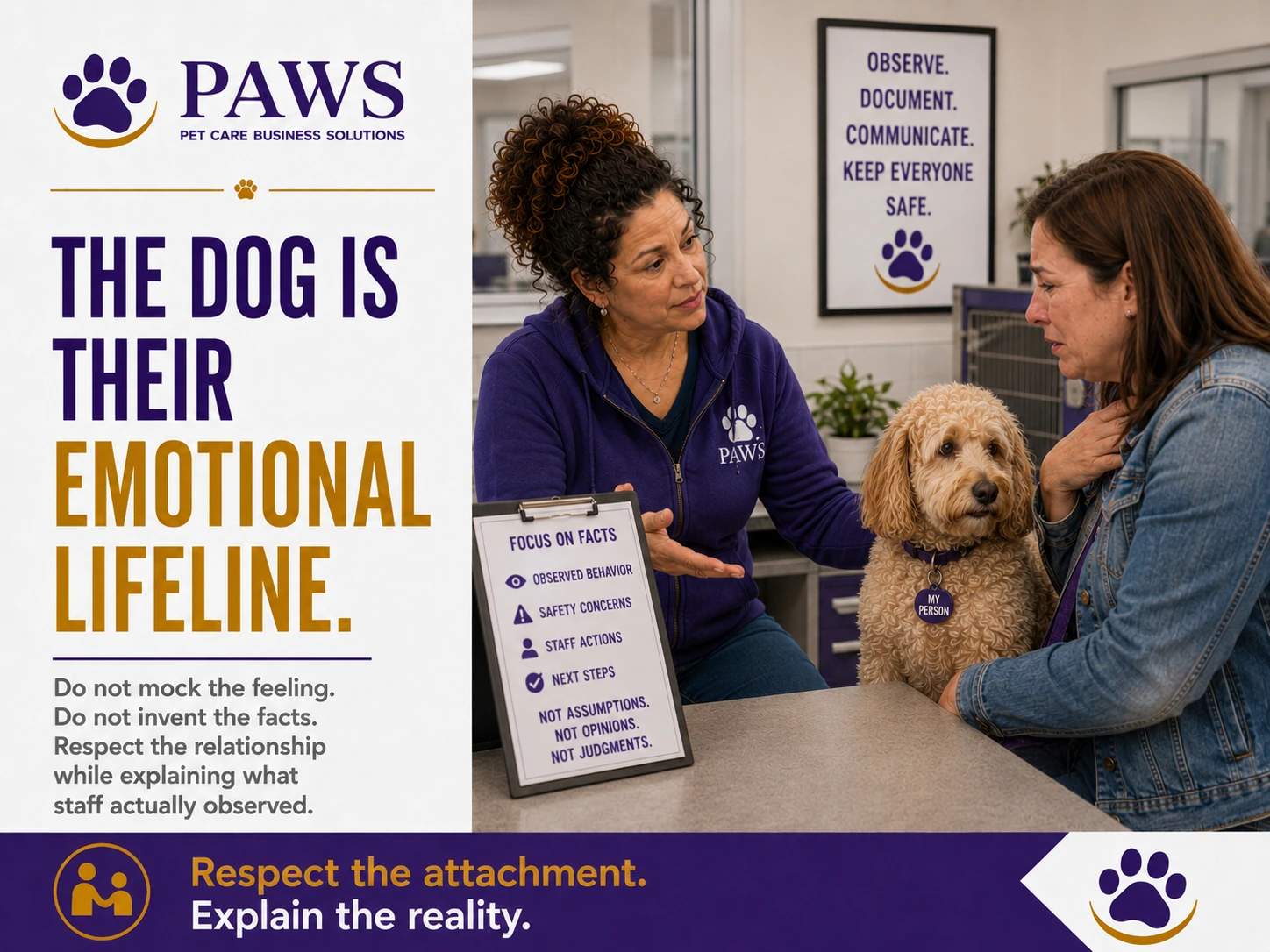
To better understand your clients and how they may react to a particular communication style, you need to understand how the client looks upon their dog and the reason they own one.
You are not always talking to a customer about daycare, boarding, grooming, nail trims, temperament testing, or a boarding policy. Sometimes you are talking to a parent about a child. Sometimes you are talking to a lonely person about their closest companion. Sometimes you are talking to an ego-driven owner about the one animal that makes them feel powerful. Sometimes you are talking to a status-conscious owner about the most beautiful thing they think they own.
That matters because the words you say may not be the words the customer hears. You may say, “His coat is too matted to brush out safely.” They may hear, “You neglected your baby.” You may say, “He is not safe for open group play today.” They may hear, “Your dog is bad and you failed.” You may say, “We cannot place that blanket in the boarding suite.” They may hear, “We do not care if he is scared.”
The operator has to understand this without getting soft-headed about it. Understanding the customer’s emotional attachment does not mean letting the customer override safety, policy, or common sense. It means you learn how to communicate the safe answer without stepping directly on the emotional landmine if you do not have to.
⚠️
Operator warning
This page is not permission to psychoanalyze customers out loud. Do not tell a woman her dog is a substitute child. Do not tell a guy his aggressive dog is an ego crutch. Do not stand in the lobby like a jackass with a psychology pamphlet. This is operator awareness, not lobby therapy.
🗺️
Use This Page Like a Client Psychology Map
The goal is not to diagnose customers. The goal is to understand why some customers react like you insulted their family when all you said was, “We cannot do that safely.”
🐾
Why the Dog’s Role Matters
The same sentence can land differently depending on what the dog represents to that owner.
👶
Dog as Child
Some owners are in a parenting position with the dog in the role of child, baby, or dependent.
🧸
Dog as Obedient Child
The dog may be the one dependent creature in the owner’s life that still behaves, listens, and needs them.
💪
Dog as Ego Support
Some owners are attached to the idea that only they can handle their powerful, difficult, or intimidating dog.
🏆
Dog as Beauty or Status
A negative comment about coat, fleas, ticks, behavior, or grooming may feel like a personal insult.
❤️
Dog as Companion
Some customers speak for the dog’s emotions because the dog is their closest daily relationship.
🛟
Dog as Rescue Mission
The rescue story may explain behavior. It does not make unsafe behavior safe.
🧩
Mixed Owner Types
Most customers are not one clean category. They are usually a messy blend of attachment, ego, fear, guilt, and expectations.
⏱️
First Five Minutes
What customers say early tells staff what communication style may be needed before the conversation gets sideways.
📝
Private Staff Notes
Staff need useful internal notes without writing insulting nonsense into the customer record.
📋
Owner Motivation Matrix
What the dog represents, what the owner says, what triggers them, and how to respond.
🗣️
Communication Scripts
Better language for child-substitute owners, ego owners, rescue owners, beauty/status owners, and sensible dog owners.
🚫
What Not To Say
Even when the thought is true, some phrases should not leave your mouth at the front counter.
🐾
Why the Dog’s Role in the Owner’s Life Matters
Customer communication is not one-size-fits-all because the dog does not mean the same thing to every customer.
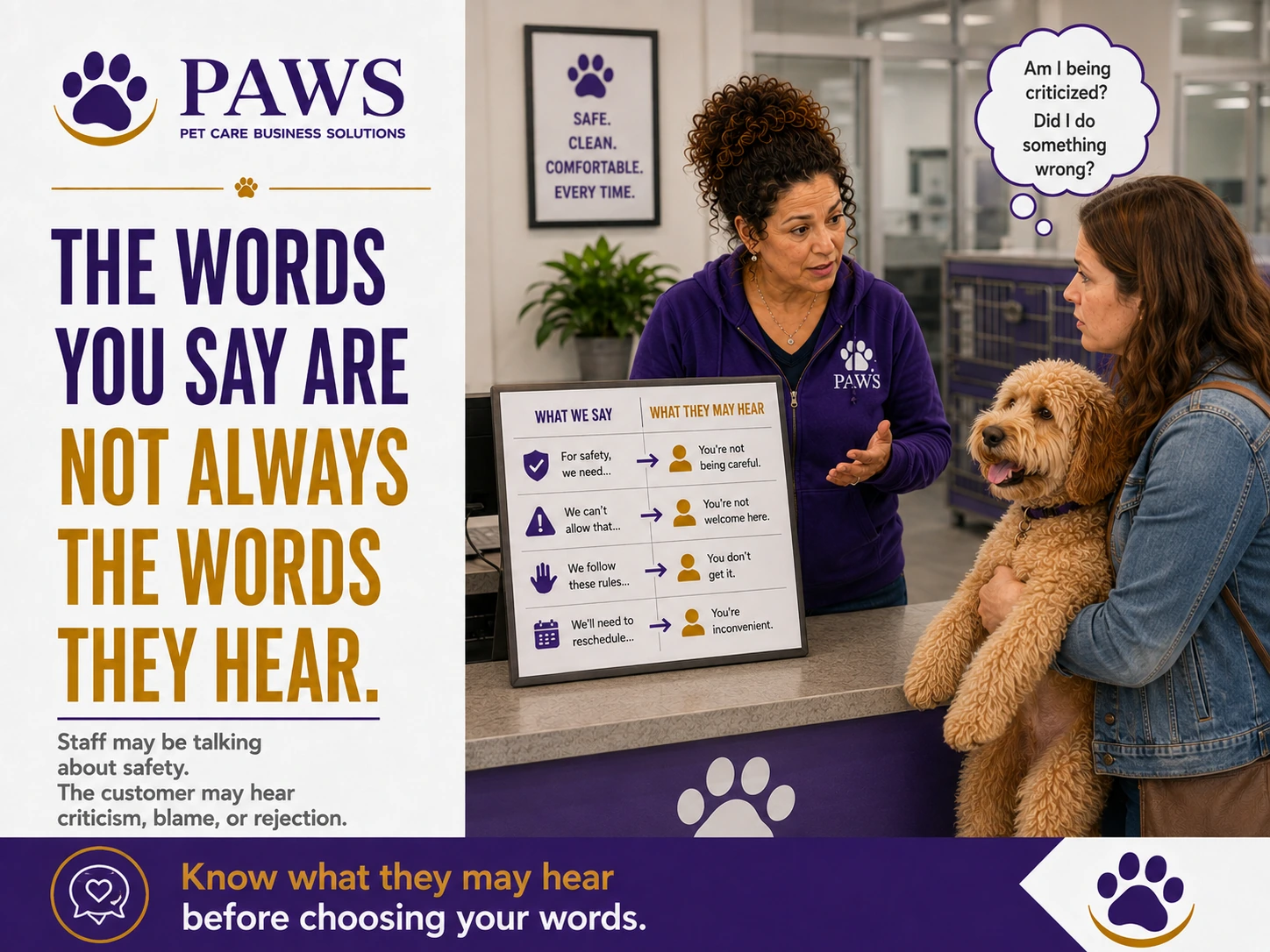
One of the primary reasons people own pets is to fill an empty space in their emotional life. That statement may make some people uncomfortable, but anyone who has worked in pet care long enough knows it is true. Dogs fill different roles for different people, and those roles affect how the customer hears what you say.
A matted-coat conversation lands one way with a practical owner and a completely different way with an owner whose ego is wrapped around the dog’s appearance. A failed daycare evaluation lands one way with a sensible dog person and a completely different way with someone who believes their dog is misunderstood by everyone but them. A boarding bedding rule lands one way with an experienced owner and a completely different way with someone who believes the blanket is the only thing standing between comfort and emotional collapse.
You need to understand this because you are going to have to say things customers do not want to hear. You may have to tell them the dog cannot be in group play. You may have to tell them the coat cannot be brushed out. You may have to tell them the dog cannot have certain items overnight. You may have to tell them the dog needs a muzzle, a vet, a different service, or no service at all.
The better you understand what the dog represents to that customer, the better chance you have of saying the necessary thing without turning the customer into a wounded animal at the front counter.
This awareness should change the order of the conversation, not the underlying decision. Staff can begin with the owner’s concern, move to observable facts, explain the operational limit, and then offer the safest available next step.
The useful question is not which label fits the customer. It is what the customer is likely to hear and how the same safety answer can be delivered without creating an unnecessary identity fight.
📌
Operator translation
You do not need to diagnose the customer. You need to understand the emotional terrain before you drive the conversation straight into a ditch.
👶
The Dog as Child or Substitute Child
Every parent likes to think they are the best judge of the needs of their children. Many dog owners feel the same way about the dog.
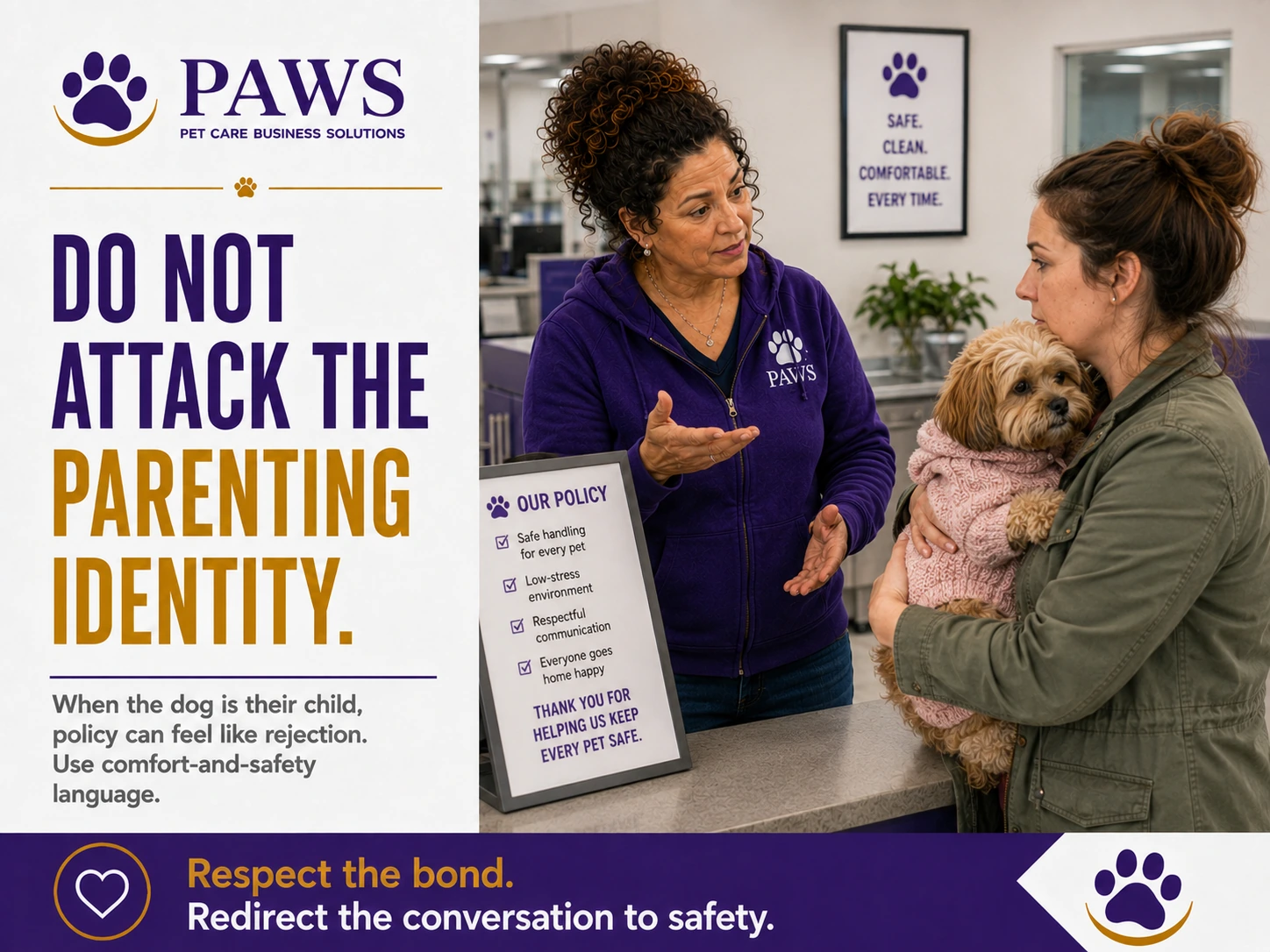
For the individual who has no children, the dog can become a viable substitute for a child. For someone whose children are grown and no longer dependent, the dog may become the substitute for a younger and more dependent child. The dog may also fill the position of the obedient child, especially for someone whose human family life is messy, distant, difficult, or out of hand.
All of these people are in a parenting position, with the dog in the role of child or infant. Few of these people are really aware of the underlying reason they have chosen to own a dog, and fewer still would appreciate a business owner telling them what the reason might be.
As a pet care professional, you need only be aware of the situation and its possibilities in order to adapt to it best. The point is not to shame the customer. The point is to understand why they may react so strongly to a haircut recommendation, daycare refusal, boarding rule, behavior note, muzzle, or correction.
This owner may say things like “he is my baby,” “he gets embarrassed,” “he will think I abandoned him,” “he has never been away from me,” or “he does not like being told no.” The operator’s job is not to mock that. The operator’s job is to redirect the conversation to comfort, safety, and professional care.
Staff should avoid language that sounds like rejection, punishment, or criticism of the owner’s care. Explain the decision through comfort, predictability, low-stress handling, and the facility’s responsibility while the owner is absent.
That still requires a firm boundary. A parenting identity does not authorize unsafe bedding, painful grooming, owner interference, restricted-area access, or group placement the facility cannot manage safely.
⚠️
Do not attack the parenting identity
With this customer, saying “he is just a dog” is about as useful as throwing gasoline into a toaster. You may be technically right in the animal-classification sense. You will still lose the conversation.
🧸
The Dog as the Obedient Child
Sometimes the dog is the dependable creature in the customer’s life when everything else is complicated.
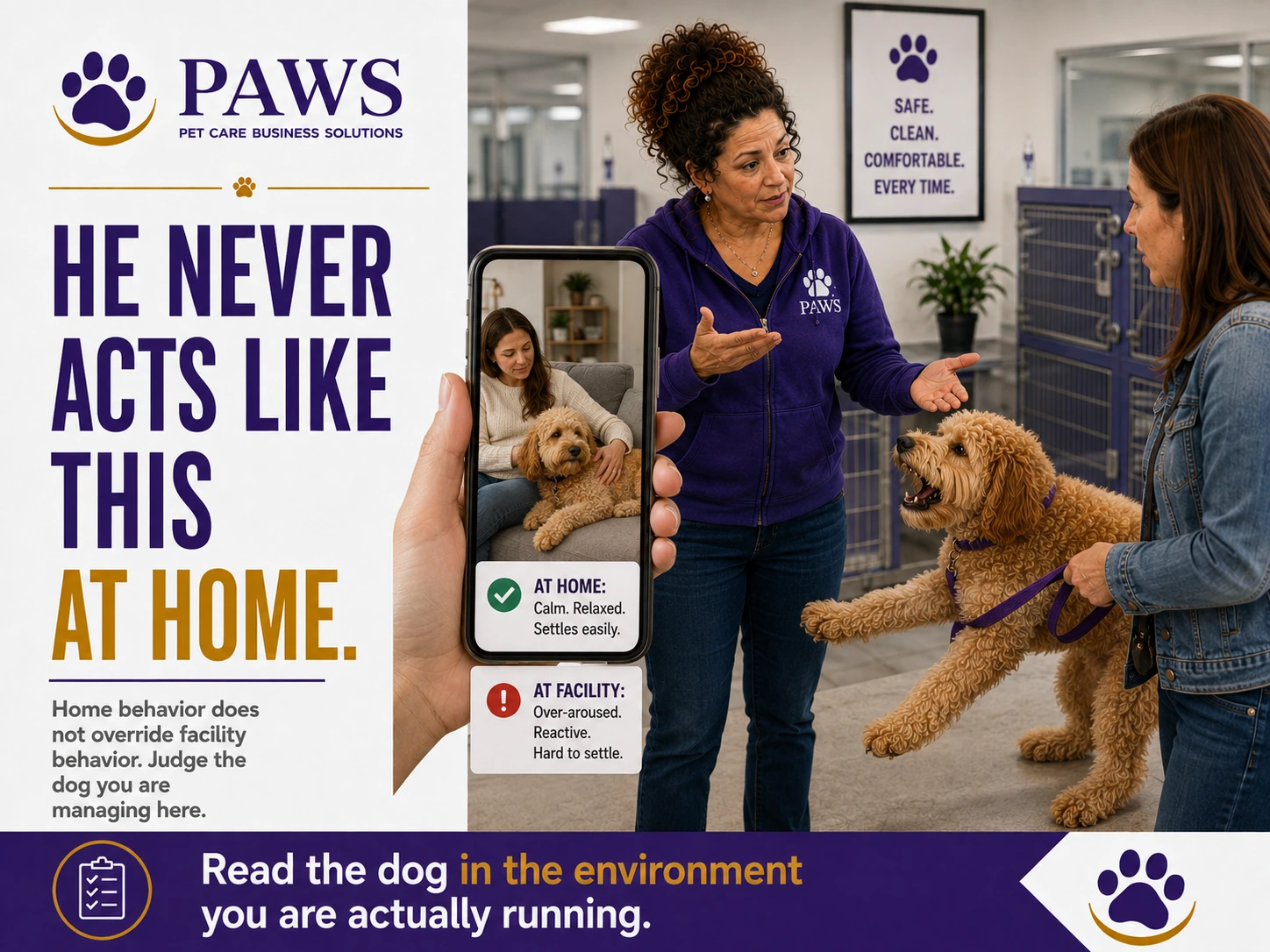
A parent whose children are grown, difficult, distant, rebellious, or causing trouble may find great comfort in the company of an amenable dog. The dog listens. The dog greets them. The dog needs them. The dog does not talk back, borrow money, crash the car, or announce at Thanksgiving that everyone in the room is emotionally toxic.
That can make behavior conversations touchy. When you tell this owner the dog is not doing well in daycare, not safe in group, guarding toys, bullying weaker dogs, snapping during handling, or panicking in boarding, the customer may hear something much bigger than a behavior note.
You may be saying, “Your dog is stressed in this environment.” The customer may hear, “The one thing in your life that behaves is not behaving here.”
That does not mean you soften the truth until it becomes useless. It means you deliver the truth in a way that does not accidentally humiliate the owner.
The most useful response separates the dog’s home relationship from the current environment. The owner does not have to be lying for the facility observation to be accurate; both descriptions can be true in different settings.
Staff should describe what changed the dog: unfamiliar handlers, group pressure, gates, noise, restraint, separation, toys, food, or over-arousal. Specific observations are easier to hear than a global statement that the dog is bad.
📌
Better angle
“He is not a bad dog. We are saying this environment is creating behavior we cannot safely manage in open group today.”
💪
The Dog as Ego Support or Control Symbol
Sometimes the owner who says “no one can handle him but me” is telling you more about themselves than the dog.
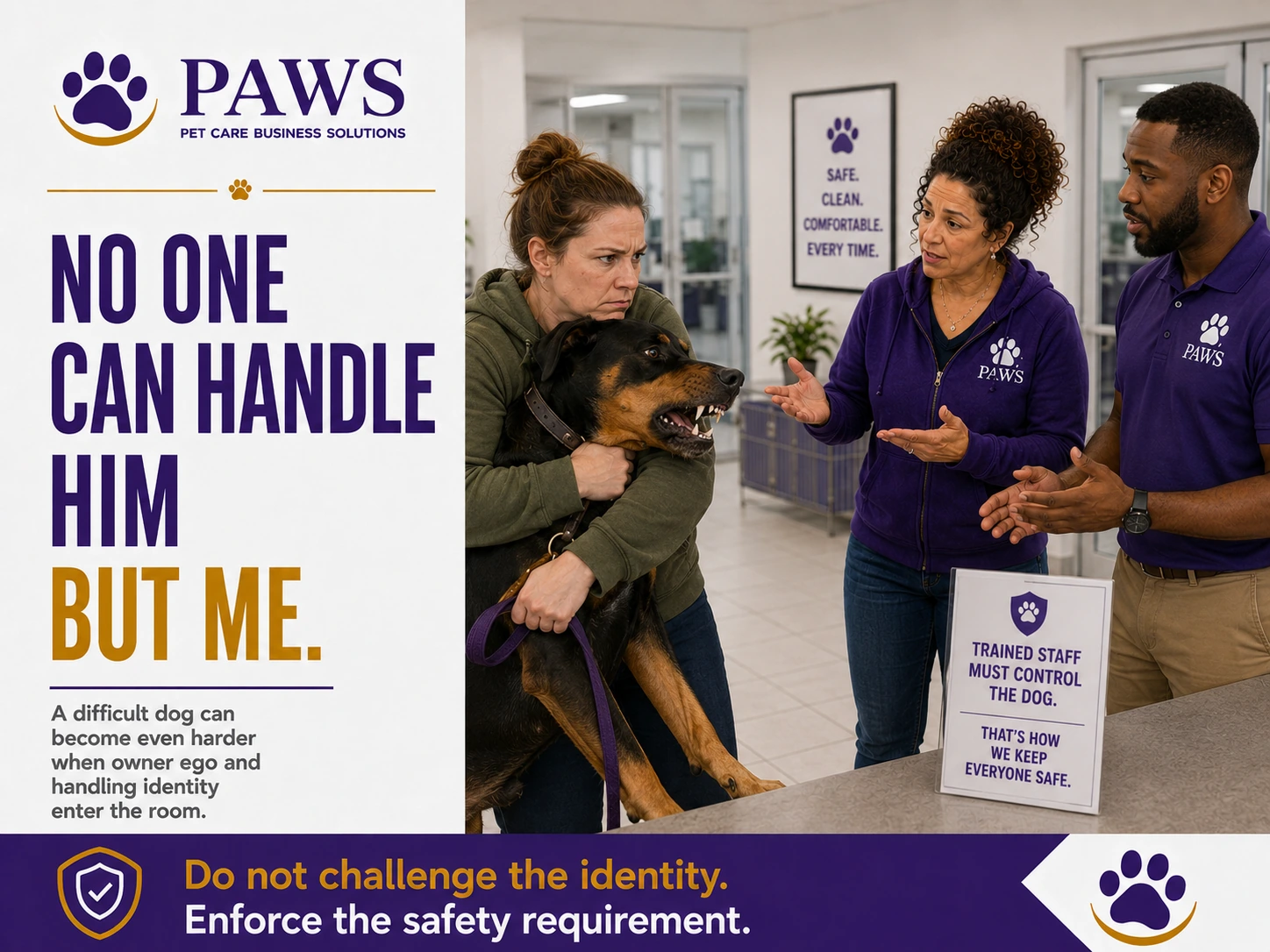
For some people, a dog serves to bolster a sagging ego. This may be especially true of people who choose to own large, intimidating, difficult, or aggressive dogs. Often these owners will assure staff that “no one can handle him but me.”
This may or may not be the case. The dog may genuinely be difficult. The dog may also be perfectly manageable once the owner is removed from the equation and the staff handles him calmly, consistently, and without ego theater. As someone who deals with dogs daily, you may be well able to handle the dog. The owner may prove to be the different matter.
This type of owner may take pride in the dog’s difficulty. They may like being the only person who can control him. They may enjoy the idea that the dog is powerful, protective, dangerous, dominant, misunderstood, or too much dog for ordinary people.
Be careful with these owners. If you say, “We can handle him,” they may hear, “You are not special.” If you say, “He is not safe in group,” they may hear, “You cannot control your dog.” If you say, “He needs a muzzle,” they may hear, “Your tough dog is a problem.”
None of that means you let the customer’s ego run the room. A dog that is unsafe is unsafe. A bite risk is a bite risk. A dog that cannot be handled safely does not become safe because the owner likes the identity attached to him.
Do not turn the conversation into a contest about who is stronger, more experienced, or more dominant. The operational question is whether trained staff can safely handle the dog under facility conditions.
If the dog cannot be handled safely, the answer may be a muzzle, a different service, an experienced handler, veterinary support, or refusal. The owner’s pride does not change the bite radius.
⚠️
Operator reality
Staff may be perfectly capable of handling the dog. Handling the owner’s ego may be the harder job.
🏆
The Dog as Beauty, Breed Status, or Personal Reflection
Some owners do not just own a dog. They own a reflection of how they want to be seen.
Dogs can fill an ego-building need in other ways. For some people, their dog becomes the beauty they feel they lack in their own person. This may express itself through showing the dog in competition, buying a fashionable breed, talking about bloodlines, or simply accepting the admiration of other people who think the dog is beautiful.
This type of owner may assure you that the dog is “pick of the litter,” “from a great line,” “a perfect specimen of the breed,” or “show quality, but we just do not want to show him.” They may not want to hear from you or anyone else that the dog is less than perfect in any way.
You may have to handle certain problems very tactfully or this owner will be deeply offended. Anything you say that could be construed as a negative remark may be taken by the client as a direct reflection on them as a person.
This can show up in grooming constantly. Coat condition, mats, fleas, ticks, odor, behavior on the grooming table, weight, skin problems, tear staining, poor haircut results due to behavior, or the simple reality that the dog is not cooperating may all trigger defensiveness.
To this person, a problem of this nature is an admission that they failed to care for the dog adequately, or that the dog is not as perfect as the owner wants to believe. Because their ego is bound up in the dog, they can become extremely agitated.
Use photographs, comb tests, behavior notes, and realistic examples when appearance is involved. Objective evidence helps move the discussion away from whether the groomer likes the dog and toward what the coat and behavior safely allow.
Do not promise an outcome based only on breed, reference photos, or the owner’s preferred image. The final result depends on coat condition, anatomy, tolerance, health, and how safely the live animal permits the work.
📌
Grooming example
Two dogs can be the same breed and booked for the same haircut, but Dog A stands calmly and Dog B jumps around on the table like a caffeinated goat with opinions. Dog B may look worse, and that does not automatically mean the groomer lacked skill. It means grooming is done on a live animal, not a mannequin.
❤️
The Dog as Companion or Emotional Lifeline
Some owners are not being ridiculous when they talk about the dog’s feelings. They are showing you how important the dog is to them.
Another primary reason for owning a dog is companionship. These owners generally fall into two subcategories.
The first is the person who lacks human companionship for one reason or another and has a dog in lieu of human companions. These clients are likely to view their pets on a very human level and may attribute to them highly developed human characteristics.
This client may tell you in all seriousness how the dog feels about various matters. “She is mad at me.” “He gets embarrassed.” “She knows when people judge her.” “He thinks I abandoned him.” “She does not like being corrected.” “He will think you do not like him.”
This can appear laughable until you realize the client is not joking. They actually believe they are expressing exactly what the dog feels. In sharing this information with you, the client is placing trust in you to understand their feelings and accept them.
If you take these remarks lightly or make jokes about the dog’s feelings, this client is likely to be hurt and offended. Again, you risk losing a client not because your policy was wrong, but because your delivery stepped on something tender.
The second subcategory is the owner who owns a dog for the real pleasure of owning a dog. This client is likely to be among the most sensible clients you have. They try to understand the dog as a dog. They do their best not to project their own feelings onto the dog to any great extent. They may be very well informed about dogs and their needs, or they may not be so well informed. If they are not particularly well informed, this client is one of the few who probably knows they have a lot to learn and will appreciate your help and information.
When the dog is an emotional lifeline, a routine policy discussion may feel like a threat to the customer’s most important relationship. Staff should slow down, avoid jokes, and explain exactly how the facility will support comfort within safe limits.
Respecting the bond does not require agreeing with every interpretation of the dog’s feelings. Staff can acknowledge the concern and redirect the conversation toward behavior, health, supervision, and the care plan actually available.
⚠️
Communication warning
Laugh at the customer who tells you exactly how the dog feels and you may lose them. Worse, you may hurt them. You can redirect the conversation without mocking the relationship.
🛟
The Dog as Rescue Mission or Savior Identity
The rescue story may explain behavior. It does not make unsafe behavior safe.
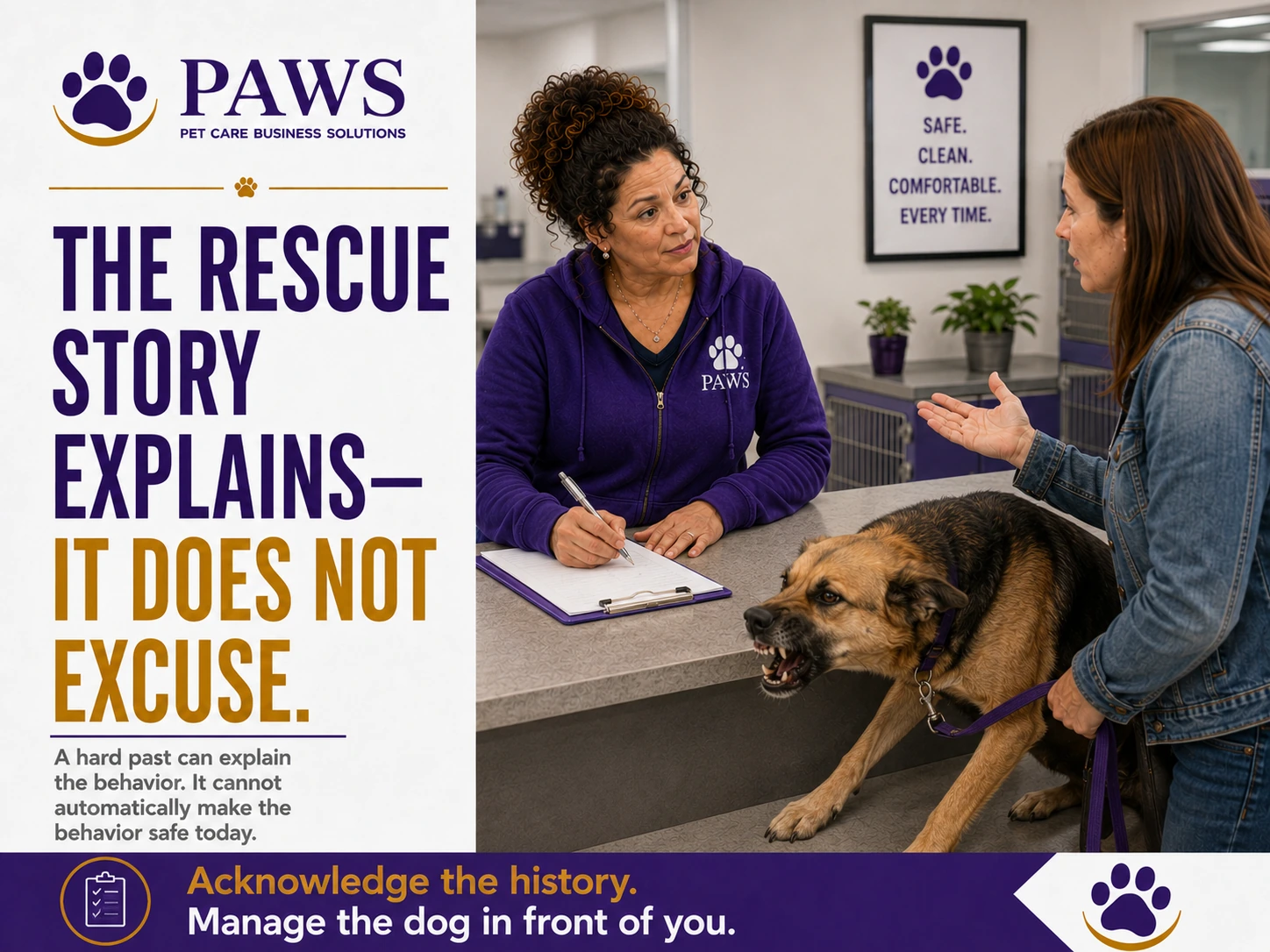
Another owner type you will see constantly is the rescue-identity owner. Sometimes these customers are wonderful. They care deeply, they are patient, and they are trying to give a difficult dog a better life. Other times, the rescue story becomes a permanent excuse for every unsafe behavior the dog displays.
This owner may say, “He was abused,” “you cannot correct him,” “he only bites because of his past,” “he needs love, not rules,” “he is scared because men must have hurt him,” or “you do not understand rescue dogs.”
The dog’s past may matter. It may explain fear, reactivity, handling sensitivity, leash behavior, separation stress, or panic. But explanation is not permission. A dog with a sad history can still bite a staff member. A dog with a trauma story can still injure another dog. A dog that was rescued still has to be safe enough for the service being requested.
Be respectful of the story, but do not let the story override your eyes. You are responsible for the dog in front of you, in your facility, under your insurance, around your staff, with other people’s pets nearby.
The rescue history belongs in the intake record when it affects handling, separation, fear, medical care, or known triggers. It should help staff plan; it should not become a permanent exemption from ordinary safety standards.
A useful response validates both truths: the dog may have been harmed in the past, and the facility must still manage the behavior occurring today. Compassion and boundaries can exist in the same sentence.
📌
Better language
“His past may explain why he reacts this way, but we still have to manage the behavior safely in this environment.”
✅
The Dog as a Dog
These are often the easiest customers to work with because they are not offended by reality.
Some people simply own a dog because they enjoy dogs. They love the dog, but they understand the dog as a dog. They know dogs can be trained, corrected, stressed, overexcited, fearful, pushy, social, antisocial, cooperative, difficult, or unsafe depending on the situation.
These clients are often among the most sensible clients you will have. They may still need education. They may still be wrong about something. But they are usually more willing to hear information without treating it as an attack.
This does not mean every practical dog owner is perfect. It means they are less likely to collapse into emotional theater when you say something normal like, “He cannot have that toy in the suite,” or “He is too over-aroused for that playgroup,” or “The coat needs to be clipped shorter today.”
These customers are gold. Educate them, respect them, and do not punish them with the same defensive communication style you use for the customers who need everything wrapped in emotional bubble wrap.
Practical owners should receive direct, useful information rather than being buried under defensive language. Tell them what staff saw, why it matters, and what the next step should be.
These customers can become strong long-term partners because they are often willing to train, adjust service, shorten coat length, change routines, or accept a different care plan when the reasoning is clear.
🧩
Mixed Owner Types: Customers Are Usually a Blend
Do not expect customers to walk in wearing a name tag that says “ego owner” or “lonely companion owner.”
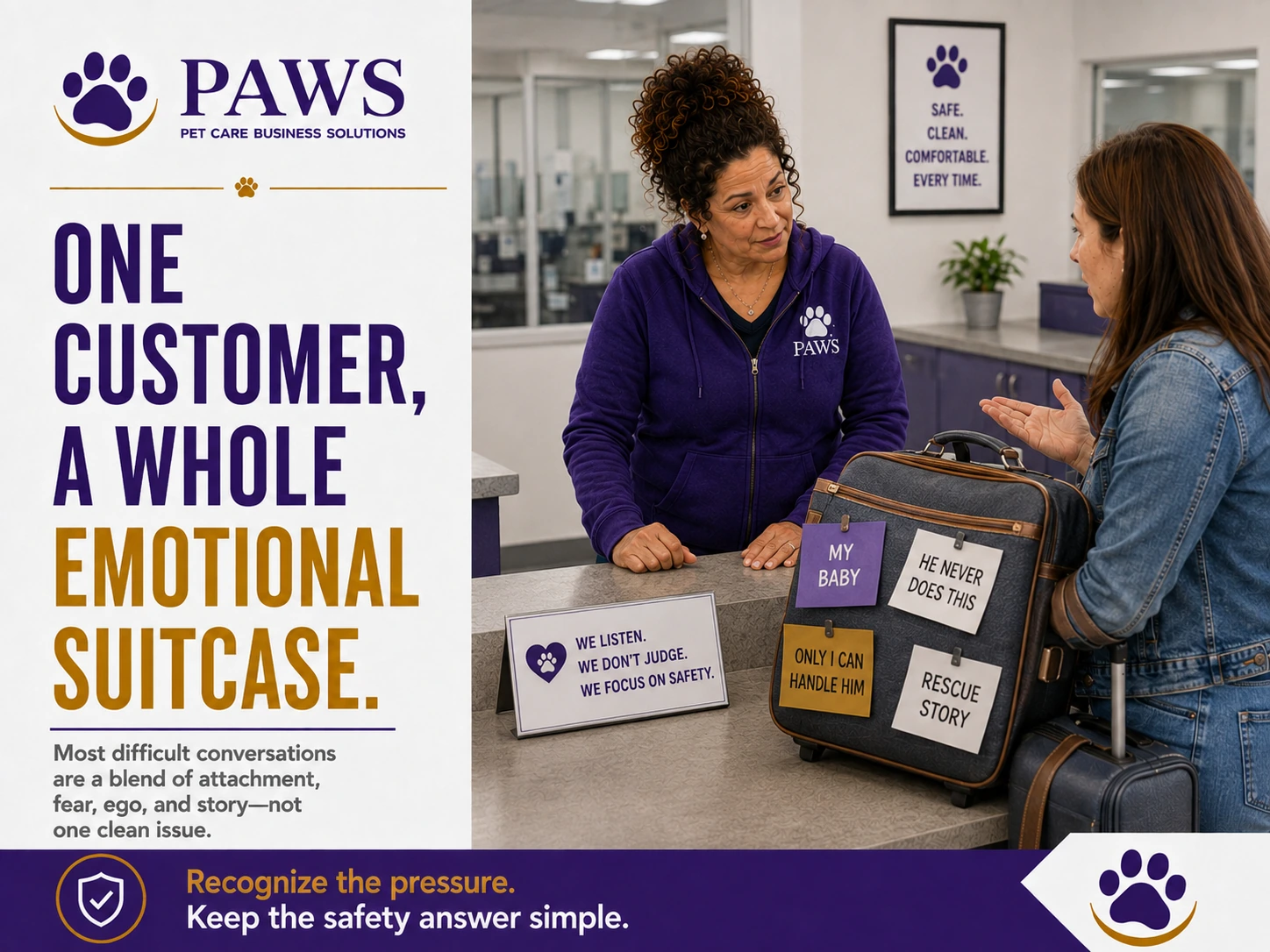
The owner types on this page are useful, but real customers are rarely one clean category. A rescue owner may also treat the dog like a child. A beauty/status owner may also be a review threatener. A lonely companion owner may also be deeply anxious about health. An ego owner may also genuinely love the dog and be scared that staff will not understand him.
That is why this is not a personality quiz. It is a working map. Staff should not decide, “This customer is Type Four” and then stop thinking. The point is to recognize the emotional pressure behind the conversation so you can choose better words and still hold the line.
One customer may say, “He is my baby,” “he was abused,” “he never acts like this with me,” and “no one else can handle him” inside the same five-minute conversation. That is not four separate customers. That is one customer with a whole emotional suitcase dragging behind the dog.
The operator has to hear the pattern without saying the pattern out loud. You may privately understand that the customer is mixing parenting, rescue identity, ego, and fear. You still do not announce that from behind the counter like you are hosting a discount therapy hour.
When several emotional themes appear at once, staff should reduce the conversation to one operational issue at a time. Trying to answer the rescue story, parenting identity, ego claim, and grooming expectation simultaneously creates more confusion.
Start with the immediate decision: what staff observed, what risk exists, what cannot happen, and what safe option remains. The emotional background helps choose the tone, but it should not take over the structure.
📌
Operator translation
Owner categories are not boxes. They are warning lights. When several lights are blinking at once, slow the conversation down, keep the language simple, and do not let emotion rewrite the safety decision.
Swipe left/right to see the full table.
| Same Problem | Owner Type | What They May Hear | Better Operator Framing |
|---|---|---|---|
| Dog fails daycare evaluation. | Child-substitute owner | “You rejected my baby.” | “We are not rejecting him. We are saying this environment is not the safest fit for him today.” |
| Dog fails daycare evaluation. | Ego/control owner | “You think I cannot control my dog.” | “You may handle him well at home. We are responsible for what our staff can safely manage here.” |
| Dog fails daycare evaluation. | Rescue-identity owner | “You are judging him for his past.” | “His history matters, but we still have to manage the behavior we are seeing in this environment.” |
| Dog fails daycare evaluation. | Beauty/status owner | “You are embarrassing me and saying my dog is not perfect.” | “He has a lot of good qualities. The issue is that today’s group setting is creating behavior we cannot safely allow.” |
| Dog fails daycare evaluation. | Practical dog owner | “Tell me what happened and what to do next.” | “Here is what we saw, why it matters, and what I would recommend next.” |
⏱️
The First Five Minutes: How to Read the Customer Without Saying It Out Loud
Customers usually tell you how to handle the conversation before they realize they told you.
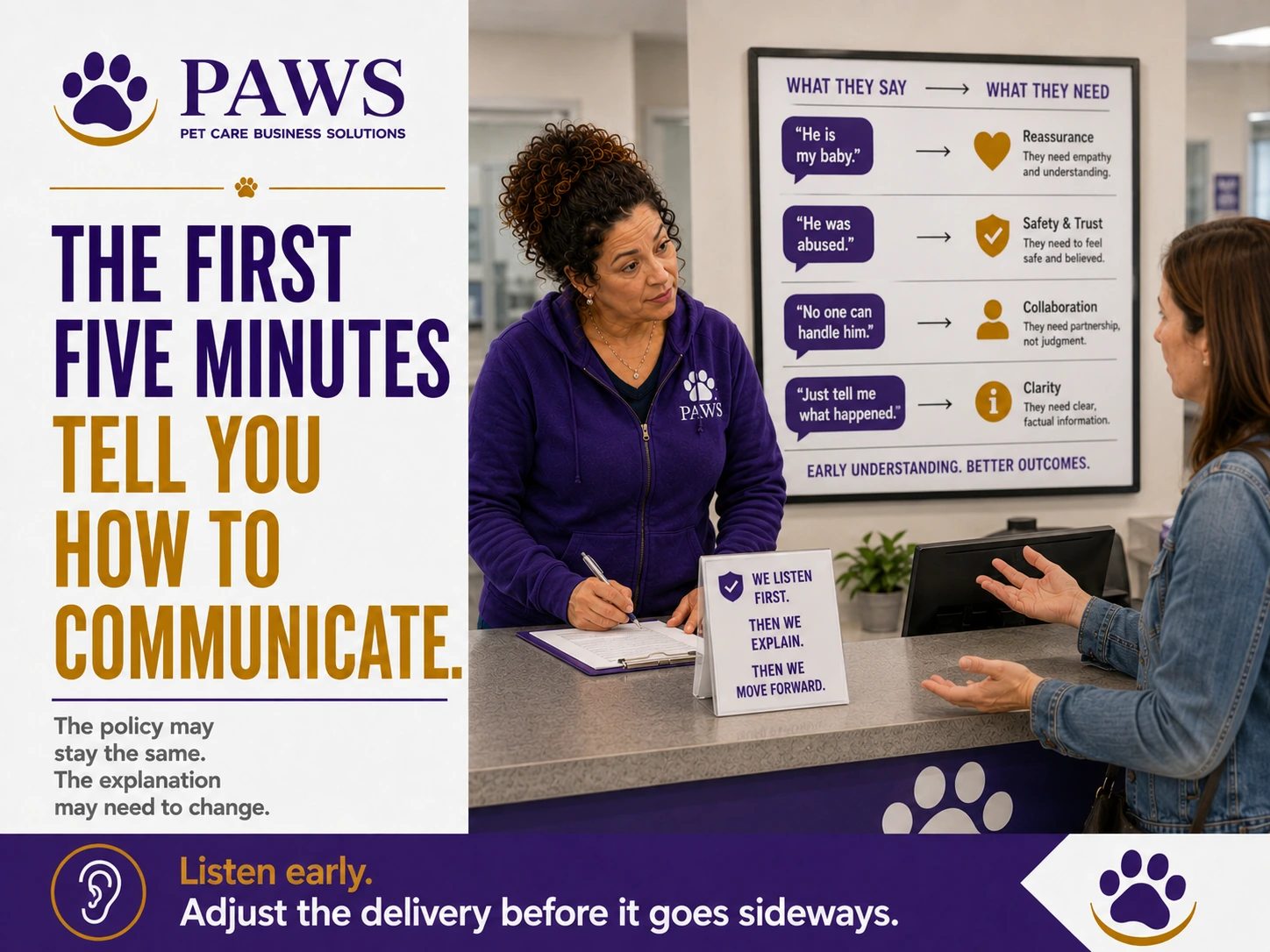
A lot of customer communication problems are visible early. The first few minutes at drop-off, intake, evaluation, grooming check-in, or boarding admission can tell staff whether they are dealing with a practical owner, anxious owner, rescue-story owner, ego owner, status owner, or someone who is already looking for a fight.
This does not mean staff should profile people like cartoon villains. It means staff should listen. The customer who says, “Just tell me what I need to know,” is not the same conversation as the customer who says, “He is my baby, he was abused, nobody can handle him but me, and he gets embarrassed when people look at him.”
The faster staff recognize the communication style needed, the less likely they are to step on the emotional landmine. You can still say no. You can still refuse unsafe service. You can still enforce policy. You just do it with a better grip on the human standing in front of you.
The early read should include how the customer responds to ordinary limits. A reasonable question, repeated exception-seeking, a threat, and refusal to provide truthful history are not the same communication problem.
Employees should share useful observations before the handoff is complete. A customer who needs extra reassurance, manager explanation, written confirmation, or a firm no should not restart the same conflict with every department.
Swipe left/right to see the full table.
| What the Customer Says Early | What You May Be Dealing With | Staff Should Avoid | Better First Response |
|---|---|---|---|
| “He is my baby.” | Child-substitute or highly attached owner. | Cold policy language or “he is just a dog.” | “I know he is very important to you. We are going to focus on what keeps him safe and comfortable.” |
| “No one can handle him but me.” | Ego/control owner or genuinely difficult dog. | Turning it into a challenge. | “Thank you for telling us. We will evaluate what our staff can safely manage here.” |
| “He was abused, so you cannot correct him.” | Rescue-identity owner. | Dismissing the rescue story or letting it erase safety rules. | “His history matters. We still need to keep the handling safe for him and staff.” |
| “He is show quality / pick of the litter / from a great line.” | Beauty/status owner. | Starting with flaws, mats, odor, fleas, weight, or behavior bluntly. | “He is a good-looking dog. Let’s talk about what his coat and behavior allow us to do safely today.” |
| “She feels judged.” “She gets embarrassed.” “She is mad at me.” | Humanized companion owner. | Laughing, eye-rolling, or mocking the dog’s supposed feelings. | “I understand she is very important to you. Here is what we are actually seeing today.” |
| “I have been to three vets and nobody can find what is wrong.” | Health-anxiety or medical-project owner. | Playing veterinarian, dismissing the concern, or adopting the customer’s diagnosis. | “We will follow written veterinary instructions, but we cannot diagnose or treat beyond our role.” |
| “Just tell me what I need to know.” | Practical dog owner. | Over-packaging simple information. | “Here is what we saw, why it matters, and what I recommend.” |
| “The last place did it wrong.” | Could be legitimate concern, unrealistic expectations, or a chronic complaint pattern. | Automatically agreeing or trashing the other business. | “Tell me what happened and what you are hoping we can do differently. Then I can tell you what is realistic here.” |
📝
Private Staff Notes: Record the Communication Need, Not Your Insult
Staff notes should help the next employee handle the customer better, not preserve everyone’s worst front-desk thought forever.
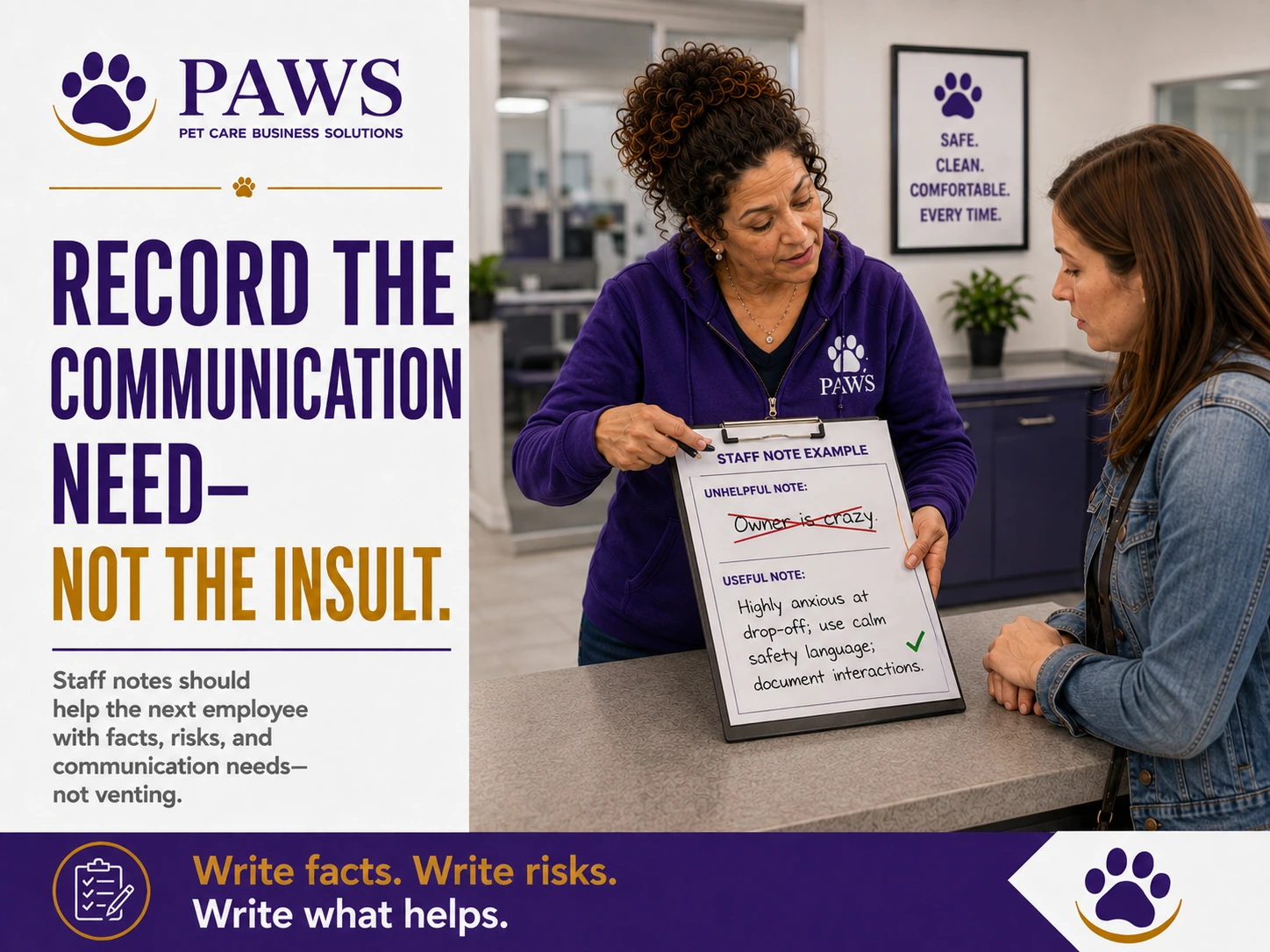
Staff need to communicate internally about difficult customers. That is part of running a professional facility. But there is a difference between a useful note and an insult typed into the record because someone was annoyed.
Bad note: “Owner is crazy and thinks dog is her child.”
Better note: “Owner is highly anxious at drop-off. Use comfort/safety language. Avoid jokes about dog emotions. Explain policy calmly and document exceptions.”
The first note makes the staff feel clever for three seconds and creates a liability-flavored landmine if the customer ever sees it. The second note helps the next person do the job better.
Keep notes factual, operational, and useful. Do not write a therapy diagnosis. Do not write the thing you wanted to say in the break room. Write what staff need to know to handle the dog, customer, policy, and risk correctly next time.
Useful notes should identify the communication trigger, business boundary, and response that worked. They may also identify manager-only decisions, required veterinary instructions, or topics that must be documented at each visit.
Assume every note could someday be read by the customer, an attorney, an insurer, or a regulator. Write facts and operating instructions the business could defend without embarrassment.
Swipe left/right to see the full table.
| Bad Staff Note | Why It Is a Problem | Better Staff Note |
|---|---|---|
| “Owner is nuts.” | Insulting, useless, and not operational. | “Owner becomes highly anxious during policy discussions. Keep explanation short, calm, and safety-based.” |
| “Dog mom thinks he is a human child.” | Mocking the attachment does not help staff. | “Owner uses child/baby language. Lead with comfort and safety before explaining restrictions.” |
| “Owner is a rescue drama person.” | Insult, not information. | “Owner references rescue history when discussing behavior. Validate history, then explain current safety requirements.” |
| “Owner thinks dog is perfect.” | Too vague and judgmental. | “Owner is sensitive to negative comments about coat and behavior. Use specific observations and avoid blunt labels.” |
| “Owner is a pain in the A**.” | It may feel accurate in the moment. It still does not belong in the file. | “Owner repeatedly challenges policy and asks for exceptions. Document explanations and manager decisions.” |
| “Owner invents medical problems.” | Staff are not diagnosing the owner or pet. | “Owner reports multiple medical concerns. Require written vet instructions for medication, restrictions, or special handling.” |
⚠️
Staff note rule
Write the communication need, the policy issue, the dog-handling risk, and the next required action. Leave the insult out of the record.
📋
Dog Owner Motivation and Communication Matrix
This is the practical part: what the dog represents, what the customer may say, what triggers them, and how to respond.
Swipe left/right to see the full table.
| Owner Type | What the Dog Represents | What They May Say | What Triggers Them | Better Communication Style |
|---|---|---|---|---|
| Child-Substitute Owner | Baby, child, dependent, emotional family member. | “He is my baby.” “He will think I abandoned him.” “He gets embarrassed.” | Anything that sounds like neglect, rejection, punishment, or criticism of their care. | Lead with comfort and safety. “I know how much you care about him. This is the safest way to handle it.” |
| Obedient-Child Owner | The dependable creature that behaves, listens, and needs them. | “He is always good for me.” “He never acts like that at home.” | Behavior notes, failed daycare evaluations, correction, or refusal. | Separate the dog from the environment. “He may be great at home. We are responsible for how he behaves here.” |
| Ego / Control Owner | Strength, control, toughness, status, personal power. | “No one can handle him but me.” “He is dominant.” “He protects me.” | Staff handling the dog easily, muzzle use, refusal, or being told the dog is unsafe. | Avoid challenging their ego directly. “We are not questioning your relationship with him. We are managing our safety requirements.” |
| Beauty / Status Owner | Beauty, breed quality, vanity, personal reflection. | “He is pick of the litter.” “He is show quality.” “Everyone says he is perfect.” | Coat condition, fleas, ticks, odor, mats, bad grooming outcome, behavior notes. | Compliment what is real, then explain the current limitation. “He is a beautiful dog. Today the coat condition limits what can be done safely.” |
| Lonely Companion Owner | Closest relationship, emotional lifeline, daily support. | “She knows when I am upset.” “He feels judged.” “She is mad at me.” | Jokes about the dog’s feelings, dismissal, cold policy language. | Respect the bond and redirect to observable facts. “I know she is very important to you. Here is what we saw today.” |
| Rescue Identity Owner | Rescue mission, proof of compassion, savior role. | “He was abused.” “You cannot correct him.” “He needs love, not rules.” | Boundaries, correction, refusal, safety restrictions, muzzle recommendations. | Validate the history without excusing unsafe behavior. “His past may explain it, but we still have to manage the behavior safely.” |
| Health-Anxiety / Medical-Project Owner | The dog as a medical mystery, fragile patient, or focus point for worry. | “Something is wrong.” “The vet missed it.” “He needs special everything.” “I know his symptoms better than anyone.” | Staff refusing to validate the concern, requiring written vet instructions, declining medical interpretation, or treating the dog like a normal boarding/daycare dog. | Respect the concern, but stay in your lane. “We can follow written veterinary instructions, but we cannot diagnose, treat, or make medical decisions beyond our role.” |
| Practical Dog Owner | Loved dog, but still understood as a dog. | “What do you recommend?” “What should I work on?” “Tell me what happened.” | Usually not triggered by honest information if delivered respectfully. | Be direct and useful. “Here is the issue, here are the options, and here is what I recommend.” |
🗣️
Communication Styles by Owner Type
The same policy can be explained different ways without changing the decision.
Scripts are most useful when employees understand the structure behind them: respect the bond, state the observable fact, explain the facility responsibility, give the boundary, and offer the next safe option.
The wording may change for an anxious owner, practical owner, rescue owner, or ego-driven owner; the safety decision should not.
Swipe left/right to see the full table.
| Owner Type | Situation | Better Script | Why It Works |
|---|---|---|---|
| Child-Substitute Owner | Owner is upset about boarding, grooming, or separation. | “I know how much you care about him. The reason we are recommending this is to keep him comfortable and safe.” | It respects the attachment while keeping the decision tied to safety. |
| Obedient-Child Owner | Dog behaves badly in daycare but owner says he never does that at home. | “He may be wonderful at home. Group play is a different environment, and we have to judge what we see here.” | It avoids calling the owner a liar while keeping facility behavior separate from home behavior. |
| Ego / Control Owner | Owner insists only they can handle the dog. | “We are not questioning your relationship with him. We are responsible for how he behaves in this facility and what our staff can safely manage.” | It avoids a dominance contest with the customer. |
| Beauty / Status Owner | Dog’s coat condition prevents the requested groom. | “He is a beautiful dog. The issue today is the condition of the coat and what can be done safely without causing pain.” | It gives the owner dignity while explaining the real limit. |
| Lonely Companion Owner | Owner speaks for the dog’s feelings in a very human way. | “I understand she is very important to you. Here is what we observed today, and here is what we recommend.” | It respects the bond without pretending the dog wrote a diary entry. |
| Rescue Identity Owner | Owner uses past abuse to resist safety rules. | “His past may explain why he reacts this way, but we still have to keep staff and other dogs safe.” | It validates history without letting history become a policy eraser. |
| Health-Anxiety / Medical-Project Owner | Owner believes the dog has an unresolved medical issue or needs special handling without written instructions. | “I understand you are concerned. For anything medical, we need written veterinary instructions. We can follow those instructions, but we cannot diagnose or create a treatment plan here.” | It respects the concern without turning daycare, boarding, or grooming staff into pretend veterinarians. |
| Practical Dog Owner | Owner wants honest feedback. | “Here is what happened, here is why it matters, and here is what I would do next.” | These customers usually want usable information, not emotional packaging. |
📌
Important point
Adjusting your communication style does not mean changing your policy. It means choosing words that give the customer a chance to hear the answer before they start defending their identity.
🚫
What Not to Say to Pet Owners, Even When the Thought Is True
Say the operational truth without stomping directly on the emotional landmine.
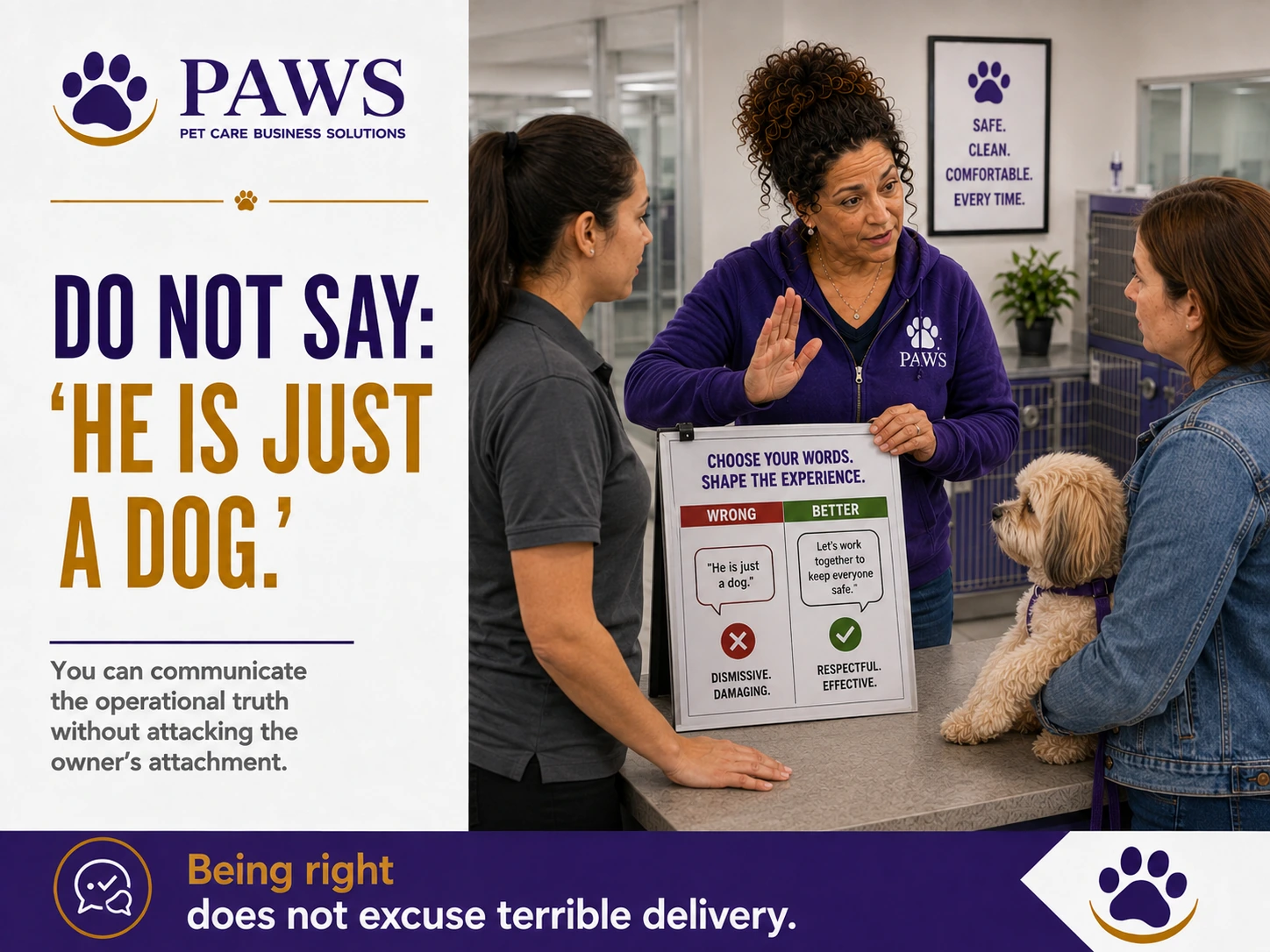
This is where a lot of operators get themselves into trouble. They may be right on the facts and still wrong on the delivery. A customer can be uninformed, emotional, unrealistic, and flat-out wrong, but if you communicate like you are trying to win a bar fight, you are going to create a bigger problem than the one you started with.
The goal is not to lie. The goal is not to flatter the customer into stupidity. The goal is to tell the truth in a way that protects the animal, protects the staff, and gives the customer the best chance of accepting reality.
Employees should also avoid joking about the customer after the conversation while still in public areas. Lobby comments, open radios, visible screens, and hallway remarks can turn a professional decision into a preventable complaint.
Replace identity attacks with observable facts. Describe the coat, body language, service limit, health policy, or behavior in the facility rather than telling the customer what kind of owner they are.
Swipe left/right to see the full table.
| Do Not Say | Why It Blows Up | Say This Instead |
|---|---|---|
| “He is just a dog.” | The customer may hear that you do not care about the dog. | “I know he is very important to you. This is what we need to do to keep him safe.” |
| “You are babying him.” | It attacks the customer’s identity and attachment. | “Sometimes extra attention can make dogs more anxious in this setting. Here is how we handle it.” |
| “Your dog is not special.” | It may be true operationally, but it is useless and insulting. | “We apply this policy to every dog because it protects the whole facility.” |
| “He is aggressive because you let him be.” | It turns the behavior conversation into a blame conversation. | “What we are seeing today creates a safety concern in this environment.” |
| “He is not embarrassed. He does not care.” | It dismisses the owner’s feelings, even if the dog is not thinking like a teenager before prom. | “The most important thing today is comfort and skin safety. A shorter clip is the humane option.” |
| “That rescue story does not matter.” | It dismisses something emotionally important to the owner. | “His history may explain the behavior, but we still have to manage what is safe today.” |
| “Your dog is fat.” | It may trigger shame, defensiveness, or a front-counter meltdown. | “His weight may be affecting comfort and mobility. It would be worth discussing with your veterinarian.” |
| “Your dog is matted because you neglected him.” | Even when poor coat care caused the problem, that sentence will usually end the relationship. | “The coat is too matted to brush out safely today. After the reset, we can talk about a maintenance schedule.” |
| “Your dog is acting like an A**.” | You may think it. Do not say it. The customer will not hear the nuance, and the review will not include your charming internal monologue. | “He is having a hard time cooperating safely today, so the finish may be limited by what he allows us to do.” |
| “You need to stop looking for problems.” | Even when the customer is diagnosis-shopping, that wording makes the business sound dismissive and careless. | “I understand you are concerned. We need written veterinary instructions for any medical restrictions, medication changes, or special handling requirements.” |
❓
Understanding Dog Owners FAQ for Pet Care Operators
Detailed answers about emotional attachment, child and companion language, rescue stories, owner ego, appearance expectations, first-impression cues, staff notes, medical concerns, communication styles, service refusal, and holding safety boundaries.
Why do some customers hear criticism of the dog as criticism of themselves?
For some owners, the dog is tied closely to parenting, loneliness, rescue identity, beauty, status, control, or self-worth. A comment about matting, behavior, weight, daycare suitability, or handling may therefore feel like a statement about the owner’s love or competence.
Staff should separate the person from the observation. Describe what was seen, explain why it matters in the facility, and focus on the safest next step instead of using labels that invite the customer to defend their identity.
Should staff tell customers what emotional role the dog appears to play?
No. This framework is for internal awareness and communication planning, not lobby diagnosis. Telling someone that the dog is a substitute child, ego prop, rescue project, or emotional crutch is intrusive and unlikely to improve the service conversation.
Use the insight quietly. Choose language that respects the bond, identify the operational facts, and keep the policy decision tied to animal welfare and facility responsibility.
How should staff respond when a customer says, “He is my baby”?
Acknowledge the importance of the relationship before explaining the limit. A useful response is, “I know how important he is to you. This is the safest way for us to keep him comfortable and protected while he is here.”
Do not use “he is just a dog” or argue about whether the parenting language is accurate. The business can respect the attachment without allowing unsafe bedding, painful grooming, owner interference, or unsuitable group placement.
How should staff handle “He never acts like this at home”?
Treat the home history as useful information rather than a lie. The dog may truly behave differently with familiar people and routines than around unfamiliar staff, dogs, gates, noise, restraint, food, toys, or separation.
Explain the environmental difference and describe the actual behavior observed. The facility must make decisions based on the dog in the setting it is responsible for, even when the owner’s home description is also true.
How should staff handle “No one can handle him but me”?
Do not turn the statement into a challenge. Thank the owner for the warning and explain that the facility will evaluate what trained staff can safely manage under its own handling rules.
If the dog cannot be handled safely, the service may require a muzzle, a more experienced provider, veterinary support, a modified plan, or refusal. The owner’s identity as the only capable handler does not reduce bite or injury risk.
How should rescue stories be handled?
Respect the history and record details that may affect handling, fear, separation, health, or known triggers. A rescue background can help staff understand why the dog reacts and plan a lower-stress approach.
The story does not excuse current unsafe behavior. Staff can say, “His past may explain this reaction, but we still have to manage what is happening safely around employees and other dogs.”
What if the customer thinks the dog will feel embarrassed or rejected?
Do not debate whether the dog experiences embarrassment exactly like a person. Acknowledge that the owner wants to protect comfort and dignity, then redirect to the actual welfare issue.
For example, explain that a short shave may be the least painful option for matting or that private care may be kinder than forcing an overwhelmed dog into group play. The decision should rest on the dog’s condition and behavior.
How should staff communicate with a beauty- or status-focused owner?
Use specific evidence and realistic expectations. Photographs, coat condition, comb tests, behavior notes, and the limitations of grooming a live animal help explain why the desired finish may not be possible.
It is reasonable to acknowledge the dog’s positive qualities without making false promises. Today’s coat, health, and cooperation determine the safe result—not breed alone or a reference photograph.
How should staff communicate with a lonely or highly attached companion owner?
Slow down, avoid jokes about the dog’s feelings, and explain how the facility will support comfort within policy. These owners may hear a routine restriction as indifference toward the most important relationship in their daily life.
Respect does not require accepting every emotional interpretation. Staff can say, “I understand how important she is to you. Here is what we observed and what we can safely do for her today.”
What if one customer fits several owner types at once?
That is common. A customer may treat the dog like a child, rely on a rescue story, take pride in being the only handler, and worry intensely about appearance during the same conversation.
Do not force the person into one category. Identify the immediate operational issue, choose language that avoids the strongest emotional trigger, and keep the safety decision simple and intact.
What should staff listen for during the first five minutes?
Listen for attachment language, rescue history, handling claims, prior-provider complaints, medical concerns, appearance expectations, repeated exception requests, and whether the customer accepts ordinary questions and limits.
Those cues help staff decide whether the conversation needs reassurance, direct facts, manager involvement, written confirmation, or a firm boundary. They should guide communication, not become insulting labels.
How should staff document communication needs?
Record observable patterns and useful instructions: the owner becomes anxious at separation, repeatedly asks for exceptions, needs written confirmation, references rescue history during behavior discussions, or requires manager approval for changes.
Do not write insults, amateur diagnoses, or break-room commentary. The note should help the next employee handle the dog, customer, policy, and risk more effectively.
What if the customer is practical and just wants the facts?
Give them the facts directly. Explain what happened, why it matters, what options exist, and what you recommend without burying the answer under emotional packaging they did not ask for.
Practical owners are often strong partners because they are willing to adjust training, service, coat length, routines, or scheduling when the operational reasoning is clear.
How should staff respond to repeated medical concerns?
Respect the concern but stay within the business’s role. Record symptoms the owner reports or staff observe, follow illness and medication rules, and require written veterinary instructions for medical restrictions or treatment-related handling.
Do not diagnose the dog, dismiss the owner, or adopt an unsupported diagnosis. The facility can explain what it can safely monitor and what requires veterinary evaluation.
Can different communication styles create inconsistent policy?
They should not. The tone and wording may change based on the customer’s needs, but the safety rule, service limit, documentation requirement, and final decision should remain consistent.
The goal is to make the same operational answer easier to hear. Communication flexibility is not permission for one employee to create an exception another employee must later reverse.
What phrases should staff avoid?
Avoid identity attacks such as “he is just a dog,” “you are babying him,” “your dog is not special,” “you caused this,” or “that rescue story does not matter.” Those phrases usually create defensiveness rather than understanding.
Replace them with observable facts and responsibility language: what staff saw, what the risk is, what the facility cannot do, and what safe option remains.
How can understanding owners help prevent bad reviews?
It can reduce avoidable offense by helping staff explain policies in language the customer can hear. Acknowledging the bond before giving a difficult answer often prevents the customer from assuming the business is cold or dismissive.
It cannot prevent every negative review. Some customers reject any answer they dislike. The business should still document the facts and refuse unsafe service rather than buying approval with a bad decision.
Does understanding attachment mean bending policy?
No. Understanding attachment helps staff communicate and anticipate reactions. It does not make a reactive dog safe in group, a matted coat painless to brush, loose bedding safe overnight, or an owner qualified to control a staff work area.
Empathy should support the boundary. The customer can feel respected while the facility still says no.
When should the customer relationship be ended?
Consider dismissal when the customer repeatedly lies about behavior or health, violates policy, abuses staff, demands unsafe exceptions, refuses necessary handling limits, or turns every service into an accusation the business cannot manage responsibly.
Document the pattern and communicate the decision professionally. Understanding the customer’s emotional attachment does not require the business to continue an unsafe or abusive relationship.
What is the bottom-line rule for understanding dog owners?
Respect the bond, listen for what the customer may be hearing, and choose language that avoids unnecessary humiliation or identity conflict. Then describe the dog and the situation as they actually exist in the facility.
The customer’s emotional story explains the reaction; it does not control the safety decision. Read the owner, read the dog, protect staff, and deal with the real animal in front of you.
🐾
Bottom Line: Understand the Attachment, But Do Not Hand It the Keys
The customer’s emotional connection explains the reaction. It does not make unsafe requests safe.
It can be of great benefit to the business owner to understand some of the primary reasons for dog ownership. Through this understanding, it is possible to deal with clients in such a way that the client feels heard and respected while the business still protects the dog, staff, and facility.
The dog may be a child, companion, ego boost, beauty project, rescue mission, obedient dependent, or genuine dog friend. The owner may not be aware of the role the dog plays in their life, and they almost certainly do not want you explaining it to them.
Your job is not to psychoanalyze the customer. Your job is to understand why the customer may react emotionally, choose words that do not unnecessarily insult them, and still hold the line when safety, policy, grooming reality, boarding risk, daycare behavior, or staff protection requires it.
Listen to the customer. Respect the bond. Read the dog. Protect the business. And when the customer’s emotional version of the dog conflicts with the real dog standing in your facility, deal with the real dog.
A business should judge communication by whether the customer understood the facts, the boundary remained intact, the animal received the safest available care, and the next employee can follow the record.
Understanding attachment is a tool for clearer service, not a reason to tolerate dishonesty, abuse, unsafe requests, or endless exceptions. Empathy works best when it supports professional judgment.