Grooming Equipment • Electric Tables • Low-Profile Lift Tables • Cord Hazards • Professional Grooming Room Planning • Equipment Review
Electric Grooming Tables: Push-Button Luxury, Cord Problems, and When the Upgrade Actually Makes Sense
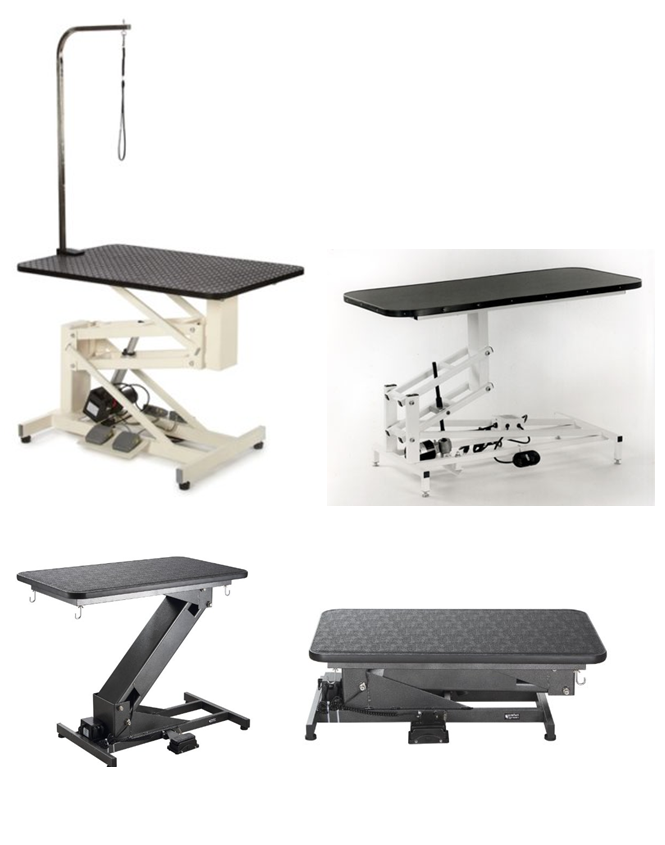
Electric grooming tables are typically reserved for professional use only. I have yet to find a notable home-use electric lift grooming table that I would treat as a serious category. The majority of products in this line are designed and intended for use specifically in a professional grooming shop.
In simplest terms, many electric grooming tables are very similar to commercial grade hydraulic grooming tables in quality of construction and robustness, except they are lowered and raised by an electric motor instead of a hydraulic foot pump.
What you are often paying for is the ability to press a button with your foot to raise and lower the table instead of pumping a pedal.
Whether that luxury is worth the extra money depends on what table you are buying, how low it goes, what dogs you groom, how many dogs your groomer handles, how the room is wired, and whether the electric feature solves a real problem or just sounds cool when you tell someone you have it.
Here is my basic take: if the electric table does not lower meaningfully lower than a good hydraulic table, then do not pretend it is saving your groomer’s back. It is mostly saving their pumping foot.
⚠️
Operator rule
A standard electric table is often a convenience upgrade. A true low-profile electric table can be a legitimate ergonomic upgrade. Those are not the same thing.
🗺️
Use This Page Like the Final Grooming Table Review
Electric tables can be useful. They can also be expensive button-operated bragging rights with a cord lying around a wet room.
💵
Current Price Reality
Modern electric tables range from budget electric lifts to low-profile commercial monsters.
🔘
What Electric Changes
The table lifts by motor instead of hydraulic foot pump. That may or may not matter.
🦶
Hydraulic Reality
A good hydraulic table is simple, reliable, and not usually hard to pump.
⬇️
Low-Profile Exception
If the table drops low enough to reduce large-dog lifting, now the electric feature has a real argument.
🔌
The Cord Problem
Electric means cord routing, trip risk, shock risk, floor outlets, wall placement, and tool damage.
💧
Humidity and Failure Points
Motors, switches, pedals, wiring, control boxes, cords, and wet grooming rooms are not nothing.
✅
Buying Checklist
Do not buy electric until you know what the motor actually earns you.
❓
FAQ
Electric vs hydraulic, low-profile tables, cords, GFCI, reliability, cost, and operator verdict.
💵
Current Market Reality: Electric Tables Are Not One Price Category
The electric table market has spread out. Some are budget electric lifts. Some are legitimate low-profile professional work platforms.
When I first looked at these tables, the extra cost for electric over hydraulic commonly felt like roughly a few hundred dollars to a thousand dollars more, depending on the table. That basic idea still holds in many cases, but the current market is wider now.
Some budget electric grooming tables are showing up in the rough $500 to $900 range. Mid-range electric tables often sit around $1,100 to $1,500. Heavier commercial electric tables and low-profile tables can run roughly $1,700 to $2,500 or more, especially when you add rotating tops, longer tops, heavier steel, drawers, outlets, special arms, freight, and options.
That price spread matters because the question is not simply “electric or hydraulic?” The better question is, “What problem does this specific electric table solve?”
A table that lowers from 19 inches to 39 inches is very different from a low-profile table that drops down around 10 to 12 inches. One mainly replaces pumping with a button. The other may actually reduce lifting large, old, heavy, sore, or stubborn dogs.
Swipe left/right to see the full table.
| Electric Table Tier | Current Price Reality | Operator Meaning |
|---|---|---|
| Budget electric lift | Roughly $500 to $900 depending on size, model, sale pricing, and included arm. | Usually a convenience upgrade. Check height range carefully before calling it back-saving equipment. |
| Mid-range electric / accordion lift | Roughly $1,100 to $1,500 in many current listings. | Better travel ranges may make these more useful, especially if they drop near 10 to 12 inches. |
| Commercial steel electric table | Roughly $1,400 to $1,600 for some strong shop-grade steel tables. | Built like serious equipment, but still ask whether the lowest height solves loading or just raises and lowers nicely. |
| Low-profile heavy-duty electric | Roughly $1,700 to $2,500 or more depending on brand, rotating top, longer top, and options. | This is where electric starts making the strongest ergonomic argument because large dogs may be able to walk on. |
| Freight and installation | Often separate or conditional. | A $1,700 table may not be a $1,700 table by the time it is delivered, wired for, placed, and actually usable. |
⚠️
Price warning
Do not compare electric tables by price alone. Compare lowest height, highest height, capacity, tabletop size, base stability, cord plan, serviceability, warranty, and whether the table reduces lifting or only replaces foot pumping.
🔘
What an Electric Grooming Table Actually Changes
The lift method changes. The laws of dogs, water, gravity, and grooming room stupidity do not.
Electric grooming tables are typically very similar to commercial grade hydraulic tables in basic purpose. They provide a stable professional work platform, a lift mechanism, a grooming surface, and a way to adjust table height.
The difference is that an electric table is lowered and raised by an electric motor, actuator, control box, and foot control instead of a hydraulic foot pump.
That means the groomer presses a button with the foot and the table moves. No pumping. No repeated hydraulic pedal strokes. No rhythm. No little up-down-up-down dance with the foot pedal.
That can be nice. I am not pretending it is not nice. Pressing a button is easier than pumping a pedal.
The question is whether that convenience is worth the added money, added cord, added electrical planning, added moving parts, and added repair complexity.
If the table is otherwise built like a commercial hydraulic table and has roughly the same lowest height, then the electric feature is mainly convenience. If the electric design allows the table to lower far enough for large dogs to step on, then it becomes more than convenience. Now it may reduce lifting, and that matters.
📌
Real distinction
Electric lift is not automatically ergonomic lift. The lowest height is what tells you whether the table actually helps with loading.
🦶
The Hydraulic Table Reality
A good hydraulic table is not some medieval torture device. It is simple, strong, and usually not hard to use.
From experience, I know that a hydraulic table can typically be lifted from the floor to full extension in under 15 pumps. The effort required to pump the table is minimal at best and can be slightly exacerbated based on the weight of the dog.
Regardless, I have had female groomers under 100 pounds comfortably lift dogs in excess of 180 pounds on a hydraulic table without problems. To be clear, the table is doing the lifting. The groomer is operating the table.
That is why I do not automatically buy the argument that every grooming room needs an electric table just because pumping a hydraulic table exists.
If the hydraulic table is stable, properly sized, well built, and has a good height range, it is already solving most of the grooming-table problem.
A hydraulic table is simple. In plain terms, it is nothing more than a hydraulic car jack connected to a base and a flat table surface. There is beauty in that simplicity. In all likelihood, a good one will work the first time, every time, for a long time.
I have hydraulic tables that have been in service in excess of 15 years that I have never had to maintenance, aside from replacing bent swing arms here and there after a large dog tried to swan dive off the table and bent them.
⚠️
Do not invent a problem
If a good hydraulic table already lowers enough, lifts enough, stays stable, and is easy to pump, the electric upgrade has to justify itself. “Button is nicer” may be true, but it is not automatically worth the money.
⬇️
The Low-Profile Electric Table Exception
This is where electric tables can stop being luxury and start making real operational sense.
The one place where I give electric tables a much stronger argument is with true low-profile electric tables.
If the table drops down around 10 to 12 inches from the floor, now we are talking about something different. A big dog, senior dog, heavy dog, arthritic dog, or dog that is not thrilled about being lifted may be able to step onto the table instead of being hoisted onto it.
That can matter. Repeated lifting is one of the things that wears groomers down. It is also one of the moments where dogs resist, twist, panic, slip, or turn into dead-weight sacks of wet laundry with opinions.
So I would separate electric tables into two categories in my head:
First, standard electric tables that mainly let the groomer press a button instead of pumping a pedal.
Second, low-profile electric tables that lower close enough to the floor to change how dogs load onto the table.
The second category has a much stronger business argument because it may reduce lifting strain, improve workflow, make large-dog loading safer, and help the groomer avoid wrestling heavy dogs onto a table all day.
Swipe left/right to see the full table.
| Table Type | What It Usually Solves | My Take |
|---|---|---|
| Standard hydraulic table | Stable working height with simple mechanical lifting. | Still a strong default choice for many grooming rooms. |
| Standard electric table | Replaces pumping with button operation. | Nice, but often luxury unless the groomer strongly values it. |
| Low-profile electric table | May reduce lifting by allowing dogs to step onto the lowered table. | This is the electric table argument I take seriously. |
| Electric table with outlets and USB ports | May reduce some floor cord clutter for tools. | Useful only if the electrical setup is planned correctly and safely. |
| Electric rotating table | May reduce walking around the table or improve access. | Useful for the right dog and groomer, but adds more moving parts and locking questions. |
💅
When the Electric Table Is Mostly a Luxury Item
Sometimes the table is useful. Sometimes it is just cool to say you have.
I would imagine that an electric table would be of use to an injured, older, or physically limited groomer. Although grooming is such a physically demanding job that the table is only one piece of the problem. The rest of the job still includes lifting, bending, restraining, drying, scissoring, wrestling mats, cleaning, standing, and dealing with dogs who did not sign a cooperation agreement.
In reality, if the electric table is basically just a hydraulic table with a motor attached and it does not meaningfully improve loading height, I would consider that style of table to be a luxury item: totally unnecessary, but cool to say you have.
That does not mean no one should buy one. If a groomer loves it, uses it all day, and the business can afford it without stealing money from more important startup needs, fine. But it should be bought honestly.
Do not call it a safety upgrade if it does not lower enough to change dog loading. Do not call it a back-saver if the dog still has to be lifted. Do not call it essential if a good hydraulic table would do the same work with fewer parts and no cord.
📌
Luxury test
If the only meaningful difference is “press button instead of pump pedal,” then the business is buying convenience. There is nothing wrong with convenience, but call it what it is.
🔌
The Main Disadvantage: The Cord Has to Go Somewhere
No matter how you slice it, there is now an electrical cord in the grooming room that must be accounted for.
The main disadvantage I see is that no matter how you slice it, there is an electrical cord that must now be accounted for.
An electrical cord must go somewhere, and it may present a tripping hazard, shock hazard, damage hazard, cleaning problem, and general “why is this thing in the way again” problem.
Grooming rooms are not dry office cubicles. They have water, wet dogs, humidity, tubs, dryers, shampoo, urine, hair, cleaning chemicals, dropped tools, rolling stools, carts, cords, hoses, leashes, loops, and people walking around trying not to get bit, soaked, tangled, or stabbed by falling scissors.
So when you add an electric table, you are not only adding push-button lift. You are adding a cord management problem inside a wet, busy, tool-heavy workspace.
Swipe left/right to see the full table.
| Cord Issue | What It Looks Like | Operator Meaning |
|---|---|---|
| Trip hazard | Cord runs across floor to a wall outlet. | Groomers, dogs, carts, stools, and customers do not need another thing to trip over. |
| Shock hazard | Cord, plug, outlet, or damaged insulation near water or moisture. | Wet grooming rooms make electrical planning matter. |
| Tool damage | Clippers or scissors fall onto cord or plug. | A cord on the floor or near the table is another thing sharp tools can damage. |
| Lost 360-degree access | Table pushed against wall to avoid cord across floor. | You fixed the cord route by making the table less usable. |
| Cleaning nuisance | Cord catches hair, moisture, dirt, and gets moved around during cleaning. | Anything in a grooming room eventually becomes a hair collector. |
⚡
Floor Outlet, GFCI Protection, and the Slab Problem
Solving the cord problem correctly may be more annoying than the table is worth.
In order to avoid running a cord along the floor to the wall, the business owner may have to install an outlet in the floor near the table location, and that outlet should be properly protected for the grooming environment.
In practical terms, that usually means talking to a licensed electrician about proper outlet placement, GFCI protection, code requirements, moisture protection, conduit, load, and how the room is actually going to be used.
A GFCI, or ground-fault circuit interrupter, is designed to help protect against ground-fault shock hazards by interrupting the circuit when current is leaking where it should not be. It is not magic. It does not eliminate every electrical hazard, and it does not make stupid cord routing safe.
The floor-outlet idea can solve one problem: it can prevent the owner from having to run the table cord across the grooming room floor to a wall outlet.
But depending on the building, that could mean cutting or busting into the slab, running conduit, coordinating electrical work, dealing with permits or inspections, and deciding where the table will live permanently.
That may be considerably more trouble than it is worth if the only thing the table adds is push-button lift.
⚠️
Electrical planning warning
Do not buy an electric table and then start improvising cords in a wet grooming room. Plan the power before the table shows up, not after the groomer is stepping over a cord with a wet dog on the table.
🧱
The Wall Placement Tradeoff
Pushing the table against the wall may clean up the cord route, but it changes how the groomer works.
The other alternative would be to push the grooming table up against a wall, again eliminating the hazard of a cord running across the floor.
That may solve the obvious trip hazard, but it totally eliminates the ability to walk a full 360 degrees around the table.
That is not a small tradeoff. Being able to move around a grooming table matters. It affects scissoring, drying, nail work, face work, rear work, control, posture, and how often the groomer has to reposition the dog.
If you shove the table against a wall just because the electric cord has nowhere sane to go, the table is now dictating the room instead of the room supporting the work.
That may still be acceptable in some small rooms or very specific grooming setups, but it should be a deliberate workflow decision, not a lazy cord-management decision.
📌
Layout truth
A table against the wall may be safer for the cord but worse for grooming access. Do not fix one problem by quietly creating another.
✂️
Murphy’s Law: Scissors, Clippers, and Cord Damage
Dogs knock tools off grooming tables. Tools do not fall politely.
It is also not at all uncommon for dogs to knock tools such as scissors and clippers off of the grooming table.
Both scissors and clippers could damage the cord if they were to fall on it.
Unlikely, you say?
Well, as Murphy’s law would have it, both scissors and clippers that fall from the table tend to land blade-side or pointy-side down. At the very least, you will be forced to pay to resharpen and deburr them after a drop. Happens all the time.
But with an electric table, the problem is not only the dropped tool. Now you also have to ask what the tool landed on.
A sharp shear, clipper blade, heavy clipper body, or metal tool landing on or near the table cord could compromise the insulation along the table’s electrical cord.
Once the cord is damaged, the table is not just inconvenient. It may be unsafe until it is repaired or taken out of service.
⚠️
Tool-drop warning
A grooming room already eats scissors, blades, clipper cords, dryer hoses, and dignity. Do not add a table power cord without thinking through where falling tools, rolling stools, dogs, and cleaning water go.
💧
Humidity, Motors, Switches, and Weak Links
The more complex an item is, the more places it has to fail.
The other disadvantage I see is the effect of humidity on electrical components and the simple fact that the more complex an item is, the more likely it is to have a weak link and break.
A hydraulic table is simple. It is basically a hydraulic jack, a base, a lift mechanism, and a flat work surface. It does not care if the internet is down. It does not care if a control box got wet. It does not need a cord. It does not need a motor to feel like working today.
An electric table adds a motor or actuator, wiring, foot pedals, plug, control box, switches, cord, and sometimes outlets, USB ports, rotating powered accessories, or other nice-looking features.
Those features may be useful. They are also failure points.
It is my opinion, based on years of experience using electric clippers, electric shampoo machines, electric fans, electric dryers, and plenty of other electrical grooming equipment that has broken at some point in its duty cycle, that it would be difficult for an electric table to attain the same type of longevity and reliability that a good hydraulic table can have.
That does not mean every electric table is fragile. Some are built very well. It means the buyer should understand what is being added: convenience, yes, but also complexity.
Swipe left/right to see the full table.
| System | Strength | Weak Point |
|---|---|---|
| Hydraulic table | Simple, proven, no cord, fewer electrical concerns. | Pump can eventually wear, arms can bend, seals may fail, but the system is mechanically simple. |
| Standard electric table | Push-button convenience and less foot pumping. | Cord, motor, actuator, control box, switches, and foot pedal add complexity. |
| Low-profile electric table | Can reduce lifting strain if it lowers close enough to the floor. | Usually higher cost, heavier equipment, freight, service, and electrical planning. |
| Electric table with built-in outlets | May reduce some loose cords around the station. | More wiring, more rules, and more ways for someone to plug in the wrong thing. |
✅
Electric Grooming Table Buying Checklist
Before buying electric, know whether the table is solving a real problem or just adding a button.
- What is the actual lowest height of the table?
- What is the actual highest height of the table?
- How much total travel does the table have?
- Does the table lower enough for large, senior, or heavy dogs to step on, or will staff still lift them?
- What is the rated capacity, and does it apply to real use, not just best-case vertical lifting?
- What are the tabletop dimensions?
- Is the base wide, heavy, and stable enough for the dogs you will actually groom?
- Where will the cord go?
- Is there a proper outlet plan, including GFCI protection where required or appropriate?
- Will the table require a floor outlet, wall placement, cord cover, cord management, or electrical work?
- Will the cord create a trip hazard, cleaning problem, or damage risk?
- Does the table have a manual lowering procedure or service procedure if the motor fails?
- What is the warranty on the frame, actuator, motor, control box, foot pedals, and tabletop?
- Are replacement parts available?
- Is freight included, or will delivery add a painful surprise to the invoice?
- Does the table have built-in outlets, and if so, what should and should not be plugged into them?
- Are dryers, clippers, USB tools, and cords going to create a cleaner workstation or a cord circus?
- Is the electric feature worth the extra money compared with a good hydraulic table?
✅
My Operator Verdict on Electric Grooming Tables
Nice equipment. Sometimes very useful. Often unnecessary. Always needs a cord plan.
My opinion is not that electric grooming tables are bad. They are typically professional-use products, and many are built very well.
My opinion is that the buyer should be honest about what is being purchased.
If the table is a standard-height electric version of a commercial hydraulic table, then you are mostly buying button operation instead of foot pumping. That is nice. It may make the groomer happy. It may make sense in a high-volume shop. It may be helpful for an older, injured, or physically limited groomer.
But it is not automatically necessary.
If the table is a true low-profile electric table that drops close enough to the floor for large dogs to step on, then I take it much more seriously. That can reduce lifting, reduce strain, improve loading, and make the table more than just a luxury upgrade.
The part I do not like is the cord, the electrical exposure, the wet-room reality, the possible need for floor power, the loss of 360-degree access if pushed against a wall, the tool-drop risk, and the fact that electric equipment eventually gives you electric-equipment problems.
A hydraulic table is simple. An electric table is convenient. A low-profile electric table may actually change the work.
That is the distinction.
⚠️
Final take
Buy electric when the table solves a real workflow, loading, or ergonomic problem. Do not buy electric just because “electric” sounds more professional while the cord lies across the floor waiting to trip somebody carrying a wet dog.
❓
Electric Grooming Table FAQ for Pet Care Operators
Straight answers about electric vs hydraulic tables, low-profile lift, cords, GFCI protection, reliability, cost, and buying judgment.
Are electric grooming tables better than hydraulic grooming tables?
Not automatically. Electric tables are easier to raise and lower because the groomer presses a button instead of pumping a pedal. But a good hydraulic table is simple, reliable, stable, and often more than adequate. Electric is better only when it solves a real problem for the room.
What is the biggest advantage of an electric grooming table?
The biggest advantage is convenience. The groomer can raise and lower the table with a foot control instead of pumping a hydraulic pedal. On true low-profile electric tables, the bigger advantage may be reduced lifting because the table can lower close to the floor.
What is the biggest disadvantage?
The cord. The cord has to go somewhere. In a wet grooming room, that means trip risk, shock risk, damage risk, cleaning nuisance, outlet planning, and possible loss of 360-degree table access if the table gets pushed against a wall.
Does an electric table reduce lifting?
Only if it lowers enough. A standard electric table that bottoms out around the same height as a hydraulic table may not reduce lifting much at all. A low-profile electric table that drops around 10 to 12 inches can make a meaningful difference because some large or senior dogs can step onto it.
Is a low-profile electric table worth the money?
It can be, especially in a grooming room that handles large dogs, senior dogs, heavy dogs, or high volume. If it reduces lifting and protects the groomer’s body, the argument is much stronger. It is still expensive, so the table needs to fit the actual work.
Do I need a floor outlet?
Not always, but the cord has to be planned. A floor outlet may keep cords from running across the room, but it can involve electrical work, slab work, conduit, and code issues. A licensed electrician should be involved in that decision.
Does GFCI protection make the cord safe?
GFCI protection helps reduce ground-fault shock risk, but it does not eliminate every electrical hazard. It does not make damaged cords okay, it does not fix bad placement, and it does not replace common sense in a wet grooming room.
Should I push the electric table against a wall?
That may solve the cord-across-the-floor problem, but it can kill 360-degree access around the table. That affects workflow, posture, dog positioning, drying, scissoring, and nail work. Do not let the cord decide the room layout by accident.
Are electric tables less reliable than hydraulic tables?
They can be. A hydraulic table is mechanically simple. An electric table adds motor, actuator, cord, control box, switches, foot pedals, wiring, and sometimes outlets or USB ports. Good electric tables can last, but they have more parts and more potential weak links.
What would you buy?
For many grooming rooms, I would still be perfectly comfortable with a good commercial hydraulic table. If the budget allows and the room handles enough large or difficult dogs, I would seriously consider a true low-profile electric table. I would be less excited about paying a big premium for a standard electric table that only saves pumping.
What is the main lesson?
Electric tables are not automatically better. They are better when they solve a specific problem. If the table reduces lifting, improves workflow, and has a safe cord plan, it may be worth the money. If it only replaces a foot pump with a button, think hard before paying the premium.
🐾
Bottom Line: Electric Is Nice. Low-Profile Electric Can Be Legit.
The motor has to earn its cost, cord, complexity, and place in the room.
Electric grooming tables are typically professional-use tables. Most are built similarly to commercial hydraulic tables, but instead of pumping a hydraulic pedal, the groomer presses a foot control and lets a motor raise or lower the table.
If that is all the table does differently, then electric is mostly a luxury item: nice, convenient, and cool to say you have, but not automatically necessary.
From experience, I know a good hydraulic table can usually be raised to full extension in under 15 pumps, and I have seen small groomers comfortably operate hydraulic tables with very large dogs on them. Hydraulic is simple, proven, and reliable.
The stronger electric-table argument is the low-profile table. If the table drops low enough that larger dogs can step on instead of being lifted, now the motor may be buying real ergonomic value instead of just convenience.
But the cord is real. The electrical planning is real. The wet grooming room is real. The tool-drop problem is real. The loss of 360-degree table access can be real. The added complexity is real.
Buy electric when it solves a real grooming room problem. Do not buy electric just because the word sounds more professional.