Dog Grooming Business Planning
Dog Grooming Salon Considerations: Location, Layout, Visibility, Utilities, and Expansion
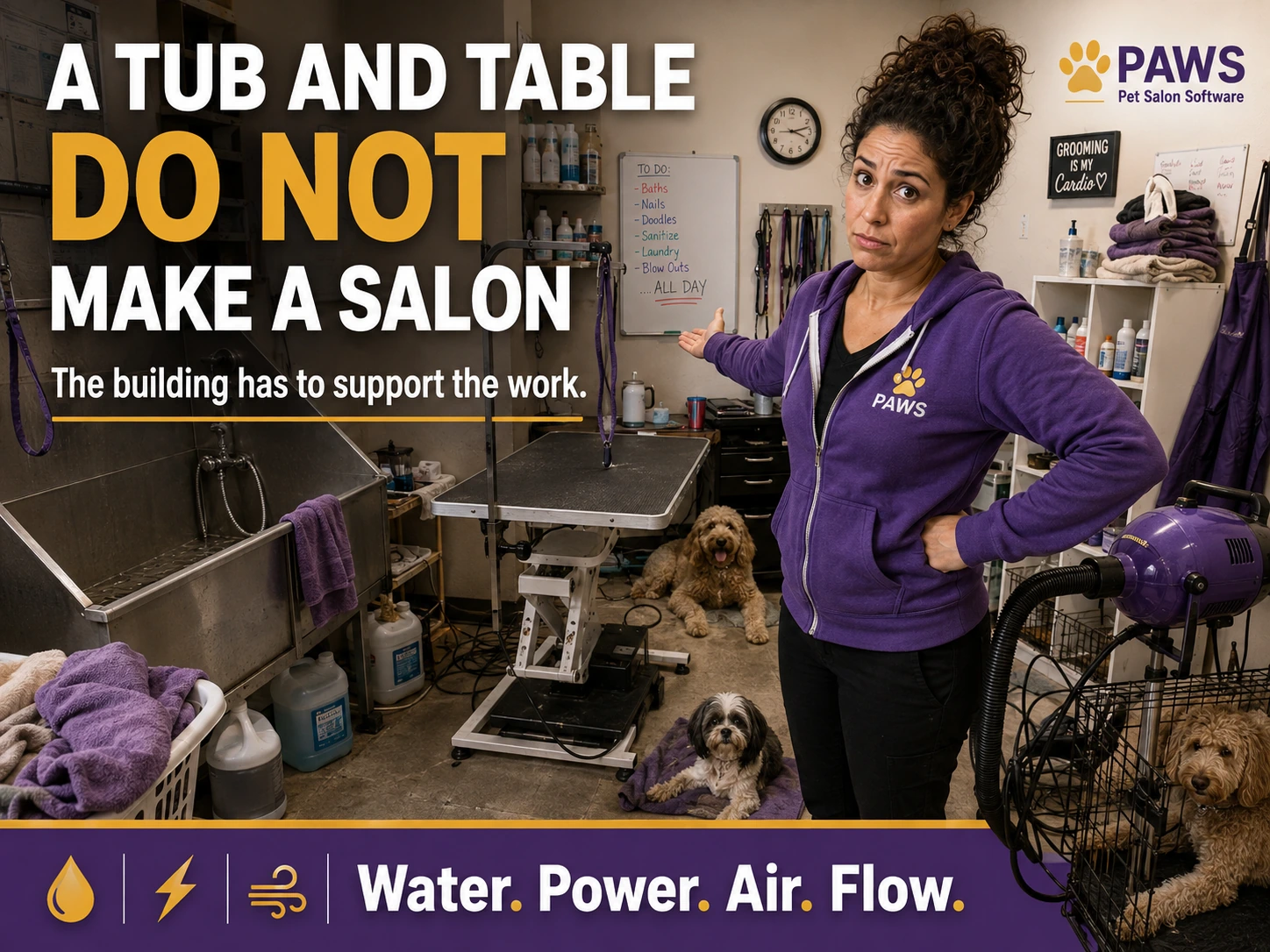
A grooming salon is not a tub and a table shoved into an available room. It is a production area that has to move dogs, water, air, hair, towels, tools, employees, and appointments without the whole thing backing up.
There is probably no service that intimidates prospective pet-care business owners as much as grooming. Cat grooming can be even more of an adventure. Some of that fear comes from not understanding what grooming actually requires. Some comes from imagining that every salon has to begin as a large, complicated, full-service operation.
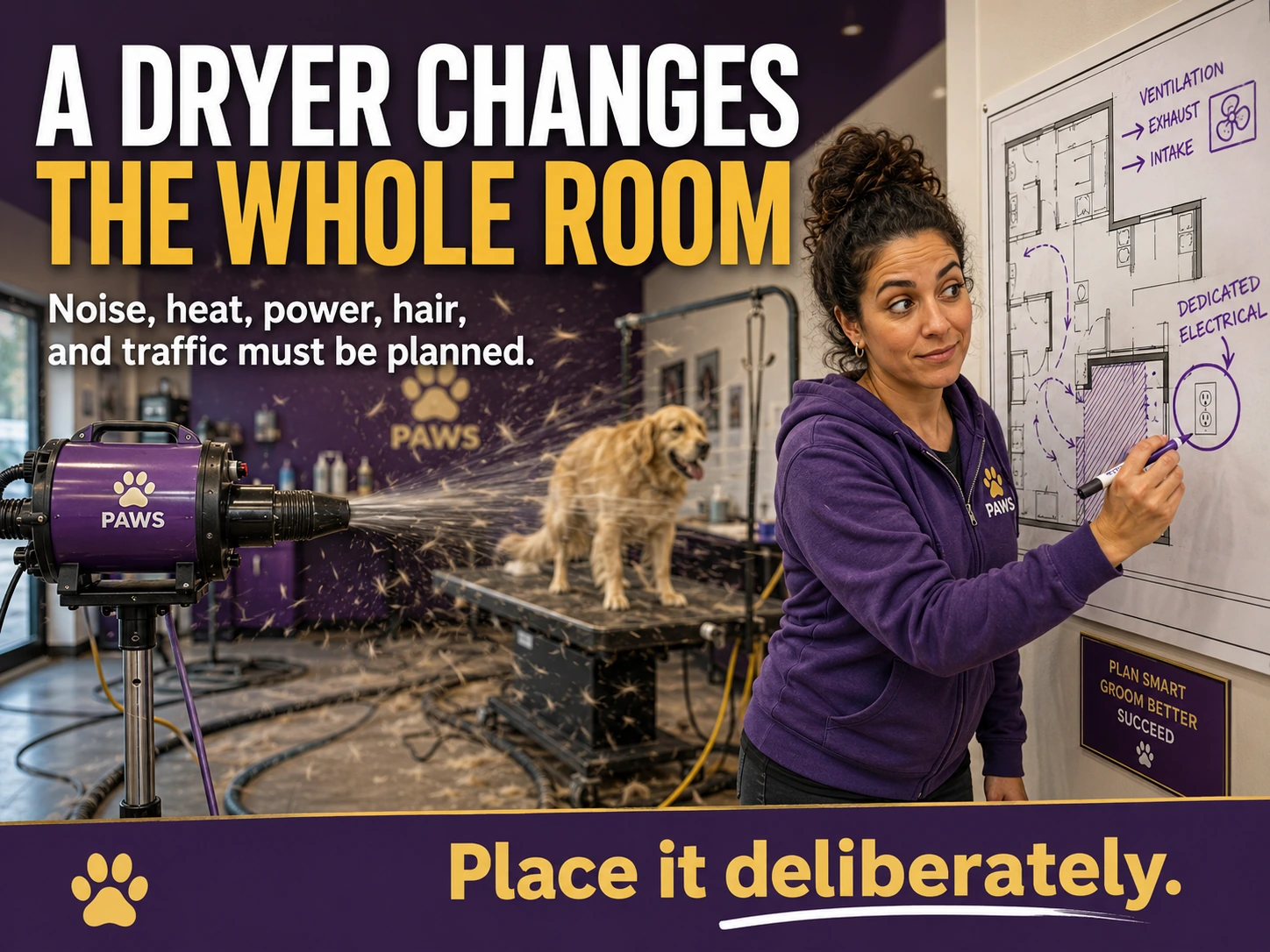
The grooming itself is only part of the decision. The bigger mistake is forcing grooming into a room that was never meant to support it. A grooming room changes water use, hot-water recovery, drainage, electrical load, ventilation, dryer noise, humidity, laundry, storage, dog holding, cleaning, customer traffic, and the way employees move through the building.
A room can physically hold a tub and grooming table and still be a terrible salon. The tub can be in the wrong place. Dryers can block the walkway. Clean towels can be across the room. Finished dogs can be sitting beside wet dogs and loose hair. Two dryers can trip a breaker while a soaked dog is standing on the table and the schedule is already falling behind.
If you are still scouting locations, grooming needs to be part of the building discussion before the lease is signed. If you already operate a daycare, boarding facility, or pet-care business, you need to determine whether the building can support grooming without creating a cramped, noisy, wet, inefficient mess.
The room should be evaluated as a production system before equipment is purchased. Every dog creates a sequence of movement, water use, drying demand, tool use, cleaning, holding, and customer handoff that the building must support at the same time.
The planning standard is not whether the equipment can fit through the door. The standard is whether the room can operate safely at the intended appointment volume without repeated delays, unsafe crossings, rework, or future demolition.
🏗️
Adding Grooming Is a Building Decision Before It Is a Service Decision
The first question is not whether grooming could produce more revenue. The first question is whether the room can produce that revenue without fighting the building all day.
Buying equipment is the easy part. The harder part is creating a room where the dog can arrive, wait safely, move to the tub, move to drying, move to the table, finish clean, and wait for pickup without getting dragged back through water, hair, noise, and traffic.
The room also has to work for the employee. Groomers stand for long periods, lift dogs, bend over tubs, reach across tables, change tools, manage dryers, clean between appointments, answer questions, and keep several dogs at different stages of service under control.
Every poor layout decision becomes a repeated daily problem. One bad turn around a table happens all day. One cabinet in the wrong place is opened all day. One towel shelf across the room sends the groomer walking all day. One undersized hot-water system slows every bath.
Before lease approval or construction, prepare a simultaneous-use list showing what equipment may run together during the busiest hour. The list should include dryers, tables, lighting, laundry, water heating, ventilation, and other building loads that compete for power or hot water.
The due-diligence decision should also price the required improvements. A location that appears inexpensive can become the expensive choice after electrical upgrades, plumbing changes, drainage work, ventilation, sound control, waterproof finishes, and dog-holding alterations are included.
🚿
Water Has to Keep Up
If the water heater cannot recover, the schedule does not care. The next dog is still waiting and the groomer is still on payroll.
⚡
Power Has to Keep Up
A breaker trip in the middle of drying is not a minor annoyance. It leaves a wet dog on the table and pushes the next appointment backward.
🐕
Dogs Need a Clear Path
The dog should not have to cross cords, squeeze between tables, pass loose dogs, or travel through the lobby dripping water.
✂️
Decide What You Are Actually Offering Before You Design the Room
“We are adding grooming” is too vague to build around. The room has to match the real services, volume, equipment, and staff.
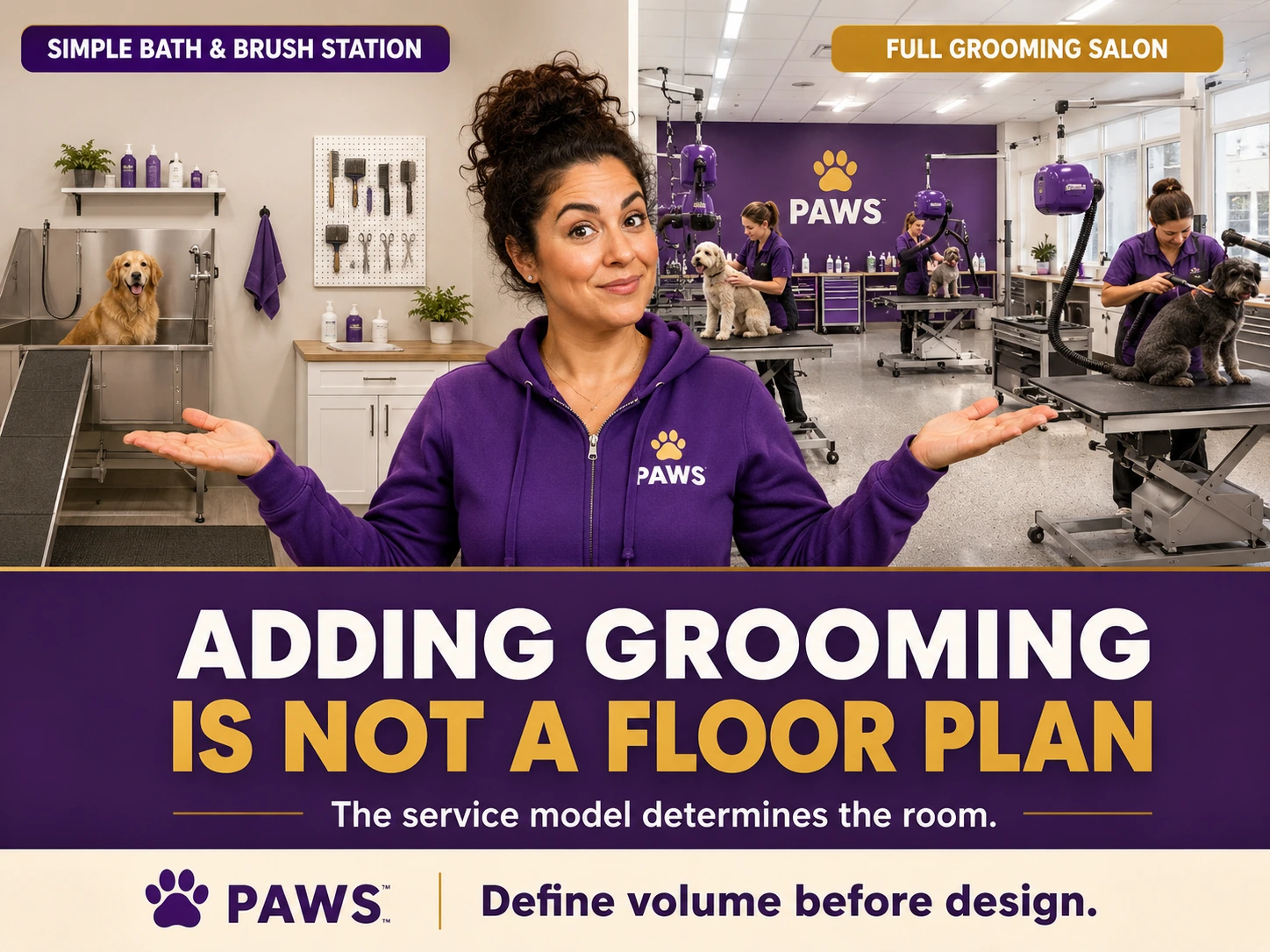
A daycare offering departure baths and nail trims does not need the same production setup as a public salon running complete haircuts all day. One groomer working alone does not need the same table clearance, dryer capacity, storage, or dog holding as three groomers working beside one another.
Decide what the business will sell before deciding what the room needs. Otherwise, the room will be built around a vague idea and every missing requirement will show up after opening.
Translate the service menu into a peak-hour production model. Estimate how many dogs may be bathing, drying, receiving table work, and waiting at the same time instead of designing around the average number of appointments.
The model should include appointment length, coat type, dog size, bather support, late pickup, no-shows, rework, and the overlap created when one dog takes longer than expected. Those conditions determine the room more accurately than the phrase full-service grooming.
| Grooming Model | What It Usually Includes | What the Room Must Handle |
|---|---|---|
| Bath-and-Brush | Bathing, brushing, blow-drying, ears, nails, and basic cleanup | Heavy water use, drying, loose hair, humidity, wet towels, and safe holding even without full haircuts |
| Daycare and Boarding Add-Ons | Departure baths, nail trims, brush-outs, de-shedding, and quick cleanup services | Scheduling around pickup times so every dog is not suddenly due at the end of the day |
| Full-Service Grooming | Haircuts, shave-downs, scissoring, clipping, coat work, and full appointments | Table space, good lighting, blades, clippers, shears, sanitation, drying, storage, and uninterrupted work time |
| Multi-Groomer Salon | Several dogs and several groomers working at the same time | More circuits, dryers, hot water, holding, table clearance, laundry, storage, and room to move safely |
| Cat Grooming | Bathing, clipping, brushing, nails, coat work, and specialty handling | Experienced handling, escape control, quieter conditions, and separation from barking dogs and heavy traffic |
Do not design the room around the word “groomer.” Design it around how many animals will be inside, how long they stay, what is being done to them, what equipment is running, and where each dog goes next.
🐾
Walk One Dog Through the Room Before You Build Anything
If you cannot explain the dog’s path from arrival to pickup without hand waving, the room is not planned yet.
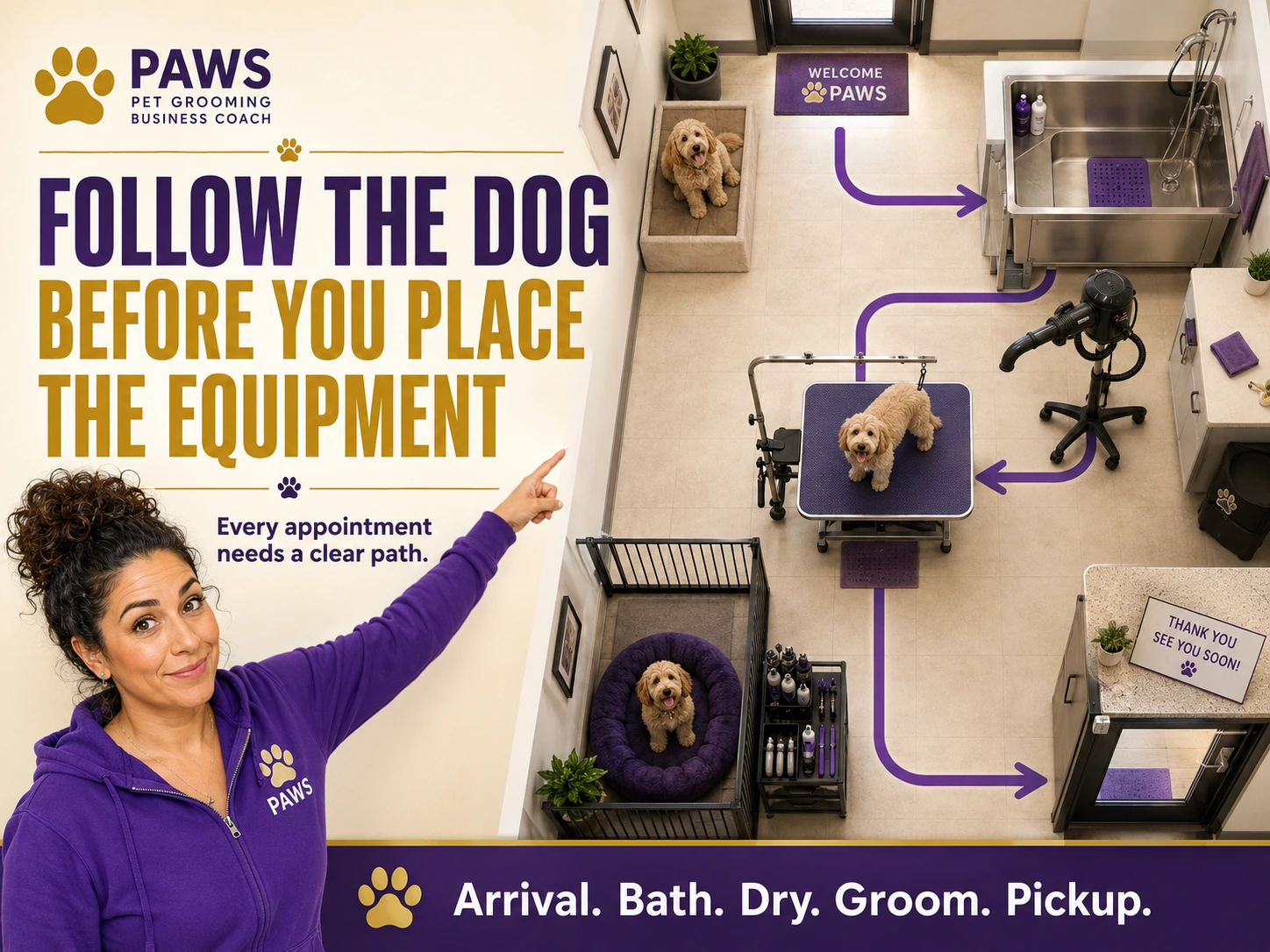
Stand in the proposed room and mentally walk one real dog through the entire appointment. Do not begin with the equipment. Begin with the dog.
The dog arrives on a leash. Where does it wait if the groomer is finishing another appointment? How does the dog reach the tub? Can a large dog turn around without hitting a table or cabinet? Where does the wet dog go next? Where is the dryer? Where are the towels? Where does the dog wait after it is clean?
Now walk the employee through the same appointment. Where does the groomer put the leash? Where are the shampoos? Where are clean towels? Where do dirty towels go? Where are blades and brushes? Where is hair collected? Where does the groomer stand while drying? Can another employee pass behind the table?
Draw the path on a floor plan and mark every crossing between wet dogs, finished dogs, employees, customers, cords, towels, tools, laundry, trash, and loose hair. A simple spaghetti diagram often reveals congestion that is invisible on a clean architectural drawing.
Test the route with realistic dog sizes and handling conditions. A path that works for a calm twenty-pound dog may fail when an employee is guiding a wet ninety-pound dog that stops, shakes, backs up, or needs two-person assistance.
| Stage | Operator Question | Failure You Are Trying to Prevent |
|---|---|---|
| Arrival | Where does the dog wait if the groomer is not immediately ready? | Dogs tied to counters, standing in walkways, or mixing with unfamiliar dogs |
| Bathing | Can the dog reach the tub without crossing equipment or public traffic? | Wet floors, leash tangles, employee lifting, and dogs squeezing through clutter |
| Drying | Can the dog be dried without blocking the center of the room? | Cords in walkways, hair blowing through clean areas, and dryers becoming obstacles |
| Table Work | Can the groomer move around the whole dog without hitting walls or another table? | Twisting, reaching, poor control, unfinished work, and employee fatigue |
| Finished Holding | Where does the clean dog wait without getting wet, hairy, or worked up again? | Re-cleaning dogs that were already finished |
| Pickup | Can the dog leave without being dragged back through active work? | Loose hair, dirty paws, wet floors, and chaotic handoffs |
👀
The Grooming Room Should Be Visible but Not Accessible
Customers should be able to see a clean professional operation without being able to walk into it.
Customers do not want to imagine their dog disappearing into some hidden dungeon within the bowels of the facility. They want to see where the dog is going. They want to see clean floors, organized tools, professional equipment, attentive employees, and dogs being handled calmly.
That visibility answers questions before the customer asks them. It cuts down on tours, explanations, hesitation, and the uneasy feeling that something is happening out of sight.
The customer should not, however, be able to open the grooming-room door and wander inside. An active salon may contain unfamiliar dogs, clippers, shears, cords, wet floors, dryers, tables, and employees trying to control moving animals.
A viewing window, controlled opening, half-wall, counter, or properly placed interior glass can provide transparency without turning the salon into a customer walkway.
Visibility should be designed with sound, dog behavior, glare, privacy, and employee concentration in mind. A large clear window may build trust, but it can also create repeated owner interruptions or cause some dogs to react when they see people moving outside the room.
The operating policy should identify where customers may stand, how tours are handled, when visual access is limited, and who may open the salon door. Transparency works best when access remains controlled.
🪟
Let Them See It
Customers should be able to look in and understand that the room is clean, bright, organized, and professionally operated.
🚫
Do Not Let Them Enter It
A distracted dog can move suddenly. A distracted groomer holding sharp tools is not the customer experience anyone wants.
🧼
Keep What They See Clean
Visibility only helps when the visible room is organized. A glass wall showing clutter and hair does not build trust.
⚠️
What a Poorly Planned Grooming Room Looks Like in Real Life
The problems do not arrive as one dramatic disaster. They show up as dozens of small delays that happen every day.

A dog is in the tub and the clean towels are on the other side of the room. The groomer drips water across the floor to get them. Another employee steps around the wet spot while carrying a dog.
A high-velocity dryer is sitting in the only open walkway because there was no wall space left for it. The hose stretches across the room. The power cord shares a circuit with another dryer. The breaker trips.
A clean dog is finished but there is nowhere clean to put it. The dog goes back beside the drying area, where loose hair lands on the finished coat and the groomer has to touch the dog up again.
Shampoo gallons are stored on the floor because no cabinet was planned. Dirty towels pile beside clean towels. Hair reaches the HVAC return. Clippers and blades from two groomers are mixed together because there is no assigned station storage.
None of those problems sounds large by itself. Put them together for six or eight appointments, five or six days a week, and the room starts stealing labor from the business.
A motion and delay audit should record where employees wait, search, walk, repeat work, move equipment, untangle cords, or clean the same area twice. Multiplying those minutes by appointments and payroll turns small irritations into a measurable design cost.
Correct the highest-frequency failures first. Moving a towel shelf, adding station storage, separating clean and dirty flow, or relocating one dryer may save more labor than buying another piece of grooming equipment.
⏱️
Small Delays Multiply
One extra trip for towels is nothing. Repeating that trip for every dog, every day, is labor the customer never pays for.
🧽
Rework Eats Production
If a finished dog gets wet or hairy again because holding was not planned, the employee performs work twice.
📆
The Schedule Slides
Hot-water delays, tripped breakers, missing tools, blocked walkways, and tours all push later appointments backward.
🧭
Give Every Part of the Grooming Process a Place
When a task has no assigned place, it ends up in the walkway, on the floor, on another groomer’s table, or wherever somebody can temporarily fit it.
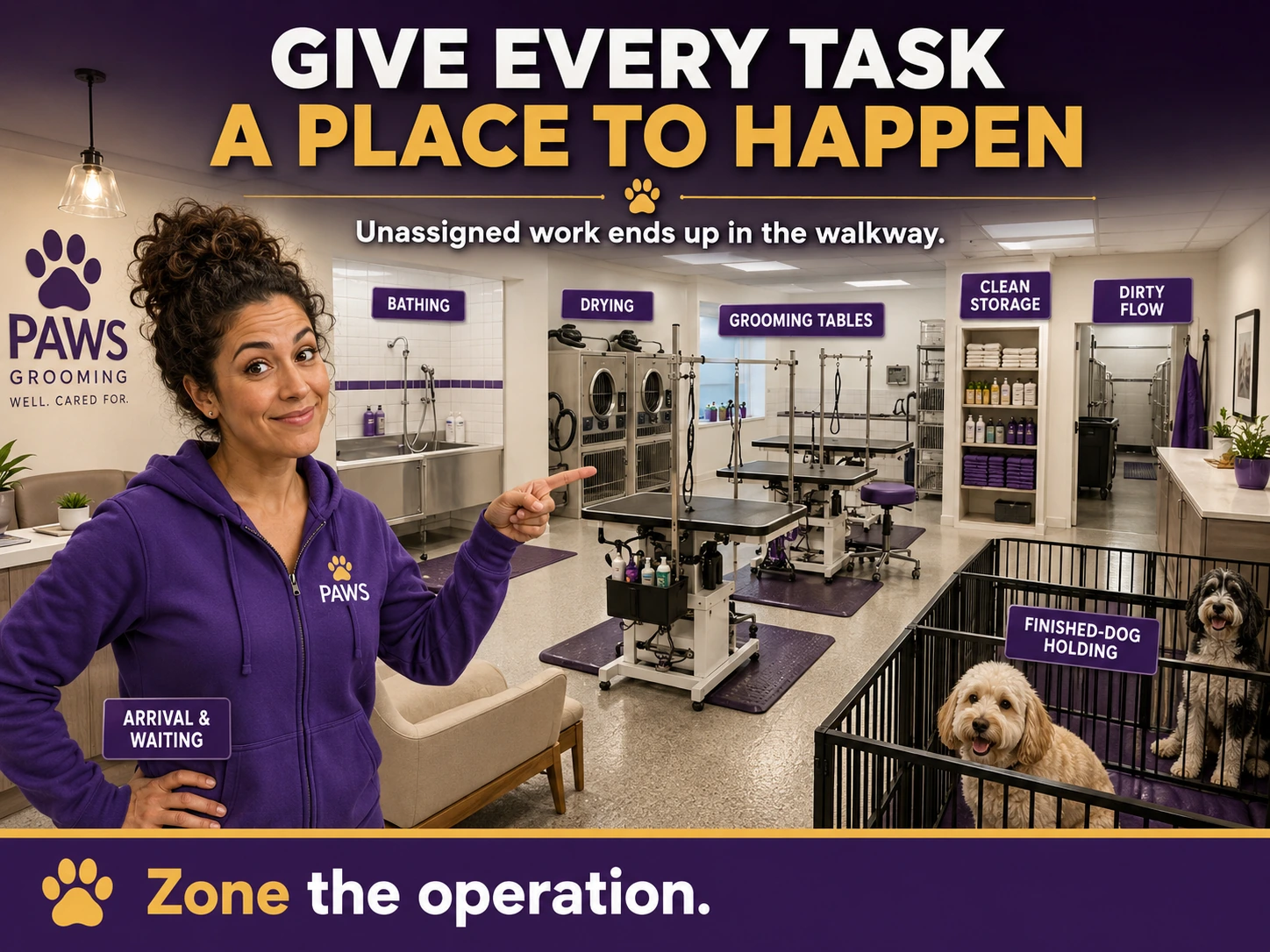
A production salon needs separate locations for dogs, people, tools, clean materials, dirty materials, water, air, and finished work.
Assigning each task a zone reduces crossings, protects completed dogs from rework, and gives staff a repeatable way to reset the room.
| Work Zone | What Belongs There | What Goes Wrong Without It |
|---|---|---|
| Arrival and Waiting | Leashes, service confirmation, controlled dog holding, and appointment staging | Dogs stand in walkways, crowd the front desk, or mix with dogs they do not know |
| Bathing | Tub, hot water, shampoo, spray control, drainage, towels, and nonslip footing | Water travels, supplies are out of reach, and the groomer leaves the dog to retrieve items |
| Drying | Dryers, hoses, cords, ventilation, hair control, and safe dog restraint | Dryers block traffic, cords become trip hazards, and hair blows through the salon |
| Grooming Tables | Table clearance, lighting, arms, restraints, clippers, blades, shears, brushes, and combs | Groomers twist, reach, bump walls, share tools, and work around each other |
| Clean Storage | Clean towels, sanitized tools, shampoos, blades, and supplies | Clean materials mix with hair, wet towels, used tools, and floor storage |
| Dirty Flow | Wet towels, hair, trash, used tools, laundry, and cleaning supplies | Dirty materials travel back through clean work and pile wherever space is available |
| Finished-Dog Holding | Clean, dry, calm holding away from active bathing and loose hair | Finished dogs need to be brushed, dried, or cleaned again before pickup |
🔧
Plan Utilities From the Equipment List, Not From the Empty Room
A sink and several outlets do not mean a room is ready for grooming.

List the actual equipment that will be used. Include dryers, electric tables, clippers, lighting, washer, dryer, water heater, tub, circulation equipment, and anything else that will run during the same part of the day.
Then plan electrical service, water, drainage, ventilation, and room surfaces around that real list. Do not assume the contractor understands the production schedule unless somebody explains it.
Give the electrician, plumber, HVAC contractor, and builder the actual equipment schedule, manufacturer requirements, simultaneous-use assumptions, and future expansion plan. A generic request for extra outlets or good ventilation is not a load calculation.
Commission the room before opening. Run the dryers, table, lighting, laundry, water heater, and other expected equipment together; confirm hot-water recovery; inspect drainage; measure heat and humidity; and correct failures before a full appointment schedule depends on the system.
| Building Need | What to Confirm | Operator Consequence if It Is Wrong |
|---|---|---|
| Hot Water | Capacity, recovery time, tub demand, line size, and other building use | The groomer waits for water temperature while the appointment schedule keeps moving |
| Drainage | Tub drain, hair capture, clean-outs, floor cleaning, and maintenance access | Slow drains, clogs, standing water, odor, and plumbing calls |
| Electrical Capacity | What equipment can run at the same time and which circuits serve it | Breakers trip during drying and the employee works around the building instead of producing |
| Ventilation | Heat, moisture, dryer exhaust, odor, and hair movement | The room becomes hot, damp, loud, uncomfortable, and harder to keep clean |
| Lighting | Clear lighting around tubs and every side of the grooming table | The groomer struggles to see skin, nails, ears, blade lines, and finish work |
| Walls and Floors | Water resistance, nonslip footing, cleanable corners, durable trim, and protected edges | Water damage, odor retention, peeling finishes, swollen trim, and sanitation problems |
🚶
Stop Making the Groomer Walk for Everything
Economy of motion is not a fancy design phrase. It is the difference between producing and wandering around the room.

Put the things used during bathing near the tub. Put the things used during table work near the table. Put dirty towels where they can leave the room without crossing clean towel storage.
Watch how often the employee turns, bends, reaches, crosses the room, opens a cabinet, steps around a dryer, or puts the dog down to retrieve something.
A groomer who walks across the room for towels, shampoo, blades, cleaning spray, restraints, or brushes several times during every appointment is performing unpaid movement.
Perform a timed motion study using a complete appointment. Record every step away from the dog, every bend or reach, every cabinet opening, every tool search, and every time an employee moves equipment to access something else.
High-use items should have assigned locations within the work zone where they are used. Backup inventory can live elsewhere, but the groomer should not leave the dog repeatedly for ordinary towels, shampoo, restraints, blades, brushes, cleaning spray, or nail supplies.
🛁
Bathing Supplies at the Tub
Shampoo, conditioner, towels, ear supplies, restraints, and cleaning products should be reachable without leaving the dog.
✂️
Table Tools at the Table
Clippers, blades, shears, combs, brushes, nail tools, and sanitation supplies need assigned station storage.
🧺
Laundry Has a Direction
Clean towels should enter clean. Wet towels should leave without being stacked beside them or dragged through the salon.
📈
Do Not Let a One-Groomer Room Become a One-Groomer Business
If grooming succeeds, the room should not be the thing that stops it from growing.
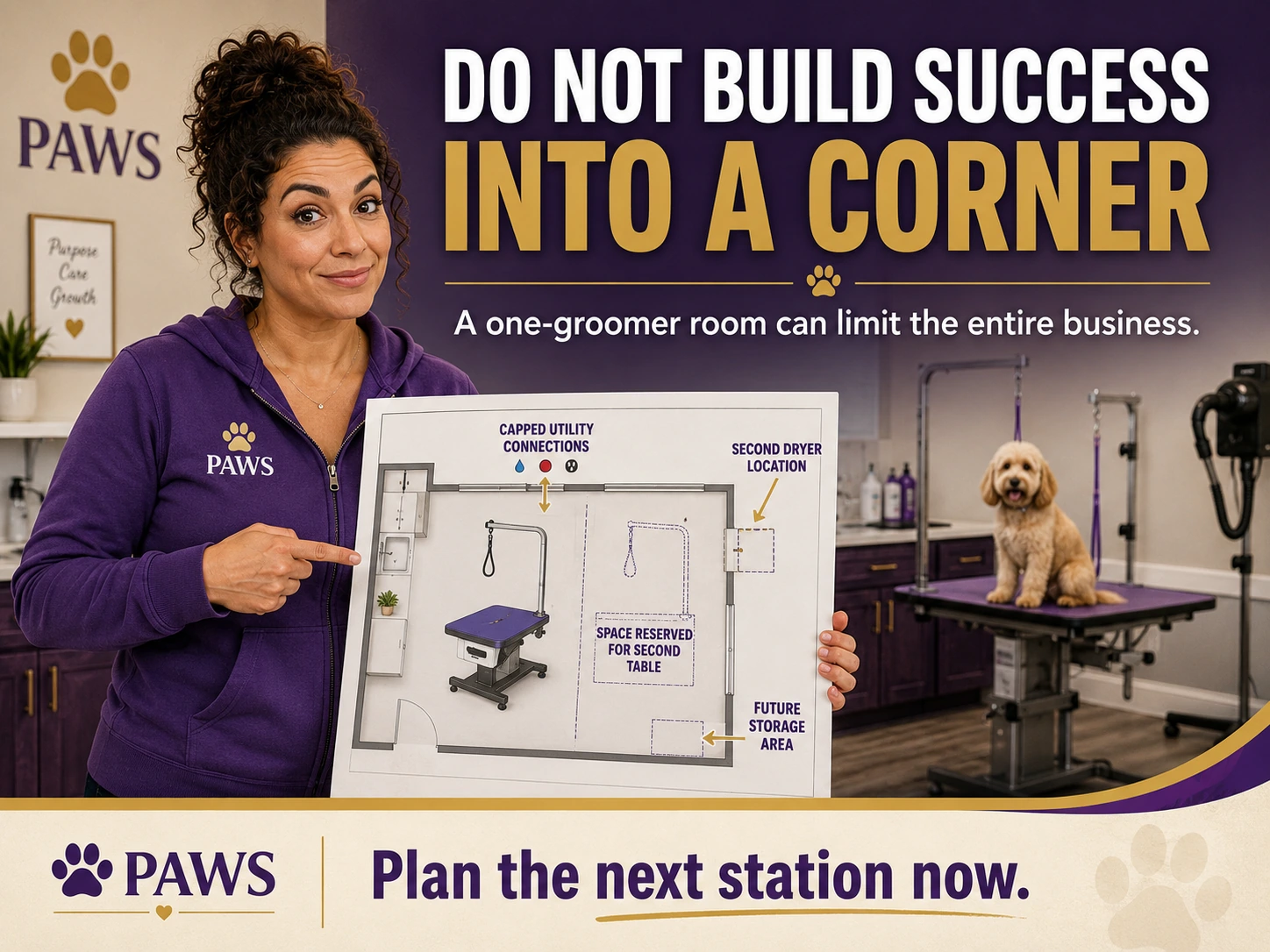
A second groomer needs more than an empty corner and another table. The room may need another dryer, more electrical capacity, more storage, more clean towels, more dirty-towel handling, more hot water, more dog holding, and enough room for two people to move safely.
If every wall is full and every walkway is already tight on opening day, growth will require moving equipment, cutting walls, relocating outlets, or rebuilding the salon while it is operating.
A little unused space at opening is cheaper than tearing the room apart later.
Future capacity should be reserved in utilities as well as floor area. Capped plumbing, electrical capacity, ventilation allowance, wall reinforcement, table clearance, storage, and dryer placement are easier to plan before finished surfaces and active appointments occupy the room.
Define the expansion trigger in advance. A sustained booking backlog, lost appointments, excessive overtime, or repeated inability to accept profitable services should lead to a planned second station—not a table squeezed into the last remaining walkway.
- Reserve space for another grooming table.
- Plan where a second dryer could operate without blocking traffic.
- Provide enough electrical capacity for future equipment.
- Leave storage for another employee’s tools and supplies.
- Confirm that the tub and hot water can support more appointments.
- Increase dog holding without stacking finished and unfinished dogs together.
- Leave enough room for employees to pass safely around dogs and tables.
✅
Grooming Salon Location and Layout Checklist
Before construction begins, these answers should be clear enough to explain to a contractor, electrician, plumber, groomer, and employee.
- What services will actually be offered?
- How many dogs may be inside the salon at one time?
- How many groomers must the room support now?
- Can another groomer be added later?
- Where does an arriving dog wait?
- Can customers see the salon without entering it?
- How does a dog move from holding to tub to dryer to table?
- Where does a clean finished dog wait?
- Where are clean towels stored?
- Where do wet and dirty towels go?
- Where is loose hair collected?
- Can the water heater support the actual bathing schedule?
- Can the electrical system run the equipment that will operate at the same time?
- Can dryer heat and humidity leave the room?
- Will dryer noise interfere with daycare, boarding, the lobby, offices, or neighboring businesses?
- Can the groomer reach high-use tools without leaving the dog?
- Are floors, walls, corners, and trim built to tolerate constant wet cleaning?
- Can wet dogs move without crossing clean customer areas?
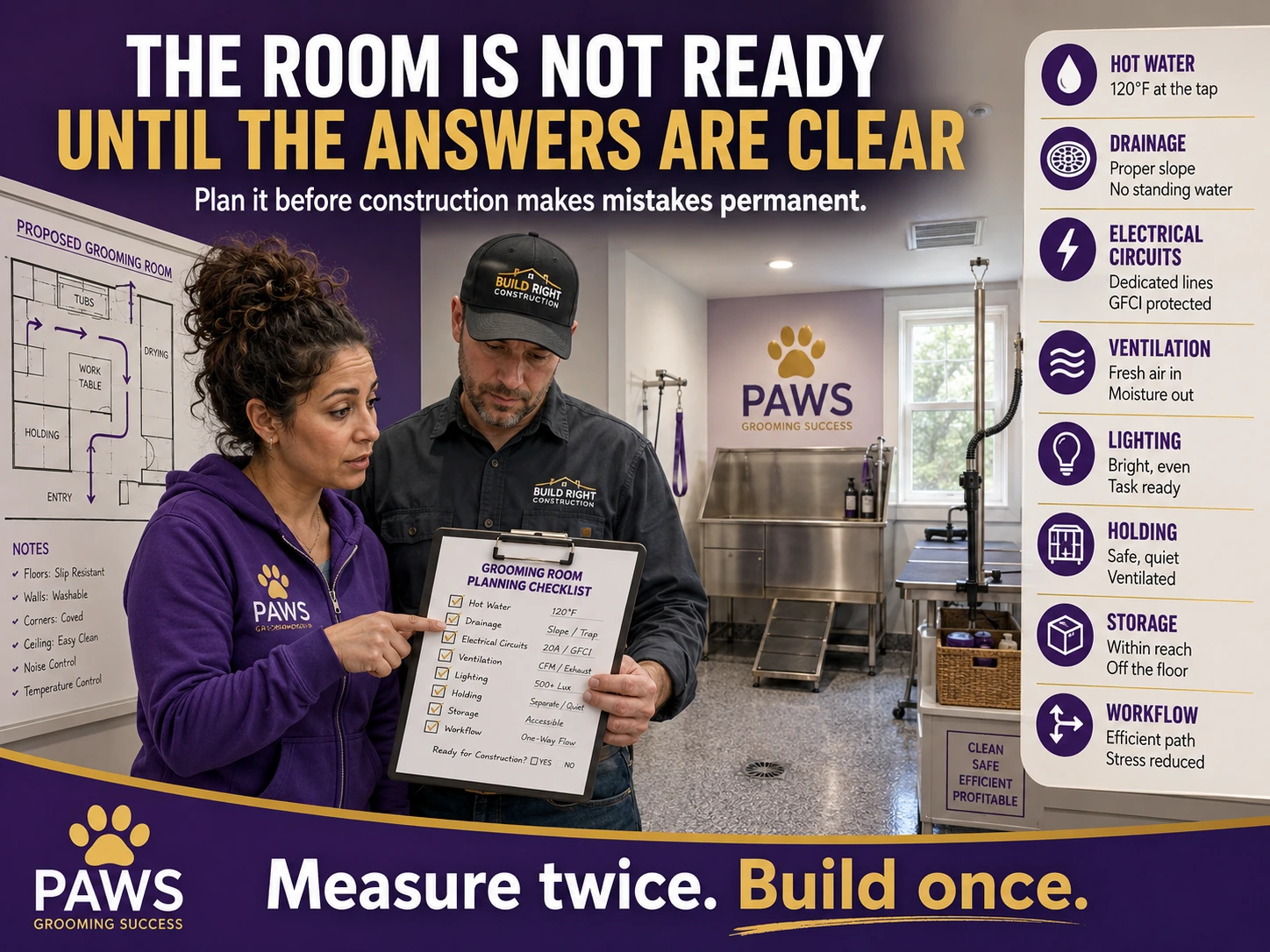
If several of these answers are still unknown, the room is not ready to be built. That does not mean grooming is a bad addition. It means the expensive decisions have not been made yet.
The checklist should produce contractor-ready answers, equipment specifications, utility loads, dimensions, and operating assumptions. A yes-or-no response without measurements or supporting information is not enough to build from.
Before construction begins, have the proposed workflow reviewed by the people who will bathe, dry, groom, clean, hold dogs, manage pickup, and maintain the building. Each role sees failures that a floor plan alone may miss.
❓
Dog Grooming Salon Planning FAQ
Detailed answers about salon size, service models, dog flow, customer visibility, finished-dog holding, dryers, hot water, drainage, electrical capacity, ventilation, clean and dirty flow, economy of motion, expansion, commissioning, and pre-construction review.
Should customers be able to see the grooming salon?
Yes, when the building can provide a controlled view without allowing customers into the active work area. Visibility can reassure owners that the salon is clean, organized, bright, professionally equipped, and staffed by people handling dogs calmly.
The design should also consider noise, glare, privacy, dog reactions, and employee concentration. A window, interior glass, half-wall, or controlled opening is usually safer than an unrestricted doorway.
Can grooming be added to any daycare or boarding facility?
No. The building must support water demand, hot-water recovery, drainage, electrical loads, ventilation, humidity, sound, laundry, storage, safe dog holding, cleanable finishes, and a workable route from arrival through pickup.
A location may technically fit a tub and table while still requiring expensive utility upgrades or creating daily workflow problems. Complete building due diligence and price the improvements before committing to the service.
How large should a grooming salon be?
There is no useful universal square-foot number without knowing the service model. The room must be sized around the number of groomers, tables, tubs, dryers, dogs in process, holding spaces, storage, walkways, laundry flow, and planned expansion.
Test the layout at peak overlap rather than average volume. The room should still function when one dog is bathing, another is drying, another is on a table, finished dogs are waiting, and employees need to pass safely.
How should the grooming service model affect the room?
A bath-and-brush program, daycare departure-bath operation, full-service salon, multi-groomer salon, and cat-grooming service create different appointment lengths, equipment needs, handling conditions, and dog-holding pressure.
Define the services, daily volume, dog sizes, coat types, staffing, appointment overlap, and pickup pattern before equipment placement. Designing around the word grooming leaves too many operational requirements undefined.
Why should the dog’s path be planned before equipment placement?
The dog must move safely from arrival to holding, bathing, drying, table work, finished holding, and pickup. Equipment placed first can create wet crossings, tight turns, cord hazards, contact with unfamiliar dogs, and repeated travel through public or clean areas.
Walk the route with realistic dog sizes and handling problems. A wet large dog that stops or backs up needs more clearance than a calm small dog shown on a floor plan.
Why does finished-dog holding matter?
A finished dog represents completed paid work. Placing that dog near wet dogs, active dryers, loose hair, dirty floors, or unfinished animals can create rework and delay pickup.
Finished holding should be clean, dry, calm, controlled, and located on a direct path to customer handoff. The business should not pay an employee to brush, dry, or clean the same dog twice.
Why are dryers such a major planning issue?
High-velocity and stand dryers create electrical demand, heat, humidity, noise, airflow, loose hair, hoses, cords, and traffic. Their placement affects the entire room, not only the dog being dried.
Plan dedicated locations, circuits, ventilation, hose reach, restraint, maintenance access, and simultaneous use. A dryer placed in leftover space often becomes a bottleneck or trip hazard.
How should electrical capacity be planned?
Create an equipment schedule that identifies dryers, electric tables, clippers, lighting, laundry, water heating, ventilation, and every device that may operate during the same period. Give the schedule and manufacturer requirements to a qualified electrician.
Do not count outlets and assume capacity. The system must support simultaneous loads, appropriate circuit protection, safe cord management, future expansion, and the actual production schedule without repeated breaker trips.
How much hot water does the salon need?
The answer depends on tub volume, dog size, bath duration, appointment overlap, incoming water temperature, heater capacity, recovery rate, line size, and other building uses. A residential assumption may not support commercial bathing demand.
Model the busiest bathing period and test recovery before opening. Running out of hot water delays the current dog and every appointment scheduled behind it.
What drainage features should be planned?
Confirm tub drainage, line capacity, hair capture, traps, clean-outs, floor-cleaning needs, access for maintenance, and how water is contained around the bathing zone. The exact solution depends on the building and local requirements.
Poor drainage creates standing water, clogs, odor, sanitation problems, employee slip risk, and emergency plumbing calls. Hair control and maintenance access should be designed before walls and equipment block the route.
How should ventilation and humidity be handled?
Bathing and drying release moisture, heat, odor, and airborne hair. The salon needs a ventilation plan that addresses room comfort, surface drying, equipment heat, exhaust or air exchange, and the effect on neighboring daycare, boarding, lobby, or office areas.
The system should be evaluated under full operating conditions, not in an empty room. Run the expected equipment and measure whether heat and humidity accumulate during consecutive appointments.
What flooring and wall finishes work best?
Surfaces should tolerate frequent wet cleaning, resist water intrusion, provide nonslip footing, and minimize seams, corners, trim details, or porous materials that hold hair, moisture, and odor.
The final selection should account for chemical compatibility, durability, slope, transitions, wall protection, base details, and maintenance procedures. A finish that looks attractive but fails under commercial cleaning is not economical.
Should the salon be located near the lobby?
It should be visible enough to build trust and convenient enough for controlled arrival and pickup, but separated enough to protect employee concentration, dogs, sound control, and access. The best location depends on the rest of the building’s flow.
A controlled line of sight is often better than an open connection. Customers should not cross wet work, enter the salon, or interrupt employees handling dogs and sharp tools.
How can a hidden salon reduce revenue?
When customers cannot see the room, staff may have to stop production for tours and explanations. Some customers may still leave because they are uncomfortable reserving a grooming appointment in a space they cannot evaluate.
Track tour interruptions and lost appointments. When physical visibility is impossible, use scheduled tours, current photographs, video, posted standards, and a consistent explanation rather than interrupting active appointments repeatedly.
How should clean and dirty flow be separated?
Clean towels, sanitized tools, shampoos, and finished dogs should not share the same route or storage with wet towels, used tools, loose hair, trash, and cleaning waste. Each stream needs an assigned destination.
The layout should allow dirty materials to leave without crossing clean storage or completed work. Separation reduces contamination, clutter, searching, and the re-cleaning of items or dogs.
How can economy of motion be measured?
Observe and time a complete appointment. Record every step away from the dog, reach, bend, cabinet opening, tool search, blocked turn, equipment move, and repeated trip for towels, shampoo, blades, brushes, restraints, or cleaning supplies.
Multiply the unnecessary minutes by daily appointments and labor cost. That calculation reveals why moving one shelf or adding station storage can produce a larger return than buying more equipment.
How should a salon plan for a second groomer?
Reserve more than floor space. A second groomer may require another table, dryer position, circuits, hot-water capacity, ventilation, storage, laundry handling, dog holding, lighting, and enough clearance for two employees to move around dogs safely.
Plan utility rough-ins and expansion space before the room is finished. Growth is far less disruptive when the next station does not require cutting walls or rebuilding the salon during active appointments.
What should be tested before the salon opens?
Run the equipment expected during the busiest hour, confirm breaker performance, test hot-water recovery, inspect drainage, operate laundry, assess ventilation, measure heat and humidity, verify lighting, and walk dogs through every production stage.
The commissioning test should also include cleaning, towel flow, tool storage, finished holding, emergency access, and customer pickup. Correct failures before the appointment book depends on the room.
Who should review the salon plan before construction?
The owner, groomer, bather, front-desk staff, cleaner, maintenance representative, contractor, electrician, plumber, HVAC professional, and other qualified specialists should review the parts of the plan they will build or operate.
Each role sees different failures. Groomers notice reach and table clearance, cleaners notice surfaces and dirty flow, front-desk staff notice arrival and pickup conflicts, and contractors identify utility or constructability issues.
What is the biggest grooming-salon planning mistake?
The biggest mistake is treating grooming as equipment placed inside an available room instead of a production system. The room must support animals, employees, water, power, air, hair, tools, cleaning, holding, customers, scheduling, and future growth together.
A good plan follows the dog, defines the service model, zones the work, calculates utilities, reduces repeated motion, protects finished dogs, controls customer access, and tests the room before opening.
🧭
Continue Planning the Grooming Operation
Once the room location is selected, the next step is refining production, noise control, equipment placement, and employee movement.
The next planning documents should stay connected. Production targets influence equipment count, equipment affects utilities and noise, utilities affect location cost, and layout affects how many appointments the team can actually complete.
Use the completed salon plan as an operating baseline after opening. Compare actual walking, delays, hot-water recovery, breaker performance, holding pressure, laundry volume, and appointment throughput with the assumptions used during design.
💵
Grooming Time and Money
Understand how appointment time, labor, pricing, production, and empty slots affect grooming revenue.
🔊
Noise and Fatigue
Plan around dryer noise, standing, lifting, repetitive movement, heat, and physical exhaustion.
🚶
Economy of Motion
Stop wasting payroll on repeated walking, reaching, searching, and moving around poorly placed equipment.
📐
Salon Design Examples
See how room and equipment placement affects actual grooming production.
🛁
Grooming Tools and Equipment
Work through the tubs, tables, dryers, restraints, tools, storage, and equipment used inside the salon.