Grooming Business • Room Placement • Daycare Noise • Customer Tours • Barking • Groomer Fatigue • Facility Design
Grooming Room Noise: Barking, Bad First Impressions, and Groomer Fatigue
The last grooming layout problem was wasted motion. Put the grooming room too far away and your groomer spends the day walking to the front, stopping work, securing dogs, talking to customers, walking back, and restarting the same dog over and over again.
The next problem is noise.
A grooming room can be in the wrong location for more than one reason. It can be too far from the lobby and create wasted motion. It can also be too close to the daycare play areas and create a barking, echoing, nerve-grinding mess that makes customers nervous, grooming dogs harder to handle, and groomers miserable.
Grooming does not belong inside the loudest part of the building just because that is where you found plumbing, electrical, or a couple of spare boarding suites to convert after the fact. That may look convenient on a floor plan, but in daily operation it can turn the grooming room into a barking blender.
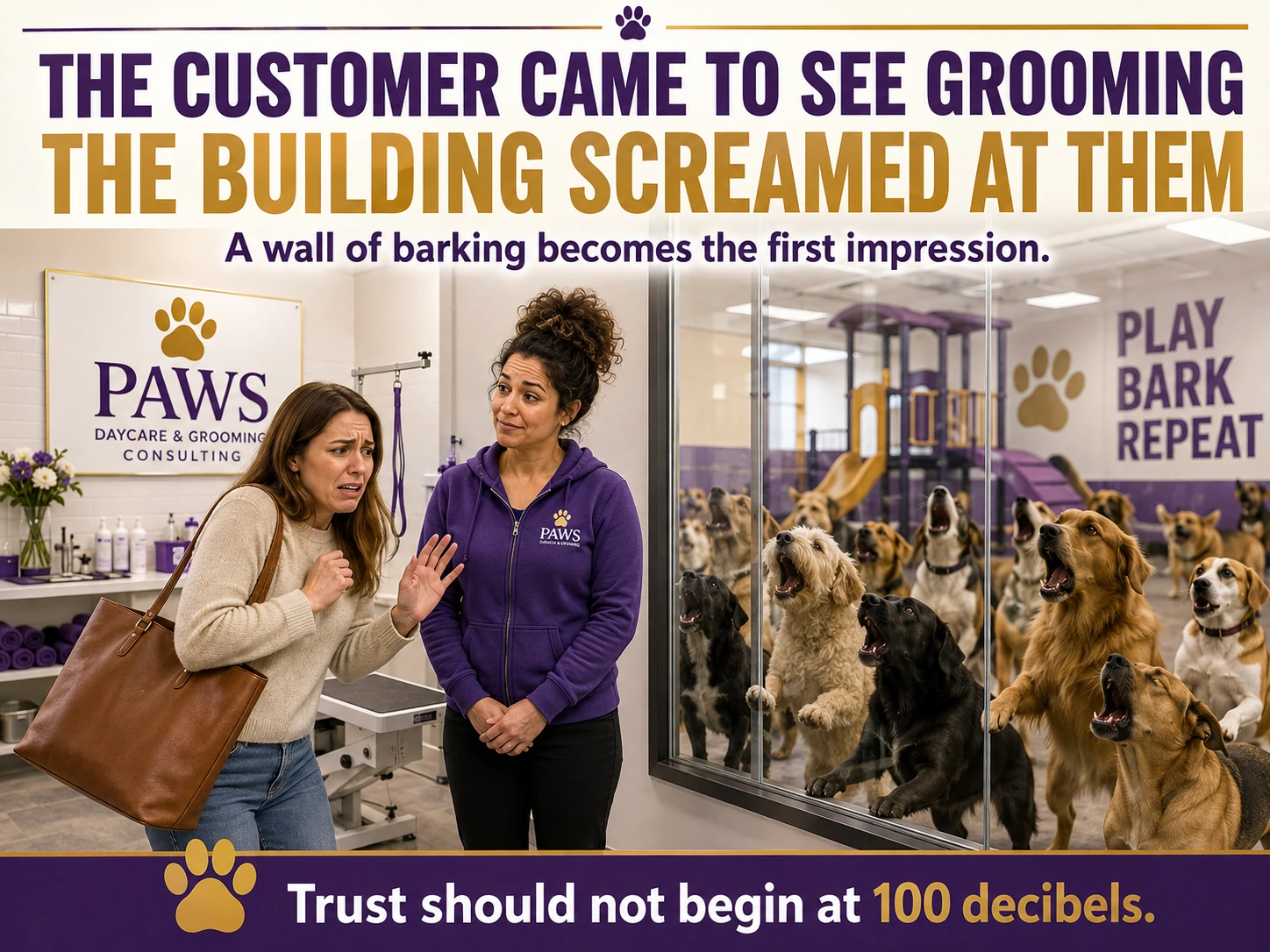
The customer came in to see a clean grooming room. Instead, the building introduced itself by screaming at them.
⚠️
Operator rule
Do not solve the walking problem by creating a barking problem. Grooming needs customer access, but it also needs sound control.
🗺️
Use This Page Like a Grooming Noise Placement Map
This page explains why grooming near daycare play areas can damage customer trust, dog behavior, staff focus, and grooming quality.
👀
Bad First Impression
A customer sees grooming for the first time while daycare dogs bark like the building is being invaded.
📣
Why Daycare Dogs Explode
Unfamiliar faces near play areas can create excitement, territorial barking, and a bad tour experience.
🔊
Noise Table
Dog noise is not just “dogs being dogs.” It can be loud enough to matter.
🐩
Grooming Dogs React
A dog being groomed does not need daycare chaos as background music while sharp tools are near its face.
🏗️
Noise Is a Layout Problem
Grooming needs customer access, but not at the price of sitting beside a playroom alarm system.
🛠️
What Actually Helps
Solid design helps. Thin walls, bad doors, and “the groomer will get used to it” do not.
⚖️
The Design Balance
Close enough for consults. Far enough from daycare chaos. That is the balancing act.
✅
Noise Checklist
Questions to ask before deciding the grooming room belongs beside the play areas.
❓
FAQ
Grooming noise, barking, customer tours, dog stress, groomer fatigue, and sound control.
👀
The Customer’s First Impression Should Not Be 100 Decibels of Barking
A customer touring the grooming area should not feel like their dog is being checked into the boiler room of a WWII battleship.

Another problem that tends to accompany a grooming room in the rear of the building, or anywhere near the play areas, is that the dogs participating in daycare may become extremely excited, territorial, or both when presented with an unfamiliar face.
In either instance, they often react by getting extremely loud.
That tends to leave a bad impression with a potential customer. Their first viewing of your grooming area comes complete with barking dogs, echoing rooms, excited playgroups, and enough noise to make them wonder whether their poor dog will be enduring that level of racket for the duration of the groom.
The customer may not understand the difference between the playroom and the grooming room. They may not understand that the barking started because a stranger appeared near a group of daycare dogs. They may not understand that their dog will not necessarily be sitting in the middle of that exact chaos all day.
They only know what they just experienced.
They came in looking for clean, safe, professional grooming. The building answered with a wall of barking. That is not the customer confidence tour you were hoping for.
The front desk should never promise an immediate walk-through before confirming that the route is safe and the playgroup is settled enough to avoid turning the tour into a barking demonstration. A professional delay is better than escorting a nervous customer into the exact conditions that make the business look uncontrolled.
Customer perception should also be documented as an operating issue, not dismissed as somebody being too sensitive. When several prospects react to the same noise, hesitate during the tour, or ask whether their dog will be exposed to that sound all day, the building is giving management useful feedback about placement and access.
📌
Operator translation
A grooming tour should build trust. If the tour route sets off the playroom and makes the business sound like a dog riot in a metal shed, the layout is working against you.
📣
Why Daycare Dogs Blow Up When a Stranger Appears
A playgroup is already full of motion, sound, excitement, and social pressure. Add an unfamiliar face near their space and the room may decide to announce it.

Daycare dogs are not sitting in a library reading tax law. They are moving, watching gates, reacting to staff, reacting to each other, watching doorways, noticing sounds, and responding to anything new that appears near their space.
When a customer walks back during a tour, the dogs may see a stranger near the play area, near the gate, near the fence line, or near a transition path. Some dogs get excited. Some dogs get territorial. Some dogs bark because another dog barked. Some dogs bark because barking feels like the official group announcement that something just happened.
That is not the atmosphere you want surrounding your grooming room.
The grooming room should not be introduced to customers through a tunnel of barking dogs. Even if the grooming room itself is clean and professional, the customer may leave with the emotional impression that grooming in your facility is loud, chaotic, stressful, and poorly separated from the daycare herd.
Tour routes should be planned with the assumption that at least some dogs will react to an unfamiliar person. That means keeping visitors away from gates, fence pressure, transfer lanes, and large viewing panels that invite the entire group to rush forward and announce the stranger.
When the group does react, staff should not try to overpower the noise by shouting explanations while continuing the tour. Stop, create distance, let the dogs settle, and move the customer to a quieter point where the facility can explain what happened without rewarding chaos with a longer audience.
Swipe left/right to see the full table.
| Trigger | What Dogs May Do | What Customer Thinks |
|---|---|---|
| Unfamiliar person near play area | Bark, rush gates, crowd windows, jump, stare, or pace. | “Is my dog going to be surrounded by this noise?” |
| Tour passing near dog movement route | Dogs react to the movement and the change in routine. | “This place seems chaotic.” |
| Grooming room beside playroom | Play barking bleeds into the grooming space. | “My dog will be groomed in a loud room.” |
| Hard surfaces and echo | Noise bounces and feels bigger than the actual number of dogs. | “This sounds worse than I expected.” |
| No controlled viewing path | Staff improvise tours through working dog areas. | “They do not seem organized.” |
🔊
Noise Comparison Table: Dog Barking Is Not Background Music
The exact number depends on distance, room shape, surfaces, number of dogs, and how the sound is measured. The business lesson does not change: loud dog noise can be loud enough to matter.
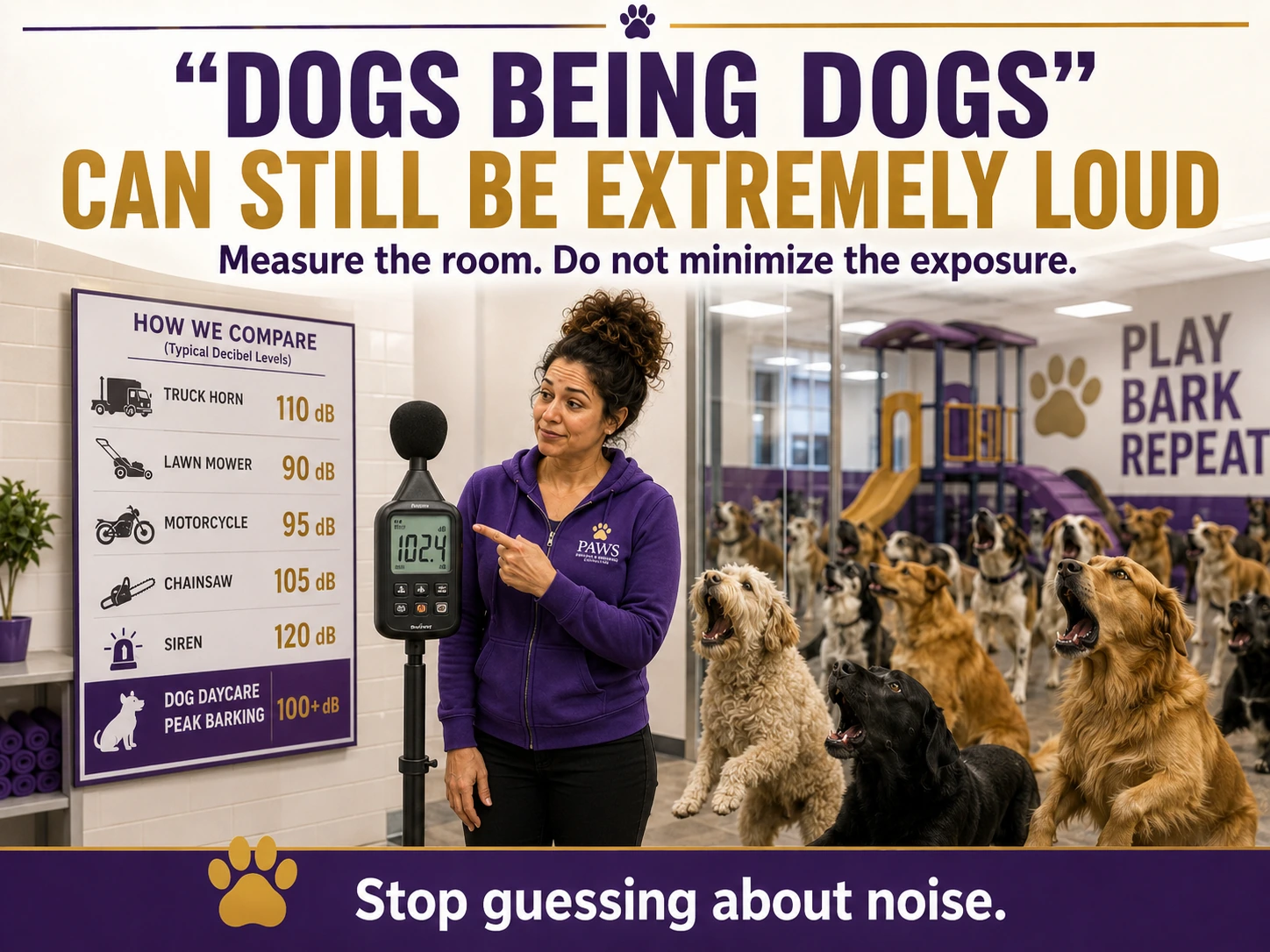
People hear “barking dogs” and sometimes file it away as normal pet business noise. That is a mistake. Dog barking inside a hard-surfaced facility can be sharp, repetitive, echoing, and exhausting. It is not the same as a little background chatter.
Decibels also do not feel like normal numbers. A small-looking increase can feel much worse in the room. Add hard walls, tile, concrete, metal gates, excited dogs, dryers, clippers, blowers, and staff trying to talk over it, and suddenly the grooming room feels like it is operating inside a drum.
The table below is not a legal noise study and should not be used as a substitute for measuring your actual facility. It is a comparison table to make the point clear: barking dogs can live in the same neighborhood as machinery, traffic, tools, sirens, and other sounds people already understand as loud.
Useful measurement happens during the real operating day: daycare active, dryers running, doors opening, dogs moving, and staff communicating. A reading taken in an empty building before opening tells you what the room sounds like when nobody is using it, which is not the problem you are trying to solve.
Keep a simple record of where the reading was taken, what equipment was operating, how many dogs were active nearby, whether doors were open or closed, and what staff were experiencing at the time. The purpose is to identify repeatable conditions and compare changes after doors, walls, routes, schedules, or room assignments are adjusted.
Swipe left/right to see the full table.
| Sound Source or Reference Point | Approximate Decibels | Operator Meaning |
|---|---|---|
| Workplace noise reference point often used for hearing-risk evaluation | 85 dBA over an 8-hour workday | This is the level where a smart operator stops guessing and starts thinking about exposure, measurement, and protection. |
| Large dog bark at distance, diesel truck, automobile horn, loud street noise, helicopter | About 100 dB | A customer hearing this near grooming may not think “normal daycare.” They may think “my dog is going to hate this.” |
| Lawn mower close by | About 107 dB | This is not gentle background sound. It is the kind of noise people instinctively want distance from. |
| Large aircraft overhead, accelerating motorcycle, blaring radio | About 110 dB | This is the neighborhood loud dog barking can start living in when groups get excited. |
| Loudest barking by a single dog, Guinness World Records example | 113.1 dB | One dog can be shockingly loud. Now put multiple excited dogs near hard surfaces. |
| Chainsaw close by | About 117 dB | Most people understand this as unpleasant. Groomers should not be expected to work inside the dog-care version of this all day. |
| Amplified hard rock, siren, heavy thunder, small aircraft engine | About 120 dB | Often described as deafening or painful territory. This is not where skilled grooming work should live. |
| Loudest barking level produced by a group of dogs, Guinness World Records example | 124 dB | A group of dogs can produce a ridiculous amount of sound. Your facility design should not pretend otherwise. |
⚠️
Noise measurement warning
Do not guess your real exposure from a table on a website. If staff are shouting to be heard, leaving with ringing ears, getting headaches, or spending full shifts in loud rooms, measure the facility and fix the environment. Guessing is how owners pretend a problem is smaller than it is.
🐩
Grooming Dogs Do Not Need Daycare Chaos as Background Music
A dog being groomed may already be wet, restrained, tired, nervous, matted, old, sore, or standing on a table wondering why life has betrayed him.
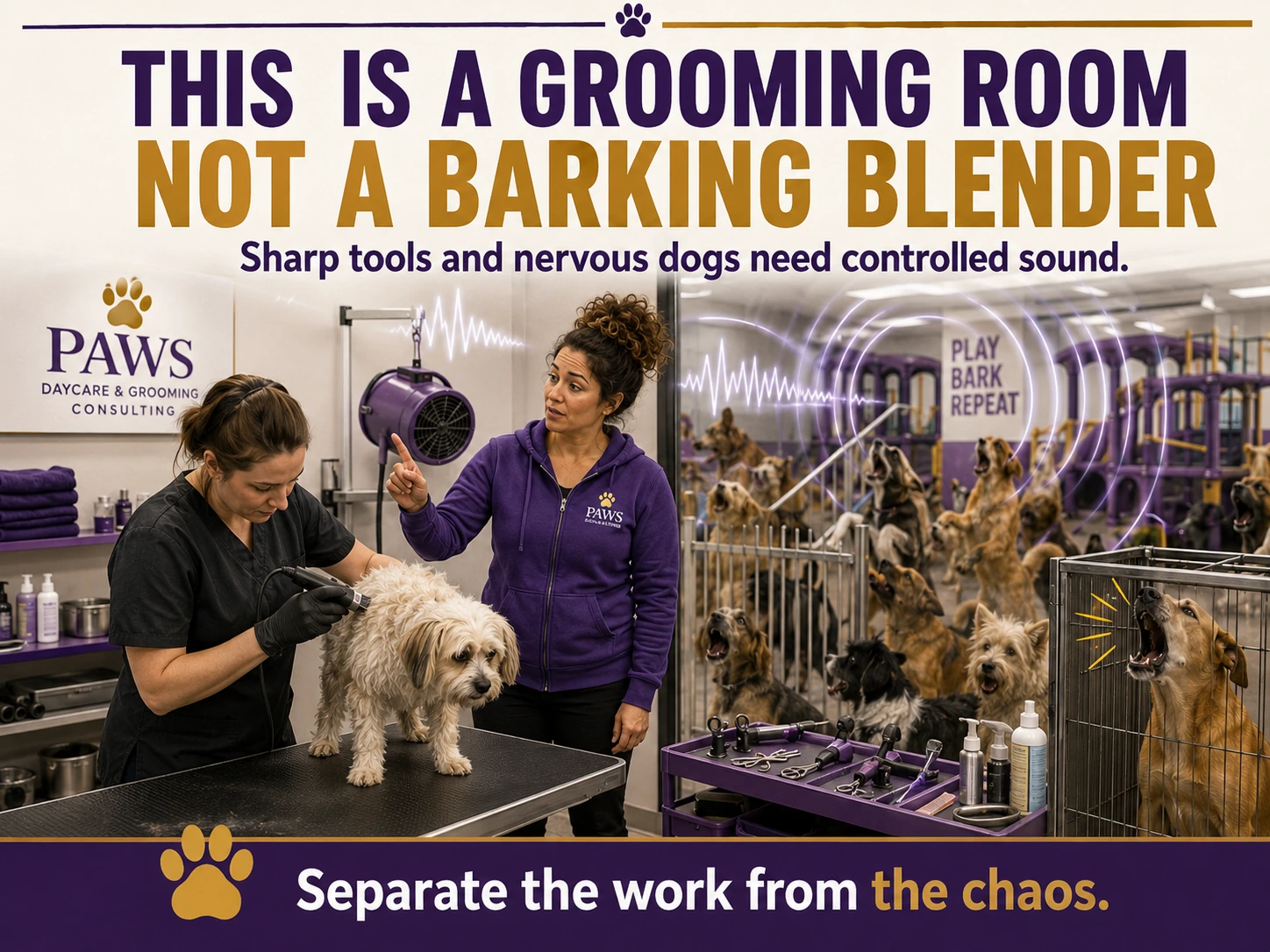
Another drawback to having the grooming area near the play areas is that the sound of dogs playing throughout the day can cause grooming dogs to become excited, nervous, reactive, or less than at ease.
A daycare dog may hear barking and think, “Party.” A grooming dog may hear barking and think, “Danger,” “escape,” “where is that dog,” or “let’s make this table interesting.”
That matters because grooming often requires stillness, balance, trust, and careful handling. The groomer may be trimming around the face, clipping near skin, lifting feet, cutting nails, brushing through coat, removing mats, drying ears, or handling an older dog that already does not want to stand for long.
The dog on the grooming table does not need the playroom firing up on the other side of the wall. The groomer does not need a dog jumping, turning, leaning, barking, or fighting restraint because the daycare room just turned into a chorus of chaos.
Grooming is hard enough without making the dog feel like a dog party, dog fight, dog announcement, and dog fire drill are happening behind the wall all day.
Noise-related behavior should change the handling plan. A dog that begins scanning, pulling, vocalizing, trembling, spinning, or fighting the hold may need a pause, a quieter location, a different sequence of work, or a decision that the groom cannot safely continue under the current conditions.
Staff need authority to slow down or stop without being punished for protecting the dog. Forcing a groomer to keep clipping around a moving face because the schedule is full converts a facility-design problem into an injury risk for the dog and the employee.
Swipe left/right to see the full table.
| Grooming Task | What Noise Can Do | Why It Matters |
|---|---|---|
| Face trimming | Dog startles, turns, ducks, or fights the hold. | Sharp tools near eyes, ears, lips, and skin do not mix well with sudden movement. |
| Nail trimming | Dog pulls feet, stiffens, or becomes more defensive. | Noise can turn a normal nail trim into a wrestling match. |
| Drying | Dog is already dealing with dryer sound, then daycare barking piles on top. | Stacked noise can push a nervous dog over threshold. |
| Matted coat removal | Dog already hurts or feels pressure, then outside barking adds stress. | Stress makes slow, careful work harder and more dangerous. |
| Senior or anxious dog handling | Dog gets shaky, tired, reactive, or harder to keep settled. | Older and anxious dogs need calm, not a playroom soundtrack. |
🧠
Groomer Noise Fatigue Is a Real Business Problem
Your groomer is skilled labor, not a noise sponge.
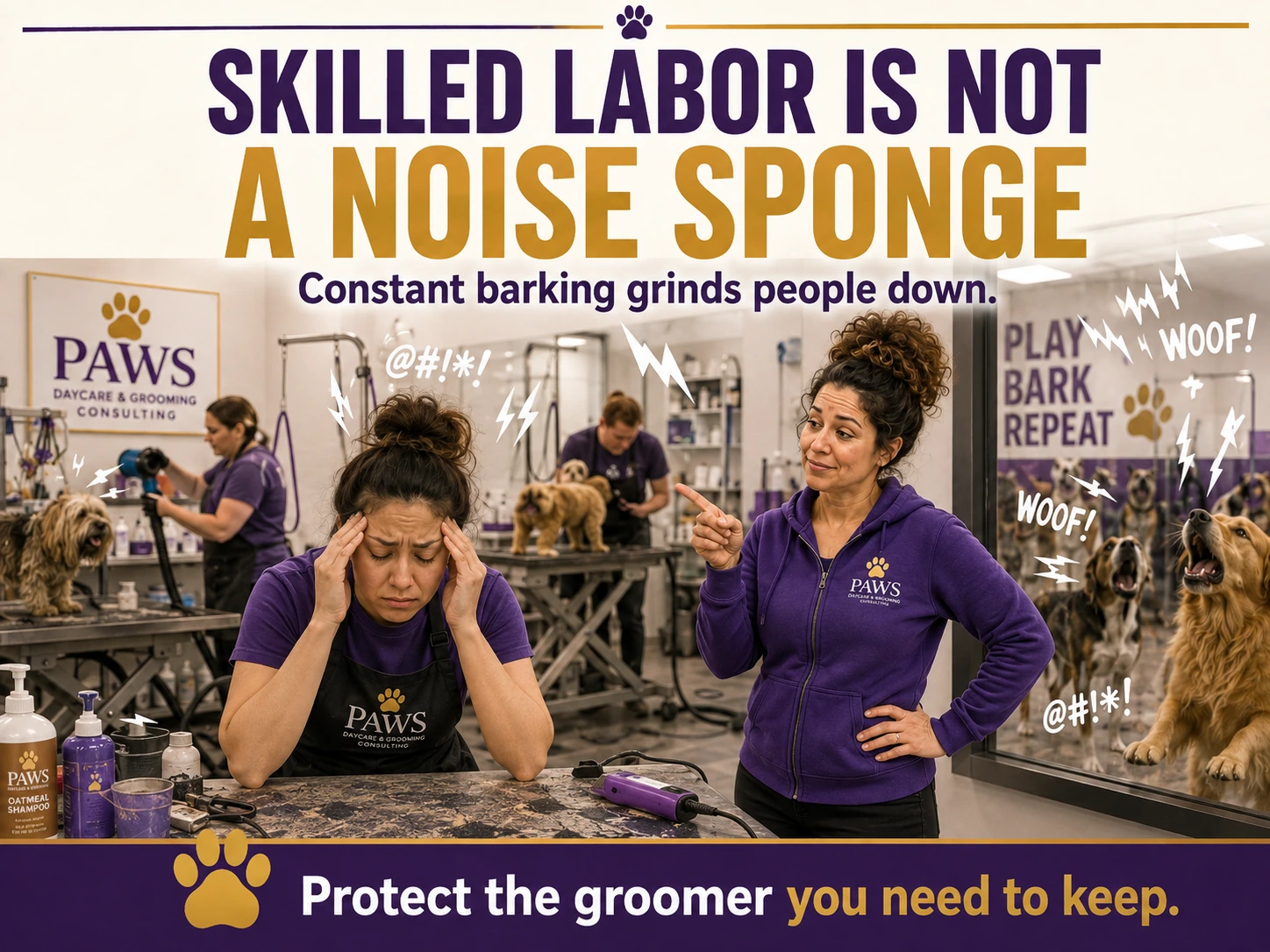
It is a well-studied and well-documented fact that prolonged exposure to loud noise can be detrimental to your health. But even before you get into formal hearing-conservation issues, any owner with common sense should understand that working all day inside loud, sharp, repetitive barking is miserable.
In the case of a dog groomer, which I would classify as very skilled labor, the constant barrage of noise and resultant stress can lessen the quality of their work and create a very unenjoyable work environment.
Grooming requires focus. It requires patience. It requires hand control. It requires judgment. It requires the groomer to read the dog, manage tools, talk to customers, handle interruptions, avoid injury, keep the schedule moving, and still send home a dog that looks good.
Now put that person beside a daycare play area where dogs are barking, bouncing, charging gates, reacting to tours, reacting to each other, and firing off group noise all day.
That is not “just part of the job.” That is wearing down the skilled person you need to keep.
A groomer who spends the day inside constant barking is not being toughened up. They are being ground down. Eventually that shows up somewhere: slower work, more mistakes, more irritation, worse customer conversations, lower job satisfaction, more sick days, more turnover, or the groomer deciding they would rather go work somewhere that does not sound like a kennel inside a trash compactor.
Managers should treat repeated noise complaints as operational data. Headaches, difficulty concentrating, shouting between stations, missed instructions, irritability, and dread about working a particular shift are signs that the environment is interfering with the job, not proof that the employee lacks toughness.
The review should look beyond whether the groomer finished the schedule. Ask how many corrections were needed, how often conversations had to be repeated, whether breaks actually provided relief, whether customers experienced delays, and whether the employee is starting to look for a quieter workplace.
📌
Labor reality
A good groomer is not easy to replace. Do not build their work area in the loudest part of the facility and then act surprised when the job becomes exhausting.
🏗️
Noise Control Is a Layout Problem
Sound does not care that plumbing was convenient beside the playroom.
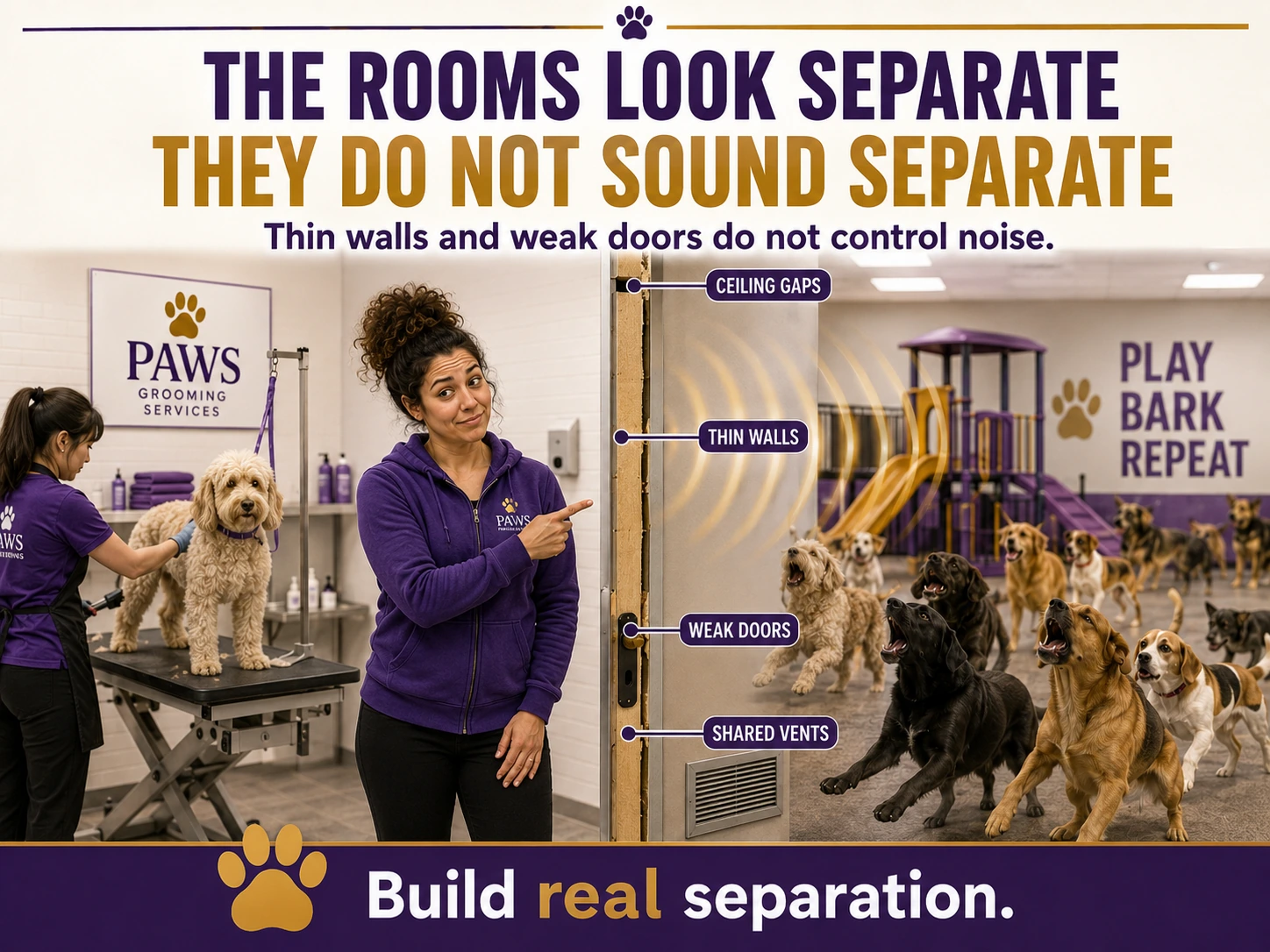
A lot of bad grooming room placement happens because the owner is looking at plumbing, electrical, unused space, and construction cost. Those things matter. But if the only question is “where can we physically put grooming,” the owner may end up creating a room that technically functions and operationally sucks.
Grooming should not be placed directly beside open daycare play areas, on the other side of thin walls from barking groups, along busy dog-transfer paths, or in a location where every customer tour sets off a canine alarm system.
Sound moves. Sound bounces. Sound leaks through weak doors, thin walls, open ceilings, vents, gates, hard surfaces, and lazy design decisions. A grooming room can look separated on a drawing and still sound like it is inside the play area once the business opens.
This is where planning matters. Solid separation, smart room adjacency, controlled tour paths, doors that actually close, sound-aware wall construction, and the basic question “would I want to groom eight dogs a day in this noise?” should be part of the design conversation before the walls are built.
A real sound-control review follows the entire transmission path. Look at the shared wall, the space above the ceiling, door construction, door sweeps, frames, pass-throughs, vents, open corridors, glass assemblies, and every place sound can move around the barrier instead of through it.
Before committing to construction, mock up the customer route and stand in the proposed grooming position while the playroom is active. Floor plans are useful, but they cannot tell you whether a barking group will pour through a ceiling gap or whether every tour will send dogs charging toward the same glass panel.
Swipe left/right to see the full table.
| Bad Layout Choice | Daily Result | Better Move |
|---|---|---|
| Grooming directly beside play areas | Daycare barking bleeds into grooming all day. | Create real separation between grooming and group play noise. |
| Tour path runs along playroom fence or glass | Dogs react to unfamiliar faces and customers see the facility at its loudest. | Use controlled tour routes or viewing points that do not set off the group. |
| Thin walls or weak doors | Rooms look separate but sound passes through like the wall is decorative. | Plan wall, door, and ceiling separation with sound in mind. |
| Hard surfaces everywhere | Sound bounces and builds until the room feels louder than it should. | Use durable, cleanable materials while still thinking about acoustic control. |
| Grooming added only where plumbing is easiest | The room may be cheap to build and expensive to operate. | Balance plumbing, customer access, dog movement, noise, and staff workflow. |
🛠️
What Actually Helps With Grooming Room Noise
Noise control is not magic. Some choices help. Some choices are just wishful thinking with a receipt.
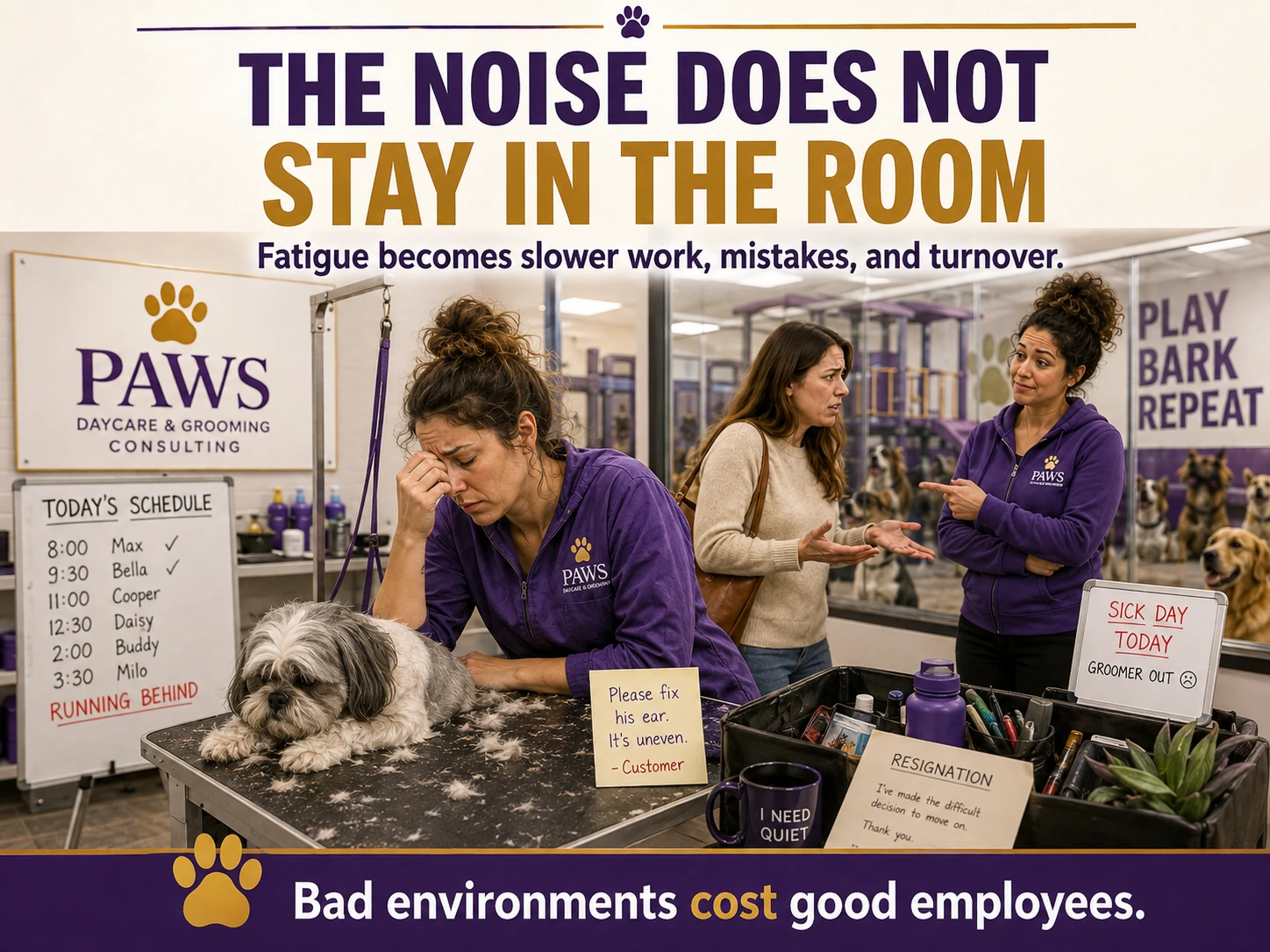
A lot of owners do not think about sound until the business opens and the grooming room sounds like it was installed inside a dog alarm. By then the walls are built, plumbing is set, the groomer is annoyed, the dogs are reacting, and customers are wondering why their tour sounds like feeding time at the wolf exhibit.
The best time to fix noise is before the room is placed. The second-best time is before the owner starts pretending the groomer is being dramatic.
Start with the biggest sources and transmission paths instead of buying random products. Moving the viewing route, keeping a door closed, separating a shared opening, changing room adjacency, or preventing dogs from crowding a particular window may accomplish more than attaching decorative foam to one wall.
After any change, measure and observe again under the same operating conditions. The question is not whether the repair looked professional on the invoice. The question is whether dogs settle faster, staff communicate without shouting, customers stop recoiling, and the groomer can complete careful work with fewer noise-driven interruptions.
Swipe left/right to see the full table.
| Noise-Control Choice | Helps or Hurts | Operator Meaning |
|---|---|---|
| Physical distance from play areas | Helps | The farther grooming is from high-arousal barking, the less sound and excitement bleed into the room. |
| Solid doors that actually close | Helps | A door with gaps, vents, or constant propping open is not sound control. It is decoration. |
| Shared thin wall with daycare play | Hurts | The room may look separate on paper while still sounding like grooming is happening inside the playgroup. |
| Controlled tour route | Helps | Customers should not have to walk past dogs that will explode at the sight of an unfamiliar face. |
| Hard surfaces everywhere | Usually hurts | Grooming rooms need cleanable surfaces, but sound bouncing off every wall, floor, gate, and ceiling makes the room feel louder. |
| “The groomer will get used to it” | Hurts | That is not a noise-control plan. That is management asking skilled labor to absorb a bad design decision. |
| Measuring the room during real operation | Helps | Do not measure the building when it is empty and quiet. Measure when daycare is running, dryers are on, and the room is living its real life. |
⚠️
Noise-control warning
Do not build a bad room and then call it a staff attitude problem. If the grooming room is sitting beside constant barking, poor separation, hard echoing surfaces, and a tour path that sets off the daycare dogs, the building is causing the problem.
⚖️
The Big Design Balance: Close to Customers, Away From Chaos
Grooming should be easy for customers to understand and hard for daycare noise to invade.
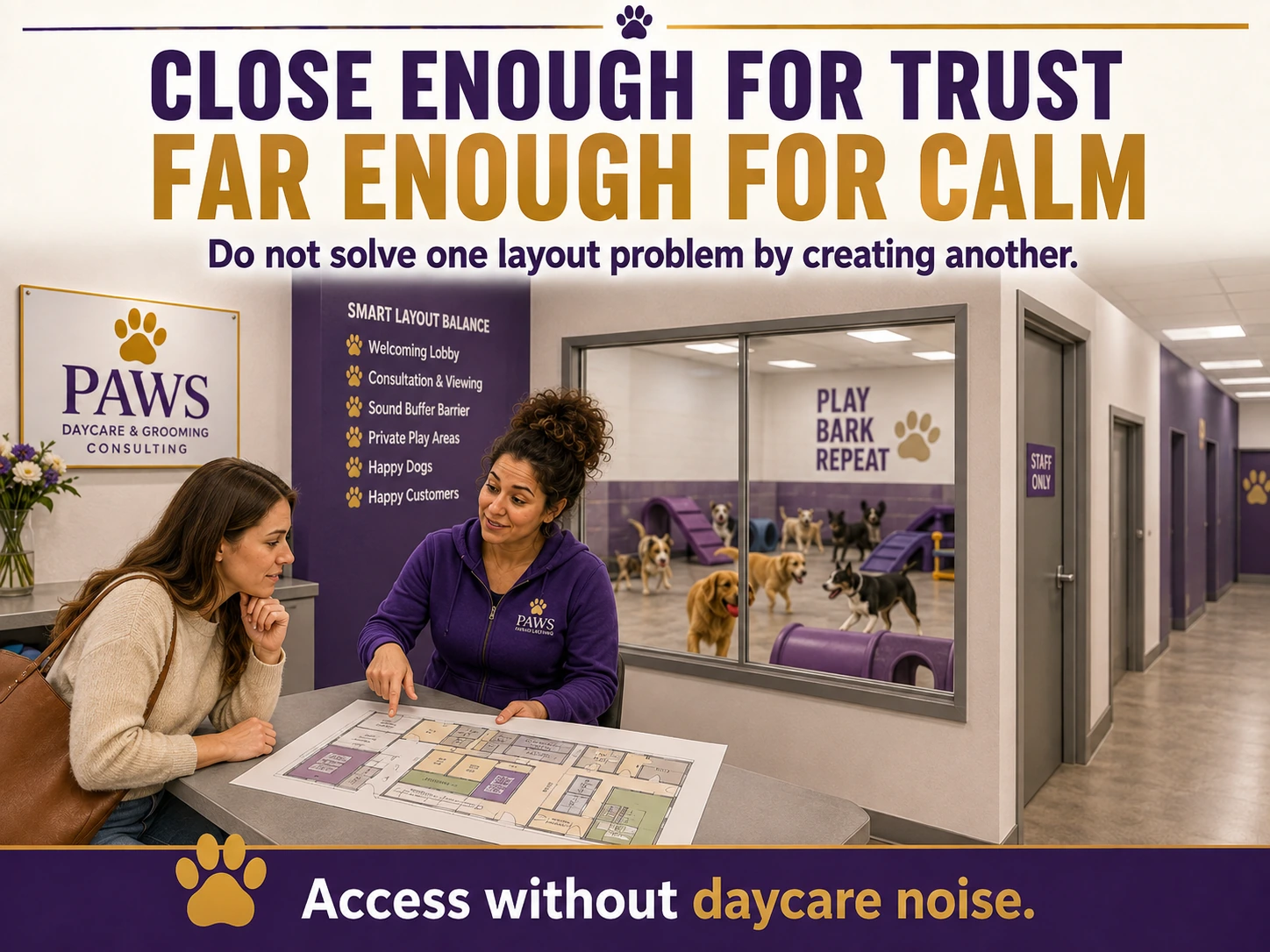
This is the balancing act.
On the one hand, grooming buried seven layers deep in the facility creates tours, wasted walking, customer-access problems, and groomer interruptions. That was the last problem.
On the other hand, grooming shoved beside the daycare play areas creates noise, barking, excited grooming dogs, bad first impressions, and groomer fatigue. That is this problem.
The answer is not to pick one stupid layout problem over the other. The answer is to design grooming as a real business unit from the beginning.
Ideally, grooming should be close enough to the customer path for controlled visibility, consults, and trust-building, while separated enough from daycare play areas that the groomer is not working inside a barking blender. Customers should be able to see professionalism without triggering the playroom. Groomers should be able to work without crossing the building or absorbing playroom noise all day.
Close to customer access. Away from daycare chaos. That is the design target.
The consult point should sit on the customer side of the operation, not force customers into the sound source. A groomer can review coat condition, confirm instructions, and answer focused questions near the handoff area while the actual workroom remains protected from daycare traffic and group reactions.
The finished design should be tested as one system. Customer visibility, door use, staff routes, dog transfers, ventilation, wall assemblies, and playgroup placement all interact. Solving only the distance to the lobby or only the noise level can leave the business with a different version of the same bad room.
⚠️
Design warning
If the grooming room location only solves plumbing, it may fail the business. Grooming placement has to solve customer access, staff motion, sound control, dog movement, safety, and production.
✅
Grooming Room Noise Placement Checklist
Use this before deciding the grooming room belongs beside the play areas because “that wall already has plumbing.”
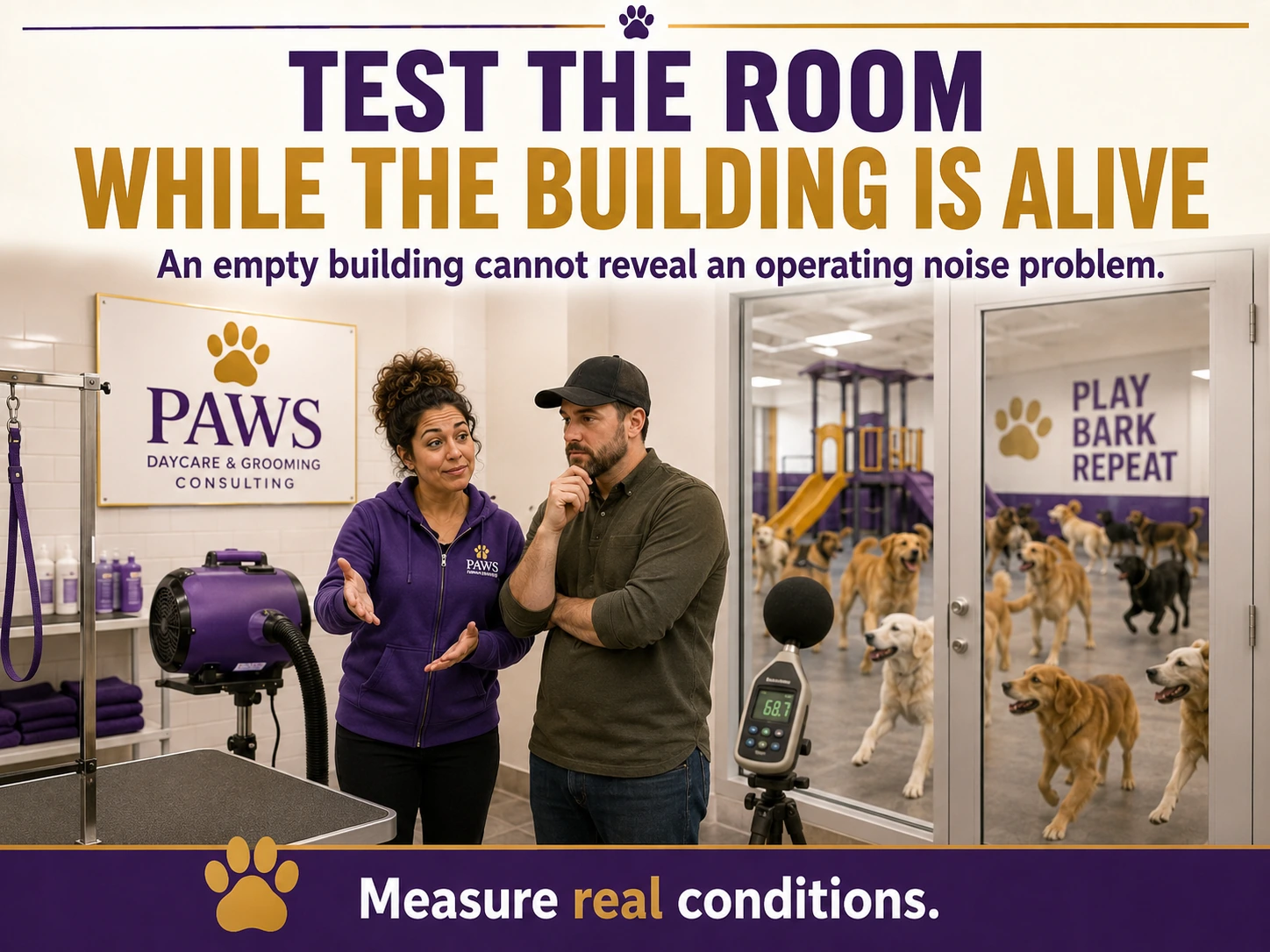
A checklist is only useful when it is tested against the building during real operation. Walk the proposed route while daycare is active, stand at the grooming table with equipment running, close every door the way staff will actually use it, and listen for the places where sound enters the room.
Include the groomer and frontline staff in the review. They know which doors stay propped open, which dogs rush the glass, which times of day produce the worst barking, and which conversations become impossible without shouting. A drawing that ignores actual staff behavior is not an operating plan.
Record the problems that appear and assign a response before opening or remodeling. Some issues require construction, some require a different tour route, some require scheduling changes, and some require moving grooming. Leaving the answer as “we will see how it goes” means the groomer becomes the test equipment.
- Is the grooming room separated from daycare barking, gate pressure, and playroom excitement?
- Can customers see or tour grooming without walking past dogs that will explode at an unfamiliar face?
- Can grooming dogs hear constant daycare barking, gate noise, or dog movement through the wall?
- Can groomers talk to each other, hear the dog, hear equipment changes, and communicate without shouting?
- Are the doors solid enough, and do they actually close, or is sound pouring through the opening all day?
- Are walls, ceilings, vents, or open areas letting playroom sound leak straight into grooming?
- Are the room surfaces making sound bounce like the inside of a metal bucket?
- Is grooming still close enough for customer consults, pickup conversations, and controlled visibility?
- Was the room placed only because plumbing and electrical were convenient?
- Would you want to clip a nervous dog’s face in that noise for eight hours a day?
📌
Simple test
Stand where the groomer will stand. Close the door. Have daycare operating normally. Then ask yourself whether a skilled person should have to work there all day with sharp tools, nervous dogs, dryers, and customer expectations. The answer usually arrives without needing a committee.
❓
Grooming Room Noise and Fatigue FAQ for Pet Care Operators
Detailed operator answers about barking, customer tours, grooming-dog stress, employee fatigue, room separation, noise testing, and corrective action.
Why should grooming not be placed beside daycare play areas?
Because daycare play areas create noise, motion, gate pressure, barking, and dog excitement. A grooming room beside that environment may create bad customer impressions, stressed grooming dogs, and tired groomers. Grooming needs controlled sound, not constant playroom chaos bleeding through the wall.
Is barking really loud enough to matter?
Yes. Dog barking can be much louder than people expect, especially when multiple dogs bark in a hard-surfaced room. The exact level depends on the room, distance, number of dogs, and measurement method, but the operator lesson is simple: do not treat barking as harmless background music when staff and grooming dogs are exposed to it all day.
Does noise affect grooming dogs?
It can. A dog being groomed may already be restrained, wet, tired, anxious, matted, sore, or nervous. Add daycare barking and the dog may become more excited, reactive, or difficult to handle. Staff should watch the dog’s behavior, adjust the handling plan, create distance from the sound when possible, and stop the work when the environment no longer supports safe grooming.
Does noise affect groomers?
Yes. Groomers need focus, patience, hand control, and judgment. Constant barking can create fatigue, irritation, communication problems, and a miserable work environment. Management should look at the conditions producing the complaint instead of treating the groomer like skilled labor is supposed to absorb unlimited noise without consequence.
Should grooming be in the lobby instead?
Not automatically. Putting grooming in the middle of the lobby can create its own problems: hair, water, smell, noise, dog excitement, customer distraction, and staff feeling like they are working in a fishbowl. The better answer is controlled visibility and smart placement, not wet dog theater.
How do you balance customer visibility with noise control?
Place grooming close enough to the customer path for controlled consults, trust, and visibility, but far enough from play areas that daycare noise does not run the room. Use solid separation, smart tour routes, viewing windows when appropriate, and a consult point that lets the owner speak with the groomer without entering the active work area.
What if plumbing is easiest near the play areas?
Plumbing matters, but plumbing should not be the only decision. A cheap buildout can become expensive if the room creates noise fatigue, customer doubt, poor workflow, and harder grooming. Balance plumbing, electrical, customer access, dog movement, sound control, staff workflow, and safety before deciding that the easiest wall is the right wall.
Can sound treatment fix a bad location?
Sometimes it can reduce the problem, but it is not magic dust. Doors, walls, ceilings, vents, openings, room surfaces, dog movement paths, and the location of the sound source all matter. If the grooming room is directly beside a high-arousal play area, treatment may help while still leaving a fundamentally bad adjacency.
Should the facility measure noise?
If staff are shouting, struggling to communicate, reporting headaches or fatigue, or working full shifts beside barking groups, the facility should measure instead of guessing. Measure during actual operation, note what equipment and dog groups were active, and compare the same conditions after changes are made.
What is the main lesson of this page?
Grooming should be designed as a real business unit. It needs customer access, but it also needs separation from daycare chaos. Do not put skilled labor, nervous dogs, sharp tools, dryers, and customer trust inside the loudest part of the building because that was where the leftover space happened to be.
How should customer tours be routed near daycare areas?
Use a route that avoids gates, transfer lanes, fence pressure, and viewing panels that cause dogs to rush forward. The front desk should confirm that the route is safe before moving the customer, and staff should be able to delay or redirect the tour when the playgroup is too active for a controlled visit.
What should staff do when a tour triggers group barking?
Stop moving deeper into the dog area, create distance from the trigger, and allow staff to settle the group. Do not stand beside the glass shouting an explanation over the barking. Move the customer to a quieter point, explain the reaction honestly, and continue only when the route can be controlled.
What signs show that noise is damaging grooming operations?
Watch for repeated schedule delays, dogs that become harder to settle, staff shouting instructions, customer conversations that cannot be heard, more handling corrections, irritability, mistakes, sick-day patterns, and groomers asking to move stations or leave the business. Noise problems rarely stay contained as a simple comfort complaint.
Are solid doors enough to separate grooming from daycare?
Not always. A solid door helps only when it closes, seals reasonably, and is not bypassed by ceiling gaps, vents, open corridors, weak frames, or a shared wall that transmits the sound. Review the complete path the noise follows instead of buying one door and declaring the problem solved.
How should a proposed grooming room be tested before construction?
Stand in the proposed grooming location while daycare is operating under normal busy conditions. Run the likely customer route, open and close the planned doors, listen near walls and ceilings, and include the groomer and frontline staff in the test. An empty-building walkthrough cannot reveal the conditions the room will face every day.
What should happen when noise makes a grooming dog unsafe to handle?
The groomer should pause the task, secure the dog, reduce the sound exposure when possible, and reassess whether the work can continue safely. Management should support that decision. A full schedule does not justify continuing sharp-tool work on a dog that is spinning, fighting restraint, or repeatedly startling because the room is too loud.
How should managers respond to groomer complaints about noise?
Treat the complaint as operating information and investigate the actual shift conditions. Observe the room, review when the worst barking occurs, ask what tasks become difficult, and document the effect on dogs, communication, schedule, and recovery time. Calling the employee dramatic does not fix the wall, door, route, or playgroup causing the problem.
How can noise fatigue become a revenue problem?
Fatigue can slow work, increase restarts, reduce schedule capacity, create customer delays, contribute to corrections or complaints, and push a skilled groomer toward another employer. The cost may appear in smaller pieces across payroll, turnover, lost appointments, and damaged trust rather than as one obvious noise invoice.
What should be documented during a grooming-noise review?
Record the date and time, active dog groups, equipment in use, door positions, measurement locations, staff observations, customer reactions, dog behavior, and any delays or safety interruptions. Use the same conditions for follow-up checks so management can tell whether a change actually improved the room.
When should relocation of the grooming room be considered?
Consider relocation when the sound source cannot be controlled economically, the room shares a fundamentally bad adjacency with high-arousal play, staff and dogs continue to struggle after reasonable corrections, or customer access and acoustic separation cannot both be achieved in the current location. Moving the room is disruptive, but repeatedly losing staff, quality, and trust can cost more.
🐾
Bottom Line: Do Not Build Grooming Inside a Barking Blender
A grooming room in the wrong place can make the business look chaotic, make grooming dogs harder to handle, and grind down the groomer you need to keep.
Grooming near play areas may look convenient on paper. In the real building, it can mean barking dogs, bad customer impressions, excited grooming dogs, stressed staff, and a grooming room that sounds like it was installed inside a dog alarm.
The customer should not discover your grooming room through a tunnel of barking dogs. The grooming dog should not have daycare chaos as background music while someone is working around its face with sharp tools. The groomer should not spend the day trying to produce clean, careful work inside a barking blender.
Grooming belongs close enough to customer access that people can trust what is happening, but separated enough from daycare noise that the work can actually be done well.
Do not place the grooming room only where plumbing happened to be convenient. Place it where the business can sell grooming, perform grooming, protect dogs, protect staff, and still look like it knows what the hell it is doing.