Gladiolus Toxicity, Corm Ingestion, and Gastrointestinal Injury
Are Gladiolus Plants Poisonous to Dogs, Cats, Horses, and Livestock?
Yes—Gladiolus plants, Gladiolus species and garden hybrids, are poisonous to dogs, cats, horses, livestock, rabbits, birds, and other animals. Ingestion can cause excessive drooling, nausea, vomiting, abdominal pain, diarrhea, appetite loss, lethargy, depression, and weakness. Large exposures may also be associated with an unsteady gait, although the responsible toxin and mechanism have not been identified.
All portions should remain inaccessible, but the solid underground corm and its small cormlets present the greatest reported toxic concern. Corms also create a separate choking and gastrointestinal foreign-body hazard and may carry fungicides, insecticides, preservatives, or storage treatments. A cat exposed to a mixed bouquet requires immediate confirmation that no true lily or daylily was present because those plants cause a separate and potentially fatal kidney emergency.
About this guide: This page provides general pet-poisoning information and cannot diagnose or treat an individual animal. For any suspected exposure, contact a veterinarian or animal poison-control service immediately. Do not induce vomiting, give medication, or attempt home decontamination unless directed by a veterinary professional.
Gladiolas
Gladiolus spp.
This general scientific designation is appropriate because pets may encounter accepted wild species, named artificial or natural hybrids, complex florist cultivars, and garden groups whose ancestry is incompletely recorded.
Relevant cultivated species and hybrids include:
- Gladiolus communis L.
- Gladiolus × byzantinus Mill. — also widely labeled Gladiolus communis subsp. byzantinus
- Gladiolus × colvillii Sweet — an artificial hybrid of G. cardinalis and G. tristis
- Gladiolus × gandavensis Van Houtte — an artificial hybrid of G. dalenii and G. oppositiflorus
- Gladiolus × hybridus C.Morren — a historically named artificial hybrid involving G. cardinalis and G. × gandavensis
- Gladiolus dalenii Van Geel
- Gladiolus murielae Kelway — formerly and still commonly sold as Acidanthera murielae or Acidanthera bicolor
Important horticultural qualifications:
- Gladiolus × hortulanus L.H.Bailey is widely used for modern tall garden and florist hybrids, but the name is currently taxonomically unplaced rather than formally accepted or synonymized.
- Grandiflora, Nanus, Primulinus, Butterfly, Miniature, and Exhibition Gladiolus identify horticultural groups rather than accepted botanical species.
- Modern garden cultivars have complex ancestry involving several African species, and their complete parentage may be unknown.
- Sword Lily is a common name based on the foliage. Gladiolus is not a true lily in the genus Lilium and is not a daylily in the genus Hemerocallis.
Iridaceae
Commonly called the Iris family.
Gladiolas; Gladiola; Gladiolus; Gladioli; Gladioluses; Glads; Glad; Sword Lily; Sword Lilies; Corn Flag; Garden Gladiolus; Garden Gladiola; Garden Glad; Florist Gladiolus; Florist Gladiola; Exhibition Gladiolus; Large-Flowered Gladiolus; Grandiflora Gladiolus; Primulinus Gladiolus; Butterfly Gladiolus; Nanus Gladiolus; Miniature Gladiolus; Hardy Gladiolus; Aunt Eliza Rat’s Rail; Gladiolus spp.; Gladiolus × hortulanus
Gladiolus × hortulanus is widely used for complex modern garden and florist hybrids, but current botanical databases treat the name as taxonomically unplaced.
Byzantine Gladiolus, Byzantine Sword Lily, or Eastern Gladiolus refers more specifically to Gladiolus × byzantinus, also widely sold as Gladiolus communis subsp. byzantinus.
Colville’s Gladiolus refers to Gladiolus × colvillii.
Gandavensis Gladiolus refers to Gladiolus × gandavensis, an important historical artificial hybrid.
Abyssinian Gladiolus, Fragrant Gladiolus, Peacock Orchid, and Acidanthera generally refer to Gladiolus murielae, formerly sold under Acidanthera names.
Grandiflora, Nanus, Primulinus, Butterfly, Miniature, and Exhibition Gladiolus are horticultural group names rather than exact species.
“Bulb” is widely used in commerce and poison-control references, but Gladiolus grows from a solid corm rather than a layered true bulb.
Sword Lily is not an exact botanical lily name. Gladiolus belongs to Iridaceae, while true lilies belong to Lilium and daylilies belong to Hemerocallis.
The Veterinary Toxic Principle Remains Unknown
No single molecule or combination of molecules has been conclusively shown to cause ordinary Gladiolus poisoning across dogs, cats, horses, wild species, named hybrids, and modern garden cultivars. Veterinary poison-control experience nevertheless supports a reproducible syndrome dominated by salivation, vomiting, diarrhea, appetite loss, abdominal discomfort, lethargy, and depression.
The unidentified toxic material appears to act principally as an oral and gastrointestinal irritant. Chewed plant tissue and sap contact the mouth, esophagus, stomach, and intestine, producing nausea, vomiting, cramping, and diarrhea. Larger exposures can cause greater fluid loss, weakness, and reported incoordination.
“Unknown toxic principle” does not mean the plant is harmless. It means that the clinical classification is stronger than the current chemical attribution and that treatment must be based on the plant part, amount, symptoms, hydration, and possible co-exposures rather than on a named antidote.
Corms and Cormlets Present the Greatest Reported Risk
The highest reported concentration of toxic material occurs in the underground corms. A corm is a solid, swollen stem base that stores carbohydrates and living tissue for the next growing season. It is not a layered true bulb.
The dense corm allows an animal to consume a comparatively large mass of plant tissue quickly. A dog may stop after chewing one fibrous leaf but may swallow several dry corms before vomiting develops, particularly when an open storage box resembles a container of roots, balls, potatoes, or treats.
Small cormlets or cormels form around the replacement corm. Their size makes them easy for puppies, cats, rabbits, poultry, birds, and small livestock to swallow whole. Cormlets should be treated as concentrated plant material rather than as harmless seeds or garden debris.
Phytochemistry Does Not Yet Identify a Universal Toxin
Individual Gladiolus species and hybrids contain diverse secondary metabolites. Research has identified oleanane-type saponins, triterpenes, anthraquinones, anthraquinone glycosides, chromones, cinnamate derivatives, sterols, flavonoids, phenolics, and other compounds in selected corms or aerial tissues.
Zhi-Gang Tai, Le Cai, Ya-Bin Yang, Chuan-Shui Liu, Jian-Jun Xia, and Zhong-Tao Ding published “Three New Oleanane-Type Triterpene Saponins from Gladiolus gandavensis” in the Bulletin of the Korean Chemical Society, volume 31, issue 10, pages 2786–2790, in 2010. The investigators isolated three previously undescribed saponins and two known compounds from aboveground material of Gladiolus × gandavensis.
Other investigators isolated anthraquinones from the subterranean corm of G. × gandavensis and triterpenes, anthraquinones, and glycosides from G. segetum. These studies demonstrate substantial chemical complexity within the genus.
None of those studies involved naturally poisoned dogs, cats, or horses or proved that the isolated compounds cause the general veterinary syndrome. A molecule found in one hybrid, wild species, extract, or plant organ should not be relabeled as the toxin of every florist gladiolus.
Extract Studies Cannot Be Converted into Pet-Safe Doses
Phytochemical and pharmacologic investigations commonly use dried plant material extracted with methanol, ethanol, petroleum solvents, or other laboratory methods. Those preparations differ greatly from a pet chewing a fresh flower, leaf, or corm.
One rat study of a methanolic aerial-parts extract of Gladiolus segetum reported no acute toxic manifestations under its experimental protocol and investigated anti-inflammatory and anti-ulcer effects. That result does not prove that raw garden Gladiolus is safe for pets, that corms are harmless, or that every species contains the same chemistry.
Species, organ, extraction method, dose, metabolism, and animal physiology all affect the result. Laboratory evidence should be used to describe chemical diversity and evidentiary limits rather than to invent a household safe threshold.
Treated Corms and Garden Products Create Additional Poisonings
Commercial corms may be dusted, dipped, coated, dyed, or stored with fungicides, insecticides, preservatives, or other agricultural treatments. Some coatings are brightly colored, while others are difficult to see.
A dog digging in a planting bed may also consume fertilizer, bone meal, blood meal, slug bait, systemic pesticide, herbicide residue, moldy compost, mulch, plastic labels, wire, or stones. These materials can produce neurologic, cardiovascular, renal, hepatic, metabolic, or obstructive signs that ordinary Gladiolus poisoning does not explain.
Tremors, seizures, abnormal pupils, excessive secretions, profound weakness, respiratory distress, major heart-rate abnormalities, or sudden collapse should prompt investigation of the package, planting area, and every product used nearby.
Mechanical Injury and Foreign-Body Hazards
A whole corm, large fragment, compact mass of fibrous leaves, or section of flower stalk may lodge in the mouth, pharynx, esophagus, stomach, or intestine. Dry corm tunics can become caught between teeth or adhere to irritated throat tissue.
Persistent gagging, repeated swallowing, regurgitation, unsuccessful retching, inability to swallow water, continued vomiting, abdominal enlargement, reduced stool, or worsening pain may indicate retained plant material rather than continued toxin activity alone.
A long plant fiber protruding from the mouth or rectum should not be pulled blindly because it may be anchored internally. Activated charcoal cannot remove a corm or correct a mechanical obstruction.
All Parts Should Be Considered Unsafe
Corms and cormlets create the greatest reported toxic concern, but flowers, petals, leaves, flower spikes, stems, roots, sap, seed capsules, seeds, dry tunics, vase debris, and discarded plant material should also remain inaccessible.
No comprehensive analysis has compared toxin concentrations across every accepted species, hybrid group, cultivar, organ, season, and growing condition. The statement that corms contain the highest reported concentration does not establish that the foliage or flowers are safe.
No Established Safe Dose
No dependable corm count, cormlet count, flower quantity, plant weight, extract concentration, or gram-per-kilogram toxic dose has been established for natural Gladiolus exposure in dogs, cats, horses, livestock, rabbits, or birds.
Risk depends on the plant part, amount, animal size, repeated access, underlying health, degree of gastrointestinal loss, physical obstruction, corm treatment, and any additional chemical or plant exposure.
Oral and Gastrointestinal Signs
The most characteristic signs are excessive drooling, lip licking, repeated swallowing, nausea, gagging, retching, vomiting, reduced appetite, abdominal discomfort, intestinal cramping, diarrhea, lethargy, and depression.
A small flower or leaf exposure may cause no visible illness or only brief gastrointestinal upset. Corm ingestion generally creates greater concern because the animal can consume a dense amount of plant tissue and may swallow the structure whole.
Vomiting may contain food, foam, bile, petals, leaves, tunic material, or corm fragments. Diarrhea may range from soft stool to frequent watery material.
Blood, Dehydration, and Weakness
Small red streaks may appear after repeated retching irritates the esophagus or stomach. More substantial mucosal injury may produce repeated blood, coffee-ground material, bloody diarrhea, or black tarry stool.
Vomiting and diarrhea can cause tacky gums, sunken eyes, reduced skin elasticity, decreased urination, rapid heart rate, weak pulses, progressive lethargy, and collapse. Electrolyte, glucose, and acid-base abnormalities may compound the weakness.
Young animals, toy-breed dogs, elderly patients, and animals with kidney, cardiovascular, endocrine, or gastrointestinal disease may deteriorate more rapidly.
Unsteady Gait After a Large Exposure
Lethargy and an unsteady gait have been reported after large Gladiolus exposures. No specific compound or neurologic mechanism has been established.
Incoordination may reflect a stronger effect of the unidentified toxic principle, but pain, dehydration, hypoglycemia, electrolyte disturbance, weakness after repeated vomiting, treated corms, pesticides, or another plant must also be considered.
Marked staggering, tremors, seizures, abnormal pupils, profound depression, or altered awareness requires prompt veterinary examination and a wider toxicologic investigation.
Corm and Foreign-Body Complications
A whole corm may lodge in the esophagus, remain in the stomach, or obstruct the intestine. Persistent gagging, neck extension, drooling, regurgitation, immediate return of water, or repeated unsuccessful retching may indicate an esophageal obstruction.
Continued or returning vomiting, abdominal enlargement, worsening pain, inability to retain water, reduced fecal production, or progressive depression may indicate gastric retention or intestinal obstruction.
Fibrous leaves, stalks, roots, tunics, bouquet wire, floral picks, and packaging can create similar physical signs.
Dogs and Cats
Dogs commonly encounter corms while following an owner during planting, digging in newly worked beds, entering winter storage, or chewing discarded garden material. They may also pull down bouquets and consume flowers, foliage, wire, ribbons, or preservative packets.
Cats are more likely to chew bouquet leaves or flowers or drink vase water. Expected Gladiolus signs include drooling, vomiting, appetite loss, diarrhea, abdominal discomfort, and lethargy.
Continued food refusal is especially important in cats because prolonged anorexia creates a separate risk of hepatic lipidosis. Every bouquet exposure must also be assessed for true lilies and daylilies.
Horses and Livestock
Horses cannot vomit and may instead develop salivation, feed refusal, dropped feed, abdominal discomfort, colic, diarrhea, depression, weakness, reduced manure production, or incoordination.
Livestock exposure is most likely when dug corms, flower arrangements, garden waste, treated planting stock, or trimmings are discarded into a paddock or enclosure.
Multiple sick animals suggest shared access to a larger quantity, a treated corm shipment, contaminated feed, fertilizer, pesticide, or another poisonous plant.
Unexpected Severe Findings
Primary kidney failure, progressive liver failure, severe respiratory depression, major cardiac arrhythmias, seizures, coma, and sudden death are not the expected syndrome of uncomplicated Gladiolus ingestion.
These findings require investigation for true lilies, pesticides, treated corms, fertilizer, slug bait, medications, another toxic plant, aspiration, severe obstruction, infection, or unrelated metabolic disease.
Expected Course and Prognosis
Mild drooling, nausea, vomiting, or diarrhea often begins improving within several hours after access stops and may resolve within approximately one or two days.
Recovery after substantial corm ingestion may require anti-nausea treatment, fluid support, electrolyte correction, imaging, or hospital observation. Bloody gastrointestinal signs and marked dehydration can prolong illness.
The prognosis is generally good to excellent after limited flower or foliage exposure. It becomes more guarded when obstruction, aspiration, severe fluid loss, treated corms, or another toxin complicates the case.
Gladiolas on This Page Means the Genus and Its Garden Hybrids
This page retains the established plant title Gladiolas and covers Gladiolus species, artificial hybrids, natural hybrids, named cultivars, and the complex garden groups encountered in landscapes and florist arrangements.
Most tall modern garden gladioli are not one unchanged wild species. They descend from repeated hybridization and selection involving several African species. Their complete ancestry may be unavailable or too complex for one species name.
Gladiolus spp. is therefore the most accurate broad scientific field for a general animal-poisoning page.
Accepted Genus and Hybrid Names
Gladiolus Tourn. ex L. is an accepted genus in Iridaceae. Its native range extends from Europe through western Asia and the Arabian Peninsula and throughout much of Africa, with the greatest diversity in southern Africa.
Gladiolus × hortulanus is widely used horticulturally for modern garden hybrids, but its botanical status remains unplaced. It should be described as a useful horticultural designation rather than as one accepted natural species.
Other hybrid names have more specific treatment. G. × colvillii is an artificial cross involving G. cardinalis and G. tristis. G. × gandavensis is an artificial hybrid involving G. dalenii and G. oppositiflorus. G. × byzantinus is recognized separately and remains widely sold under the synonym G. communis subsp. byzantinus.
Former Genera and Familiar Cultivated Groups
Several plants formerly assigned to genera such as Acidanthera, Antholyza, Anisanthus, and Homoglossum are now included within Gladiolus. Older nursery labels may therefore use names no longer accepted at genus level.
Abyssinian Gladiolus, Peacock Orchid, Fragrant Gladiolus, and Acidanthera generally identify Gladiolus murielae. Its fragrant white flowers and dark central markings look different from the familiar tall Grandiflora types, but it remains within the same genus.
Grandiflora, Primulinus, Nanus, Butterfly, Miniature, and Exhibition Gladiolus are horticultural categories used to describe flower size, height, form, ancestry, or exhibition class. They do not identify toxin-free groups.
Identification: Sword Leaves and Flower Spikes
Gladiolus foliage generally forms an upright fan of narrow, parallel-veined, sword-shaped leaves. The genus name is derived from the Latin word for a small sword.
A flower stalk rises from the center of the foliage and bears a succession of funnel-shaped flowers. Lower flowers commonly open before the buds farther up the spike.
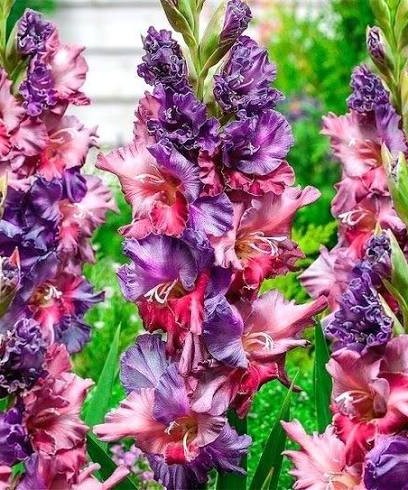
Garden cultivars occur in white, cream, yellow, green, orange, salmon, pink, red, burgundy, purple, nearly black, and multicolored combinations. Flower color does not identify a safer cultivar.
A Corm Is Not a True Bulb
Gladiolus grows from a corm, a solid, compressed, swollen stem base covered by dry papery or fibrous tunics. When cut open, the corm is solid rather than layered.
A true bulb, such as an onion, is made primarily from concentric modified leaves surrounding a growing point. The difference matters botanically even though retailers and poison-control references commonly call Gladiolus corms bulbs.
The planted corm supplies stored resources for the season’s shoot and flower spike. As it shrivels, a replacement corm forms above it.
Cormlets and Seasonal Storage
Small cormlets develop around the replacement corm and can be separated for propagation. They are easily lost during digging, cleaning, curing, division, and storage.
In climates where tender hybrids are lifted for winter, boxes or mesh bags may contain old corms, replacement corms, cormlets, roots, dry tunics, soil, and treatment dust. One open container can expose a dog to dozens of concentrated plant structures.
After an exposure, count the remaining corms and inspect the container for missing treatment labels or chemical packets.
Corm Treatments and Planting-Bed Co-Exposures
Commercial or home-stored corms may be treated for fungal rot, thrips, mites, or other storage pests. A colored coating may indicate treatment, but an untreated-looking corm is not proof that no chemical was used.
Newly planted beds may contain bone meal, blood meal, granular fertilizer, slug bait, systemic insecticide, compost, mulch, herbicide residue, or moldy organic matter. Some products smell attractive to dogs and encourage digging.
The corm package, receipt, planting instructions, treatment label, and every garden-product container should be preserved when an animal becomes ill.
Gladiolus Is Not a True Lily
Sword Lily is a visual common name. Gladiolus belongs to Iridaceae and does not produce the characteristic feline acute kidney injury associated with true lilies in Lilium or daylilies in Hemerocallis.
This distinction should never be used casually when the bouquet contains unidentified flowers. Gladiolus is commonly arranged beside Easter Lilies, Asiatic Lilies, Oriental Lilies, Tiger Lilies, Stargazer Lilies, or daylilies.
A cat exposed to any unidentified lily-like bouquet should be managed according to the most dangerous plausible identification until every flower, leaf, pollen-bearing structure, and stem is confirmed.
Cut Flowers, Vase Water, and Bouquet Hardware
Gladiolus flower spikes are common in weddings, funerals, churches, hotels, offices, restaurants, and household arrangements. Indoor exposure may involve petals, sword-shaped leaves, cut stem ends, vase water, floral preservative, ribbons, wire, picks, foam, or other bouquet plants.
Vase water should not be treated as safe drinking water. It may contain plant sap, bacterial growth, preservative chemicals, fertilizer residue, and toxins from another species in the arrangement.
Fallen florets and leaves should be removed promptly, and the entire bouquet should be kept genuinely inaccessible rather than placed on a surface a cat can reach from nearby furniture.
What the Saponin Study Established
Zhi-Gang Tai, Le Cai, Ya-Bin Yang, Chuan-Shui Liu, Jian-Jun Xia, and Zhong-Tao Ding isolated three new oleanane-type triterpene saponins and two known compounds from the aboveground portions of Gladiolus × gandavensis.
The study established that structurally complex saponins occur in at least one horticultural Gladiolus hybrid. It did not administer the plant or purified compounds to dogs, cats, or horses and did not investigate the corm-focused clinical syndrome reported by veterinary poison-control services.
It would therefore be inaccurate to identify those five isolated compounds as the proven universal toxins of all Gladiolus plants.
Anthraquinones, Triterpenes, and Other Constituents
Investigators have isolated multiple anthraquinones and related compounds from G. × gandavensis corms. Research on G. segetum has identified anthraquinone derivatives, anthraquinone glycosides, an oleanene triterpene, medicagenic acid, sterols, and other constituents.
These studies confirm that corm chemistry can differ substantially among species and hybrids. They also show why a broad list of every compound reported anywhere in the genus does not identify the veterinary toxin.
Concentrated laboratory extracts, acid-hydrolyzed saponin fractions, and isolated compounds are not equivalent to raw plant ingestion.
Dogs, Cats, Horses, and Livestock
Dogs most often encounter Gladiolus during planting, digging, corm storage, garden cleanup, or access to a fallen bouquet. Corm ingestion combines the greatest reported toxic concern with the greatest foreign-body risk.
Cats most often encounter cut foliage, flowers, or vase water. Continued appetite loss deserves prompt attention, and every bouquet must be checked for true lilies.
Horses and livestock may be exposed when bouquets, corms, or ornamental waste are dumped into an enclosure. Standing garden plants may be less attractive than freshly discarded material placed at ground level.
Diagnosis
There is no routine blood, urine, or toxin assay that confirms Gladiolus ingestion. Diagnosis depends on plant identification, the part consumed, the estimated quantity, clinical signs, and exclusion of other causes.
Useful evidence includes the complete plant, flower spike, leaves, corms, cormlets, nursery label, cultivar package, treatment information, bouquet tag, vase products, planting-area photographs, vomited material, and every fertilizer or pesticide container.
Veterinary assessment may include oral and throat examination, hydration, abdominal palpation, neurologic evaluation, bloodwork, electrolyte and glucose testing, urinalysis, radiographs, ultrasound, contrast imaging, or endoscopy.
Prevention and Prognosis
Store corms and cormlets in closed containers inside a locked or genuinely animal-inaccessible room. Exclude pets during planting and lifting, and collect every dropped cormlet before animals regain access.
Secure flower arrangements, inspect mixed bouquets for true lilies, prevent vase-water access, and remove fallen petals, leaves, wire, and preservative packets promptly.
Most limited flower or foliage exposures have a favorable prognosis. Substantial corm ingestion requires closer observation because toxin exposure, dehydration, chemical treatment, and physical obstruction may occur together.
Immediate Steps After Gladiolus Exposure
- Stop further access. Move the animal away from flowers, leaves, stems, roots, corms, cormlets, storage containers, bouquets, vase water, and garden debris.
- Identify the plant part. Determine whether the animal chewed a flower or leaf or swallowed part or all of an underground corm.
- Count missing corms. Compare the remaining planting stock with the package, storage count, or planting layout whenever possible.
- Remove only loose visible material. If the animal is calm, alert, breathing normally, and swallowing normally, remove pieces resting at the lips or front of the mouth.
- Do not reach deeply. Do not place fingers into the throat of a gagging, frightened, painful, or poorly swallowing animal.
- Preserve evidence. Save the plant, corm package, treatment label, bouquet tag, photographs, remaining pieces, vomited material, and garden-product containers.
- Contact veterinary help promptly after corm ingestion. A whole corm, several cormlets, substantial plant material, repeated symptoms, or an uncertain chemical treatment warrants professional assessment.
Do Not Attempt Unsupervised Home Treatment
- Do not induce vomiting. Do not use hydrogen peroxide, salt, mustard, syrup of ipecac, oil, detergent, manual gagging, or fingers in the throat.
- Do not give activated charcoal yourself. Binding of the unidentified toxin is uncertain, and charcoal may be inhaled by a vomiting, weak, unsteady, or poorly swallowing animal.
- Do not force food or fluids. Forced water, milk, food, or electrolyte solution can cause aspiration when gagging, vomiting, weakness, or obstruction is present.
- Do not give antidiarrheal medication or stomach protectants. These products do not neutralize the toxic principle or correct a lodged corm.
- Do not give human pain medication, antacids, herbal products, or leftover veterinary prescriptions. The wrong treatment may add toxicity or obscure progression.
- Do not pull plant fibers blindly. Material protruding from the mouth or rectum may be anchored internally.
When Emergency Examination Is Required
- A whole corm or several cormlets are missing. Dense plant material may cause substantial poisoning or obstruction even before symptoms develop.
- Vomiting or diarrhea is repeated. Inability to retain water, worsening lethargy, or frequent gastrointestinal loss requires examination.
- Blood is present. Repeated fresh blood, coffee-ground vomit, bloody diarrhea, black stool, pale gums, or weakness warrants prompt care.
- Dehydration is developing. Tacky gums, sunken eyes, reduced urination, weak pulses, rapid heartbeat, or collapse indicates clinically important fluid loss.
- Obstruction is possible. Persistent gagging, regurgitation, unsuccessful retching, abdominal enlargement, reduced stool, or inability to retain water requires imaging.
- Coordination changes. Staggering, pronounced weakness, tremors, abnormal pupils, or altered awareness requires evaluation for a large exposure or a second toxin.
- Breathing changes. Coughing after vomiting, rapid breathing, labored breathing, blue-gray gums, or collapse may indicate aspiration or another emergency.
Professional Gastrointestinal Decontamination
A veterinarian may consider clinic-induced vomiting after a recent substantial corm ingestion in a dog that remains fully alert, stable, neurologically normal, not already vomiting, able to swallow, and unlikely to have an esophageal obstruction.
Emesis is inappropriate in an animal that is weak, unsteady, collapsed, repeatedly vomiting, gagging, unable to swallow, breathing abnormally, or suspected of swallowing a large obstructing object.
Hydrogen peroxide should not be used as a home emetic and should never be given to a cat for this purpose.
Activated charcoal may be considered professionally after selected large or chemically complicated exposures, but its benefit for the unidentified Gladiolus toxin has not been established. It cannot remove a corm or fibrous mass.
Gastric lavage is reserved for exceptional recent exposures under anesthesia with a protected airway.
Veterinary Gastrointestinal Treatment
The veterinarian will assess hydration, abdominal pain, swallowing, cardiovascular status, coordination, vomiting and diarrhea frequency, and the possibility of another garden chemical or bouquet toxin.
Persistent vomiting may be treated with a veterinarian-selected antiemetic after obstruction and useful decontamination procedures have been considered.
Intravenous fluids may be required to replace losses, support circulation, and correct electrolyte, glucose, or acid-base abnormalities. Fluid treatment must be individualized for patients with cardiovascular, kidney, or endocrine disease.
Gastrointestinal protectants may be used when hematemesis, melena, esophagitis, or erosive gastrointestinal injury is documented or strongly suspected. They are supportive medications rather than Gladiolus antidotes.
Corm and Foreign-Body Evaluation
Tell the veterinarian how many corms or cormlets may be missing, their approximate dimensions, and whether the animal regurgitates immediately after drinking or has stopped passing stool.
Oral and pharyngeal examination may identify tunic fragments, fibers, or material caught around the teeth. Sedation may be needed when gagging, pain, or poor cooperation prevents safe examination.
Radiographs may reveal some foreign material or secondary obstruction patterns. Ultrasound can assess gastrointestinal movement and plant material that is difficult to see on ordinary radiographs.
Endoscopy may remove a corm lodged within the esophagus or stomach. Surgery may be required when material has entered the intestine, caused complete obstruction, or damaged the gastrointestinal wall.
Treated Corm and Garden-Chemical Exposure
Provide the complete commercial package and active-ingredient label. Do not assume that a colored corm coating is decorative or that an uncolored corm is untreated.
Report access to fungicides, insecticides, preservatives, fertilizer, bone meal, blood meal, slug bait, herbicide, compost, mulch, or moldy material.
Tremors, seizures, excessive salivation beyond gastrointestinal nausea, abnormal pupils, unusual heart rate, profound weakness, or respiratory distress may require a treatment protocol directed at a co-exposure rather than Gladiolus alone.
Cat-Specific Bouquet Safety
Gladiolus does not cause the established feline acute-kidney-injury syndrome associated with true lilies and daylilies. That distinction is useful only after every plant in the arrangement has been identified reliably.
If a cat may have contacted Lilium or Hemerocallis petals, leaves, pollen, stems, or vase water, seek immediate veterinary care even when the cat appears normal.
Save the florist’s tag and photograph every flower, leaf, stem, pollen-bearing structure, and remaining portion of the bouquet.
A cat that continues refusing food after Gladiolus-associated stomach upset requires veterinary guidance because prolonged anorexia creates an additional metabolic risk.
Horses and Livestock
Remove every exposed animal from garden plants, corm storage, bouquets, discarded stems, and treated planting material. Horses cannot vomit and should never receive an emetic.
Inspect the entire group for salivation, feed refusal, colic, diarrhea, weakness, depression, incoordination, reduced manure, and changes in drinking.
Provide uncontaminated feed and water after swallowing safety and abdominal status have been assessed. Preserve representative plant material and chemical packaging.
Severe neurologic disease, sudden death, kidney failure, jaundice, or multiple rapidly affected animals requires investigation for pesticides, contaminated feed, another plant, or infectious disease.
Prognosis and Recovery
The prognosis is good to excellent after most limited flower or foliage exposures. Mild drooling, nausea, vomiting, or diarrhea often begins improving within several hours.
Substantial corm ingestion may require one or more days of anti-nausea treatment, intravenous fluids, laboratory monitoring, and observation.
Recovery becomes more complicated when gastrointestinal bleeding, aspiration, severe dehydration, treated corms, or foreign-body obstruction is present.
Persistent or returning symptoms require reassessment rather than assuming that prolonged illness is a normal effect of one minor Gladiolus exposure.
Frequently Asked Questions About Gladiolus and Animal Poisoning
Why does the scientific field say Gladiolus spp.?
The page covers numerous accepted species, artificial and natural hybrids, florist cultivars, and garden groups with complex or incompletely recorded ancestry. No single species name accurately identifies every Gladiolus plant encountered by pets.
Is Gladiolus × hortulanus an accepted species?
It is a widely used horticultural designation for modern garden hybrids, but its current taxonomic status is unplaced rather than formally accepted or synonymized. It remains useful on nursery labels and in horticultural descriptions.
Is a Gladiolus corm the same as a bulb?
No. A corm is a solid, swollen underground stem base. A true bulb consists mainly of layered modified leaves. Retailers and poison references commonly use “bulb” because corms are planted and stored in a similar manner.
Which part presents the greatest poisoning risk?
The underground corm contains the highest reported concentration of the unidentified toxic material. Small cormlets should also be treated as concentrated plant tissue. Flowers, leaves, stems, roots, seeds, and sap remain unsafe.
Has the Gladiolus toxin been identified?
No. The veterinary toxic principle remains unknown. Selected species contain saponins, triterpenes, anthraquinones, flavonoids, sterols, and other compounds, but none has been proven to cause the standard poisoning syndrome across the genus.
Do the saponins isolated from Gladiolus × gandavensis explain every poisoning?
No. The study confirmed three new and two known saponins in one historical hybrid’s aboveground tissues. It did not study naturally poisoned animals, determine corm toxicity, or establish those compounds as universal toxins of modern garden gladioli.
Can a commercial corm coating cause a second poisoning?
Yes. Planting stock may be treated with fungicides, insecticides, preservatives, dyes, or storage chemicals. Save the package and active-ingredient label, especially when tremors, seizures, abnormal pupils, excessive secretions, respiratory signs, or profound weakness occur.
Can a whole corm cause an obstruction?
Yes. A corm may lodge in the esophagus, remain in the stomach, or obstruct the intestine. Persistent gagging, regurgitation, vomiting, abdominal enlargement, reduced stool, or inability to retain water requires veterinary examination.
Is Sword Lily a true lily?
No. Gladiolus belongs to Iridaceae. True lilies belong to Lilium, while daylilies belong to Hemerocallis. The shared word “lily” does not indicate the same plant or toxic mechanism.
Does Gladiolus cause kidney failure in cats?
Gladiolus does not cause the established acute-kidney-injury syndrome of true lilies and daylilies. Mixed bouquets may contain both, so every flower must be identified before a true-lily emergency is ruled out.
Should vomiting be induced after a dog eats a corm?
Not at home. A veterinarian may consider clinic-induced vomiting after a recent substantial ingestion only when the dog remains alert, stable, symptom-free, able to protect the airway, and unlikely to have an obstruction.
How long should symptoms last?
Mild drooling, vomiting, or diarrhea may improve within several hours to approximately two days. Continued vomiting, blood, marked weakness, incoordination, abdominal enlargement, reduced stool, or returning illness requires reassessment for obstruction, dehydration, aspiration, treated corms, or another toxin.