Heartleaf Philodendron Toxicity and Insoluble Calcium Oxalate Injury
Is Heartleaf Philodendron Poisonous to Dogs, Cats, Horses, and Livestock?
Yes—Heartleaf Philodendron, Philodendron hederaceum, is poisonous to dogs, cats, horses, livestock, rabbits, birds, and other animals that chew it. Its tissues contain insoluble calcium oxalate crystals capable of producing immediate mechanical and inflammatory injury when a leaf, petiole, climbing stem, aerial root, terrestrial root, or other plant part is crushed in the mouth.
Meaningful exposure may cause intense burning or stinging pain, excessive drooling, lip smacking, head shaking, pawing at the mouth, gagging, vomiting, redness, tongue or lip swelling, painful swallowing, food refusal, and difficulty drinking. Most limited exposures are painful but recover completely. Rapidly increasing tongue or throat swelling, inability to swallow saliva, a weak or hoarse voice, noisy inhalation, open-mouth breathing, blue-gray gums, or collapse requires immediate emergency veterinary treatment.
The insoluble crystals act principally where they contact tissue. Ordinary Heartleaf Philodendron exposure is not expected to cause the systemic soluble-oxalate syndrome associated with profound hypocalcemia, widespread kidney-crystal deposition, or primary renal failure. Long vines, fibrous stems, root bundles, potting materials, pesticides, fertilizers, and propagation containers can create additional choking, obstruction, eye-injury, and chemical hazards.
About this guide: This page provides general pet-poisoning information and cannot diagnose or treat an individual animal. For any suspected exposure, contact a veterinarian or animal poison-control service immediately. Do not induce vomiting, give medication, or attempt home decontamination unless directed by a veterinary professional.
Heartleaf Philodendron
Philodendron hederaceum (Jacq.) Schott
The accepted species is Philodendron hederaceum (Jacq.) Schott.
Accepted infraspecific taxa include:
- Philodendron hederaceum var. hederaceum
- Philodendron hederaceum var. kirkbridei Croat
- Philodendron hederaceum var. oxycardium (Schott) Croat
Species-level homotypic synonyms include:
- Arum hederaceum Jacq.
- Pothos hederaceus (Jacq.) Aubl.
Historical names now placed within Philodendron hederaceum var. hederaceum include:
- Philodendron acrocardium Schott
- Philodendron cuspidatum K.Koch & C.D.Bouché
- Philodendron harlowii I.M.Johnst.
- Philodendron isertianum Schott
- Philodendron micans Klotzsch ex K.Koch
- Philodendron micans var. brevipes Engl.
- Philodendron micans var. microphyllum (K.Koch) Engl.
- Philodendron microphyllum K.Koch
- Philodendron miduhoi Matuda
- Philodendron oxyprorum Schott
- Philodendron pittieri Engl.
- Philodendron prieurianum Schott
- Philodendron scaberulum C.Wright
- Philodendron scandens K.Koch & Sello
- Philodendron scandens subsp. cubense (Engl.) I.Arias
- Philodendron scandens var. cubense Engl.
- Philodendron scandens var. cuspidatum (K.Koch & C.D.Bouché) Engl.
- Philodendron scandens subsp. isertianum (Schott) G.S.Bunting
- Philodendron scandens f. micans (Klotzsch ex K.Koch) G.S.Bunting
- Philodendron scandens subsp. prieurianum (Schott) G.S.Bunting
- Philodendron subsessile Gleason
Philodendron oxycardium Schott is the historical name underlying the accepted combination Philodendron hederaceum var. oxycardium. It remains common in older horticultural, toxicological, and veterinary literature.
“Cordatum” is widely used as a nursery or household name for Heartleaf Philodendron, but Philodendron cordatum Kunth ex Schott is a separate accepted species native to southeastern and southern Brazil. It is not the accepted scientific name or a botanical synonym of Philodendron hederaceum.
Araceae Juss. — Arum Family
Order: Alismatales
Heartleaf Philodendron; Heart-Leaf Philodendron; Heart Leaf Philodendron; Sweetheart Plant; Sweetheart Philodendron; Parlor Ivy; Parlour Ivy; Ivy Philodendron; Climbing Philodendron; Trailing Philodendron; Vining Philodendron; Philodendron Vine; Green Heartleaf Philodendron; Philodendron hederaceum; Philodendron hederaceum var. hederaceum; Philodendron hederaceum var. oxycardium; Philodendron scandens; Philodendron oxycardium; Arum hederaceum; Pothos hederaceus; Velvet-Leaf Philodendron; Velvet Leaf Philodendron; Velvet Philodendron; Micans Philodendron; Philodendron micans; Brasil Philodendron; Philodendron ‘Brasil’; Lemon Lime Philodendron; Philodendron ‘Lemon Lime’; Cream Splash Philodendron; Silver Stripe Philodendron; Rio Philodendron; Gabby Philodendron
Philodendron scandens is a historical botanical name still used widely for the common green Heartleaf Philodendron.
Philodendron oxycardium is an older name associated with the accepted Philodendron hederaceum var. oxycardium and remains common in older veterinary, toxicological, horticultural, and nursery literature.
Sweetheart Plant, Sweetheart Philodendron, Parlor Ivy, Ivy Philodendron, Climbing Philodendron, and Trailing Philodendron are common descriptive names for the cultivated heart-shaped climbing vine.
Philodendron micans is currently placed within Philodendron hederaceum var. hederaceum. Plants sold as Micans or Velvet-Leaf Philodendron generally have velvety bronze-green, reddish, or purple-toned foliage rather than the glossy plain-green appearance most people associate with Heartleaf Philodendron.
Brasil, Lemon Lime, Cream Splash, Silver Stripe, Rio, Gabby, and similar names identify horticultural selections or trade cultivars associated with the Philodendron hederaceum complex. Their coloration does not make them safe for pets.
“Cordatum” is often placed on nursery labels for Heartleaf Philodendron, but Philodendron cordatum is a separate accepted Brazilian species and is not a synonym of Philodendron hederaceum.
Horsehead Philodendron, Fiddle-Leaf Philodendron, Violin Philodendron, and Saddle-Leaf Philodendron refer to Philodendron bipennifolium, a separate species with much larger lobed mature leaves.
Golden Pothos is Epipremnum aureum, not a Philodendron. Satin Pothos is generally Scindapsus pictus. Both are separate aroid vines that can produce a similar insoluble-calcium-oxalate injury.
Fruit Salad Plant and Swiss Cheese Plant usually refer to Monstera deliciosa. Split-Leaf Philodendron is an imprecise common name applied to several different aroids and should not be used as an exact synonym for Heartleaf Philodendron.
Red Emerald, Red Princess, Pink Princess, White Princess, and White Wizard identify other Philodendron species, hybrids, or cultivar groups rather than the ordinary Heartleaf Philodendron.
Insoluble Calcium Oxalate Crystals
The principal recognized toxic concern in Heartleaf Philodendron is insoluble calcium oxalate stored within specialized plant tissues. Calcium oxalate may occur in several microscopic forms, including needle-like raphides, rounded or star-like druses, prisms, styloids, and other crystal arrangements.
Raphides are the crystal form most closely associated with the immediate oral-irritation syndrome of many aroids. These narrow crystals are packed together within specialized cells called idioblasts. Biting, crushing, cutting, or tearing the plant can rupture or activate the crystal-containing cells and release the microscopic material into sap, saliva, and contacted tissue.
Crystal type and distribution are not necessarily identical in every leaf, stem, root, variety, growth stage, or sampled plant. Microscopic studies across Philodendron have found substantial variation among species and tissues. Heartleaf Philodendron should be treated as an insoluble-calcium-oxalate plant without claiming that every individual cell or organ contains an identical concentration or crystal arrangement.
Mechanical Penetration and the Needle Effect
Needle-shaped crystals can penetrate the lips, gums, tongue, palate, pharynx, esophagus, skin, and eyes. The injury is primarily mechanical at first: large numbers of microscopic sharp structures puncture moist tissue and create immediate burning, stinging, and pain.
The punctures also allow sap and other plant constituents to move beneath the surface barrier. Damaged cells release inflammatory mediators, causing redness, edema, vascular leakage, and increased sensitivity.
Experimental work with purified raphides from other plants has shown that the needle shape can amplify the biological activity of proteases or other defensive compounds by opening microscopic pathways through tissue. This supports a plausible “needle effect,” but it does not prove that the same named enzyme or concentration occurs in Heartleaf Philodendron.
Possible Proteinaceous and Sap Irritants
Additional proteinaceous, enzymatic, phenolic, resinous, or sap-associated irritants may contribute to the pain and inflammation produced by some Araceae. The irritant response can therefore be stronger than would be expected from inert mineral particles alone.
No particular cysteine protease, proteinase, allergen, or other sap constituent has been conclusively established as the defining toxic principle of Philodendron hederaceum. Insoluble calcium oxalate remains the best-supported toxin description.
The possibility of additional irritants is clinically relevant because washing away loose sap may reduce continuing exposure even though irrigation cannot extract crystals already embedded in tissue.
Plant Parts and Cultivars
All parts should be considered unsuitable for ingestion, including juvenile leaves, mature leaves, petioles, climbing stems, nodes, cataphylls, aerial roots, terrestrial roots, sap, inflorescences, spathes, spadices, fruit, seeds, propagation cuttings, pruning debris, and discarded plant material.
Plain-green Heartleaf Philodendron, Micans, Brasil, Lemon Lime, Cream Splash, Silver Stripe, Rio, Gabby, and other cultivated forms should be treated as presenting the same general oxalate-contact hazard. Variegation, velvety texture, yellow foliage, smaller leaves, or a trade name does not establish safety.
Drying, wilting, freezing, pruning, or placing a cutting in water does not reliably remove the crystals. Fallen leaves, rooted cuttings, trimmed vines, and dead stems remain capable of causing irritation when chewed.
Local Injury Rather Than Systemic Soluble-Oxalate Poisoning
The crystals in Heartleaf Philodendron are principally insoluble. They act where they contact tissue and are absorbed poorly through an intact gastrointestinal tract.
This differs from soluble oxalate poisoning caused by certain plants capable of delivering absorbable oxalate salts. Soluble oxalates can bind circulating calcium, cause hypocalcemia, and contribute to widespread calcium oxalate deposition within the kidneys and other tissues.
Systemic hypocalcemia, primary oxalate nephropathy, extensive kidney-crystal deposition, cardiac failure, seizures, coma, and direct systemic oxalate death are not expected after an ordinary correctly identified Heartleaf Philodendron exposure.
Serious secondary complications can still occur. Severe swelling can compromise the airway, painful swallowing can cause dehydration, vomiting can lead to aspiration, prolonged food refusal in a cat can contribute to hepatic lipidosis, and a swallowed vine can cause obstruction.
Mechanical and Mixed Household Hazards
Long stems, fibrous petioles, aerial-root bundles, large leaf masses, support ties, moss-pole fibers, wire, plastic clips, decorative stakes, and propagation equipment can cause choking, esophageal obstruction, or gastrointestinal foreign bodies independently of the plant’s chemistry.
Commercial plants may have been treated with systemic insecticides, foliar pesticides, fungicides, fertilizer, growth regulators, or leaf-shine products. Potting media may contain fertilizer granules, wetting agents, bark, mold, decorative stones, glass, or other foreign material.
Tremors, seizures, major cardiovascular abnormalities, profound central nervous system depression, unusual pupil changes, kidney failure, jaundice, or collapse after a small exposure should prompt investigation for a chemical co-exposure, another plant, obstruction, aspiration, or unrelated disease.
Immediate Oral Pain and Inflammation
Meaningful chewing generally causes signs immediately or within minutes. Possible findings include intense burning, stinging, tingling, or pain affecting the lips, gums, tongue, palate, mouth, and throat.
Dogs may abruptly drop the leaf, shake the head, rub the muzzle on the floor, paw at the mouth, hold the mouth open, whine, gag, retch, or vomit. Cats may lip-smack, swallow repeatedly, paw at the lips, crouch, hide, refuse food, or produce an altered meow.
Excessive drooling may become thick, foamy, or rope-like. Visible changes can include redness, swelling, erosions, ulcerated areas, small blister-like lesions, bleeding from damaged tissue, or tenderness that prevents normal examination.
The painful sensation usually discourages continued eating, which limits many exposures. Puppies shredding vines during play and cats repeatedly chewing leaf tips may receive a larger exposure despite the plant’s immediate deterrent effect.
Difficulty Eating, Drinking, and Swallowing
Pain and swelling may cause reduced appetite, complete food refusal, hesitation at the water bowl, painful swallowing, coughing while drinking, regurgitation, or inability to manage saliva.
An animal may repeatedly approach food or water and then pull away after attempting to swallow. Thick saliva, neck extension, repeated unsuccessful swallowing, or coughing after drinking suggests deeper oral, pharyngeal, or esophageal involvement.
Inflammation near the laryngeal area may produce a weak, hoarse, or altered bark or meow. Progressive voice change is clinically important when it occurs with tongue swelling, noisy breathing, or failed swallowing.
Airway Swelling
Severe swelling of the tongue, pharynx, epiglottic region, or larynx is uncommon but represents the most urgent complication.
Warning signs include harsh or noisy inhalation, stridor, wheezing, open-mouth breathing, neck extension, elbows held away from the chest, panic, inability to swallow saliva, rapid or labored breathing, blue-gray gums, weakness, collapse, or respiratory failure.
Respiratory compromise may result from direct inflammatory swelling, a lodged plant fragment, aspiration, or a concurrent hypersensitivity reaction. Emergency airway evaluation is required regardless of the precise mechanism.
Gastrointestinal Signs and Dehydration
Swallowed plant material may cause nausea, vomiting, abdominal discomfort, appetite loss, lethargy, depression, and diarrhea. Gastrointestinal signs are usually secondary to swallowed irritating material rather than evidence of widespread systemic oxalate absorption.
Repeated vomiting or diarrhea can cause dry or tacky gums, sunken eyes, reduced urination, weakness, rapid heart rate, electrolyte disturbance, and worsening depression.
Puppies, kittens, toy-breed dogs, elderly animals, and patients with kidney, heart, endocrine, or gastrointestinal disease may tolerate fluid loss poorly.
Continued food refusal deserves particular attention in cats. Oral pain or nausea that prevents eating can contribute to secondary hepatic lipidosis even though direct liver poisoning is not the expected calcium-oxalate mechanism.
Skin and Eye Exposure
Sap on the skin may cause burning, redness, itching, swelling, rash, or contact irritation, particularly on damaged, inflamed, recently shaved, or otherwise sensitive skin.
A pet may walk through sap or brush against a cut vine and later transfer the material into its mouth or eyes while grooming.
Eye exposure may cause severe pain, tearing, rapid blinking, squinting, conjunctival redness, eyelid swelling, corneal abrasion, corneal edema, cloudiness, ulceration, discharge, or apparent visual difficulty.
Plant particles and crystals may remain trapped beneath the eyelids after a brief splash. Continued squinting or cloudiness after irrigation requires veterinary examination.
Choking, Obstruction, and Foreign-Body Signs
Long vines, petioles, root bundles, leaf masses, support fibers, ties, clips, and decorative materials may cause choking or obstruction independently of the calcium oxalate injury.
Persistent gagging, coughing, repeated swallowing, unproductive retching, regurgitation, or neck extension may indicate material lodged in the mouth, pharynx, or esophagus.
Continued vomiting, abdominal enlargement, increasing pain, inability to retain water, reduced fecal production, straining, or worsening depression raises concern for a gastric or intestinal foreign body.
A long plant fiber, string, support tie, or root protruding from the mouth or rectum should not be pulled without veterinary direction.
Atypical Systemic Findings and Expected Course
Systemic hypocalcemia, primary kidney failure, major liver necrosis, dilated pupils, paralysis, cardiac failure, uncontrolled seizures, coma, or rapid multisystem deterioration is not the expected result of an uncomplicated correctly identified Heartleaf Philodendron exposure.
Such signs require investigation for oxygen deprivation, aspiration pneumonia, dehydration, another poison, pesticide or fertilizer exposure, medication ingestion, obstruction, incorrect plant identification, or unrelated disease.
Most limited oral exposures improve substantially within several hours and resolve within approximately one day. More extensive oral ulceration, painful swallowing, dehydration, eye injury, aspiration, infection, or obstruction can prolong recovery for days or longer.
Correct Identity and Taxonomic History
Heartleaf Philodendron is Philodendron hederaceum (Jacq.) Schott, an accepted species in the Araceae. It should not be confused with Horsehead Philodendron, Philodendron bipennifolium, which develops much larger mature leaves shaped like a violin, saddle, or horse’s head.
The species has accumulated a long and confusing history of botanical and horticultural names. Arum hederaceum and Pothos hederaceus are early combinations based on the same taxon. Philodendron scandens remains common in gardening books and nursery labels, while Philodendron oxycardium appears frequently in older veterinary and toxicological literature.
Current taxonomic treatment recognizes Philodendron hederaceum var. hederaceum, var. kirkbridei, and var. oxycardium. The familiar name Philodendron micans is placed within var. hederaceum.
The plain-green houseplant sold as Heartleaf Philodendron may be labeled P. hederaceum, P. scandens, P. oxycardium, or simply “Philodendron.” The older name on a plant tag does not indicate a different toxic mechanism.
“Cordatum” creates a separate problem. The word means heart-shaped and has been used loosely in the nursery trade for Heartleaf Philodendron. However, Philodendron cordatum is a distinct accepted climbing species from southeastern and southern Brazil. A commercial label reading “Philodendron cordatum” may therefore be horticulturally conventional but botanically inaccurate for the common Heartleaf Philodendron.
Native Range, Growth Habit, and Mature Form
Philodendron hederaceum is native from Mexico through Central America, the Caribbean, and extensive portions of tropical South America. It grows primarily in wet tropical forest and may occur as an epiphyte, appressed climber, or climbing vine associated with trunks and other supports.
The household plant is often seen trailing from a hanging basket, shelf, cabinet, or mixed planter. In its natural growth pattern, however, the vine seeks vertical support and uses aerial roots to attach to bark and other textured surfaces.
Juvenile indoor stems are usually slender and flexible, with clearly spaced nodes and one leaf produced at each node. Aerial roots emerge near the nodes and may remain short or lengthen toward a moist support or potting medium.
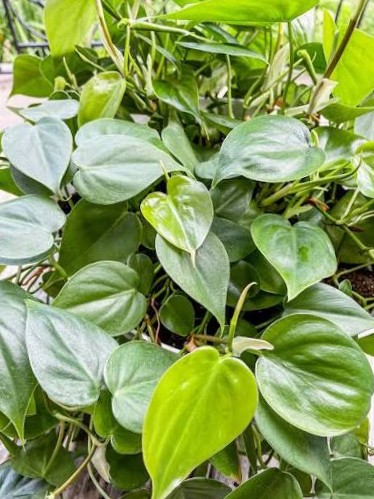
The familiar leaves are broadly ovate to heart-shaped, with a deep basal sinus, smooth margins, and a pointed tip. Plain-green plants generally have thin to moderately leathery blades that are more symmetrical and less waxy than typical Golden Pothos leaves.
Leaf size depends heavily on maturity, light, moisture, humidity, nutrition, rooting conditions, and whether the vine climbs or trails. A hanging plant in ordinary indoor conditions often retains small juvenile leaves. A well-rooted vine climbing a moist trunk or support can produce thicker stems and substantially larger foliage.
Heartleaf Philodendron does not develop the deeply divided horsehead or saddle-shaped mature leaves characteristic of P. bipennifolium. It also does not naturally produce the large fenestrations or splits associated with mature Monstera deliciosa.
The species can produce a typical aroid inflorescence consisting of a fleshy spadix enclosed partly by a spathe. Flowering and fruiting are uncommon on ordinary juvenile houseplants but can occur on mature climbing specimens in tropical or greenhouse conditions.
Inflorescences, developing fruit, seeds, aerial roots, terrestrial roots, and old stems should not be declared safe merely because household exposures usually involve the leaves.
Houseplant Cultivars and Naming Confusion
The ordinary Heartleaf Philodendron has solid-green foliage. Several popular variegated, chartreuse, striped, or velvety plants are sold within the broader Philodendron hederaceum horticultural complex.
‘Brasil’ commonly has a broad yellow, lime, or cream stripe through the center of a darker green leaf. ‘Lemon Lime’ produces bright chartreuse to yellow-green foliage. Cream Splash, Silver Stripe, Rio, Gabby, and related trade selections differ in the pattern and proportion of cream, silver, pale green, dark green, or yellow coloration.
Micans or Velvet-Leaf Philodendron typically has soft velvety foliage with bronze-green, copper, red, or purple tones. The historical botanical name Philodendron micans is currently placed within P. hederaceum var. hederaceum.
Retail cultivar identification is not always consistent. Similar-looking variegated plants may be mislabeled, renamed, propagated under unofficial trade names, or sold without documented parentage. Exact cultivar identity is less important during first aid than confirming that the plant is a philodendron or another calcium-oxalate-containing aroid.
All of these cultivated forms should remain inaccessible to animals. Variegation changes pigment distribution, not the fundamental veterinary recommendation.
Red Emerald, Red Princess, Pink Princess, White Princess, White Wizard, Birkin, Congo, and many other commercial Philodendrons belong to different species, hybrids, or cultivar groups. They may share a calcium oxalate hazard but should not be listed as synonyms of Heartleaf Philodendron.
Pothos, Scindapsus, Monstera, and Other Look-Alikes
Heartleaf Philodendron is frequently confused with Golden Pothos, Epipremnum aureum. Both are trailing or climbing aroids with heart-shaped juvenile foliage.
Golden Pothos generally has thicker, waxier, more irregularly shaped leaves, grooved or winged petioles, and more conspicuous aerial-root development. Heartleaf Philodendron more often has thinner, more symmetrical leaves, a deeper heart-shaped sinus, and smooth rounded petioles.
The distinction matters botanically but usually does not change the immediate first-aid approach because both plants contain insoluble calcium oxalate crystals and are unsafe to chew.
Satin Pothos is generally Scindapsus pictus, a different aroid with matte foliage and silver markings. Cebu Blue and Baltic Blue Pothos are forms associated with Epipremnum pinnatum. These are not Heartleaf Philodendron even though retailers may group them with similar trailing houseplants.
Fruit Salad Plant and Swiss Cheese Plant commonly refer to Monstera deliciosa. Mature Monstera leaves develop large splits and natural holes. Split-Leaf Philodendron is an ambiguous common name that has been used for Monstera and for large self-heading plants now placed in Thaumatophyllum.
Horsehead Philodendron is Philodendron bipennifolium. Its mature leaves become substantially larger and develop pronounced projecting lobes, unlike the familiar heart-shaped blades of P. hederaceum.
What the Experimental and Clinical Evidence Shows
Heartleaf Philodendron is routinely classified as an insoluble-calcium-oxalate plant because chewing may expose the mouth to mechanically irritating crystals. However, direct toxicological evidence does not support the dramatic systemic syndrome sometimes attributed broadly to all Philodendrons.
A 1978 toxicological assessment used the former name Philodendron oxycardium, now associated with P. hederaceum var. oxycardium. Cats received minced leaf material orally at substantial amounts, including approximately 2.8, 5.6, and 9.1 grams per kilogram.
The cats did not develop acute clinical signs or gross lesions attributable to the exposure. This finding strongly challenges claims that ordinary ingestion predictably causes renal failure, encephalitis, seizures, or fatal systemic oxalate poisoning in cats.
The study does not prove that chewing a fresh leaf cannot hurt. Administration of minced material under experimental conditions is not identical to an animal biting and crushing a living leaf, releasing crystals directly against the lips, tongue, and oral mucosa.
It does show that the plant should not be presented as a predictable systemic renal poison based solely on historical anecdotal reports.
A poison-center review of 127 childhood Philodendron ingestions likewise found that effects were predominantly mild and associated with local oral irritation or stomatitis. Severe outcomes were not the expected course.
These data fit the practical veterinary picture: most exposed animals experience immediate local pain, salivation, vomiting, or transient swallowing difficulty, and most recover after the source is removed and complications are controlled.
How Crystal-Associated Injury Develops
Calcium oxalate crystals form within specialized plant cells and can take several shapes. Needle-like raphides are particularly effective at penetrating soft moist surfaces, while druses form rounded or star-like aggregates.
Microscopic studies of Philodendron demonstrate that crystal morphology and location vary among species and tissues. Raphides may be abundant in one organ or taxon and difficult to detect in another sample.
This variation helps explain why one aroid may produce more intense irritation than another and why two exposures involving the same general plant group may differ substantially.
When a pet bites a leaf or stem, cell rupture, compression, sap movement, and saliva can release crystal material into the mouth. The resulting sensation has been compared with chewing fiberglass or receiving many microscopic splinters at once.
Crystal penetration damages epithelial cells and creates small channels through the tissue. Sap and additional plant compounds may then move more deeply into the injured area, increasing inflammation and pain.
Experimental research with other raphide-containing plants demonstrated that raphides can amplify the activity of cysteine proteases through this needle effect. The finding supports a general mechanism but does not establish that Heartleaf Philodendron contains the same enzyme at a clinically significant concentration.
The safest description remains that insoluble calcium oxalate is confirmed and additional plant irritants may contribute.
Kidney, Liver, and Neurologic Claims
Insoluble calcium oxalate crystals act mainly at the point of contact. They are not readily dissolved and absorbed in the manner required to produce the classic systemic soluble-oxalate syndrome.
Primary hypocalcemia, widespread kidney-crystal deposition, acute oxalate nephropathy, and direct cardiac toxicity are therefore not expected after an ordinary Heartleaf Philodendron exposure.
Historical reports of cats developing seizures, neurologic disease, kidney failure, or death after alleged Philodendron exposure did not always establish exact plant identity, dose, timing, competing illness, or causation. Later experimental findings did not reproduce that syndrome with P. oxycardium.
A cat may still develop secondary medical problems. Painful swallowing and nausea can cause prolonged food refusal, and sustained anorexia can contribute to hepatic lipidosis. Vomiting may cause dehydration or aspiration. Airway swelling can cause oxygen deprivation. None of these complications requires a direct systemic oxalate mechanism.
Abnormal liver values after a suspected Philodendron exposure must be interpreted carefully. They may reflect anorexia, dehydration, preexisting disease, medication, another toxin, or an unconfirmed plant identity rather than direct hepatotoxicity from Heartleaf Philodendron.
Seizures, coma, paralysis, major pupil abnormalities, renal failure, jaundice, severe arrhythmias, or profound collapse should trigger investigation for another toxin, pesticide, fertilizer, medication, oxygen deprivation, aspiration, obstruction, or unrelated disease.
Household Exposure, Diagnosis, Prevention, and Prognosis
Heartleaf Philodendron is commonly displayed in hanging baskets, on shelves, in wall planters, and on poles or trellises. Elevation alone does not provide dependable protection because vines may grow downward, attach to furniture, reach a nearby cat tree, or fall after a container is pulled.
Propagation is easy from stem sections containing a viable node. Cuttings may be rooted in water, moss, bark, or potting media. Every cutting remains capable of causing irritation.
Propagation water should not be used as pet drinking water. It may contain sap, fertilizer, algae, bacteria, mold, decaying tissue, or pesticide residue even though one small drink does not necessarily reproduce the intense chewing injury.
Freshly cut stems can contaminate pruning tools, gloves, floors, countertops, clothing, furniture, bedding, and animal fur. Sap-covered paws or coats may transfer plant material into the mouth or eyes during grooming.
No routine blood or urine test confirms Heartleaf Philodendron exposure. Diagnosis relies on plant identification, witnessed chewing, missing material, compatible immediate oral signs, examination of the mouth and eyes, and exclusion of other causes.
Useful evidence includes the complete plant, nursery tag, photographs of leaves and petioles, representative stem sections, vomited fragments, potting-medium packaging, fertilizer labels, pesticide information, and an inventory of missing support ties or decorative materials.
Persistent gagging or vomiting may require oral examination, radiographs, ultrasound, contrast imaging, or endoscopy to identify a lodged vine or foreign body. Eye exposure may require fluorescein staining and examination beneath the eyelids.
Prevention requires controlling trailing growth, stabilizing the container and support, collecting fallen leaves and cuttings, securing propagation containers, cleaning sap promptly, and keeping pruning waste out of kennels, paddocks, bird cages, rabbit areas, and open compost.
Most limited exposures have a good-to-excellent prognosis. Oral pain and drooling usually begin improving within several hours. Moderate inflammation may interfere with eating or drinking for the remainder of the day.
Recovery may take longer after extensive ulceration, corneal injury, aspiration, dehydration, infection, airway compromise, or gastrointestinal obstruction. Symptoms lasting several days should not be dismissed as the normal effect of one small bite.
Immediate Steps After Heartleaf Philodendron Exposure
- Stop further access. Move the animal away from leaves, petioles, climbing stems, aerial roots, terrestrial roots, cuttings, sap, propagation water, potting debris, and discarded plant material.
- Confirm the plant. Preserve labels using Philodendron hederaceum, Philodendron scandens, Philodendron oxycardium, Heartleaf Philodendron, Sweetheart Plant, Micans, Brasil, or another cultivar name.
- Remove only loose visible material. When the animal is calm and breathing normally, lift away plant fragments resting at the lips or front of the mouth.
- Do not reach deeply. Do not place fingers into the throat of an animal that is gagging, panicked, painful, struggling, or breathing abnormally.
- Protect your hands. Wear gloves or use gauze or a clean damp cloth when handling sap-covered material, saliva, or vomit.
- Gently rinse or wipe the mouth. Use cool water or a clean wet cloth to remove loose sap and fragments from the lips, gums, and front of the tongue.
- Do not pour water toward the throat. Painful or impaired swallowing increases aspiration risk.
- Offer something cool only when swallowing is clearly normal. A fully alert animal breathing normally and not repeatedly vomiting may receive a small amount of cool water, milk, yogurt, cottage cheese, or soft food.
- Treat dairy or soft food as comfort care, not an antidote. It may help clear loose material and temporarily soothe tissue but cannot remove embedded crystals.
- Preserve evidence. Save the plant, label, photographs, vomited fragments, potting-medium information, fertilizer packaging, and pesticide labels.
Airway and Swallowing Emergency
Recheck the lips, tongue, voice, swallowing ability, and breathing during the first several hours. Swelling may progress after the initial bite.
- Watch for failed swallowing. Continuous drooling with repeated unsuccessful swallowing, neck extension, or coughing after drinking requires examination.
- Listen for voice changes. A weak, hoarse, or altered bark or meow may indicate deeper inflammation.
- Listen for stridor. Harsh or noisy inhalation suggests narrowing near the larynx or upper airway.
- Watch body position. Open-mouth breathing, elbows held away from the chest, refusal to lie down, neck extension, or panic indicates respiratory distress.
- Check mucous-membrane color. Blue-gray lips, gums, or tongue indicate inadequate oxygen.
- Minimize stress. Keep the animal quiet and avoid repeated mouth examinations or forceful restraint.
- Give nothing by mouth. Do not offer food, water, medication, or charcoal when swallowing is impaired.
Rapidly increasing swelling, inability to swallow saliva, stridor, open-mouth breathing, blue-gray gums, collapse, or loss of consciousness requires immediate emergency transportation.
Veterinary airway care may include oxygen, injectable medication, sedation, endotracheal intubation, assisted ventilation, or another emergency airway procedure.
Do Not Induce Vomiting or Force Activated Charcoal
The principal injury occurs when plant tissue is crushed in the mouth. An emetic cannot remove crystals embedded in the lips, gums, tongue, palate, pharynx, or esophagus.
Vomiting can carry plant fragments and acidic stomach contents back across punctured and inflamed tissue. Drooling, swelling, gagging, and painful swallowing also increase aspiration risk.
- Do not use hydrogen peroxide, salt, mustard, ipecac, detergent, oil, or manual gagging.
- Never use hydrogen peroxide as a feline emetic.
- Never attempt to induce vomiting in a horse.
- Do not induce vomiting in an animal with oral swelling, gagging, vomiting, weakness, altered awareness, breathing difficulty, or impaired swallowing.
- Do not force activated charcoal. Charcoal does not extract mineral crystals from tissue and may be aspirated.
- Do not attempt gastric lavage at home. Lavage rarely addresses the primary oral injury and would require anesthesia and airway protection in an unusual major ingestion.
Oral Pain, Eating, and Hydration
Do not scrub the mouth aggressively. Vigorous wiping can drive loose crystal material into tissue, increase bleeding, and worsen pain.
Cool water, a cool damp cloth, or a small amount of refrigerated soft food may provide temporary comfort when the animal is alert and swallowing normally.
Monitor whether the animal can swallow saliva, drink without coughing, and retain small amounts of water. An animal that repeatedly approaches the bowl but pulls away may have substantial oral or esophageal pain.
Do not force-feed a nauseated, gagging, vomiting, or painfully swallowing animal. Cats that continue refusing food require veterinary guidance because prolonged anorexia can cause additional metabolic disease.
Veterinary oral examination may require sedation to inspect beneath the tongue, behind the teeth, across the palate, and within the pharynx safely.
Skin, Fur, and Eye Exposure
Prevent the animal from grooming sap-covered paws, skin, or fur until washing is complete.
Wear gloves and wash exposed skin and fur with mild soap or pet-safe shampoo and lukewarm water. Rinse thoroughly without aggressive scrubbing.
Direct contaminated rinse water away from the eyes and mouth. Do not use peroxide, alcohol, bleach, solvents, concentrated vinegar, essential oils, or abrasive cleaners.
Persistent redness, itching, swelling, pain, rash, blistering, or repeated licking requires veterinary guidance.
Flush an exposed eye immediately with sterile saline or clean lukewarm water for at least 15 to 20 minutes.
- Do not rub the eye. Rubbing may drag crystals or plant debris across the cornea.
- Prevent pawing. Use safe restraint or an Elizabethan collar when available.
- Do not use human redness drops or leftover eye medication. Steroid-containing medication can worsen an undiagnosed corneal ulcer.
- Seek examination for persistent signs. Continued squinting, tearing, redness, cloudiness, discharge, eyelid swelling, light sensitivity, or visual uncertainty requires care.
Gastrointestinal and Foreign-Body Monitoring
Record each vomiting and diarrhea episode and note whether plant material, foam, blood, coffee-ground material, black stool, support ties, or potting debris appears.
Monitor appetite, water intake, urination, gum moisture, activity, abdominal comfort, and fecal production.
Dry or tacky gums, sunken eyes, reduced urination, weakness, persistent vomiting, or inability to retain water requires veterinary attention.
Determine whether the animal merely punctured one leaf or whether a vine, petiole, aerial-root bundle, moss-pole fiber, string, wire, or large plant mass is missing.
Persistent gagging, repeated swallowing, regurgitation, continued vomiting, abdominal enlargement, increasing pain, reduced stool, or inability to retain water may indicate obstruction.
Do not pull a long plant fiber, string, root, or support material protruding from the mouth or rectum without veterinary direction.
Veterinary Examination and Treatment
There is no antidote that dissolves or extracts crystals after they have penetrated tissue. Treatment is directed toward airway protection, pain, inflammation, vomiting, hydration, eye injury, and mechanical complications.
The veterinarian may examine the lips, gums, tongue, palate, pharynx, laryngeal area, eyes, hydration, abdomen, breathing, and neurologic status.
Veterinary treatment may include:
- Airway support. Oxygen, sedation, intubation, assisted ventilation, or emergency airway procedures may be required when swelling compromises breathing.
- Pain control. Prescription analgesia may be necessary for substantial stomatitis, tongue injury, pharyngeal inflammation, eye pain, or esophageal injury.
- Anti-inflammatory treatment. A veterinarian may use selected medication when clinically important edema is present.
- Antihistamines when appropriate. These may be used in selected hypersensitivity reactions but cannot remove crystals and do not replace airway management.
- Anti-nausea medication. Persistent vomiting may require a veterinarian-selected antiemetic.
- Fluid therapy. Subcutaneous or intravenous fluids may be needed when pain, vomiting, diarrhea, or food refusal causes dehydration.
- Gastrointestinal protection. Mucosal-support medication may be considered when painful swallowing, repeated vomiting, blood, or suspected esophageal injury is present.
- Eye treatment. Fluorescein staining, eyelid examination, removal of retained debris, lubrication, pain control, and corneal-ulcer treatment may be required.
- Foreign-body removal. A lodged vine, root bundle, support tie, or fibrous mass may require endoscopic or surgical removal.
Seizures, profound collapse, renal failure, jaundice, major arrhythmias, or coma requires investigation for another toxin, chemical co-exposure, severe oxygen deprivation, aspiration, obstruction, or unrelated disease.
Medication and Home-Treatment Warnings
- Do not give diphenhydramine automatically. It cannot remove crystals and must not delay airway assessment.
- Do not give calcium tablets or concentrated supplements. They cannot pull embedded crystals from tissue and may create additional medical problems.
- Do not give human antidiarrheals, antacids, bismuth products, or stomach remedies automatically.
- Do not give ibuprofen, naproxen, aspirin, acetaminophen, or other human pain relievers.
- Do not use essential oils or concentrated citrus products as repellents or treatments.
- Do not use fixed medication doses from older plant-poisoning pages. Medication selection and dosing must be based on the individual animal and current examination findings.
Horses, Livestock, Rabbits, Birds, and Other Animals
Remove horses, livestock, rabbits, birds, reptiles, and other animals from live plants, cut vines, roots, propagation containers, and discarded material.
Horses cannot vomit and may develop salivation, painful chewing, dropped feed, reduced appetite, difficulty swallowing, colic-like discomfort, or diarrhea.
Rabbits, guinea pigs, birds, and other small animals may receive a medically important exposure from an amount that appears minor to a person.
Do not apply dog or cat emesis instructions, oral-fluid recommendations, charcoal use, or medication protocols to another species. Obtain species-specific veterinary advice.
Prevention, Recovery, and Prognosis
Trim trailing growth before it reaches floors, furniture, cages, aquariums, kennels, or cat trees. Secure climbing stems and aerial roots so they cannot spread into animal-accessible areas.
Stabilize hanging containers, shelves, poles, and trellises so a pet cannot pull the entire plant down by one vine.
Root cuttings inside a closed room or secure plant cabinet. Keep propagation water inaccessible and remove fallen leaves, petioles, roots, and potting debris promptly.
Wear gloves during pruning and repotting, wash tools and hands, and clean sap from floors, counters, furniture, clothing, and bedding.
Most limited exposures have a good-to-excellent prognosis. Drooling, mouth pain, and pawing often improve within several hours.
Moderate inflammation may interfere with eating and drinking for a day or longer and may require pain control, anti-nausea medication, or fluids.
Prognosis becomes more serious when swelling affects the airway, aspiration occurs, the cornea is injured, or a vine causes obstruction. Prompt airway protection and removal of foreign material substantially improve the outlook.
Frequently Asked Questions About Heartleaf Philodendron and Animal Poisoning
Is Heartleaf Philodendron the same plant as Horsehead Philodendron?
No. Heartleaf Philodendron is Philodendron hederaceum, a slender trailing or climbing plant with broadly heart-shaped leaves. Horsehead Philodendron is Philodendron bipennifolium, whose mature leaves become much larger and develop a violin-, saddle-, or horsehead-like outline. Both are aroids and should not be chewed, but they are separate species.
What is the accepted scientific name for Heartleaf Philodendron?
The accepted species is Philodendron hederaceum (Jacq.) Schott. Philodendron scandens remains a familiar historical name. Philodendron oxycardium is associated with the accepted variety Philodendron hederaceum var. oxycardium.
Is Philodendron cordatum another scientific name for Heartleaf Philodendron?
No. “Cordatum” is often used loosely on nursery labels because it means heart-shaped, but Philodendron cordatum is a separate accepted Brazilian species. It is not a botanical synonym of Philodendron hederaceum.
Is Philodendron micans part of the Heartleaf Philodendron group?
Yes. The historical name Philodendron micans is currently placed within Philodendron hederaceum var. hederaceum. Micans usually has velvety bronze-green or reddish foliage, while the ordinary Heartleaf Philodendron has smoother glossy green leaves.
Are Brasil, Lemon Lime, Rio, and Cream Splash Philodendrons poisonous?
They should all be treated as poisonous to chew. These names identify cultivated selections associated with the Philodendron hederaceum horticultural complex. Their yellow, cream, silver, lime, or variegated pigmentation does not remove the insoluble-calcium-oxalate hazard.
Is Heartleaf Philodendron the same as Golden Pothos?
No. Heartleaf Philodendron is Philodendron hederaceum, while Golden Pothos is Epipremnum aureum. Heartleaf Philodendron usually has thinner, more symmetrical leaves and smooth rounded petioles. Pothos generally has thicker waxier leaves and grooved or winged petioles. Both are raphide-containing aroids and are unsafe for pets to chew.
What exactly makes Heartleaf Philodendron poisonous?
The principal concern is insoluble calcium oxalate stored in microscopic crystal-containing cells. Needle-shaped raphides and other crystal forms can injure contacted tissue when the plant is crushed. Additional sap constituents may intensify inflammation, but no specific protease has been established as the defining Heartleaf Philodendron toxin.
Did experimental cats develop kidney failure after eating Heartleaf Philodendron?
No. In a toxicological assessment using the former name Philodendron oxycardium, cats given substantial amounts of minced leaf material did not develop acute clinical signs or lesions attributed to the exposure. The study does not prove that chewing fresh leaves is painless, but it argues strongly against claims of predictable systemic kidney failure or fatal oxalate poisoning.
Can Heartleaf Philodendron cause liver damage in a cat?
Direct liver poisoning is not the expected insoluble-calcium-oxalate mechanism. However, oral pain or nausea may cause prolonged food refusal, and sustained anorexia can contribute to secondary hepatic lipidosis in cats. Abnormal liver values require evaluation for anorexia, dehydration, another toxin, medication, preexisting disease, or incorrect plant identification.
Can Heartleaf Philodendron stop a pet from breathing?
Severe tongue, pharyngeal, or laryngeal swelling can obstruct airflow, although this is uncommon. Harsh or noisy inhalation, open-mouth breathing, neck extension, inability to swallow saliva, blue-gray gums, panic, weakness, or collapse requires emergency care.
Can milk, yogurt, or soft food help?
A small amount of cool water, milk, yogurt, cottage cheese, or soft food may soothe the mouth and help clear loose plant material when the animal is fully alert, breathing normally, swallowing comfortably, and not repeatedly vomiting. It cannot dissolve or remove crystals already embedded in tissue and must not be forced.
Should I give Benadryl?
Do not administer diphenhydramine automatically. It cannot remove calcium oxalate crystals or neutralize sap, and it must not delay airway evaluation. A veterinarian may use an antihistamine in a selected hypersensitivity reaction, but serious swelling requires direct airway and cardiovascular assessment.
How long should symptoms last?
Most limited oral exposures begin improving within several hours and resolve within approximately one day. Symptoms continuing for days suggest extensive ulceration, painful esophageal injury, corneal damage, aspiration, dehydration, infection, retained plant material, gastrointestinal obstruction, another toxin, or an unrelated condition.