Startup Budget, Revenue Drivers, Payroll, Profit and Loss, Cash Flow, Balance Sheet, Unit Economics, Break-Even, Opening Reserve, Scenarios, Risk, and Lender Preparation
Dog Daycare Financial Projections and Lender Plan
Part three of the PAWS dog daycare business-plan series: turn the researched market and operating model into projections that show how much money the project requires, whether it survives the opening ramp, and how a lender or investor can evaluate the request.
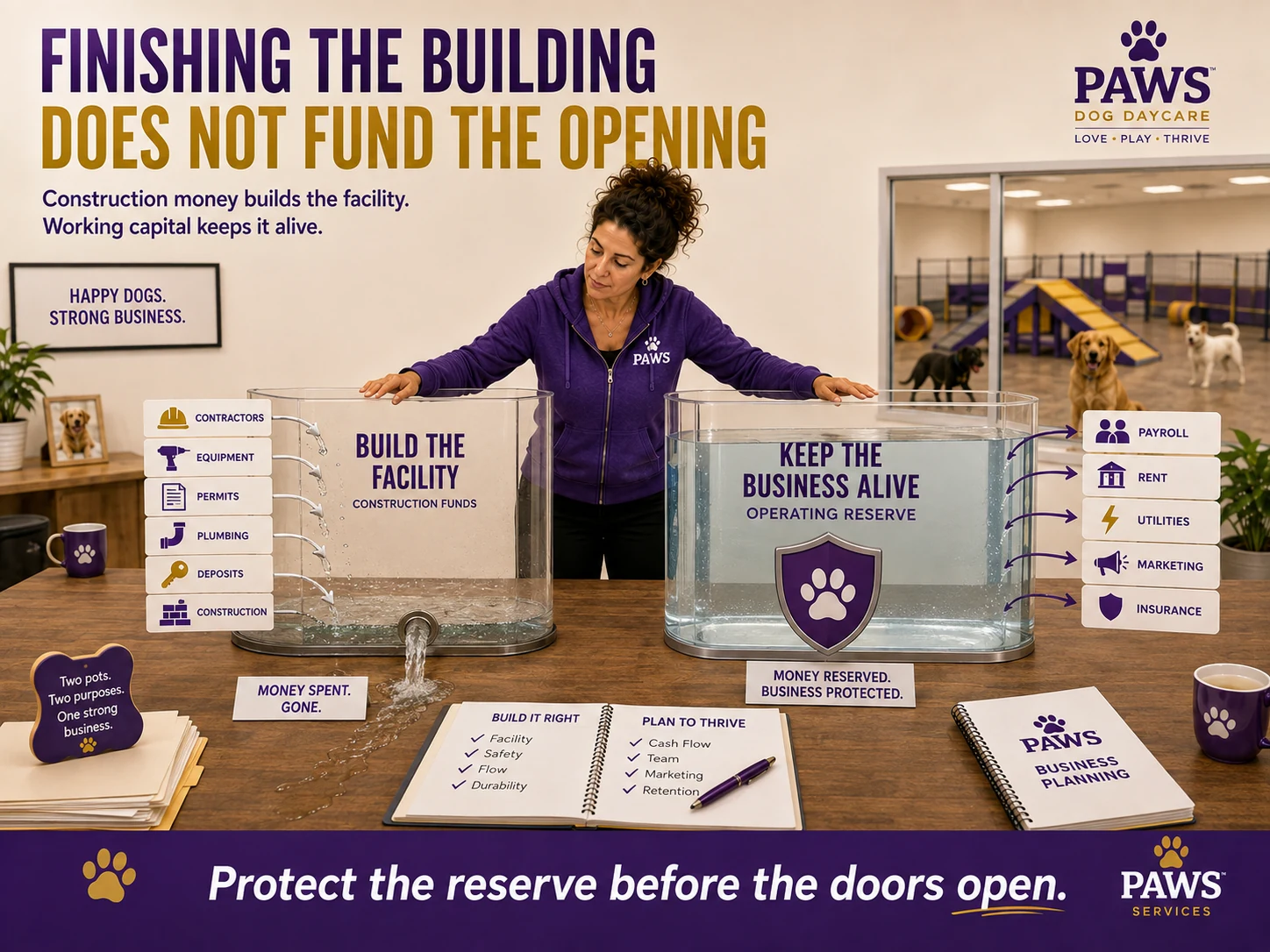
The financial model is where the business-plan story has to survive arithmetic. Every sales number should connect to customers, service units, collected prices, capacity, and timing. Every payroll number should connect to the work that must be performed. Every funding request should connect to documented uses, contingency, and opening reserve.
This page preserves the startup-budget, financial-statement, worked-example, cash-flow, break-even, scenario, risk, lender, and post-opening review material from the complete PAWS business-plan guide.
Use it only after the market, location, capacity, services, staffing, and operating system have been defined. A sophisticated spreadsheet cannot repair assumptions that were never verified.
⚠️
Financial warning: precise numbers are not automatically reliable numbers.
A forecast can be mathematically correct and still be commercially false when the customer count, collected price, capacity, payroll, construction cost, or opening date underneath it is invented.
🗺️
Use the Three-Part Dog Daycare Business Plan Series
Each page answers a different decision. Use all three so the narrative, operation, and numbers describe the same business.
🧱
1. Build the Business Plan
Structure the document, use the complete outline, control revisions, and identify what must be proven.
🏢
2. Prove the Market and Operation
Validate demand, property, capacity, staffing, safety, pricing, and the customer pipeline.
📊
3. Build the Financial and Funding Model
Connect startup cost, revenue, payroll, cash flow, break-even, risk, and the lender package.
💰
Startup Budget and Sources of Funds
The amount required to finish construction is not the same as the amount required to open and survive.
The startup budget should show every planned use of cash from the first deposit through the point where the business can support itself. Separate one-time startup cost from recurring operating expense, and separate committed quotes from rough estimates.
The sources-of-funds side should show owner cash, investor funds, loans, landlord contributions, equipment financing, lines of credit, grants when real, and any other funding source. Timing matters. A reimbursement received after work is complete does not pay the contractor before the reimbursement arrives.
Keep contingency and working capital visible. Do not bury them inside construction or assume unused construction money will automatically become operating reserve. If the project uses the reserve to finish the build-out, the business may open already wounded.
Build the sources-and-uses schedule by timing as well as category. Identify when each deposit, contractor draw, equipment payment, permit fee, pre-opening payroll period, and marketing commitment becomes due, then match those dates to when each funding source is actually available. A committed source that arrives too late can still create a cash crisis.
Protect working capital with a separate minimum-reserve line rather than treating it as whatever is left after construction. If a change order would push the project below that minimum, the plan should require a funding decision, scope change, or stop decision before the reserve is consumed.
Typical Uses of Funds
- Lease deposit, initial rent, and utility deposits.
- Legal, accounting, architecture, engineering, design, and consulting.
- Zoning, permits, inspections, licenses, and professional reports.
- Construction, demolition, flooring, walls, plumbing, drains, HVAC, electrical, fire, and sound.
- Gates, kennels, suites, grooming equipment, laundry, furniture, technology, cameras, and security.
- Insurance, software, inventory, uniforms, cleaning supplies, marketing, training, and pre-opening payroll.
- Construction contingency and opening operating reserve.
Funding Sources
- Owner cash contribution.
- Investor equity.
- Term loan or government-backed lending program.
- Landlord tenant-improvement contribution.
- Equipment financing.
- Line of credit or documented contingency source.
- Other verified funding—not hope, future sales, or a credit card nobody has approved.
📊
The Financial Model Is Where the Story Has to Survive Arithmetic
Each statement answers a different question. One projected profit-and-loss page is not the whole model.
Build the financial model from the operating assumptions. Estimate daycare attendance, boarding nights, grooming appointments, average collected prices, payroll hours, occupancy cost, utilities, insurance, cleaning, software, payment fees, repairs, marketing, taxes, debt, and owner compensation.
The first year should normally be shown month by month because the opening ramp matters. Later years can be summarized more broadly, but they still need to connect to capacity, staffing, price changes, service growth, and capital needs.
| Financial Schedule | What It Answers | What It Must Connect To |
|---|---|---|
| Startup Budget | How much cash is required before and through opening? | Quotes, lease, build-out, equipment, professional fees, contingency, and reserve. |
| Sources and Uses | Where does the money come from and exactly where will it go? | Owner contribution, loan, investor funds, landlord funds, equipment financing, and timing. |
| Sales Forecast | How much revenue is generated by each service and when? | Attendance, nights, appointments, collected prices, seasonality, capacity, and ramp. |
| Payroll Forecast | What labor is required and what will it cost? | Hours, wages, taxes, benefits, management, specialists, overtime, training, and growth. |
| Projected Profit and Loss | Does revenue exceed operating expenses over the period? | Sales, cost of delivery, payroll, occupancy, overhead, marketing, depreciation, interest, and taxes. |
| Cash-Flow Projection | When does cash enter and leave, and does the business run out? | Opening balance, sales timing, deposits, debt, construction, equipment, payroll, taxes, and owner draws. |
| Projected Balance Sheet | What will the business own, owe, and retain at a point in time? | Cash, equipment, deposits, debt, payables, equity, and retained results. |
| Break-Even Analysis | What revenue or service volume is required to cover the cost structure? | Fixed costs, variable costs, average contribution, service mix, and owner compensation. |
| Debt Schedule | What principal and interest payments are due and when? | Loan amount, rate, term, fees, draw schedule, payment start, and pre-opening interest. |
| Capital Expenditure Plan | What major equipment, repairs, or expansion spending will be needed later? | Replacement cycles, growth, maintenance, expansion, and reserve planning. |
🧮
Worked Dog Daycare and Boarding Financial Example
This is an illustration of how assumptions connect. It is not an industry average, recommendation, promise, or substitute for your own numbers.
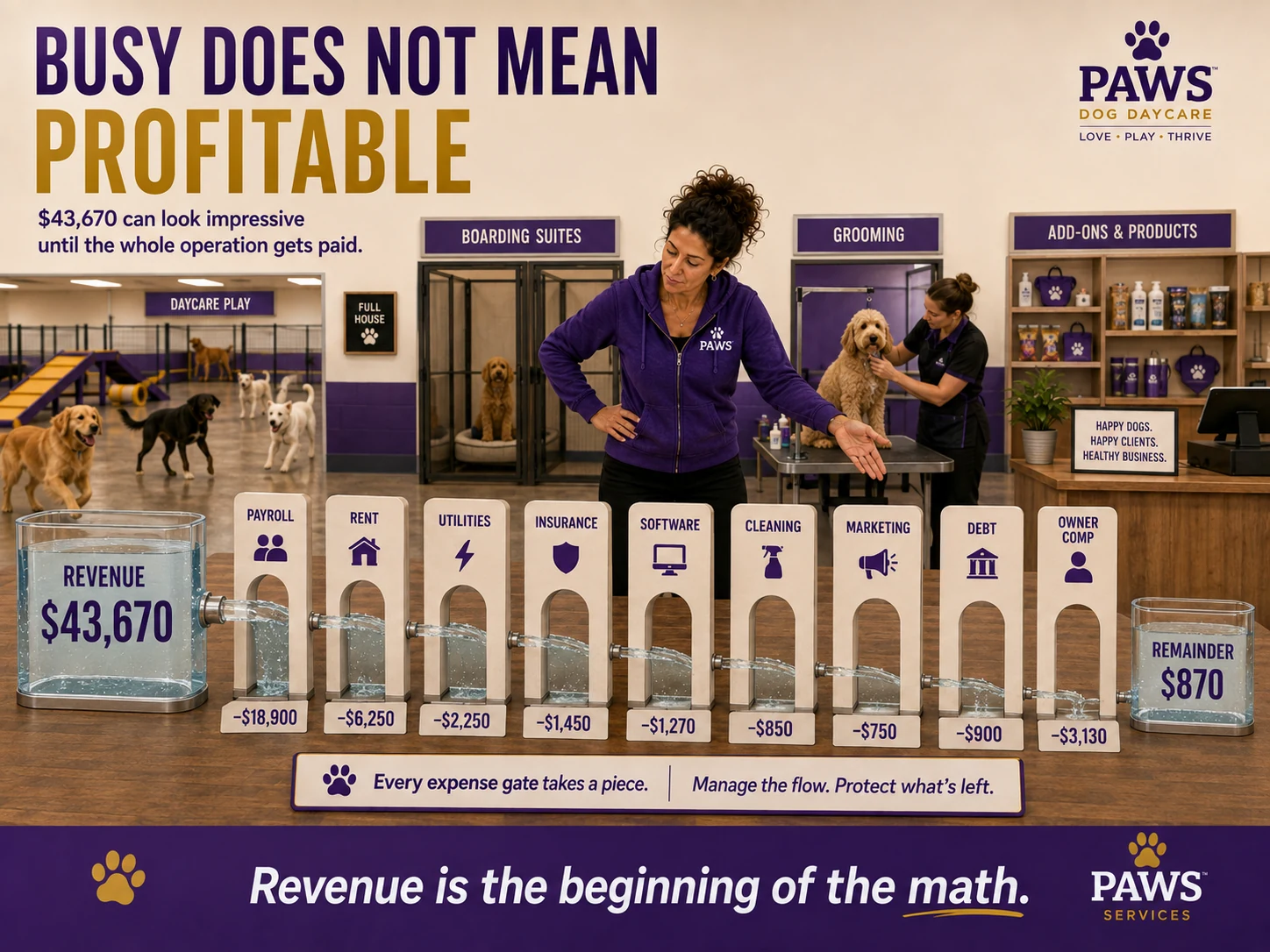
Assume a combination facility averages 35 paid daycare dogs per weekday, collects an average of $34 per daycare visit after packages and discounts, sells 180 boarding nights during the month at an average collected rate of $52, completes 85 grooming appointments at an average collected ticket of $78, and earns $1,500 from legitimate add-ons.
That sounds like a healthy amount of business. Now put the full operation underneath it.
Swipe left/right to see the full table.
| Illustrative Monthly Item | Example Calculation | Example Amount | Operator Read |
|---|---|---|---|
| Daycare Revenue | 35 paid dogs × $34 collected × 22 weekdays | $26,180 | The result depends on paid attendance and collected price, not posted price or maximum capacity. |
| Boarding Revenue | 180 occupied nights × $52 collected | $9,360 | The plan still needs to explain seasonality and the labor behind those nights. |
| Grooming Revenue | 85 appointments × $78 collected | $6,630 | The groomer, room, utilities, supplies, and compensation must exist. |
| Add-On Revenue | Baths, nail trims, enrichment, retail, or other verified sales | $1,500 | Add-ons should be based on a realistic attachment rate, not wishful participation. |
| Total Revenue | Daycare + boarding + grooming + add-ons | $43,670 | Revenue is only the top line. Now pay for the machine that created it. |
| Wages | Handlers, front desk, boarding, grooming support, cleaning, and management coverage | $19,000 | A busy facility can still fail if labor is not scheduled and priced correctly. |
| Payroll Taxes and Benefits | Employer payroll burden and benefits | $2,700 | Wages are not the full payroll cost. |
| Occupancy | Rent and property-related charges | $7,200 | The building gets paid before the owner does. |
| Utilities | Electric, water, gas, sewer, trash, internet, and phones | $1,800 | Laundry, hot water, ventilation, and climate control can be expensive. |
| Insurance | Business, property, liability, workers compensation, and related coverage | $1,200 | Coverage needs vary; do not copy a generic number. |
| Software and Payment Fees | Booking, payroll, accounting, phones, card fees, and technology | $1,400 | Small percentages become real money at higher sales volume. |
| Cleaning, Laundry, and Waste | Chemicals, paper, laundry, waste, pest control, and related supplies | $1,300 | Cleanliness is a daily operating cost, not a leftover task. |
| Marketing | Advertising, website, local outreach, and customer acquisition | $1,000 | Customer flow does not maintain itself forever. |
| Repairs and Operating Supplies | Maintenance, replacements, office, dog-care, grooming, and facility supplies | $1,200 | Dogs, water, gates, floors, and equipment create wear. |
| Debt Service | Loan principal and interest | $2,500 | Debt is paid with cash even when accounting treatment differs. |
| Owner Compensation | Planned owner pay | $3,500 | A business that only works when the owner is free has not proven it supports the owner. |
| Remaining Before Other Taxes and Unplanned Costs | $43,670 revenue − $42,800 listed costs | $870 | A business can look busy and still have almost no room for error. |
⚠️
Example warning
This example is not telling you what your prices, payroll, rent, or service volume should be. It is showing why revenue alone is a terrible way to judge whether a dog daycare or boarding business works.
🔀
Profit, Cash Flow, and the Balance Sheet Are Different Views
The worked example above is an operator cash view. A formal financial model should also separate accounting profit, cash movement, assets, debt, and owner withdrawals.
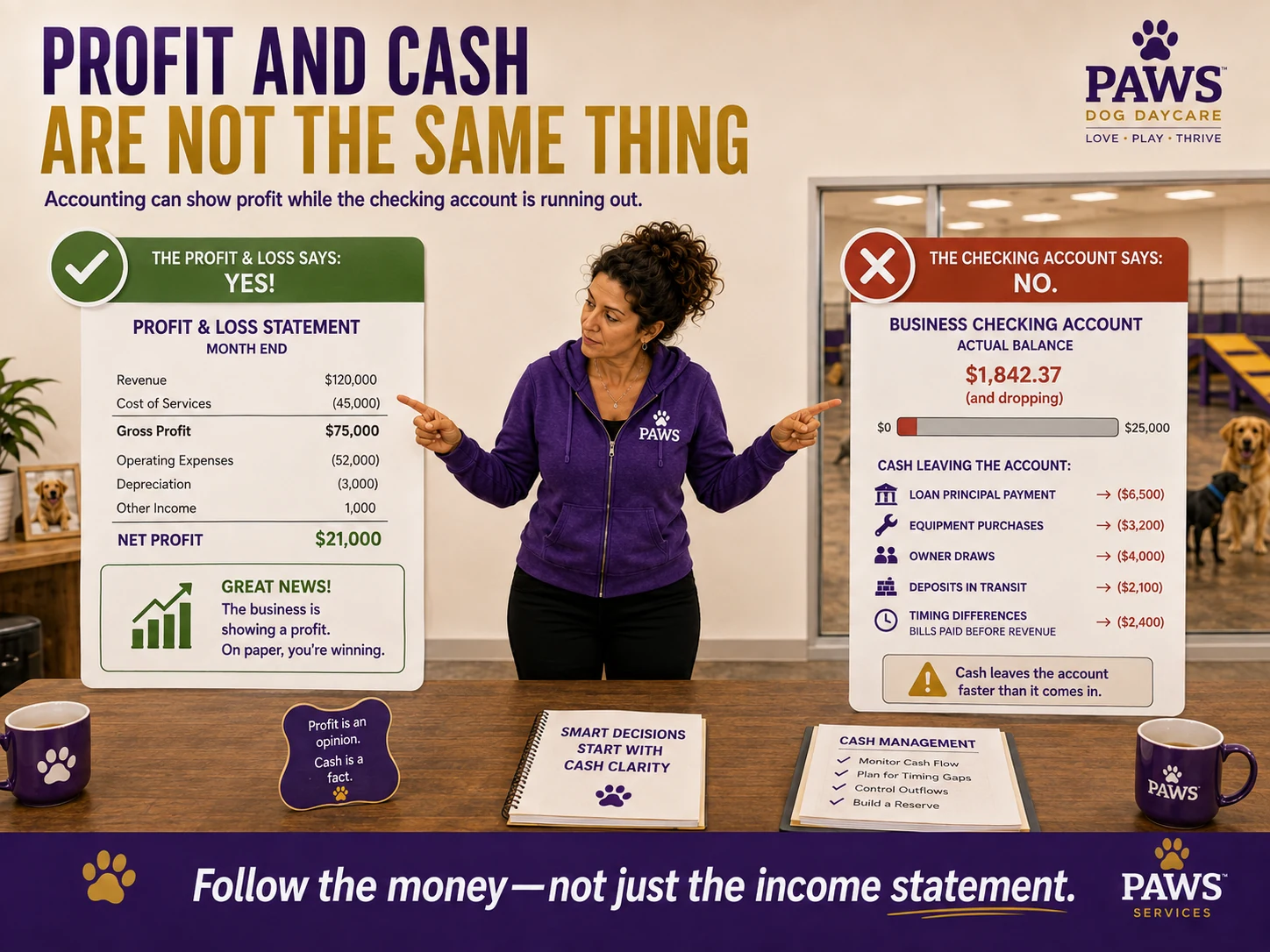
Loan principal usually reduces cash and debt but is not an ordinary operating expense on the profit-and-loss statement. Interest is generally an expense. Equipment purchases may create an asset rather than being expensed in full immediately, while depreciation can reduce accounting profit without creating a current cash payment. Owner pay can be treated differently depending on the entity, role, and method of payment.
Use a qualified accountant or tax professional for the actual entity and reporting treatment. The business-plan model should still make the cash consequences visible so a technically profitable operation does not run out of money.
Swipe left/right to see the full table.
| Item | Profit and Loss | Cash Flow | Balance-Sheet Effect |
|---|---|---|---|
| Loan Principal | Normally not an ordinary expense. | Cash outflow when paid. | Reduces outstanding debt. |
| Loan Interest | Generally an expense, subject to applicable rules. | Cash outflow when paid. | May be payable if accrued but unpaid. |
| Equipment Purchase | Often not expensed in full immediately. | Cash outflow or financing draw. | Creates an asset and possibly debt. |
| Depreciation | Noncash expense over the asset’s accounting life. | No current cash outflow from depreciation itself. | Reduces the carrying value of the asset. |
| Customer Deposit | May not yet be earned revenue. | Cash inflow. | May create a customer obligation or liability until earned. |
| Prepaid Package | Revenue recognition may occur as service is earned, depending on accounting treatment. | Cash may be received before visits occur. | Unused service can remain an obligation. |
| Owner Salary or Payroll | May be an operating expense when paid as compensation. | Cash outflow. | May create payroll liabilities until remitted. |
| Owner Draw or Distribution | Usually not an ordinary operating expense. | Cash outflow. | Reduces owner equity. |
🧬
Unit Economics: Find Out What Each Service Contributes
A busy service is not automatically a profitable service. Measure what remains after the costs that move with delivering it.
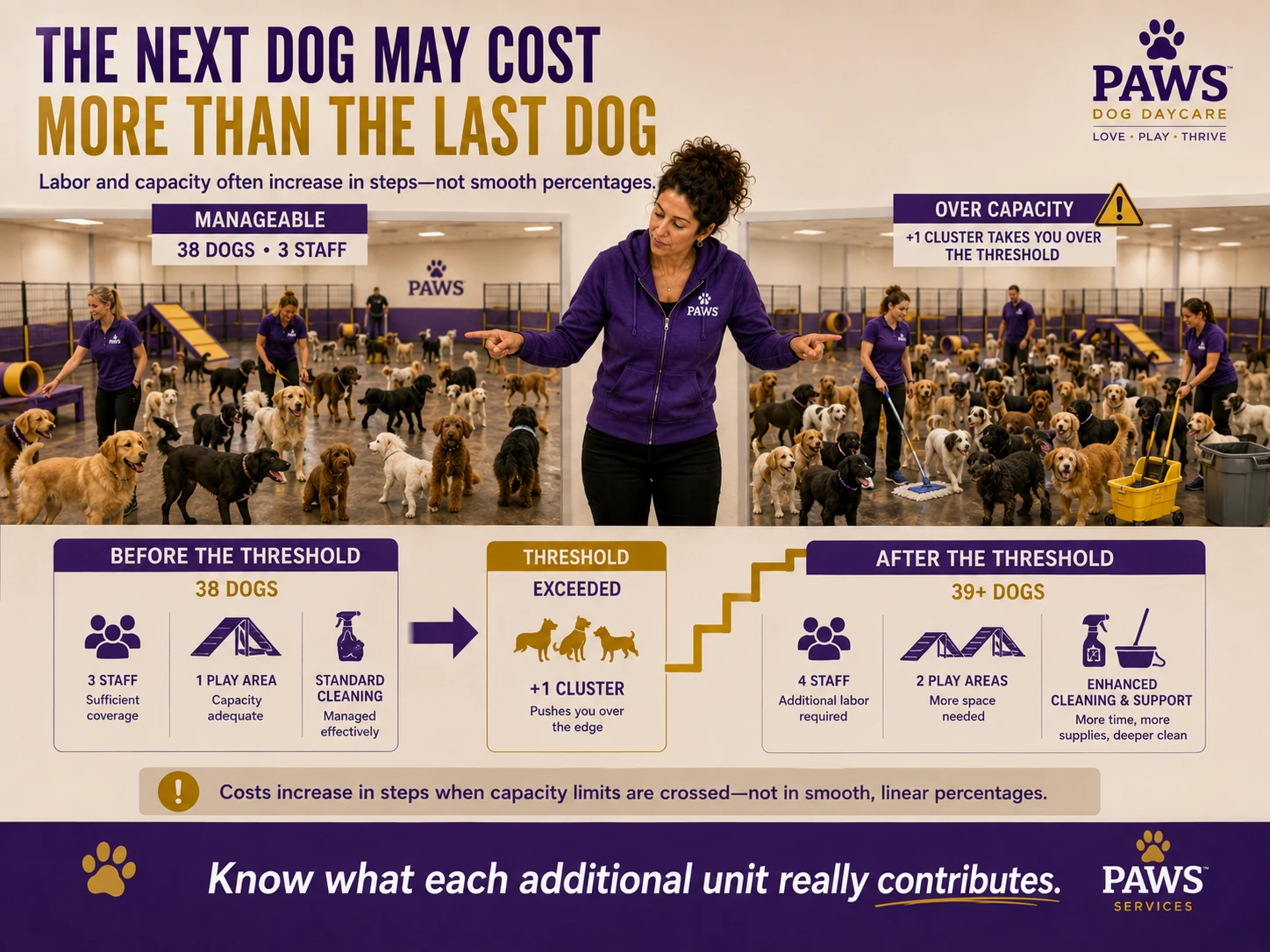
Unit economics do not replace the full profit-and-loss statement. They help explain whether each additional paid visit, occupied night, grooming appointment, class, or add-on contributes enough to carry fixed overhead and profit.
Be careful with labor. Some labor is fixed for a daypart, some grows in steps when another employee is required, and some is directly tied to a service. The cleanest model may show a range rather than pretending every labor minute can be assigned perfectly.
Model step costs explicitly. The thirty-ninth dog may not cost the same as the thirty-eighth if that next unit requires another handler, another room, a second cleaning cycle, more pickup coverage, or a different group split. Marginal contribution can change suddenly when an operating threshold is crossed.
Use unit economics to test decisions at the edge of capacity. The question is not only whether another dog produces revenue, but whether accepting that dog triggers enough additional labor, space, cleaning, risk, or service complexity to reduce the contribution of the entire group.
| Service Question | Why It Matters | Common Mistake |
|---|---|---|
| What is the average collected price? | Packages, discounts, refunds, promotions, and service mix can reduce the posted price. | Using the highest menu price for every unit. |
| Which costs increase with each unit? | These reduce the amount available to cover rent, management, debt, and profit. | Treating every cost as fixed or every cost as variable. |
| Where does labor increase in steps? | The next group, shift, boarder load, or grooming schedule may require another employee. | Assuming thirty-nine dogs and forty-five dogs have identical labor cost. |
| Does one service consume another service’s capacity? | Boarders, grooming holding, training, isolation, or transportation can occupy shared space and staff. | Counting both revenues while double-counting the same room or employee. |
| Does the service create customer value elsewhere? | Daycare may feed boarding and grooming; boarding may build loyalty; grooming may improve retention. | Using cross-sell value to excuse a service that loses money without control. |
🏨
Dog Boarding Occupancy, Available Nights, and Seasonality
Holiday demand can make boarding look stronger than the ordinary year. Model sellable nights by month and suite type.
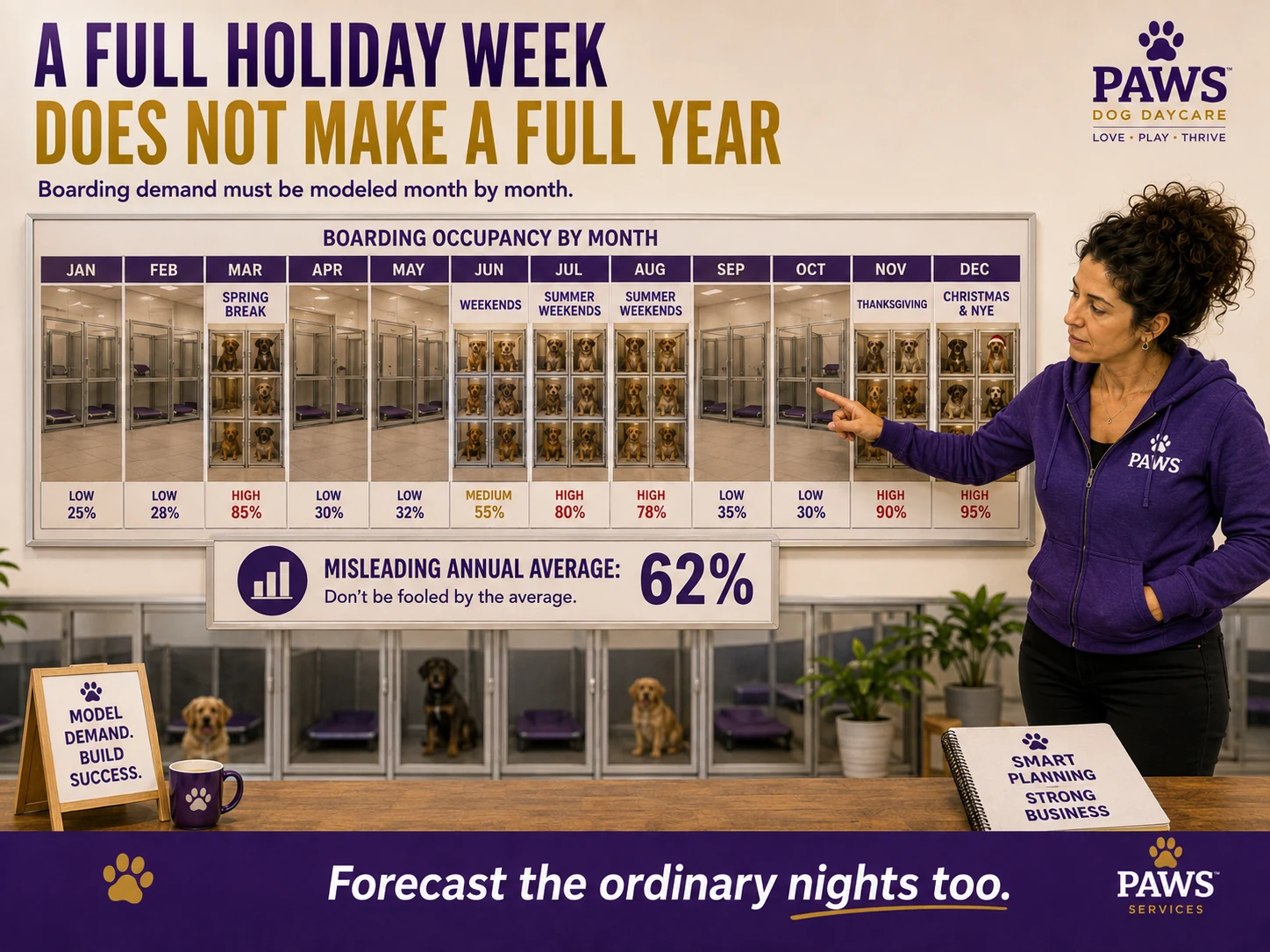
Boarding capacity is normally measured in occupied nights rather than daily daycare attendance. Start with sellable spaces, remove rooms held for isolation, maintenance, staff operations, or service limitations, and calculate available nights for each month.
Then model ordinary weekdays, weekends, school breaks, holidays, cancellations, minimum stays, deposits, suite categories, add-ons, and the effect boarders have on daycare playrooms, feeding, medication, cleaning, laundry, and staffing.
Swipe left/right to see the full table.
| Boarding Variable | What to Forecast | Why the Annual Average Can Mislead |
|---|---|---|
| Ordinary Week Occupancy | Normal non-holiday nights by weekday and weekend. | Peak weeks can hide long stretches of weak occupancy. |
| Holiday and School-Break Occupancy | Demand, minimum stays, staffing, cancellations, and premium pricing where used. | Holiday performance cannot be applied to every week. |
| Suite or Run Mix | Standard, premium, private, large-dog, family, or other categories. | A high blended rate may depend on premium inventory that is not always sold. |
| Unavailable Spaces | Isolation, maintenance, deep cleaning, repairs, behavior restrictions, or operational buffer. | Permitted spaces are not always sellable spaces. |
| Length of Stay | Average nights, arrival and departure patterns, turnover, and minimum stays. | Two short stays can create more cleaning and administrative work than one longer stay. |
| Deposits, Cancellations, and No-Shows | Collection policy, refund behavior, forfeiture, reselling, and chargebacks. | Reserved space does not always become collected revenue. |
| Boarder Daytime Care | Playgroup use, private exercise, feeding, rest, medication, and staffing. | Boarding nights can consume daytime capacity the plan already sold to daycare. |
⚠️
Boarding forecast warning
Do not annualize Thanksgiving, Christmas, spring break, or summer vacation occupancy across ordinary months. Forecast each month from the number of sellable nights and the demand pattern that actually applies.
📅
Illustrative 12-Month Customer, Revenue, and Cash Ramp
This is a mechanics example, not an industry benchmark. Replace every number with the actual service area, conversion, pricing, staffing, and cost assumptions.
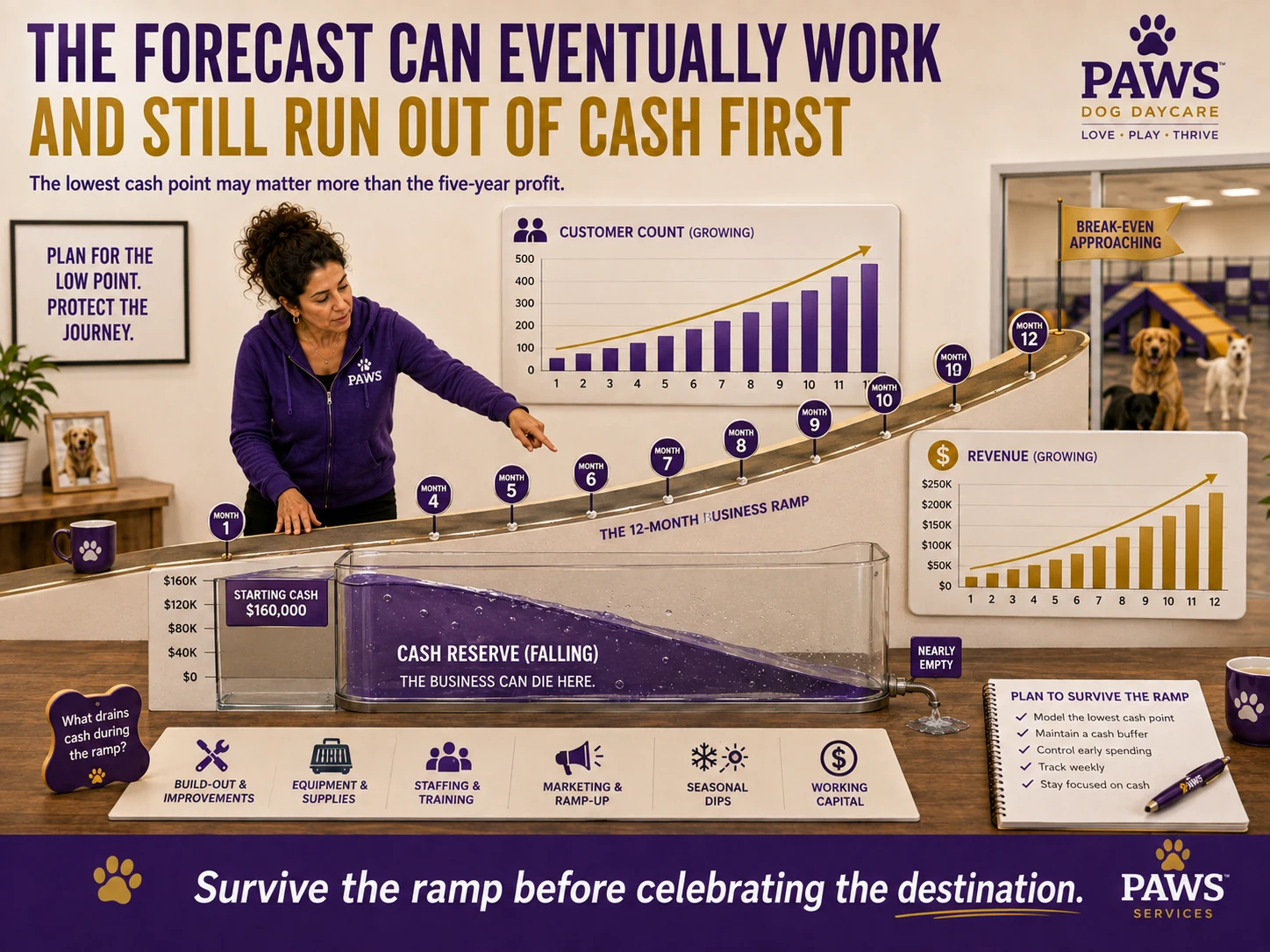
This illustration begins with $160,000 of working capital after construction and assumes the business adds active customers gradually while some customers churn. Daycare visits are built from the average active customer base and visit frequency. Boarding nights, grooming appointments, revenue, and operating cash cost also ramp by month.
The example nearly consumes the entire reserve before monthly operations reach cash break-even. That is the point. A project can eventually approach a healthy customer count and still fail if the opening reserve is too small for the path required to get there.
Set monthly trigger points before opening. Examples include minimum qualified leads, first visits, active customers, collected revenue, labor percentage, and ending cash. If the business misses a trigger for one or two periods, the response should already be defined instead of waiting until the reserve is nearly gone.
Track the lowest projected cash balance, not only the month the operation reaches break-even. A model that reaches positive monthly cash flow in month thirteen is still unacceptable if cash reaches zero in month ten. The reserve has to finance the path, not merely the destination.
Swipe left/right to see the full table.
| Month | Beginning Active Daycare Dogs | New Active Dogs | Churned Dogs | Ending Active Dogs | Paid Daycare Visits | Average Dogs per Weekday | Boarding Nights | Grooming Appointments | Total Collected Revenue | Operating Cash Cost | Monthly Cash Change | Ending Reserve |
|---|---|---|---|---|---|---|---|---|---|---|---|---|
| 1 | 0 | 20 | 0 | 20 | 30 | 1.4 | 20 | 10 | $3,040 | $30,000 | $-26,960 | $133,040 |
| 2 | 20 | 18 | 1 | 37 | 114 | 5.2 | 30 | 18 | $7,140 | $31,500 | $-24,360 | $108,680 |
| 3 | 37 | 16 | 2 | 51 | 198 | 9.0 | 45 | 25 | $11,422 | $32,500 | $-21,078 | $87,602 |
| 4 | 51 | 15 | 3 | 63 | 285 | 13.0 | 60 | 32 | $15,806 | $33,500 | $-17,694 | $69,908 |
| 5 | 63 | 14 | 3 | 74 | 363 | 16.5 | 70 | 40 | $19,702 | $34,500 | $-14,798 | $55,110 |
| 6 | 74 | 13 | 4 | 83 | 432 | 19.6 | 80 | 45 | $23,058 | $35,500 | $-12,442 | $42,668 |
| 7 | 83 | 12 | 4 | 91 | 496 | 22.5 | 90 | 50 | $26,244 | $36,500 | $-10,256 | $32,412 |
| 8 | 91 | 12 | 5 | 98 | 548 | 24.9 | 100 | 55 | $29,022 | $37,500 | $-8,478 | $23,934 |
| 9 | 98 | 11 | 5 | 104 | 596 | 27.1 | 110 | 60 | $31,664 | $38,500 | $-6,836 | $17,098 |
| 10 | 104 | 11 | 5 | 110 | 642 | 29.2 | 130 | 65 | $34,758 | $39,500 | $-4,742 | $12,356 |
| 11 | 110 | 10 | 6 | 114 | 672 | 30.5 | 150 | 70 | $37,358 | $41,000 | $-3,642 | $8,714 |
| 12 | 114 | 10 | 6 | 118 | 708 | 32.2 | 180 | 85 | $41,562 | $42,800 | $-1,238 | $7,476 |
⚠️
Opening-ramp warning
A five-year projection can show eventual profit while hiding the month the bank account reaches zero. Forecast the first year month by month and identify the lowest cash point before committing to the project.
💵
Opening Cash Flow and Working Capital
The doors can be open, the income statement can look promising, and the checking account can still be dying.
Cash flow is about timing. Construction deposits may be due before loan draws. Payroll may be due before customer payments settle. Insurance, rent, utilities, software, and debt begin on fixed schedules while the customer base grows unevenly.
The opening reserve should cover the gap between opening and stable operations. It should also account for delay, repair, weak enrollment, seasonal demand, employee turnover, marketing needs, and the ordinary mistakes that happen when a new operation is learning.
A five-year projection can hide the danger by showing the business profitable later. A month-by-month cash-flow schedule shows whether the business survives long enough to reach later.
| First-Year Period | What to Forecast Closely | Why It Matters |
|---|---|---|
| Pre-Opening | Deposits, design, permits, construction draws, equipment, payroll, training, marketing, and delayed opening. | Cash can disappear before the business serves one dog. |
| Months 1–3 | Leads, evaluations, first visits, repeat rate, attendance, staffing, reviews, and initial service use. | The business is open, but customer habits are still forming. |
| Months 4–6 | Repeat attendance, package sales, boarding seasonality, grooming growth, payroll changes, and marketing performance. | Early curiosity must become regular customer volume. |
| Months 7–12 | Retention, pricing, labor efficiency, service mix, repairs, taxes, debt, and cash reserve rebuilding. | The business should begin showing whether the original model is actually repeatable. |
⚖️
Dog Daycare and Boarding Break-Even Analysis
Break-even is not “the month sales feel busy.” It is the point where the business covers the cost structure included in the model.

Start with fixed or mostly fixed costs such as rent, management, insurance, software, debt, base utilities, professional services, and other expenses that continue even when attendance is weak. Then identify the variable or volume-sensitive cost associated with delivering each service.
Because dog daycare and pet resorts sell multiple services, break-even may need to be calculated from a blended service mix rather than one daily dog count. Daycare, boarding, grooming, training, and add-ons each contribute differently.
Include owner compensation if the goal is to prove the business supports the owner. Otherwise the calculation may only prove that everyone except the person carrying the risk gets paid.
📌
Break-even rule
Use average collected revenue and real variable cost. Do not use the highest posted price, ignore discounts, or assume payroll remains unchanged while attendance grows.
📋
Build an Assumptions Register
Every major number should have a source, date, confidence level, and consequence if it is wrong.
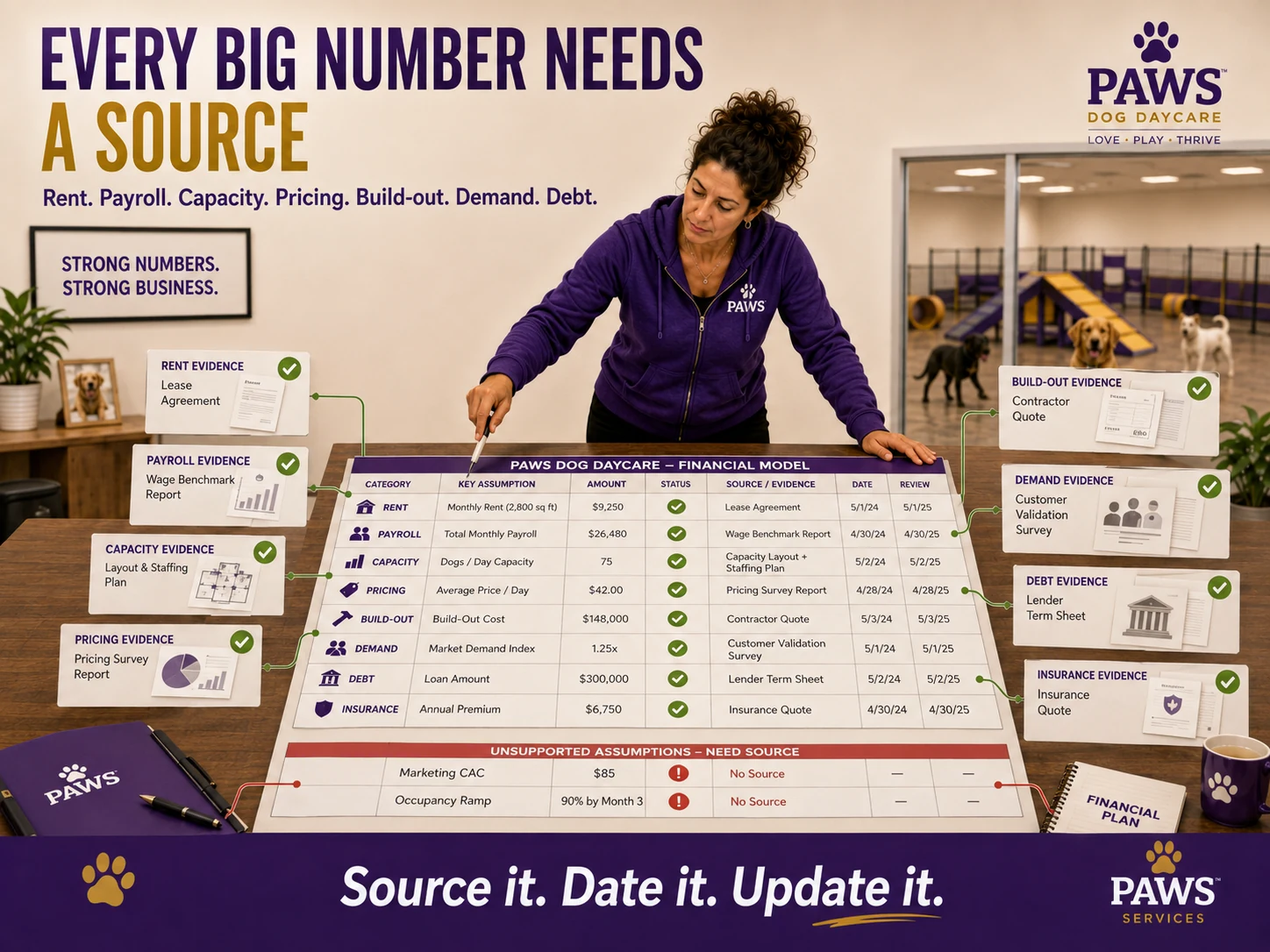
An assumptions register turns a spreadsheet full of numbers into a model that can be explained and updated. It also prevents one outdated estimate from quietly controlling the entire plan months after the project changed.
Record whether each assumption is verified, quoted, estimated, based on local research, based on owner experience, or simply unresolved. Then test a conservative, expected, and stronger value where the assumption materially affects the outcome.
Assign an owner and review date to every material assumption. Contractor pricing expires. Insurance quotes renew. wages change. Lease terms move from proposal to executed document. Customer-validation data becomes stale. The register should show who is responsible for replacing an estimate when better evidence becomes available.
Flag assumptions that cascade through multiple schedules. A capacity change can alter sales, staffing, utilities, marketing need, break-even, debt coverage, and reserve. A good register makes those dependencies visible so one revised number does not leave five old numbers behind.
Swipe left/right to see the full table.
| Assumption | Source | Status | Conservative / Expected / Stronger | What Changes If Wrong |
|---|---|---|---|---|
| Monthly rent and additional charges | Lease or landlord proposal | Quoted or executed | Known unless lease changes | Break-even, cash reserve, funding need, and location decision. |
| Build-out cost | Contractor estimates and design scope | Estimate until contracted | Base estimate plus contingency cases | Loan amount, owner contribution, delay, and reserve. |
| Average paid daycare attendance | Market research, pre-opening leads, comparable operations, and ramp plan | Forecast | Slow / expected / stronger ramp | Revenue, staffing, cash flow, and break-even month. |
| Average collected daycare price | Pricing plan, packages, discounts, and competitor review | Forecast | Lower / expected / higher collection | Revenue per visit and required dog count. |
| Boarding nights | Service-area demand, competition, seasonality, and capacity | Forecast | Low / expected / high occupancy | Revenue, weekend staffing, cleaning, and cash flow. |
| Payroll hours and wages | Staffing schedule and local wage research | Estimate until hiring | Higher-cost case should be tested | Largest operating expense, pricing, and break-even. |
| Opening date | Approval and construction schedule | Target | On-time / delayed / materially delayed | Pre-opening rent, interest, payroll, marketing, and reserve. |
| Owner compensation | Household need and management role | Planned | Deferred / expected / full compensation | True profitability and owner sustainability. |
🔎
Where Do You Get the Numbers for a Dog Daycare Business Plan?
The best model is built from local public data, written quotes, actual contracts, observed competition, customer evidence, and a transparent list of unresolved estimates.
Do not search for one national number and paste it into every facility. Rent comes from the actual property. Build-out comes from the actual scope. Wages come from the local labor market and the jobs being staffed. Capacity comes from the actual floor plan and operating system. Pricing comes from the market and the cost structure. Customer volume comes from the acquisition and retention model.
Record the source, date, geography, status, and confidence level for each number. When a quote or rule changes, update the assumption and every schedule that depends on it.
Swipe left/right to see the full table.
| Number Needed | Better Source | What to Record | Weak Shortcut |
|---|---|---|---|
| Population, households, income, housing, commuting, and local growth | U.S. Census Bureau data, American Community Survey, local planning agencies, and development data. | Geography, table or source, year, estimate, and why it relates to the service area. | Using a national average or the entire county when customers come from a smaller drive-time area. |
| Local wages | BLS Occupational Employment and Wage Statistics, state labor data, local job postings, recruiters, and actual applicants. | Occupation, geography, wage range, benefits, payroll burden, and hiring date. | Using minimum wage or one online salary figure as the full payroll cost. |
| Market and competitor information | Competitor websites, calls, visits, reviews, published policies, local interviews, search results, and customer feedback. | Date checked, service, price, package, hours, capacity signal, reputation, and limitations. | Copying one competitor’s price without understanding its building, payroll, or strategy. |
| Zoning and licensing | Municipal code, planning or zoning department, licensing authority, fire and building officials, and written professional guidance. | Rule, official contact, date, written confirmation, conditions, approval path, and unresolved issues. | Relying on a broker, landlord, or counter conversation as final approval. |
| Rent and property cost | Actual proposal, lease, tax information, common-area charges, insurance obligations, utilities, repair duties, and legal review. | Base rent, additional rent, increases, deposits, guarantees, term, options, and owner responsibilities. | Modeling only the advertised base rent. |
| Build-out and equipment | Architects, engineers, contractors, specialty trades, equipment vendors, permit fees, and current quotes. | Scope, exclusions, allowances, tax, freight, installation, timing, contingency, and quote expiration. | A generic cost per square foot from another city or another building. |
| Utilities and operating supplies | Building history, utility providers, comparable operations, vendor quotes, equipment specifications, and test periods after opening. | Season, usage assumption, rate, fixed charge, and service volume. | Using ordinary retail utility cost for laundry, hot water, ventilation, and animal care. |
| Insurance | Written broker quotes based on the exact services, property, payroll, vehicles, limits, deductibles, and exclusions. | Coverage, limit, deductible, exclusion, premium, and renewal assumption. | Using a generic small-business premium from an unrelated operation. |
| Customer demand and conversion | Interviews, surveys, landing-page tests, lead campaigns, tour requests, applications, pre-opening list, and early operating data. | Source, geography, response, qualification, conversion, repeat behavior, and cost. | Counting likes, survey enthusiasm, or raw leads as recurring customers. |
| Loan payments and funding timing | Actual lender proposal, term sheet, amortization schedule, draw conditions, fees, and professional advice. | Amount, rate, term, fees, payment start, draw timing, interest-only period, and guarantees. | Using an online payment estimate while ignoring fees, draw timing, and pre-opening interest. |
| Tax and accounting treatment | IRS recordkeeping guidance, state agencies, and the business’s accountant or tax professional. | Entity, tax treatment, records, sales tax, payroll, depreciation, owner pay, and filing assumptions. | Treating every cash payment as an expense or every cash receipt as earned revenue. |
| Business-plan structure and market-research framework | SBA business-plan guidance and SBA market-research guidance. | What the intended lender, investor, or owner needs to evaluate. | Copying a template without adapting it to the animal-care operation. |
🧮
Put the Local Numbers Into the Profit and Loss Simulator
The simulator does not invent your rent, wages, capacity, prices, or demand. It gives you a structured place to test the numbers you researched and see how attendance, services, payroll, overhead, and pricing affect the result.
📌
Source rule
The model is only as honest as the numbers inside it. A sophisticated spreadsheet cannot repair an invented rent, unverified capacity, guessed payroll, or customer count chosen to produce the desired profit.
🧪
Scenario Testing: Make the Plan Survive a Bad Month Before the Business Has One
The plan should explain what happens when the expected case does not show up on schedule.
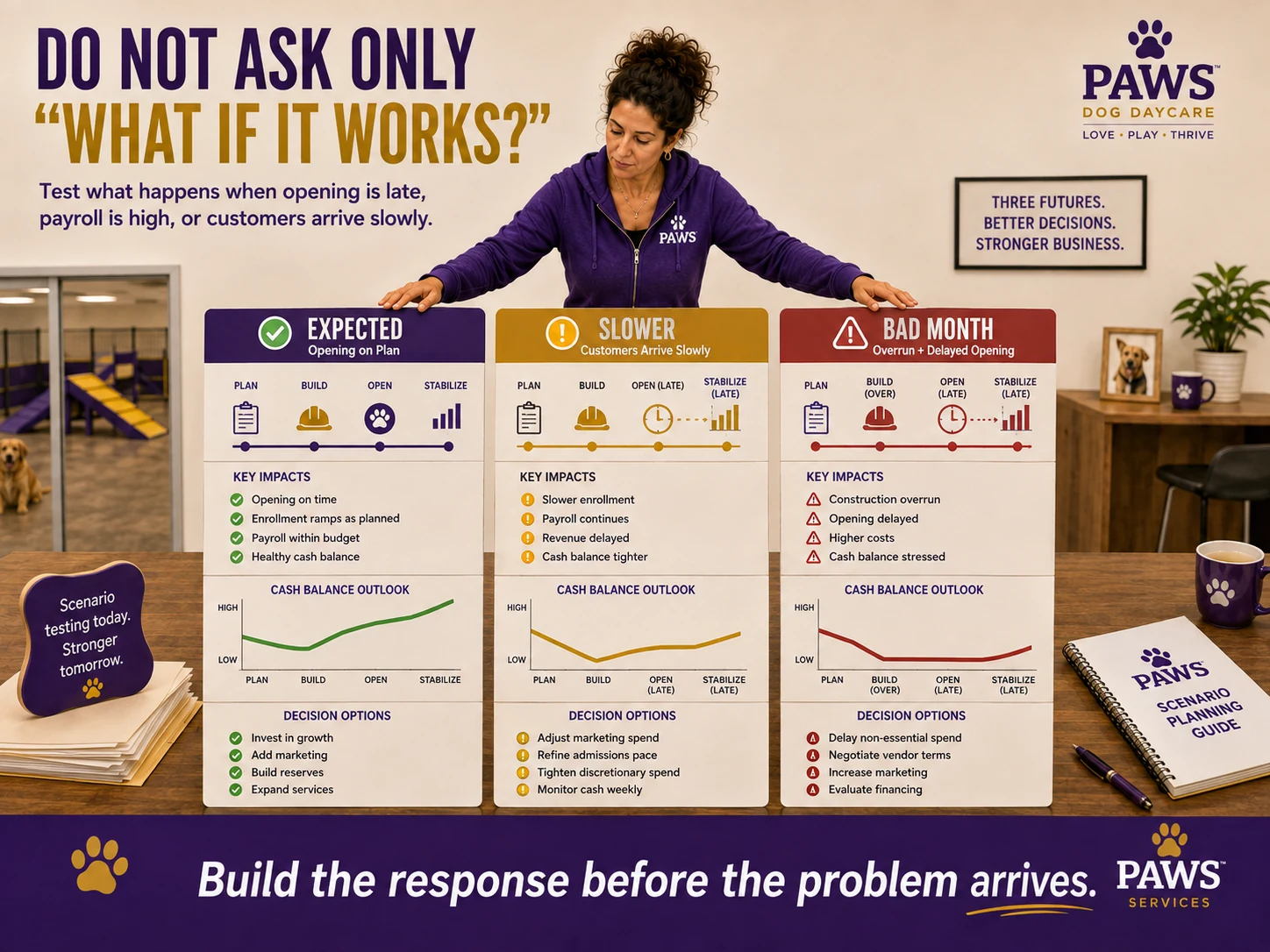
A conservative case is not the expected forecast with slightly smaller numbers. It should test the specific risks that can damage this project: construction overruns, delayed opening, slower enrollment, weaker pricing, higher payroll, seasonal boarding, employee turnover, repairs, or service delays.
Scenario testing should lead to decisions. Identify what will be delayed, reduced, financed, renegotiated, or changed if the result falls below plan. A warning without a response is only a more organized surprise.
Test combined stress as well as isolated variables. Real projects do not always fail one assumption at a time. A two-month delay may occur alongside a construction overrun, higher payroll, and slower customer growth. The model should show whether the available contingency and reserve can absorb combinations that are plausible for this project.
Tie each scenario to pre-authorized management actions. Define which hires are delayed, which owner draws stop, which marketing spend is protected, which service launches are postponed, what minimum cash floor triggers intervention, and when the project requires additional capital rather than another optimistic forecast.
| Scenario | What to Change in the Model | What the Owner Needs to Decide |
|---|---|---|
| Construction costs 15% more | Increase build-out, interest, owner contribution, and opening cash need. | Reduce scope, find more funding, renegotiate, or stop before reserve is consumed. |
| Opening is delayed two months | Add rent, utilities, interest, insurance, professional fees, and pre-opening payroll without operating revenue. | Determine who funds the delay and whether marketing or hiring timing must change. |
| Attendance grows at half the expected pace | Reduce daycare revenue and related add-ons while keeping fixed costs largely intact. | Adjust labor, marketing, owner pay, reserve use, pricing, or service launch timing. |
| Payroll is higher than expected | Increase wage rates, hours, taxes, overtime, management, or benefits. | Reprice, redesign schedules, change service mix, or accept a lower return. |
| Boarding is highly seasonal | Concentrate nights around holidays and reduce ordinary-month occupancy. | Verify whether daycare, grooming, or reserve can carry weak boarding months. |
| Grooming launch is delayed | Remove grooming revenue and related direct cost for the delayed period. | Determine whether the core business still works without the service. |
| Owner needs pay sooner | Add or accelerate owner compensation in the cash-flow model. | Decide whether funding, pricing, customer volume, or household planning must change. |
🧯
Build a Real Risk Register, Not a Decorative SWOT List
Each material risk should have an owner, prevention step, trigger, financial effect, and response.
A risk register turns vague concern into management. Estimate likelihood and impact honestly, identify what can reduce the risk, define the warning sign that activates the response, and assign responsibility.
Risk treatment belongs in the budget. Maintenance, training, backup equipment, insurance, reserve, legal review, monitoring, and redundant systems cost money because uncontrolled failure costs more.
Swipe left/right to see the full table.
| Risk | Potential Impact | Prevention or Reduction | Trigger | Planned Response |
|---|---|---|---|---|
| Zoning or approval failure | Project delay, conditions, reduced capacity, or total loss of the location. | Written verification, contingencies, professional review, and no premature binding commitment. | Use is disputed, delayed, conditioned, or denied. | Renegotiate, appeal where appropriate, redesign, or exit under documented rights. |
| Construction overrun | Reserve consumed, funding gap, delayed opening, or unfinished scope. | Detailed plans, bids, allowances, exclusions, contingency, and change control. | Committed cost exceeds the approved budget or contingency threshold. | Reduce scope, obtain funding, renegotiate, or stop before working capital is consumed. |
| Slow customer growth | Cash burn, overstaffing, weak debt coverage, and delayed owner pay. | Pre-opening pipeline, realistic ramp, source tracking, conversion process, and reserve. | Leads, approved customers, attendance, or repeat use fall below the monthly trigger. | Adjust labor, acquisition, offer, conversion, service launch, and cash plan. |
| Employee shortage or key-manager loss | Reduced capacity, burnout, service failure, closure, or unsafe coverage. | Competitive pay, documentation, cross-training, backup coverage, and recruiting pipeline. | Vacancy, turnover, absence, schedule gaps, or declining performance. | Reduce sellable capacity, activate interim management, recruit, and stabilize core services. |
| Communicable-disease event | Illness, reduced attendance, closure, refunds, reputation damage, and veterinary expense. | Health policy, sanitation, isolation, records, training, ventilation, and response procedure. | Confirmed exposure, clinical pattern, veterinary notice, or public-health direction. | Isolate, notify, document, clean, reduce or stop service, and follow professional guidance. |
| Serious animal or employee incident | Injury, claim, investigation, staff trauma, closure, and reputation damage. | Evaluation, staffing, training, group control, facility design, records, and insurance. | Serious bite, fight, escape, injury, allegation, or emergency transport. | Emergency care, notification, evidence preservation, reporting, review, and corrective action. |
| HVAC, power, water, or drainage failure | Reduced capacity, closure, animal risk, sanitation failure, and repair cost. | Design review, preventive maintenance, monitoring, backup plan, and reserve. | Temperature, air quality, water, drainage, or equipment moves outside safe operation. | Close affected areas, relocate or discharge animals safely, repair, and communicate. |
| Technology or payment failure | Lost bookings, records, communication, payment delays, or privacy incident. | Backups, access control, redundant procedures, vendor review, and incident plan. | System outage, account compromise, data loss, or payment interruption. | Activate manual process, secure accounts, restore data, notify as required, and reconcile. |
| Reputation event | Lead loss, cancellations, staff pressure, media attention, and revenue decline. | Strong operations, documentation, complaint process, transparency, and trained response. | Serious complaint, public allegation, viral post, or repeated service failure. | Investigate, preserve facts, respond accurately, correct the operation, and monitor impact. |
| Owner incapacity or burnout | Management failure, missed decisions, service decline, or forced sale. | Defined roles, documentation, management depth, reasonable compensation, and backup authority. | Extended absence, overload, health event, or sustained operating dependence on one person. | Transfer authority, reduce complexity, hire management, or activate continuity plan. |
🏦
The Lender Package: Support the Plan With Evidence
A lender is evaluating the borrower, the business, the use of funds, the repayment source, and the risk if the forecast is wrong.
The exact requirements depend on the lender, loan program, borrower, and project. The business plan should be prepared to work with a broader package instead of pretending the narrative alone creates financing.
The funding request should state the amount requested, owner contribution, other funding sources, use of funds, timing, expected repayment source, and what contingency exists if construction or opening takes longer than planned.
Business and Project Documents
- Business plan and executive summary.
- Funding request and sources-and-uses schedule.
- Entity and ownership information.
- Owner and management résumés.
- Lease, letter of intent, property information, or purchase agreement.
- Zoning, licensing, approval, or permit evidence available at the time.
- Construction estimates, design scope, and equipment quotes.
Financial and Borrower Support
- Startup budget and opening reserve.
- Monthly first-year projections.
- Multi-year profit and loss, cash flow, and balance-sheet projections.
- Break-even and scenario analysis.
- Assumptions supporting the projections.
- Owner financial, tax, credit, collateral, or guaranty information when requested.
- Existing-business financial records when applicable.
⚠️
Financing warning
A professional business plan can organize and strengthen a funding request. It cannot guarantee approval, replace the borrower’s qualifications, or rescue a project whose numbers do not work.
🕵️
Red-Team the Plan Before a Lender, Investor, or Partner Does
Read the plan like someone whose money is at risk and whose job is to find the unsupported assumption.

A strong plan does not avoid hard questions. It answers them with evidence or clearly identifies what remains unresolved. Practice the questions below and make sure the narrative, appendix, and financial model give the same answer.
Make every important answer traceable from the narrative to the assumption, source document, and financial schedule. If the lender asks where the rent, build-out, wage, capacity, collected price, or opening reserve came from, the answer should be a current document or clearly labeled estimate—not a memory of what someone once said.
Reconcile the package before it is shared. The lease, sources and uses, startup budget, debt schedule, monthly cash flow, assumptions register, and funding request should all use the same current numbers. A lender should not be the first person to discover that two parts of the package describe different projects.
| Question the Reader May Ask | Evidence the Plan Should Provide | Weak Answer |
|---|---|---|
| Why this location and this building? | Service area, access, zoning, lease, systems, workflow, build-out, cost, and alternatives considered. | “It was available and the rent seemed reasonable.” |
| How many active customers are required? | Daily attendance, monthly visits, visit frequency, active-customer count, churn, and acquisition ramp. | “We need about forty dogs.” |
| Why will customers pay these prices? | Local competitor pricing, customer research, value, collected-price assumptions, and cost structure. | “Other cities charge more.” |
| How was capacity determined? | Floor plan, group model, staffing, behavior, weather, boarding overlap, isolation, and sellable buffer. | “The building can hold eighty dogs.” |
| How was payroll determined? | Daypart schedule, positions, wages, taxes, benefits, weekends, management, and growth steps. | “One employee can watch fifteen dogs.” |
| What happens if opening is delayed? | Delay scenario, additional carrying cost, funding source, hiring change, and marketing adjustment. | “The contractor expects to finish on time.” |
| What remains after construction? | Separate construction contingency and operating reserve with the lowest cash point. | “Any unused build-out money becomes working capital.” |
| How is the loan repaid in the slower case? | Cash flow, debt schedule, coverage, owner contribution, trigger points, and corrective actions. | “Sales should be higher than the conservative case.” |
| Who runs the facility when the owner is absent? | Management roles, authority, training, backup coverage, and compensation. | “The owner plans to be there most of the time.” |
| What if grooming or boarding launches late? | Core-business case without the delayed revenue and the costs that remain. | “Those services are easy to add.” |
| What is the owner putting at risk? | Cash contribution, guarantees or collateral when applicable, unpaid labor, and contingency capacity. | “The owner has invested significant time.” |
| What assumption would kill the project fastest? | Risk register, sensitivity analysis, decision gate, and exit or correction plan. | “The pet industry is recession-resistant.” |
🗂️
Build an Appendix and Evidence Pack That Can Be Audited
The appendix should make important claims easier to verify without burying the narrative in documents.
Organize evidence by section and date. Give important files clear names, keep the current version separate from superseded versions, and identify which assumption each document supports.
Maintain a controlled lender or investor package for sensitive information. The broadly shared business plan should not contain private tax returns, personal account information, credit reports, or other confidential records.
Ownership and Management
- Owner and management résumés.
- Entity and ownership documents.
- Organizational chart and role descriptions.
- Advisor and professional-team information.
- Management continuity and backup plan.
Market and Competition
- Service-area maps and demographic tables.
- Customer interviews, surveys, and validation results.
- Competitor matrix, prices, policies, reviews, and dated observations.
- Lead tests, waiting lists, tour requests, or other demand evidence.
- Marketing funnel and acquisition assumptions.
Property and Build-Out
- Property information and site photos.
- Zoning or use correspondence.
- Lease, letter of intent, or purchase documents.
- Floor plans, engineering, and design documents.
- Contractor bids, equipment quotes, permits, and schedules.
Operations and Risk
- Service and pricing schedule.
- Staffing schedule and job descriptions.
- Animal-care and safety summaries.
- Insurance quotes and coverage notes.
- Risk register, emergency systems, and milestone plan.
Financial Support
- Startup budget and sources and uses.
- Assumptions register.
- Sales, payroll, expense, debt, and capital schedules.
- Profit and loss, cash flow, balance sheet, and break-even.
- Conservative, expected, and stronger scenarios.
Controlled Borrower Material
- Personal financial statements when requested.
- Tax returns and historical financial records when requested.
- Credit, collateral, guaranty, and banking information when requested.
- Proof of owner contribution.
- Other lender-specific documents.
🔄
Use the Business Plan After the Doors Open
The projections become valuable when they are compared against actual operations instead of filed away after the loan closes.
Compare actual leads, evaluations, first visits, repeat customers, daycare attendance, boarding nights, grooming appointments, average collected prices, payroll, operating expenses, cash balance, and debt against the plan.
Variance does not automatically mean failure. It means the business is telling you where the original assumptions were wrong. Investigate the cause before making a random correction. Weak attendance may be marketing, pricing, location, conversion, customer experience, seasonality, or an unrealistic plan. High payroll may be wages, scheduling, poor layout, service complexity, training, or volume that has not caught up.
Update the plan when the business adds a service, expands capacity, changes pricing, hires management, refinances debt, moves, remodels, or discovers a major operating truth the original plan missed.
| Operating Review | What to Compare | Decision It Supports |
|---|---|---|
| Weekly | Leads, evaluations, first visits, attendance, staffing issues, service demand, and immediate cash problems. | Scheduling, lead follow-up, marketing, staffing, and short-term operating correction. |
| Monthly | Revenue by service, collected price, payroll, occupancy, overhead, cash flow, reserve, debt, and customer growth. | Pricing, labor, marketing spend, cost control, service mix, and owner compensation. |
| Quarterly | Capacity, retention, seasonality, service profitability, capital needs, management performance, and forecast accuracy. | Hiring, equipment, service expansion, strategic changes, and revised projections. |
| Annually | Full financial performance, taxes, owner return, debt, maintenance, pricing, market changes, and next-year plan. | Budget, compensation, growth, financing, renovation, or exit planning. |
❓
Dog Daycare Financial Projections and Lender FAQ
Detailed answers about revenue, payroll, startup costs, cash reserve, accounting, break-even, boarding occupancy, taxes, risk testing, sources and uses, and financing.
How many years of financial projections should be included?
The exact requirement depends on the reader and financing request. Multi-year projections are common, but the first year should receive the most detailed month-by-month attention because opening delays, customer ramp, payroll, reserve, and early cash flow carry the greatest immediate risk.
Should owner compensation be included?
Yes. The form and timing may vary, but a plan that covers every expense except the owner has not fully shown that the business supports the owner. Owner labor should not disappear merely because it is not paid immediately.
How should dog daycare revenue be projected?
Build it from paid attendance, average collected revenue per visit, operating days, packages, memberships, discounts, customer frequency, and a realistic opening ramp. Do not use full capacity multiplied by the highest posted daily rate.
How should dog boarding revenue be projected?
Use occupied nights, average collected nightly revenue, suite mix, seasonality, holidays, cancellations, deposits, add-ons, and real boarding capacity. Do not annualize peak holiday occupancy across ordinary months.
What startup costs belong in the plan?
Include deposits, rent, professional fees, zoning, permits, construction, flooring, drainage, HVAC, plumbing, electrical, fire, sound, gates, kennels, suites, grooming, laundry, equipment, software, insurance, inventory, marketing, training, payroll, contingency, and opening reserve.
How much opening cash reserve is enough?
There is no responsible universal amount. Build the reserve from the monthly cash-flow model and test delayed opening, slow enrollment, higher payroll, repairs, and higher construction. The reserve should be based on the project’s own burn rate and risk.
What should be included in a lender package?
Common items include the business plan, funding request, sources and uses, owner contribution, résumés, entity information, lease or property documents, approvals, contractor estimates, equipment quotes, projections, assumptions, cash-flow analysis, break-even, and borrower information requested by the lender.
Does a professional business plan guarantee financing?
No. It can organize and strengthen the request, but approval depends on the lender, borrower, credit, equity contribution, collateral or guarantees when applicable, management experience, market, projections, and overall risk.
What is the difference between profit and cash flow?
Profit measures revenue and expenses under the accounting model. Cash flow measures when money actually enters and leaves. Loan principal, equipment purchases, deposits, prepaid packages, depreciation, and owner withdrawals can make profit and cash move differently.
How do prepaid packages, deposits, and gift cards affect the model?
They can create cash before all service is earned. The model should track cash receipt, service obligation, expiration or refund policy, customer usage, and the accounting treatment recommended for the business.
How should loan principal and interest be shown?
Interest is generally treated as an expense, while principal reduces cash and the loan balance rather than ordinary operating profit. The debt schedule, cash flow, profit and loss, and balance sheet should agree.
How should equipment purchases and depreciation be modeled?
Major equipment may be recorded as an asset and depreciated rather than expensed immediately. The cash-flow model must still show the purchase or financing payment. Use an accountant for the actual treatment and useful-life assumptions.
How do I estimate payroll burden above hourly wages?
Include employer payroll taxes, workers’ compensation, unemployment, benefits, paid time where applicable, overtime, training, uniforms, recruiting, turnover, payroll service, and other employer costs relevant to the location and benefits plan.
Should taxes be included in the projections?
Yes, but the type and treatment depend on entity, location, services, products, payroll, owner compensation, and profitability. Model the cash obligations with professional guidance rather than leaving taxes out because the amount is uncertain.
How should price increases and wage inflation be modeled?
State the timing and reason for each change. Do not raise prices automatically while holding customer behavior and competition unchanged. Test what happens if wages rise faster than prices or customers resist the planned increase.
How do I determine whether boarding, grooming, or another service is actually profitable?
Calculate average collected revenue per unit, direct and volume-sensitive costs, labor steps, space consumed, and the contribution available for shared overhead. Then examine whether the service improves retention or cross-sell without hiding a direct loss.
How many boarding spaces should be used in the forecast?
Use sellable spaces after isolation, maintenance, cleaning, operational buffer, suite restrictions, and other unavailable inventory. Forecast occupied nights by month rather than using peak holiday occupancy for the full year.
What do lenders look for in a dog daycare business plan?
They may evaluate the borrower, owner contribution, management experience, market, property, use of funds, projections, repayment source, collateral or guarantees when applicable, construction risk, opening reserve, and what happens in the slower case.
What is a sources-and-uses statement?
It shows where project money comes from and exactly where it will be spent. Total sources should equal total uses, and the timing should match when deposits, construction draws, equipment, fees, and working capital are needed.
How is an investor-focused plan different from a lender-focused plan?
A lender focuses heavily on repayment and downside protection. An investor may focus more on ownership, control, return, distributions, growth, valuation, exit, and dilution. Both still need the same honest market, operating, and financial foundation.
Make the Numbers Explain the Same Business the Plan Describes
A lender-ready model is not the most optimistic spreadsheet. It is the model whose revenue, payroll, capital, cash flow, reserve, and risk assumptions can be traced to the market, building, staffing plan, operating system, and evidence package.
🗺️
Continue Through the Three-Part Business Plan Series
Move between the plan structure, market and operating proof, and the financial and funding model without losing the connection between them.
🧱
1. Build the Business Plan
Structure the document, use the complete outline, control revisions, and identify what must be proven.
🏢
2. Prove the Market and Operation
Validate demand, property, capacity, staffing, safety, pricing, and the customer pipeline.
📊
3. Build the Financial and Funding Model
Connect startup cost, revenue, payroll, cash flow, break-even, risk, and the lender package.