Market Research, Facility Planning, Staffing, Startup Costs, Customer Acquisition, Financial Projections, Cash Flow, Break-Even, Risk Testing, and Lender Preparation
Dog Daycare Business Plan: Complete Guide and Outline
A business plan should do more than make the idea sound attractive. It should show whether the facility can be built, staffed, filled, financed, operated, and kept alive when the customer count grows slower than the bills.
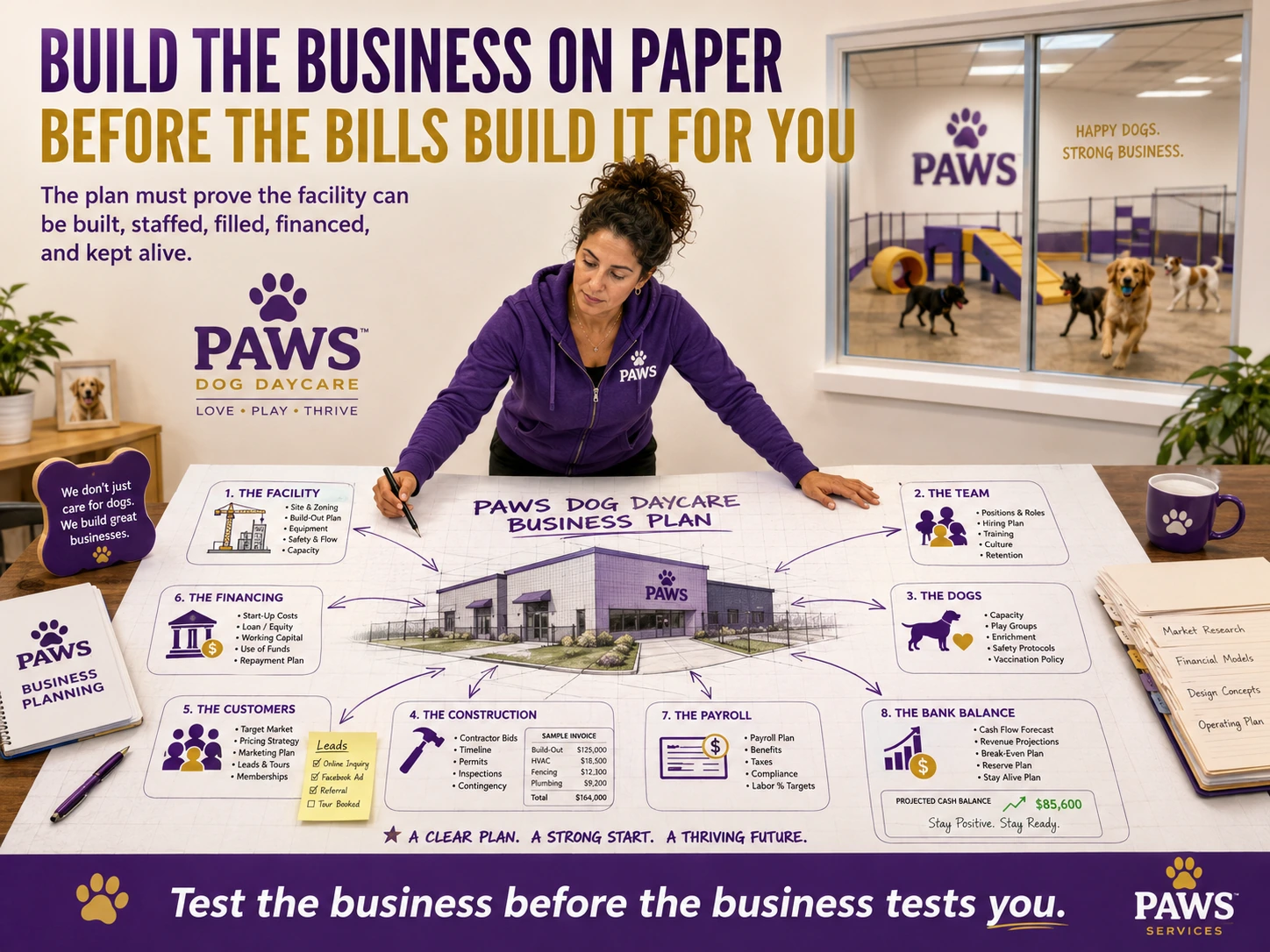
A dog daycare business plan is not a school assignment, a stack of optimistic paragraphs, or a document you create only because a lender asked for one. It is the working model for the business you are about to spend real money building.
The same is true whether you call it a dog daycare business plan, doggy daycare business plan, dog boarding business plan, kennel business plan, or pet resort business plan. The exact service mix changes, but the plan still has to answer the same hard questions: Who will buy the service? What will the building cost? How many dogs can the operation safely and consistently handle? How many employees will it really take? What will customers actually pay? How long can the business survive while enrollment grows?
A weak plan tells the reader that the owner loves dogs, the pet industry is growing, and the business expects to become profitable. A useful plan explains the service area, target customer, competition, zoning, lease, build-out, capacity, pricing, staffing, startup budget, opening reserve, sales ramp, cash flow, break-even point, management responsibilities, and what happens when one of those assumptions is wrong.
The real value is not the finished document. The value is what the process forces you to discover before rent, payroll, construction, debt, and daily operations begin making the decisions for you.
⚠️
Operator warning: a professional-looking document can still describe a bad business.
If the plan only works at full capacity, excludes owner pay, guesses at construction, treats every square foot as sellable dog space, or assumes customers appear the week the doors open, it is not reducing risk. It is decorating it.
🗺️
Use the Three-Part Dog Daycare Business Plan Series
Each page answers a different decision. Use all three so the narrative, operation, and numbers describe the same business.
🧱
1. Build the Business Plan
Structure the document, use the complete outline, control revisions, and identify what must be proven.
🏢
2. Prove the Market and Operation
Validate demand, property, capacity, staffing, safety, pricing, and the customer pipeline.
📊
3. Build the Financial and Funding Model
Connect startup cost, revenue, payroll, cash flow, break-even, risk, and the lender package.
🧭
Business Plan, Feasibility Study, Financial Model, and Lender Package
They use much of the same information, but each one answers a different question.
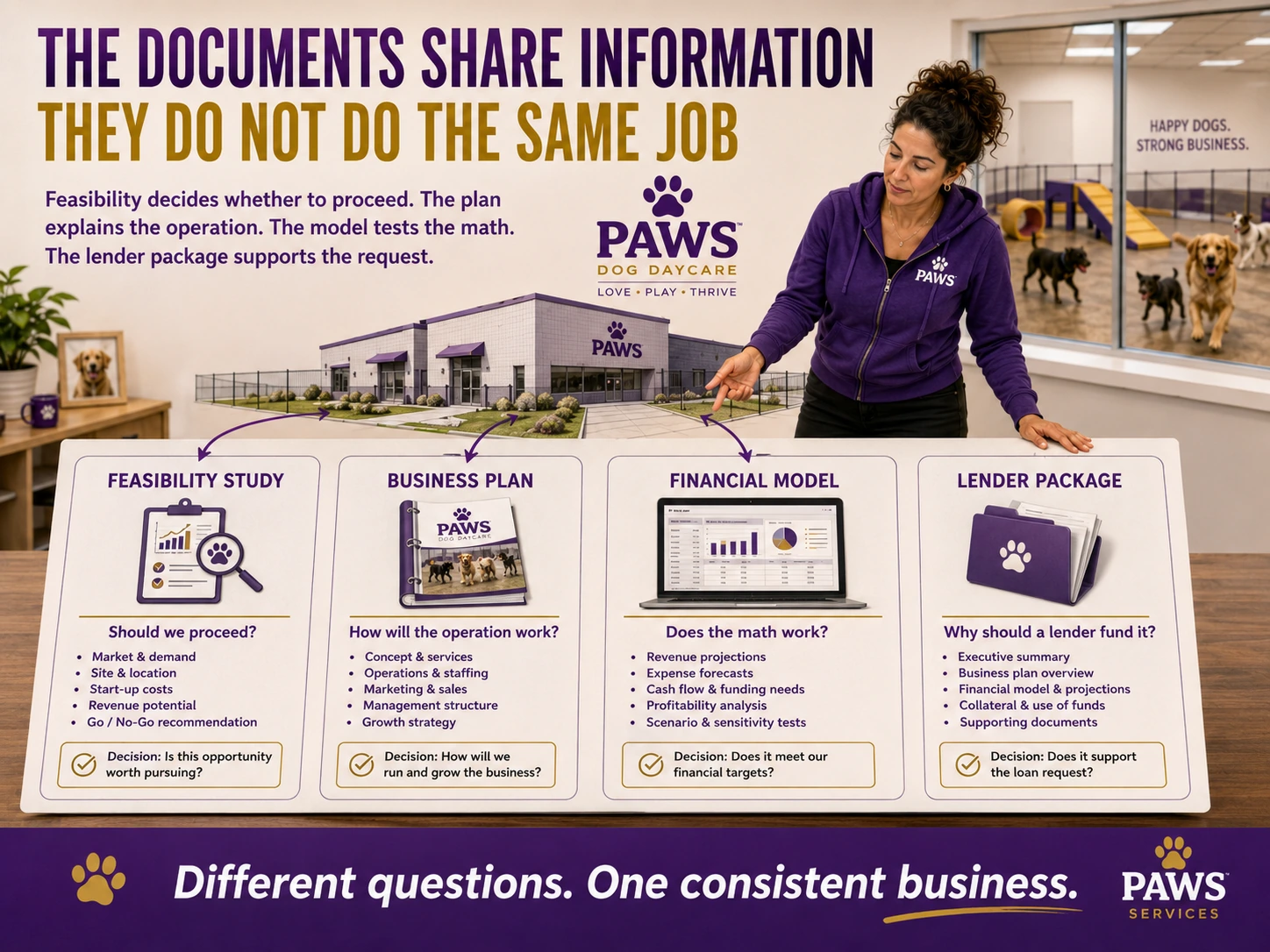
One of the first mistakes is treating every planning document as the same thing. A business plan can be beautifully written and still fail to prove that the location, service area, construction cost, staffing model, or opening reserve makes sense.
Start by understanding which question you are trying to answer. Then make sure the documents agree with one another. The feasibility work should support the decision to proceed. The financial model should support the numbers in the business plan. The lender package should support the funding request with evidence.
Treat the four tools as a controlled chain of evidence. The feasibility study decides whether the concept deserves to move forward. The business plan explains the chosen operation. The financial model tests whether that operation works mathematically. The lender package proves the funding request and repayment case to someone outside the project.
When one document changes, trace the change through the others. A new lease, higher contractor bid, delayed opening, revised capacity limit, or different staffing plan should not remain isolated in one file. It should update every narrative, schedule, assumption, and funding statement affected by it.
| Planning Tool | Primary Question | What It Should Contain | Common Failure |
|---|---|---|---|
| Feasibility Study | Should this business be opened in this market, building, and financial situation? | Demand, competition, location, zoning, lease risk, build-out, pricing, capacity, staffing, startup cost, and expected return. | The owner decides to proceed first and uses the study to justify the decision afterward. |
| Business Plan | How will the business be structured, funded, marketed, operated, staffed, and grown? | Company, management, market, services, operations, marketing, funding, financial projections, risks, and milestones. | The narrative is polished, but the operating assumptions underneath it are thin. |
| Financial Model | Do the prices, service volume, payroll, expenses, debt, taxes, and cash flow work mathematically? | Startup budget, revenue drivers, payroll, operating expenses, profit and loss, cash flow, balance sheet, break-even, and scenarios. | Revenue is chosen first and the customer count is reverse-engineered to make it appear possible. |
| Lender Package | Why should this borrower receive this amount of money, and how will it be repaid? | Business plan, funding request, sources and uses, borrower information, estimates, lease/property documents, projections, assumptions, and supporting evidence. | The funding request is clear, but the use of funds, owner contribution, repayment ability, or backup plan is not. |
📌
Planning rule
A business plan should describe the same business the feasibility study approved and the financial model can support. When those documents tell different stories, the weakest story usually wins.
🐕
Dog Daycare, Dog Boarding, Kennel, and Pet Resort Plans Are Not Identical
The same planning framework applies, but each service model creates different labor, space, scheduling, revenue, and liability demands.
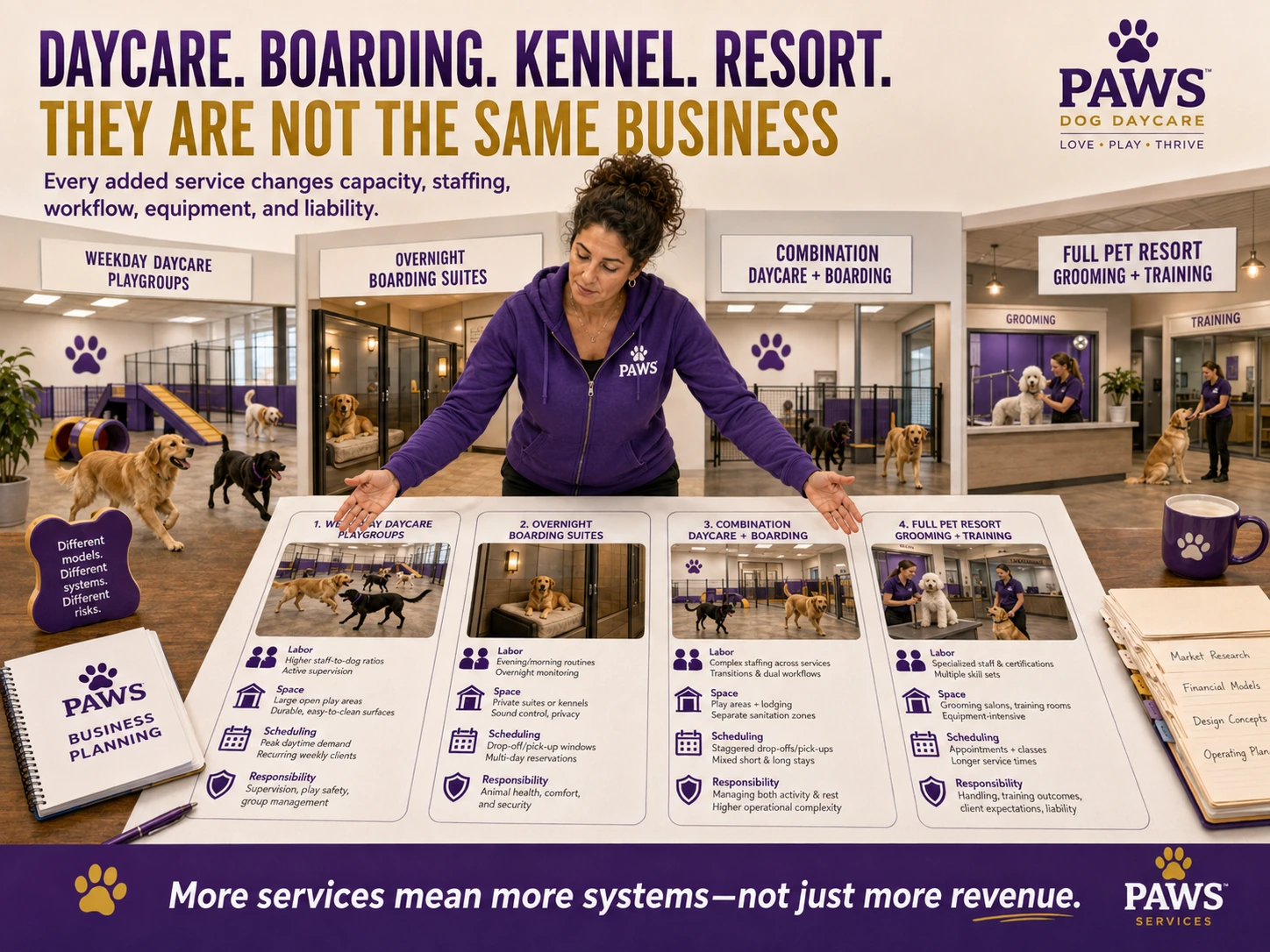
A doggy daycare business plan is normally built around recurring weekday attendance, group management, drop-off and pickup patterns, labor scheduling, and repeat local customers. A dog boarding business plan is more dependent on nights sold, holidays, weekends, seasonal demand, feeding, medication, cleaning, sleeping arrangements, overnight responsibility, and 365-day staffing.
A combination dog daycare and boarding business plan has to show how the services overlap. Daycare dogs may use the same playrooms as boarders during the day. Boarding may increase staffing, cleaning, food preparation, weekend work, laundry, and building use without increasing weekday daycare capacity in the way the owner expects.
A pet resort plan may add grooming, training, retail, enrichment, transportation, private suites, cameras, pools, or premium services. Every additional service can create revenue, but every service also consumes space, utilities, equipment, scheduling attention, qualified labor, insurance review, and management time.
Swipe left/right to see the full table.
| Business Model | Main Revenue Driver | Capacity Question | Labor Question | Planning Warning |
|---|---|---|---|---|
| Daycare Only | Paid dogs per day, packages, memberships, and repeat frequency. | How many dogs can be grouped, rotated, supervised, rested, cleaned behind, and processed through pickup? | How does staffing change by arrival, peak play, lunch, cleaning, and pickup? | Do not use total building square footage as daily sellable capacity. |
| Boarding Only | Occupied nights, seasonal pricing, suite type, add-ons, and length of stay. | How many overnight spaces can be sold after isolation, maintenance, cleaning, and operational needs? | Who handles mornings, evenings, weekends, holidays, feeding, medication, and overnight emergencies? | Holiday demand can look excellent while ordinary weeks remain weak. |
| Daycare and Boarding | Daycare attendance plus occupied boarding nights and add-ons. | How do boarders affect playroom use, feeding, rest, cleaning, and daycare dog limits? | Can the staff cover weekday peaks and the 365-day boarding responsibility? | Do not count boarding revenue without counting the additional labor and building use. |
| Pet Resort | Daycare, boarding, grooming, training, premium suites, enrichment, transportation, and retail. | Which spaces are shared, dedicated, or unavailable when another service is operating? | Which services require specialists, different compensation, separate scheduling, or management oversight? | More services can create more revenue and more ways to lose control of the operation. |
📝
Write the Dog Daycare Business Plan in the Right Order
The executive summary appears first, but it should usually be written after the rest of the plan has been built.
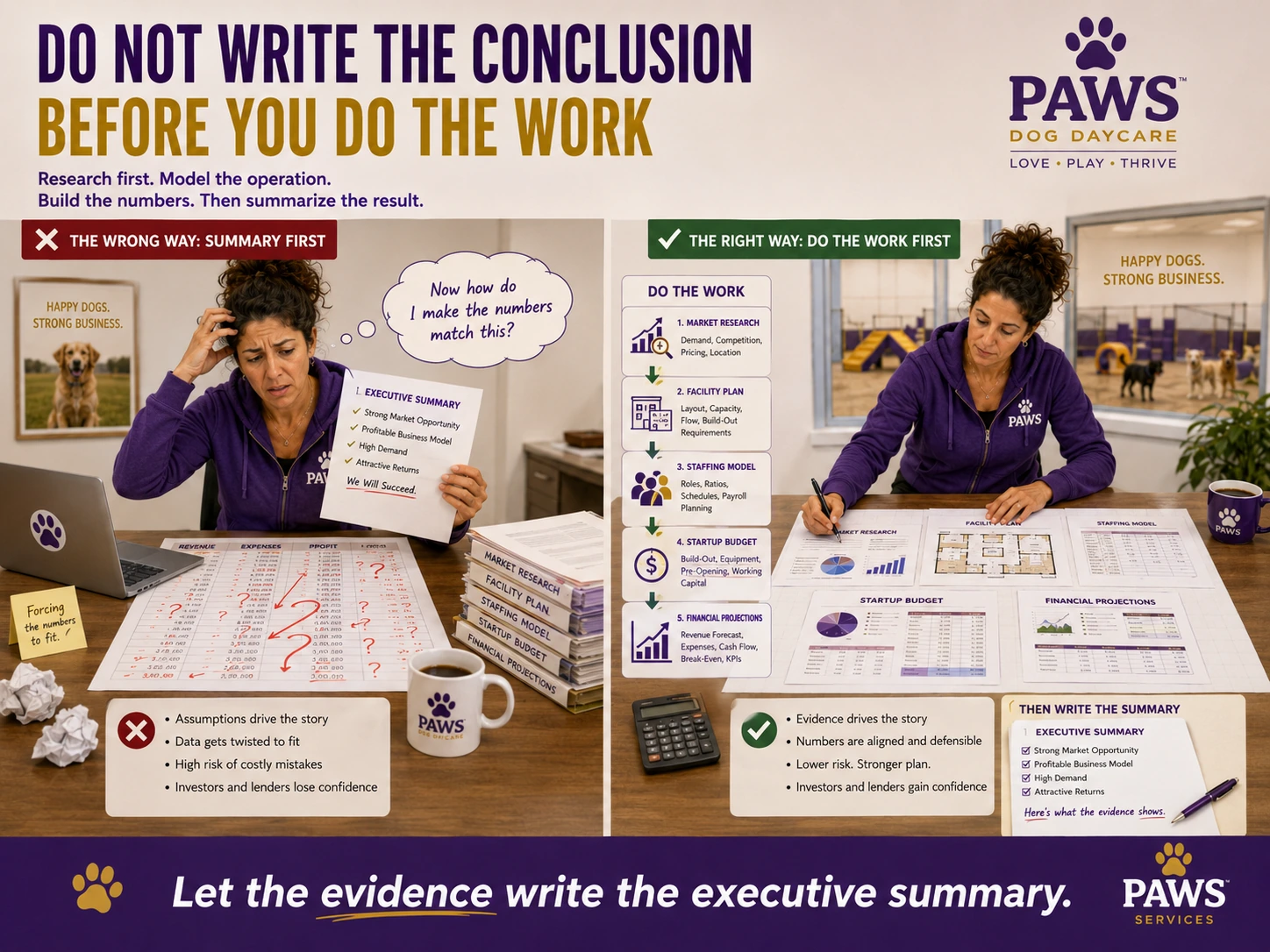
Many owners open a template and begin with the executive summary because it is at the top. That is backwards. You cannot accurately summarize a business that has not yet been researched, priced, staffed, costed, and tested.
Build the facts first. Build the operating model next. Build the financial model from those facts. Then write the narrative so it explains the business the numbers actually describe.
Keep an assumptions register while the work is being completed. Record each major number, its source, its date, who verified it, the confidence level, and which schedules depend on it. That prevents temporary guesses from quietly becoming permanent facts.
The writing sequence should follow dependency rather than appearance. The building affects capacity. Capacity affects staffing and revenue. Staffing and revenue affect cash flow. Cash flow affects the funding request. Writing around those dependencies makes contradictions easier to find before they become commitments.
| Order | Work to Complete | What You Should Know Before Moving On |
|---|---|---|
| 1 | Define the business model. | Daycare, boarding, grooming, training, retail, service hours, customer type, facility type, and ownership structure. |
| 2 | Research the market and competition. | Service area, customer need, local pricing, competitor capacity, reputation, positioning, and realistic market opportunity. |
| 3 | Verify location, zoning, lease, and build-out. | Whether the use is allowed, whether the building can support it, and what it will cost to make the location operational. |
| 4 | Design the operating model. | How dogs, customers, employees, cleaning, feeding, rest, boarding, grooming, and emergencies move through the facility. |
| 5 | Build staffing and management. | Who performs each function, when they work, what they cost, and who covers absence or growth. |
| 6 | Set pricing and revenue drivers. | Posted price, expected collected price, service volume, packages, discounts, seasonality, and customer frequency. |
| 7 | Calculate startup cost and opening reserve. | Total cash needed through opening, contingency, working capital, and what remains after construction. |
| 8 | Build the projections. | Monthly sales, payroll, expenses, debt, cash flow, break-even, balance sheet, and multi-year outlook. |
| 9 | Stress-test the assumptions. | What happens with slower sales, higher build-out, delayed opening, higher payroll, weaker pricing, or unexpected repairs. |
| 10 | Write the narrative and executive summary. | A clear explanation that matches the documented operation, funding request, and projections. |
⚠️
Executive summary warning
Do not write “the business will be profitable in year one” and then pressure the spreadsheet to obey. Build the model first. Let the summary report the result instead of ordering it.
🧱
Complete Dog Daycare and Dog Boarding Business Plan Outline
Use this as the working table of contents. Every section should answer a real decision, identify the evidence behind it, and agree with the financial model.
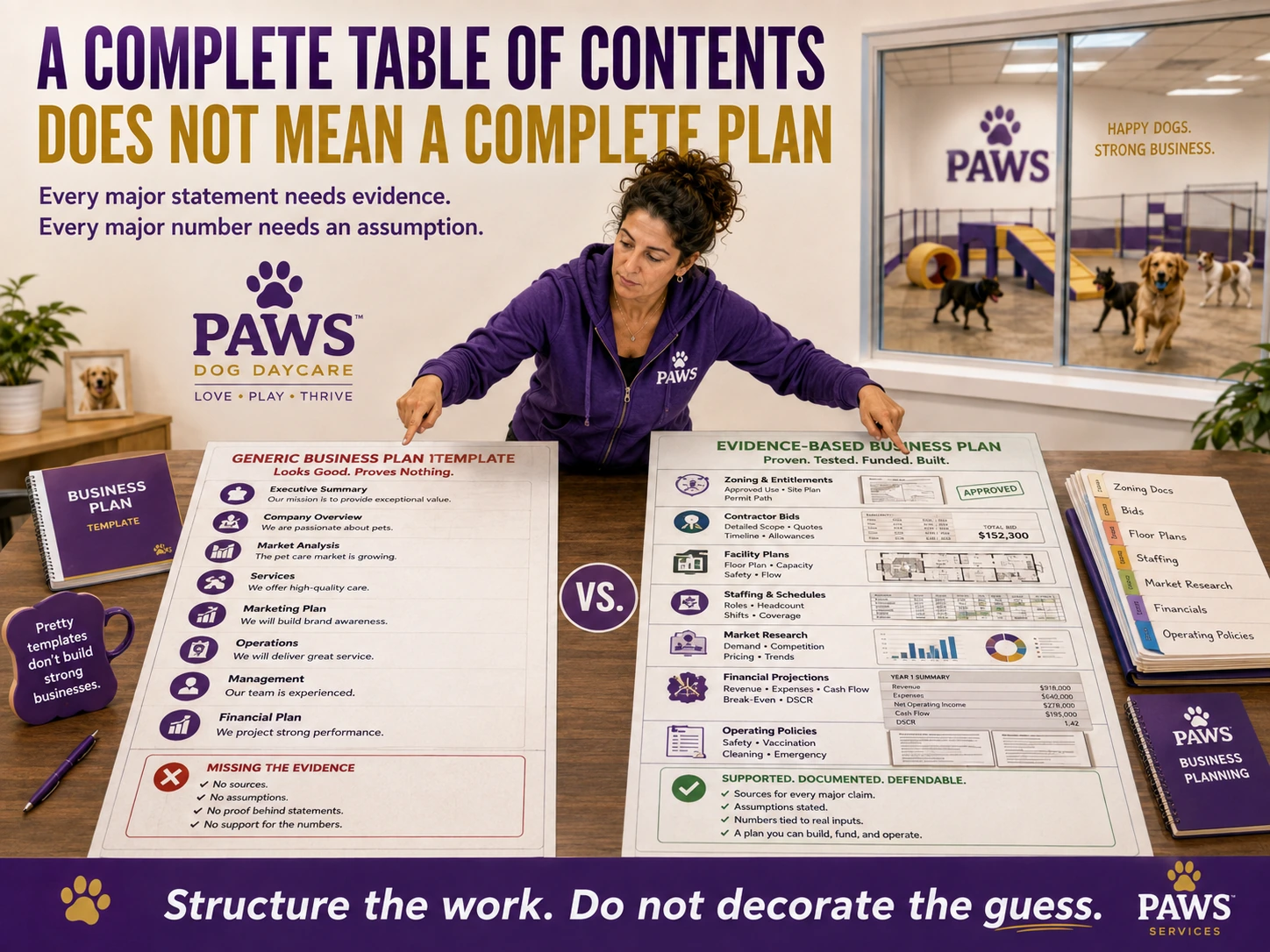
A template is useful when it tells you what work belongs in the plan. It becomes dangerous when it gives you polished filler that can be copied without proving anything. The outline below is designed for an independent dog daycare, dog boarding kennel, combination facility, or pet resort. Remove sections that genuinely do not apply, but do not delete a difficult section merely because the answer is inconvenient.
The executive summary belongs at the front of the finished plan, but write it after the market, facility, operations, funding, and financial work are complete. The appendix belongs at the back, but build it while you research so every important statement has support.
| Plan Section | What Belongs There | Evidence or Work Behind It | Weak Filler to Avoid |
|---|---|---|---|
| 1. Cover Page and Document Control | Business name, location, owners, version, revision date, intended reader, and confidentiality status. | Current plan version and matching financial-model version. | An undated document that nobody can distinguish from an older draft. |
| 2. Executive Summary | Concept, customer, location, management, funding request, use of funds, expected performance, and principal risks. | The completed plan and model. | “The pet industry is booming and success is expected.” |
| 3. Company Description | Legal entity, ownership, mission, stage of development, proposed opening, and business purpose. | Entity documents, ownership agreement, and project schedule. | A generic mission statement that says nothing about the operation. |
| 4. Owner and Management Qualifications | Relevant operating, animal-care, employee, financial, construction, sales, and management experience. | Résumés, role descriptions, advisors, and coverage for missing expertise. | “The owner loves dogs and has always wanted this business.” |
| 5. Business Model and Service Mix | Daycare, boarding, grooming, training, transportation, retail, hours, service sequence, and customer type. | Workflow, space, staffing, equipment, demand, and launch timing. | Listing every possible service because each one adds revenue to the spreadsheet. |
| 6. Market and Service Area | Target customer, drive-time area, population, income, housing, employment, commuting, travel, and demand drivers. | Local data, maps, interviews, lead tests, and competitor activity. | National pet spending used as proof that one local building will work. |
| 7. Competition and Substitutes | Direct competitors, sitters, walkers, veterinary boarding, mobile services, family care, remote work, pricing, reviews, and positioning. | Competitor matrix, calls, visits, websites, reviews, and local customer feedback. | A list of names and addresses with no analysis. |
| 8. Customer Acquisition and Sales | Pre-opening leads, local search, website, tours, evaluations, first visits, repeat use, packages, referrals, reviews, and retention. | Funnel assumptions, budget, conversion targets, and staff handoff. | “Social media and word of mouth will generate customers.” |
| 9. Location, Zoning, and Lease | Permitted use, animal limits, outdoor rules, rent, additional charges, term, guarantees, landlord work, repairs, and exit risk. | Written zoning information, lease review, property due diligence, and legal advice where needed. | “The broker said dog daycare should be allowed.” |
| 10. Facility and Build-Out | Layout, drainage, plumbing, flooring, HVAC, ventilation, sound, electrical, fire, laundry, waste, security, isolation, and yards. | Plans, engineering, contractor scope, quotes, permits, and contingency. | A generic cost per square foot before the building has been investigated. |
| Plan Section | What Belongs There | Evidence or Work Behind It | Weak Filler to Avoid |
|---|---|---|---|
| 11. Animal-Care and Safety Systems | Health requirements, intake, behavior evaluation, group formation, feeding, medication, sanitation, isolation, incident response, and emergency care. | Operating policies, training, equipment, staffing, insurance review, and veterinary relationships. | “Safety will be our highest priority” with no system behind it. |
| 12. Capacity Model | Permitted, physical, group, staffed, behavioral, weather-adjusted, boarding, and sellable capacity. | Floor plan, group strategy, daypart schedule, staffing, isolation, and service overlap. | Square footage divided by a preferred number of feet per dog. |
| 13. Operations Plan | Opening, intake, play, rest, feeding, cleaning, grooming, boarding, pickup, closing, records, maintenance, and emergencies. | Daypart workflow, responsibilities, forms, software, and backup coverage. | A paragraph saying the facility will provide excellent care. |
| 14. Staffing and Management Plan | Positions, shifts, wages, payroll burden, training, supervision, call-outs, weekends, holidays, specialists, and owner role. | Weekly schedule, wage research, job descriptions, payroll model, and management coverage. | One dog-to-employee ratio applied to the entire business. |
| 15. Pricing and Revenue Model | Posted price, collected price, packages, memberships, deposits, cancellations, units sold, seasonality, and service mix. | Competitor research, unit economics, capacity, demand, and customer behavior. | Maximum capacity multiplied by the highest posted price. |
| 16. Startup Budget | Every use of cash from property deposits through opening and stabilization. | Quotes, estimates, payment timing, contingency, and reserve calculation. | Construction total presented as the total amount needed to open. |
| 17. Sources and Uses of Funds | Owner cash, equity, loan, landlord contribution, equipment financing, line of credit, and exactly where each dollar goes. | Funding commitments, lender terms, reimbursement timing, and owner contribution. | Money listed as available before it is approved or accessible. |
| 18. Funding Request | Amount, purpose, timing, borrower contribution, repayment source, collateral or guarantees when applicable, and contingency. | Sources and uses, debt schedule, projections, and slower-case repayment ability. | “We need $500,000” without a defensible use-of-funds schedule. |
| 19. Financial Assumptions | Every major price, volume, wage, cost, date, capacity, and growth assumption with source and confidence level. | Assumptions register and supporting documents. | Numbers pasted into a spreadsheet with no source or date. |
| 20. Sales Forecast | Daycare visits, active customers, boarding nights, grooming appointments, collected prices, add-ons, churn, and monthly ramp. | Customer-acquisition model, capacity, seasonality, and service launch schedule. | A straight-line percentage increase unrelated to customers or operations. |
| Plan Section | What Belongs There | Evidence or Work Behind It | Weak Filler to Avoid |
|---|---|---|---|
| 21. Payroll Forecast | Hours, wage rates, payroll taxes, benefits, overtime, training, management, specialists, and growth. | Operating schedule and local wage research. | Hourly wages multiplied by a few playroom shifts. |
| 22. Projected Profit and Loss | Revenue, direct costs, payroll, occupancy, overhead, depreciation, interest, and applicable taxes. | Sales, payroll, expense, debt, and capital schedules. | Loan principal treated as an ordinary expense or owner draws ignored without explanation. |
| 23. Cash-Flow Projection | Beginning cash, receipts, deposits, construction, payroll, debt principal, equipment, taxes, owner withdrawals, and ending cash. | Actual payment timing and opening reserve. | Assuming projected profit means enough cash exists to pay every bill. |
| 24. Projected Balance Sheet | Cash, equipment, deposits, prepaid items, debt, payables, customer obligations, equity, and retained results. | Startup transactions, debt schedule, capital spending, and accounting treatment. | Ignoring what the business owns and owes because the income statement looks positive. |
| 25. Break-Even Analysis | Fixed cost, variable cost, contribution margin, blended service mix, owner compensation, and required units. | Unit economics and collected pricing. | Calling the first profitable month “break-even” without defining the cost base. |
| 26. Scenario and Sensitivity Analysis | Delayed opening, higher construction, slower customers, higher wages, weaker pricing, service delay, repairs, and owner-pay timing. | Alternative model cases and corrective actions. | Three forecasts that differ only by a convenient revenue percentage. |
| 27. Risk Register | Operational, financial, property, staffing, animal-care, reputation, technology, and regulatory risks. | Likelihood, impact, prevention, trigger, owner, and response. | A generic SWOT list with no action attached. |
| 28. Implementation Timeline | Research, property, approvals, design, bids, financing, permits, construction, hiring, marketing, inspections, and opening. | Milestones, dependencies, decision gates, and responsible party. | An opening date chosen before the approval and construction path is known. |
| 29. Performance Review Plan | Weekly, monthly, quarterly, and annual comparisons of actual results against the plan. | Dashboard, accounting process, booking data, and revision schedule. | Filing the plan away after financing. |
| 30. Appendix and Evidence Pack | Résumés, data, competitor matrix, zoning, lease, plans, bids, quotes, insurance, policies, assumptions, projections, and supporting documents. | Organized source files with dates and version control. | Claims in the narrative that cannot be traced to evidence. |
🗃️
Document Control, Confidentiality, and Versioning
A business plan can become dangerous when the narrative, lease assumptions, contractor bids, and financial model are all from different versions.
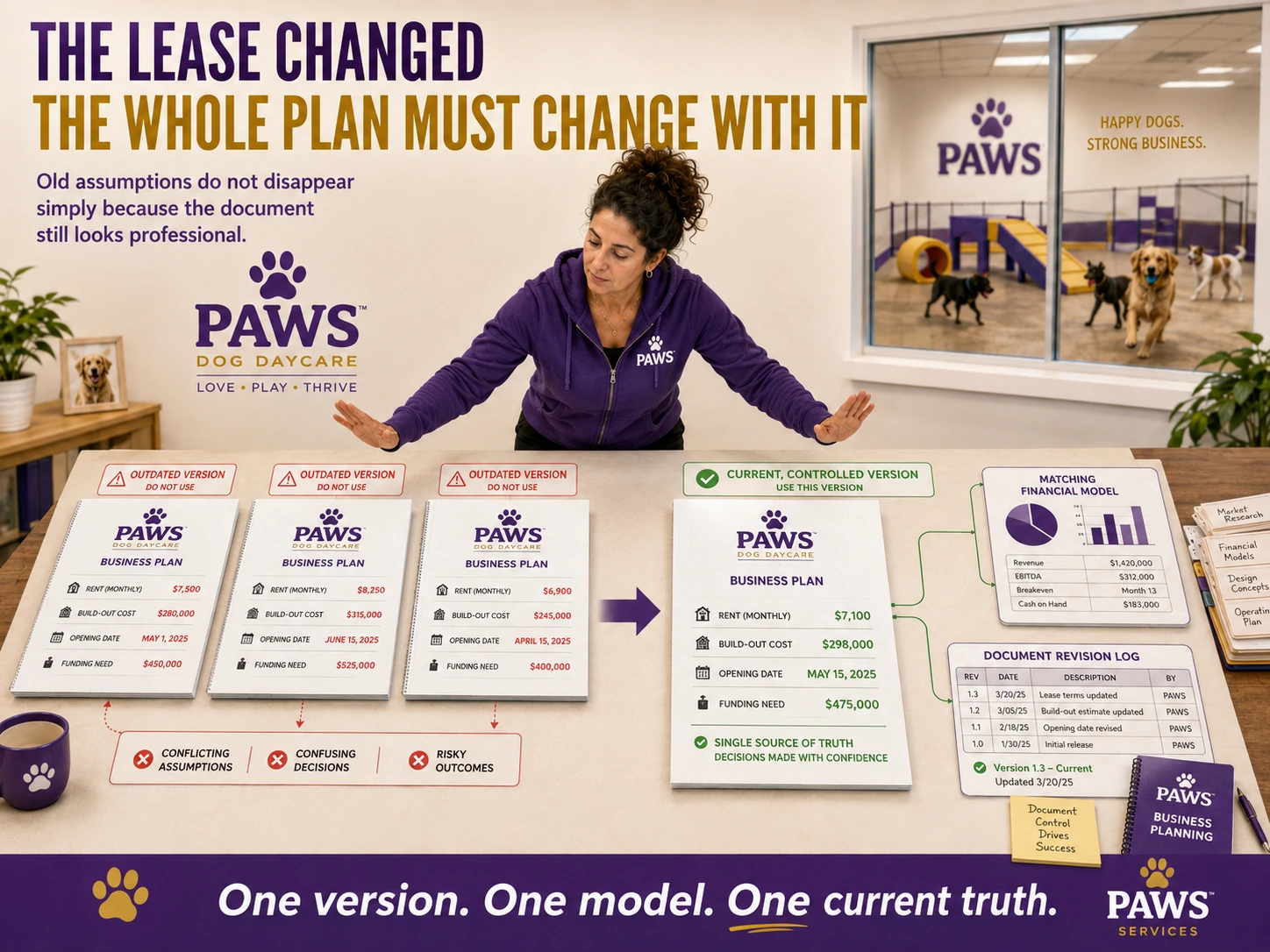
Put a version block near the front of the plan and keep a revision log. When rent, build-out, financing, staffing, pricing, capacity, or the opening date changes, identify which parts of the plan and model changed with it.
Maintain a public or broadly shareable plan separately from a controlled lender or investor package. Personal financial statements, tax returns, credit information, guarantees, account information, and other sensitive records do not belong in a copy distributed casually.
Version control is not clerical housekeeping. It is part of financial and operating risk management. A change in rent, additional charges, landlord work, construction responsibility, loan terms, service launch, or opening date can alter the startup budget, reserve, monthly cash flow, and break-even point.
Use one controlled source of truth for the active plan and model. Mark older versions as superseded, preserve the revision history, and identify who approved the change. Everyone reviewing the project should know which assumptions are current before they make a decision or authorize spending.
Front-Page Version Block
- Plan version and last revision date.
- Prepared by and prepared for.
- Financial-model version.
- Property and lease assumption being used.
- Opening-date assumption.
- Funding assumption and request amount.
- Confidentiality status.
Revision Log
- Date of the change.
- What changed.
- Why it changed.
- Who approved or verified it.
- Sections and schedules affected.
- Whether older copies should be withdrawn.
⚠️
Version warning
If the narrative says rent is $8,000, the cash flow uses $7,200, and the signed lease produces $9,100 after additional charges, the plan does not have three opinions. It has a control failure.
🎯
Define the Business Before You Describe It
The plan needs a specific operation, not a collection of pet-care services floating around in a paragraph.
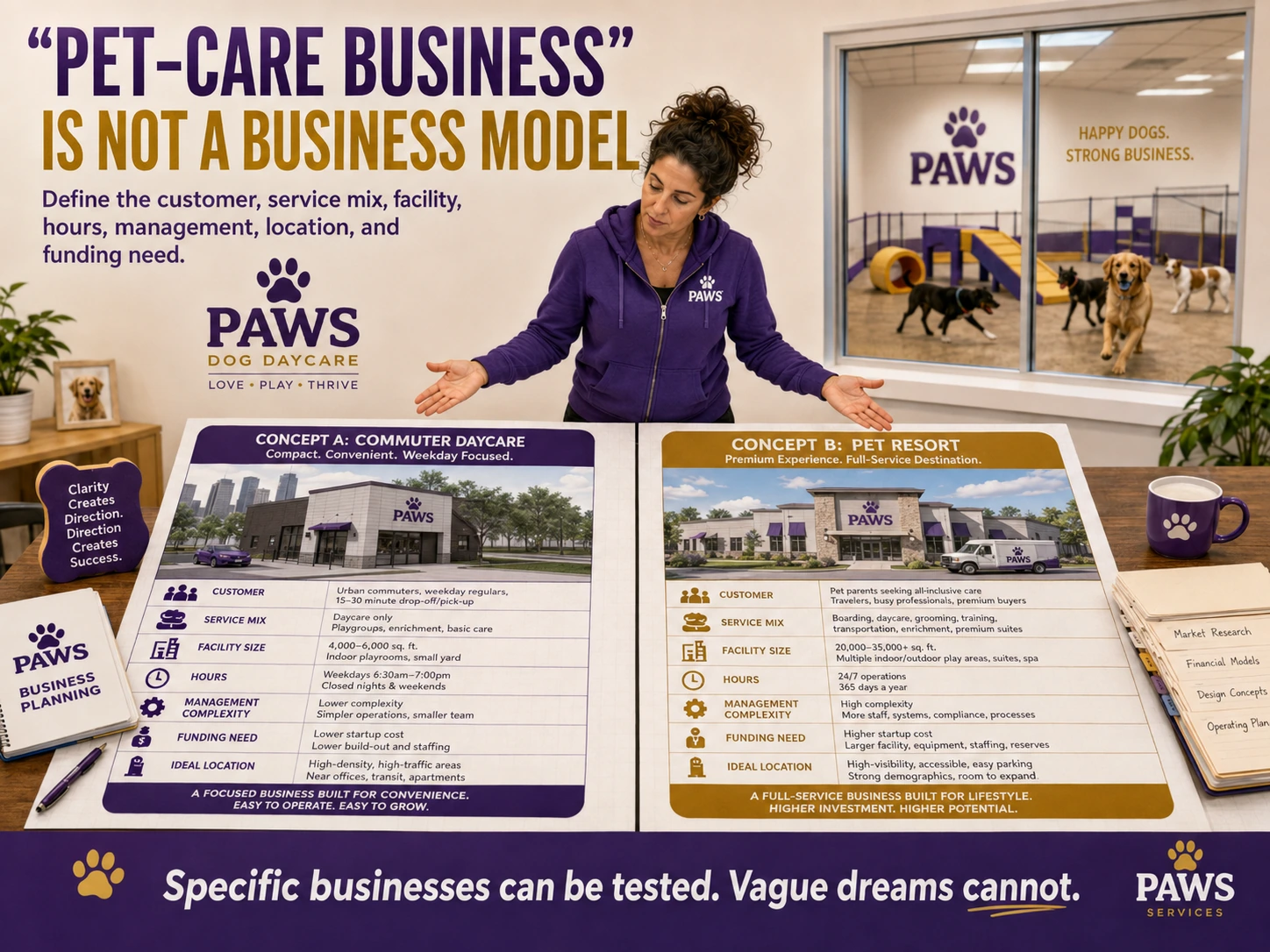
Start by defining exactly what the business is. A 4,000-square-foot weekday daycare serving commuters is a different business from a 20,000-square-foot pet resort with boarding, grooming, private suites, training, transportation, and outdoor yards.
Identify the legal entity, owners, proposed location, facility size, service mix, operating hours, target customer, service area, management structure, startup schedule, and funding need. Explain why this combination makes sense in this market rather than listing every service that might someday make money.
The executive summary should eventually state what is being opened, who will own and manage it, who the customer is, why the market can support it, how much funding is required, what the money will be used for, and what the financial model shows. It should summarize the plan—not replace it.
Define what the business will not do at opening as clearly as what it will do. Delayed services, future expansion ideas, optional amenities, and unproven revenue streams should not be allowed to support the opening forecast unless the space, labor, equipment, marketing, and launch date are already built into the plan.
A specific concept also creates a testable customer promise. The plan should explain why the chosen customer will select this facility, how the operation delivers that promise every day, and which design, staffing, service, and pricing decisions are required to make the promise credible.
Business Identity
- Legal business name and entity type.
- Owners and ownership percentages.
- Proposed location and facility type.
- Daycare, boarding, grooming, training, retail, transportation, or other services.
- Hours, days, holidays, and overnight responsibilities.
Business Purpose
- Customer problem being solved.
- Primary target customer.
- Reason the service mix fits the market.
- Reason the location supports the operation.
- Reason the owner and management team can execute it.
🗓️
Project Timeline and Go/No-Go Decision Gates
The plan should show what must be proven before the next expensive commitment is made.
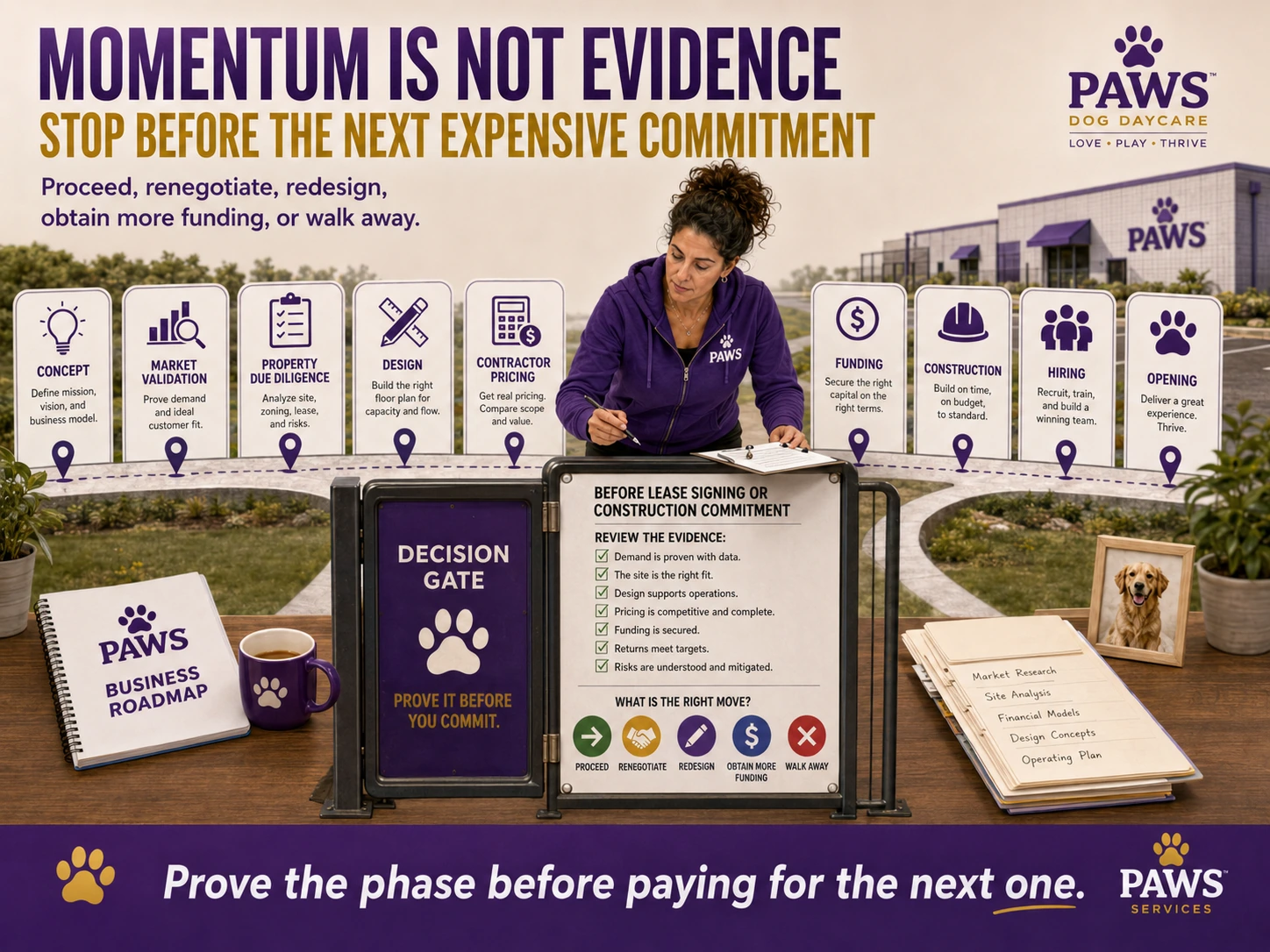
A startup timeline is not only a calendar. It is a chain of dependencies. Zoning affects the lease. The lease affects design responsibility. Design affects bids. Bids affect the funding request. Financing and permits affect construction. Construction affects hiring, marketing, inspections, and opening.
Place a decision gate between major phases. A gate is the point where the owner decides whether the evidence is strong enough to proceed, renegotiate, redesign, obtain more funding, or stop.
Each gate should have written pass, revise, and stop criteria. Without predefined criteria, the owner can always reinterpret disappointing evidence as a reason to continue. The gate should identify the unresolved assumption, the evidence required, who verifies it, and the maximum additional exposure allowed before the answer is known.
A stop decision is not automatically failure. Stopping before a binding lease, unaffordable build-out, weak funding structure, or unsupported market commitment can preserve the capital and credibility needed for a better property or a redesigned project.
| Phase | Work to Complete | Decision Gate Before Proceeding | Common Premature Commitment |
|---|---|---|---|
| Concept and Preliminary Feasibility | Service model, target market, preliminary capacity, rough cost, owner goals, and initial funding ability. | Is the concept worth property-level investigation? | Forming the entire plan around a building found first. |
| Market Validation | Service area, competition, price, demand, customer interviews, lead tests, and required customer count. | Is there enough believable local demand for the required volume and price? | Assuming pet ownership equals daycare demand. |
| Property Due Diligence | Zoning, use, lease, systems, parking, neighbors, sound, utilities, drainage, HVAC, fire, and workflow. | Can this building legally and operationally support the model at an acceptable cost? | Signing a binding lease because the rent looks attractive. |
| Design and Contractor Pricing | Plans, engineering, scope, bids, equipment, permits, landlord work, schedule, and contingency. | Is the real project affordable without consuming the opening reserve? | Financing from a rough cost-per-square-foot guess. |
| Final Model and Funding | Sources and uses, monthly projections, slower case, owner contribution, debt schedule, and lender package. | Does committed or reasonably obtainable funding cover construction, contingency, and working capital? | Beginning work before the full capital stack is understood. |
| Permits and Construction | Approvals, contracts, draw schedule, change control, inspections, equipment, software, and documentation. | Are scope, cash, and opening date still aligned after changes? | Using operating reserve to quietly absorb every change order. |
| Hiring and Pre-Opening | Job descriptions, recruiting, training, policies, website, lead pipeline, tours, software, and opening procedures. | Are people, systems, customers, cash, and inspections ready for a controlled opening? | Hiring a mature-facility payroll before customer volume exists. |
| Soft Opening and First 90 Days | Limited volume, workflow testing, customer feedback, staff adjustment, incident review, marketing conversion, and cash monitoring. | What must change before volume is increased? | Treating opening day as proof that the operating model works. |
⚠️
Decision-gate warning
Momentum is not evidence. The fact that money and time have already been spent is not a reason to make the next commitment if the project no longer works.
🚦
Dog Daycare Business Plan Readiness Audit
Use this to identify whether the plan is ready to be relied upon or still depends on unresolved assumptions.
| Status | What It Looks Like | What to Do Next |
|---|---|---|
| Red: Do Not Rely on It Yet | Zoning or use is unverified; lease risk is unresolved; construction is a rough guess; revenue requires full capacity; opening reserve is missing; payroll ignores major functions; owner pay is excluded; or cash runs out in the base case. | Stop polishing the narrative. Resolve the deal-breaking assumption first. |
| Yellow: Directionally Useful | The operating model is defined, but major costs remain estimates; market evidence is limited; staffing or pricing still needs local verification; or scenario testing has not been completed. | Replace estimates with quotes and local evidence. Test the slower case before committing more money. |
| Green: Decision-Ready | Use is verified; lease obligations are modeled; build-out is supported; capacity is operational; staffing covers the full workday; prices and demand are researched; projections connect; reserve exists; assumptions are documented; and slower scenarios remain survivable. | Use the plan for financing, execution, milestones, and ongoing comparison against actual performance. |
Market Ready
- Target customer and service area are specific.
- Competition and substitutes are documented.
- Customer volume required by the model is understood.
- Demand evidence is local and connected to the forecast.
Facility Ready
- Use, zoning, lease, and approvals are verified or clearly conditioned.
- Build-out scope and systems are understood.
- Operational flow and real capacity are defined.
- Construction contingency and schedule risk are modeled.
Operating Ready
- Services launch in a deliberate sequence.
- Staffing covers the full workday and 365-day duties when applicable.
- Management responsibilities and backup coverage are defined.
- Pricing and revenue follow actual service delivery.
Financially Ready
- Startup budget, sources and uses, and opening reserve connect.
- First-year projections are monthly.
- Owner compensation, debt, taxes, and capital needs are included.
- Slower and higher-cost scenarios have been tested.
🚑
Business Plan Triage: Fix the First Unresolved Problem
Do not polish the whole document when one unverified assumption can still kill the project. Start with the biggest unresolved issue.
📍
I Do Not Know if Demand Is Real
Define the service area, required customer count, competitors, and stronger pre-lease validation.
🏢
The Building or Lease Is Unresolved
Verify use, lease obligations, systems, construction responsibility, cost, and exit risk.
💰
I Do Not Know the Real Startup Cost
Separate quotes, estimates, contingency, working capital, funding timing, and unresolved scope.
📐
I Do Not Trust the Capacity Number
Rebuild capacity from groups, staffing, behavior, weather, boarding overlap, isolation, and workflow.
👥
Payroll Is a Guess
Follow the workday, build shifts, price owner labor, and include the full payroll burden.
🏷️
Pricing or Revenue Feels Convenient
Use collected price, units sold, active customers, seasonality, unit economics, and real capacity.
💵
I Do Not Know How Much Reserve Is Enough
Build the monthly opening ramp, delay scenario, lowest cash point, and corrective triggers.
📊
The Financial Statements Do Not Connect
Separate profit, cash, debt principal, assets, depreciation, deposits, and owner withdrawals.
🏦
The Funding Request Is Not Ready
Build sources and uses, evidence, borrower support, slower-case repayment, and the appendix.
❓
I Do Not Know What I Am Missing
Use the complete outline and final checklist, then mark each answer verified, estimated, or unresolved.
🚫
Common Dog Daycare and Dog Boarding Business Plan Failures
Most bad plans do not fail because the grammar is weak. They fail because the assumptions are convenient.
🐕
Instant Full Capacity
The forecast jumps from opening day to a mature customer base without explaining lead generation, conversion, repeat use, or time.
💸
No Opening Reserve
The facility is funded through construction, but the business has no money left to survive the customer ramp.
🏷️
Posted Price Equals Collected Price
Packages, discounts, credits, promotions, and customer behavior are ignored.
👥
Fantasy Payroll
Supervision is counted while cleaning, front desk, management, boarding, weekends, grooming, training, and call-outs disappear.
🏢
Generic Building Cost
The plan uses a rough per-square-foot number before zoning, lease, drainage, HVAC, sound, utilities, or actual conditions are known.
📐
Square-Footage Capacity
The model counts dogs the facility cannot group, staff, rotate, clean behind, or consistently sell.
📈
Revenue Without Workflow
Boarding, grooming, training, transportation, and retail are added without qualified labor, space, equipment, or operating systems.
🧮
Profit Confused With Cash
The projected income statement looks positive while deposits, debt, construction, taxes, and timing empty the bank account.
👤
Owner Works for Free
The business only appears profitable because management, sales, scheduling, emergencies, and owner labor have no cost.
🏦
Funding Request Without Evidence
The amount requested is clear, but the use of funds, owner contribution, quotes, repayment source, and contingency are not.
📣
Marketing Begins After Opening
Rent and payroll start immediately while customer acquisition begins from zero.
📄
The Plan Never Changes
Old numbers remain after the building, lease, bids, payroll, financing, pricing, services, or opening date change.
✅
Final Dog Daycare and Dog Boarding Business Plan Checklist
This is the “does the plan describe a business that can actually be opened and operated?” checklist.
🎯
Concept Ready
- Business model and service mix are specific.
- Target customer and service area are defined.
- Ownership and management roles are clear.
- Executive summary matches the completed plan.
📍
Market Ready
- Demand is supported by local evidence.
- Competition and substitutes are documented.
- Required customer volume is understood.
- Marketing and customer acquisition are planned before opening.
🏢
Facility Ready
- Use and zoning are verified.
- Lease obligations are inside the model.
- Build-out scope and estimates are current.
- Drainage, HVAC, sound, utilities, fire, and workflow are addressed.
📐
Capacity Ready
- Permitted and physical capacity are separated.
- Group, staffed, behavioral, and weather-adjusted capacity are tested.
- Boarding and other services do not double-count space.
- Revenue uses sellable operating capacity.
👥
Staffing Ready
- Every daily function has coverage.
- Payroll includes taxes, benefits, overtime, training, and management.
- Weekends, holidays, boarding, grooming, and call-outs are covered.
- Owner labor and compensation are visible.
🏷️
Revenue Ready
- Each service has a real revenue driver.
- Collected price is separated from posted price.
- Service volume follows capacity and customer demand.
- Seasonality, discounts, cancellations, and ramp are included.
💰
Funding Ready
- Startup budget and sources and uses balance.
- Construction contingency is visible.
- Opening reserve is separate and sufficient for the tested case.
- Funding timing matches payment timing.
📊
Financial Model Ready
- First year is projected monthly.
- Profit and loss, cash flow, balance sheet, debt, and break-even connect.
- Owner compensation and taxes are included.
- Assumptions are documented and updateable.
🧪
Risk Ready
- Delayed opening has been tested.
- Higher construction and payroll have been tested.
- Slower customer growth has been tested.
- Trigger points and corrective actions are defined.
⚠️
Final checklist warning
If the plan still depends on an unverified building, a full-capacity forecast, free owner labor, or money that has not been committed, do not let a polished document talk you into treating the risk as resolved.
🔄
How the Business Plan Changes for Different Dog-Care Projects
The planning framework remains useful, but the evidence, risks, and financial schedules change with the transaction and service model.
| Project Type | What Requires Extra Attention | Common Planning Error |
|---|---|---|
| New Independent Facility | Market validation, property, zoning, full build-out, startup funding, opening pipeline, and management system. | Underestimating the time and cash required before recurring customers exist. |
| Buying an Existing Dog Daycare | Historical financials, customer retention, owner adjustments, payroll, deferred maintenance, lease transfer, reputation, records, and seller dependence. | Paying for reported revenue without proving normalized cash flow and customer transfer. |
| Franchise Facility | Franchise disclosure, fees, royalties, required vendors, build standards, territory, marketing fund, restrictions, and franchisor assumptions. | Using franchisor projections without rebuilding the model for the actual local market and lease. |
| Home-Based Boarding | Home occupation rules, animal limits, neighbors, parking, insurance, property restrictions, household impact, overnight supervision, and evacuation. | Assuming lower occupancy cost removes zoning, liability, capacity, or lifestyle risk. |
| Boarding-Only Kennel | Seasonality, occupied nights, 365-day labor, feeding, medication, overnight monitoring, cleaning turnover, and ordinary-week demand. | Annualizing holiday occupancy and overlooking quiet periods. |
| Grooming and Boarding Combination | Specialist compensation, appointment capacity, boarding support labor, shared utilities, holding space, and separate demand channels. | Counting both services without understanding which one controls the room, staff, or schedule. |
| Transportation or Mobile Service | Vehicles, routes, drive time, commercial auto, loading, scheduling, fuel, maintenance, licensing, and driver labor. | Counting service revenue while treating travel time as free. |
| Expansion of an Existing Facility | Historical demand, current bottleneck, disruption, additional management, financing, customer retention, and incremental contribution. | Using existing popularity as proof that every added square foot or service will be profitable. |
🏪
Buying an Existing Dog Daycare
Review the acquisition-specific risks, records, customer transfer, lease, maintenance, and seller claims.
🏷️
Dog Daycare Franchise Planning
Review royalties, fees, control, vendors, brand claims, disclosure, and the difference between a system and a guaranteed result.
❓
Dog Daycare Business Plan FAQ
Practical answers about business-plan purpose, structure, writing order, templates, examples, document length, updates, pitch decks, and professional help.
What is a dog daycare business plan?
A dog daycare business plan is the written explanation of how the proposed business will be structured, funded, marketed, staffed, operated, and expected to perform financially. It should connect the market, location, facility, services, capacity, payroll, startup cost, cash reserve, and projections.
Is a dog boarding business plan different from a dog daycare business plan?
The overall structure is similar, but the operating model differs. Boarding depends on occupied nights, seasonal demand, sleeping space, feeding, medication, cleaning, weekends, holidays, and overnight responsibility. Daycare depends more heavily on recurring weekday attendance, group management, arrival and pickup flow, and local convenience.
What is a doggy daycare business plan?
“Doggy daycare business plan” is simply another common way people refer to a dog daycare business plan. The serious planning work is the same regardless of the wording used in the search.
Do I need a business plan to open a dog daycare?
You may not be legally required to write one simply to open, but serious planning is essential when committing to a lease, construction project, employees, debt, investors, or substantial personal savings. A lender or investor will commonly expect a formal plan and projections.
Can I use a generic business-plan template?
You can use a generic structure, but the content must address dog-care realities: zoning, animal use, noise, flooring, drainage, HVAC, odor, group capacity, boarding, cleaning, vaccines, behavior screening, staffing, weekends, liability, and customer flow.
Can I use a dog daycare business plan example and change the name?
No example can replace local research. A useful example can show structure, formulas, and the relationship between assumptions. It should not be copied as if another facility’s rent, market, payroll, capacity, prices, and customer ramp automatically apply to yours.
How long should a dog daycare business plan be?
Long enough to explain and support the business without padding it with repeated marketing language. The quality of the market evidence, operating model, financial assumptions, and supporting documents matters more than a particular page count.
Should the executive summary be written first?
Usually not. It appears first, but it should summarize work that has already been completed. Build the market, operating, funding, and financial sections first, then write the executive summary to match them.
How often should the business plan be updated?
Update it whenever major assumptions change, including the building, lease, contractor bids, financing, pricing, payroll, services, equipment, opening date, or sales ramp. After opening, compare actual performance with the plan regularly and revise the forecast when the business proves an assumption wrong.
What is the biggest mistake in a dog daycare business plan?
The biggest mistake is allowing a required outcome to control the assumptions. When the owner decides the business must produce a certain profit, every estimate begins leaning toward that answer. Build the assumptions from evidence and let the result tell you whether the project works.
What sections should a dog daycare business plan include?
At minimum, cover the company, ownership, management, services, market, competition, customer acquisition, location, zoning, facility, operations, safety, staffing, pricing, startup budget, funding, assumptions, sales, payroll, profit and loss, cash flow, balance sheet, break-even, scenarios, risk, milestones, and supporting appendix.
Is a one-page or lean business plan enough?
A lean plan can help organize an early concept or an existing owner’s internal priorities. It is usually not enough for a facility involving a lease, construction, employees, animal care, debt, investors, or a formal funding request. Use the lightest format that still answers the decisions and risks involved.
What is the difference between a business plan and a pitch deck?
A pitch deck is a short presentation used to communicate the opportunity and start a conversation. A business plan and supporting model provide the detailed market, operating, funding, financial, and risk evidence behind the presentation.
Who should write the business plan?
The owner must understand and control the assumptions even when an accountant, consultant, writer, lender, attorney, architect, or other professional helps. A plan written by someone else is useless if the owner cannot explain where the numbers came from or how the operation works.
Should I hire a business-plan writer?
A skilled writer can organize and clarify the document, but writing skill does not replace market research, property due diligence, operating design, contractor pricing, or financial modeling. Avoid anyone who promises approval or produces a generic plan without requiring project-specific evidence.
What should be completed before signing a dog daycare lease?
Before signing a binding lease, verify the proposed use, zoning path, animal limits, parking, outdoor restrictions, sound exposure, utilities, drainage, HVAC, fire requirements, construction responsibility, rent structure, additional charges, guarantees, and exit risk. The preliminary operating and financial model should show that the building can support the service mix at a cost the business can survive.
How should the plan calculate dog daycare capacity?
Capacity should be built from the operation rather than total square footage alone. Separate permitted, physical, group, staffed, behavioral, weather-adjusted, boarding, isolation, and sellable capacity. Then test how dogs move through arrival, play, rest, feeding, cleaning, grooming, boarding, and pickup without double-counting the same space.
How much opening reserve should the business plan include?
The reserve should be based on the monthly cash-flow ramp and the lowest projected cash point, not a generic number of months. Include rent, payroll, debt, utilities, insurance, marketing, repairs, taxes, owner needs, and slower customer growth. The slower and delayed-opening cases should help determine how much protection the project actually requires.
How should a business plan handle estimates that are not verified yet?
Label each major assumption as verified, quoted, estimated, or unresolved. Include the source, date, responsible person, expected verification date, and the schedules affected. Do not allow an unresolved estimate to appear as a confirmed fact merely because the document needs a number.
What should happen to the business plan after the dog daycare opens?
Use it as a comparison and control tool. Review actual customers, attendance, collected pricing, payroll, expenses, cash, incidents, marketing conversion, and capacity against the plan. Update the forecast when the business proves an assumption wrong, while preserving the original plan and revision history so management can see what changed and why.
🗺️
Continue Through the Three-Part Business Plan Series
Move between the plan structure, market and operating proof, and the financial and funding model without losing the connection between them.
🧱
1. Build the Business Plan
Structure the document, use the complete outline, control revisions, and identify what must be proven.
🏢
2. Prove the Market and Operation
Validate demand, property, capacity, staffing, safety, pricing, and the customer pipeline.
📊
3. Build the Financial and Funding Model
Connect startup cost, revenue, payroll, cash flow, break-even, risk, and the lender package.
🐾
The Bottom Line: Build the Business on Paper Before the Building Starts Charging You
The plan should make the project clearer, harder to fool, and easier to operate—not merely easier to present.
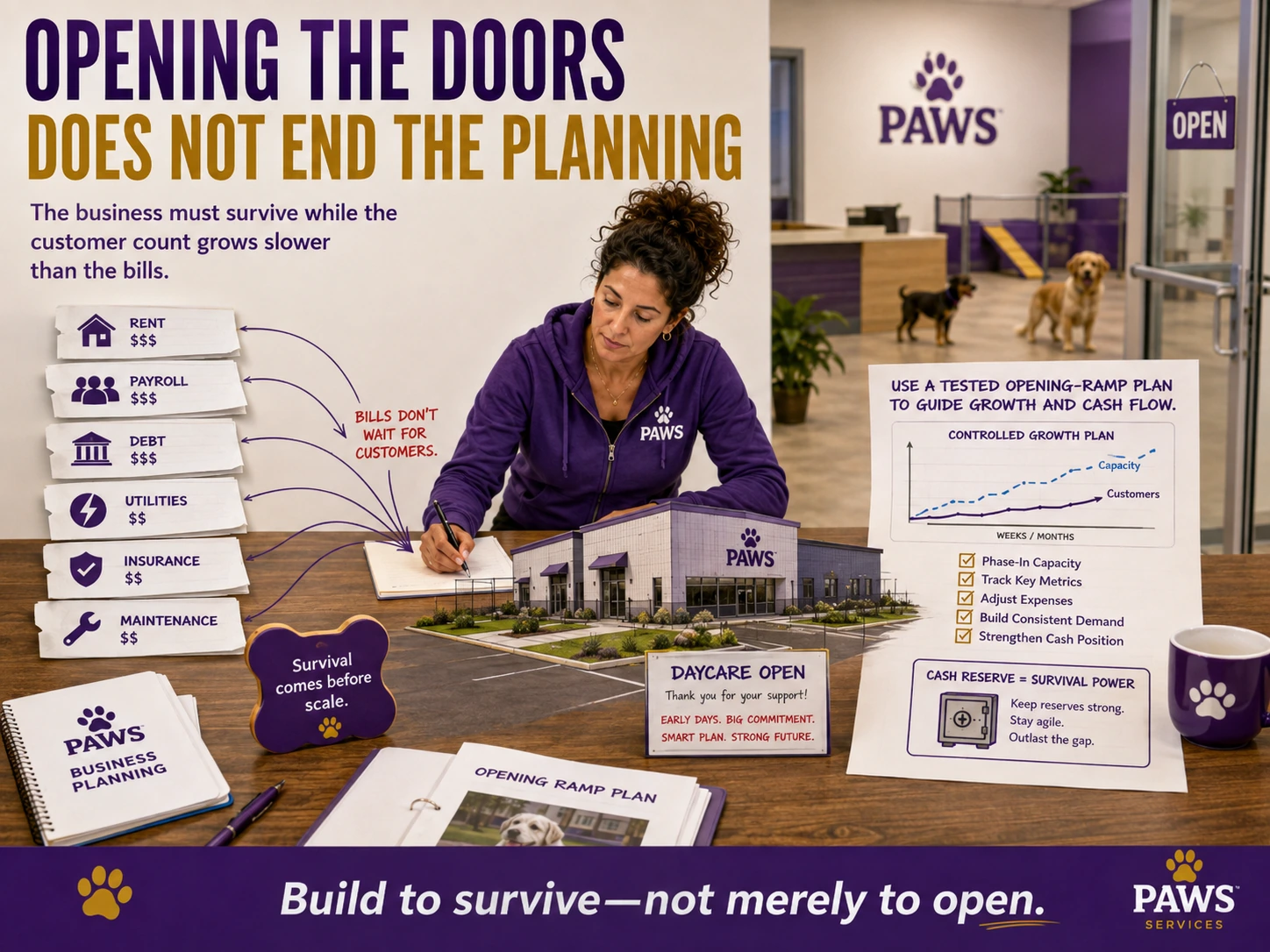
A serious dog daycare, doggy daycare, dog boarding, kennel, or pet resort business plan should explain what is being opened, who will buy it, why the market can support it, what the building requires, how many dogs can actually be served, who performs the work, what customers will pay, how much cash is needed, when the business reaches break-even, and what happens when growth is slower than expected.
Do not use the plan to make the dream look safe. Use it to find the parts that are not safe while they can still be corrected cheaply.
Then keep using it. Compare the forecast with the real customer count, real payroll, real expenses, real cash, and real problems after opening.
The business does not need a document that says it will succeed. It needs a plan that shows what success requires and tells you early when the operation is moving away from it.
After opening, convert the plan into a rolling operating forecast. Compare actual active customers, attendance, boarding nights, collected price, payroll hours, marketing conversion, expenses, cash, incidents, and capacity against the assumptions that justified the project.
The first ninety days should produce scheduled review points and corrective triggers. If customer growth is slower, payroll is heavier, construction debt is larger, or collected pricing is weaker than expected, the owner needs an action plan before the opening reserve becomes the only remaining decision-maker.