Market Demand, Competition, Customer Acquisition, Location, Zoning, Facility Planning, Capacity, Staffing, Safety, Services, and Operating Control
Dog Daycare Market Analysis and Operations Plan
Part two of the PAWS dog daycare business-plan series: prove that the local market, proposed building, customer pipeline, capacity, staffing model, and daily operation can support the business before the financial forecast depends on them.
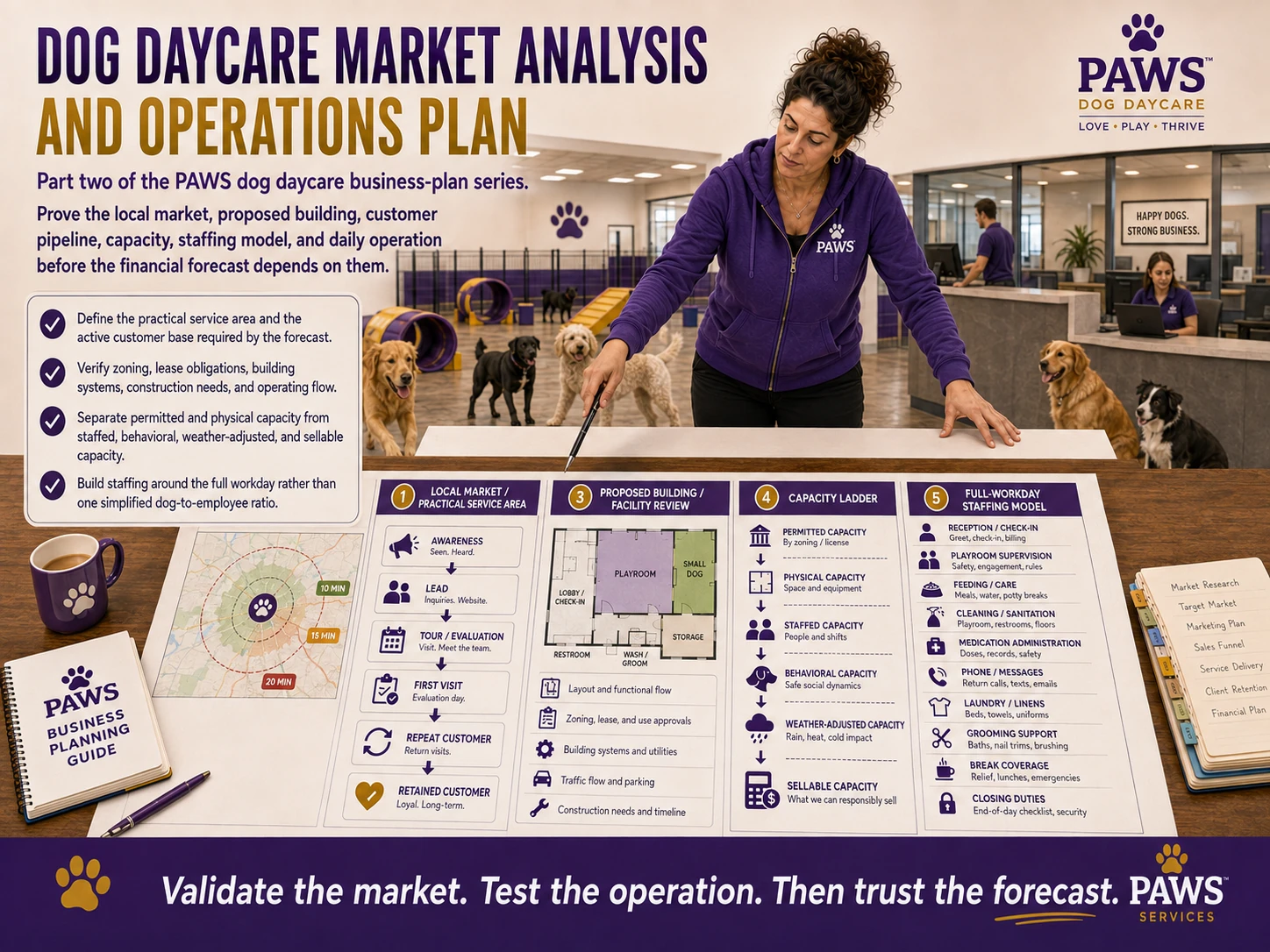
A dog daycare business plan cannot be supported by national pet-industry statistics and a promising-looking building. The market and operations plan must show who will use the service, how the business will reach them, whether the location can legally and physically support the operation, and how the staff will deliver the promised care every day.
This page preserves the market, facility, customer-acquisition, capacity, staffing, pricing, safety, and operator-review material from the complete PAWS business-plan guide. Use it after defining the business-plan structure and before treating any revenue or payroll forecast as reliable.
The goal is not to prove that some people own dogs. The goal is to connect a realistic local customer base to a specific building, service mix, operating system, staffed capacity, and repeatable customer experience.
⚠️
Operator warning: demand and capacity must be operational, not theoretical.
A market full of dog owners does not prove that this building, price, service mix, staff, and customer-acquisition plan can produce the required repeat use. Prove the operation before the spreadsheet depends on it.
🗺️
Use the Three-Part Dog Daycare Business Plan Series
Each page answers a different decision. Use all three so the narrative, operation, and numbers describe the same business.
🧱
1. Build the Business Plan
Structure the document, use the complete outline, control revisions, and identify what must be proven.
🏢
2. Prove the Market and Operation
Validate demand, property, capacity, staffing, safety, pricing, and the customer pipeline.
📊
3. Build the Financial and Funding Model
Connect startup cost, revenue, payroll, cash flow, break-even, risk, and the lender package.
📍
Build the Market Analysis Around the Real Service Area
“People love their dogs” is true. It is not enough to support a lease, payroll, or loan payment.
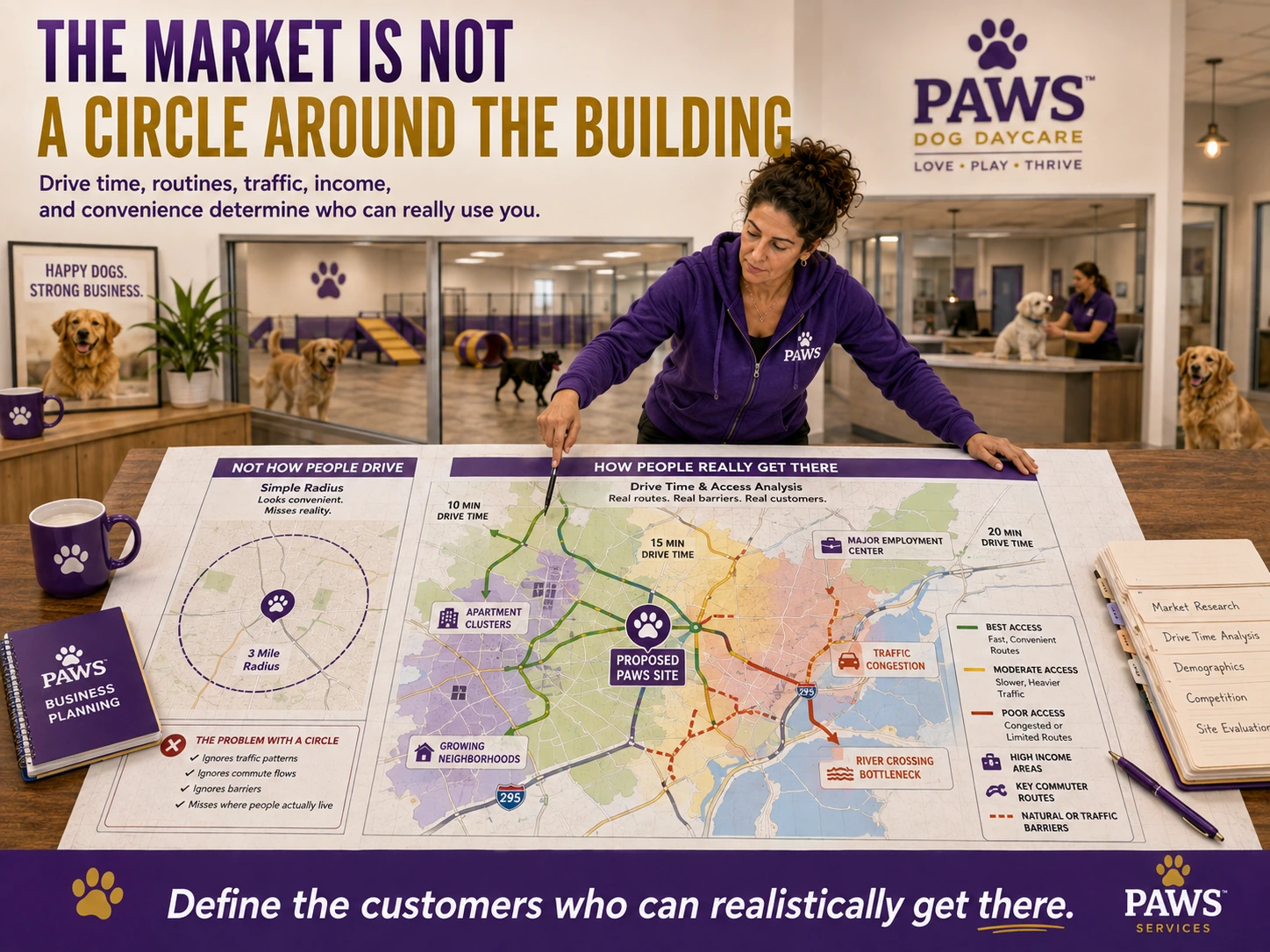
A dog daycare market is local. Most daycare customers need repeated drop-off and pickup convenience. Boarding may pull from farther away because it is used less often and depends more heavily on trust. Grooming, training, transportation, and premium services may each have a different practical service radius.
Define the area customers can realistically travel from, not the area you wish they would travel from. Consider drive time, commuter routes, employment centers, neighborhoods, apartment density, household income, traffic barriers, nearby growth, existing pet-care habits, and the locations of competing facilities.
Market demand should be connected to the amount of business you need. It is not enough to prove that some customers exist. The plan has to show a believable path to the number of repeat customers, daycare visits, boarding nights, grooming appointments, or package sales required by the financial model.
Map the service area by actual customer convenience rather than a fixed radius. A three-mile trip that follows a direct commuter route can be easier than a one-mile trip across a congested interchange, bridge, school zone, or neighborhood bottleneck. The market model should reflect how people really move during the hours the business expects them to drop off and pick up.
Separate the population that can theoretically reach the facility from the customers who fit the service. Household schedule, dog ownership, dog behavior, disposable income, housing type, employer location, commute direction, and willingness to use organized pet care all narrow the usable market. The forecast should be built from that narrower group.
| Market Question | Evidence to Gather | Weak Shortcut |
|---|---|---|
| Who is the target customer? | Work schedule, income, housing type, commute, travel, dog ownership, service need, and buying behavior. | “Busy professionals who love dogs.” |
| How far will they drive? | Drive-time map, commuter routes, neighborhood access, bridges, traffic, and actual customer patterns when available. | Drawing a large circle around the building and counting everyone inside it. |
| How much demand is required? | Customer count needed, average visits, boarding nights, appointment volume, and conversion assumptions. | Proving that dog ownership is common without proving the business can capture enough paying use. |
| What affects demand? | Employment, remote work, travel, apartments, new development, competition, seasonality, local culture, and price sensitivity. | Using national pet-spending numbers as if they automatically describe the neighborhood. |
| What evidence supports the forecast? | Local competitor activity, pricing, waitlists, search demand, inquiries, surveys, demographic data, interviews, and pre-opening leads. | Choosing the revenue goal first and calling it market demand. |
🔬
Validate Demand Before the Lease Makes the Question Expensive
Interest is useful. Repeated customer action is stronger. Neither should be confused with guaranteed demand.
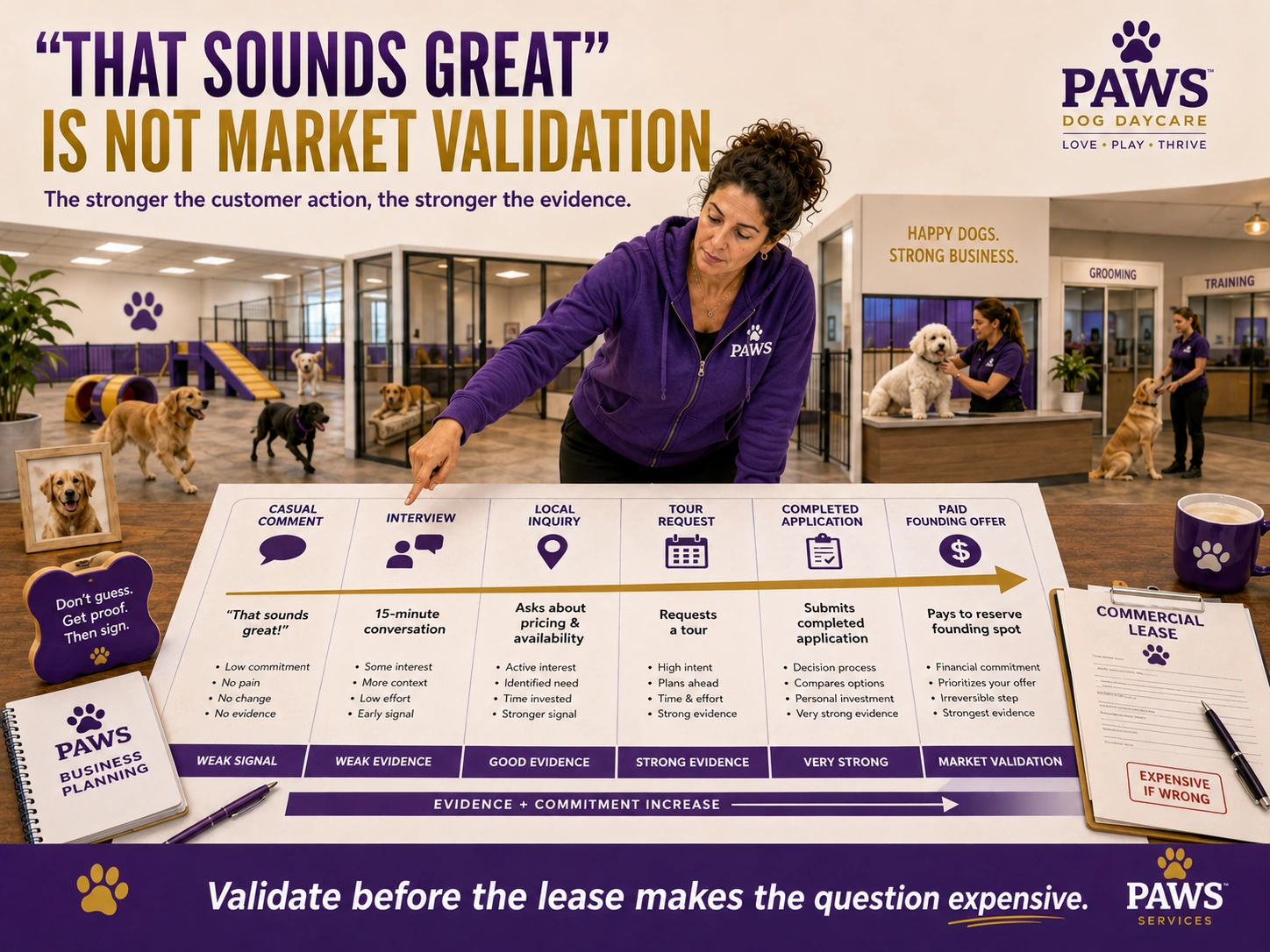
Market validation should become more specific as the project becomes more expensive. Early interviews can expose customer needs, price resistance, commute patterns, and objections. A targeted landing page, local campaign, interest list, tour request, completed application, or other concrete action can provide stronger evidence than a general survey response.
Validation does not mean collecting flattering answers from friends. It means testing whether the proposed customer understands the service, lives within a realistic service area, accepts the likely price, can meet the facility requirements, and is willing to take the next step.
Use validation in stages and raise the standard before each larger financial commitment. Casual comments may justify more research. Qualified inquiries may justify more detailed planning. Applications, tours, and paid founding offers are stronger signals, but even those should be tested for geography, price fit, dog eligibility, and likely repeat use.
Track the drop-off between stages instead of only counting the top of the funnel. If one hundred people express interest but only twelve are local, qualified, willing to pay, and ready to complete the intake process, the twelve are the evidence that belongs in the operating model.
| Validation Method | What It Can Tell You | What Makes the Signal Stronger | What It Still Does Not Prove |
|---|---|---|---|
| Customer Interviews | Needs, routines, objections, current alternatives, price sensitivity, and travel patterns. | Interviewing people in the actual service area who use or seriously need the service. | That the person will buy from this facility when it opens. |
| Local Survey | Directional interest, service preferences, hours, and common concerns. | Specific questions, identified geography, and respondents outside the owner’s social circle. | Recurring paid attendance. |
| Landing Page and Interest List | Whether a clear local offer creates visits, sign-ups, calls, or tour requests. | Defined geography, tracked traffic, clear pricing context, and qualified contact information. | That every sign-up becomes an approved, repeat customer. |
| Small Test Campaign | Cost and quality of initial local inquiries. | Tracking from impression through call, form, tour, or application. | Long-term customer acquisition cost after competitors respond or novelty fades. |
| Partner Conversations | Local demand patterns seen by apartments, vets, groomers, trainers, rescues, employers, and pet businesses. | Specific evidence about customer requests, gaps, waiting periods, and service complaints. | That a partner will consistently refer customers. |
| Pre-Opening Tours or Applications | How many people will invest time and share detailed information. | Scheduled appointments, completed records, clear next steps, and follow-up behavior. | That the dog will qualify or the customer will use the service repeatedly. |
| Deposit or Paid Founding Offer | A stronger willingness-to-pay signal when lawful, clearly documented, and operationally appropriate. | Clear refund terms, realistic opening date, and a specific service commitment. | That the broader market supports the full facility. |
🥊
Competition Analysis Is More Than a List of Nearby Facilities
Competition is anyone solving the same customer problem, including businesses that package the solution differently.
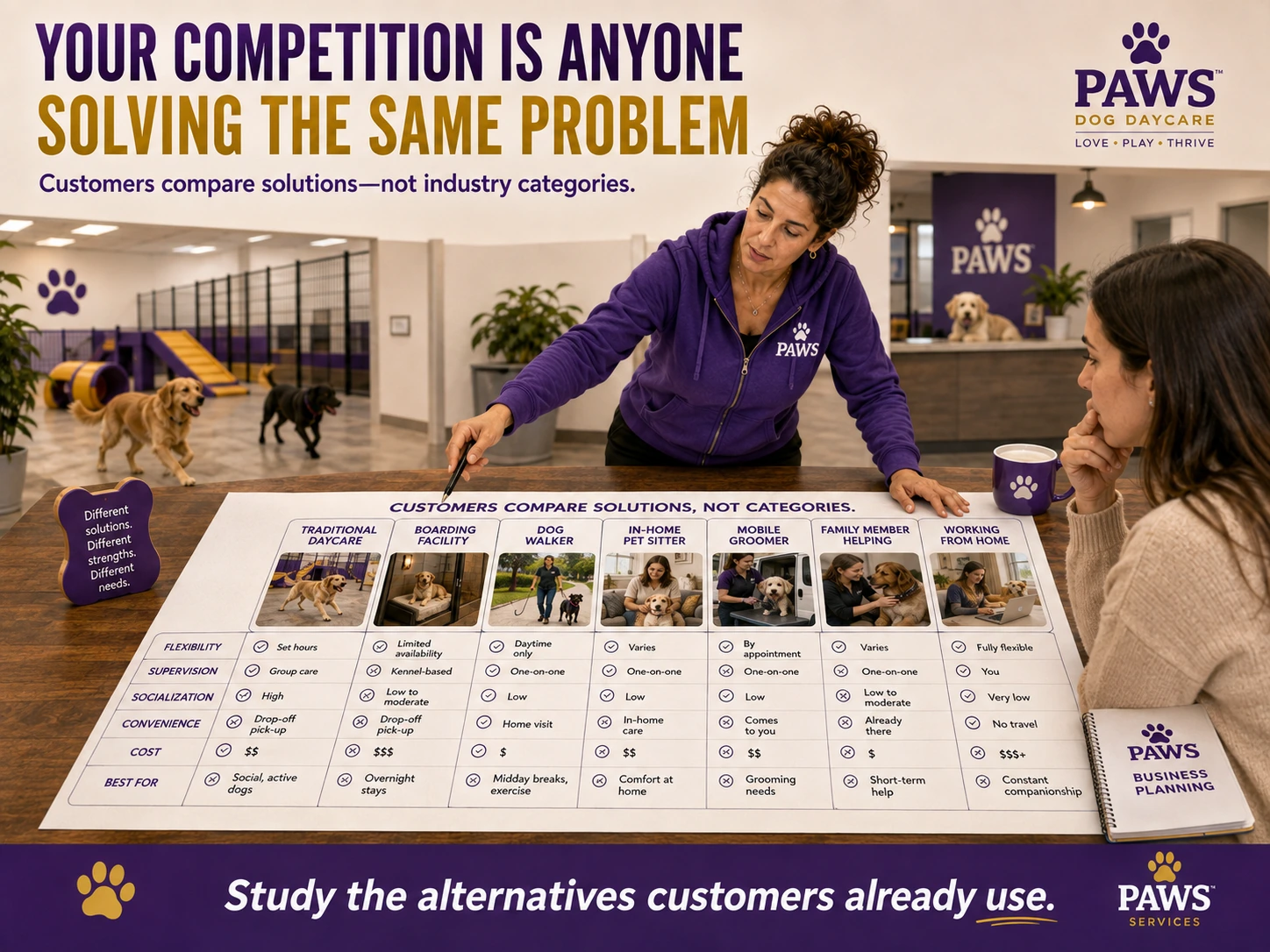
Study direct competitors such as dog daycares, boarding kennels, pet resorts, groomers, and trainers. Also study substitutes: in-home sitters, dog walkers, mobile groomers, veterinary boarding, apartment dog walkers, family care, and remote-work households that may not need daycare five days a week.
Review prices, packages, hours, location, customer reviews, website clarity, facility photos, services, capacity signals, waitlists, reputation, staffing, policies, and the customer experience they appear to provide. The goal is not to copy them. The goal is to understand what customers already expect and where the market remains weak.
Be honest. A new facility does not automatically win because it is cleaner, newer, or more enthusiastic. Existing competitors may have years of reviews, established staff, referral relationships, recurring packages, and customer habits that are expensive to break.
What to Compare
- Daycare, boarding, grooming, training, and add-on pricing.
- Packages, memberships, discounts, cancellation rules, and deposits.
- Hours, weekends, holidays, early drop-off, and late pickup.
- Facility condition, layout, yards, suites, cameras, and customer visibility.
- Reviews, complaints, strengths, recurring themes, and reputation.
What the Plan Should Explain
- Why customers would choose this business.
- Which customers are a better fit for another provider.
- Whether the market can support another facility.
- How pricing compares without becoming a race to the bottom.
- How the business will earn trust before it has years of reviews.
📣
The Business Plan Needs a Customer-Acquisition Model, Not Just a Market Description
Proving that customers exist is different from showing how this business will reach, convert, retain, and replace them.
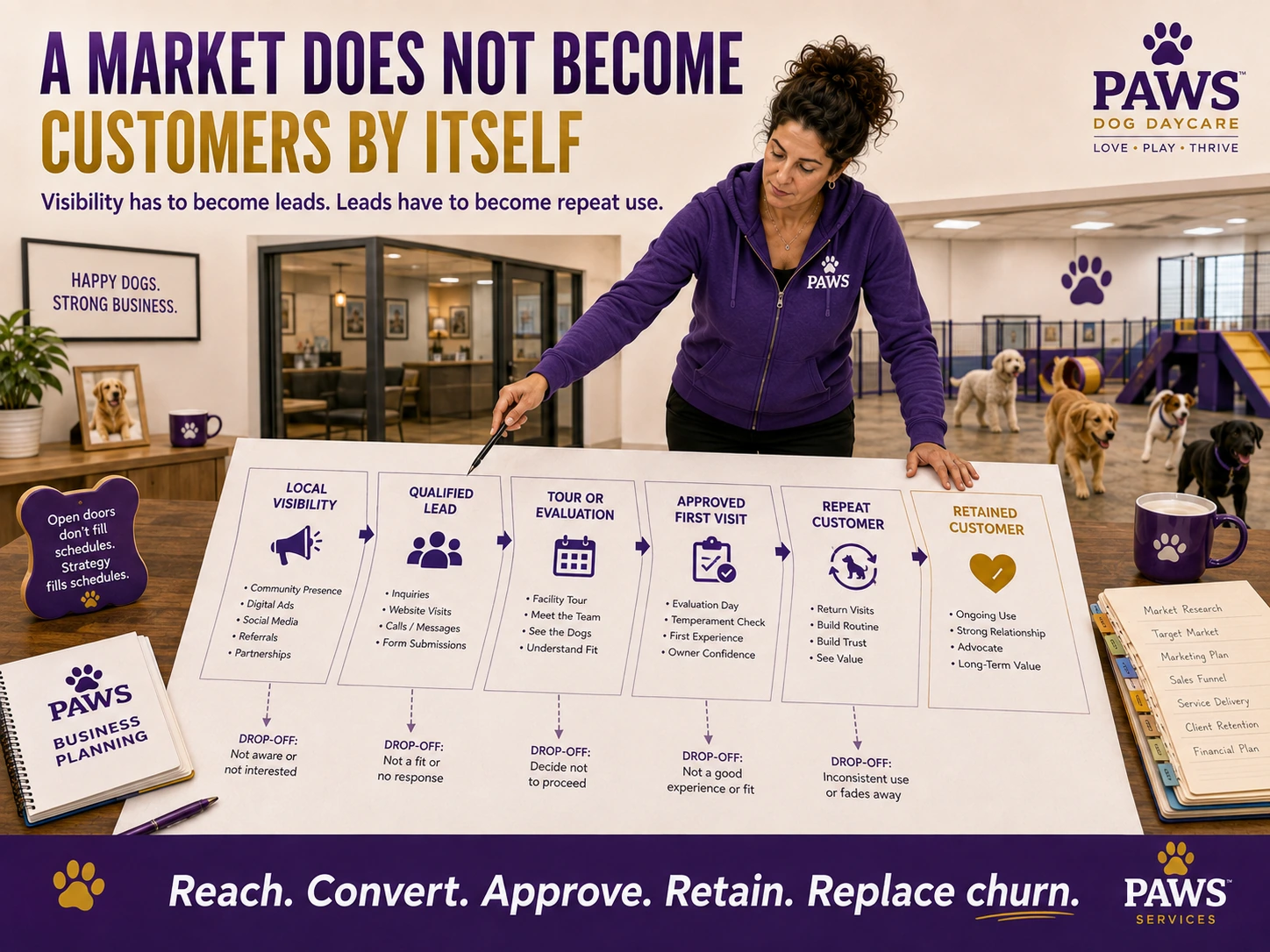
The marketing section should connect the revenue forecast to an acquisition funnel. How many local people must see the business? How many become qualified leads? How many schedule tours or evaluations? How many show up, qualify, book, return, buy packages, add boarding or grooming, and remain active?
Pre-opening marketing should create a pipeline before full overhead begins. Opening marketing should convert the pipeline into first visits and repeat use. Ongoing marketing should replace normal customer churn and support growth. “Word of mouth” can become a valuable channel, but it is not a complete plan for launching or maintaining the customer base.
The acquisition plan should identify a target conversion rate and a responsible owner for every stage. Visibility without response, leads without appointments, appointments without approved dogs, and first visits without repeat use are different failures and require different corrections.
Retention belongs in the acquisition model because growth is net of churn. If the business loses eight active customers in a month and adds ten, the customer base grew by two—not ten. Marketing budgets, staffing expectations, and revenue ramps should be built around net active-customer growth.
Swipe left/right to see the full table.
| Funnel Stage | What the Plan Should Estimate | Evidence or Tracking | What Can Break |
|---|---|---|---|
| Local Visibility | Search presence, signs, ads, partner reach, referrals, events, and content needed to create awareness. | Impressions, local profile actions, website visits, campaign traffic, and partner activity. | The business is invisible or reaches people outside the real service area. |
| Qualified Leads | Calls, forms, messages, applications, and tour requests from realistic customers. | Lead source, service requested, ZIP code, dog information, and response time. | Cheap inquiries are counted even when distance, price, or dog requirements make them unusable. |
| Tours or Evaluations | Percentage of qualified leads that schedule and attend the next step. | Scheduled, attended, no-show, and rescheduled appointments. | Staff answer questions but never ask for a specific appointment. |
| Approved First Customers | Dogs or households that meet requirements and complete the first paid service. | Approval rate, first booking, average acquisition cost, and service chosen. | The forecast assumes every lead becomes an approved dog. |
| Repeat Customers | Percentage that returns and expected visit frequency. | Second visit, package purchase, monthly visits, and active-customer status. | The plan counts one trial visit as a recurring customer. |
| Retention and Churn | Customers remaining active, customers lost, and replacements needed. | Last visit, booking frequency, cancellations, package use, and reactivation. | The active customer base only grows because nobody ever leaves. |
| Service Expansion | Daycare customers using boarding, grooming, baths, training, transportation, or add-ons. | Attachment rate, repeat use, direct cost, and capacity. | Cross-sell revenue is counted without staff, space, demand, or a customer handoff. |
🏢
The Building Is Part of the Business Plan
A dog daycare or boarding business cannot be planned accurately while the location remains a generic box on a real-estate listing.
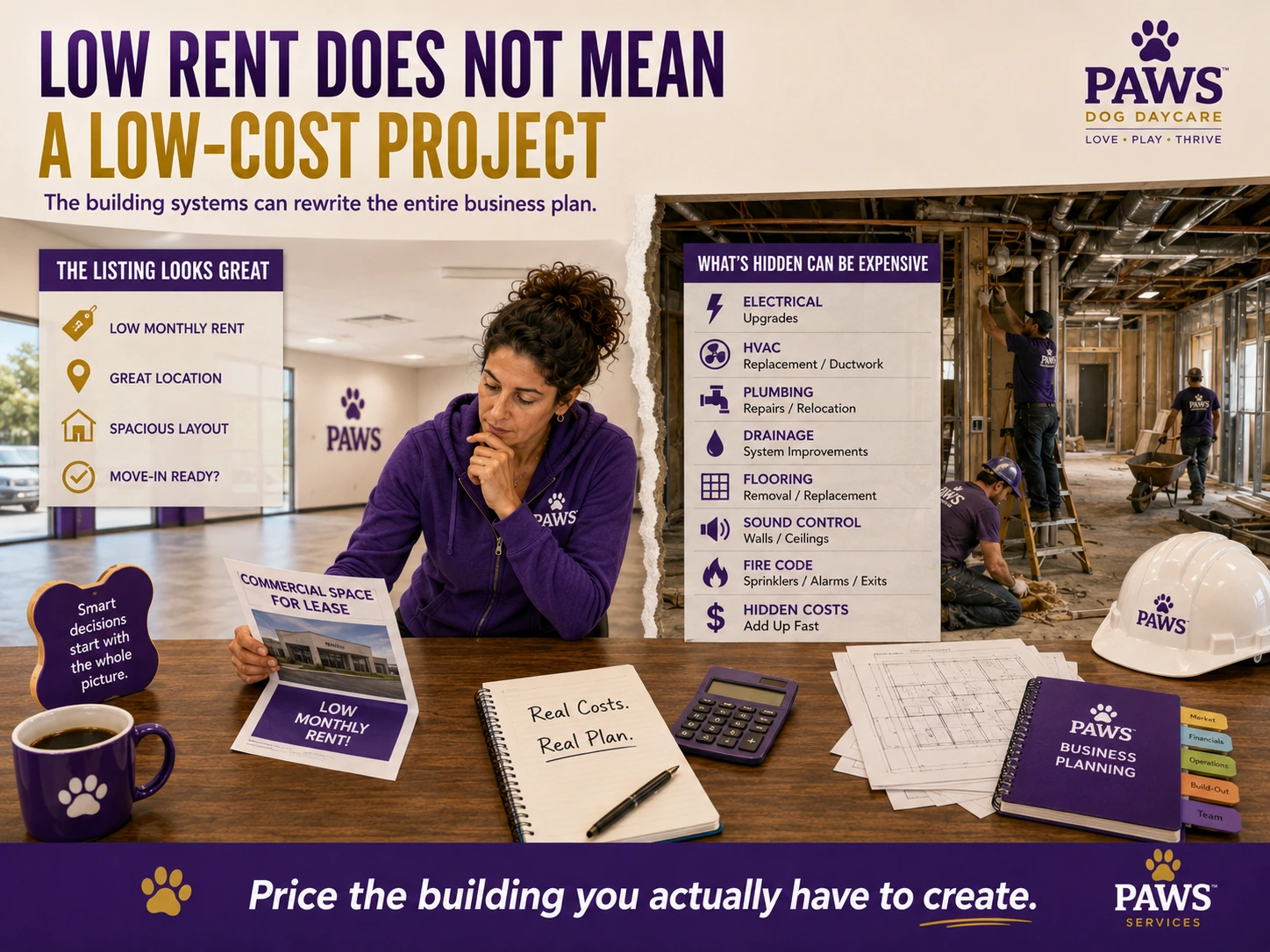
Zoning, lease terms, permitted use, parking, traffic flow, neighbors, outdoor space, sound, drainage, plumbing, electrical service, HVAC, ventilation, floor condition, fire protection, accessibility, waste handling, and construction limits can completely change the project.
The plan should identify what is verified, what is still under review, who is responsible for improvements, what the landlord is contributing, what permits are required, how long approvals and construction may take, and what happens if opening is delayed.
A low rent can be expensive when the building requires major plumbing, electrical, HVAC, sound, floor, fire, or drainage work. A beautiful building can be worthless if the use is not allowed. A generous tenant-improvement allowance can be less generous once the lease language, payment timing, and eligible work are understood.
Property economics should be evaluated as total occupancy and project cost, not base rent alone. Add common-area charges, taxes where applicable, utilities, insurance obligations, repairs, required upgrades, landlord work, tenant work, financing cost, construction delay, and the cash tied up before revenue begins.
The lease should also be tested against the construction schedule. Rent commencement, free-rent periods, tenant-improvement reimbursement, permit delays, delivery conditions, and landlord approvals can determine whether the business starts paying occupancy costs months before it can legally open.
| Building Issue | What the Plan Needs | Operator Warning |
|---|---|---|
| Zoning and Use | Written confirmation of permitted use, conditional-use requirements, animal limits, outdoor rules, and approval sequence. | Do not sign a long lease because someone at the counter said it “should be fine.” |
| Lease | Base rent, additional rent, increases, term, options, guarantees, use clause, improvements, repairs, insurance, assignment, and exit risk. | The business plan is not complete until the lease obligations are inside the financial model. |
| Construction | Scope, contractor estimates, design fees, permits, contingency, landlord work, owner work, timing, and payment schedule. | A per-square-foot guess is not a final build-out budget. |
| Utilities and Systems | HVAC, ventilation, plumbing, drains, hot water, electrical, laundry, internet, security, fire, and backup needs. | Dog-care buildings use systems differently from ordinary retail or office space. |
| Operational Flow | Customer entry, dog intake, playgroups, rest, feeding, boarding, grooming, isolation, waste, laundry, storage, and staff movement. | A building can fit the equipment and still fail the daily workflow. |
📜
Licensing, Compliance, Insurance, and Professional Review
Requirements vary by location and service. The plan should identify what must be verified, who will verify it, what it costs, and what happens if approval is delayed or conditioned.
Do not publish or rely on a universal licensing checklist as if every city, county, and state treats animal-care businesses the same way. Verify the proposed use, animal limits, outdoor activity, boarding, grooming, transportation, signage, building occupancy, fire requirements, accessibility, employment, taxes, and other obligations with the appropriate local and professional sources.
Insurance belongs inside the operating and financial model. The business may need different coverage depending on whether it provides daycare, overnight boarding, grooming, training, transportation, retail, cameras, employee vehicles, or other services. Use written quotes based on the actual proposed operation rather than a generic small-business estimate.
| Area to Verify | Business-Plan Question | Possible Financial or Operating Effect |
|---|---|---|
| Entity and Registration | What entity will operate, who owns it, and what registrations or filings are required? | Fees, taxes, agreements, banking, liability structure, and ownership control. |
| Zoning and Animal Use | Is daycare, boarding, kennel, grooming, outdoor play, or overnight use allowed? | Approval cost, delay, conditions, animal limits, outdoor restrictions, or project failure. |
| Animal-Facility or Kennel Licensing | Does the jurisdiction license the facility, service, number of animals, or overnight operation? | Fees, inspections, construction requirements, records, staffing, and capacity. |
| Building, Fire, and Accessibility | What occupancy, egress, fire protection, alarm, restroom, and accessibility work is required? | Major build-out cost, design time, permits, and opening delay. |
| Employment and Payroll | What wage, overtime, posting, workers’ compensation, leave, and payroll obligations apply? | Payroll burden, scheduling, records, insurance, and penalties. |
| Tax and Recordkeeping | Which services or products are taxable, and what records must be maintained? | Pricing, point-of-sale setup, cash flow, accounting, and filing obligations. |
| Insurance | Which policies and limits fit the actual services, property, employees, vehicles, and animal-care exposures? | Premiums, deductibles, exclusions, contracts, and whether a service can be offered. |
| Customer Agreements and Policies | Do waivers, service terms, deposits, cancellations, health requirements, emergency authority, and privacy practices match the operation? | Dispute handling, chargebacks, customer expectations, records, and legal exposure. |
📄
Dog Daycare Licensing
Review the PAWS licensing and approval planning page while verifying the rules that apply to the proposed location.
🛡️
Dog Daycare Insurance
Connect the services and operating risks in the plan to written coverage discussions and actual insurance quotes.
🩺
Animal-Care, Safety, and Emergency Systems Belong in the Plan
The business model is incomplete if it explains revenue and staffing but not how the operation protects animals, employees, customers, and continuity.
The business plan does not need to reproduce the entire operations manual, but it should summarize the major care and safety systems, identify the staff and equipment they require, and show where the costs appear in the model.
These systems affect capacity, payroll, training, software, forms, supplies, insurance, layout, isolation space, customer agreements, and emergency response. They are not decorative policies added after opening.
| System | What the Plan Should Address | Operational or Financial Effect |
|---|---|---|
| Health Requirements | Vaccination, illness screening, parasite policy, records, exclusions, and return after illness. | Software, staff time, customer conversion, outbreak risk, and capacity. |
| Behavior Evaluation and Intake | Application, history, evaluation process, approval, restrictions, reassessment, and denial. | Labor, scheduling, group capacity, liability, and customer acquisition. |
| Group Formation and Rest | Size, age, temperament, play style, staffing, rotation, rest, and separation. | Sellable capacity, layout, payroll, and service quality. |
| Feeding and Medication | Instructions, storage, double-checks, documentation, missed doses, and customer authorization. | Boarding labor, storage, forms, training, and risk. |
| Cleaning and Infectious-Disease Response | Routine sanitation, product use, laundry, waste, isolation, exposure response, closure, and customer communication. | Supplies, labor, downtime, refunds, reputation, and insurance. |
| Injury and Veterinary Emergency | First response, transport, veterinary relationship, owner contact, authorization, records, and review. | Training, transport, forms, staffing, expense, and liability. |
| Fire, Weather, Power, and HVAC Failure | Evacuation, shelter, backup locations, temperature monitoring, reduced capacity, closure, and communication. | Equipment, maintenance, backup plans, lost revenue, and business interruption. |
| Escape, Security, and Facility Failure | Gate control, door procedures, cameras, alarms, perimeter, key control, and incident response. | Construction, technology, training, insurance, and reputation. |
| Overnight Monitoring | Staff presence or monitoring model, rounds, alarms, emergency response, and customer representation. | Boarding price, payroll, technology, insurance, and customer expectations. |
🏷️
Services, Pricing, and Revenue Must Be Built From the Operation
Do not add boarding, grooming, training, retail, and enrichment to the forecast because the spreadsheet needed more revenue.
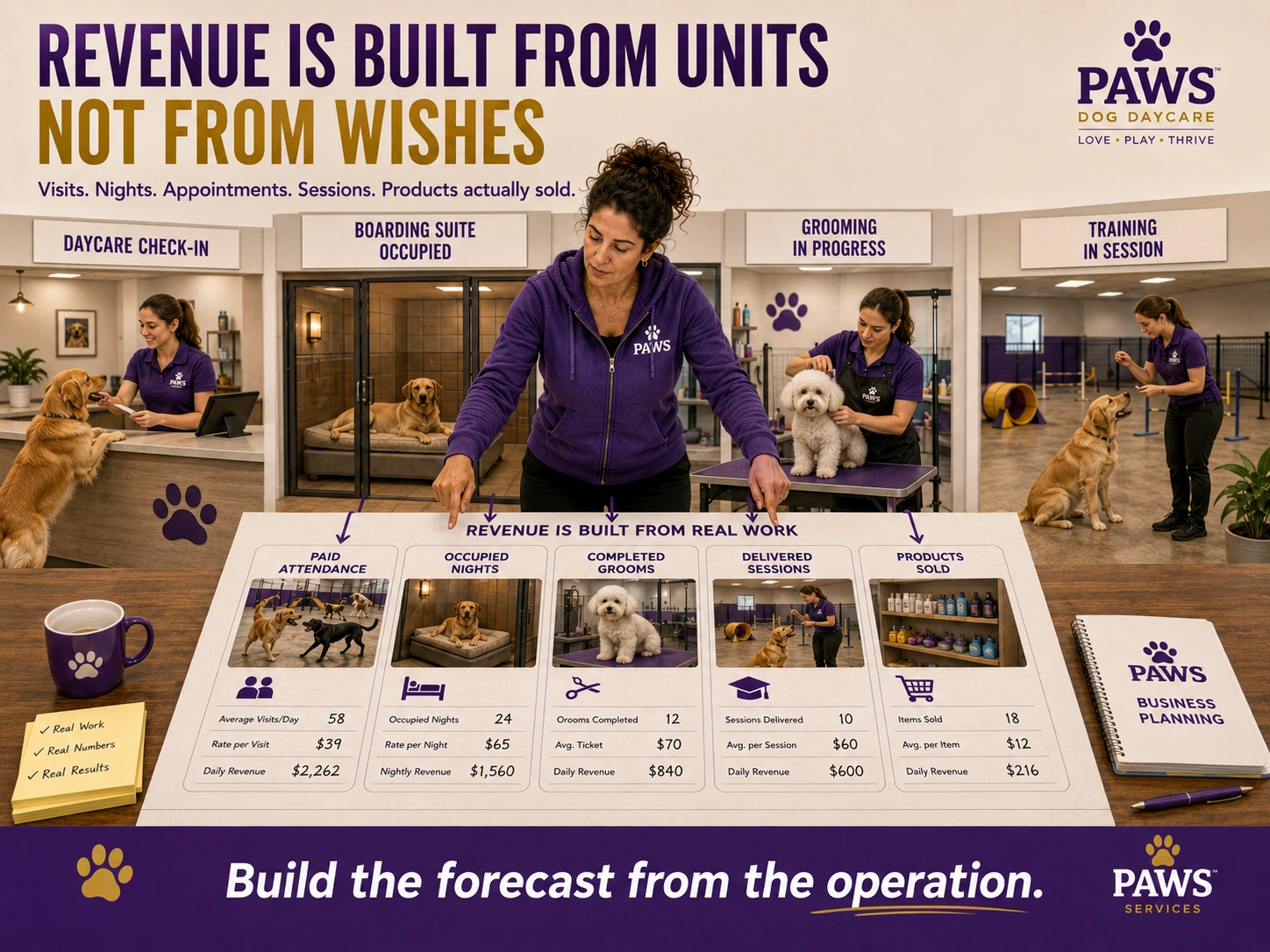
List each service the business expects to offer, when it will launch, what space and equipment it requires, who will perform it, how customers will buy it, what the posted price is, what the average collected price is likely to be, and what the direct operating cost looks like.
Posted price is not always collected price. Packages, memberships, promotions, free trials, employee discounts, refunds, credits, no-shows, package expiration, and customer behavior can change the average amount actually collected per visit or service.
Revenue should be built from units. Daycare revenue comes from paid attendance. Boarding revenue comes from occupied nights. Grooming revenue comes from completed appointments and average tickets. Training revenue comes from sessions, classes, or programs actually delivered. Retail revenue comes from products sold, not shelf space filled.
Build a separate unit schedule for every meaningful service. The schedule should show the unit sold, average collected price, expected volume, direct labor, direct supplies, capacity limit, launch date, and the operating dependency that could constrain it. That makes it harder for a convenient revenue line to exist without the work required to produce it.
Cross-sell assumptions should be treated as attachment rates rather than automatic revenue. If daycare customers are expected to add boarding, grooming, training, transportation, or retail, the plan should show what percentage actually converts, how often they buy, and whether the receiving service has enough staff and capacity to deliver the add-on.
| Service | Revenue Driver | Costs and Limits to Include | Common Forecast Mistake |
|---|---|---|---|
| Dog Daycare | Average paid attendance × average collected revenue per dog × operating days. | Handlers, front desk, cleaning, group structure, rest, packages, discounts, and real sellable capacity. | Using posted daily price and full capacity for every weekday. |
| Dog Boarding | Occupied nights × average collected nightly revenue. | Seasonality, suite mix, feeding, medication, laundry, cleaning, weekends, holidays, and overnight responsibility. | Annualizing holiday occupancy across the entire year. |
| Grooming | Completed appointments × average collected ticket. | Groomer compensation, bathing, drying, supplies, utilities, no-shows, scheduling, and service time. | Counting a full appointment book without a groomer, customer base, or workable room. |
| Training | Classes, private sessions, packages, or board-and-train programs delivered. | Qualified trainer, space, class size, scheduling, marketing, insurance, and customer acquisition. | Adding training revenue because the room appears available at night. |
| Retail and Add-Ons | Units sold, attachment rate, or add-ons per visit. | Inventory, shrink, staff selling, storage, payment fees, spoilage, and customer demand. | Assuming every daycare or boarding customer buys extras. |
👤
Daily Attendance Is Not the Same as Active Customer Count
A facility averaging 35 daycare dogs per weekday usually needs far more than 35 active customers.
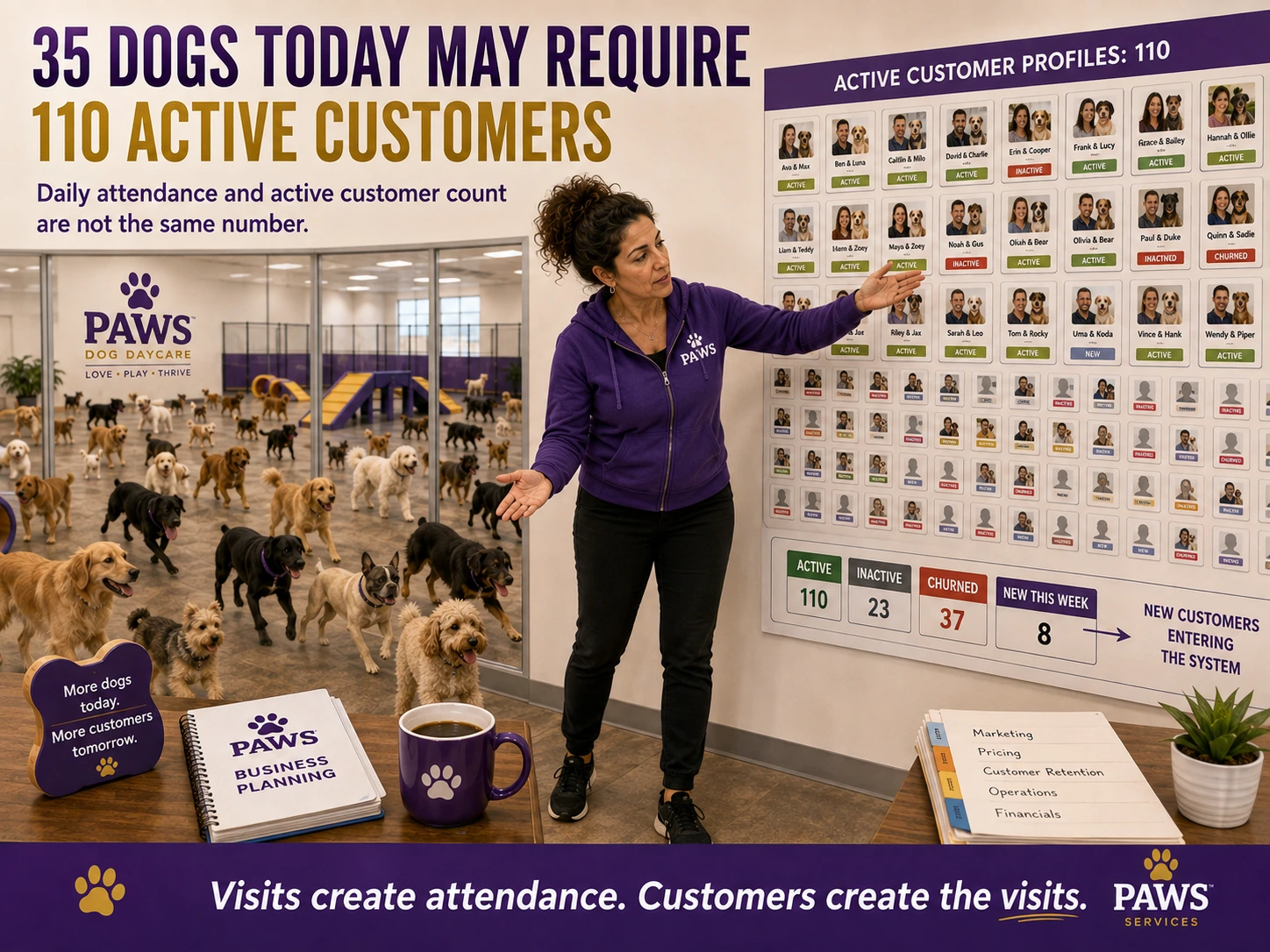
Some customers attend once a week, some twice, some irregularly, and some stop using the service. The forecast should translate required daily attendance into monthly visits, active dogs, new-customer acquisition, and replacement of churn.
This is where the marketing plan and revenue model finally meet. If the facility needs 110 active daycare customers but the acquisition plan only produces five new repeat customers a month, the opening ramp cannot be treated as a detail.
| Illustrative Attendance Pattern | Approximate Monthly Visits per Active Dog | Active Dogs Needed for 770 Monthly Visits | Operator Read |
|---|---|---|---|
| About once weekly | 4.3 | About 179 | A low-frequency customer base requires many more active households. |
| About twice weekly | 8.7 | About 89 | Packages and routine can reduce the number of active customers required. |
| About three times weekly | 13.0 | About 59 | High-frequency customers are valuable but should not be assumed without evidence. |
| Mixed base averaging seven visits monthly | 7.0 | 110 | Thirty-five paid dogs × 22 weekdays = 770 visits; 770 ÷ 7 = 110 active dogs. |
⚠️
Customer-count warning
Do not forecast 35 dogs per day by writing “35 customers.” Forecast the active customer base, visit frequency, new-customer conversion, churn, and the time required to build that base.
📐
Real Capacity Is Not the Number of Dogs You Can Physically Fit Inside
The financial model needs the number the operation can safely, consistently, legally, and profitably serve.
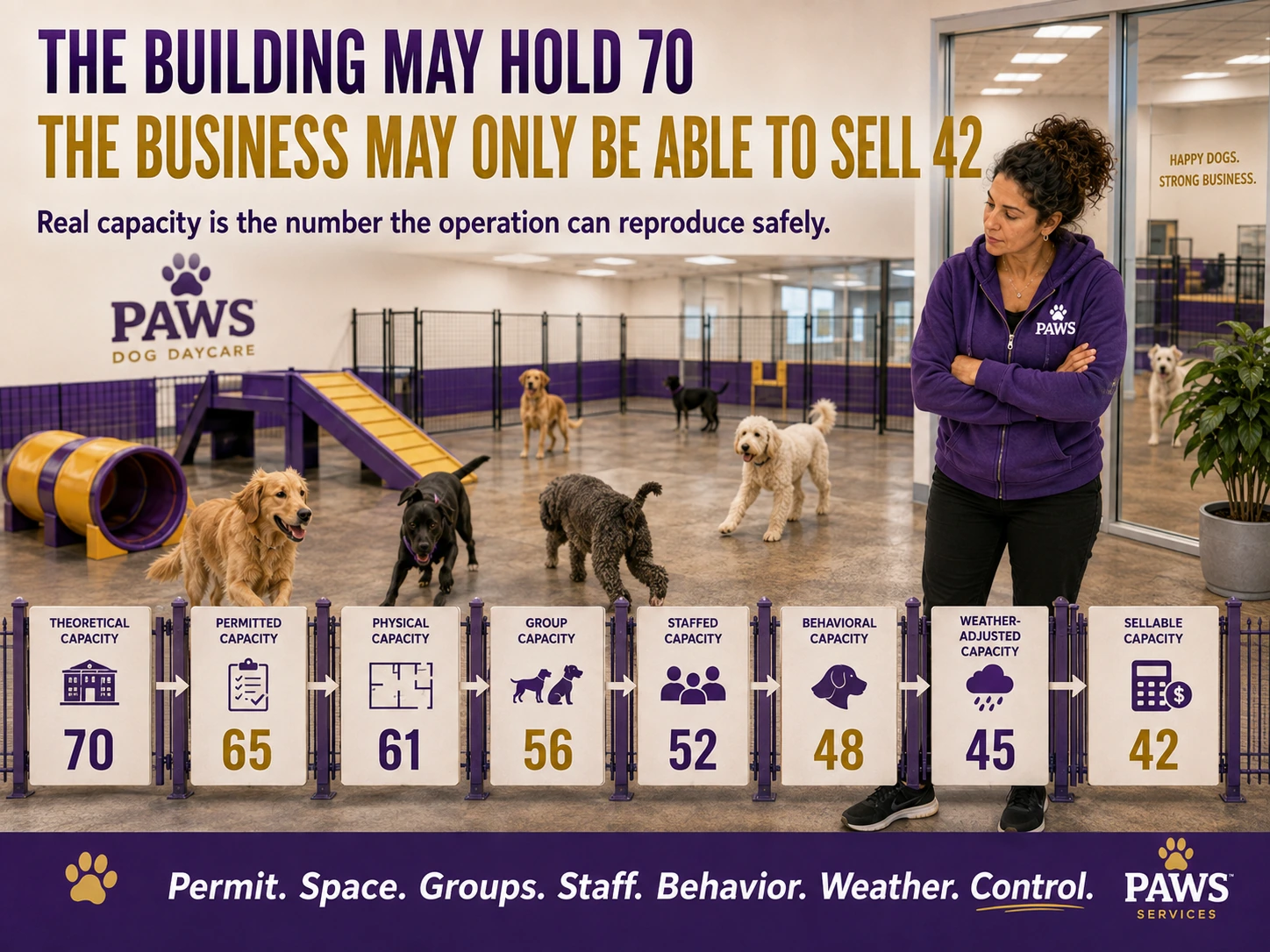
Capacity is often overstated because owners begin with square footage, divide by an assumed amount per dog, and call the result revenue capacity. That ignores how the facility actually operates.
Dogs have to be separated by size, temperament, age, play style, medical condition, feeding needs, rest needs, and service type. Employees have to supervise, clean, rotate, evaluate, feed, medicate, move, and release them. Weather can reduce outdoor use. Boarding dogs can consume daycare space. Grooming and training may use rooms the forecast counted twice.
The correct number is not the largest number that can be defended in a permit application. It is the number the business can reproduce on an ordinary difficult day without safety, cleanliness, customer service, or staff control collapsing.
Build capacity from the hardest ordinary operating day, not the easiest marketing photo. Model arrival peaks, incompatible dogs, indoor-only weather, staff breaks, cleaning, evaluations, feeding, medication, isolation, boarding overlap, and pickup. Capacity that disappears when one employee calls out or one room goes offline is not dependable sellable capacity.
Keep a deliberate operating buffer. Selling every theoretical space removes the room needed for behavior changes, maintenance, late pickups, isolation, staff learning, or unexpected group splits. The buffer is not wasted capacity; it is part of the control system that allows the sold capacity to remain safe and repeatable.
| Capacity Layer | What It Means | Why It May Be Lower Than the Number Above It |
|---|---|---|
| Permitted Capacity | The limit allowed by zoning, license, fire, building, lease, or other authority. | Permission does not prove the layout, staff, behavior mix, or operating system can support the limit. |
| Physical Capacity | The number that appears to fit based on rooms, runs, yards, or square footage. | Space must also support aisles, gates, storage, cleaning, isolation, equipment, customers, and employee movement. |
| Group Capacity | The number that can be divided into workable playgroups or care groups. | One difficult dog, age group, size split, or incompatible mix can leave usable space stranded. |
| Staffed Capacity | The number current staffing can supervise and care for throughout the entire day. | Arrival, pickup, breaks, cleaning, evaluations, feeding, grooming, boarding, and call-outs consume labor. |
| Behavioral Capacity | The number the actual dog mix can safely and productively handle. | Not every approved dog can be placed with every other approved dog. |
| Weather-Adjusted Capacity | The number that still works when yards, outdoor rotation, or exercise options are limited. | Rain, heat, cold, storms, and local conditions can remove space the plan assumed was always available. |
| Sellable Capacity | The number of spots the business can reliably sell while preserving operating control. | Buffer space, maintenance, isolation, cancellations, service overlap, and quality standards reduce the number that should be sold. |
⚠️
Capacity warning
If the revenue forecast requires 70 paid daycare dogs per day but the staffed, behavioral, and weather-adjusted operation can reliably handle 42, the spreadsheet is not ambitious. It is wrong.
👥
Build Staffing Around the Workday, Not a Single Dog-to-Employee Ratio
“The owner will help” is not a complete labor plan, and it does not make the owner free.
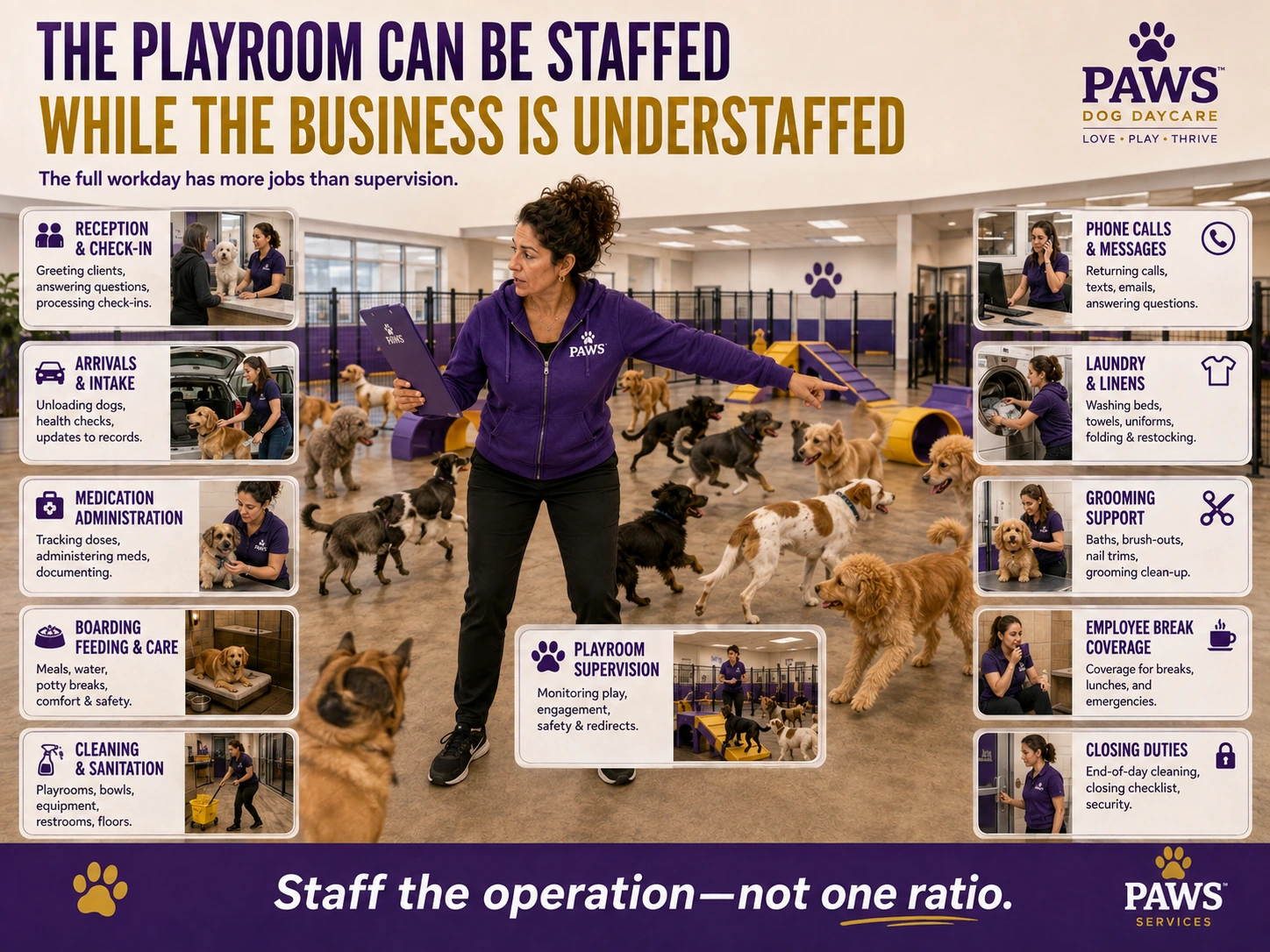
Start with the work that has to happen. Someone opens the building, checks dogs in, verifies records, answers calls, supervises groups, cleans accidents, rotates dogs, prepares food, gives medication, performs evaluations, helps customers, runs tours, processes payments, handles maintenance, closes the facility, and covers the employee who called out.
A single staffing ratio does not capture the entire operation. A playroom may be adequately staffed while the front desk, cleaning, boarding, grooming, laundry, medication, pickup, or management function remains uncovered.
The management plan should also identify who controls finances, hiring, training, scheduling, safety, customer complaints, marketing, vendor relationships, maintenance, compliance, and emergency decisions. If every function depends on one owner being present every hour, the plan should say so and price the risk honestly.
Build labor by daypart and function. Opening, morning intake, peak play, midday cleaning and feeding, afternoon evaluations or grooming support, pickup, closing, weekends, holidays, and overnight boarding can require different staffing even when the dog count is unchanged.
Price management and owner labor explicitly. If the owner is the scheduler, salesperson, trainer, maintenance coordinator, payroll reviewer, complaint handler, emergency contact, and backup employee, the plan should show the hours and the replacement cost. Otherwise the business may appear profitable only because management labor is invisible.
| Operating Function | Work to Cover | What Weak Plans Miss |
|---|---|---|
| Opening and Intake | Building check, cleaning review, arrivals, records, medication, belongings, payments, and customer questions. | Dogs do not all arrive evenly after the staff is settled. |
| Daycare Supervision | Group control, movement, rest, water, behavior monitoring, cleaning, injury response, and documentation. | One ratio is assumed to work for every group and every hour. |
| Front Desk and Customer Service | Calls, messages, tours, check-in, checkout, scheduling, billing, records, and complaints. | Handlers are expected to abandon supervision whenever the phone rings. |
| Boarding | Feeding, medication, morning and evening care, weekends, holidays, cleaning, laundry, sleep spaces, and emergencies. | Boarding revenue is counted without the labor required outside daycare hours. |
| Grooming | Appointments, bathing, drying, grooming, holding, cleanup, customer handoff, and rebooking. | Grooming revenue appears without a qualified groomer or compensation model. |
| Cleaning and Maintenance | Accidents, routine cleaning, deep cleaning, laundry, floor care, waste, equipment, repairs, and outbreak response. | Cleaning is assigned to whatever time employees happen to have left. |
| Management | Hiring, scheduling, training, payroll review, financial control, safety, customer issues, vendors, and performance. | Management time is treated as free because the owner performs it. |
🔧
What I Look for When I Review a Proposed Dog Daycare Facility
The fastest way to expose a weak plan is to follow the dogs, employees, money, and building through an ordinary difficult day.
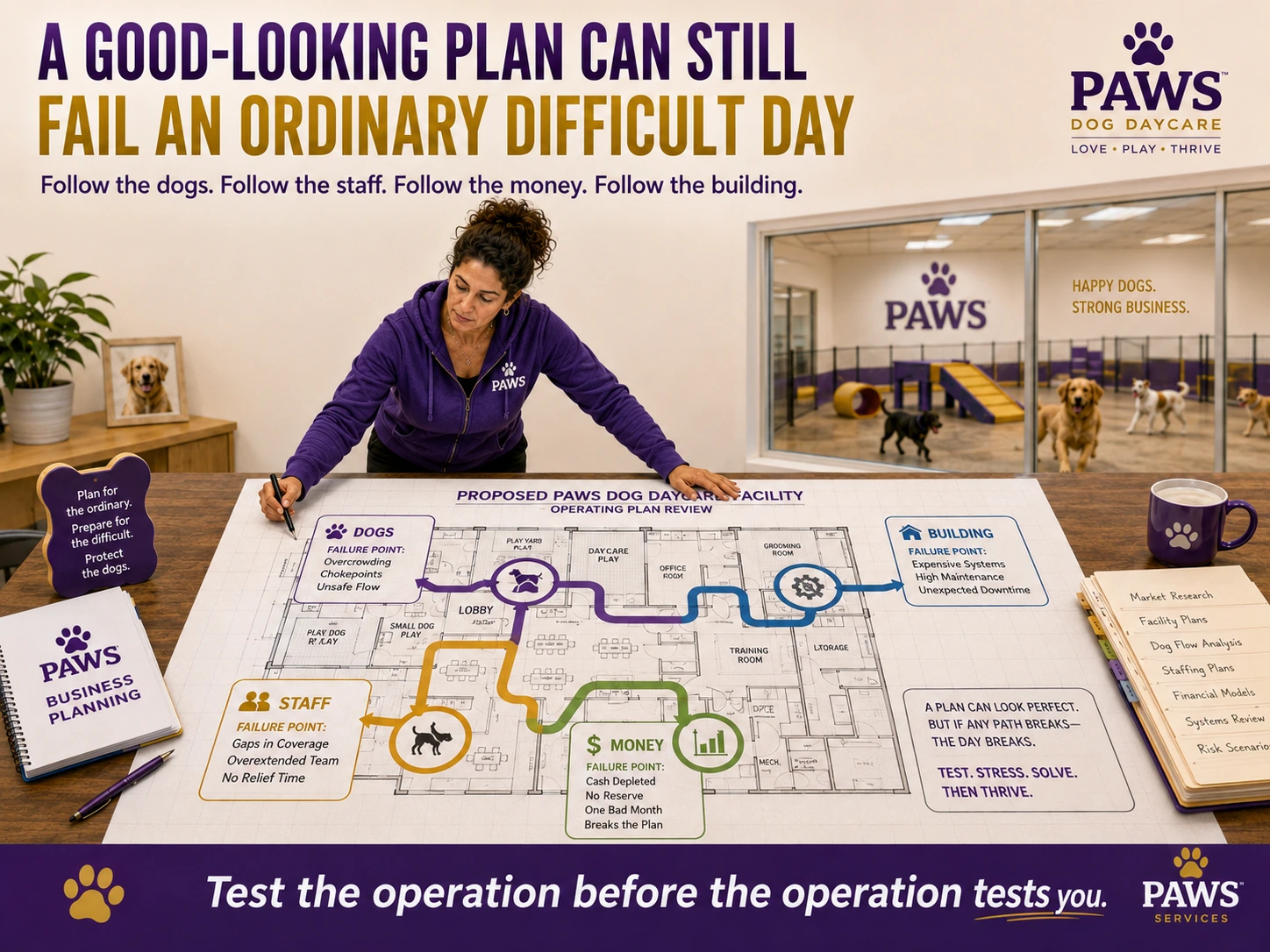
When I review a proposed facility, I do not begin by asking whether the executive summary sounds exciting. I look for the assumptions that control everything else: the legal use, the real building cost, the operating layout, the number of dogs the staff can actually manage, the active customer base required, the opening reserve, and the point where payroll steps up.
The patterns below are not theoretical. They are the recurring places where otherwise attractive projects become fragile. The plan needs to prove that each one has been tested rather than merely mentioned.
Stress-test the facility with ordinary disruptions rather than extreme disasters. One employee calls out, two dogs cannot be grouped together, a drain clogs, a dryer or HVAC unit fails, a customer arrives late, boarding feeding overlaps pickup, and payroll is due before a slow week of receipts. The plan should show which system absorbs each problem.
The purpose of an operator review is to identify where one assumption controls too many others. A fragile plan often has a single room, employee, revenue stream, vendor, cash reserve, or equipment system whose failure immediately breaks safety, service, or cash flow. Those dependencies should be visible before opening.
📐
The Layout Cannot Produce the Forecast
The revenue model needs groups, rotations, rest, isolation, boarding overlap, staff movement, and pickup flow the actual floor plan cannot reproduce.
🏢
Cheap Rent Hides an Expensive Building
Drainage, HVAC, electrical service, sound, fire work, flooring, plumbing, or landlord responsibility turns a low rent into a high project cost.
💵
Construction Eats the Opening Reserve
The facility gets finished, but the business opens without enough cash to carry payroll and overhead while customers build.
🏨
Boarding Revenue Appears Without Boarding Labor
Nights are sold in the forecast while weekends, mornings, evenings, feeding, medication, laundry, and emergency responsibility remain invisible.
👥
The Payroll Fits the Dream, Not the Opening
The owner hires for a mature dog count before the active customer base exists, then pays staff to wait for the revenue forecast to arrive.
📊
The Numbers Cannot Be Traced
Rent, wages, customer count, price, and build-out look precise until someone asks where they came from.
❓
Dog Daycare Market and Operations Plan FAQ
Detailed answers about capacity, service mix, local research, demand validation, customer math, churn, cancellations, acquisitions, franchises, home boarding, and expansion.
How do I calculate dog daycare capacity?
Separate permitted, physical, playgroup, staffed, behavioral, weather-adjusted, and sellable capacity. Use the lowest number the operation can consistently reproduce while maintaining safety, cleanliness, customer service, and staff control.
Should I include grooming, training, retail, or transportation revenue?
Include services the business can realistically launch and support with space, qualified staff, equipment, customer demand, scheduling, insurance, and operating systems. Do not add revenue streams merely because they improve the spreadsheet.
Can AI write a dog daycare business plan?
AI can help organize headings, revise language, generate questions, or test whether explanations are clear. It cannot verify local zoning, inspect a building, obtain contractor bids, determine safe capacity, interview customers, quote insurance, or know whether the owner’s assumptions are true. Treat generated language as a draft, not evidence.
What should never be copied from a sample business plan?
Do not copy another facility’s rent, build-out, capacity, wages, staffing ratios, collected prices, customer growth, profit margin, reserve, loan terms, licensing assumptions, or management claims. Samples can show structure and logic; project facts must come from the proposed business.
How long does it take to prepare a business plan properly?
The writing may be completed quickly once the facts exist. The research can take much longer because location, zoning, lease, design, bids, financing, customer validation, and insurance depend on other people and real documents. A fast narrative is not the same as a completed plan.
How do I estimate the number of active daycare customers I need?
Multiply the required average daily attendance by operating weekdays to estimate monthly paid visits. Divide those visits by the expected average monthly visits per active dog. Then add the new customers needed to replace churn and support growth.
How do I validate demand before signing a lease?
Use local interviews, competitor research, drive-time analysis, surveys, landing-page tests, lead campaigns, interest lists, tour requests, applications, and other increasingly specific customer actions. Treat each signal according to its strength and do not mistake enthusiasm for recurring paid use.
How should remote work and changing commute patterns affect the plan?
They can change weekday need, drop-off patterns, customer frequency, service area, and the value of convenience. Use current local evidence instead of assuming the commuter pattern that supported an older daycare still applies.
How should customer churn be modeled?
Track customers who move, change schedules, age out, stop attending, switch providers, or no longer need the service. The customer-acquisition plan should replace normal churn before it can produce net growth.
How do cancellations, no-shows, and late pickups affect revenue?
They can reduce collected revenue, block inventory, increase labor, create overtime, and produce customer disputes. Model the expected behavior and the effect of deposits, cancellation terms, waitlists, and enforcement.
What changes when buying an existing dog daycare?
Replace startup-only assumptions with historical financial statements, tax returns, booking data, customer retention, payroll, lease transfer, owner adjustments, maintenance, reputation, records, and the amount of revenue that depends on the seller personally.
How is a franchise business plan different?
Include the franchise fee, royalties, advertising fund, required vendors, build standards, territory, restrictions, renewal, transfer, disclosure, and franchisor relationship. Rebuild the numbers for the actual local market rather than relying on brand-level assumptions.
Does this process apply to home-based dog boarding?
Yes, but the property, zoning, animal limits, neighbors, parking, household impact, insurance, overnight supervision, evacuation, and lifestyle constraints become central. Lower rent does not eliminate operating and legal risk.
Can an existing facility use this process for expansion?
Yes. Use historical customer, capacity, payroll, service, cash-flow, and maintenance data to identify the real bottleneck. Model the incremental revenue and cost of expansion rather than assuming the entire current business repeats in the added space.
How should I define the real service area for dog daycare?
Use drive time, access, commuter direction, traffic barriers, neighborhood patterns, employment centers, housing concentrations, and actual customer convenience rather than a simple radius. Daycare usually depends on repeated drop-off and pickup, so the practical market is the area customers can use consistently without the trip becoming a burden.
What is the strongest kind of pre-opening demand evidence?
Evidence becomes stronger as the customer action becomes more specific and costly in time or money. A casual positive comment is weak. A qualified local inquiry is better. A completed application, attended tour, or lawful paid founding offer with clear terms is stronger. None of these guarantees repeat use, so conservative forecasting still matters.
How do I know whether low rent is actually a good deal?
Model total project and occupancy cost. Include rent, additional charges, required repairs, electrical, HVAC, plumbing, drainage, flooring, sound control, fire work, design, permits, construction timing, and the cash cost of delayed opening. A cheap lease can become an expensive project when the building systems do not fit animal-care use.
How should I build a revenue forecast for multiple services?
Create a unit model for each service. Daycare should use paid visits, boarding occupied nights, grooming completed appointments, training delivered sessions or classes, and retail units sold. Apply realistic collected prices, direct labor, capacity, launch timing, seasonality, discounts, and customer attachment rates rather than adding broad revenue percentages.
Why can a properly staffed playroom still mean the business is understaffed?
Play supervision is only one labor function. The business also needs intake, front desk, cleaning, feeding, medication, evaluations, boarding care, laundry, grooming support, customer service, breaks, closing, maintenance, and management. Staffing has to cover the entire workday and all operating functions, not only the visible dog-to-handler ratio.
How should I stress-test the operating plan before opening?
Test ordinary difficult days: a call-out, incompatible dogs, indoor-only weather, a full pickup rush, equipment failure, cleaning delays, boarding tasks overlapping daycare, slower receipts, or a room temporarily unavailable. The plan should show which staff, space, cash, policies, and backup systems absorb the disruption without losing safety or control.
Prove the Operation Before You Finance the Forecast
The market, property, customer pipeline, capacity, staffing, safety systems, and daily workflow are the operating facts the financial model must use. When those facts are documented, move into the startup budget, cash-flow model, break-even analysis, risk testing, and lender package.
🗺️
Continue Through the Three-Part Business Plan Series
Move between the plan structure, market and operating proof, and the financial and funding model without losing the connection between them.
🧱
1. Build the Business Plan
Structure the document, use the complete outline, control revisions, and identify what must be proven.
🏢
2. Prove the Market and Operation
Validate demand, property, capacity, staffing, safety, pricing, and the customer pipeline.
📊
3. Build the Financial and Funding Model
Connect startup cost, revenue, payroll, cash flow, break-even, risk, and the lender package.