Dog Daycare Personality Types, Adaptable Dogs, Low-Conflict Playgroup Dogs, Staff Supervision, Group Balance, Compatibility, and Daycare Admission Decisions
Understanding the Adaptable Dog Personality in Dog Daycare
The easiest dog in the room can still be mismanaged if staff treat patience like an unlimited resource.
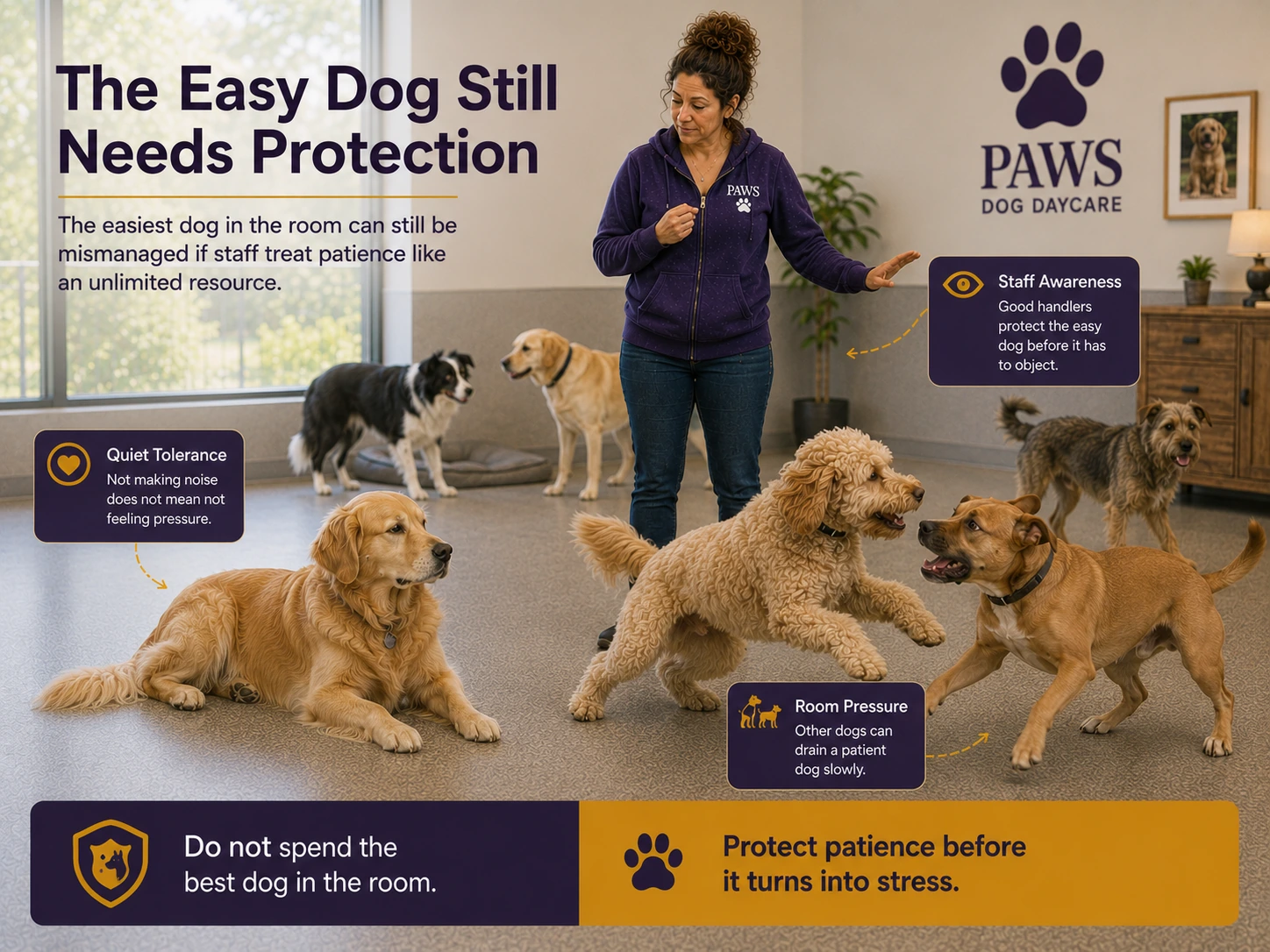
The adaptable dog is usually the easiest personality type to work with in dog daycare. This dog adjusts, cooperates, reads the room better than most, accepts human direction, and usually blends into group play without trying to run the place.
In the PAWS personality system, the adaptable dog shares some outgoing traits and some insecure traits. That makes sense, and daycare staff should think about it like this: this dog may be friendly, soft, cooperative, slightly cautious at first, and then quick to settle once the room feels predictable.
Adaptable dogs are valuable because they help stabilize a playgroup. They are often gentle, affectionate, easy to handle, and less likely to create conflict. They may tolerate different play styles, different people, different dogs, and different routines better than most.
But do not get stupid with that. Adaptable does not mean disposable. It does not mean test dog. It does not mean babysitter. It does not mean emotional support furniture for every rude, pushy, nervous, loud, adolescent, badly matched dog that walks through the door.
⚠️
Operator warning
The adaptable dog is easy to overlook because the dog is not the one making the room loud. That is exactly why staff must watch them. Quiet tolerance can hide stress until the dog finally says no.
🔄
What PAWS Means by Adaptable Personality
This is the dog that usually adjusts instead of controlling, panicking, or escalating.
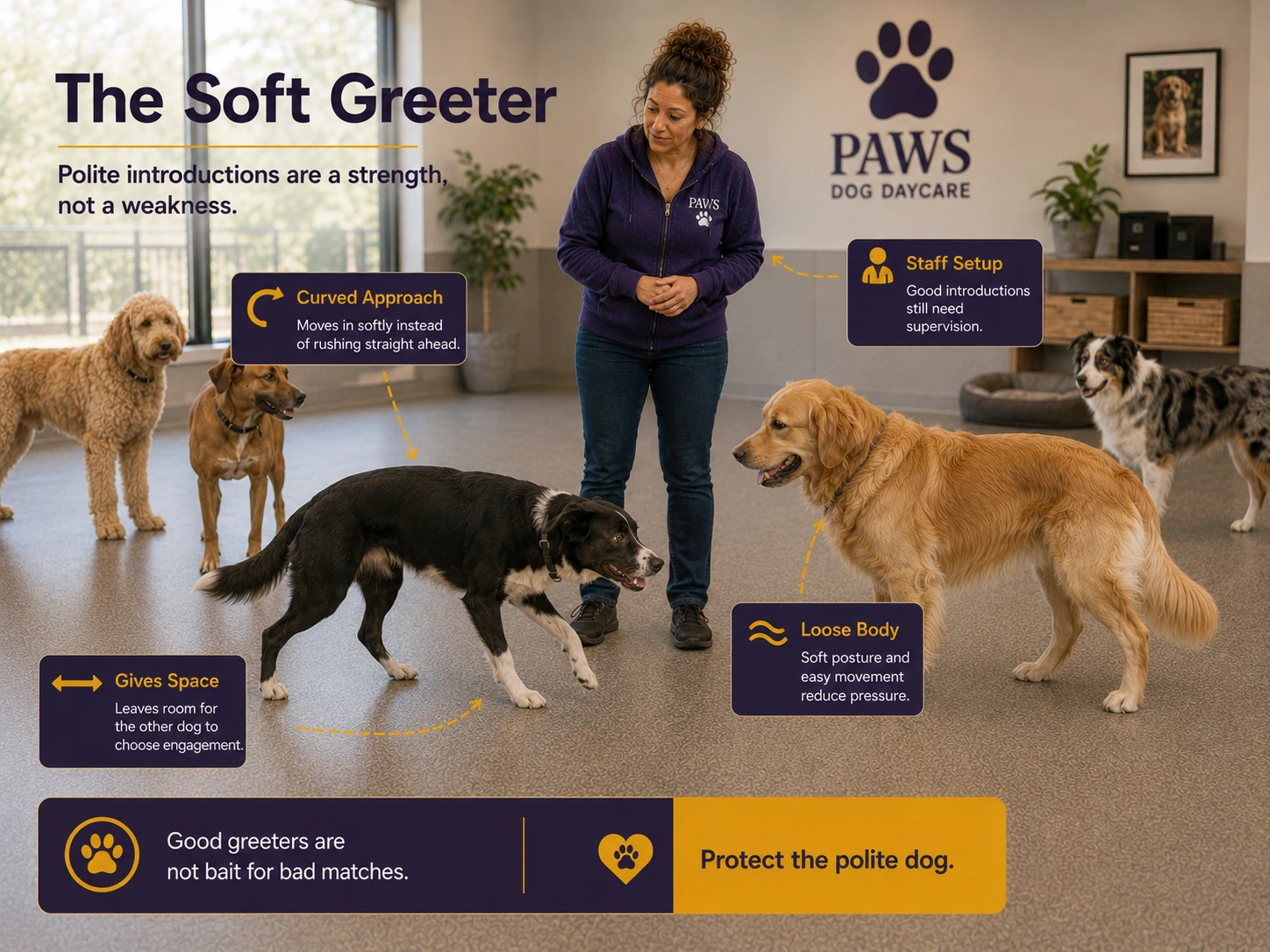
In dog daycare, the adaptable personality is the dog that tends to fit into the room without demanding that the room fit around them. This dog may be gentle, cooperative, easy to handle, affectionate, soft, tolerant, and willing to follow human direction.
The useful daycare measure is not whether the dog looks submissive, shy, sweet, or easy. The useful measure is recovery. Does the dog recover after pressure? Does the body loosen again? Does the dog choose interaction again? Does the dog return to normal play, normal resting, normal curiosity, and normal check-ins with staff?
Adaptable dogs may look cautious when first placed into a new situation. That does not automatically mean abuse, trauma, or some dramatic backstory. Some dogs are simply soft, polite, careful, or waiting to understand the room before they participate.
Once the room makes sense, many adaptable dogs show more social behavior. They may play, greet, follow staff, interact with compatible dogs, and move through the day without much trouble. The key is that they usually solve pressure by yielding, moving away, softening, waiting, or accepting direction.
That makes them easier to manage. It also makes them easy to take advantage of if staff are lazy. Adaptable is not the same thing as weak. It is not the same thing as happy with everything. It means the dog adjusts well until the room asks too much.
🔍
The Adaptable Dogs Staff Actually See in the Room
“Easy dog” is not enough. Staff need to know what kind of easy they are seeing.
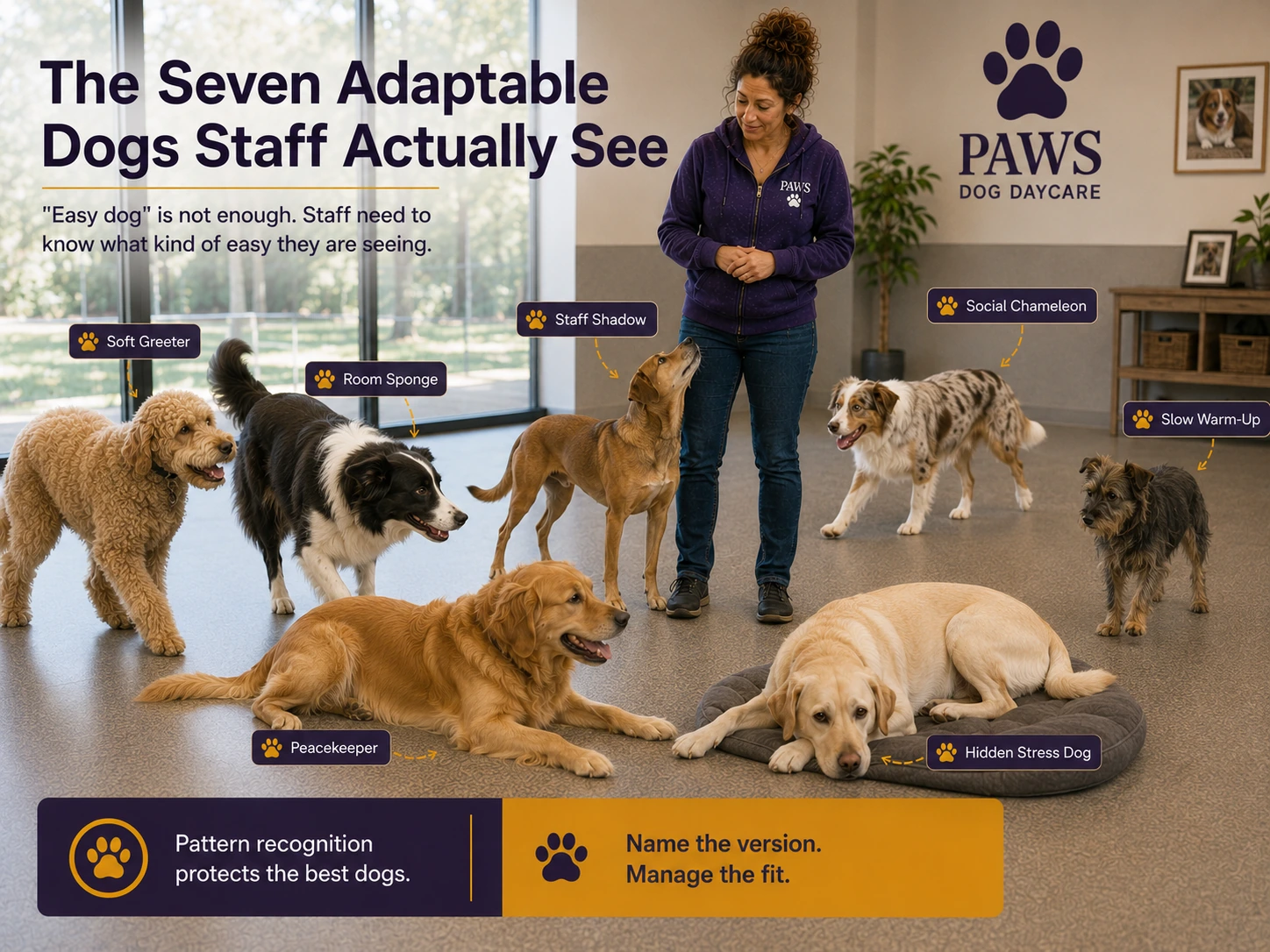
Adaptable dogs are often the dogs that make the staff’s day easier. That does not mean they are all the same. One dog is a soft greeter. Another is a staff shadow. Another is a social chameleon. Another is quietly absorbing pressure until one day the dog finally snaps and everyone acts betrayed.
Name the pattern so staff do not accidentally turn the best dog in the room into the dog that pays for everyone else’s bad manners.
The same dog may move between these patterns as conditions change. A soft greeter may become a staff shadow in a crowded room, a social chameleon may become a room sponge around a rude dog, and a peacekeeper may become a hidden-stress dog after repeated pressure.
Staff notes should name the pattern, the trigger, the dogs involved, how long it lasted, and what restored comfort. “Easy dog” gives the next shift almost no usable information and encourages the facility to keep spending the dog’s tolerance without tracking the cost.
Swipe left/right to see the full table.
| Adaptable Type | What Staff See | Daycare Meaning |
|---|---|---|
| The Soft Greeter | Approaches politely, curves body, avoids rushing, and gives other dogs room. | Good candidate for introductions, but do not use this dog as bait for questionable dogs. |
| The Room Sponge | Absorbs pressure, avoids conflict, and tolerates rude dogs longer than most. | Watch this dog closely. Tolerance is not consent forever. |
| The Staff Shadow | Checks in with people, follows staff, and looks to humans for room direction. | Useful dog, but watch for clinginess or being crowded by attention-hungry dogs. |
| The Social Chameleon | Adjusts play style depending on the dog nearby. | Excellent group dog when protected from dogs that do not adjust back. |
| The Slow Warm-Up | Starts reserved, watches first, then joins once the room feels safe. | Do not rush this dog. Slow confidence is still confidence. |
| The Peacekeeper | Avoids tension, moves away from conflict, and rarely escalates. | Great dog, but do not let staff mistake conflict avoidance for unlimited patience. |
| The Hidden Stress Dog | Looks “fine” but shows lip licking, tucked posture, avoidance, yawning, or sudden fatigue. | This dog may need a break before the stress turns into a defensive snap. |
🏠
Why Daycare Gets Adaptable Dogs
These are often the dogs owners trust because they are easy at home.
Adaptable dogs often come to daycare because owners see them as social enough, gentle enough, and easy enough to handle group care. Many of these dogs are good family pets. They may live well with other dogs, children, visitors, and normal household routines.
They usually have a higher tolerance for being left alone than the outgoing or confident types. They may show less destructive behavior, less separation-related chaos, and less demand for constant interaction.
Some adaptable dogs do not need wild play all day. They need routine, mild exercise, familiar dogs, staff attention, social maintenance, boarding-daycare structure, or a safe place to spend the day while the owner works. That is different from needing to be thrown into the loudest group and expected to love it.
These dogs can enjoy daycare without needing the room to become a theme park. The mistake is assuming a dog that tolerates daycare wants every version of daycare. Some adaptable dogs want calm routine. Some want short play and rest. Some want familiar friends. Some want staff nearby. Some want social contact in doses, not a twelve-hour bachelor party with paws.
🧬
Breeds and Job Lines That May Show Adaptable Traits
Breed is a clue. The individual dog still makes the decision.
Adaptable traits can show up in any breed or mix. Some companion dogs, retrievers, spaniels, softer mixed-breed dogs, older stable dogs, and well-socialized family dogs may show this pattern. Some working breeds may also become highly adaptable when they have good handling, good social exposure, and a clear routine.
Do not turn this into a cute breed list. The daycare question is not whether the dog looks like a family dog. The question is whether the dog can handle this room, these dogs, this staff, this noise, and this routine without creating or absorbing too much pressure.
Swipe left/right to see the full table.
| Common Type | Daycare Version You May See | Operator Warning |
|---|---|---|
| Companion-style dogs | People-focused, soft, affectionate, and generally cooperative. | Watch clinginess, stress, and whether they are being crowded by pushier dogs. |
| Softer retrievers and spaniels | Friendly, biddable, tolerant, and willing to follow staff direction. | Do not let tolerance turn them into the daycare practice dummy. |
| Stable mixed-breed dogs | Often practical, moderate, and less extreme in drive or pressure. | Still evaluate the actual dog. “Mixed” does not mean magic. |
| Mature adult dogs | Less frantic, better recovery, more predictable boundaries. | Mature does not mean tolerant of rude puppies all day. |
| Well-handled working breeds | Responsive, cooperative, and good with structure. | If the dog needs a job, daycare still has to provide enough mental structure. |
| Previously cautious dogs with good exposure | Reserved at first, then steady once they know the routine. | Do not misread cautious as broken. Some dogs are just careful. |
📌
Breed rule
Breed gives staff a starting guess. Behavior gives staff the answer. The adaptable dog proves itself by recovery, tolerance, cooperation, and group fit.
✅
Where Adaptable Dogs Do Well
Adaptable dogs often make the room easier when the staff does not abuse that advantage.
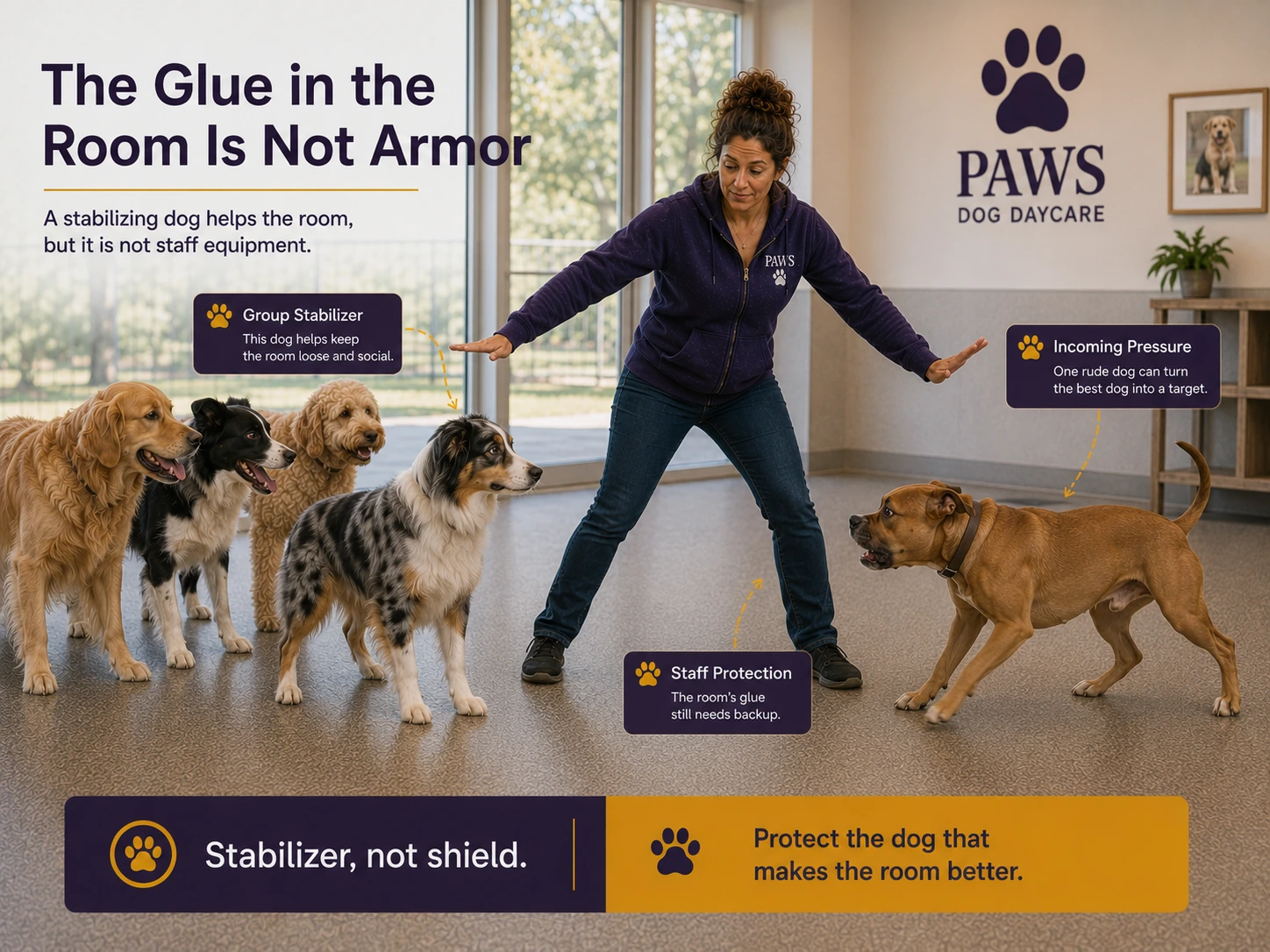
Adaptable dogs often do best as stabilizers, not centerpieces. They are useful in middle-energy groups, soft introductions, familiar playgroups, puppy-calming setups, and rooms where staff are actively managing pressure.
A good adaptable dog can help the room feel less sharp. That does not mean the dog should be used to make every questionable dog look better. The adaptable dog is part of the group plan, not duct tape for bad decisions.
A true room stabilizer contributes softer greetings, fewer retaliatory responses, flexible play, tolerance of normal movement, and predictable check-ins with staff. Those qualities can make a balanced room easier to supervise, but they should never be treated as free labor supplied by the dog.
The adaptable dog should benefit from the pairing too. If the dog is always the one softening, yielding, calming, or moving away, the room is using flexibility without returning fairness. Good management protects the dog’s choices and removes pressure before patience becomes the only thing holding the group together.
- They do well in balanced groups with moderate energy and clear staff direction.
- They do well with outgoing dogs that are social but not rude, sticky, or physically overwhelming.
- They do well with confident dogs that are stable, fair, and not quietly controlling the room.
- They do well with insecure dogs when the room stays calm and predictable.
- They do well when staff notice subtle stress before the dog has to defend itself.
- They do well when staff protect their tolerance instead of spending it on every difficult dog.
📌
Room rule
The adaptable dog is often the glue in the room. Do not confuse glue with armor.
🚦
Where Adaptable Dogs Get Into Trouble
The problem is usually not what they do first. It is what staff lets happen to them.
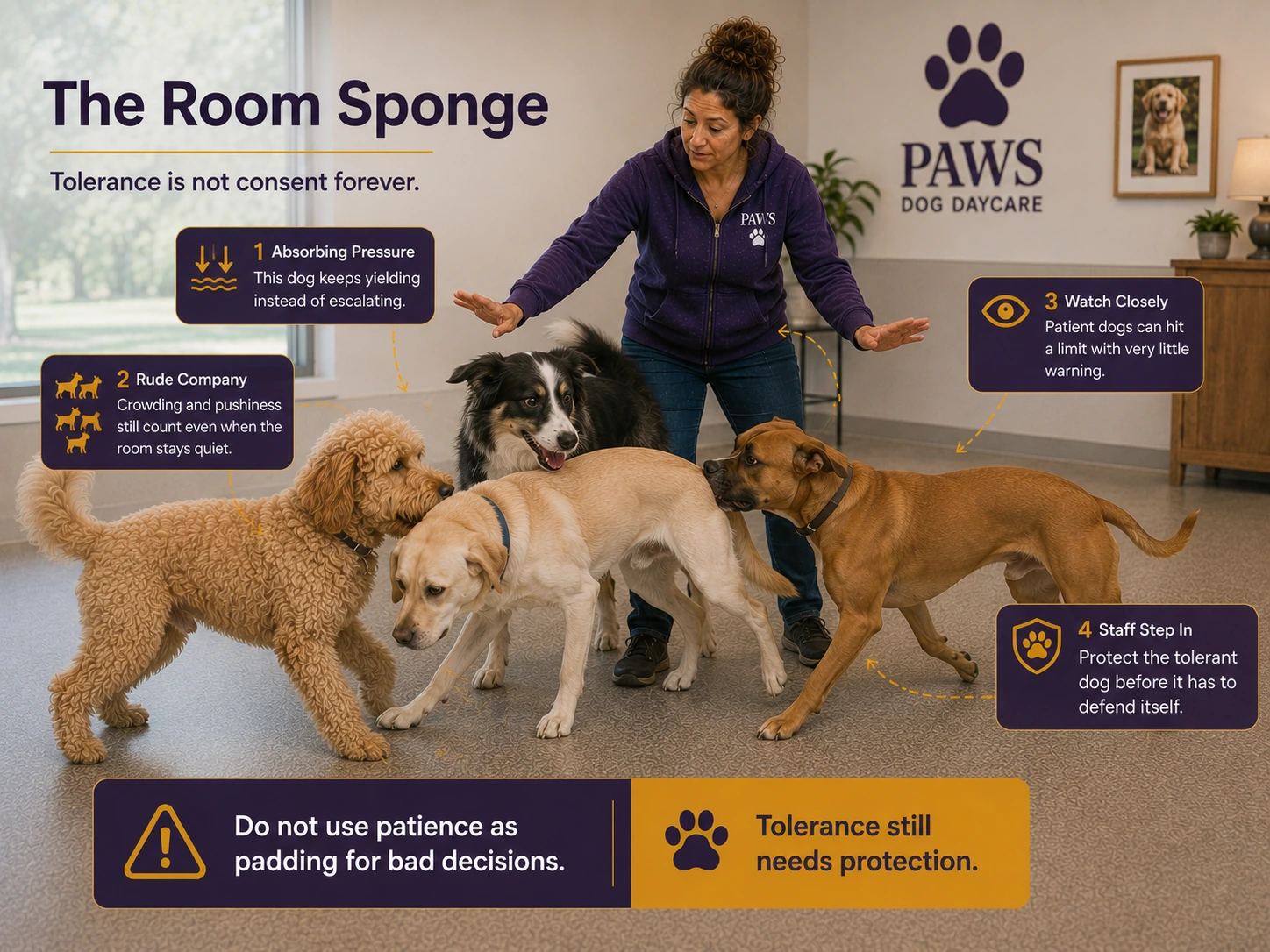
Adaptable dogs usually do not start the biggest problems. They get into trouble when staff let pushier dogs keep testing them, crowding them, mounting them, stealing from them, blocking them, chasing them, or using them as the safe dog for every questionable introduction.
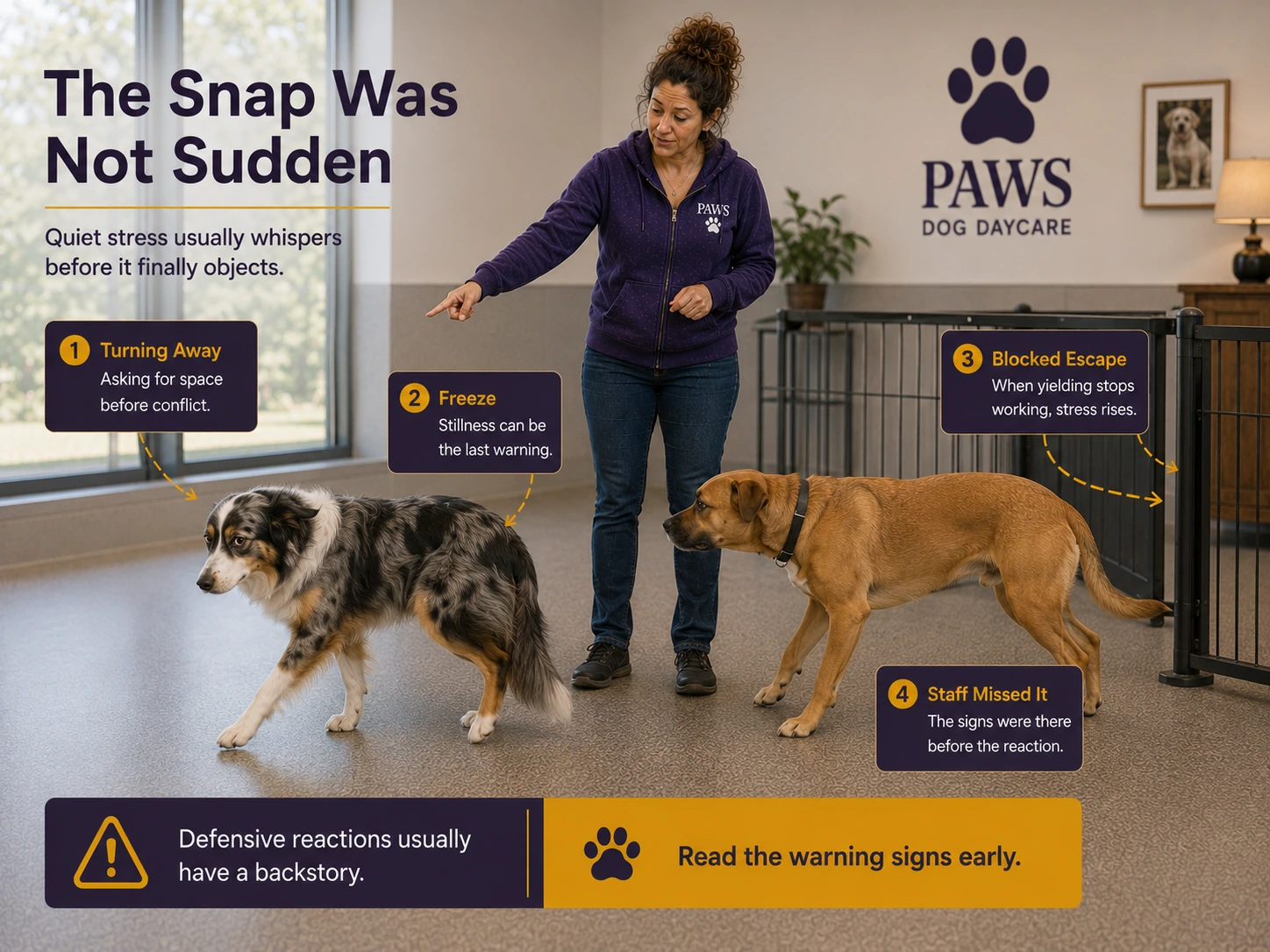
Staff often miss the warning signs because the adaptable dog is still being polite. The dog turns away. Moves behind staff. Stays near the gate. Lies down too early. Avoids the water bowl. Stops choosing play. Lets the rude dog approach but no longer looks loose. That is not “fine.” That is the dog quietly filing paperwork with its nervous system.
That is how the “easy dog” eventually becomes the “sudden snap” dog. It was not sudden. The dog probably asked for space ten times before using its teeth as a resignation letter.
Swipe left/right to see the full table.
| Problem | What It May Mean | Staff Response |
|---|---|---|
| Constantly being targeted | Pushier dogs are using the adaptable dog’s tolerance. | Move the pushy dog. Do not make the polite dog keep paying rent. |
| Hiding behind staff | The dog is asking humans for help. | Give help. Do not shove the dog back into the same pressure. |
| Staying near gates or walls | The dog may be looking for an exit or reducing contact. | Lower the room pressure, change the group, or offer rest. |
| Sudden defensive snap | The dog may have been pushed past tolerance. | Review the lead-up. Do not write “unprovoked” because staff missed the warnings. |
| Shutdown or withdrawal | The dog is overwhelmed, tired, or done participating. | Rest, smaller group, calmer dogs, or end daycare for the day. |
| Overused as a test dog | Staff are relying on the dog’s patience instead of a real evaluation system. | Stop using one good dog to absorb every bad admission question. |
| Quiet stress signals | Lip licking, yawning, avoidance, tucked posture, turning away, or freezing. | Create space before the dog has to get louder. |
📈
The Adaptable Dog Stress Curve
The adaptable dog often fails quietly before failing loudly.
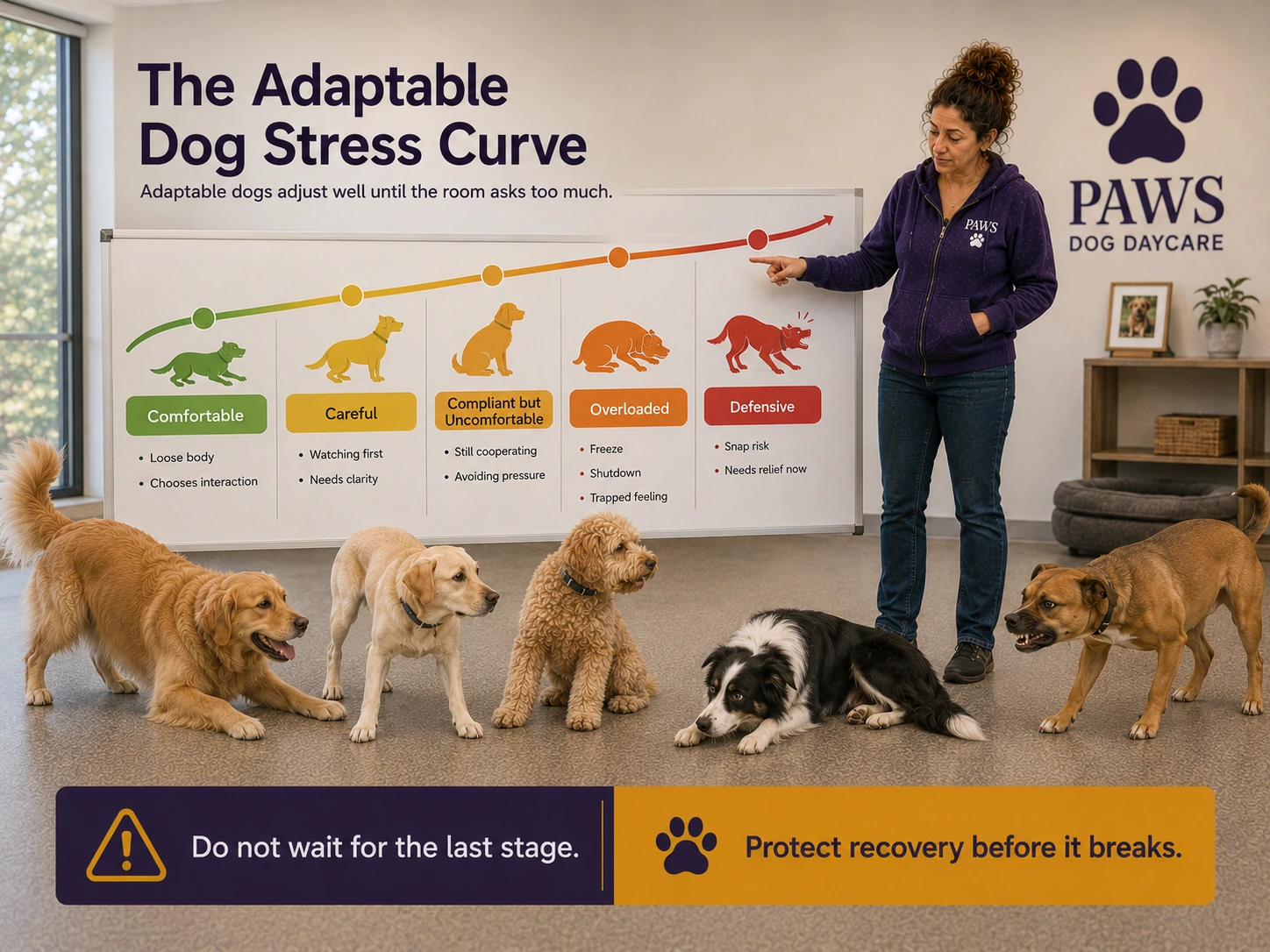
Adaptable dogs may not explode when the room gets uncomfortable. They may absorb, avoid, soften, yield, hide, or wait for staff to fix it. That is helpful until staff mistake silence for comfort.
The danger stage is compliance without comfort. The dog is still obeying, still walking, still allowing dogs nearby, still not fighting, and still making staff think everything is fine. But the dog is no longer enjoying the room. That is where good staff step in.
The cheapest intervention happens during the careful stage. Moving a pushy dog, opening space, lowering group intensity, or offering a short break can restore comfort before the adaptable dog begins shutting down. Staff should not wait for a growl or snap before believing the quieter signals.
Recovery matters as much as removal. Before returning the dog, staff should see looser posture, normal movement, curiosity, and voluntary engagement. If the dog remains avoidant or immediately returns to the same stressed pattern, the group plan—not the dog’s patience—needs to change.
Swipe left/right to see the full table.
| Stage | What It Looks Like | Staff Move |
|---|---|---|
| Comfortable | Loose body, soft greetings, normal play, checks in, rests normally. | Good fit. Keep watching and protect the dog from rude pressure. |
| Careful | Slower movement, watching more, staying near staff, avoiding intense dogs. | Lower pressure. Pair with calmer dogs or give a reset. |
| Compliant but Not Comfortable | Still follows staff, still allows contact, but stops choosing play, avoids certain dogs, or stays close to exits. | Treat this as a warning stage. Do not wait for the dog to make the message louder. |
| Overloaded | Hiding, freezing, lip licking, yawning, tucked posture, trying to leave. | Remove the dog from group. Do not make the dog keep being polite. |
| Defensive | Snap, growl, quick correction, air bite, sudden “out of character” reaction. | End the pressure, document the trigger, and fix the group plan. |
🧩
Adaptable Personality Compatibility in Daycare
This dog usually has the widest compatibility window, but that is not permission to be lazy.
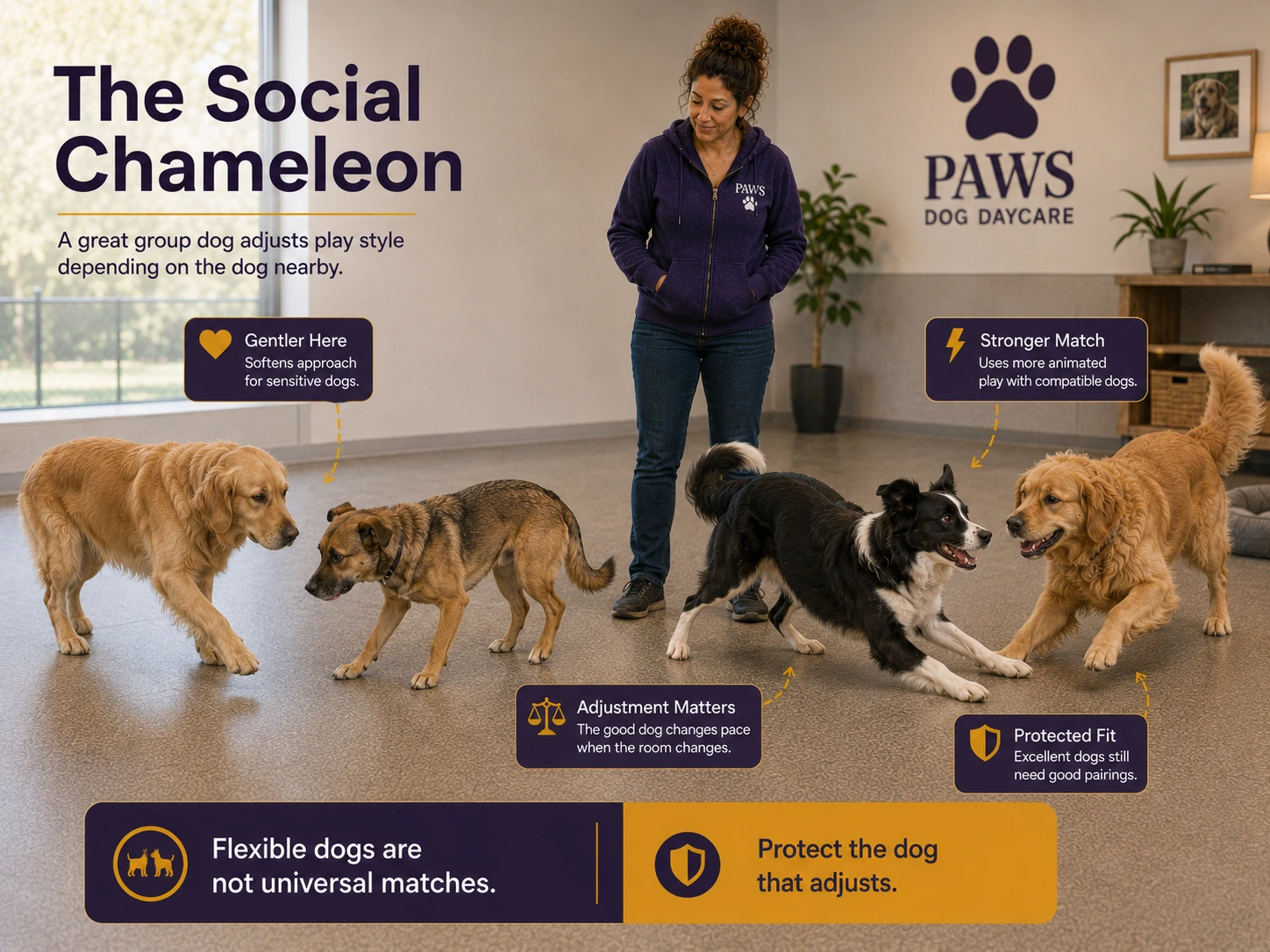
Adaptable dogs usually have the widest compatibility window because they are more willing to adjust, yield space, and match the social tone of the dogs around them. That flexibility is useful, but it is not permission to place the dog with every difficult personality in the building.
Compatibility still depends on size, energy, play style, physical ability, recovery, room pressure, and whether the other dog adjusts back. A social chameleon can soften with a cautious dog and play more strongly with a compatible partner, but staff must watch for one-sided adjustment where the adaptable dog keeps yielding while the other dog keeps taking.
The pairing remains conditional throughout the day. Fatigue, pain, crowding, gate pressure, staff changes, and rising arousal can turn an easy pairing into a poor one. If the adaptable dog begins avoiding, freezing, staying near exits, or repeatedly seeking staff, the room is no longer working even if the chart predicted a good match.
Swipe left/right to see the full table.
| Pairing | Compatibility | Daycare Meaning |
|---|---|---|
| Adaptable + Aggressive | Moderate / Controlled Only | The adaptable dog may yield, but that does not make the aggressive dog safe. Tolerance is not consent to be controlled. |
| Adaptable + Confident | High / Watch Pressure | Often works well if the confident dog is stable and not turning the adaptable dog into a subordinate employee. |
| Adaptable + Outgoing | High | Usually a good fit when the outgoing dog is social without being rude, sticky, or physically overwhelming. |
| Adaptable + Insecure | High | Often helpful because the adaptable dog may not pressure the insecure dog. Keep the room calm. |
| Adaptable + Independent | High | Usually easy because both dogs may respect space if staff do not force interaction. |
| Adaptable + Adaptable | High | Often one of the easiest pairings. Still watch for stress, fatigue, and one dog quietly avoiding the other. |
⚠️
Compatibility warning
Adaptable dogs make many pairings easier. They do not make unsafe pairings safe. Do not use a good dog to excuse a bad group decision.
📝
Intake: Do Not Mistake Softness for Damage
Some adaptable dogs are naturally gentle, cautious, and cooperative.
Adaptable dogs can be easy to intimidate, and people sometimes misread that as proof the dog was abused. That can happen, but it is not the automatic answer.
Some dogs naturally soften around strong people, loud rooms, pushy dogs, or new situations. They are trying to figure out where they fit. Staff should not turn every soft dog into a tragic novel. Watch the behavior and write what is real.
Useful notes are specific. “Easy dog” is not a record. “Warmed up after eight minutes,” “avoided Bruno after repeated shoulder pressure,” “stayed near staff during high-energy group,” “accepted greeting from Daisy but moved away from Max,” and “needed break after being mounted twice” are records.
- Does the dog recover after the first few minutes, or stay shut down?
- Does the dog choose social contact when given time and space?
- Does the dog look to staff for guidance?
- Does the dog avoid specific dogs, rooms, sounds, gates, or handling?
- Does the dog tolerate pressure, or actually enjoy the interaction?
- Does the dog become more confident with routine?
- Is the dog being used too often with difficult dogs?
- Are staff documenting stress signals instead of just writing “easy dog”?
- Are notes showing what helped the dog recover?
👀
How Staff Should Handle the Adaptable Dog
Protect the easy dog from becoming the room’s unpaid therapist.
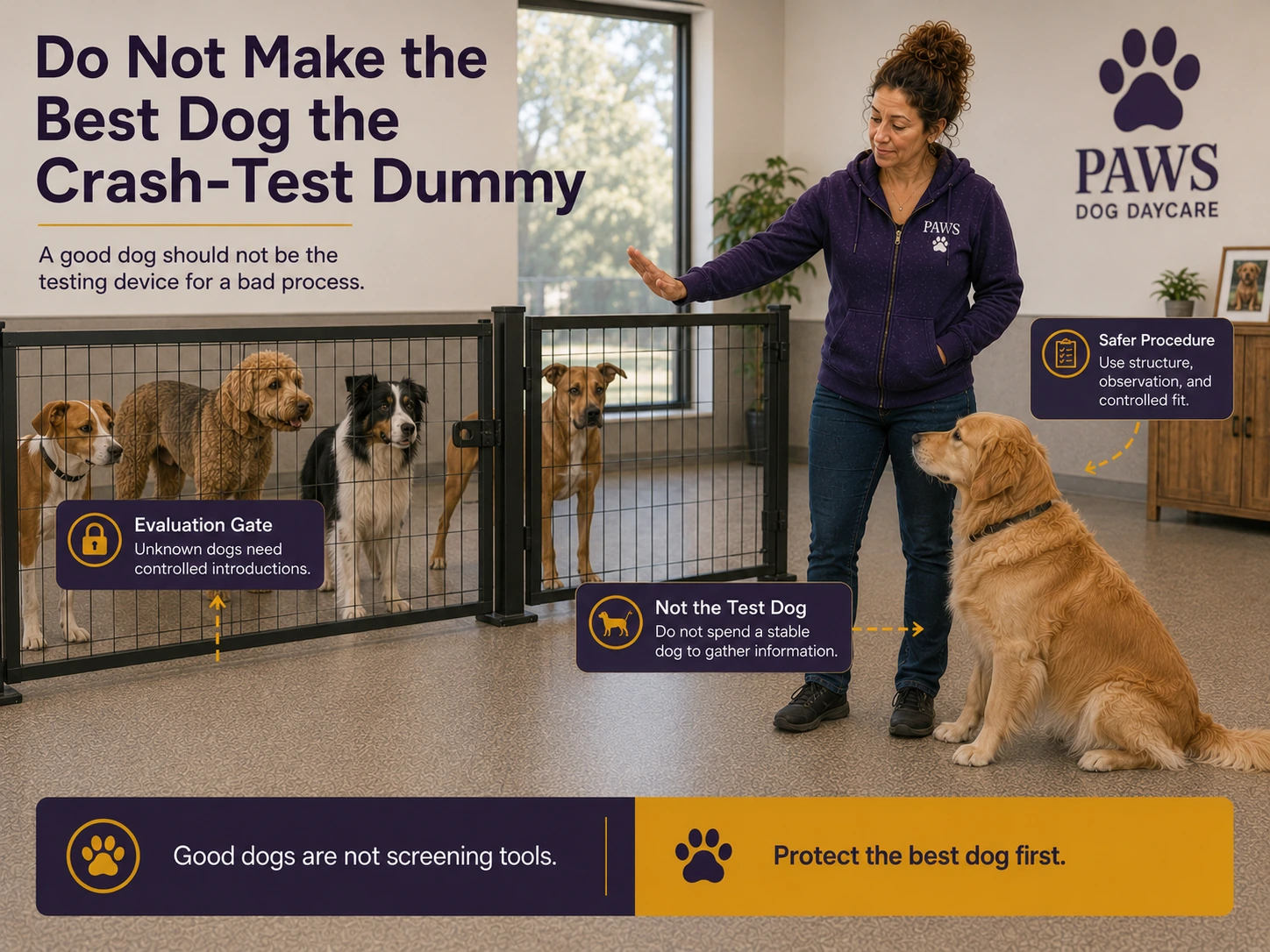
Adaptable dogs usually need less correction and less direct management than the louder personalities. That does not mean staff ignore them. It means staff should protect the qualities that make them useful.
Staff intensity matters with these dogs. A loud, heavy, rushed, overly forceful handler can make an adaptable dog shrink, appease, or shut down. This dog does not need circus energy or prison-guard energy. It needs calm direction, protected space, clean timing, and a staff member who notices when polite has stopped meaning comfortable.
The worst staff habit is using the adaptable dog as the universal test dog. New dog? Put it with the adaptable dog. Pushy dog? Put it with the adaptable dog. Nervous dog? Put it with the adaptable dog. Weird dog? Put it with the adaptable dog. Congratulations, you just made your best dog the crash-test dummy.
- Let the dog warm up at its own pace instead of forcing instant interaction.
- Interrupt pushy dogs before the adaptable dog has to handle it.
- Do not use the same adaptable dog for every evaluation.
- Watch for quiet stress signals, not just obvious conflict.
- Give rest breaks before tolerance turns into shutdown.
- Write notes about what the dog tolerated, avoided, enjoyed, and needed help with.
⏱️
Rest, Rotation, and Transition Rules for Adaptable Dogs
Easy dogs still need relief from room pressure.
Adaptable dogs may not demand breaks. They may not bark at the gate, throw themselves at staff, or start drama. That is why staff have to offer breaks before the dog is quietly cooked.
Planned breaks are different from emergency removal. A planned break happens while the dog is still recoverable and gives the nervous system time to settle before quiet stress becomes shutdown or a defensive correction. Waiting until the dog is hiding, frozen, or refusing the room means staff waited too long.
Recovery should be visible before the dog returns. Look for looser movement, normal interest, willingness to take direction, and the ability to re-enter without immediately avoiding the room or returning to the same pressure point. A dog that remains watchful, withdrawn, or glued to staff may need a smaller group or an early end to the day.
Re-entry is part of the test. Do not put the dog back into the same rude pairing, crowded gate, or overwhelming group and call the break successful. Change the setup, reduce pressure, and document whether the dog improved under the new conditions.
- Rotate the dog out if it keeps being targeted by pushier dogs.
- Give the dog calm space after heavy introductions or repeated social pressure.
- Do not return the dog into the same bad pairing after a break.
- Use adaptable dogs in evaluations carefully and sparingly.
- Watch gate changes, staff changes, and owner pickup windows for stress or crowding.
- Document whether the dog recovered with rest or needed a smaller group.
🗣️
What Owners Need to Hear
Easy dogs still deserve accurate feedback.
Owners of adaptable dogs may only hear good reports because the dog is not causing trouble. That is nice, but it is not enough. If the dog is doing well, say why. If the dog is soft, cautious, tolerant, or getting pressured by certain dogs, say that too.
The owner should understand that the facility is protecting the dog, not just using the dog. “She is great with everyone” sounds nice, but it can hide the real work: choosing the right group, interrupting rude dogs, giving breaks, and not letting one good dog absorb every questionable pairing.
Do not turn the report card into empty sunshine. Useful feedback helps the owner understand the dog and helps the facility protect the dog long term.
📌
Owner script
“Your dog is doing well because she adjusts nicely and reads the room. We are also watching that she does not get overwhelmed by pushier dogs, because she is tolerant and may not complain right away. She is a good group dog, and we are going to protect that instead of using her with every difficult dog.”
🛑
When to Pause, Rotate, Separate, or Restrict the Adaptable Dog
This dog usually does not need refusal. It may need protection from the wrong room.
These decisions belong on a continuum. Pause means a brief decompression while the dog is still recoverable. Rotate means changing the group, partner, room pressure, or schedule so the dog can succeed under a better setup.
Separate means ending a specific interaction because one dog is creating pressure or the adaptable dog is no longer comfortable. Restrict means changing the ongoing service plan when the same unsafe pattern repeats despite reasonable management.
Severity, repetition, recovery, staff capacity, available space, and the effect on the other dogs should control the decision. The adaptable dog does not have to become aggressive before the facility admits that open group play is no longer serving that dog safely.
- Pause the dog when it starts avoiding, hiding, freezing, or staying glued to staff.
- Rotate the dog when it has absorbed too much pressure from louder dogs.
- Separate the dog from pushy, mounting, guarding, or obsessive dogs.
- Use a smaller group when the dog is social but overwhelmed by crowd size.
- Send the dog home early if the dog is stressed, exhausted, or not recovering with rest.
- Restrict open group if the dog repeatedly shuts down or defends itself under daycare pressure.
⚠️
No crash-test rule
If your safest dog keeps being used to test your riskiest dogs, your evaluation system is lazy. The good dog should not be the business plan.
✅
Adaptable Personality Daycare Checklist
Use this list before relying on an adaptable dog as a regular group stabilizer.
Use this checklist with observations from multiple visits, different employees, changing group sizes, busy transitions, and rest periods. It is not a one-day temperament score and should not disappear into a file after intake.
One isolated sign may be manageable. A repeated cluster of avoidance, staff shadowing, reduced play, poor recovery, gate hovering, and tolerance of rude dogs shows that the room is spending more of the dog’s patience than staff may realize.
The answers should change the operating plan. Group placement, rest timing, evaluation use, partner selection, visit length, and service restrictions should reflect what the dog repeatedly shows—not the reputation the dog earned for being easy.
- Does the dog recover quickly after entering a new room?
- Does the dog choose interaction, or only tolerate it?
- Does the dog respond well to staff guidance?
- Does the dog avoid certain dogs or play styles?
- Is the dog being used too often for difficult introductions?
- Does the dog show quiet stress signals during busy periods?
- Does the dog improve after rest?
- Are staff protecting the dog from pushy dogs?
- Are notes specific enough to show what the dog actually experienced?
❓
Adaptable Dog Personality FAQ
Detailed answers about adaptable-dog compatibility, quiet stress, group protection, staff handling, evaluation use, rest, recovery, owner communication, and open-play decisions.
Are adaptable dogs good daycare dogs?
Usually, yes. Adaptable dogs often succeed because they cooperate, recover, and create less social conflict than louder personality types. They still need screening, appropriate partners, rest, and protection from dogs that keep spending their patience.
Do adaptable dogs need less supervision?
They may need less direct correction, but they should not be ignored. Staff must watch whether the dog is choosing the room, recovering after pressure, and remaining comfortable rather than merely complying. Quiet dogs can become overloaded without creating an obvious scene.
Can adaptable dogs be placed with aggressive dogs?
Only under tightly controlled circumstances, and often not in open group play. An adaptable dog may yield, move away, or tolerate pressure longer than most, but that does not make the aggressive dog safe. The pairing should never depend on the adaptable dog absorbing risk.
Why do adaptable dogs sometimes snap?
A defensive snap may happen after repeated pressure, pain, fear, fatigue, blocked escape, mounting, crowding, or ignored avoidance signals. The reaction often looks sudden only because staff missed the earlier turning away, freezing, lip licking, hiding, or staying near exits. The full lead-up should be reviewed before labeling the dog unpredictable.
Are adaptable dogs good test dogs for evaluations?
They can help in carefully controlled evaluations, but they should not become the universal test dog. Repeated exposure to unknown, pushy, or poorly screened dogs can turn the facility’s safest dog into the dog carrying the most risk. Rotate evaluation dogs and use barriers, staff skill, history, and staged introductions instead of one patient animal.
Can adaptable dogs be mistaken for abused dogs?
Yes. Soft posture, caution, appeasement, or slow warm-up can be misread as proof of abuse. Abuse is possible, but staff should document what the dog actually does, how quickly the dog recovers, and which conditions help or worsen the behavior rather than inventing a backstory.
What is a room-sponge dog?
A room sponge is an adaptable dog that absorbs social pressure without escalating. This dog may tolerate rude greetings, crowding, mounting, or persistent play longer than most. Staff must protect the dog because tolerance is not unlimited and should never become the facility’s management plan.
What is a social chameleon?
A social chameleon adjusts play style to the partner nearby. The dog may soften movement with a cautious dog and use stronger play with a compatible energetic dog. This flexibility is valuable only when the other dogs also respect space and staff prevent one-sided pressure.
How can staff tell whether an adaptable dog is enjoying daycare or just tolerating it?
Look for choice, loose movement, normal rest, curiosity, voluntary re-engagement, and recovery after pressure. A dog that stops choosing play, stays near gates, shadows staff, avoids water, lies down unusually early, or repeatedly turns away may be tolerating the room rather than enjoying it.
What does compliance without comfort look like?
The dog still follows staff, walks through the room, and allows other dogs nearby, but the body is less loose and the dog stops making social choices. The dog may obey while avoiding specific dogs, staying near exits, or watching more than participating. This is a warning stage, not proof that everything is fine.
When should an adaptable dog receive a rest break?
Give the break before the dog reaches overload. Repeated targeting, withdrawal, hiding behind staff, reduced play, yawning, lip licking, freezing, or staying near a wall are useful signals. A planned break protects recovery and prevents a polite dog from being pushed into a defensive response.
Should an adaptable dog return to the same group after a break?
Only if the cause of the pressure has changed and the dog returns loose, curious, and willing to participate. Putting the dog back with the same rude partner or into the same crowded setup wastes the break. Staff may need a smaller group, calmer partners, or an early end to the day.
How should staff introduce an adaptable dog to a new group?
Use space, controlled movement, appropriate partners, and enough time for the dog to observe before joining. Do not force instant social contact because the dog is known to be easy. A slow warm-up can be normal and may produce a better long-term group fit.
What warning signs should staff record?
Record turning away, lip licking, yawning, tucked posture, freezing, hiding, staff-seeking, gate hovering, reduced play, avoiding water, and sudden fatigue. Notes should also identify the dog, place, transition, or interaction that preceded the signal and what helped the dog recover.
How should staff manage a pushy dog around an adaptable dog?
Move the pushy dog instead of asking the adaptable dog to keep tolerating the behavior. Interrupt mounting, blocking, repeated chasing, body pressure, and obsessive following early. The adaptable dog should not have to escalate before staff decides the interaction is unfair.
Can adaptable dogs help insecure dogs?
Often, because adaptable dogs may greet softly, respect space, and avoid escalating the insecure dog’s fear. The setup still needs calm staff, enough room, and protection from crowding. The adaptable dog should not be expected to function as therapy equipment for every nervous admission.
How should staff explain adaptable-dog stress to an owner?
Use specific observations rather than vague labels. Explain which dogs or conditions created pressure, what the dog did, how staff responded, whether rest helped, and what changes are planned. Owners should understand that protecting the dog is part of maintaining the dog’s good daycare behavior.
When should an adaptable dog move to a smaller group?
A smaller group may help when the dog is social but becomes quiet, avoidant, or overloaded in a crowded room. It can reduce repeated greetings, gate pressure, rough play, and attention from pushier dogs. The dog’s recovery and voluntary participation should determine whether the change is working.
When should an adaptable dog be restricted from open group play?
Restriction may be appropriate when the dog repeatedly shuts down, becomes defensive, fails to recover with rest, or only remains safe by avoiding the room. Private care, smaller-group service, or shorter visits may protect the dog better than forcing continued participation.
What makes an adaptable dog a strong long-term daycare client?
The strongest adaptable dogs recover well, choose social contact, accept staff direction, adjust play fairly, rest normally, and remain comfortable across routine changes. Their success depends on staff protecting their tolerance, using appropriate partners, and refusing to treat patience as an unlimited resource.
🐾
The Bottom Line: The Easy Dog Still Needs Protection
Adaptable dogs are often excellent daycare dogs, but they are not equipment.
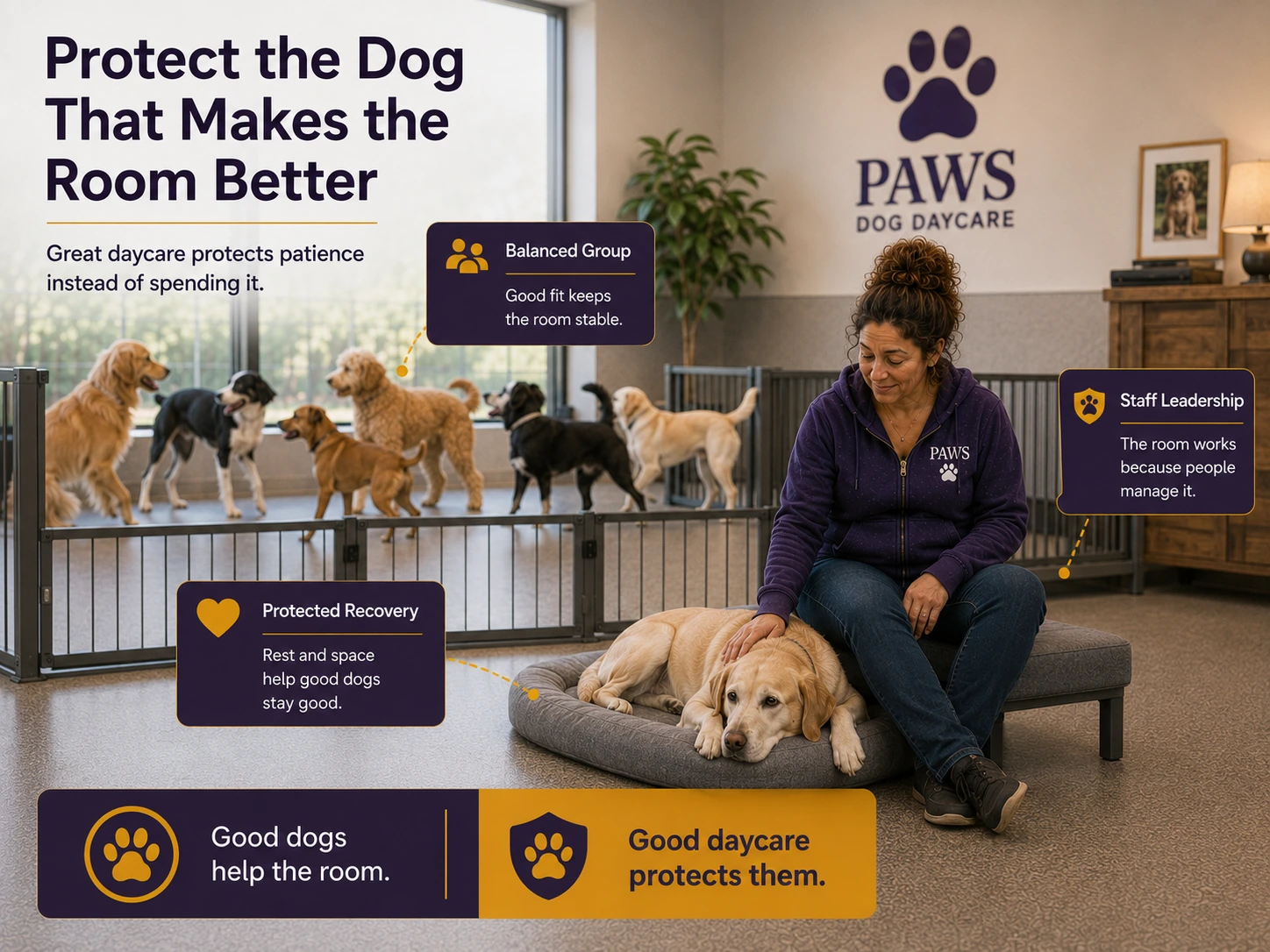
The adaptable personality may be the easiest dog daycare type to manage. These dogs often fit well, cooperate with staff, tolerate different groups, and help balance the room.
That is exactly why staff need to respect them. The dog that rarely complains is not the dog that should absorb every bad pairing, every rude puppy, every pushy regular, and every questionable evaluation.
A good daycare protects the dogs that make the room better. It does not spend them like loose change.