Dog Daycare Personality Types, Insecure Dogs, Fearful Dogs, Defensive Snapping, Group Play Risk, Slow Socialization, Staff Supervision, Compatibility, and Daycare Admission Decisions
Understanding the Insecure Dog Personality in Dog Daycare
Fear can look like attitude when the room is too loud, too close, and nobody is reading the dog.
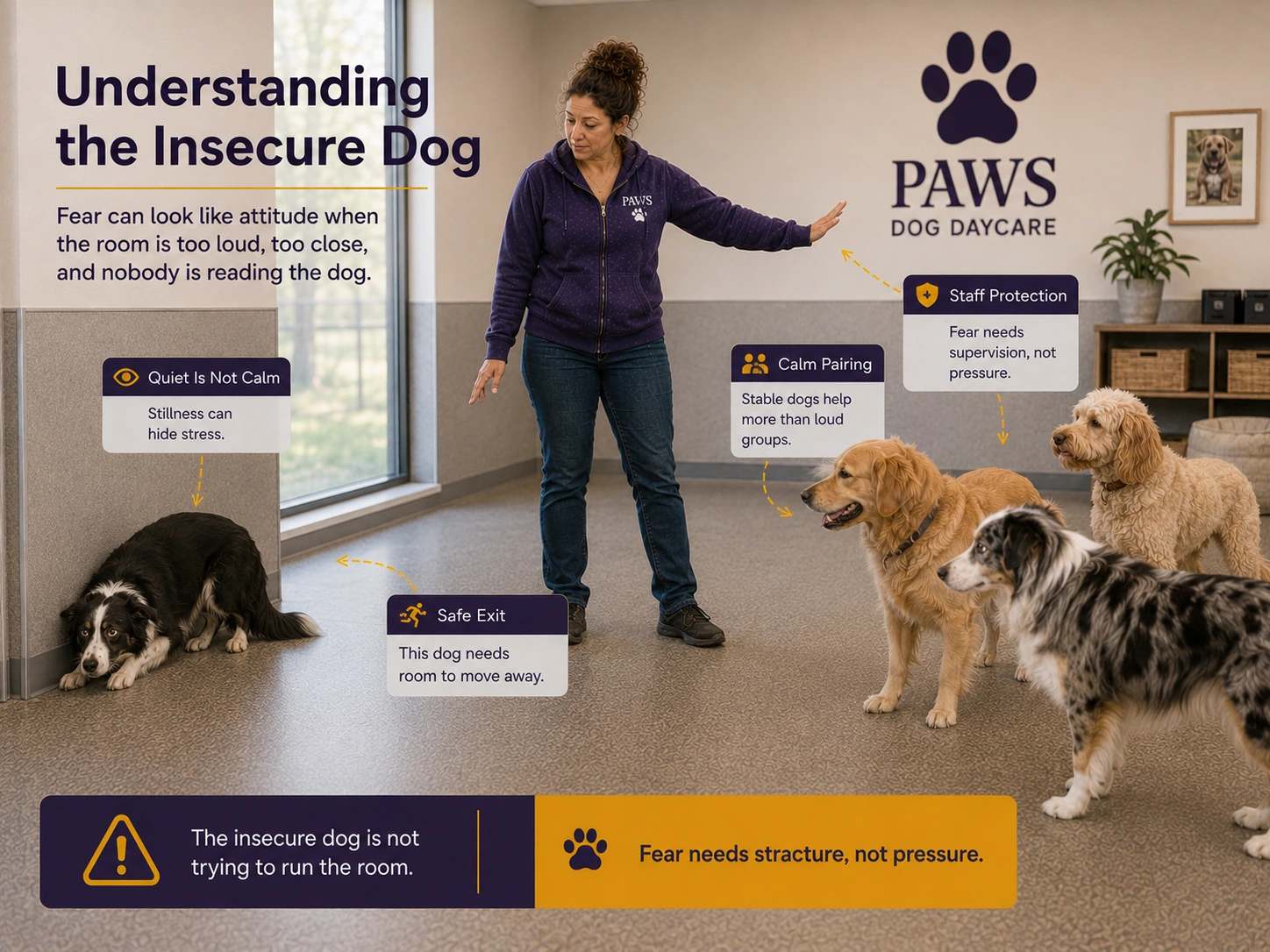
In the PAWS personality system, the insecure dog is the dog that lacks confidence in new situations, strange dogs, fast movement, loud rooms, pressure, crowding, and unfamiliar handling. This dog may be submissive, fearful, clingy, avoidant, frozen, defensive, or quick to snap when the dog feels trapped.
The insecure dog is not automatically an aggressive dog. That distinction matters. An aggressive dog may use force to control the room. An insecure dog often uses teeth because the dog feels cornered, overwhelmed, or out of options. The result can still be a bite. The reason is different.
This is one of the most misunderstood daycare personality types because inexperienced staff may either feel sorry for the dog and push too much social contact, or blame the dog after it snaps. Both mistakes can make the dog worse. Throwing an insecure dog into the middle of a playgroup to “get used to it” is not socialization. That is just fear with witnesses.
A good daycare can sometimes help the insecure dog slowly build confidence, but only with patience, structure, controlled exposure, careful matching, predictable handling, and staff who understand that progress is measured in inches, not fireworks.
⚠️
Operator warning
Do not push an insecure dog into the middle of the group and hope daycare fixes fear by magic. That is not confidence-building. That is tossing the dog into the deep end and acting surprised when it bites the lifeguard.
🐕
What PAWS Means by Insecure Personality
This is the dog that does not trust the room yet.
The insecure dog is usually unsure, fearful, submissive, easily overwhelmed, or slow to adjust. This dog may bond very closely to the owner and struggle when separated. Some insecure dogs howl, whine, pace, cling, hide, shake, refuse to move, urinate or defecate from stress, destroy things when left alone, or show other separation-distress behaviors.
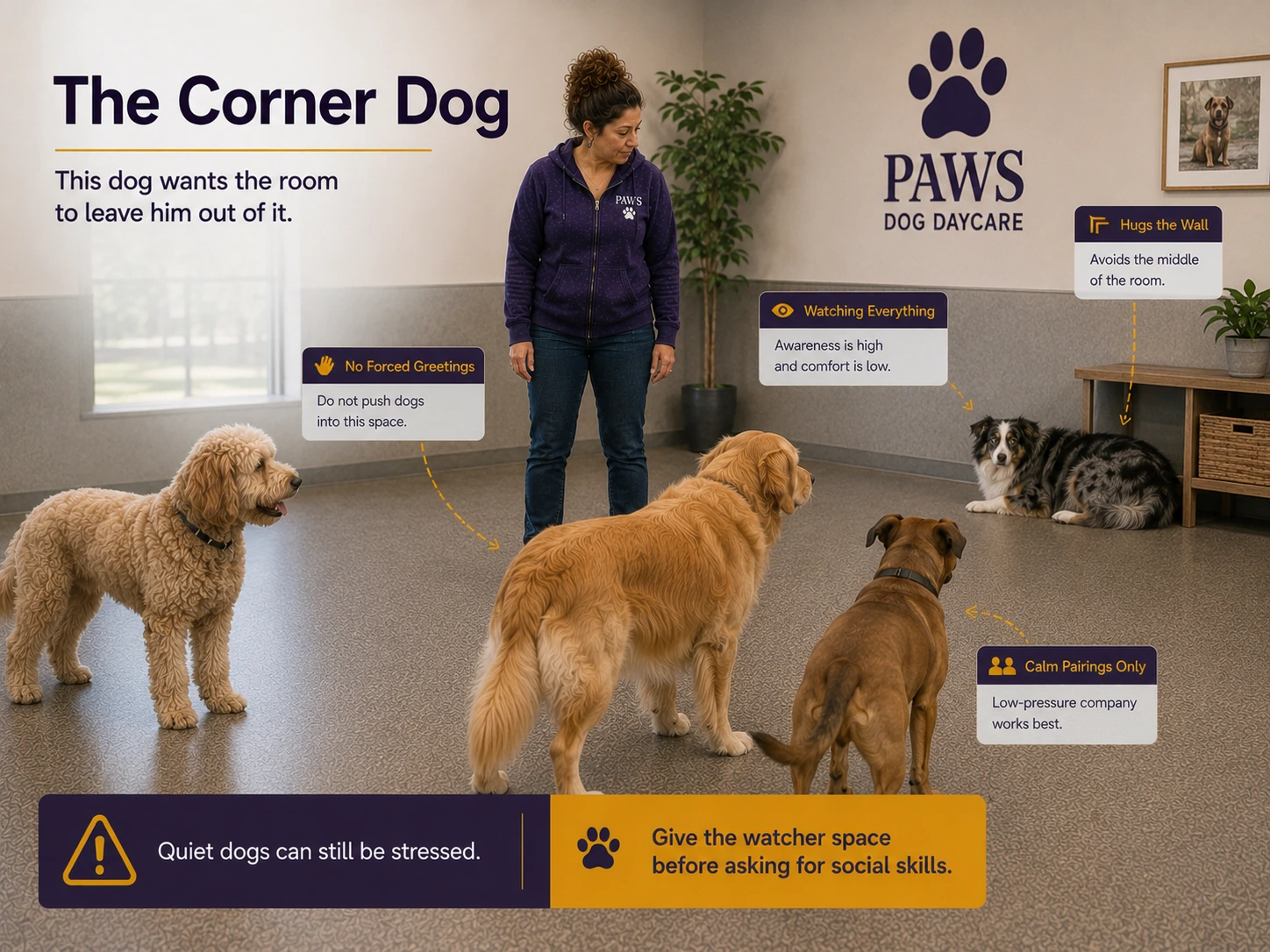
In daycare, the insecure dog may sit in a corner, hide behind staff, avoid the group, freeze near gates, dodge greetings, snap when crowded, or lash out when the dog feels trapped. That behavior can look aggressive if staff only notice the final teeth.
In the room, this may be the dog that hugs the wall, will not cross the middle of the play area, hides under a bench, avoids the water bowl because another dog is near it, refuses to pass through a gate, or watches every moving dog like the room is full of unpaid debt collectors.
Sometimes the insecure dog looks “fine” because the dog is quiet. Quiet is not always calm. A dog can be quiet because the dog is thinking, learning, resting, or coping. A dog can also be quiet because the dog has emotionally left the building and is just waiting for the body to catch up.
The operator has to ask what happened before the teeth. Did a confident dog pressure the insecure dog all morning? Did an outgoing dog rush the face? Did staff block the dog’s escape path? Did the dog give quiet warnings that nobody respected?
The insecure dog needs controlled confidence-building. Not chaos. Not pity. Not rough handling. Not “let them work it out.” This dog needs structure, patience, safe exits, predictable staff, calm dogs, and very careful progress.
⚖️
Insecure Is Not the Same as Aggressive
Fear biting is still serious, but it is not the same operating problem as offensive aggression.
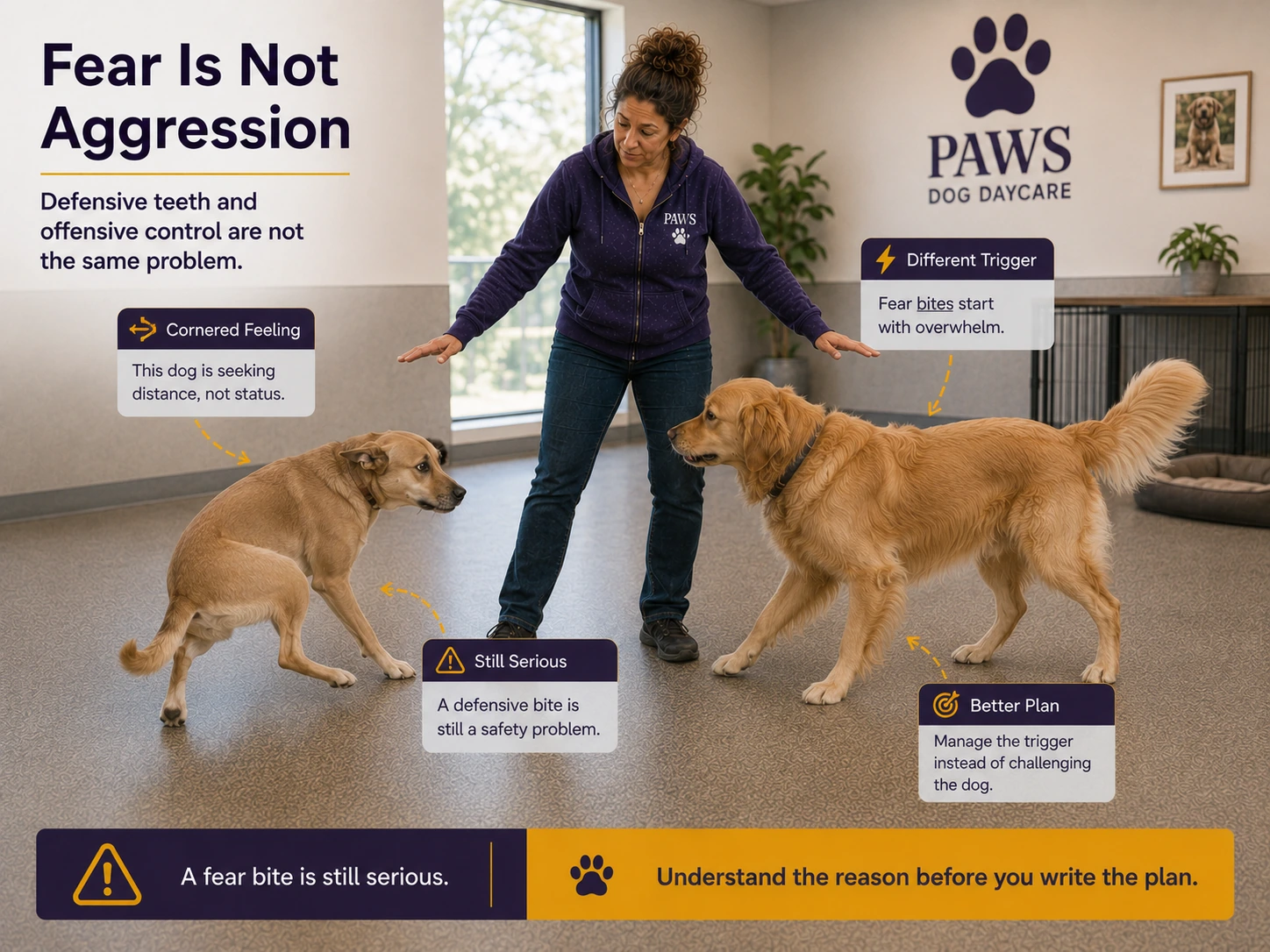
An insecure dog may growl, show teeth, snarl, snap, or bite when the dog feels threatened. That does not automatically make the dog an aggressive personality in the PAWS system. It may mean the dog is scared, cornered, overwhelmed, or trying to create distance.
That difference matters because the staff response is different. A fearful dog does not need to be dominated, broken, challenged, flooded, or forced to “face it.” That kind of handling often makes the dog more defensive and less predictable.
The daycare still has to take the behavior seriously. A fear bite is still a bite. The goal is not to excuse the dog. The goal is to understand the trigger, prevent the setup, and decide whether the facility can safely help the dog without putting other dogs or staff at risk.
This is where staff have to hold two thoughts at the same time. The dog may be scared, and the dog may still be unsafe in that setup. Understanding fear does not mean pretending teeth are harmless. It means the business makes a better decision instead of getting emotional, blaming the dog, or forcing round two.
📌
Operator distinction
The aggressive dog may bite to control. The insecure dog may bite to survive the moment. The injury can look the same. The management plan should not.
🔍
The Insecure Dogs Staff Actually See in the Room
“Scared” is too vague. Staff need to know what version of fear just walked in.
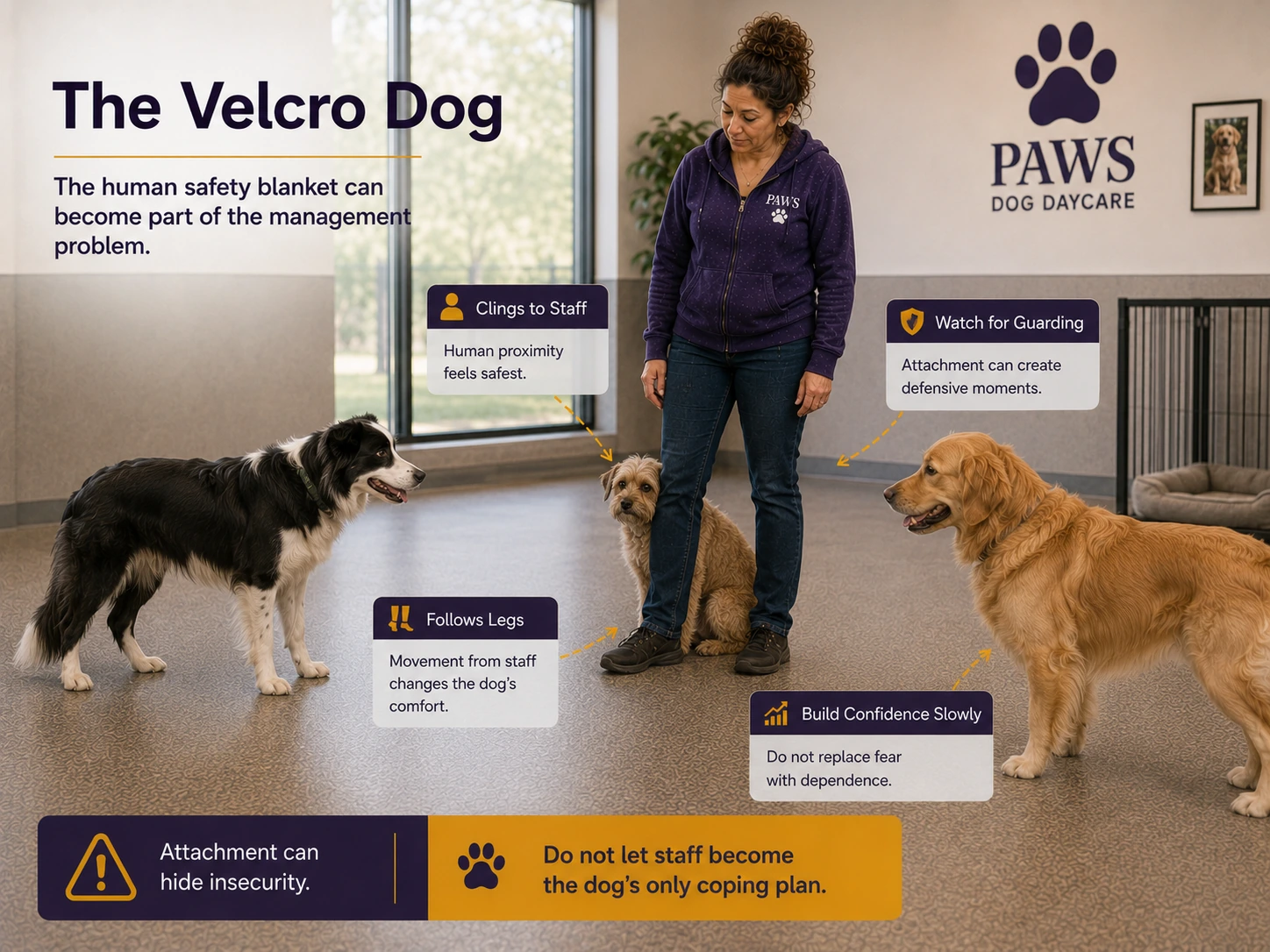
Insecure dogs do not all behave the same way. One dog hides. One dog clings. One dog freezes. One dog runs. One dog snaps if another dog gets too close. One dog looks fine until the owner leaves and then emotionally melts into the floor.
The operator needs to label the pattern early, because the wrong setup can turn a manageable insecure dog into a defensive incident.
The same dog may shift between several patterns as pressure changes. A corner dog may become a fear snapper when the exit is blocked, a Velcro dog may panic when the employee moves away, and an owner-left-me dog may look socially capable until the handoff is complete. Staff should expect movement between patterns instead of treating one label as permanent.
Useful notes identify which version appeared, what triggered the change, how long the dog remained in that state, and what restored recovery. “Scared today” is not enough. “Settled after owner left, froze when rushed at the gate, then recovered in private space with familiar staff” gives the next shift a workable plan.
Swipe left/right to see the full table.
| Insecure Type | What Staff See | Daycare Meaning |
|---|---|---|
| The Corner Dog | Sits alone, avoids movement, watches everything, and wants the room to leave him out of it. | This dog needs space, calm dogs, and no forced greetings. |
| The Velcro Dog | Clings to staff, follows legs, hides behind people, or panics when separated from the owner. | Watch guarding around staff and stress when the human safety blanket moves. |
| The Owner-Left-Me Meltdown | Looks manageable during check-in, then falls apart once the owner leaves: whining, pacing, howling, scratching, drooling, or refusing to settle. | This dog may need shorter trial visits, calmer handoff routines, and honest separation-stress notes. |
| The Don’t-Touch-Me Dog | May tolerate the room from a distance but panics, ducks, snaps, or freezes when staff reach too quickly. | Handling has to slow down. Staff should stop trying to prove they are friendly with their hands. |
| The I’m-Fine-Until-Cornered Dog | Appears okay while space is available, then snarls, snaps, or bolts when dogs or staff block the exit path. | The escape path is part of the safety plan. Cornering this dog creates the problem. |
| The Freeze Dog | Goes still, lowers body, avoids eye contact, refuses to move, or shuts down under pressure. | Freezing is not consent. It may be the warning before panic or snapping. |
| The Fear Snapper | Shows teeth, snarls, air snaps, or bites when crowded, rushed, cornered, or touched too fast. | The dog needs more distance and better handling immediately. Do not punish the warning out of the dog. |
| The Panic Runner | Darts away, bolts for gates, dodges dogs, or tries to escape the room when pressure builds. | Escape risk matters. Gates, leashes, lobby movement, and handoffs need extra control. |
| The Slow Warmup Dog | Starts nervous but improves with routine, calm dogs, patient staff, and predictable handling. | This may become a workable daycare dog if the facility does not rush the process. |
🏠
Why Daycare Gets Insecure Dogs
Owners often come to daycare hoping social exposure will fix fear.
Insecure dogs often arrive because the owner is trying to help. The dog may be lonely, anxious when left alone, scared of other dogs, poorly socialized, newly adopted, recently moved, under-exercised, or struggling in normal household routines.
The owner may say, “I think he just needs socialization.” Maybe. But socialization does not mean dropping the dog into a loud room full of strangers and hoping confidence grows out of panic.
Daycare can help some insecure dogs when the facility uses slow introductions, calm pairings, rest periods, predictable staff, and careful notes. It can hurt them when the business treats fear like a bad attitude or a problem that can be fixed by volume.
Daycare is not automatic treatment for separation anxiety, poor socialization, generalized fear, handling sensitivity, pain-related defensiveness, or household behavior problems. Those issues may require training, veterinary evaluation, behavior treatment, owner work, or services that provide more control than an open playroom can offer. A busy room should not become the diagnostic test for every problem the dog has at home.
What daycare can contribute is narrower and still useful: controlled exposure, predictable routine, carefully selected partners, consistent observation, and honest feedback about what the dog can handle. The facility helps when each visit stays below the dog’s panic threshold and builds on documented success. It harms when repeated overwhelm is renamed socialization because the owner wants progress faster than the dog can produce it.
🧬
Dogs and Backgrounds That Often Show Up as Insecure
Background is a clue. It is not a verdict.
Insecurity can show up in any breed, size, age, or background. Staff should never accept or reject a dog based on a label alone. But certain histories and body types can tell staff what to watch first.
Background gives staff hypotheses about what to observe, not conclusions about what happened to the dog. Under-socialization, developmental fear periods, recent relocation, owner separation, pain, sensory decline, and unknown history can produce similar-looking avoidance or defensive behavior for very different reasons. The current trigger and recovery pattern matter more than the story staff are tempted to invent.
Document what the dog does around movement, sound, touch, gates, strange dogs, separation, and rest. If behavior changes suddenly or handling tolerance drops, the owner may need veterinary input because pain or medical change can look like a personality shift. The safest record describes observable behavior and leaves unsupported explanations out of the chart.
Swipe left/right to see the full table.
| Common Background | Daycare Version You May See | Operator Warning |
|---|---|---|
| Under-socialized dogs | Fearful around strange dogs, new surfaces, gates, loud rooms, and fast greetings. | Go slow. The dog is not behind schedule because staff failed to scare it enough. |
| Small or toy-sized dogs | May feel physically vulnerable in mixed-size groups and become defensive when rushed. | Size matters. A friendly big dog can still feel like a weather event to a small scared dog. |
| Rescue or rehomed dogs | May have unknown history, attachment stress, fear of handling, or slow trust development. | Do not invent a tragic backstory. Observe the dog in front of you and document patterns. |
| Sensitive herding-type dogs | May be sound-sensitive, movement-sensitive, fast to worry, and easily overloaded by chaotic rooms. | Watch chasing, barking, crowding, and whether motion makes the dog more anxious. |
| Adolescent dogs in fear periods | May suddenly become suspicious, avoidant, reactive, or overwhelmed by things they previously handled. | Do not make a temporary fear stage permanent by forcing bad experiences. |
| Older, sore, or medically fragile dogs | May avoid contact, snap when bumped, or become defensive because pain lowers tolerance. | Do not treat pain behavior like personality. Get owner and veterinary information when needed. |
📌
Background rule
History gives staff a starting suspicion. Behavior gives staff the answer. The dog in the room always outranks the story on the intake form.
✅
Where Insecure Dogs Can Do Well
The best setup is boring on purpose.
“Boring on purpose” means the room is predictable enough for the dog to think instead of merely react. The same calm staff, controlled entry, familiar space, appropriate partners, and clear exits reduce the number of surprises the dog has to solve. The goal is not deprivation; it is giving the dog a level of stimulation the nervous system can actually process.
Success should be measured through voluntary behavior. The dog begins moving through the room without being pulled, investigates at its own pace, takes water, rests normally, checks in with staff, and chooses limited social contact without immediately retreating. Small choices made comfortably are more meaningful than surviving a long visit while shut down.
A quiet dog that remains pinned to a wall, watches every movement, refuses resources, or follows staff without loosening is not necessarily doing well. The dog may simply be enduring the visit without creating a problem. Good daycare produces recovery and growing choice, not silent compliance that staff mistake for progress.
- They do better with predictable routines, familiar staff, and slow introductions.
- They do better with calm, adaptable, independent, or polite dogs that do not rush them.
- They need safe exit paths, quiet spaces, and no forced cornering.
- They need staff who can reward bravery without making a production out of it.
- They often need shorter visits, trial periods, or slow build-up before full daycare days.
- They need documentation so every visit builds on the last one instead of restarting the experiment.
🚨
When Fear Turns Into Snapping
The snap is often the last sentence, not the first one.
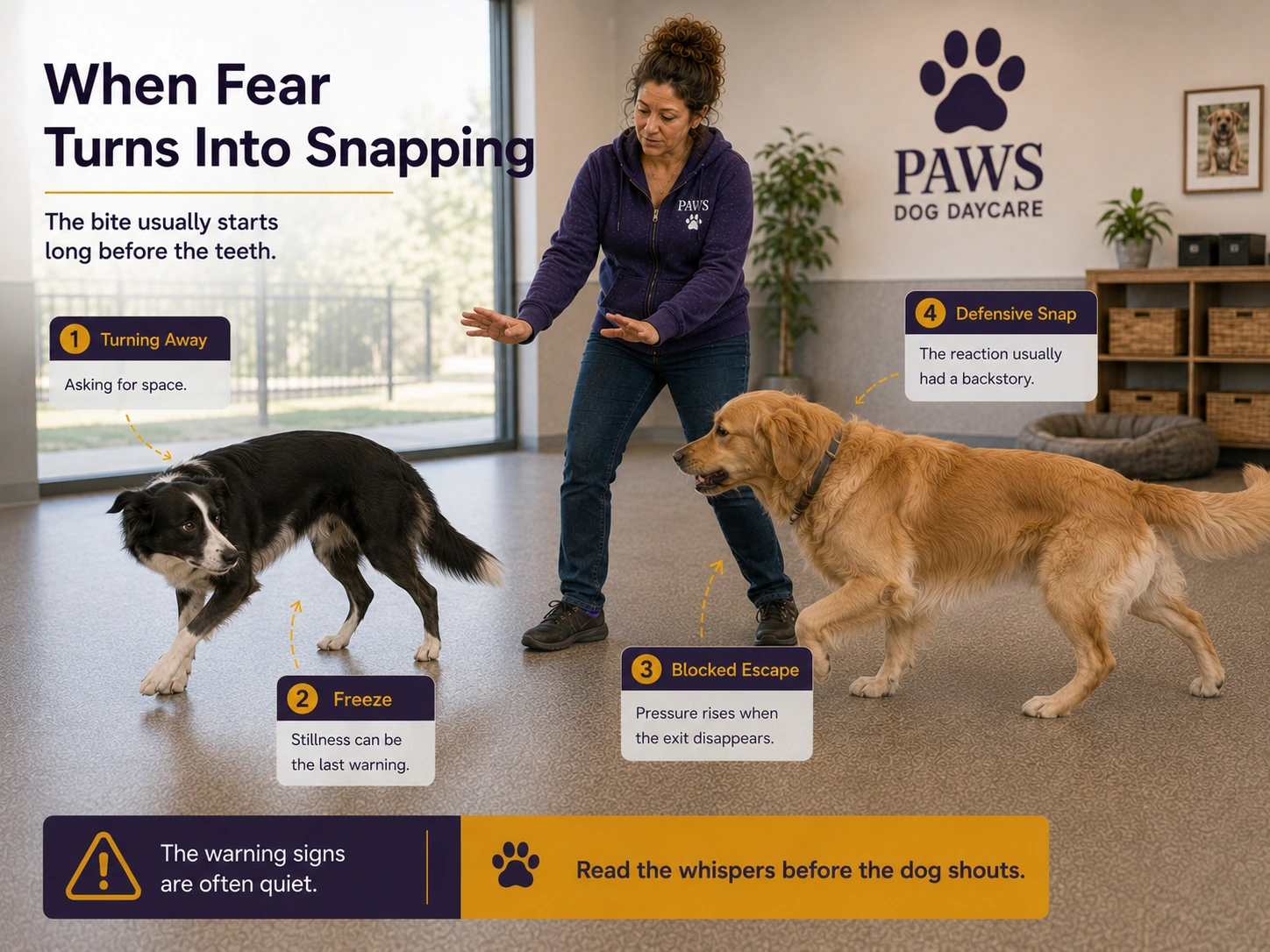
Insecure dogs often warn quietly before they warn loudly. They may turn away, lower their body, tuck their tail, lick lips, show whale eye, freeze, hide, avoid, stiffen, or try to leave. If those signals are ignored, the dog may escalate to growling, showing teeth, air snapping, or biting.
The sequence matters. A dog turns away. Nobody notices. The dog backs up. Another dog follows. The dog freezes. Staff think the dog is “being good” because it stopped moving. Then the dog shows teeth, snaps, and suddenly everyone acts like the bite came out of nowhere. It did not come out of nowhere. It came out of the warnings nobody respected.
Staff who only notice the bite will misunderstand the dog. The real question is what happened before the bite. Did another dog keep approaching? Did staff block the escape path? Did a handler reach too fast? Was the dog trapped in a corner? Was the room too loud? Was the dog already past its limit?
Do not punish a fearful dog for giving warnings. If staff scare the warnings out of the dog, the dog may stop growling and go straight to biting. That is not improvement. That is removing the smoke alarm because the noise was annoying.
⚠️
Fear warning
If an insecure dog snaps, do not automatically blame the snap. Find the pressure that made the snap look like the dog’s only option.
👀
What Staff May See With an Insecure Dog
The goal is to catch fear before it becomes defense.
No single signal should be interpreted in isolation. A tucked tail after one loud noise may resolve quickly, while freezing combined with gate hovering, refusal to drink, staff clinging, and repeated avoidance shows a larger pressure pattern. Staff should read the cluster, the duration, and whether the dog returns to its normal baseline.
Baseline matters because insecure dogs do not all display fear the same way. One dog may normally stay near staff and still play, while another becomes unusually still, stops taking familiar routes, or begins avoiding a dog it previously tolerated. The useful question is what changed from this dog’s ordinary behavior under similar conditions.
Every observation should include what happened immediately before and after the signal. Record the approaching dog, gate movement, handling attempt, noise, resource, blocked path, staff response, and recovery. That context turns body language into an operating decision instead of a list of disconnected symptoms.
Swipe left/right to see the full table.
| Behavior | What It May Mean | Staff Response |
|---|---|---|
| Hiding in corners | The dog is seeking distance and safety. | Do not drag the dog into the group. Reduce pressure and create a calmer setup. |
| Freezing | The dog may be overwhelmed and unable to choose a safe action. | Pause the interaction. Give space before freeze turns into panic or defense. |
| Showing teeth or growling | The dog is asking for distance. | Respect the warning, remove pressure, and change the setup. |
| Snapping when approached | The dog may feel trapped, rushed, or cornered. | Stop the approach. Reassess whether group exposure is too much. |
| Clinging to staff | The dog is using the person as a safety base. | Protect the dog without letting staff become a guarded resource. |
| Panic running or gate rushing | The dog is trying to escape pressure. | Control gates, leash movement, and transitions. Escape risk is serious. |
| Improves with the same calm dog | The dog may benefit from careful, predictable social exposure. | Use that information. Build confidence slowly instead of changing everything at once. |
📈
The Insecure Dog Fear Curve
This dog often fails by feeling trapped, not by trying to start trouble.
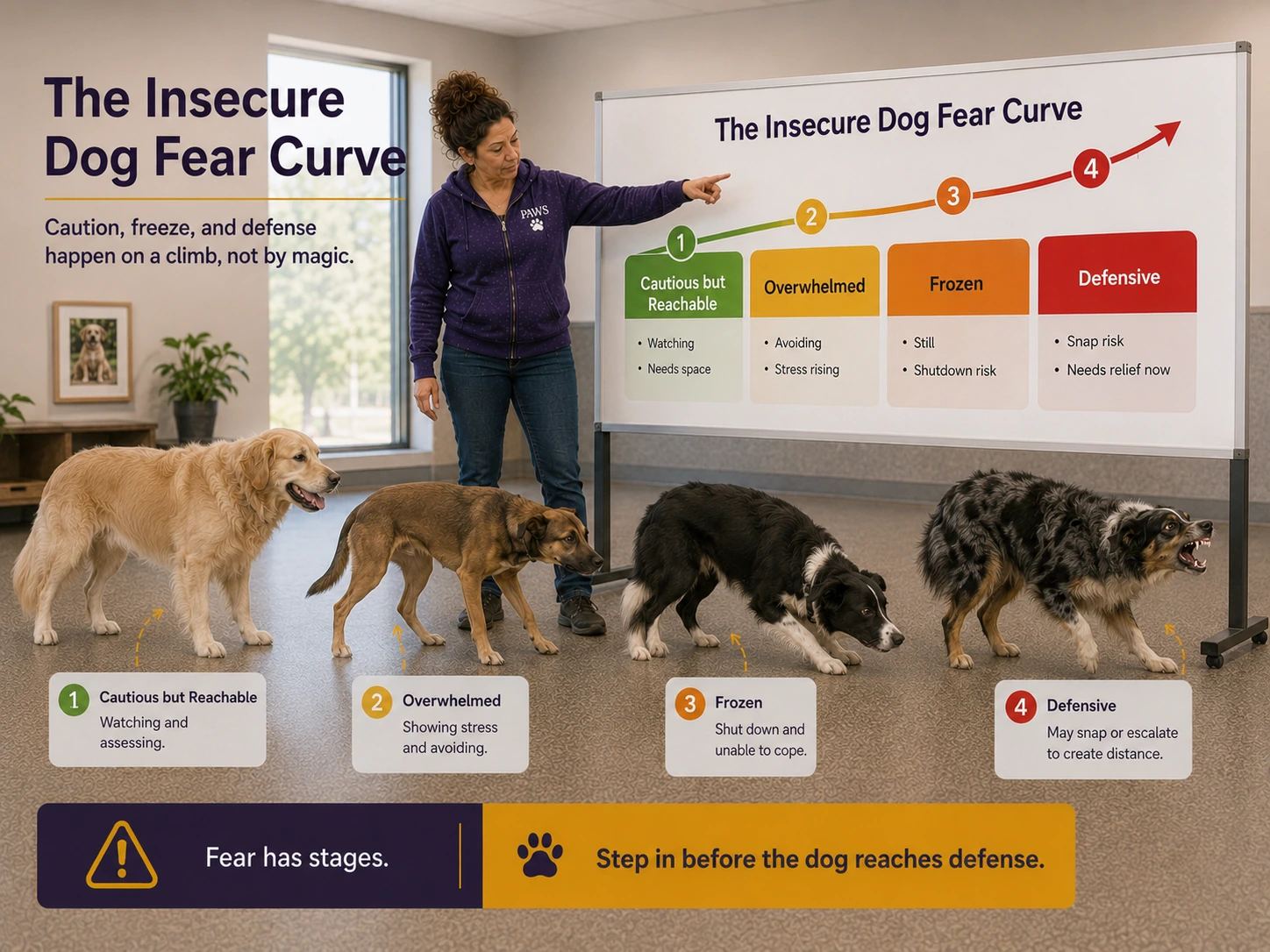
The insecure dog may start the visit worried but workable. Then one dog rushes the face, a staff member reaches too fast, the room gets louder, the dog loses the escape path, and suddenly the fearful dog has no more soft warnings left.
That is the fear curve. The dog did not become “mean.” The setup pushed the dog past the point where avoidance still worked.
The cheapest intervention point is while the dog remains unsure but reachable. Increasing distance, slowing the room, changing the partner, stopping an approach, or offering a quiet reset can prevent the dog from moving into freeze and defensive behavior. Waiting for a growl or snap means staff allowed the dog to travel too far up the curve.
Recovery must be visible before re-entry. Staff should see looser posture, normal movement, curiosity, willingness to take direction, and the ability to use the room without immediately returning to avoidance. If the same trigger sends the dog through the same curve visit after visit, the service plan needs to change rather than asking the dog to keep rehearsing fear.
Swipe left/right to see the full table.
| Stage | What It Looks Like | Staff Move |
|---|---|---|
| Unsure but Reachable | Slow movement, cautious sniffing, mild avoidance, but still taking direction. | Keep the room calm. Reward small bravery and do not rush the dog. |
| Worried and Avoidant | Hiding, retreating, tucked posture, refusing greetings, avoiding staff hands. | Reduce exposure, increase distance, and use calmer dogs or no dogs for a reset. |
| Cornered or Pressured | Freezing, whale eye, lip licking, growling, showing teeth, stiff body. | Stop the interaction. Move pressure away. Do not force handling. |
| Defensive Contact or Shutdown | Snapping, biting, panic running, redirecting, trembling, or emotionally checking out. | End the setup. Separate, document, notify owner as needed, and reassess daycare fit. |
🧩
Insecure Personality Compatibility in Daycare
Compatibility means pressure level, not whether the other dog “means well.”
Compatibility for an insecure dog is really a pressure calculation. Staff have to consider how quickly the other dog approaches, whether the insecure dog can move away, how much body contact is used, and whether the other dog respects avoidance without following, crowding, or trying harder. A friendly label does not reduce the pressure if the insecure dog still feels trapped.
A pairing that works in a quiet room may fail after arrivals, staff changes, fatigue, pain, barking, crowded gates, or the loss of a clear exit path. The other dog may not have changed at all; the insecure dog may simply have less ability left to absorb the same interaction. Compatibility must therefore be watched throughout the visit rather than decided once at intake.
The pairing stops working when the insecure dog begins freezing, hiding, clinging, avoiding water or rest areas, staying near exits, or repeatedly asking staff for protection. Those behaviors are not minor inconveniences to wait out. They are evidence that the current group is demanding more than the dog can safely give.
Swipe left/right to see the full table.
| Pairing | Compatibility | Daycare Meaning |
|---|---|---|
| Insecure + Aggressive | Very Low | The insecure dog may panic, snap, or flee, and the aggressive dog may answer with force. This is not a casual pairing. |
| Insecure + Confident | Low / Caution | A stable confident dog may help in rare cases, but a pushy confident dog may bully, pressure, or control the insecure dog. |
| Insecure + Outgoing | Low / High Supervision | The outgoing dog may be friendly but overwhelming. Face rushing and social pressure can trigger defensive snapping. |
| Insecure + Adaptable | Moderate / High | Often workable if the adaptable dog is calm, polite, and not forced to absorb fear reactions all day. |
| Insecure + Independent | High | Often a good match because the independent dog may allow space and avoid unnecessary social pressure. |
| Insecure + Insecure | Moderate | Can be calm if both dogs want space, but two fearful dogs can also feed each other’s anxiety. |
⚠️
Compatibility warning
A friendly dog can still be the wrong dog for an insecure dog. Intent does not matter much when the insecure dog feels trapped.
👀
How Staff Should Handle the Insecure Dog
Do not punish fear. Structure it.
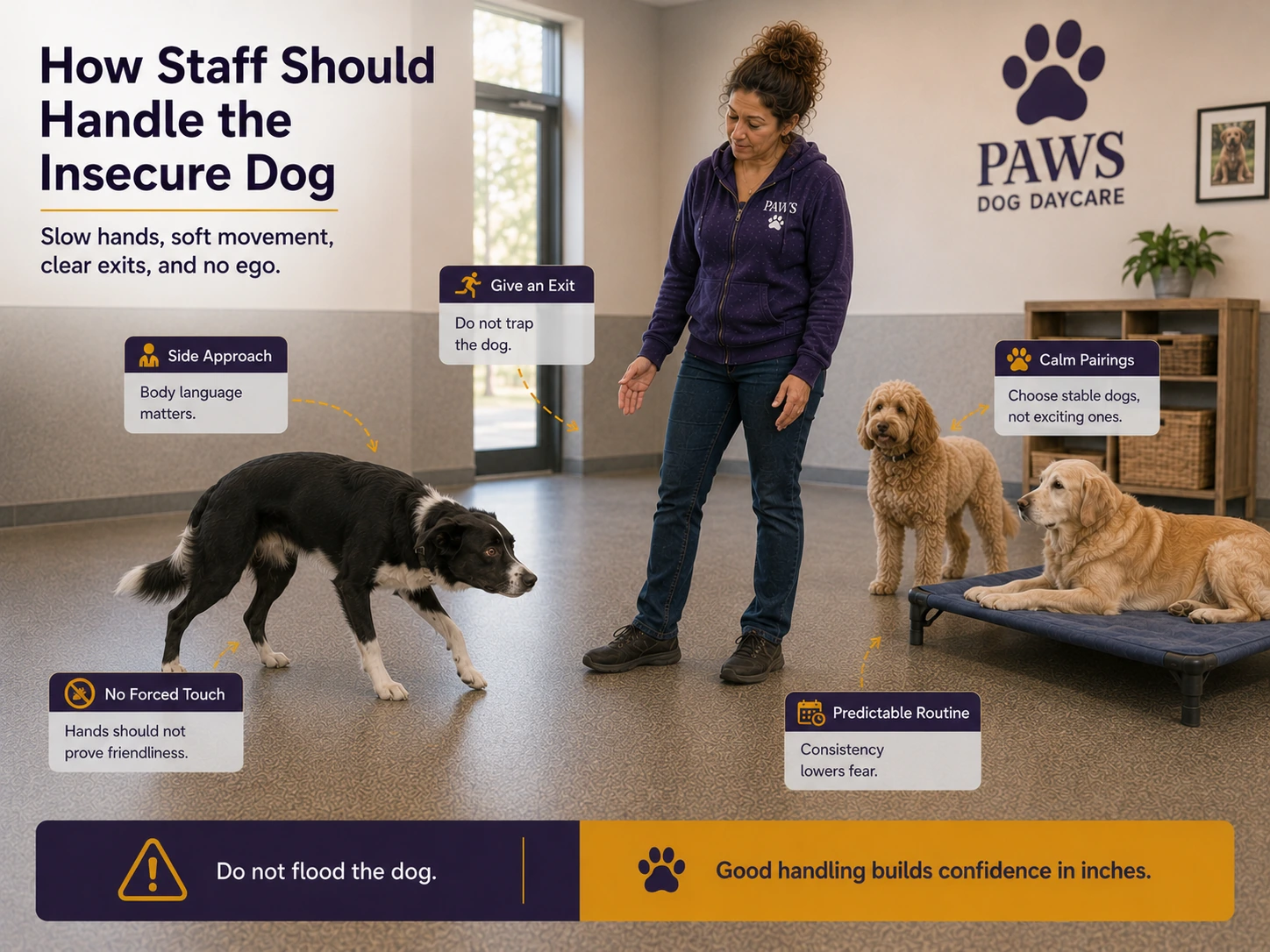
The staff job is not to force confidence into the dog. The staff job is to create conditions where the dog can safely find a little confidence without being overwhelmed.
That means calm movement, predictable handling, slow introductions, safe distance, controlled groups, and respecting early warnings. Staff should not crowd, grab, chase, loom over, corner, or “make friends” with the dog because they personally want to feel helpful.
Staff should approach sideways when possible, keep their body loose, avoid looming over the dog, avoid hard direct pressure, and give the dog a way out. The insecure dog does not need three employees baby-talking in its face like a rescue commercial. The dog needs calm, boring competence.
- Give the dog room to move away. Escape paths reduce defensive behavior.
- Use calm dogs first, not the happiest dog in the building with no brakes.
- Do not reach over the dog, crowd the dog, or drag the dog into greetings.
- Do not chase the dog around the room to leash it. Slow down, reduce pressure, and set up the catch before the dog panics.
- Do not let employees crowd the dog with sympathy. Feeling bad for the dog is not a handling plan.
- Interrupt other dogs before they corner, rush, mount, chase, or pressure the insecure dog.
- Reward small confidence without turning every tiny improvement into a parade.
- Write specific notes: what scared the dog, what helped, what repeated, and what should happen next visit.
⏱️
Routine, Rest, and Predictability Rules for Insecure Dogs
Boring is not a failure. Boring is often the treatment plan.
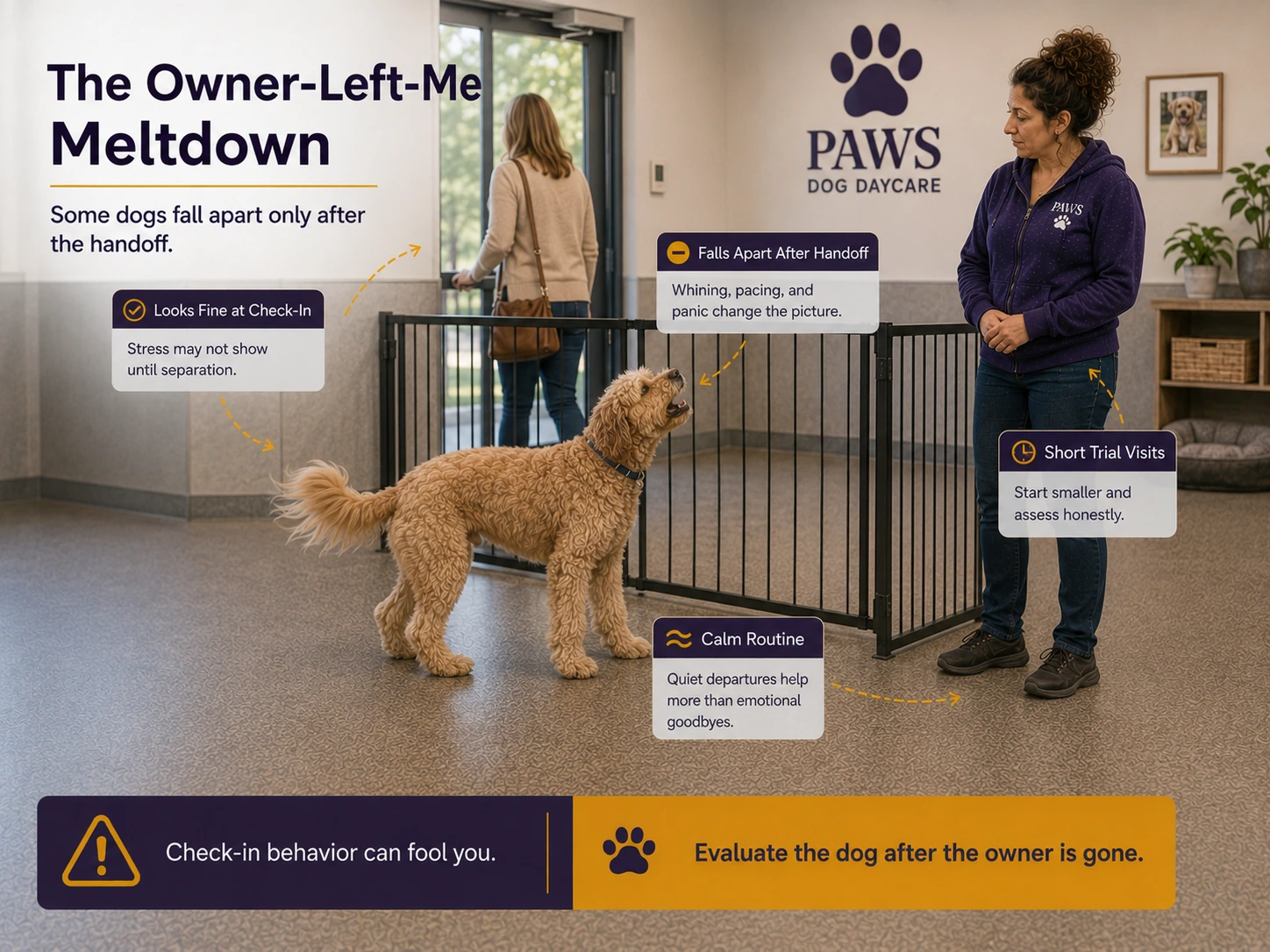
The insecure dog usually does better when the day feels predictable. Same staff when possible. Same calm area. Same slow entry. Same type of dog. Same rest pattern. Same owner handoff routine. The dog is not being spoiled. The business is removing unnecessary chaos.
Drop-off matters. If the owner creates a dramatic goodbye, the dog may start the visit already overloaded. If staff rush the dog through a loud lobby, crowded gate, and busy room, the first five minutes may poison the next three hours. A boring handoff, quiet entry, and controlled first dog introduction can make the difference between progress and a stress circus.
Rest is also important. Fear is tiring. A dog that spends two hours scanning the room like the building owes him money may need a quiet break before staff try another social step.
- Use short visits or partial days when full daycare overwhelms the dog.
- Keep the first few visits boring, controlled, and successful.
- Avoid loud transitions, crowded gates, and chaotic arrivals.
- Build confidence with one calm dog before adding more movement.
- Document whether the dog improves after rest or returns more fearful.
- Stop the session while the dog is still successful instead of pushing until failure.
🗣️
What Owners Need to Hear
Scared dogs need honest information, not fake reassurance.
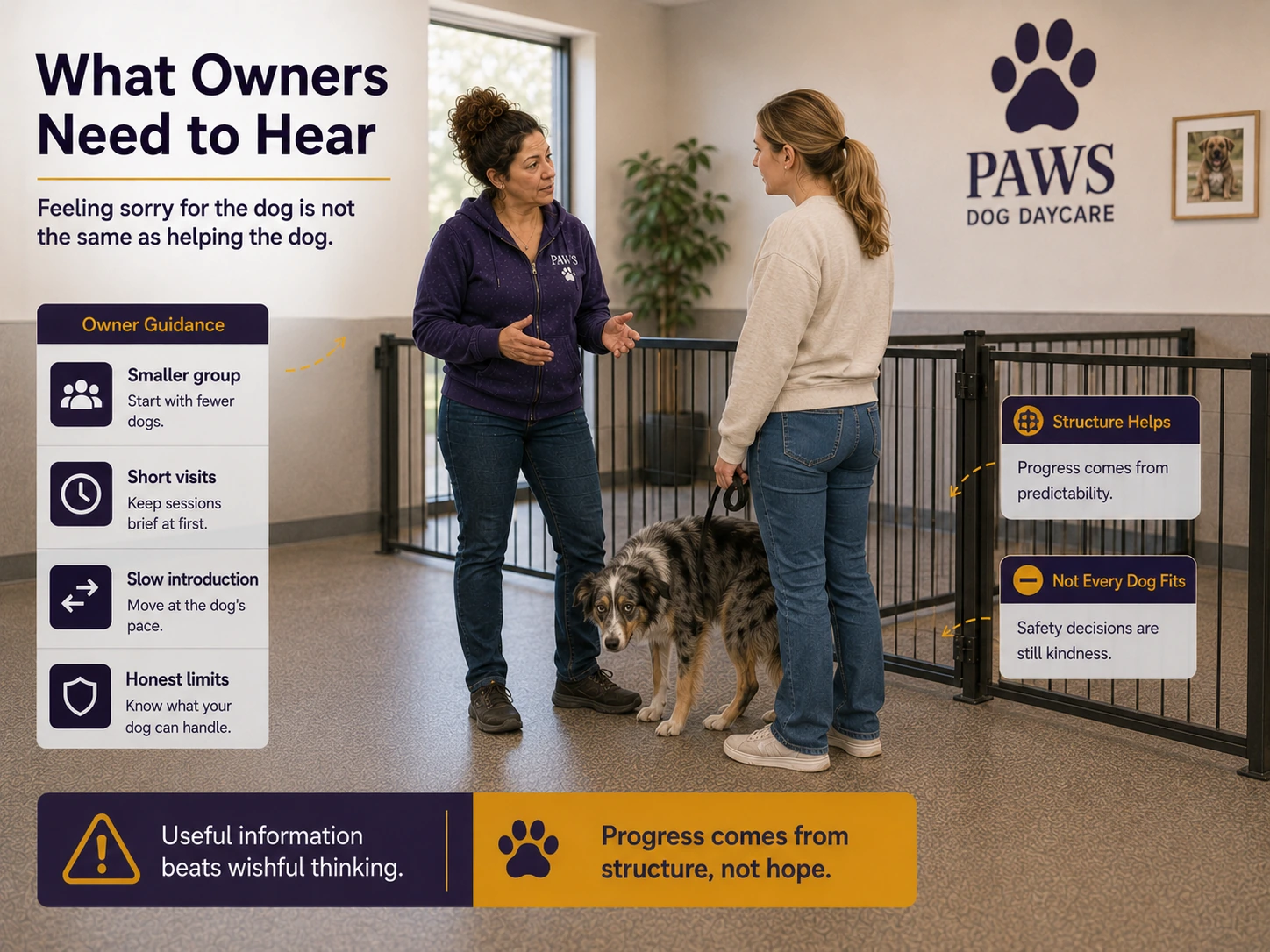
Owners of insecure dogs often feel protective, guilty, embarrassed, or desperate for progress. Keep the conversation kind, but specific. Do not call the dog bad. Do not promise daycare will fix the dog. Explain what the dog did, what triggered the fear, what helped, what repeated, and what the next safe step should be.
The owner needs to understand that slow progress is still progress. A calm five-minute success may be better than a three-hour daycare disaster that sends the dog home worse than he arrived.
The hard truth is that daycare may not be the right tool yet. Some insecure dogs need private visits, training support, veterinary input, confidence work, or controlled one-dog introductions before open daycare makes sense. That is not failure. Failure is pretending the dog is improving while every visit teaches the dog that group care is something to survive.
📌
Owner script
“Your dog is not bad. He is scared in this environment. We need to slow the process down, use calmer dogs, give him space, and build confidence carefully. If we push too fast, he may learn that daycare is something he has to defend himself from.”
🛑
When to Pause, Separate, or Refuse the Insecure Dog
Helping the dog does not mean sacrificing the room.
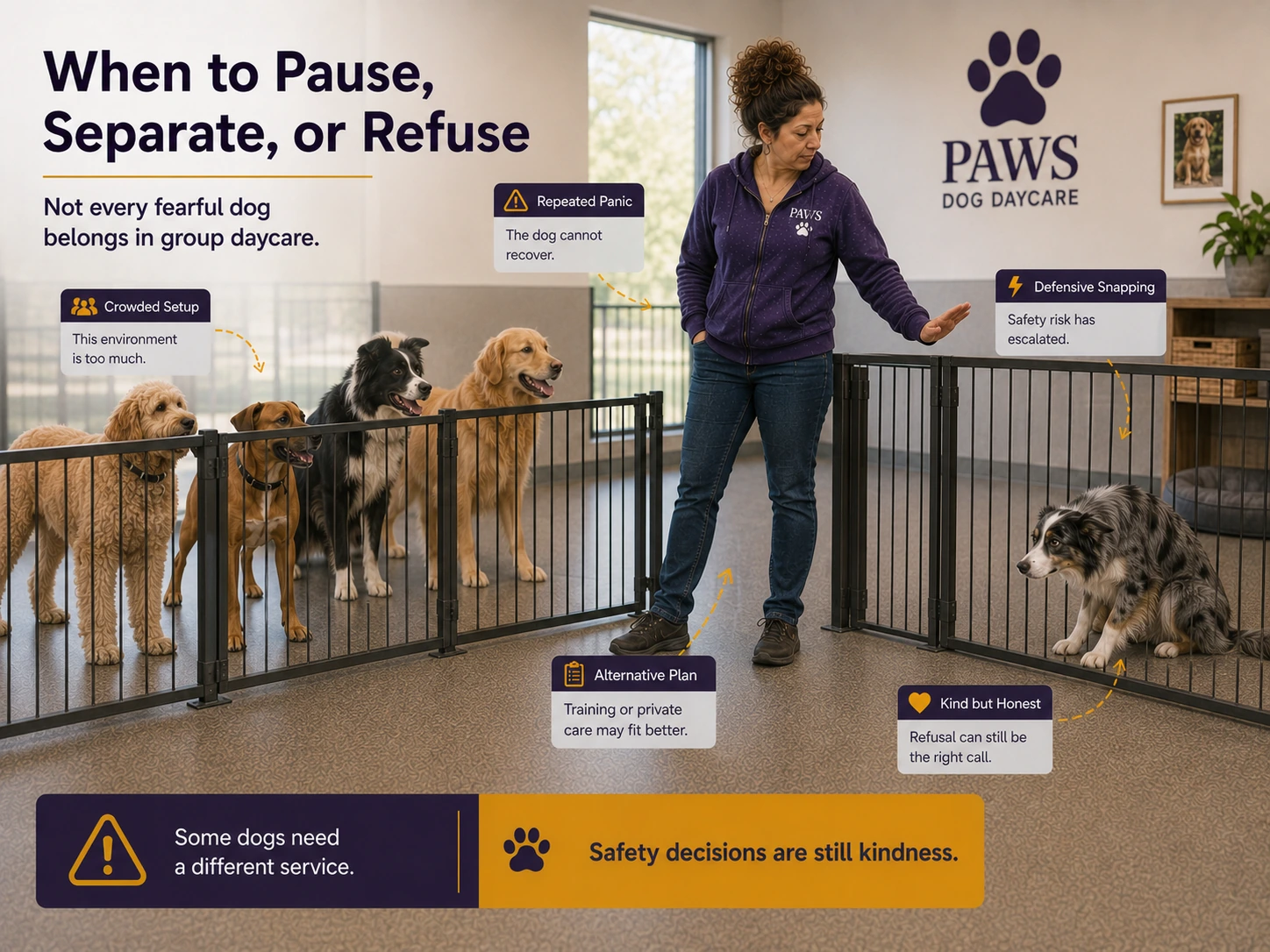
Pause means giving a still-recoverable dog a controlled break before fear becomes shutdown, escape behavior, or defensive contact. The break should lower stimulation, restore space, and give staff a chance to decide whether the dog can safely continue under a different setup. A pause is useful only when staff evaluate the result instead of automatically returning the dog to the same problem.
Separate means ending the specific interaction or removing the dog that is creating pressure. Staff should not repeatedly remove the insecure dog while leaving the rushing, crowding, or fixating dog free to rehearse the same behavior. The intervention should correct the setup, not merely relocate the dog showing the consequences.
End the visit when fear continues to climb, recovery does not occur, escape risk increases, or the dog can no longer be handled without chasing, cornering, or force. Restrict or refuse open group play when the same pattern repeats across reasonable attempts at slower entry, smaller groups, rest, and careful matching. Severity, repetition, staff capacity, and the effect on the rest of the room all belong in that decision.
A kind answer is not always another trial. Private care, shorter visits, structured one-dog exposure, training support, veterinary evaluation, or no open play may protect the dog better than continuing a service the dog repeatedly experiences as danger.
- Pause the session when the dog is freezing, hiding, trembling, or unable to recover.
- Separate the dog when other dogs are crowding, chasing, rushing, or fixating on the dog.
- Use smaller groups or private care when open play creates repeated fear responses.
- Send the dog home when fear is escalating instead of improving.
- Refuse open group play if the dog repeatedly snaps, bites, panic-runs, or cannot safely function in the room.
- Refer the owner to a qualified trainer, veterinarian, or veterinary behavior professional when the fear is severe, escalating, or outside the facility’s ability to manage safely.
📌
Pattern rule
The clearest sign daycare is failing the insecure dog is not one bad moment. It is the pattern. If the dog comes in worried and leaves worse, visit after visit, the business is not building confidence. It is rehearsing fear.
A good operator knows when to stop. Sometimes the best service you can provide is a smaller plan, a slower plan, or an honest no. That protects the dog, protects the room, and protects the business from turning compassion into a claim.
⚠️
No hero rule
Do not let staff turn one fearful dog into a personal rescue mission while the rest of the room loses supervision. Compassion is good. Losing the room is not.
✅
Insecure Personality Daycare Checklist
Use this before admitting, retaining, or moving an insecure dog into open group play.
Use this checklist across multiple visits rather than treating it as a one-time temperament score. Compare quiet and busy days, different employees, different group sizes, owner handoffs, rest periods, handling needs, and visit length. A dog that succeeds only under one unusually perfect setup still has an important restriction that must be recorded.
Track trends in recovery, not only incidents. Faster settling, more voluntary movement, better resource use, and improved response to familiar staff may show real progress even when the dog remains cautious. Repeated shutdown, defensive contact, panic running, or failure to recover shows that the current plan is not working.
The answers should produce an actual service decision. Group placement, approved partners, handling instructions, visit duration, rest timing, gate procedures, owner communication, private-care options, and refusal criteria should all be written clearly enough that the next shift can repeat the plan without guessing.
- Does the dog recover after mild stress, or stay fearful?
- Does the dog have a safe way to move away from pressure?
- Does the dog snap, growl, freeze, hide, or panic-run when approached?
- Which dogs make the insecure dog better, and which dogs make the dog worse?
- Can staff safely handle the dog without cornering, chasing, or forcing contact?
- Does the dog improve with rest, routine, and smaller groups?
- Is the owner willing to accept slow progress, limits, private care, or refusal if needed?
- Are staff notes specific enough to guide the next visit?
❓
Insecure Dog Personality FAQ
Detailed answers about fear signals, defensive behavior, group compatibility, staff handling, owner handoff, rest, documentation, private care, and open-play admission decisions.
Are insecure dogs good daycare dogs?
Some can be, but success depends on the individual dog, the room, the staff, and the pace of exposure. Many insecure dogs need short visits, calm partners, predictable routines, safe exits, and careful handling before open group play is appropriate. Some dogs remain better suited to private care or another service.
Is an insecure dog aggressive if it snaps?
Not automatically. A snap may be defensive behavior from fear, blocked escape, painful handling, or feeling trapped. The behavior still has to be taken seriously because fear-based contact can injure dogs or staff, but the management plan should address pressure and safety rather than treating fear as a dominance contest.
What warning signs usually come before a fear bite?
Common early signs include turning away, lowering the body, tucked posture, lip licking, yawning, whale eye, freezing, hiding, avoiding contact, stiffening, or repeatedly trying to leave. These signals often become louder only after the dog’s softer attempts to create distance have failed. Staff should intervene while the dog is still reachable.
Why is freezing not the same as being calm?
A frozen dog may be overwhelmed and unable to choose a safe action. The dog may stop moving because escape, avoidance, and normal coping have failed—not because the interaction is acceptable. Freezing should trigger more space and less pressure, not closer handling.
Should staff punish growling from an insecure dog?
No. Growling communicates that the dog needs distance and gives staff an opportunity to change the setup before contact occurs. Punishing the warning may suppress the sound without changing the fear, leaving the dog more likely to move directly to snapping or biting.
Can daycare help an insecure dog become more confident?
Sometimes. Daycare can support confidence when exposure is slow, positive, predictable, and carefully matched to the dog’s current ability. It can worsen fear when the dog is flooded, cornered, repeatedly rushed, or left in a group that exceeds the dog’s capacity.
What is the safest first group for an insecure dog?
A very small group with calm, socially polite dogs is usually safer than a busy open room. The partners should give space, avoid direct face rushing, and recover easily when staff interrupt. In some cases, the best first group is one compatible dog—or no dog at all while staff evaluate handling and recovery.
Should insecure dogs play with outgoing dogs?
Only with caution. A polite outgoing dog may be workable, but a face-rushing, body-slamming, highly persistent dog can overwhelm an insecure dog quickly even when the intent is friendly. The effect on the insecure dog matters more than the other dog’s enthusiasm.
Should insecure dogs play with confident dogs?
A stable, respectful confident dog may help some insecure dogs, but a pushy or controlling confident dog may increase fear. Staff must watch whether the confident dog blocks movement, follows avoidance, claims staff attention, or pressures the insecure dog to interact. The pairing should change as soon as the insecure dog loses choice.
Why do some insecure dogs cling to staff?
The dog may be using the person as a safety base in an unfamiliar environment. Staff can provide calm support while gradually building independent coping, but they should not become the dog’s only plan. Clinging also needs supervision because another dog approaching the employee may trigger guarding or defensive behavior.
How should staff approach an insecure dog?
Use low-pressure movement, a sideways body position, soft handling, and enough space for the dog to move away. Avoid looming, reaching over the head, cornering, chasing, grabbing, or surrounding the dog with employees trying to make friends. Calm, boring competence is usually more useful than enthusiastic reassurance.
Why should staff avoid forced socialization?
Forced contact removes choice and can teach the dog that dogs, people, and daycare predict trapping. The dog may shut down, panic, or become more defensive after repeated exposure. Good socialization builds positive experience below the dog’s panic threshold rather than using fear as the lesson.
How should owner handoff be handled?
Keep the routine simple, quiet, and predictable. Dramatic goodbyes, crowded lobbies, rushed gates, and immediate group entry can overload the dog before the visit begins. Staff should evaluate the dog after the owner leaves because separation distress may not appear during check-in.
When should an insecure dog receive a rest break?
Give the break before fear becomes shutdown or defensive behavior. Hiding, trembling, constant scanning, gate hovering, refusal to move, clinginess, worsening avoidance, and inability to recover are useful signals. Rest should reduce pressure and should not be followed by a return to the same bad setup.
How should an insecure dog return after a break?
Re-entry should be slow, controlled, and lower pressure than the previous setup. Staff should look for looser posture, normal movement, curiosity, and willingness to take direction. If the dog returns frozen, frantic, or immediately avoidant, the visit may need to end or move to private care.
What should staff document about an insecure dog?
Document the trigger, location, dogs and staff present, warning signs, handling used, recovery time, successful pairings, failed pairings, owner-handoff behavior, and response to rest. Specific notes help the next shift continue a safe plan instead of restarting the same experiment.
How should staff explain fear-based behavior to an owner?
Use specific observations rather than calling the dog bad, dramatic, or aggressive without context. Explain what happened before the reaction, what the dog did, what staff changed, whether recovery occurred, and what the next safe step should be. Honest limits are more useful than promising daycare will fix the dog.
When should an insecure dog move to a smaller group or private care?
A smaller group or private plan is appropriate when the dog is workable under reduced pressure but repeatedly shuts down, panic-runs, or becomes defensive in open play. The goal is not to keep the dog in the largest service possible. The goal is to use the safest service the dog can actually tolerate.
When should an insecure dog be refused open group daycare?
Refusal may be necessary when the dog repeatedly snaps, bites, panic-runs, cannot be safely handled, fails to recover, or requires more supervision than the facility can provide without neglecting the room. Refusal can be a kind and responsible decision when group care repeatedly rehearses fear.
What makes an insecure dog a successful long-term daycare client?
The strongest long-term candidates gradually recover faster, make more voluntary choices, tolerate predictable handling, and remain comfortable with selected dogs and staff. Their success depends on a facility that protects escape routes, honors quiet warnings, controls pressure, documents patterns, and stops before progress turns into flooding.
🐾
The Bottom Line: Fear Needs Structure, Not Force
The insecure dog can improve when daycare builds confidence carefully instead of flooding the dog with pressure.
The insecure personality belongs in the PAWS system because daycare owners will see these dogs. Some will be too fearful for open group play. Some will improve slowly. Some will do well with the right calm dog, the right staff, and the right routine.
The daycare owner’s job is not to prove every scared dog can handle a group. The job is to protect the dog, the other dogs, the staff, the customer, and the business from a bad setup.
A good daycare does not punish fear. It reads fear early, lowers pressure, builds confidence slowly, and knows when the kindest answer is no open play today.