Dog Daycare Personality Types, Independent Dogs, Aloof Dogs, Escape Risk, Low Social Drive, Group Compatibility, Staff Handling, and Daycare Admission Decisions
Understanding the Independent Dog Personality in Dog Daycare
The independent dog is the un-dog-like dog. Fox-like, cat-like, and dancing to music nobody else can hear.
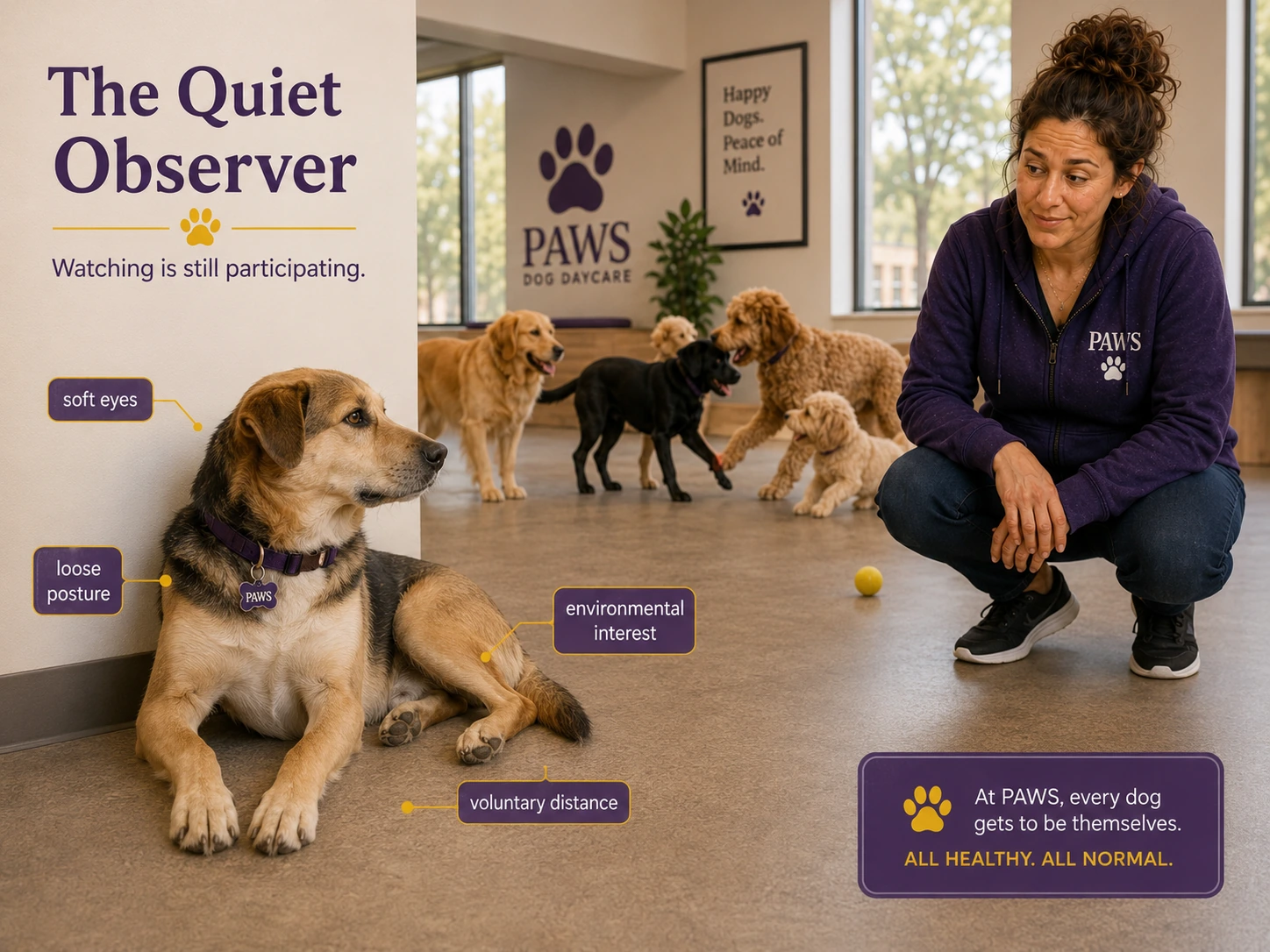
The independent personality is the dog that does not fit the normal picture people carry around in their head when they think “dog.” Most people expect dogs to be friendly, gregarious, people-hungry, up in your business, thrilled to be included, and ready to join the group. The independent dog may look at that whole idea like someone offered it a timeshare presentation.
This dog is not broken. It is not rude. It is not sad. It is not damaged because it does not act like a golden retriever at a birthday party. It is just an un-dog-like dog. It may be affectionate, but on its own terms. It may enjoy the daycare environment, but not all the interaction. It may like the building, the yard, the smells, the routine, and the change of scenery without needing to be welded to staff or buried in a pile of playmates.
Independent dogs can seem fox-like or cat-like. They observe. They drift. They choose. They may stand outside the social window looking in, not miserable, just separate. There is music playing that nobody else can hear, and they are perfectly happy dancing to it.
The daycare risk is usually not that this dog starts fights. The risk is that staff misread independence, force interaction, miss stress, handle the dog too heavy, or underestimate escape risk. If this dog finds a weak gate, it may not panic, look back, or care that three people are yelling its name. It may simply continue walking like it has errands.
⚠️
Operator warning
The independent dog may be the least likely dog in the building to care about frantic recall. If this dog slips out, yelling louder is not a safety system. This dog may keep walking like the whole daycare was just a brief suggestion.
🧭
What PAWS Means by Independent Personality
This is the dog that prefers choice, space, and self-direction over constant social contact.
In dog daycare, the independent personality is the dog that does not strongly seek human attention, dog interaction, or group approval. This dog may watch more than participate. It may rest on the edge of the room, sniff quietly, patrol calmly, or choose one familiar spot and settle there like it signed a private lease.
Independent does not mean unfriendly. It means selective. The dog may like a trusted staff member, a familiar dog, a predictable routine, or a specific part of the facility. But it is not begging for constant handling, not trying to be the center of the room, and not emotionally crushed if nobody throws a parade around it.
This is the un-dog-like dog. Fox-like. Cat-like. Affectionate when it chooses to be. Present without being clingy. Interested without being needy. It may enjoy the building, the yard, the smells, the routine, and the change of scenery while still acting like the other dogs are optional background furniture.
These dogs often show little destructive or separation-anxiety-driven behavior when left alone. They may be able to rest, settle, and entertain themselves better than dogs that need constant interaction. That can make them easier in a home and quieter in a facility, but it does not mean they should be ignored, warehoused, or assumed to be fine because they are not causing noise.
The daycare question is whether the dog benefits from the environment without being pressured into the wrong version of it. Some independent dogs like daycare as a place, not as a social event. They are not rude. They are just not very doggy in the way most people expect dogs to be.
🔍
The Independent Dogs Staff Actually See in the Room
“Aloof” is too vague. Staff need to know what version of independent they are handling.
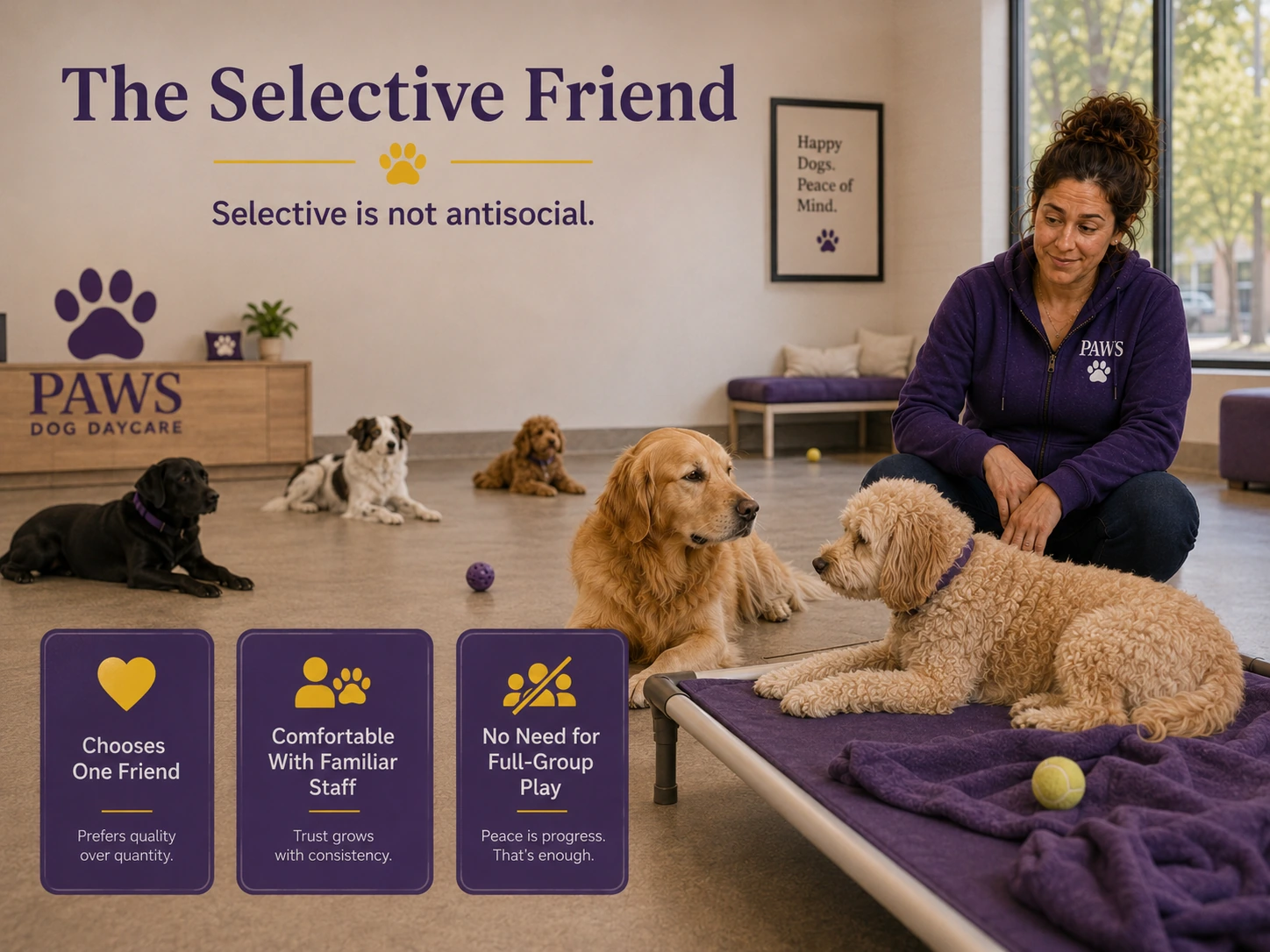
Independent dogs are easy to misread because they do not always advertise what they need. One dog is calmly observing. Another is quietly anxious. Another is content to hang near the edge of the room. Another is looking for the one weak gate latch in the building.
Staff have to separate peaceful independence from stress, avoidance, escape planning, and shutdown. Quiet is not automatically good. Quiet is also not automatically bad. A loose dog sniffing, resting, taking treats, and choosing distance is not the same dog as the one frozen under a bench, refusing food, scanning every exit, and hoping nobody notices it is overwhelmed.
The same dog may move between these patterns as the room changes. A quiet observer may become an escape thinker during a busy transition, a selective friend may become touch-sensitive after repeated handling, and a peaceful loner may freeze when staff block the only path away.
Staff notes should identify the version observed, the trigger, the handling used, and what restored normal behavior. “Aloof” tells the next shift almost nothing. “Rested loosely near the wall, accepted leash from familiar staff, then tracked the lobby door during pickup” gives the facility an operating plan.
Swipe left/right to see the full table.
| Independent Type | What Staff See | Daycare Meaning |
|---|---|---|
| The Quiet Observer | Watches the room, stays near the edge, sniffs, rests, and seems loose and present. | This dog may be fine. Do not force play just because the dog is not entertaining the humans. |
| The Selective Friend | Likes one staff member, one familiar dog, or one routine, but ignores most other contact. | Respect the selectivity. The dog does not need to be passed around socially like a party favor. |
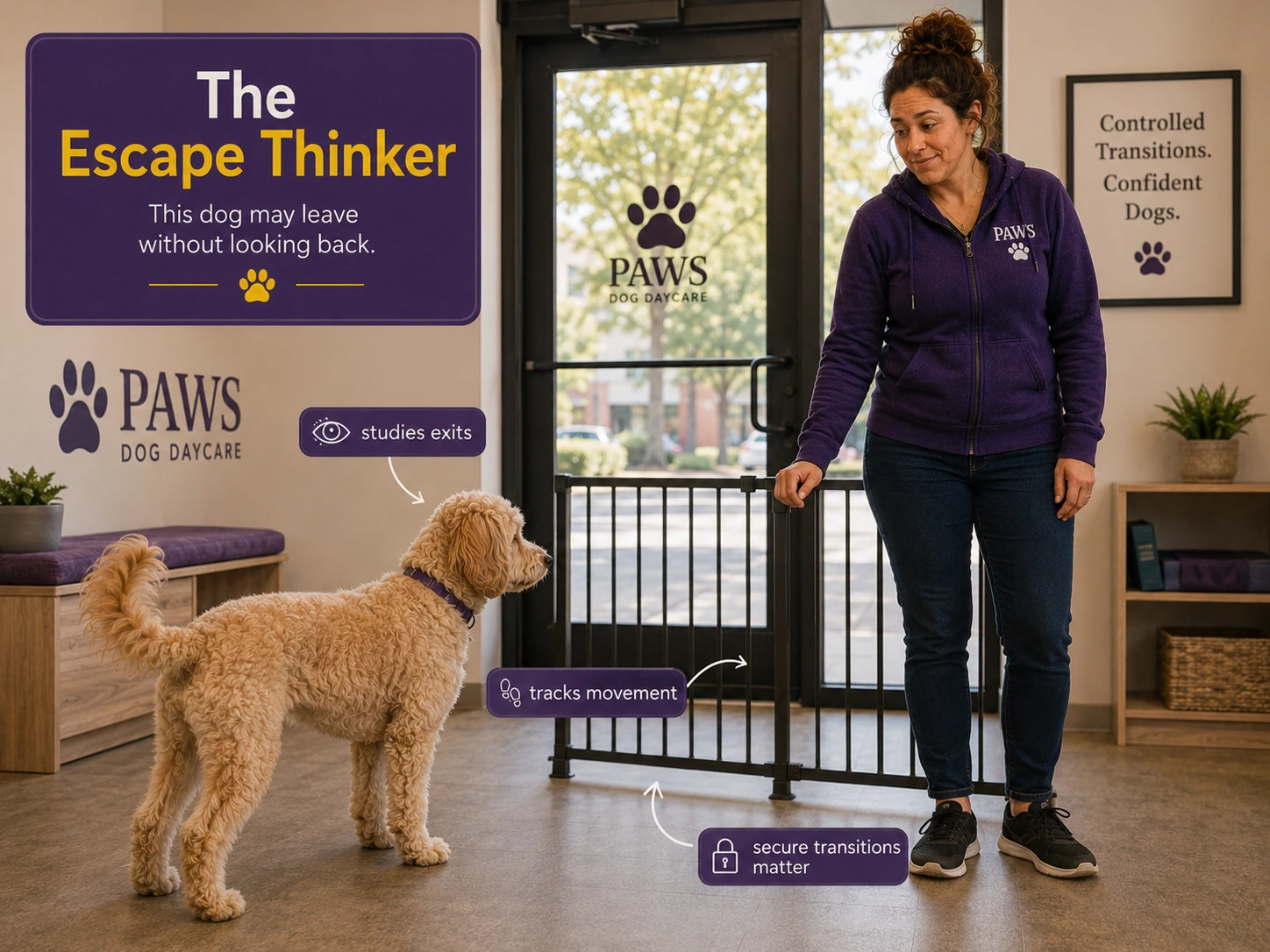
| The Escape Thinker | Watches gates, follows openings, drifts toward exits, checks fences, and does not panic when separated. | Double-check gates, leashes, transfers, and outdoor areas. This dog may leave calmly and keep going. |
| The Touch-On-My-Terms Dog | Accepts affection briefly, then moves away; dislikes being grabbed, crowded, hugged, or loomed over. | Use calm handling. Do not turn normal independence into defensive behavior. |
| The Freeze-Up Dog | Freezes in new situations, may urinate, defecate, release anal glands, refuse treats, or stop responding. | This is stress, not stubbornness. Lower pressure, slow down, and stop acting like more handling fixes everything. |
| The Peaceful Loner | Rests, sniffs, wanders, and avoids conflict without seeking much contact. | Good fit for quiet daycare or boarding-daycare routines if staff protect space. |
| The “I Can Take It or Leave It” Dog | Enjoys the building or routine but does not care much about the group. | This dog may benefit from daycare as enrichment, not nonstop social play. |
🏠
Why Daycare Gets Independent Dogs
These dogs may enjoy the environment without needing the social circus.
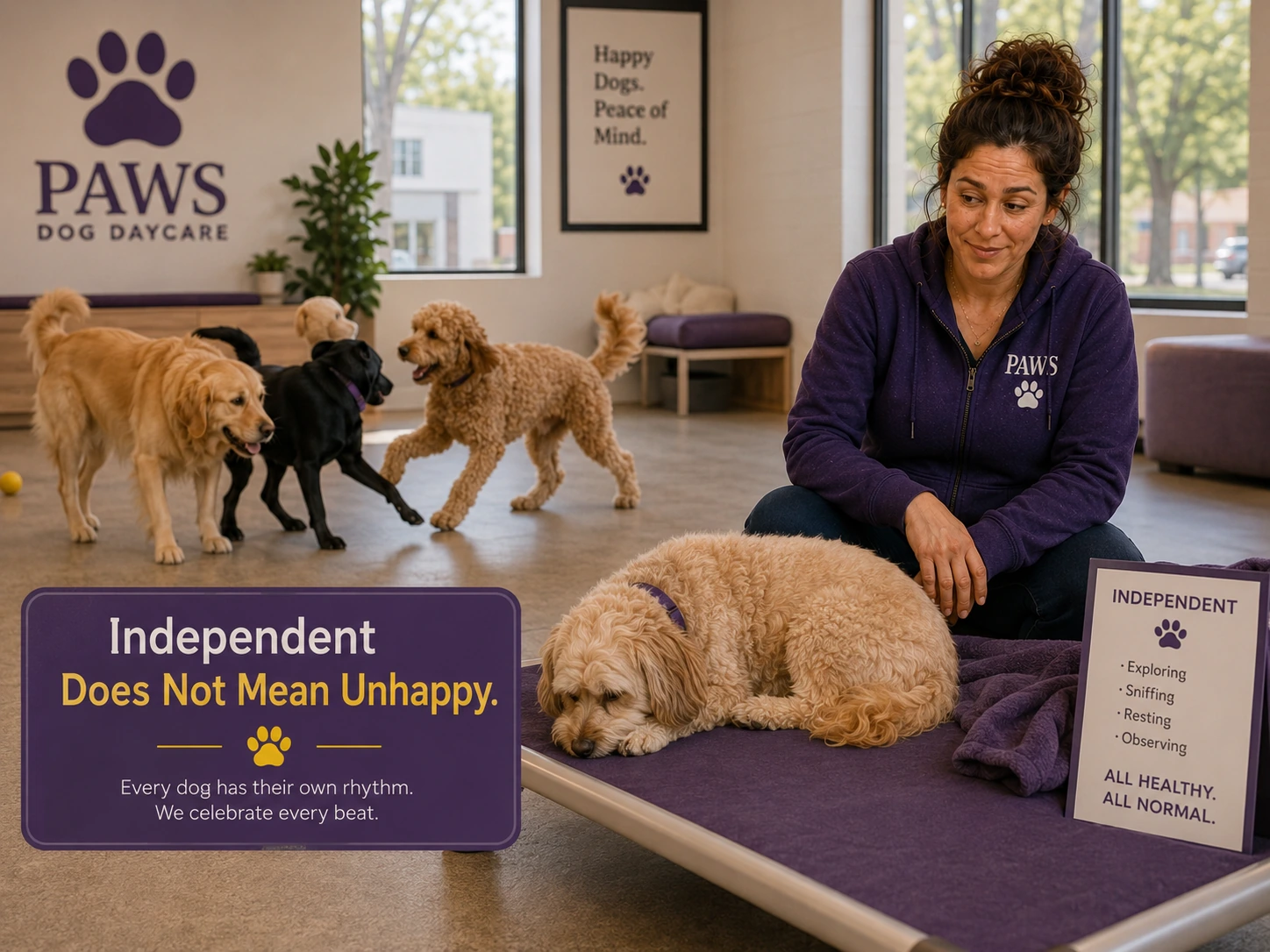
Independent dogs come to daycare for different reasons than outgoing dogs. They may not need nonstop play. They may not need constant attention. They may not be lonely in the dramatic way some owners imagine.
They may still benefit from routine, movement, smells, supervised outdoor time, quiet enrichment, familiar staff, mild social exposure, boarding-daycare structure, or simply being somewhere other than home while the owner works.
The owner may want the dog to “make friends.” The dog may want a corner, a nap, a sniff route, and one trusted human who does not act like every interaction needs confetti.
This is where daycare has to stop selling one version of success. Success is not always wrestling, chasing, group photos, and a dog passed out from eight hours of chaos. For the independent dog, success may be a calm day, a clean transition, a relaxed body, a few chosen interactions, and no forced nonsense.
That is not failure. That is the dog’s personality. A daycare can serve this dog well if it stops measuring success by how much the dog acts like an extrovert with paws.
🧬
Breeds and Job Lines That May Show Independent Traits
Breed is a clue. The individual dog still makes the decision.
Independent traits can show up in any breed or mix. They are often seen in dogs with more self-directed tendencies, lower social demand, strong environmental interest, guardian instincts, primitive or northern-type traits, scent-driven behavior, or dogs that simply do not need constant human feedback.
Do not turn this into a breed stereotype. The daycare question is not whether the dog looks independent. The question is whether the dog chooses calm participation, avoids pressure, recovers from stress, and can be safely handled in the facility.
Job history can explain why a dog values environmental information, scent, territory, self-direction, or distance more than human praise. Those tendencies are not excuses and do not determine admission. They tell staff which conditions deserve closer observation during handling, outdoor movement, and group placement.
Dogs with similar breed backgrounds may differ sharply in recall value, touch tolerance, recovery, escape interest, and willingness to participate. The facility should document the individual dog’s behavior instead of turning a breed description into a decision.
Swipe left/right to see the full table.
| Common Type | Daycare Version You May See | Operator Warning |
|---|---|---|
| Northern or primitive-type dogs | Aloof, self-directed, environmentally focused, less interested in pleasing people. | Recall and escape control matter. Do not assume this dog cares about your panic. |
| Guardian-style dogs | Observant, reserved, selective, sometimes suspicious of novelty. | Watch pressure around strangers, gates, staff changes, and forced handling. |
| Scent-driven dogs | Nose down, independent movement, more interested in the environment than the group. | Secure outdoor areas. A dog following its nose may not care that daycare has a schedule. |
| Mature low-play dogs | Calm, quiet, selective, not looking for wrestling or chase games. | Do not force them into puppy chaos because the owner paid for daycare. |
| Soft but self-contained dogs | Gentle, cautious, low-contact, and easily overwhelmed by heavy handling. | Low-pressure handling works better than trying to dominate the dog into being social. |
| Stable mixed-breed dogs | Moderate, observant, independent, and not strongly attached to one group pattern. | Still evaluate the actual dog. “Quiet” can mean peaceful, stressed, bored, or planning an exit. |
📌
Breed rule
Breed gives staff a starting guess. Behavior gives staff the answer. The independent dog proves itself by calm recovery, safe handling, low conflict, and secure facility management.
✅
Where Independent Dogs Do Well
Independent dogs do best when daycare gives them structure without demanding performance.
Independent dogs often do well in calm rooms, smaller groups, predictable routines, familiar spaces, and lower-pressure daycare setups. They may enjoy the environment without becoming the social center of it.
The best setup lets the dog choose appropriate interaction instead of being dragged into every game because staff think quiet dogs need “help coming out of their shell.”
Success should be measured through loose posture, normal exploration, voluntary rest, predictable movement, safe handling, and chosen interaction. The dog does not have to wrestle, chase, or seek constant affection to demonstrate that the environment is working.
The setup should benefit the independent dog, not merely make the dog easy to store. Quiet enrichment, sniffing opportunities, familiar routes, selected companions, and protected rest give the dog something useful while preserving the space and choice this personality needs.
- They do well in groups that respect space and do not constantly pressure them.
- They do well with confident or outgoing dogs that are social without being rude, sticky, or offended when ignored.
- They do well with adaptable and insecure dogs when the room stays calm and predictable.
- They do well when staff allow observation, sniffing, resting, and selective contact.
- They do well with secure gates, controlled transfers, and no sloppy leash handling.
- They do well when staff stop treating low social demand like a defect.
📌
Room rule
The independent dog may enjoy daycare quietly. Quiet enjoyment still counts.
🚦
Where Independent Dogs Get Into Trouble
The problem usually starts when staff force contact or underestimate escape risk.
Independent dogs usually do not create conflict by demanding attention. They get into trouble when the environment keeps demanding something from them: play more, greet more, tolerate more, be touched more, come back faster, care more.
Human ego can make this worse. Some staff take aloofness personally and start trying to win the dog over. That is how the peaceful little observer becomes the dog dodging hands, freezing under pressure, snapping when cornered, or slipping through a gate because the humans became exhausting.
The dog was not rude. The setup was rude.
Swipe left/right to see the full table.
| Problem | What It May Mean | Staff Response |
|---|---|---|
| Avoiding staff contact | The dog may dislike pressure, grabbing, looming, or forced affection. | Use calm movement, reward history if appropriate, leash planning, and no cornering unless safety requires it. |
| Freezing in new areas | The dog is overwhelmed by novelty, sound, dogs, handling, or too many choices at once. | Slow down. Reduce pressure. Give the dog time to process before moving forward. |
| Hanging near exits | The dog may be tracking escape routes or avoiding the group. | Increase gate awareness, use controlled transfers, and reassess whether the dog wants the room. |
| Ignoring recall | The dog may not find human panic rewarding or relevant. | Do not rely on yelling. Use secure handling systems, reward history, and backup containment. |
| Defensive snap when cornered | The dog may be trying to stop forced contact or pressure. | Review handling. Do not call it attitude if staff trapped the dog. |
| No interest in play | The dog may be content observing, or may be stressed. | Read body language. Calm independence and shutdown are not the same thing. |
| Wandering off mentally or physically | The dog is self-directed and may not track staff or the group closely. | Keep eyes on movement patterns. This dog can drift into trouble quietly. |
📈
The Independent Dog Stress and Escape Curve
The independent dog often fails by withdrawing, freezing, or leaving.
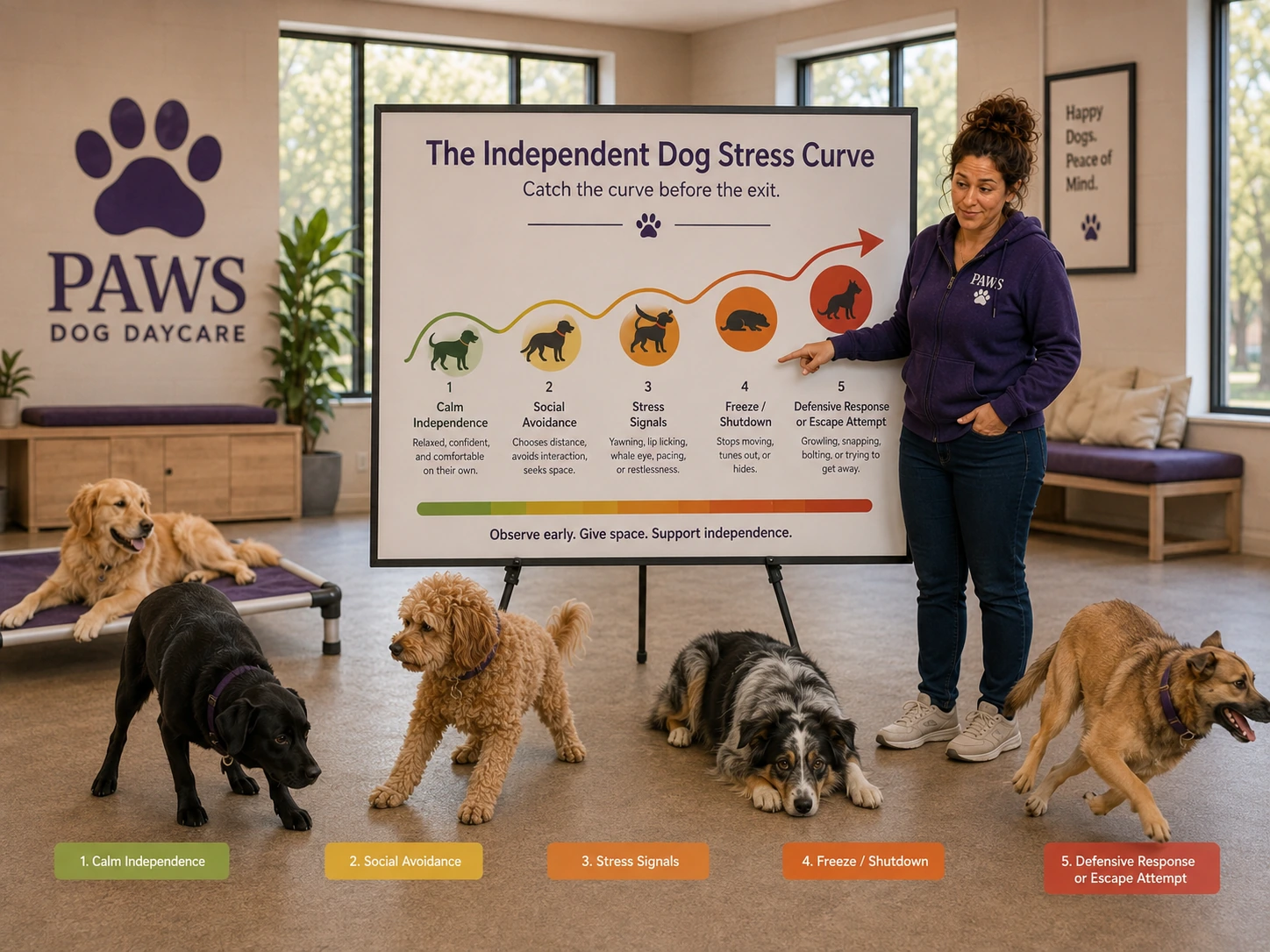
Independent dogs may not bark for help, jump on staff, or make a big dramatic scene when they are uncomfortable. They may go still, move away, watch exits, stop taking treats, refuse eye contact, scan the room, or quietly decide the entire daycare concept is no longer their problem.
This is why staff cannot judge the independent dog by noise. A loud dog is easy to notice. A quiet dog can be falling apart politely in the corner while everybody congratulates themselves because the room seems calm.
Staff need to catch the curve before the dog is frozen in a corner, defensive under a hand, or walking away through a gate like the building was merely a suggestion.
The cheapest intervention happens during social avoidance, while the dog is still mobile and able to choose distance. Reducing handling, opening space, changing the group, or offering a quiet reset can prevent avoidance from becoming shutdown, defense, or an escape attempt.
Recovery must be visible before re-entry. Look for looser movement, renewed environmental interest, normal food response when appropriate, and the ability to move with staff without freezing or pulling toward an exit. Repeated movement through the same curve should change the service plan.
Swipe left/right to see the full table.
| Stage | What It Looks Like | Staff Move |
|---|---|---|
| Calm Independence | Sniffs, observes, rests, takes treats, moves loosely, chooses brief contact, and avoids conflict. | Let the dog be. Do not force social behavior for human entertainment. |
| Social Avoidance | Moves away from dogs or staff, stays near walls, avoids hands, declines play, or keeps choosing distance. | Reduce pressure and offer space. Do not chase the dog around the room trying to make it like you. |
| Stress Signals | Scanning, panting, lip licking, yawning, tucked posture, refusing food, stiff body, or repeated exit checking. | Lower the room load, shorten exposure, and document what changed the dog’s behavior. |
| Freeze or Shutdown | Stops moving, stiffens, urinates, defecates, releases anal glands, hides, or stops responding. | Lower stimulation, use calm handling, and move slowly with a plan. |
| Defensive Response | Growl, snap, air bite, or sudden correction when cornered or grabbed. | End the pressure, document the trigger, and change the handling plan. |
| Escape Attempt | Tracks doors, slips gates, ignores recall, or continues away from staff. | Use containment systems, controlled transfers, double checks, and no frantic chasing. |
🧩
Independent Personality Compatibility in Daycare
This dog can fit with many types when staff respect space and do not force interaction.
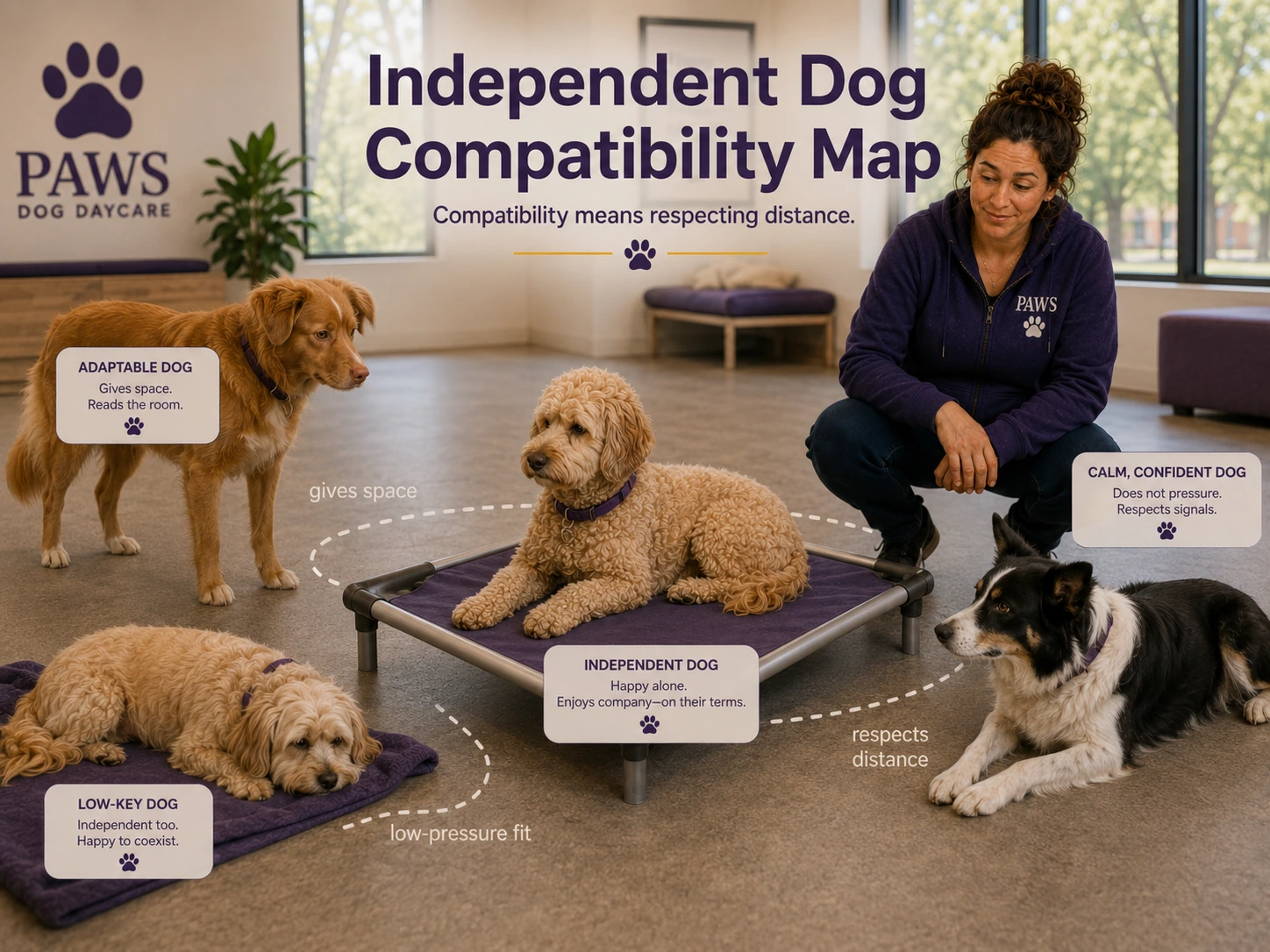
Independent dogs often have a broad compatibility window because they are less likely to demand interaction or compete for social control. That flexibility remains conditional. The other dog must respect distance instead of treating avoidance as an invitation to try harder.
Compatibility depends on pressure, not labels alone. Size, speed, persistence, resource behavior, room density, fatigue, pain, and whether the independent dog has a clear exit can change a pairing that looked easy earlier in the day.
A pairing stops working when the independent dog repeatedly moves away, remains near walls or gates, freezes, stops taking normal rewards, or becomes defensive under contact. Staff should change the room when the dog’s choices keep shrinking.
Swipe left/right to see the full table.
| Pairing | Compatibility | Daycare Meaning |
|---|---|---|
| Independent + Aggressive | Low / Controlled Only | The independent dog may avoid conflict, but that does not make the aggressive dog safe. Avoidance is not a force field. |
| Independent + Confident | High / Watch Pressure | Often workable when the confident dog respects space and does not try to control the independent dog. |
| Independent + Outgoing | Moderate / High | Can work well if the outgoing dog is not sticky, rude, or offended when ignored. |
| Independent + Adaptable | High | Usually a good fit because both dogs may allow space and avoid unnecessary conflict. |
| Independent + Insecure | High / Calm Setup | Often workable because the independent dog may not pressure the insecure dog. Watch shared anxiety in loud rooms. |
| Independent + Independent | High | Often peaceful if both dogs have enough space and nobody forces them into fake friendship. |
⚠️
Compatibility warning
Independent dogs may tolerate many personalities because they avoid conflict. Avoidance is not permission to let other dogs keep pressing them.
📝
Intake: Do Not Mistake Independence for a Problem
Some dogs are naturally selective, aloof, and self-contained.
Independent dogs can be easy to intimidate with overbearing handling. They may also look emotionally flat to staff who expect every good dog to act excited, social, and eager for attention.
That is a staff problem, not necessarily a dog problem. The evaluation should ask whether the dog is calm, safe, recoverable, and manageable, not whether the dog flatters the humans by needing them.
Useful notes are specific. “Aloof” is not enough. “Watched room from back wall,” “accepted leash from Maria but avoided new staff,” “sniffed yard calmly for fifteen minutes,” “froze near lobby door,” “checked gate twice,” “ignored recall outdoors,” “refused treats in main room,” “took treats in quiet room,” and “settled well after being moved to quiet group” are records.
Intake should also separate personality from distress. A calm independent dog may choose distance and still look loose, curious, and recoverable. A stressed dog may choose distance because the room is too much. Those are not the same dog, and they should not get the same plan.
- Does the dog choose any contact with staff or dogs when given time and space?
- Does the dog recover after entering a new room?
- Does the dog freeze, shut down, urinate, defecate, or release anal glands under pressure?
- Does the dog track gates, exits, fences, or outdoor boundaries?
- Can staff safely leash, move, and handle the dog without cornering or chasing?
- Does the dog ignore recall in open areas?
- Does the dog seem calm and self-contained, or stressed and shut down?
- Are staff documenting actual behavior instead of writing “does not like people”?
👀
How Staff Should Handle the Independent Dog
Give the dog direction without turning every interaction into a negotiation or a chase.
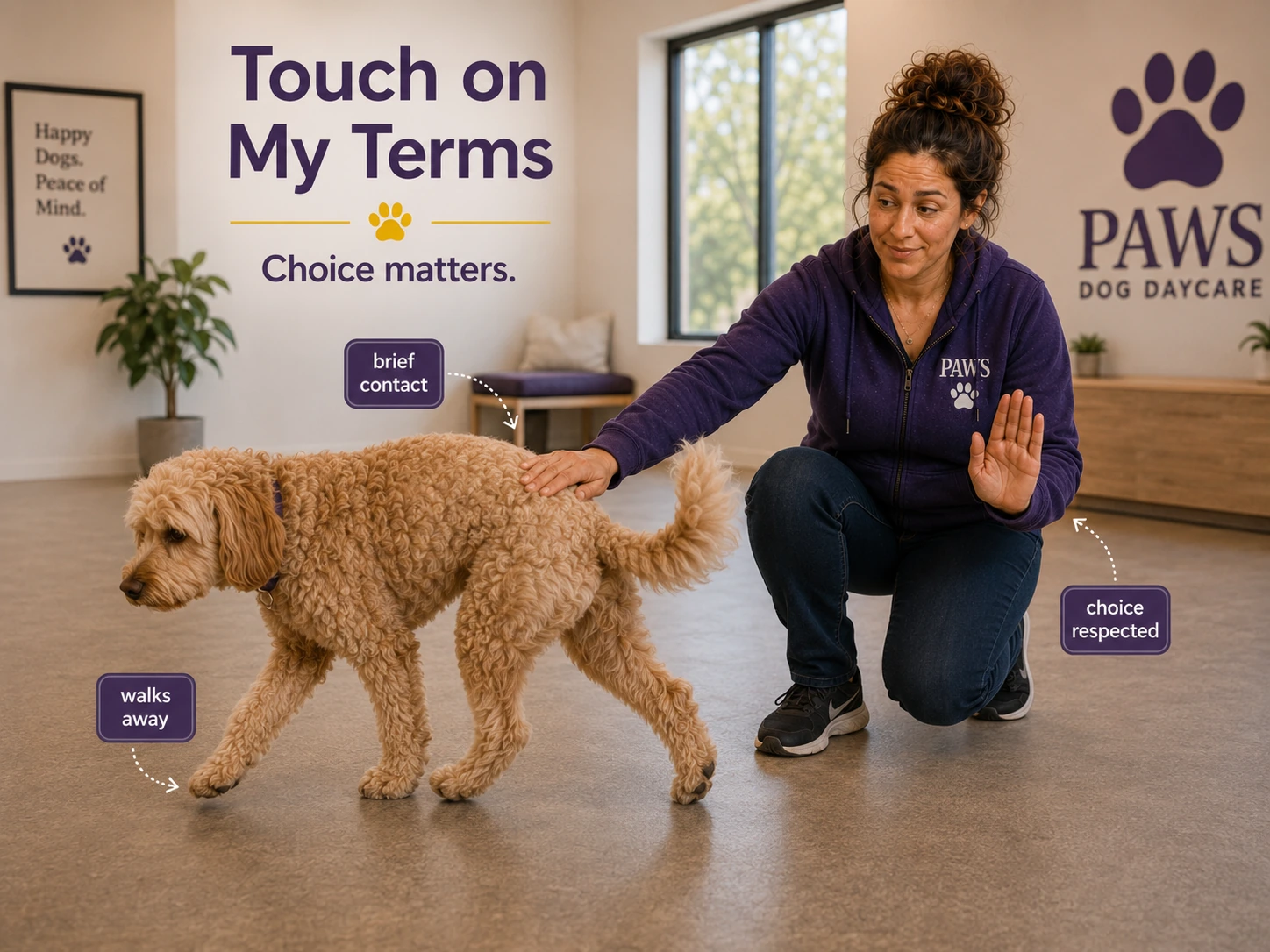
Independent dogs usually do best with calm, low-pressure handling. They do not need staff begging for affection, grabbing at them, looming over them, or trying to dominate them into being more social.
Strong-arm handling can make this dog more aloof, more avoidant, more defensive, or harder to catch. The dog may not fight staff. It may simply decide staff are irrelevant and create more distance.
The goal is not to make the dog needy. The goal is to make the dog safe, comfortable, predictable, and manageable inside the facility.
- Use calm movement, quiet confidence, and predictable routines.
- Do not chase, corner, grab, or hover unless safety requires immediate control.
- Build leash and recall value before the dog needs to be caught.
- Let the dog observe and choose appropriate contact.
- Protect the dog from pushy dogs that keep demanding interaction.
- Write notes about escape interest, handling response, social choice, stress, and recovery.
⏱️
Rest, Rotation, and Transition Rules for Independent Dogs
This dog may not ask for help. The building has to be ready anyway.
Independent dogs may not need rest because they are wild. They may need rest because the room is too social, too loud, too handsy, too crowded, or too unpredictable.
Transitions matter more with this dog than people think. Gates, leashes, outdoor movement, pickup windows, lobby noise, and staff changes are where the calm independent dog can become the missing independent dog.
Recall is not the safety system. Recall is a backup. The safety system is controlled movement, closed gates, leash awareness, staff communication, and nobody assuming “she usually comes back” counts as a procedure.
A planned transition begins before the gate opens. Staff should know who holds the leash, which barriers are secured, where the receiving employee stands, and what happens if the dog stops, backs away, or changes direction. Improvising after the dog reaches an opening is not controlled movement.
Rest should lower social and handling pressure rather than simply confine the dog somewhere else. Before returning the dog, staff should confirm that posture, movement, and attention have normalized. Returning immediately to the same crowding or forced contact defeats the break.
- Use controlled transfers through gates, doors, yards, and lobbies.
- Do not rely on recall as the primary safety system.
- Give calm rest after new-room stress, forced handling, or repeated dog pressure.
- Do not return the dog to a room where it was cornered, crowded, or chased.
- Watch pickup, drop-off, outdoor play, and staff changes for escape opportunities.
- Document whether the dog recovered with space or needed a different service plan.
🗣️
What Owners Need to Hear
Independent dogs do not need to be apologized for.
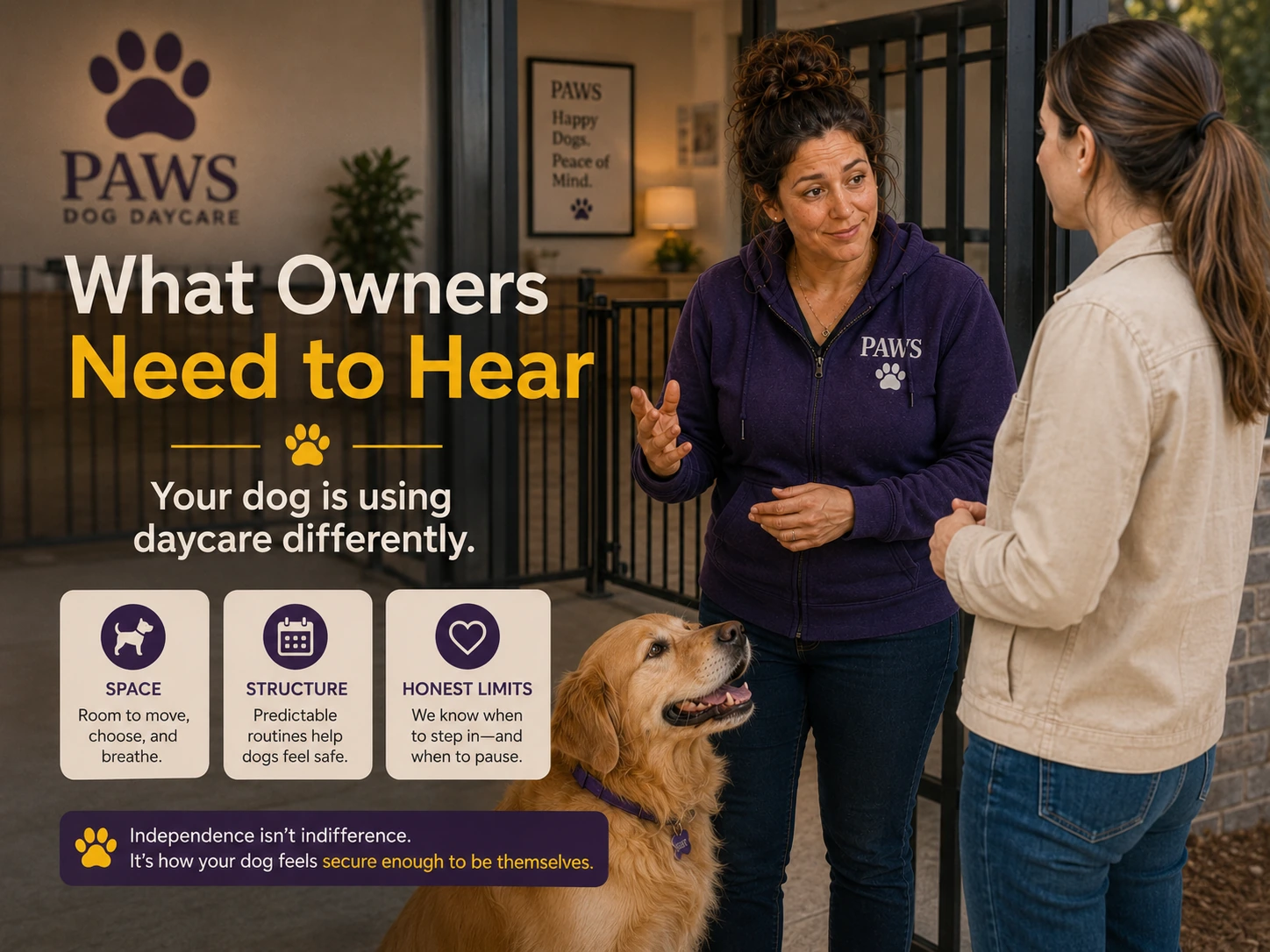
Owners may worry that their independent dog is not friendly enough, not playful enough, not affectionate enough, or not “normal” enough. Be careful with that. Do not make the owner feel like the dog needs a personality transplant.
Tell the owner what the dog actually does. If the dog enjoys quiet observation, say that. If the dog avoids rough play, say that. If the dog has escape risk, say that clearly. If the dog needs a smaller group, quiet rotation, leash control, or limited outdoor freedom, say that too.
The key phrase is simple: your dog is not failing daycare because she is not wrestling. She is using daycare differently.
Do not turn the report card into fake sunshine. This dog’s safety depends on honest details. If she is calm, say calm. If she is shut down, say shut down. If she likes the facility but not the group, say that. Owners can handle truth better than they can handle a missing dog, a defensive bite, or a daycare that pretended everything was adorable until it was not.
📌
Owner script
“Your dog is comfortable here, but she is independent. She likes the routine and the space more than heavy group play. She is not failing daycare because she is not wrestling. She is using daycare differently. We are going to let her participate on her terms, protect her from pushy dogs, and be extra careful with gates because she may not come back just because someone calls her.”
🛑
When to Pause, Rotate, Separate, or Restrict the Independent Dog
This dog may need a different setup, not a personality repair job.
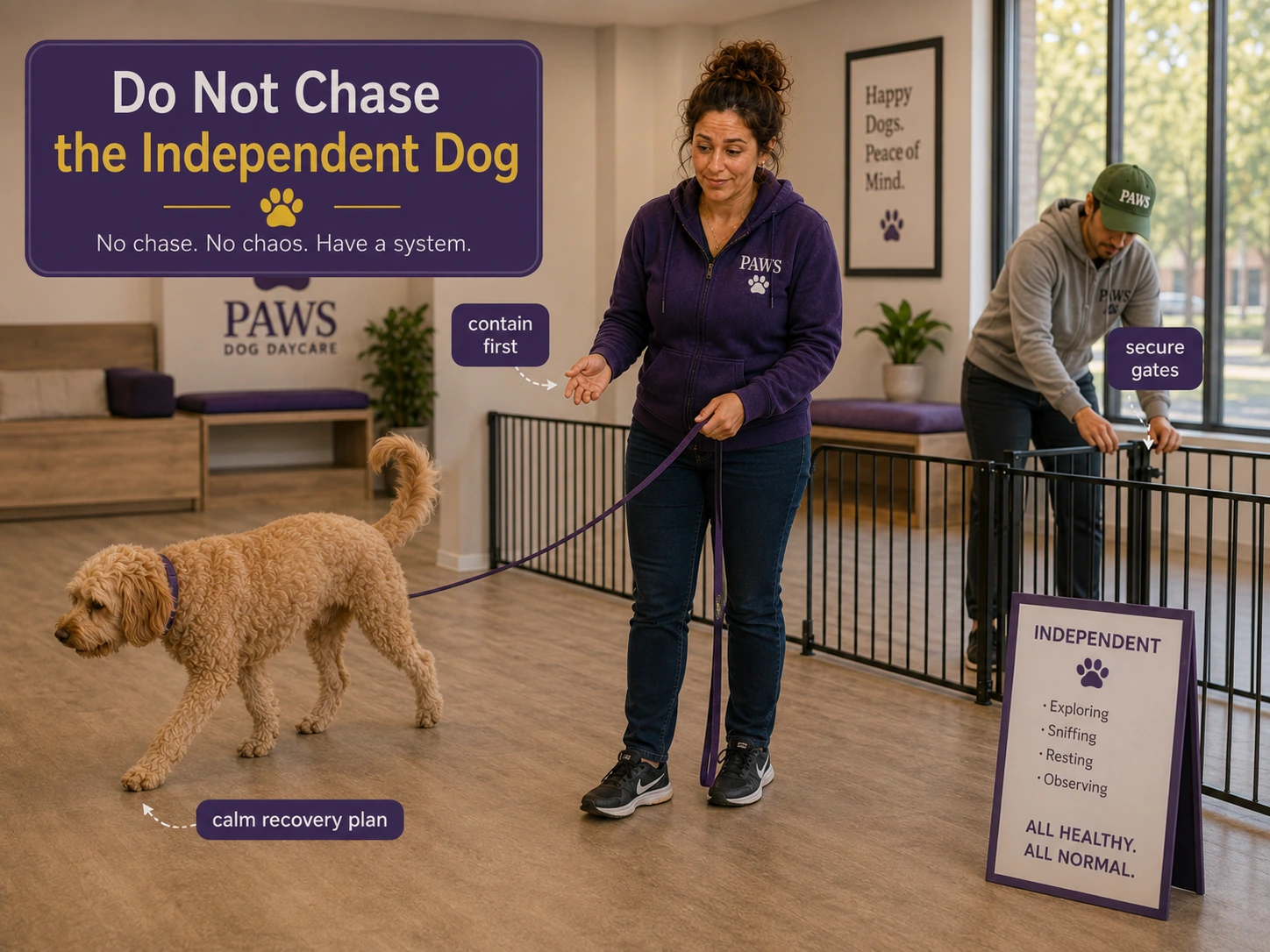
These decisions belong on a continuum. Pause means reducing stimulation while the dog remains recoverable. Rotate means changing the room, partner, schedule, or activity so the dog can function under a lower social load.
Separate means ending a specific interaction that is forcing contact or blocking movement. Restrict means changing the ongoing service plan when escape interest, handling difficulty, shutdown, or defensive behavior repeats despite reasonable management.
Severity, repetition, recovery, containment risk, staff capacity, and the effect on the rest of the room should control the decision. The dog does not have to create a fight before the facility admits that the current setup is wrong.
- Pause the dog when it freezes, shuts down, avoids handling, or stops responding.
- Rotate the dog when the room becomes too loud, crowded, or socially demanding.
- Separate the dog from pushy dogs that keep forcing interaction.
- Use a smaller or quieter group when the dog enjoys the facility but not the full social load.
- Restrict outdoor or open-area access if the dog tracks exits, ignores recall, or shows escape interest.
- Refuse open group if staff cannot safely leash, move, contain, or recover the dog.
⚠️
No chase rule
If your plan for catching the independent dog is yelling louder and running after it, you do not have a plan. You have cardio and a liability problem.
✅
Independent Personality Daycare Checklist
Use this list before assuming an independent dog is either fine or unhappy.
Use this checklist across multiple visits, staff members, rooms, outdoor transfers, and pickup conditions. It is not a one-day personality score. Independent dogs may look settled during quiet hours and show their real handling or escape risk only when movement increases.
One isolated choice for distance may be normal. A repeated cluster of exit tracking, recall failure, freezing, food refusal, handling avoidance, and poor recovery should change the operating plan before the dog finds a weak point in the system.
The answers should produce decisions about group size, handling permissions, outdoor access, leash procedures, rest, visit length, and service fit. A checklist that does not change practice is paperwork, not risk control.
- Does the dog calmly choose observation, or is the dog shut down?
- Does the dog accept staff handling without freezing, dodging, or defensive behavior?
- Does the dog track exits, gates, fences, or outdoor boundaries?
- Does the dog ignore recall in distracting spaces?
- Does the dog choose any safe dog interaction?
- Does the dog do better in smaller, calmer, or familiar groups?
- Does the dog recover after rest or quiet space?
- Are staff protecting the dog from forced interaction?
- Are notes specific enough to guide gate handling, leash handling, group fit, and owner communication?
❓
Independent Dog Personality FAQ
Detailed answers about quiet participation, selective contact, stress, escape risk, compatibility, handling, transitions, owner communication, restrictions, and daycare fit.
Are independent dogs good daycare dogs?
Some are. Independent dogs may enjoy routine, outdoor movement, quiet enrichment, familiar staff, and limited chosen interaction. They may not benefit from large, loud, heavy-play groups, so admission should be based on comfort, handling, recovery, containment, and actual use of the environment.
Does independent mean unfriendly?
No. It usually means selective and self-contained. The dog may enjoy people or dogs without needing constant contact, and it may show affection briefly before choosing space. Staff should respect selectivity rather than treating low social demand as rejection.
Is an independent dog unhappy if it is not playing?
Not automatically. Loose posture, normal sniffing, voluntary rest, curiosity, safe movement, and selected contact may show that the dog is comfortable. Staff must distinguish calm independence from shutdown, where the dog freezes, refuses normal rewards, scans exits, or stops responding.
Should staff force an independent dog to play?
No. Forced interaction can create avoidance, freezing, defensive behavior, or escape attempts. The dog should be allowed to observe, rest, sniff, and choose appropriate social contact while staff protect it from pushy dogs.
Why are some independent dogs escape risks?
Some independent dogs have little need to remain near people or the group. They may track openings, follow scent, study gates, and continue moving after leaving without responding to frantic recall. Secure containment and controlled transfers must be the primary safety system.
What is an escape thinker?
An escape thinker watches doors, follows gate movement, checks fences, and notices transition patterns. The dog may not appear panicked; it may simply be gathering information. Staff should document exit interest and use deliberate leash, gate, and handoff procedures.
Why should staff avoid chasing an independent dog?
Chasing often increases distance, turns handling into a game or threat, and drives the dog toward more dangerous openings. Staff should secure exits first, reduce movement, use planned containment, and calmly guide the dog rather than creating a frantic pursuit.
How should staff handle touch-on-my-terms behavior?
Offer brief, predictable contact and allow the dog to move away. Do not follow, grab, hug, loom, or repeatedly reach because staff want affection. Respecting the end of contact makes future handling safer and more predictable.
How can staff tell calm independence from shutdown?
A calm independent dog remains loose, mobile, curious, and able to rest normally. A shut-down dog may freeze, hide, refuse food, avoid eye contact, release urine or stool under pressure, or stop responding. Choice and recovery separate healthy distance from distress.
What warning signs appear on the independent dog stress curve?
Watch for increasing avoidance, wall or gate hovering, scanning, panting, lip licking, yawning, tucked posture, food refusal, stiffness, freezing, defensive responses, and exit tracking. The dog may stay quiet throughout the entire progression.
What should staff do when an independent dog freezes?
Lower stimulation, stop adding social or handling pressure, open space, and use a calm plan. Do not drag or crowd the dog simply because it stopped moving. Staff should document what preceded the freeze and whether the dog recovered with distance.
Can independent dogs be placed with outgoing dogs?
Sometimes. The pairing works when the outgoing dog accepts being ignored, respects pauses, and does not repeatedly crowd or chase. A sticky, face-rushing, or highly persistent outgoing dog can turn the independent dog’s avoidance into stress or defense.
Can independent dogs be placed with confident dogs?
Often, if the confident dog is stable and respects space. The pairing becomes poor when the confident dog blocks movement, controls resources, follows avoidance, or insists on interaction. Staff should protect the independent dog’s ability to leave.
Can independent dogs help insecure dogs?
They sometimes can because they may apply less social pressure than outgoing or controlling dogs. The room still needs enough space and calm staff. Two quiet dogs can also share anxiety, so staff should watch recovery rather than assuming silence means success.
What kind of daycare enrichment suits an independent dog?
Quiet sniffing, secure outdoor exploration, familiar routes, selected social partners, resting areas, and low-pressure staff interaction may be more useful than nonstop group play. Enrichment should respect the dog’s environmental interests without creating escape opportunities.
How should transitions be managed?
Plan the movement before opening a barrier. Assign the leash, secure receiving gates, control nearby dogs, and make sure employees understand the transfer. Recall may support the process, but it should never replace containment.
What should staff document about an independent dog?
Document chosen locations, social selections, handling response, food response, gate interest, recall, outdoor movement, stress signs, recovery, successful groups, and failed setups. “Aloof” or “did not play” is not enough to guide the next visit.
How should staff explain an independent dog to the owner?
Explain how the dog uses daycare rather than apologizing for the personality. Describe whether the dog enjoys the routine, rests comfortably, selects certain dogs, avoids rough play, or needs handling and gate restrictions. Honest detail helps the owner understand that quiet participation can still be success.
When should an independent dog move to quieter care or restricted access?
Change the plan when the dog repeatedly shuts down, avoids handling, tracks exits, cannot be safely transferred, or remains stressed in open group play. A smaller group, quiet rotation, private enrichment, or restricted outdoor access may serve the dog more safely.
What makes an independent dog a successful long-term daycare client?
The best candidates remain calm and recoverable, accept necessary handling, move safely through transitions, and use the environment without repeated stress or escape behavior. Their success depends on staff respecting choice while maintaining strict containment and clear operating procedures.
🐾
The Bottom Line: This Dog Does Not Need to Be Fixed
Independent dogs can be good daycare dogs when the facility respects what they are.
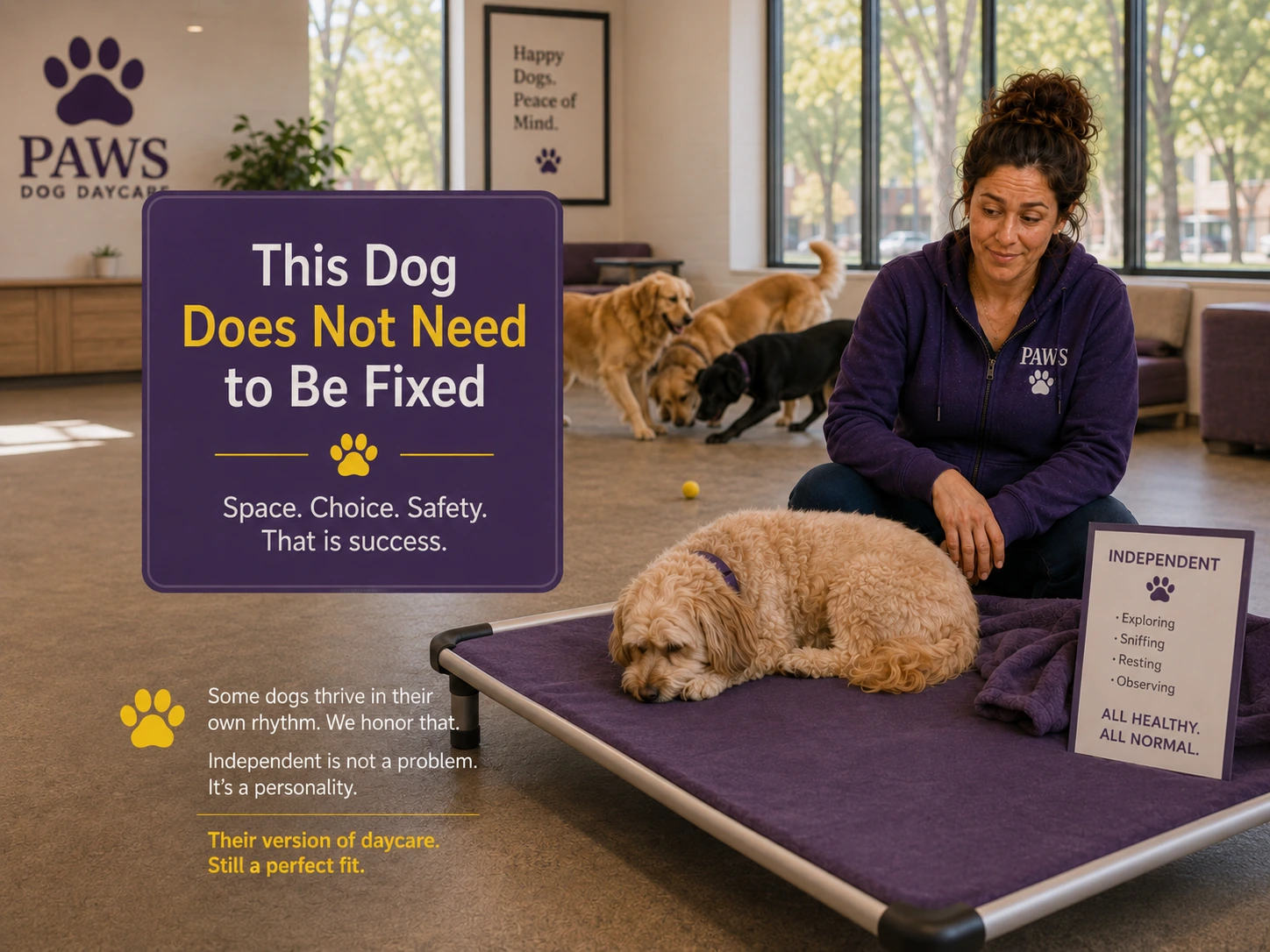
The independent personality is not broken, rude, cold, or wrong. This dog may simply prefer space, routine, observation, selective contact, and freedom from forced social nonsense.
A good daycare does not try to turn every dog into an outgoing dog. It figures out whether the dog is safe, comfortable, recoverable, and manageable in the environment.
Some independent dogs will quietly enjoy daycare on their own terms. Some will need smaller groups, quieter routines, tighter gate control, or a different service plan. The staff job is to know the difference before the dog freezes, snaps, or walks away like the entire building was optional.