Dog Daycare Behavior, Dominant Dogs, Confident Dogs, Body Language, Threat Displays, Staff Supervision, Fight Prevention, and Playgroup Safety
Identifying Dominant or Confident Behavior in Dog Daycare
Confident is fine. Pushy is where the trouble starts.
One of the benefits of dogs being so strongly guided by instinctive pack behavior is that dogs generally have little desire to truly injure each other. This does not mean dogs are harmless. Dogs do fight. Dogs can do serious damage. But most dogs do not walk into every disagreement looking to mortally wound another dog.
If in the wild every dispute in a wolf pack was resolved with a fight, the number of injured and mauled wolves within the pack would increase and the number of healthy wolves available to hunt, travel, defend territory, and survive would decrease. It is not conducive to the survival of the pack to risk serious injury over every dispute.
This is why most dogs will try to demonstrate confidence, pressure, superiority, or dominance through other means before full physical combat. They use posturing and body language. They stand tall. They hold the head high. They raise the hair along the spine to appear larger. They stiffen the tail. They stare. They wrinkle the nose. They show teeth. They snarl. They tell the other dog, in every way they can before contact, “This can get worse if you keep pushing.”
That warning display is not pointless drama. It is the language before impact. Sometimes one dog reads it and backs down. Sometimes the other dog answers back. Sometimes the whole thing lasts a few seconds and ends. Sometimes neither dog yields, the display becomes a lunge, and the lunge becomes a fight.
The daycare staff job is to read that sequence before it becomes holes in skin, vet bills, owner phone calls, insurance notes, and a staff meeting nobody wanted. If staff only notice dominant or confident behavior after the fight starts, they are late.
⚠️
Operator warning
A high tail and a wagging tail are not a peace treaty. A confident dog can look calm right up until the moment he decides another dog has crossed the line. Read the whole dog, the whole room, and the other dog’s answer.
👀
What Dominant or Confident Behavior Looks Like
The dog is trying to look bigger, stronger, more certain, or harder to move.
A confident dog may approach directly, carry the head high, keep the body upright, hold the tail high, move with purpose, and show little hesitation. That does not automatically mean the dog is aggressive. Some dogs are just solid. They know who they are. They are not nervous, not shrinking, and not asking the room for permission to exist.
Dominant-looking behavior becomes more serious when confidence turns into pressure. The dog stands over another dog, blocks movement, mounts repeatedly, holds a hard stare, crowds the face, stiffens through the body, raises hackles, wrinkles the nose, snarls, shows teeth, or keeps pushing after the other dog tries to leave.
Staff should read clusters, not single body parts. Hackles alone do not prove aggression. A wagging tail does not prove friendliness. Mounting does not always mean dominance. A high head is not a crime. The question is what the whole dog is doing, what the other dog is doing, and whether the interaction is moving toward resolution or toward a fight.
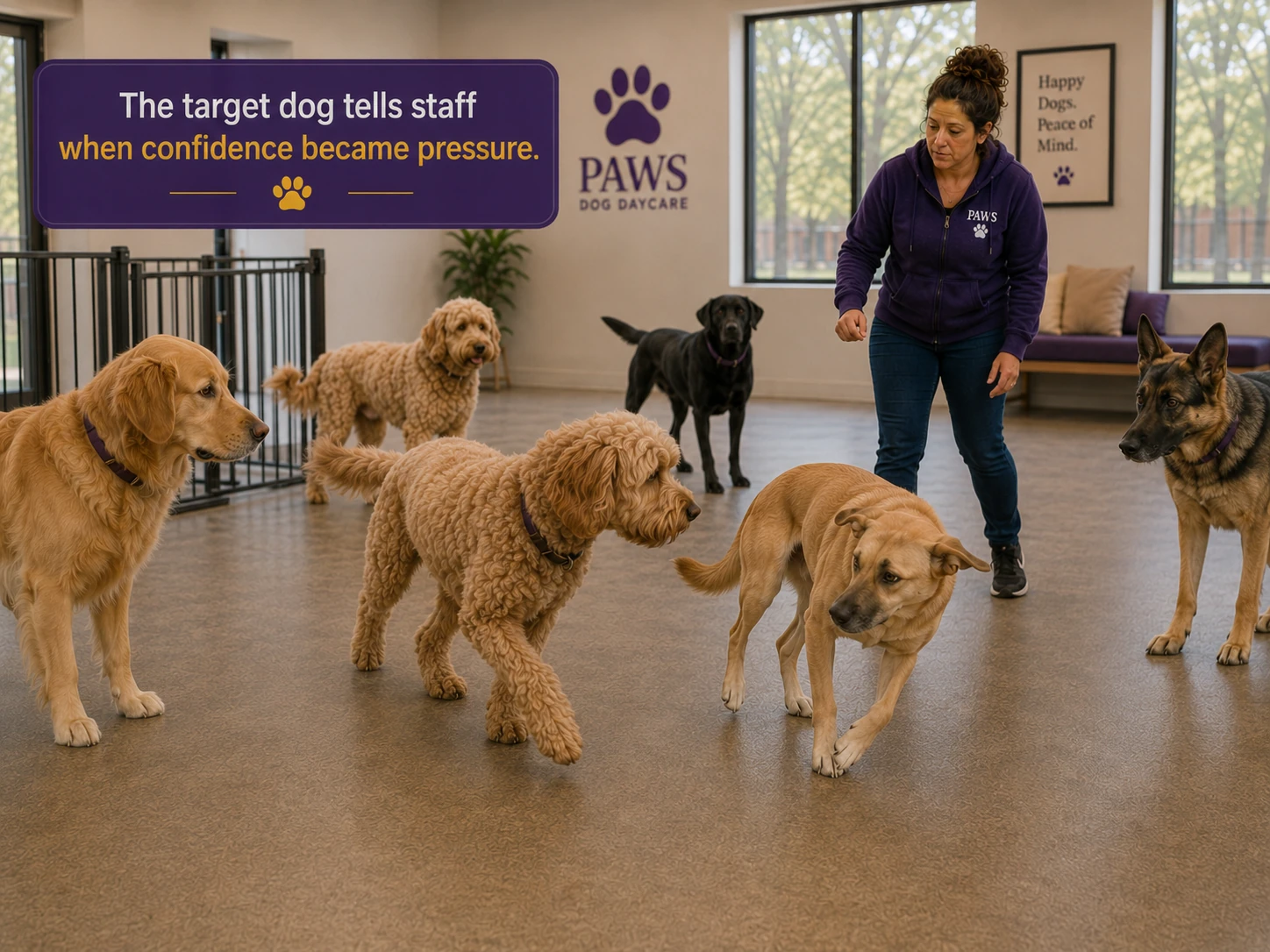
The target dog matters. If the other dog stays loose, re-engages, role-switches, and keeps choosing the interaction, staff may be watching rough but workable play. If the other dog freezes, tucks, turns away, hides, snaps, or keeps trying to leave while the confident dog keeps following, the pressure dog is now the problem.
A confident dog can be one of the easiest dogs in the room when he has manners. A confident dog with no brakes can become the dog everybody else has to manage around. That is not leadership. That is liability with fur.
Swipe left/right to see the full table.
| Behavior | What It May Mean | Staff Translation |
|---|---|---|
| Head held high | Confidence, alertness, interest, or social pressure depending on the rest of the body. | Watch whether the dog stays loose or starts looming over another dog. |
| Closed mouth and stiff face | The dog may be assessing, loading, or moving from casual interest into pressure. | A closed mouth with hard eyes is not the same thing as relaxed confidence. |
| Forward weight | The dog is leaning into the interaction instead of leaving space. | If the other dog is backing up, freezing, or turning away, step in. |
| High stiff tail | Assertiveness, arousal, challenge, or tension. | Do not call it friendly just because it is wagging. |
| Raised hackles | Arousal. Could be excitement, stress, fear, pressure, or aggression. | Hackles tell you the dog is loaded. They do not tell you what he is loaded with. |
| Hard stare | Fixation, challenge, threat, or refusal to disengage. | Interrupt before the stare becomes a launch ramp. |
| Standing over another dog | Social pressure, control of space, bullying, or challenge. | If the lower dog is uncomfortable, move the standing dog. |
| Chin over shoulder or back | Pressure, testing, control, or status behavior. | One brief moment may pass. Repeated chin-over pressure needs interruption. |
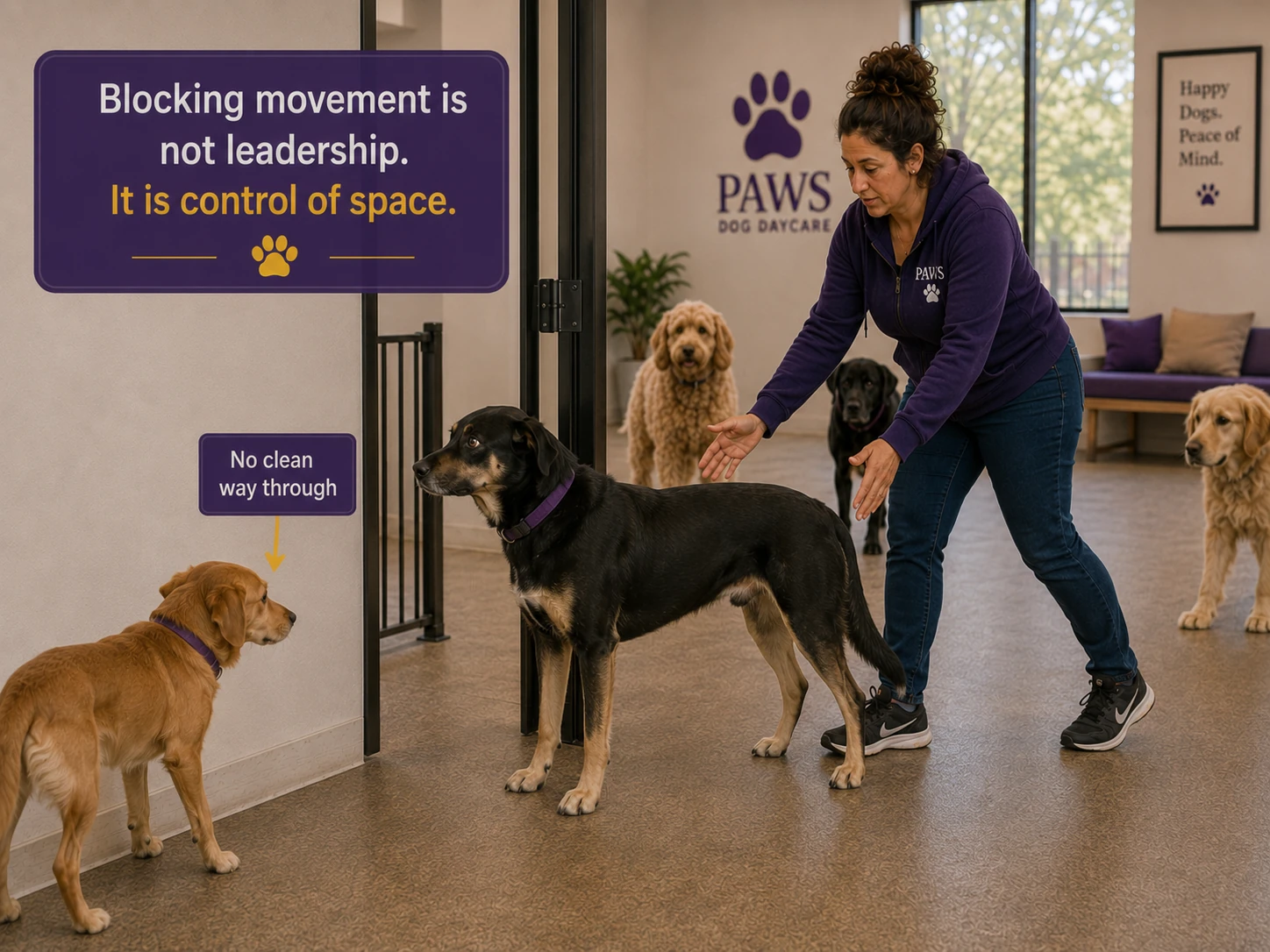
| T-positioning or blocking | The dog cuts across another dog’s path or blocks movement. | Do not let one dog turn the room into a toll booth. |
| Mounting | Arousal, play, stress, sexual behavior, habit, pressure, or conflict. | Motive matters less than impact. Repeated mounting creates problems. |
| Pinning or hovering | The dog is keeping another dog down or trapped in the interaction. | If the dog underneath is not loose and choosing it, stop it. |
| Snarling or teeth display | Threat display. The dog is showing what could happen next. | Do not wait to see if the dog is serious. Assume the warning matters. |
| Lunging or air snapping | Escalation from display toward contact. | Separate, document, and reassess the dog’s group fit. |
🐾
Which Dogs Commonly Show This Behavior
Confident behavior can show up in any dog, but certain dogs use pressure more naturally than others.
This behavior is common in confident dogs, pushy outgoing dogs, adolescent dogs testing social boundaries, intact dogs, high-arousal dogs, dogs with poor play manners, dogs that resource guard space or objects, and dogs that have learned other dogs move when they apply pressure.
It can also show up in dogs that are not truly confident at all. A fearful dog may posture. An insecure dog may bluff. A dog guarding a toy may suddenly look bold because the toy matters. A sore dog may warn another dog away because being bumped hurts. Do not slap one label on the dog and stop thinking.
In daycare, pressure often shows up around gates, corners, doorways, water bowls, toys, staff attention, owner pickup, new dog entry, tired dogs, sore dogs, small-dog and large-dog mismatch, and over-aroused chase. A dog may look fine in the middle of the room and become a different animal when another dog tries to pass through a bottleneck.
Watch the dog that returns from rest too hot, the dog that enters a room like it owns the furniture, the dog that rushes every newcomer, the dog that keeps policing play, and the dog that will not let another dog disengage. Those are the dogs that turn “confident” into work.
Daycare behavior is always the dog plus the room. The same dog may look confident in a calm group, pushy in a crowded group, defensive near a gate, possessive around water bowls, and rude with puppies. Staff notes need to describe the actual setup, not just the personality label.
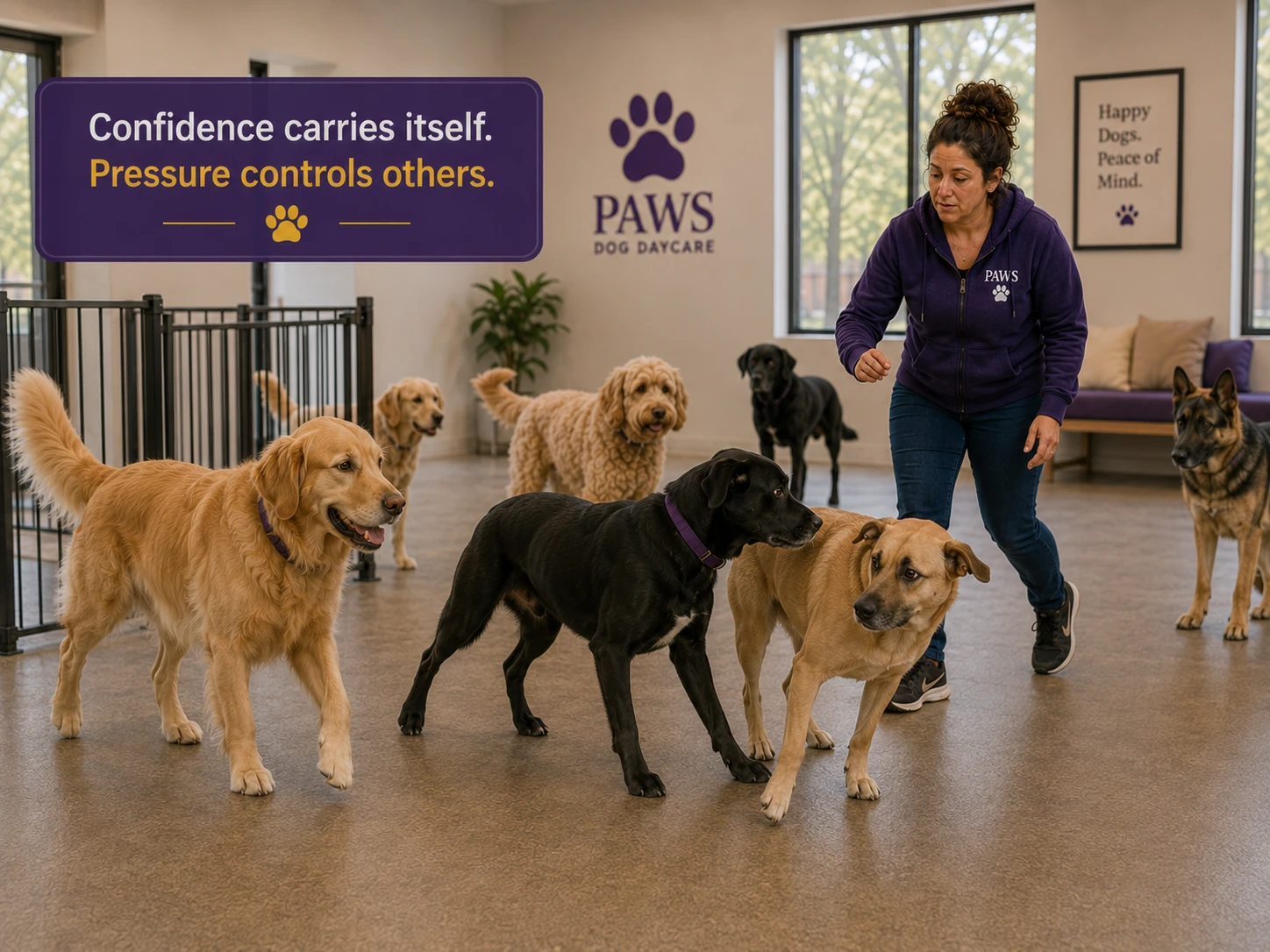
Healthy confidence is usually self-contained. The dog moves through the room without needing every other dog to change direction, surrender a resource, leave a person, or give up a resting place. Pressure behavior is different because it tries to control the choices available to someone else.
Staff should track where the behavior appears and where it does not. A dog that blocks only at gates, guards only around staff attention, or becomes controlling after rest return needs a setup-specific plan instead of a permanent label.
🚨
When Confident Behavior Becomes a Fight Risk
The risk starts when one dog keeps applying pressure and the other dog has no clean answer left.
Most dogs give some kind of warning before full contact. They may approach, posture, freeze, stare, stand taller, raise hackles, wrinkle the lip, growl, show teeth, block, mount, shoulder in, lunge, air snap, make inhibited contact, or go into a real fight. Not every dog uses every step, and some dogs skip steps when arousal is high. But staff should know the staircase.
This is the ugly little negotiation phase. One dog is saying, “Move.” The other dog is deciding whether to move, freeze, submit, correct, or fight. If one dog backs down and the confident dog lets it end, the room may reset. That is normal conflict resolution. Not pretty, not cute, but not automatically a disaster.
The dangerous version happens when the confident or dominant dog does not stop. The other dog turns away, crouches, freezes, tucks, tries to leave, growls, or gives a correction, and the pressure dog keeps coming. Now the interaction is no longer communication. It is a countdown.
A behavior is not judged only by what the confident dog meant. It is judged by what the behavior does to the room. If the other dog cannot leave, cannot recover, cannot re-enter play, or has to escalate to make the pressure stop, staff waited too long.
Staff should not wait for both dogs to agree on a solution. Dogs do not sign conflict-resolution paperwork. If the room is tightening up, staff need to move.
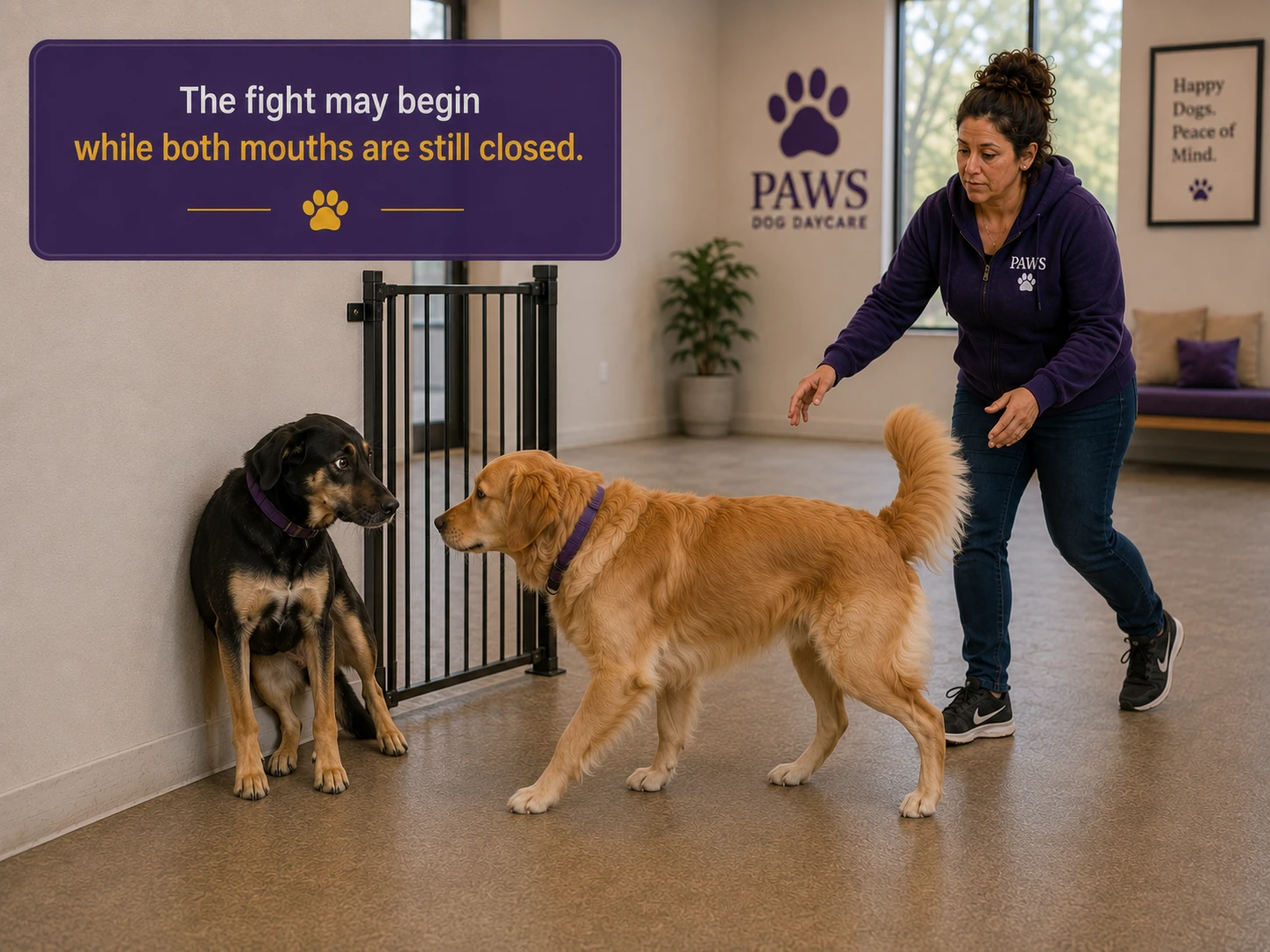
The fight may begin while both mouths are still closed. Fixed posture, forward weight, a narrowing path, and one dog losing its last clean exit can be the active conflict even before barking, growling, or teeth appear.
A fair social correction ends after the message is delivered. Continued pursuit, blocking, standing over, or returning to the same target after that dog has yielded turns communication into bullying and should change the group plan.
⚠️
Fight-risk warning
If one dog keeps saying “move” and the other dog keeps saying “no,” staff should not wait for the teeth to vote.
🧯
What Staff Should Do When They See It
Interrupt pressure early, calmly, and with control of space.
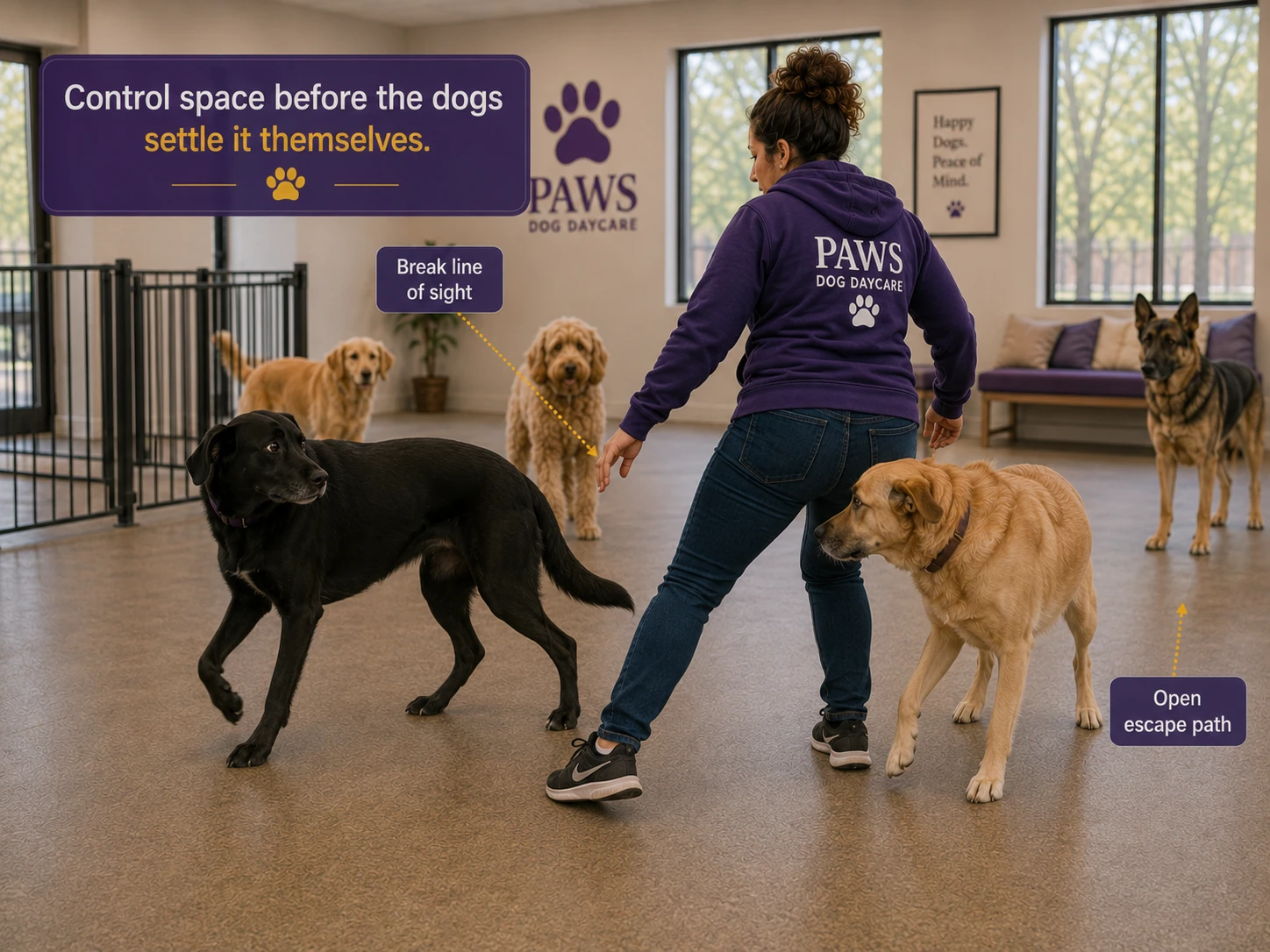
Staff should step in before confident behavior turns into bullying, fixation, or a fight. The answer is not panic. It is not screaming. It is not chasing dogs around the room like the daycare has turned into amateur theater. The answer is calm interruption, body positioning, redirection, rotation, and separation when needed.
If the dog can still hear staff, use that. Call the dog off, redirect movement, open space, and break the line of pressure. If the dog cannot hear staff because he is locked in, that is information. A dog that cannot disengage from another dog may not belong in that group at that moment.
Staff should control the dog applying pressure first when possible. The dog being stared at, mounted, blocked, or stood over may already be trying to avoid conflict. Moving the pressure dog often solves more than grabbing the uncomfortable dog.
Split the line of sight. Break the path. Move the pressure dog away from the target. Do not return the dog to the same target two minutes later like the room magically forgot what just happened.
The goal is not to punish confidence. The goal is to stop pressure from becoming violence.
The first useful intervention often controls space rather than touching either dog. Staff can step into the lane, break the stare, change the angle, open an exit, and move the pressure dog before physical contact becomes necessary.
A real reset changes distance, pairing, room, activity, or time. Briefly moving the dog and then returning it to the same target is not recovery; it is a short intermission in the same conflict.
- Step in when posture becomes pressure.
- Interrupt hard staring, standing over, blocking, repeated mounting, and refusal to disengage.
- Move the pressure dog before the uncomfortable dog has to defend itself.
- Split the line of sight and open an escape path for the target dog.
- Lower the room energy without turning staff into the loudest problem in the building.
- Rotate, leash, rest, or separate the dog if it keeps reinitiating.
- Do not return the dog to the same target until staff know the dog has actually reset.
- Document the sequence, not just the final bark, growl, snap, or contact.
⚖️
Do Not Confuse Confidence With Aggression
A dog can be confident, stable, and socially appropriate. That dog is not the problem.
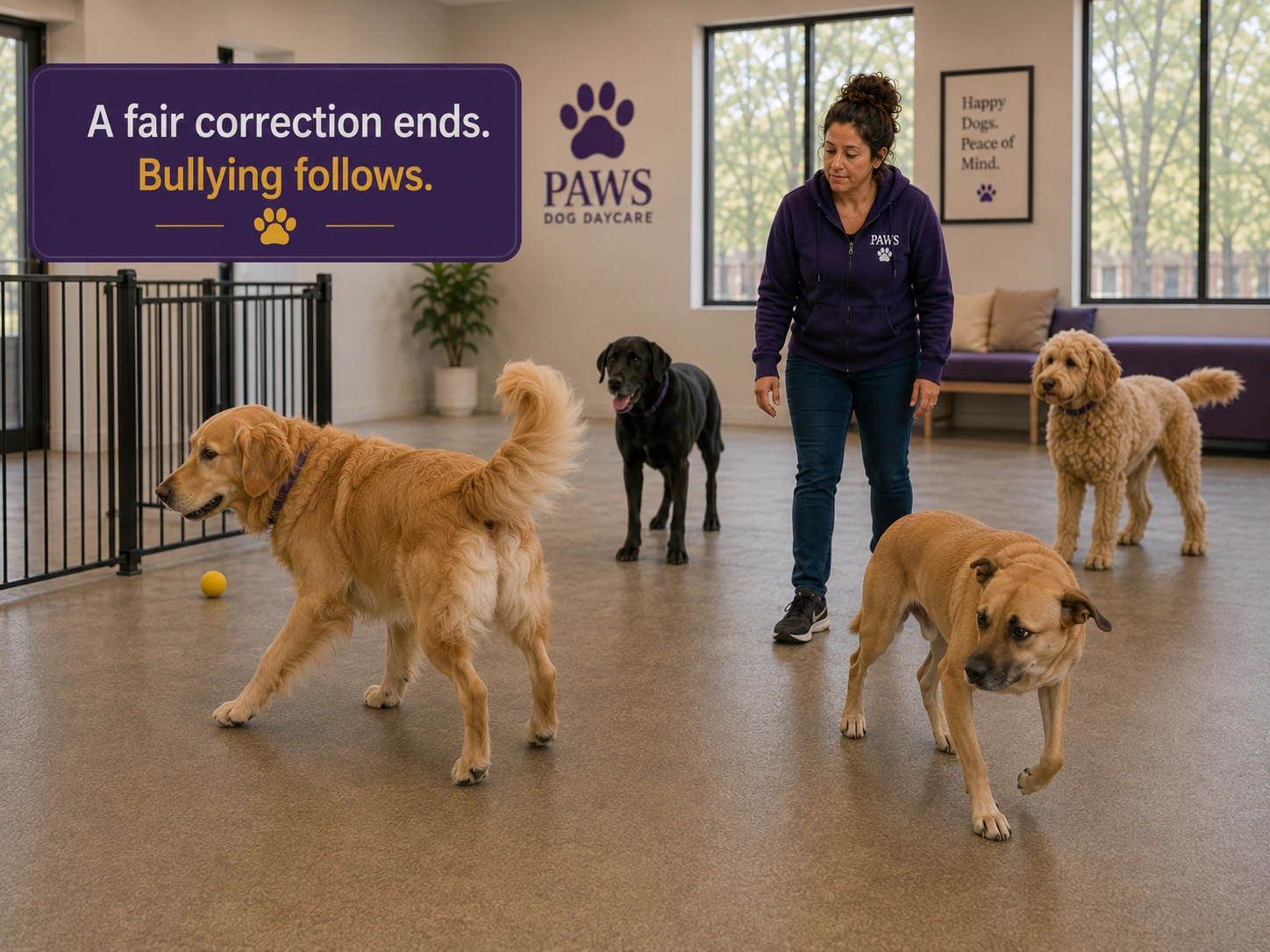
Some confident dogs are excellent daycare dogs. They enter the room calmly, read other dogs well, correct nonsense without overdoing it, disengage when asked, and do not need to prove themselves every five minutes. That dog is valuable. That dog can help stabilize a group.
A fair correction is not the same thing as bullying. A stable dog may give one clean growl, lip lift, bark, snap, or body check when another dog is being rude, and then the moment ends. The correction has a point. The other dog changes behavior. The confident dog disengages. The room exhales.
Bullying is different. The bully corrects and follows. Mounts and returns. Stands over and stays there. Blocks and crowds. Keeps collecting rent from the other dog’s nervous system. That dog is not resolving conflict. That dog is becoming the conflict.
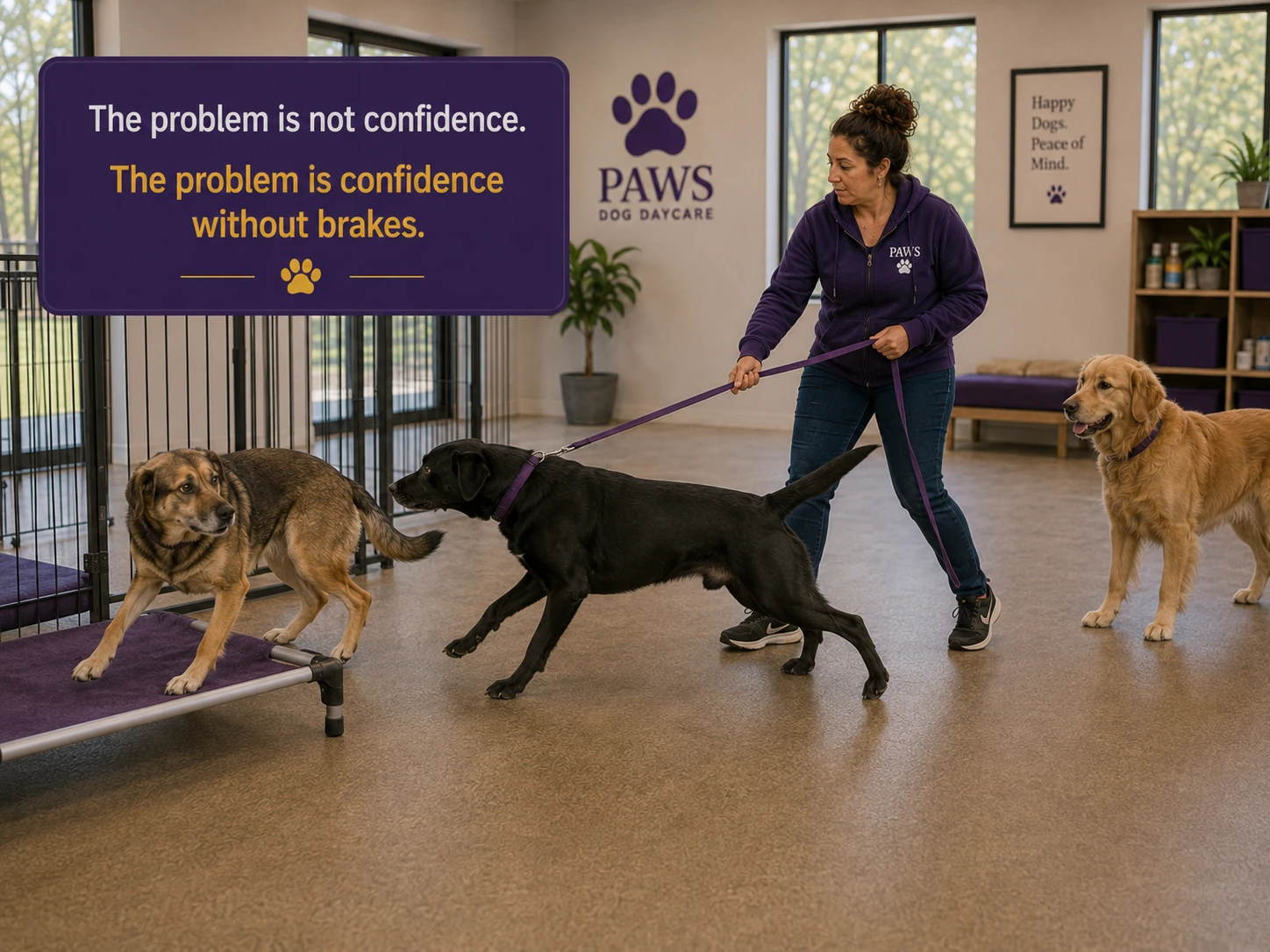
The problem is not confidence. The problem is confidence without brakes. The dog that will not stop standing over others, will not stop mounting, will not release a stare, will not accept another dog’s avoidance, will not leave toys alone, will not hear staff, and will not quit returning to the same target is not “just confident.” That dog is creating work and risk.
Staff also need to avoid lazy labeling. A dog showing teeth may be defensive. A dog with hackles may be excited. A dog mounting may be over-aroused. A dog standing tall may simply be comfortable. But if the behavior creates pressure that another dog cannot escape, staff need to manage it regardless of the textbook label.
The target dog often reveals the difference first. When the receiving dog remains loose and willingly returns, the interaction may still be socially workable. When that dog freezes, turns away, lowers posture, seeks staff, or repeatedly leaves, confidence has become pressure regardless of the stronger dog’s intent.
Staff should preserve fair corrections without allowing repeated enforcement. A socially skilled dog delivers information and disengages. A bullying dog keeps collecting compliance after the point has already been made.
📌
Room rule
Do not punish confidence. Manage pressure. The room does not need every strong dog softened. It needs every strong dog under control.
🪜
The Staff Interruption Ladder
Start early and calm. Escalate only as much as needed.
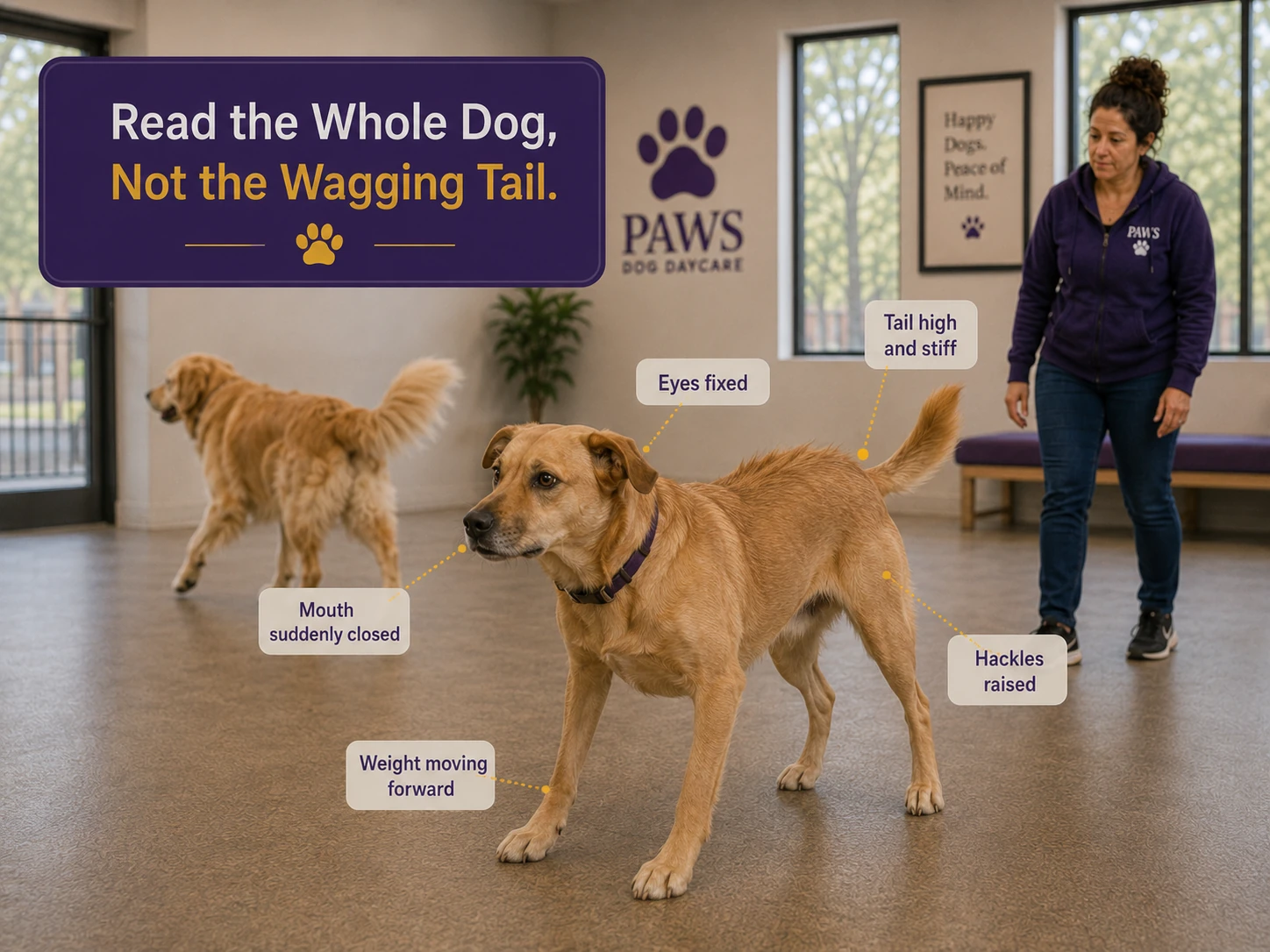
The ladder starts with observation. Staff should read eye fixation, mouth changes, tail height and stiffness, weight shift, muscle tone, blocking, and the target dog’s response together. A wagging tail cannot overrule a body that is loading forward.
Use the lowest effective step while the dog is still reachable, but do not repeat a failed cue until the room escalates. If the dog ignores voice and keeps applying pressure, staff should move immediately to body positioning, line-of-sight control, leash handling, rotation, or ending the setup.
Each intervention must create a safer arrangement. The target dog needs an exit, the pressure dog needs distance from the target, and staff need enough control to prevent an immediate return.
Swipe left/right to see the full table.
| Step | What Staff Do | Why It Helps |
|---|---|---|
| Read the pressure | Notice hard eyes, stiff body, high tail, standing over, blocking, mounting, or repeated return to the same dog. | The best interruption happens before the room explodes. |
| Check the target dog | Look at the dog receiving the pressure: loose, re-engaging, freezing, leaving, hiding, correcting, or escalating? | The target dog tells staff whether the pressure is being handled or becoming dangerous. |
| Voice cue | Calmly call the dog off or redirect movement while the dog can still respond. | If the dog can hear staff, use that before fixation builds. |
| Body block | Walk in calmly, split the line, open space, and stop the direct pressure. | Staff control the room before the dogs solve the argument. |
| Break line of sight | Move between the dogs, change angles, and stop the hard stare or direct path. | Fixation feeds conflict. Break the visual lock before it becomes contact. |
| Redirect | Move the dog into another activity, another area, a leash transfer, or a calmer group. | The dog needs a new job before the old job becomes fighting. |
| Rotate or rest | Remove the dog from the group if it keeps returning to the same pressure behavior. | Repeating pressure is a pattern, not a cute moment. |
| End the setup | Split the dogs, change the group, restrict access, or end open play for the dog. | Some combinations should not be negotiated. They should be stopped. |
🚫
What Not to Do
Bad staff reactions can turn posturing into contact.
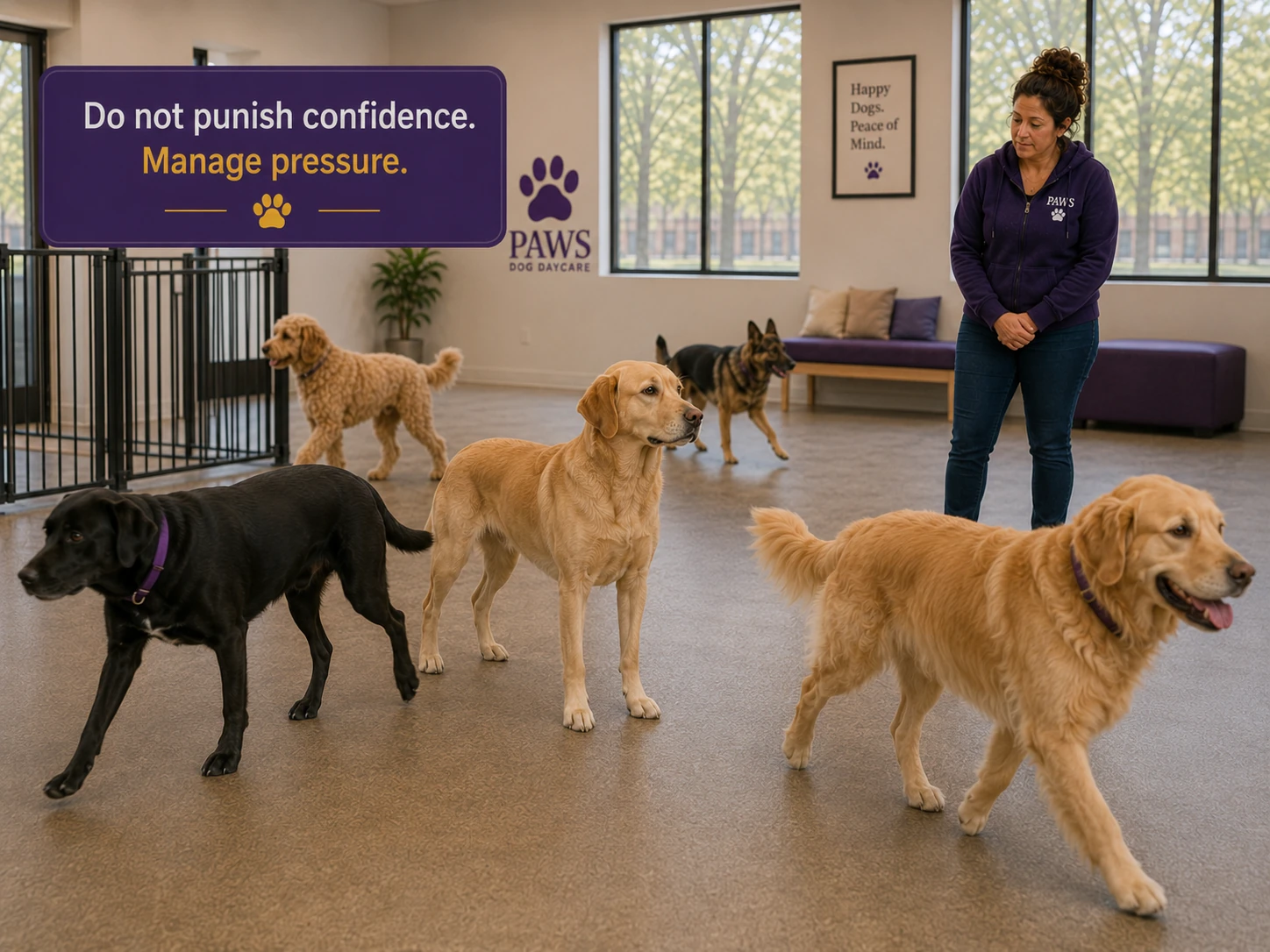
The goal is not to punish every dog that carries itself strongly. Heavy-handed handling, alpha displays, pinning, and staff ego can add conflict without teaching the dog to disengage from social pressure.
Manage the behavior that destabilizes the room: blocked movement, repeated mounting, hard staring, standing over, resource control, and returning to a dog that is trying to leave. A calm confident dog should not be corrected merely for existing with presence.
Staff should also avoid waiting for dramatic proof. Quiet pressure can be dangerous before anyone growls. Move the dog when the target dog’s choices begin disappearing, not after the incident becomes obvious to everyone.
- Do not assume a wagging tail means the dog is friendly.
- Do not ignore hard staring because “nothing happened yet.”
- Do not let one dog keep standing over, mounting, blocking, or crowding another dog.
- Do not call every confident dog aggressive just because the dog has presence.
- Do not alpha-roll, pin, intimidate, or physically challenge the dog to prove a point.
- Do not let staff ego enter the room. The dog does not need a dominance contest with a human in logo apparel.
- Do not write “fight came out of nowhere” if the warning display was standing there in neon lights.
⚠️
Staff rule
The room does not need a philosopher. It needs someone to move the dog before the posturing becomes paperwork.
📝
What Staff Should Document
“Dominant today” is not enough. Write what the dog actually did.
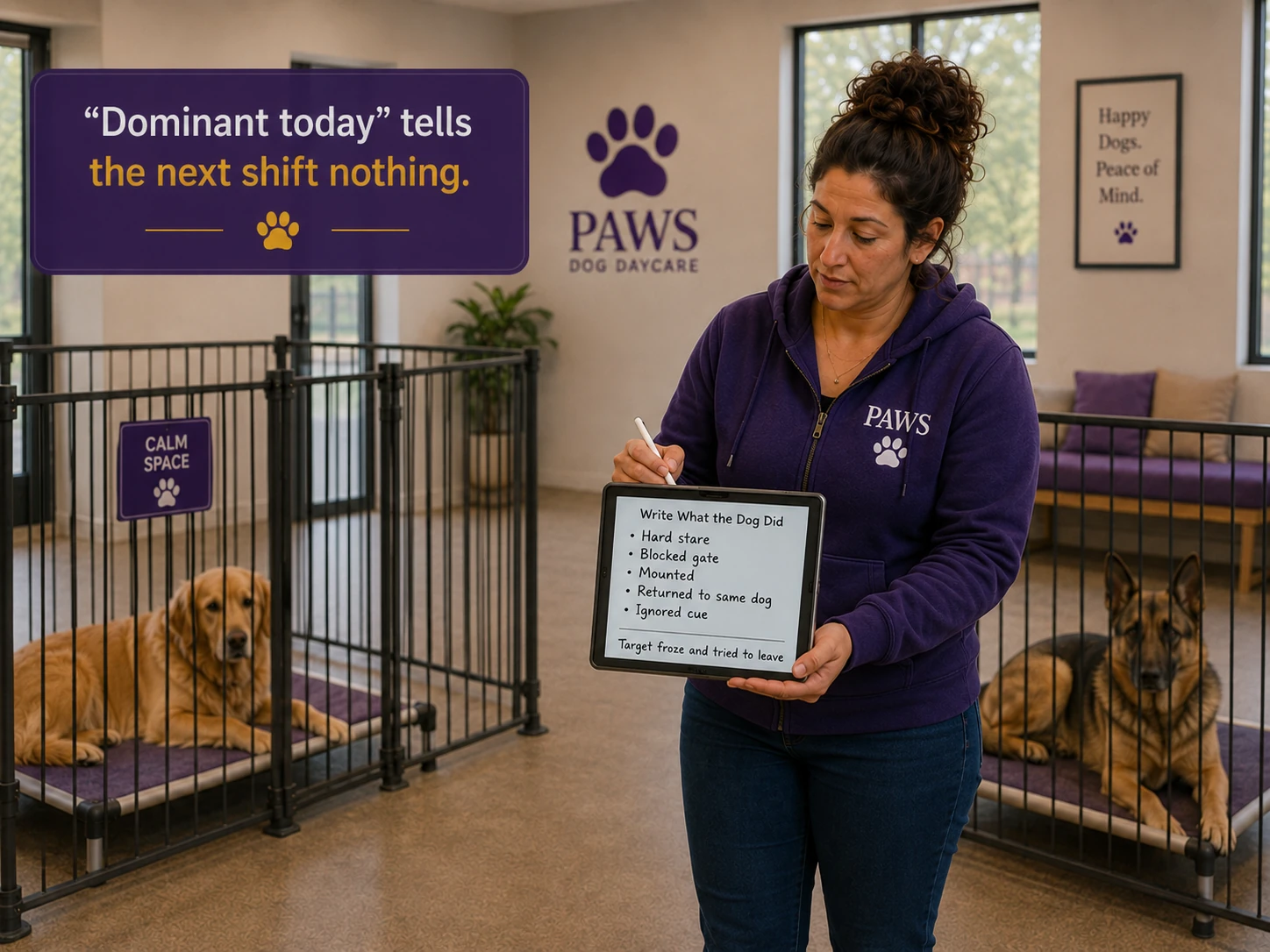
Staff notes should describe behavior, target, trigger, intensity, duration, interruptibility, recovery, recurrence, and staff response. A vague label does not help the next shift. “Dominant” does not tell anyone whether the dog mounted once during play, hard-stared a puppy into a corner, guarded the water bowl, blocked an insecure dog at the gate, or lunged after a correction.
Documentation matters because dominant or confident behavior can be harmless in one context and dangerous in another. The business needs to know which dog was applying pressure, which dog was receiving it, what warning signs appeared, whether staff interrupted successfully, and whether the dog returned to the behavior.
Good notes should help staff answer one question before the next visit: was this a normal dog conversation, a fair correction, rough play, pressure behavior, bullying, resource guarding, or a dog that should not be in that setup again?
Notes should describe the spatial pattern as well as the visible display. Record whether the dog blocked a gate, cut off a route, followed avoidance, stood over a resting dog, or returned after the target had already moved away.
The record should produce a change for the next visit: a different pairing, earlier interruption, resource restrictions, gate management, smaller group, rest timing, or removal from open play. Labels without an operating response do not reduce risk.
- What exact behavior did staff see: hard stare, standing over, mounting, blocking, snarling, teeth, lunge, air snap, inhibited contact, or bite?
- Which dog was the target, and did this dog target the same dog more than once?
- What was happening before the behavior: entry, toy, water bowl, gate, pickup, staff attention, new dog, arousal spike, rest return, or correction?
- Did the other dog move away, freeze, submit, hide, growl, correct, or fight back?
- How intense was the behavior, and how long did it last?
- Could staff interrupt the dog with a normal cue, body block, redirection, leash, or rotation?
- Did the dog recover, or did it return to the same behavior?
- Should the dog be rotated, separated, restricted from certain dogs, or removed from open group?
✅
Dominant or Confident Behavior Checklist
Use this when staff see a dog standing tall, staring, mounting, blocking, or pressuring another dog.
Use this checklist while the interaction is developing and across multiple visits. Staff should compare the same dog in different groups, around gates and resources, after rest, and with dogs that respond differently to pressure.
One upright posture or brief correction may be socially appropriate. A repeated cluster of hard staring, blocking, mounting, target selection, poor interruptibility, and immediate return after redirection shows a pattern that should change the operating plan.
The answers should lead to a decision about pairing, group size, resources, gate access, rest, supervision, or open-play eligibility. A checklist that does not alter practice is not risk management.
- Is the dog loose and socially appropriate, or stiff and pressuring?
- Is the dog reading the other dog’s signals?
- Is the other dog trying to leave, freeze, submit, hide, or correct?
- Is there hard staring, standing over, blocking, repeated mounting, snarling, teeth, or lunging?
- Can staff interrupt the behavior with a calm cue or body movement?
- Does the dog disengage and recover, or return to the same target?
- Does the setup need a rotation, rest break, smaller group, different pairing, or refusal from open play?
- Did staff document the full sequence instead of only the final reaction?
❓
Dominant or Confident Dog Behavior FAQ
Detailed answers about stable confidence, social pressure, body language, corrections, blocking, staff intervention, documentation, group restrictions, and fight prevention.
Is a confident dog automatically aggressive?
No. A confident dog may be calm, stable, socially skilled, and easy to manage. The risk begins when the dog uses posture, space, resources, or repeated pursuit to control another dog and does not stop when the other dog disengages.
What is the difference between confidence and pressure?
Confidence is usually self-contained. The dog carries itself strongly without needing others to move, submit, or give up space. Pressure behavior narrows another dog’s choices through staring, blocking, following, standing over, mounting, or repeated interruption.
Can a fight begin while both dogs are quiet?
Yes. Closed mouths, fixed posture, forward weight, hard eyes, blocked movement, and a shrinking escape path can show that the conflict is already active. Staff who wait for barking or growling may miss the safest intervention point.
Does a wagging tail mean the dog is friendly?
No. Tail movement can occur with excitement, tension, arousal, pressure, and threat. Staff should read tail height and stiffness together with the eyes, mouth, weight, muscles, movement, and the target dog’s response.
Are raised hackles always aggression?
No. Raised hackles show arousal, which may come from excitement, stress, uncertainty, fear, or aggression. They are useful information but cannot be interpreted without the rest of the dog and the interaction.
Is mounting always dominance?
No. Mounting can reflect arousal, stress, habit, play, sexual behavior, or social pressure. In daycare, impact matters more than the label. Repeated mounting that another dog dislikes should be interrupted.
Is blocking movement a form of pressure?
Yes. A dog that cuts across a path, holds another dog against a wall, controls a doorway, or prevents access to staff or resources is controlling space. That can become dangerous even without growling or contact.
How can staff tell a fair correction from bullying?
A fair correction is brief, proportional, and ends after the other dog changes behavior. Bullying continues through following, crowding, blocking, standing over, mounting, or repeated return after the message has already been delivered.
Why does the target dog matter so much?
The target dog shows the effect of the interaction. Loose re-engagement may indicate workable communication. Freezing, turning away, lowering posture, hiding, leaving, seeking staff, or escalating defensively shows that the pressure has become too much.
When should staff interrupt hard staring?
Interrupt when the stare becomes fixed, the body stiffens, the dog stops responding, or the target dog begins losing space or choice. Waiting for a lunge turns an early spatial problem into a physical one.
Which dog should staff move first?
When possible, move the dog applying pressure. The target dog may already be trying to avoid conflict, and grabbing that dog can add pressure while leaving the controlling dog free to re-engage.
What does controlling space look like?
It may include T-positioning, standing in doorways, cutting off routes, hovering over resting dogs, blocking access to water or staff, following avoidance, or repeatedly placing the body between another dog and its destination.
Should staff punish a dog for being confident?
No. The goal is not to soften every strong dog. Staff should preserve stable confidence while interrupting the specific behaviors that control, trap, or repeatedly pressure other dogs.
Why are alpha rolls and dominance contests poor staff responses?
They add physical and social conflict, can increase defensiveness, and do not teach the dog to disengage appropriately. Staff need control of the environment, not a contest with the dog.
What should staff do if the dog keeps returning to the same target?
End the setup. Repeated return after cues, body blocks, redirection, or rest shows that the dog has not reset. Change the pairing, group, room, resource access, or open-play plan.
What is a real reset for a pressure dog?
A real reset changes something meaningful: distance, target access, group composition, room, activity, resource conditions, or time. Brief separation followed by the same interaction is only a pause.
What should staff document?
Record the exact behavior, target, trigger, room location, resources, duration, intensity, target response, interruption used, recovery, and whether the dog returned. Observable facts are more useful than words such as dominant or bossy.
When should resources be removed?
Remove toys, food, attention setups, or access points when they repeatedly trigger blocking, guarding, fixation, or conflict. The facility does not need to prove the dog can fail around a predictable trigger.
When should a confident dog be removed from open group?
Remove or restrict the dog when it cannot disengage, repeatedly targets the same dog, controls resources or movement, escalates after corrections, ignores staff, or creates a room where other dogs no longer have safe choices.
What is the main operating rule for dominant or confident behavior?
Read the warning before impact. Preserve healthy confidence, interrupt social pressure early, protect the target dog’s choices, and change the setup before the dogs resolve the problem physically.
🐾
The Bottom Line: Read the Warning Before the Impact
Dogs usually give language before contact. Staff are paid to read it.
Dominant or confident behavior is not automatically bad. Some dogs carry themselves strongly and still have excellent social control. Those dogs are not the problem.
The problem is the dog that uses confidence as pressure and will not stop. The hard stare, high stiff tail, raised hackles, standing over, blocking, mounting, snarling, teeth display, and lunge are all part of the conversation before the fight. Ignore that conversation and the dogs may finish it physically.
Dogs do not usually want to pay a vet-bill price over every disagreement. They posture, warn, threaten, and try to settle things before full combat because real injury is costly. But when the warning does not work, when neither dog backs down, or when one dog keeps pushing, the room can go from body language to blood fast.
Good staff do not wait for the loud version. They see the posture, the pressure, the target dog’s response, and the escalation path. Then they move the dog before the incident report writes itself.
When staff are uncertain, look at the dog receiving the behavior. The target dog’s shrinking choices, repeated exits, freezing, lowered posture, and defensive corrections often identify the exact moment confident presence became social pressure.
The best operators do not soften every strong dog or wait for every conflict to become loud. They preserve stable confidence, stop controlling behavior, and change the setup before either dog has to settle the argument physically.