Dog Daycare Behavior, Frightened Dogs, Submissive Dogs, Fear Biting, Aggressive Dogs, Dominant Dogs, Bullying, Staff Supervision, and Fight Prevention
Identifying Frightened or Highly Submissive Behavior in Dog Daycare
A scared dog trying to disappear is not being dramatic. He is telling the room the situation is getting dangerous.
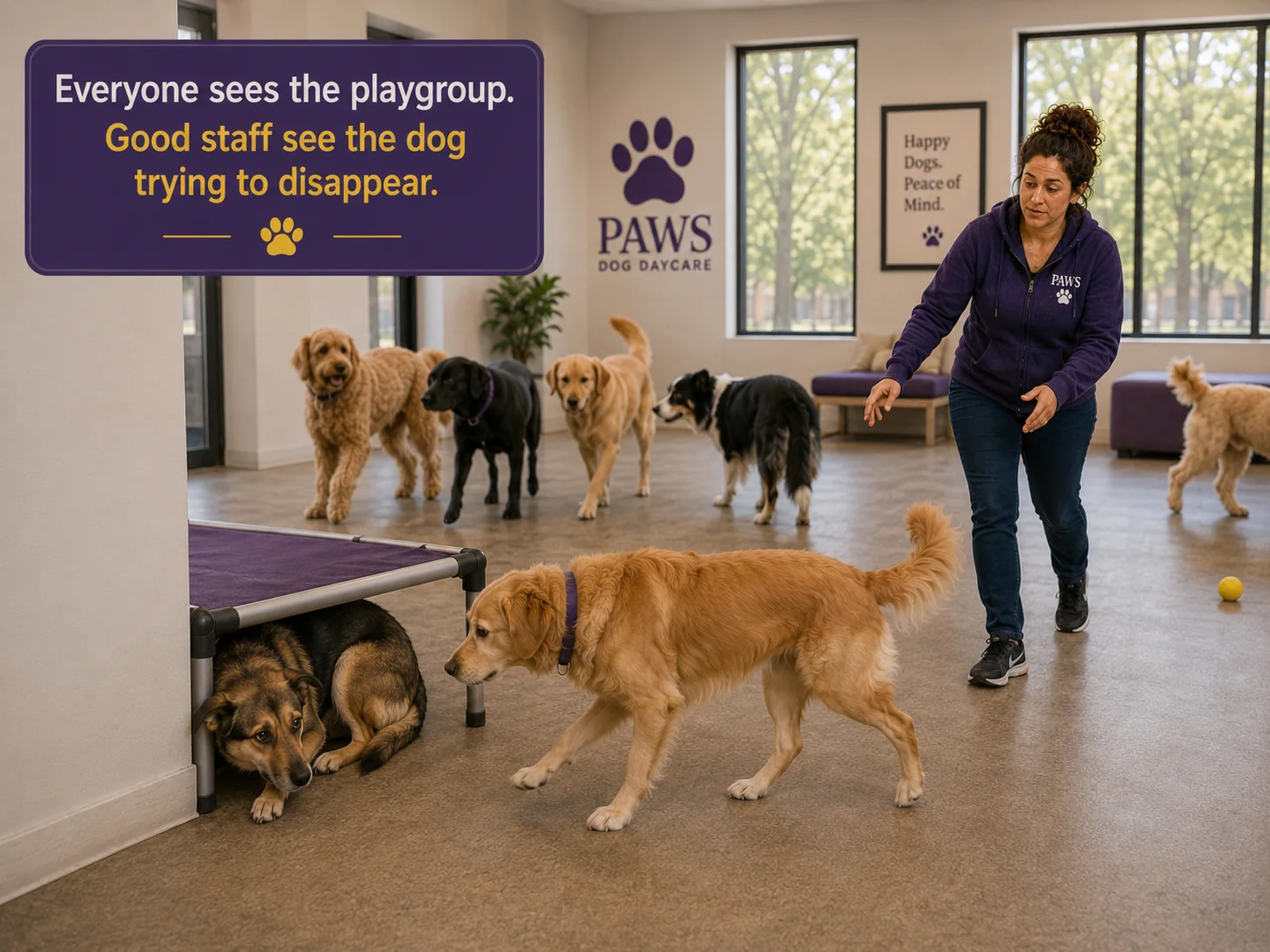
A frightened or highly submissive dog will often try to make itself as small as possible. This behavior is common in insecure dogs and can also show up in adaptable dogs, young dogs, under-socialized dogs, small dogs, sore dogs, or any dog that suddenly feels trapped in the wrong daycare setup.
The dog may crouch, cower, tuck the tail, lower the body, roll onto the back, lick another dog’s face from a submissive position, freeze, urinate, avoid eye contact, or try to hide. In plain operator terms, the dog is saying, “I am already beaten. I am not a threat. Leave me alone.”
Most of the time, a socially reasonable dog will read that and back off. The problem starts when an aggressive, dominant, pushy, or bully-type dog keeps pressing the issue. That is when the frightened dog can run out of polite options and become a fear-biter.
The staff job is to stop the escalation before it turns into violence. Not by screaming, not by making a big emotional production, and not by grabbing the submissive dog off the floor. Staff need to calmly control the aggressive dog, create space, and keep the scared dog from being forced into a corner where teeth become the only tool left.
⚠️
Operator warning
If one dog is on the floor saying “I give up” and another dog keeps standing over him, mounting him, pawing him, staring him down, or pushing into him, do not blame the scared dog for finally snapping. Stop the bully before the scared dog has to.
🙈
What Frightened or Highly Submissive Behavior Looks Like
The dog is trying to look small, harmless, young, beaten, or invisible.
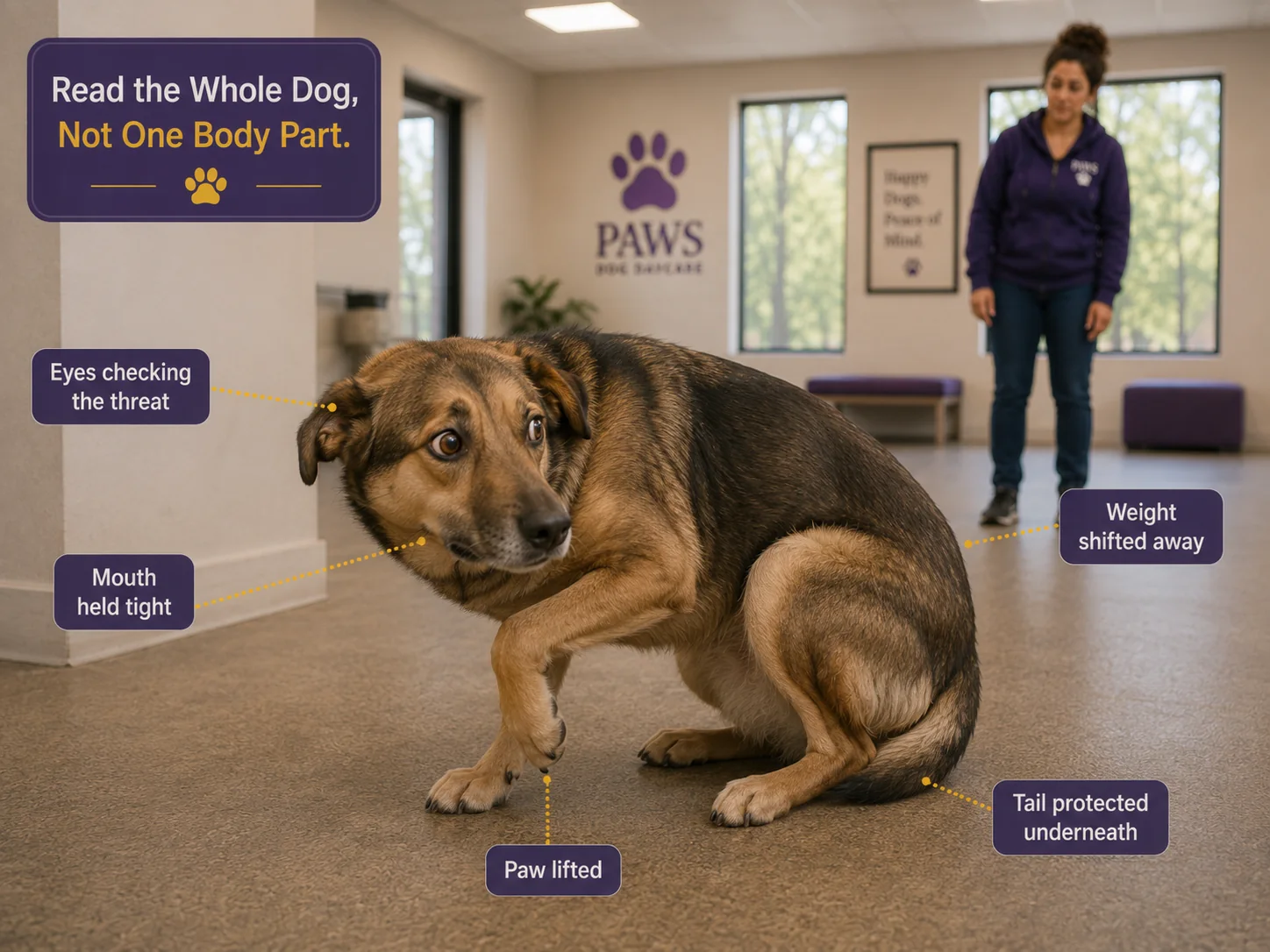
A frightened dog may crouch, cower, lower the head, tuck the tail, flatten the ears, avoid eye contact, lick lips, turn away, crawl, freeze, roll onto the back, expose the belly, urinate, or suddenly release anal-gland odor. Some dogs will lick the other dog’s face or muzzle from a low position as an appeasement signal.
If the room suddenly smells like rotten fish and panic, pay attention. That dog may not be “being gross.” The dog may be scared enough that the body just dumped the emergency stink button by releasing its anal glands. Staff should treat that as information, not a joke.
Also watch the small stuff before the dramatic stuff: turning the head away, licking lips, yawning, sniffing the floor, blinking hard, whale eye, paw lift, tucked tail, stiff mouth, pinned ears, sudden stillness, or trying to leave. Those little signs are not trivia. They are the dog whispering before he has to yell.
In a natural dog interaction, that behavior often means, “I am not challenging you.” The dog may be trying to make the aggressive or dominant dog believe there is no threat and no reason to continue. It is a conflict-avoidance signal, not an invitation for the other dog to keep being a jerk.
Staff should not confuse this with relaxed play. A dog on its back during good play may be loose, wiggly, and choosing to re-engage. A frightened dog on its back may be stiff, tucked, wide-eyed, frozen, leaking urine, or trying to make the other dog stop.
Do not read one body part like it tells the whole story. A wagging tail does not automatically mean happy. A dog on its back does not automatically want belly rubs. A quiet dog is not automatically calm. Read the whole dog, the other dog, the space, and what changed in the last ten seconds.
That difference matters. One dog is playing. The other dog is basically filing a surrender form with his whole body.
Swipe left/right to see the full table.
| Behavior | What It May Mean | Staff Translation |
|---|---|---|
| Crouching or cowering | The dog is trying to look small and non-threatening. | Reduce the conflict. Do not let a dominant dog keep crowding. |
| Rolling onto the back | The dog may be showing submission or trying to stop the interaction. | Do not assume the dog wants contact. Watch stiffness, face, tail, and the other dog. |
| Submissive urination | The dog may be overwhelmed, fearful, or appeasing. | Calm the room. Do not shame the dog or turn cleanup into a drama scene. |
| Anal-gland odor release | The dog may be highly stressed, frightened, or overwhelmed. | Do not laugh it off. Find what scared the dog, reduce conflict, clean the area, and document the trigger. |
| Face licking from a low position | The dog may be appeasing another dog and trying to avoid conflict. | Watch whether the other dog accepts the signal or keeps pressing. |
| Freezing | The dog may be overwhelmed and out of safe choices. | Step in calmly. Freeze can be the quiet hallway before the bite. |
| Snapping when crowded | The dog may feel trapped and forced to create distance. | Separate and document. Do not call it “out of nowhere” if the bully behavior was visible. |
🐾
Which Dogs Commonly Show This Behavior
This often shows up in insecure and adaptable dogs, but the room can scare almost any dog under the wrong conditions.
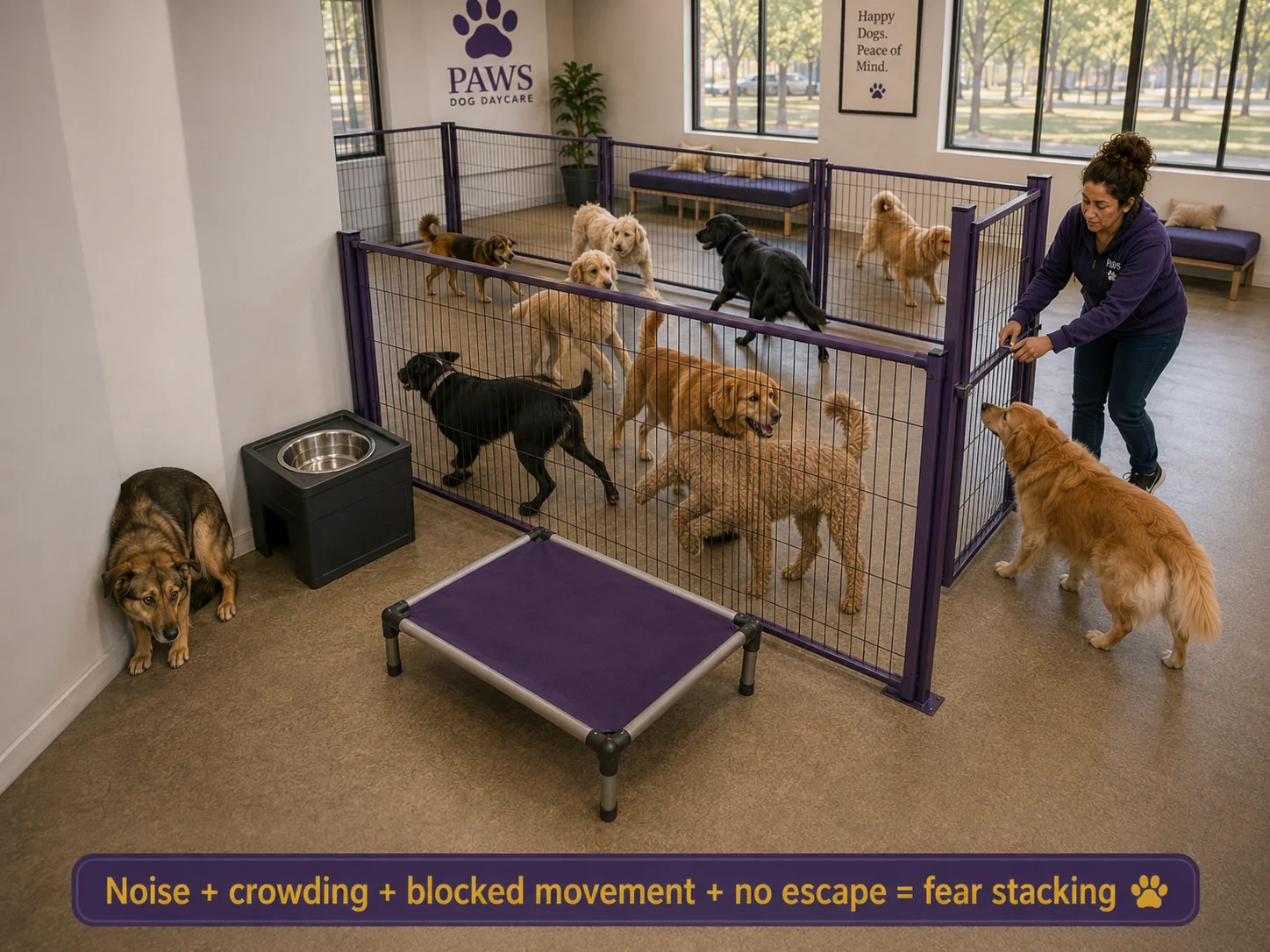
Frightened or highly submissive behavior is common in insecure dogs because those dogs already lack confidence in strange rooms, fast movement, loud play, and pressure from other dogs. It can also show up in adaptable dogs because adaptable dogs may yield, appease, or submit instead of challenging.
But staff should not treat this as a fixed label. A confident dog can become frightened if injured, sick, overwhelmed, cornered, or matched with the wrong dog. An outgoing dog can panic if the play turns too intense. A small dog may feel vulnerable in a room full of large body-slammers. An older or sore dog may snap because the body hurts and the room will not leave it alone.
The dog’s personality matters, but the setup matters too. Daycare behavior is always the dog plus the room, the dogs, the gates, the noise, the staff, the timing, and the pressure of the moment.
The same dog may look comfortable in one room and frightened in another because the operating conditions changed. Group density, gate placement, noise, flooring, available rest space, physical pain, and the behavior of one persistent dog can all shift the dog from workable to trapped.
Staff should avoid turning frightened behavior into a permanent personality label. Record where it happened, who was present, what blocked movement, and whether the dog recovered after the setup changed. The room is part of the incident record.
🚨
When Submissive Behavior Becomes a Fight Risk
Submission usually lowers conflict, unless the aggressive dog keeps pushing.
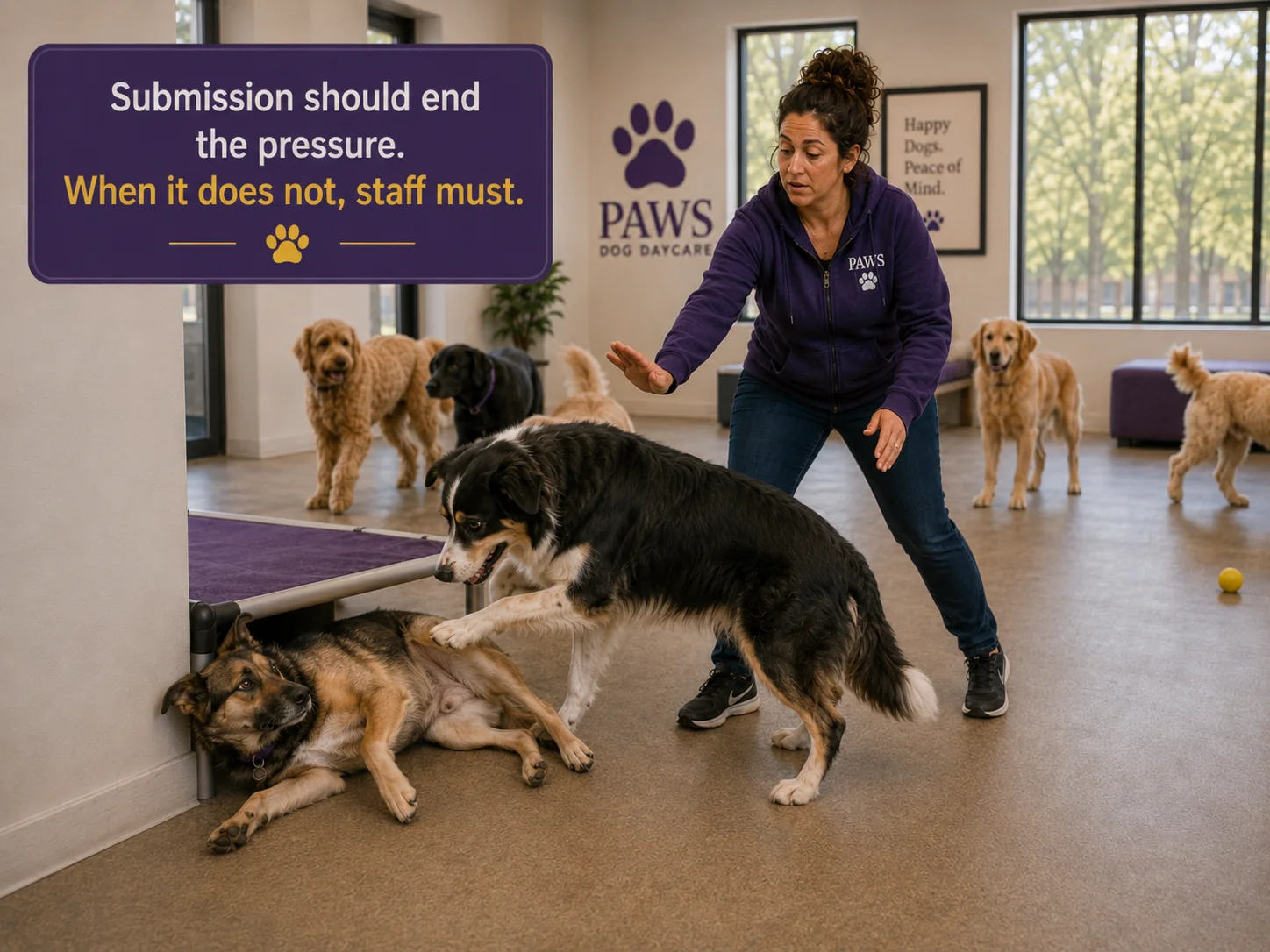
In many cases, submissive behavior helps the conflict resolve. One dog says, “I am no threat,” and the other dog backs off. That is the clean version.
The dangerous version happens when the aggressive, dominant, pushy, or bully-type dog does not stop. The frightened dog rolls over, crouches, licks, freezes, urinates, or tries to shrink, and the other dog keeps standing over, pawing, mounting, staring, barking, pushing, or correcting.
Now the frightened dog may have no room left. If it cannot flee and soft signals do not work, it may snap or bite. That is how the dog on the floor suddenly becomes the dog blamed for the fight.
Staff need to understand this sequence because the final bite is not always the whole story. Sometimes the dog that bit was the dog asking for help ten seconds earlier.
Fear also stacks. One dog rushing the face may not cause the bite by itself. Add a loud room, a gate behind the dog, a dominant dog standing over him, no escape path, staff moving too fast, and the dog has gone from uncomfortable to trapped. The bite may look sudden because nobody counted the ingredients.
The sequence may be quiet at first: turn away, crouch, tuck, freeze, lick, roll, urinate, release that nasty anal-gland smell, show teeth, snap. If staff only notice the snap, they missed the whole movie and walked in for the credits.
The dangerous point is not defined only by contact. When one dog has already yielded and the other dog continues to control space, follow avoidance, or keep physical pressure on the lower dog, the interaction has stopped being socially useful. Staff should end it before the frightened dog has to escalate.
A defensive snap may happen in less than a second, but the setup often developed over several minutes. Reviewing the last ten seconds matters; reviewing the entire pressure pattern matters more.
⚠️
Fear-bite warning
A frightened dog can become dangerous when the room keeps taking away every softer option. Distance is a safety tool. Use it before teeth become the safety tool.
🧯
What Staff Should Do When They See It
Stop it before it escalates, without pouring more excitement into the room.
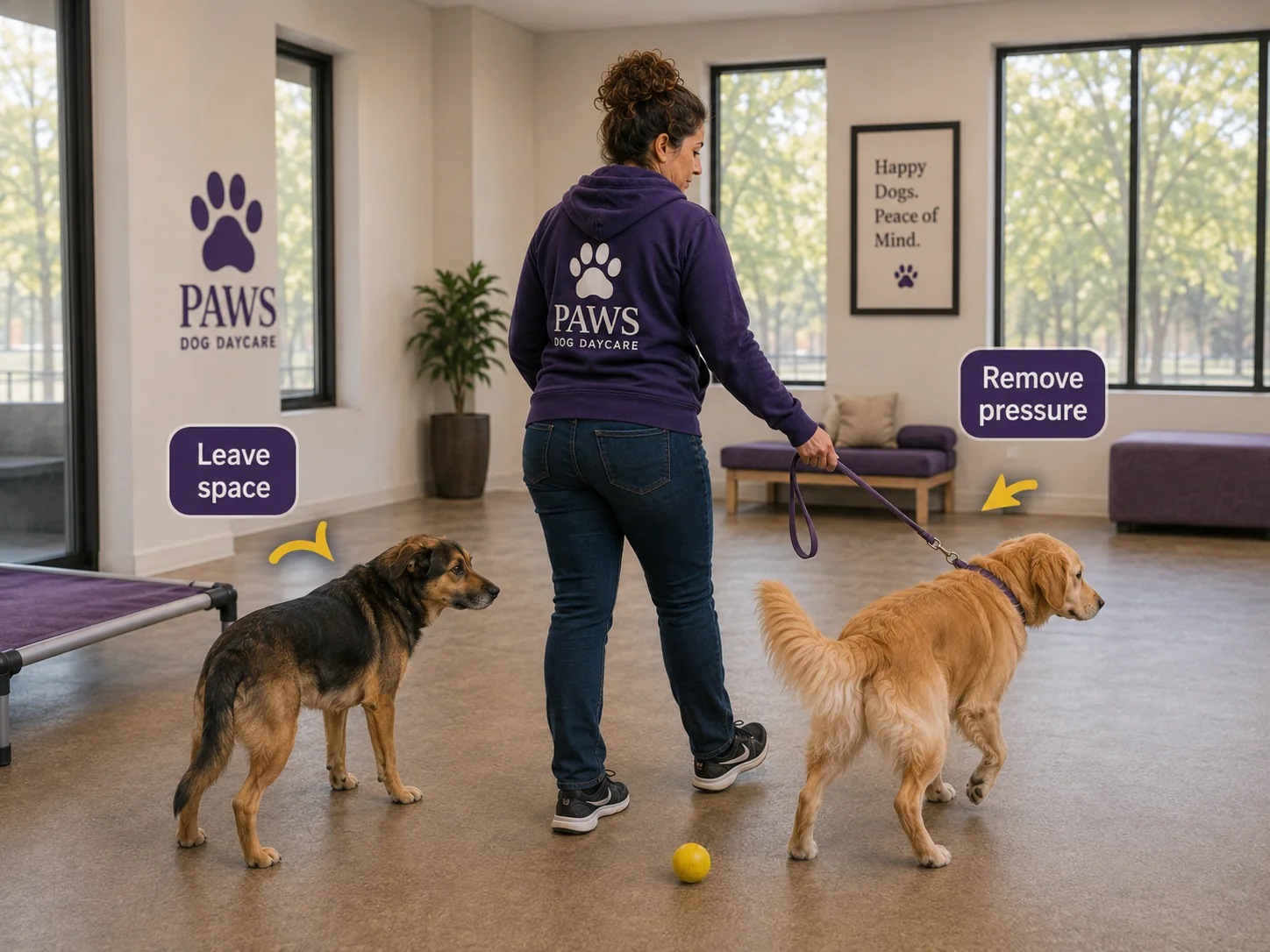
The best response is early, calm, and direct. Staff should interrupt the aggressive dog, create space, and stop the bully behavior before the frightened dog feels forced to defend itself.
Do not start screaming, scolding, stomping, or turning the room into a circus. That usually adds excitement to a situation that already has too much. A loud human can make the dominant dog more intense, the scared dog more panicked, and the rest of the room more interested.
A sharp neutral interruption may help break fixation in some rooms. A hand clap, a firm verbal interruption, or another clean distraction can shift attention long enough for staff to move in and take control. The point is not to scare the submissive dog worse. The point is to interrupt the aggressive dog and create space.
If the aggressive dog tries to reinitiate, staff need to take control of that dog and move him away. Do not let him go right back to the submissive dog like he is returning to unfinished paperwork.
Staff body position matters. Do not bend over between the dogs like you are volunteering your face for the incident report. Stay balanced, move calmly, block access, use gates or barriers when available, and keep your hands out of the bite zone unless there is no safer option.
Also, do not let staff stand around commenting on the smell, the urine, or the dog “being dramatic.” The dog is giving staff useful information. Clean it, note it, and fix the setup that caused it.
Once the pressure dog is removed, staff should avoid immediately surrounding or handling the frightened dog. Open space, lower movement, and a clear exit often help more than multiple people reaching down. The dog needs a chance to stand, breathe, orient, and choose the next movement.
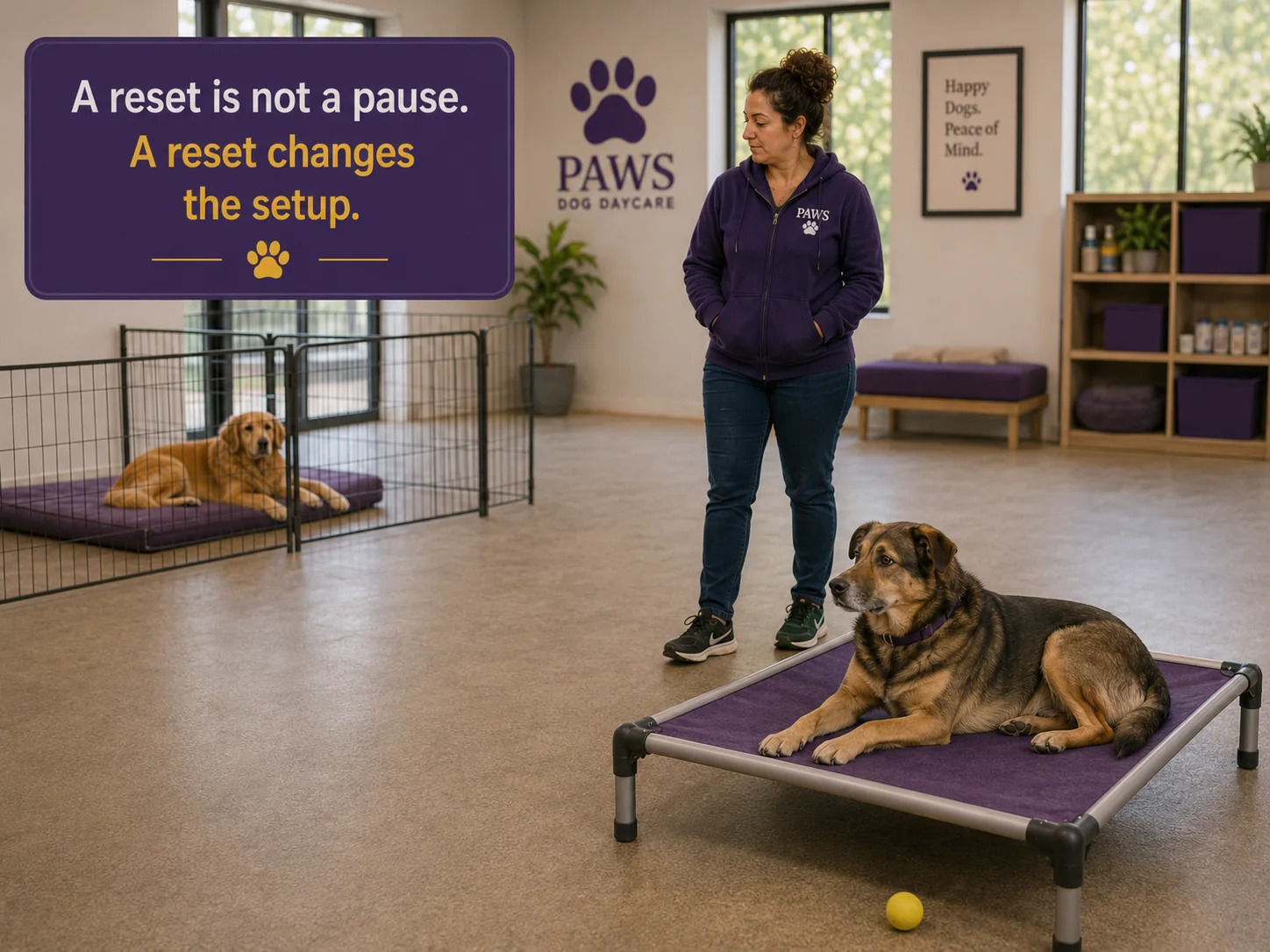
A useful reset changes at least one operating condition: distance, dog pairing, group size, room location, barrier placement, handling plan, or time. Brief separation followed by the same setup is only a pause in the same problem.
- Step in before the frightened dog has to snap.
- Control the aggressive, dominant, or bully dog first when possible.
- Give the frightened dog an escape path instead of trapping it.
- Lower the room energy. Do not yell unless there is an immediate emergency.
- Redirect, leash, rotate, or separate the aggressive dog if it tries to re-engage.
- Document which dog was being aggressive, which dog showed fear, and what staff did.
📌
Reset rule
Do not separate the dogs for thirty seconds and then toss them back together like the room magically learned something. Give the frightened dog time to recover, change the pairing, change the space, or end that setup.
✋
Do Not Reach Down and Grab the Submissive Dog First
The dog on the floor may be the easiest dog to reach and the worst dog to grab.
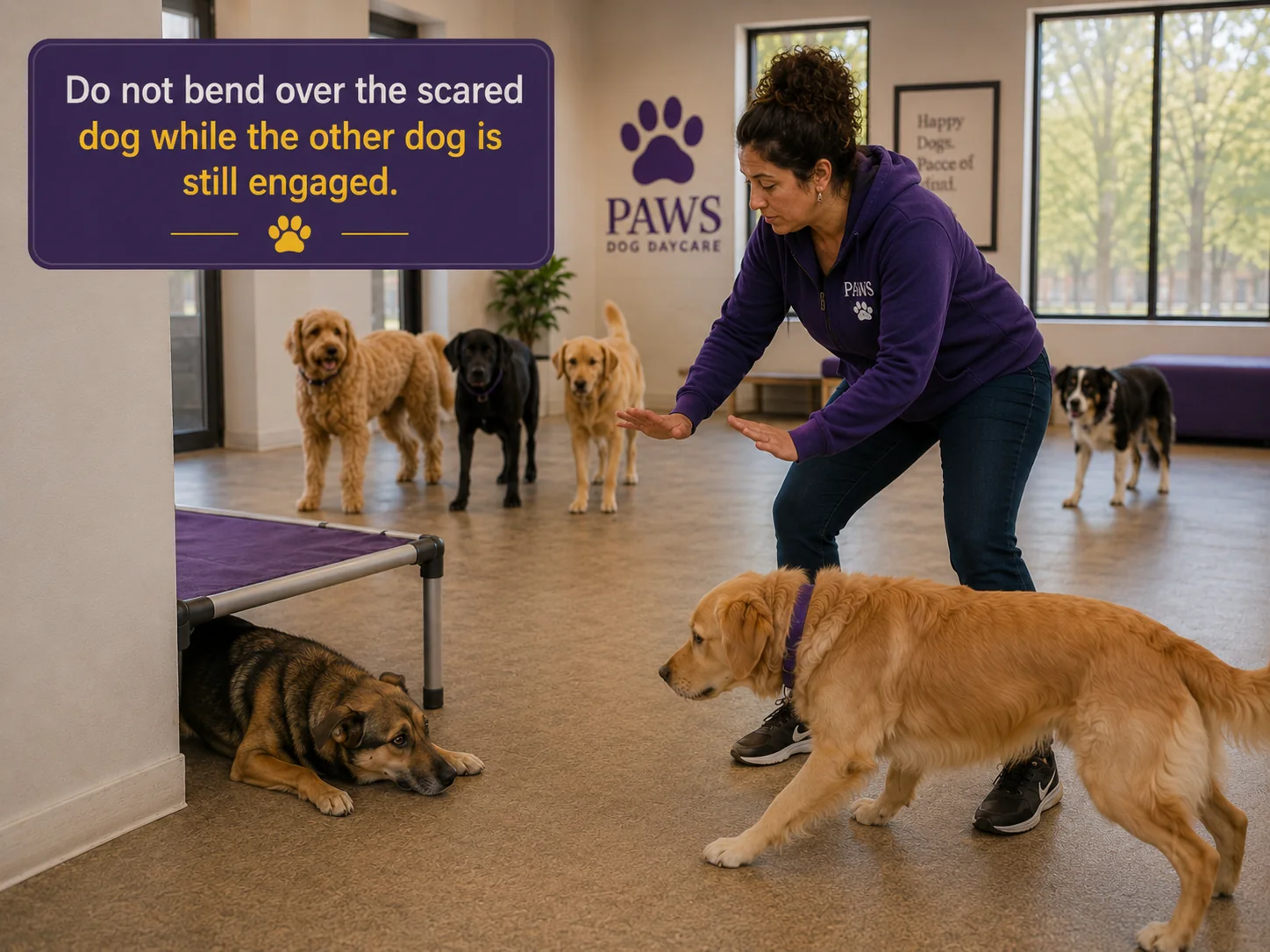
When a frightened dog is crouched, rolled over, frozen, or cornered, staff may instinctively want to reach down and scoop up that dog. That can be dangerous. The dog is already scared, close to the floor, and possibly out of choices. A hand coming down fast may become one more threat.
The submissive dog may bite the staff member. Not because the dog is evil. Because the dog is terrified and the hand arrived at the worst possible time.
There is another problem. If staff reach down toward the submissive dog while the aggressive dog is still engaged, the aggressive dog may read that movement as part of the conflict. He may see the staff member bending over the submissive dog, surge back in, and attack at exactly the moment the person is in the worst possible position.
That is how a staff member ends up bent over between two dogs with one hand on the scared dog, one aggressive dog coming back in, and a brand-new incident report writing itself in real time.
Usually, the cleaner answer is to calmly control the aggressive dog, move that dog away, and give the frightened dog room to stand up and recover.
📌
Handling rule
Control the aggressor first. Space helps the submissive dog more than hands grabbing at it from above.
🪜
The Staff Interruption Ladder
Start early and calm. Escalate only as much as needed.
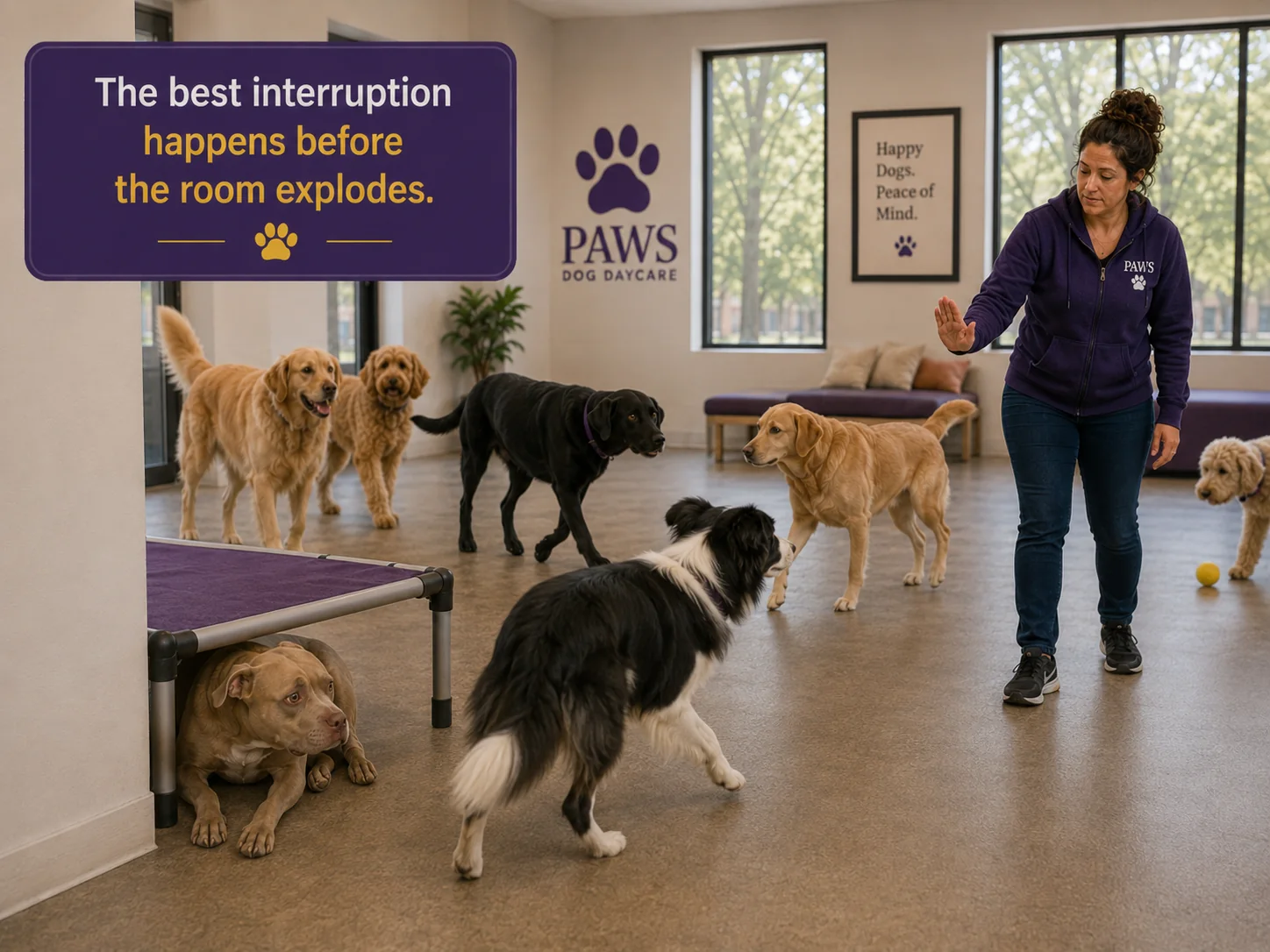
The interruption ladder begins before physical contact. Staff should act when the pushy dog first begins tracking, hovering, blocking, staring, or repeatedly returning to the frightened dog—not after the submissive dog is pinned against a gate.
Use the lowest effective level that safely changes the behavior. A calm cue may work while the dog remains reachable. Body position, a barrier, leash control, separation, or ending the setup becomes necessary as fixation rises.
Each step must create an actual result. Repeating a cue that the dog is ignoring is not calm handling; it is delayed action. Once staff interrupt, they must move the pressure away and protect the frightened dog’s exit.
Swipe left/right to see the full table.
| Step | What Staff Do | Why It Helps |
|---|---|---|
| Early voice cue | Calmly call the aggressive or pushy dog away before fixation builds. | If the dog can still hear staff, use that before the room gets louder. |
| Body movement | Walk in calmly, block the bully behavior, open space, and interrupt the approach. | Staff control space before dogs solve it themselves. |
| Distraction | Use a clean interruption if needed to break fixation, then immediately move the aggressive dog. | The interruption is not the solution. It buys staff a moment to take control. |
| Leash or separate | Remove the aggressive dog if it keeps returning to the frightened dog. | Repeating aggression is a pattern, not a cute moment. |
| End the setup | Rotate, rest, split the group, or end group play for one or both dogs. | Some setups should not be negotiated. They should be stopped. |
🚫
What Not to Do
Bad staff reactions can turn fear into a fight.
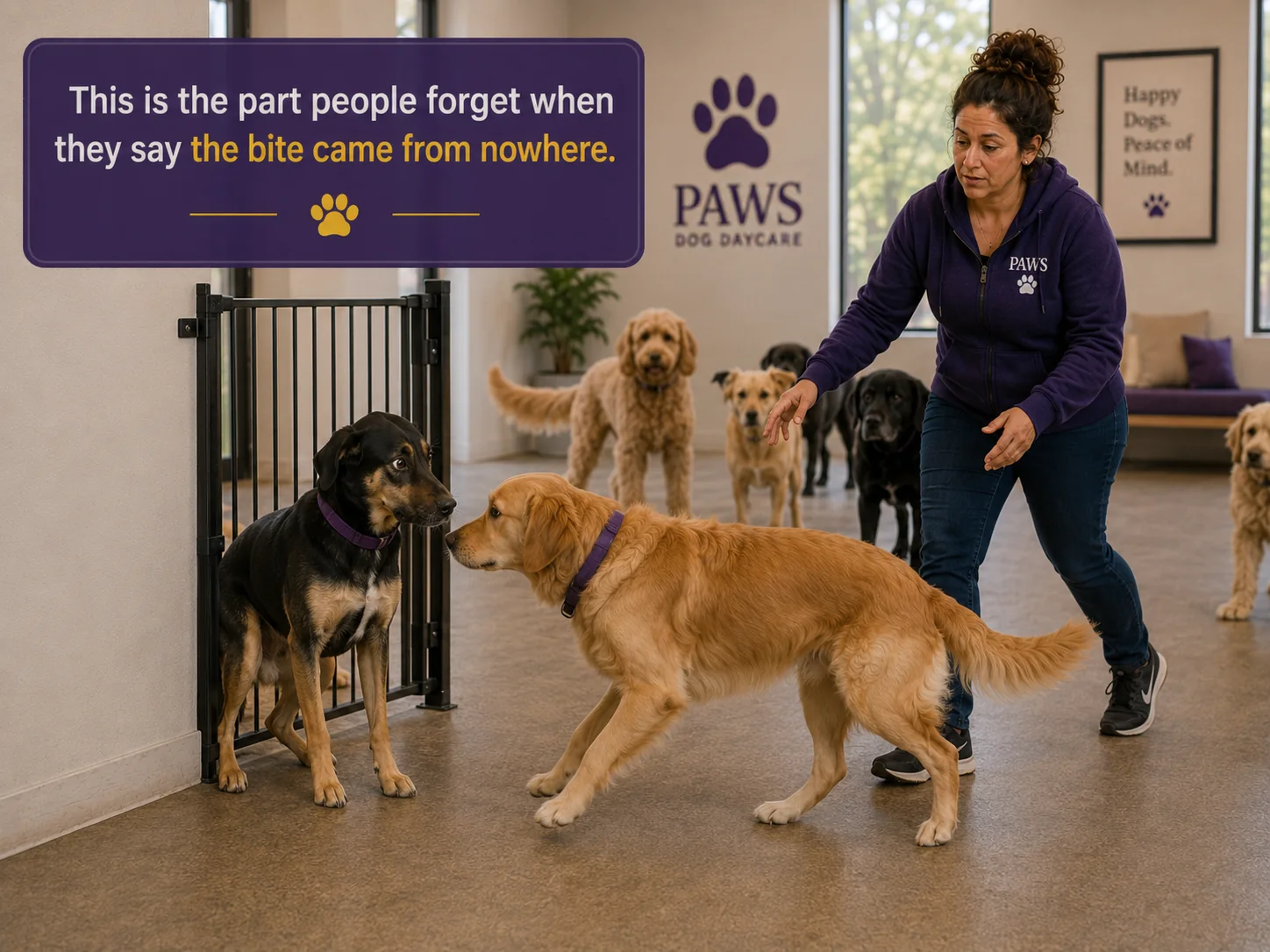
Bad responses usually share one problem: they add pressure to the dog already carrying too much. Yelling, grabbing, crowding, forced greetings, punishment, and immediate reintroduction can turn a preventable fear response into defensive contact.
Staff should review the quiet seconds before the snap. A closed mouth, fixed body, backward weight, whale eye, tucked tail, and blocked escape path may be the dog’s final warning. Waiting for growling or teeth means waiting until the safer information has already been ignored.
The goal is not to prove the dog can tolerate more. The goal is to remove pressure early enough that the dog does not need to become dangerous to be believed.
- Do not yell at the room unless there is an immediate emergency.
- Do not scold the frightened dog for growling, showing teeth, urinating, or trying to leave.
- Do not punish the warning out of the dog. If staff teach the dog that growling gets punished, the dog may skip the growl next time and go straight to teeth.
- Do not mock or dismiss the dog for releasing anal-gland odor. The smell may be disgusting, but the information is useful.
- Do not drag the submissive dog into the group to “make it socialize.”
- Do not let the aggressive dog keep standing over, mounting, pawing, staring, or crowding the dog on the floor.
- Do not reach down between dogs unless staff safety requires it and the handler knows what they are doing.
- Do not write “started fight” in the notes if the submissive dog had been bullied before snapping.
⚠️
Staff rule
The dog that makes the final noise is not always the dog that created the problem. Watch the whole sequence.
📝
What Staff Should Document
“Had a rough moment” is not useful. Write what actually happened.
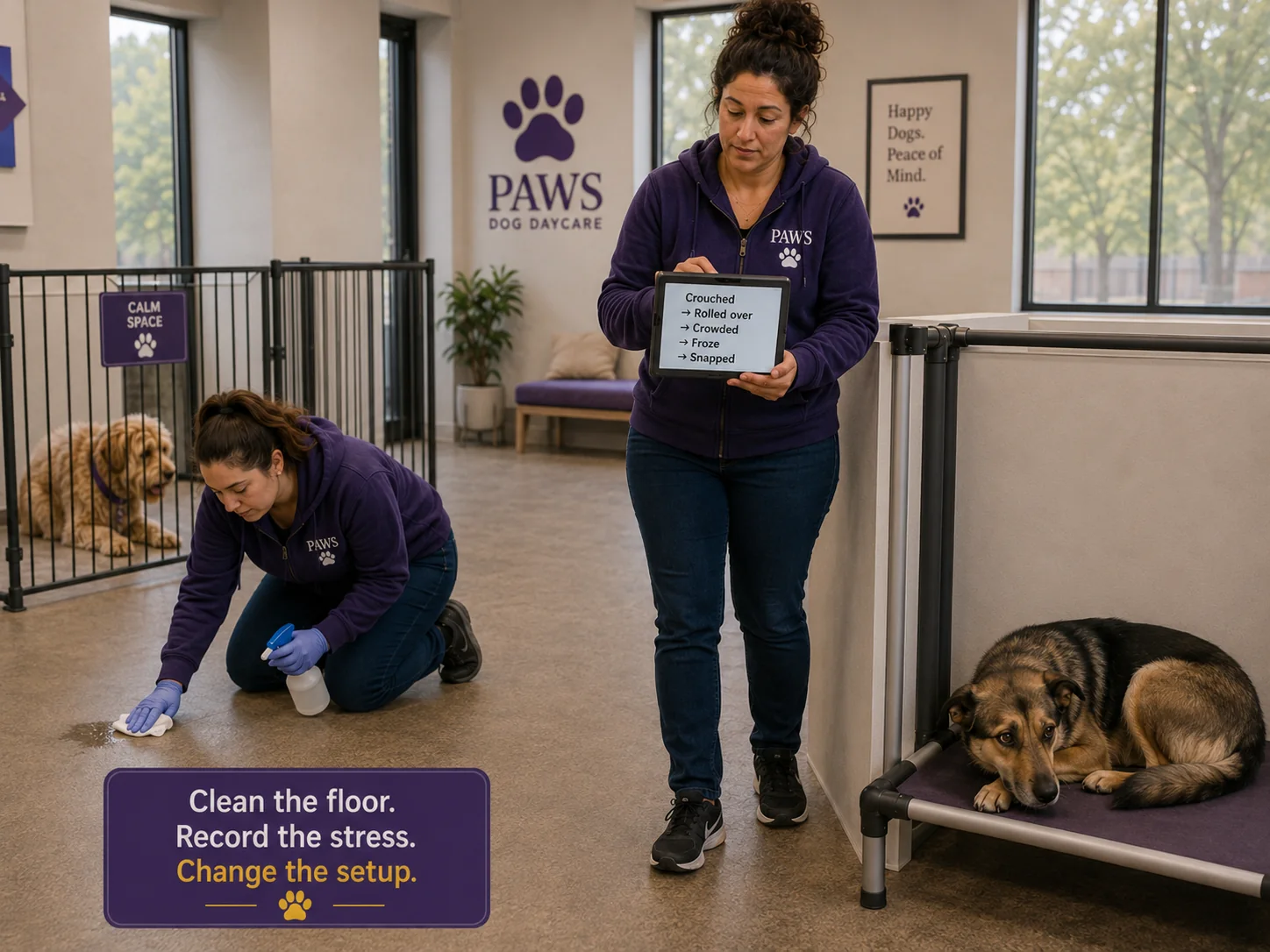
Fear behavior should be documented clearly because the next visit depends on it. Staff need to know which dog showed fear, which dog was acting aggressive, what the aggressive dog did, what warning signs appeared, what staff tried, whether the submissive dog recovered, and whether the same pairing should happen again.
Documentation also protects the business. If a frightened dog snaps after being bullied, the record should show the full pattern, not just the final mouth movement.
Include body-fluid clues too. Submissive urination and anal-gland release can matter because they show the dog was under stress before the incident. That does not excuse a bite, but it helps explain the setup and prevents staff from pretending the reaction came out of nowhere.
Staff notes should capture the setup, not just the ending. “Dog snapped” is weak. “Submissive dog rolled over, dominant dog stood over and pawed, staff interrupted late, submissive dog snapped when cornered near gate” is useful. That note can actually prevent the next incident.
Include the room conditions as well as the dogs. Note gate position, crowding, noise, available exits, resources, staff location, and whether the frightened dog had been approached repeatedly. Those details explain why a pairing failed in one setup and may work in another.
Documentation should produce a change. The next visit should reflect the record through different partners, earlier interruption, more space, shorter exposure, a revised gate plan, or no repeat of the pairing. Notes that do not influence practice merely preserve the story of a preventable incident.
- Which dog showed fear or submissive behavior?
- Which dog was acting aggressive, dominant, pushy, or bullying?
- What fear signs appeared before growling, snapping, or contact?
- Did the dog urinate, defecate, or release anal-gland odor during the fear response?
- Did staff control the aggressive dog early enough?
- Did the frightened dog recover after space, rest, or separation?
- Should this pairing, room, or group size be changed next time?
✅
Frightened or Highly Submissive Behavior Checklist
Use this when staff see a dog shrinking, freezing, rolling over, urinating, or trying to avoid conflict.
Use this checklist while the interaction is developing, not only after an incident. Staff should identify the frightened dog, the pressure dog, the available exits, and the earliest safe interruption before the dog on the floor has to create distance with its mouth.
The answers should lead to an immediate operating decision: interrupt, leash, rotate, separate, change the group, provide recovery space, or end the setup. A checklist that produces no action does not protect the dog.
Afterward, compare recovery with the dog’s normal baseline. If posture, movement, curiosity, and willingness to engage do not return, the dog may need a quieter service plan or the visit may need to end.
- Is the dog trying to move away, hide, crouch, freeze, roll over, or avoid contact?
- Is another dog continuing to approach, stand over, mount, paw, stare, or crowd?
- Does the frightened dog have an escape path?
- Can staff calmly move the aggressive dog away before the frightened dog snaps?
- Is the frightened dog recovering after space, or staying overwhelmed?
- Should these dogs be separated, rotated, or no longer matched together?
- Did staff document the full sequence instead of only the final reaction?
❓
Frightened Dog Behavior FAQ
Detailed answers about submissive signals, fear biting, body language, staff positioning, interruption, recovery, documentation, pairing decisions, and fight prevention.
Is rolling onto the back always submission?
No. Some dogs roll during relaxed play and remain loose, wiggly, and willing to re-engage. A frightened dog may be stiff, tucked, wide-eyed, frozen, urinating, or trying to stop the interaction. Staff must read the whole dog and the surrounding pressure.
What does highly submissive behavior mean in daycare?
It usually means the dog is trying to reduce conflict by looking small, harmless, young, or non-threatening. Crouching, lowering the body, licking from a low position, rolling over, freezing, and urinating may all communicate that the dog does not want a confrontation.
Why can a submissive dog still bite?
Submission works only when the other dog accepts it. If the frightened dog cannot flee and softer signals fail, snapping or biting may become the only remaining way to create distance. The bite is still serious, but staff must understand the pressure sequence that produced it.
What warning signs often appear before a fear snap?
Common signs include turning away, lip licking, yawning, whale eye, lifted paw, tucked tail, closed mouth, backward weight, freezing, hiding, and repeated attempts to leave. The final snap may be fast, but the earlier warnings are often visible.
Does a wagging tail mean the frightened dog is friendly?
Not by itself. Tail movement must be read with posture, height, stiffness, facial tension, weight shift, movement, and context. A low or tight wag can occur during uncertainty or appeasement and should not override the rest of the dog’s body.
Why might a frightened dog urinate or release anal-gland odor?
Extreme fear and appeasement can produce involuntary urination or anal-gland release. These are stress clues, not misconduct. Staff should clean discreetly, reduce pressure, document the sequence, and change the conditions that produced the response.
Should staff grab the scared dog first?
Usually no. Reaching down can add another threat, put hands and the handler’s face in the bite zone, and draw the engaged dog back into the conflict. It is often safer to control the dog creating pressure first and give the frightened dog room to recover.
Which dog should staff control first?
When possible, control the dog that is standing over, crowding, mounting, pawing, tracking, or repeatedly returning to the frightened dog. Removing the pressure creates space without forcing more handling onto the dog already overwhelmed.
Should staff yell to stop the behavior?
Routine yelling usually adds arousal and can make the pushy dog more intense, the frightened dog more panicked, and the rest of the room more interested. Calm early interruption is preferable. Loud emergency action may be necessary in immediate danger, but it should not be the normal plan.
What is the interruption ladder?
It is a progression from early voice cues and body movement to barriers, distraction, leash control, separation, and ending the setup. Staff begin with the lowest effective level while the dog remains reachable and escalate only enough to create safety.
Why is freezing dangerous?
Freezing can mean the dog has run out of safe choices and is waiting under intense pressure. Staff sometimes misread stillness as cooperation. A frozen dog needs more space and less pressure before panic or defensive contact follows.
How does the room contribute to a fear incident?
Noise, crowding, gate placement, blocked movement, resources, flooring, fast staff movement, and lack of an exit can stack with social pressure. The incident is often produced by the full setup rather than one dog alone.
What is fear stacking?
Fear stacking happens when multiple manageable stressors combine: a face rush, loud barking, crowding, a nearby gate, a dog standing over the frightened dog, and no escape path. The total can push the dog past the point where avoidance still works.
What does a real reset require?
A real reset changes something meaningful: distance, pairing, group size, room, barrier placement, handling plan, or time. Separating dogs briefly and immediately returning them to the same conditions does not remove the cause.
How long should the frightened dog recover before re-entry?
There is no single clock. Staff should look for normal posture, movement, curiosity, breathing, orientation, and voluntary engagement. If the dog remains frozen, avoidant, or hypervigilant, it is not ready for the same social demand.
Should the frightened dog be punished for growling or snapping?
No. Punishing warnings may suppress communication without reducing fear, making future behavior less predictable. Staff should create safety, document the trigger, and decide whether the dog can remain in that setup.
What should staff document after a fear incident?
Record the dogs involved, body-language sequence, pressure behavior, room conditions, exits, staff position, interruption used, fluids or odor released, recovery, and the changes required for the next visit. The record should describe the setup, not only the final mouth movement.
Can frightened dogs improve in daycare?
Some can with slow exposure, calm partners, predictable staff, short successful sessions, protected exits, and honest documentation. Others may need smaller groups, private care, training support, veterinary input, or no open play.
When should the pairing be permanently stopped?
Stop repeating the pairing when one dog persistently pressures the other, the frightened dog cannot recover, defensive contact occurs, or staff must constantly intervene to prevent escalation. A pairing should not continue merely because the dogs have not yet caused a serious injury.
What is the main operating rule for frightened or highly submissive behavior?
Believe the quiet warning early. Control the dog creating pressure, open an escape path, keep staff out of the bite zone, and change the setup before the frightened dog has to use teeth to create safety.
🐾
The Bottom Line: Fear Signals Are Early Warnings, Not Annoying Drama
Read them early, control the aggressor, and prevent the bite before the scared dog runs out of options.
Frightened or highly submissive behavior is not something staff should laugh off, punish, or ignore. It is the dog telling the room that the current situation is too much.
If the aggressive dog respects the signal, the moment may pass quietly. If the aggressive dog keeps pushing, the frightened dog may become defensive. That is where daycare staff earn their paycheck: reading the moment before it turns into teeth.
Good staff do not wait for the loud version. They see the low body, the frozen face, the rolled belly, the tucked tail, the submissive urination, the dominant dog standing over him, and they step in before the incident report writes itself.
A real recovery plan protects the frightened dog without turning the entire room into a rescue mission. Staff should restore supervision to the group, place the pressure dog under control, and give the frightened dog a quieter setup that can be evaluated honestly.
The measure of success is not whether the dogs can be placed back together quickly. Success is whether the dog regains normal posture, movement, curiosity, and choice under safer conditions—and whether staff learn enough to prevent the same pressure sequence next time.