Dog Daycare Poisoning • Toxin Exposure • Poison Control • Pet First Aid • Emergency Vet Transport • Staff Roles • Incident Documentation
How to Identify and Respond to Dog Poisoning in a Daycare Facility
If a dog is convulsing on your floor, Google is not the emergency plan.
Poisoning cases in dogs require accurate assessment and rapid effective action. The first problem is that poisoning does not always announce itself neatly. Symptoms vary from dog to dog, toxin to toxin, dose to dose, and exposure route to exposure route.
A poisoned dog may drool, vomit, stagger, tremble, collapse, seize, act dull, become frantic, lose coordination, develop pale gums, have diarrhea, have trouble breathing, or simply look wrong. Another dog may look fine for a while and then crash later. That is what makes poisoning dangerous in a daycare setting.
The daycare’s job is not to play veterinarian with kitchen remedies. The daycare’s job is to secure the dog, identify the toxin, call the right poison-control or veterinary authority, follow directions, prepare transport, control the rest of the room, and document what happened.
You need to know the first steps almost instinctively because there may be precious little time available. If staff are standing around trying to research the problem while the dog is shaking, seizing, vomiting, or losing coordination, the business is already behind.
☠️
Emergency order of operations
Remove the dog from the exposure, control the room, check airway and breathing, identify the substance, call animal poison control or the emergency vet, do not induce vomiting unless directed, do not give charcoal unless directed, prepare transport, and document the timeline.
⚠️
This page does not replace veterinary care, animal poison control, or hands-on pet first-aid training.
Poisoning response is high-risk because the wrong treatment can make the dog worse. Staff should not guess, dose, induce vomiting, give charcoal, give medication, give oils, or force fluids unless a veterinarian, emergency clinic, or animal poison-control professional tells them to do it.
🗺️
Use This Page Like a Poison Emergency Response Map
Poisoning response is recognition, identification, poison-control contact, vet coordination, transport, documentation, and prevention. Guessing is not a system.
🚫
Do Not Guess
Vomiting, charcoal, salt, oils, and medication mistakes can hurt the dog.
🧪
Exposure Types
Ingested, topical, inhaled, eye, and unknown exposures need different handling.
🏠
Daycare Toxin Sources
Common facility risks: cleaners, plants, medications, foods, pesticides, and bags.
🚗
Exposure Before Drop-Off
The dog may have arrived already exposed from home, a car, yard, bag, garage, trash, or medication.
🏠
Household Poison Hub
Link to the household poison reference hub when the source may have come from outside the facility.
☎️
Poison Control: Call Now Resources
These numbers should be posted by the phone, stored in the daycare cell phone, and printed inside the emergency binder.
☠️
ASPCA Animal Poison Control
24/7 animal poison emergency resource. Consultation fee may apply.
☎️
Pet Poison Helpline
24/7 animal poison-control service. Consultation fee may apply.
🏥
Emergency Vet
Your local emergency clinic should be called early when the dog is symptomatic or transport is likely.
🎓
Red Cross Pet First Aid Training
Useful for staff training and first-aid education before an emergency. This is not the poison-control number to call during a toxin exposure.
⚠️
Call rule
Do not wait until the dog is convulsing to make the call. If staff know or suspect a dog got into a toxin, call animal poison control or the emergency vet and get real instructions.
📌
Call preparation rule
Keep a business payment card available for poison-control consultation fees and write down the case number if one is provided. If the dog goes to the emergency vet, send the case number, product label, active ingredients, estimated dose, symptoms, and timeline with the dog.
🚨
Dog Poisoning Symptoms Staff Must Recognize
Poisoning can look like stomach trouble, neurologic trouble, breathing trouble, collapse, or just a dog that suddenly looks wrong.
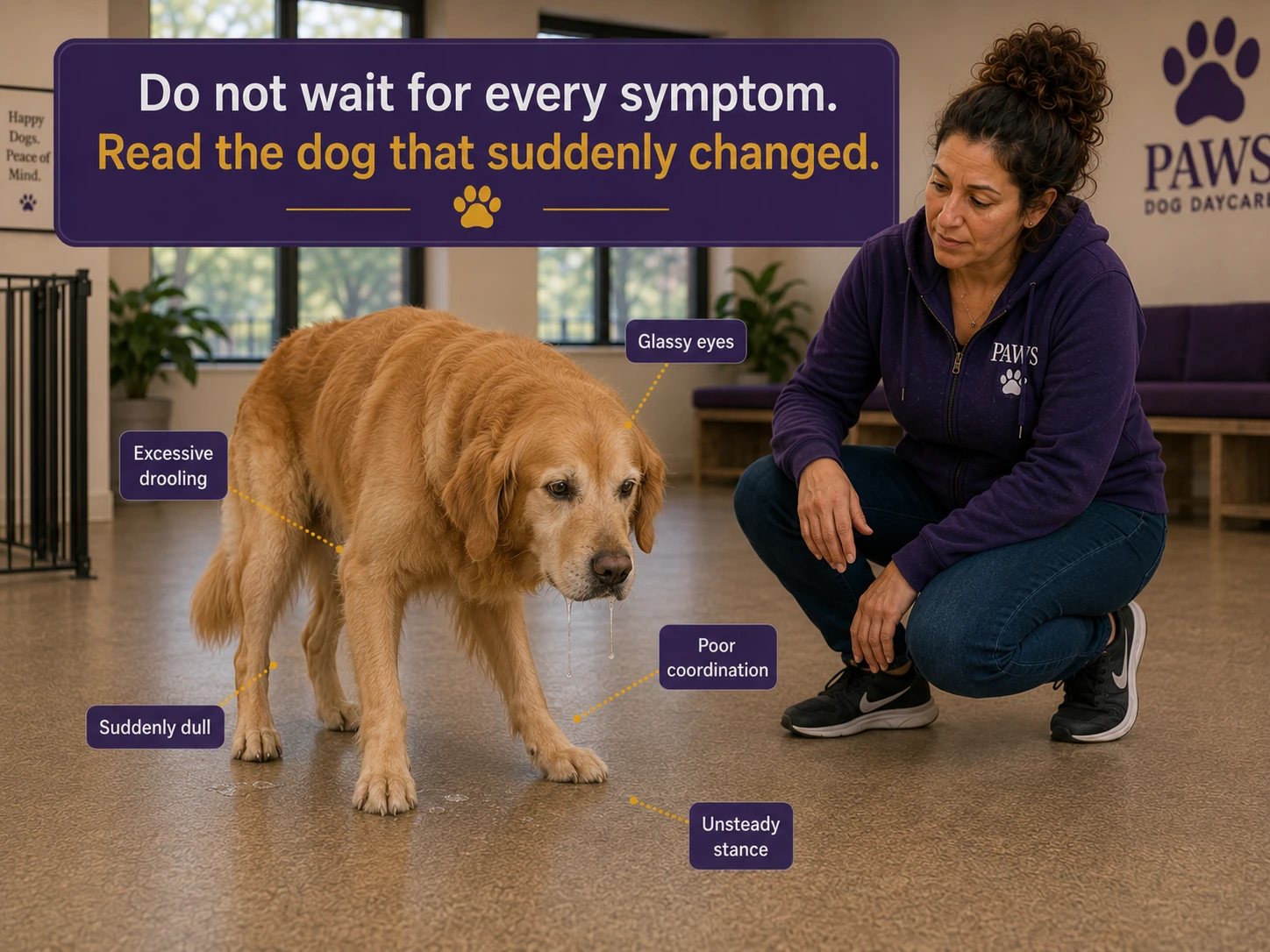
Signs that a dog may have been poisoned often include drooling, vomiting, fatigue, convulsions, lethargy, tremors, diarrhea, weakness, pale gums, abnormal heart rate, trouble breathing, agitation, collapse, and loss of coordination.
Many things can make a dog sick. The concern goes up when an otherwise normal dog suddenly develops multiple symptoms, symptoms appear after a known or suspected exposure, another dog got into the same area, or staff find evidence such as chewed packaging, spilled cleaner, chewed plants, medication, bait, food wrappers, or chemical residue.
Staff should not get tunnel vision. Not every poisoning looks like vomiting. Some toxins hit the nervous system. Some hit the kidneys. Some hit the liver. Some affect blood clotting. Some burn the mouth and throat. Some make the dog weak, shaky, drunk-looking, or strangely quiet.
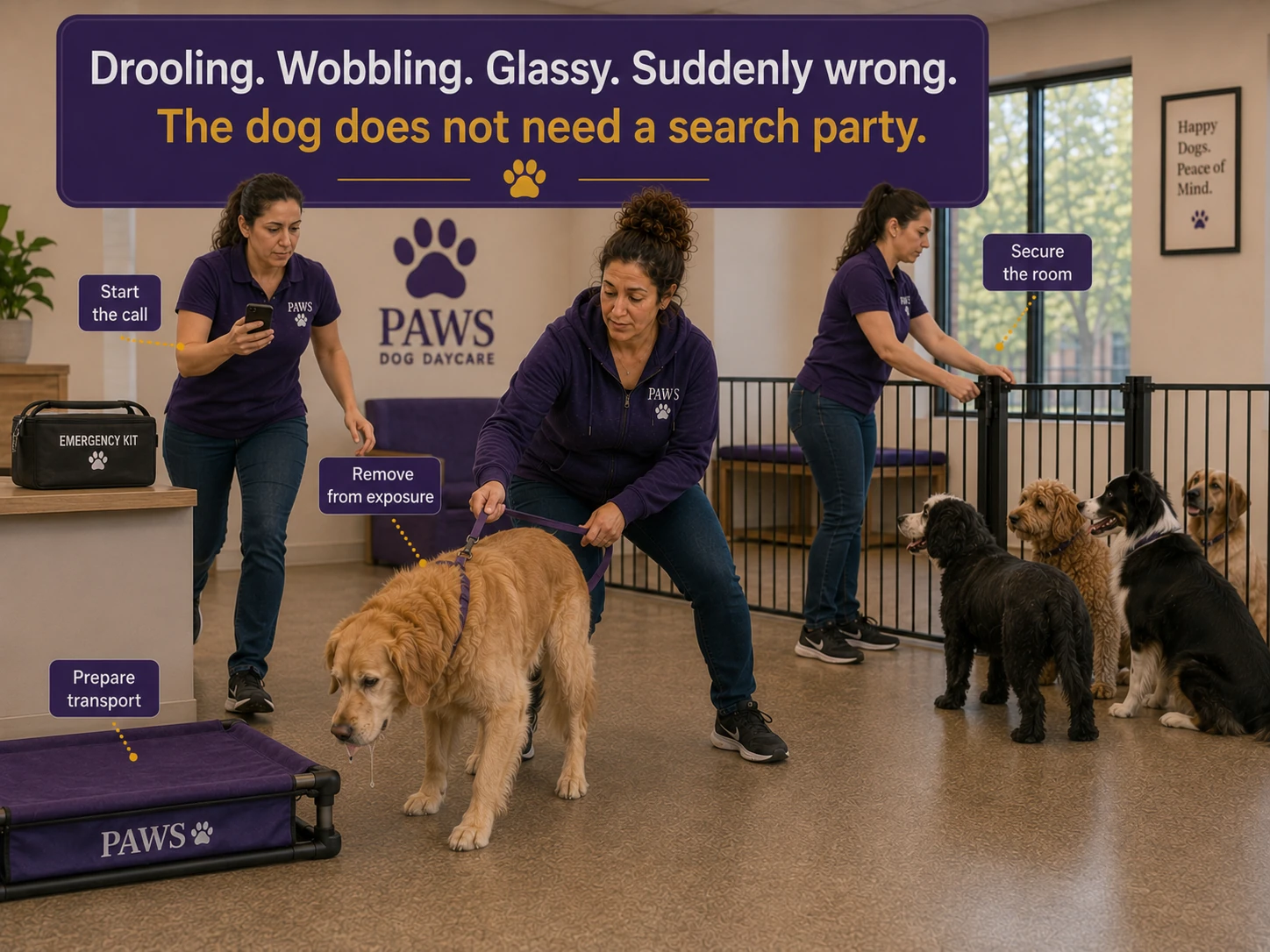
Staff should respond to the change, not wait for a perfect textbook pattern. A dog that suddenly becomes glassy, unsteady, dull, excessively drooly, agitated, or unable to coordinate normally has already earned removal from group activity and immediate evaluation.
The absence of vomiting does not make poisoning unlikely. A toxin may first affect the nervous system, breathing, circulation, blood clotting, kidneys, liver, skin, eyes, or behavior. The operating question is whether the dog changed suddenly and whether exposure is possible.
Swipe left/right to see the full table.
| Symptom Group | What Staff May See | Operator Read |
|---|---|---|
| Mouth and stomach signs | Drooling, foaming, vomiting, retching, diarrhea, nausea, pawing at mouth, burned lips or tongue. | Possible ingestion, caustic exposure, plant exposure, chemical exposure, or toxin irritation. |
| Neurologic signs | Tremors, seizures, twitching, wobbling, loss of coordination, stumbling, glassy eyes. | Emergency. Do not stand around debating whether the dog is “acting weird.” |
| Weakness or collapse | Lethargy, sudden fatigue, collapse, inability to stand, dull behavior, fainting. | Serious concern, especially with known exposure or other symptoms. |
| Breathing or gum changes | Trouble breathing, pale gums, blue gums, muddy gums, excessive panting, abnormal pulse. | Emergency vet now. This is not a watch-and-wait situation. |
| Bleeding or bruising | Nosebleeds, bloody vomit, bloody stool, bruising, weakness, pale gums. | Possible anticoagulant toxin or serious internal problem. Vet care is urgent. |
| Sudden behavior change | Panic, agitation, disorientation, hiding, abnormal quietness, confusion. | Do not ignore a dog that suddenly becomes a different dog. |
⏱️
The First Five Minutes of a Poisoning Emergency
The first few minutes are not for guessing. They are for controlling the scene and getting the right authority on the phone.
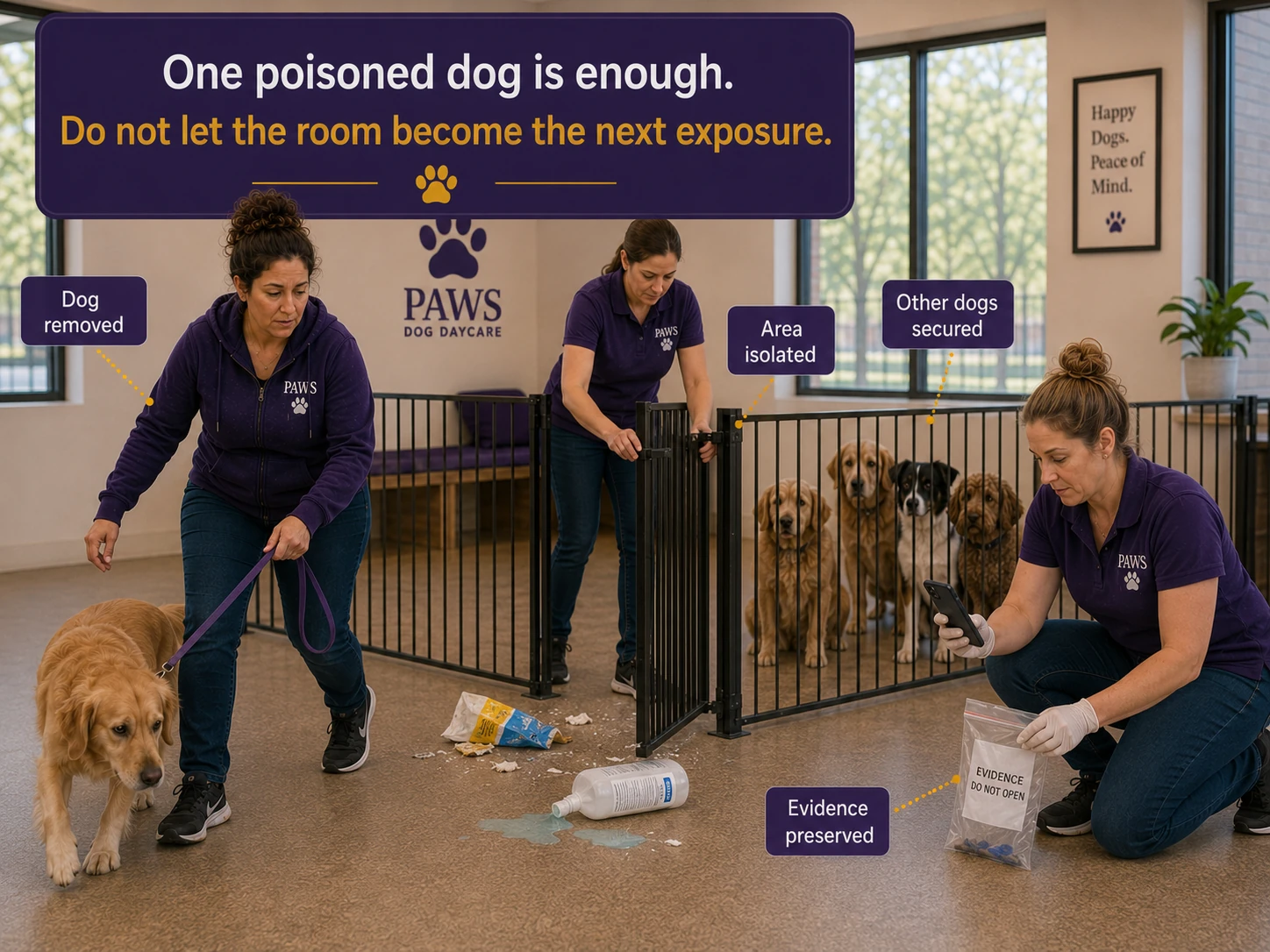
Once staff suspect poisoning, remove the dog from the exposure immediately. Secure the area so other dogs do not get into the same substance. Control the room. One poisoned dog is bad enough. Do not let the rest of the group turn the exposure into a buffet.
Check the dog’s airway, breathing, gum color, consciousness, coordination, tremors, vomiting, and seizure activity. If the dog is actively seizing, collapsed, struggling to breathe, unconscious, bleeding, or deteriorating, call the emergency vet while preparing transport.
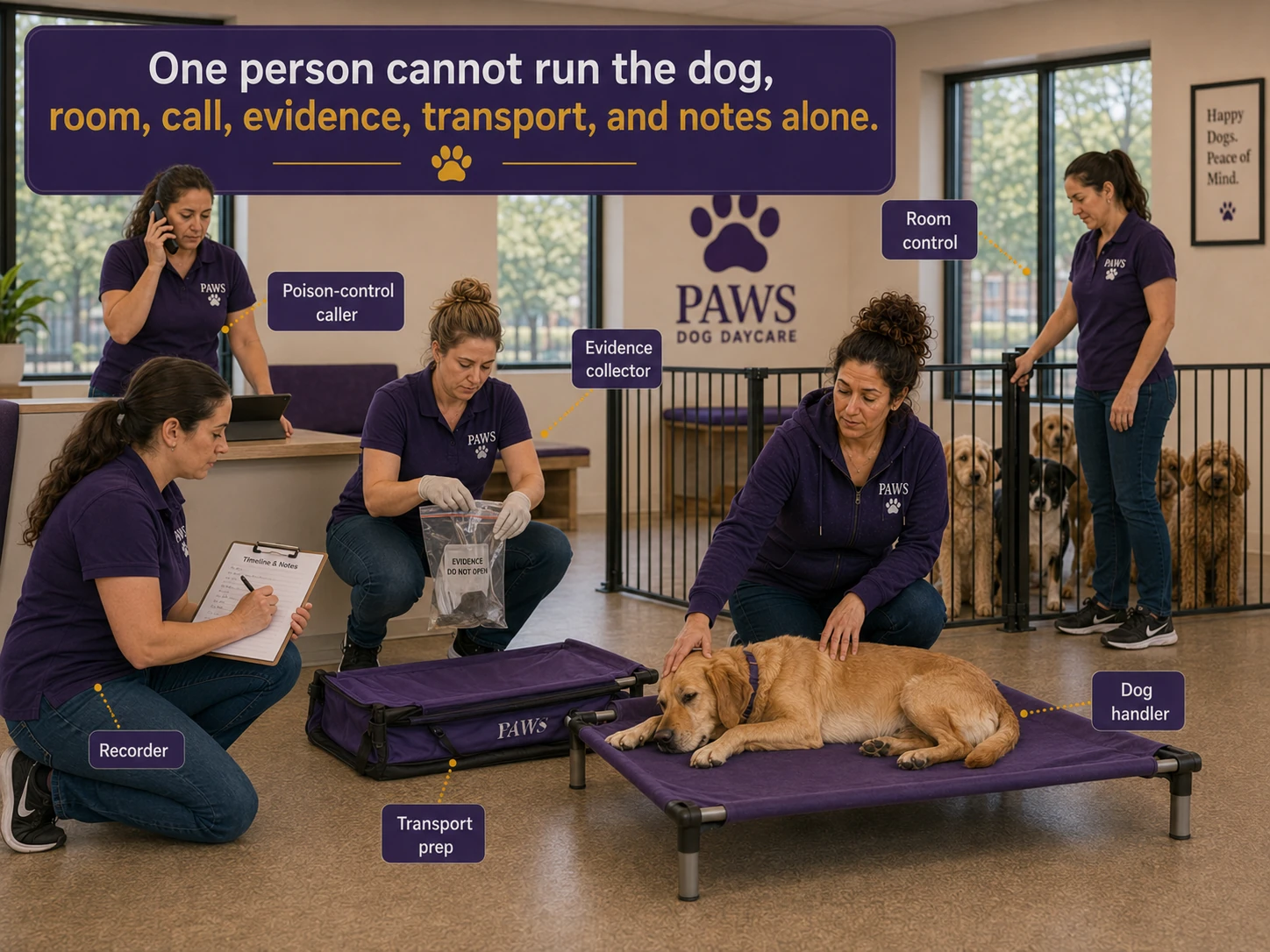
Assign one person to the dog, one to the room, one to call poison control or the emergency vet, one to collect packaging or evidence, and one to document the timeline if staffing allows. In a small facility, one person may wear several hats, but the jobs still have to happen.
Scene control must include contamination control. Staff should identify who may have walked through, licked, inhaled, or contacted the same material, isolate the area, and keep cleanup from destroying the label, residue, package, or other evidence needed by the veterinarian.
Do not send every employee searching the building while nobody stays with the dog. The dog handler monitors breathing, gums, consciousness, vomiting, tremors, and coordination while the caller and evidence collector work in parallel.
- Remove the dog from the exposure.
- Secure the area so no other dog can access the substance.
- Check airway, breathing, gum color, responsiveness, tremors, vomiting, and coordination.
- Identify the substance, package, plant, medication, bait, food, cleaner, or chemical if possible.
- Call animal poison control or the emergency vet.
- Do not induce vomiting unless specifically directed.
- Do not give activated charcoal unless specifically directed.
- Prepare transport if the dog is symptomatic, the toxin is serious, or the vet/poison-control professional directs it.
🧾
What Staff Should Collect Before or During the Call
Poison control needs facts. “He ate something bad” is not enough.
Do not delay a call while trying to build a perfect report. Call early. But as one person calls, another should gather the useful facts: what the dog got into, how much may be missing, when it happened, what symptoms are showing, the dog’s weight, age, breed, medical history, and any medications.
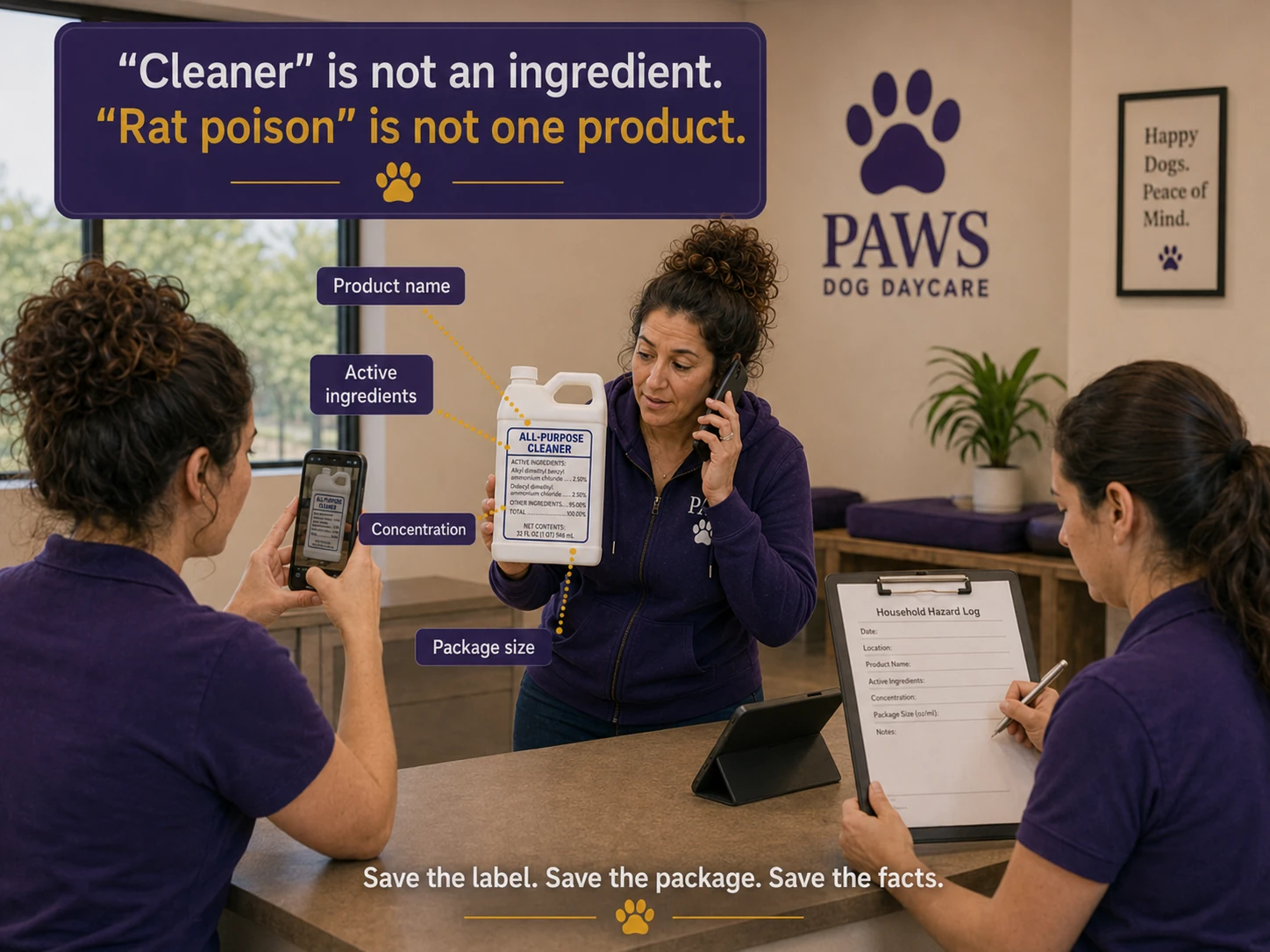
Save the package, label, plant piece, wrapper, bait box, medication bottle, cleaner container, vomit sample if safely collected, or photos of the scene. The label may matter more than staff opinions. “Rat poison” is not one thing. “Cleaner” is not one thing. “Mushroom” is not one thing. Details change treatment.
Photograph the full front and back of the product label before anything is discarded or cleaned. Record the exact product name, active ingredients, concentration, package size, lot information when visible, and the maximum possible amount missing.
The estimate should be honest rather than optimistic. Poison-control professionals need the largest amount the dog could reasonably have accessed, not the amount staff hope was consumed. Uncertainty belongs in the report.
- Dog’s name, breed, approximate weight, age, and known medical issues.
- What the dog may have eaten, licked, inhaled, rolled in, or walked through.
- Time of possible exposure and when symptoms started.
- Estimated amount missing or maximum possible amount.
- Packaging, labels, ingredients, active ingredients, concentration, photos, or plant material.
- Symptoms: vomiting, drooling, tremors, seizures, diarrhea, weakness, collapse, gum color, breathing changes.
- Any first-aid steps already taken.
- Owner contact information and authorization for emergency veterinary treatment.
🚫
Do Not Use Cowboy Poisoning Treatment
The wrong “first aid” can make the poisoning worse.
The old shortcut of “corrosives do one thing, non-corrosives do another thing” is too simple for a real daycare emergency. Some toxins should not come back up. Some dogs are not safe to vomit. Some substances burn twice if they come back through the throat. Some petroleum products can enter the lungs. Some dogs are already weak, seizing, or not alert enough to protect their airway.
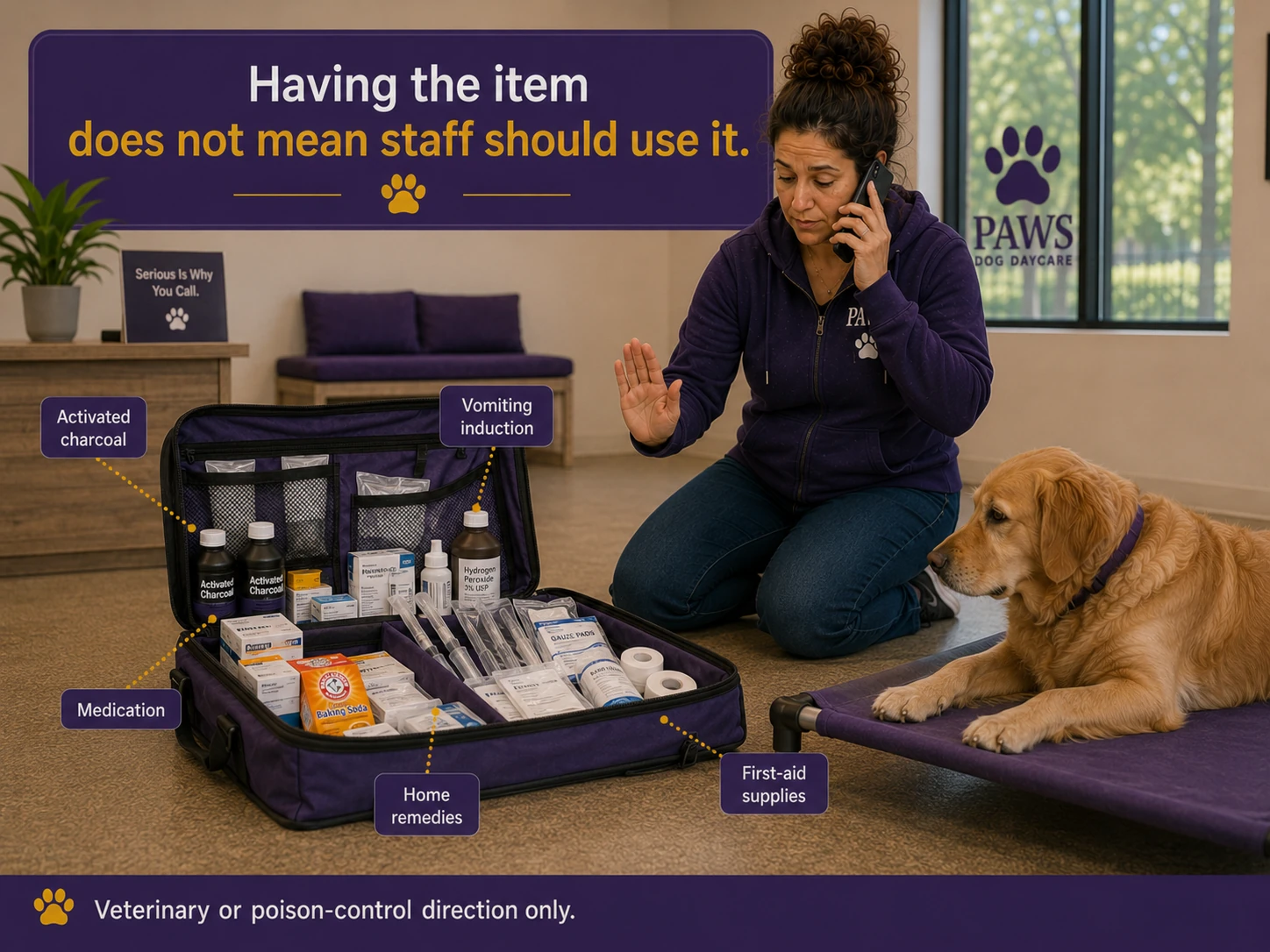
Do not induce vomiting unless a veterinarian, emergency clinic, ASPCA Animal Poison Control, or Pet Poison Helpline tells you to do it. Do not use salt. Do not use syrup of ipecac as a normal daycare response. Do not give oil because something sounds “corrosive.” Do not give activated charcoal because it sounds serious. Serious is exactly why you call.
Hydrogen peroxide may be used in some dog poisoning cases under professional direction, but it is not a blanket daycare procedure. Activated charcoal may be useful for some toxins under professional direction, but it is not a magic sponge and it is not appropriate for every case.
Possessing charcoal, peroxide, medication, syringes, oils, milk, or other emergency supplies does not authorize their use. The same treatment may help one exposure and harm another because toxin type, dose, timing, symptoms, airway safety, and the dog’s medical condition all matter.
Staff should write down the exact instructions, dose if one is professionally directed, time given, product used, and person authorizing it. Verbal memory is not enough in a poisoning event.
Swipe left/right to see the full table.
| Item or Action | Why It Is Dangerous to Guess | Daycare Rule |
|---|---|---|
| Inducing vomiting | Wrong for some toxins, sharp objects, caustics, petroleum products, seizures, weakness, or airway risk. | Only when directed by vet or animal poison control. |
| Salt | Can cause sodium poisoning and severe neurologic problems. | Do not use. |
| Syrup of ipecac | Not an appropriate routine daycare response and can create additional risk. | Do not use unless specifically directed by a veterinarian. |
| Hydrogen peroxide | Can be wrong depending on toxin, timing, dog condition, and airway risk. | Veterinary or poison-control direction only. |
| Activated charcoal | Not useful for every toxin and can create aspiration or dosing problems. | Veterinary or poison-control direction only. |
| Oil, milk, food, or home antidotes | Can delay care, worsen aspiration risk, or interfere with proper treatment. | Do not improvise antidotes. |
| Forcing water | Weak, seizing, vomiting, or altered dogs may aspirate. | Do not force fluids into the mouth. |
⚠️
No guessing rule
If staff are not sure what the dog got into, the answer is not to start trying random treatments. The answer is identify what you can, call the right authority, and follow instructions.
🧪
Ingested, Topical, Inhaled, Eye, and Unknown Exposures
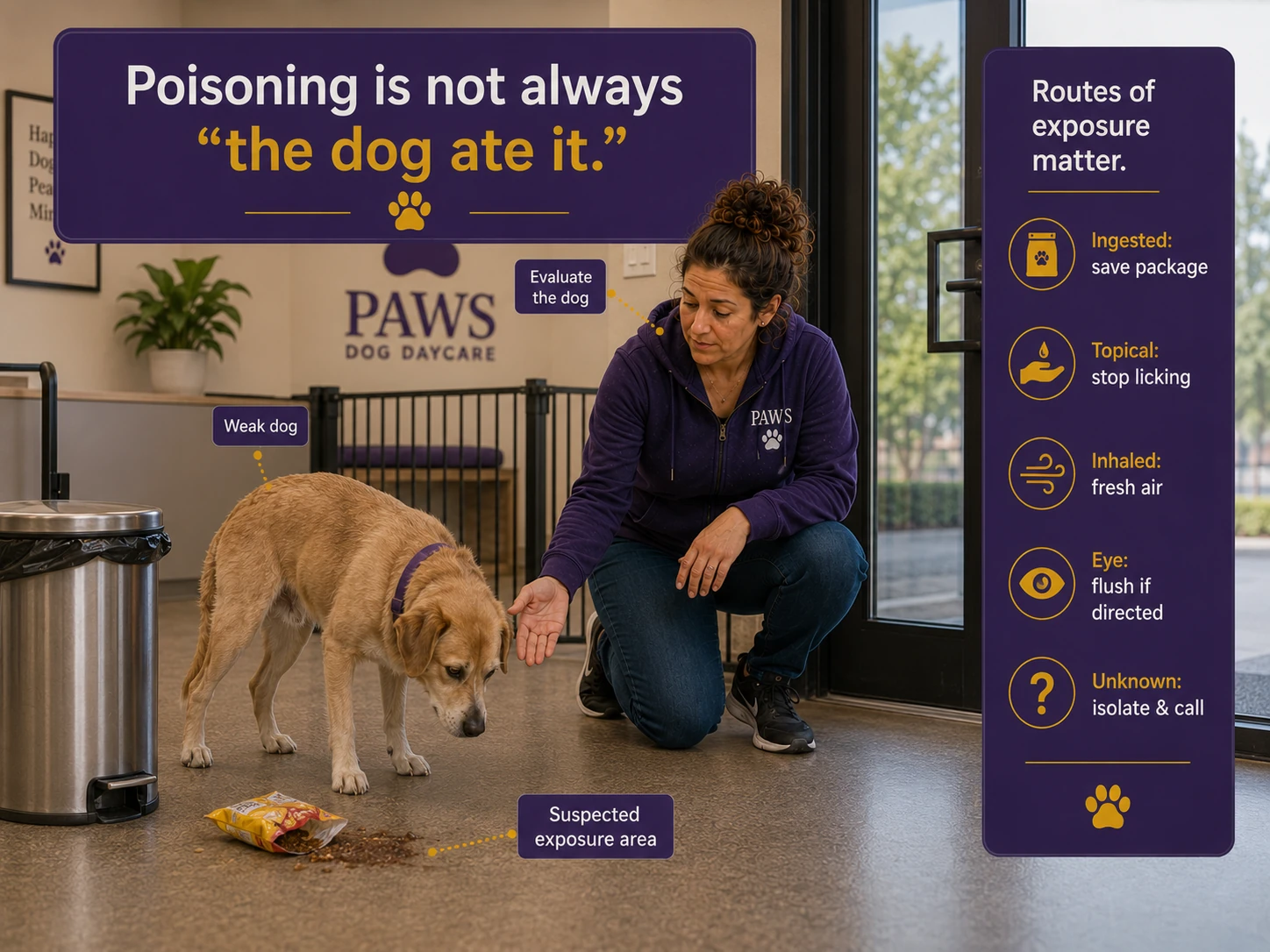
Poisoning is not always “dog ate something.” Exposure route changes the response.
Staff should quickly sort the exposure type without getting cute. Did the dog eat it? Lick it? Walk through it? Roll in it? Breathe it? Get it in the eyes? Chew the package? Vomit it up? Did another dog have access too?
Exposure type matters because the first move may be removing the dog from the area, flushing skin, flushing eyes, ventilating the room, preventing more ingestion, bagging the substance, calling poison control, or transporting immediately.
The route also determines how staff protect themselves and the rest of the facility. Gloves, ventilation, eye protection, isolation, removal of contaminated bedding, and prevention of licking may matter before any treatment question is answered.
Unknown exposure should remain an active category. Staff should not force an ingestion story onto a dog with fumes, topical contamination, eye irritation, or unexplained neurologic signs simply because ingestion is the most familiar poisoning scenario.
Swipe left/right to see the full table.
| Exposure Type | What Staff May Find | First Operator Move |
|---|---|---|
| Ingested | Chewed package, missing pills, eaten food, plant pieces, bait, vomit, wrappers. | Remove access, save evidence, call poison control or vet, do not induce vomiting unless directed. |
| Topical | Chemical on coat, paws, skin, bedding, floor, spilled cleaner, pesticide residue. | Prevent licking, use gloves, follow vet/poison-control direction, flush or bathe only when appropriate. |
| Inhaled | Fumes, smoke, chemical smell, aerosol, cleaning product vapor, poor ventilation. | Move dog to fresh air, ventilate area if safe, call vet, watch breathing. |
| Eye exposure | Squinting, pawing face, red eye, chemical splash, shampoo or cleaner exposure. | Flush with sterile saline or clean water if appropriate and call vet. Do not rub the eye. |
| Unknown | Symptoms but no obvious source. | Treat as serious. Search the room, isolate possible exposure, call vet or poison control with symptoms. |
🏠
Common Dog Daycare Poison Sources
Daycare poisoning is often a facility-control failure before it is a medical emergency.
A daycare is full of things dogs should not eat, lick, chew, inhale, roll in, or steal from bags. Some are obvious. Some are boring until a dog turns them into an emergency.
The facility should control chemicals, medications, human food, plants, pest products, grooming products, owner bags, staff bags, trash, repairs, maintenance areas, and outdoor hazards. “The dog found it” is not a magical explanation. It means the dog had access.
Swipe left/right to see the full table.
| Source | Examples | Control Rule |
|---|---|---|
| Cleaning chemicals | Disinfectants, bleach products, floor cleaners, degreasers, kennel cleaners. | Store locked, dilute correctly, rinse when required, keep dogs away until safe. |
| Human food | Chocolate, xylitol products, grapes/raisins, onions, caffeine, alcohol-containing items. | No staff food, owner food, or trash access in dog areas. |
| Medications | Owner meds, staff meds, dog meds, pill bottles, topical medications. | Locked storage, labeled meds, controlled handling, no bags in reach. |
| Plants and yard hazards | Toxic plants, mushrooms, treated mulch, acorns, unknown yard growth. | Inspect yards and remove unknown plant material before dogs access the area. |
| Pest control | Rodent bait, insect bait, ant traps, pesticides, treated areas. | No accessible bait. Require professional placement away from dogs and document locations. |
| Grooming products | Shampoos, ear cleaners, sprays, flea products, medicated products. | Store controlled and prevent licking, spills, and cross-use. |
| Staff and owner bags | Gum, snacks, prescriptions, supplements, vapes, candy, lotions, food wrappers. | Bags stay out of dog reach. Period. |
| Trash and maintenance | Food trash, chemical rags, caulk, paint, glue, batteries, hardware. | Covered trash, locked maintenance, dog-free repair zones. |
🚗
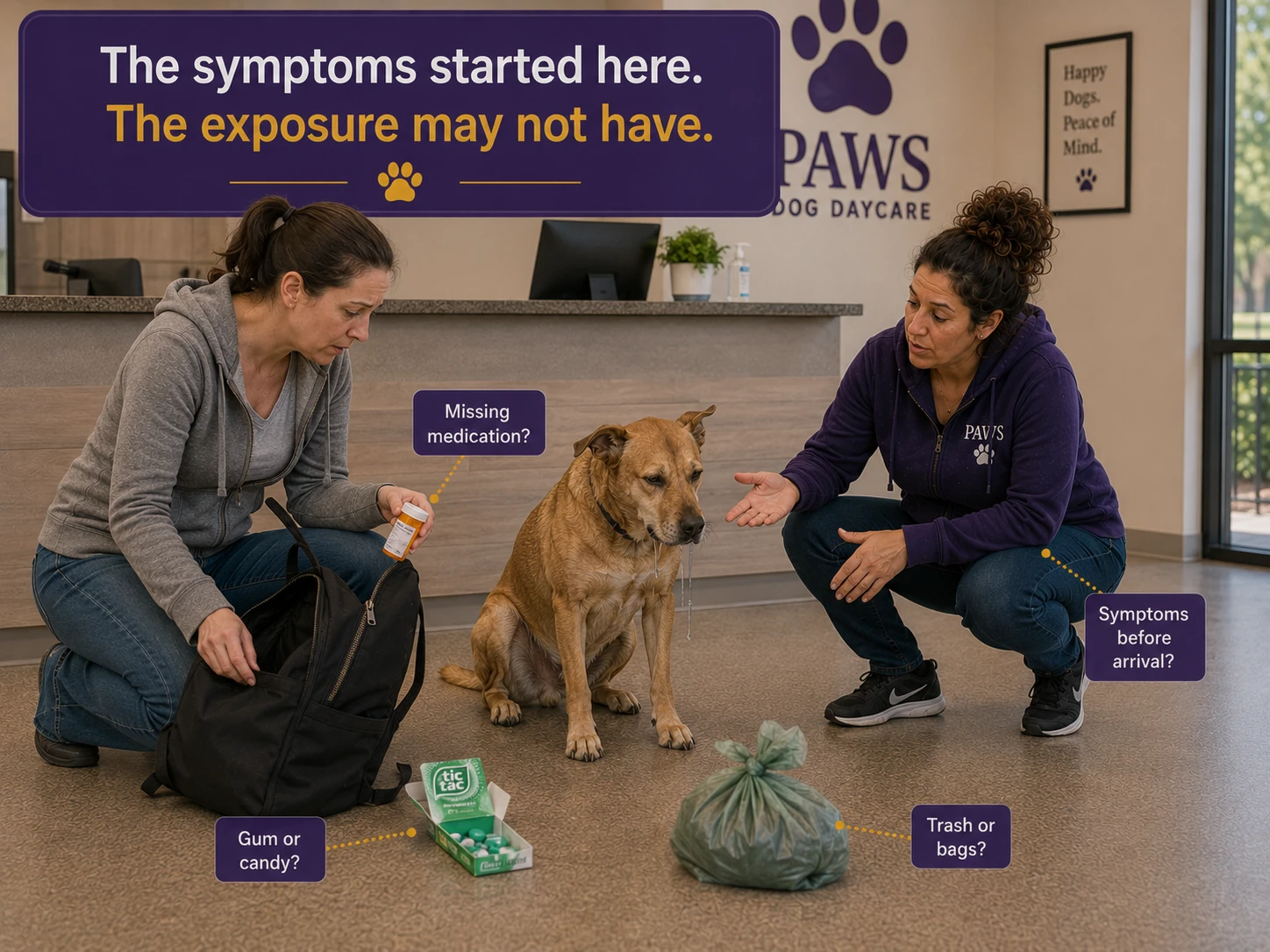
The Dog May Have Been Exposed Before Drop-Off
Not every poisoning starts inside the daycare. Sometimes the emergency walks through the front door already loaded.
A dog can arrive at daycare after getting into something at home, in the garage, in the yard, in the car, in an owner’s purse, in a backpack, in trash, during a walk, or during a rushed morning where nobody noticed the missing pill, chewed gum pack, spilled cleaner, chocolate wrapper, bait station, mushroom, plant, or dropped medication.
That matters because staff may be looking around the daycare for the cause while the real exposure happened an hour earlier somewhere else. The dog may vomit at daycare, stagger at daycare, seize at daycare, or collapse at daycare, but the toxin may have come from home.
When poisoning is suspected, owner questions matter. Ask direct questions. Do not ask, “Could he have gotten into anything?” and accept a vague “I don’t think so.” Ask about medications, food, trash, plants, yard chemicals, pest control, garage products, visitors, purses, bags, and anything missing, spilled, chewed, or unusual.
Build the timeline backward from the first abnormal sign. Ask when the dog was last known normal, what rooms and vehicles the dog entered, who handled medications or food, whether bags or trash were accessible, and whether anything is now missing.
Owner answers may change after someone checks the home. Keep the communication line open and ask the owner to photograph labels, packages, yard products, medications, or damaged items rather than relying only on a phone description.
- Did the dog have access to human medication, supplements, gum, candy, chocolate, snacks, or trash before drop-off?
- Was the dog in a garage, shed, yard, car, workshop, laundry room, bathroom, kitchen, or guest room before arrival?
- Did the owner notice vomiting, diarrhea, drooling, wobbling, shaking, weakness, odd behavior, or unusual tiredness before drop-off?
- Are any medications, pill bottles, bait products, cleaning products, plants, food wrappers, batteries, or bags missing or chewed?
- Was the yard recently treated, sprayed, fertilized, mulched, or exposed to mushrooms, dead animals, pest products, or unknown plant material?
- Did the dog ride in a car with groceries, bags, lunch containers, medication, work supplies, cleaning products, or pest-control materials?
📌
Operator rule
Do not assume the exposure happened in your building just because the symptoms showed up in your building. Poisoning timelines can be ugly, delayed, and inconvenient.
🏠
Household Items Poisonous to Pets
The dog may have gotten into something before arriving at daycare.
Not every poisoning starts inside the daycare. A dog can arrive already exposed from home, the yard, the garage, the car, an owner’s purse, a backpack, trash, medication, pest control, chocolate, grapes, batteries, bait, cleaners, plants, or some other household item nobody noticed during the morning rush.
If poisoning is suspected and the source is not obvious inside the facility, use the household poison reference hub to help narrow the suspect list. It includes common household items and exposures such as aspirin, antihistamines, acetaminophen, arsenic, batteries, borate, chocolate, iron, lead, NSAIDs, raisins and grapes, rodent poison, snail bait, and zinc.
☠️
Open the Household Poison Hub
Use this reference when staff, owners, poison control, or the emergency vet need help identifying what the dog may have gotten into before symptoms appeared.
⚠️
Reference rule
Use the household poison hub to narrow the suspect list. Do not use it as a substitute for calling animal poison control, calling the emergency vet, saving the package or label, documenting the dose and timeline, or transporting a symptomatic dog.
🚐
When to Transport the Dog to the Vet
A poisoned dog that is symptomatic, deteriorating, or exposed to a serious toxin needs veterinary care, not a lobby debate.
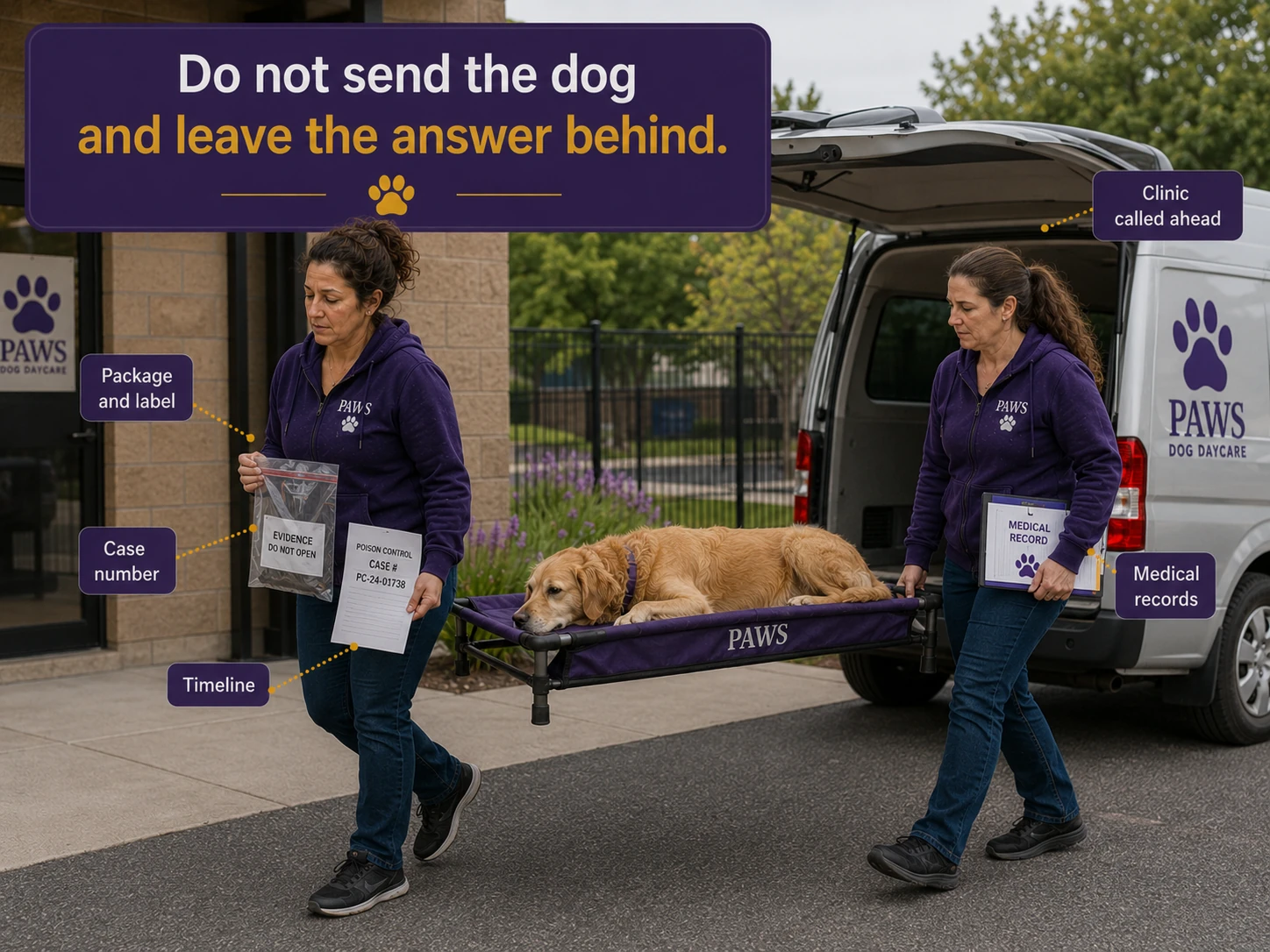
Call first when possible so the vet knows what is coming. Bring the package, label, plant sample, medication bottle, bait container, photos, vomit sample if safely collected, and the dog’s records. If poison control gives you a case number, bring that too.
Transport immediately if the dog is seizing, collapsed, struggling to breathe, weak, pale, nonresponsive, bleeding, repeatedly vomiting, unable to stand, or getting worse. Do not wait for an owner to call back if your signed emergency agreement authorizes care and the dog is actively in danger.
The handoff should include more than the dog. Send the package or clear label photos, poison-control case number, written instructions received, symptom timeline, estimated exposure, medical history, current medications, and any safely collected sample.
Call the clinic ahead and state that poisoning is suspected. That allows the veterinary team to prepare equipment, review the poison-control recommendation, and reduce delay when the dog arrives.
- Dog has seizures, tremors, collapse, weakness, or trouble breathing.
- Dog has pale, blue, muddy, or abnormal gums.
- Dog ingested medication, chemical, bait, unknown toxin, or a serious known toxin.
- Dog has repeated vomiting, bloody vomit, bloody diarrhea, or severe diarrhea.
- Dog is dull, disoriented, unable to stand, or getting worse.
- Poison control or the emergency vet says to come in.
👥
Staff Roles During a Poisoning Emergency
One person cannot manage the dog, the room, the phone, the evidence, the owner, transport, and notes alone.
The roles should be assigned before anyone reaches for a phone. The dog handler owns patient observation, the room handler prevents another exposure, the caller obtains professional direction, and the evidence collector preserves the facts needed to identify the toxin.
Transport preparation begins while the call is happening. The driver should know the clinic, route, vehicle, loading equipment, and records that must travel with the dog. Waiting until the call ends wastes time.
In a small facility one employee may hold multiple roles, but the responsibilities do not disappear. Staff should state the assignments out loud so the dog, the room, the evidence, and the timeline are not all assumed to be someone else’s job.
Swipe left/right to see the full table.
| Role | Main Job | What They Track |
|---|---|---|
| Dog handler | Stay with the dog, monitor symptoms, prevent licking or further exposure. | Breathing, gums, vomiting, tremors, seizures, coordination, changes. |
| Room handler | Secure other dogs and block access to the exposure area. | Which dogs had access and whether the area was isolated. |
| Poison-control caller | Call ASPCA Animal Poison Control, Pet Poison Helpline, or emergency vet. | Time called, person spoken to, case number, instructions received. |
| Evidence collector | Save labels, packaging, photos, plant material, bait, medication, or samples. | What was found, where it was found, amount missing, photos taken. |
| Driver | Prepare transport, records, evidence, route, and clinic arrival. | Departure time, destination, arrival time, dog condition in transit. |
| Recorder | Write the timeline while the emergency is happening. | Symptoms, exposure, calls, instructions, owner contact, transport, follow-up. |
🧾
Document the Poisoning Incident
Poisoning cases turn into memory soup fast. Write the facts while the facts still exist.
Documentation should record the exposure, symptoms, times, staff actions, calls, instructions, owner contact, transport, and follow-up. This protects the dog, helps the vet, helps poison control, and gives the business a real record instead of five employees remembering five different stories.
The record should separate confirmed facts from estimates. Identify what was observed directly, what the owner reported, what amount is missing, what remains unknown, and which professional gave each instruction.
Preserve relevant camera footage, access logs, cleaning records, product inventory, labels, photographs, and witness notes. The purpose is not only liability protection; the information may help determine which dogs had access and which facility weakness must be corrected.
The incident review should produce a specific control change. Lock a cabinet, revise bag storage, change chemical handling, correct pest-control placement, improve yard inspection, retrain staff, or alter the owner handoff. A poisoning report that changes nothing is incomplete.
- Time the dog was last seen normal.
- Time exposure was discovered or suspected.
- Substance, product, plant, medication, food, bait, or chemical involved.
- Amount missing or maximum possible exposure.
- Symptoms observed and who observed them.
- Photos, packaging, labels, samples, and scene notes.
- Poison-control or vet calls, instructions, and case number if provided.
- Owner contact attempts and instructions.
- Transport time, driver, destination, and records sent.
- Facility correction made after the incident.
🧯
Dog Daycare Poisoning Prevention Rules
The best poisoning response is the one the dog never needs.
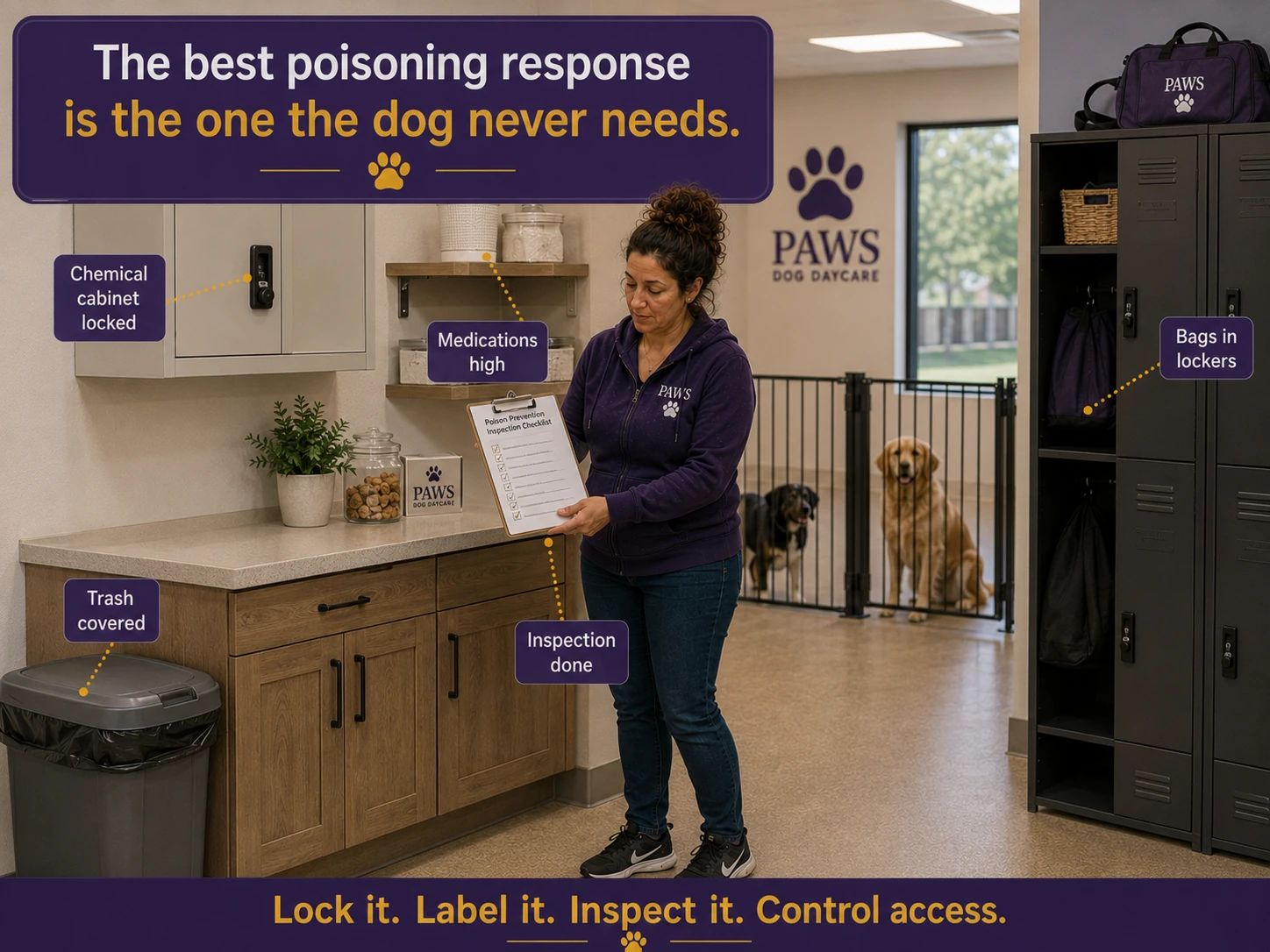
Poison prevention is facility discipline. Chemicals stay locked. Medications stay controlled. Staff bags stay away from dogs. Owner bags do not enter dog areas. Trash is covered. Yard checks happen. Maintenance zones are dog-free. Pest control is documented. Plants are checked before dogs can reach them.
A dog daycare is not a normal house. It is a building full of opportunistic animals with mouths. Anything accessible may become a chew toy, snack, licking station, or emergency.
Controlled storage means more than placing a product on a high shelf. Cabinets should latch or lock, inventory should be known, transfer containers should be labeled, staff bags should be secured, and chemicals should never be left unattended during use.
Routine inspection should follow the dog’s point of view. Check floors, drains, low shelves, gates, trash, outdoor edges, maintenance areas, employee lockers, owner handoff zones, and any place a nose or paw can reach.
- Lock cleaning chemicals and store them away from dog areas.
- Keep staff bags, owner bags, purses, backpacks, and lunch containers out of dog reach.
- Store medications in a controlled area with labeled instructions.
- Inspect yards for mushrooms, toxic plants, trash, bait, dead animals, and unknown objects.
- Keep pest-control products inaccessible and document all placements.
- Keep grooming products controlled and prevent licking during and after use.
- Keep trash covered, removed, and away from play areas.
- Train staff that “drop it and call somebody” is not the same thing as a poisoning plan.
🎓
Poisoning Training and Drills
Staff should practice before the dog eats the cleaner, the pill, the plant, or the bait.
Run staff drills. Dog chews a pill bottle from an owner bag. Dog gets into cleaner. Dog eats chocolate from a staff lunch. Dog is found shaking beside a chewed plant. Dog walks through a spilled chemical. Dog vomits and staggers with no known source.
The drill should answer who controls the dog, who secures the area, who calls poison control, who collects packaging, who contacts the owner, who prepares transport, and who writes the timeline.
Drills should require staff to read a label, identify the active ingredient, estimate the maximum exposure, isolate a mock spill, call from the posted contact sheet, record the case number, and prepare a complete veterinary handoff packet.
After each drill, review what slowed the response. Missing payment access, an unreadable label, weak room control, no available driver, or unclear documentation roles should be fixed before the exercise is considered complete.
📌
Training rule
Red Cross pet first-aid resources can help with general staff training, but poisoning calls go to the emergency vet, ASPCA Animal Poison Control, or Pet Poison Helpline.
✅
Dog Daycare Poisoning Response Checklist
Use this when staff know or suspect a dog has been exposed to a toxin.
Use this checklist as a coordinated response sequence rather than a collection of independent tasks. Removing the dog, controlling the room, identifying the substance, calling for professional direction, preparing transport, and preserving evidence should happen in parallel when staffing permits.
Do not mark a step complete unless the result is usable. “Called poison control” should include the time, person or service reached, case number, instructions, and who is responsible for carrying them out.
The checklist continues after transport. Preserve evidence and records, obtain veterinary follow-up, determine whether another dog was exposed, notify the appropriate parties, and correct the access failure before normal operations resume.
- Remove the dog from the exposure.
- Secure the area so no other dog can access the toxin.
- Check airway, breathing, gum color, responsiveness, tremors, vomiting, and coordination.
- Identify the product, plant, medication, food, bait, chemical, or unknown substance.
- Save packaging, labels, photos, samples, or scene evidence.
- Call ASPCA Animal Poison Control, Pet Poison Helpline, or the emergency vet.
- Write down the poison-control case number, caller name, time called, and exact instructions received.
- Do not induce vomiting unless directed.
- Do not give activated charcoal unless directed.
- Do not use salt, syrup of ipecac, oils, forced water, or home antidotes.
- Contact the owner or emergency contact without delaying emergency veterinary care.
- Prepare transport if the dog is symptomatic, toxin is serious, or instructed by poison control or vet.
- Document symptoms, exposure, timeline, calls, instructions, owner contact, transport, and follow-up.
- Preserve labels, packaging, photos, video notes, and samples until the vet, poison control, owner, and insurance questions are resolved.
- Review the incident afterward and fix the access failure.
❓
Dog Poisoning Response FAQ
Detailed answers about exposure routes, symptom recognition, poison-control calls, unsafe treatments, evidence, staff roles, transport, documentation, owner communication, and prevention.
What should staff do first when poisoning is suspected?
Remove the dog from the suspected exposure and secure the area so no other dog can reach it. One person should assess breathing, gums, consciousness, vomiting, tremors, and coordination while another calls animal poison control or the emergency veterinarian. Identification, evidence collection, transport preparation, and documentation should begin without delaying care.
Should staff wait for several symptoms before acting?
No. A sudden unexplained change may be enough to act, especially when the dog becomes drooly, glassy-eyed, unsteady, dull, agitated, weak, or unable to coordinate normally. Poisoning does not always produce a complete textbook pattern, and waiting for every expected sign can waste critical time.
Does poisoning always mean the dog swallowed something?
No. Exposure may be ingested, topical, inhaled, through the eyes, or unknown. The route changes the immediate controls, such as preventing licking, flushing skin or eyes when professionally appropriate, moving to fresh air, ventilating the room, isolating contaminated materials, and protecting staff from contact.
Why is the exact product label so important?
Broad descriptions such as cleaner, rat poison, medication, or mushroom are not specific enough to guide treatment. Staff should record the exact product, active ingredients, concentration, package size, and maximum amount that may be missing. Clear photographs of the front and back label should travel with the dog or be sent to the clinic.
Should daycare staff induce vomiting?
Not unless a veterinarian, emergency clinic, or animal poison-control professional specifically directs it for that dog and exposure. Vomiting can be dangerous with caustic products, petroleum materials, sharp objects, altered consciousness, seizures, weakness, breathing problems, or an unprotected airway.
Can staff give activated charcoal because poisoning is suspected?
No, not on their own. Activated charcoal does not bind every toxin and can create aspiration, dosing, and handling risks. Use it only when a qualified professional directs its use and document the exact product, amount, time, and authorizing professional.
Are milk, oil, salt, food, or other home remedies safe?
They should not be improvised. Salt can itself cause severe poisoning, oils and food can worsen aspiration risk or interfere with treatment, and forced fluids can enter the lungs of a weak or altered dog. The correct response is professional guidance, not a familiar-sounding household remedy.
What information does poison control need?
Prepare the dog’s name, age, breed, weight, medical conditions, medications, suspected substance, active ingredients, concentration, estimated maximum exposure, time of exposure, symptom onset, current signs, and any first aid already performed. Do not delay the call to make the information perfect; gather missing details while the call is underway.
What evidence should staff preserve?
Save the product package, label, medication bottle, plant material, bait container, wrapper, photographs, scene notes, and any sample that can be collected without creating another exposure. Preserve relevant video and access records as well. Evidence should be labeled and kept with the incident record until veterinary, owner, poison-control, and insurance questions are resolved.
What if the exposure may have happened before drop-off?
Build the timeline backward. Ask when the dog was last normal and about medications, gum or candy, food, trash, bags, garage products, yard treatments, pest control, plants, mushrooms, and anything missing or chewed. Ask the owner to inspect the home and send photographs of possible products rather than relying only on memory.
When should the dog be transported immediately?
Immediate transport is warranted for seizures, tremors, collapse, breathing difficulty, abnormal gums, repeated vomiting, bleeding, severe weakness, disorientation, inability to stand, deterioration, or exposure to a serious or unknown toxin. Transport also follows whenever poison control or the veterinarian directs the facility to come in.
Should staff wait for owner permission before transporting?
Not when the dog is actively in danger and the signed daycare agreement authorizes emergency treatment and transport. The owner should be contacted promptly, but life-saving action should not stop while staff wait for a callback. Intake paperwork should clearly establish authorization, financial responsibility, and the veterinary destination.
What should travel with the dog to the veterinary clinic?
Send the package or label photographs, poison-control case number, written instructions, estimated exposure, symptom and treatment timeline, medical history, medication list, owner contacts, and any safely collected sample. Call the clinic ahead so the team knows a poisoning case is arriving.
Why must the exposure area be isolated?
The same substance may expose additional dogs or staff through licking, walking, fumes, contaminated bedding, shared water, or cleanup. Secure the area, identify every dog that had access, use appropriate protective equipment, and preserve the evidence before cleaning destroys the information.
How should staff divide responsibilities during a poisoning emergency?
Assign a dog handler, room handler, poison-control or veterinary caller, evidence collector, driver, and recorder. One employee may hold multiple roles in a small operation, but each responsibility must be stated clearly. Transport preparation and documentation should begin while the medical call is still happening.
What should staff document?
Record when the dog was last normal, when exposure was discovered, the suspected product and amount, symptoms, staff present, evidence collected, calls made, case number, instructions received, actions performed, owner contact, transport times, veterinary handoff, and follow-up. Separate confirmed observations from estimates and owner reports.
Can a dog appear normal after a dangerous exposure?
Yes. Some toxins have delayed effects, and early appearance does not establish safety. A dog may need monitoring, testing, preventive treatment, or transport even before dramatic symptoms appear. Follow the poison-control or veterinary recommendation rather than relying on the dog’s current appearance.
How should topical or eye exposure be handled?
Prevent the dog from licking contaminated material, protect staff from contact, and remove the dog from the source. Flushing or bathing may be appropriate, but the product and professional instructions matter. Eye exposure may require immediate flushing with clean water or saline while veterinary guidance and transport are arranged.
What facility controls prevent poisoning?
Use locked chemical and medication storage, labeled transfer containers, covered trash, secured staff and owner bags, controlled pest products, dog-free maintenance zones, grooming-product controls, routine yard inspections, and documented inventory. Inspect from the dog’s level rather than assuming a high shelf or closed-looking cabinet is enough.
What should happen after the incident?
Conduct an after-action review using the timeline, video, evidence, veterinary information, and staff accounts. Determine how access occurred, whether another dog was exposed, what delayed the response, and which control failed. The incident should produce a specific correction such as storage changes, retraining, revised owner handoff, improved inspection, or clearer emergency roles.
🐾
The Bottom Line: Poisoning Response Is Not Guesswork
A dog daycare needs a poisoning plan before a dog is shaking on the floor.
Poisoning cases require fast thinking, but fast thinking is not the same thing as guessing. The right move is not “make him puke” or “give him something.” The right move is secure the dog, identify the toxin, call the right authority, follow instructions, transport when needed, and document everything.
The page can sound harsh because the situation is harsh. By the time a dog is convulsing, collapsing, or losing coordination, there may be very little time left for staff to become useful. Preparation is not optional when you are taking money to care for other people’s animals.
The strongest poisoning plan runs several jobs at once: protect the patient, prevent another exposure, identify the substance, obtain professional direction, prepare transport, preserve evidence, contact the owner, and record the timeline.
Speed matters, but disciplined speed matters more. The business should move quickly without inventing treatment, destroying evidence, losing the rest of the room, or sending the dog to the clinic without the information needed to treat it.