Franchise Brand Value, Local Trust, Logo Power, Customer Demand, Reviews, Staff Loyalty, and the Simple Test That Cuts Through the Glitter
The Golden Arches Test for Dog Daycare Franchises
If the franchise dog daycare logo came off the building tomorrow, would the same dogs still show up?
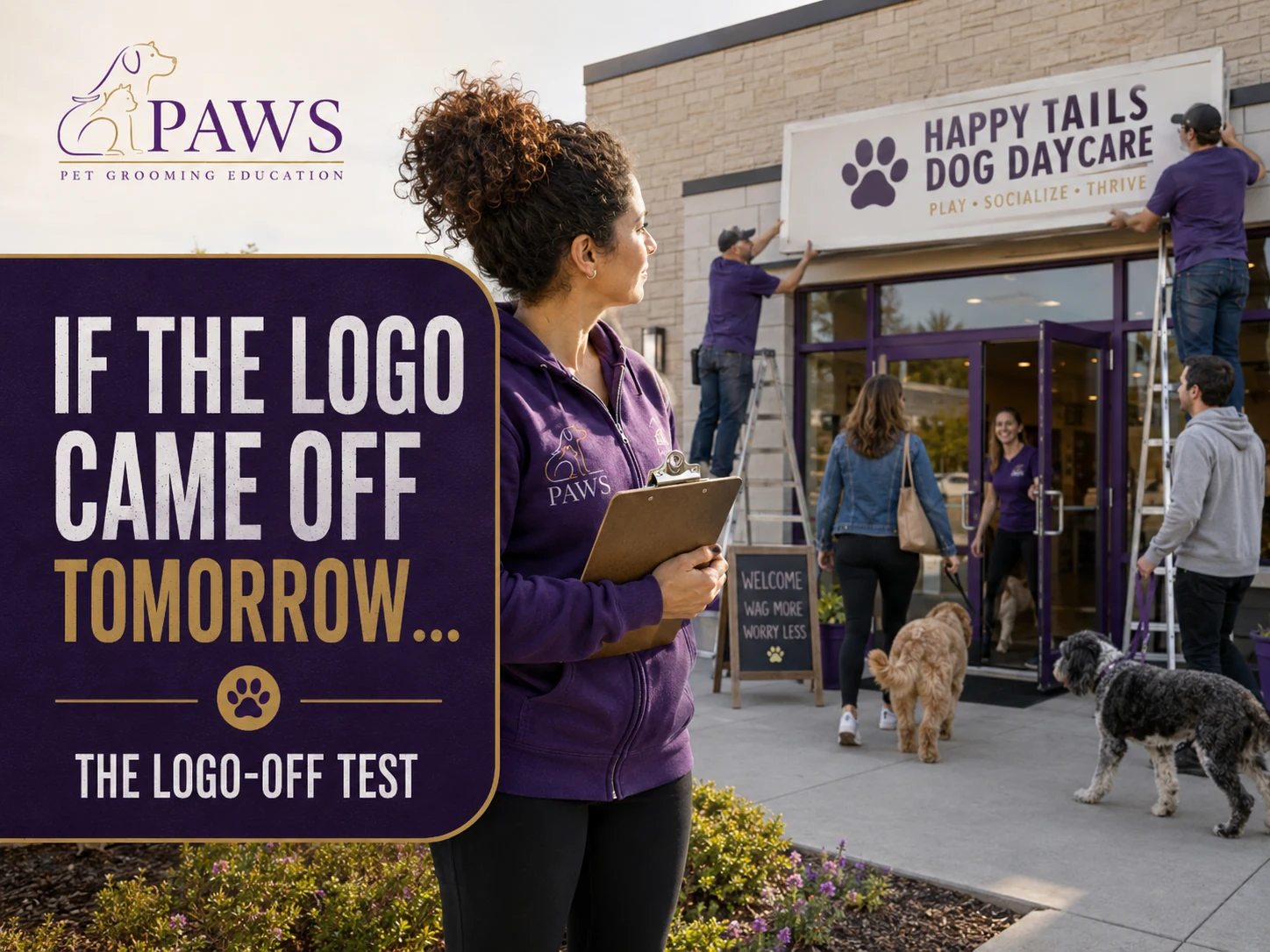
That question cuts through a lot of franchise glitter.
The Golden Arches are valuable because customers already know what they mean. They know the food, the drive-thru, the fries, the colors, the menu, the price range, the national advertising, and the basic promise before they ever turn into the parking lot.
A dog daycare franchise logo does not automatically carry that same power. Maybe it does in some markets. Maybe the brand is known, trusted, searched, and valuable. Fine. Prove it.
Because if the franchise sign came off a dog daycare building tomorrow and the same dogs still got dropped off, the same grooming customers still came in, the same boarding customers still booked, and the same local reviews still carried the business, then maybe the logo was not the thing creating the value.
Maybe the staff was. Maybe the manager was. Maybe the groomer was. Maybe the location, reviews, cleanliness, convenience, customer trust, and local relationships were doing the real work while the logo got to stand on the building looking important.
⚠️
Operator warning: a dog daycare franchise is not McDonald’s.
McDonald’s without the arches is a different business. A dog daycare without the franchise sign may still have the same dogs, same staff, same customers, same reviews, same building, same groomer, same manager, and same local reputation. That difference matters.
🍟
The Burger Test
If the franchise system disappeared, what would actually break?
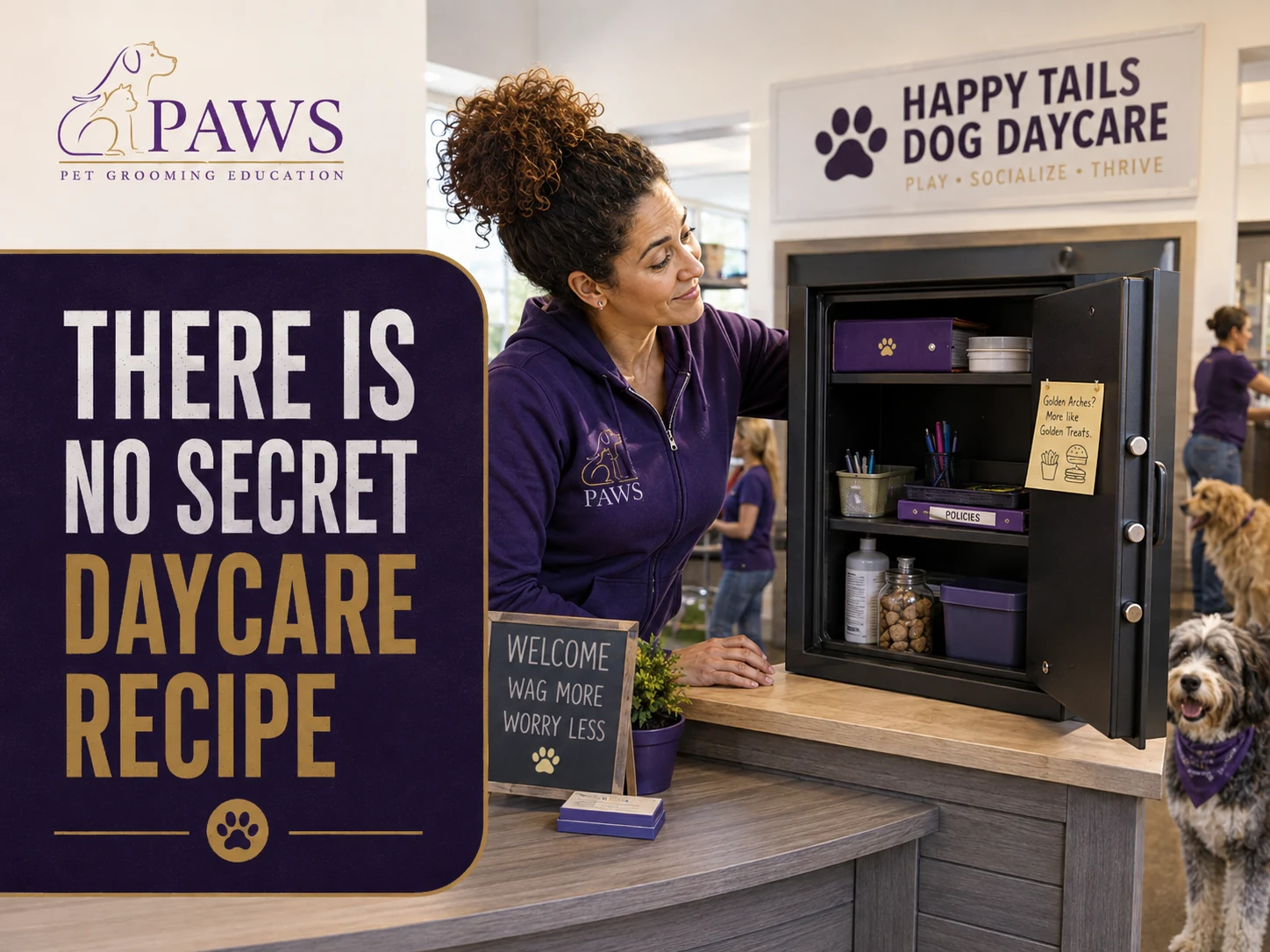
If a McDonald’s franchisee loses the franchise system, they lose the name, the menu, the supply chain, the operating system, the brand colors, the packaging, the national advertising machine, the customer expectations, and the entire reason most people pulled into the parking lot.
The customer did not pull in because they loved “a building that sells sandwiches.” They pulled in because it was McDonald’s. Tear the arches down, repaint the building, remove the menu, change the fries, change the packaging, and shut off the supply system, and the next morning is not business as usual.
Now ask the same question for a dog daycare franchise.
If the hypothetical leading dog daycare franchisors "Camp Sniff Bark Woof" or "Camp Wigglebutt Wagging Happy Paws" disappeared tomorrow, what actually happens? Do the dogs stop needing daycare? Do the boarding customers vanish? Does the groomer forget how to groom? Does the front desk forget how to answer the phone? Do customers stop trusting the staff they already know? Does the building stop being convenient? Do the reviews disappear from the customer’s memory?
Maybe you have to migrate kennel software and that's a pain. Maybe the signs, website, uniforms, forms, and listings all need to be reworked. Maybe there are contract issues, legal restrictions, and real transition costs. This is not a pretend problem.
But the business-value question is still simple: What actually breaks? Would the local customer demand collapse, or would the same dogs still show up because the local operation is what they trusted all along?
The comparison should focus on dependency. A food franchise may lose a controlled product, approved ingredients, packaging, recipes, national customer habit, and a supply chain that cannot be recreated overnight. A daycare often retains the building, trained people, local customer relationships, and the ability to keep delivering the underlying service.
That does not make transition easy. Software, signage, websites, forms, data, contracts, phone numbers, and customer communication may all need work. The point is to separate transition cost from true loss of customer demand.
📌
No secret burger in the back room
Dog daycare is a real operation with real risk, but there is usually no secret recipe, no national burger, no exclusive fry pipeline, and no household-name menu pulling customers into the parking lot by itself. The local operation has to earn the trust.
🍔
What the Golden Arches Actually Represent
The arches are not valuable because they are yellow. They are valuable because customers already know what they are buying.
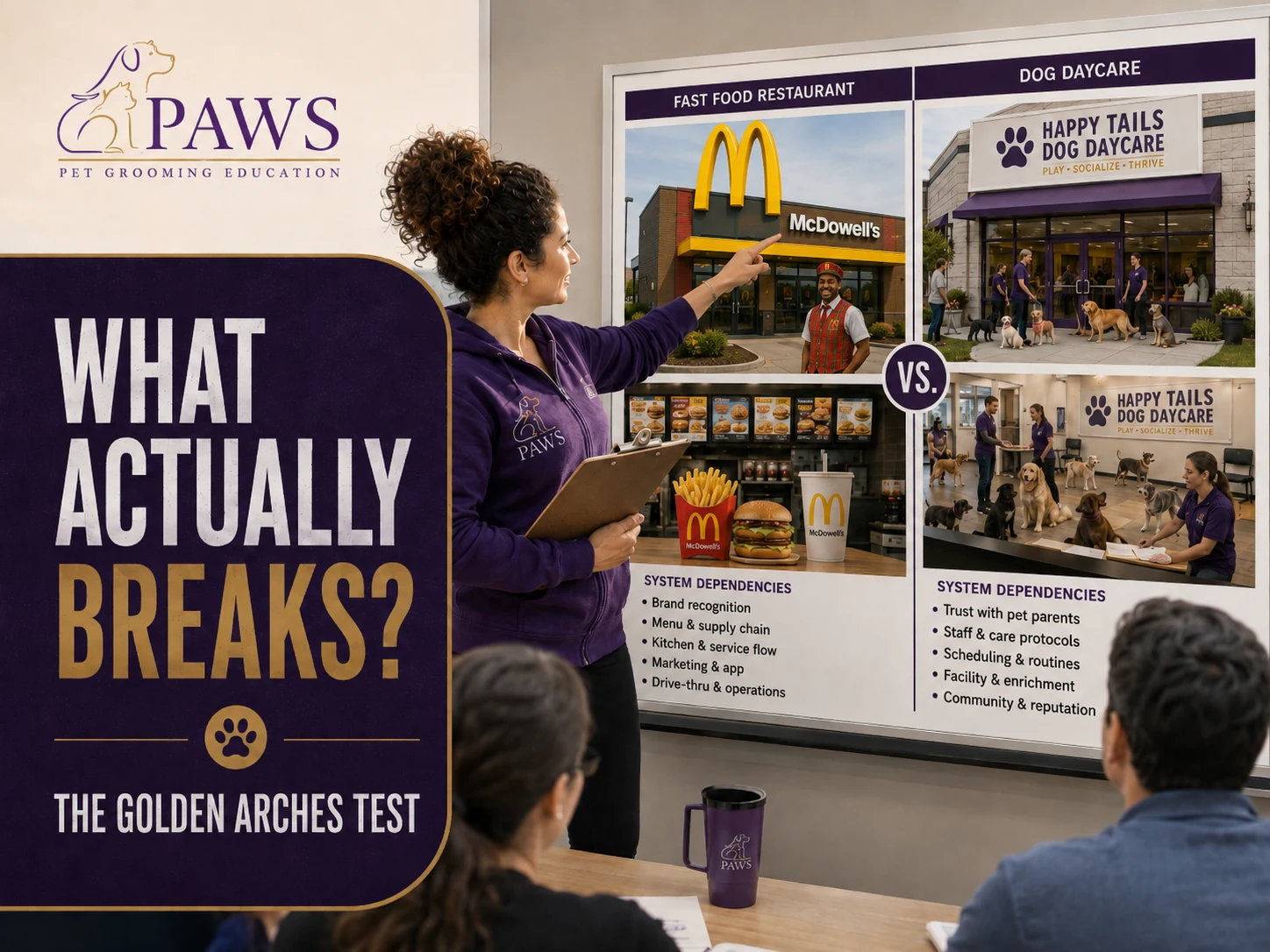
The McDonald’s comparison is not about worshiping hamburgers. It is about understanding brand power. The Golden Arches represent instant recognition, customer habit, known products, national advertising, supply chain, pricing expectations, menu familiarity, packaging, colors, procedures, and consistency.
A customer can be driving in a town they have never visited, see the arches, and already know what is going to happen. They know the product before the window opens. That is brand power.
That is the menu test. A normal customer can sit on the couch and name several McDonald’s items without looking anything up. They know the burger, the fries, the nuggets, the breakfast, the drive-thru, and the basic price expectation. That brand is already living in the customer’s head before the customer gets hungry.
Now ask the same thing about a dog daycare franchise. Can a normal pet owner in your market name the services? Do they know the price range? Do they know what makes the brand different? Do they know the brand well enough to choose it before reading reviews, touring the building, or meeting the staff? Do they know it well enough to automatically choose it over a local independent dog daycare? If not, do not pretend the logo has Golden Arches power.
If you are paying franchise money because you believe the brand will bring customers, then the brand needs to prove it has customer-facing power in your market. Not franchise-buyer power. Not trade-show power. Not “we rank when investors search pet franchises” power. Customer power.
Brand power should be measured by what the customer already knows before meeting the local operator. Recognition, product expectation, price familiarity, buying habit, and willingness to choose the brand without further explanation are stronger signals than a polished logo or large franchise-sales presence.
A buyer should ask whether normal pet owners can describe the franchise promise, name its services, distinguish it from local competitors, and choose it before reading reviews or taking a tour. If not, the brand may still need the local owner to create its meaning.
👀
Instant Recognition
Customers know the sign before they know the local owner.
🍟
Known Product
Customers know the menu, price range, and basic expectation before ordering.
🚚
Supply Chain
The system supplies and controls the product in a way that is difficult to replace overnight.
📣
National Advertising
The advertising machine reinforces the same customer expectation everywhere.
🔁
Customer Habit
People pull in because the brand already lives in their head.
🏷️
Brand Promise
The sign itself creates expectations before the local staff says a word.
🐕
What a Dog Daycare Franchise Logo Usually Represents
A dog daycare logo does not watch the playroom. People do.
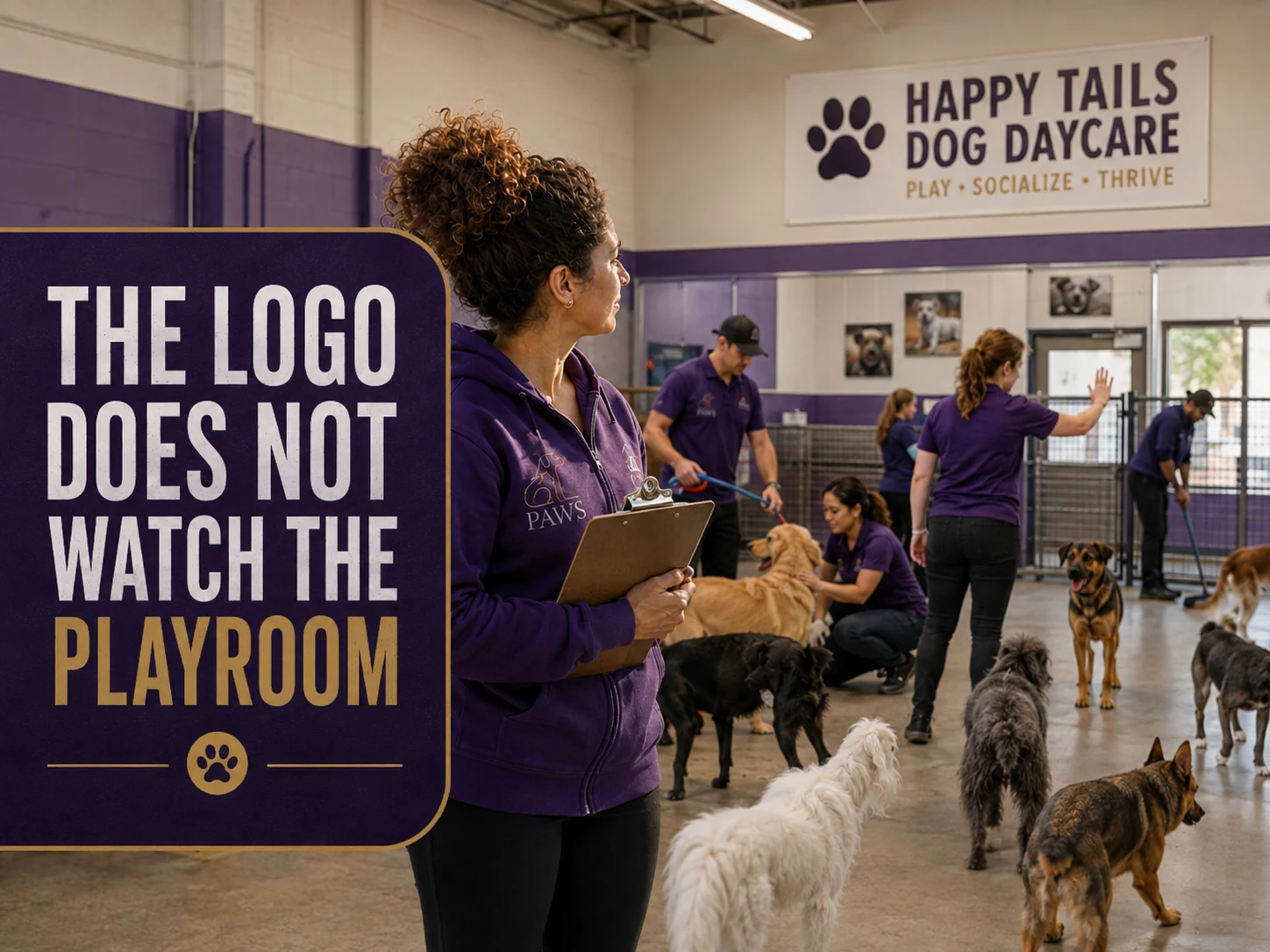
A dog daycare franchise logo may represent a real system. It may come with manuals, training, brand standards, software direction, facility design standards, vendor suggestions, opening support, marketing templates, peer support, and operating rules.
That is not worthless. A good franchise can help a new owner avoid expensive mistakes, especially during the blank-page stage when zoning, build-out, pricing, cleaning, staff training, forms, software, temperament testing, customer service, and dog handling are all hitting at once.
But to the local dog owner, the logo may not mean, “I trust these people with my dog.” That trust usually comes from the staff, reviews, tour, smell of the building, cleanliness, communication, convenience, local reputation, and how the dog acts when it comes back.
That is the difference. A logo can open a door. The local operation has to earn the repeat drop-off.
The system may create valuable structure behind the scenes, but customers experience the local execution. Staffing ratios, playgroup judgment, cleaning, disease control, incident handling, grooming quality, boarding checks, and communication determine whether the brand promise survives contact with the real building.
The buyer should therefore separate system assets from consumer pull. Manuals and training may improve operations even when the public does not recognize the name. Both can be valuable, but they are not the same asset and should not be priced as though they are.
⚠️
The logo is not the leash handler.
Customers do not leave their dog with a logo. They leave their dog with people. If the people, reviews, location, and local trust are doing the work, do not give the logo all the credit.
🚪
The Logo-Off Test
If the sign changed tomorrow, would the same dogs still pull their owners toward the door?
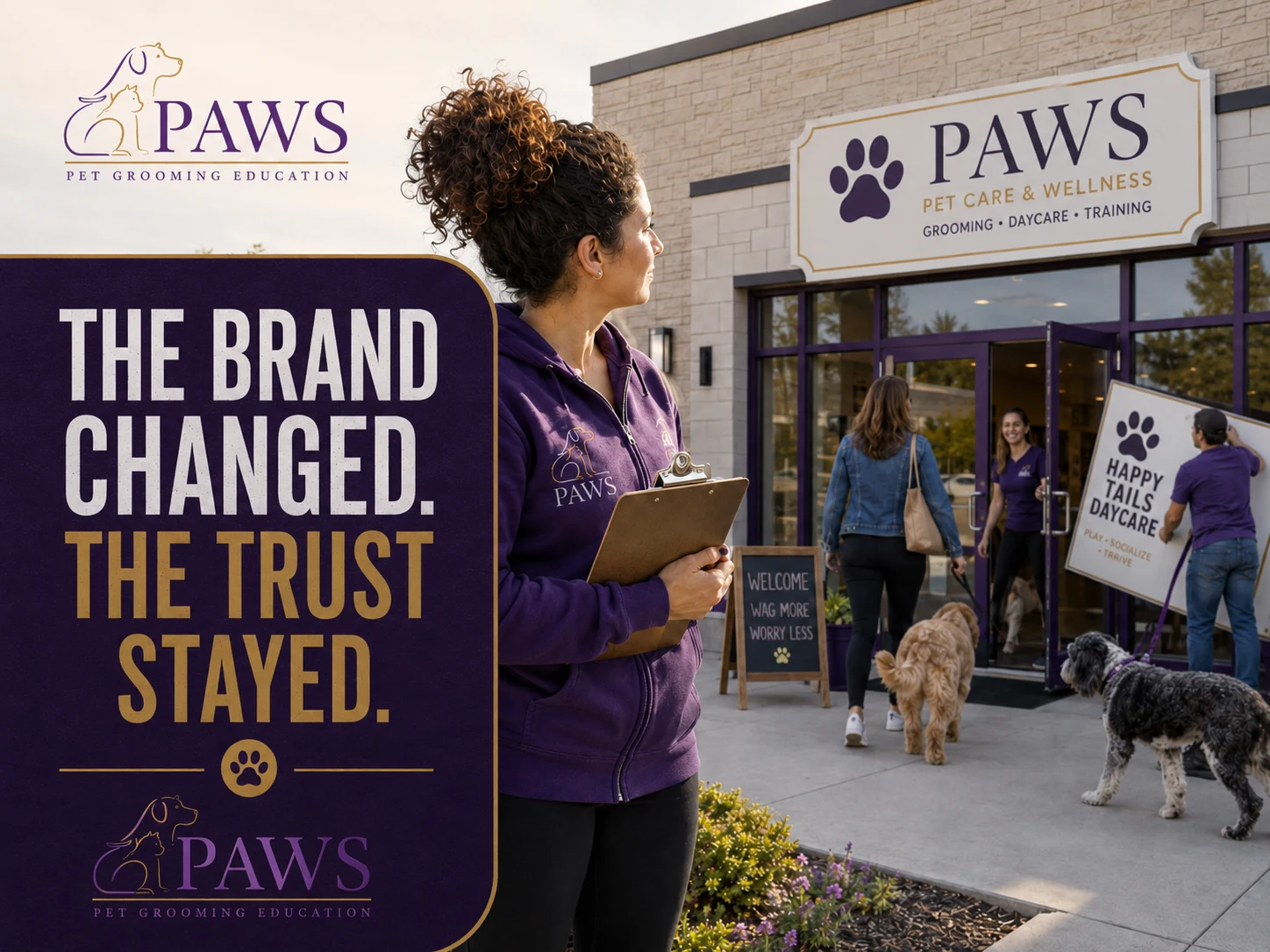
This is the whole page in one test.
If the franchise logo came off the building tomorrow and the same staff, same manager, same groomer, same building, same reviews, same phone handling, same dog routines, same boarding care, same customer list, and same local relationships stayed in place, what would happen?
Would daycare customers still come? Would boarding customers still book? Would grooming customers still follow the groomer? Would customers still trust the manager? Would local vets still refer? Would the reviews still matter? Would the parking lot still have cars in it?
In a lot of dog-care businesses, the answer is yes. Maybe not perfectly. Maybe there is confusion. Maybe a few customers ask questions. Maybe there is rebranding pain. But the business does not automatically collapse because there was no secret dog daycare recipe hiding in a vault behind the reception desk that you no longer have access to.
I have lived this in the real world. One of my Florida pet-care locations operated for years under a dog-daycare-focused name. Over time, the business had grown beyond just dog daycare. We wanted the brand to fit the full service mix better and become more welcoming to cat owners, too.
That mattered because cat owners did not always feel like a place called “dog daycare” was meant for them. So we rebranded around a broader pet-care name, changed the signage, changed the colors, and positioned the business to include cat boarding, cat grooming, and other pet-care services instead of making everything sound dog-only.
Monday came. The same daycare dogs showed up. The same grooming appointments showed up. The same boarding customers showed up. A few people asked about the name change. The answer was simple: we were broadening the brand so it fit the business better and reached more pet owners, including cat owners.
Customers basically said, “Oh, okay, cool,” and kept dropping off their dogs. They did not sprint out the door because the sign changed. They did not panic because the colors changed. They did not suddenly forget that their dogs were safe, the staff knew them, the groomer had appointments, boarding was booked, and the business was still doing the same work in the same building.
The name change did what it was supposed to do. Existing dog customers stayed, and the broader pet-care brand made it easier to attract cat customers. That is the point. The old name had recognition, but the service, staff, trust, location, routines, and customer relationship are what kept the parking lot full after the sign changed.
That does not mean branding is worthless. Better branding can absolutely help reach new people. A better name, better colors, better signage, and a clearer market position can improve the business. But the rebrand did not destroy the existing customer base because the local operation was still strong.
With Dog Daycare, you don't lose the ability to offer the service. That is different from the Golden Arches scenario. If a McDonald’s franchise relationship ends, the operator does not just lose a sign. They lose the name, menu, branded product expectations, supply chain access, packaging, colors, national advertising machine, and the customer promise people recognized before they ever pulled into the drive-thru.
Could that building still become an independent hamburger stand? Sure. But it is no longer McDonald’s. It is now a mom-and-pop burger place competing against McDonald’s, Burger King, Wendy’s, and every other food option nearby without the brand machine that used to pull cars into the lot.
Dog daycare is different. If the franchise sign changes but the same trusted people are still caring for the same dogs in the same building with the same reviews, same routines, and same local relationships, the customer may not care nearly as much as the franchise sales deck wants you to believe.
That is not a swipe at every franchise. It is a value test. If the same dogs still show up when the sign changes, the local operation may be creating more value than the franchise brand.
The test becomes stronger when the owner uses actual customer evidence. Review what people say during tours, why they renew packages, whether they follow specific staff, and what reasons appear in reviews. Those answers reveal where loyalty lives.
A rebrand should also be modeled honestly. Some customers may hesitate, online visibility may dip, and new marketing may be required. The question is whether the local trust base survives the transition, not whether changing a sign is completely painless.
- Would daycare regulars still come if the same staff stayed?
- Would boarding customers still book if the same manager and routines remained?
- Would grooming customers follow the groomer instead of the brand?
- Would local reviews still carry trust?
- Would convenience and location still matter more than the sign?
- Would local vets, groomers, trainers, rescues, and customers still refer?
- Would customers care more about the name or the people handling their dog?
🧾
If the Franchise Relationship Ended, What Would You Actually Lose?
Some things may matter. Some may be replaceable. Some may have sounded better in the sales process than they feel in year five.
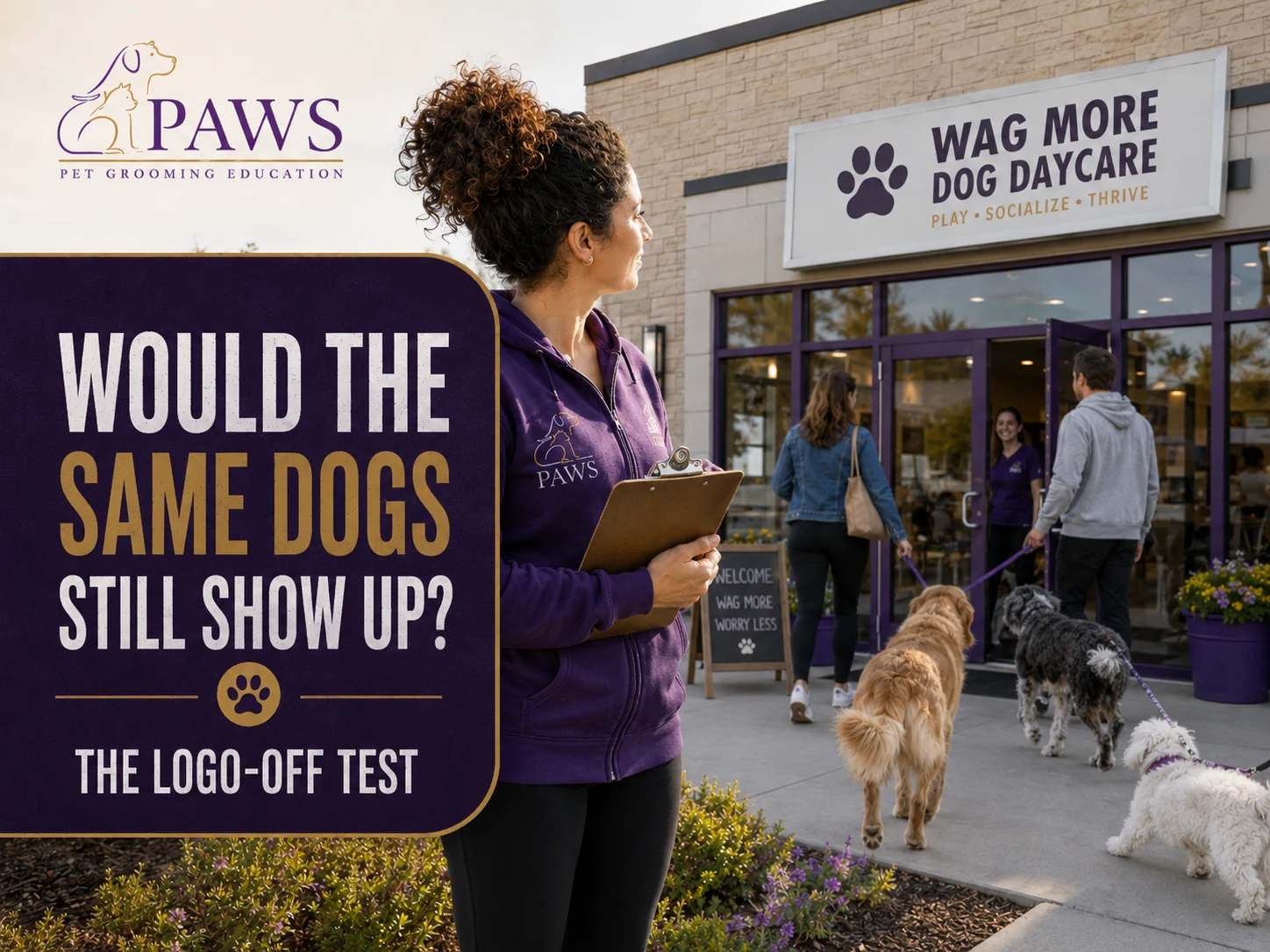
This does not mean a franchisee can just peel the sign off and do whatever they want. The contract may have termination rules, non-compete language, de-identification requirements, software issues, customer data restrictions, transfer limits, lease complications, territory rules, and post-termination obligations. A franchise attorney needs to read the actual agreement before anybody assumes anything.
But as a business-value test, the question still matters. What disappears if the franchise disappears? What stays? What is truly proprietary? What can be replaced? What have you already learned? What would customers actually miss?
This page is not aimed at existing franchisees looking for a way around their agreement. If you are already in a franchise system, follow your contract and get a franchise attorney before making any major move. This test is for the person thinking about signing in the first place.
Before you sign, do not let the franchise company take credit for value you may be the one building. If you spend years hiring staff, handling bites, cleaning messes, calming nervous customers, earning Google reviews, building vet referrals, keeping boarding dogs safe, filling grooming appointments, and turning a cold local market into a trusted pet-care business, that value did not magically appear because a cute sign was bolted above the door.
The sign may help. The system may help. The brand may help. But if the hard local trust was built by your staff, your payroll, your building, your customer service, your reviews, and your daily operating grind, then be honest about whose value is actually sitting inside that business.
Build a replacement map before assigning value. For every item that disappears, identify the cost, time, risk, legal restriction, data dependency, customer disruption, and realistic replacement source. Replaceable does not mean free or immediate.
The buyer should also identify what remains locally: staff knowledge, facility routines, reviews, customer relationships, vendor knowledge, referral sources, and management judgment. Those assets may carry more of the operating value than the franchise presentation admits.
| What Disappears | Could It Matter? | Is It Replaceable? | Buyer Question |
|---|---|---|---|
| Brand Name | Yes, if local customers know it, search it, trust it, and choose it. | Maybe, but local rebranding costs money and effort. | Do customers choose the name or the local operation? |
| Logo and Signage | Somewhat. Signs create recognition and help people find the building. | Yes, with cost and confusion. | Would customers stop coming because the sign changed? |
| Website Listing | Yes, if the brand website drives leads. | Usually, but local SEO takes time. | Does the franchise website actually send local customers? |
| Software | Yes. Migration can be painful. | Usually yes. Pet-care software exists outside the franchise. | Is the software special, or just required? |
| Operating Manuals | Valuable early, especially for a new operator. | Eventually the business internalizes routines. | Is the manual still creating value in year five? |
| Vendor Relationships | Useful if they save money, improve quality, or reduce mistakes. | Often replaceable. | Are vendors better, cheaper, safer, or just approved? |
| Marketing Templates | Helpful if they are practical and current. | Yes. Templates can be built or bought. | Do they create local leads or just look professional? |
| Training Updates | Valuable if real, current, specific, and used. | Maybe. Staff training can be built locally too. | Are updates practical or recycled webinar fog? |
| Franchisee Network | Can be valuable if owners share real operational truth. | Harder to replace, but not impossible. | Is the network honest and useful, or mostly polite brand cheerleading? |
| National Advertising | Valuable if it creates local customer demand. | Depends on the market and lead sources. | Does it make your phone ring? |
| Customer Demand | Extremely valuable if the brand truly creates it. | Hard to replace if real. | Does the brand create demand, or did you create demand locally? |
| Proprietary Dog-Handling System | Valuable if truly better and consistently trained. | Often teachable. | What is actually proprietary? |
| Pricing Power | Valuable if customers pay more because of the brand. | Market-dependent. | Can the brand let you charge more, or are you still trapped by local reality? |
⚠️
The real question is not “do I lose something?”
Of course you lose something if a franchise relationship ends. The real question is whether what you lose is worth the fees, royalties, restrictions, approved vendors, upgrade rules, and long-term control you accepted to get it.
⏳
Front-Loaded Help vs. Long-Term Value
Startup help can be real. That does not automatically justify paying forever.
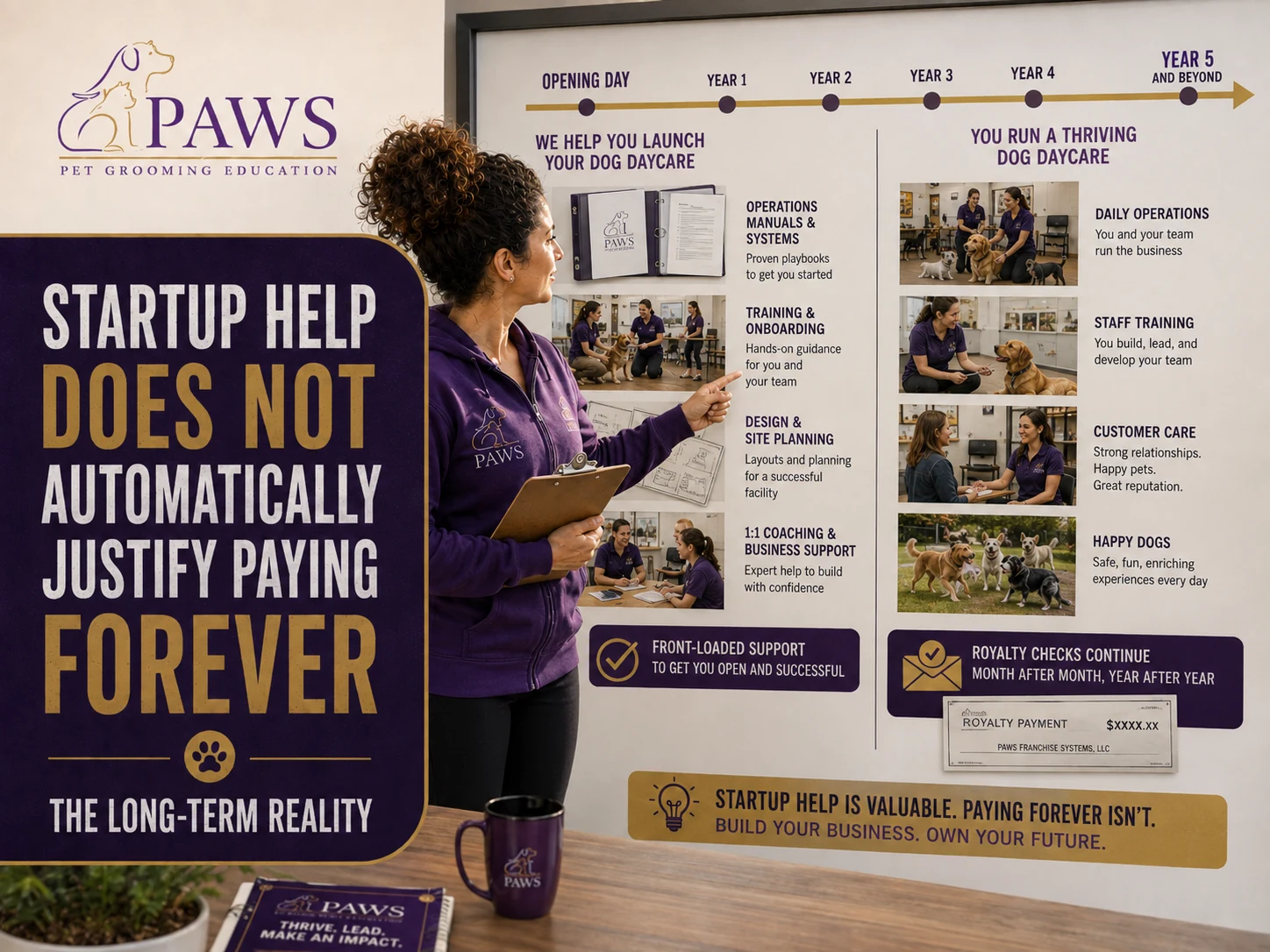
A good dog daycare franchise may help with the startup roadmap, facility design, training, manuals, forms, software, vendor suggestions, hiring systems, policy templates, pricing guidance, opening support, coaching, lender familiarity, and peer network.
That can be valuable. Nobody needs to pretend it is worthless. Opening a dog daycare is not rocket science, but it is also not “I love dogs, therefore I can manage payroll, leases, disease control, dog fights, odor, capacity, temperament testing, staff turnover, customer complaints, and cash flow.” That is how people get flattened.
But most of that help is front-loaded. It matters most when the business is a blank page and the owner is trying to figure out what to do next.
After year one, year three, year five, or year ten, the question changes. You have lived the holidays. You have dealt with sick dogs. You have handled staff drama. You have seen grooming bottlenecks, boarding rushes, daycare capacity limits, cleaning failures, customer complaints, payroll pressure, and the joys of explaining to someone why their dog is not a misunderstood angel but a furry little lawsuit with teeth.
At that point, what are you still buying every month?
If the franchisor is still improving the business, sending leads, sharpening systems, saving money, supporting staff, creating brand demand, strengthening resale value, and solving real problems, the royalty has an argument.
If not, the royalty starts to look like you bought confidence during the scary part and kept paying rent on that fear long after you learned how to run the place.
The support package should evolve as the owner becomes experienced. Opening help may focus on site selection, design, manuals, hiring, training, and launch. Later support should improve labor control, pricing, utilization, service mix, management depth, crisis response, expansion, and resale value.
When the support remains beginner-level while the royalty remains permanent, the buyer may be paying for a knowledge gap that no longer exists. Current franchisees at different ages can show whether the system continues to mature with them.
📌
The year-five question
The franchise may have helped you open. Good. Now ask what it did for you last month.
📣
Brand Recognition vs. Franchise-Buyer Visibility
Showing up for “dog daycare franchise” is not the same as being known by dog owners.
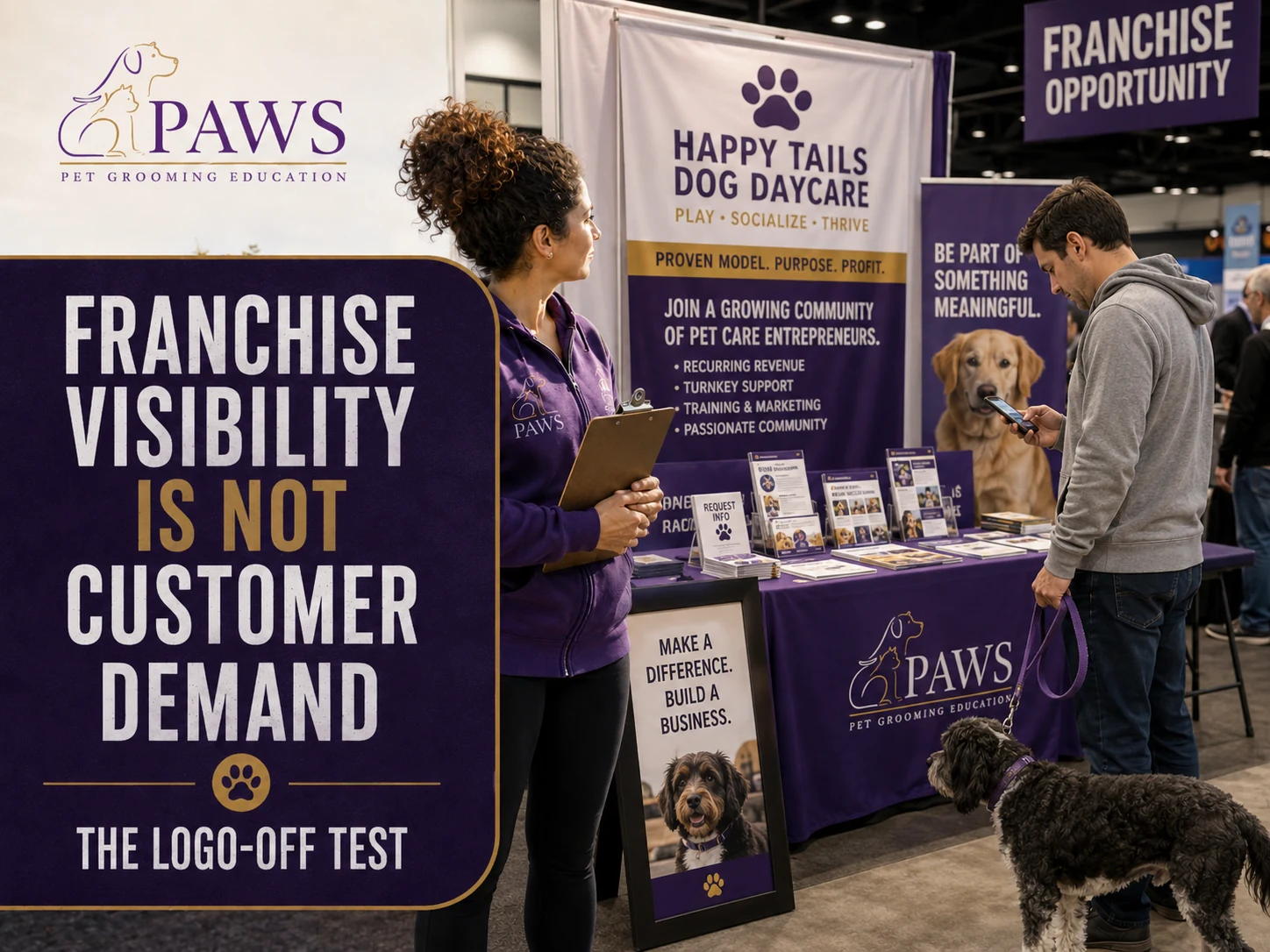
This is one of the easiest traps in the whole franchise decision. You search “dog daycare franchise” or “doggy daycare franchise,” and a few names keep showing up. They may have ads, franchise pages, rankings, lead magnets, videos, webinars, and polished sales funnels.
That can make the brand feel bigger than it is. But you are looking at the franchise-buyer side of the machine. The average local dog owner is not sitting at home searching “best pet franchise opportunity.” They are searching for a safe daycare near work, a boarding place before vacation, a groomer who will not butcher the dog, or a place recommended by somebody they trust.
A franchise can be well known to people trying to buy franchises and unknown to people trying to buy dog daycare.
That does not make the franchise bad. It means the buyer needs to stop confusing sponsored franchise visibility with local customer demand.
Compare the franchisor’s investor-acquisition machine with its consumer-acquisition machine. Separate websites, campaigns, budgets, agencies, and reports may reveal that franchise sales receive far more attention than local customer demand.
A strong franchise-sales organization is not a defect. The problem begins when visibility among investors is presented as proof that pet owners in a new territory already know and want the service brand.
⚠️
Known by whom?
Franchise brokers, franchise buyers, and other dog daycare operators are not the people paying your rent. Local dog owners are. Test the brand with them.
🤝
What Customers Are Actually Loyal To
In dog daycare, loyalty usually attaches to trust before it attaches to a logo.
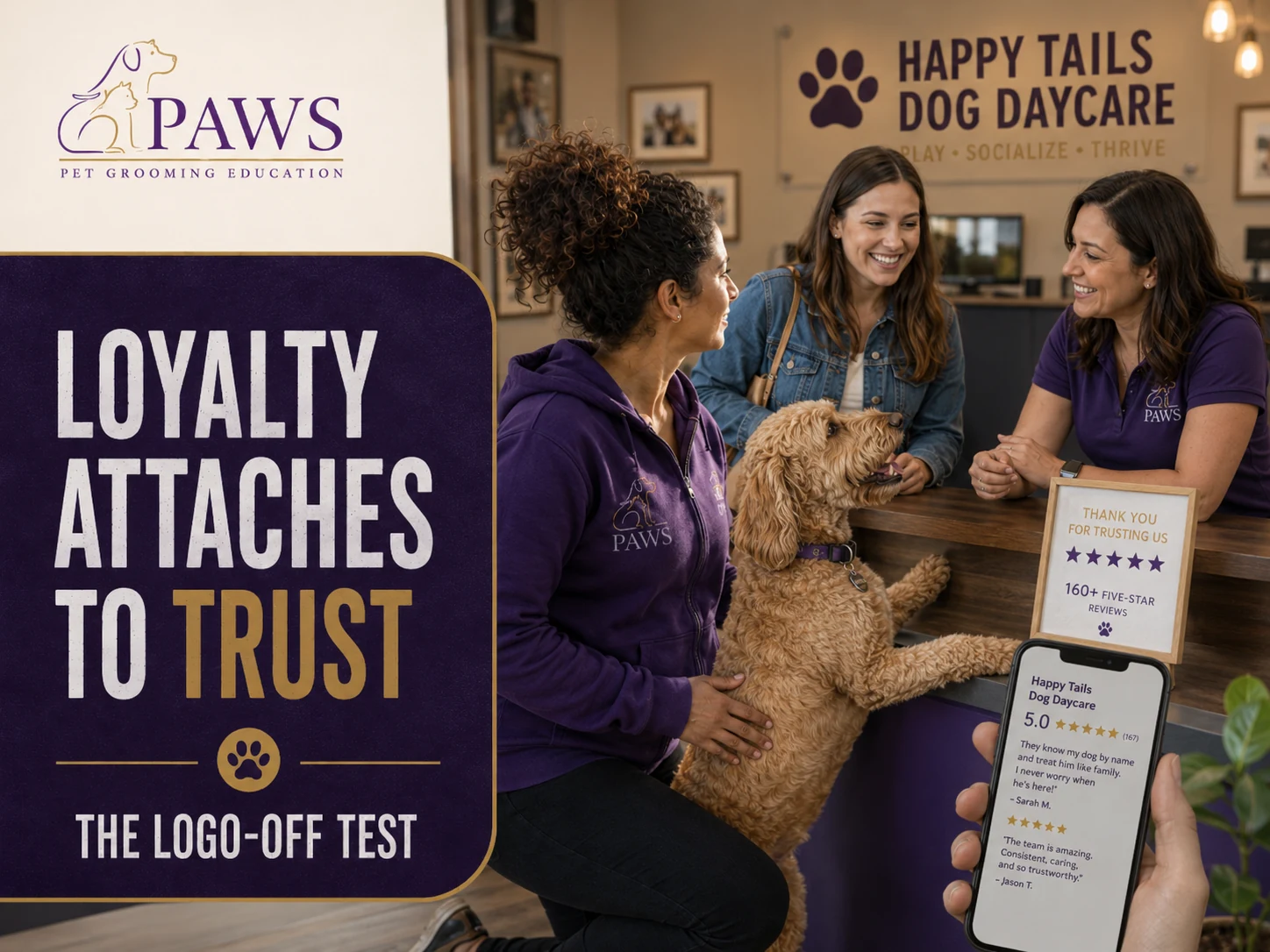
Dog daycare is not an impulse hamburger stop. People are leaving their dog with you. That makes the decision personal, emotional, and local.
Customers come back because their dog is safe, the staff knows them, the building is convenient, the place smells clean enough, the reviews are strong, the manager communicates, the groomer does good work, the boarding routine feels reliable, and the dog seems happy to return.
A franchise logo may help introduce the business. It may help the first impression. It may reassure some people. But repeat business is earned inside the building.
If the customer says, “We love Sarah at the front desk,” “Max loves the playroom staff,” “The groomer knows my dog,” “They always communicate,” or “They handled that incident honestly,” that is local operating value. The sign did not do that. The people did.
Loyalty should be tracked instead of assumed. Ask customers why they chose the business, why they stayed, who they trust, what they mention in reviews, and whether they would follow a groomer, manager, or staff team after a name change.
The answers matter because customer loyalty can attach to different assets. A franchise name may open the first door, while staff relationships, convenience, safe care, and honest communication create the repeat revenue.
👥
Staff Trust
Customers remember the people who handle their dog calmly and competently.
⭐
Local Reviews
Reviews often carry more local trust than a brand name customers barely know.
📍
Convenience
Location, hours, parking, drop-off, and pickup routines matter every week.
🧼
Cleanliness
Odor, floors, laundry, yards, suites, and lobby condition build or destroy confidence fast.
🐾
Dog Safety
Temperament screening, grouping, supervision, incident handling, and disease control are where trust is earned.
📞
Communication
People forgive problems faster when the business communicates honestly and quickly.
✅
When the Logo Really Does Matter
If customers would leave because the brand disappeared, the brand has teeth.
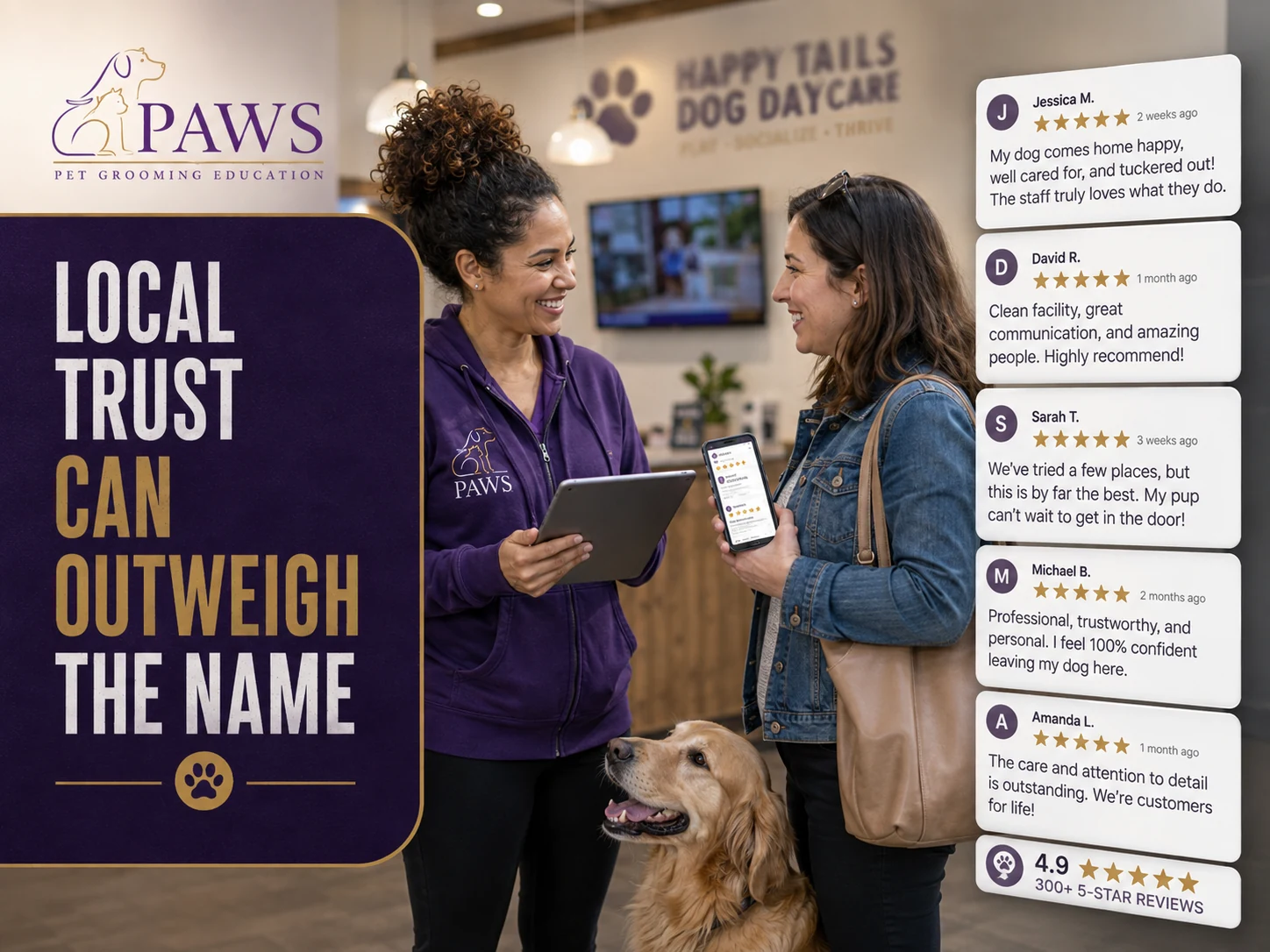
The logo can matter. This page is not pretending franchise brands are worthless. A franchise brand has real value when customers already know it, search for it, trust it, and choose it.
If nearby locations have strong reputation, the brand brings leads before opening, customers mention the name during calls, tours convert faster because of the brand, and the logo reassures nervous dog owners, that is value.
If the brand helps recruiting, lender confidence, landlord conversations, resale value, multi-location expansion, or pricing power, that can matter too.
The key is proof. Not logo confidence. Not franchise brochure confidence. Proof.
The strongest evidence is behavioral. Customers search the name, drive farther for it, convert faster, accept pricing more readily, mention it during tours, and hesitate when the possibility of losing it is raised.
Market comparisons matter. A brand may have real pull in a region with several established locations and almost none in a first-time market. Buyers should insist on evidence from territories that resemble the one they plan to open.
- Customers already recognize the brand in your market.
- Customers search the brand by name.
- Nearby locations have strong reviews and regional reputation.
- The brand brings leads before opening.
- The logo increases tour conversion.
- The brand reassures nervous customers.
- The brand helps recruiting, financing, landlord confidence, or resale value.
- Customers would hesitate if the name disappeared.
🎨
When the Logo Is Mostly Paint on the Building
A logo that does not change customer behavior is not brand power. It is paint.
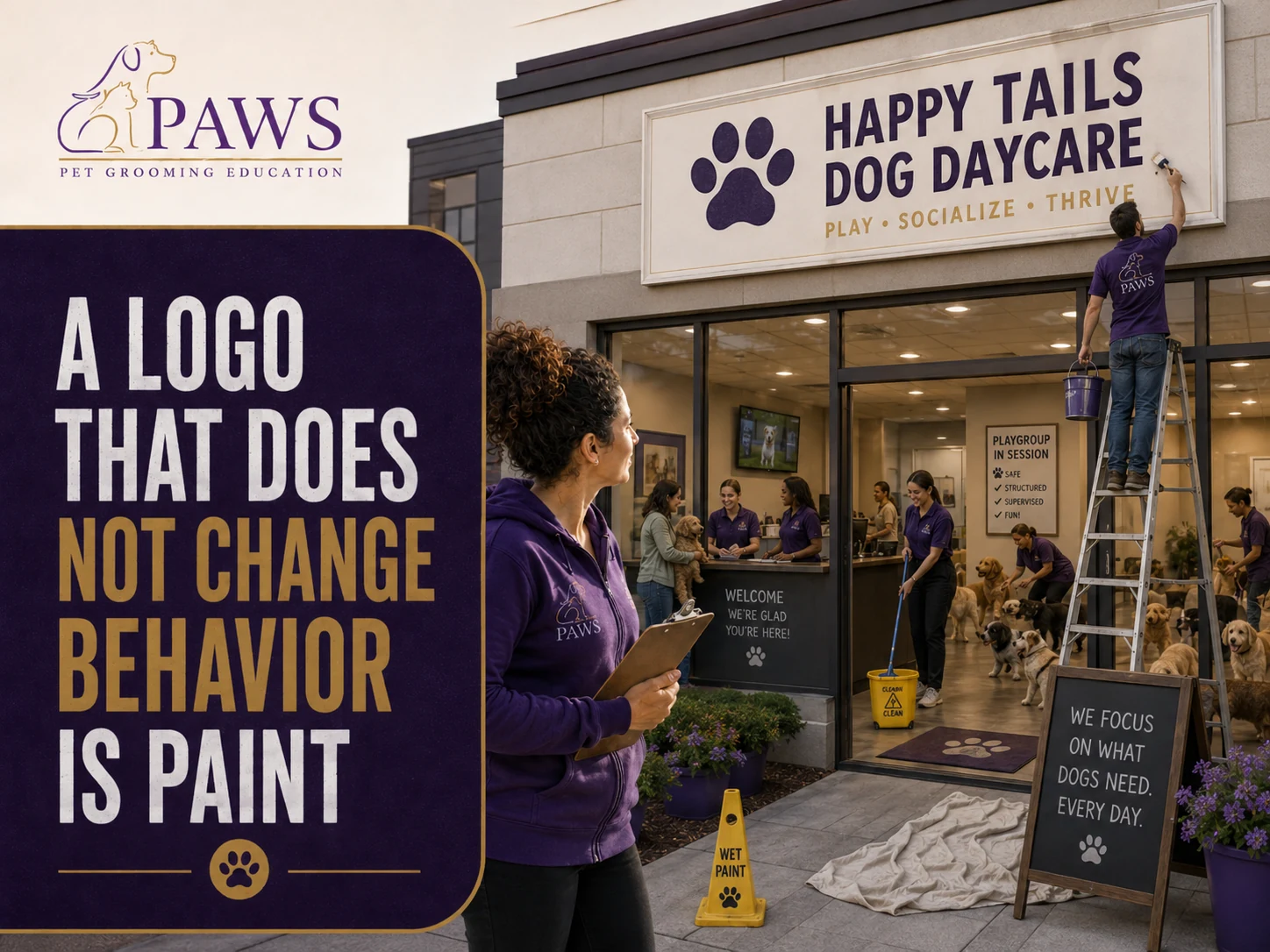
The logo has a weaker argument when customers do not know the brand, most leads come from local ads and Google, customers mention staff and reviews instead of the name, nearby independents have stronger local trust, and franchisees admit they had to build awareness themselves.
That does not mean the franchise has no value. It may still provide structure, training, systems, and support. But the buyer should not pretend the logo is doing work it is not doing.
If the local operation is creating the demand, then the franchise value has to come from something else: operating support, training, software, vendor savings, coaching, network value, marketing help, resale support, or expansion help.
The logo does not get to take credit for customers it did not bring.
Cosmetic consistency can still have value, but it should not be confused with operating performance. New colors, signs, uniforms, and design packages do not improve supervision, cleanliness, training, customer service, or dog handling unless the system behind them changes behavior.
When brand standards require spending, the owner should ask what customer or operating result the expense is expected to create. A required upgrade with no measurable effect is a cost of compliance, not proof of brand power.
- Local customers have never heard of the brand.
- Customers mention reviews, staff, cleanliness, location, and convenience instead of the name.
- Most leads come from local ads, local SEO, Google Business Profile, referrals, or reviews.
- The ad fund does not create measurable local demand.
- Franchisees say they built awareness themselves.
- Nearby independents have stronger reviews and local trust.
- Customers would likely stay if the sign changed but the staff and service stayed.
🧾
The Royalty Question Hiding Inside the Logo Test
The logo only deserves control and royalties if the logo or system keeps creating value.
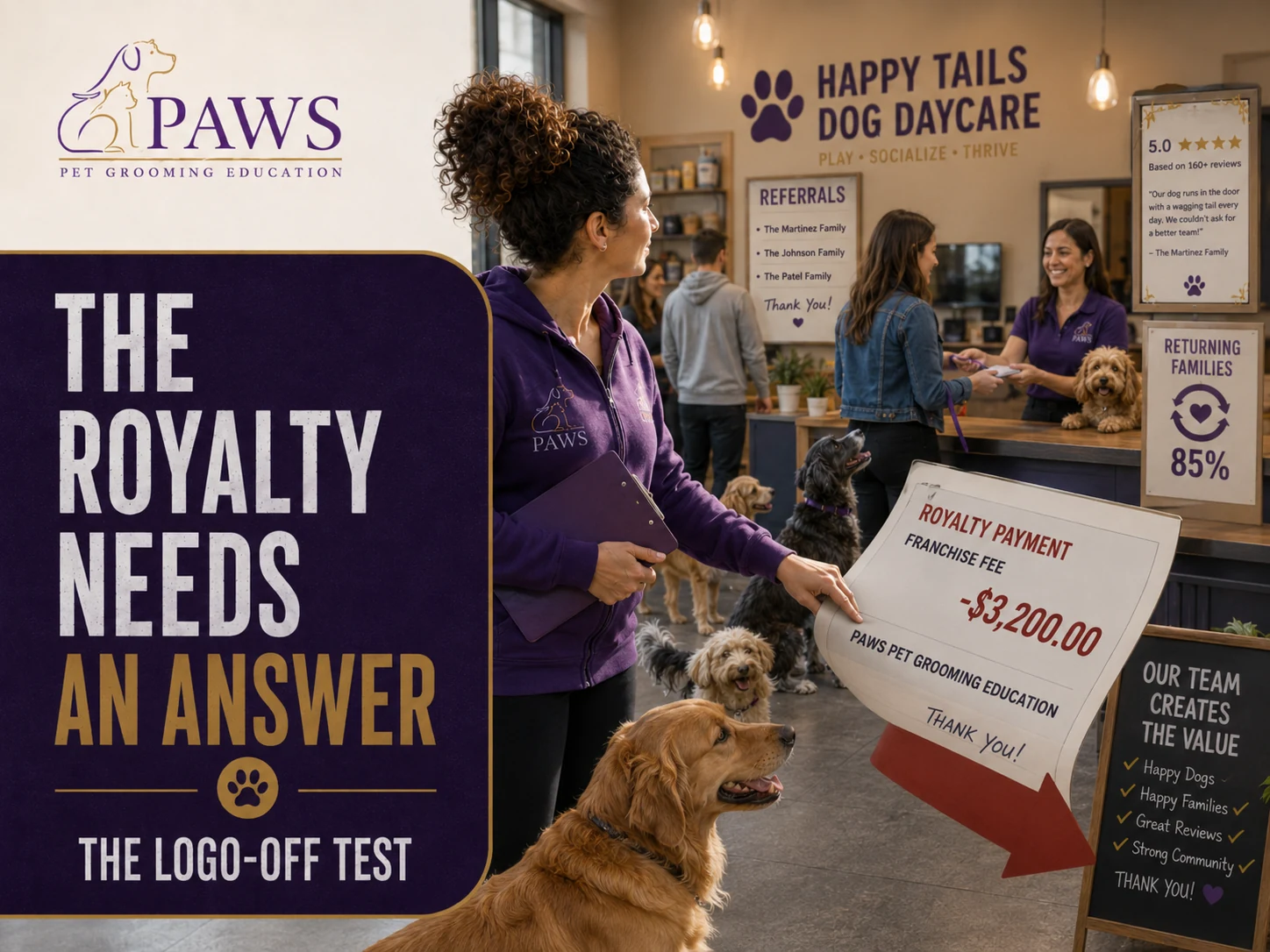
This is where the Golden Arches Test turns into money.
If the franchise brand is creating real customer demand, the royalty has a stronger argument. If the brand brings leads, improves trust, helps pricing, supports resale value, and keeps customers choosing the business, that matters.
But if the local operation is creating the demand, the royalty has to be justified by something else. Maybe support. Maybe systems. Maybe vendor savings. Maybe coaching. Maybe software. Maybe network value. Maybe expansion help.
But there needs to be an answer.
A royalty cannot just sit on gross sales forever because the logo looks official. If the local staff, reviews, location, and customer trust are doing the work, then the buyer needs to ask what the franchisor is still providing every month.
That is the incentive question. If you build the local trust, earn the reviews, absorb the ugly days, train the staff, calm the customers, and make the business valuable, how much of that value belongs to the franchise system and how much belongs to the local operation you built? A buyer needs to know that before agreeing to send a percentage of gross sales out the door for years.
If you are not comfortable building a local brand, a franchise may make sense. Some buyers want the structure, rules, support, and brand framework. Fine. But if you are capable of building the local trust yourself, hiring targeted help where needed, and owning both the upside, and hard times then you need to ask whether paying for someone else’s sign is actually the best deal.
Run a recurring value audit. List the leads, savings, training, software improvements, vendor benefits, crisis support, operational changes, and resale advantages created by the franchisor during the same period the royalty was paid.
Then compare those results with the work completed locally. Hiring, training, reviews, retention, safety, marketing, capacity management, cleaning, and customer relationships may be producing most of the value that generated the royalty payment.
⚠️
The fee has to defend itself.
If the same dogs would still come without the logo, the royalty has to be justified by ongoing value somewhere else. Otherwise, you may be paying Golden Arches money for a sign that does not have Golden Arches power.
📄
The Contract Reality Check
This is a value test, not permission to ignore a franchise agreement.
Do not read this page and think, “Great, I can just take the sign down if I get annoyed.” No. That is how people wander into legal bear traps wearing flip-flops.
Franchise agreements may include rules about brand use, de-identification, customer data, software, phone numbers, websites, territory, non-competes, non-solicitation, transfer approval, renewal, post-termination obligations, approved vendors, and operating standards.
You may own the local business entity and local assets, but you do not fully own the brand, system, rules, renewal rights, transfer rights, operating standards, vendor freedom, signage, software path, or post-termination obligations.
That is why this test matters before you sign. You are not only asking whether the logo helps. You are asking whether the help is worth the control.
The agreement can control more than the sign. Buyers should understand customer data, telephone numbers, domain names, social accounts, software exports, lease rights, transfer approval, de-identification, restrictive covenants, and the time allowed to complete a transition.
This is why local goodwill and contractual control must be reviewed together. Customers may trust the people inside, but the agreement may determine whether those people can continue serving the same customers after the relationship ends.
📌
Have a franchise attorney read the agreement.
The sales deck tells you the story. The contract tells you the leash length.
🔒
Forced Upgrades, Approved Vendors, and Brand Control
Consistency is the fair reason for control. The cost of control is the part buyers need to understand.
A franchise system needs control because the brand has to stay consistent. That is fair. If every local owner freelances the brand into a ditch, the whole system can suffer.
But control has a cost. If the franchisor requires remodels, signage changes, software changes, approved vendors, uniform updates, paint changes, design updates, equipment standards, or renewed brand packages, the local owner pays real money to keep fitting the brand.
That may be worth it if the brand is creating value. If the logo is bringing customers, raising trust, supporting prices, and strengthening resale value, then brand standards have a stronger argument.
But if the logo is mostly paint and the local operation is doing the work, forced costs feel a lot different. Nobody enjoys being barely above water and then getting told the new brand direction requires a checkbook, a contractor, and a nervous laugh.
Ask how often standards have changed, what prior remodels cost, whether franchisees received adequate notice, and whether vendors were competitive. Historical examples are more useful than a general statement that upgrades are occasionally necessary.
The buyer should also model the worst timing. A required remodel, software conversion, or equipment package can arrive during a slow year, lease renewal, debt pressure, or local expansion plan. The cost is not only the invoice; it is what the business must postpone to comply.
⚠️
The logo only deserves control if the logo is creating value.
Brand standards can protect the system. They can also cost the local owner money. Make sure the brand value is real enough to justify the control.
🧪
Golden Arches Test Table
Ask simple questions. Do not let franchise glitter answer for you.
| Test Question | If Yes | If No | What It Means |
|---|---|---|---|
| Do customers search the franchise name? | The brand may create real demand. | Local service search may matter more. | Brand demand needs search proof, not wishful thinking. |
| Do customers mention the brand during calls or tours? | The name may influence trust. | Customers may care more about location, reviews, and staff. | Listen to what customers actually say. |
| Would customers drive farther because of the brand? | The brand may have real pull. | Convenience may beat logo recognition. | Dog daycare is often local and routine-based. |
| Would customers leave if the brand disappeared? | The brand has teeth. | The local operation may be the real value. | This is the heart of the test. |
| Do nearby locations create trust? | Regional awareness may help. | You may be building awareness from scratch. | Nearby reputation can matter. |
| Do reviews attach to the brand or the local team? | The brand may carry reputation across locations. | Staff and local service may drive trust. | Reviews often reveal the true loyalty source. |
| Does the brand increase tour conversion? | Brand trust may help close customers. | The tour, staff, and facility may be doing the closing. | Track why tours convert. |
| Does the brand bring leads before opening? | The brand may have pre-opening value. | Local marketing will carry more weight. | Pre-opening leads are a strong brand test. |
| Does the ad fund create local demand? | The fee may be easier to justify. | You may pay the fund and still buy local customers yourself. | Brand advertising has to reach your market. |
| Would staff and customer loyalty survive a sign change? | Local operating value is strong. | Brand dependence may be higher. | Know whether loyalty belongs to the system or the location. |
☎️
Questions to Ask the Franchisor
Make the brand claim answer in facts, not fog.
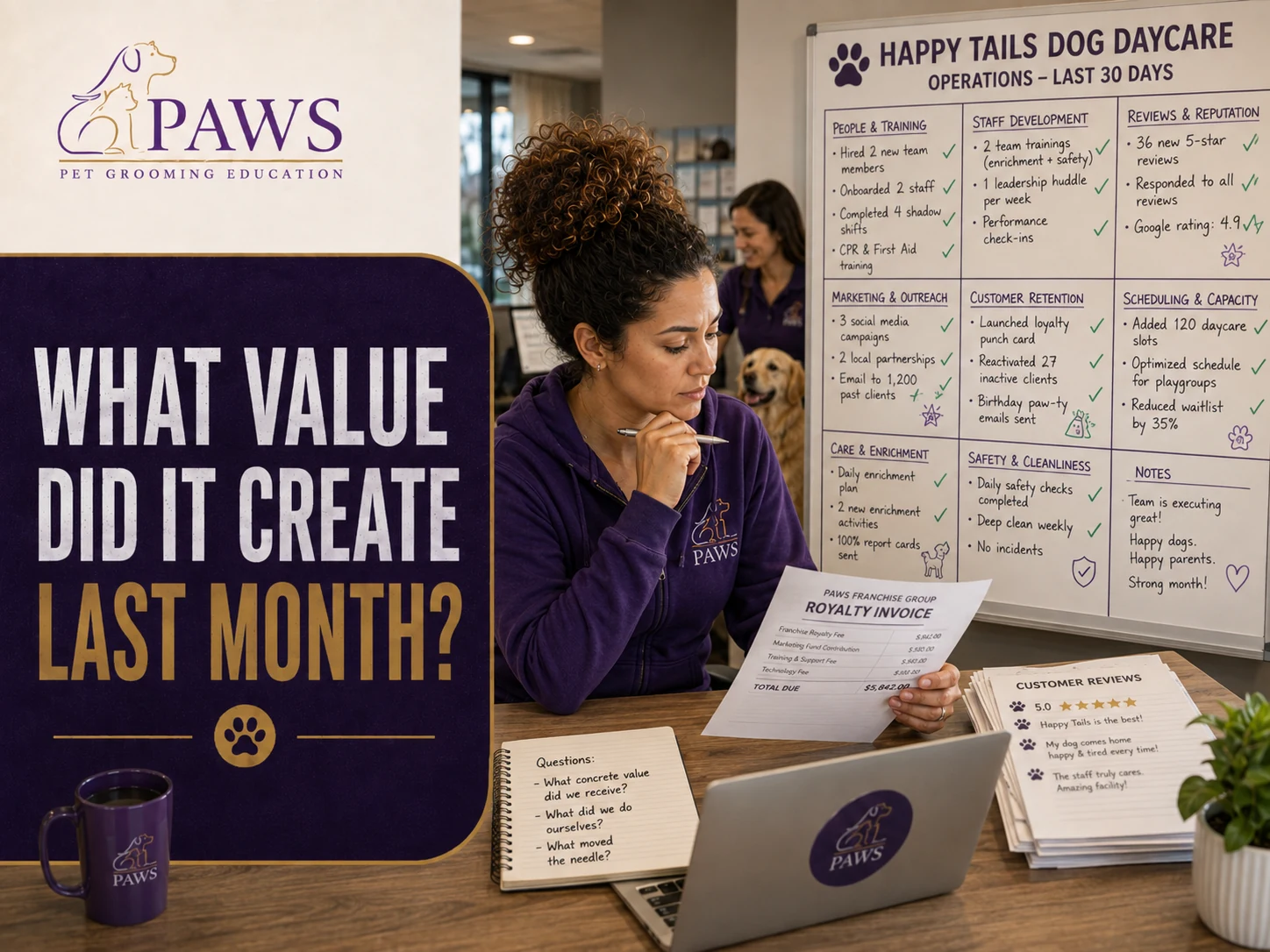
Require answers in a form that can be checked. Ask for branded-search data, local lead reports, pre-opening campaign results, tour conversion, ad-fund allocation, support activity, vendor savings, upgrade history, and examples from first-in-market locations.
The buyer should compare sales statements with the FDD, agreement, marketing obligations, support descriptions, and current franchisee experience. A promise that exists only in the sales conversation may not survive closing.
Repeat the questions as a monthly-value test: what did the system create, improve, save, or prevent during the last thirty days that the local team could not have produced on its own?
- What proof shows customers choose this brand by name?
- How many leads come from branded search?
- How many leads come from local service search?
- How much brand demand exists in my market right now?
- Do customers mention the brand during calls or tours?
- Do franchisees in new markets get brand-driven leads before opening?
- Does the logo improve tour conversion?
- Would customers still come if the same location had a different name?
- What does the brand do that local reviews cannot?
- How do you measure brand value after opening?
- What support continues after year one?
- What would I lose if the franchise system disappeared tomorrow?
- Which parts of the system are truly proprietary?
- What forced upgrades, remodels, approved vendors, or software changes could I be required to fund?
🐾
Questions to Ask Franchisees
Current owners can tell you whether the logo actually moves customers.
- Did customers know the brand before calling?
- Do customers ask for the franchise by name?
- What actually drives tours?
- What actually drives repeat business?
- Do customers mention the logo or the staff?
- Would customers follow the manager?
- Would grooming customers follow the groomer?
- Would boarding customers stay if the name changed?
- Do reviews matter more than brand recognition?
- Does the ad fund create local demand?
- What support is still useful after the startup period?
- Does the royalty still feel justified by brand value?
- If the franchise relationship ended, what would actually be hard to replace?
📌
Ask the uncomfortable version.
“If the sign changed but your same staff, reviews, location, and customers stayed, how much business would you actually lose?” That answer tells you more than a brochure ever will.
🗂️
Keep Testing the Franchise Claim
The logo test leads straight into brand recognition, royalties, marketing support, and control.
📣
Brand Recognition
Known by franchise buyers is not the same as known by local dog owners.
🧾
Franchise Royalties
If the logo is not creating demand, the royalty has to be justified by something else.
📣
Marketing Support
National brand support does not automatically replace local SEO, reviews, ads, referrals, and outreach.
🔒
Control and Approved Vendors
A franchise is support with a leash attached. Make sure the control is worth the value.
⚖️
Franchise vs. Independent
Compare packaged support against building your own system, hiring targeted help, and keeping local upside.
💵
Franchise Costs
The franchise fee is not the full cost. Build-out, payroll, marketing, working capital, and fee stacks matter.
❓
Golden Arches Test FAQ for Dog Daycare Franchise Buyers
Detailed answers about logo power, local trust, franchise-buyer visibility, rebranding, continuing royalties, contract control, upgrades, and proving what the franchise system actually contributes.
What is the Golden Arches Test for a dog daycare franchise?
It asks whether the same dogs and owners would continue using the business if the franchise sign changed while the staff, manager, groomer, building, routines, reviews, and local relationships remained. The test helps separate customer loyalty to the brand from loyalty to the local operation.
Why compare dog daycare with a household-name food franchise?
A major food brand may control products, recipes, packaging, supply chain, advertising, pricing expectations, and customer habit. Dog daycare usually depends more heavily on local staff, safety, cleanliness, convenience, reviews, and trust. The comparison exposes how much value the logo actually carries.
Does the test mean dog daycare franchises have no value?
No. A franchise may provide systems, manuals, training, software direction, vendors, design standards, launch help, coaching, and a peer network. The test simply requires the buyer to identify which value comes from the brand name and which comes from other parts of the system.
How can I tell whether customers choose the logo or the local operation?
Track lead sources, ask customers why they called and why they stayed, review tour conversations, read review language, and speak with franchisees. Customers may mention the brand, or they may consistently mention staff, cleanliness, safety, location, convenience, communication, and referrals.
What does it mean when customers would stay after a rebrand?
It suggests that local goodwill is strong. The staff, service, location, routines, reviews, and customer relationships may be creating more loyalty than the name on the sign. A rebrand can still cause cost and confusion, but the underlying demand may survive.
What would actually disappear if the franchise relationship ended?
Potential losses include the name, signage, website listing, software access, manuals, vendor programs, training, marketing assets, network access, and brand-related demand. The agreement may also impose de-identification, transfer, data, lease, and post-termination obligations. Each item should be mapped and priced.
What local assets might remain valuable after a sign change?
The building, trained staff, customer relationships, reviews, referral sources, local search authority, management judgment, operating routines, vendor knowledge, and community reputation may remain important. Contract terms can affect whether those assets can continue being used.
Why does franchise-buyer visibility not prove customer demand?
People researching franchise opportunities use different searches and channels from dog owners looking for daycare, boarding, grooming, or training. Ranking for franchise-investment terms proves the franchisor can reach buyers, not that local pet owners know or want the service brand.
When does a dog daycare logo have real customer power?
It has real power when customers search the name, recognize it before opening, drive farther for it, convert faster, accept pricing more readily, mention it during calls and tours, and would hesitate if the name disappeared. Those outcomes should be measured in the actual market.
Can local reviews outweigh a franchise name?
Yes. Reviews describe the local staff, cleanliness, safety, grooming, boarding, communication, and incident handling that customers actually experience. A strong independent with deep local trust can outperform a franchise name that customers do not recognize or that executes poorly.
What does front-loaded franchise help mean?
Startup support may be most valuable during site selection, design, hiring, training, software setup, policy development, and launch. As the operator gains experience, the continuing royalty should be supported by continuing improvements, leads, savings, training, crisis help, expansion support, or resale value.
How should I test year-five franchise value?
Ask what the system produced during the last month and last year. Identify leads, cost savings, vendor benefits, training outcomes, software improvements, operational changes, crisis assistance, and resale advantages. Compare them with the work and value created locally.
How does the logo test connect to royalties?
When the brand creates demand, the royalty has a stronger argument. When the local team creates the demand, the royalty must be defended through other ongoing value such as systems, support, vendors, software, coaching, marketing, network benefits, or expansion assistance.
What should a recurring royalty-value audit include?
List the fee paid and the specific franchisor contributions received during the same period. Separate brand-driven leads, training, savings, software, crisis support, and vendor value from locally completed hiring, marketing, reviews, retention, safety, cleaning, and customer-service work.
Why do contracts matter even when the local operation creates the loyalty?
The agreement may control the brand, customer data, phone numbers, websites, software, transfer, renewal, de-identification, vendors, lease rights, restrictive covenants, and post-termination conduct. Local trust does not cancel contractual obligations.
What should I ask about required upgrades and approved vendors?
Ask for the history, frequency, cost, notice period, financing options, vendor competitiveness, and business reason for prior upgrades. Model whether a remodel, software change, equipment package, or rebrand could arrive during a slow year or other major capital need.
What evidence should the franchisor provide for brand value?
Useful evidence includes branded-search demand, pre-opening leads, local inquiry sources, tour conversion, customer surveys, nearby-location reputation, ad-fund results, franchisee reports, and performance from first-in-market territories similar to the proposed location.
What should I ask current franchisees?
Ask whether customers knew the brand before opening, what drove early and current leads, whether people mention the name, how much local marketing they still buy, what support remains useful, what upgrades cost, and whether the royalty still feels justified.
Can a logo upgrade create operating value?
It can improve visibility, positioning, consistency, or customer understanding, but it does not automatically improve supervision, cleanliness, staff skill, communication, safety, or retention. The expected customer or operating result should be identified before treating the upgrade as value.
What is the simplest Golden Arches decision rule?
Do not pay household-name money for assumed brand power. Separate what the logo changes, what the system delivers, what the local team creates, what the contract controls, and what could be replaced. Then price each part using evidence from the actual market.
🍟
The Bottom Line: Do Not Pay Golden Arches Money for Paint
The logo has to prove it creates real value.
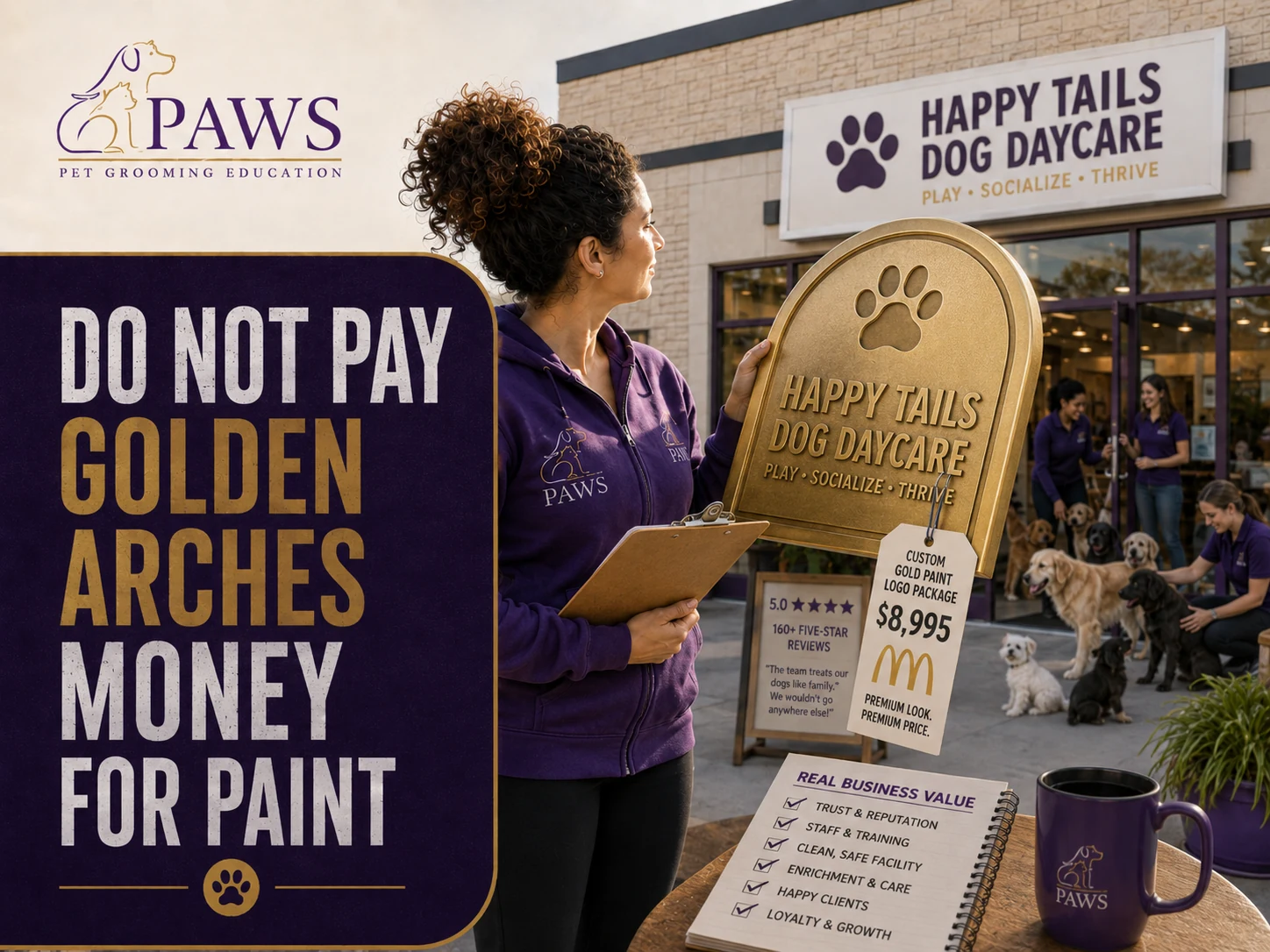
The Golden Arches are valuable because customers already know what they mean. They represent a product, a menu, a supply chain, a price expectation, national advertising, customer habit, and instant consumer recognition.
A dog daycare franchise logo has to prove that kind of power before you pay for it like it has that kind of power.
If the sign brings customers, increases trust, improves tour conversion, supports pricing, creates local demand, strengthens resale value, and keeps producing value after the startup period, that is real franchise value.
If the same dogs would still show up because of the staff, reviews, location, cleanliness, groomer, manager, local referrals, and customer trust, then be honest: the local operation may be doing the work the logo is getting credit for.
Do not pay Golden Arches money for a logo that has not proven Golden Arches power.
The final valuation should separate brand demand, operating systems, startup assistance, ongoing support, software, vendors, network value, control, and exit restrictions. One attractive logo should not be allowed to stand in for the whole package.
Paying a premium can make sense when the system keeps producing measurable value. Paying premium-system money for a sign that does not change customer behavior leaves the local owner carrying the work while the brand receives the credit.