Franchise Structure, Independent Control, Royalty Drag, Startup Systems, Vendor Freedom, Local Marketing, and Real Ownership
Dog Daycare Franchise vs. Independent Startup: The Real Comparison
A blunt operator comparison for people trying to decide whether they need a dog daycare franchise, or whether they can build the system themselves and keep the leash off their business.
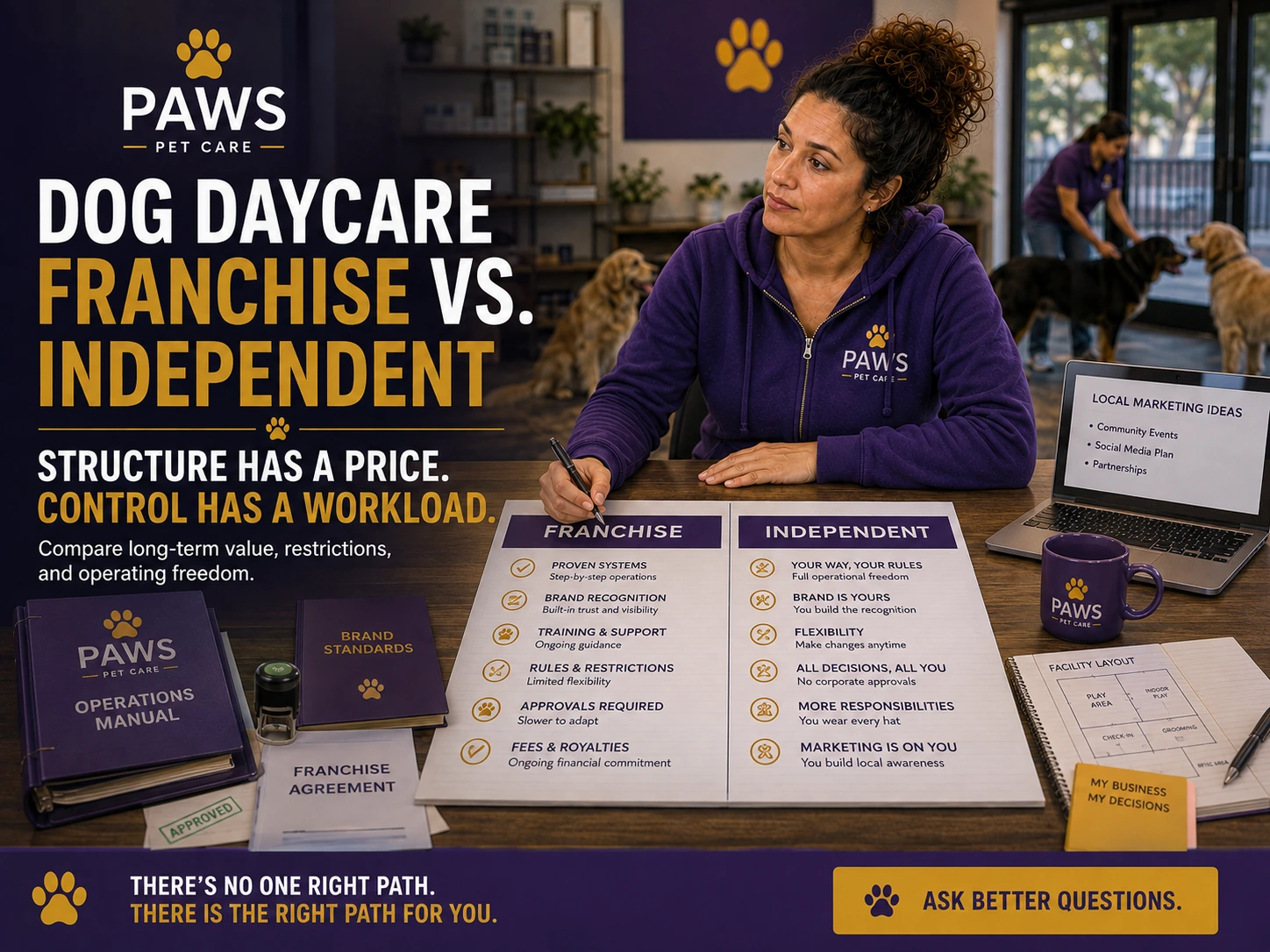
A dog daycare franchise gives you structure. An independent startup gives you control. The real question is whether the structure is worth the upfront cost, royalties, restrictions, approved vendors, brand rules, and long-term claim on gross revenue.
Independent does not mean amateur. Independent means you build the system instead of renting someone else’s. Franchise does not mean easy. Franchise means you bought a rulebook, a brand, a support structure, and a leash.
That is the trade. If you go independent, nobody hands you the binder. You have to build the binder. You have to research zoning, leases, contractors, pricing, software, cleaning systems, dog-handling rules, staffing, local marketing, insurance, forms, vendors, and customer policies. That work lands on your desk.
But once you build it, it is yours. You are not renting it forever. You are not paying a percentage of gross sales for the privilege of using systems you already learned. You are not waiting for permission to change a vendor, adjust a package, run a special, choose a product, shift your local marketing, or build your own brand.
This page is not here to tell every person to avoid franchises. Some buyers need structure. Some buyers want structure. Some buyers are better inside a defined system. Fine. But do not confuse fear with inability. We are not putting a lunar lander on Mars. We are taking care of dogs. The work is serious, and the consequences can be ugly, but the systems can be learned.
⚠️
Operator warning: a franchise does not make the dog business disappear.
Franchise or independent, the dog still bites the same. The floor still needs cleaning. Payroll still clears on Friday. The landlord still wants rent. The customer still wants answers when something goes wrong. A franchise can hand you a system, but it cannot remove reality from the building.
⚖️
The Real Difference: Structure or Control
Stop making this more mysterious than it is. This is the trade sitting in the middle of the table.
A dog daycare franchise sells structure. You may get a startup roadmap, brand standards, training, operating procedures, facility guidance, vendor suggestions, marketing templates, software direction, opening support, and a name to put on the sign.
An independent startup gives you control. You build the local brand, choose the vendors, set the pricing, pick the software, shape the services, design the policies, hire the experts, change direction when needed, and keep the gross revenue without a royalty riding on top of it.
Neither path is magic. The franchise path can save you from some blank-page problems, but it brings cost and control. The independent path gives you freedom, but it puts more work on you before opening. Pick your burden. There is no version where the dog business fairy shows up with a mop, a manager, and a full lobby.
The comparison should be made with a written cost-and-control ledger. List the startup help, the time it saves, the mistakes it may prevent, the restrictions it creates, and the total amount likely to leave the business through royalties, advertising funds, required software, and mandated vendors.
The choice also changes how quickly the owner can respond to the local market. An independent operator can revise packages, vendors, services, branding, and promotions directly. A franchise operator may gain consistency and support, but changes may require approval or remain unavailable under the system.
📚
Franchise Path
You buy structure, rules, brand standards, training, support, and permission to operate under someone else’s name.
🔧
Independent Path
You build the structure yourself, keep control, own the local brand, choose your vendors, and carry the full responsibility.
🧠
The Real Question
Are you paying for a system you truly need long term, or are you paying forever because the startup phase scared you?
🍔
Dog Daycare Is Not Fast Food
Do not compare a dog daycare franchise to a giant food brand and pretend the value works the same way.
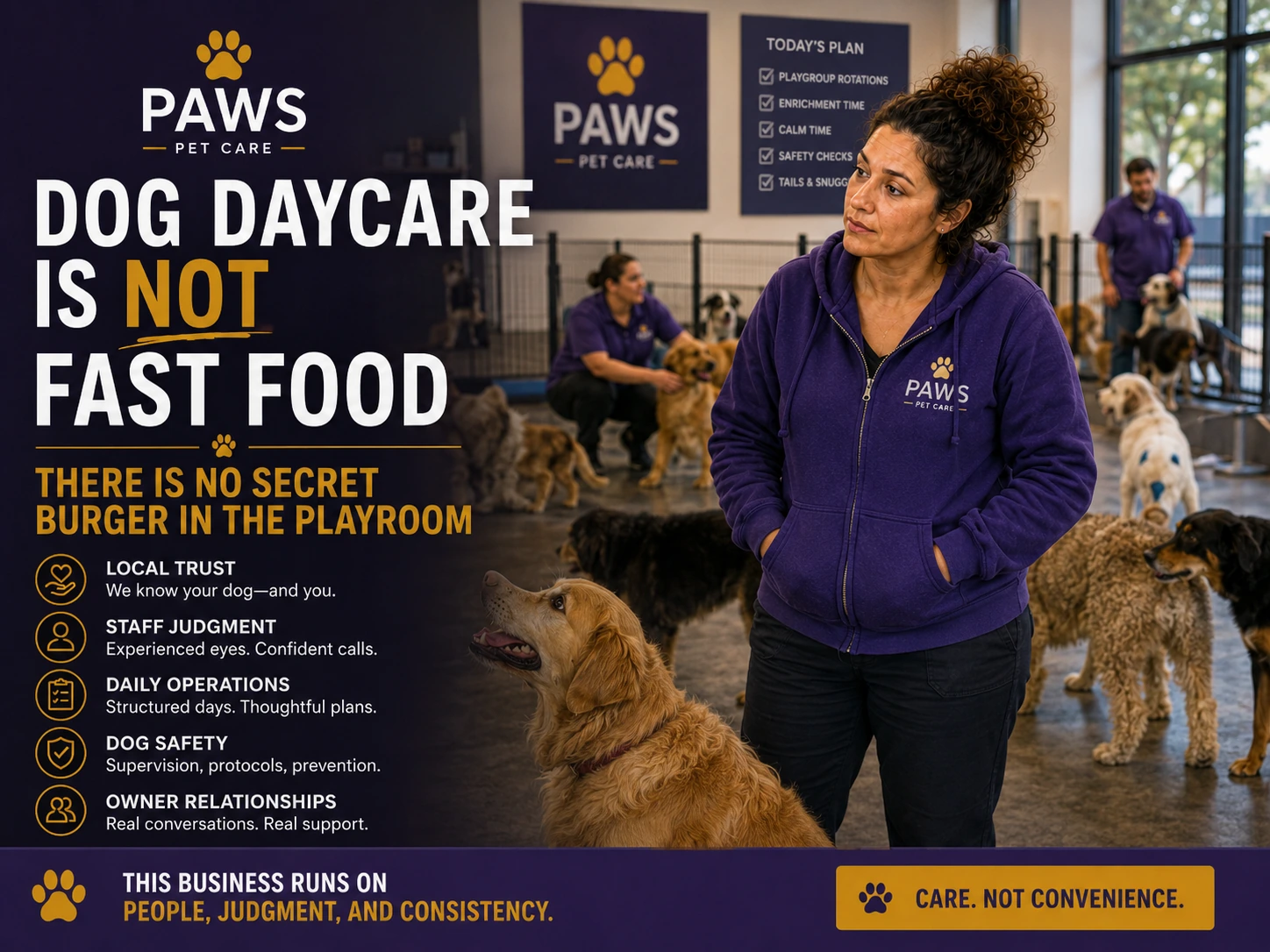
A major fast-food franchise can bring massive consumer recognition, national demand, supply-chain systems, product consistency, menu expectations, and customers who already know what they are buying before they pull into the lot.
Dog daycare is different. Most customers are not choosing the building because of some sacred national logo. They choose based on location, trust, reviews, cleanliness, staff, tours, convenience, boarding availability, grooming options, customer service, and whether they believe their dog will come home alive, healthy, and not psychologically wrecked.
Nobody is dropping off their Labrador because your lobby has the dog-care version of the golden arches. They are dropping off because they trust the local people touching their dog.
That does not mean a dog daycare franchise brand has no value. It means the value has to be proven in the local market. If local dog owners do not know the brand, you may not be buying customer demand. You may be buying the right to build local demand under someone else’s sign.
The local team creates much of the customer experience through judgment that cannot be reduced to a logo. Staff decide when a dog needs rest, which playgroup is appropriate, when an owner must be called, how an incident is documented, and whether a service should be refused.
A franchise comparison should therefore separate product-style standardization from care-quality standardization. Consistent forms and procedures can help, but the real result still depends on local hiring, training, supervision, maintenance, and customer trust.
📦
What a Dog Daycare Franchise May Give You
A good franchise is not selling nothing. The question is whether what it sells is worth the long-term price.
A franchise can provide real startup value. It may give a first-time owner a roadmap, a checklist, training, policy templates, facility standards, vendor direction, marketing materials, software direction, and people to call when the wheels start wobbling.
That can matter. A weak intake policy can bring the wrong dog into the wrong group. A bad floor can punish you every day. A sloppy cleaning system can turn a normal sickness problem into a full outbreak. Bad staffing, bad gates, bad customer communication, and weak documentation can cost far more than a manual.
So no, the franchise side is not automatically worthless. The problem is when the startup value gets treated like permanent value. A system that helped you open does not automatically earn a royalty in year five, year ten, or year fifteen.
The buyer should assign a realistic dollar value to each promised benefit. Estimate what comparable consulting, manuals, software, legal review, design guidance, marketing help, and staff training would cost independently, then compare that amount with the initial fee and long-term fee stack.
Value should also be tested against execution. A detailed manual has little value when it is outdated, ignored, too generic for the building, or unsupported when an unusual operating problem appears. The benefit is the usable result, not the number of pages in the binder.
🗺️
Startup Roadmap
A defined path can help a new owner understand the order of operations before lease, build-out, hiring, and opening collide.
🏗️
Facility Guidance
Layout, flooring, gates, suites, traffic flow, lobby setup, bathing areas, and dog movement matter. Bad design becomes daily punishment.
🎓
Training
Training can help owners, managers, and staff understand intake, cleaning, safety, customer service, and daily operations.
📋
Operating Manual
Procedures can reduce stupid mistakes. The buyer still has to ask whether the manual keeps earning money after the business is trained.
📣
Marketing Materials
Templates, brand assets, opening campaigns, and suggested outreach can help. They do not replace local hustle.
🧰
Vendor Direction
Vendor lists can save research time. They only create value if they save money, improve quality, or prevent bad purchases.
🔒
What the Franchise Takes Back
A franchise is not just support. It is support with a leash attached.
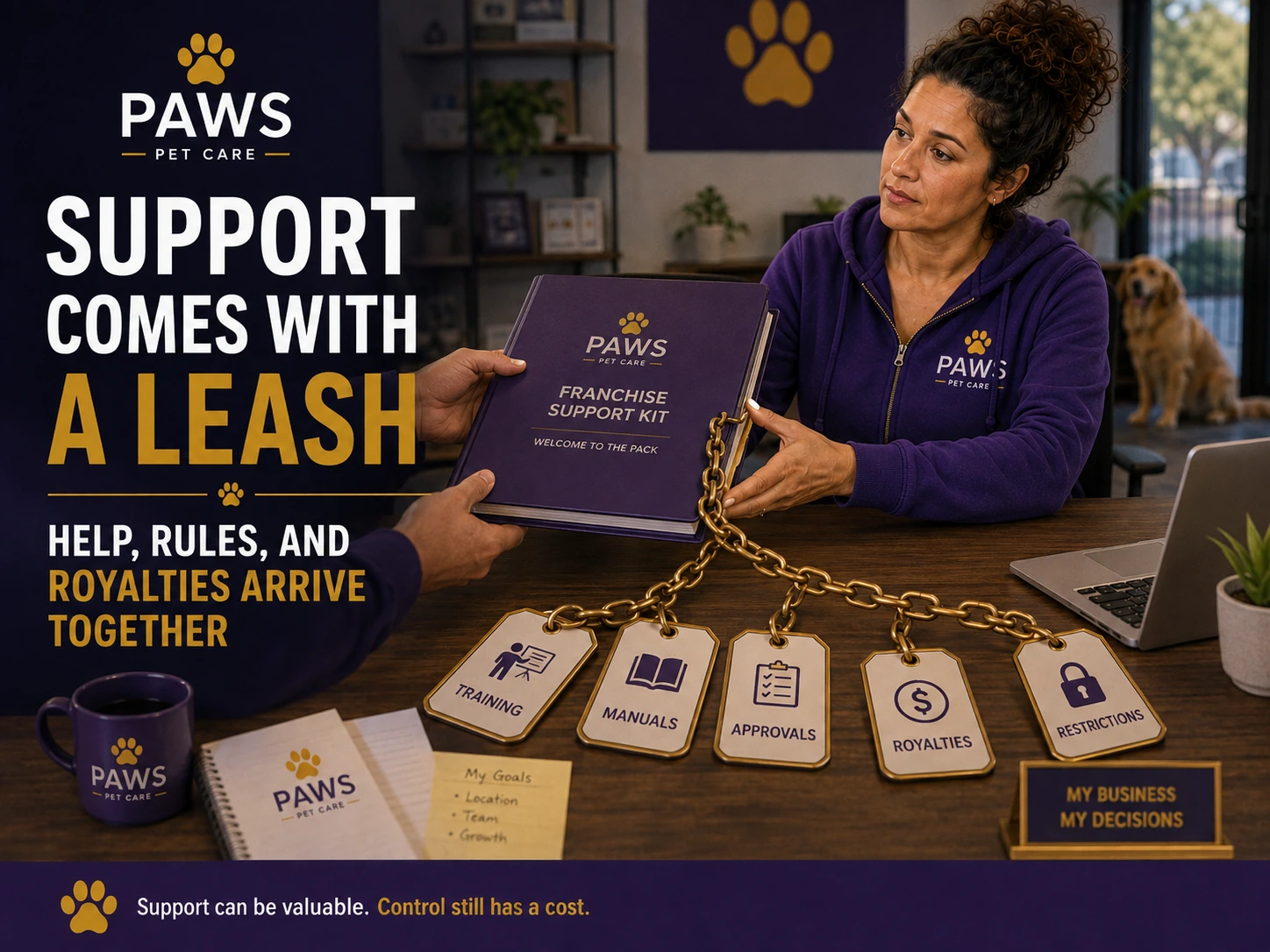
When you buy a franchise, you are not just buying help. You are also accepting rules. Those rules can affect your vendors, signage, software, services, marketing, pricing flexibility, products, build-out, remodels, resale, renewal, default, and what you are allowed to do with the local business you are paying to build.
That control is not random. The franchisor is protecting the brand system. That is their job. They do not want every local owner freelancing the brand into the ditch with weird signs, bad products, sloppy operations, cheap equipment, unapproved ads, sketchy vendors, or discount-bin business decisions that make the whole system look bad.
Fine. Brand protection has a purpose. But the buyer needs to understand what that means in real life. Your facility may be local. Your payroll may be local. Your lease may be local. Your debt may be local. Your staff problems may be local. But the rules may still come from somewhere else.
If a vendor gets too expensive, you may not be able to tell them to pound sand and buy somewhere else. If you want to change a local offer, adjust a product, shift branding, test a service, change shampoo, run a promotion, change colors, add a service, or move faster than the system wants to move, the agreement may have something to say about it.
Vendor arrangements deserve special attention. Required vendors, purchasing programs, supplier rebates, commissions, preferred-provider deals, and approved-product lists may be legitimate. They may also mean someone else benefits while you write the check. The buyer needs to ask who gets paid, who gets flexibility, and who gets stuck with the invoice.
Contract control matters too. If the agreement gives the franchisor rights around default, renewal, transfer, resale, lease issues, brand removal, software access, approved vendors, required upgrades, or operating standards, do not skim past that language like it is legal wallpaper. That is where the teeth live.
Before signing, build a control inventory. Identify which decisions require approval, which vendors are mandatory, what purchases produce rebates or other compensation for the franchisor, how local pricing can change, and who pays when the system requires a remodel or technology conversion.
The exit rules deserve the same attention as the opening support. Transfer approval, buyer qualifications, de-branding, noncompetition terms, renewal conditions, software access, customer data, and lease rights can determine how much of the local value the owner can actually sell later.
🧾
Royalty on Gross Sales
The franchisor may get paid before you know whether the month was actually profitable.
📢
Ad Fund Fees
The buyer has to know whether the ad fund creates local customers or mostly supports the larger brand machine.
🧴
Vendor Restrictions
Approved vendors are only valuable if they save money, improve quality, or improve safety. Otherwise, they are limited choice with a logo on the invoice.
🎨
Brand Rules
Brand standards can protect consistency. They can also force your local business to look, sell, and operate inside someone else’s box.
🏷️
Brand-First Priorities
The franchisor protects the franchise system first. Your location matters, but it lives inside the larger brand machine.
🔁
Remodels and Upgrades
Required upgrades are not free. They can land right when the local business is finally crawling out from under startup debt.
📄
Contract Teeth
Renewal, transfer, default, territory, vendor rules, lease language, and termination terms matter. The sales deck is not the contract.
🚪
Exit Friction
Getting in is the fun sales process. Getting out is where renewal, transfer, resale, default, de-branding, and contract language start mattering.
🏷️
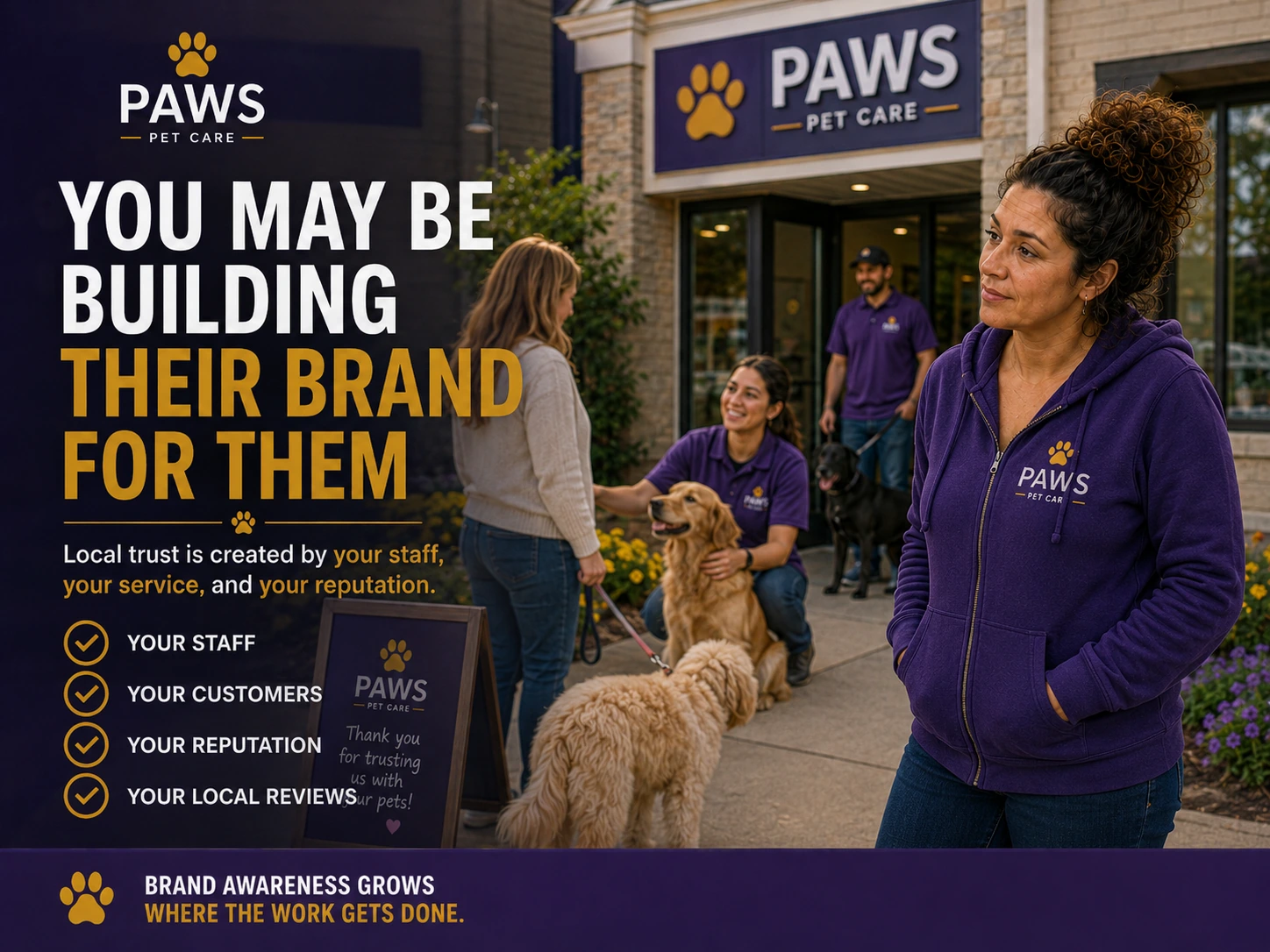
You Are Not Just Buying Their Brand. You May Be Building It for Them.
This is where dog daycare franchising gets different from buying into a giant national food brand.
When someone buys a major fast-food franchise, the brand recognition usually already exists. The customer sees the sign and already knows the product, the menu, the expectation, and the general experience. The franchisee is buying into a machine the public already understands.
Dog daycare is not there yet. In many local markets, the average dog owner may have no idea who a dog daycare franchise brand is. That changes the deal. You may not be buying huge customer recognition. You may be paying the franchise fee, signing the lease, funding the build-out, hiring the staff, doing the local marketing, earning the reviews, and teaching your market that the brand exists in the first place.
That does not mean the franchise has no value. It means you need to understand the direction of the value. If local dog owners already know and trust the brand, that is one thing. If nobody in your market knows the brand until you spend your own money opening the building and promoting it, then you are not just receiving brand value. You are creating brand value.
That is the part buyers miss. You may be paying the franchisor so you can promote their name in a market where their name did not mean much yet. You are taking the lease risk. You are building the local customer base. You are getting the reviews. You are creating the local trust. You are putting the brand on the map in your area.
The relationship can still be symbiotic. If the franchise gives you a strong system, training, support, operating standards, marketing direction, and a real brand path, both sides can benefit. But do not get confused about the business relationship. The franchise cares about the franchise first. It cares about protecting the brand, growing the brand, collecting fees, keeping standards consistent, and making sure local operators do not damage the larger system.
Your success matters to them because successful locations help the brand. Weak locations hurt the brand. That is not evil. That is the business model. But it means the buyer needs to stop thinking like someone being “welcomed into a family” and start thinking like someone entering a contract where the other side has its own priorities.
Track where each lead originates after opening. A franchise-generated lead, a local search lead, a customer referral, an apartment partnership, a veterinary referral, and a walk-in created by the location are not the same source of value. Attribution makes the brand discussion measurable.
The buyer should also ask who owns the local digital assets and customer relationship. Reviews, phone numbers, website pages, social accounts, email lists, photographs, and customer records may become important if the owner later sells, renews, changes brands, or leaves the system.
⚠️
The brand-first reality
A franchise company is not your rich uncle, your rescue squad, or your emotional support animal. It is a brand system. It will protect the brand first. If your local choices, vendors, pricing, marketing, signage, policies, or operations conflict with the system, the agreement may give the franchisor more control than you emotionally understood during the sales process.
🔧
What Independent Owners Must Build Themselves
Independent does not mean winging it. Independent means the homework is yours.
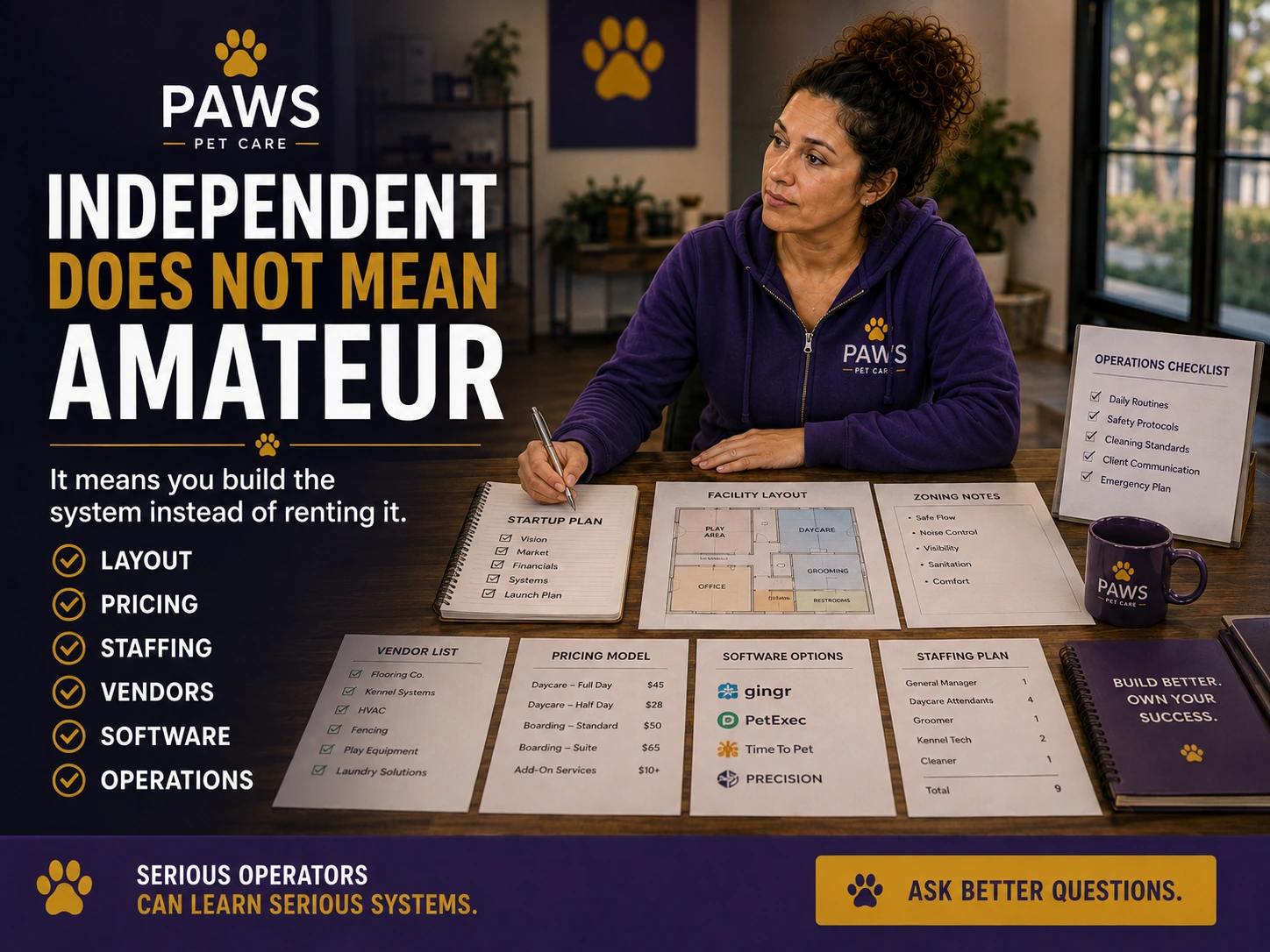
If you open independently, nobody is coming to hand you the binder. You have to do the work. You have to research the market, study competitors, check zoning, read local code, talk to compliance officers, review the lease, talk to contractors, price the build-out, choose software, build forms, write policies, find vendors, plan cleaning, design dog-handling systems, train staff, and figure out how customers will find you.
That is not a small list. But none of it is beyond the realm of doable. The information is out there. You can read local code. You can look at how veterinarians, kennels, groomers, and other pet-care businesses are zoned. You can call local officials. You can hire a commercial lease attorney, zoning attorney, architect, contractor, accountant, consultant, or insurance agent for specific problems.
No, that is not free. Independent does not mean you never spend money on help. It means you pay for the help you actually need instead of automatically buying a whole franchise system because the startup phase feels big. A zoning attorney costs money. A lease review costs money. A consultant costs money. A contractor review costs money. But targeted help up front is not the same animal as giving away a percentage of gross sales for years.
If you go independent, you may make mistakes. That is business. But serious research shrinks the mistakes. Good planning shrinks the mistakes. Hiring the right expert for the right problem shrinks the mistakes. The goal is not to become perfect before opening. The goal is to avoid the kind of stupid mistake that burns six figures, ruins the lease, or gets a dog hurt because you were too lazy to learn.
And here is the part that gets forgotten: once you figure it out, you figure it out. The zoning work is done. The lease is signed. The build-out is finished. The systems are written. The vendors are chosen. The staff gets trained. The business starts repeating itself. You patch the holes, tighten the weak spots, and keep improving. You are not paying forever for the same lesson.
Independent planning needs a decision calendar with owners and deadlines. Zoning confirmation, lease review, design drawings, contractor pricing, insurance, software, forms, hiring, training, marketing, and opening cash should be tracked as connected work rather than a pile of unrelated tasks.
The independent owner should also document why each major decision was made. Vendor comparisons, pricing assumptions, design choices, safety rules, and staffing plans become the operation’s first manual and make later improvement easier than relying on memory.
| Independent Startup Work | What You Have to Do | Who Can Help |
|---|---|---|
| Zoning and Local Rules | Research Municode, zoning categories, permitted uses, special-use rules, noise, odor, parking, outdoor space, and kennel/daycare definitions. | Local planning office, compliance officer, zoning attorney, commercial real estate broker. |
| Lease Review | Understand use clauses, build-out permission, landlord work, HVAC, plumbing, signage, outdoor areas, renewal, assignment, default, and exit terms. | Commercial lease attorney, contractor, broker, insurance agent. |
| Build-Out Planning | Plan flooring, gates, walls, drains, HVAC, sound, odor control, cleaning flow, lobby, suites, grooming, bathing, storage, and staff areas. | Contractor, architect, plumber, HVAC contractor, operator consultant. |
| Pricing and Cash Flow | Set daycare, boarding, grooming, package, membership, add-on, holiday, and late-fee pricing that survives payroll and rent. | Accountant, bookkeeper, pricing calculator, startup manual, consultant. |
| Dog Operations | Build intake, temperament testing, vaccination rules, playgroup management, staff ratios, incident reports, medication logs, cleaning, and disease control. | Experienced operator, trainer, veterinarian, insurance agent, staff trainer. |
| Marketing | Build local SEO, Google Business Profile, reviews, service pages, signage, referral systems, social content, vet outreach, and tour conversion. | Web developer, marketing consultant, local SEO help, operator mentor. |
| Vendors and Software | Choose software, cleaning supplies, shampoos, gates, equipment, cameras, laundry, payment processing, phones, and customer systems. | Other operators, vendor demos, software trials, consultant, accountant. |
📌
The independent truth
If you go independent, you have to do it independently. That does not mean doing it stupidly. It means you do the research, hire help where needed, build the system, and then the system belongs to you.
🧠
The Fear Problem: Do Not Let “I Can’t” Buy the Franchise for You
Some buyers do not need a franchise. They need to stop talking themselves out of their own ability.
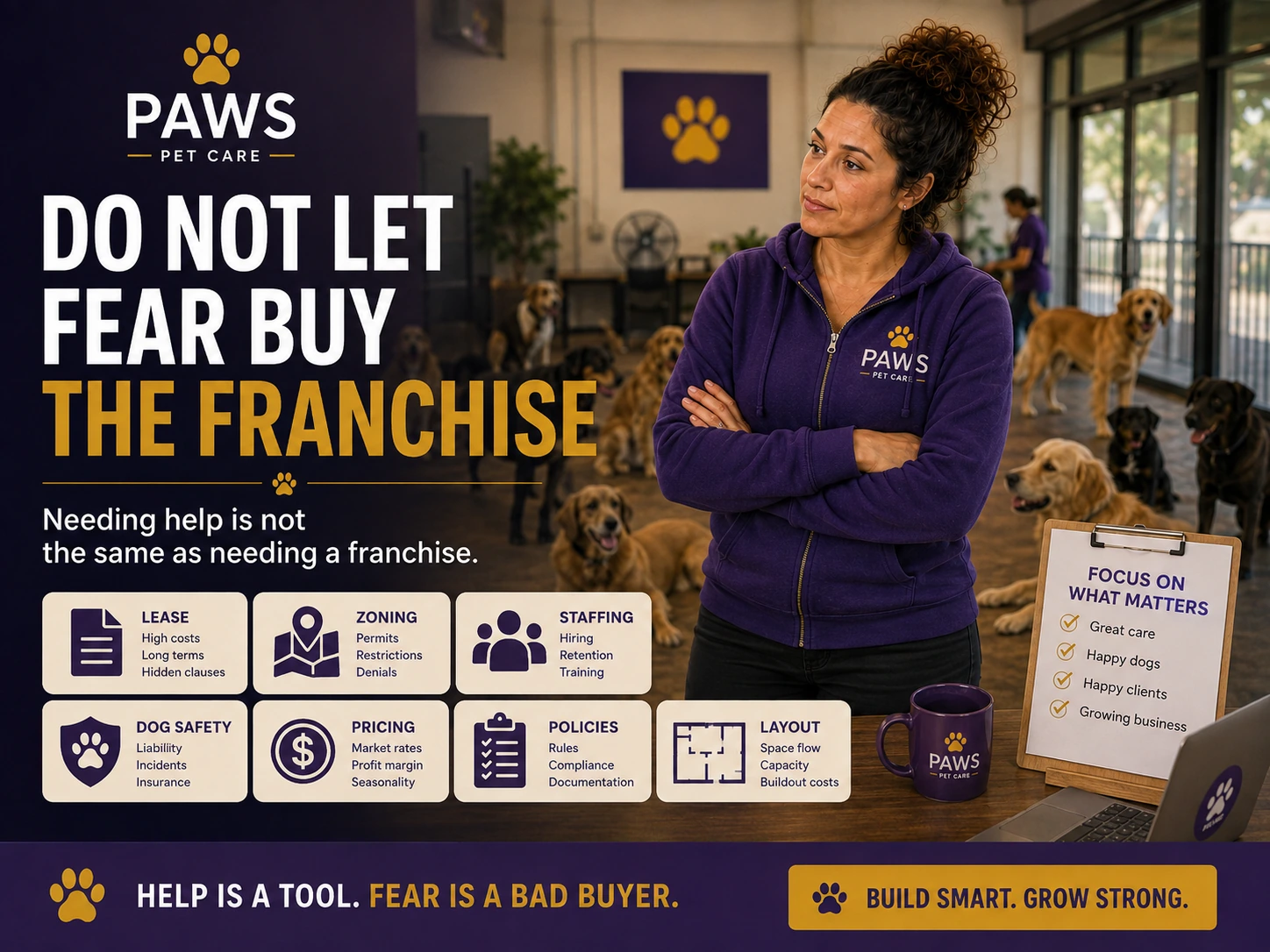
If you have enough money, credit, discipline, or investor backing to seriously consider opening a dog daycare facility, you are probably not helpless. You may not know this industry yet. Fine. Learn it. You may not know zoning yet. Fine. Research it. You may not know daycare pricing, dog grouping, cleaning systems, or boarding risk yet. Fine. Those are problems to solve, not proof that you need to rent someone else’s brand forever.
People sell themselves short because the startup feels big. The lease is intimidating. The build-out is intimidating. Dogs are unpredictable. Customers are emotional. Payroll is real. Insurance is real. The possibility of getting it wrong is real. That fear can make a franchise look like the safe adult choice.
Sometimes structure is exactly what a buyer needs. But sometimes the buyer is paying for fear management. There is a difference between needing help and needing a franchise. You may need a lawyer, a calculator, a better lease, a consultant, a manual, software, and six months of hard study. That does not automatically mean you need a long-term royalty relationship.
“I can’t” cannot do anything. If you tell yourself you cannot open a dog daycare independently, you are probably right. If you tell yourself you can figure it out and then actually do the research, hire the right people, and respect the learning curve, you may surprise yourself.
Convert anxiety into a problem list. If the fear is zoning, hire zoning help. If it is the lease, hire a commercial lease attorney. If it is dog operations, obtain operator training and written systems. If it is cash flow, model the numbers. A defined problem can be solved without automatically buying an entire franchise relationship.
The buyer should delay the decision when the only clear reason for franchising is emotional relief. Confidence can be valuable, but it should come from verified demand, adequate capital, competent plans, reviewed contracts, and support that can be described in specific deliverables.
⚠️
Do not confuse fear with inability.
The question is not, “Can I do this with no help?” That is the wrong question. The question is, “What help do I actually need, how long do I need it, and do I need to give up a piece of gross revenue for years to get it?”
🐕
The Learning Curve Is Real, and It Can Bite
Do not confuse doable with harmless. Dog daycare mistakes can get ugly.
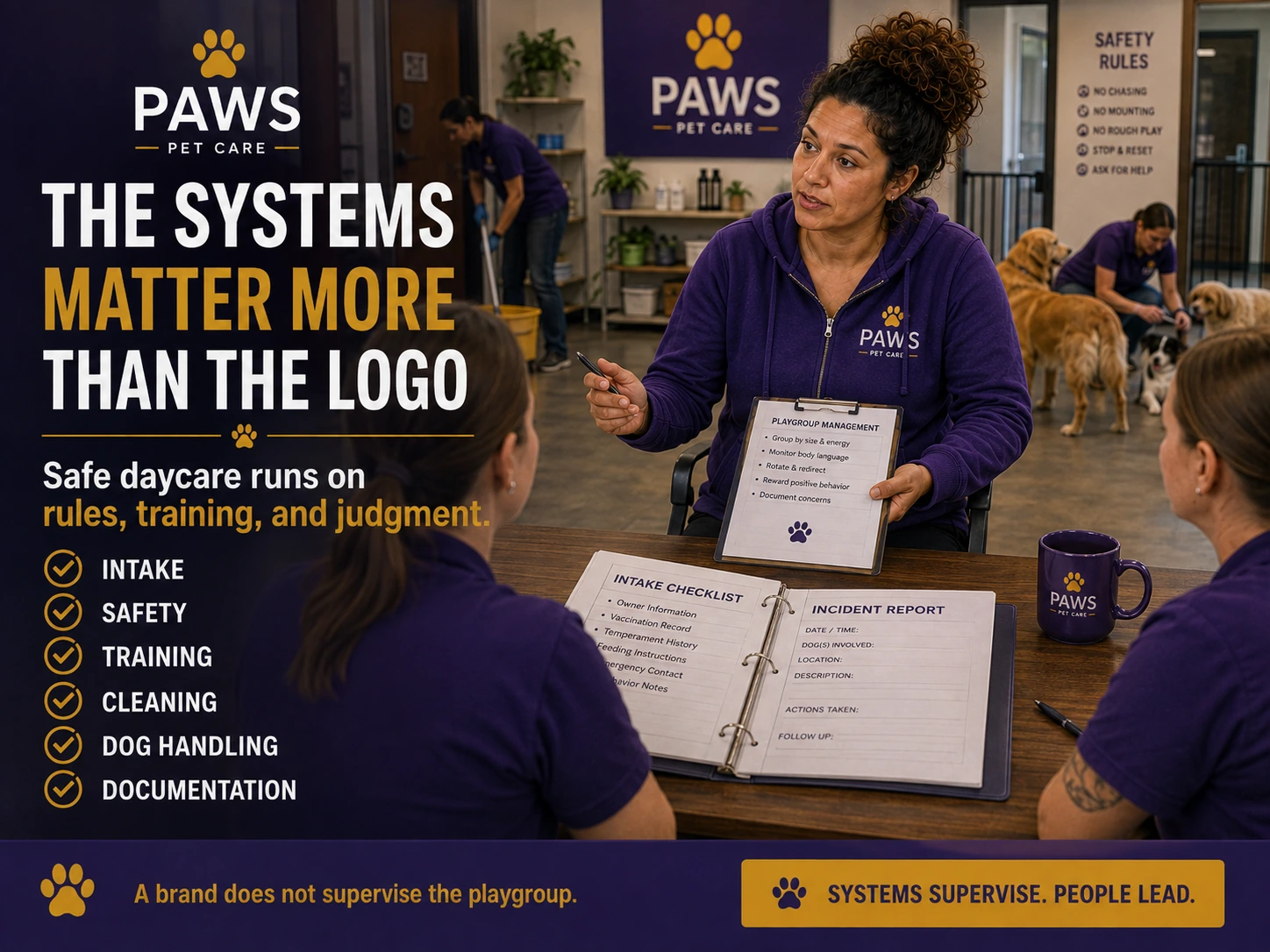
Dog daycare is not rocket science, but it is not a hobby with a cash register either. The learning curve can be steep. Bad screening, bad playgroup decisions, bad boarding checks, bad medication handling, bad cleaning, bad staffing, bad heat control, bad gates, and bad judgment can hurt dogs. In the worst cases, dogs can die.
That is why independent owners cannot wing it. You need systems before the first customer walks in. You need intake rules. You need vaccination rules. You need temperament testing. You need playgroup controls. You need cleaning protocols. You need boarding checks. You need incident reports. You need staff training. You need emergency plans. You need to know what happens when the day goes sideways.
A franchise may help package those systems. Independent owners have to build them, buy them, hire help for them, or learn them. The difference is not whether systems matter. Of course systems matter. The difference is who owns them when the dust settles.
Once you figure it out, you figure it out. After you survive a couple holiday seasons, boarding rushes, grooming crushes, staff problems, customer complaints, and cleaning surprises, the holes in the business get easier to see. Patch the holes. Train the staff. Tighten the forms. Fix the schedule. Clean up the pricing. Get the facility running smoothly. Then hire a manager and start working on the business instead of being buried inside it every day.
Training should be evaluated by demonstrated competence rather than attendance. Staff must be able to apply intake standards, read dog behavior, interrupt play safely, complete cleaning procedures, handle medication, document incidents, and escalate emergencies under real operating conditions.
The system also needs a review cycle. Incidents, near misses, illnesses, customer complaints, staffing failures, and maintenance problems should produce updated procedures and retraining. A static manual does not protect a facility that refuses to learn from its own operation.
🧰
The systems matter more than the logo
A good dog daycare is not safe because the sign looks professional. It is safe because the owner built rules, trained staff, watched the dogs, documented problems, cleaned correctly, and fixed weak spots before they turned into disasters.
📋
The Blank Page Problem
Some people want the checklist. That is fine. Just know what the checklist costs.
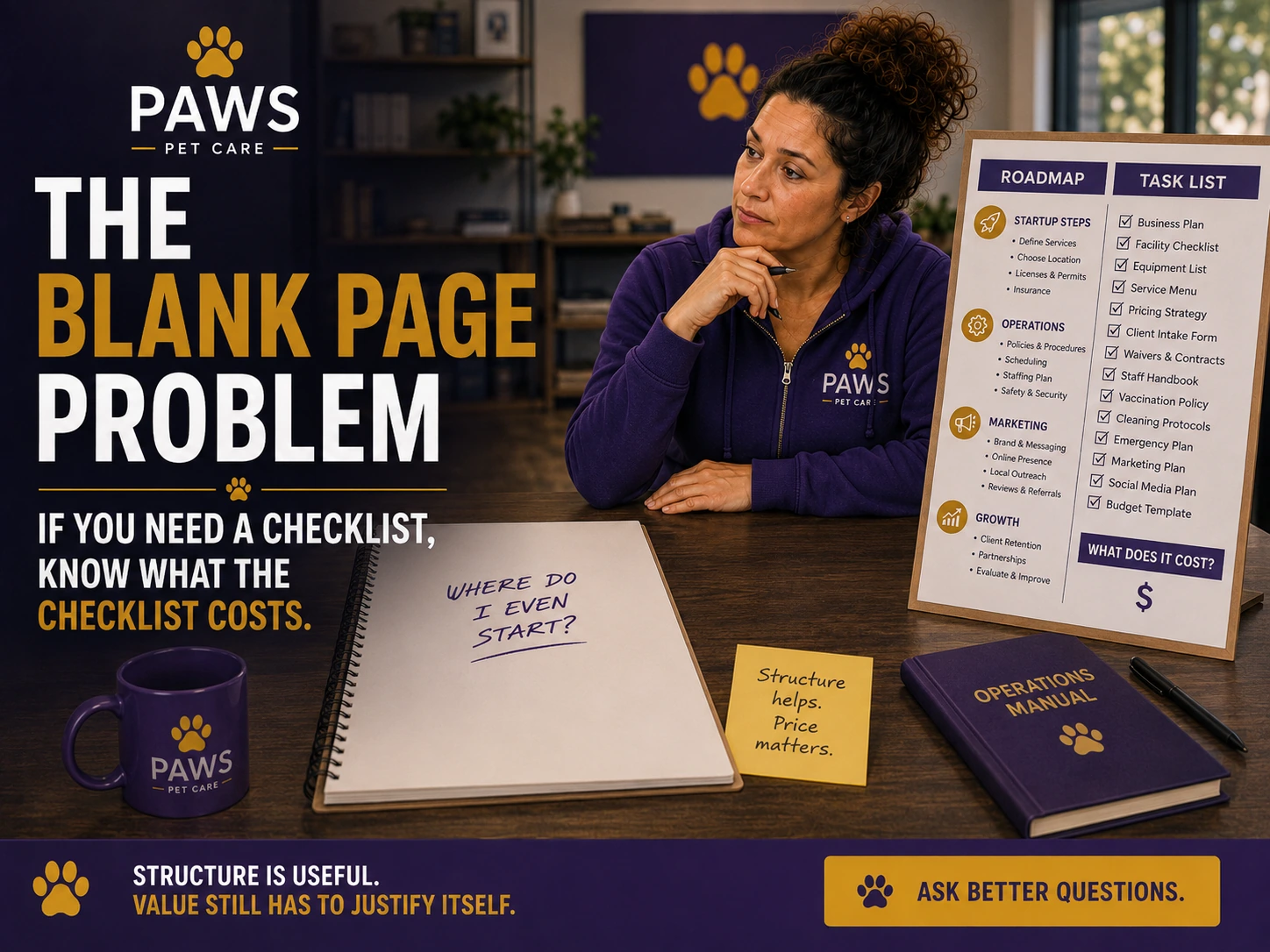
A lot of capable buyers come from structured careers. They worked inside corporations, medical systems, finance departments, military systems, engineering teams, sales organizations, real estate companies, or management structures where policies, checklists, departments, reporting, and hierarchy were normal.
Then they retire, cash out, change careers, or decide to open a dog daycare, and suddenly the blank page is staring at them. No department. No boss. No corporate process. No one handing them the next form. That can be uncomfortable.
A franchise feels familiar to that buyer. It gives them the checklist, the brand standards, the opening schedule, the training path, the software direction, the rules, and someone to call. There is nothing wrong with wanting structure.
The dangerous part is paying forever for structure you only needed at the beginning. If you need a checklist, get a checklist. If you need consulting, hire consulting. If you need a lawyer, hire a lawyer. If you need six months of education, take six months and learn. Do not automatically turn a temporary blank-page problem into a long-term gross-revenue sharing problem.
A buyer can price the blank-page solution separately. Compare the cost of a startup manual, consultant, attorney, accountant, architect, contractor review, software implementation, and operator training with the present value of the franchise fee stack over the expected ownership period.
Structure should have an expiration test. Ask which parts are needed before opening, which remain useful during the first year, and which continue producing measurable value after the owner and staff have learned the routine.
⚖️
Dog Daycare Franchise vs. Independent Startup Comparison Table
This is the apples-to-apples version. No sales fog. No motivational paw-print confetti.
Use the table as a due-diligence worksheet rather than a scorecard. Assign actual costs, time requirements, approval limits, and evidence to each row so the comparison reflects the buyer’s market and resources.
The same feature may have different value for different owners. A detailed rulebook may be worth more to a first-time operator who wants structure and less to an experienced operator with existing systems, local recognition, and a trained management team.
| Issue | Franchise Path | Independent Path | PAWS Operator Take |
|---|---|---|---|
| Startup Confidence | More structure, more guidance, more defined steps. | More research, more self-direction, more responsibility. | Confidence has value. Just make sure you know what it costs. |
| Training | Training may be provided before opening and during launch. | You must build training through experience, consultants, manuals, experts, and staff procedures. | Training is useful. Paying forever for early training is the question. |
| Facility Design | May include layout guidance, design standards, approved looks, and build-out rules. | You research, hire, plan, and approve the design yourself. | Bad design punishes you daily. Good design matters either way. |
| Operating Systems | May provide manuals, forms, safety standards, cleaning rules, and daily procedures. | You build or buy the systems yourself and customize them to your facility. | The system matters more than the source. Build it, buy it, or rent it, but do not run without it. |
| Marketing | May provide brand assets, templates, launch guidance, and ad fund support. | You build local SEO, reviews, referral systems, service pages, events, and outreach yourself. | Local trust fills the building. A template does not. |
| Brand Recognition | Valuable only if local dog owners know and trust the brand. | You build a local brand from scratch. | Known by franchise buyers is not the same as known by dog owners. |
| Pricing Control | Pricing may be guided, restricted, or influenced by brand standards. | You set pricing based on rent, payroll, local market, capacity, and service mix. | Broken pricing kills both paths. The spreadsheet gets a vote. |
| Vendor Choice | May involve approved vendors, required vendors, or brand-controlled purchasing. | You choose vendors and can leave when they get expensive, slow, or useless. | Vendor freedom matters more after the honeymoon wears off. |
| Software | Software may be required or recommended. | You choose the pet-care software that fits your facility. | Software is a tool, not a religion. |
| Royalties | Ongoing percentage of gross sales or revenue may apply. | No franchise royalty. | A royalty on gross sales means the franchisor eats before you know what you kept. |
| Control | You operate inside someone else’s system and agreement. | You control the local business, local brand, vendors, systems, and changes. | Support and control often arrive in the same box. |
| Local Flexibility | Flexibility may be limited by brand rules and approval processes. | You can adjust packages, pricing, services, products, and promotions faster. | Local markets change. Being able to move matters. |
| Exit and Resale | Transfer, resale, renewal, and buyer approval may be controlled by the agreement. | You still deal with lease, valuation, and buyer issues, but without franchise approval layers. | Read the exit rules before you sign the entry papers. |
| Long-Term Value | Must prove ongoing support, brand demand, system improvement, and franchisee value. | Value depends on the local brand, systems, staff, reputation, cash flow, and owner execution. | The franchise has to keep earning its cut. Early help is not forever value. |
🐾
What Both Paths Still Require
Nobody escapes the actual dog business.
A franchise does not remove the need for working capital, a workable lease, competent staff, customer service, local marketing, cleaning, dog evaluation, insurance, payroll discipline, and the ability to handle bad days without folding like a wet cardboard box.
An independent startup does not remove those needs either. It just puts more of the planning responsibility directly on you. That is the whole comparison. Franchise may package some of the work. Independent forces you to build the package.
Both paths also require management depth. The owner needs a plan for illness, turnover, no-call/no-show employees, equipment failure, emergency veterinary transport, customer escalation, and days when several problems occur at once.
Neither structure compensates for weak cash reserves. A sound concept can still fail when the owner runs out of money before occupancy, staffing, and service mix reach the level required to support the building.
🧯
No easy button either way
If you go independent and screw up, that is on you. Nobody is coming to bail you out because you forgot to check zoning, signed a bad lease, underpriced daycare, hired weak staff, or built a cleaning nightmare. But a franchise does not give you a magic rescue button either. It gives you a system, not immunity from bad decisions.
- Enough working capital to survive the ramp-up.
- A lease that actually allows the business you are opening.
- A location with enough demand, visibility, access, parking, and local customer base.
- A pricing model that survives payroll, rent, insurance, debt, and capacity limits.
- Cleaning systems that work when the building is full and staff are tired.
- Dog intake, evaluation, grouping, vaccination, and incident procedures.
- Insurance coverage that fits the real risks of daycare, boarding, grooming, and staff work.
- Local marketing that creates tours, trials, packages, boarding reservations, grooming appointments, and repeat customers.
- Staff training that is more than “watch the dogs and yell if something happens.”
- The stomach to fix problems instead of pretending the logo, binder, or website will save you.
✅
Who Should Consider a Dog Daycare Franchise
A franchise can fit the right buyer. The key is knowing why it fits.
A franchise may fit a buyer who wants structure more than freedom, has enough capital to absorb the fee stack, values brand standards, wants a defined playbook, and is comfortable operating inside someone else’s system.
Some people do better with a rulebook. That is not an insult. If you know you need the structure, and the franchise proves its value, then the franchise may be the right business decision.
The strongest franchise candidate understands that structure is being purchased intentionally. The buyer has reviewed the agreement, accepts the limits, can afford the fee stack without starving the operation, and has verified that current franchisees receive the support being promised.
Fit should also include temperament. An owner who resents approvals, required vendors, reporting, inspections, and brand rules will not become happier after signing a long agreement that formalizes those obligations.
📋
You Want the Checklist
You do not want a blank page. You want a defined process, training path, launch plan, and brand standards.
💰
You Have Enough Capital
You can absorb franchise fees, build-out costs, working capital, royalties, ad fund fees, and ramp-up pain without choking the business.
🔒
You Accept the Rules
You are comfortable with brand standards, vendor rules, reporting, approved systems, and less local flexibility.
📚
You Value Training and Support
You want structured help and can prove the support continues to matter after opening.
📄
You Will Read the Contract
The FDD, agreement, territory, fees, renewal, transfer, vendor, and termination language all survive attorney review.
🧾
You Can Prove Long-Term Value
The brand, support, vendor savings, marketing, software, and peer network justify the ongoing fees in real numbers.
🔧
Who Should Start Independent
Independent is not for lazy people. It is for people who would rather do the work once than pay forever.
Independent makes sense for buyers who want control, are willing to study, can hire help where needed, want to build a local brand, and do not want royalty drag riding on gross sales for years.
If you are the type of person who wants to choose your own vendors, control your pricing, change your offers, test services, adjust your branding, build your own systems, and own the upside, the independent path may fit you better.
But do not lie to yourself. Independent does not mean cheap, casual, or easy. It means the research is yours, the mistakes are yours, the decisions are yours, and the business is yours.
The strongest independent candidate is not someone who refuses advice. It is someone who can identify gaps, hire qualified help, compare options, document decisions, and build accountability without needing a corporate office to force the work.
Independent ownership also requires restraint. Freedom to change pricing, services, vendors, and policies is valuable only when changes are based on data, safety, customer demand, and operating capacity rather than the owner’s mood.
🧠
You Are Willing to Study
You will research zoning, leases, contractors, pricing, software, insurance, cleaning, dog safety, and local competition.
🧰
You Can Hire Targeted Help
You know when to pay a lawyer, contractor, accountant, consultant, designer, or insurance agent instead of pretending you know everything.
📍
You Want a Local Brand
You want customers loyal to your staff, your building, your service, your reviews, and your reputation.
🧾
You Hate Royalty Drag
You do not want a percentage of gross revenue leaving before the business pays its own bills.
🛒
You Want Vendor Freedom
If a vendor is expensive, slow, weak, or annoying, you want the freedom to leave and buy somewhere else.
🚀
You Want Room to Grow Your Way
You may want a manager, another location, your own corporate stores, a new service mix, or a model that belongs to you.
🔍
The “Do I Actually Need a Franchise?” Test
Before you sign away a piece of gross revenue, make the need prove itself.
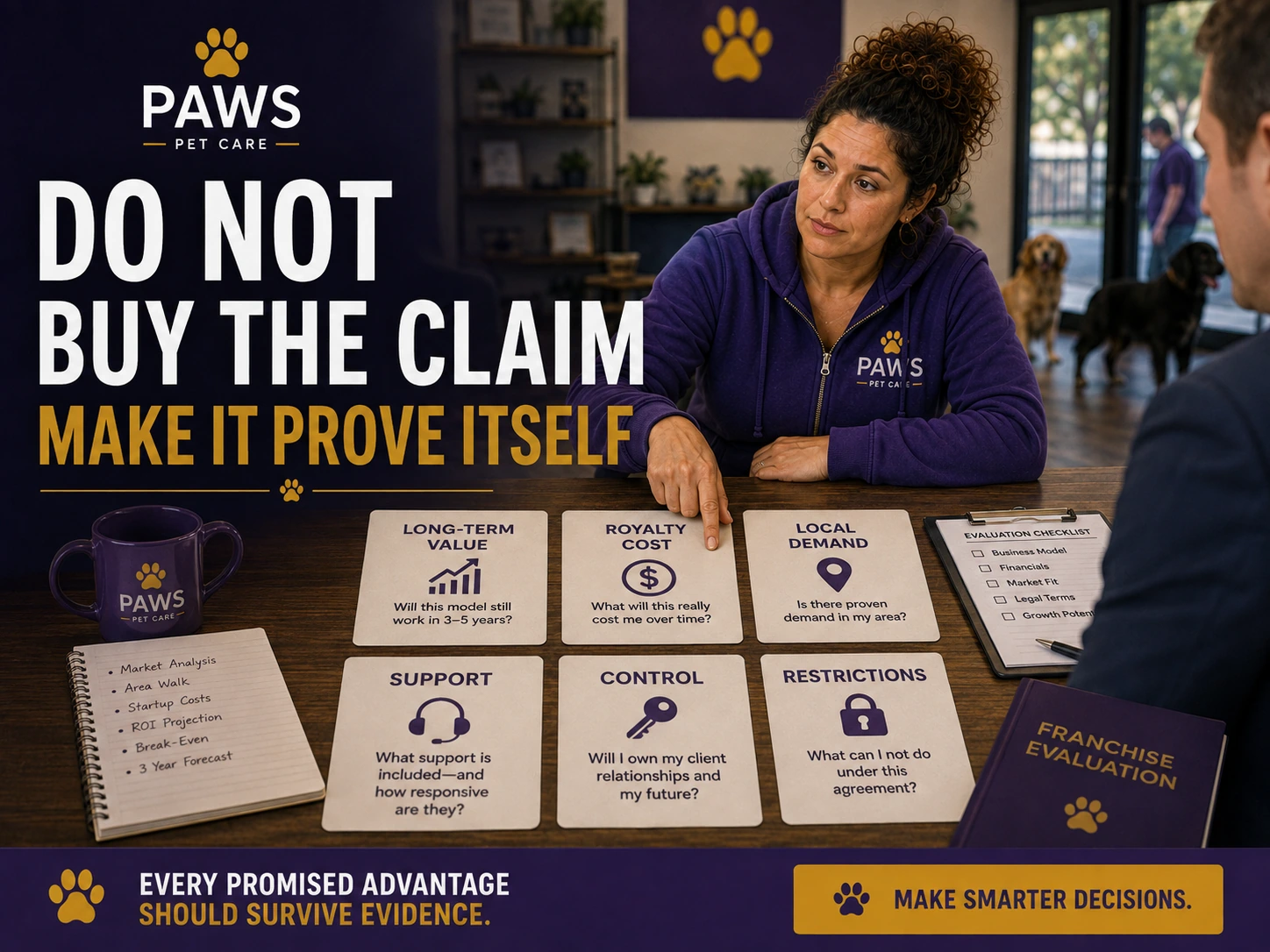
The question is not whether franchises have value. Some do. The question is whether you need that value badly enough to pay the fee stack, follow the rules, accept the control, and keep paying after the startup fog clears.
The test should end with evidence, not a feeling. Request franchisee contacts, closure and transfer history, Item 19 support when available, local lead data, vendor comparisons, training details, support-response examples, and the complete long-term fee structure.
Then compare the franchise path with a funded independent plan. Price the legal, design, consulting, training, software, marketing, and operating help the independent path would actually require. The decision is incomplete until both paths are compared using the same assumptions.
- Am I buying the franchise because I need a real system, or because I am scared?
- Can I buy, build, hire, or learn the same system another way?
- Am I buying a brand customers already know, or am I paying to build that brand in my market with my own lease, money, staff, reviews, and local marketing?
- If the franchise protects its brand first, am I comfortable with how much control the agreement gives them over my local business?
- Would a consultant solve the problem without a long-term royalty relationship?
- Would a manual, software stack, lawyer, accountant, contractor, and serious research solve the problem?
- Does the franchise brand create local customer demand, or is the brand mostly known by people shopping for franchises?
- Will the support still matter in year five, or is most of the value front-loaded before opening?
- How much will royalties and ad fund fees cost over five, ten, fifteen, and twenty years?
- What vendor freedom, pricing freedom, service flexibility, branding control, and resale control am I giving up?
- What happens if I want out, want to sell, want to renew, or want to change the business?
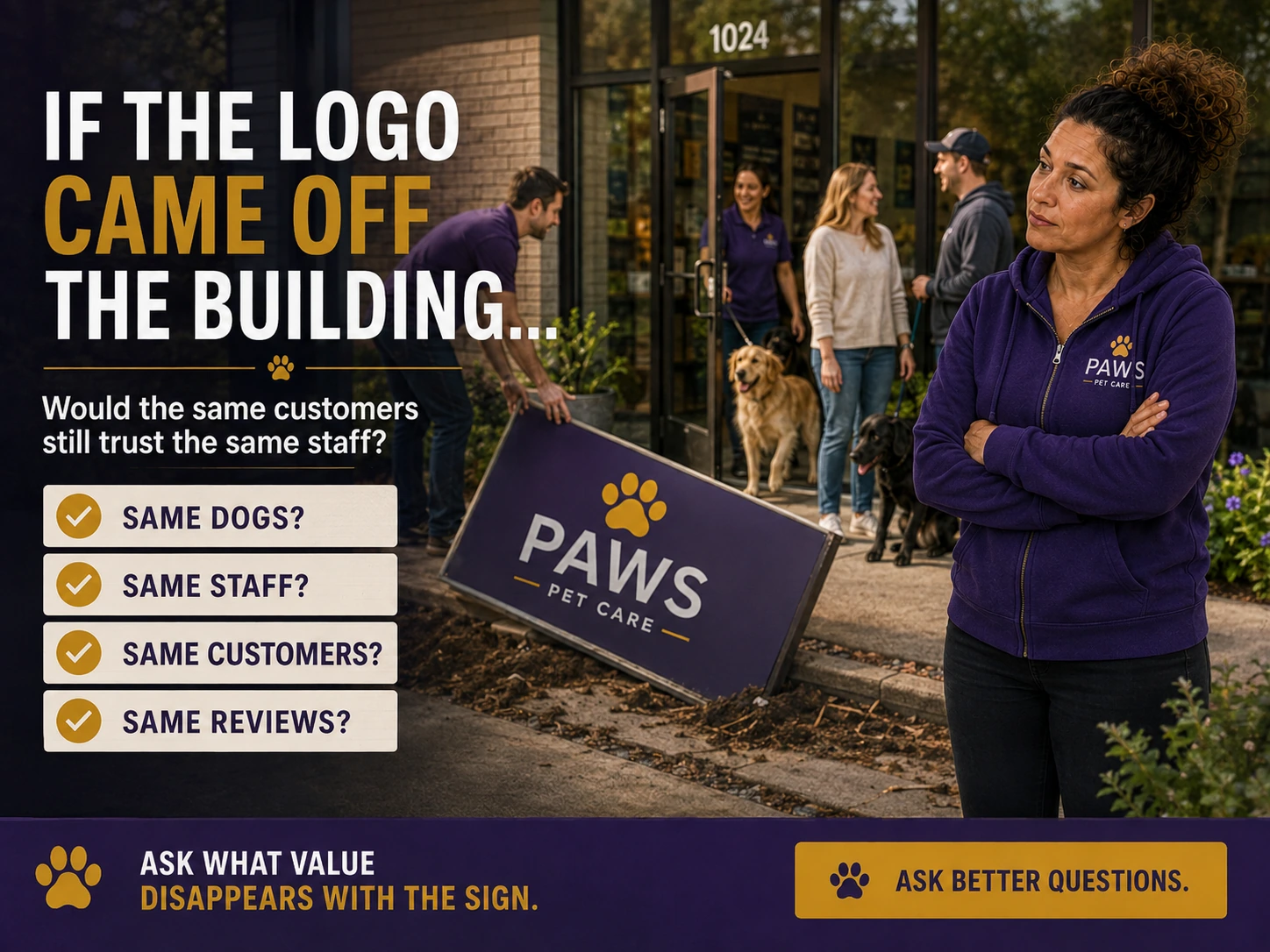
- If the logo came off the building, would the same customers still trust the same staff in the same facility?
⚠️
Blunt answer
If the franchise cannot prove long-term value, then you may not be buying a business advantage. You may be buying startup confidence with a payment plan attached.
🗂️
Keep Working Through the Franchise Decision
This comparison is only the first cut. The money, contract, control, brand, and long-term value still need to be put under bright lights.
💵
Dog Daycare Franchise Costs
The franchise fee is not the cost of opening. Build-out, rent, equipment, payroll ramp-up, working capital, and debt still show up.
🧾
Dog Daycare Franchise Royalties
A royalty on gross sales means the franchisor eats first. Run the long-dollar math before the percentage starts looking harmless.
📚
Franchise Operating System
Manuals, training, forms, software, safety standards, and procedures can help. But is the rulebook worth paying for forever?
🔒
Control and Approved Vendors
Brand rules, required vendors, inspections, upgrades, software, advertising approval, and resale rules are part of the real deal.
🧠
Consultant vs. Franchise
A consultant should help you avoid expensive mistakes and then get out of your pocket. A franchise may stay there.
🔧
Starting an Independent Dog Daycare
Independent does not mean winging it. It means you build the system, own the brand, and keep the upside.
❓
Dog Daycare Franchise vs. Independent Startup FAQ
Detailed answers about structure, control, royalties, local brand value, operating systems, vendor rules, due diligence, exit terms, and choosing the right ownership path.
Is it better to buy a dog daycare franchise or start independently?
It depends on what the buyer needs and what each path costs over time. A franchise may fit someone who wants a defined operating system, training, brand rules, and continuing support. Independence may fit someone prepared to research, hire targeted experts, build systems, create a local brand, and keep full control. Compare both paths using the same revenue, staffing, build-out, and ownership assumptions.
Can I start a dog daycare without a franchise?
Yes. Independent facilities can be professionally built and operated, but independence does not eliminate the need for zoning research, lease review, design planning, working capital, pricing, insurance, software, intake rules, cleaning systems, staff training, emergency procedures, documentation, and local marketing. The owner must build or buy those systems instead of receiving them in a franchise package.
What does a dog daycare franchise actually provide?
A franchise may provide a startup sequence, facility standards, training, manuals, forms, software direction, vendor relationships, marketing materials, opening support, peer contacts, and continuing operational guidance. The buyer should identify which benefits are delivered before opening, which continue later, and how each benefit can be verified rather than relying on broad words such as support or proven system.
What does an independent owner have to build?
The independent owner must assemble the market research, site and lease strategy, design, contractor plan, startup budget, pricing, service mix, policies, forms, software, vendors, cleaning, dog-handling standards, employee training, customer communication, and marketing. Targeted attorneys, accountants, contractors, consultants, trainers, and software providers can help without becoming permanent royalty partners.
Are franchise royalties worth paying?
Only when the continuing value exceeds the continuing cost. Calculate royalties, advertising funds, required software, vendor effects, remodel obligations, and other fees across the expected ownership period. Then identify what the franchisor continues to deliver in customer demand, operating improvement, purchasing savings, support, data, training, or resale value after the startup period ends.
Does a franchise make dog daycare less risky?
It may reduce some startup and operating mistakes by providing standards, training, and a known sequence. It also creates contract, fee, vendor, approval, renewal, transfer, and de-branding risks. The dogs, staff, lease, payroll, cleaning, incidents, illness, and local customer relationships still have to be managed by the location.
Is independent ownership automatically riskier?
It is riskier when the owner wings it, underfunds the project, ignores expert review, or opens without systems. It may be a rational path when the owner performs serious due diligence, hires qualified help, documents decisions, builds cash reserves, and installs professional operating controls. Risk depends more on preparation and execution than on the sign alone.
How do I know whether the franchise brand has local value?
Ask ordinary dog owners in the actual service area whether they recognize and trust the brand. Review local search demand, lead sources, conversion data, customer surveys, and franchisee reports. Distinguish customers generated by the national brand from customers generated by location, reviews, staff, local SEO, veterinary referrals, apartments, events, and owner outreach.
What should I ask if the logo came off the building?
Ask whether the same customers would continue using the same staff, facility, groomer, boarding operation, and local reputation. Also identify what would be lost: software access, phone numbers, customer data, website visibility, national advertising, vendor terms, manuals, or support. The answer helps separate durable local value from franchise-dependent value.
What does “support comes with a leash” mean?
Franchise support is delivered inside a contract. The same system that provides training, standards, manuals, software, and purchasing may also control vendors, products, services, signs, local marketing, remodels, reporting, renewal, transfer, and exit. Buyers should value the help and the restrictions together rather than discussing support as though it arrives without obligations.
How should required vendors be evaluated?
Compare required prices, quality, delivery, warranties, safety, service, and available independent alternatives. Ask whether the franchisor or an affiliate receives rebates, commissions, or other compensation. Approved vendors can create real efficiency, but a mandatory relationship should prove that it benefits the local operation rather than merely limiting choice.
What is the year-five franchise value question?
Ask what the business is still receiving in year five that justifies royalties and control after the facility is open, staff are trained, local customers know the location, and routine systems are established. Look for measurable leads, updated training, useful benchmarking, vendor savings, operating improvements, crisis support, technology, and resale advantages—not memories of launch assistance.
Can a consultant or startup team solve the blank-page problem?
Often, depending on the buyer. A commercial lease attorney, zoning lawyer, accountant, architect, contractor, operator consultant, trainer, software provider, and written startup system can address defined gaps. Price that independent help honestly and compare it with the franchise fee stack. The right answer may still be a franchise, but the alternative should be fully funded and professionally designed before comparison.
Who is a strong candidate for a dog daycare franchise?
A strong candidate wants structure, can afford the full fee stack and working capital, accepts brand rules, values standardized training, and has verified that current franchisees receive useful ongoing support. The candidate should understand the agreement, tolerate approval processes, and prefer operating inside a defined system rather than resenting it after opening.
Who is a strong candidate for independent ownership?
A strong independent candidate is willing to study, compare vendors, hire experts, document systems, build a local brand, and accept full responsibility. The person values flexibility but also has the discipline to base changes on data, safety, margin, and customer demand instead of treating independence as permission to operate casually.
What proof should I request before accepting franchise claims?
Request the FDD, agreement, fee schedules, territory language, current and former franchisee contacts, closure and transfer history, financial-performance support when provided, training details, support examples, vendor comparisons, lead data, and the long-term cost of required systems. Have a franchise attorney review the documents and compare the promises with franchisee experience.
Why is dog daycare not comparable to fast food franchising?
Dog daycare is a live-care service driven by local staff judgment, animal behavior, cleaning, communication, trust, and facility execution. A major food franchise may deliver national product recognition and a standardized supply chain that customers already understand. A dog daycare brand must prove that it creates comparable consumer demand rather than assuming the category works the same way.
How do exit and resale rules affect the decision?
Review transfer approval, buyer qualifications, fees, renewal conditions, de-branding, noncompetition terms, customer data, software access, lease rights, required upgrades, and default provisions before signing. A local business may build substantial value, but the agreement can influence who may buy it, what must change, and how much friction exists when the owner wants to leave.
Should fear ever be part of the franchise decision?
Fear can identify real gaps, but it should be converted into research and specific help. Name the concern—zoning, lease, design, dog safety, pricing, staffing, marketing, or cash flow—and price the solution. Signing because the franchise process feels reassuring is not enough; the final choice should rest on verified value, adequate capital, and reviewed obligations.
What is the simplest final decision rule?
Choose the franchise when its continuing brand, systems, support, purchasing, training, and network create enough measurable value to justify the cost and loss of control. Choose independence when the needed expertise can be built or purchased separately and the owner is prepared to operate professionally. Do not choose either path until the same local financial assumptions have been applied to both.
🐾
The Bottom Line: Do the Work or Pay for the Shortcut
Both paths have a price. One price is money and control. The other is homework and responsibility.
A dog daycare franchise can be the right path for the right buyer. But do not confuse structure with magic. Do not confuse fear with inability. Do not confuse a polished sales process with proof. And do not give away a piece of gross sales unless the long-term value is real.
If you go independent, the work is on you. You have to research the building, zoning, lease, contractors, pricing, operations, software, vendors, staff, cleaning, marketing, and customer systems. That is the deal. But the information is available. The experts can be hired. The systems can be built. Once you figure it out, you figure it out.
A franchise sells structure. Independent forces you to create structure. The buyer has to decide whether they want to pay for the shortcut, or do the work, own the system, and keep the freedom.
The durable value of the final business will usually be visible in its cash flow, staff, systems, customer relationships, reviews, facility condition, lease, service mix, and local reputation. The buyer should understand which of those assets are owned locally and which remain dependent on the franchise relationship.
Choose the franchise only when the continuing value is strong enough to justify continuing cost and control. Choose independence only when the owner is prepared to build the missing structure with the same seriousness expected from a professional system.