Dog Grooming Room Layout Examples, Motion Economy, Small Grooming Room Design, Large Grooming Room Design, Grooming Tables, Grooming Tubs, Cage Placement, Bather Area, Tool Tables, Grooming Workflow, Customer Sightlines, Groomer Ergonomics, and Grooming Room Setup
Grooming Room Layout Examples: Motion Economy in Small and Large Grooming Rooms
These layouts are not meant to be copied blindly. They are meant to show how tubs, tables, cages, tool tables, bathers, groomers, and customer sightlines affect the actual work.
The concept of motion economy is easier to understand once you look at actual grooming-room layouts. It is one thing to say that tools should be close, dogs should move laterally, and groomers should avoid unnecessary bending and lifting. It is another thing to look at a room and ask, “What does this layout actually make the groomer do all day?”
These examples are simple by design. They are not construction drawings, permit drawings, or universal blueprints. They are layout examples intended to show the working relationship between cages, grooming tables, tubs, drying areas, tool tables, bathers, groomers, and customer visibility.
The important question is not whether the equipment technically fits in the room. A bad grooming room can fit all the equipment and still punish the worker all day. The real question is whether the room allows dogs and people to move through the grooming process with the least amount of wasted motion, unnecessary lifting, awkward handling, noise stress, customer misunderstanding, and staff frustration.
⚠️
Operator warning
Do not judge a grooming layout by whether it looks neat on paper. Judge it by what it makes the groomer, bather, and dog do repeatedly. Every wasted step, lift, turn, reach, and customer-created dog meltdown becomes part of the room.
🗺️
Use This Page to Read Grooming Layouts Like an Operator
The diagrams are simple. The lessons are not. The point is to understand why equipment placement either helps the work or makes every dog harder than it needed to be.
📐
Small One-Groomer Layout
A simple layout showing how cages, table, tub, and tool table can support one groomer with minimal wasted motion.
🔁
Small Room Workflow
Cage to table, table to tub, tub back to table, and finished dog movement should happen without a room-wide wrestling match.
🧱
Small Layout Limits
A one-groomer setup can work well, but it is not automatically scalable once bathers, dryers, and multiple groomers are added.
🏢
Larger Grooming Room Layout
A more scalable layout showing separate grooming, drying, bather, cage, tub, and tool-table areas.
🛁
Tub Placement Tradeoff
Better bather motion may conflict with customer visibility, cage placement, and the public impression of the salon.
👀
Cage Visibility Problem
Customers misunderstand cages, waiting time, barking, whining, and their own role in winding up the dog.
📊
Layout Comparison
Compare the small and larger layouts by staff count, dog movement, noise, visibility, scalability, and workflow.
✅
Lessons From Both Layouts
The real lesson is not the drawing. It is learning how to think before buying equipment or copying a floor plan.
📐
Simple Motion-Economy Layout for a Small Grooming Room
This first diagram shows the concept in the simplest terms: one groomer, nearby tools, close cage access, table access, and a tub close enough to support lateral movement.
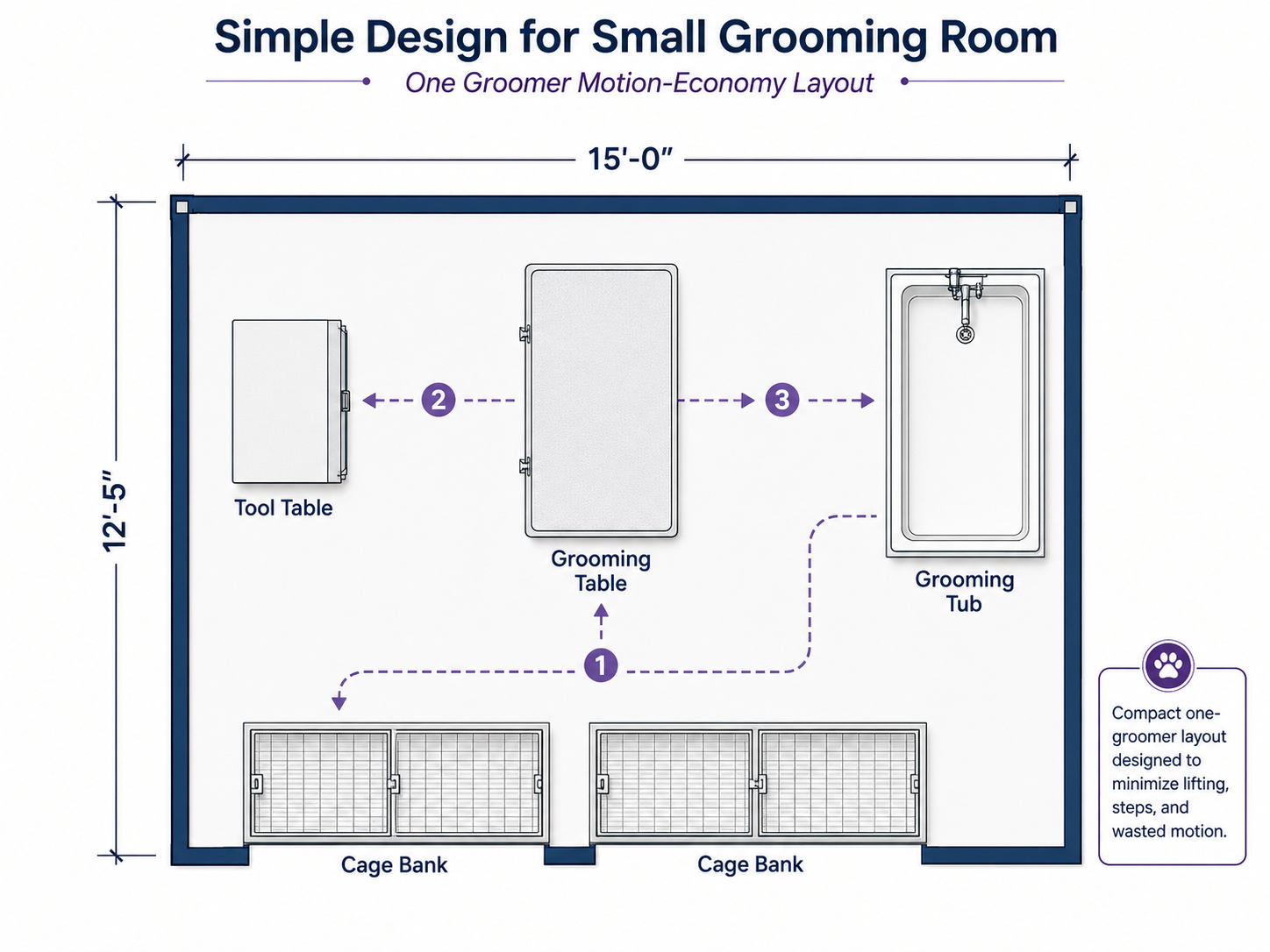
The above design is intended to put in simplest terms the concept of motion economy. The layout is not complicated, and that is part of the point. The groomer has access to the basic tools and equipment necessary to complete the job from a tight, logical work area instead of wandering all over the room.
The table is positioned near the cage banks, the tub is close enough to support a short dog movement, and the tool table is placed where the groomer can keep common tools close instead of turning the workday into a scavenger hunt.
This is really a one-groomer setup. That matters. A layout that works nicely for one groomer can become a traffic jam when two groomers, a bather, dryers, extra cages, customer interruptions, and a doodle having a spiritual crisis all show up at the same time.
🔁
How the Small Layout Should Work
The dog should move through the grooming process without forcing the groomer to cross the room, bend unnecessarily, or carry the dog around obstacles.
The typical workflow would be that the groomer removes a dog from one of the cage banks and moves it to the grooming table. This can be accomplished by simply turning around after removing the dog from the cage and placing it on the table. The point is not drama. The point is fewer steps and fewer awkward movements.
At this point, the groomer can perform the necessary prep work: nails, ears, dematting, brushing, inspection, and whatever else needs to happen before the bath. Once the prep work is complete, the groomer can move the dog laterally into the tub for bathing without having to bend down, lift from the floor, and travel across the room.
After bathing, the same principle works in reverse. The dog can be moved back to the table for hand drying and finish work, or placed back into a cage for automatic drying if that is part of the salon’s process and appropriate for that dog.
This is the whole point of motion economy. The room should reduce the number of times the groomer has to lift, carry, bend, twist, reach, search, and reposition. The room should help the worker complete the job, not add a physical tax to every dog.
📌
Small room lesson
A simple grooming room can still be efficient when the cage, table, tub, and tools are arranged around the work sequence instead of randomly placed wherever they happen to fit.
✅
What the Small Layout Does Well
The strength of the small layout is not that it is fancy. It is that it keeps the core work close.
Short Cage-to-Table Movement
The groomer can remove a dog from holding and move directly to the table without crossing the room.
Table-to-Tub Relationship
The dog can move from prep to bath and back again without turning every transfer into a lifting event.
Tool Table Nearby
Tools have a defined place and can remain close enough to support the groomer’s normal work sequence.
One-Groomer Simplicity
For one groomer, the layout keeps the work centered instead of spreading basic tasks across the room.
Less Walking
Less walking means less time wasted, less fatigue, and fewer chances for the dog to turn the transfer into a circus act.
Easy to Understand
A simple room is easier to manage when every major piece of equipment has a reason for being where it is.
🧱
Where the Small Layout Is Limited
A layout can be good for one purpose and still be wrong for another.
This design is really a one-groomer setup. It can demonstrate motion economy very well, but it is not automatically the right layout for a larger salon, a daycare adding serious grooming volume, or a business with separate bathers, multiple groomers, drying stations, and higher dog flow.
The moment you add more people, the room changes. A second worker may need to pass behind the table. A bather may need a dedicated work path. Drying may create noise and air movement that interferes with finishing work. Cages may become a bottleneck. Tools may spread. Towels may pile up. What felt efficient for one person can become cramped and annoying with two or three people.
That is not a criticism of the layout. It is the lesson of the layout. The room must match the staffing model and work volume. A one-groomer room should be designed like a one-groomer room. A production salon needs zones and separation.
- It is not ideal for multiple groomers working at the same time.
- It does not create much separation between bathing, drying, holding, and finish work.
- Noise, hair, wet-dog movement, and dryer activity can concentrate in one small area.
- Holding capacity is limited and may not support higher-volume scheduling.
- It can become cluttered quickly if tool placement and towel flow are not disciplined.
- It may not be the right answer for a daycare trying to add grooming as a serious production department.
🏢
Larger Grooming Room Layout for More Scalable Production
The same principles of motion economy still apply in larger grooming rooms. The difference is that the work starts separating into zones.
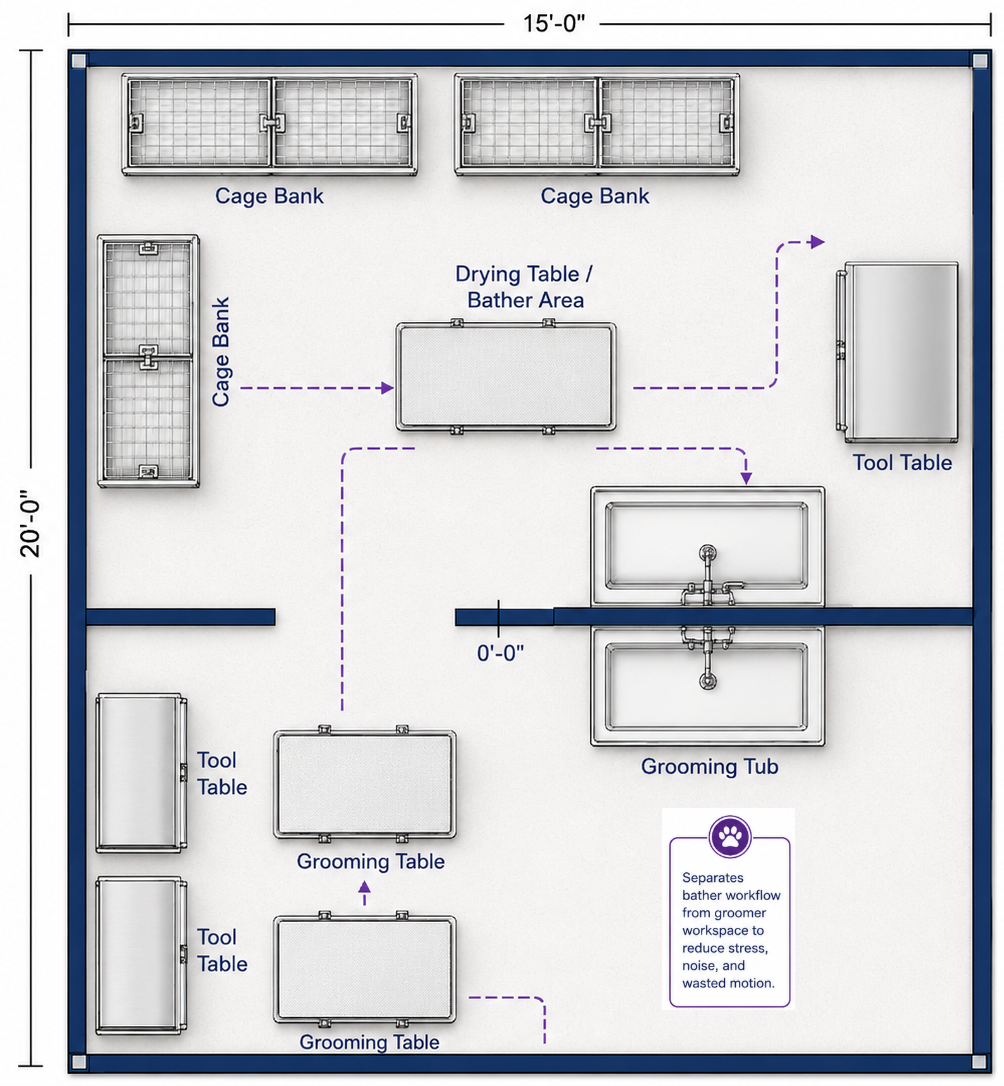
The same principles of motion economy hold true in larger, more scalable grooming rooms or salons that may employ several people. The layout above shows the grooming tables separated from the caging and drying area, which can help reduce noise and stress on the groomers while also providing adequate working space for employees performing different jobs within the grooming room.
In a design such as this, which could operate as a standalone grooming salon or a larger grooming department inside an existing pet care business, the cages, prep, drying table, and bather area are located to support motion economy for the bathers. The grooming tables and tool tables are located to allow groomers to operate effectively with the least amount of wasted motion.
This is the difference between a one-person work cell and a larger production layout. In a larger room, the bather’s workflow and the groomer’s workflow are related, but they are not the same job. The layout should recognize that instead of forcing everyone to work on top of each other.
🔁
How the Larger Layout Changes the Workflow
Larger rooms need more than extra square footage. They need a cleaner separation of work.
Bather Area
The bather needs cages, drying access, tub access, towels, shampoos, and dog movement that support prep and bathing without constantly interfering with table work.
Groomer Area
Groomers need table space, tool tables, controlled dog positioning, lighting, and enough separation from drying noise and cage activity to do finish work.
Drying Area
Drying is noisy, hairy, and stressful enough without placing it directly in the groomer’s face if the room is large enough to separate it.
Cage Areas
Cages support staging, drying, finished holding, and scheduling flow, but their location affects noise, customer perception, and dog stress.
Tool Tables
Each grooming station needs its own reachable tool system so groomers are not crossing into each other’s space.
Worker Separation
The bigger the room and staff count, the more important it becomes that bathers and groomers are not constantly blocking each other.
🛁
The Tub Placement Tradeoff: Better Bather Motion vs Better Customer Trust
In the larger layout, the tubs are a wash, so to speak. Moving them could improve one thing and create new problems somewhere else.
In the larger layout, the tubs could arguably be more efficient for the bathers if they were placed on the other side of the wall, closer to the bather and drying area. From a pure bather-motion standpoint, that could make sense.
But grooming room layout is rarely one simple answer. Moving the tubs may create at least two negatives. First, customers would no longer have the ability to see dogs being bathed, which can be an important factor when trying to operate a transparent business that makes customers feel comfortable leaving their dogs with you.
Second, the cages may have to be moved to a point where they are visible to customers. That is not always a disaster, but it is something to avoid when possible because visible cages create their own customer-relations problems.
This is the kind of tradeoff operators need to understand. A layout decision may improve motion economy for one employee while damaging customer trust, dog calmness, noise control, or the public impression of the salon. Good design is not just “move the thing closer.” It is understanding what else moves when that thing moves.
📌
Tradeoff lesson
The best layout is not always the one that gives one worker the shortest path. It is the one that best balances worker movement, dog movement, customer trust, noise, stress, visibility, and production.
👀
The Cage Visibility Problem
The idea is to present a clean, happy grooming salon to customers, not one where dogs are sitting seemingly unattended in cages.
Customers do not always understand dog grooming. Many have absolutely no idea how much work is involved to properly groom a dog and may ignorantly expect or think that grooming a dog should take minutes, not hours.
If customers can see the cages, they may assume the dog has been sitting there lonely and ignored the entire time, even when most of that appointment has actually been active grooming, bathing, drying, coat work, nail work, cleaning, handling, and waiting for safe timing. The customer sees one slice of the process and writes a whole story around it.
It gets worse when customers can see their own dog in a cage. Even if separated by a door or glass, some customers will point, wave, call the dog’s name, tap, make faces, or try to interact. This will likely entice the dog to bark, whine, jump, scratch, spin, or stress. Then the customer hears the dog barking or whining and imagines the dog is sad and uncomfortable, totally oblivious to the fact that they just asked the dog to do exactly that.
Now the staff have more noise, more stress, more dog agitation, more customer anxiety, and a grooming room that has to keep working while the customer accidentally turns the holding area into amateur theater.
⚠️
Customer visibility warning
Transparency is good until the customer misunderstands what they are seeing and starts winding up the dog through the glass. Customers like visibility, but they do not always know how to interpret it.
📊
Small Grooming Room vs Larger Grooming Room Layout
The difference is not just size. The difference is staffing, movement, separation, noise, visibility, and production.
Swipe left/right to see the full table.
| Design Issue | Small One-Groomer Layout | Larger Grooming Room Layout | Operator Lesson |
|---|---|---|---|
| Best Use | One groomer, simple service flow, limited volume. | Multiple workers, bathers, groomers, drying, and higher production. | Match the room to the staffing model, not just the available square footage. |
| Cage Access | Cages are close to the grooming table for short dog movement. | Cages are part of a broader staging, drying, and bather zone. | Cage placement should support dog flow without creating customer drama or worker traffic jams. |
| Table Access | Table is central to one groomer’s work cell. | Multiple tables create separate groomer stations. | Each table needs its own reach zone, tool access, and working space. |
| Tub Relationship | Tub is close enough for short lateral movement. | Tub placement becomes a tradeoff between bather motion and customer visibility. | Tub placement should reduce lifting and wasted movement without creating new operational problems. |
| Tool Access | One nearby tool table may be enough if kept organized. | Each grooming station may need its own tool table or storage system. | Tools should follow the worker, not force the worker to hunt for tools. |
| Noise and Stress | Noise is concentrated in one smaller room. | Separation can help reduce drying and cage noise near groomers. | Noise is not just annoying. It affects dogs, staff fatigue, and grooming quality. |
| Customer Sightline | Usually simpler to control because the room is smaller. | More complicated because tubs, cages, drying, and tables may compete for visibility. | Let customers see professionalism, not every working mess or cage misunderstanding. |
| Scalability | Limited scalability. | More scalable if zones are planned correctly. | A room that works for one groomer may not work for five people. |
| Dog Movement | Short, simple movement path. | More movement paths and more chances for crossover. | Larger rooms need traffic control, not just more open space. |
| Employee Separation | Limited separation between bathing, drying, and grooming. | Better opportunity to separate bather work from groomer work. | Separation matters when different employees are doing different jobs at the same time. |
🧭
Trace the Paths Before You Trust the Layout
A grooming layout can look clean on paper and still be stupid in real life. Trace what actually moves.
Before you copy any grooming layout, including either of these examples, trace the paths. Do not just look at where the equipment sits. Look at what has to move, who has to move it, how often they move it, and what happens when the dog is wet, nervous, heavy, loud, old, slippery, or fully committed to making the groomer earn every dollar.
A layout that works on paper may fail the moment you trace the dog from cage to table, table to tub, tub to drying, drying to finish, and finish to holding. It may fail when you trace the groomer’s hand from the dog to the tool table. It may fail when you trace clean towels, dirty towels, dryer hoses, barking, customer sightlines, and staff traffic.
Swipe left/right to see the full table.
| Path to Trace | What to Ask | What Bad Design Looks Like | Operator Lesson |
|---|---|---|---|
| Dog Path | How does the dog move from cage to table, table to tub, tub to drying, and back to finish or holding? | Wet dogs crossing the room, weaving through equipment, or being lifted because the room gives no better option. | The dog path should be short, logical, and designed to reduce lifting. |
| Groomer Path | How many steps does the groomer repeat for tools, towels, blades, products, and dog movement? | A groomer leaving the dog repeatedly because the room is spread out or poorly organized. | Repeated steps become fatigue, and fatigue becomes mistakes. |
| Tool Path | Are the common tools within the groomer’s normal working reach? | Clippers, combs, scissors, blades, brushes, and nail tools drifting around the room with no fixed home. | Tools should support the work sequence instead of becoming a daily scavenger hunt. |
| Towel Path | Where do clean towels live, where do dirty towels go, and who has to move them? | Damp towel piles, bathers yelling for towels, or staff leaving wet dogs to grab supplies. | Towel flow is part of motion economy, not housekeeping trivia. |
| Noise Path | Where do dryer noise, barking, cage noise, and customer noise travel? | Drying and cage noise sitting directly on top of finish grooming stations. | Noise affects dogs, staff fatigue, communication, and grooming quality. |
| Customer Sightline | What can customers see, and what will they misunderstand? | Customers seeing cages, winding up their own dogs, then assuming the dog is barking because staff ignored it. | Transparency needs control. Customers do not always understand what they are looking at. |
✅
Motion Economy Lessons From Both Layouts
Do not memorize the drawings. Learn how to think about the room.
The point of these layouts is not that every grooming room should look exactly like either example. The point is that every equipment placement decision should have an operational reason.
A grooming table is not just a rectangle on a floor plan. It is where the groomer stands, reaches, restrains, clips, brushes, trims, dries, checks, and finishes. A tub is not just a plumbing fixture. It is where wet, slippery, nervous, heavy, and sometimes uncooperative dogs have to be handled safely. A cage is not just storage for dogs. It is staging, holding, drying, waiting, customer perception, noise, and stress. A tool table is not just furniture. It is whether the groomer can keep working without leaving the dog.
Once you understand that, the diagrams become more useful. You stop asking, “Where can I fit the equipment?” and start asking, “What does this placement make my staff and dogs do?”
- Every tool needs a fixed home close to the work it supports.
- Dog movement should be short, logical, and designed to reduce lifting.
- Tubs and tables should relate to each other, not exist as separate islands.
- Cages should support workflow without becoming customer-visible drama when avoidable.
- Bather work and groomer work are related, but they are not the same job.
- Larger rooms need zones, traffic paths, and separation instead of just more square footage.
- Customer sightlines matter, but they should not control the room at the expense of workflow.
- Customers often misunderstand what they see, so transparency needs control and explanation.
➡️
Next Grooming Setup Pages
These layout examples sit inside the grooming setup sequence. The next step is understanding time, noise, motion economy, and the tools that make the room actually work.
🔁
Economy of Motion
The deeper look at arranging work so the groomer is not wasting movement all day.
⏱️
Grooming Time and Money
Grooming production is labor. Bad layout, wasted motion, and slow workflow turn directly into lost money.
🔊
Noise and Fatigue
Dryers, barking, cages, hard surfaces, and long grooming days can grind down staff and stress dogs.
🧰
Salon Setup Tool Review
Move from layout thinking into the actual tools and equipment used in a working grooming setup.
❓
Grooming Room Layout Examples FAQ
Straight operator answers about small grooming rooms, larger grooming rooms, customer sightlines, cages, and motion economy.
Are these grooming layouts meant to be copied exactly?
No. These are simple examples to demonstrate motion economy and workflow thinking. Your actual layout depends on room size, staffing, equipment, customer flow, dog volume, plumbing, electrical, door locations, noise control, and the services you offer.
Is the small grooming room layout enough for one groomer?
It can be, depending on the groomer, dog volume, services offered, storage discipline, drying method, and holding needs. The small layout is strongest as a one-groomer work cell where the cage, table, tub, and tools are close enough to reduce wasted motion.
Can the small room layout work for daycare add-on grooming?
It may work for light add-on grooming, baths, nail trims, and low-volume services. It is not automatically enough for a daycare trying to build a serious grooming department with bathers, multiple groomers, higher volume, and clean holding expectations.
Why separate bathers and groomers in a larger salon?
Bathers and groomers do different physical work. Bathing, drying, caging, and prep create water, noise, hair, dog movement, and drying stress. Finish grooming requires concentration, tool access, lighting, and controlled table work. Separation helps both jobs happen with less interference.
Should customers be able to see the bathing area?
Controlled visibility can help customers trust the business. But visibility has to be balanced against workflow, dog stress, staff concentration, and what else becomes visible when the tub is moved. The customer should see professionalism, not a confusing slice of the process they will misunderstand.
Should customers be able to see cages?
Not if you can avoid it. Visible cages can make customers think dogs are ignored, lonely, or caged for the whole appointment. Customers may also wind up their own dogs by waving, calling, pointing, or tapping, then blame the salon when the dog barks or whines.
Why do customers misunderstand grooming time?
Many customers do not understand how much work goes into a proper groom. Bathing, drying, brushing, dematting, nail work, ear work, trimming, clipping, handling difficult dogs, cleaning, and waiting for safe timing all take time. Customers may think grooming should take minutes when it often takes hours.
Is cage visibility always bad?
Not always. Sometimes cages are visible because of space, layout, staffing, or transparency choices. But if cages are visible, staff need to manage customer expectations and prevent customers from interacting with dogs in a way that creates barking, whining, stress, or false assumptions.
What is the biggest motion economy lesson from these layouts?
Place equipment around the work sequence. Do not scatter tools, tubs, tables, cages, and dryers wherever they happen to fit. The room should reduce unnecessary dog movement, staff movement, lifting, bending, reaching, and searching.
What should I decide before buying grooming equipment?
Decide the staffing model, expected dog volume, whether bathers and groomers are separate, how dogs move from cage to table to tub to drying to finish, where tools live, where customers can see, and what kind of grooming production the room is actually supposed to support.
🐾
Bottom Line: The Layout Is About What the Room Makes People and Dogs Do
A grooming layout is not just equipment placement. It is motion, labor, stress, customer perception, and production.
These two diagrams are simple, but the lesson is important. A grooming room should be arranged so dogs move through the process logically and groomers are not wasting motion, lifting unnecessarily, hunting for tools, fighting cages, crossing traffic, or explaining to customers why the dog they just wound up through the glass is now barking.
The small layout shows how one groomer can work efficiently when the cage, table, tub, and tools are close. The larger layout shows how the same principles have to scale into separate work zones for bathers, groomers, drying, cages, tubs, and tool tables.
Do not copy a layout because it looks clean on paper. Read it like an operator. Where does the dog move? Where does the worker move? Where are the tools? Where is the noise? What does the customer see? What will they misunderstand? What will the room make staff repeat a hundred times a day?
That is motion economy in the real world. The room should help the work happen, not quietly make every dog harder.