Dog Grooming Salon Design, Grooming Room Layout, Grooming Workflow, Motion Economy, Grooming Tubs, Grooming Tables, Dryers, Groomer Fatigue, Salon Setup, Grooming Equipment, Grooming Room Function, Pet Business Operations, and Grooming Profit
Dog Grooming Salon Design: Layout, Workflow, Equipment, and Motion Economy
A grooming room is not just a room with a tub, table, and dryer. It is a production workspace built around a human body trying to safely groom a live animal that may be heavy, wet, scared, uncooperative, or fully committed to being a pain in the A**.

Leaving the issue of grooming room location in a pet care facility behind, let us take a much closer look at setting up a dog grooming business in general. Regardless of whether you are beginning a standalone grooming business or adding grooming to an existing business, the fundamentals and challenges will be the same.
Customers now expect more in terms of pet comfort, cleanliness, professionalism, and ambiance. This is where the battle between form and function begins. Although both play a role, when it comes to grooming salon design, practical and functional considerations outweigh aesthetic or stylistic considerations.
A grooming salon or grooming room has one key purpose: to provide the business the ability to safely and efficiently provide grooming services to client pets in order to create a profit. It is important that you keep this in mind when designing your grooming business.
The customer sees the room for a few seconds. The groomer lives in it for hours. Pretty matters, but if the tub is in the wrong place, the table is fighting the worker, the dryer cord is in the walkway, the towels are across the room, and every wet dog has to be dragged through an obstacle course like a hairy slip-and-slide with opinions, the room is not designed. It is just decorated.
⚠️
Operator warning
A pretty grooming room with bad workflow is not a salon. It is an expensive photo prop with a bather slowly dying inside it. Build the room so the work can actually happen.
🗺️
Use This Page as the Grooming Setup Gateway
Before you start buying tubs, tables, dryers, grooming arms, restraints, barber-chair tables, and tool systems, understand how the room is supposed to work.
⚖️
Form vs Function
Customers need confidence. Groomers need a room that actually produces work without beating them up all day.
🔁
Motion Economy
Every extra step, reach, bend, lift, twist, and tool search costs time, energy, safety, and profit.
🦴
The Groomer’s Body
Backs, shoulders, wrists, hands, knees, and patience are part of the grooming production system.
🐕
The Dog Is Not a Box
Ergonomics gets harder when the thing being moved has teeth, fear, opinions, slippery feet, and bad timing.
🚧
Ergonomic Bottlenecks
The bottleneck is wherever the room forces the groomer to waste the most body effort.
🎾
Daycare-to-Grooming Dogs
A dog pulled from group play may arrive in grooming with its brain still in recess mode.
🐕
Grooming Workflow Path
Intake, holding, tub, towel, dryer, table, finish, checkout, cleanup, and reset need a logical path.
🛁
Tub-to-Table Relationship
The tub and table should work together so every wet dog does not become a staff strength test.
💨
Wet, Dry, and Hair Zones
Water, electricity, hair, tools, dryers, towels, and dogs should not all be fighting for the same square footage.
🧰
Storage and Tools
Clippers, blades, combs, scissors, shampoos, towels, dryers, and cleaning supplies need fixed homes.
📉
What Fails First
The same bad layout choices show up again and again: cords, towels, drains, lifting, hair, humidity, and cramped work zones.
✅
Workflow Audit Checklist
Use the checklist to judge whether the room helps the groomer or quietly attacks production all day.
🏢
Standalone Grooming Business or Grooming Added to an Existing Facility
The business model may change. The room still has to work.
Whether you are starting a standalone grooming salon or adding grooming to an existing dog daycare, boarding facility, or pet care business, the fundamentals and challenges remain largely the same. You still need a dog intake process, holding area, bathing area, drying area, table work area, tool storage, cleaning flow, towel management, customer communication, and enough space to move dogs without turning every appointment into a wrestling match.
Adding grooming to a daycare can be a strong income move, but only when the room supports the work. A grooming room that is jammed into leftover space because “we had a corner available” will punish the groomer, slow the service, stress the dogs, and eventually show up in customer complaints, staff turnover, poor production, or all of the above.
Grooming is not magic add-on money. It is skilled labor performed on live animals, with water, dryers, sharp tools, moving dogs, customer expectations, staff fatigue, and a room that either makes the work easier or harder every hour of the day.
⚖️
The Battle Between Form and Function
A grooming salon has to make customers comfortable, but it still has to be built for work.
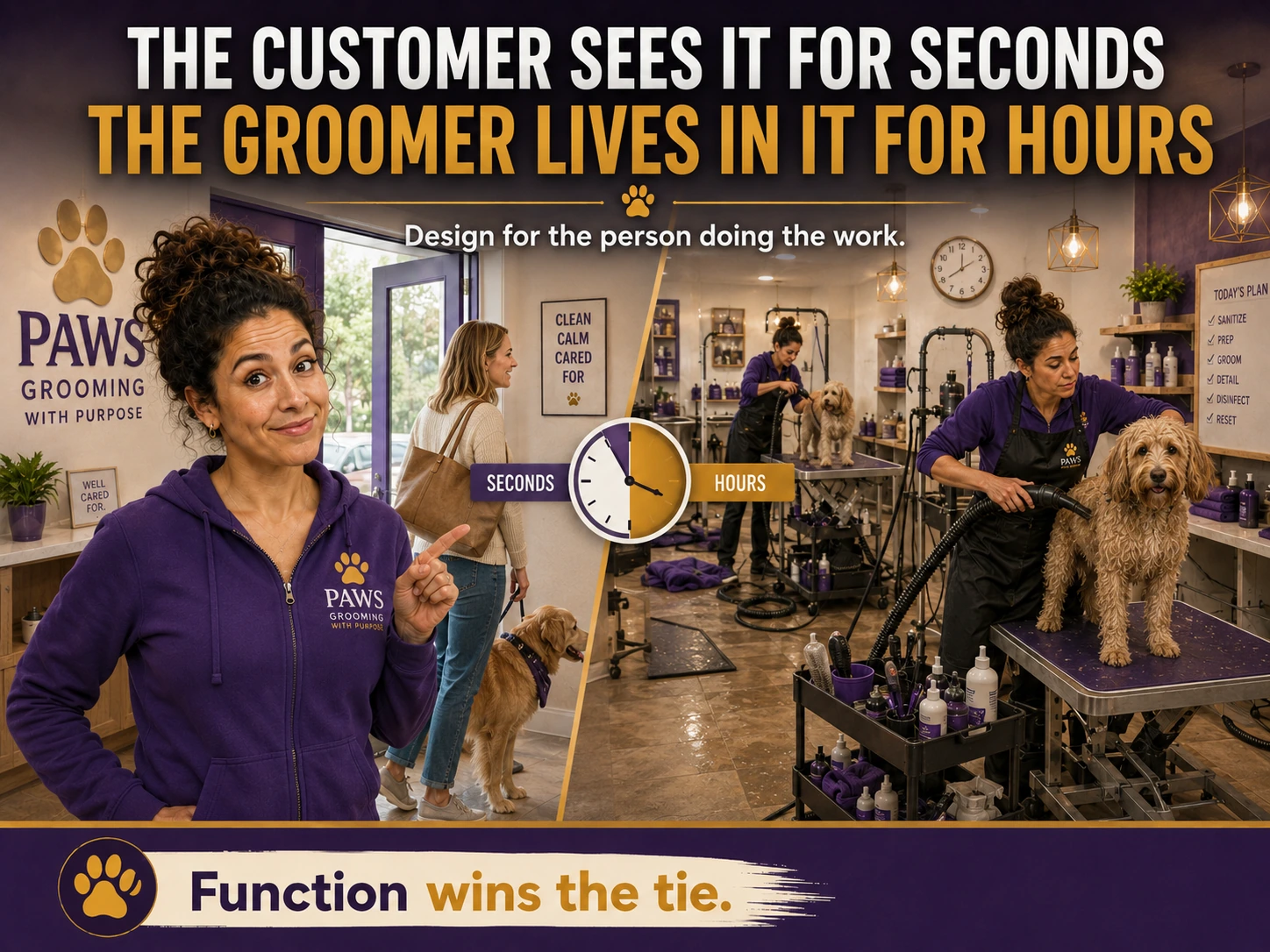
Most individuals new to the business tend to favor one extreme or the other and fail to find a balance that appeals to the customer while also providing the functionality needed to be effective.
On one extreme, you have the beautiful salon that photographs well, looks expensive, and makes the customer feel good at drop-off. But if the room is cramped, tools are poorly placed, wet dogs have to be carried across the room, dryers are blasting hair into everything, and staff are constantly bending, reaching, searching, and dodging cords, the room defeats the purpose of having it in the first place.
On the other extreme, you have the purely functional back-room cave with no customer confidence, no polish, poor lighting, ugly surfaces, cluttered tools, and a general feel that makes customers a little leery about leaving their pets with you.
The answer is balance. Customers need to see cleanliness, organization, professional equipment, good lighting, and a room that looks like animals are cared for properly. Staff need workflow, space, reach, storage, drainage, safety, and equipment that does not make every dog harder than it needs to be.
A useful design review separates what the customer notices from what the worker repeats. Lighting, finishes, and a clean sightline may influence the sale, but reach distance, table clearance, towel access, dog-transfer space, and cord routing influence every appointment.
When form and function compete, ask which choice still works on the eighth dog of a busy day. The room should remain presentable without requiring the groomer to pay for the appearance with extra lifting, walking, twisting, cleaning, or tool searches.
📌
Design rule
Form sells confidence. Function makes money. If the two conflict, function still wins.
🔁
Motion Economy: Build the Room So the Worker Does Less Wasted Work
The most important functional element of an effective grooming room is the overall layout.
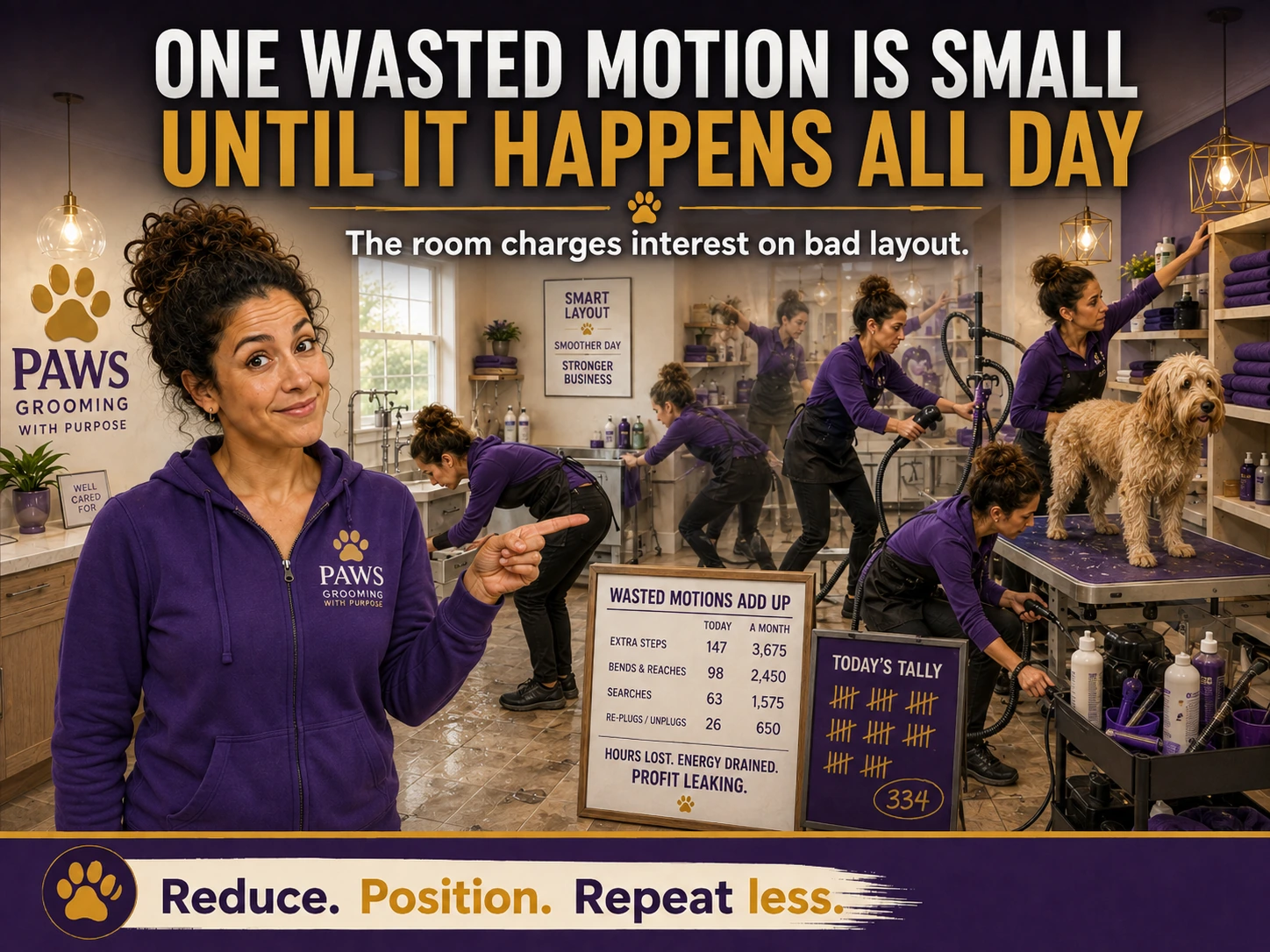
The overall layout should promote the principles of motion economy as originally put forth by Frank Gilbreth. In plain language, motion economy is about improving manual work, reducing fatigue, reducing unnecessary movement, and helping the worker produce more without being ground down by the room.
In grooming, this matters because the work is physical. Groomers and bathers lift, guide, restrain, brush, clip, dry, reach, bend, stand, twist, hold, reposition, clean, and repeat. Every extra step, lift, reach, twist, search, unplug, re-plug, bend, and wet-dog wrestling match costs time. Time becomes fatigue. Fatigue becomes mistakes. Mistakes become bites, bad grooms, injured staff, angry customers, and lost profit.
The best motion audit is not performed by staring at a floor plan. Watch a full bath and groom from intake through reset, count every unnecessary step and reach, and identify each moment when the worker has to release control of the dog to find a tool or supply.
Then repeat the count across the daily schedule. A five-second search or three-step detour may look harmless once, but repeated across dogs, employees, and workdays it becomes fatigue, schedule compression, rushed finishing, and lost appointment capacity.
- There should be a definite and fixed place for all tools and materials.
- Tools, materials, and controls should be located close in and directly in front of the operator when possible.
- Materials and tools should be located to permit the best sequence of motions.
- The height of the workplace, table, tub, and chair should reduce unnecessary bending and allow alternate sitting and standing when possible.
- Tools should be combined or consolidated when it makes the work easier and does not create clutter.
- Tools and materials should be pre-positioned for ease of use before the dog is on the table.
- Momentum should help the worker complete the task, not increase the work the worker has to fight against.
- Any motion that must be overcome by muscular effort should be reduced as much as possible.
⚠️
Operator reality
A bad grooming layout charges interest all day. Every wasted step seems small until the groomer has repeated it hundreds of times with wet dogs, sharp tools, dryer noise, barking, hair, and a schedule that is already behind.
🦴
The Groomer’s Body Is Part of the Business Model
Grooming is not just skill. It is physical labor repeated over and over again on living animals.
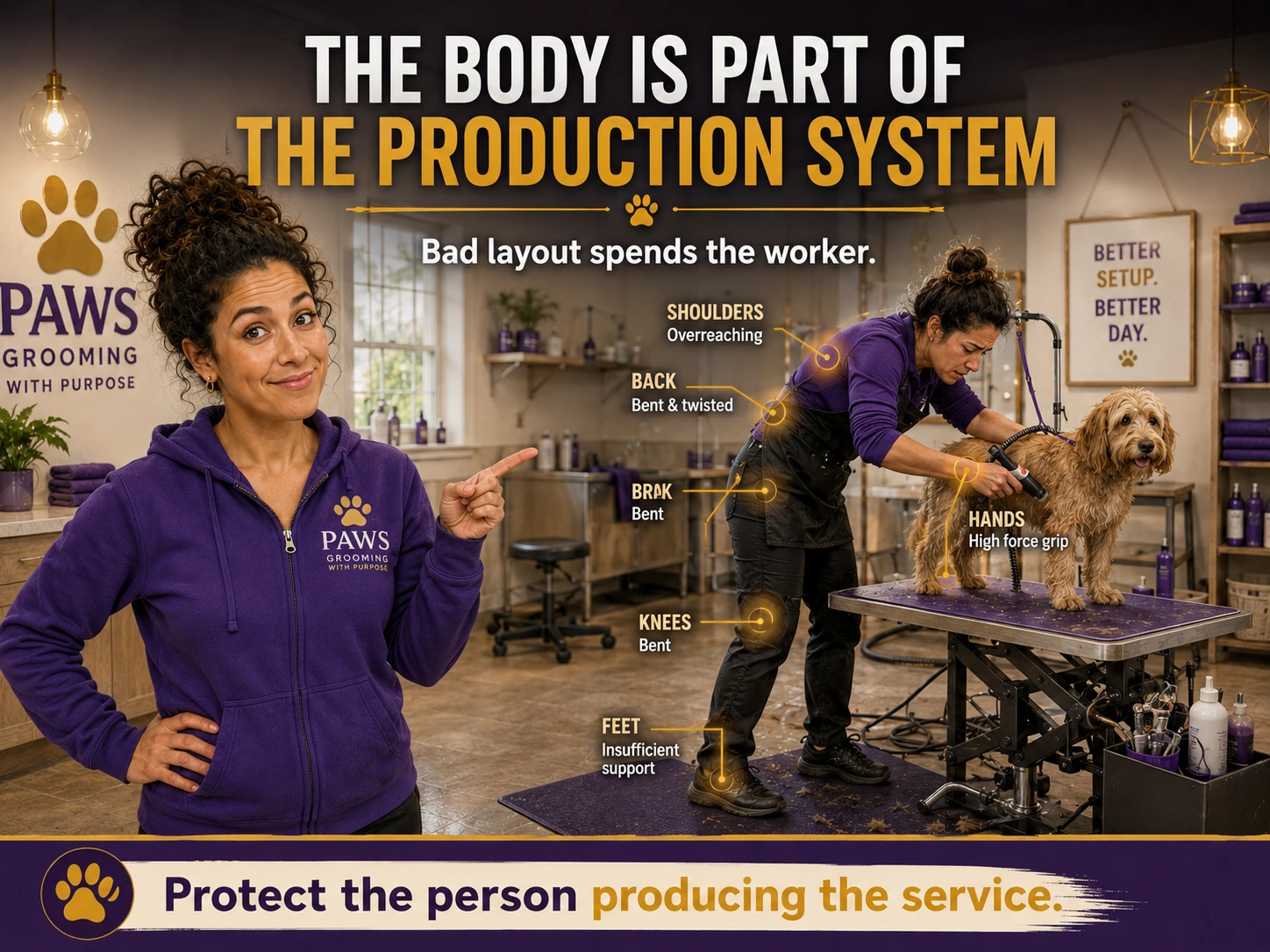
When people think about grooming, they often think about clippers, scissors, tubs, dryers, shampoos, and finished dogs. They do not always think about the body of the person doing the work. That is a mistake.
A groomer’s back, shoulders, wrists, hands, knees, feet, and patience are part of the production system. If the room forces the groomer to bend over the tub all day, lift heavy dogs unnecessarily, reach across the table for tools, twist to grab towels, fight a dryer hose, or stand in awkward positions while trying to control a dog, the room is not just inconvenient. It is slowly taxing the worker.
That tax shows up as fatigue first. Then it shows up as slower production, lower grooming quality, more mistakes, more frustration, more risk, and eventually staff who either burn out, get injured, or decide there are easier ways to make a living than wrestling wet dogs in a poorly designed room.
This is why layout matters. Every unnecessary lift, reach, bend, twist, search, drag, and repositioning movement takes something from the groomer. One movement does not seem like much. Hundreds of them in a day absolutely matter.
Equipment should adjust to the worker and the dog whenever practical. Adjustable tables, usable tub access, supportive flooring, reachable controls, and clear dog-transfer paths reduce the amount of muscular effort the employee has to spend before the actual grooming work even begins.
The operator should also listen for patterns instead of waiting for an injury. Repeated complaints about one shoulder, one reach, one hose, one table height, or one lifting step are operating data. The room is telling you where it is charging the groomer.
⚠️
Operator reality
A grooming room that saves the groomer’s body saves production. A grooming room that abuses the groomer’s body eventually costs you in speed, quality, staff turnover, injury risk, and lost money.
🐕
The Dog Is Not a Static Object
Most ergonomic examples deal with boxes, parts, tools, or workstations. Grooming is worse because the “workpiece” is alive.

A dog is not a box. A box does not decide halfway from the tub to the table that today is the day it becomes airborne.
Grooming ergonomics is different from normal workstation ergonomics because the dog moves, resists, slips, shakes, leans, panics, sits down, jumps, bites, pulls away, refuses to stand, hates the dryer, hates its feet touched, or suddenly discovers that the grooming table is apparently made of lava.
That is why the grooming room layout has to reduce unnecessary handling before the dog ever decides to make things interesting. The more the room forces staff to lift, twist, drag, carry, bend, reach, or reposition the dog, the more chances there are for the dog to resist at exactly the wrong moment.
A calm, cooperative dog can make a bad room seem workable. A large, nervous, wet, slippery, overexcited dog will expose every stupid layout decision in the building. The layout has to be built for the hard dogs too, not just the easy ones.
Layout must preserve control when the dog changes direction, braces, shakes, or tries to leave. Staff need room to reposition their feet, guide the dog, close a gate, reach a restraint, and retreat from a bite attempt without colliding with equipment.
Mock up the difficult movement before construction is final. Use the size and weight of the dogs the business expects, walk the tub-to-table route, test doors and corners, and make sure the safe path still works when the dog is wet, frightened, and refusing to cooperate.
📌
Design translation
Do not design the room around the best dog on the best day. Design it around the wet dog, the old dog, the scared dog, the heavy dog, the doodle with opinions, and the dog that waits until the worst possible second to launch.
🐕
Design the Room Around the Grooming Workflow Path
Do not design around where the equipment happens to fit. Design around how the dog, staff, tools, towels, water, air, and hair actually move.
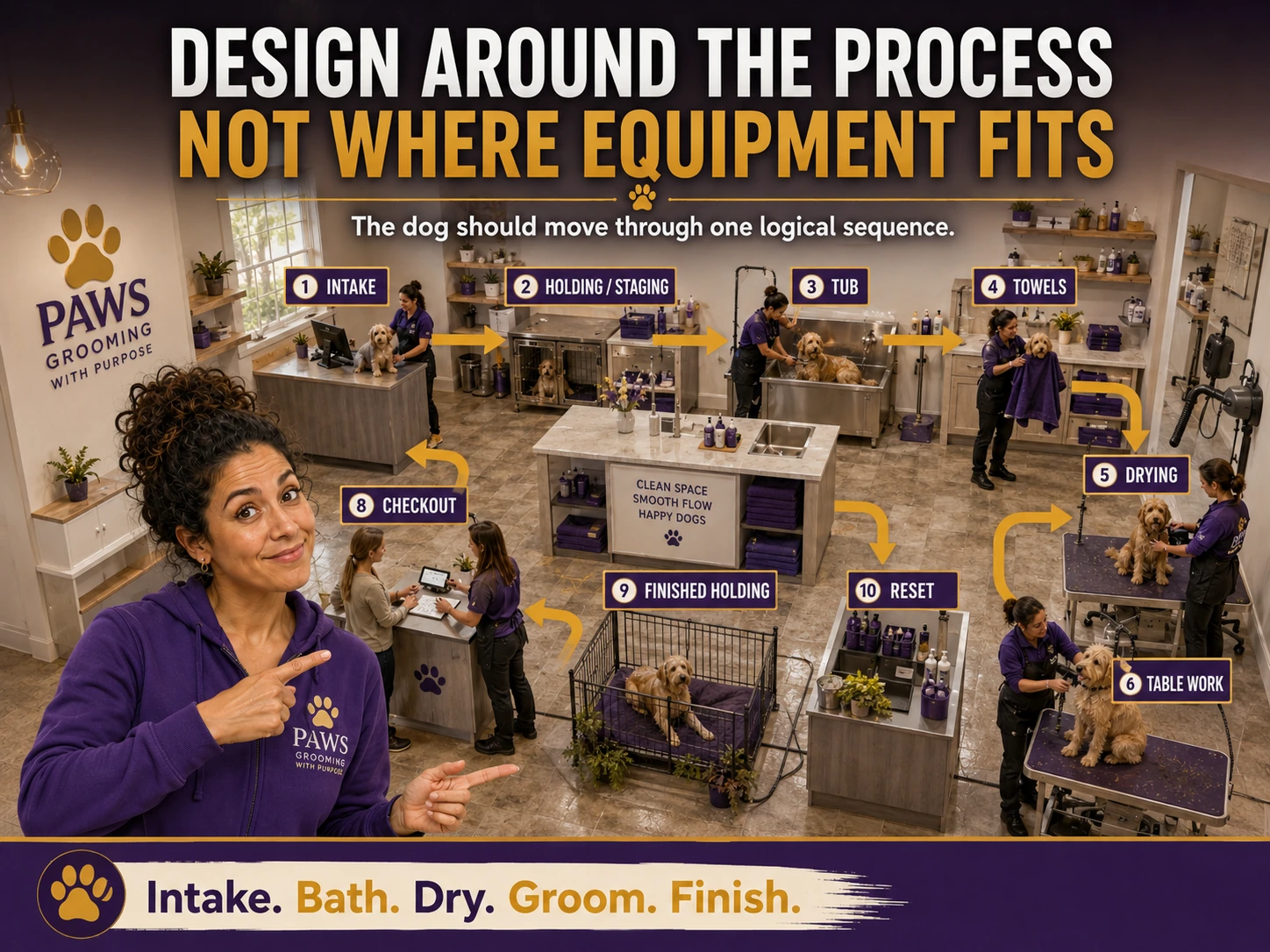
A grooming room should be laid out around the work sequence. Dogs do not magically teleport from dirty intake to finished checkout. They move through a process, and that process should be obvious in the room.
The basic workflow is intake, holding or staging, tub, towel station, drying, table work, finishing, holding or checkout, cleanup, laundry, and reset. Every part of that path creates movement. The more poorly arranged the room is, the more staff have to compensate with their bodies.
The path should be tested as a sequence rather than as a collection of stations. Each handoff should leave the dog in a safer, cleaner, and more controlled position without forcing staff to reverse direction or carry supplies against the flow.
A good workflow also protects completed work. Finished dogs, clean towels, sanitized tools, and customer-ready areas should not be routed back through wet floors, dirty laundry, loose hair, or incoming dogs that have not entered the grooming process yet.
Intake / Staging
The dog enters the grooming process with instructions, behavior notes, coat condition, service expectations, and a place to wait safely.
Bathing
The tub, shampoo, sprayer, towels, drainage, splash control, and bather movement need to work together.
Drying
Drying creates noise, heat, air movement, loose hair, dog stress, and cord problems if the space is not planned.
Table Work
Clippers, scissors, combs, brushes, blades, restraint, lighting, mats, and finishing tools must be close to the groomer.
Finished Holding
Finished dogs should not be mixed into wet work, loose hair, open doors, dryer cords, or traffic that can undo the groom or stress the dog.
Cleanup / Reset
Hair, dirty towels, disinfectant, tools, tubs, tables, drains, and floors need a reset path that does not eat the day.
🛁
The Tub-to-Table Relationship Is One of the Biggest Layout Decisions
The worst grooming-room layout is the one where every large wet dog becomes a staff strength test.

It takes a substantial amount of space and a large variety of specialized tools and fixtures to groom dogs in a highly productive manner. The most basic of those tools are a grooming tub, grooming table, dryers, and small hand tools like clippers, scissors, combs, and brushes.
In applying the principles of motion economy, the grooming table and tub should be located in relation to each other so that the groomer or bather can move the dog laterally from the tub to the table, or from the table to the tub, without having to bend down, lift the animal unnecessarily, and travel across the room.
Wet dogs are slippery. Large dogs are heavy. Nervous dogs can launch. Old dogs can fold up on you. Dogs with bad hips, bad knees, bad backs, or fear issues can turn a simple move into a staff injury or dog injury if the room forces the wrong motion.
There should be adequate space around tools and fixtures so groomers can lead or carry animals from one location to another without having to go around, under, over, or through obstructions. If the bather has to drag a wet dog around a garbage can, over a hose, past a dryer cord, around a table leg, and through a towel pile, that is not workflow. That is a lawsuit audition.
Before fixing equipment to the floor or wall, test the clearances with the table raised, lowered, and occupied. Confirm that the worker can open gates, move around the dog, manage the hose, and guide the animal without backing into storage, cords, or another workstation.
The goal is not merely a short distance. The goal is a controlled transfer that reduces vertical lifting, twisting under load, and the moment when a large wet dog is unsupported between two pieces of equipment.
📌
Tub/table rule
The tub and table should be arranged so the dog moves through the room naturally. Do not make the staff lift, twist, carry, and negotiate obstacles because the equipment looked better against the other wall.
💨
Wet Zone, Dry Zone, and Hair Zone
Grooming rooms fail when water, electricity, hair, tools, dogs, towels, and staff all fight for the same badly planned space.
Wet Zone
The wet zone includes the tub, sprayer, shampoo, conditioner, towel access, drain, hair trap, splash control, waterproof surfaces, and wet-dog movement. This zone should be easy to clean and should not dump water into table work, cords, or customer-visible chaos.
Dry Zone
The dry zone includes grooming tables, clippers, blades, scissors, combs, brushes, restraint systems, lighting, and finishing tools. This area should not be soaked by tub splash or buried in towels, shampoo bottles, and dryer hoses.
Hair / Air Zone
Dryers move hair, air, heat, sound, and dog stress. Plan where that air goes. A force dryer pointed into the wrong part of the room can turn the whole salon into a flying hair cannon.
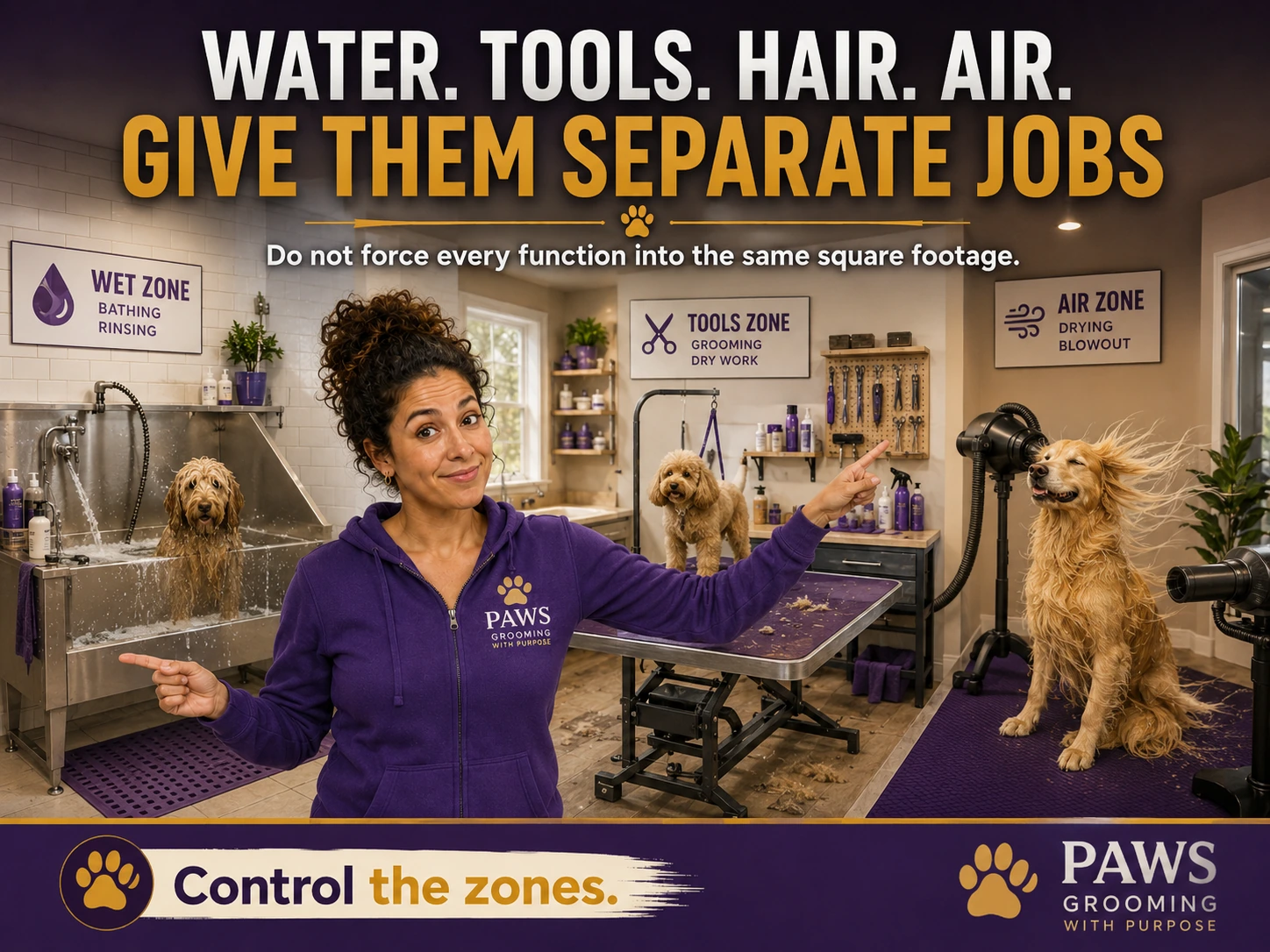
These zones do not have to be separated by walls in every business, but they do have to be understood. Water belongs where water can be controlled. Electrical tools belong where splash is controlled. Hair needs a cleaning plan. Towels need a clean/dirty flow. Dryers need space, cord control, and noise awareness.
When these zones are ignored, the room becomes one big pile of wet towels, loose hair, tangled cords, barking, dryer heat, slippery floors, and staff pretending this is normal because they have not yet seen what a functional grooming room feels like.
Each zone needs a defined job and a reset standard. Staff should know where wet equipment stops, where dry tools begin, where loose hair is directed, where clean towels remain protected, and how the room returns to ready condition between dogs.
The boundaries can be created with distance, equipment orientation, storage, drainage, cord routing, and work rules even when walls are not practical. What matters is that one task does not repeatedly contaminate, obstruct, or interrupt the next.
🧰
Storage and Tool Placement: Stop Making Groomers Hunt for the Room
A tool without a home becomes a scavenger hunt. Scavenger hunts are not a business model.
Hand tools should be located so they are conveniently accessible and easily storable without creating the need for groomers to search for tools or move out of their workspace to put them down when not in use.
Clippers, blades, scissors, combs, brushes, nail tools, ear products, bows, bandanas, shampoos, conditioners, towels, disinfectant, cleaning supplies, dryer nozzles, filters, and grooming restraints all need defined places. The goal is not to collect equipment. The goal is to position equipment so the work sequence makes sense.
If the groomer has to step away from the dog every time they need a different comb, blade, towel, or product, the room is stealing time. If tools are stacked in random drawers, jammed on counters, balanced on tubs, or hidden behind whatever someone moved yesterday, the room is creating waste.
- Tools used at the table should live at the table or within immediate reach.
- Shampoo, conditioner, sprayers, towels, and cleaning tools should be positioned for the bathing sequence.
- Clean towels and dirty towels need separate paths so the room does not become a damp pile of laundry.
- Cords, hoses, dryer nozzles, and restraint equipment should have storage that keeps walkways clear.
- Frequently used tools should not require bending, digging, leaving the dog, or asking another employee where the thing went.
🔌
Utilities and Surfaces Matter Only Because They Affect the Work
This page is not the deep construction page. The point here is how the room supports or punishes the groomer’s movement.
Plumbing, electrical, drains, surfaces, lighting, and ventilation all matter, but this is not where we are going to get lost in construction details. Those topics deserve their own pages. Here, the question is simpler: do those systems make the groomer’s work easier or harder?
A bad outlet location creates cord problems. A bad drain location creates wet-floor movement. Poor lighting makes detail work harder. Slick flooring changes how staff move around wet dogs. Poor towel flow creates extra steps. Poor dryer placement forces the groomer to fight hoses, air direction, noise, and dog movement at the same time.
The operator does not need to become a plumber, electrician, or contractor to understand the ergonomic issue. The operator needs to understand the work sequence well enough to tell those trades what the room must support.
👀
The Customer View Still Matters
Function wins, but customers still need to feel comfortable leaving their pets with you.
None of this means aesthetics do not matter. They do. Customers judge cleanliness, smell, lighting, organization, staff confidence, equipment quality, and the general feel of the business. A grooming room that looks filthy, cluttered, hidden, chaotic, or unsafe will make customers nervous.
But the customer does not need a fake luxury stage set. They need confidence. They need to see a room that appears clean, controlled, professional, and built for pet care. They do not need to see every wet dog shake, every towel pile, every hair explosion, every drain, and every staff member trying to wrestle a doodle through the dryer like it owes money.
Control the sightline. Make the customer-facing view clean and professional. Keep restricted work areas restricted. Do not let customer impression force a layout that punishes the people doing the work.
🚧
Ergonomic Bottlenecks: Where the Room Steals the Most Body Effort
The bottleneck is not always the slowest piece of equipment. Sometimes it is the place where the room makes the groomer fight the hardest.
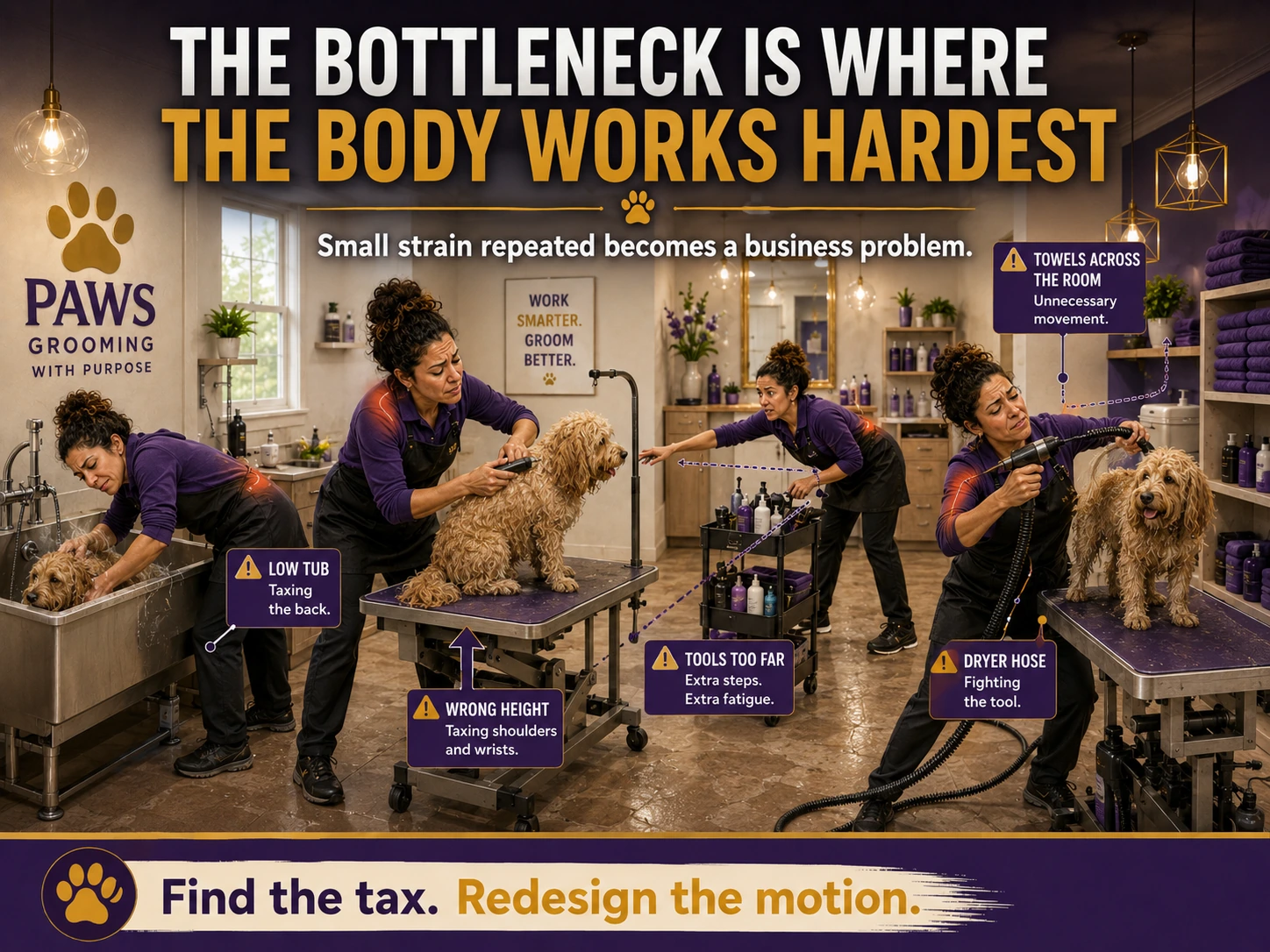
In a grooming room, a bottleneck is not just a scheduling problem. It can be a body problem. The room may technically have a tub, table, dryer, tools, and storage, but if the groomer has to fight the same awkward motion over and over, that spot becomes the tax collector.
A tub that is too low taxes the back. A table at the wrong height taxes the shoulders and wrists. Tools too far away tax time and attention. Towels across the room tax control. A dryer hose that constantly fights the worker taxes patience. A dog that has to be lifted instead of moved laterally taxes the body. A room with nowhere to safely set down tools taxes concentration.
These bottlenecks do not always look dramatic. They look like a groomer taking three extra steps a hundred times a day. They look like bending slightly too far for every dog. They look like twisting to reach a tool. They look like carrying dogs because the layout did not allow a better movement path.
That is how a grooming room quietly becomes expensive. It does not always fail in one big event. It fails by wearing down the worker, slowing the process, and making every dog slightly harder than it needed to be.
A bottleneck audit should follow the worker, not just the dog. Notice where the employee pauses, braces, changes grip, asks for help, steps around something, or leaves the workstation. Those are the points where the room is consuming body effort instead of supporting production.
Fix the highest-frequency strain first. Removing one repeated bend, long reach, or loaded carry can matter more than buying a faster piece of equipment that still sits inside the same bad movement pattern.
Swipe left/right to see the full table.
| Ergonomic Bottleneck | What It Does to the Worker | What It Does to Production | Better Layout Thought |
|---|---|---|---|
| Tub too low or awkward | More bending, leaning, reaching, and back fatigue. | Slower bathing and more exhausted bathers. | Choose tub height and access based on the dogs and workers who will use it all day. |
| Table too high or too low | Shoulder, wrist, back, and neck strain. | Slower finish work and lower grooming quality as fatigue builds. | Use table height and adjustability to fit the worker and dog, not just the room. |
| Tools too far away | Reaching, stepping away, breaking focus, and leaving the dog less controlled. | Wasted time and more chances for the dog to move at the wrong moment. | Put common tools inside the normal working reach zone. |
| Towels across the room | Staff leave wet dogs or call for help constantly. | Slower baths, wetter floors, and worse dog control. | Store clean towels where wet dogs actually need them. |
| Dryer hose fights the worker | More pulling, bracing, twisting, and frustration. | Drying takes longer and dogs become harder to manage. | Plan dryer placement, hose path, and dog position together. |
| Dog has to be lifted instead of moved laterally | More strain and more injury risk, especially with large or wet dogs. | Slower transitions and higher staff reluctance with difficult dogs. | Arrange tub, table, ramps, steps, and holding to reduce lifting. |
🎾
Daycare-to-Grooming Ergonomics
Adding grooming to daycare creates a special handling problem: the dog may not arrive in grooming mentally ready to be groomed.
When grooming is added to an existing daycare or boarding business, the ergonomic problem is not only the room. It is also the transition. A dog pulled out of group play and shoved into grooming may arrive with its brain still in recess mode. That is not an ergonomic gift to the groomer.
Daycare dogs may be over-aroused, sweaty, tired, excited, thirsty, overstimulated, or still mentally engaged with the playgroup. Then the groomer is expected to put that same dog on a table, touch feet, run clippers, use dryers, trim nails, and produce a clean finish. Sometimes that works fine. Sometimes the dog arrives like a wet tennis ball with teeth.
The operator has to think about how daycare dogs enter the grooming process. Is the dog groomed before group play? After rest? After daycare? During a quiet window? Does the dog have a calm transition path, or is staff dragging the dog through daycare traffic, barking, gates, hoses, and lobby chaos before asking the groomer to perform detail work?
Clean and dirty movement matters too. A freshly groomed dog should not automatically go back into group play unless the service and customer expectations allow it. A dog that just had a bath, trim, blowout, or finishing work may need a clean holding plan instead of being returned to the same chaos that made him dirty in the first place.
📌
Daycare integration rule
Do not treat grooming as a side corner that daycare dogs get dragged into whenever convenient. The dog’s arousal level, route, timing, rest period, and clean holding plan all affect how hard the groomer’s job becomes.
📉
What Fails First in a Bad Grooming Room Layout
Bad design usually fails in boring ways first: wasted steps, wet floors, missing towels, cord problems, staff fatigue, and dogs being moved the hard way.

The first failures are usually not dramatic enough to force an immediate redesign. Staff compensate. They step over the hose, walk farther for towels, lift the dog because the transfer path is blocked, and lose a few minutes cleaning hair from a place that should never have collected it.
That compensation hides the layout defect until the schedule gets busy, a large wet dog resists, a worker is tired, or two people need the same narrow path at the same time. Then the room stops looking merely inconvenient and starts creating control, safety, and production problems.
Treat recurring workarounds as evidence. If staff have invented a daily ritual to overcome the room, the ritual is not the solution. It is the symptom that tells the operator what needs to be redesigned.
Swipe left/right to see the full table.
| Layout Failure | What It Looks Like | Why It Hurts the Business | Better Design Thought |
|---|---|---|---|
| Tub too far from table | Staff carry or drag wet dogs across the room. | More lifting, slip risk, dog stress, staff injury, and wasted time. | Arrange tub and table for short, logical dog movement. |
| No towel station | Bather has to leave the dog or yell for towels. | Slower baths, wet floors, frustrated staff, and poor control. | Place clean towels where wet dogs actually need them. |
| Dryer cords and hoses in walkways | Staff step over cords while handling dogs. | Trip risk, equipment damage, dog panic, and messy workflow. | Plan dryer locations, cord routing, storage, and usable outlets. |
| Poor hair control | Hair piles into drains, corners, filters, tools, and lobby sightlines. | Cleaning time explodes and the salon looks dirty even when staff are working hard. | Design for hair capture, sweeping, filters, drains, and easy reset. |
| Pretty but cramped | Room looks good but staff bump into equipment and each other. | Production drops, stress rises, and dogs become harder to handle. | Leave enough working space around tubs, tables, dryers, and holding. |
| No fixed tool homes | Tools migrate, disappear, stack up, or live in random drawers. | Groomers waste time searching instead of grooming. | Assign fixed locations based on the work sequence. |
| Bad surfaces | Floors get slick, walls absorb splash, corners hold grime. | Cleaning takes longer and the room ages badly. | Use cleanable, moisture-tolerant, traction-conscious materials. |
| No laundry flow | Dirty towels mix with clean towels or pile up in work areas. | Clutter, odor, moisture, and staff irritation. | Build a clean/dirty towel path from the beginning. |
✅
Grooming Room Workflow Audit Checklist
Use this before you buy equipment, sign off on a layout, or decide that a room is “good enough.”
- Can a dog move from tub to table without crossing the room or forcing staff to lift more than necessary?
- Can the bather reach clean towels from the tub without leaving the dog unsecured?
- Can the groomer reach common table tools without stepping away from the dog?
- Are dryer cords, hoses, and electrical cords kept out of main dog and staff paths?
- Is there a clear wet zone, dry zone, and dryer/hair zone?
- Does the room have enough space around the tub, table, and dryers for staff to work safely?
- Is there a clean/dirty towel flow that does not create piles of damp laundry in the work area?
- Is there a fixed place for every tool, product, restraint, dryer part, and cleaning item?
- Can the room be cleaned quickly between dogs and reset at the end of the day?
- Does the customer-facing view build confidence without forcing the work area to become a showpiece?
- Does the layout reduce lifting, bending, reaching, twisting, and wasted steps?
- Does the room help production, or does it quietly tax every appointment?
⚠️
Audit rule
Do not ask whether the room can technically fit the equipment. Ask whether the room can support the work for an entire day without beating the staff, stressing the dogs, and slowing the schedule.
➡️
Next Grooming Setup Pages
This page explains the design philosophy. The next pages get into time, noise, motion, equipment, tables, arms, restraints, and the pieces that make the grooming room actually work.
⏱️
Grooming Time and Money
Grooming production is labor. Wasted motion, poor layout, and bad room setup turn directly into lost money.
🔊
Noise and Fatigue
Dryers, barking, hard surfaces, and long grooming days can grind down staff and stress dogs.
🔁
Economy of Motion
The deeper dive into arranging the grooming room so the worker is not wasting motion all day.
📐
Motion Design Examples
Practical examples of how layout choices change the amount of work a groomer has to do.
🧰
Salon Setup Tool Review
Move from design philosophy into the actual tools and equipment used in a working grooming setup.
⬆️
Grooming Tables
Grooming tables are not just furniture. They affect lifting, restraint, reach, fatigue, safety, and speed.
❓
Dog Grooming Salon Design and Motion Economy FAQ
Detailed operator answers about grooming workflow, ergonomics, dog movement, room zones, equipment placement, staff fatigue, and production.
What should control a grooming-room layout first?
The work sequence should control the layout first. Intake, holding, bathing, towel access, drying, table work, finishing, checkout, cleaning, and reset should follow a logical path that reduces unnecessary dog handling and worker movement. Equipment should support that path rather than forcing staff to invent workarounds around whatever fit against the wall.
How do I know whether a grooming room has good motion economy?
Watch a complete appointment from intake through cleanup and count the repeated steps, bends, reaches, searches, lifts, and equipment changes. Good motion economy keeps common tools close, places supplies where they are used, limits cross-room travel, and allows the dog to move between stages without becoming a strength test. The room should make the normal sequence easier as the day gets busy, not harder.
Why is the groomer’s body part of the business model?
Grooming revenue depends on skilled people being able to produce safe, consistent work over full shifts and over many years. A room that repeatedly taxes the back, shoulders, wrists, hands, knees, or feet eventually reduces speed, quality, attendance, and retention. Protecting the worker’s body protects appointment capacity and the business’s ability to keep a good groomer.
Why can’t ordinary warehouse ergonomics be copied directly into grooming?
A box stays where it is placed. A dog may resist, slip, shake, panic, sit down, jump, bite, or change direction while the worker is lifting or guiding it. Grooming layout has to preserve control around a living animal, which means clear foot space, safe restraints, short transfer paths, reachable tools, and room to respond when the dog does something unexpected.
How should the tub and grooming table relate to each other?
They should support a short, controlled transfer that minimizes vertical lifting, twisting under load, and carrying a wet dog across the room. The exact arrangement depends on equipment and dog size, but staff should be able to guide the dog laterally or through a supported route without negotiating cords, trash cans, towel piles, or other workstations.
Should I buy equipment before finalizing the workflow?
No. First map the service sequence and the movement of dogs, people, tools, water, towels, hair, and waste. Then select equipment dimensions and features that support that plan. Buying a tub or table first and designing the room around it can lock the business into bad clearances, wrong heights, and awkward transfer paths.
What is an ergonomic bottleneck in a grooming room?
It is the location or task where the worker repeatedly spends the most body effort or loses the most control. Common examples include a low tub, a table at the wrong height, towels stored across the room, a dryer hose that constantly pulls against the worker, or tools that require stepping away from the dog. The bottleneck may look small but becomes expensive through repetition.
Which ergonomic problem should be fixed first?
Start with the movement that is both frequent and physically costly. A repeated loaded lift, long reach, deep bend, or cross-room trip usually deserves attention before an inconvenience that happens once a week. Observing several real appointments and asking staff where they brace, pause, ask for help, or lose dog control will identify the highest-value correction.
How much working clearance should be left around equipment?
Enough for the employee to position their feet, guide the dog, open gates, operate controls, use hoses, and move around the table or tub without backing into another workstation. The correct clearance depends on equipment size and the dogs served, so mark the footprint on the floor and test it with the table raised, lowered, and occupied before construction is final.
Why are fixed tool locations so important?
A fixed location reduces searching, prevents tools from migrating, and helps the groomer maintain control of the dog. Frequently used table tools should remain inside the normal reach zone, while bathing products and towels should be positioned for the bathing sequence. Storage should follow the task instead of forcing every employee to create a personal scavenger hunt.
How should clean and dirty towels move through the room?
Clean towels should be protected and immediately reachable where wet dogs need them. Dirty towels should have a separate collection path that does not cross clean storage or accumulate in active work areas. A clear clean-and-dirty flow reduces walking, wet-floor clutter, odor, and the chance that staff leave a dog to search for supplies.
Do wet, dry, and hair zones require separate rooms?
Not always, but the functions must be controlled. Water and splash should not invade electrical tools or dry finishing work, dryer air should not fire loose hair through the whole salon, and clean supplies should not sit inside wet or dirty traffic. Distance, orientation, drainage, storage, barriers, and work rules can create useful zones even within one room.
How should dryers be positioned?
Dryer placement should be planned with the dog position, hose path, electrical supply, noise, heat, air direction, and employee movement in mind. The hose should not fight the worker or cross the main walking path, and the dryer should not blow hair into clean tools, customer sightlines, or another groomer’s workstation. Storage for hoses and nozzles should be part of the plan.
What makes a customer-facing grooming room professional?
Customers need to see cleanliness, organization, good lighting, maintained equipment, and confident staff. They do not need unrestricted access to wet floors, loose hair, difficult-dog handling, dirty laundry, or every part of the production process. A controlled sightline can build trust without forcing the work area to become a decorative stage.
How should a standalone salon differ from grooming added to daycare?
The core grooming workflow is the same, but an add-on service must also manage transitions from daycare or boarding. The operator needs a calm route into grooming, timing that considers the dog’s arousal level, and clean holding after the service. The grooming room should not become leftover space squeezed around the daycare operation.
When should a daycare dog be moved into grooming?
Timing should reflect the dog’s behavior, energy, coat service, and the facility’s operating flow. Some dogs should be groomed before group play, some after a rest period, and some during a quiet window. Moving an over-aroused dog directly from play to detailed grooming can make restraint, drying, nail work, and face trimming harder than necessary.
How can I test a layout before construction is complete?
Mark equipment footprints on the floor, use boxes or temporary tables to represent actual dimensions, and walk through the full service with staff. Test large-dog turns, tub-to-table transfer, towel reach, hose routing, door swing, finished holding, and cleanup. The mockup should be tested as if the dog is wet, heavy, nervous, and refusing to cooperate.
What daily signs indicate the layout is failing?
Watch for staff repeatedly asking for help with ordinary transfers, stepping over cords, walking for towels, searching for tools, leaving dogs to retrieve supplies, piling wet laundry in work zones, or creating unofficial storage wherever space appears. Repeated workarounds are evidence that the room is not supporting the actual process.
Can better layout increase grooming profit without adding staff?
It can recover capacity by reducing wasted movement, restart time, cleaning friction, and physical fatigue. The gain may appear as one more appointment, fewer schedule overruns, better quality late in the day, or less overtime rather than a dramatic single event. The operator should measure appointment duration and repeated motion before and after changes.
What is the main design rule for a grooming salon?
Build the room around the worker’s body and the dog’s movement. Form should create customer confidence, but function must protect control, safety, repeatable workflow, and production. A room is successful when it still works on the difficult dog, during the busy shift, after hours of physical labor—not merely when it looks good while empty.
🐾
Bottom Line: Build the Grooming Room Around the Worker's Body and the Dog's Movement
A grooming room is a production workspace with dogs, water, dryers, tools, hair, staff fatigue, customer expectations, and profit attached.
A beautiful grooming room can help customers feel comfortable, but beauty does not make the room productive. Ergonomic layout determines whether staff can move dogs safely, reach tools efficiently, reduce lifting, control wet dogs, manage dryers, avoid wasted motion, and complete grooming services without the room slowly grinding them down.
The room should support the groomer and bather instead of making them fight for every appointment. The tub, table, dryers, towels, tools, storage, cleaning, and dog movement should follow a logical path. When they do not, the business pays for it in time, exhaustion, risk, and lost production.
Before you buy equipment or fall in love with a pretty layout, ask the only question that really matters: will this room help the work happen safely and efficiently all day, or will it quietly beat the staff into the floor while looking nice for the customer?