Grooming Table Hardware • Overhead Arms • Restraint Points • No-Sit Control • Sling Support • Grooming Room Equipment Review
Overhead Grooming Arms: Cumbersome but Useful Table Control Hardware
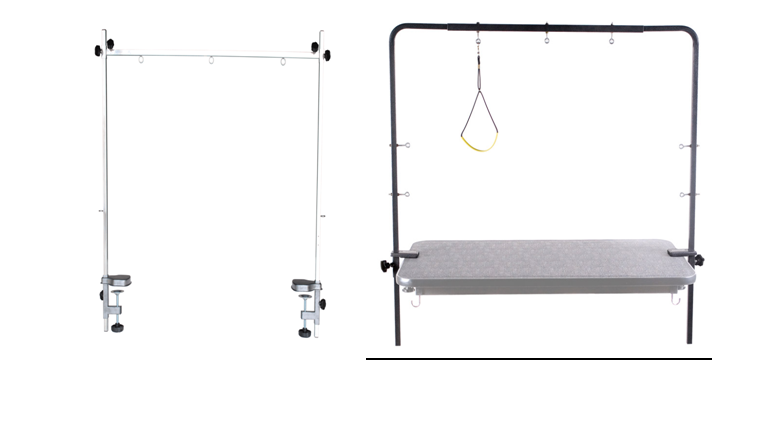
The overhead grooming arm, impressions and experience summed up in three words: cumbersome but useful.
That is still my take. This is not elegant equipment. It is not invisible equipment. It is a control frame. It gives the groomer more restraint points, more stability, and more ways to manage body position on the table.
But it also puts metal at both ends of the table and a solid bar across the top. That means the same piece of equipment that gives you control can also get in your way, catch cords, crowd the table, and make height adjustment more annoying than it should be.
So the question is not whether an overhead grooming arm is good or bad. The question is whether your grooming room needs the control badly enough to live with the hardware.
⚠️
Operator rule
An overhead grooming arm gives control, but it costs space. Buy it because you need multiple attachment points and a stable restraint frame, not because it looks like professional grooming equipment in a catalog.
🗺️
Use This Page Like a Hardware Review
This is the sit-across-the-table version: here is what the overhead arm solves, what it creates, and when I would actually want one.
🧰
What It Is
Two table-end posts, a top crossbar, clamps, eyelets, and multiple restraint points.
✅
Why It Helps
Stable restraint points for difficult small to medium-large dogs, cats, no-sit work, and support gear.
🧍
Where It Works Best
Useful for the right animals and the right work, but not magic for every dog on the schedule.
🚧
Why It Gets in the Way
Both ends of the table are occupied, the top bar steals room, and multiple staff can get crowded fast.
🔌
Cords and Eyelets
The little metal connection points are useful, but they love catching cords, loops, leashes, and dog nonsense.
⬆️
Height Adjustment
Raising both sides evenly can become a small annoying table-side wrestling match.
📏
Price and Fit
Basic arms are still affordable, but premium versions can cost real money. Fit the table before buying.
❓
FAQ
Size range, no-sit use, cats, sling support, head clearance, clamps, eyelets, and premium versions.
🧰
What an Overhead Grooming Arm Actually Is
It is basically a restraint frame that clamps to both ends of the grooming table.
By design, this particular type of grooming arm is designed to provide maximum stability and maximum attachment points to manipulate the body position of an animal being groomed.
Instead of one single arm clamped to one corner or side of the table, an overhead grooming arm attaches to both ends of the table simultaneously. It usually has two upright posts, a solid bar along the top, clamps at the table ends, and multiple metal eye loops or connection points along the overhead bar.
That two-end attachment is why it is stable. It is also why it is in the way.
The advantage is that the groomer gets a stronger restraint setup and more options for where to attach grooming loops, nooses, support straps, or no-sit devices. The disadvantage is that the groomer is now working inside and around a metal rectangle sitting on the table.
📌
Product reality
This is control hardware. It is not meant to be invisible. If you need the control, it can be worth the inconvenience. If you do not need the control, it may just become one more thing to bang into.
✅
Why Overhead Grooming Arms Are Useful
Stability and multiple attachment points are the reason this hardware exists.
As it attaches to both ends of the table simultaneously, it is a very stable piece of equipment and is well able to handle unruly small to medium-large dogs, roughly in the 30-to-50-pound range, thrashing about in the event they are not fans of the grooming process.
That does not mean it turns an unsafe dog into a safe dog. It means that for difficult but still manageable animals, the hardware gives the groomer more control than a single clamp-on arm.
It also works well for cats and dogs when used in conjunction with a groomer’s sling, support vest, belly band, or other support equipment to help steady or support the animal over the table.
It can also be useful when used with multiple grooming loops or nooses to prevent an animal from sitting, spinning, backing up, leaning, or turning itself into a furry bag of bad decisions.
The advantages are simple: this type of grooming arm is stable and provides numerous connection points.
That is the whole reason to own one.
Swipe left/right to see the full table.
| Use Case | Why the Overhead Arm Helps | Operator Meaning |
|---|---|---|
| Dog keeps sitting | Multiple attachment points allow better no-sit positioning. | Useful when one loop is not enough to keep the dog standing. |
| Dog shifts or thrashes | Two-end attachment gives more stability than a single arm. | Helps with difficult but still manageable dogs. |
| Support sling or belly support | The overhead bar gives places to attach support equipment. | Good for steadying an animal, especially during nails or long standing work. |
| Cats or smaller animals | More control points may help with careful restraint. | Useful only when restraint is thoughtful, safe, and not overdone. |
| Groomer needs body-position control | The arm lets the groomer manipulate where support and loops connect. | This is where the overhead arm earns its place. |
⚠️
Support warning
Support gear should support and steady the animal, not hang the dog like a chandelier. Follow the manufacturer’s instructions, use appropriate restraints, and do not ask cheap hardware to do unsafe suspension work.
🧍
Where an Overhead Arm Works Best
This hardware is not for every table moment. It is for control-heavy table moments.
I like overhead grooming arms best when the grooming job requires more than a simple neck loop and single arm can reasonably provide.
That might mean a dog that constantly tries to sit. It might mean a small or medium dog that squirms, leans, backs up, or thrashes. It might mean a cat or small dog being supported carefully with a sling or support vest. It might mean nail work on an animal that needs help staying in position.
The sweet spot is generally small to medium-large animals where extra restraint points are useful and the animal still fits under the top bar without head or eye clearance becoming a problem.
I would not think of this as a large-dog miracle tool. Taller dogs tend to run into clearance problems, and once you are dealing with a strong dog that is big enough to move the table, bend hardware, or create a real safety issue, the answer is not “add more metal and hope.”
At that point, the business needs better handling policy, better staff support, better equipment, a different restraint plan, or possibly the willingness to stop the groom instead of trying to turn the table into a rodeo chute.
🚧
The Cumbersome Part: It Gets in the Way
The same frame that gives you stability also steals table access, elbow room, and body space.
The disadvantages are that in order to provide this overkill in stability, it connects at both ends of the table, meaning that it has to be constantly worked around and at times can get in the way.
This is especially true if you have a particularly unruly animal that requires multiple staff members to work with.
The fact that it extends from both ends of the table and has a solid bar along the top tends to cut down on elbow room and wiggle room when trying to forcibly secure an unwilling grooming participant.
That is the tradeoff. You get more control points, but you also put a top bar and two vertical posts exactly where people are trying to move, lean, reach, dodge, and not get smacked by a dog acting like the groomer just announced tax season.
When one groomer is working alone on a controlled dog, the overhead arm may be mildly annoying. When two staff members are trying to secure a dog that does not want to cooperate, that same frame can feel like someone parked a metal jungle gym on top of the table.
📌
Real tradeoff
The same metal that gives you control is also the metal everyone is trying not to bang into while the dog is auditioning for a prison break.
🔌
Cord, Loop, Leash, and Eyelet Problems
The little metal connection points are useful. They are also perfect little hang points.
Additionally, all of the connection points, usually metal eye loops, are perfect for catching cords and for dogs to bump into or try to bite and chew.
Those eyelets are why the tool is useful. They give the groomer options. But everything in a grooming room that can catch a cord eventually catches a cord. Clippers, dryer hoses, loops, nooses, leash clips, apron strings, and random table-side nonsense all seem to find metal eyelets when you least need them to.
Dogs can also bump into them. Taller dogs can get their head or eyes near them. Nervous dogs may mouth, bite, or chew at anything near their face. A dog does not look at a metal eyelet and think, “That is a restraint attachment point.” A dog thinks, “This shiny thing is touching my personal space, and I may need to investigate it with my teeth.”
This is why I like smooth edges, clean hardware, smart placement, and as few unnecessary protrusions as possible.
Swipe left/right to see the full table.
| Hang Point | What It Catches | Why It Matters |
|---|---|---|
| Top-bar eyelets | Loops, nooses, cords, leash clips, support straps. | Useful for restraint, annoying when everything else finds them too. |
| Vertical posts | Elbows, shoulders, tools, cords, and staff movement. | They create control but reduce open working space. |
| Clamp hardware | Knees, cords, loops, and clothing. | Bad clamp placement turns into a daily nuisance. |
| Low or exposed hardware | Dogs may bump, lick, bite, chew, or rub against it. | Hardware near the dog’s face and eyes needs extra attention. |
⬆️
Height Adjustment Can Be Cumbersome
Raising a two-sided overhead bar is not always smooth, especially when you are trying to do it alone.
Height adjustment can be a bit cumbersome as well.
You must raise one side, then the other in small increments to avoid it getting all lopsided and binding up.
The alternative is to loosen both height adjustment points at once and hold the top bar with one hand so it does not drop down onto the tabletop. Then you wiggle it up to the desired height, lock one side, switch hands, and lock the other side in place.
Cumbersome.
It is not the end of the world, but it is the kind of thing that sounds minor before you own it and annoying after you have used it for a while.
A well-built premium unit may adjust better than a cheaper arm, but the basic problem is still the same: you are managing two vertical posts and a top bar, not one simple arm.
⚠️
Adjustment warning
Before buying, look at how the overhead bar adjusts. If it takes two hands, two sides, and three bad words every time the height changes, that matters in a working grooming room.
🤕
Dog and Groomer Head Clearance Problems
The top bar is useful until someone’s head, eyes, or forehead finds it.
Lastly, the design and construction of this type of grooming arm limits its use to dogs around 50 pounds.
Taller dogs tend to have issues with their head coming into contact with the top bar. Again, the eyelets make perfect places for taller dogs to bump their head or eyes into.
Groomers on occasion will also bump their head on the top bar when backing out if they were leaning into and over the pet while working, such as trimming the far side nails on a small dog.
This is even more likely if, while the groomer is leaned in over the animal, the animal does something to startle the groomer and the groomer has to move back quickly.
That may sound like a small thing until you are the person who just stood up into a metal bar because a dog decided to flinch, bark, sit, bite at a loop, or impersonate a raccoon in a pillowcase.
📌
Clearance lesson
The overhead arm must fit the table, the dog, and the groomer. Tall dogs and low bars are not a good combination.
📏
Price, Table Fit, and Buying Reality
This hardware is not usually the most expensive thing in the room, but the wrong fit still makes it a pain.
Price in 2017 was generally around $75 to $100 for common basic overhead grooming arms.
Current market pricing still has basic overhead arms in roughly that neighborhood, but common professional versions can be more like $125 to $200 depending on the supplier, model, shipping, and included nooses or clamps. Premium stainless or fully adjustable systems can run several hundred dollars.
The buying question is not only price. The buying question is fit.
Will it fit your table length? Will the clamps fit your tabletop thickness? Will it clear the dog’s head? Does the top bar adjust high enough? Are the eyelets smooth? Are there enough restraint locations? Are there too many? Is the arm compatible with your no-sit system, support sling, loops, and grooming style?
A cheap overhead arm that fits poorly is not a bargain. A premium overhead arm that is overbuilt for what you need is not automatically smart either.
Buy the amount of hardware the work actually requires.
Swipe left/right to see the full table.
| Buying Item | What to Check | Operator Take |
|---|---|---|
| Table length | Many overhead arms are designed for specific table ranges, often around 36 to 48 inches. | Do not assume it fits just because it says grooming table arm. |
| Tabletop thickness | Clamp capacity matters, especially with odd or thick commercial tops. | A great arm is useless if the clamp does not fit the table. |
| Bar height | Check max height and how smoothly both sides adjust. | Tall dogs need clearance. Groomers need headroom. |
| Eyelets | Number, smoothness, placement, and whether they create hang points. | Attachment points are useful until they become cord traps. |
| Clamp quality | Metal quality, knob quality, grip surface, and table protection. | Weak clamps defeat the entire point of a stable overhead arm. |
| Price tier | Basic, professional, stainless, or premium fully adjustable. | Buy for fit and function, not just because the shiny one looks serious. |
✅
Overhead Grooming Arm Buying Checklist
Ask these questions before you bolt a metal rectangle onto the table and call it solved.
- Does the arm fit the actual length of your grooming table?
- Do the clamps fit the actual thickness and edge shape of your tabletop?
- Does the arm adjust high enough for the dogs you plan to groom?
- Can one person adjust the height without fighting both sides?
- Are the height locks secure and easy to tighten?
- Are the eyelets smooth, useful, and placed where they will not constantly catch cords?
- Does the top bar create head-clearance problems for taller dogs?
- Will the top bar interfere with groomer posture, elbow room, or multiple-staff handling?
- Is the arm compatible with your loops, no-sit device, support sling, belly band, or support vest?
- Are you buying it because you need control points, or because it looks like the serious version of a grooming arm?
- Is the hardware easy to remove, clean, adjust, and store if you do not want it on the table all the time?
- Does the price match the amount of control and durability your room actually needs?
✅
My Operator Verdict on the Overhead Grooming Arm
Cumbersome but useful. That is the verdict.
I would not put an overhead grooming arm on every table and pretend it is automatically better than a normal grooming arm. It is not.
It is bulkier. It is more annoying to adjust. It gets in the way. It has more places to catch cords, loops, leashes, and tools. It can create head-clearance issues for taller dogs. It can reduce elbow room and make multiple-staff handling feel crowded.
But when you need control, the overhead arm can earn its keep.
If you are dealing with small to medium-large dogs that need better positioning, animals that keep sitting, cats or dogs that need thoughtful support, or grooming situations where multiple restraint points make the job safer and more controlled, this hardware can be very useful.
The main thing is to buy it for the right reason. Do not buy it because it looks more professional. Buy it because the work on that table actually needs more restraint points and more stability.
⚠️
Final take
The overhead grooming arm is a control tool, not a magic tool. It gives you stability and attachment points, but it also puts hardware in the groomer’s way. Use it where the control is worth the inconvenience.
❓
Overhead Grooming Arm FAQ for Pet Care Operators
Straight answers about overhead arms, restraint points, no-sit use, support gear, dog size, clamps, price, and daily annoyance.
Is an overhead grooming arm better than a single grooming arm?
Not always. It is more stable and gives more attachment points, but it is also bulkier and more cumbersome. It is better when you need multiple restraint points. It is worse when you do not need the extra hardware and just want open access around the table.
What size dogs is it best for?
I generally think of this hardware as most useful for small to medium-large dogs, roughly in the 30-to-50-pound range, depending on the dog, the table, the arm, and the restraint setup. Taller dogs can run into head-clearance problems with the top bar and eyelets.
Can it be used with cats?
Yes, it can be useful with cats when restraint is thoughtful, careful, and appropriate. The advantage is multiple support and positioning points. The danger is over-restraint or using the wrong setup for the animal.
Does an overhead arm prevent dogs from sitting?
It can help. Multiple loops, nooses, support straps, or no-sit devices can be positioned from different points to discourage sitting. It does not turn a determined dog into a statue, but it gives the groomer more options.
Why is it considered cumbersome?
It attaches to both ends of the table, has a top bar, has multiple eyelets, and creates hardware the groomer has to work around. It reduces elbow room and can crowd the table, especially if multiple staff members are helping with an unruly animal.
Is height adjustment hard?
It can be annoying. Many overhead arms require both sides to be adjusted evenly. If one side moves more than the other, the bar can bind or sit crooked. Loosening both sides at once means holding the top bar while adjusting and locking each side.
What should I check before buying one?
Check table length compatibility, tabletop thickness, clamp quality, maximum height, adjustment method, eyelet placement, support gear compatibility, top-bar clearance, and whether the arm will interfere with the way your groomer actually works.
Are premium stainless or fully adjustable versions worth it?
They may be worth it for high-volume professional use, hard-to-handle pets, better adjustability, stronger clamps, and easier cleaning. But premium hardware still has to fit the table and workflow. Expensive cumbersome equipment is still cumbersome.
What is the main lesson?
An overhead grooming arm is useful when control is worth the inconvenience. It is not a universal upgrade. It is stable, versatile, and often helpful, but it costs elbow room, open access, and simplicity.
🐾
Bottom Line: Cumbersome but Useful
That is still the best three-word description of this hardware.
The overhead grooming arm is designed to provide maximum stability and multiple attachment points for manipulating and supporting the body position of an animal being groomed.
It is stable. It is useful. It can help with unruly small to medium-large dogs, cats, support gear, multiple loops, no-sit control, and table-side body positioning.
It is also cumbersome. It attaches to both ends of the table, has a top bar, catches cords, creates hang points, steals elbow room, makes height adjustment annoying, creates head-clearance problems, and can crowd the table when multiple staff are involved.
I would own one for the right use. I would not pretend every table needs one.
Buy it when the control points matter. Skip it when all it does is turn an otherwise workable grooming table into a metal obstacle course.