Grooming Table Hardware • Standard Grooming Arms • Clamp-On Arms • Grooming Loops • Table Restraint • Operator Equipment Review
Standard 90-Degree Grooming Arms: Cheap, Common, Convenient, and Easy to Bend if You Buy Junk
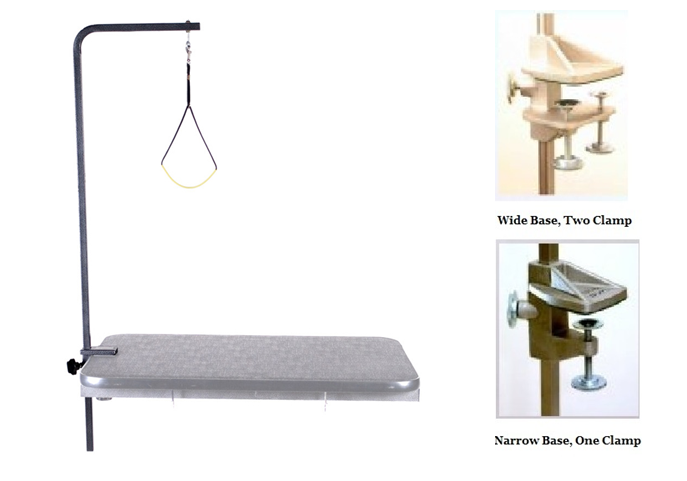
This is the industry standard.
In saying that, I mean that this is the grooming arm I see used most frequently because of its low cost, convenience, and ease of use.
The first reason, low cost, is the primary reason this particular type of grooming arm is so popular for both home and commercial use. It became the standard because it is cheap and it works well enough often enough. That is not the same as saying every version of it is good.
These arms are simple. They are nothing more than a piece of tubular metal bent on a 90-degree angle with an attachment point for a groomer’s noose, sling, or loop.
To attach it to the table, there is a base that consists of a simple clamping mechanism with a turn handle. The clamp slides over the lip of the table and allows you to tighten it to the table. The upper arm then slides through the center of the base so that it may be adjusted to the desired height and locked into position.
That is the whole tool. Simple. Cheap. Useful. And, depending on which one you buy, either perfectly acceptable or flimsy enough that a determined dog can turn it into modern art.
⚠️
Operator rule
Standard does not mean strong. It only means common. The cheap free arm that came with a table may look like the good one, but tubing size, metal quality, clamp design, and base width decide whether it actually holds up.
🗺️
Use This Page Like a Basic Grooming Arm Buying Review
This is the common grooming arm everyone recognizes. The important part is knowing when the cheap version becomes the weak point.
🧰
What It Is
A simple 90-degree clamp-on grooming arm with one height adjustment and a loop attachment point.
💵
Why It Became Standard
Low cost, simplicity, convenience, table bundles, and enough usefulness for many routine grooming jobs.
🔩
Quality Differences
Stainless steel versus cheap pot metal, half-inch versus three-quarter-inch tubing, and clamp quality.
🧲
Clamp Base Matters
A narrow one-clamp base is more likely to twist, rotate, or loosen under dog stress.
🎣
The Bending Problem
Cheap arms bend like fishing rods, except they do not bounce back when the dog stops pulling.
⚖️
Lever and Fulcrum
The higher the arm goes, the more leverage the dog gets. Long grooming loops make it worse.
👀
Two Eyelets
Two top eyelets give better positioning options, belly strap use, and more control with wigglers.
❓
FAQ
Professional use, tubing size, clamp fit, large dogs, loop length, bending, and stainless versions.
🧰
What the Standard 90-Degree Grooming Arm Is
It is the simple clamp-on arm most people picture when they think of a grooming table arm.
These arms are simple and are nothing more than a piece of tubular metal bent on a 90-degree angle with an attachment point for a groomer’s noose, sling, or loop.
To attach it to the table, there is a base that consists of a simple clamping mechanism with a turn handle that slides over the lip of the table and allows you to tighten it to the table.
The upper arm then slides through the center of the base so that it may be adjusted to the desired height and locked into position.
That simple design is the reason this arm is everywhere. There are no complicated crossbars, no multiple posts, no overhead frame, no motor, no special setup. Clamp it on, slide the arm to the height you want, tighten it, attach the grooming loop, and go to work.
That simplicity is useful. It is also why people underestimate it. Because the arm looks simple, buyers often assume one arm is about the same as another. That is where they get into trouble.
📌
Product reality
This is basic restraint hardware. It does not need to be complicated, but it does need to be strong enough, clamped properly, and used with the right loop length.
💵
Why This Grooming Arm Became the Industry Standard
Low cost is the big reason, but convenience and simplicity helped it stay there.
The industry standard, in saying that I mean that it is the grooming arm I see used most frequently for its low cost, convenience, and ease of use.
The first reason, low cost, is the primary reason this particular type of grooming arm is so popular for both home and commercial use.
In many cases, this type of arm will be included for free with the purchase of a grooming table. That is a big part of why so many new groomers and new pet-care operators end up using one. It came in the box, so it becomes the arm.
There is nothing wrong with that if the arm is decent and the dog being groomed is appropriate for it. A good standard arm can be perfectly useful. It can handle a lot of normal grooming work without putting an overhead frame in the groomer’s way.
But the old adage of “you get what you pay for” comes into play. The fact that a grooming arm came free with a table does not mean it is the arm you should trust with every dog that comes through the door.
It became the standard because it is cheap and convenient. It should remain on your table only if it is also strong enough for the work.
🔩
Not All Standard Grooming Arms Are Equal
Two arms may look almost identical and still be very different in strength and durability.
As with many grooming products, while two items may look the same, there may be substantial differences in quality and durability.
Depending upon the manufacturer, some of these arms are constructed from tough stainless steel while others are made from cheaper pot metal.
Some are made from half-inch tubing while others are made from three-quarter-inch tubing. The latter is obviously stronger.
Some arms use better metal, thicker tubing, cleaner bends, stronger welds, better knobs, and a clamp that actually looks like it was designed to hold something. Others look fine from ten feet away and then behave like a wet noodle the first time a dog puts serious pressure on them.
This is why I do not judge grooming arms by shape alone. The shape is easy to copy. Strength is where the cheap versions expose themselves.
Swipe left/right to see the full table.
| Feature | Better Version | Cheap Version Problem |
|---|---|---|
| Metal | Stainless steel or strong coated/zinc-plated steel. | Cheap pot metal or vague mystery metal that bends too easily. |
| Tubing size | Three-quarter-inch or one-inch arm, depending on design and use. | Half-inch arms can bend under dogs that are not even gigantic. |
| Clamp base | Wide base, strong screw, good table contact, sometimes two tightening points. | Narrow one-point clamp twists or rotates when a dog stresses it. |
| Adjustment knob | Strong knob that locks height securely. | Cheap knob slips, strips, cracks, or never really tightens enough. |
| Table fit | Clamp actually fits the table edge and thickness. | Clamp barely grabs the table or does not work with odd table edges. |
⚠️
Cheap-arm warning
A grooming arm can look like the industry standard and still be junk. Look at the metal, tubing size, clamp design, and how securely it locks to the table.
🧲
The Clamp Base Matters More Than People Think
The arm is only as good as the clamp holding it to the table.
Some include two tightening clamps at the bottom and a wider base so it attaches to the table more securely.
Some only have one clamp and a narrow attachment point, making the arm more likely to twist or rotate when an animal puts stress on it.
That twisting matters. A grooming arm does not have to snap in half to become a problem. If the clamp rotates, loosens, slides, or shifts under load, the dog moves, the groomer loses control, and now everyone is trying to manage a dog that just learned the table hardware is negotiable.
A wider clamp base spreads the load better and gives the arm more resistance to twisting. Two tightening points can help the clamp hold the table lip more securely. A better clamp also protects the table edge instead of chewing it up every time you tighten it.
This is especially important on cheap tables, odd-edged tables, tables with folded metal lips, tables with thick tops, and tables where the edge was never designed to accept serious clamp pressure in the first place.
📌
Clamp reality
A strong arm in a weak clamp setup is still a weak restraint system. The clamp has to fit the table, grip securely, and resist twisting when the dog loads the arm.
🎣
The Bending Problem
Cheap arms do not always fail dramatically. Sometimes they just bend and become useless.
As for the half-inch version, I have seen the weight of a Basset Hound or Border Collie bend these.
Imagine a fishing rod bending under the weight of a large fish.
The difference is that grooming arms do not bounce back into place when the weight is removed. They tend to stay bent.
That is the part people do not think about. A cheap arm may not break. It may not throw sparks. It may not make some dramatic snapping sound. It just bends.
Now the grooming arm no longer slides cleanly through the base. It no longer adjusts smoothly. It may not sit straight. It may bind. It may scrape. It may be a permanent reminder that the free arm that came with the table was not really free after all.
To add insult to injury, repairing these arms by bending them back tends to crease them, which in turn makes it impossible for the arm to slide freely up and down through the base.
So now you have bent grooming hardware and a lesson you bought with annoyance.
⚠️
Bending warning
The arm bends like a fishing rod, except this fishing rod does not spring back. It stays bent, and now you own bent grooming hardware.
⚖️
The Lever and Fulcrum Problem
The higher the arm is positioned, the more leverage the dog gets against it.
Depending upon the quality of construction, these grooming arms can be used with any dog, large or small.
The important thing to remember is that the larger the dog, the further up, or higher, the grooming arm must be positioned.
In order to understand why this matters, you must think of the arm in terms of a lever and fulcrum.
The higher the arm, which is the lever, the lower the base, which is the fulcrum, will be on the arm. That creates leverage.
This leverage can then be used to bend the arm regardless of how well it is constructed.
This is one of those simple physics problems that becomes very obvious once a dog demonstrates it for you. The dog does not know it is doing mechanical engineering. The dog is just leaning, pulling, sitting, backing up, or fighting the loop. But the arm feels all of that as force.
If you have a solidly constructed grooming arm and a proper-length grooming loop, this is typically not an issue.
However, many groomers use a noose that is way too long, which requires the arm to be lifted much higher than it should be in order to secure the dog.
Now the arm is high, the dog has more leverage, the base becomes the fulcrum point, and the groomer has accidentally made the arm easier to bend.
Swipe left/right to see the full table.
| Setup Choice | What Happens | Operator Meaning |
|---|---|---|
| Arm kept at reasonable height | Less leverage against the arm. | Better for arm life and table control. |
| Arm raised too high | Dog has more leverage to bend or twist the arm. | Long loops often create this problem. |
| Proper loop length | Dog can be secured without raising the arm excessively. | Good loop fit protects both dog control and hardware. |
| Noose too long | Groomer raises arm higher to compensate. | This increases leverage and makes bending more likely. |
| Large dog on weak arm | Arm may bend, clamp may rotate, or setup may shift. | Cheap hardware becomes the weak point. |
🪢
The Simple Noose-Length Trick
Do not raise the arm too high just because the grooming loop is too long.
One trick is to, instead of raising the arm, just loop the noose over the top of the arm once to shorten its length.
That is a small thing, but it matters.
If the loop is too long, the lazy solution is to raise the grooming arm higher. But as we just covered, raising the arm higher increases leverage. That gives the dog more mechanical advantage against the arm.
Looping the noose over the top of the arm once shortens the working length without forcing the whole arm higher. That can keep the dog better positioned while reducing unnecessary stress on the arm.
Obviously, this still has to be done safely. The loop should not choke, hang, twist, trap, or over-restrain the dog. The point is not to rig nonsense. The point is to avoid raising the arm to the moon because the loop is too long.
📌
Practical trick
Shorten the loop before you raise the arm too high. A proper-length loop protects control, dog safety, groomer workflow, and the arm itself.
👀
Why I Prefer Two Eyelets on the Top
One eyelet works. Two gives you more positioning options.
Some variations you will encounter include multiple eyelets on the upper portion.
I prefer two eyelets on top so as to facilitate the use of a belly strap for dogs that like to sit.
It also allows you to position the head closer to or farther away from the bar if you have a wiggler.
That extra eyelet may not sound like much, but it gives the groomer more ways to manage body position without adding an entire overhead grooming arm to the table.
For dogs that sit, lean, wiggle, rotate, or keep trying to turn themselves into a comma, the second eyelet can make the basic arm more versatile.
It does not turn a standard arm into an overhead restraint system, and it does not replace good handling, but it gives the groomer more options than a single fixed attachment point.
Swipe left/right to see the full table.
| Eyelet Setup | What It Allows | Operator Take |
|---|---|---|
| One eyelet | Basic loop attachment. | Fine for many calm, routine grooming jobs. |
| Two eyelets | Better head positioning and belly strap options. | My preference for a standard arm. |
| Multiple eyelets | More attachment flexibility. | Useful if placed well; annoying if they become cord and loop traps. |
| Belly strap use | Helps discourage sitting. | Valuable for dogs that collapse into “nope” mode during grooming. |
| Head position control | Lets the groomer place the head closer to or farther from the bar. | Helpful with wigglers and dogs that need better positioning. |
💵
Current Price and Buying Reality
This is still one of the cheaper pieces of grooming hardware, but the spread is wider now.
As of 2017, these could be acquired for as low as free with the purchase of some tables up to around $100 for an independently purchased high-quality stainless version.
The current market is still generally in that same basic world at the low and middle end. Cheap or basic standard arms can still be found around $40 to $60. Better foldable, heavier, or one-inch arms often sit around $80 to $110. Higher-quality stainless or premium arm-and-clamp setups can push closer to $150 or more depending on brand, clamp, tubing, table fit, and design.
The price is not the whole point.
A $40 arm that fits your table, holds securely, and is used with appropriate dogs may be perfectly fine. A $100 arm that does not fit your table edge is not a bargain. A free arm that bends the first time a Basset Hound leans into it was not free. It was delayed annoyance.
Buy the arm based on the dogs, table, clamp fit, tubing size, metal quality, and daily use. Do not buy it only because it came in the box.
⚠️
Buying warning
The cheapest arm may be fine for light use. The cheapest arm is not automatically fine for commercial use, larger dogs, long loops, weak table edges, or groomers who need the hardware to survive actual work.
🐾
Where This Standard Arm Actually Fits
This arm makes sense when the dog, table, loop, clamp, and groomer expectations all match.
I like this type of grooming arm for routine grooming work where the animal is reasonably manageable and the arm is built well enough for the dog being groomed.
It is simple, open, easy to adjust, inexpensive, and does not put an overhead crossbar in the groomer’s way.
For small dogs, medium dogs, normal commercial use, home use, and many basic grooming-room setups, a good 90-degree clamp-on arm is perfectly reasonable.
The problems show up when owners treat every version of this arm as equal, use cheap half-inch tubing on stronger dogs, use long grooming loops that force the arm too high, clamp the arm to a weak table edge, or expect a single basic arm to do the work of a more serious restraint setup.
This is not an overhead arm. It is not a multi-point restraint system. It is not a miracle tool. It is the basic arm. When used correctly, it is useful. When bought cheaply and overloaded, it becomes the weak point.
Swipe left/right to see the full table.
| Situation | Fit | Operator Take |
|---|---|---|
| Small calm dogs | Usually a good fit. | Basic arm is often enough. |
| Routine commercial grooming | Good fit if arm and clamp are quality. | Do not use the cheapest version as your default commercial standard. |
| Medium dogs | Depends on tubing, clamp, table, and behavior. | Three-quarter-inch or stronger hardware matters. |
| Large dogs | Possible with a strong arm and proper setup. | Watch leverage, loop length, and clamp twist. |
| Dogs that sit constantly | Better with two eyelets or belly strap support. | One eyelet may not give enough positioning options. |
| Thrashing or unsafe dogs | Not the right answer by itself. | Do not expect a basic arm to solve a handling problem that should stop the groom. |
✅
Standard 90-Degree Grooming Arm Buying Checklist
Ask these questions before trusting the arm just because it looks like every other arm.
- Is the arm made from stainless steel, zinc-plated steel, coated steel, or cheap pot metal?
- Is the tubing half-inch, three-quarter-inch, one-inch, or something the seller conveniently avoids saying?
- Does the arm feel rigid, or does it flex before a dog is even attached?
- Does the clamp fit the actual thickness of your grooming table top?
- Does the clamp fit the actual shape of your table edge, including folded metal lips or odd commercial tops?
- Does the clamp have a wide enough base to resist twisting?
- Does it have one tightening point or two?
- Does the height adjustment lock securely?
- Does the arm slide smoothly up and down through the base?
- Does it have one eyelet, two eyelets, or multiple attachment points?
- Can you use a belly strap or no-sit support with the arm?
- Are you using the proper length grooming loop, or are you raising the arm too high to compensate for a loop that is too long?
- What size and temperament of dogs will actually be attached to this arm?
- Is this arm being used because it is the right hardware, or because it came free with the table?
✅
My Operator Verdict on the Standard 90-Degree Grooming Arm
It is common for a reason, but the cheap versions deserve suspicion.
I have no problem with the standard 90-degree grooming arm as a basic piece of grooming table hardware.
It is cheap, convenient, easy to understand, easy to store, easy to adjust, and useful for a lot of normal grooming work.
But I do have a problem with pretending all of them are the same.
Some are constructed from tough stainless steel. Some are cheaper pot metal. Some use half-inch tubing. Some use three-quarter-inch tubing or heavier. Some have a wide base and two tightening clamps. Some have one narrow clamp point and twist as soon as a dog leans wrong.
I have seen the weight of a Basset Hound or Border Collie bend the half-inch versions like a fishing rod. The problem is that grooming arms do not bounce back into place. They stay bent. Then if you try to bend them back, they crease, and then they no longer slide freely up and down through the base.
I also want groomers to understand the lever and fulcrum problem. The higher the arm is raised, the more leverage the dog has. Long grooming loops make this worse because they force the arm higher than it should be.
Use the right loop length. Buy the stronger arm. Make sure the clamp fits the table. Prefer two eyelets if you want belly strap and positioning options. Do not let the free arm that came with the table become the weak link in the whole grooming setup.
⚠️
Final take
The standard 90-degree grooming arm is a good basic tool when it is built well and used correctly. The cheap version is still shaped like a grooming arm, but that does not mean it should be trusted with every dog.
❓
Standard 90-Degree Grooming Arm FAQ for Pet Care Operators
Straight answers about basic clamp-on arms, tubing size, clamp quality, dog size, loop length, leverage, bending, and eyelets.
Is the standard 90-degree grooming arm good enough for professional use?
It can be, if it is well built, fits the table properly, and is used with appropriate dogs and proper loop length. A cheap arm that came free with a table may be fine for light use, but I would not automatically trust it as professional hardware without inspecting the metal, tubing, clamp, and adjustment mechanism.
Why is this type of grooming arm so common?
Low cost, convenience, and simplicity. It is easy to attach, easy to adjust, easy to understand, and often included with grooming tables. That is why it became common. That does not mean every version is strong.
Is half-inch tubing enough?
I do not like half-inch tubing for serious commercial use. I have seen dogs like Basset Hounds and Border Collies bend those arms. Three-quarter-inch or heavier tubing is generally a better choice, especially in a professional grooming room.
Why does the clamp base matter?
The clamp base is what holds the arm to the table. A narrow one-clamp base can twist or rotate when a dog stresses the arm. A wider base with better clamp contact and stronger tightening hardware is more stable.
Can this arm be used with large dogs?
Depending on construction quality, yes, but large dogs create more leverage because the arm usually has to be raised higher. That means the arm, clamp, loop length, and table edge all matter more.
Why does grooming loop length matter?
If the loop is too long, the groomer may raise the arm too high to secure the dog. That increases leverage against the arm and makes bending more likely. A proper-length loop is safer and easier on the hardware.
What is the loop-over-the-arm trick?
Instead of raising the arm too high because the noose is too long, you can loop the noose over the top of the arm once to shorten its working length. This can help keep the arm lower while still positioning the dog properly.
Why do bent arms become such a problem?
Once a grooming arm bends, it usually stays bent. If you try to bend it back, it can crease. Once creased, it may no longer slide smoothly up and down through the clamp base, which makes adjustment difficult or impossible.
Why do you prefer two eyelets?
Two eyelets give more positioning options. They make it easier to use a belly strap for dogs that sit, and they let you position the dog’s head closer to or farther away from the bar when dealing with wigglers.
What is the main lesson?
The standard 90-degree grooming arm is useful, common, and affordable, but standard does not mean automatically strong. Buy the stronger version, make sure the clamp fits your table, use the right loop length, and do not trust junk hardware just because it looks like the real thing.
🐾
Bottom Line: Standard Does Not Mean Strong
This is the common arm for a reason. Just do not buy or trust the weakest version of it.
The standard 90-degree one-adjustment grooming arm is the industry standard because it is cheap, convenient, easy to use, and often included with grooming tables.
It is a simple piece of tubular metal bent at a 90-degree angle with an attachment point for a grooming loop and a clamp base that tightens to the table.
That simplicity is the advantage. The problem is that two arms may look the same and be built very differently. Stainless steel beats cheap pot metal. Three-quarter-inch tubing beats half-inch tubing. A wide clamp base beats a narrow one. Two eyelets give more options than one.
I have seen cheap half-inch arms bend under dogs like Basset Hounds and Border Collies. They bend like fishing rods, but unlike fishing rods they do not bounce back. Try to bend them back and they may crease, which keeps them from sliding through the base properly.
The other major lesson is leverage. The higher you raise the arm, the more leverage the dog has. Long grooming loops make this worse. Use proper loop length, or shorten the loop intelligently instead of raising the arm too high.
This is good basic hardware when it is built well and used correctly. It is cheap trouble when the arm, clamp, loop, table, and dog are mismatched.