Grooming Tubs • Repurposed Tubs • DIY Bathing Stations • Horse Troughs • Stock Tanks • Professional Appearance • Grooming Room Safety
Comical / Repurposed Grooming Tubs: Horse Troughs, Pool Noodles, and the DIY Bathing Station Problem
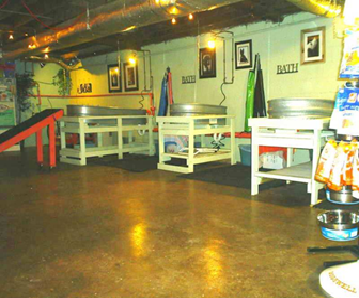
These are tubs for which I could find no other category to properly place them in.
They score points for originality, attempted cost saving, and making do-it-yourselfers the world over proud.
But I find no place for them in an upscale, classy, or professional-looking grooming shop.
A horse trough with a hole cut in it, a stock tank wrapped in 2x4s, or a round metal trough with pool noodle material stuck around the cut edge may technically hold water and a dog. That does not mean it belongs in a professional grooming room.
The problem is not only how strange these look. The problem is that they were not designed for grooming, often lack proper restraint points, require a pile of modification, and can make customers wonder where else the business cut corners for the sake of the almighty dollar.
⚠️
Operator rule
A repurposed tub may hold water, but a professional grooming tub also needs safe restraint points, proper drainage, cleanable surfaces, stable support, good access, and a finished appearance that does not scream “we saved money and you can tell.”
🗺️
Use This Page Like a DIY Tub Reality Check
Creativity is nice. A professional grooming room still needs purpose-built equipment or a very well-planned custom station.
🤡
What These Are
Horse troughs, stock tanks, plastic bins, farm-supply containers, and DIY tubs modified into bathing stations.
👀
Appearance Problem
Customers may not know tub specs, but they know when a bathing station looks like a farm-supply accident.
🦺
Safety Features
Repurposed containers often lack proper restraint eyelets, safe entry, finished edges, and dog-handling design.
💵
False Savings
Once you frame it, cut it, drain it, ramp it, pad it, and modify it, the savings may not be real.
🧽
Cleaning and Finish
Purpose-built tubs are designed for wet work. Repurposed tubs often create seams, wood, edges, and cleaning headaches.
✅
Operator Verdict
I understand the DIY instinct. I do not think these belong in a professional-looking grooming shop.
🖼️
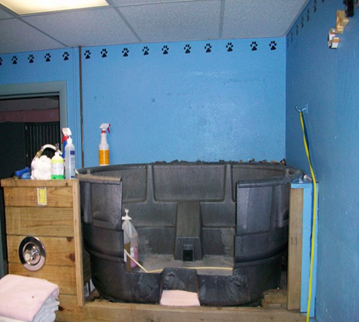
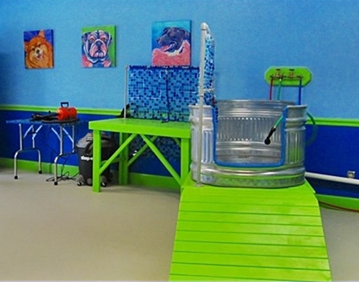
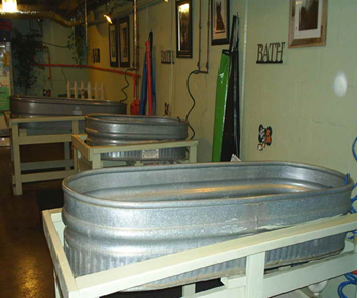
Repurposed Grooming Tub Examples
These examples show the kind of DIY tub conversions that may be creative, but do not look like purpose-built professional grooming equipment.
🤡
What I Mean by Comical / Repurposed Grooming Tubs
These are tubs that started life as something else and got drafted into dog bathing duty.
This category includes the tubs I could not place anywhere else.
We are talking about horse troughs, stock tanks, black plastic livestock containers, round metal water tanks, and straight troughs surrounded by 2x4s and modified into something that technically functions as a dog bathing station.
One version might be a black plastic trough with a chunk cut out of it. Another might be a small round metal trough with an angled opening cut into the side and pool noodle material wrapped around the edge to keep it from being sharp.
Another version is the classic straight horse trough surrounded and framed with lumber, which is the ultimate “I wanted to save a buck and I own a saw” version of grooming tubs.
I understand the impulse. People are trying to save money, use what they have, make something work, and avoid paying for purpose-built equipment.
But in a professional grooming room, “it holds water” is not enough of a qualification.
👀
The Appearance Problem
A grooming tub is big, visible, and hard to hide once it looks improvised.
While these repurposed tubs score points for originality and attempted cost saving, I find no place for them in an upscale, classy, or professional-looking grooming shop.
Maybe I am the exception, but I would find a shop that uses a horse trough to bathe dogs somewhat suspect.
I would wonder what other areas they chose to cut corners in for the sake of the almighty dollar.
That may sound harsh, but customer perception matters.
Customers do not need to know stainless gauge thickness, fiberglass layup quality, or plumbing layout to understand when something looks hacked together.
A clean stainless tub, a well-built custom bathing station, or a properly installed fiberglass setup tells the customer the bathing area was planned.
A trough with a hole cut in it tells a different story.
⚠️
Customer perception warning
The dog may not care whether the tub started life in a barn aisle. The owner standing in your lobby might.
🦺
These Items Were Not Designed for Grooming Safety
A purpose-built grooming tub is more than a container that holds water.
These repurposed items were by no means designed for grooming use.
They often lack key safety features such as properly placed eyelets or restraint points to secure dogs.
They may also lack safe entry design, predictable footing, proper edges, reinforced attachment points, good drainage, cleanable seams, wall protection, and a tub shape meant for bathers to work around live animals.
A horse trough is designed to hold water for livestock. That is not the same thing as safely bathing a wet, nervous, slippery, possibly large dog while a bather leans over it with shampoo, sprayers, loops, towels, and a wet floor.
When you start cutting openings, padding edges with foam, adding homemade ramps, drilling drains, and bolting on restraints, you are inventing a grooming tub from scratch.
At that point, the question becomes obvious: why not buy a tub actually designed for this job?
Swipe left/right to see the full table.
| DIY Tub Issue | Why It Matters | Purpose-Built Tub Advantage |
|---|---|---|
| Missing restraint eyelets | Dogs need safe, predictable restraint points during bathing. | Grooming tubs usually include planned eyelets or restraint locations. |
| Cut openings | Edges can become sharp, awkward, weak, or hard to finish cleanly. | Entry doors and openings are designed into the tub structure. |
| Improvised padding | Foam, pool noodles, and taped edges can look bad and trap grime. | Professional tubs use finished edges, doors, and safer contact surfaces. |
| Homemade ramps | Ramp angle, traction, stability, and storage can become problems. | Commercial ramp systems are at least designed for tub access. |
| Homemade drains | Poor drain cutting or sealing can leak, clog, or create cleaning issues. | Grooming tubs are built around intended drainage and plumbing points. |
| Wood framing | Wood around wet grooming areas can swell, rot, trap hair, and look rough. | Proper surrounds use materials and finishes planned for wet work. |
💵
The False Savings Problem
Cheap starts getting less cheap once the modification pile begins.
When you think about the time and materials spent modifying these items, I doubt much is saved over buying a tub actually intended for a pet grooming shop.
You may need to build a frame, build a wooden ramp, cut out an opening, smooth or pad the edge, cut in a drain, seal the drain, add restraint points, reinforce the structure, stabilize the tub, create wall protection, and figure out how to keep the whole thing clean.
Then you still have a repurposed trough trying to cosplay as a grooming tub.
DIY can save money when the finished product is safe, durable, cleanable, professional-looking, and genuinely cheaper after time and materials.
But if the finished product looks strange, lacks safety features, creates cleaning problems, and still requires a pile of work, the savings are not as impressive as they looked on day one.
📌
Cost reality
The tub is not cheap if it costs time, materials, safety, professional appearance, cleaning efficiency, customer confidence, and future rework.
🧽
Cleaning, Finish, and Wet-Room Reality
Grooming tubs live in water, hair, shampoo, sludge, and constant cleaning.
A grooming tub needs to be cleanable.
That sounds obvious until someone surrounds a livestock trough with lumber, cuts openings into it, pads edges with foam, and creates a collection of seams, crevices, fasteners, raw cuts, and odd surfaces that were never meant for salon cleaning.
Grooming tubs collect hair, shampoo, conditioner, dirt, ear cleaner, nail dust, wet towels, dog slobber, and whatever else the dog brought in from its personal ecosystem.
That equipment must be easy to rinse, scrub, disinfect, inspect, and maintain.
Repurposed tubs often fail the clean-finished-equipment test. Even when they function, they rarely look as clean and professional as a properly installed tub designed specifically for grooming pets.
⚠️
Wet-room warning
Wood framing, foam padding, rough cuts, and improvised seams do not get prettier after months of wet dogs, hair, shampoo, and cleaning chemicals.
✅
When a Repurposed Tub Might Make Sense
There are narrow situations where “make something work” is understandable.
I can understand a repurposed tub in a barn, rescue wash area, temporary setup, private kennel, farm environment, or personal-use space where appearance does not matter and the use case is limited.
I can also understand someone experimenting when money is tight and the setup is not customer-facing.
But that is different from using one as the main bathing station in a professional grooming shop trying to present itself as clean, polished, safe, and worth paying for.
A business can be scrappy without looking cheap.
A customer-facing grooming room needs a higher standard than “it drains and the dog fits.”
🚫
When I Would Not Use One
Customer-facing professional grooming rooms are not where I want farm equipment pretending to be salon equipment.
I would not use a repurposed horse trough, stock tank, or DIY tub conversion in an upscale grooming salon.
I would not use one in a customer-visible bathing room where the business is trying to look professional.
I would not use one if proper restraint points, safe entry, drainage, edge finishing, cleaning, and stability have to be invented after the fact.
I would not use one if the finished result makes the shop look like it saved money in the most visible way possible.
A grooming tub is too large and too central to hide bad judgment.
✅
My Operator Verdict on Comical / Repurposed Grooming Tubs
I respect the creativity. I do not want it in a professional-looking grooming shop.
My verdict is that these repurposed tubs do not belong in a polished professional grooming room.
They may be original. They may be cheap at first glance. They may make DIY people proud.
But they look strange, were not designed for grooming, often lack key safety features, and usually require enough modification that the savings become questionable.
By the time you build a frame, cut an opening, add a drain, pad the edges, create a ramp, add restraint points, stabilize the whole thing, and make it presentable, you may have spent a lot of time and money to still own something that looks like a modified horse trough.
No matter how functional these items may be, they will never look as clean and professional as a properly installed tub designed specifically for grooming pets.
For a real grooming business, buy a real grooming tub or build a real custom bathing station.
⚠️
Final take
A repurposed trough may be clever. A professional bathing station should be safer, cleaner, better restrained, easier to maintain, and less likely to make customers wonder what else got built from leftovers.
❓
Comical / Repurposed Grooming Tub FAQ
Straight answers about horse trough tubs, stock tank conversions, DIY bathing stations, safety, and professional appearance.
What is a repurposed grooming tub?
It is a tub or container originally designed for another purpose, such as a horse trough or stock tank, modified to act like a dog grooming tub.
Why call these “comical” grooming tubs?
Because some of the conversions are creative enough to be memorable, but strange enough that they do not fit cleanly into professional tub categories.
Are repurposed tubs always unsafe?
Not automatically, but they often lack purpose-built grooming safety features such as proper restraint eyelets, safe entry points, finished edges, predictable drainage, and stable support.
Do horse troughs make good grooming tubs?
I would not use one in a professional-looking grooming shop. A horse trough may hold water, but it was not designed as a grooming workstation.
What is the biggest problem with DIY grooming tubs?
The biggest problem is that once you add framing, ramps, drains, edge protection, restraint points, and cleaning accommodations, the savings may not be real anymore.
Why does appearance matter?
The bathing station is large and visible. Customers may not know equipment specs, but they notice when a tub looks improvised, cheap, or out of place.
When might a repurposed tub make sense?
It may make sense in a private, temporary, barn, rescue, or non-customer-facing wash area where appearance and professional presentation are not the priority.
What should a professional shop use instead?
A professional shop should usually use a stainless steel grooming tub, fiberglass tub, or properly planned custom bathing station designed for grooming use.
What is the main lesson?
Do not confuse creativity with professional design. A grooming tub needs safety, restraint, drainage, cleanability, durability, and a finished appearance.
🐾
Bottom Line: Clever Is Not the Same as Professional
A grooming business should not look like the bathing station was assembled from whatever was leaning behind the shed.
Repurposed grooming tubs may be creative, but they usually do not belong in a professional grooming shop.
They often look strange, lack proper safety features, require a pile of modification, and rarely look as clean or professional as a tub designed for grooming pets.
The supposed savings can disappear quickly once you account for framing, ramps, cutting, drains, padding, restraint points, sealing, cleaning, and time.
For a private wash area, maybe. For an upscale or professional customer-facing grooming room, no.
Buy a real grooming tub or build a real custom bathing station. Do not let the main wet-work station look like a livestock container with a side hustle.