Dog Grooming • Automatic Shampoo Machines • Vacuum Draw • Venturi Injectors • Bathing Systems • Product Control • Grooming Room Plumbing
Vacuum Draw Shampoo Machines: Venturi Injectors, Weak Suction, Plumbing Headaches, and Real Product Savings
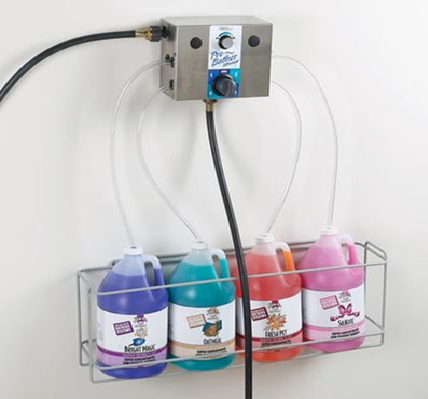
Although quite a bit more wordy, it would be more accurate to call this class of machines “Venturi draw downstream shampoo injectors.”
That sounds like something someone would say while wearing safety glasses and trying to justify a thousand-dollar plastic box, so most people just call them vacuum draw shampoo machines.
In operation, these machines function much like the chemical injector you would find on a household or commercial pressure washer. Water moves through the machine, creates suction, draws shampoo or conditioner through a supply line, mixes it with clean water, and sends the mixed bathing solution out through the hose.
That mixed stream is the reason the machine matters. It wets the coat and delivers diluted shampoo at the same time, which can save a busy grooming shop real labor and real product cost.
I do recommend these machines. In fact, for a busy fixed grooming room, this is the direction I generally prefer. But I am not going to pretend they are magic, plug-and-play, perfectly engineered, or priced like the simple machine they actually are.
⚠️
Operator rule
A vacuum draw shampoo machine can save a bunch of money when used correctly. It can also become annoying fast if the suction is weak, the product is too thick, the plumbing is wrong, the hose has the wrong nozzle, or the thing is mounted to drywall like a decorative picture frame.
🗺️
Use This Page Like a Vacuum Draw Shampoo Machine Reality Check
These machines can save product and labor, but they need correct dilution, plumbing, mounting, product placement, and staff understanding.
💧
How They Work
A Venturi-style injector uses water velocity and pressure difference to draw shampoo into the water stream.
💵
Product Savings
The machine helps control expensive shampoo use instead of letting staff empty five-gallon buckets one sloppy squeeze at a time.
🧴
Shampoo Dilution Trap
Weak suction means thick shampoos may need heavy dilution, and machine-specific shampoo can quietly steal the savings back.
🔧
Plumbing Problems
Bad installation can eliminate normal faucet use, prevent proper rinsing, and cause backflow into product bottles.
🧱
Mounting Reality
Drywall anchors are not enough when dogs, hoses, bathers, water, and panic all share the same tub space.
✅
Operator Verdict
I recommend them for busy shops, but only when the installation and product system are handled like serious equipment.
🖼️
Vacuum Draw Shampoo Machine Examples
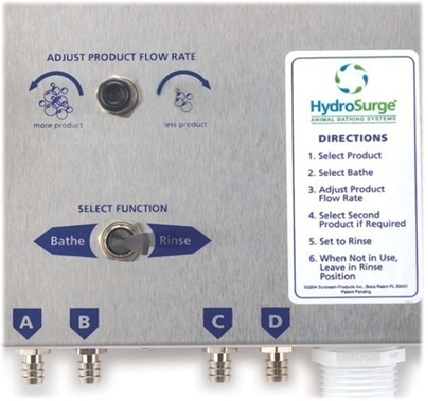
These examples show the wall-mounted type of shampoo machine commonly used in fixed grooming rooms.
💧
How Vacuum Draw Shampoo Machines Actually Work
The fancy explanation is Venturi injection. The simple explanation is water movement creates suction and pulls shampoo into the line.
This particular class of shampoo machine works by creating a vacuum that draws shampoo or conditioner through a supply line where it mixes with clean water and is then dispensed as a combined solution from the end of the hose.
Simply put, when the machine is operating, pressurized tap water from the building supply is pushed into the machine.
That water enters a constricted section of tubing containing an injector.
As the diameter of the tubing decreases, the velocity of the water flowing through it increases. That creates a vacuum that draws in the bathing or conditioning solution.
After passing through the constricted section, the now-mixed solution enters the exit hose. The hose diameter increases, creating a lower pressure side that helps the overall function of the system.
Although that sounds technical, the injector is basically a small valve with an adjustable flow rate for setting the desired shampoo-to-water ratio.
That is it. Water goes in. Pressure and velocity do their thing. Product gets pulled into the stream. Mixed solution comes out.
There is nothing especially magical happening behind the cover.
📌
Operator translation
A vacuum draw shampoo machine is basically a controlled product injector tied into the bathing water stream. It should make shampoo delivery faster, more consistent, and less wasteful.
🧠
The Venturi Effect Is Not New, and That Is Part of the Pricing Irritation
The design works. That does not mean I am impressed by how much some of these things cost.
There is nothing particularly novel or amazing about the design of these machines.
The Venturi effect has been known for a very long time and has been harnessed countless times for industrial, commercial, and household uses.
Anyone who has used a pressure washer chemical injector has already seen the basic concept in action.
Considering the simplicity of the design and the relatively small number of parts used in construction, the only amazing thing is how expensive some of these machines are relative to what appears to be inside the box.
I am not sitting in the manufacturer’s factory with a clipboard auditing their parts cost, so take this as operator opinion, not courtroom testimony.
But I would not be shocked if the manufacturing cost of some of these units was a fraction of the retail price. Not a bad profit margin if you can get it.
A handy DIY person could probably create a functioning version of the same general concept with parts from a local home improvement store. It would not look as pretty, it would not have the same product selector, and it would not have the nice commercial housing, but the basic physics are not some secret shampoo-machine wizardry.
That said, I am not arguing that every grooming shop should go play plumber, engineer, and liability test dummy.
The commercial unit gives you a cleaner setup, product selection, a finished wall-mounted package, and a system that staff can understand. That has value.
I just want owners to understand what they are buying: a simple injection system packaged for grooming room use.
💵
Where These Machines Make Their Money: Product Control
A busy grooming room can waste a shocking amount of shampoo one careless squeeze at a time.
The real reason I recommend these machines is product control.
A grooming salon is not usually buying shampoo in cute little consumer bottles. A real grooming room is buying gallons, cases, and often five-gallon buckets.
Depending on the product, those buckets can cost real money. Basic shampoo is one thing. Specialty, medicated, degreasing, coat-specific, brightening, hypoallergenic, or premium products can get expensive fast.
The problem is not only the price of the bucket. The problem is the way product gets handled in a busy room.
Staff scoop product out of buckets. Product drips down the side. Product sticks to the scoop. Product gets poured into smaller bottles. Bottles get overfilled. Bottles fall over. Staff squeeze too much because more shampoo feels like more cleaning, even when it is really just expensive foam and wasted rinse time.
One bather wasting a little product on one dog is not the end of the world.
A room bathing twenty, thirty, forty, or fifty dogs a day with multiple people using product by feel can quietly turn shampoo waste into a real expense.
A vacuum draw machine helps because product use becomes more controlled. The machine dilutes and delivers product through the water stream. The bather is not standing there drowning the dog in shampoo like they are putting ketchup on a hot dog at the ballpark.
This is where the savings come from: less overuse, less bottle waste, less transfer waste, better dilution, faster coverage, and less product disappearing through sloppy habits.
The machine does not remove the need for staff training. It just makes product use harder to abuse.
📌
Product-control rule
The machine is not only about speed. It is about stopping expensive grooming product from being wasted through buckets, scoops, bottles, heavy hands, bad dilution, and “more shampoo must mean cleaner dog” thinking.
🧴
The Shampoo Dilution Trap
The machine works, but the suction is often weaker than the sales photo makes you want to believe.
It has been my experience that these machines work, but they do not work quite as well as many people expect.
That is not to say I do not recommend them. I do. In fact, I highly recommend them for any busy grooming shop interested in saving money by cutting material waste.
The primary issue is that the vacuum created by these machines is actually quite weak.
As a result, shampoos and conditioners often need to be severely diluted before they will draw into the machine reliably.
The other option is to purchase machine-specific shampoo from the manufacturer, and that is where the math can get ugly.
The issue is that machine-specific shampoos and conditioners may be diluted gallons sold at the same price as undiluted gallons from another shampoo company.
For example, you may buy a gallon of machine-specific shampoo at a price that feels normal for a gallon, but what you actually receive is one gallon ready for machine use.
From experience, I know a busy shop can go through a lot of product in a week. If the shop is running through ten or fifteen gallons of machine-ready product weekly, the cost can start eating the savings the machine was supposed to create.
Alternatively, you can buy a regular undiluted grooming shampoo and dilute it yourself. If that shampoo dilutes eight-to-one, one gallon of concentrate can create many gallons of usable product for the machine.
That is the difference between buying controlled product and buying convenience at a markup.
⚠️
Cost warning
Do not let machine-specific shampoo quietly cancel out the savings. Run the cost per usable gallon, not the cost per jug sitting on the shelf.
⬆️
Bottle Placement Matters More Than the Advertising Photos Admit
If the suction is weak, gravity becomes your assistant manager.
Another issue I have found is that the advertising pictures often show the supply bottles placed below the machine.
That looks neat in a product photo.
In real use, because the suction is not especially strong, the machines often work better and provide a more reliable supply of product when the bottles are placed above the machine.
That allows gravity and the siphon effect to provide some assistance.
It is not glamorous, but it works.
The machine may technically be designed to draw from below, but technical design and real grooming room behavior are not always the same animal.
If the machine is struggling to pull product, the first thing I want to look at is dilution and bottle placement.
📌
Operator trick
When suction is weak, try placing the supply bottles above the machine so gravity helps feed the product. Pretty is nice. Reliable product draw is nicer.
🪣
Feeding the Machine Straight From Five-Gallon Buckets
The product photo shows little bottles. A real busy grooming room may need a better plan than constantly refilling little bottles all day.
One thing I did that worked very well was design the setup so the vacuum draw machine could draw straight from five-gallon buckets instead of small shampoo bottles.
In my setup, I had two grooming tubs with the vacuum draw shampoo machine mounted on the wall between them.
On the backside of that same wall, I had a heavy-duty shelf built into the wall. It was not some flimsy decorative shelf from the home aisle. It was a real shelf meant to hold heavy product buckets without sagging, wobbling, or eventually becoming part of the floor.
The shelf was positioned so that when the five-gallon buckets were sitting on it, the product level was roughly even with the shampoo machine. That matters because these machines do not always have impressive suction.
By getting the buckets up high and behind the wall, the machine had a much easier time drawing product. Gravity and the siphon effect helped the machine instead of making the weak little vacuum do all the work by itself.
This also kept the buckets out of the customer-facing side of the grooming room.
Customers do not need to see a row of five-gallon shampoo buckets, product lines, caps, hoses, and whatever other wet-room reality is happening behind the scenes. They need to see a clean tub area and a professional setup. The ugly useful stuff can live behind the wall where it belongs.
This kind of setup also reduces bottle refilling. Instead of staff constantly scooping, pouring, dripping, overfilling, knocking bottles over, and wasting product during transfer, the machine can pull from bulk containers directly.
That is a big deal in a high-volume room.
A five-gallon bucket setup is not always possible. It depends on the wall, the room layout, shelf placement, product storage, hose routing, and whether you have access to the backside of the wall.
But if you are building the room from scratch or still have the chance to plan the tub wall, this is the kind of thing worth thinking about before everything is finished and painted.
The advertising picture may show little bottles sitting neatly under the unit. Fine. That works. But with the right build-out, these machines can absolutely draw from five-gallon buckets. I have done it.
📌
Operator build-out trick
If you can place five-gallon product buckets on a heavy-duty shelf behind the tub wall at roughly machine height, the vacuum draw machine may draw more reliably, staff refill less often, product transfer waste drops, and the customer-facing grooming room stays cleaner.
⚠️
Build it like it is holding weight
Five-gallon buckets are heavy. Do not put them on a weak shelf, cheap bracket, loose board, or anything that will fail once it gets wet, bumped, overloaded, or ignored. Build the shelf like it belongs in a working grooming room.
🔧
Installation Is Where These Machines Start Making People Mad
The product photo shows the finished machine. It usually does not show the plumbing argument.
Another major issue is installation.
Advertising images always show the finished product installed nice and clean on the wall, but these units are not necessarily plug-and-play.
In most instances, the existing plumbing will need modification to provide supply water for the machine.
The way these are commonly installed eliminates the ability to run straight water from the faucet without sending it through the shampoo machine first.
Why? Because the hose for the machine water supply is screwed onto the faucet.
I find that disadvantageous.
A grooming tub still needs normal water access. You need to rinse dogs. You need to rinse tubs. You need to clean equipment. You may need to fill bottles, buckets, dog bowls, or containers. You may want a high-pressure sprayer. You may want a nozzle with an automatic shutoff.
You do not want every water need in the tub area chained to the shampoo machine.
A vacuum draw machine depends on the pressure downstream of the injector being lower than the pressure upstream of the injector.
That means you cannot use just any sprayer or nozzle on the machine hose, especially anything that increases pressure or has a shutoff like a garden spray nozzle.
If downstream pressure increases, one of two things can happen.
First, the injector may stop injecting shampoo because the Venturi effect has been neutralized.
Second, water can backflow through the injector and into the supply lines, which can send water into the shampoo bottles and overflow product all over the floor.
That is one of those problems that feels stupid because it is stupid, but it is also how the machine works.
⚠️
Nozzle warning
Do not assume you can slap a normal shutoff sprayer or pressure-increasing nozzle on the machine hose. If it changes downstream pressure, it can stop injection or force water backward into the product lines.
🚿
My Preferred Plumbing Approach
Keep normal water available. Do not make the shampoo machine the gatekeeper for every drop.
When I install these units, I always try to “T” into the tub water supply line before the actual tub fixture.
This allows you to have regular on-demand water without forcing it through the shampoo machine first.
That way you can still rinse the tub or other items using a high-pressure sprayer, use an automatic shutoff, run straight water, fill shampoo bottles, fill dog bowls, or do whatever normal tub work needs to happen without passing everything through the machine.
This matters because the machine’s rinse pressure can be disappointing, especially on long-coated dogs.
If you preserve an alternative water supply, you can soap the dog quickly through the machine and then rinse properly through a separate high-pressure sprayer or normal tub fixture.
That gives you the best of both worlds: fast product application from the shampoo machine and proper rinse power from a separate water path.
A shampoo machine should support the tub. It should not take the tub hostage.
📌
Operator plumbing rule
Keep a separate normal water supply whenever possible. Shampoo-machine water is for shampoo-machine work. The tub still needs real water access.
🧱
Mounting Reality: Drywall Anchors Are Not a Grooming Room Plan
The installation sheet may be optimistic. Dogs are not.
Contrary to some installation instructions, mounting can be another headache.
The documentation may say you need only drill two small holes, add drywall anchors, and attach the mounting plate.
The reality is that this may last two months or two days before the machine gets jerked off the wall by a dog trying to flee the scene, or by a person or animal getting tangled in the hose.
Truthfully, the machine should be securely mounted into a wall stud, onto a concrete wall, or onto a scab board attached to wall studs.
The availability of a suitable anchor point may limit where the machine can actually be installed.
That is annoying, but it is better to be annoyed during installation than to have a shampoo machine hanging by a hose while a wet dog and a bather both look at it like they just witnessed a crime.
Grooming rooms are abusive environments. Hoses get pulled. Dogs jump. Staff rush. Water gets everywhere. Equipment gets bumped. If the machine is not mounted like it belongs in a working room, the room will eventually vote on that installation.
⚠️
Mounting warning
Mount into structure. Studs, concrete, or a properly attached backing board. Do not trust light anchors in a wet room full of hoses and animals trying to leave bath day behind.
✅
Where Vacuum Draw Machines Shine
Once installed correctly, this machine can save a ton of time and money.
Onto the positive.
This machine can save you a ton of time and money.
It also adds a considerable amount of convenience because switching from one product to the next is usually as simple as turning a knob.
That is a big deal in a real grooming room.
One dog may need basic shampoo. Another may need hypoallergenic. Another may need conditioner. Another may need degreasing. Another may need a coat-specific product. Nobody wants to stop the tub flow every time and play bottle shuffle while the wet dog is standing there plotting escape.
This machine mixes shampoo and water before it exits the hose, which makes soaping a dog fast and relatively painless regardless of how thick the coat may be.
Once the dog is soaped up, the bather can scrub, switch the knob, and rinse.
The rinse pressure from the machine itself can be somewhat disappointing, especially for long-coated dogs.
But if you followed the better plumbing approach and left an alternative water supply, that problem becomes much easier to handle because you can rinse with a stronger dedicated sprayer.
That is the setup I like: machine for product application, separate proper water supply for real rinsing and tub work.
📌
Best-use pattern
Use the vacuum draw machine to apply diluted shampoo quickly and consistently. Keep a separate rinse path so the bather is not stuck trying to rinse a long-coated dog through disappointing machine pressure.
💰
Cost Reality: Not Cheap, Still Usually Worth It
The initial purchase can sting, but waste and labor have their own price tag.
These units are not cheap.
New commercial vacuum draw shampoo machines can easily land around the thousand-dollar neighborhood or higher depending on brand, options, product-selection capacity, and where you buy them.
Used units may be available for less, and sometimes new units show up discounted through secondary marketplaces, but the general point remains the same: this is an investment, not a twenty-dollar bath toy.
The price is irritating when you understand how simple the basic mechanism is.
But the question is not whether the machine feels overpriced compared to the parts inside the box. The question is whether it saves enough product and labor in your room to justify the purchase.
In a busy grooming room, it usually can.
Product waste, extra bath time, poor dilution, staff inconsistency, bottle refills, and inefficient coat penetration all cost money. They just do it quietly.
A vacuum draw machine makes that waste harder to hide.
In my opinion, this machine should be considered an investment and a necessary piece of equipment for most grooming shops once there is enough bathing volume to justify it.
⚖️
Vacuum Draw Machine Strengths and Weak Spots
This is the good, the bad, and the “you should have planned that before drilling holes.”
Swipe left/right to see the full table.
| Issue | What Works | What Goes Wrong | Operator Move |
|---|---|---|---|
| Product delivery | Mixes water and shampoo before it exits the hose. | Thick products may not draw unless heavily diluted. | Use proper dilution and test draw reliability before depending on the setup. |
| Product savings | Controls dilution and reduces overuse. | Machine-specific shampoo can erase savings if overpriced or already diluted. | Compare cost per usable gallon, not cost per jug. |
| Bottle placement | Can draw from supply bottles through product lines. | Weak suction may struggle when bottles sit below the unit. | Place bottles above the machine if gravity helps draw. |
| Plumbing | Can tie into building water supply for continuous use. | Bad install can eliminate normal faucet use and create rinse problems. | Preserve a separate normal water supply when possible. |
| Nozzle use | Works when downstream pressure stays compatible with injection. | Shutoff or pressure-increasing nozzles can stop injection or cause backflow. | Do not use incompatible sprayers on the machine hose. |
| Mounting | Wall-mounted units save space and keep controls accessible. | Weak anchors can pull loose under hose or dog pressure. | Mount into studs, concrete, or a structural backing board. |
| Rinsing | Can switch away from product and run water. | Rinse pressure may disappoint on long coats. | Keep a separate high-pressure rinse option. |
✅
Vacuum Draw Shampoo Machine Buying Checklist
Before buying, make the machine survive these questions.
- How many product selections does the machine provide, and does that match the way the shop actually bathes dogs?
- Does the machine require machine-specific shampoo, or can regular grooming shampoo be diluted and used economically?
- How thick are the shampoos and conditioners you plan to use, and will the machine draw them reliably?
- Can supply bottles be placed high enough to help the draw if suction is weak?
- Will the installation preserve a normal water supply for rinsing, tub cleaning, filling containers, and general use?
- Is there a plan to “T” into the water line before the tub fixture instead of hijacking the faucet completely?
- Does the machine hose require a specific nozzle or open-flow setup to avoid killing the Venturi draw?
- Is there a separate high-pressure rinse sprayer for long-coated dogs?
- Where will the unit mount, and is that location tied into a stud, concrete, or proper backing board?
- Where will the product bottles sit so staff can access them without creating clutter or trip hazards?
- Can staff understand dilution, product draw, knob selection, rinse settings, and what not to put on the hose?
- Are replacement hoses, valves, injectors, fittings, selectors, and parts available without paying absurd branded-part markup?
- Can the machine be fed directly from five-gallon buckets instead of constantly refilling small bottles?
- Is there a backside wall, shelf, cabinet, utility space, or hidden product area where bulk shampoo buckets can sit at a useful draw height?
- Is any bucket shelf strong enough to hold full five-gallon containers without sagging, tipping, pulling loose, or becoming a wet-room disaster?
🚫
Common Vacuum Draw Shampoo Machine Mistakes
These machines do not usually fail because the concept is bad. They fail because the setup is bad.
Swipe left/right to see the full table.
| Mistake | Why It Hurts | Better Move |
|---|---|---|
| Assuming the machine will pull thick shampoo straight from the bottle | Weak suction may not draw heavy product reliably. | Dilute properly and test each product before relying on it. |
| Buying machine-specific shampoo without doing cost math | Diluted product sold at full-product pricing can erase savings. | Compare cost per usable gallon and consider diluting regular professional shampoo yourself. |
| Placing bottles below the machine when suction is weak | Product may draw poorly or inconsistently. | Place bottles above the machine when gravity improves reliability. |
| Assuming the machine has to draw from small bottles | Small bottles mean more refilling, more transfer waste, more dripping, more staff handling, and more chances for product to disappear before it ever touches a dog. | When the room layout allows it, feed the machine from five-gallon buckets placed on a strong backside shelf at a helpful draw height. |
| Letting the machine take over the only water supply | Rinsing, cleaning, filling, spraying, and normal tub use become annoying. | Preserve a separate normal water supply whenever possible. |
| Using a shutoff sprayer on the machine hose | Can neutralize the Venturi effect or cause backflow into product lines. | Use compatible hose and nozzle setup. |
| Mounting with weak drywall anchors | Dogs, hoses, and staff can rip the unit off the wall. | Mount into studs, concrete, or a proper structural backing board. |
| Expecting machine rinse pressure to handle every coat | Long-coated dogs may need stronger rinse pressure than the machine provides. | Keep a separate high-pressure rinse sprayer. |
| Treating the product selector like staff-proof magic | Staff can still choose the wrong product, wrong dilution, or wrong setting. | Label products clearly and train bathers on the system. |
🏪
When a Vacuum Draw Machine Makes the Most Sense
This is usually the fixed-shop machine, not the mobile “fill it and go” machine.
Vacuum draw machines make the most sense in fixed grooming rooms with regular bathing volume.
If the shop is bathing enough dogs that product waste, bottle refills, product switching, and bath speed matter every day, this kind of machine starts becoming very attractive.
It is also useful when the room uses multiple products and staff need to switch between them without dragging bottles around the tub like a wet chemistry set.
I like them better in busy shops than enclosed tank machines because the vacuum draw machine does not need to be refilled constantly when installed properly into the water supply.
That matters as volume increases.
A small shop may still benefit from one, but the payoff is more obvious when there are enough baths happening that saved product and saved minutes start stacking up.
For mobile groomers or very low-volume setups, enclosed or recirculating machines may make more sense depending on water availability, vehicle setup, budget, and workflow.
✅
My Operator Verdict on Vacuum Draw Shampoo Machines
I recommend them, but I recommend them with plumbing, mounting, dilution, and product-cost reality attached.
My verdict is that a vacuum draw shampoo machine should be considered an investment and, in my opinion, a necessary piece of equipment for most grooming shops with real bathing volume.
It can save a bunch of money over the course of a year when used properly.
It saves product by controlling dilution and reducing waste. It saves time by wetting and shampooing at the same time. It improves convenience by letting staff switch products with a knob instead of juggling bottles. It makes soaping thick-coated dogs faster and less annoying.
That is the good.
The bad is that the suction may be weaker than expected, thick products may need heavy dilution, machine-specific shampoo can wreck the savings, bottle placement matters, plumbing may need modification, shutoff nozzles can create problems, rinse pressure may disappoint, and the unit needs to be mounted like it belongs in a working wet room.
None of that makes the machine bad.
It just means the owner has to install and use it like an operator, not like someone hanging a towel rack.
If you install it correctly, preserve a separate water supply, mount it into structure, train staff on dilution and product selection, and avoid getting trapped into overpriced machine-specific shampoo, this machine can be a money saver.
If you install it badly, mount it weakly, run every drop of water through it, use the wrong nozzle, and let staff blame the machine for product problems they created, the room will hate it.
⚠️
Final take
A vacuum draw shampoo machine is a strong busy-shop tool. It is not perfect, not cheap, and not magic. But installed correctly and used correctly, it can save serious product and labor over time.
❓
Vacuum Draw Shampoo Machine FAQ
Straight answers about Venturi injection, weak suction, product dilution, machine-specific shampoo, plumbing, mounting, and real grooming room use.
What is a vacuum draw shampoo machine?
It is a shampoo machine that uses water flow and pressure difference to draw shampoo or conditioner through a supply line, mix it with clean water, and dispense the mixed solution through a hose.
Is it really a Venturi injector?
Yes. A more technical name would be a Venturi-style downstream shampoo injector, but that is a mouthful and normal people usually call it a vacuum draw shampoo machine.
Do vacuum draw shampoo machines save money?
Yes, when used correctly. They help control dilution, reduce product waste, speed up shampoo application, and prevent staff from overusing expensive shampoo.
What is the biggest problem with these machines?
Weak suction is one of the biggest issues. Thick shampoo may not draw well unless diluted, and bottle placement can matter more than the advertising pictures suggest.
Should I use machine-specific shampoo?
Be careful. Machine-specific shampoo may be convenient, but if it is diluted product sold at full-product pricing, it can erase the savings the machine is supposed to create.
Why place the shampoo bottles above the machine?
Because gravity can help the machine draw product more reliably when suction is weak.
Can I use a shutoff sprayer on the machine hose?
Not casually. Shutoff or pressure-increasing nozzles can interfere with the pressure difference needed for injection and may cause the machine to stop drawing product or backflow into the supply lines.
Should the machine be connected directly to the tub faucet?
I prefer preserving a normal water supply whenever possible. Tying into the water line before the tub fixture can allow the machine to work while still keeping regular water available for rinsing, cleaning, filling, and sprayer use.
Is drywall anchor mounting good enough?
Not in my opinion. These machines should be mounted into a stud, concrete, or a properly attached backing board. Hoses, dogs, water, and panic will test weak mounting.
Do I recommend vacuum draw shampoo machines?
Yes. I recommend them for busy grooming shops, provided the owner handles dilution, plumbing, mounting, product selection, bottle placement, rinse options, and staff training correctly.
🐾
Bottom Line: Great Busy-Shop Tool, But Install It Like You Mean It
The machine saves money when the whole bathing system is planned around how it actually works.
Vacuum draw shampoo machines are not complicated miracle devices.
They are Venturi-style injection systems packaged for grooming rooms.
They can save real money by controlling product use, reducing shampoo waste, speeding up bath work, and making product switching easier.
They also have real annoyances: weak suction, heavy dilution needs, overpriced machine-specific shampoo traps, bottle placement issues, plumbing headaches, nozzle restrictions, disappointing rinse pressure, and mounting demands.
I still recommend them.
But I recommend them as working equipment that needs a working-room installation. Preserve normal water. Mount into structure. Understand the Venturi pressure issue. Keep product costs under control. Train staff. Do not let the sales photo design your plumbing.
Done right, the machine saves time and money.
Done wrong, it becomes a thousand-dollar wall ornament that occasionally fills shampoo bottles with backflow and makes the bather hate everyone involved.