Grooming Table Hardware • Telescoping Arms • Nested Steel • Bend Resistance • Clamp-On Arms • Operator Equipment Review
Telescoping Grooming Arms: Stronger Nested Steel, But the Bend Geometry Matters
I typically prefer arms with telescoping ability over straight arms or dual adjustable arms.
In my experience, arms with telescoping ability are a bonus because the design can make the entire arm stronger. Instead of having a single piece of tubular steel and a long fulcrum to bend the arm, we now have an arm within an arm.
As the upper portion slides into the lower portion, the overlapping section essentially becomes doubly as thick and that much more resistant to bending.
That is the real reason I like telescoping ability. It is not just that the arm adjusts. It is that the nested section of the arm gives you more material where a straight arm may otherwise act like one long lever waiting for a dog to test it.
But not all telescoping grooming arms are equal. The shape of the upper bend matters.
⚠️
Operator rule
The best part of a telescoping grooming arm is not just that it moves. It is that, when nested, part of the arm is doubled up. But the wrong bend geometry can turn that sliding design into a binding problem.
🗺️
Use This Page Like a Telescoping Arm Design Review
This page is about why telescoping arms can be stronger, and why I prefer the square abrupt 90-degree version over the rounded mandrel-bent version.
🧰
What It Is
A grooming arm where the upper section slides into the lower section instead of acting as one long single tube.
💪
Strength Advantage
The arm-within-an-arm design gives more material overlap and better resistance to bending.
⚖️
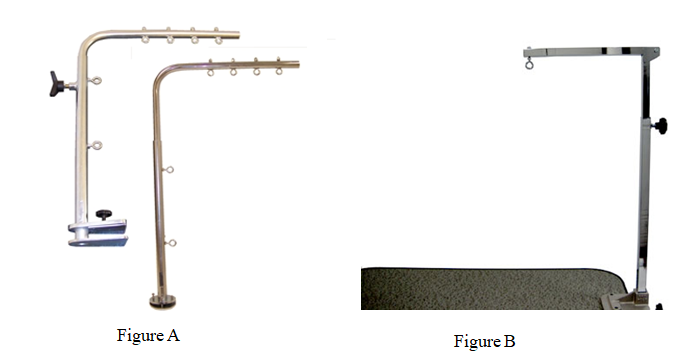
Figure A vs. Figure B
Rounded mandrel bend versus square abrupt 90-degree bend. Subtle difference, big use difference.
🪤
Mandrel Bend Problem
The smooth curve can eventually act like a wedge where it telescopes into the lower arm.
📐
Square Bend Preference
The abrupt 90-degree square steel design gives a cleaner contact point and is easier to cushion.
🩹
Tape Cushion Trick
A little electrical tape or duct tape at the right contact point can help prevent metal-on-metal deformation.
💵
Price and Buying
Common adjustable arms are still affordable, but premium stainless systems can cost much more.
❓
FAQ
Telescoping strength, rounded bends, square tubing, binding, tape, clamps, and buying judgment.
🧰
What a Telescoping Grooming Arm Is
It is a grooming arm built around sliding nested sections instead of one long exposed arm.
A telescoping grooming arm is designed so that one section of the arm slides into another section. The upper portion can be raised, lowered, extended, or collapsed depending on the specific design.
That sliding action is the obvious feature. But the more important feature, at least to me, is the overlap.
When the upper arm slides into the lower arm, you now have an arm within an arm. That creates a stronger nested section than a single uninterrupted piece of tubing.
That matters because grooming arms are not just sitting there holding a loop in a quiet showroom. They are being pulled, leaned on, loaded sideways, raised, lowered, tightened, loosened, bumped, and tested by dogs who do not know or care that you are trying to preserve the hardware.
A telescoping arm does not eliminate all bending risk. Metal quality, tubing wall thickness, clamp design, lock quality, table edge, dog size, and loop length still matter.
But all else being equal, I generally like the arm-within-an-arm concept better than a long single straight arm acting as one long lever.
📌
Product reality
Telescoping is not just an adjustment feature. The nested overlap can become a strength feature when the arm is built correctly.
💪
The Arm-Within-an-Arm Strength Advantage
The nested section gives the arm more material where a straight arm may otherwise flex.
I typically prefer arms with telescoping ability over straight arms or dual adjustable arms.
In my experience, arms with telescoping ability are a bonus due to the fact that it makes the entire arm stronger.
Instead of having a single piece of tubular steel and a long fulcrum to bend the arm, we now have an arm within an arm as the upper portion slides into the lower portion, essentially making it doubly as thick and that much more resistant to bending.
That is the part a lot of people miss. They look at the telescoping feature and think only about adjustment. I look at it and think about what happens when the dog loads the arm.
A straight arm has one tube taking the stress. A telescoping arm, where properly overlapped, has two sections sharing space. That extra overlap can make the arm less likely to bend like a fishing rod when a dog pulls, leans, sits, backs up, or throws weight into the grooming loop.
Again, this assumes the arm is actually built well. A cheap telescoping arm with weak tubing, sloppy locks, bad clamps, or loose fitment is still cheap hardware. Telescoping does not magically fix junk construction.
But as a general design preference, I like the strength potential of telescoping arms.
Swipe left/right to see the full table.
| Arm Design | Strength Behavior | Operator Take |
|---|---|---|
| Straight single-piece arm | One continuous tube acts as the lever. | Simple, but more exposed to bending if the arm is long or weak. |
| Dual adjustable arm | Helps with adjustment convenience but does not necessarily double the loaded section. | Useful for height tweaks, not automatically stronger. |
| Telescoping arm | Upper section slides into lower section, creating overlap. | My preference when the design is built well and slides cleanly. |
| Poor telescoping arm | Weak metal, bad locks, poor fit, or binding can ruin the benefit. | Telescoping is a design advantage only if the arm is not cheaply made. |
⚖️
Figure A vs. Figure B: The Subtle Design Difference
The two arms may look similar at a glance, but the bend geometry changes how they wear and adjust.
I provided two images to note a subtle but important difference.
Figure A is made from rounded, mandrel-bent steel to create a sweeping 90-degree angle.
Figure B is made from square steel with an abrupt 90-degree angle.
At first glance, the rounded mandrel bend may look smoother or more refined. It has a nice sweeping bend. It looks like it should slide well because it does not have the abrupt corner.
But in actual use, that smooth rounded bend can become the problem.
The square abrupt bend is not as pretty, but I prefer it because the contact points are more predictable and easier to protect.
Swipe left/right to see the full table.
| Design | What Looks Good | What I Worry About | My Preference |
|---|---|---|---|
| Figure A: rounded mandrel bend | Smooth sweeping 90-degree curve. | Curve can begin acting like a wedge inside the lower telescoping section. | Not my choice if Figure B is available. |
| Figure B: square abrupt 90-degree bend | Less elegant but more defined geometry. | Still needs good metal, clamp, and lock quality. | My preferred version. |
| Rounded contact point | Looks smoother in the product photo. | Harder to cushion without causing binding. | Looks are not enough. |
| Abrupt square contact point | Contact area is easier to understand. | May look less polished. | I will take function over pretty. |
🪤
The Rounded Mandrel Bend Problem
The curve looks smooth until it starts acting like a wedge.
The problem, and I have run into this, is that the rounded mandrel bend creates a smooth curve that will eventually begin to bind where it telescopes inside of the lower portion.
Think of it not as a curve but as a wedge in the making.
When the upper portion of the arm is raised and lowered repeatedly, the curve has to pass into and out of the lower telescoping section. Over time, the radius of that bend can start contacting the lip of the lower arm or the inside of the lower tube in a way that does not stay smooth.
That repeated contact is where the problem starts.
The other issue is that either the lip of the lower arm, the inside radius on the upper arm, or both will begin to deform as a result of impact with each other through use.
Once that deformation starts, the sliding action gets worse. The arm may bind. It may scrape. It may need to be wiggled. It may no longer adjust cleanly. And once a grooming arm starts requiring little table-side wrestling matches to move it up and down, it has already become annoying.
This is not the sort of thing a new buyer will notice in a product photo. It shows up after use.
⚠️
Binding warning
The rounded bend can look like the smoother design, but smooth-looking is not the same as smooth-sliding after months of metal-on-metal use.
📐
Why I Prefer the Square Abrupt 90-Degree Arm
The abrupt bend gives me a cleaner, more predictable contact point.
It is for this reason that, given the choice, I would choose the abrupt 90-degree arm with square steel.
The square steel version with the abrupt bend avoids the rounded curve acting like a wedge inside the lower telescoping portion.
It also gives me a better idea of where the upper arm is actually contacting the lower telescoping section.
That matters because if I know where the contact point is, I can protect it. If the contact point is a sweeping curve that disappears into the lower tube, I have fewer useful options.
Square tubing can also resist rotation better than round tubing in some designs, depending on how the lower section and lock are built. That does not mean every square arm is automatically better, but it is another reason I generally like the square abrupt 90-degree version in this comparison.
The abrupt square bend may not win a beauty contest. I do not care. I am not buying grooming arms to impress the table. I am buying them so the groomer can adjust the hardware without fighting it and so the arm resists bending and binding over time.
📌
Design preference
Given the choice, I would take the square abrupt 90-degree telescoping arm over the rounded mandrel-bent version because it avoids the wedge problem and gives a better place to cushion contact.
🩹
The Electrical Tape or Duct Tape Cushion Trick
It is not glamorous engineering. It is just stopping metal from beating itself up.
Additionally, with the abrupt angle, I am able to wrap a bit of electrical tape or even duct tape around the upper arm where it comes into contact with the lower telescoping portion to add a bit of cushion and prevent metal deformity caused by use.
This is not glamorous engineering. It is tape in the right place because metal-on-metal impact is stupid when you can soften it.
The point is not to turn the arm into a duct-tape sculpture. The point is to add a small cushion where the upper arm actually contacts the lower telescoping section.
With the square abrupt bend, that contact point is easier to identify. You can wrap the tape around the upper arm where it actually matters.
With the mandrel bend, there is no good way to add a cushion. No matter where you wrap the tape, it will either not make contact with the lower portion, thereby being useless, or it will try to bind inside the lower portion of the arm when the upper portion is lowered.
That is the difference. One design gives you a practical place to protect the contact point. The other design makes the contact point part of the sliding curve itself.
⚠️
Do not create a new binding point
Tape only helps if it cushions the contact point without interfering with the telescoping action. If the tape slides inside the lower arm and binds, you just fixed one problem by creating another.
💵
Current 2026 Market Snapshot and Buying Reality
Telescoping, foldable, adjustable, stainless, and H-style grooming arms can look like the same category until the price tag and construction quality start telling the real story.
Current grooming arm pricing has a wide spread. Basic adjustable clamp-on arms and simple H-shape arms can still show up in the roughly $45 to $60 range, depending on seller, table size, clamp, tubing, included loops, and whether the arm is meant for light-duty or real commercial use.
Common foldable or telescoping-style professional arms often land closer to the $80 to $125 range. That is the zone where you start seeing better tubing, stronger clamps, one-inch square tubular steel, better fitment, cleaner folding or telescoping action, and designs that are more likely to survive daily grooming-room abuse.
Premium stainless systems can jump much higher. A simple premium 1-inch stainless arm may sit around the $100 range, but heavier flip-top stainless arms, slider-ready systems, and H-style stainless setups can push into the $250 to $350 range depending on configuration.
That is why I do not like talking about these arms as if there is one “normal” price. There is cheap grooming hardware, useful professional grooming hardware, and expensive specialty hardware. They are not automatically the same thing just because they all hold a grooming loop.
A cheap telescoping arm with weak locks, sloppy fit, soft metal, poor clamp contact, or a rounded bend that binds is not a bargain. It is just cheap hardware with another moving part.
A more expensive arm that is built well, slides smoothly, locks securely, overlaps enough to add strength, fits the table properly, and uses bend geometry that will not annoy the groomer after real use may be the better purchase.
The buying question is not just “does it telescope?” The buying question is whether it telescopes cleanly, locks firmly, overlaps enough to resist bending, fits the table, and uses a bend shape that will not turn into a binding problem after months of metal-on-metal use.
Swipe left/right to see the full table.
| Current 2026 Price Band | What You Usually See | Operator Take |
|---|---|---|
| About $45–$60 | Basic clamp-on adjustable arms, budget grooming arms, and some simple H-shape arms. | Fine for light use if the clamp, tubing, and lock are decent. Suspicious for serious commercial abuse unless inspected closely. |
| About $80–$125 | Better foldable, telescoping-style, one-inch, or more professional arm designs. | This is often the more realistic working range for a grooming room that needs hardware to survive daily use. |
| About $100–$150 | Premium single-arm stainless options, stronger flip-top designs, heavier tubing, and better hardware. | Worth considering when you want a stronger arm without jumping into a full H-style system. |
| About $250–$350+ | Premium stainless H-style arms, slider-ready systems, heavier commercial configurations, and specialty setups. | This is no longer “cheap grooming arm” money. At this level, fit, workflow, table size, and actual need matter. |
⚠️
Price warning
Do not compare grooming arms by price alone. A $50 arm that fits poorly is expensive aggravation. A $100 arm that does the job every day may be cheap in the long run. A $300 system that solves a problem you do not have is just shiny overspending.
✅
Telescoping Grooming Arm Buying Checklist
Ask these questions before buying the arm just because “telescoping” sounds stronger.
- Is the arm truly telescoping, or is the seller using vague adjustable language?
- Is the upper section sliding into the lower section with enough overlap to add strength?
- Does the arm slide smoothly through its full useful range?
- Does it bind where the upper arm enters the lower section?
- Is the upper bend rounded and mandrel-bent, or square with an abrupt 90-degree angle?
- If it has a rounded bend, does the curve contact the lower arm lip in a way that could become a wedge?
- If it has a square abrupt bend, is there a clear contact point that can be cushioned?
- Is the tubing strong enough for the dogs you actually groom?
- Does the locking knob or mechanism hold firmly without slipping?
- Does the clamp fit the actual thickness and edge shape of your grooming table?
- Does the arm resist rotation, twisting, and sideways load?
- Are replacement knobs, clamps, or parts available?
- Are you buying the stronger nested design, or just buying a cheap arm with another moving part?
✅
My Operator Verdict on Telescoping Grooming Arms
I generally prefer telescoping ability, but I care about the bend shape.
My operator take is simple: I typically prefer grooming arms with telescoping ability over straight arms or dual adjustable arms.
The reason is strength. Instead of one single piece of tubular steel acting as a long lever, the telescoping design puts one arm inside another. That overlap essentially doubles up the material in the nested section and makes the arm more resistant to bending.
But once you decide you like telescoping arms, the next question is which telescoping design.
Given the choice between the rounded mandrel-bent version and the square abrupt 90-degree version, I would choose the square abrupt version.
The rounded mandrel bend looks smooth, but in use that curve can eventually begin to bind where it telescopes inside the lower portion. Think of the curve not as a curve, but as a wedge in the making.
The lip of the lower arm, the inside radius on the upper arm, or both can begin to deform through repeated impact and metal-on-metal contact.
With the abrupt square bend, I have a more predictable contact point. I can wrap a bit of electrical tape or duct tape around the upper arm where it contacts the lower telescoping portion to add cushion and help prevent metal deformity.
With the mandrel bend, there is no good place to add that cushion. If the tape does not contact the lower portion, it is useless. If it does contact where the curve slides inside the lower portion, it can bind when the arm is lowered.
So yes, I like telescoping arms. But I like the square abrupt 90-degree design better than the rounded mandrel-bent version.
⚠️
Final take
Telescoping is a good idea when the arm is built well. The square abrupt 90-degree version is my preference because it avoids the rounded wedge/binding problem and gives a better contact point to protect.
❓
Telescoping Grooming Arm FAQ for Pet Care Operators
Straight answers about telescoping strength, rounded bends, square tubing, binding, cushioning, and buying judgment.
Are telescoping grooming arms stronger than standard arms?
They can be. The advantage is the arm-within-an-arm overlap. Instead of one long exposed tube acting as the lever, part of the upper arm slides into the lower arm, creating a doubled-up section that can be more resistant to bending.
Does telescoping automatically mean better?
No. Telescoping is only an advantage if the arm is built well. Weak tubing, bad locks, poor clamp fit, sloppy tolerances, or binding can ruin the benefit.
Why do you prefer telescoping over dual adjustable arms?
Dual adjustable arms help with convenience and small height adjustments. Telescoping arms can also add strength because the upper section nests inside the lower section. I like that overlap.
What is the problem with a rounded mandrel bend?
The rounded bend can eventually act like a wedge where it slides into the lower telescoping section. The curve may begin to bind, and the lip of the lower arm or inside radius of the upper arm can deform over time.
Why do you prefer the square abrupt 90-degree bend?
The square abrupt bend gives a more predictable contact point and avoids the sweeping curve that can bind inside the lower arm. It also gives me a better place to add a small cushion where the upper arm contacts the lower section.
Is the tape trick really worth mentioning?
Yes. A small amount of electrical tape or duct tape at the right contact point can cushion metal-on-metal impact and help prevent deformation. It is a simple field fix, not fancy engineering.
Can tape make the arm worse?
Yes, if it is placed where it slides into the lower arm and causes binding. That is why the square abrupt bend is easier to work with. The contact point is easier to identify and cushion.
What should I check before buying a telescoping arm?
Check tubing strength, bend geometry, overlap, sliding action, lock quality, clamp fit, table-edge compatibility, and whether the arm binds when raised or lowered.
What is the main lesson?
Telescoping ability is a good feature when built correctly. I prefer it because the nested design can make the arm stronger. But if choosing between rounded mandrel bend and square abrupt bend, I would take the square abrupt version.
🐾
Bottom Line: I Like Telescoping, But I Want the Square Abrupt Bend
Telescoping is good. Binding is not. The bend shape matters.
I typically prefer grooming arms with telescoping ability over straight arms or dual adjustable arms because the arm-within-an-arm design can make the arm stronger.
Instead of one single piece of tubular steel and a long fulcrum to bend the arm, the upper portion slides into the lower portion, essentially making the overlapped section doubly thick and more resistant to bending.
But the shape of the upper bend matters.
Figure A uses rounded, mandrel-bent steel to create a sweeping 90-degree angle. Figure B uses square steel with an abrupt 90-degree angle.
The rounded mandrel bend can eventually begin to bind where it telescopes inside the lower portion. Think of it not as a curve, but as a wedge in the making.
The lip of the lower arm, the inside radius of the upper arm, or both can deform from repeated impact through use. Once that starts, the arm stops sliding as cleanly.
Given the choice, I would choose the abrupt 90-degree arm with square steel. It avoids the rounded wedge problem and gives a better place to wrap a bit of electrical tape or duct tape around the upper arm where it contacts the lower section.
With the mandrel bend, there is no good place to add that cushion because the tape either does not contact the lower portion and is useless, or it slides inside the lower portion and causes binding.
That is the whole lesson: telescoping is useful, but geometry still matters.