Grooming Table Hardware • Wall-Mount Arms • Drying Stations • Bather Stations • Build-Out Planning • Grooming Room Equipment Review
Wall-Mount Grooming Arms: Space-Saving Drying Station Hardware That Needs Real Blocking Behind the Wall
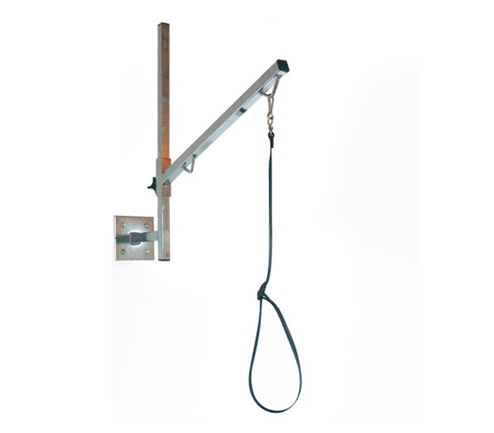
I have never actually used one of these as my main setup, but I have seen them in use.
Most often, I have seen them used for drying stations where a long section of wall will have a table base, counter, shelf, or work ledge that runs its length. Every three feet or so, the wall area may be partitioned to create individual stations where bathers can dry dogs.
The idea is simple: restrain the dog with a groomer’s noose without having to put an actual grooming table in every single drying spot.
In my opinion, this is a space-saving accessory with its own little niche. It makes the most sense for grooming shops with limited space or grooming shops that employ a large number of bathers who may need to perform different tasks on multiple dogs at the same time.
But this is not a drywall accessory. This is restraint hardware attached to a building. That means it needs to be planned like build-out hardware, not treated like something you casually screw into a finished wall because it looked useful in a catalog.
⚠️
Operator rule
A wall-mount grooming arm is not a good afterthought accessory. If you want it clean, strong, and professional, the wall needs proper backing, blocking, or masonry support before the wall finish goes up.
🗺️
Use This Page Like a Build-Out Planning Review
This hardware can save space in the right layout, but it needs the wall to be ready for it.
🧰
What It Is
A wall-mounted restraint arm used to control a dog without placing a full grooming table at every station.
🛁
Drying Stations
This hardware is most useful in long-wall drying station layouts with shelves, counters, and multiple bathers.
📏
Space-Saving Niche
Useful where floor space is limited or several bathers are drying multiple dogs at the same time.
🚧
Afterthought Problem
The biggest drawback is installation. The wall must have solid anchor points where the arm needs to go.
🪵
Studs and Blocking
Studs, masonry, plywood backing, and scab boards decide whether this looks professional or patched together.
🔁
Folding Arm Improvement
The best improvement would be a folding upper arm that clears the space when restraint is not needed.
💵
Current 2026 Market
Wall-mounted grooming and drying station hardware ranges from simple brackets to full drying equipment.
❓
FAQ
Drying stations, anchor points, build-out planning, scab boards, masonry, and whether this is worth adding.
🧰
What a Wall-Mount Grooming Arm Is
It is restraint hardware attached to the wall instead of a grooming table.
A wall-mount grooming arm gives the shop a fixed restraint point without requiring a full grooming table at that exact location.
Instead of clamping a grooming arm to a table edge, the arm screws or bolts to the wall. The dog can then be restrained by a groomer’s noose, loop, or similar restraint while standing on a shelf, counter, table base, drying ledge, or other station surface.
This is why I think of it more as station hardware than table hardware.
It is not there to replace every grooming table. It is there to make certain workstations more useful, especially drying stations where the bather needs to control the dog but does not necessarily need a full hydraulic or electric grooming table.
That can make sense. But the wall has to be able to take the load. Dogs pull, sit, back up, lean, thrash, spin, and load restraint hardware sideways. The wall does not get to be decorative only. If it is holding a grooming arm, it has a job.
📌
Product reality
A wall-mount grooming arm is not just an accessory. It is a restraint point attached to the building. Treat it like build-out hardware.
🛁
Where I Have Seen Wall-Mount Arms Used: Drying Stations
This is where the wall-mounted arm makes the most sense to me.
Most often, wall-mount grooming arms are used for drying stations.
A long section of wall may have a table base, shelf, counter, or drying ledge that runs its length. Every three feet or so, the station may be partitioned to create individual areas where bathers can dry dogs.
That kind of layout lets several bathers work at the same time without putting a full grooming table at every single station.
One bather can be drying a small dog in one partition. Another can be towel-drying or brushing out another dog. Another can be managing post-bath work. The wall-mounted arm gives each station a restraint point without filling the room with separate tables.
This is the niche where the wall-mount arm makes sense. It is not trying to be the main grooming table for finish work. It is trying to support drying, post-bath handling, and basic station control in a space-efficient way.
That said, drying stations are not just “put a shelf on the wall and call it good.” You still need to think about dryer placement, cords, hoses, towels, wall finish, cleaning, water exposure, dog size, bather reach, and how many animals may be in that area at once.
Swipe left/right to see the full table.
| Drying Station Element | Why It Matters | Operator Take |
|---|---|---|
| Long wall shelf or counter | Creates multiple working spots without separate tables. | Good use of space if it is built strong and easy to clean. |
| Partitions every few feet | Helps separate dogs and gives bathers individual stations. | Useful when multiple dogs are being dried at once. |
| Wall-mounted restraint arm | Gives each station a noose or loop point. | Works only if the wall anchor is solid. |
| Dryer brackets and hose control | Keeps dryers, hoses, and cords from becoming floor clutter. | Vertical storage helps, but every mount still needs proper support. |
| Waterproof wall finish | Drying stations live near water, wet dogs, towels, and hair. | Plan wall finish before installing hardware through it. |
| Electrical placement | Dryers need power, and cords need to stay out of the way. | Do not design the restraint station and forget the dryer cord mess. |
📏
Why This Can Be a Space-Saving Accessory
It has its own little niche, especially in shops where floor space and bather workflow matter.
It allows the user the ability to restrain a dog via groomer’s noose without having to have an actual grooming table.
In my opinion, this is a space-saving accessory that has its own little niche for pet grooming shops with limited space or for grooming shops that employ a large number of bathers that may need to perform different tasks on multiple dogs simultaneously.
That is the proper way to think about it.
This is not the best choice for every shop. It is not automatically better than a table-mounted arm. It is not a magic way to turn every wall into a grooming table.
It makes sense when the work is station-based, repetitive, and space-sensitive. Drying, post-bath handling, towel work, brushing, quick touch-ups, and bather-controlled tasks are the better fit.
It makes less sense when the dog needs real grooming-table control, adjustable table height, full access around the body, heavy restraint, or a more serious table setup.
⚠️
Use-case warning
Do not confuse “space-saving” with “good for every dog.” A wall-mounted arm may be useful at a drying station. That does not make it the right restraint point for full grooming work or unsafe dogs.
🚧
Why This Is Not a Good Afterthought Accessory
The biggest drawback is not the arm. The biggest drawback is the wall.
The only major drawback that I see to this item is that it is not a good afterthought accessory, or to say it better, an accessory that is easily added to an existing grooming shop.
This is an item that, in order to make it aesthetically pleasing and structurally sound, needs to be considered in the initial design and construction phase of a grooming shop.
That is the whole lesson.
A wall-mount grooming arm has to be attached where the station needs it, not just where the studs happen to be. Those are not always the same location.
If the wall was not planned for it, the shop owner may be stuck choosing between a bad location, a weak attachment, opening the wall back up, drilling through finished tile or wall panels, or running an exposed board across the wall face to catch the studs.
That is not where you want to be after the room is finished.
This is why I would rather decide on these stations before build-out. Place the arm locations. Place the backing. Coordinate the wall finish. Make it look intentional. Make it strong. Make it cleanable. Do not wait until the groomers are standing in the room saying, “This would be a good place for an arm,” and then discover there is nothing solid behind the wall.
📌
Build-out lesson
You cannot just decide later that drywall is now a dog-restraint anchor. The wall either has support where you need it or it does not.
🪵
Studs, Blocking, Masonry, and Scab Boards
This is where the wall-mount grooming arm either looks professional or starts looking like someone patched the idea in later.
As it screws or bolts to the wall, it will require a solid anchor point. This would typically be a wall stud unless the shop owner is fortunate enough to have masonry walls where they wish to attach it.
Since it is unlikely that in an existing shop the studs in the wall will correspond with the desired location of this item, it is important that you know its location prior to build-out.
This way, studs, blocking, plywood backing, or scab boards can be placed behind the wall surface, whether that surface is drywall, tile, FRP, wall paneling, or another finish.
Then the anchor points for the wall-mount grooming arm will be in place when it is installed.
That is the clean version.
The alternative way to install it would be to run a board, or scab board, across the outside of the wall face so that the board can be anchored to the existing wall studs and then the wall-mount grooming arm can be attached to this outer board.
That can work from a practical standpoint if done properly, but it is not ideal and it looks somewhat thrown together.
It looks like what it is: the wall was not ready for the hardware, so the hardware had to drag a board onto the finished wall and pretend that was always the plan.
Swipe left/right to see the full table.
| Mounting Situation | What It Means | Operator Take |
|---|---|---|
| Wall stud in the correct location | Arm can be anchored directly into framing. | Good if the stud location lines up with the actual station layout. |
| Masonry wall | May provide a strong attachment surface with proper anchors. | Potentially useful, but still needs proper installation and hardware. |
| Blocking behind wall finish | Backing is added before drywall, tile, or wall panels are installed. | Best planned approach for clean, professional installation. |
| Plywood backing behind station wall | Gives more flexibility for mounting stations in the right locations. | Smart in bather/drying walls where equipment locations may vary. |
| Exterior scab board | Board is added over finished wall and anchored to studs. | Can work, but often looks patched-in if not designed cleanly. |
| Drywall only | Not a reliable restraint anchor for dogs loading the arm. | Do not treat wall finish as structure. |
⚠️
Installation warning
Have a qualified builder, installer, or contractor verify the attachment method. Dog restraint hardware creates live load, sideways load, and ugly surprises when installed into the wrong wall.
🔁
The Improvement I Would Want: A Folding Upper Arm
The same lesson from table arms applies here: get the arm out of the way when it is not doing work.
I could certainly see it being improved upon by adding a folding upper arm to eliminate the upper bar from the space when not needed.
That is the feature I would want.
In a drying station, there will be plenty of times when the restraint arm is useful. There will also be plenty of times when the upper arm is just occupying head space, elbow space, drying space, or bather movement space.
The biggest improvement I would want is the same thing I keep wanting from table arms: get the arm out of the way when it is not doing work.
A folding upper arm would make the wall-mounted station more flexible. Use it when the dog needs a restraint point. Fold it away when the bather is wiping down the station, moving dogs, cleaning tools, changing towels, drying without a noose, or trying not to bang into the same piece of metal all day.
The fold mechanism would still need to lock securely. A folding wall arm with a weak hinge is not an upgrade. It is just a wall-mounted annoyance with moving parts.
📌
Design preference
Wall-mounted station hardware should save space, not create a permanent metal obstacle above every drying bay.
💵
Current 2026 Market Snapshot and Buying Reality
Wall-mounted grooming and drying station hardware ranges from small brackets to full wall-mounted dryer systems.
Current wall-mounted grooming and drying station pricing depends on what you are actually buying. This category is not as simple as a standard clamp-on grooming arm.
Simple dryer wall brackets can be inexpensive. Some current K-9-style dryer wall brackets sit around the $20 range, while other dryer wall mount kits with hose clips, nozzle storage, and mounting hardware may sit around the $30 to $70 range depending on brand and dryer compatibility.
Universal grooming arm kits and smaller station accessories can sit closer to the $85 to $115 range, depending on what is included and whether the product is actually a wall-mounted restraint solution or just a table/station accessory.
Wall-mounted finishing dryers and wall-arm dryer systems are a completely different purchase. Those can move toward the $1,000 range or higher because you are buying the dryer, arm, bracket, motor, controls, and the wall-mounted drying system itself.
That is why I would not think of this as one simple product category. A wall bracket, a wall-mounted dryer, a wall-mounted restraint arm, and a full drying-station build are different things.
The real cost is not just the arm. The real cost is the station: blocking, framing, wall finish, partitions, counter or shelf, dryer placement, electrical, hose control, cleaning access, and installation labor.
A cheap wall bracket may hold a dryer. That does not mean the wall is ready to restrain dogs. Those are different loads, different risks, and different decisions.
Swipe left/right to see the full table.
| Current 2026 Buying Category | Typical Market Reality | Operator Take |
|---|---|---|
| Simple dryer wall bracket | Often around $20 to $35 depending on brand and dryer fit. | Good for organizing dryers, but not the same thing as dog restraint hardware. |
| Dryer wall mount kit | Often around $30 to $70 with hose clips, nozzle storage, and mounting hardware. | Useful for drying station organization and keeping equipment off the floor. |
| Universal grooming arm or small station accessory | Often around $85 to $115 depending on included parts. | Check whether it is truly useful for wall restraint or just another general arm kit. |
| Wall-mounted finishing dryer | Can approach or exceed $1,000 depending on model and configuration. | This is equipment planning, not just a bracket purchase. |
| Full drying-station build | Includes framing, backing, finish material, counter/shelf, partitions, electrical, dryer hardware, and labor. | The arm may be the cheap part. The build-out is where the real planning happens. |
⚠️
Price warning
Do not confuse a cheap dryer wall bracket with a properly planned restraint station. Hanging a dryer and restraining a dog are not the same structural problem.
✅
Wall-Mount Grooming Arm Build-Out Checklist
Ask these questions before the wall is finished, not after the tile is up and everyone is pretending the studs landed in the right place.
- Is this station for drying only, post-bath handling, light restraint, or serious grooming work?
- How many wall-mounted stations are needed?
- How far apart will the stations be placed?
- Will partitions be installed between stations?
- What dog sizes will be handled at these stations?
- What wall type is being used: framed wall, masonry, concrete, block, tile over backer, FRP, drywall, or another finish?
- Are studs, blocking, plywood backing, or scab boards located exactly where the arm needs to mount?
- Has the installer confirmed the anchor method is suitable for dog restraint load?
- Will the arm mounting interfere with tile, waterproofing, wall panels, corner trim, outlets, plumbing, or dryer brackets?
- Are electrical outlets placed where dryers can be used without cord chaos?
- Are dryer hoses, cords, nozzles, towels, and tools planned so they do not fight the restraint arm?
- Does the upper arm fold, swing, or remove when not needed?
- If the arm does not fold, will it become a permanent head, shoulder, or elbow obstacle?
- Can the wall, shelf, counter, ledge, and partitions be cleaned around the hardware?
- Is the landlord or building owner allowing wall penetrations, backing, bolts, masonry anchors, or structural modifications?
- Are you planning this before build-out, or trying to patch it into a finished grooming room?
⚖️
Wall-Mount Arms vs. Table-Mount Grooming Arms
Wall-mounted arms save floor space, but table-mounted arms are usually more flexible.
Swipe left/right to see the full table.
| Arm Type | What It Does Well | Main Drawback | My Take |
|---|---|---|---|
| Wall-mount grooming arm | Saves floor space and supports drying station layouts. | Requires proper wall structure exactly where it mounts. | Useful niche when planned before build-out. |
| Standard clamp-on arm | Cheap, common, movable, and easy to understand. | Depends on table edge and clamp quality. | Better for flexible table use. |
| Folding table arm | Gets out of the way when not needed. | Hinge and lock quality matter. | My preferred table-arm style. |
| Overhead arm | Maximum stability and multiple attachment points. | Cumbersome and in the way. | Useful when control is worth the inconvenience. |
| Drying wall with multiple stations | Lets several bathers work multiple dogs in a compact footprint. | Must be designed with wall support, partitions, electrical, and cleaning in mind. | Good build-out strategy if planned correctly. |
✅
My Operator Verdict on Wall-Mount Grooming Arms
I see the niche. I also see the installation trap.
I have never actually used one of these as my main setup, but I have seen them in use, and I understand why grooming shops use them.
They make the most sense in drying station layouts where a long wall has a shelf, counter, table base, or ledge running its length, with partitions every few feet so multiple bathers can dry dogs at the same time.
They allow the shop to restrain a dog with a groomer’s noose without putting a full grooming table at every station.
That can save space and improve bather workflow in the right shop.
But this is not an accessory I would want to add casually after everything else is done. The wall-mount grooming arm has to screw or bolt into something solid. That usually means studs, masonry, proper blocking, plywood backing, or a planned anchor point behind the wall finish.
If the station locations are not known before build-out, the studs may not land where the arms need to go. Then the shop owner is stuck with bad locations, wall surgery, weak attachment, or an exterior scab board across the wall face.
That outer board may work if done properly, but it is not ideal and often looks thrown together.
My preferred improvement would be a folding upper arm so the bar can be moved out of the space when it is not needed.
So my verdict is this: useful niche, good for planned drying station layouts, bad as a casual afterthought. Plan it early or skip it.
⚠️
Final take
Wall-mount grooming arms can be smart in drying stations, but only when the wall is built for them. Otherwise you are trying to make finished-wall hardware do construction work it was never prepared to do.
❓
Wall-Mount Grooming Arm FAQ for Pet Care Operators
Straight answers about drying stations, wall anchors, blocking, scab boards, build-out timing, and whether this hardware belongs in your grooming room.
Have you personally used a wall-mount grooming arm?
I have never actually used one as my main setup, but I have seen them in use. The places I have seen them make the most sense are drying stations and space-saving bather layouts.
Where are wall-mount grooming arms most useful?
They are most useful in drying station layouts where a long wall has a shelf, counter, table base, or ledge with individual partitions so bathers can dry multiple dogs at the same time.
Do they replace grooming tables?
No. They can provide a restraint point without a full grooming table, but that does not mean they replace a real table for finish grooming, large dogs, difficult dogs, or work that requires full body access and height adjustment.
Why are they space-saving?
They allow a shop to restrain dogs at a wall station without putting a full grooming table at every drying bay. That can help shops with limited space or several bathers working at once.
Why are they not a good afterthought accessory?
Because the arm has to screw or bolt into something solid. If the wall was not planned with studs, blocking, plywood backing, masonry, or proper anchor points in the right places, installation becomes ugly, weak, expensive, or awkward.
Can I just screw one into drywall?
I would not treat drywall as a dog-restraint anchor. A dog can pull, lean, sit, thrash, and load the arm sideways. The arm needs real structure behind it.
What is a scab board?
In this context, a scab board is a board run across the wall face so it can be anchored into existing studs. The grooming arm then attaches to that board. It can solve the anchoring problem, but it often looks patched-in if it was not planned as part of the wall design.
What improvement would you want?
I would want a folding upper arm so the upper bar can be moved out of the station space when it is not needed.
What should I plan before build-out?
Decide station locations, arm locations, backing, wall finish, counter or shelf design, partitions, electrical outlets, dryer placement, hose control, and cleaning access before the wall is finished.
What is the main lesson?
Wall-mount grooming arms can be useful drying station hardware, but they need to be planned into the room. They are build-out hardware, not casual finished-wall accessories.
🐾
Bottom Line: Useful Niche, Bad Afterthought
Wall-mount grooming arms make sense when the drying wall is designed for them.
Wall-mount grooming arms are not something I have used as my main setup, but I have seen them used, mostly in drying station layouts.
They make sense where a long wall has a shelf, counter, or table base divided into individual stations so bathers can dry dogs without each station needing a full grooming table.
In that niche, they save space and can help multiple bathers work multiple dogs at the same time.
The problem is installation. This is not a good afterthought accessory. It screws or bolts to the wall, and that wall needs a solid anchor point. Studs, masonry, blocking, plywood backing, or properly planned support needs to be there before the arm is installed.
If the room is already finished and the studs do not line up with the desired station locations, the shop owner may end up running an exterior scab board across the wall face. That can work if done properly, but it is not ideal and often looks thrown together.
I could see this hardware being improved with a folding upper arm that clears the station when not needed.
My take is simple: plan it early, anchor it correctly, use it where it fits, and do not pretend a finished wall magically becomes restraint structure because you bought an arm.