Grooming Table Hardware • Rotating Arms • Pivoting Arms • Swing-Away Arms • Table-Mounted Arm Systems • Grooming Room Equipment Review
Rotating Grooming Arms: Convenient Swing-Away Feature Until the Dog Swings It Back
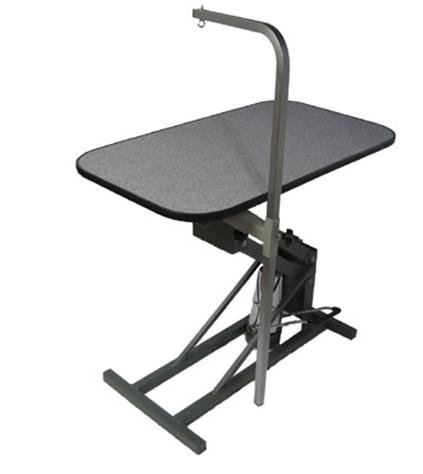
This is more of an option that has to be purchased with the table than an item that can be purchased separately and added to any grooming table.
In my grooming shop, I have both a table with this feature and a table without this feature. To be quite honest, I am on the fence as to whether I like it or not.
I find it to be extremely convenient when I wish to work on the face or head and can just slide the bar out of the way to the other side of the table.
I find it to be quite annoying when the bar cannot be locked into place and the dog can simply thrash about and swing it back around.
That is the whole argument with rotating grooming arms. I like the idea. I do not like the dog being able to operate the idea for me.
⚠️
Operator rule
Rotation without a lock is not control. It is just permission for the dog to help operate the table hardware.
🗺️
Use This Page Like a Rotating Arm Reality Check
This is not a “rotating arms are bad” page. This is a “rotating arms need to lock where the groomer puts them” page.
🧰
What It Is
A table-mounted arm that pivots or rotates around the table instead of staying fixed in one position.
🧩
Table-System Feature
This is usually table-specific hardware, not a universal clamp-on arm that fits every table.
✂️
Convenient Side
Very handy for face, head, muzzle, ear, and neck work when the arm can swing out of the way.
🚧
Non-Locking Problem
If the arm cannot lock, the dog can thrash and swing the bar right back into the work zone.
🔒
Locking Angle
A rotating arm that locks into useful positions is a very different product from one that just swings freely.
🪢
Groomer’s Helper Issue
Some restraint systems depend on fixed geometry, and rotating arms can make that awkward.
💵
Current 2026 Market
Rotating arms may be table options, retrofit accessories, or part of a full rotating-post table system.
❓
FAQ
Table fit, locking positions, Groomer’s Helper issues, current pricing, and whether I would buy one again.
🧰
What a Rotating Grooming Arm Is
It is a grooming arm that pivots or swings around the table instead of staying fixed in one table position.
A rotating grooming arm is designed so the arm can swing, pivot, or rotate around part of the grooming table.
Instead of clamping a standard arm to one table edge and leaving it there, the rotating design lets the groomer move the arm from one side or angle to another.
In theory, that gives the groomer more flexibility. You can work around the dog, move the bar away from the face, clear your working angle, and shift the restraint point without removing the arm.
In practice, the feature is only as good as the way it locks, fits the table, and works with the rest of the restraint hardware.
A rotating arm that moves when the groomer wants it to move is useful. A rotating arm that moves when the dog wants it to move is a problem.
📌
Product reality
The question is not simply whether the arm rotates. The question is whether it rotates, locks, fits your table, and stays where the groomer puts it.
🧩
This Is Usually a Table-System Feature
Do not assume this is a universal accessory you can add to any grooming table.
This is more of an option that has to be purchased with the table than an item that can be purchased separately and added to any grooming table.
That is still the way I would think about this category.
Yes, there are rotating and swing-arm accessories on the market now, but many of them are designed around specific table frames, specific brands, specific mounting points, or specific table shapes.
That matters because rotating hardware is not just clamped to the table edge like a basic arm. It often mounts to the table frame, rotates around a post, swings around an end, or bolts into a location the manufacturer designed for that purpose.
That is a very different buying decision from grabbing a standard clamp-on grooming arm and tightening it to the tabletop.
Before buying anything in this category, I would want to know whether it is a table option, a brand-specific accessory, a retrofit kit, or a true universal add-on. “Rotating” does not mean “fits whatever table I already own.”
⚠️
Fit warning
If the rotating arm mounts to the frame, underside, or a special table end, compatibility matters. Do not buy it until you know it fits your actual grooming table.
🤔
Why I Am on the Fence About Rotating Arms
I have used both. I see the benefit. I also see the annoyance.
In my grooming shop I have both a table with this feature and a table without this feature, and to be quite honest I am on the fence as to whether I like it or not.
That is not me dodging the answer. That is the answer.
I like it when I am working on the face or head and want the bar out of my way. I do not like it when I want the arm to stay in one place and the dog discovers that the arm swings.
A feature can be convenient in one part of the groom and annoying in another. Rotating arms are exactly that kind of feature.
They are not stupid. They are not useless. They are also not automatically better than a fixed arm or folding arm.
The rotating arm has to be judged by how it behaves when the dog moves, not just how slick it looks when the groomer moves it.
✂️
Where the Rotating Arm Is Extremely Convenient
Face, head, muzzle, ear, and neck work are where this feature makes the most sense.
I find it to be extremely convenient when I wish to work on the face or head and can just slide the bar out of the way to the other side of the table.
That is the best use case.
When you are working around the face, muzzle, eyes, ears, head, cheeks, throat, or front of the neck, a fixed grooming arm can be exactly where your hands, clippers, scissors, or line of sight need to go.
Being able to swing the bar away without removing the dog from the table or unclamping the arm is genuinely useful.
In that moment, the rotating arm feels smart. The bar moves away from the work, the groomer gets a cleaner angle, and the table feels less crowded.
That is why I understand the appeal. When the groomer controls the movement, the feature makes sense.
Swipe left/right to see the full table.
| Grooming Task | Why Rotation Helps | Operator Take |
|---|---|---|
| Face trimming | The arm can move away from the groomer’s working angle. | This is one of the best arguments for the feature. |
| Head work | The groomer can clear space around the front of the dog. | Helpful when the fixed arm would be in the way. |
| Ear work | The arm can be moved away from the side being worked. | Convenient if the dog does not swing it back. |
| Neck and throat work | Cleaner access around the collar/loop area. | Useful, but restraint geometry still matters. |
| Groomer line of sight | Less hardware between groomer and dog. | Good when the arm stays where the groomer puts it. |
🚧
The Non-Locking Problem
The feature becomes annoying when the arm swings freely and the dog gets a vote.
I find it to be quite annoying as the bar cannot be locked into place and the dog can simply thrash about and swing it back around.
That is the problem.
When the arm does not lock, the groomer is not the only one controlling the arm position. The dog can move it by leaning, pulling, sitting, backing up, thrashing, or loading the loop from the wrong angle.
Now the arm that you moved out of the way for face work has come right back into the work zone because the dog decided the hardware needed to participate.
That gets old fast.
It also changes the way the restraint feels. I like knowing where the arm is. I like the grooming arm being locked into one spot. A fixed point gives the groomer predictable geometry. A freely rotating arm gives you movement, but it can also give you surprise movement.
Surprise movement around a dog’s face, head, grooming loop, scissors, clippers, or staff hands is not my idea of a good feature.
⚠️
Main warning
If the rotating arm cannot lock, the dog can rotate it too. That turns a convenience feature into one more moving part the groomer has to manage.
🔒
Why a Locking Angle Changes the Verdict
A rotating arm that locks is a very different piece of equipment from a rotating arm that just swings.
All in all, I am pretty certain I could live without this feature.
If given the option of purchasing a table with it or without it, at this point I would likely purchase a table without it because I appreciate the grooming arm being locked into one spot.
That being said, if the manufacturer were to create an easy way to lock the arm at a specific angle in relation to the table, I would be all for it.
That is the dividing line.
A rotating arm that swings freely is a mixed bag. A rotating arm that rotates 180 degrees and locks into useful positions is much more interesting.
The lock is what changes the feature from “this moves” to “this moves when I decide it moves.”
Modern table systems and accessories are starting to address that exact issue. Some pivoting and rotating arm designs now advertise multiple locking positions, frame-mounted stability, and swing-away or flip-top function.
That is the version I would pay attention to. Not just rotating. Rotating and locking.
📌
Buying distinction
Ask this before buying: does the arm rotate, or does it rotate and lock? Those are not the same thing in a working grooming room.
🪢
The Groomer’s Helper Compatibility Problem
The more a restraint system depends on fixed geometry, the less I like a rotating arm that will not lock.
Additionally, it does not work the best with a Groomer’s Helper.
That matters because a Groomer’s Helper-style restraint setup depends on where the arm, loop, clamp, and restraint points are located in relation to the dog and the table.
When the arm is fixed, the geometry is predictable. When the arm rotates, that geometry changes.
If the rotating arm also locks solidly at useful positions, then the groomer may be able to make it work. But if the arm swings freely, the restraint system can start feeling sloppy, awkward, or inconsistent.
That is another reason I do not automatically love this feature. I do not want table hardware fighting the restraint system.
The more serious the restraint setup, the more I want the anchor points to stay where I put them.
💵
Current 2026 Market Snapshot and Buying Reality
Rotating grooming arms are not all the same purchase. Some are table features, some are brand-specific accessories, and some are part of full rotating-post table systems.
Current rotating grooming arm pricing and availability depend heavily on whether you are buying a separate swing-arm accessory, a retrofit system, or an entire table designed around a rotating post.
Table-specific rotating swing arms commonly live in the few-hundred-dollar range. Current examples of rotating stainless swing-arm accessories can sit around $200 to $280 depending on seller, construction, table compatibility, height range, and whether the arm includes flip-top function.
Full grooming tables with rotating post or rotating arm features cost much more because you are buying the table and the rotating system together. Current rotating-post hydraulic and electric tables commonly land in the $1,650 to $2,200+ range depending on lift type, table size, capacity, brand, and configuration.
That is why this feature should not be treated like a cheap clamp-on upgrade. It is often part of the table decision.
The money question is not simply “how much is the rotating arm?” The money question is whether the rotating feature actually improves daily grooming workflow enough to justify buying the table, accessory, retrofit, or specialty system.
If the arm rotates and locks into useful positions, I am interested. If it rotates freely and the dog can swing it back into the work zone, I would rather have a fixed arm, folding arm, or folding telescoping arm that stays where I put it.
Swipe left/right to see the full table.
| Current 2026 Buying Category | Typical Market Reality | Operator Take |
|---|---|---|
| Non-locking rotating arm | May be built into older or simpler table designs. | Convenient until the dog swings it back. Not my favorite. |
| Locking pivoting arm | Better systems rotate and lock into several useful working positions. | This is the version that makes sense. |
| Rotating swing-arm accessory | Often brand-specific or frame-mounted, commonly in the few-hundred-dollar range. | Check compatibility before buying. Do not assume universal fit. |
| Full table with rotating post | Usually a table-system purchase, often well over $1,500. | Judge the whole table, not just the arm feature. |
| Rotating plus flip-top | Combines swing-away rotation with the ability to flip the top out of the way. | Much more interesting if it locks solidly and fits the table. |
⚠️
Price warning
Do not pay table-system money for a rotating arm unless the feature actually helps your groomer. Rotation without locking is not worth much to me.
✅
Rotating Grooming Arm Buying Checklist
Ask these questions before buying a rotating arm, rotating-post table, or swing-arm accessory.
- Is the rotating arm built into the table, sold as a retrofit, or sold as a separate accessory?
- Is it compatible with your actual grooming table frame, tabletop, underside, and edge shape?
- Does it rotate freely, or does it rotate and lock?
- How many locking positions does it have?
- Are the locking positions actually useful for face, head, body, and side work?
- Can the dog move the arm by thrashing, leaning, sitting, pulling, or backing up?
- Does the arm stay rigid once locked?
- Does the rotation introduce wobble, slop, rattling, or surprise movement?
- Does it work with your Groomer’s Helper-style restraint system or other restraint hardware?
- Does it interfere with no-sit devices, belly straps, grooming loops, sling support, or table clamps?
- Does the rotating mechanism create pinch points, cord catch points, or awkward places for hair and grime to collect?
- Does it rotate smoothly without being loose?
- Can staff use it quickly without stopping the groom to fight the mechanism?
- Are you buying it because it solves a real workflow problem, or because it sounds like a fancy table option?
⚖️
Rotating Arms vs. Folding, Telescoping, Fixed, and Overhead Arms
Rotating arms solve a different problem, but they only win when the locking design is good.
Swipe left/right to see the full table.
| Arm Type | What It Does Well | Main Drawback | My Take |
|---|---|---|---|
| Standard fixed arm | Simple, predictable, and locked into one spot. | Always in the way unless removed. | I like the predictable fixed point. |
| Telescoping arm | Better adjustment and nested strength when designed well. | Still may stay in the work zone. | Good design feature, especially with square abrupt geometry. |
| Folding arm | Gets out of the way when not needed. | Hinge and lock quality matter. | My preferred style, especially with telescoping ability. |
| Overhead arm | Maximum stability and multiple restraint points. | Cumbersome and in the way. | Useful when control is worth the inconvenience. |
| Rotating arm | Swings the arm to different working angles. | Annoying if it cannot lock and the dog can swing it back. | I like the idea only when the arm locks where I put it. |
✅
My Operator Verdict on Rotating Grooming Arms
I am on the fence unless the arm locks.
My verdict on rotating grooming arms is exactly what my experience says it is: I am on the fence.
I understand the benefit. I like being able to slide the bar out of the way when I am working on the face or head.
That part is convenient.
But I do not like the bar being able to move when the dog moves. If the dog can thrash and swing the arm back around, I no longer feel like the groomer is fully controlling the table hardware.
I also do not love the way this feature can work with a Groomer’s Helper-style restraint setup. The more the restraint system depends on fixed anchor points, the more I want the arm locked into a predictable position.
If I had to choose between a table with a non-locking rotating arm and a table without it, I would likely choose the table without it because I appreciate the grooming arm being locked into one spot.
If the rotating arm has an easy way to lock at specific angles in relation to the table, that changes the conversation.
Then I am interested. Then the feature makes sense. Then the groomer gets the convenience without handing the dog control of the arm.
⚠️
Final take
I like rotating arms that rotate and lock. I do not like rotating arms that simply swing around and let the dog decide where the hardware goes next.
❓
Rotating Grooming Arm FAQ for Pet Care Operators
Straight answers about rotating arms, locking positions, table fit, Groomer’s Helper compatibility, and whether this feature is worth buying.
Is a rotating grooming arm usually a separate accessory?
Often, no. Many rotating arms are part of a table system or designed for a specific table brand or frame. Some retrofit or accessory versions exist, but compatibility has to be checked carefully.
What is the main advantage of a rotating grooming arm?
The main advantage is being able to swing the bar out of the way for face, head, muzzle, ear, and neck work without removing the arm from the table.
What is the main problem?
The main problem is a rotating arm that cannot lock. If the dog can thrash, pull, lean, or swing the arm back around, the feature becomes annoying and unpredictable.
Does locking make the feature better?
Yes. Locking positions are the difference between a useful rotating arm and a free-swinging nuisance. I am much more interested in a rotating arm that locks at specific working angles.
Would you buy a table with a non-locking rotating arm?
Given the choice, probably not. I appreciate the grooming arm being locked into one spot. I could live without the rotating feature if the arm cannot lock.
Does a rotating arm work well with a Groomer’s Helper?
Not always. A Groomer’s Helper-style restraint setup depends on predictable restraint geometry. A rotating arm that will not lock can make that setup awkward.
What should I check before buying?
Check table compatibility, mounting method, rotation range, locking positions, height range, clamp or frame strength, Groomer’s Helper compatibility, pinch points, wobble, and whether the dog can move the arm under load.
What current price range should I expect?
Rotating swing-arm accessories often sit in the few-hundred-dollar range, depending on brand and construction. Full tables with rotating post or rotating arm systems cost much more because you are buying the table and the rotating mechanism together.
What is the main lesson?
Do not buy rotation by itself. Buy controlled rotation. If the arm rotates and locks, the feature may be useful. If it rotates freely and the dog can swing it back around, I would rather have a fixed or folding arm.
🐾
Bottom Line: I Like the Idea, But I Want the Lock
A rotating arm is only as useful as the groomer’s ability to control where it stays.
The rotating grooming arm is a feature I understand but do not automatically love.
It is extremely convenient when working on the face or head because the bar can slide out of the way to the other side of the table.
It is also quite annoying when the bar cannot be locked into place and the dog can thrash about and swing it right back around.
It does not always work the best with a Groomer’s Helper-style restraint setup, and I generally appreciate the grooming arm being locked into one predictable position.
I could live without this feature. If I were choosing between a table with a non-locking rotating arm and a table without it, I would likely buy the table without it.
But if the manufacturer gives me an easy way to lock the arm at specific useful angles in relation to the table, then I am all for it.
Rotation is nice. Controlled rotation is the feature.