Creeping Myrtle Toxicity and Vinca Alkaloid Exposure
Is Creeping Myrtle Poisonous to Dogs, Cats, Horses, and Livestock?
Yes—Creeping Myrtle, Vinca minor, contains numerous biologically active monoterpene indole alkaloids and should not be eaten by dogs, cats, horses, livestock, or other animals. Exact-species research confirms a chemically diverse alkaloid mixture dominated in many plants by vincamine, but controlled feeding studies and well-documented veterinary case series involving authenticated Vinca minor are lacking.
A brief taste may cause no observable illness. When signs follow an ordinary raw-plant exposure, nausea, drooling, vomiting, diarrhea, abdominal discomfort, reduced appetite, or temporary lethargy are more plausible than a predictable severe systemic syndrome. Marked weakness, fainting, loss of coordination, tremors, seizures, collapse, abnormal heart rhythm, persistent low blood pressure, or prolonged gastrointestinal shutdown requires urgent examination and confirmation that the exposure did not involve Madagascar Periwinkle, a concentrated alkaloid product, medication, pesticide, or another poisonous plant.
About this guide: This page provides general pet-poisoning information and cannot diagnose or treat an individual animal. For any suspected exposure, contact a veterinarian or animal poison-control service immediately. Do not induce vomiting, give medication, or attempt home decontamination unless directed by a veterinary professional.

Creeping myrtle
Vinca minor L.
Important botanical synonyms and historical names include:
Pervinca minor (L.) Garsault
Vinca humilis Salisb.
Pervinca procumbens Gilib.
Pervinca repens Raf.
Pervinca heterophyla Raf.
Vinca ellipticifolia Stokes
Vinca intermedia Tausch
Names such as Vinca minor var. alba, var. atropurpurea, and var. argenteovariegata are historical names for flower-color or foliage forms rather than separate toxicologic species.
Apocynaceae Juss. — Dogbane Family
Creeping Myrtle belongs to the order Gentianales and the genus Vinca. Other members of Apocynaceae include oleander, desert rose, plumeria, star jasmine, dogbane, milkweeds, Madagascar Periwinkle, and numerous medicinally important alkaloid-producing plants.
The family contains several unrelated toxin mechanisms. Some members contain cardiac glycosides, while Vinca minor is known primarily for monoterpene indole alkaloids and should not be described automatically as an oleander-like cardiac-glycoside plant.
Creeping Myrtle, Lesser Periwinkle, Lesser Periwinkle Vine, Dwarf Periwinkle, Small Periwinkle, Common Periwinkle, Running Myrtle, Trailing Periwinkle, Blue Periwinkle, Ground Periwinkle, Bowles Periwinkle, Myrtle, Vinca, Vinca minor, Pervinca minor
“Bowles Periwinkle” is associated with the cultivated selection ‘Bowles’ or ‘Bowles’s Variety.’ Other cultivated forms include ‘Alba,’ ‘Atropurpurea,’ ‘Gertrude Jekyll,’ ‘Illumination,’ ‘Ralph Shugert,’ ‘Honeydew,’ ‘24 Carat,’ and ‘Variegata.’ Cultivar differences in flower or foliage color do not establish that one form is safe for animals to eat.
“Periwinkle” and “Vinca” are ambiguous. Greater Periwinkle is Vinca major, while Madagascar Periwinkle or Annual Vinca is Catharanthus roseus. These are separate species with different alkaloid profiles.
“Myrtle” is also used for unrelated plants, including true myrtles in Myrtaceae, Crape Myrtle in Lythraceae, and Wax Myrtle in Myricaceae. The complete plant or scientific name should be used for poison identification.
Monoterpene Indole Alkaloids
Creeping Myrtle produces a diverse group of monoterpene indole alkaloids. These nitrogen-containing specialized metabolites are formed through pathways involving tryptamine, secologanin, strictosidine, and numerous later enzymatic transformations.
Genomic and chemical research indicates that Vinca minor can produce approximately fifty alkaloids. The profile is not fixed. Alkaloid identity and concentration vary with plant genetics, tissue, developmental stage, season, environmental conditions, cultivation, damage, and chemical signaling within the plant.
These studies establish that Creeping Myrtle is pharmacologically active plant material. They do not establish a veterinary toxic dose or prove that every alkaloid reaches a clinically significant concentration when an animal briefly chews a fresh leaf.
Vincamine Is a Characteristic Major Alkaloid
Vincamine is the alkaloid most strongly associated with Vinca minor and is dominant in many analyzed plants. One exact-species investigation of cultivated aerial material isolated vincaminorine, vincaminoreine, minovine, minovincine, and vincamine and measured vincamine at 0.057 percent of the dried plant mass in that particular sample.
That figure is not a universal concentration. The same research emphasized that total alkaloid content can change with cultivation, nutrition, climate, irrigation, and harvest timing. Fresh household plants, escaped woodland populations, cultivars, roots, flowers, and leaves should not be assumed to match one dried research sample.
Vincamine has pharmacological effects on cerebral circulation and has been used as the basis for medicinal and supplemental products. A purified drug or concentrated extract is fundamentally different from an animal briefly tasting intact groundcover.
Other Confirmed Alkaloids
Research on mature leaves identified vincamine, strictamine, 10-hydroxycathofoline, and vincadifformine as major alkaloids. Experimental methyl-jasmonate treatment substantially changed the chemical profile, reducing vincamine and vincadifformine while increasing minovincinine, minovincine, and 9-methoxyvincamine.
Additional exact-species work has identified or investigated alkaloids including vincaminoreine, vincaminorine, akuammicine, lochnericine, minovincinine, pseudoakuammigine, picrinine, pericyclivine, and related aspidosperma-, eburnamine-, and akuammiline-type compounds.
The presence of a named alkaloid does not establish that it is responsible for a particular clinical sign after spontaneous animal ingestion. Many compounds have been studied for biosynthesis, enzyme activity, receptor effects, or laboratory cytotoxicity rather than veterinary poisoning.
Tissue-Specific and Stress-Dependent Chemistry
Recent metabolic research demonstrates that alkaloids accumulate differently among Vinca minor tissues. The plant also alters its alkaloid composition in response to signaling compounds such as methyl jasmonate, which models part of the defensive response to damage or herbivory.
Leaves, stems, flowers, roots, fruits, seeds, and fresh clippings should therefore remain inaccessible. This precaution reflects uncertain and variable chemical distribution rather than proof that every plant part has identical potency.
There is no validated ranking showing that a white-flowered, purple-flowered, golden-leaved, or variegated cultivar is safe for animals to eat.
Creeping Myrtle Is Not Madagascar Periwinkle
Madagascar Periwinkle is Catharanthus roseus, formerly classified as Vinca rosea. It is the principal botanical source of the dimeric antineoplastic alkaloids vinblastine and vincristine.
Those chemotherapy compounds disrupt microtubules and can cause bone-marrow suppression, peripheral neuropathy, ileus, and other serious pharmaceutical toxicities. They should not be listed as established principal toxins of Vinca minor merely because both plants have been called Vinca or Periwinkle.
Creeping Myrtle has its own alkaloid profile, centered more strongly on vincamine and numerous related monomeric compounds. Plant identity must be confirmed before predicting clinical effects.
Raw Plant Material Versus Concentrated Products
A raw leaf contains plant fiber, water, and a comparatively dilute mixture of constituents. An extract, tincture, powder, purified alkaloid, herbal product, vincamine preparation, or vinpocetine-containing supplement may deliver a much larger and more readily absorbed dose.
Medication and supplement exposures require evaluation from the exact ingredient list, concentration, formulation, amount missing, release characteristics, and additional substances. Guidance for a groundcover nibble is not sufficient for a concentrated product.
What the Research Does Not Establish
No controlled study has established that raw Vinca minor predictably causes hypotension, arrhythmias, tremors, seizures, paralysis, coma, or death in dogs, cats, horses, or livestock. Those signs remain biologically possible after a substantial or concentrated alkaloid exposure but should not be presented as the expected course of an ordinary garden ingestion.
Likewise, laboratory cytotoxicity, enzyme inhibition, receptor binding, vasodilatory activity, or effects of purified pharmaceutical vincamine do not prove that one naturally chewed leaf produces the same endpoint in an animal.
No Established Veterinary Toxic Dose
No dependable leaf count, flower count, vine length, plant weight, total-alkaloid amount, vincamine dose, gram-per-kilogram threshold, or lethal dose has been established for naturally occurring Creeping Myrtle exposure.
Risk depends on the amount, plant part, alkaloid profile, animal size, age, health, repeated access, stomach contents, and whether the exposure involved raw plant material or a concentrated preparation.
A small taste may cause no signs. A substantial or unknown ingestion deserves veterinary guidance, but an extreme clinical course should prompt confirmation of the plant and investigation for another exposure rather than automatic attribution to Vinca minor.
No Exact Veterinary Syndrome Has Been Defined
Published research has not established a characteristic dose-dependent Vinca minor poisoning syndrome in dogs, cats, horses, or livestock. Most exact-species studies investigate alkaloid chemistry, biosynthesis, transport, pharmacology, or laboratory biological activity rather than spontaneous animal ingestion.
The clinical response to raw Creeping Myrtle should therefore be described cautiously. A small exposure may produce no signs, while a larger ingestion may cause nonspecific gastrointestinal illness. Serious systemic findings remain reasons for urgent treatment but are not proven routine consequences of this species.
No Signs After a Brief Taste
An animal that briefly mouths one leaf or flower may remain completely normal. The plant’s bitter chemistry and leathery foliage may limit continued chewing, although this cannot be relied upon as protection.
Absence of signs after one exposure does not establish a universally safe amount. Repeated grazing, eating pulled vines, swallowing roots, or accessing a concentrated preparation creates a different risk.
Gastrointestinal Irritation
The most plausible findings after meaningful raw-plant ingestion are lip licking, drooling, nausea, vomiting, reduced appetite, abdominal discomfort, soft stool, diarrhea, or temporary lethargy.
These effects may reflect bitter alkaloids, plant fiber, other constituents, or a combination of factors. No exact onset period or duration has been validated for companion animals.
Repeated vomiting or diarrhea can cause dehydration and electrolyte abnormalities regardless of the plant’s direct systemic toxicity. Inability to retain water, reduced urination, dry or tacky gums, worsening weakness, blood, black stool, or severe abdominal pain warrants examination.
Lethargy and Weakness
An affected animal may hide, sleep more, move reluctantly, or show reduced interest in food and activity. Mild lethargy may accompany nausea or dehydration.
Pronounced weakness, fainting, inability to stand, weak pulses, pale or gray gums, cool extremities, prolonged capillary refill, or collapse is more severe than expected after a minor Creeping Myrtle nibble.
These findings require assessment for dehydration, blood loss, low blood glucose, cardiovascular disease, medication, pesticide, another plant, or a concentrated alkaloid product.
Blood-Pressure and Cardiac Findings
Vincamine has pharmacological vascular effects, but no controlled veterinary study has demonstrated a predictable hypotensive dose from raw Vinca minor. Low blood pressure after a suspected ingestion should be measured and treated rather than assumed from the plant name alone.
The heart rate may change because of stress, vomiting, dehydration, hypotension, electrolyte abnormalities, hypoxia, or another toxicant. No characteristic Creeping Myrtle arrhythmia has been established.
Fainting, a persistently irregular pulse, severe weakness, or poor perfusion requires electrocardiography, blood-pressure measurement, and investigation for other causes.
Neurologic Signs Require Broader Investigation
Ataxia, tremors, seizures, profound depression, coma, and paralysis are often repeated in generalized Vinca poisoning lists, but exact-species veterinary evidence linking these findings to raw Vinca minor is inadequate.
When neurologic signs occur after an apparent Creeping Myrtle exposure, confirm that the plant was not Catharanthus roseus and investigate pesticides, tremorgenic mold, cannabis, medications, mushrooms, metabolic disease, head trauma, and other poisonous plants.
Active seizures, loss of consciousness, inability to stand, repeated falling, abnormal eye movements, or failure to recover normally requires emergency treatment regardless of the ultimate cause.
Dogs and Cats
Dogs may chew vines during yardwork, pull up rooted stems, or consume clippings. Cats may investigate cut material brought indoors or chew container-grown plants.
Vomiting, drooling, diarrhea, reduced appetite, or lethargy is more consistent with a limited raw-plant exposure than a delayed chemotherapy-like syndrome.
Creeping Myrtle does not produce the acute feline kidney-failure syndrome associated with true lilies and daylilies. Kidney abnormalities require evaluation for dehydration, hypotension, another plant, medication, or underlying disease.
Horses and Livestock
Species-specific livestock case evidence is sparse. Exposure is most likely through discarded landscaping material, old homestead plantings, contaminated clippings, limited forage, or vines incorporated accidentally into feed.
Possible findings include feed refusal, salivation, colic, diarrhea, depression, or weakness. Horses cannot vomit.
Several animals becoming ill together should prompt investigation of the entire feed, clipping pile, water source, pesticides, oleander, yew, Madagascar Periwinkle, and other shared exposures.
Concentrated Products May Produce a Different Course
Ingestion of a vincamine product, vinpocetine supplement, herbal extract, tincture, or laboratory preparation cannot be assessed as though the animal chewed one fresh leaf.
Concentrated products may produce more significant cardiovascular, neurologic, or gastrointestinal effects and may include caffeine, other stimulants, sweeteners, solvents, or additional active ingredients.
Preserve the container and ingredient panel and report the amount missing, formulation, strength, and time of exposure.
Findings That Do Not Fit a Minor Raw-Plant Exposure
Bone-marrow suppression, progressive peripheral neuropathy, prolonged ileus, persistent major dysrhythmia, severe hypotension, organ failure, paralysis, coma, or death is not the expected course after a brief raw Vinca minor nibble.
These findings require confirmation of the plant identity and investigation for Madagascar Periwinkle, a vinca-derived medication, another poisonous plant, pesticide, pharmaceutical, foreign material, infection, or underlying disease.
When Veterinary Examination Is Needed
Obtain veterinary care for repeated vomiting, inability to retain water, bloody vomit or stool, severe abdominal pain, continuing food refusal, marked weakness, fainting, abnormal pulse, poor coordination, tremors, seizures, collapse, altered awareness, or failure to improve.
A substantial or unknown ingestion, repeated grazing, root consumption, uncertain identification, or concentrated-product exposure also warrants prompt professional guidance even when the animal initially appears normal.
Plant Identity
Creeping Myrtle is a low-growing evergreen perennial or subshrub that spreads horizontally across the soil. Its slender trailing stems root where nodes contact the ground, allowing one planting to form a dense mat.
The leaves occur in opposite pairs and are simple, glossy, leathery, and oval to elliptic. Their bases are generally rounded or wedge-shaped rather than deeply heart-shaped, and their margins lack the fringe of hairs often seen on Greater Periwinkle.
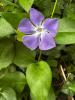
Flowering stems rise slightly above the groundcover. Each flower is borne singly from a leaf axil and has a narrow tubular base opening into five blue-violet, lavender, purple, or white lobes.
Native and Introduced Range
Vinca minor is native from parts of Europe eastward to the Caucasus. It has been introduced widely as an ornamental groundcover in North America, northern Europe, New Zealand, and other temperate regions.
Escaped plants occur around abandoned homes, cemeteries, forest margins, shaded roadsides, stream terraces, old gardens, and woodland edges.
Dense mats can persist for decades after a property is abandoned, creating exposure in areas where no one remembers planting an ornamental groundcover.
Groundcover Exposure
Dogs may chew leaves while investigating garden beds, retrieve vines during yardwork, or eat clippings left on the ground. Puppies and dogs that graze plants repeatedly can consume more than an owner observes during one episode.
Cats are less likely to consume a large outdoor mat but may chew cut stems brought indoors, investigate container-grown plants, or encounter Creeping Myrtle in enclosed patios and cat gardens.
Horses and livestock generally encounter the plant through discarded landscaping waste, old homestead sites, fence-line growth, restricted forage, or contaminated clippings rather than intentional grazing.
Creeping Myrtle Versus Greater Periwinkle
Greater Periwinkle, Vinca major, has larger flowers and broader leaves that are commonly heart-shaped or rounded at the base. Its leaf margins are usually fringed with fine hairs.
Creeping Myrtle has smaller, thicker leaves with rounded to wedge-shaped bases and smooth, hairless margins. Its flowers and overall growth are also smaller.
Both plants contain biologically active alkaloids and should be kept away from animals, but exact alkaloid concentrations and veterinary risk should not be assumed to be identical.
Creeping Myrtle Versus Madagascar Periwinkle
Madagascar Periwinkle, Catharanthus roseus, is usually an upright or spreading warm-season ornamental rather than a creeping evergreen groundcover. It has broader leaves with a conspicuous pale midrib and produces pink, white, red, lavender, or bicolored flowers.
Catharanthus roseus is the principal botanical source associated with vinblastine and vincristine. Those antineoplastic alkaloids interfere with microtubules and can produce a substantially different systemic syndrome.
Garden centers frequently label Madagascar Periwinkle as Annual Vinca, Vinca, or Periwinkle. A veterinary risk assessment based only on the word “vinca” may therefore evaluate the wrong plant.
Creeping Myrtle Versus Myrtle and Crape Myrtle
True myrtles belong to the genus Myrtus in Myrtaceae and grow as woody shrubs. Crape Myrtles belong to Lagerstroemia in Lythraceae and are shrubs or trees with showy summer flower clusters.
Creeping Myrtle belongs to Vinca and forms a ground-level mat. The plants do not share the same chemistry merely because “myrtle” appears in their common names.
Cultivars and Flower Colors
‘Bowles’ or ‘Bowles’s Variety’ is a vigorous blue-flowered selection historically associated with the name Bowles Periwinkle. ‘Gertrude Jekyll’ and ‘Alba’ produce white flowers, while ‘Atropurpurea’ produces darker purple flowers.
‘Ralph Shugert,’ ‘Variegata,’ and ‘Illumination’ have variegated foliage. ‘Honeydew’ and ‘24 Carat’ display yellow-green or golden foliage.
Flower color and variegation do not establish pet safety. Every cultivar remains a form of Vinca minor and should be managed as an alkaloid-containing plant.
Medicinal Products and Extracts
Vincamine has been used in or investigated for human cerebrovascular and cognitive conditions. Vinpocetine is a semisynthetic derivative of vincamine used in some supplements and pharmaceutical products.
A manufactured tablet, concentrated extract, tincture, powder, or herbal mixture can deliver a far greater alkaloid dose than a brief raw-plant nibble. Such exposures must be assessed from the product label, ingredient concentration, amount missing, and other included substances.
Medication or supplement ingestion should not be managed solely from guidance written for landscape groundcover.
Diagnosis
No routine veterinary test confirms Creeping Myrtle poisoning or measures its entire alkaloid mixture. Diagnosis depends on plant identification, amount and timing, compatible gastrointestinal or cardiovascular signs, and exclusion of another exposure when illness is severe.
Preserve a complete leafy flowering stem, photographs of the groundcover, the nursery label, any product packaging, and plant material found in vomit.
Persistent or systemic signs may justify blood pressure measurement, electrocardiography, complete blood count, serum chemistry, glucose, electrolytes, urinalysis, abdominal imaging, and serial neurologic examinations.
Prevention
Keep plant-chewing pets away from dense groundcover beds and collect cut or pulled vines immediately. Do not leave clippings where dogs can carry or shred them.
Do not place Creeping Myrtle in rabbit pens, poultry enclosures, tortoise habitats, horse paddocks, livestock lots, or open compost accessible to animals.
Confirm the scientific identity of plants sold as Vinca or Periwinkle. This prevents both underestimating Madagascar Periwinkle and exaggerating a minor Creeping Myrtle nibble into an antineoplastic-alkaloid emergency.
Immediate Steps After Creeping Myrtle Ingestion
- Stop further exposure: Remove the animal from the groundcover, pulled vines, roots, flowers, clippings, compost, or concentrated product.
- Confirm the plant: Determine whether the plant is Vinca minor, Vinca major, or Catharanthus roseus. Save clear photographs, a complete leafy flowering stem, and the nursery label.
- Remove only loose fragments: When the animal is calm, alert, breathing normally, and swallowing normally, take away material resting at the lips or front of the mouth. Do not reach blindly into the throat.
- Wipe visible residue gently: Use a soft water-dampened cloth on the lips, muzzle, tongue tip, and accessible gums. Do not forcefully flush the mouth.
- Record the exposure: Estimate the amount, plant parts, timing, repeated access, and whether the material was raw plant tissue, an extract, tincture, supplement, or medication.
- Allow voluntary water when appropriate: An alert animal that swallows normally and is not vomiting repeatedly may have access to fresh water. Do not syringe or pour liquids toward the throat.
- Contact a veterinarian when risk is uncertain: Prompt guidance is appropriate after a substantial or unknown ingestion, uncertain identification, repeated grazing, concentrated-product exposure, or developing signs.
Do Not Attempt Unsupervised Home Treatment
- Do not induce vomiting at home: Hydrogen peroxide, salt, mustard, ipecac, detergent, and manual gagging can cause gastric injury, prolonged vomiting, and aspiration.
- Do not force activated charcoal: Its benefit after an ordinary raw-plant exposure has not been established, and it may be aspirated by a vomiting, weak, sedated, or poorly swallowing animal.
- Do not force food or liquids: Milk, oil, yogurt, bread, broth, or water does not neutralize indole alkaloids and may enter the lungs when swallowing is impaired.
- Do not give antidiarrheal or stomach medication automatically: These drugs may obscure bleeding, obstruction, ileus, infection, or another toxic exposure.
- Do not give cardiovascular, sedative, or seizure medication from another patient: Treatment depends on measured blood pressure, rhythm, neurologic findings, and the confirmed exposure.
- Do not give human pain relievers: Ibuprofen, naproxen, acetaminophen, aspirin, and similar products can create a more serious secondary poisoning.
When Prompt Examination Is Important
- Plant identification is uncertain: An upright flowering plant sold as Annual Vinca may be Catharanthus roseus rather than Creeping Myrtle.
- The exposure was substantial or concentrated: Numerous vines, roots, repeated grazing, extracts, tinctures, supplements, powders, or medications require a different assessment from one leaf taste.
- Gastrointestinal signs persist: Repeated vomiting, inability to retain water, blood, black stool, severe abdominal pain, profuse diarrhea, or continuing food refusal requires care.
- Circulation appears abnormal: Pale or gray gums, weak pulses, cool extremities, fainting, collapse, or profound weakness requires cardiovascular assessment.
- Neurologic signs develop: Staggering, repeated falling, tremors, seizures, severe depression, altered awareness, or inability to stand indicates a serious systemic problem.
- The illness is more severe than expected: Paralysis, prolonged ileus, blood-cell abnormalities, organ injury, coma, or progressive deterioration requires investigation for another plant or toxicant.
Veterinary Assessment
The veterinarian will assess hydration, abdominal comfort, vomiting and diarrhea, appetite, mental status, gait, muscle activity, heart rate, pulse quality, blood pressure, perfusion, and the possibility that the plant or product was identified incorrectly.
Most asymptomatic brief raw-plant exposures do not require extensive testing. Persistent or systemic signs may justify glucose and electrolyte measurement, serum chemistry, complete blood count, urinalysis, blood-pressure monitoring, electrocardiography, abdominal imaging, and serial neurologic examinations.
A complete blood count is particularly relevant when Catharanthus roseus, a vinca-derived chemotherapy drug, or another concentrated antineoplastic product may have been involved.
Professional Decontamination
A minor raw-plant nibble followed by no signs generally does not justify aggressive gastrointestinal decontamination.
Veterinarian-induced vomiting may be considered after a recent substantial ingestion in an alert, asymptomatic patient with normal coordination, swallowing, breathing, blood pressure, and gastrointestinal function.
Emesis is inappropriate when the animal is already vomiting repeatedly, weak, hypotensive, ataxic, tremoring, seizuring, collapsed, breathing abnormally, or unable to protect its airway.
Activated charcoal is a case-specific veterinary decision for a large or concentrated exposure. Its effectiveness against the complete Vinca minor alkaloid mixture has not been established, and aspiration risk may outweigh benefit.
Gastric lavage would be reserved for an exceptional concentrated or very large recent exposure after anesthesia, intubation, and airway protection.
Gastrointestinal and Fluid Support
Persistent nausea or vomiting may be treated with a veterinarian-selected antiemetic such as maropitant or ondansetron after obstruction, foreign material, pancreatitis, infection, and another toxin have been considered.
Fluid and electrolyte support becomes important when vomiting, diarrhea, or reduced intake produces measurable dehydration or poor circulation. Oral, subcutaneous, or intravenous support should be selected according to swallowing ability, hydration, perfusion, continuing losses, kidney function, and cardiopulmonary status.
Sucralfate or acid suppression may be considered when repeated vomiting has caused documented esophageal or gastric injury, hematemesis, or melena. These medications are not antidotes for plant alkaloids.
Cardiovascular and Neurologic Support
Weakness, fainting, collapse, or an abnormal pulse may require continuous blood-pressure and electrocardiographic monitoring. Treatment should be based on the measured rhythm, perfusion, hydration, oxygenation, electrolytes, and acid-base status.
Persistent hypotension after appropriate fluid support may require a titrated vasopressor. There is no Creeping Myrtle-specific antidote or one antiarrhythmic appropriate for every patient.
Tremors or seizures require a quiet padded environment, glucose and electrolyte evaluation, oxygenation assessment, and veterinarian-selected anticonvulsant treatment. Severe neurologic findings should trigger an active search for another exposure rather than being attributed automatically to raw Vinca minor.
Concentrated Product Exposure
Preserve the complete product container and ingredient list. Vincamine, vinpocetine, herbal extracts, nootropic supplements, and compounded or pharmaceutical products may have substantially different concentrations and absorption from intact plant tissue.
Additional ingredients such as caffeine, other stimulants, alcohol, solvents, sweeteners, or multiple herbal substances may determine the clinical course and treatment priorities.
Horses and Livestock
Remove animals from Creeping Myrtle beds, old homestead plantings, discarded vines, compost, and contaminated feed. Preserve samples of every plant included in mixed landscaping debris.
Horses cannot vomit. Veterinary management may include colic assessment, gastrointestinal-motility evaluation, fluids, cardiovascular monitoring, and neurologic examination.
Group illness is not well explained by a small Creeping Myrtle exposure and should prompt investigation of oleander, yew, pesticides, contaminated water, mixed clippings, and other shared hazards.
Recovery and Prognosis
The prognosis is expected to be good after a small raw-plant exposure producing no signs or limited gastrointestinal upset. Improvement should include cessation of vomiting, normal drinking and urination, return of appetite, normal strength, and normal behavior.
A prolonged or severe course should prompt reassessment of the plant identity, amount, product concentration, complications, and alternative diagnoses rather than assuming that ordinary Creeping Myrtle exposure alone explains every finding.
Frequently Asked Questions About Creeping Myrtle Exposure
Why do online descriptions of “Vinca poisoning” vary so much?
The word Vinca is used for more than one plant. Creeping Myrtle is Vinca minor, while Madagascar Periwinkle is Catharanthus roseus, formerly named Vinca rosea. Older names, nursery labels, and generalized poison lists may merge the two plants even though their dominant alkaloids and expected risks are not identical.
Is a nursery label that says only “Vinca” enough for poison identification?
No. A trailing evergreen groundcover with opposite glossy leaves is more consistent with Vinca minor. An upright or mounded warm-season flowering plant with a conspicuous pale leaf midrib may be Catharanthus roseus. Photographs of the entire plant, growth habit, leaves, flowers, stems, and label are more useful than the word Vinca alone.
Does Creeping Myrtle contain vincristine and vinblastine?
Those dimeric antineoplastic alkaloids are associated principally with Catharanthus roseus. Exact-species research on Vinca minor instead emphasizes vincamine and numerous related monomeric alkaloids. Vincristine and vinblastine should not be assigned automatically to Creeping Myrtle because of an old shared genus name.
What does the chemical research prove about pet poisoning?
It proves that Vinca minor contains a complex, variable, pharmacologically active alkaloid mixture. It does not establish how many fresh leaves poison a dog or cat, which compound causes each veterinary sign, or that the severe syndrome reported for generalized Vinca exposure occurs predictably after eating this groundcover.
Is one small bite expected to cause a medical emergency?
A single brief taste is more likely to cause no signs or limited gastrointestinal upset than severe systemic poisoning. The animal should still be observed, and the plant should be removed. The assessment changes when numerous vines, roots, repeated grazing, an unknown amount, uncertain identification, or a concentrated product is involved.
Why is a vincamine or vinpocetine product more concerning than a leaf?
Manufactured products can contain purified or concentrated active ingredients that are more readily absorbed than the dilute mixture in intact plant tissue. They may also contain caffeine, other stimulants, alcohol, sweeteners, or additional compounds. The complete ingredient panel and product strength are needed for an accurate risk assessment.
Why should severe neurologic or cardiovascular signs trigger a broader investigation?
Authenticated veterinary cases defining seizures, paralysis, major arrhythmias, or coma from raw Vinca minor are lacking. Those findings may reflect Madagascar Periwinkle, medication, pesticide, tremorgenic mold, mushroom, metabolic disease, another poisonous plant, or a concentrated alkaloid preparation. Immediate treatment should proceed while the exposure is re-evaluated.
Are white-flowered, golden-leaved, or variegated cultivars safer?
No cultivar has been shown to be animal-safe. Flower color and leaf variegation do not establish absence of alkaloids. ‘Alba,’ ‘Bowles,’ ‘Atropurpurea,’ ‘Illumination,’ ‘Ralph Shugert,’ ‘Honeydew,’ ‘24 Carat,’ and other selections should all remain inaccessible to plant-chewing animals.
What evidence should be preserved for the veterinarian?
Save photographs showing the complete growth habit, leaves, flowers, stems, planting bed, and label. Record the amount missing, time of access, repeated grazing, vomiting, appetite, strength, coordination, and every other product or plant within reach. For a supplement or medication, preserve the container, ingredient panel, formulation, and strength.