Taro Raw-Plant Calcium Oxalate Raphides, Food-Crop Processing Boundaries, Elephant-Ear Name Confusion, Airway-Swelling Risk, Eye Exposure, and Livestock Scrap Hazards
Is Taro Poisonous to Dogs, Cats, Horses, and Livestock?
Yes—Taro, Colocasia esculenta (L.) Schott, is poisonous to dogs, cats, horses, livestock, birds, rabbits, guinea pigs, reptiles, pigs, poultry, and other animals when raw, underprocessed, or discarded plant material is chewed or swallowed. Its leaves, petioles, corms, cormels, roots, sap, shoots, flowers, fruits, seeds, peelings, and propagation pieces contain insoluble calcium oxalate crystals, especially needle-shaped raphides. Chewing raw tissue releases these microscopic crystals into the lips, tongue, gums, palate, throat, esophagus, skin, or eyes, causing immediate burning pain, drooling, swelling, gagging, vomiting, and difficulty swallowing.
Most limited exposures are painful but not fatal because the sharp burning sensation usually makes the animal stop chewing. The case becomes more serious when tongue, pharyngeal, glottic, or laryngeal swelling progresses; the animal cannot swallow saliva; breathing becomes noisy or difficult; vomiting or diarrhea is repeated; an eye is exposed; the animal is a horse, rabbit, guinea pig, bird, or other species that cannot vomit; or the exposure involved raw kitchen scraps, crop waste, ornamental clippings, partially cooked material, fertilizers, pesticides, herbicides, potting media, or a mixed elephant-ear planting.
Taro is also a major human food crop, but that does not make the raw plant safe. Traditional preparation may involve peeling, soaking, fermenting, drying, boiling, steaming, baking, or combinations of methods selected for a particular cultivar and plant part. Raw or inadequately cooked taro can remain intensely acrid. “Elephant ear,” “cocoyam,” “malanga,” and “caladium” are also ambiguous names used for related aroids such as Alocasia, Xanthosoma, and Caladium, which may cause similar raphide injury but are not exact botanical synonyms.
About this guide: This page provides general pet-poisoning information and cannot diagnose or treat an individual animal. For any suspected exposure, contact a veterinarian or animal poison-control service immediately. Do not induce vomiting, give medication, or attempt home decontamination unless directed by a veterinary professional.
Taro
Colocasia esculenta (L.) Schott
Important historical botanical synonyms include:
- Arum esculentum L.
- Caladium esculentum (L.) Vent.
- Colocasia antiquorum Schott
- Colocasia antiquorum var. esculenta (L.) Schott
- Colocasia esculenta var. typica A.F.Hill
- Leucocasia esculenta (L.) Nakai
Historical cultivated-form, variety, and horticultural names include:
- Colocasia antiquorum var. illustris (W.Bull) Engl.
- Colocasia esculenta var. illustris (W.Bull) A.F.Hill
- Colocasia antiquorum var. nymphaeifolia (Vent.) Engl.
- Colocasia esculenta var. nymphaeifolia (Vent.) A.F.Hill
- Colocasia antiquorum var. stolonifera Haines
- Colocasia esculenta var. stolonifera (Haines) H.B.Naithani
- Colocasia violacea (Desf.) Anon.
- Caladium violaceum Engl.
Important ornamental cultivar and trade names:
- Colocasia esculenta ‘Black Magic’ — dark purple-black ornamental taro; not proven less toxic
- Colocasia esculenta ‘Black Coral’ — dark ornamental taro; not proven less toxic
- Colocasia esculenta ‘Illustris’ — dark-leaved ornamental taro associated with historical illustris names; not proven less toxic
- Colocasia esculenta ‘Mojito’ — mottled ornamental taro; not proven less toxic
- Colocasia esculenta ‘Hilo Bay’ — ornamental taro; not proven less toxic
- Colocasia esculenta ‘Rhubarb’ — red- or pink-stemmed ornamental taro; not proven less toxic
Important non-synonym confusion names:
- Alocasia macrorrhizos (L.) G.Don — Giant Taro, Giant Elephant Ear, or Upright Elephant Ear; separate aroid genus with similar insoluble-calcium-oxalate risk
- Alocasia odora (Lodd.) Spach — Night-Scented Lily or Giant Upright Elephant Ear; separate aroid sometimes treated as edible after processing in some regions
- Caladium bicolor (Aiton) Vent. and related Caladium species — true caladiums; separate aroids, not modern taro
- Xanthosoma sagittifolium (L.) Schott and related Xanthosoma species — malanga, yautia, tannia, or new cocoyam; separate food-crop aroids
- Dieffenbachia species — Dumb Cane; separate calcium-oxalate aroids
- Monstera deliciosa Liebm. — Swiss Cheese Plant; separate calcium-oxalate aroid
- Philodendron species and Thaumatophyllum species — philodendron and tree-philodendron plants; separate calcium-oxalate aroids
- Zantedeschia species — Calla Lily; separate calcium-oxalate aroids
Araceae
Taro; Green Taro; Dasheen; Eddo; Eddoe; Cocoyam; Old Cocoyam; True Taro; Wetland Taro; Elephant Ear; Elephant’s Ear; Taro Elephant Ear; Poi Plant; Kalo; Gabi; Arbi; Arvi; Dalo; Satoimo; Madumbe; Talo; Colocasia; Colocasia esculenta; Arum esculentum; Caladium esculentum; Colocasia antiquorum; Colocasia antiquorum var. esculenta; Leucocasia esculenta
“Elephant Ear” is highly ambiguous. It may refer to Colocasia, Alocasia, Caladium, or Xanthosoma plants. These are separate aroid genera, although many contain insoluble calcium oxalate raphides and can cause a similar immediate oral-irritation syndrome. Exact identification still matters for food-crop material, ornamental cultivar records, market-name confusion, pesticide history, and whether another toxic plant was present.
“Caladium” appears as an older or loose common name for taro because Caladium esculentum is a historical synonym, but modern Caladium species are distinct plants. “Malanga” more often refers to cultivated Xanthosoma, although regional markets may apply the name loosely. “Cocoyam” can refer to either Colocasia or Xanthosoma. Ornamental cultivars such as ‘Black Magic,’ ‘Black Coral,’ ‘Illustris,’ ‘Mojito,’ ‘Hilo Bay,’ and ‘Rhubarb’ should be treated as raw calcium-oxalate plants despite differences in leaf color, petiole color, size, or pattern.
Insoluble Calcium Oxalate Raphides Are the Confirmed Primary Hazard
The principal toxic structures in raw taro are water-insoluble calcium oxalate crystals, especially bundles of slender needle-shaped raphides. These crystals form inside specialized cells called idioblasts and occur throughout the plant, including the leaves, petioles, corms, cormels, roots, sap, shoots, flowering structures, fruits, and seeds. Their concentration, shape, density, and distribution vary among tissues, cultivars, maturity stages, growing conditions, water status, and processing history.
When an animal bites, crushes, or chews raw taro tissue, crystal-bearing cells rupture or release their contents. Raphides become mixed with sap and saliva and are pressed into the lips, gums, tongue, palate, throat, and esophagus. The primary injury is immediate and mechanical: microscopic needles puncture and abrade moist tissue before the plant must be digested or its compounds absorbed into the bloodstream.
This explains why signs usually begin while the animal is chewing or within minutes. Affected animals often drop the plant suddenly, shake the head, paw at the mouth, drool, gag, retch, refuse food, or resist swallowing because the injury starts at the contact site rather than after metabolism in the liver or kidneys.
Idioblasts, Crystal Release, and Ongoing Exposure
Taro raphides are packaged in idioblast cells that separate the crystal bundles from ordinary tissue. Chewing, tearing, chopping, grating, peeling, pruning, mowing, cooking preparation, or rooting propagation pieces can disrupt these cells and expose animals to crystals and sap. Raw corm peelings, cut petiole ends, damaged leaves, broken shoots, and wet kitchen scraps can be more accessible than a standing plant.
The animal’s reaction can spread the crystals farther. Head shaking, licking, mouth pawing, repeated swallowing, chewing at the paws, rubbing the face, or rolling can distribute sap onto additional oral tissue, paws, skin, feathers, or eyes. Fragments lodged between the teeth, beneath the tongue, along the gumline, or toward the back of the mouth may continue releasing irritating material after the animal has stopped chewing.
First aid should therefore focus on ending access, removing loose visible material, preventing eye contamination, assessing swallowing, and watching the airway. The injury does not necessarily stop the instant the animal releases the leaf, petiole, corm, or peeling.
Raphide-Associated Proteins and Taro Acridity
Taro raphides are associated with proteins as well as mineral crystals. Exact-species research has identified proteins closely associated with taro raphides, including profilins with potential allergenic activity and proteins likely involved in crystal growth, development, and adhesion. These findings support a more complex model than “mineral needles alone.”
Older edible-aroid acridity research proposed that raphides puncture soft tissue and that a soluble irritant, often discussed as a protease or protease-associated factor, enters through those microscopic punctures and intensifies swelling and soreness. This helps explain why taro can feel more acrid than a simple mineral crystal count would predict and why cultivars can vary in perceived burning.
The evidence boundary remains important. No single named protease has been established as a universal clinically confirmed veterinary toxin equal in importance to the insoluble calcium oxalate raphides. The safest statement is that raw taro poisoning is dominated by raphide injury, while raphide-associated proteins, cultivar chemistry, soluble irritants, and individual sensitivity may influence intensity.
Inflammation, Pain, and Swelling
Raphide punctures activate pain fibers and provoke inflammation. Damaged tissue releases mediators that increase blood flow and vascular permeability, causing redness, heat, burning pain, swelling, and sometimes small erosions or blister-like lesions. The tongue, lips, gums, palate, pharynx, and upper esophagus are especially vulnerable because the tissue is moist, mobile, and easily penetrated by the crystals.
Histamine may participate in that response, but taro poisoning is not simply an allergic reaction. Antihistamines do not remove embedded crystals, do not undo mechanical injury, and should not replace pain control, swallowing assessment, hydration assessment, or airway monitoring. Sedating an animal at home can also make it harder to judge weakness, swallowing, and respiratory distress.
Progressive tongue, pharyngeal, glottic, or laryngeal swelling is uncommon but potentially life-threatening. The most urgent question after a significant raw-taro exposure is not whether the plant is “systemic,” but whether the animal can swallow saliva and breathe normally.
Insoluble Oxalate Is Not Soluble-Oxalate Poisoning
Insoluble calcium oxalate must be distinguished from soluble oxalate poisoning. Soluble oxalates can be absorbed, bind calcium, contribute to hypocalcemia, and lead to calcium oxalate deposition in the kidneys. The acute syndrome after chewing raw taro is dominated by local raphide injury and is not expected routinely to cause primary kidney failure, permanent liver damage, systemic oxalosis, seizures, or coma.
This distinction prevents two errors. Owners should not assume a raw-taro bite is the same as true-lily poisoning, ethylene glycol poisoning, or severe soluble-oxalate forage poisoning. At the same time, they should not dismiss raw taro as harmless because the main injury is local rather than renal.
Kidney or liver abnormalities after a taro incident should prompt investigation for severe dehydration, shock, preexisting disease, soluble-oxalate plants, ethylene glycol, pesticides, herbicides, another toxic plant, medication exposure, or a mistaken identification. They should not be presented as direct expected consequences of one uncomplicated raw-taro bite.
Raw Food Crop Material Is Still Poisonous
Taro is one of the world’s major tropical root crops, but raw edibility cannot be inferred from food use. Traditional preparation may involve peeling, scraping, soaking, fermenting, drying, boiling, steaming, baking, pounding, repeated water changes, cooking in coconut milk, or combinations of methods selected for a particular cultivar and plant part. Those practices exist because raw taro can be intensely acrid.
Processing can reduce soluble oxalate, alter raphide structure, reduce crystal sharpness, denature associated proteins, leach irritants, and soften plant tissue. The effectiveness varies by cultivar, tissue, piece size, cooking duration, water temperature, water changes, pH, fat or milk additions, and local preparation method. Light cooking, quick microwaving, brief baking, partial steaming, or tasting a still-acrid piece is not a dependable animal-safety test.
Food-preparation information is not first aid. An animal that chewed raw taro should not be given cooked taro, dairy, oil, bread, or another food in an attempt to neutralize crystals already embedded in the mouth or throat.
Raw Leaves, Petioles, Corms, Cormels, Peelings, and Scraps
Every raw plant part should be treated as potentially irritating. Leaves and petioles contain raphides and may also contain substantial soluble oxalate. Corms and cormels are starchy food organs but can still be acrid and crystal-bearing when raw. Corm skin, peeled scraps, cut surfaces, shoots, roots, and broken propagation pieces may expose animals directly to sap and crystal material.
Kitchen scraps are a major preventable pathway. Raw peelings, trimmed corm ends, petiole pieces, discarded leaves, failed cooking batches, compost, and food-preparation waste may be more tempting or accessible than a standing plant. Dogs, pigs, poultry, goats, rabbits, and rodents may investigate scraps quickly, and several animals may be exposed at once.
Partially cooked or wilted taro should not be assumed safe. If a piece remains acrid to people or was not prepared according to an appropriate food method, it should not be fed to animals.
Ornamental Cultivars and Elephant-Ear Plantings
Ornamental taros such as ‘Black Magic,’ ‘Black Coral,’ ‘Illustris,’ ‘Mojito,’ ‘Hilo Bay,’ ‘Rhubarb,’ and other dark, purple, blue-green, red-stemmed, mottled, or variegated forms should be treated as toxic when raw. Leaf color, pattern, gloss, petiole color, or ornamental value does not establish reduced raphide content or pet safety.
Mixed elephant-ear beds create additional uncertainty. Colocasia, Alocasia, Caladium, and Xanthosoma may grow together or be sold under overlapping common names. Many produce insoluble-calcium-oxalate injury, but exact identification still matters because food-crop use, cultivar, plant part, chemical treatment, and possible co-exposures may differ.
All clippings from elephant-ear plantings should be kept out of animal areas. A pile of ornamental leaves and corm pieces can expose goats, pigs, horses, poultry, rabbits, dogs, and cats to a larger amount than they would ever sample from a standing plant.
No Dependable Animal Toxic Dose
No dependable animal toxic dose has been established. Immediate pain normally limits the amount swallowed, but puppies, habitual plant-chewing cats, parrots, pigs, browsing livestock, goats, rabbits, guinea pigs, and animals given raw kitchen scraps or ornamental clippings may consume more than expected before the pain stops them.
Risk depends on species, body size, amount chewed, plant part, cultivar, tissue maturity, whether the tissue was crushed thoroughly, whether sap entered the eye, whether vomiting or diarrhea develops, and whether the animal has airway, swallowing, dental, gastrointestinal, kidney, liver, respiratory, or neurologic disease.
Risk also depends on co-exposures. Potting mix, fertilizers, pesticides, herbicides, fungicides, systemic insecticides, rooting hormones, compost, mold, decorative stones, plastic labels, and other plants can change the veterinary picture.
Immediate Onset Is Typical
Clinical signs usually begin while the animal is chewing raw taro or within minutes. Dogs and cats may suddenly release the plant, shake the head, paw at the mouth, rub the muzzle, lick repeatedly, drool heavily, foam at the lips, gag, retch, or vocalize. The animal may approach food or water but pull away because tongue movement and swallowing are painful.
The rapid onset is a key diagnostic clue. Raw taro injures tissue by direct raphide contact rather than by a delayed absorbed toxin. A delayed illness hours or days later without oral pain should prompt investigation for another plant, a foreign object, spoiled food, infection, pesticide, medication, or unrelated disease.
A small animal may show less dramatic behavior than a dog but still be in pain. Cats may hide; rabbits may stop eating; birds may wipe the beak; horses may salivate and chew repeatedly; pigs may root and then stop eating. Species behavior changes how the same mouth injury appears.
Mouth, Tongue, Throat, and Esophageal Signs
The lips, gums, tongue, palate, and oral lining may become red, tender, and swollen. Larger exposures can cause erosions, blister-like lesions, or ulcerated areas. Saliva may pool around the mouth when swallowing hurts, and a bark, meow, whinny, squeal, or other vocalization may sound weak, hoarse, or strained if inflammation extends toward the pharynx or larynx.
Repeated swallowing, gagging, retching, neck extension, reluctance to open the mouth, chewing motions without food, or refusal of water can indicate painful pharyngeal or esophageal involvement. Plant material lodged between the teeth or under the tongue may continue causing irritation after the visible leaf, corm, or peeling has been dropped.
Bringing irritating material back across the mouth and esophagus by inducing vomiting can repeat the raphide injury. That is why routine home emesis is unsafe for taro exposure.
Vomiting, Appetite Loss, Diarrhea, and Dehydration
Dogs, cats, pigs, and other species capable of vomiting may vomit after plant material irritates the pharynx, esophagus, stomach, or upper intestinal tract. Reduced appetite, temporary lethargy, abdominal discomfort, and diarrhea can follow a more substantial ingestion.
Repeated vomiting or diarrhea may cause dehydration and electrolyte abnormalities, but these are secondary complications rather than proof of systemic oxalate poisoning. Tacky gums, sunken eyes, weakness, reduced urination, inability to retain water, or worsening depression requires veterinary assessment.
Severe or bloody gastrointestinal signs are not expected after one small bite. Blood in vomit, black stool, bloody diarrhea, severe abdominal pain, abdominal distention, repeated retching, or persistent illness should prompt investigation for substantial ingestion, another plant, foreign material, chemical contamination, pancreatitis, parasites, infection, or another gastrointestinal disease.
Airway Swelling and Aspiration Risk
Progressive swelling of the tongue, pharynx, glottis, or larynx can interfere with swallowing and, rarely, breathing. Repeated choking, neck extension, noisy inspiration, open-mouth breathing, rapid respiratory effort, inability to swallow saliva, blue-gray mucous membranes, weakness, or collapse requires emergency care.
Airway obstruction is uncommon but is the most immediately dangerous recognized complication. The animal may appear panicked, hold the head and neck abnormally, drool without swallowing, make noise on inspiration, or resist lying down. Any worsening respiratory effort after raw taro exposure should be treated as an emergency rather than watched at home.
Aspiration can occur when an animal vomits, gags, chokes, receives forced liquids, or cannot coordinate swallowing because the throat is painful and swollen. Coughing after drinking, feed or water at the nostrils, wet breathing sounds, fever, or delayed respiratory decline may indicate aspiration pneumonia.
Skin and Eye Exposure
Sap or crushed taro tissue transferred onto damaged or sensitive skin can produce localized burning, redness, itching, swelling, or dermatitis. Dogs and cats may lick the paws, rub the muzzle, scratch the face, or chew at irritated skin after contact with leaves, petioles, corms, peelings, clippings, or kitchen scraps.
Sap or crushed tissue transferred into an eye can cause sudden tearing, blinking, squinting, redness, and pain. Persistent cloudiness, light sensitivity, eyelid swelling, discharge, inability to open the eye, or continuing discomfort after gentle rinsing may indicate corneal injury or retained irritant material.
Eye exposure deserves prompt attention. An animal that keeps rubbing an irritated eye can create additional trauma, and corneal injury can worsen if not examined and treated.
Dogs
Dogs may chew ornamental elephant-ear leaves, raw corms, corm peelings, discarded petioles, garden debris, compost, kitchen scraps, crop waste, or potting material. Puppies may pull down potted plants, dig up corms, chew plant tags, swallow fertilizer pellets, or eat raw scraps because they smell like food.
The most likely signs are sudden mouth pain, drooling, head shaking, pawing at the mouth, gagging, vomiting, appetite loss, temporary lethargy, and possibly diarrhea after a larger exposure. Most dogs improve once access ends and mouth pain begins to settle.
Repeated vomiting, bloody vomit, inability to retain water, progressive swelling, respiratory noise, collapse, severe weakness, pronounced abdominal pain, or signs after treated plants or kitchen scraps should prompt veterinary care and investigation of co-exposures.
Cats
Cats may chew leaf edges, petioles, fresh shoots, decorative indoor elephant-ear plants, or pieces dropped during pruning. They may also contaminate the paws while batting at leaves and then rub sap into the eyes or ingest it while grooming.
Cats commonly show drooling, mouth pawing, head shaking, gagging, food refusal, hiding, vomiting, or reluctance to drink. Some cats appear quiet rather than dramatic because moving the mouth hurts.
Persistent food refusal in a cat matters even when the toxin is localized. Cats that do not eat after the acute mouth pain improves may become dehydrated or develop secondary metabolic complications. Cats should not receive hydrogen peroxide as a home emetic.
Horses, Ponies, and Donkeys
Horses cannot vomit. Possible signs include salivation, repeated chewing motions, muzzle rubbing, feed refusal, coughing, painful swallowing, oral redness, diarrhea, or abnormal respiratory noise. Water or feed material coming from the nostrils raises concern for impaired swallowing, choke, or aspiration and requires prompt veterinary examination.
Exposure is most likely through tropical or subtropical landscaping, crop fields, wetland plantings, stable decorations, greenhouse waste, storm-damaged ornamentals, raw food-processing waste, kitchen scraps, or ornamental clippings thrown into a paddock. Horses should not be allowed access to raw taro corms, leaves, petioles, peelings, or elephant-ear clippings.
Do not drench a horse after exposure, especially when salivation, coughing, choking, depression, weakness, or impaired swallowing is present. Forced oral fluids, oil, charcoal, electrolytes, or medication can enter the lungs.
Cattle, Sheep, Goats, Camelids, Pigs, and Poultry
Livestock may encounter taro through crop waste, wetland or subtropical plantings, greenhouse disposal, ornamental clippings, raw kitchen scraps, compost, and mixed elephant-ear debris. Goats and other browsers may sample leaves and petioles readily. Pigs may consume raw corms, peelings, and crop waste more aggressively than many other animals.
Expected signs include salivation, mouth irritation, feed refusal, diarrhea, coughing, painful swallowing, and temporary depression. Several affected animals should prompt investigation of the entire feed, scrap, compost, or clipping source because multiple aroids, pesticides, herbicides, moldy material, spoiled food, or more dangerous plants may be mixed together.
Poultry may peck raw corm pieces, leaf scraps, peelings, compost, or fallen plant material. Beak wiping, reduced feed intake, abnormal droppings, weakness, respiratory signs, or group illness should be evaluated in the context of all available scraps and chemicals, not taro alone.
Rabbits, Guinea Pigs, Birds, and Other Small Animals
Rabbits, guinea pigs, chinchillas, and several other small mammals cannot vomit. They may show drooling, tooth grinding, facial rubbing, food refusal, diarrhea, reduced fecal production, hunched posture, or lethargy. Even a localized mouth injury can become serious when pain prevents a rabbit or guinea pig from eating and initiates gastrointestinal hypomotility or stasis.
Parrots and other birds may shred leaves, petioles, and corm pieces with the beak, creating direct contact with the tongue, oral lining, crop, skin, and feathers. Beak wiping, regurgitation, reduced appetite, altered droppings, weakness, inability to perch, or respiratory signs after plant contact require avian veterinary advice.
Reptiles, tortoises, rabbits, guinea pigs, poultry, parrots, and other captive animals should not be given raw taro leaves, stems, petioles, corm scraps, or elephant-ear foliage as cage greenery, browse, humidity cover, bedding, forage, enrichment, or natural décor they can chew.
Signs That Do Not Fit Uncomplicated Raw-Taro Exposure
Convulsions, coma, primary kidney failure, permanent liver damage, dangerous cardiac abnormalities, and death are not ordinary effects of taro’s insoluble raphides. Seizures, profound weakness, organ failure, collapse, abnormal heart rhythm, or loss of consciousness requires investigation for oxygen deprivation from airway obstruction, severe dehydration, pesticides, herbicides, medications, soluble oxalates, ethylene glycol, another toxic plant, or an unrelated medical emergency.
A diagnosis should not stop at the visible taro plant when the animal’s signs are severe or atypical. Potting mix, fertilizer, insecticide, fungicide, herbicide, spoiled food, mold, kitchen scraps, foreign material, and other plants in a mixed elephant-ear planting or clipping pile may all change the case.
Expected Duration and Prognosis
Most limited exposures improve substantially within several hours and resolve within approximately 12–24 hours. Drooling, mouth pain, gagging, and food refusal should decrease rather than worsen once the raw plant is removed and loose residue is cleared.
Significant oral ulceration, esophageal irritation, eye injury, dehydration, aspiration, or laryngeal swelling can prolong recovery. A routine illness lasting two weeks is not expected, although severe localized tissue injury may remain painful for several days.
The prognosis is good to excellent after uncomplicated exposure. It becomes more guarded when airway obstruction, aspiration, severe eye injury, extensive oral injury, significant dehydration, small-animal food refusal, or a mixed exposure develops.
Taro Is Both a Food Crop and a Poisonous Raw Plant
Colocasia esculenta is one of the world’s major tropical root crops. Its starchy underground corms and, in some food traditions, its leaves and petioles are prepared as vegetables. Names such as poi, kalo, dasheen, eddoe, gabi, arbi, dalo, satoimo, madumbe, cocoyam, and taro reflect centuries of cultivation across Asia, Africa, the Pacific, the Caribbean, and the Americas.
That food history does not make raw ornamental taro safe. Edibility depends on selecting an appropriate cultivar and following preparation methods developed for that plant part. Raw corm, corm peelings, leaves, stems, petioles, shoots, and kitchen waste can remain highly acrid and should not be offered to pets, livestock, poultry, rabbits, guinea pigs, birds, reptiles, or pigs.
The public safety message must preserve both truths. Taro is a culturally and agriculturally important food crop, and raw taro is a poisonous raw plant capable of causing immediate mouth, throat, eye, and swallowing injury.
Accepted Taxonomy and Native Range
The accepted name is Colocasia esculenta (L.) Schott. Current botanical treatment places its native range from the Indian subcontinent through southern China and mainland Southeast Asia to Sumatra. It grows primarily as a wet-tropical tuberous geophyte.
Human cultivation has spread taro through tropical and subtropical regions worldwide. It may persist or naturalize around wetlands, drainage channels, old garden sites, farms, streams, ponds, ditches, irrigation systems, flooded fields, and moist landscape beds.
Historical names such as Arum esculentum, Caladium esculentum, Colocasia antiquorum, and Leucocasia esculenta explain why older food-crop, horticultural, and poison-list sources may use different scientific names for the same broadly cultivated species.
How to Identify Taro
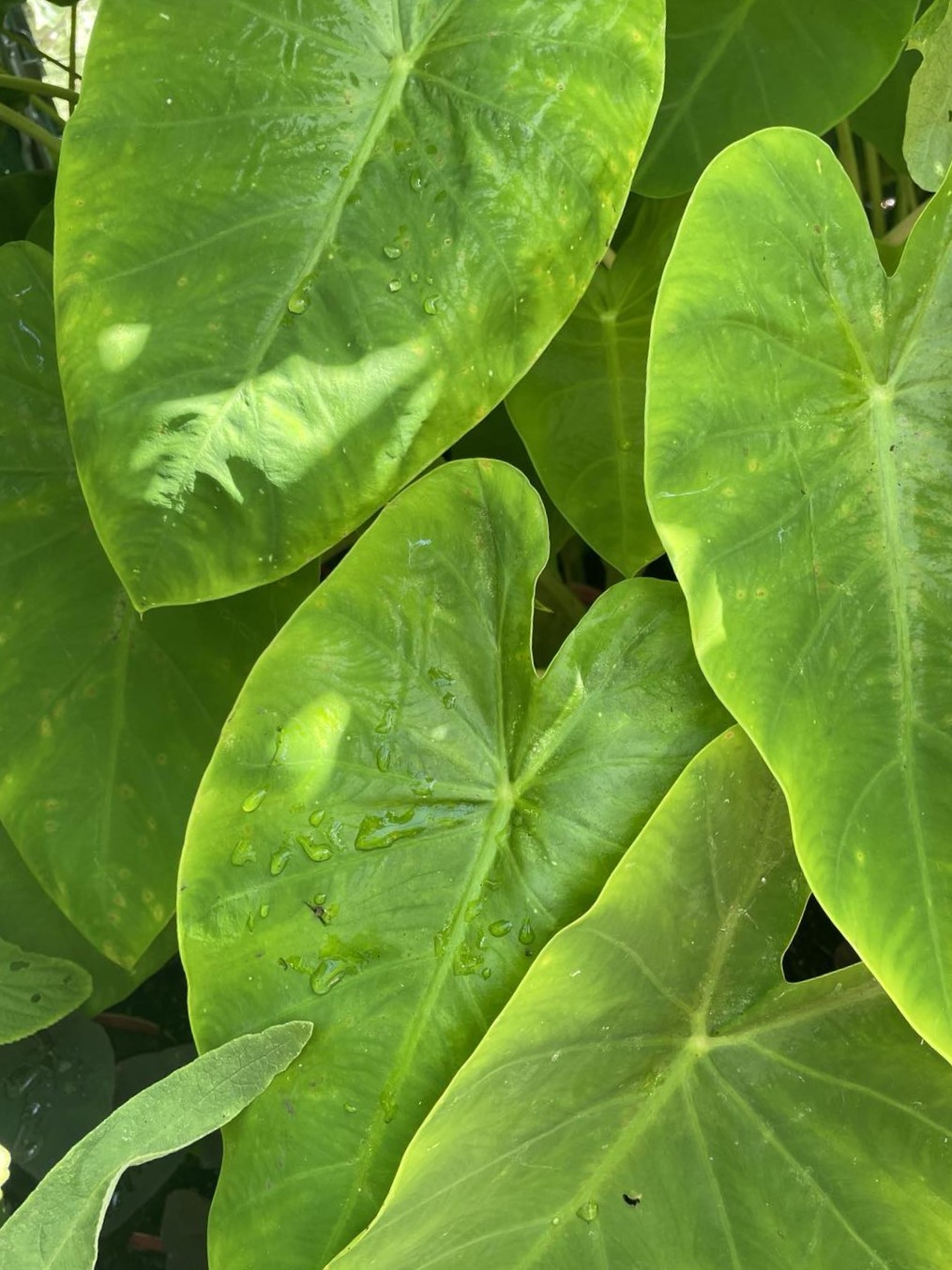
Taro is a clumping herbaceous perennial arising from a central underground corm. Depending on the cultivar and growing conditions, the foliage may stand approximately 3–6 feet tall or higher. Plants grown in rich, wet, warm conditions may become large and dense, while potted ornamental forms may remain smaller.
The leaves are very large, smooth, and generally heart-, shield-, or arrow-shaped, with strong veins radiating through the blade. Green is most common, but ornamental cultivars may have purple, black, bronze, blue-green, cream, pink, red, mottled, or variegated foliage.
The petiole is attached to the underside of the leaf blade inward from the margin, creating a peltate leaf. This feature helps distinguish taro from many Alocasia and Xanthosoma plants, whose stalks more commonly meet the blade at or close to the basal notch. However, identification should use the whole plant, not one feature alone.
Flowers, Corms, Cormels, and Other Plant Parts
The flowering structure consists of a greenish or yellowish spathe surrounding a pale yellow, cream, or white spadix. Flowering is uncommon on many ornamental specimens and is not necessary for identification. When present, flowers and fruiting structures should be treated as raw irritating plant material.
The underground storage organ is a corm rather than a true bulb or ordinary root. Cultivars may produce one large central corm, numerous smaller cormels, stolons, or combinations of storage structures depending on type and growing conditions.
Every raw part should be treated as potentially irritating. This includes leaves, petioles, corm skin and flesh, cormels, roots, flowers, fruits, seeds, sap, shoots, kitchen peelings, and propagation pieces. Food cultivars are not naturally free of oxalate hazards merely because they can be prepared for people.
Why Raw Taro Burns the Mouth
Raphides form inside elongated idioblast cells and help the plant regulate calcium while discouraging herbivores. Once the plant is chewed, the cells rupture and the crystals become embedded in soft tissue. The immediate puncture injury produces burning pain, swelling, drooling, and difficulty swallowing.
The injury is immediate because it does not depend on absorption. The punctures also allow sap proteins and other irritants to contact tissue below the surface, increasing pain and inflammation. Some cultivars and plant parts are noticeably more acrid than others.
Visual appearance, leaf color, cultivar name, food use, or market label cannot reliably predict whether an unprocessed piece will irritate an animal. A green food taro, a black ornamental taro, a Japanese satoimo-type cormel, and a kitchen peeling all deserve raw-plant caution unless they have been processed appropriately for human food—and even then they should not be used as pet first aid.
What Research Shows About Raphide-Associated Proteins
Exact-species research recovered proteins associated closely with taro raphides. These included profilins, which are recognized plant-allergen proteins, and proteins that may participate in calcium oxalate crystal growth, adhesion, and organization.
The findings support a more complex model than “needles alone.” They do not establish that every oral reaction is an IgE-mediated allergy or identify one protease as the universal taro toxin. Mechanical injury from the crystals remains the confirmed primary cause of the acute veterinary syndrome.
Allergy, associated proteins, cultivar chemistry, surface deposits on raphides, soluble irritants, and individual sensitivity may influence how intense a reaction becomes. That is why two animals can chew similar raw plant material and show different degrees of swelling, drooling, or food refusal.
Cooking Reduces Risk but Is Not Pet First Aid
Boiling, steaming, soaking, drying, fermenting, and other traditional processes can reduce taro acridity. Research on taro cormels, leaves, petioles, and flowers has shown that processing can reduce soluble oxalates and, in some plant parts, reduce the number, dimensions, or sharpness of needle-like crystals.
Processing success depends on the cultivar, plant part, piece size, temperature, cooking duration, water changes, soaking conditions, pH, and local preparation method. Light cooking, quick microwaving, partial baking, brief steaming, raw tasting, or assuming a cultivar is “food taro” is not a dependable safety test.
Cooking information belongs to food preparation, not emergency treatment. An animal that chewed raw taro should not be given cooked taro, milk, yogurt, cheese, coconut milk, oil, bread, or another food in an attempt to neutralize crystals already embedded in the mouth or throat.
Caladium, Alocasia, Xanthosoma, Malanga, and Elephant Ear Confusion
True caladiums belong to the genus Caladium and often have thinner, brightly patterned leaves. Giant elephant ears may belong to Alocasia, while malanga, yautia, tannia, or new cocoyam commonly refers to Xanthosoma. “Elephant ear” can be used for all of these in nurseries, garden centers, and landscape language.
These plants are related aroids rather than botanical synonyms for taro. Many contain raphides and cause a similar oral-pain syndrome, so the immediate veterinary response may be similar even when exact identification remains uncertain.
Correct identification still matters for documenting the exposure, recognizing food-crop material, evaluating pesticides and herbicides, preserving market or nursery labels, and determining whether another plant with a different toxin was present in the same clipping pile or food scrap source.
Dogs and Cats
Dogs and cats generally react immediately, which limits consumption. Drooling, head shaking, mouth pawing, gagging, vomiting, and temporary food refusal are the most recognizable signs.
Dogs may eat raw corm peelings, kitchen scraps, compost, ornamental leaves, or clippings. Cats may chew indoor elephant-ear leaves, new shoots, or freshly cut pieces brought indoors. Both may rub contaminated paws or muzzles into the eyes after contacting sap.
A pet that repeatedly seeks out houseplants or raw scraps may have boredom, pica, anxiety, dental discomfort, gastrointestinal disease, nausea, dietary imbalance, stress, compulsive behavior, or another behavioral or medical issue that deserves separate evaluation. Preventing access is essential, but repeated plant eating should not be dismissed as harmless curiosity.
Horses, Livestock, Pigs, Poultry, and Other Farm Animals
Horses and livestock are most likely to encounter taro through wetland or subtropical landscaping, crop fields, raw processing waste, kitchen scraps, greenhouse disposal, storm-damaged ornamental plantings, or clippings thrown into an enclosure. Horses cannot vomit and should never be drenched after exposure, especially when salivation, coughing, choking, or impaired swallowing is present.
Pigs may consume raw corms, cormels, peelings, and food waste more readily than many other animals. Goats and sheep may browse leaves and petioles if clippings are offered. Cattle, camelids, and other grazing animals may sample taro when it is mixed with other plants or when forage is limited.
Several animals affected after eating the same scraps, hay, compost, crop waste, or landscape debris should trigger investigation of the whole source. Taro may be only one component in a mixed exposure involving other aroids, lilies, rhododendrons, yew, oleander, sago palm, nightshade, pesticides, herbicides, mold, or spoiled food.
Rabbits, Guinea Pigs, Birds, Reptiles, and Other Exotics
Rabbits and guinea pigs may stop eating because of mouth pain, creating a secondary risk of gastrointestinal stasis. They cannot vomit, so drooling, tooth grinding, food refusal, reduced fecal output, hunched posture, weakness, or diarrhea after raw taro exposure requires prompt veterinary advice.
Parrots may shred leaves and petioles with the beak, exposing the tongue and oral lining directly. Poultry may peck raw corms, scraps, peelings, and compost. Captive birds may show beak wiping, regurgitation, reduced appetite, abnormal droppings, weakness, or inability to perch after exposure.
Reptiles and tortoises should not be given taro leaves as humidity cover, enclosure greenery, or browse unless a qualified reptile veterinarian or nutrition specialist has specifically approved the plant and preparation. The fact that taro grows in a tropical habitat does not make raw ornamental foliage safe enclosure décor.
Diagnosis
Diagnosis usually depends on witnessed exposure, rapid onset of compatible signs, and plant identification. Useful photographs show the whole plant, leaf attachment, corms, cormels, petioles, flowers, cultivar label, market label, kitchen scraps, peelings, potting material, and chewed pieces.
The veterinarian will assess the lips, tongue, oral cavity, pharynx, breathing, swallowing, hydration, vomiting, stool, and eyes. Sedation may be required for a thorough examination, but airway stability must be considered before sedating an animal with progressive swelling.
Blood testing is usually unnecessary after a mild exposure. Persistent vomiting, substantial dehydration, weakness, respiratory distress, eye injury, collapse, severe systemic signs, or findings inconsistent with localized irritation may justify electrolyte testing, serum chemistry, blood-gas assessment, imaging, eye staining, or investigation for another toxin.
Veterinary Treatment and Prognosis
No antidote removes crystals already embedded in tissue. Treatment begins with ending exposure, removing loose plant fragments, gently clearing the mouth, controlling pain and vomiting, and monitoring swallowing and respiration.
Veterinary care may include analgesics, antiemetic medication, fluid and electrolyte therapy, gastrointestinal support, oxygen, and treatment of skin or eye injury. Significant pharyngeal or laryngeal edema may require injectable medication, intubation, or an emergency surgical airway.
Most limited exposures have a good to excellent prognosis. Marked improvement commonly occurs within several hours, with uncomplicated recovery expected within approximately one day. The outlook becomes more guarded when airway obstruction, aspiration, severe eye injury, extensive oral or esophageal injury, significant dehydration, or a mixed exposure develops.
Prevention
Keep ornamental taro away from pets and livestock, collect fallen leaves and pruning debris, and secure raw corms, peelings, petioles, leaves, and food-processing waste. Do not place any raw Colocasia material in animal enclosures, bird cages, rabbit areas, reptile habitats, poultry runs, pig pens, horse paddocks, goat pens, livestock feed areas, or accessible compost.
Label ornamental cultivars with the scientific name. Names such as elephant ear, caladium, cocoyam, and malanga are too ambiguous to support confident emergency identification by themselves. Keep nursery tags, food packages, market labels, and cultivar names when possible.
After pruning or food preparation, clean sap from counters, floors, tools, sinks, cutting boards, buckets, gloves, and footwear before animals regain access. The small pieces left after cooking preparation can be more realistic animal hazards than the standing plant.
Immediate Steps After Exposure
Stop further chewing. Move the animal away from the plant, raw corm, cormel, leaf, petiole, kitchen peeling, propagation piece, crop waste, compost, pruning debris, or mixed elephant-ear clippings. Do not allow another animal to investigate the same material while the first animal is being assessed.
- Remove loose plant fragments safely: If the animal is alert and cooperative, take visible pieces from the lips and front of the mouth. Do not reach deeply into the throat or place your fingers near the teeth of a frightened or painful animal.
- Gently clear residue when swallowing is normal: Wipe the lips and front of the mouth with a damp cloth or allow a small amount of clean water to rinse loose material. Do not pour or spray water forcefully into the mouth.
- Prevent eye contamination: Stop the animal from rubbing sap-covered paws, muzzle, feathers, or fur into the eyes.
- Preserve identification evidence: Photograph the whole plant, leaf attachment, corm, cormels, petioles, pot label, food package, kitchen scraps, cultivar name, and chewed material.
- Check for co-exposures: Determine whether the animal also contacted fertilizer, pesticide, herbicide, fungicide, rooting hormone, potting mix, compost, mold, spoiled food, decorative stones, plastic, or another plant.
- Contact a veterinarian or animal poison-control service: Report the species, weight, plant part, estimated amount, time of exposure, breathing, swallowing, vomiting, diarrhea, possible eye contact, and whether the animal can eat or drink.
Skin or Eye Exposure
- Rinse sap from skin and fur: Use lukewarm running water to remove visible residue and prevent grooming until the contaminated area is clean.
- Clean paws, muzzle, feathers, and belly: Sap on the feet, face, feathers, or coat may be swallowed later during grooming or rubbed into the eyes.
- Flush an exposed eye promptly: Use sterile saline or clean lukewarm water and allow it to flow gently across the eye. Do not rub the eye or attempt to remove microscopic crystals with tweezers, cloth, cotton swabs, or fingers.
- Seek examination for persistent eye signs: Continuing squinting, tearing, redness, cloudiness, discharge, light sensitivity, swollen eyelids, or refusal to open the eye may indicate corneal injury.
Do Not Attempt Unsupervised Home Treatment
- Do not induce vomiting: Hydrogen peroxide, salt, mustard, syrup of ipecac, dish soap, detergent, and manual gagging can cause additional injury or aspiration. Vomiting may bring irritating plant material back across the mouth and esophagus.
- Do not force milk, yogurt, cheese, food, or water: Dairy does not remove crystals already embedded in tissue, and forced material can enter the lungs when swallowing is painful or the throat is swollen.
- Do not give diphenhydramine automatically: An antihistamine does not remove raphides, and sedation can complicate assessment of swallowing, weakness, and airway function.
- Do not administer activated charcoal without veterinary direction: Charcoal does not extract insoluble crystals from tissue and may be aspirated by a drooling, gagging, vomiting, weak, sedated, or poorly swallowing animal.
- Do not give Kapectolin, Kaopectate, sucralfate, loperamide, antacids, antiemetics, antibiotics, essential oils, topical human creams, or human pain medication: Treatment must be selected for the animal’s species, size, symptoms, swallowing ability, and medical history.
- Do not give raw or cooked taro as a “neutralizer”: Food preparation is not first aid, and adding more material to a painful mouth or swollen throat can worsen aspiration risk.
- Do not drench horses or livestock: Never force water, oil, milk, charcoal, electrolytes, or medication into an animal that is coughing, choking, salivating heavily, weak, depressed, or unable to swallow normally.
When Emergency Examination Is Especially Important
- Breathing becomes noisy or difficult: Stridor, open-mouth breathing, neck extension, rapid respiratory effort, blue-gray gums, or increasing distress may indicate airway swelling.
- The animal cannot swallow normally: Repeated swallowing attempts, choking, gagging, saliva pooling in the mouth, water falling from the lips, or nasal reflux requires urgent assessment.
- Swelling is increasing: Progressive tongue, facial, pharyngeal, glottic, or throat swelling can worsen after chewing has stopped.
- Vomiting or diarrhea is persistent: Continuing fluid loss can cause dehydration and electrolyte abnormalities.
- The eye may have been exposed: Significant pain, cloudiness, marked redness, discharge, light sensitivity, or persistent squinting requires prompt corneal examination.
- Severe systemic signs develop: Tremors, seizures, collapse, coma, abnormal heart rhythm, or profound weakness does not fit an uncomplicated taro exposure and requires immediate investigation.
- A rabbit, guinea pig, bird, or other small animal stops eating: Food refusal can lead to gastrointestinal stasis, weakness, and other secondary complications.
- Several animals are affected: Group illness raises concern for crop waste, kitchen scraps, contaminated compost, pesticides, herbicides, spoiled food, mixed clippings, or another toxic plant.
Veterinary Treatment
The veterinarian will assess the lips, tongue, oral cavity, pharynx, breathing, swallowing, hydration, abdominal comfort, vomiting, diarrhea, and eyes. Loose plant material may be removed and the mouth gently wiped or rinsed. Pain relief and airway monitoring are generally more useful than aggressive gastrointestinal decontamination.
An alert patient breathing comfortably and swallowing normally may receive a small veterinarian-approved amount of water or soothing food. Nothing should be given orally when swelling, gagging, vomiting, weakness, sedation, altered mentation, or impaired swallowing creates an aspiration risk.
Veterinary care may include analgesics, antiemetic medication, fluid and electrolyte therapy, gastrointestinal support, oxygen, and treatment of skin or eye injury. Significant pharyngeal or laryngeal edema may require injectable medication, intubation, or an emergency surgical airway.
Blood testing is not usually required after a mild exposure. Persistent vomiting, substantial dehydration, weakness, respiratory distress, collapse, severe eye injury, or findings inconsistent with localized irritation may justify electrolyte testing, serum chemistry, blood-gas assessment, imaging, eye staining, or investigation for another toxin.
Horse, Livestock, Pig, Rabbit, Bird, and Exotic Exposures
Remove access to landscape plants, crop waste, kitchen scraps, compost, greenhouse waste, clipping piles, raw corms, peelings, and mixed elephant-ear debris. Preserve a sample of all plants and scraps because multiple species or chemicals may be involved.
- Do not drench large animals: Forced oral products can be aspirated when swallowing is abnormal.
- Inspect mixed clippings: Landscape debris may include more dangerous plants such as yew, oleander, rhododendron, azalea, Japanese pieris, lilies, sago palm, nightshade, or treated material.
- Remove raw food waste: Raw corms, peelings, leaves, petioles, and failed cooking batches should not be placed in pig pens, poultry runs, horse paddocks, goat yards, rabbit areas, or compost accessible to animals.
- Watch small herbivores closely: Rabbits and guinea pigs that stop eating or produce fewer fecal pellets need prompt veterinary advice.
- Use avian care for birds: Beak wiping, regurgitation, abnormal droppings, weakness, inability to perch, or incoordination after shredding leaves or scraps requires avian veterinary input.
Recovery and Prognosis
Most animals recover completely after a limited exposure. Marked improvement often occurs within several hours, and uncomplicated cases commonly resolve within approximately 12–24 hours.
- Monitor mouth pain: Drooling, pawing, gagging, food refusal, or painful swallowing should improve rather than worsen.
- Monitor breathing: Noisy breathing, neck extension, blue-gray gums, open-mouth breathing, or increasing effort is an emergency.
- Monitor hydration: Repeated vomiting, diarrhea, refusal to drink, tacky gums, sunken eyes, weakness, or reduced urination requires reassessment.
- Monitor eyes: Persistent squinting, cloudiness, discharge, swelling, or light sensitivity requires prompt care.
- Monitor small animals closely: Rabbits, guinea pigs, birds, and other small animals should resume eating and producing normal droppings promptly.
- Monitor for signs that do not fit: Seizures, coma, organ injury, collapse, severe neurologic signs, or cardiovascular instability should prompt investigation for another toxin or complication.
Continuing mouth pain, food refusal, vomiting, diarrhea, coughing, swallowing difficulty, respiratory noise, reduced fecal output, or eye pain deserves reassessment. Extensive oral, esophageal, or ocular injury may require treatment for several days.
Frequently Asked Questions About Taro and Animal Poisoning
How can Taro be edible for people but poisonous when raw?
Taro becomes food only after cultivar-appropriate processing. Peeling, soaking, boiling, steaming, fermenting, drying, baking, pounding, or other traditional methods can reduce soluble oxalates, alter raphide structure, denature associated proteins, leach irritants, and remove acridity. Raw or underprocessed taro can still cause immediate mouth and throat injury.
What toxin makes raw Taro dangerous?
The confirmed toxic structures are insoluble calcium oxalate crystals, especially needle-shaped raphides stored inside specialized idioblast cells. Chewing releases the crystals into the lips, tongue, mouth, throat, and esophagus, causing immediate pain, inflammation, drooling, swelling, gagging, and difficulty swallowing.
Does Taro also contain a protein toxin?
Proteins have been found attached to taro raphides, including profilins with potential allergenic activity and proteins involved in crystal development or adhesion. Older research proposed that a protease or soluble irritant intensifies raphide injury. A specific clinically important protease has not been confirmed as firmly as the calcium oxalate crystals themselves.
Which parts of Taro are poisonous when raw?
Raw leaves, petioles, corms, cormels, roots, sap, flowers, fruits, seeds, shoots, kitchen peelings, and propagation pieces should all be treated as potentially irritating. Food cultivars are not naturally free of oxalates merely because their corms or leaves are eaten after traditional processing.
Are ‘Black Magic,’ ‘Mojito,’ and other ornamental Colocasia cultivars toxic?
Yes. ‘Black Magic,’ ‘Black Coral,’ ‘Illustris,’ ‘Mojito,’ ‘Hilo Bay,’ ‘Rhubarb,’ and other ornamental forms should all be treated as raw calcium-oxalate plants. Purple, black, blue-green, red-stemmed, mottled, or variegated leaves have not been shown to be safe for animals.
Is Taro the same as Caladium or Malanga?
No. Taro belongs to Colocasia. True caladiums belong to Caladium, and malanga commonly refers to Xanthosoma. “Elephant ear” and “cocoyam” can identify several genera. Many of these related plants contain raphides, but they are not exact botanical synonyms.
How quickly do symptoms appear?
Signs usually begin immediately or within minutes because the crystals injure tissue as soon as the raw plant is chewed. An animal may suddenly release the plant, shake its head, paw at the mouth, drool, gag, or refuse food and water. Swelling can continue after chewing has stopped.
Can Taro block an animal’s airway?
Severe airway obstruction is uncommon but possible when tongue, pharyngeal, glottic, or laryngeal swelling becomes substantial. Noisy breathing, open-mouth respiration, neck extension, inability to swallow saliva, blue-gray gums, weakness, or collapse requires immediate emergency treatment.
Can raw Taro cause kidney or liver failure?
Primary kidney failure and permanent liver damage are not expected from an uncomplicated raw-taro exposure. Its insoluble raphides cause local tissue injury rather than the systemic hypocalcemia and renal deposition produced by soluble oxalates. Organ abnormalities suggest severe secondary dehydration, another toxin, mistaken plant identification, or unrelated disease.
Should milk or yogurt be given after ingestion?
Do not force dairy products. Milk or yogurt does not remove crystals already embedded in tissue, and forced material may enter the lungs when the animal is gagging, vomiting, weak, or its throat is swollen. Oral material should be offered only when breathing and swallowing are clearly normal and a veterinarian approves it.
Should I make my pet vomit or give activated charcoal?
No, unless a veterinarian specifically directs treatment after assessing the case. Vomiting can expose the mouth and esophagus to irritating material again. Activated charcoal does not remove insoluble crystals from tissue and may be aspirated by a drooling, gagging, vomiting, weak, or poorly swallowing animal.
Can raw Taro scraps in the kitchen poison a dog or cat?
Yes. Raw corm peelings, trimmed ends, leaf pieces, petioles, failed cooking batches, and scraps dropped during preparation can all expose an animal to raphides. Kitchen waste may be more accessible than the standing plant and may also include seasonings, oils, plastic, packaging, mold, or spoiled food that changes the case.
Can pigs, goats, or poultry eat raw Taro waste?
They should not be given raw taro waste. Pigs may eat raw corms or peelings readily, goats may browse leaves and petioles, and poultry may peck scraps or compost. Raw food-crop waste can cause oral pain, feed refusal, salivation, diarrhea, and swallowing trouble and may expose several animals at once.
Is cooked Taro safe for pets?
Properly prepared plain taro may be a human food, but it is not a first-aid treatment and should not be offered to neutralize raw-plant exposure. Pet safety depends on preparation, amount, ingredients, species, and the animal’s health. Taro prepared with salt, fat, garlic, onion, spices, dairy, sugar, coconut products, or sauces may create separate dietary or toxic concerns.
Can raw Taro hurt an animal’s eyes?
Yes. Sap or crushed tissue can transfer raphides into the eye and cause tearing, blinking, squinting, redness, swelling, and pain. Flush gently with sterile saline or clean lukewarm water and prevent rubbing. Persistent squinting, cloudiness, discharge, light sensitivity, or refusal to open the eye requires veterinary examination.
Why should horses and livestock not be drenched?
Forced oral fluids, oil, milk, charcoal, electrolytes, or medication can enter the lungs when an animal is salivating, coughing, choking, weak, or unable to swallow normally. Horses cannot vomit, and raw taro can make swallowing painful. Drenching should not be attempted unless a veterinarian specifically directs and manages the situation.
Is Taro dangerous to rabbits, guinea pigs, or birds?
Yes. Rabbits and guinea pigs cannot vomit and may stop eating because of mouth pain, creating a risk of gastrointestinal stasis. Birds may shred leaves, petioles, and corm pieces with the beak. Food refusal, reduced droppings, regurgitation, weakness, inability to perch, or respiratory signs after exposure requires species-appropriate veterinary care.
Do drying, wilting, freezing, or partial cooking make Taro safe?
No reliable safety assumption should be made from those changes alone. Wilting or drying may reduce some moisture and alter some soluble material, but raphides and irritating tissue can remain. Freezing does not prove the crystals are gone. Partial cooking may leave the plant acrid, especially in thick corm pieces, petioles, leaves, or flowers.
What signs do not fit ordinary raw-Taro exposure?
Seizures, coma, primary kidney failure, permanent liver damage, dangerous heart abnormalities, sudden death, or severe neurologic disease are not expected from an uncomplicated raw-taro bite. Those signs require investigation for another toxin, airway-related hypoxia, severe dehydration, chemical exposure, medication ingestion, soluble oxalates, ethylene glycol, or unrelated disease.
What is the usual prognosis?
The prognosis is good to excellent after most limited exposures. Pain, drooling, and food refusal often improve within several hours, with uncomplicated recovery in approximately 12–24 hours. Airway swelling, aspiration, severe eye injury, extensive ulceration, significant dehydration, or prolonged food refusal in small animals makes the case more serious.
How can Taro poisoning be prevented?
Keep ornamental taro inaccessible, collect pruning debris, secure raw corms and peelings, and keep food-preparation waste out of reach. Do not place raw Colocasia material in horse paddocks, goat pens, pig areas, poultry runs, rabbit enclosures, reptile habitats, aviaries, livestock feed areas, or accessible compost. Preserve scientific names and cultivar labels because common names such as elephant ear, cocoyam, caladium, and malanga are ambiguous.