Grooming Nooses • Cable Grooming Noose • Chew-Resistant Restraint • Table Safety • Emergency Removal • Muzzle Risk
Cable Grooming Nooses: Chew-Resistant, Situational, and Capable of Making a Bad Dog Panic Worse
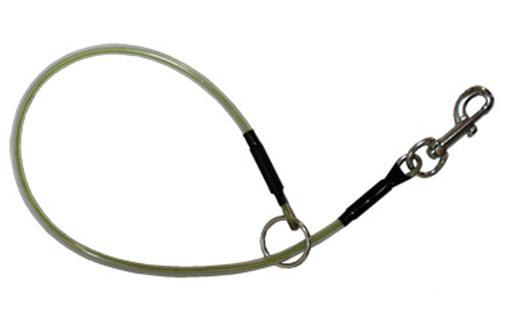
Cable grooming nooses are exactly what they sound like: grooming nooses made from plastic-coated metal cable so they are more resistant to chewing.
The key word is resistant. I have seen larger dogs chew one in half anyway.
We had these in our stores, but I would consider them a situational-use item, not an all-the-time use item. We used them on dogs we knew liked to chew on nooses.
The problem is that cable nooses are not just tougher fabric loops. They behave more like true nooses. If the dog fights, thrashes, or tries to escape, the noose can tighten around the neck and turn a restraint problem into a panic problem.
Chew-resistant does not automatically mean safer. It means the tool solves one problem while creating a few others you had better be ready to manage.
⚠️
Operator rule
A cable noose is for the dog that has proven it will chew through soft restraint. It is not my everyday default because the failure mode can be worse than a fabric loop.
🗺️
Use This Page Like a Cable Noose Safety Check
Cable nooses solve the chewing problem, but they need more caution than ordinary fabric loops.
⛓️
What It Is
A plastic-coated metal cable noose designed to resist chewing better than soft fabric loops.
📣
Marketing Claims
The 1,200-pound tensile-strength pitch sounds impressive, but it is not the real grooming-room issue.
🫁
True Noose Risk
Unlike a fabric loop with a stop, a cable noose can tighten as the dog fights it.
🧶
Coat Tangling
The plastic coating may reduce tangles, but long coat under tension can still become a mess.
✂️
Emergency Removal
Cable is not cloth. Scissors may not help, which is why cable cutters belong nearby.
🐕
Muzzle Problem
Any noose that slides over the head can catch muzzle straps and remove the muzzle.
⛓️
What a Cable Grooming Noose Is
It is a grooming noose made from plastic-coated metal cable, built mainly for dogs that chew restraint loops.
Cable grooming nooses are made from plastic-coated metal cable so they are chew resistant.
That is the reason they exist.
Some dogs will chew fabric nooses if they can get slack in their mouth. Some will chew a dangling strap. Some will chew because they are nervous, bored, angry, smart enough to know the strap is the thing keeping them there, or just because they are dogs and dogs make weird little hobby choices.
A cable noose gives the groomer a tougher restraint option for those dogs.
But tougher is not the same thing as better for every dog.
A fabric grooming loop is more forgiving because it is really a loop with a stop. A cable grooming noose behaves more like a true noose. That difference matters when the dog stops standing calmly and starts fighting the equipment.
📌
Main distinction
Fabric loops usually fail by being chewed, slipped, or misused. Cable nooses can fail by tightening into the exact panic that makes the dog fight harder.
📣
The 1,200-Pound Tensile Strength Pitch
Product copy loves impressive numbers. Grooming rooms care about what happens when the dog panics.
I find the advertising pitch used with these to be a bit humorous when it states they are made of ultra-tough cable with a tensile strength of 1,200 pounds.
The 1,200-pound reference is a bit of useless information for my purposes.
I doubt I will be using this to groom large domestic grazing animals, nor do I plan on stringing a bunch of them together to pull a car out of a ditch.
The real question is not how much straight-line force the cable can technically tolerate.
The real question is whether the tool is safe, practical, removable, and appropriate when attached to a moving, scared, chewing, twisting dog on a grooming table.
⚠️
Spec-sheet warning
Strength ratings do not tell you how the noose behaves around a dog’s neck under panic, coat tangling, muzzle conflict, or emergency removal.
🎯
Why I Treat Cable Nooses as Situational Equipment
We owned them, but we did not use them on every dog.
I would consider these to be a situational-use item and not an all-the-time-use item.
We had them at our stores, but we only used them on dogs that we knew liked to chew on nooses.
That is the correct lane for this tool.
A known chewer may make a fabric loop unsafe because the dog can damage or destroy the restraint. In that case, a cable noose may be the better choice.
But putting a cable noose on every dog because it is tougher is backwards thinking.
For a normal dog, I would rather use a more forgiving fabric loop, quick-release loop, or another restraint that fits the situation. I do not want the more serious tightening behavior of a cable noose unless the chewing problem justifies it.
🫁
The Main Problem: Cable Nooses Are True Nooses
This is the safety section that matters most.
The main issue I have against their regular use is that, unlike other grooming nooses that are really a loop with a stop, these are truly nooses.
In application, caution has to be used to ensure that a dog does not choke off either its air or blood supply.
In the event that you get a dog on the table that tries to fight, thrash about, or escape, this type of noose can tighten around the neck, cutting off the dog’s air or blood supply.
As a result, the animal will panic, causing it to struggle and fight more because it is now dealing with the feeling of being strangled or dying.
That is the ugly feedback loop.
The dog fights the noose. The noose tightens. The dog feels pressure. The dog panics harder. The noose gets tighter. Now the groomer is not dealing with a dog that dislikes grooming. The groomer is dealing with a dog that believes something around its neck is trying to kill it.
That is why I do not like cable nooses as an everyday default.
⚠️
Panic-loop warning
A restraint that tightens under resistance can create the exact panic that makes the dog resist harder. That is the core cable noose risk.
🧶
The “No-Tangle” Coating Is Only a Half Truth
Plastic coating may help, but long coat and tension can still turn the loop into a mess.
The other issue that I have with this item is that although it may advertise a no-tangle plastic coating, that is only a half truth.
The large metal loop can become quite ensnarled in the coat of a long-haired animal, especially under tension.
In the event that the animal begins to struggle against it, the loop will at times tangle in the hair, preventing it from being loosened.
As a result, it can become quite difficult to quickly remove because you may have to work your fingers in between the cable and the neck to loosen it up.
This can be a very exciting task, especially when you are likely dealing with a pet that is now very scared and more than willing to fend off perceived threats to its health.
That is not the moment you want to discover that “no-tangle” did not mean what the product copy made it sound like it meant.
📌
Long-coat caution
Long coat, tension, and a scared dog are a bad combination. A cable loop caught in coat may not loosen quickly when you need it to.
✂️
Emergency Removal: Cable Is Not Cloth
This is the part people do not think about until the noose is already locked around a scared dog’s neck.
Adding insult to injury is the fact that it is made of cable, not cloth, so most groomers will not have a readily available way to cut it off in the event that it becomes locked around an animal’s neck.
With cloth nooses, a groomer can use scissors if need be.
Cable is different.
That is why we kept a small pair of cable cutters in the grooming cabinet.
That may sound dramatic until you are standing there with a dog fighting a cable noose that has tightened, tangled, or refused to loosen. At that point, the tool you did not think you would need becomes the most important tool in the room.
Do not use restraint equipment without knowing how you will get it off if the dog makes the situation go sideways.
⚠️
Cabinet rule
If cable nooses are used in the grooming room, keep cable cutters accessible. Not buried in a truck, not in somebody’s toolbox, not “somewhere around here.” Accessible.
🐕
The Muzzle Problem: Over the Head Means Back Over the Head
Sounds obvious, but this is where removal can become exciting in the wrong way.
Lastly, any grooming noose or other implement that must be slid over the head must also be slid off the head.
Sounds obvious, I know.
But problems can arise when trying to use nooses of this type with pets that are muzzled.
It is not uncommon at all for certain types of nooses to either tangle in or grab the straps of the muzzle when being removed, taking the muzzle with it.
The result is an unsecured, non-muzzled, and disgruntled dog that must now be dealt with.
The only workaround is to unclasp the noose from the table and use it as a leash or handle when transporting the animal from the table to the tub or drying station.
But it still must be removed when the animal is caged, which can be a potentially exciting task when dealing with a highly agitated animal.
This is exactly why quick-release nooses matter. Being able to unclip at the neck instead of dragging a loop backward over the muzzle can prevent a lot of nonsense.
⚠️
Muzzle warning
If the dog needs a muzzle, think carefully before using any noose that must slide backward over the head during removal.
✅
When I Would Use a Cable Grooming Noose
The right use case is narrow: known chewers, controlled setup, and a groomer paying attention.
I would use a cable grooming noose when the dog has a known habit of chewing through fabric loops or soft restraint.
That is the problem it solves.
It may also make sense during a short, closely supervised table session where the chewing risk is greater than the tightening and tangling concerns.
But the groomer needs to stay aware of the dog’s behavior, coat type, muzzle status, breathing, panic level, and ability to reach the noose.
Cable nooses are not something I would slap on every dog just because they look tougher. Tougher equipment can create tougher problems.
🚫
When I Would Not Use a Cable Grooming Noose
Do not use the more dangerous failure mode when a simpler loop will do.
I would not use a cable grooming noose as the default loop for normal, cooperative dogs.
I would be cautious with long-coated dogs where the loop can tangle in coat under tension.
I would be cautious with muzzled dogs because removal over the head can catch the muzzle straps and pull the muzzle off.
I would also avoid it with dogs likely to thrash hard enough to create a tightening panic unless the chewing problem is so serious that the cable noose is the least bad option.
That is how I look at this tool: sometimes useful, never casual.
Swipe left/right to see the full table.
| Situation | Cable Noose Fit | Main Risk | Better Default |
|---|---|---|---|
| Known noose chewer | Good situational choice. | Tightening under panic. | Cable noose with close supervision and cutters nearby. |
| Normal cooperative dog | Usually unnecessary. | Using more risk than the dog requires. | Fabric grooming noose. |
| Long-coated dog | Use caution. | Cable loop can tangle in coat under tension. | Fabric or quick-release option when appropriate. |
| Muzzled dog or fear biter | Usually not my first choice. | Noose can pull muzzle off during removal. | Quick-release grooming noose. |
| Dog likely to thrash hard | High caution. | Tightening can create choking panic. | Safer restraint plan based on dog behavior. |
✅
My Operator Verdict on Cable Grooming Nooses
Own them for chewers. Do not use them like ordinary everyday loops.
My verdict is that cable grooming nooses are situational tools.
We had them in the stores, but we used them only on dogs we knew liked to chew on nooses.
They are chew-resistant, not chew-proof, and the fact that they are made of cable does not magically make them safer.
The main problem is that they behave like true nooses. If a dog fights, thrashes, or tries to escape, the noose can tighten around the neck and create choking pressure. That pressure can make the dog panic harder, which can make the whole situation worse.
They can also tangle in long coat, especially under tension. They are harder to cut off than cloth nooses. They can catch muzzle straps during removal. All of that matters.
Use them when the chewing problem justifies the added risk.
Keep cable cutters in the grooming cabinet.
Watch the dog like the tool can become the problem, because it can.
⚠️
Final take
Cable nooses solve one problem: chewing. They create different problems: tightening, panic, tangling, muzzle conflict, and emergency removal. That tradeoff makes them situational, not standard.
❓
Cable Grooming Noose FAQ
Straight answers about chew resistance, true noose behavior, coat tangling, cable cutters, and muzzle problems.
What is a cable grooming noose?
It is a grooming noose made from plastic-coated metal cable, designed to resist chewing better than a fabric loop.
Are cable nooses chew-proof?
No. They are chew-resistant, not chew-proof. I have seen larger dogs chew one in half regardless.
Why not use cable nooses on every dog?
Because they behave more like true nooses and can tighten under resistance. That makes the failure mode more serious than a basic fabric loop.
What is the biggest safety risk?
A dog that fights, thrashes, or tries to escape can cause the noose to tighten around the neck, creating choking pressure and panic.
Do cable nooses tangle in coat?
They can. The plastic coating may help, but long coat and tension can still cause the metal loop to become ensnarled and difficult to loosen.
Why keep cable cutters in the grooming cabinet?
Cable is not cloth. Scissors may cut a fabric loop in an emergency, but a cable noose may require actual cable cutters.
Are cable nooses good for muzzled dogs?
Not usually as my first choice. Any noose that must slide over the head can catch muzzle straps during removal and pull the muzzle off.
When would I use one?
I would use one on a dog known to chew fabric nooses, with close supervision and an emergency removal plan.
What is the main lesson?
Cable nooses are situational tools. Use them when chew risk justifies the added tightening, tangling, muzzle, and emergency-removal risks.
🐾
Bottom Line: Chew-Resistant Does Not Mean Panic-Proof
Use cable nooses for the dogs that need them, not as the default loop for every table.
Cable grooming nooses have a place in a grooming room.
That place is usually the dog that has already proven it will chew through softer nooses.
The tradeoff is real. Cable nooses can tighten like true nooses, tangle in long coat, resist quick removal, require cable cutters, and create muzzle-removal problems.
I would own them. I would use them. I would not use them casually.
The tool is useful when the chewing problem is worse than the cable noose risks. That is the standard.