Grooming Table Hardware • Grooming Harness • Double-Loop Restraint • No-Sit Control • Belly Support • Simple Table Restraint
Grooming Harness: Cheap, Simple No-Sit Control, but I Still Prefer Two Separate Loops
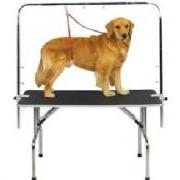
For the money, this is probably the easiest packaged way to prevent a dog from sitting.
This is the no-sit idea stripped down to something useful: two grooming loops attached to a single clasp. One loop controls the head or neck area. The other loop supports under the belly or rear body area to discourage sitting.
I have used these and I like them.
My only real issue is that when you have a good dog on the table that does not need both straps, the unused strap tends to dangle in the dog’s face, which can lead to it getting chewed in half.
Personally, I still prefer two standard groomer’s loops because I can use the second loop when I need it, remove it when I do not, and hang it back on the wall.
⚠️
Operator rule
This is one of the few no-sit items I actually like. It is simple, fast, and understandable. My preference for two separate loops is not because the harness idea is bad; it is because separate loops give me more control over what stays on the table.
🗺️
Use This Page Like a Simple No-Sit Harness Check
This is a shorter, mostly positive page. The grooming harness works. My only debate is whether one combined harness beats two separate loops.
🦺
What It Is
A double-loop grooming table harness with two loops attached to one clasp.
🪢
How It Works
One loop restrains the head area while the other supports the belly or rear body.
🐕
Dangling Strap Problem
When the dog does not need both loops, the unused strap can hang in the dog’s face.
✅
My Preference
I usually prefer two separate loops because the extra loop can be removed when not needed.
🦺
What This Grooming Harness Is
This is the double-loop grooming table harness, not the suspended hammock-style nail-trim sling.
A grooming harness like this is nothing more than two grooming loops attached to a single clasp.
One loop goes around the neck or head area. The other loop supports under the belly or rear body area to help keep the dog from sitting.
That is why I like the idea. It is simple.
It does not require another table contraption. It does not need a chain-heavy restraint system. It does not need a pivoting overhead bar. It does not turn the grooming table into a hardware puzzle.
Clip it to the grooming arm, adjust the loops, support the dog, and get back to grooming.
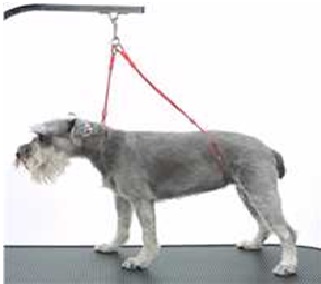
🪢
How the Double-Loop Setup Works
One strap provides belly support while the other controls the head area.
Typically, grooming harnesses can be adjusted for length to make sure one strap provides lift under the belly while the other restrains the head.
This also allows you to adjust the length of the straps based on the size of the dog being worked on.
That adjustability is the useful part.
A small dog does not need the same loop length as a large dog. A dog that is only lightly sitting does not need the same support as a dog trying to fold itself into a loaf of bread every time you touch the rear legs.
The harness gives you a quick way to support the dog without adding a separate no-sit post, belly support frame, or other table hardware.
Swipe left/right to see the full table.
| Harness Part | What It Does | Operator Take |
|---|---|---|
| Neck/head loop | Helps keep the dog positioned at the grooming arm. | Use as control, not as a hanging device. |
| Belly/rear loop | Gives lift and support under the belly or rear body to discourage sitting. | This is the no-sit part that makes the harness useful. |
| Single clasp | Attaches both loops to the grooming arm from one connection point. | Fast and simple, but both loops stay connected unless managed. |
| Length adjustment | Allows the harness to be matched to dog size and support need. | This is why it beats most complicated no-sit gadgets. |
🐕
The Dangling-Strap Problem
The harness works, but the unused strap can become a chew toy if you are not paying attention.
I have used these and like them.
The only issue I have is that when you have a good dog on the table that does not need both straps, the unused strap tends to dangle in the dog’s face.
That can lead to it getting chewed in half.
This is one of those stupid little grooming-room things that sounds minor until you are standing there looking at a half-chewed restraint strap and wondering why the dog now has the expression of someone who just won a small private victory.
To prevent this from happening, the unused strap should be wrapped around the upper grooming arm when not in use.
⚠️
Chew warning
Do not leave unused straps dangling in front of the dog’s mouth. Wrap the unused loop around the upper grooming arm or remove the extra loop if you are using separate loops.
✅
Why I Still Prefer Two Separate Grooming Loops
This is a preference item. The harness works. I just like the separate-loop setup better.
This is a preference item.
For me, I will just use two standard groomer’s loops, one around the neck and the other around the belly.
I will then wrap them over the top of the grooming arm to get the desired length.
When the extra loop is not needed, I just take the additional loop off and hang it back on the wall.
That is why I prefer separate loops. They are modular. I can use one or two. I can remove the second one when the dog does not need belly support. I do not have an unused strap dangling in the dog’s face. If one loop gets worn or chewed, I replace one loop instead of the whole harness.
The grooming harness is still a good tool. I just prefer the separate-loop version of the same basic idea.
Swipe left/right to see the full table.
| Setup | Advantage | Drawback | My Take |
|---|---|---|---|
| Double-loop grooming harness | Fast, simple, one clasp, built-in head and belly support. | Unused strap can dangle in the dog’s face. | Good tool. I like it. |
| Two separate grooming loops | Modular, removable, easy to hang back on the wall. | Requires keeping track of two separate loops. | My preference. |
| No-sit table gadget | May provide support for certain sitters. | More table clutter, more setup, more hardware. | Usually not my first choice. |
| Full positioning system | May help with difficult, weak, elderly, or special-needs dogs. | More cost, training, and restraint complexity. | Use only when the dog or workflow justifies it. |
💵
Current 2026 Market Snapshot and Buying Reality
This category is messy because sellers use similar names for basic loops, no-sit haunch holders, double-loop harnesses, and hammock-style supports.
Current grooming restraint pricing depends on what you are actually buying.
Basic grooming loops can still be very inexpensive, especially in multipacks. Simple loops are useful because every grooming room needs extras, and they are easy to replace when worn or chewed.
Simple no-sit haunch holders and cable-style belly supports often sit in the low-to-mid-teens depending on size, seller, and material.
Dedicated double-loop grooming table harnesses can cost more than the simplest loops, especially when sold as an adjustable neck-and-waist harness with one clasp and broader size adjustment.
Hammock-style grooming harnesses are a different category. Those are usually for suspension-style nail trimming or special support work, not the same double-loop table harness being discussed on this page.
My buying advice is simple: do not overthink this category. For normal no-sit control, start with the simplest safe loop setup that gives you head control and belly support without cluttering the table.
Swipe left/right to see the full table.
| Current 2026 Buying Category | Typical Market Reality | What You Usually Get | Operator Take |
|---|---|---|---|
| Basic grooming loops | Often inexpensive, especially in multipacks. | Simple neck or body loop for grooming arm use. | Keep extras on hand. They get worn, chewed, and misplaced. |
| No-sit haunch holder | Commonly in the low-to-mid-teens depending on seller and size. | Belly or haunch support to discourage sitting. | Useful, but still judge fit and comfort. |
| Double-loop grooming table harness | Can cost more than basic loops when sold as an adjustable table harness. | Neck loop, belly/rear loop, one clasp, length adjustment. | Good simple tool. Watch the dangling strap. |
| Hammock-style grooming harness | Different category and often priced separately. | Sling-style support for nail trims or suspension tasks. | Do not confuse this with the double-loop table harness. |
⚠️
Buying warning
Search terms are messy in this category. Make sure you are buying the double-loop table harness or grooming loops you actually need, not a hammock sling, no-sit post, or unrelated support device.
🛟
Use and Safety Notes
Simple restraint still needs common sense.
The neck loop is for control. It is not a hanging device.
The belly or rear loop should help discourage sitting and support the dog’s posture. It should not force the dog’s full weight onto the neck loop.
Adjust both loops to the dog in front of you. Too loose and the harness does nothing. Too tight and you are creating discomfort, panic, or unsafe pressure.
Watch older dogs, weak dogs, short-legged dogs, barrel-chested dogs, and dogs with breathing or mobility issues. Some dogs need more thoughtful support than a quick no-sit loop.
Also inspect the straps. If a dog has chewed one, replace it. Do not keep using a compromised restraint because it “probably has one more groom left in it.” That is how equipment waits until the worst possible moment to fail.
✅
My Operator Verdict on the Grooming Harness
This one works. I like it. I just prefer separate loops.
My verdict is mostly positive.
For the money and simplicity, this is probably the easiest packaged way to prevent a dog from sitting.
It is basically two grooming loops attached to a single clasp. One loop controls the head area, and the other supports under the belly or rear body to discourage sitting.
I have used these and like them.
My only real gripe is the unused strap. When the dog is good and does not need both loops, that extra strap can dangle in the dog’s face and get chewed in half.
Wrapping the unused strap around the upper grooming arm helps.
For my own preference, I still use two standard grooming loops. One goes around the neck, one goes around the belly, and I wrap them over the top of the grooming arm to get the desired length. When the second loop is not needed, I take it off and hang it back on the wall.
So this is not a “do not buy” item. This is a “good tool, but I like the modular version better” item.
⚠️
Final take
The grooming harness is simple enough to be useful. My preference for two separate loops comes down to cleaner table management, less dangling strap, and the ability to remove what I do not need.
❓
Grooming Harness FAQ for Grooming Rooms
Straight answers about double-loop grooming harnesses, no-sit support, dangling straps, and why I still prefer two separate loops.
What is this grooming harness?
It is a double-loop grooming table harness. One loop controls the head or neck area, and the other loop supports under the belly or rear body to discourage sitting.
Is this the same as a grooming hammock?
No. This page is about a double-loop table restraint harness, not a suspended hammock-style sling used for nail trims or special support work.
Do I like this tool?
Yes. I have used these and like them. It is one of the simpler no-sit solutions.
What is the main benefit?
It gives you head control and belly support from one clasp without adding a separate no-sit gadget to the table.
What is the main drawback?
If the dog does not need both loops, the unused strap can dangle in the dog’s face and may get chewed in half.
How do you prevent the dangling strap problem?
Wrap the unused strap around the upper grooming arm when it is not being used.
Why do I prefer two separate grooming loops?
Separate loops are modular. I can use one around the neck and one around the belly, wrap them over the top of the grooming arm for length, and remove the extra loop when it is not needed.
Is the grooming harness safe?
It can be safe when properly adjusted and used with judgment. The neck loop should not be used to hang the dog, and belly support should not force all the dog’s weight onto the neck.
What is the main buying lesson?
Buy simple first. A grooming harness or two-loop setup usually solves the sitting problem without turning the grooming table into a pile of extra hardware.
🐾
Bottom Line: Good Simple Tool, but I Like Separate Loops Better
The grooming harness works. My preference is about table management, not because the idea is bad.
The grooming harness is probably the easiest packaged no-sit solution for the money.
It is nothing more than two grooming loops attached to a single clasp. One loop controls the head area, and one loop supports under the belly or rear body.
I have used them and like them.
The only issue is the unused strap. If the dog does not need both loops, that extra strap may dangle in the dog’s face and get chewed in half. Wrap it around the upper grooming arm when not in use.
For me, I still prefer two separate grooming loops. One around the neck, one around the belly, wrap them over the top of the grooming arm to get the desired length, and remove the extra loop when it is not needed.
This one works. It is mostly a preference item.