Tall Buttercup Protoanemonin Injury, Fresh-Pasture Risk, Mouth and Gut Irritation, Skin and Eye Burns, Hay Safety Boundaries, and Figwort Name Confusion
Is Tall Buttercup Poisonous to Dogs, Cats, Horses, and Livestock?
Yes—Tall Buttercup, Ranunculus acris L., is poisonous to dogs, cats, horses, cattle, sheep, goats, camelids, pigs, rabbits, guinea pigs, poultry, birds, reptiles, and other animals that chew, graze, mouth, or contact the fresh plant. Fresh leaves, stems, flowers, buds, roots, sap, pulled weeds, and recently mowed clippings can release protoanemonin after plant tissue is crushed or chewed. Protoanemonin is a volatile blistering irritant that can burn the lips, gums, tongue, throat, esophagus, stomach, intestines, skin, and eyes.
Most animals stop eating because the plant is bitter and painful, so many exposures remain mild to moderate. A larger fresh-plant ingestion can still cause severe drooling, mouth ulcers, vomiting, diarrhea, abdominal pain, colic, dehydration, weakness, an unsteady gait, tremors, recumbency, shock, convulsions, and rarely death. Tall Buttercup is not a routine cardiac-glycoside, hellebore, kidney-failure, liver-failure, or digitalis-like poisoning plant. Helleborin, hellebrin, helleborein, slow pulse, atrioventricular block, and ventricular fibrillation belong to other toxin discussions unless the animal’s actual findings or another plant support that diagnosis.
About this guide: This page provides general pet-poisoning information and cannot diagnose or treat an individual animal. For any suspected exposure, contact a veterinarian or animal poison-control service immediately. Do not induce vomiting, give medication, or attempt home decontamination unless directed by a veterinary professional.
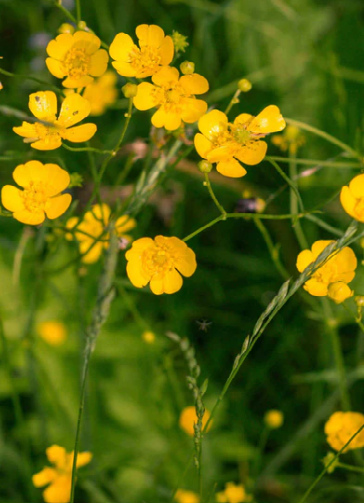
Tall Buttercup
Ranunculus acris L.
Accepted infraspecific taxa include:
- Ranunculus acris subsp. acris
- Ranunculus acris subsp. friesianus (Jord.) Syme
- Ranunculus acris subsp. hultenii Vorosch.
- Ranunculus acris subsp. pumilus (Wahlenb.) Á.Löve & D.Löve
- Ranunculus acris var. frigidus (Regel) Regel
Historical synonyms include:
- Ranunculastrum acre (L.) Fourr.
Important cultivar and horticultural names include:
- Ranunculus acris ‘Flore Pleno’ — double-flowered garden form
- Ranunculus acris ‘Multiplex’ — double-flowered garden form
Important non-synonym confusion names:
- Ranunculus repens L. — Creeping Buttercup; lower-growing buttercup with creeping stolons that root at the nodes
- Ranunculus bulbosus L. — Bulbous Buttercup; separate buttercup with a swollen bulb-like stem base and reflexed sepals
- Ranunculus sceleratus L. — Celery-Leaved Buttercup; generally considered among the more acrid buttercups, especially in wet habitats
- Ficaria verna Huds. — Lesser Celandine; low spring plant with glossy heart- or kidney-shaped leaves and more numerous narrow yellow petals
- Ceratocephala testiculata (Crantz) Besser — Bur Buttercup; western rangeland plant sometimes discussed with buttercups but not Ranunculus acris
- Helleborus spp. — Hellebores; related at the family level but separate plants with different toxin profiles
- Scrophularia spp. — True Figworts; separate plants in Scrophulariaceae, not Tall Buttercup
- Digitalis, Nerium, Convallaria, and other cardiac-glycoside plants — unrelated toxin profile despite older blended poison-list language
Ranunculaceae
Tall Buttercup; Meadow Buttercup; Common Buttercup; Giant Buttercup; Upright Buttercup; Tall Crowfoot; Gold Cup; Buttercup; Blister Plant; Butter Cress; Burwort; Crowfoot Burwort; Figwort.
Scientific and historical search names include Ranunculus acris L., Ranunculus acris subsp. acris, Ranunculus acris subsp. friesianus (Jord.) Syme, Ranunculus acris subsp. hultenii Vorosch., Ranunculus acris subsp. pumilus (Wahlenb.) Á.Löve & D.Löve, Ranunculus acris var. frigidus (Regel) Regel, and Ranunculastrum acre (L.) Fourr.
“Figwort” is a legacy and botanically confusing poison-list name when attached to Ranunculus acris. True figworts are generally Scrophularia species in Scrophulariaceae and have different flowers, growth habits, and chemistry. “Buttercup” is also broad and may refer to Creeping Buttercup, Bulbous Buttercup, Celery-Leaved Buttercup, Lesser Celandine, Bur Buttercup, ornamental Persian Buttercups, or other yellow-flowered plants. Tall Buttercup is the upright meadow species R. acris, not a hellebore and not a cardiac-glycoside plant.
Ranunculin Is the Stored Precursor and Protoanemonin Is the Fresh-Plant Irritant
The principal toxic system in Tall Buttercup is the ranunculin-to-protoanemonin defense reaction. Intact fresh tissue stores ranunculin, a glycosidic precursor that is less irritating while contained within undamaged plant cells. When an animal bites, crushes, chews, tramples, cuts, mows, pulls, bruises, or macerates the plant, cellular compartments are disrupted. Enzymatic hydrolysis separates glucose from the precursor and releases protoanemonin at the exact point where the plant has been damaged.
Protoanemonin is a small, volatile, reactive lactone with vesicant properties. Vesicant means blister-forming. It can irritate and chemically injure wet mucous membranes, exposed skin, and the surface of the eye. The reaction is therefore not simply “plant fiber upset” and not a poison that must first circulate throughout the entire body before causing harm. The toxin is generated rapidly in damaged fresh tissue and then acts directly on the lips, gums, tongue, mouth, throat, esophagus, stomach, intestines, skin, and eyes that contact it.
Exact-Species Evidence for Ranunculus acris
Direct exact-species work supports treating Ranunculus acris as a ranunculin-bearing plant rather than relying only on broad buttercup tradition. In a Journal of Chemical Ecology study, investigators quantified ranunculin in R. acris pollen and flower buds collected from multiple Swiss locations. The measured concentration in pollen was much lower than in flower buds; the reported mean for pollen was approximately 0.55 mg/g dry weight, while flower buds averaged approximately 19.45 mg/g dry weight and ranged up to more than 50 mg/g in the sampled material. That study focused on bee larval survival rather than veterinary poisoning, but it provides valuable exact-species evidence that reproductive structures can contain meaningful ranunculin.
Broader analytical research on the buttercup family also identifies ranunculin as the natural storage form of protoanemonin and supports the chemical pathway from fresh plant damage to protoanemonin exposure. The evidence does not establish a dog, cat, horse, cattle, sheep, goat, rabbit, or bird toxic dose for Tall Buttercup. It does show why fresh flowers, buds, leaves, stems, roots, and recently damaged plants deserve more concern than a vague “yellow weed” label suggests.
Freshness, Drying, Hay, and Anemonin
Freshness is central to Tall Buttercup toxicity. Protoanemonin is unstable and gradually polymerizes or changes into anemonin as plant material dries. Anemonin is substantially less irritating and is not considered the same vesicant hazard. This is why properly dried buttercup in fully cured hay is generally far less dangerous than fresh, bruised, actively growing, recently mowed, or freshly pulled plants.
The hay point needs careful boundaries. Drying reduces the protoanemonin hazard; it does not make a weed-infested bale good forage, prove that every plant in the bale is harmless, or eliminate separate risks from mold, dust, incomplete curing, pesticide residue, poor-quality feed, or other toxic weeds. Fresh clippings are a different problem. Mowed buttercup can be crushed, concentrated, and presented in piles where dogs, horses, cattle, goats, sheep, rabbits, poultry, or other animals may investigate material they would have avoided while it was standing in pasture.
Plant Parts and Relative Risk
Leaves, stems, flowers, flower buds, roots, sap, fresh clippings, pulled weeds, and crushed material should all be treated as toxic. The exact amount of ranunculin and the amount of protoanemonin generated can vary by plant part, growth stage, environment, season, and how much tissue is damaged. The exact-species pollen and flower-bud study supports special caution around reproductive tissue, but it should not be misused to declare leaves, stems, or roots safe.
Fresh green growth during active spring and summer growth is the most important practical exposure. Flowering plants are conspicuous and may contain strongly irritating fresh tissues. Root crowns, pulled plants, and wet clippings can also expose animals and handlers because damage continues to release irritating juice. Dead, fully dried material is lower risk for protoanemonin, but fresh-to-wilting plants should remain inaccessible until they have dried completely away from animals.
Mechanism of Mouth, Skin, Eye, and Gastrointestinal Injury
Protoanemonin injures tissue by direct chemical irritation. In the mouth it can produce burning pain, redness, swelling, blistering, erosions, ulcers, and immediate salivation. Salivation is partly a defensive response that dilutes and removes the irritant, but it also signals that painful mucosal contact has occurred. If swallowed, the same irritant can inflame the esophagus, stomach, and intestines, causing vomiting in species capable of vomiting, abdominal pain, colic, diarrhea, and occasionally bloody diarrhea after substantial exposure.
Skin exposure is most likely when fresh plants are crushed against thin skin, trapped in fur, handled with bare hands, packed under tack or collars, caught between toes, used as bedding contamination, or left as wet clippings where animals lie. Eye exposure is especially important because protoanemonin is not a crystal, yet the chemical irritation can still inflame the conjunctiva and injure the corneal surface. A pet pawing at the mouth can transfer sap from the muzzle or paws into an eye.
Why the Plant Is Usually Avoided but Still Dangerous
Most grazing animals avoid fresh buttercups because the plant tastes acrid and causes immediate irritation. That avoidance helps explain why severe poisoning is uncommon even where the plant is widespread. Avoidance is not a safety guarantee. Animals may eat it when pastures are overgrazed, forage is scarce, animals are turned out hungry, young animals investigate unfamiliar plants, fresh clippings are concentrated, pulled plants are discarded in animal areas, or dense buttercup growth leaves few palatable alternatives.
Dogs and cats generally encounter Tall Buttercup in lawns, damp yards, field edges, garden beds, fresh clippings, and on contaminated paws or fur. Horses and livestock encounter it in infested pasture, hay fields before curing, wet field margins, drainage areas, paddock edges, and clippings dumped into enclosures. Rabbits, guinea pigs, birds, poultry, and reptiles may be exposed when owners offer weeds or greenery without exact identification.
Not a Hellebore, Not a Cardiac-Glycoside Plant
Tall Buttercup belongs to Ranunculaceae, the same broad family as hellebores, but family-level relatedness does not make it a hellebore poisoning case. Helleborin, hellebrin, helleborein, and related digitalis-like cardiac glycoside language should not be placed in the Tall Buttercup toxin field. The recognized Tall Buttercup hazard is ranunculin-derived protoanemonin, a fresh-plant vesicant and gastrointestinal irritant.
Severe dehydration, pain, shock, hypoxia, fever, or electrolyte disturbance can affect heart rate and rhythm indirectly in any very sick animal. That is not the same as a predictable primary cardiac-glycoside mechanism. A human case report described recurrent supraventricular tachyarrhythmia after Ranunculus acris ingestion, so unusual cardiovascular findings should be taken seriously, but that single human toxicology pattern should not be converted into routine veterinary advice that treats Tall Buttercup like foxglove, oleander, lily-of-the-valley, or hellebore.
No Reliable Toxic Dose
No dependable toxic dose has been established for dogs, cats, horses, cattle, sheep, goats, pigs, camelids, rabbits, guinea pigs, birds, reptiles, or other animals. Amount eaten is often hard to reconstruct because the animal may chew, spit out, graze selectively, eat cut clippings, or contact sap without swallowing much plant mass. A small bite may cause only brief drooling, while dense fresh-plant ingestion can cause serious gastroenteritis and fluid loss.
The absence of immediate severe signs after one nibble should not be used to declare future access safe. The practical risk assessment should consider the plant’s freshness, whether it was crushed or mowed, whether flowers or buds were present, how much material appears missing, whether multiple animals had access, whether the animal is vomiting or has diarrhea, whether the animal can swallow normally, whether there was skin or eye contact, and whether another plant or chemical may be involved.
Onset and Early Progression
Signs often begin during chewing or soon afterward because protoanemonin is generated when fresh plant tissue is damaged and then acts directly on the tissues it touches. Dogs and cats may suddenly drop the plant, shake the head, lick repeatedly, drool, foam at the mouth, paw at the face, rub the muzzle, gag, or refuse food. Horses, cattle, goats, and sheep may salivate, chew repeatedly, drop feed, back away from pasture plants, or show painful swallowing.
Early signs can look dramatic even when little plant material was swallowed because the irritant contacts sensitive oral surfaces. A mild exposure may improve after the plant is removed and the mouth is gently cleared. A more serious exposure is suggested by persistent drooling, visible oral blisters or ulcers, repeated vomiting, diarrhea, abdominal pain, refusal to drink, weakness, tremors, unsteady gait, or any sign that the animal cannot swallow normally.
Oral Burning, Blistering, and Swallowing Pain
The mouth is usually affected first. Protoanemonin can cause burning or tingling of the lips, gums, tongue, palate, inner cheeks, and throat. Redness, swelling, blistering, erosions, and ulcers may develop after more substantial contact. Saliva may pool around the mouth because swallowing hurts, and animals may resist examination because the injured tissue is painful.
Painful swallowing can produce repeated swallowing attempts, gagging, coughing, feed refusal, or water dribbling from the mouth. In horses and livestock, dropped feed, quidding, salivation, reluctant chewing, or reduced rumination may be the most obvious signs. Severe throat swelling is not the classic Tall Buttercup syndrome in the same way it is with some other plant injuries, but any animal that cannot swallow saliva, is choking, or is breathing abnormally needs urgent care.
Vomiting, Diarrhea, Colic, and Fluid Loss
Dogs, cats, pigs, and other species capable of vomiting may vomit after swallowing fresh buttercup tissue. The esophagus, stomach, and intestines may become inflamed, causing nausea-like behavior, abdominal pain, diarrhea, and lethargy. Diarrhea can be soft, watery, or occasionally bloody after substantial intestinal irritation.
Repeated vomiting and diarrhea can cause dehydration, electrolyte disturbance, poor circulation, and shock. Tacky gums, sunken eyes, weakness, reduced urination, cold extremities, pale gums, collapse, or worsening depression are not “just buttercup drooling” and require veterinary assessment. Secondary dehydration can temporarily reduce kidney perfusion, but primary kidney failure is not the expected protoanemonin mechanism.
Skin and Eye Signs
Fresh sap on the skin may cause redness, burning, itching, swelling, blistering, scaling, delayed peeling, or contact dermatitis. Moisture, friction, pressure, contaminated bedding, sap trapped in fur, clippings under a collar, or plant residue between toes can intensify the irritation. Animals that lick contaminated fur may convert a skin exposure into an oral exposure.
Eye exposure can cause immediate pain, tearing, blinking, squinting, eyelid swelling, conjunctival redness, discharge, light sensitivity, or corneal injury. Persistent squinting, cloudiness, refusal to open the eye, marked redness, or continued pawing after gentle flushing requires veterinary examination. Leftover human eye drops, steroid drops, essential oils, and old veterinary eye medications can make an eye injury worse if the cornea is damaged.
Dogs and Puppies
Dogs may encounter Tall Buttercup in damp yards, field margins, lawns, drainage swales, pasture edges, fresh mowing piles, pulled weeds, or clippings stuck to toys, paws, and fur. Puppies may bite the bright flowers, chew stems during play, or investigate freshly pulled plants. A small mouthful often causes immediate drooling, head shaking, and refusal to continue chewing.
Concern increases when a dog ate fresh clippings, consumed a dense patch, has visible oral ulcers, vomits repeatedly, develops diarrhea, cannot keep water down, becomes weak, develops tremors, or appears uncoordinated. Bloody vomiting or bloody diarrhea should not be dismissed as ordinary mild buttercup exposure. It may reflect substantial gastrointestinal inflammation, another plant, foreign material, pesticide exposure, infection, pancreatitis, or another medical problem.
Cats and Kittens
Cats may chew fresh plants in a yard, patio planter, pasture edge, or bouquet-like weed collection brought indoors. They may also groom sap from contaminated paws or fur. Possible signs include drooling, hiding, mouth pain, pawing at the face, gagging, vomiting, diarrhea, and refusal to eat.
Persistent food refusal is especially important in cats. A cat that stops eating because its mouth or stomach hurts can develop secondary complications even when the original plant exposure was not highly systemic. Continuing anorexia, repeated vomiting, dehydration, tremors, collapse, or painful eye exposure requires veterinary care.
Horses, Ponies, Donkeys, and Mules
Horses cannot vomit, so equine exposure is more likely to appear as salivation, painful chewing, muzzle rubbing, oral ulcers, dropped feed, reluctance to graze, feed refusal, colic, diarrhea, depression, weakness, or an abnormal gait. Horses are often discussed as particularly sensitive to the gastrointestinal effects of buttercups, but serious poisoning usually requires limited forage, heavy infestation, hunger, fresh clippings, or other circumstances that overcome the plant’s bitter deterrent.
Colic, diarrhea, dehydration, weakness, tremors, recumbency, or bloody feces after access to fresh buttercups requires veterinary evaluation. A horse with severe signs should not be walked continuously as a generic colic response. If the animal is dehydrated, weak, painful, or neurologically abnormal, forced exercise increases stress and may worsen collapse risk.
Cattle, Sheep, Goats, Camelids, Pigs, and Poultry
Cattle, sheep, goats, camelids, and pigs may show salivation, repeated chewing motions, reduced appetite, oral irritation, diarrhea, abdominal pain, reduced rumination, weakness, decreased production, or dehydration. Goats and sheep may sample plants more readily than cattle when forage is limited, while pigs may root through fresh weeds or clippings. Poultry may peck fresh flowers or leaves when clippings are thrown into runs.
Group illness is a warning that the exposure site should be inspected completely. Fresh buttercup may be part of the problem, but mixed clippings may also contain yew, cherry, oak, nightshade, foxglove, ragwort, hemlock, pesticides, herbicides, mold, spoiled feed, or other hazards. Severe neurologic signs, widespread collapse, high mortality, or signs that do not fit mouth and gut irritation should trigger a broader investigation.
Rabbits, Guinea Pigs, Birds, Reptiles, and Other Small Animals
Rabbits, guinea pigs, rats, and several other small mammals cannot vomit. They may show drooling, tooth grinding, reluctance to chew, food refusal, diarrhea, reduced fecal output, abdominal discomfort, or lethargy. Even a mild irritant exposure can become serious when a rabbit or guinea pig stops eating and develops gastrointestinal hypomotility or stasis.
Birds may peck flowers, shred stems, or consume weed bundles offered as enrichment. Possible signs include beak wiping, reduced appetite, regurgitation, altered droppings, weakness, and abnormal quietness. Reptiles and tortoises should not be offered Tall Buttercup as enclosure greenery or browse because species-specific safe doses are not established and protoanemonin can irritate mucous membranes.
Severe, Atypical, or Misattributed Signs
Large fresh-plant ingestions may cause severe gastroenteritis, profound weakness, dehydration, tremors, unsteady gait, recumbency, convulsions, shock, circulatory collapse, and rarely death. Those severe effects are uncommon because most animals stop eating early, but they are biologically plausible when hungry livestock or confined animals consume enough fresh plant material. Convulsions may reflect severe systemic illness, dehydration, electrolyte disturbance, shock, pain, or another concurrent toxin rather than a simple routine finding after one bite.
Digitalis-like bradycardia, atrioventricular block, ventricular fibrillation, primary kidney failure, permanent liver injury, and routine respiratory paralysis are not the expected Tall Buttercup syndrome. A human report of supraventricular tachyarrhythmia after R. acris ingestion means unusual cardiovascular findings should be taken seriously, but animals with major cardiac, renal, hepatic, neurologic, or respiratory abnormalities need investigation for another poisonous plant, pesticide, medication, infection, metabolic disease, aspiration, dehydration, shock, or a misidentified exposure.
Expected Duration and Prognosis
Mild drooling and mouth discomfort may improve within several hours once the source is removed and the mouth is gently cleared. Vomiting, diarrhea, appetite loss, and oral soreness can persist longer after more substantial exposure and may require veterinary medication or fluids. Skin lesions may take days to heal when blistering or self-trauma occurs, and eye injuries depend on how quickly the eye is flushed and examined.
Most uncomplicated Tall Buttercup exposures have a good to excellent prognosis. The outlook becomes guarded when there is large fresh-plant ingestion, profuse or bloody diarrhea, persistent vomiting, severe dehydration, shock, tremors, convulsions, recumbency, aspiration, corneal injury, or prolonged food refusal in cats, rabbits, guinea pigs, birds, or other small animals.
Tall Buttercup Identity and Figwort Confusion
Tall Buttercup is Ranunculus acris L., an upright herbaceous perennial in Ranunculaceae. The page name should remain Tall Buttercup because that is the correct common-name identity for the scientific plant. “Figwort” should remain only as a legacy and botanically confusing AKA/search term. True figworts are usually Scrophularia species in Scrophulariaceae, with opposite leaves, angular stems, and small dull green, brown, purple, or maroon flowers rather than the glossy yellow buttercup flowers of R. acris.
Older poison-list material sometimes blended Tall Buttercup with hellebore toxicology because both are in Ranunculaceae. That blending should not survive in this page. Hellebores are Helleborus species with different morphology and different toxin priorities. Tall Buttercup’s practical toxicology is ranunculin-derived protoanemonin irritation, not helleborin, hellebrin, helleborein, or a predictable digitalis-like heart-poisoning syndrome.
Native Range and Introduced Range
Ranunculus acris is native across Greenland, Europe, and much of temperate northern Eurasia, extending eastward into the Russian Far East and Aleutian region. It has been introduced widely in North America and other temperate regions, including parts of South America, Australia, Tasmania, and other island or cool-climate areas. Its wide distribution makes it relevant to pets, horses, livestock, and small animals across many damp temperate landscapes.
The plant grows primarily in temperate habitats and is particularly successful in cool, moist, moderately disturbed ground. It occurs in meadows, pastures, hay fields, roadsides, lawns, drainage areas, field margins, streambanks, open woodland, moist ditches, and disturbed sites. Heavy infestations often signal overgrazing, poor drainage, compaction, low forage competition, bare soil, fertility imbalance, or repeated disturbance.
How to Identify Tall Buttercup
Tall Buttercup is usually an upright perennial growing from a fibrous root system. Flowering stems commonly reach about one to three and one-half feet tall, branching toward the upper portion. Stems may be sparsely or densely hairy. The plant does not spread by the long rooting runners that characterize Creeping Buttercup.
Basal and lower stem leaves arise on longer petioles and are deeply divided into three to five main sections, each of which may be further divided into pointed segments. This creates the hand-shaped or crowfoot appearance that gives many buttercups their crowfoot names. Upper leaves become smaller, shorter-stalked, and more narrowly divided.
The flowers are bright, glossy yellow and usually have five petals, five green sepals, many stamens, and a rounded central cluster that later becomes a head of achenes. The shiny petal surface reflects light strongly, producing the familiar polished buttercup appearance. Flowering usually occurs from late spring through summer and may continue into autumn where soil remains cool and moist.
Seeds, Persistence, and Pasture Spread
After flowering, the rounded center matures into numerous small dry fruits called achenes. Each achene contains a seed and ends in a short beak that may be curved or nearly straight. A mature plant can produce many seeds, and seed may remain in soil until disturbance, grazing pressure, flooding, cultivation, animal traffic, or construction opens space for germination.
Selective grazing can worsen a Tall Buttercup problem. Animals often eat surrounding grasses and legumes while leaving fresh buttercup standing because it is bitter and irritating. That allows buttercups to flower, set seed, and occupy the openings created by weakened forage. A poisoning page should therefore connect prevention to pasture condition rather than treating buttercup as an isolated yellow flower problem.
Important Look-Alikes
Creeping Buttercup, Ranunculus repens, grows lower and spreads by long horizontal stolons that root at the nodes, creating dense mats. Bulbous Buttercup, Ranunculus bulbosus, has a swollen bulb-like stem base and sepals that bend sharply downward beneath the petals. Celery-Leaved Buttercup, Ranunculus sceleratus, favors wet ground and is often treated as especially acrid among buttercups. Lesser Celandine, Ficaria verna, is a low spring plant with glossy heart- or kidney-shaped leaves and flowers that usually have more than five narrow petals.
True figworts in Scrophularia have a different family placement, different flower form, and different identification profile. Bur Buttercup, now commonly treated in Ceratocephala, is another western rangeland concern sometimes discussed near buttercups but is not Tall Buttercup. When a poisoning case is uncertain, photographs should show the whole plant, leaf arrangement, flower, sepals, stem base, root structure, presence or absence of runners, and the full exposure site.
Fresh-Plant Chemistry and Plant Defense
Fresh Tall Buttercup stores ranunculin within intact tissue. When tissue is damaged, ranunculin is hydrolyzed and protoanemonin is released. This creates a rapid chemical defense at the site of damage. The plant does not need to be swallowed in large quantity before it can hurt the mouth or skin; the irritant is formed where fresh tissue is crushed.
Exact-species research measuring ranunculin in R. acris pollen and flower buds adds useful nuance. Flower buds contained far more ranunculin than pollen in the sampled material, and the investigators did not detect protoanemonin or anemonin in those intact samples. That is consistent with the idea that ranunculin is the stored precursor and that damaging fresh tissue is the critical event for animal exposure.
Fresh Versus Dried Risk
Fresh, bruised, wet, actively growing, flowering, recently mowed, freshly pulled, or trampled Tall Buttercup is the main hazard. Proper drying substantially lowers the protoanemonin risk as protoanemonin changes into less irritating anemonin. This makes fully cured hay containing dried buttercup less hazardous than fresh pasture plants, unlike plants whose stable toxins remain dangerous in hay.
That distinction should not be exaggerated into a recommendation to feed buttercup. Buttercup-contaminated hay may still be poor quality, unpalatable, dusty, moldy, incompletely cured, or contaminated with other toxic weeds. Fresh clippings, weed piles, and newly pulled plants should never be dumped into dog yards, kennels, paddocks, stalls, goat pens, sheep lots, rabbit areas, poultry runs, tortoise enclosures, or accessible compost.
Dogs and Cats
Dogs may chew Tall Buttercup in damp lawns, field edges, farm lanes, drainage swales, garden beds, or freshly mowed piles. Puppies may be attracted to bright flowers and pulled weeds. Because signs begin quickly, many dogs stop after a small bite, but mouth pain, drooling, vomiting, diarrhea, and dehydration can still follow.
Cats may contact the plant outdoors, groom contaminated paws, or chew fresh stems brought inside with weeds or wildflowers. Cats that refuse food after exposure deserve special attention because persistent anorexia can create secondary health problems even if the original plant syndrome was primarily local irritation. A cat with repeated vomiting, eye exposure, tremors, collapse, or continuing food refusal should be examined.
Horses, Cattle, Sheep, Goats, Camelids, and Pigs
Horses and livestock usually avoid fresh buttercups when good forage is available. Poisoning becomes more plausible in overgrazed pasture, sparse forage, crowded turnout, hungry animals, dry lots with poor hay access, heavy buttercup infestation, fresh clippings, or mixed ornamental/garden waste. Horses may show salivation, mouth ulcers, feed refusal, colic, diarrhea, weakness, or abnormal gait. Cattle, sheep, goats, camelids, and pigs may show similar oral and gastrointestinal irritation, with ruminants also showing reduced cud chewing and reduced production.
Livestock deaths from Tall Buttercup are uncommon, but severe fresh-plant intake can cause serious gastroenteritis, dehydration, shock, recumbency, tremors, convulsions, and rarely death. A herd or group event should never be attributed to buttercup alone until the entire site has been checked for other toxic plants, chemical treatments, spoiled feed, nitrates, molds, and water contamination.
Rabbits, Guinea Pigs, Birds, Reptiles, and Other Exotics
Rabbits and guinea pigs should not be given Tall Buttercup as forage, bedding, enrichment, or weeds from the yard. They cannot vomit, and mouth or gut irritation can reduce food intake. Appetite loss, tooth grinding, diarrhea, reduced fecal output, lethargy, or abdominal discomfort after exposure requires prompt veterinary guidance because gastrointestinal stasis can become more serious than the initial plant contact.
Birds and poultry may peck fresh flowers or leaves when clippings are thrown into a run. Parrots may shred stems and flowers with the beak, exposing the mouth directly. Reptiles and tortoises should not receive Tall Buttercup as browse or enclosure greenery. Species-specific safe doses are not established, and the fresh sap is a mucous-membrane irritant.
Diagnosis and Differential Diagnosis
Diagnosis usually depends on a credible exposure, identification of Ranunculus acris, rapid onset of compatible mouth or gastrointestinal signs, and exclusion of more dangerous possibilities. Useful evidence includes photographs of the whole plant, flowers, leaves, stem base, roots, seed heads, pasture density, mowed clippings, and all other plants in the exposure area. No routine clinical test specifically confirms protoanemonin poisoning in a dog, cat, horse, or livestock patient.
Important differentials include other buttercups, lesser celandine, hellebore, foxglove, oleander, lily-of-the-valley, yew, nightshade, poison hemlock, water hemlock, wild cherry, oak, pesticides, herbicides, fertilizers, caustic chemicals, foreign material, infectious gastroenteritis, pancreatitis, colic, dental disease, choke, aspiration, and unrelated metabolic disease. Major cardiac, renal, hepatic, neurologic, or respiratory abnormalities should prompt reconsideration of plant identity and the full exposure history.
Veterinary Treatment, Prognosis, and Prevention
No specific antidote exists for protoanemonin. Treatment focuses on removing the source, clearing exposed tissue, controlling pain and vomiting, supporting hydration, correcting electrolyte abnormalities, treating skin or eye injury, and monitoring for aspiration or shock in severe cases. Bloodwork may be needed when vomiting, diarrhea, dehydration, weakness, tremors, collapse, or bloody feces is present. Eye exposure requires special attention because corneal injury can remain painful after the mouth signs begin improving.
Most limited exposures have a good to excellent prognosis. Drooling and mouth discomfort may improve within several hours, while moderate vomiting, diarrhea, appetite loss, or skin irritation can last longer and may require veterinary support. The prognosis becomes guarded when a large fresh-plant ingestion causes severe gastroenteritis, bloody diarrhea, dehydration, shock, tremors, convulsions, recumbency, aspiration, or persistent food refusal in small animals.
Prevention requires both plant removal and pasture correction. Improve drainage where practical, reduce compaction, correct fertility and pH based on soil testing, prevent overgrazing, maintain dense competitive forage, avoid turning animals out hungry, mow or control plants before seed set when appropriate, and remove fresh clippings from animal areas. Hand-pulling can work in small areas, but gloves, long sleeves, and eye protection are appropriate because fresh sap can blister human skin and irritate eyes. Herbicide decisions must follow the product label, local rules, pasture species, animal re-entry restrictions, haying restrictions, and environmental conditions.
Immediate Response to Tall Buttercup Ingestion
Prevent further ingestion by moving the animal away from fresh Tall Buttercup plants, recently mowed clippings, pulled weeds, crushed stems, flowers, roots, seed heads, sap-contaminated bedding, or tools. Identify the plant before assuming the case is simple buttercup irritation. Confirm whether the exposure involved Tall Buttercup, Creeping Buttercup, Bulbous Buttercup, Lesser Celandine, Hellebore, a true Figwort, another yellow-flowered weed, pesticides, or mixed clippings.
- Remove visible plant material: When it is safe, remove leaves, flowers, stems, or other fragments from the lips and front of the mouth. Do not reach deeply into the throat or place fingers near the teeth of a painful or frightened animal.
- Gently clear the mouth: Wipe the lips, gums, and front of the tongue with a damp cloth or gently rinse loose sap only when the animal is alert and swallowing normally. Do not force water into the throat.
- Protect your skin: Wear gloves when handling crushed fresh buttercup, contaminated saliva, vomit, feces, bedding, or tools. Wash exposed skin with soap and water.
- Save identification evidence: Photograph the whole plant, flowers, leaves, stem base, roots, runners or lack of runners, pasture density, mowing pile, and every other plant in the exposure area.
- Contact veterinary help promptly: Call a veterinarian or animal poison-control service after a large fresh ingestion, severe mouth injury, persistent vomiting or diarrhea, eye exposure, horse or herd exposure, weakness, tremors, collapse, neurologic signs, or small-animal food refusal.
Do Not Routinely Induce Vomiting
Tall Buttercup already irritates and may blister the mouth, throat, esophagus, stomach, and intestines. Routine home-induced vomiting can re-expose those injured tissues. Dogs and cats may vomit spontaneously because protoanemonin and plant material strongly irritate the stomach. That natural vomiting does not mean owners should add peroxide or another emetic.
A veterinarian or animal poison-control professional may consider induced vomiting after a substantial, very recent dog ingestion only when the dog remains fully alert, breathing normally, swallowing normally, and free of repeated vomiting, severe oral lesions, weakness, tremors, collapse, or neurologic abnormalities. Cats should not receive hydrogen peroxide as a home emetic. Never attempt vomiting in an animal that is weak, collapsed, uncoordinated, seizuring, having trouble breathing, unable to swallow, or showing severe oral or throat injury.
Do Not Attempt Unsupervised Home Treatment
- Do not force water, milk, oil, broth, or food: Forced oral material can be aspirated when the animal is gagging, drooling, weak, panicked, vomiting, or swallowing abnormally.
- Do not give activated charcoal automatically: Charcoal is not routinely useful for a small local-irritant exposure and may be aspirated by a drooling, vomiting, weak, or poorly swallowing animal.
- Do not give diphenhydramine as a substitute for care: Protoanemonin injury is chemical irritation, not simply allergy. Sedation may obscure worsening weakness or airway problems.
- Do not give Kapectolin, Kaopectate, bismuth products, loperamide, sucralfate, antacids, antiemetics, or human pain medication unless directed: These products are not universal antidotes and can be inappropriate for the species, disease, or timing.
- Do not use atropine or antiarrhythmics as buttercup antidotes: Tall Buttercup is not a routine cardiac-glycoside plant. Cardiovascular treatment must be based on actual examination findings.
- Do not drench horses or livestock: Forced oral treatment can be aspirated by an animal that is coughing, choking, salivating heavily, weak, recumbent, bloated, or unable to swallow normally.
- Do not use crushed buttercup as a poultice: Traditional blistering use demonstrates tissue injury, not a safe remedy.
Oral and Gastrointestinal Care
An alert animal that is breathing normally and swallowing comfortably may be allowed access to small amounts of cool clean water. Once vomiting has stopped and swallowing is comfortable, a veterinarian may recommend small amounts of cool, soft, bland, or species-appropriate food. Do not force food or fluids into an animal that is gagging, choking, unable to swallow, repeatedly vomiting, severely weak, or mentally abnormal.
Monitor for redness, ulcers, blisters, bleeding, persistent drooling, refusal to eat, pain when swallowing, repeated vomiting, blood in vomit, inability to retain water, diarrhea, blood in stool, worsening lethargy, reduced urination, and abdominal pain. Veterinary fluids, antiemetic medication, analgesia, electrolyte correction, and gastrointestinal support may be needed when vomiting or diarrhea causes dehydration, weakness, poor circulation, or reduced urination.
Skin and Fur Exposure
Remove the animal from crushed plants, fresh clippings, sap-contaminated bedding, wet plant residue, or mowing debris. Prevent dogs and cats from licking sap-covered paws, fur, or skin until the area has been washed. Wash affected skin and fur with mild soap and generous amounts of cool or lukewarm water, then rinse thoroughly without aggressively scrubbing blistered or painful tissue.
Do not use bleach, alcohol, peroxide, essential oils, solvents, abrasive cleaners, human anti-itch creams, or old medications on irritated skin unless a veterinarian directs it. Watch for redness, burning, swelling, itching, blisters, hair loss, open skin, continued licking, and secondary infection. Significant blisters, open wounds, persistent pain, spreading inflammation, or suspected infection requires veterinary examination.
Eye Exposure
If fresh sap or plant material entered an eye, begin gentle irrigation with sterile saline or clean lukewarm water. Continue long enough to remove plant juice and loose debris from the eye and surrounding fur. Prevent rubbing or pawing while veterinary guidance is obtained.
Squinting, tearing, redness, cloudiness, swollen eyelids, light sensitivity, discharge, continued pawing, or refusal to open the eye requires prompt veterinary examination. Do not use human redness-relief drops, leftover veterinary medication, steroid drops, antibiotic ointment, essential oils, or herbal rinses because some products are dangerous when a corneal ulcer is present.
When Veterinary Examination Is Especially Important
- Oral injury is more than mild: Blisters, ulcers, bleeding, severe drooling, inability to swallow, or refusal to drink requires assessment.
- Vomiting or diarrhea persists: Repeated vomiting, inability to retain water, profuse diarrhea, or bloody stool can rapidly cause dehydration and electrolyte loss.
- Abdominal pain is significant: Hunched posture, repeated stretching, guarding the abdomen, flank-watching, pawing, rolling, crying, sweating, or reluctance to move may indicate serious gastrointestinal inflammation.
- Weakness or neurologic signs develop: Tremors, unsteady gait, collapse, convulsions, recumbency, or abnormal mentation does not fit a trivial exposure.
- The eye was exposed: Persistent eye pain or cloudiness needs corneal examination.
- Several animals are affected: Group illness requires inspection for mixed toxic plants, chemicals, mold, spoiled feed, nitrates, and water contamination.
- A horse or livestock animal is involved: Persistent colic, severe diarrhea, dehydration, weakness, tremors, abnormal gait, or recumbency requires veterinary treatment.
- A cat, rabbit, guinea pig, bird, or small animal stops eating: Food refusal can become medically important even when the initial plant exposure is considered only locally irritating.
Horse and Livestock Exposure
Move animals from heavily infested pasture, fresh mowing piles, pulled weeds, or contaminated clippings and provide clean water plus safe forage. Do not turn animals out hungry into unfamiliar or buttercup-heavy pasture. Feed safe hay before turnout when forage competition is uncertain, and inspect the mouth for salivation, lip or tongue ulcers, dropped feed, and painful swallowing.
Monitor horses for colic signs such as pawing, flank-watching, repeated stretching, rolling, sweating, feed refusal, diarrhea, or abnormal manure. Monitor ruminants for salivation, reduced cud chewing, diarrhea, abdominal pain, depression, weakness, reduced production, and dehydration. Weak, dehydrated, painful, or neurologically abnormal animals should not be forced to exercise continuously. Severe cases may require fluids, electrolyte correction, pain control, and shock support.
Veterinary Treatment
No specific antidote exists for protoanemonin. Veterinary treatment focuses on source removal, oral cleansing, pain control, vomiting control, hydration, electrolyte correction, skin and eye treatment, and monitoring for aspiration, shock, or secondary complications. The veterinarian may examine beneath the tongue and around the gums for ulcers, blisters, retained plant fragments, and swelling.
Severe cases may require bloodwork to evaluate hydration, electrolytes, kidney perfusion, blood glucose, acid-base status, inflammation, and blood loss. Kidney values and urine output may be monitored when severe dehydration or shock is present, but primary kidney failure is not the expected toxin mechanism. Cardiovascular support should be based on the animal’s actual perfusion, heart rate, blood pressure, hydration, and electrolytes rather than on imported hellebore or cardiac-glycoside assumptions. If hypotension persists after appropriate volume correction, vasopressors may be considered by the veterinarian as part of shock management rather than as a plant-specific antidote.
Tremors or convulsions require emergency assessment and may be treated with veterinarian-selected medications such as methocarbamol, benzodiazepines, or other agents depending on the species and findings. Coughing, fever, nasal discharge, or labored breathing after vomiting may indicate aspiration pneumonia and requires additional treatment.
Pasture, Lawn, and Garden Prevention
Long-term prevention is pasture management, not just annual flower removal. Maintain dense competitive forage, correct drainage and compaction problems where practical, test soil and correct fertility or pH problems, prevent overgrazing, avoid bare ground, rest pastures when needed, and avoid forcing hungry animals to graze buttercup-heavy areas. Mowing before seed set may reduce new seed production but can also create fresh irritating clippings that animals should not eat.
Hand-pulling is practical in dog yards, gardens, small paddocks, and scattered patches. Wear gloves, long sleeves, and eye protection because fresh sap can irritate human skin and eyes. Remove the crown and collect the pulled plants. Do not leave fresh piles in kennels, paddocks, stalls, feeding areas, water-trough edges, rabbit areas, poultry runs, or compost where animals can reach them. Herbicide selection depends on location, pasture species, plant growth stage, local regulations, and the product label; grazing, haying, animal re-entry, and environmental restrictions must be followed.
Recovery and Prognosis
Most Tall Buttercup exposures have a good to excellent prognosis because the plant’s bitter taste and immediate pain limit the amount consumed. Mild drooling and mouth discomfort often begin improving within several hours after plant residue is removed and the mouth is gently cleared. Moderate vomiting, diarrhea, or appetite loss may last longer and may require veterinary fluids or medication.
Skin exposure may resolve quickly when mild, while blistered or ulcerated skin can take days or weeks to heal. Eye exposure has a good prognosis when flushed promptly and examined when signs persist, but untreated corneal injury can become painful and serious. Large fresh-plant ingestion carries a more guarded prognosis when bloody diarrhea, severe dehydration, shock, tremors, convulsions, recumbency, aspiration, or prolonged anorexia develops.
Frequently Asked Questions About Tall Buttercup, Figwort, and Animal Poisoning
Is Tall Buttercup poisonous to dogs?
Yes. Fresh Tall Buttercup can cause immediate mouth burning, drooling, lip licking, head shaking, pawing at the face, oral redness, vomiting, diarrhea, abdominal pain, reduced appetite, and lethargy. A large fresh-plant ingestion can cause severe dehydration, weakness, tremors, loss of coordination, shock, or convulsions. Most dogs stop after a small amount because the plant is bitter and painful, but fresh clippings and pulled weeds can create a more concentrated exposure.
Is Tall Buttercup toxic to cats?
Yes. Cats may develop drooling, mouth pain, pawing at the face, vomiting, diarrhea, hiding, and refusal to eat after chewing the fresh plant or grooming sap from the paws or fur. Persistent appetite loss in a cat is important even when the plant is considered a local irritant. Repeated vomiting, eye exposure, tremors, collapse, or refusal to eat should be discussed with a veterinarian promptly.
Is Tall Buttercup poisonous to horses and livestock?
Yes. Horses, cattle, sheep, goats, camelids, pigs, and other livestock may develop salivation, mouth blistering, feed refusal, diarrhea, colic, reduced rumination, weakness, or an abnormal gait after eating enough fresh buttercup. Poisoning is most likely when pasture is overgrazed, desirable forage is limited, animals are hungry, fresh plants have been mowed, or clippings are thrown into enclosures.
What is the scientific name for Tall Buttercup?
The accepted scientific name is Ranunculus acris L. It belongs to Ranunculaceae, the Buttercup Family. Current botanical sources accept the species and recognize several infraspecific taxa, while Ranunculastrum acre is a historical synonym useful for older literature searches.
Is Figwort the correct name for Ranunculus acris?
Figwort is a legacy and confusing poison-list name for this page, not the best botanical name. True figworts are generally Scrophularia species in Scrophulariaceae, with very different flowers and chemistry. Tall Buttercup or Meadow Buttercup is the clearer name for Ranunculus acris, while Figwort should be kept only as an AKA/search-warning term.
Is Tall Buttercup the same as hellebore?
No. Tall Buttercup is Ranunculus acris. Hellebores are Helleborus species. They are related at the family level but are not the same plants and do not have the same toxin profile. Tall Buttercup poisoning is primarily protoanemonin-mediated irritation, not classic hellebore cardiac-glycoside poisoning.
Does Tall Buttercup contain cardiac glycosides?
Cardiac glycosides such as hellebrin, helleborin, and helleborein are not the defining toxins of Ranunculus acris. Tall Buttercup poisoning is caused primarily by ranunculin-derived protoanemonin, a blistering and gastrointestinal irritant. Severe dehydration, shock, or electrolyte disturbance can affect the heart indirectly, but Tall Buttercup should not be treated as foxglove, oleander, lily-of-the-valley, or hellebore.
What is protoanemonin?
Protoanemonin is a volatile blistering compound formed when fresh buttercup tissue is crushed, chewed, cut, mowed, trampled, or otherwise damaged. It inflames the skin, mouth, esophagus, stomach, and intestines. It acts quickly at the site of contact, which explains why animals may react immediately while chewing.
Why does the plant become toxic when chewed?
Intact plant cells store ranunculin, the glycosidic precursor. Chewing damages the cells and allows ranunculin to be hydrolyzed into glucose and protoanemonin. This creates an irritant at the exact point where the animal is damaging the plant. The mechanism is a plant-defense reaction, not simple digestion of plant fiber.
Is dried Tall Buttercup poisonous in hay?
Proper drying converts much of the unstable protoanemonin into less irritating anemonin, so fully cured buttercup is substantially less toxic than fresh plants. That does not make weed-contaminated hay desirable. Incomplete curing, mold, dust, pesticide residue, poor forage quality, or other toxic weeds can create separate hazards, and fresh clippings should not be offered as feed.
Are freshly mowed buttercups dangerous?
Yes. Mowing crushes plant tissue and can concentrate fresh irritating material in piles. Animals that avoid standing buttercup may investigate clippings, especially dogs, goats, sheep, rabbits, poultry, and hungry livestock. Fresh clippings should be removed from animal areas or dried completely where animals cannot reach them.
How can I identify Tall Buttercup?
Look for an upright perennial, often one to three and one-half feet tall, with branching stems, deeply divided crowfoot-like leaves, and glossy yellow flowers that usually have five petals. The basal leaves have longer stalks and deeper divisions, while upper leaves are smaller and narrower. It lacks the long creeping runners of Creeping Buttercup and lacks the swollen bulb-like base of Bulbous Buttercup.
How is Tall Buttercup different from Creeping Buttercup?
Tall Buttercup grows upright and does not produce long horizontal stolons that root at the nodes. Creeping Buttercup, Ranunculus repens, grows lower and spreads into mats with rooting runners. Both can irritate animals when fresh, but the growth habit matters for identification, control, and exposure reconstruction.
How is Tall Buttercup different from Bulbous Buttercup?
Bulbous Buttercup, Ranunculus bulbosus, has a swollen bulb-like stem base and sepals that bend sharply downward beneath the petals. Tall Buttercup lacks that bulb-like base and has a more distinctly upright meadow habit. The distinction matters because veterinary reports and abortion discussions sometimes involve R. bulbosus, not R. acris.
Can touching Tall Buttercup cause blisters?
Yes. Fresh crushed sap can cause redness, burning, itching, swelling, blisters, and contact dermatitis. Risk increases when sap is trapped against skin by moisture, friction, gloves, collars, tack, bedding, or fur. Wear gloves when pulling or cutting the plant and wash exposed skin promptly.
Can Tall Buttercup damage a pet’s eyes?
Yes. Fresh sap can cause pain, tearing, redness, squinting, eyelid swelling, conjunctival inflammation, and possible corneal injury. Flush the eye gently with sterile saline or clean lukewarm water and prevent rubbing. Persistent squinting, cloudiness, discharge, light sensitivity, or refusal to open the eye requires veterinary examination.
Can Tall Buttercup cause kidney failure?
Primary kidney failure is not the expected Tall Buttercup syndrome. Severe vomiting, diarrhea, dehydration, or shock can reduce kidney perfusion secondarily, but direct kidney failure should prompt investigation for another toxin or medical condition. Kidney values may still be monitored in severe cases because dehydration and shock can injure many organs indirectly.
Can Tall Buttercup cause fatal heart arrhythmias?
Digitalis-like arrhythmias are not the recognized routine poisoning pattern of Ranunculus acris. A human case report described recurrent supraventricular tachyarrhythmia after ingestion, so unusual cardiovascular signs should not be ignored, but the typical veterinary syndrome is mouth, skin, eye, and gastrointestinal irritation. Fatal arrhythmia language from hellebore or cardiac-glycoside plants should not be imported into this page as the expected buttercup mechanism.
Can Tall Buttercup cause abortion in mares or livestock?
Abortion has been discussed in relation to some buttercup exposures, especially reports involving Bulbous Buttercup rather than exact-species Tall Buttercup. The evidence should be handled cautiously. Severe maternal illness, fever, dehydration, shock, or another plant could threaten pregnancy, but abortion should not be presented as a routine or diagnostic Ranunculus acris effect.
What symptoms should I watch for?
Watch for mouth burning, drooling, head shaking, pawing at the face, oral redness, blisters, ulcers, gagging, painful swallowing, vomiting, diarrhea, abdominal pain, colic, reduced appetite, depression, weakness, unsteady gait, tremors, eye pain, skin irritation, bloody diarrhea, dehydration, or collapse. Severe, persistent, or worsening signs require veterinary care.
How dangerous is Tall Buttercup?
Most exposures remain mild or moderate because the bitter taste and immediate irritation stop animals from eating much. Dense fresh pasture exposure, limited forage, fresh clippings, hungry livestock, or a large ingestion can cause severe gastrointestinal inflammation, dehydration, shock, tremors, convulsions, recumbency, and rarely death. The plant is painful and toxic, but it should not be exaggerated into a routine cardiac-glycoside or kidney-failure plant.
Should I induce vomiting after my pet eats Tall Buttercup?
Do not routinely induce vomiting. The plant is already irritating the mouth, esophagus, and stomach, and vomiting can re-expose those tissues. A veterinarian or animal poison-control professional may consider an emetic for a substantial recent dog exposure only when the dog is fully alert, breathing normally, swallowing normally, and not already vomiting or neurologically abnormal. Cats should not receive hydrogen peroxide as a home emetic.
Is activated charcoal useful?
Activated charcoal is not routinely useful for a small local-irritant exposure. A veterinarian may consider one dose after a large recent ingestion when the animal can safely protect its airway. It should not be given at home to an animal that is drooling heavily, gagging, vomiting, weak, uncoordinated, or unable to swallow normally.
What should I do after suspected ingestion?
Remove access to fresh plants or clippings, carefully take visible plant material from the front of the mouth, gently wipe or rinse away fresh sap only when the animal can swallow normally, and save plant photographs or a sample for identification. Contact a veterinarian after a large ingestion, severe mouth injury, persistent vomiting or diarrhea, eye exposure, horse or herd exposure, weakness, collapse, tremors, or small-animal food refusal.
How can Tall Buttercup be controlled around animals?
Improve pasture density, drainage, fertility, soil pH, and grazing management so desirable forage outcompetes buttercup. Avoid overgrazing and do not turn hungry animals into buttercup-heavy pasture. Pull or control plants before seed set where practical, remove fresh clippings from animal areas, and follow all herbicide label rules for grazing, haying, re-entry, and environmental safety.