Grooming Table Hardware • Flexi-Restraint System • Adjustable Overhead Arms • No-Sit Support • Grooming Restraint Review
Flexi-Restraint System: Adjustable Overhead Control That Puts the Bar Where I Want My Body
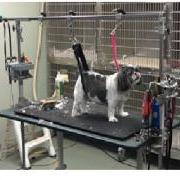
Yet another system that I have come across is the Flexi-Restraint System.
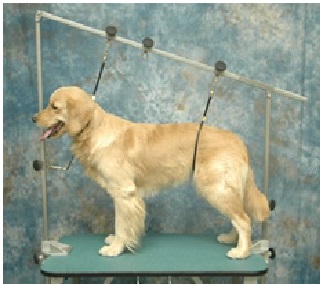
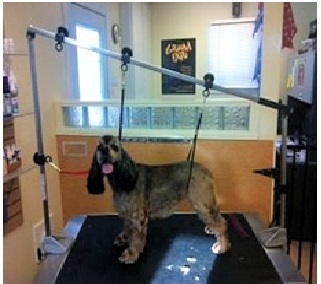
This system features an overhead grooming arm that allows for pivoting in the upper corners so you can lock the bar on an angle.
Additionally, the position of the eyelets used to connect nooses and harnesses is adjustable. You can slide them left or right along the top bar or up and down on the side bar to position them where you need them to hold the animal.
That sounds useful on paper. My problem is that it solves a simple restraint-positioning issue by putting more overhead structure into the groomer’s working space.
Adjustable does not automatically mean better. Adjustable means more ways to put the hardware somewhere. The question is whether those positions help the groomer or get in the groomer’s way.
⚠️
Operator rule
I do not want to lower, angle, and work around an overhead bar when I can usually lengthen the noose, harness, or belly strap instead.
🗺️
Use This Page Like an Adjustable Overhead Restraint Reality Check
This page is about whether the extra adjustability helps the groom or just puts more metal in the groomer’s way.
🧰
What It Is
An overhead restraint system with pivoting upper corners and adjustable eyelet positions.
🎚️
Adjustability Issue
Being adjustable is only useful when the adjustment improves the work instead of complicating it.
⬆️
Vertical Space
The overhead bar occupies the area where the groomer’s body, arms, and head need to move.
🧍
Leaning Around the Bar
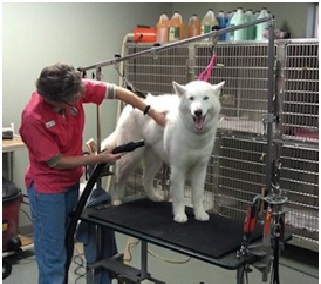
The lower-left image shows the groomer working around the bar instead of over the dog.
🪢
Strap vs. Bar Adjustment
I would rather adjust the harness, noose, or no-sit strap than angle the entire overhead bar.
💵
Current Market
Current overhead restraint systems range from budget arms to premium stainless adjustable systems.
🤔
Where It Might Fit
Some groomers may like highly adjustable overhead restraint points. I just do not want them in my face.
✅
Operator Verdict
Too much overhead adjustment for a problem I can usually solve at the strap.
🧰
What the Flexi-Restraint System Is
It is an adjustable overhead restraint system that gives the groomer several ways to position nooses, harnesses, and support straps.
The Flexi-Restraint System features an overhead grooming arm that allows for pivoting in the upper corners so the groomer can lock it on an angle.
It also lets the groomer adjust the position of the eyelets used to connect nooses, harnesses, and support straps.
Those eyelets can slide left or right along the top bar or move up and down on the side bar. In theory, that lets the groomer position the restraint points exactly where they need them to securely hold the animal.
I understand the theory.
If a dog needs a restraint point farther left, farther right, higher, lower, or angled from a different direction, this system gives the groomer more options than a fixed overhead arm.
My issue is what those options cost me in working space.
🎚️
Adjustable Does Not Automatically Mean Better
Adjustability is only useful when the adjustment makes the groom easier.
I do not dislike adjustability by itself.
Adjustable eyelets can be useful. Adjustable restraint points can be useful. The ability to move a noose, harness, or support strap to a better angle can help with some dogs.
The problem is that this system appears to solve restraint-position adjustment by moving the larger overhead structure into different positions.
That is where I start losing interest.
In grooming, the dog is not the only thing that needs space. The groomer needs body access. The groomer needs to lean, reach, rotate, brush, clip, scissor, dry, and sometimes get close to the dog to see what they are doing.
If the restraint adjustment gives the dog a slightly better angle but puts a metal bar where my face, shoulder, arm, or upper body needs to be, I do not consider that a clear improvement.
📌
Equipment filter
Adjustable hardware earns its keep when it makes the work smoother. It loses points when the adjustment becomes something else the groomer has to fight.
⬆️
The Vertical Space Problem
Overhead systems do not just occupy table space. They occupy the air where the groomer works.
The problem is that, as mentioned previously with overhead systems, this overcomplicates a simple task and takes up vertical space.
Vertical space matters more than people think.
The area above and around the dog is where the groomer’s hands, arms, shoulders, face, clippers, dryer hose, brush, comb, and line of sight all need to move.
An overhead bar can give you more restraint points, but it can also become the thing you are constantly leaning around.
That may not matter much during a quick restraint moment. It matters a lot during a full groom when the same bar keeps occupying the exact airspace the groomer wants to use.
I do not want to solve one dog-positioning problem and create a groomer-positioning problem.
⚠️
Working-space warning
A restraint system can hold the dog correctly and still be annoying if it blocks the groomer’s body access. The dog is not the only thing being positioned at the table.
🧍
The Lower-Left Image Problem: Leaning Around the Bar
The image shows the issue better than any sales description could.
The image demonstrating this best is the one where the groomer is unable to lean over the dog to work, but must lean out and around the overhead bar.
That is exactly what I do not want.
Grooming is already physical. The groomer is reaching, bending, looking, adjusting the dog, changing tool angle, controlling coat direction, and trying to keep the dog safe and still.
When the restraint system forces the groomer to lean out and around the bar, it changes the body mechanics of the groom.
That might sound small until you do it all day.
If a piece of equipment causes the groomer to work around it instead of letting the groomer work through the dog naturally, that equipment needs a very good reason to be there.
😑
The Bar-in-My-Face Problem
Angling the bar may help position the dog, but it can also put the hardware right where the groomer is trying to work.
I also do not like the idea of angling the bar because it will then be directly in my face as I am trying to groom the dog.
That is not a minor annoyance.
Groomers do not work from a distance like they are viewing the dog through binoculars. They get close. They look at coat direction. They check lines. They adjust blade angle. They lean in around the face, shoulders, back, ribs, legs, and belly.
If the overhead bar is angled into the groomer’s working lane, the system has moved from restraint equipment to personal space violation.
I do not want to angle the bar so it solves the dog’s position and creates a metal bar in my face.
🪢
Strap Length vs. Bar Angle
Most of the time, I would rather adjust the strap than reposition the overhead structure.
The other problem is that the ability to angle the bar is unnecessary because all of the grooming harnesses and no-sit straps that I have seen come with a quick adjust for length.
That is the practical point.
If the restraint is too short, lengthen it. If it is too long, shorten it. If the dog needs slightly different support, move the noose, belly strap, or harness adjustment.
Taking the time to lower the grooming bar and work around it instead of just lengthening the harness seems backwards to me.
To me, choosing to use this system that way is akin to hanging your laundry on a clothesline as opposed to just tossing it in the dryer. They both work, but I prefer the dryer.
The simplest effective adjustment usually wins.
Swipe left/right to see the full table.
| Adjustment Method | What It Changes | Main Cost | My Take |
|---|---|---|---|
| Lengthen or shorten the noose | Changes restraint length without moving the bar. | Minimal. | Usually the first thing I would do. |
| Adjust the harness | Changes body support without changing overhead structure. | Requires proper fit and correct use. | More practical than putting the bar in my way. |
| Move a belly strap | Shifts support forward or backward as needed. | Small handling adjustment. | Simple and flexible. |
| Slide eyelets on the overhead bar | Changes restraint location along the bar. | Useful, but still tied to overhead structure. | Fine when it helps without blocking the groomer. |
| Angle the overhead bar | Changes the whole restraint geometry. | Can put the bar in the groomer’s working space. | Usually not worth it to me. |
💵
Current 2026 Market Snapshot and Buying Reality
I am treating this as the adjustable overhead restraint category because the exact current Flexi-Restraint listing is not cleanly verified under that name.
Current overhead grooming restraint systems have a wide price spread.
Budget overhead-style grooming arms can show up around the $55 to $90 range depending on brand, seller, clamp quality, materials, and adjustment range.
Common adjustable overhead arm systems with two vertical arms, an overhead bar, multiple eye bolts, and clamp hardware can sit around the $120 to $200 range.
Premium stainless double-overhead adjustable systems can go much higher, with current examples over $500 when the system includes heavier clamps, stainless construction, independent side adjustment, multiple tether positions, and a more professional build.
That price spread matters, but the bigger question is still workflow.
The more adjustable the system becomes, the more important it is to ask whether that adjustability actually improves the groom or just gives the groomer more hardware to move around.
Swipe left/right to see the full table.
| Current 2026 Buying Category | Typical Market Reality | What You Usually Get | Operator Take |
|---|---|---|---|
| Budget overhead arm | About $55 to $90 in some current listings. | Basic overhead restraint frame with adjustable width or height. | Cheap enough to consider, but clamp strength and table fit matter. |
| Common adjustable overhead system | About $120 to $200. | Two vertical posts, overhead bar, eye bolts, and clamps. | Useful if you really need overhead restraint points. |
| Universal overhead arm with wider clamp range | Often near the $200 range. | Wider table compatibility, multiple eye bolts, stronger clamps, and height/width adjustment. | Better build may help, but it still occupies overhead space. |
| Premium stainless double overhead system | Can exceed $500. | Stainless construction, independent side adjustment, heavy clamps, and multiple tether locations. | Serious money. It needs to solve serious workflow or safety problems. |
| Flexi-style pivoting/angled overhead control | Exact current named listing not cleanly verified. | Category logic overlaps with adjustable overhead restraint systems. | I would judge it by space, speed, and whether the bar gets in my way. |
⚠️
Price warning
Do not pay for adjustability unless you actually need it. An adjustable system that puts the bar in your face is not an upgrade just because it has more positions.
🤔
When This System Might Actually Make Sense
Some groomers may value exact overhead positioning more than open body access.
Fair is fair. This kind of system might make sense for some groomers.
A groomer who loves overhead restraint systems and uses them every day may appreciate the ability to move eyelets left, right, up, down, and on an angle.
A groomer working with certain difficult dogs, large dogs, weak dogs, or unusual positioning needs may also find value in having restraint points exactly where they want them.
A shop where one experienced groomer controls one table and knows the system inside and out may get more value from it than a busy multi-groomer shop where everyone has to learn and work around the same setup.
That is the fair use case.
My hesitation remains the same: I do not want to give up body access and vertical working space unless the restraint problem is serious enough to justify it.
📌
Fair-use point
A highly adjustable overhead system may be useful when exact restraint geometry matters more than open table access. That is not how I want to handle most normal grooming work.
✅
My Operator Verdict on the Flexi-Restraint System
I understand the idea. I still would rather adjust the strap than angle the bar.
My verdict is that the Flexi-Restraint System is clever, but not something I would reach for first.
It gives the groomer a pivoting overhead bar and adjustable eyelets so restraint points can be positioned more precisely.
That may be useful for some dogs and some groomers.
My problem is that it overcomplicates a simple task and takes up vertical space.
The image showing the groomer leaning out and around the overhead bar demonstrates my concern perfectly. I do not want to work around the restraint system more than I work around the dog.
I also do not think angling the bar is usually necessary when most grooming harnesses and no-sit straps already have quick length adjustment.
To me, lowering or angling the bar instead of lengthening the harness is like hanging laundry on a clothesline instead of tossing it in the dryer. They both work, but I prefer the dryer.
And finally, I do not like the idea of angling the bar so it ends up directly in my face while I am trying to groom.
My vote: too much overhead adjustment for a problem I can usually solve at the strap.
⚠️
Final take
Adjustable overhead control may sound impressive, but I would rather keep the bar out of my working space and adjust the noose, harness, or belly strap instead.
❓
Flexi-Restraint System FAQ for Grooming Rooms
Straight answers about pivoting bars, adjustable eyelets, vertical space, strap adjustment, and whether this system earns its place.
What is the Flexi-Restraint System?
It is an overhead grooming restraint system with a pivoting bar and adjustable eyelets for positioning nooses, harnesses, and support straps.
What makes it different from a basic overhead arm?
The upper corners can pivot so the bar can be locked on an angle, and the eyelets can be moved left or right along the top bar or up and down on the side bar.
What do I like about the idea?
I understand the appeal of adjustable restraint points. In some cases, being able to position a noose or harness exactly where needed can help control the dog.
What is my main problem with it?
It takes up vertical working space and can force the groomer to lean around the overhead bar instead of working naturally over the dog.
Why do I dislike angling the bar?
Because the angled bar can end up directly in the groomer’s face or working lane while trying to clip, brush, scissor, or inspect the dog.
Why not just angle the bar instead of adjusting the strap?
Most grooming harnesses, no-sit straps, belly straps, and nooses already have quick length adjustment. I would usually rather adjust the strap than reposition the entire overhead bar.
What is the clothesline versus dryer comparison?
Lowering or angling the bar instead of lengthening the harness feels like hanging laundry on a clothesline instead of tossing it in the dryer. Both work, but I prefer the faster, simpler method.
What current price range should I expect for overhead restraint systems?
Budget overhead arms can show up around $55 to $90, common adjustable overhead systems often sit around $120 to $200, and premium stainless double-overhead systems can exceed $500.
Could this system still make sense for some groomers?
Yes. Groomers who regularly need exact overhead restraint angles, work with difficult positioning problems, or prefer overhead systems may like it. It is just not my first choice.
What is the main lesson?
Do not confuse adjustability with usefulness. Buy the system only if the adjustment improves the groom more than the overhead bar interferes with the groomer.
🐾
Bottom Line: I Would Rather Adjust the Strap
The Flexi-Restraint System gives you more overhead adjustment, but I do not want the bar in my working space.
The Flexi-Restraint System has clever adjustment features. The bar can pivot and lock on an angle, and the restraint eyelets can move along the top and side bars.
That gives the groomer more ways to position nooses, harnesses, and support straps.
My problem is that the system overcomplicates a simple task and takes up vertical space.
The image showing the groomer leaning around the overhead bar demonstrates the issue well. I do not want to give up natural body access to the dog unless the restraint benefit is strong enough to justify it.
Since most harnesses and no-sit straps already have quick adjustment for length, I would rather adjust the strap than lower, angle, and work around the overhead bar.
Both approaches may work. Like the clothesline and the dryer, they both dry clothes. I prefer the dryer.
My vote: too much overhead adjustment for a problem I can usually solve at the strap.