Grooming Table Hardware • No-Sit Devices • Belly Straps • Positioning Systems • Grooming Restraint • Handling Equipment Hub
No-Sit Grooming Devices: Why I Usually Skip the Extra Hardware and Use a Belly Strap Instead
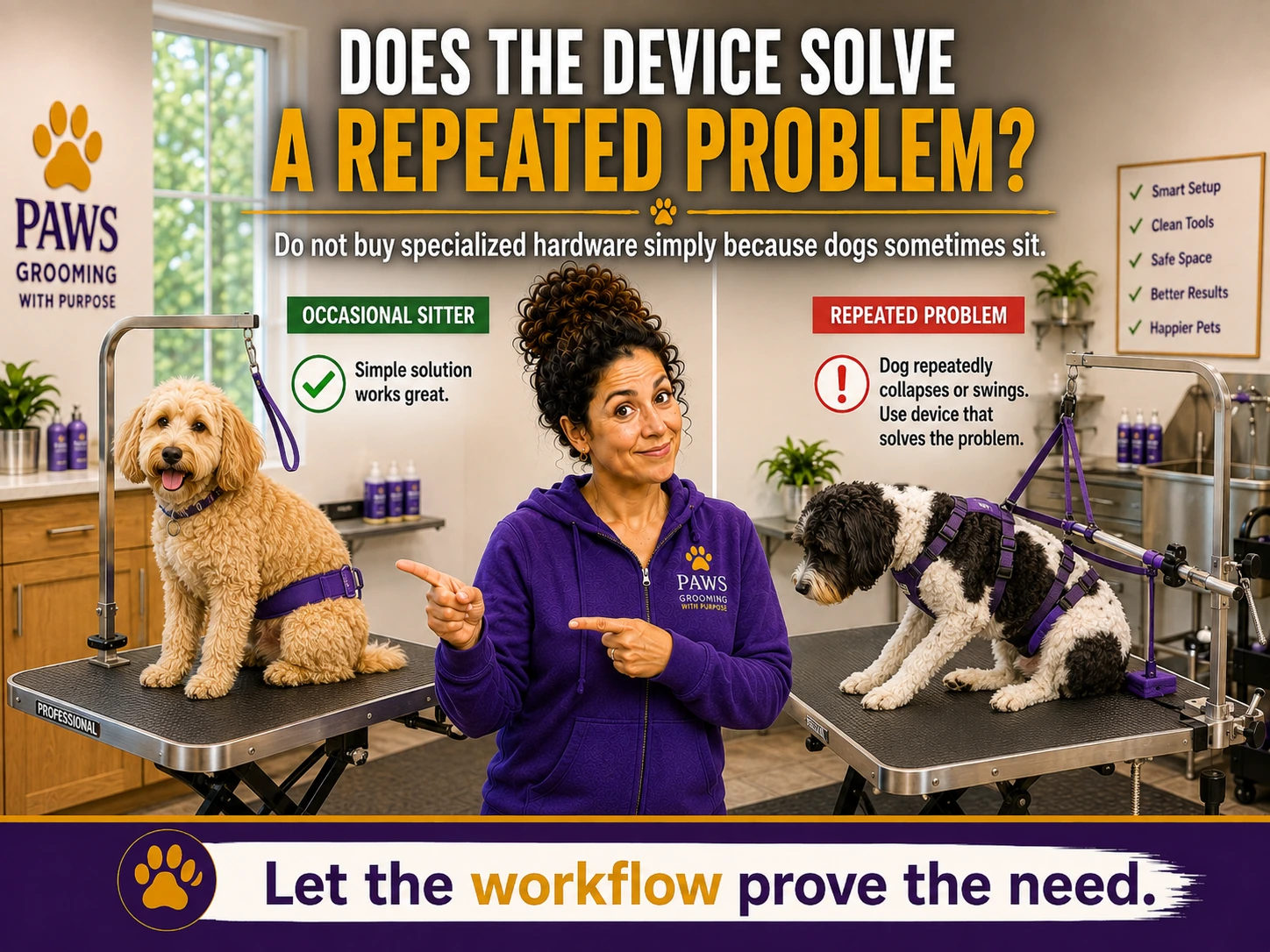
My experience with these has been limited to understanding that they are unnecessary.
In saying “they,” I mean items or accessories that clamp on or otherwise attach to the table in addition to the standard grooming arm in an attempt to prevent the dog from sitting.
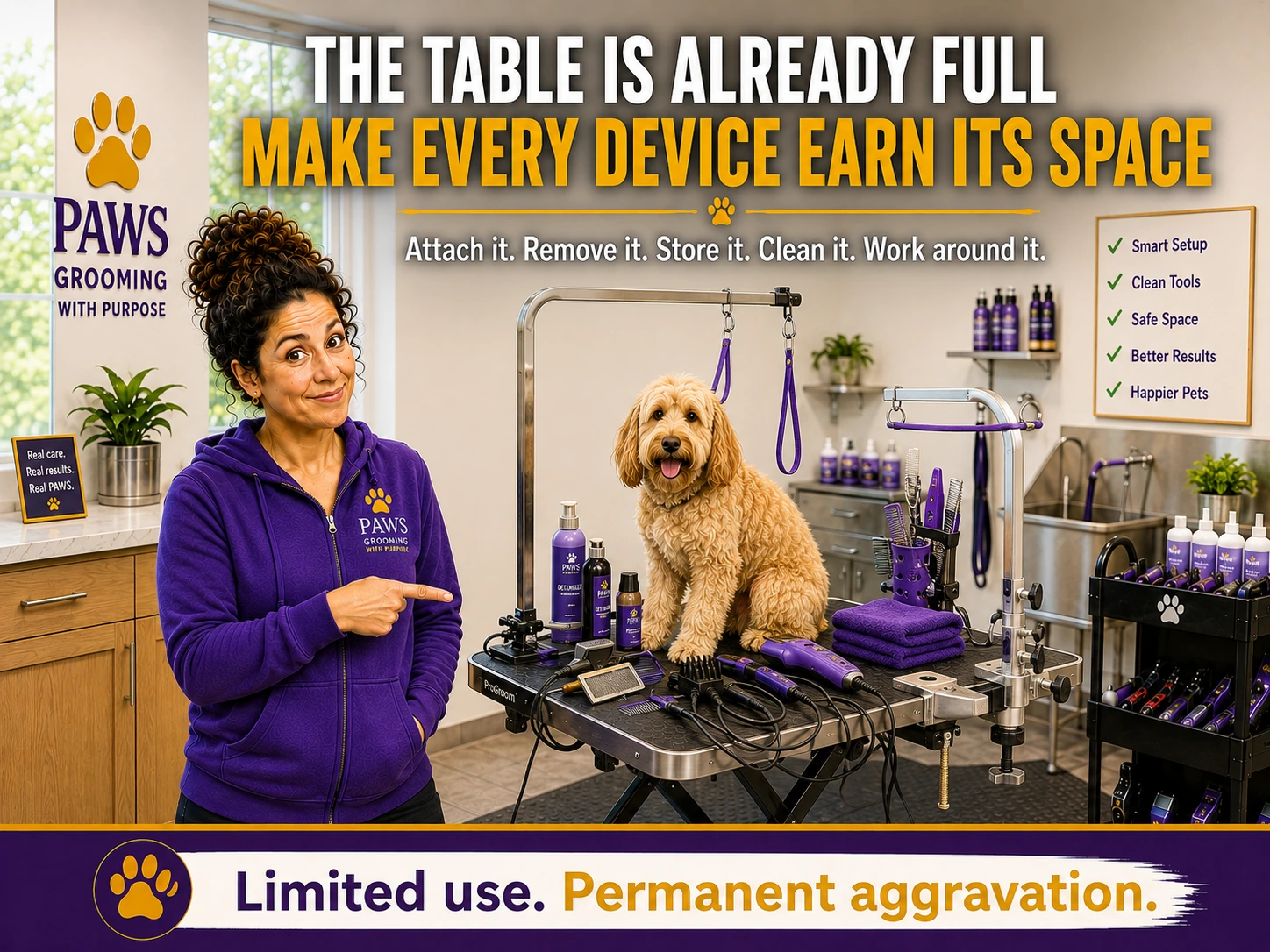
The first and most obvious problem that I have with items such as these is that they are but one more thing on an already space-deprived grooming table.
Grooming tables are already crowded with the dog, the arm, the loop, the groomer, tools, cords, clippers, brushes, towels, and whatever else has decided to migrate onto the table during the day. Adding another device that only solves a problem some dogs have some of the time is not automatically a win.
This is the no-sit equipment branch. Some of these devices may have a use case. Some are interesting. Some are more complicated than I think they need to be. My general approach is still simple: if a dog wants to sit, I usually solve that with a belly strap before I start adding another metal contraption to the table.
⚠️
Operator rule
Do not buy a no-sit device just because the dog sat down. First ask whether a simple belly strap, proper loop length, better table positioning, or better handling solves the problem without adding more hardware to an already crowded table.
🗺️
Use This Page Like the No-Sit Equipment Gateway
This page explains my basic opinion on no-sit hardware and then points into the individual device reviews.
🪑
No-Sit Overview
My general take on no-sit devices, table clutter, limited use, and why simple usually wins.
🪢
Belly Strap Method
The simple approach I normally use when a dog wants to sit during grooming.
🧰
Device Directory
Jump to no-sit posts, positioning systems, harnesses, and handling-assist equipment pages.
✅
Buying Filter
Questions to ask before buying another table accessory that may live in a drawer.
🪑
My General Opinion on No-Sit Devices
Most of the time, I think they are more hardware than the problem requires.
My experience with these has been limited to understanding that they are unnecessary.
In saying “they,” I mean items or accessories that clamp on or otherwise attach to the table in addition to the standard grooming arm in an attempt to prevent the dog from sitting.
The first and most obvious problem that I have with items such as these is that they are but one more thing on an already space-deprived grooming table.
This is an item that must be either attached or detached when not in use and placed or stored somewhere out of the way when not in use.
Its use is so limited, because not every dog or every other dog or even every other other dog will need it, that its cost and inconvenience outweighs, to me, any benefit that it may have.
That is the practical issue. A tool that only helps once in a while but has to be stored, attached, removed, cleaned, explained, worked around, and not lost becomes less attractive in a real grooming room.
If a no-sit device solves a specific problem for a specific groomer, fine. But as a general purchase, I do not want another clamp, bar, strap, rod, post, or mystery bracket on the table unless it earns its space.
A no-sit device should be evaluated as part of the entire table station. The operator has to account for where it clamps, how it affects the grooming arm, whether it blocks the groomer’s working position, whether cords or loops can catch on it, and where the device goes when the next dog does not need it.
The strongest justification is repetition. If the same positioning problem appears across enough dogs or enough appointments that it regularly slows work or weakens control, specialized equipment may earn a place. If the problem appears occasionally and a strap solves it in seconds, the extra hardware may create more operating burden than value.
⚠️
Table clutter warning
Grooming tables are not unlimited real estate. Every extra device needs a reason to exist, a place to attach, a place to store, and a benefit strong enough to justify the aggravation.
🪢
The Simple Belly Strap Method
For most dogs that like to sit, this is the answer I reach for first.
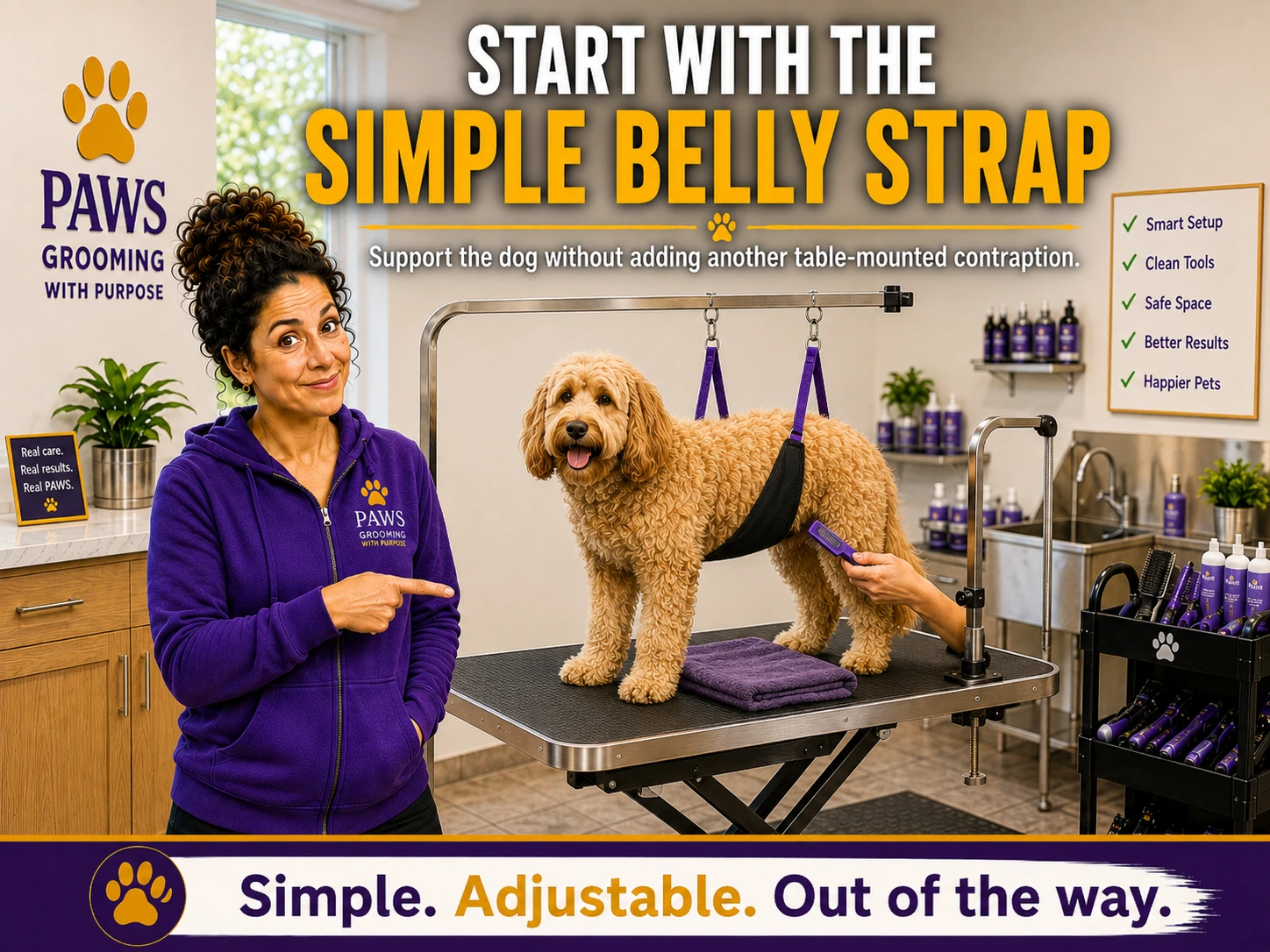
Typically, for dogs that like to sit, I will just attach an additional belly strap, or groomer’s noose, from the top of the grooming arm.
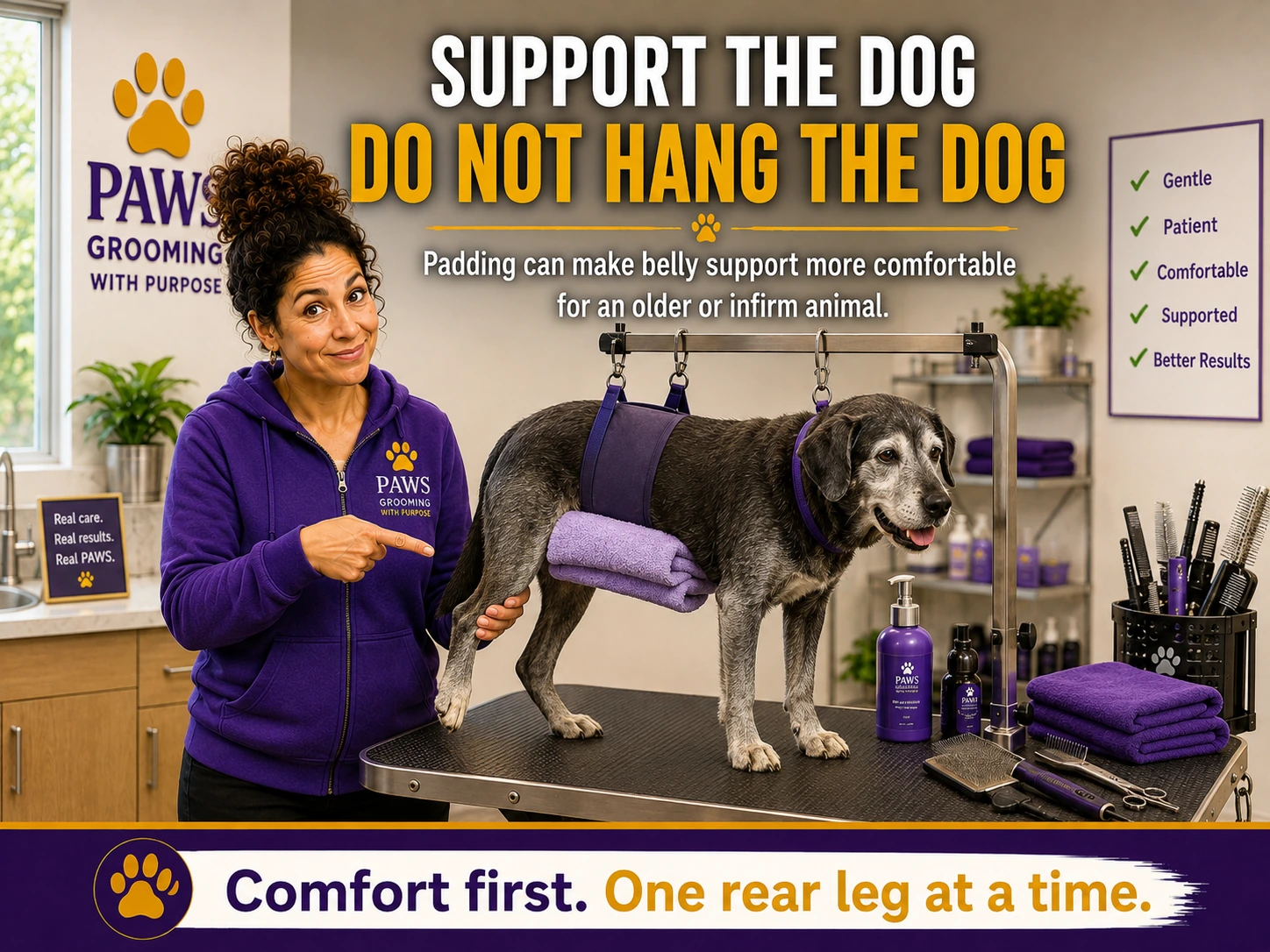
If it is an aged or otherwise infirm animal, I will fold a hand towel and place it under its belly first and then place the belly strap over that for the comfort of the dog.
That keeps the solution simple. It does not require another table-mounted contraption. It does not require another clamp. It does not require another specialty device that has to be removed and stored when not needed.
It also gives the groomer some flexibility. The belly strap supports the dog enough to discourage sitting while still letting the groomer work around the dog without turning the table into a hardware display.
Additionally, the only time sitting is a real issue is when you are working on the undercarriage of the dog.
In order to keep it simple, if you use a simple belly strap, you can just lift one rear leg, do your work, and then lift the other.
That is not complicated. That is the point.
The belly strap should provide light support and discourage the dog from dropping into a full sit. It should not bear the dog’s entire weight, compress the abdomen, or become a substitute for watching the dog’s breathing, balance, comfort, and willingness to remain standing.
Placement and adjustment matter. The strap should be wide enough and positioned so it supports the body without digging into sensitive tissue. Staff should recheck it whenever the dog shifts, the table height changes, or one rear leg is lifted for undercarriage work.
📌
Comfort detail
For an older, sore, weak, or otherwise infirm dog, padding under the belly strap with a folded hand towel can make the support more comfortable. The goal is support and positioning, not hanging the dog like laundry.
🤔
When No-Sit Hardware Might Actually Make Sense
I am not saying every device is useless. I am saying the purchase needs to survive real-world questions.
There may be groomers, dogs, tables, restraint styles, or shop setups where a specific no-sit device makes sense.
A groomer who repeatedly works on dogs that collapse, sit, rotate, swing their rear end away, or refuse to stay positioned may find value in a more formal device.
A shop that does a high volume of certain coat types, certain body trims, or certain undercarriage work may also find a device useful if it genuinely speeds the work and improves control.
But that is different from buying one because sitting dogs exist.
Dogs sit. Dogs lean. Dogs slump. Dogs decide their legs have resigned from employment at the worst possible moment. That does not automatically mean the answer is another accessory.
The question is whether the device solves the problem better than a belly strap, better loop placement, better grooming arm setup, better table height, or better handling.
A device earns serious consideration when it solves a clearly defined positioning failure more consistently than the simpler alternatives. The operator should be able to explain which dogs need it, which task improves, how much handling effort it removes, and how staff will know when not to use it.
The purchase also has to survive compatibility and safety questions. It must fit the existing table and arm, stay stable under normal dog movement, avoid pinch and catch points, allow quick release, clean easily, and leave enough working space for the groomer to move around the dog.
Swipe left/right to see the full table.
| Situation | Simple Belly Strap | Separate No-Sit Device | Operator Take |
|---|---|---|---|
| Dog sits occasionally | Usually enough. | Probably overkill. | Do not buy hardware for a once-in-a-while problem. |
| Dog constantly collapses or sits | May help, especially with padding. | Could be worth reviewing. | The device must improve control enough to justify table clutter. |
| Older or infirm dog | Towel-padded belly support is often kinder and simpler. | Needs careful judgment. | Comfort and safety matter more than forcing posture. |
| Undercarriage work | Lift one rear leg, work, then lift the other. | May be unnecessary. | This is the main time sitting is a real issue. |
| High-volume specialty grooming | May still be enough. | Could make sense if it saves real time. | Let workflow prove the need before buying the device. |
🧰
No-Sit and Positioning Equipment Directory
Use these cards to jump into the individual device pages.
🦴
No-Sit Grooming Post
A specific no-sit approach for keeping the dog in a workable position.
🐾
The Pet Sitter
Existing positioning-device page in the no-sit and handling equipment branch.
❓
Unknown Dog No-Sit Device
A page for evaluating no-sit-style tools when the device or use case needs closer inspection.
🔗
Linked Interval Positioning System
A positioning system page for understanding how linked restraints affect dog control and handling.
🦺
Flexi Restraint System
Existing page for reviewing a restraint system used to help position and control dogs during grooming.
🐕
Grooming Harness
Harnesses can support safer positioning when used correctly and matched to the dog and table setup.
🛠️
Groomers Helper
Handling-assist system page for controlling dog movement and improving table safety during grooming.
🪢
Grooming Nooses
Grooming nooses are the basic restraint pieces behind most table setups, belly straps, harnesses, head control, no-sit support, and safer dog positioning.
✅
No-Sit Device Buying Filter
Before buying another positioning device, make it pass these questions.
- Does this device solve a problem that happens often enough to justify owning it?
- Does a simple belly strap from the top of the grooming arm solve the same problem?
- Can the device be attached quickly without interrupting the groom?
- Can the device be removed quickly when it is in the way?
- Where will it be stored when not in use?
- Will it fit the grooming table, arm, clamp, loop, and restraint system you already use?
- Does it create one more catch point for cords, loops, tools, knees, elbows, or dog feet?
- Does it improve dog comfort, or does it just force the dog into position?
- Is it appropriate for older, sore, weak, nervous, or infirm dogs?
- Does it help with undercarriage work better than lifting one rear leg, doing the work, and then lifting the other?
- Will staff actually use it, or will it live in a drawer after the first week?
- Are you buying it because it solves a real grooming problem, or because it looks like a solution in a product photo?
✅
My Operator Verdict on No-Sit Devices
Most of the time, I think they are unnecessary.
My general opinion on no-sit devices is that most of them are unnecessary for the way I would solve the problem.
They are usually extra items that clamp on or attach to the grooming table in addition to the standard grooming arm. That means more hardware on a table that already does not have much extra space.
They must be attached when needed, removed when not needed, stored somewhere, cleaned, kept track of, and worked around. For a tool that not every dog, every other dog, or even every other other dog needs, that is a lot of inconvenience for a limited use case.
For dogs that like to sit, I typically use an additional belly strap from the top of the grooming arm. If the dog is aged or infirm, I pad the belly area with a folded hand towel first and place the strap over that for comfort.
The only time sitting is a real issue is usually when working on the undercarriage. With a simple belly strap, I can lift one rear leg, do the work, and then lift the other.
That keeps the setup simple, keeps the table cleaner, and avoids buying another gadget that may spend most of its life being moved from one storage spot to another.
Comfort is the limit on every support method. An older, weak, painful, neurologically impaired, or exhausted dog may need help remaining upright, but the goal is to share the load and stabilize posture—not force the animal to stand beyond what it can safely tolerate.
If padding, a wider support surface, a shorter work interval, a lower table, or an additional staff member is needed, the operator should make that adjustment. If the dog cannot remain comfortably positioned even with support, the answer may be to modify, divide, or stop the service rather than add more restraint.
⚠️
Final take
No-sit devices may have a niche, but my first answer is still the simple belly strap. If a device cannot beat that for speed, comfort, storage, table space, and real usefulness, I do not want it cluttering the grooming room.
❓
No-Sit Grooming Device FAQ
Detailed operator answers about belly straps, table-mounted hardware, older dogs, undercarriage work, compatibility, comfort, and safe positioning.
What is a no-sit grooming device?
A no-sit device is a support or positioning accessory intended to keep a dog from repeatedly sitting, collapsing, or moving its rear away during table work. Some devices attach directly to the table, while simpler methods use an additional loop or belly strap from the grooming arm. The equipment should support a specific task without creating new control or comfort problems.
Do most grooming rooms need specialized no-sit hardware?
Not necessarily. Many occasional sitting problems can be managed with correct table height, loop adjustment, better positioning, and a simple belly strap. Specialized hardware becomes more reasonable when the same problem repeatedly disrupts work, the simple methods do not provide enough support, and the device produces a clear improvement in control or workflow.
Why is table space part of the buying decision?
A grooming table already has limited room for the dog, restraint equipment, tools, cords, and the groomer’s working position. An additional clamp, post, bar, or bracket can block access, create catch points, complicate cleaning, or interfere with another restraint. Every device should provide enough value to justify the space and attention it consumes.
When should I try a simple belly strap first?
A belly strap is a practical first option when a dog occasionally sits or needs light support during undercarriage work. It is quick to install, adjustable, easy to remove, and does not require another permanent table attachment. Staff should still assess the dog’s comfort, balance, breathing, and physical condition before and during use.
How should a belly strap be positioned?
It should support the body without carrying the dog’s full weight or pressing into sensitive tissue. The strap should be wide enough for the dog, adjusted to discourage sitting rather than suspend the animal, and rechecked whenever the dog shifts or a leg is lifted. Exact placement depends on body shape, medical condition, and the work being performed.
Should padding be used under a belly strap?
Padding can improve comfort for an older, thin, sore, weak, or otherwise infirm dog. A folded hand towel or appropriate soft pad can spread pressure and reduce rubbing. Padding does not make excessive suspension safe; staff still need to ensure the dog remains supported by its feet and is not hanging from the restraint.
What does “support the dog, do not hang the dog” mean?
The device should stabilize posture and share a small amount of load while the dog continues to stand. It should not lift the animal off its feet, compress the abdomen, or force an exhausted or painful dog to remain upright beyond its ability. If the dog cannot stand comfortably with reasonable support, the service plan should be modified or stopped.
When might specialized no-sit hardware make sense?
It may make sense when dogs repeatedly collapse, rotate, swing the rear away, or sit so often that the problem regularly weakens control or slows a specific task. The operator should be able to identify the repeated use case, demonstrate that simpler methods are inadequate, and confirm that the device improves handling without causing new interference.
How do I know whether a device solves a repeated problem?
Track how often the problem occurs, which dogs are involved, which grooming tasks are affected, and what staff currently do to manage it. A device has a stronger business case when it consistently reduces handling effort or appointment delay across multiple uses. A single difficult dog or rare event is usually not enough evidence by itself.
What compatibility checks should be made before buying?
Verify that the device fits the table, grooming arm, clamp location, restraint system, dog sizes, and employee work positions. Check attachment strength, adjustability, release method, pinch points, cleaning access, storage dimensions, and whether the device interferes with cords, tools, dog feet, or the groomer’s legs.
Can no-sit equipment replace good handling?
No. Equipment can assist positioning, but staff still need to read behavior, adjust pressure, monitor comfort, maintain balance, and know when the dog cannot be safely groomed. A device that creates false confidence can be more dangerous than having no device because employees may continue after control has already been lost.
Does a no-sit device prevent bites?
It may reduce certain sudden movements and improve positioning, but it does not eliminate bite risk. A dog can still turn, redirect, panic, or react to pain. Bite prevention depends on behavior assessment, correct restraint, staff skill, task selection, and the decision to stop before the situation becomes unsafe.
How should undercarriage work be handled with a belly strap?
Use the strap to provide light support, then lift one rear leg, complete the accessible work, and switch sides. The groomer should avoid overextending the leg or forcing the dog to balance on an unstable posture. The table height and strap adjustment should allow the worker to reach the area without twisting or pulling the dog.
What should I consider for senior or infirm dogs?
Consider pain, weakness, arthritis, neurologic limitations, breathing, skin condition, stamina, and the dog’s ability to bear weight. Use padding and shorter work periods when appropriate, lower the table if that improves safety, and avoid forcing posture. Some dogs need the service divided, modified, assisted by another employee, or discontinued.
How should no-sit devices be cleaned and stored?
The device should be cleaned according to its material and manufacturer guidance after use, especially where straps, padding, clamps, or contact surfaces collect hair and product. Storage should keep it dry, identifiable, and immediately available without occupying the active table. If storage and cleaning are consistently skipped, the equipment is not fitting the operation.
What are signs that a device is making the workflow worse?
Staff avoid using it, spend too long attaching it, remove it repeatedly because it blocks access, catch loops or cords on it, lose table space, or store it wherever it will fit. The device may also make the dog more distressed or force the groomer into a worse posture. Those patterns indicate that the hardware is not earning its place.
Should every groomer use the same no-sit setup?
The business should have safety standards and approved equipment, but the setup may vary with dog size, task, physical condition, table type, and the employee’s working position. Variation should be intentional and trained—not a collection of improvised methods that nobody has evaluated.
What inspection should be done before each use?
Check straps, stitching, padding, clamps, fasteners, adjustment points, quick releases, corrosion, cracks, sharp edges, and the connection to the table or arm. Confirm that the support cannot slide unexpectedly and that staff can release the dog quickly. Damaged or questionable equipment should be removed from service.
How should I decide whether the purchase is worth it?
Compare frequency of use, improvement in control, time saved, dog comfort, staff acceptance, cleaning, storage, compatibility, and the risk created by another table attachment. A device is worthwhile when it solves a recurring problem better than the simple method and remains practical enough that staff will actually use it correctly.
What is the main operator rule for no-sit equipment?
Start with the simplest safe method and add hardware only when the problem proves that more support is necessary. The device should help position the dog, preserve comfort, reduce handling effort, and fit the table workflow. If it creates more clutter, force, storage, or risk than it removes, it has not earned its place.
🐾
Bottom Line: Start Simple Before Adding More Hardware
The dog sitting down does not automatically justify another device on the table.
No-sit devices are meant to prevent dogs from sitting, but I generally find them unnecessary.
They add extra hardware to an already space-deprived grooming table, have to be attached and detached, need storage when not in use, and are only useful for a limited number of dogs.
For dogs that like to sit, I usually use an additional belly strap from the top of the grooming arm. For an older or infirm dog, I pad under the belly first with a folded hand towel for comfort.
Since sitting is usually only a real issue during undercarriage work, the simple approach is often enough: belly strap, lift one rear leg, do the work, then lift the other.
Review the individual device pages if you want to compare specific systems, but my starting point stays the same: do not add equipment unless it solves more problems than it creates.